
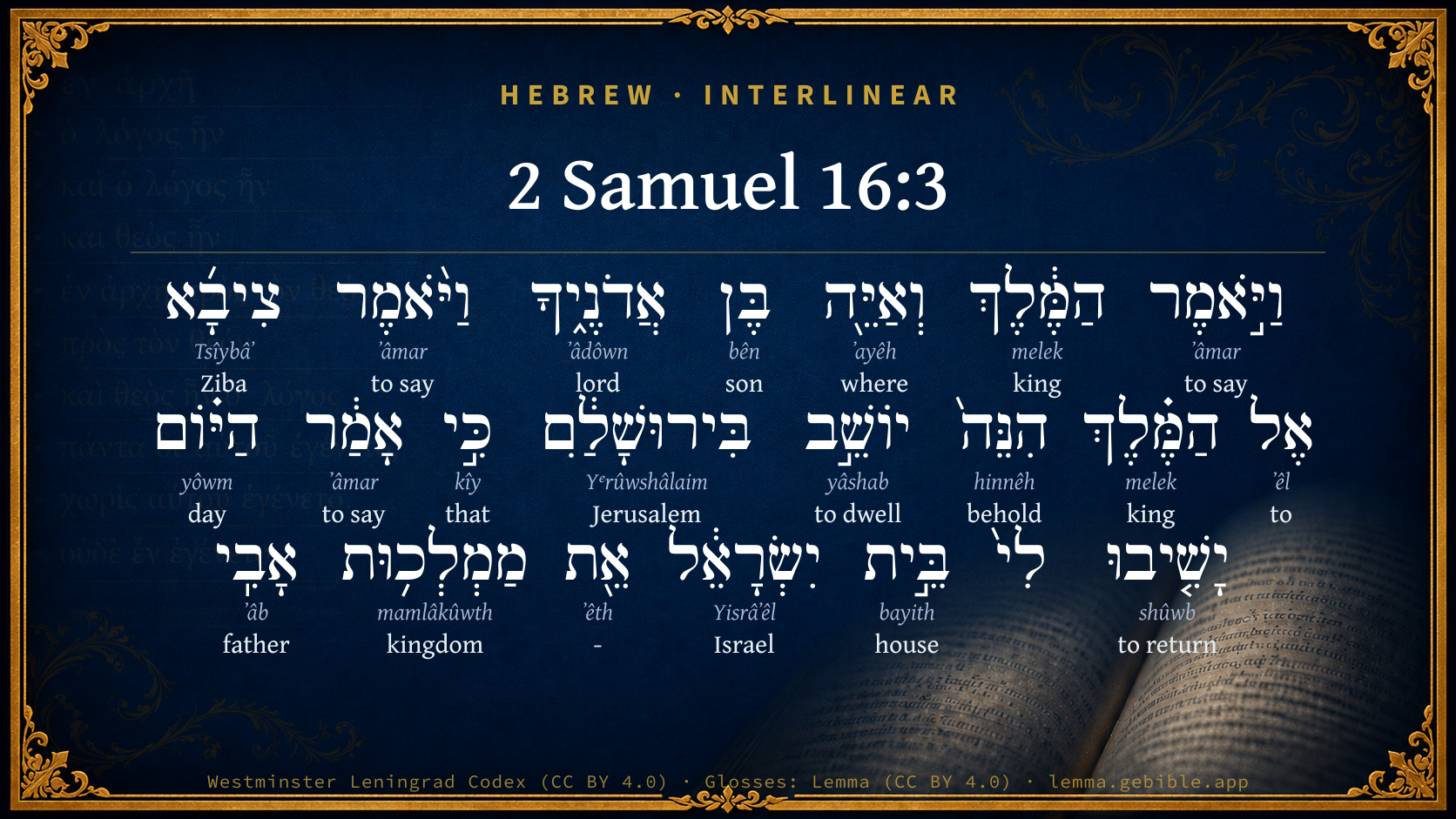
2 Samuel 16:3

Hebrew (Westminster Leningrad Codex) 2 Samuel 16:3 appears in the Hebrew Old Testament. The text above is from the Westminster Leningrad Codex. Each word links to its Strong’s number, a concise gloss, and parsing drawn from the Open Scriptures Hebrew Bible morphology. Click any word for its full Brown-Driver-Briggs (BDB) entry.
Download image
Cite this verse

2 Samuel 16:3 (World English Bible). Public Domain. Lemma interlinear Bible study tool, https://lemma.gebible.app/v/2-samuel/16/3.

Show BibTeX & RIS
BibTeX
RIS
English Translation
The king said, Where is your master's son? Ziba said to the king, Behold, he abides at Jerusalem; for he said, Today will the house of Israel restore me the kingdom of my father.
World English Bible · Public Domain
Download a study sheet

One document with this verse’s original text, its word-by-word gloss line, the meaning frame, cross-references with their text, attributed commentary, and full source and license credits — printable, and it pastes into notes with its structure intact.

This verse Autodidact and up

Study sheet (.html) Plain text (.txt)

A passage Seminary Student

Up to 50 verses in one chapter. A passage sheet keeps up to 6 commentary sources and 12 cross-references per verse, in the order this page ranks them, and says so on the sheet whenever that leaves anything out. Ask for a single verse and you get the Autodidact verse sheet above.

Everything on this page stays free to read, with no account — the sheet is a download of what is already on screen, not access to it.

Want to remove ads? Support Godless Engineer
Compare translations 3

The same verse in 3 English versions, stacked beneath the original-language interlinear above. Click any original word for its lexicon entry.

Each is an independent rendering of the whole verse — the interlinear is not word-aligned to these translations.

Highlighted words mark where these versions differ — a whole-verse word diff, not a word-by-word alignment.

  • World English Bible Public Domain
    The king said, Where is your master's son? Ziba said to the king, Behold, he abides at Jerusalem; for he said, Today will the house of Israel restore me the kingdom of my father.
  • King James Version Public Domain
    And the king said, And where is thy master's son? And Ziba said unto the king, Behold, he abideth at Jerusalem: for he said, To day shall the house of Israel restore me the kingdom of my father.
  • unfoldingWord Literal Text CC BY-SA 4.0
    And the king said, “And where the son of your master?” And Ziba said to the king, “Behold, he is staying in Jerusalem, for he said, ‘Today, the house of Israel will return the kingdom of my father to me.’”

unfoldingWord Literal Text — © unfoldingWord, licensed CC BY-SA 4.0. Word-aligned USFM3 via Door43 (git.door43.org/unfoldingWord/en_ult).

Versions to compare (up to 4)

3 of 4 selected

Show all 18 translations

Every available English version of this verse, each an independent rendering of the whole verse.

  • World English Bible Public Domain
    The king said, Where is your master's son? Ziba said to the king, Behold, he abides at Jerusalem; for he said, Today will the house of Israel restore me the kingdom of my father.
  • Berean Standard Bible Public Domain
    “Where is your master’s grandson?” asked the king. And Ziba answered, “Indeed, he is staying in Jerusalem, for he has said, ‘Today, the house of Israel will restore to me the kingdom of my grandfather.’”
  • Majority Standard Bible Public Domain
    “Where is your master’s grandson?” asked the king. And Ziba answered, “Indeed, he is staying in Jerusalem, for he has said, ‘Today, the house of Israel will restore to me the kingdom of my grandfather.’”
  • King James Version Public Domain
    And the king said, And where is thy master's son? And Ziba said unto the king, Behold, he abideth at Jerusalem: for he said, To day shall the house of Israel restore me the kingdom of my father.
  • American Standard Version (1901) Public Domain
    And the king said, And where is thy master's son? And Ziba said unto the king, Behold, he abideth at Jerusalem; for he said, To-day will the house of Israel restore me the kingdom of my father.
  • Revised Version (1885) Public Domain
    And the king said, And where is thy master’s son? And Ziba said unto the king, Behold, he abideth at Jerusalem: for he said, Today shall the house of Israel restore me the kingdom of my father.
  • Geneva Bible (1599) Public Domain
    And the king sayde, But where is thy masters sonne? Then Ziba answered the King, Beholde, he remayneth in Ierusalem: for he sayde, This day shall the house of Israel restore me the kingdome of my father.
  • Douay-Rheims (1899) Public Domain
    And the king said: Where is thy master's son? And Siba answered the king: He remained in Jerusalem, saying: To day will the house of Israel restore me the kingdom of my father.
  • Young's Literal Translation Public Domain
    And the king saith, `And where `is' the son of thy lord?' and Ziba saith unto the king, `Lo, he is abiding in Jerusalem, for he said, To-day do the house of Israel give back to me the kingdom of my father.'
  • Literal Standard Version CC BY-SA 4.0
    And the king says, “And where [is] the son of your lord?” And Ziba says to the king, “Behold, he is abiding in Jerusalem, for he said, Today the house of Israel gives back the kingdom of my father to me.”
  • Unlocked Literal Bible CC BY-SA 4.0
    The king said, “Then where is your master's grandson?” Ziba replied to the king, “Look, he has stayed behind in Jerusalem, for he said, 'Today the house of Israel will restore my father's kingdom to me.'”
  • unfoldingWord Literal Text CC BY-SA 4.0
    And the king said, “And where the son of your master?” And Ziba said to the king, “Behold, he is staying in Jerusalem, for he said, ‘Today, the house of Israel will return the kingdom of my father to me.’”
  • Darby Bible Public Domain
    And the king said, And where is thy master's son? And Ziba said to the king, Behold, he abides at Jerusalem; for he said, To-day shall the house of Israel restore me the kingdom of my father.
  • World Messianic Bible Public Domain
    The king said, “Where is your master’s son?” Ziba said to the king, “Behold, he is staying in Jerusalem; for he said, ‘Today the house of Israel will restore me the kingdom of my father.’”
  • Webster's Bible Public Domain
    And the king said, And where is thy master's son? And Ziba said to the king, Behold, he abideth at Jerusalem: for he said, To-day shall the house of Israel restore to me the kingdom of my father.
  • Free Bible Version CC BY-SA 4.0
    “Where is your master's grandson?” the king asked. Ziba answered, “He decided to stay in Jerusalem. He's saying, ‘Today the people of Israel will give me back my grandfather's kingdom.’”
  • Bible in Basic English Public Domain
    And the king said, And where is your master's son? And Ziba said, He is still at Jerusalem: for he said, Today Israel will give back to me the kingdom of my father.
  • JPS Tanakh (1917) Public Domain
    And the king said: 'And where is thy master's son?' And Ziba said unto the king: 'Behold, he abideth at Jerusalem; for he said: To-day will the house of Israel restore me the kingdom of my father.'

Literal Standard Version (2020), Covenant Press — licensed CC BY-SA 4.0. Text via the HelloAO Bible API (eBible.org). Unlocked Literal Bible (unfoldingWord) — licensed CC BY-SA 4.0. Text via the HelloAO Bible API (eBible.org). unfoldingWord Literal Text — © unfoldingWord, licensed CC BY-SA 4.0. Word-aligned USFM3 via Door43 (git.door43.org/unfoldingWord/en_ult). Free Bible Version, Dr. Jonathan Gallagher — licensed CC BY-SA 4.0. Text via the HelloAO Bible API (eBible.org).

Word by word

More ways to search: Search by grammar → Find every occurrence → Compare this word →

Practice this passage: Drill this verse → Learn its vocabulary →

מַמְלְכ֥וּת
mamlâkûwth
H4468
“kingdom of”
Noun, Common, Feminine, Singular, Construct
Part of Speech
Noun
Type
Common
Gender
Feminine
Number
Singular
State
Construct
Full BDB Definition

Origin: a form of H4467 and equiv. to it

TWOT: 1199g

kingdom, dominion, reign, sovereignty - kingdom - dominion, royal power - reign
  1. וַיֹּ֣אמֶר ʼâmar H559 “and · to say” Conjunction + Verb, Qal, Sequential Imperfect, 3rd Person, Masculine, Singular
  2. הַמֶּ֔לֶךְ melek H4428 “the · king” Particle, Definite Article + Noun, Common, Masculine, Singular, Absolute
  3. וְאַיֵּ֖ה ʼayêh H346 “and · where” Conjunction + Particle, Interrogative
  4. בֶּן bên H1121 “son of” Noun, Common, Masculine, Singular, Construct
  5. אֲדֹנֶ֑יךָ ʼâdôwn H113 “lords · your” Noun, Common, Masculine, Plural, Construct + Suffix, Personal, 2nd Person, Masculine, Singular
  6. וַיֹּ֨אמֶר ʼâmar H559 “and · to say” Conjunction + Verb, Qal, Sequential Imperfect, 3rd Person, Masculine, Singular
  7. צִיבָ֜א Tsîybâʼ H6717 “Ziba” Noun, Proper
  8. אֶל ʼêl H413 “to” Preposition
  9. הַמֶּ֗לֶךְ melek H4428 “the · king” Particle, Definite Article + Noun, Common, Masculine, Singular, Absolute
  10. הִנֵּה֙ hinnêh H2009 “behold” Particle, Demonstrative
  11. יוֹשֵׁ֣ב yâshab H3427 “dwelling” Verb, Qal, Participle Active, Masculine, Singular, Absolute
  12. בִּירוּשָׁלִַ֔ם Yᵉrûwshâlaim H3389 “in/at · Jerusalem” Preposition + Noun, Proper
  13. כִּ֣י kîy H3588 “that” Conjunction
  14. אָמַ֔ר ʼâmar H559 “to say” Verb, Qal, Perfect, 3rd Person, Masculine, Singular
  15. הַיּ֗וֹם yôwm H3117 “the · day” Particle, Definite Article + Noun, Common, Masculine, Singular, Absolute
  16. יָשִׁ֤יבוּ shûwb H7725 “to return” Verb, Hiphil, Imperfect, 3rd Person, Masculine, Plural
  17. בֵּ֣ית bayith H1004 “house of” Noun, Common, Masculine, Singular, Construct
  18. יִשְׂרָאֵ֔ל Yisrâʼêl H3478 “Israel” Noun, Proper
  19. אֵ֖ת ʼêth H853 “-” Particle, Direct Object
  20. אָבִֽי ʼâb H1 “father · my” Noun, Common, Masculine, Singular, Construct + Suffix, Personal, 1st Person, Common, Singular

About this verse

These counts appear in no published source. They are computed here, from the morphology-tagged text and Lemma’s own curated glosses. What Lemma adds →

22
words
18
distinct lemmas
Historical
section

Notable vocabulary

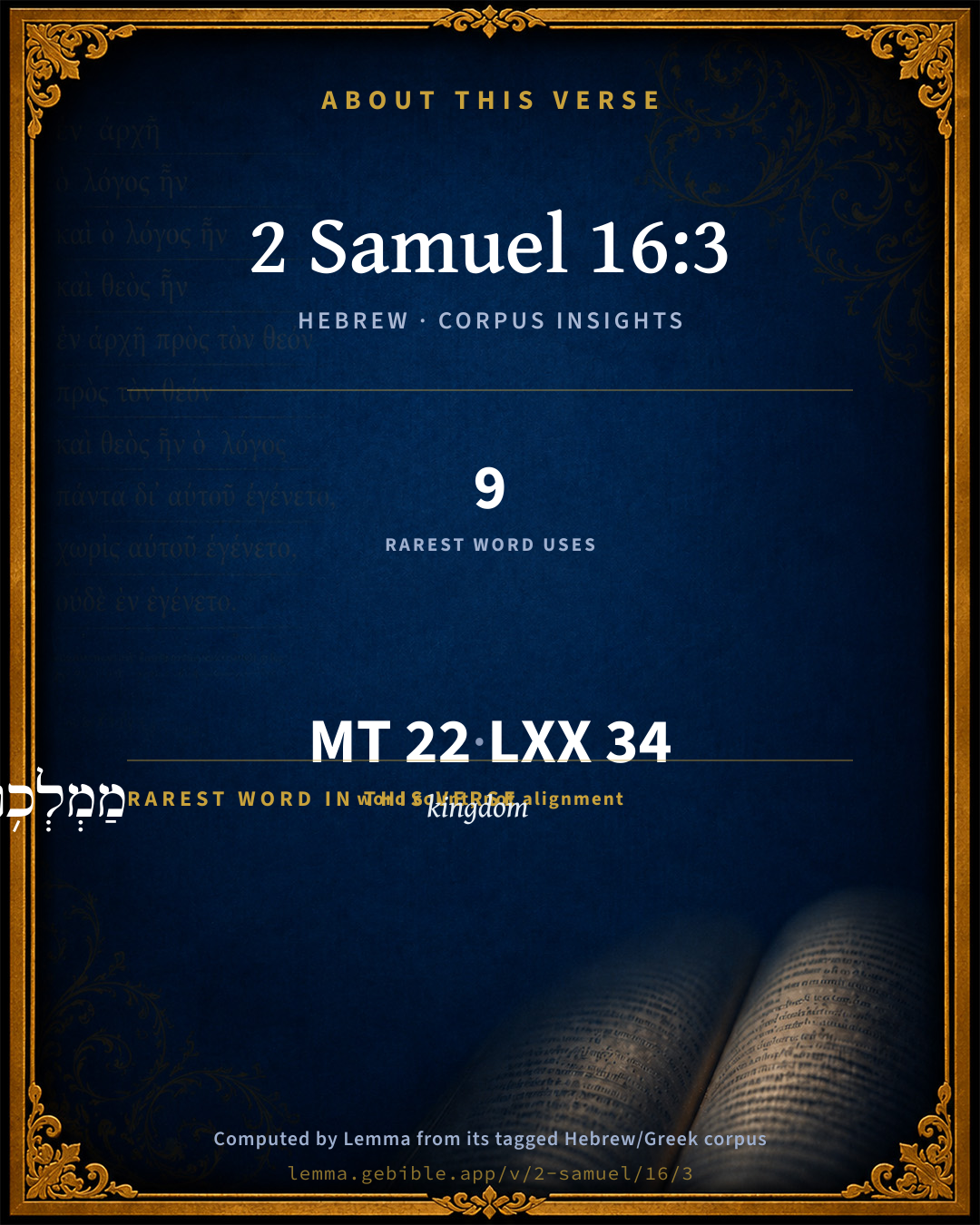
The rarest word here is מַמְלְכ֥וּת kingdom H4468 — appearing just 9 times in the whole Hebrew Bible.

Shared distinctive vocabulary

מַמְלְכ֥וּת kingdom H4468 occurs in 9 verses of the Hebrew Bible. Also found in:

Grammatical profile

  • 5 verbs
  • 11 nouns
  • 2 prepositions
  • 1 conjunction
  • 3 particles

Verb forms

  • וַיֹּ֣אמֶר Qal · Sequential Imperfect
  • וַיֹּ֨אמֶר Qal · Sequential Imperfect
  • יוֹשֵׁ֣ב Qal · Participle Active
  • אָמַ֔ר Qal · Perfect
  • יָשִׁ֤יבוּ Hiphil · Imperfect

Repetition

Words recur within this verse — often emphatic in Hebrew:

  • וַיֹּ֣אמֶר to say H559 ×3
  • הַמֶּ֔לֶךְ king H4428 ×2

Hebrew & Septuagint length

In English translation the verse runs 34 words from the Hebrew and 40 from the Septuagint (LXX English) — closely comparable.

A rough comparison of the two English renderings, which tokenize alike — not a word-level alignment.

Word counts can differ between the Hebrew and the Greek without any difference in meaning — e.g. the Hebrew direct-object marker אֵת has no separate Greek word, and Greek often adds the article ὁ.

In the original languages it is 22 Hebrew tokens and 34 Greek tokens — but the two are counted differently (Hebrew bundles its prefixes and suffixes into one token; the Greek is in lemma form), so that isn’t a like-for-like length.

Cross-references

12

Topical passages linked to 2 Samuel 16:3 in the Treasury of Scripture Knowledge — connected by theme and wording, ordered by reader-vote popularity; previews shown in the World English Bible.

  • 2 Samuel 9:9–10 Then the king called to Ziba, Saul's servant, and said to him, "All that pertained to Saul and to all his house have I given to your master's son.
  • Exodus 20:16 "You shall not give false testimony against your neighbor.
  • 2 Samuel 19:24–30 Mephibosheth the son of Saul came down to meet the king; and he had neither dressed his feet, nor trimmed his beard, nor washed his clothes, from the day the king departed until the day he came home in peace.
  • Psalms 15:3 He who doesn't slander with his tongue, Nor does evil to his friend, Nor casts slurs against his fellow man;
  • Psalms 88:18 You have put lover and friend far from me, And my friends into darkness.
  • Psalms 101:5 I will silence whoever secretly slanders his neighbor. I won't tolerate one who is haughty and conceited.
  • Proverbs 1:19 So are the ways of everyone who is greedy for gain. It takes away the life of its owners.
  • Proverbs 21:28 A false witness will perish, And a man who listens speaks to eternity.
  • Micah 7:5 Don't trust in a neighbor. Don't put confidence in a friend. With the woman lying in your embrace, Be careful of the words of your mouth!
  • 1 Timothy 6:9–10 But those who are determined to be rich fall into a temptation and a snare and many foolish and harmful lusts, such as drown men in ruin and destruction.
  • Jude 1:11 Woe to them! For they went in the way of Cain, and ran riotously in the error of Balaam for hire, and perished in Korah's rebellion.
  • Deuteronomy 19:18–19 and the judges shall make diligent inquisition: and, behold, if the witness is a false witness, and has testified falsely against his brother;

Cross-references courtesy of OpenBible.info (CC BY 4.0).

Hebrew and Greek witnesses Masoretic Hebrew ↔ Greek Septuagint

The same verse in the two great witnesses to the Old Testament, shown verse-for-verse.

These are two independent witnesses, not word-aligned to each other, and the Septuagint is shown in lemma (dictionary) form.

Hebrew 2 Samuel 16:3 Masoretic · Westminster Leningrad Codex

וַיֹּ֣אמֶר הַמֶּ֔לֶךְ וְאַיֵּ֖ה בֶּן אֲדֹנֶ֑יךָ וַיֹּ֨אמֶר צִיבָ֜א אֶל הַמֶּ֗לֶךְ הִנֵּה֙ יוֹשֵׁ֣ב בִּירוּשָׁלִַ֔ם כִּ֣י אָמַ֔ר הַיּ֗וֹם יָשִׁ֤יבוּ לִי֙ בֵּ֣ית יִשְׂרָאֵ֔ל אֵ֖ת מַמְלְכ֥וּת אָבִֽי

The king said, Where is your master's son? Ziba said to the king, Behold, he abides at Jerusalem; for he said, Today will the house of Israel restore me the kingdom of my father.

World English Bible · Public Domain

Greek LXX 2 Samuel 16:3 Septuagint · lemma form

καί εἶπον ὁ βασιλεύς καί ποῦ ὁ υἱός ὁ κύριος σύ καί εἶπον σιβα πρός ὁ βασιλεύς ἰδού καταἧμαι ἐν ἰερουσαλήμ ὅτι εἶπον σήμερον ἐπιστρέφω ἐγώ ὁ οἶκος ἰσραήλ ὁ βασιλεία ὁ πατήρ ἐγώ

And the king said, And where is the son of your master? and Siba said to the king, Behold, he remains in Jerusalem; for he said, To-day shall the house of Israel restore to me the kingdom of my father.

LXX2012 (modern English Septuagint) · Public Domain

Hebrew: Westminster Leningrad Codex (CC BY 4.0). Greek: Septuagint (public domain); English from LXX2012 (modern English Septuagint) (Public Domain). How the Septuagint differs from the Hebrew →

Targum (Aramaic paraphrase)

1

The Targum is the ancient Jewish Aramaic paraphrase of the Hebrew Scriptures — an interpretive translation, not the Hebrew text itself. Onkelos (literal) and Pseudo-Jonathan (expansive) render the Torah, and Jonathan the Prophets. Coverage is partial: where no permissively-licensed English translation exists for a verse, only the Aramaic is shown. This is verse-level text, not a word-by-word alignment to the Hebrew.

  1. Targum Jonathan Prophets (Joshua–Malachi)
    וַאֲמַר מַלְכָּא וְאָן בַּר רִבּוֹנָךְ וַאֲמַר צִיבָא לְמַלְכָּא הָא יָתֵיב בִּירוּשְׁלֵם אֲרֵי אֲמַר יוֹמָא דֵין יְתִיבוּן לִי בֵּית יִשְׂרָאֵל יַת מַלְכוּתָא דְאַבָּא:

    (no public-domain English translation for this verse)

    Targum Jonathan — Aramaic: “Mikraot Gedolot” (public domain). English: “Sefaria Community Translation” (CC0 1.0 (public-domain dedication)); “London "Chaldee Paraphrase," 1871” (public domain). Text via Sefaria.

Commentary

Notes on 2 Samuel 16:3 from classic Christian and Jewish commentators (each source and its license shown beneath its notes). The classic Christian expositions comment on the surrounding passage and are grouped to its opening verse, so a note may address several verses; the Jewish commentaries on the Tanakh (Rashi and others) are per-verse, so they appear only where the commentator wrote on this verse.

Lemma curates 59 commentaries, every one of them public domain or Creative Commons licensed, each selected and text-cleaned for this edition rather than reprinted as found. About our sources →

Trapp's Complete Commentary

John Trapp

2Sa 16:3 And the king said, And where [is] thy master’s son? And Ziba said unto the king, Behold, he abideth at Jerusalem: for he said, To day shall the house of Israel restore me the kingdom of my father.

Ver. 3. For he said, Today shall the house of Israel.] A shameless and senseless slander, uttered by a false and faithless informer, who would, in all likelihood, have been as ready to murder his master, if the king had pleased, as now he was to deceive him. See Eze 22:9. Plato commendeth that law of the Lydians, that punisheth slanderers like as they did murderers.

John Trapp, A Commentary or Exposition upon All the Books of the Old and New Testament (1647–1656) — public domain. Text from a community e-Sword module.

Joseph Benson's Commentary

2Sa 16:3-4. He said, To-day shall the house of Israel restore me, &c. — This was a fiction, but not badly contrived; for the family of David being so divided, and one part enraged against another, it was possible they might destroy one another by mutual wounds; and the people, being tired out by civil wars, might think of restoring the kingdom to the family of Saul their former sovereign, of which family Mephibosheth was the principal branch. Then said the king, Behold, thine are all that pertained to Mephibosheth — A rash sentence, and unrighteous, to condemn a man unheard upon the single testimony of his accuser and servant. But David’s mind was both clouded by his trouble, and biased by Ziba’s great and seasonable kindness. And he thought, probably, Ziba would not dare accuse his master, except on good grounds, of so great a crime as that of being a traitor, which, if false, might be so easily disproved. Ziba said, that I may find grace in thy sight, my lord, O king — Thus he hypocritically pretends to value the king’s favour more than the gift he had bestowed upon him.

Joseph Benson's Commentary on the Old and New Testaments (1811–1818) — public domain. Text from a community e-Sword module.

Tyndale Open Study Notes

Tyndale Open Resources

16:3-4 Ziba was lying to David for his own gain; Mephibosheth later set the record straight (19:24-30).

Tyndale Open Study Notes — © Tyndale Open Resources, licensed CC BY-SA 4.0. Text via the HelloAO Bible API.

Jamieson, Fausset & Brown

Robert Jamieson, A. R. Fausset & David Brown

To-day shall the house of Israel restore me the kingdom of my father--Such a hope might not unnaturally arise at this period of civil distraction, that the family of David would destroy themselves by their mutual broils, and the people reinstate the old dynasty. There was an air of plausibility in Ziba's story. Many, on whom the king had conferred favors, were now deserting him. No wonder, therefore, that in the excitement of momentary feeling, believing, on the report of a slanderer, Mephibosheth to be among the number, he pronounced a rash and unrighteous judgment by which a great injury was inflicted on the character and interests of a devoted friend.

Jamieson, Fausset & Brown — Commentary Critical and Explanatory on the Whole Bible (1871) — public domain (CC PDM 1.0). Text via the HelloAO Bible API.

Adam Clarke's Commentary

Verse 3. To-day shall the house of Israel] What a base wretch was Ziba! and how unfounded was this accusation against the peaceable, loyal and innocent Mephibosheth!

Adam Clarke's Commentary on the Bible (1810–1826) — public domain. Text from a community e-Sword/MySword module.

The Cambridge Bible for Schools and Colleges

gen. ed. J. J. S. Perowne

3. thy master’s son] Mephibosheth is called the son, i.e. grandson, of Ziba’s lord Saul in ch. 2Sa_9:9. David was hurt by Mephibosheth’s apparent ingratitude.

for he said, To day, &c.] That Ziba was calumniating Mephibosheth is sufficiently obvious. How could Mephibosheth, an insignificant cripple, who had never claimed the crown, or taken any part in politics, expect to be made king, even in the confusion of parties which might ensue upon Absalom’s rebellion? Ziba’s story was an audacious fiction, invented in the hope of getting a grant of the estate which he was cultivating for Mephibosheth’s benefit, and in spite of its improbability, it passed muster in the haste and confusion of the moment.

The Cambridge Bible for Schools and Colleges (gen. ed. J. J. S. Perowne; Cambridge University Press, 1878–1918) — public domain. Text from a community e-Sword module.

John Gill's Exposition

And the king said, and where is thy master's son?.... The son of Saul, who was Ziba's master, meaning Mephibosheth:

and Ziba said unto the king, behold, he abideth at Jerusalem; as there was reason for it, since he was lame of both his feet, Sa2 9:13, though he could have rode upon an ass, and followed the king, as he proposed to do; but his servant deceived him, and carried off the asses to serve a purpose for himself, see Sa2 19:26,

for he said, today shall the house of Israel restore unto me the kingdom of my father; his father Saul; which was far from his thoughts; and a most wicked suggestion of his servant to blacken his character, and get his estate from him; nor was there the least probability of the kingdom coming to him, but all the reverse; for let it go how it would with David, Absalom, and not Mephibosheth, stood fair for the kingdom.

John Gill's Exposition of the Whole Bible (1746–1763) — public domain (CC PDM 1.0). Text via the HelloAO Bible API.

Albert Barnes' Notes on the Bible

Thy master’s son - Meaning Saul’s grandson 2Sa 9:6. David asks the question, evidently hurt at the apparent ingratitude of Mephibosheth. It is impossible to say whether Mephibosheth was quite guiltless or not. If Ps. 116 was composed by David, and after the quelling of Absalom’s rebellion, 2Sa 16:11 may contain David’s confession of his present hasty judgment 2Sa 16:4 in the matter.

Albert Barnes' Notes on the Bible (1834–1885) — public domain. Text from a community e-Sword/MySword module.

Haydock's Catholic Bible Commentary

Father: a very improbable story, as the son of Jonathan was lame, and all Israel had declared for Absalom. (Menochius)

George Leo Haydock (1774–1849), Haydock's Catholic Family Bible and Commentary, 1859 edition — public domain. Excludes Psalms (Douay-Rheims chapter numbering differs from Protestant) and Deuterocanonical books (Catholic canon only).

Matthew Poole's English Annotations

Which though it might seem a very unlikely thing, yet such vain expectations do often get into the minds of men; nor was it impossible, that when David’s family was thus divided, and one part engaged against another, they might destroy themselves by mutual wounds; and the people being tired out with civil wars, might restore the kingdom to the family of Saul their old master, whereof this was the top branch. And this was a time of general defection of many whom the king had greatly obliged, witness Ahithophel. And Mephibosheth’s absence made the calumny more probable.

Matthew Poole's English Annotations on the Holy Bible (1683–1685) — public domain. Text from a community e-Sword/MySword module.

Whedon's Commentary on the Bible

Daniel D. Whedon

3. Restore me the kingdom of my father — This was a base slander of Ziba’s own devising, designed by him to secure the favour of the king, and the possessions of Mephibosheth. Compare 2Sa_19:24-30.

Daniel D. Whedon (gen. ed.), Commentary on the Old and New Testaments (1874–1909) — public domain. Text from a community e-Sword module.

The Pulpit Commentary

Thy master"s son; that is, the son of Jonathan, or even of Saul, as the word "son" is used very indefinitely in Hebrew. Mephibesheth held the property as their representative. Today shall the house, etc. Ziba"s slander was absurd. Mephibosheth was likely to meet with no kind treatment from Absalom; but perhaps he was a visionary, and David may have thought that he was holding back for any chance that might turn up. But upon this slander David acts with blamable impetuosity, and, indignant that the son of his old friend should so desert him, he gives Ziba all his lands. The grant would be valid only if David"s cause prevailed, and Ziba so far deserves credit in that he attached himself to a ruined man; but his motive was not love to David, but selfish calculation.

The Pulpit Commentary (1880–1919), ed. H.D.M. Spence-Jones & Joseph S. Exell — public domain. Text from a community e-Sword module.

unfoldingWord translationNotes

Door43 World Missions Community

your master's grandson

"Mephibosheth, your master's grandson"

grandson

the son of one's son or daughter

Look

Here this word is used to draw someone's attention to what is said next. AT: "Listen"

house of Israel

This refers to the people of Israel. AT: "the people of Israel" (See: Metonymy)

will restore my father's kingdom to me

Having a descendant of Saul being allowed to rule is spoken of as the kingdom being restored to their family. AT: "will allow me to rule the kingdom that my grandfather ruled" (See: Metaphor)

Mephibosheth

See how you translated this man's name in 2 Samuel 4:4.

I bow in humility to you

Ziba is not literally bowing before the king when he is speaking here. This means that he will serve the king with the same amount of humility he would be showing if he were literally bowing before him. AT: "I will humbly serve you" (See: Metaphor)

Let me find favor in your eyes

The phrase "find favor" means to be approved of by someone. Also, "eyes" is a metonym for sight, and sight represents judgment or evaluation. AT: "I want you to be pleased with me" or "I desire you for to be pleased with me" (See: Idiom and Metonymy and Metaphor)

translationWords

king

lord

Jerusalem

house

Israel

restore

kingdom

bow

humble

favor

unfoldingWord translationNotes — © Distant Shores Media and the Door43 World Missions Community, licensed CC BY-SA 4.0. Source: git.door43.org/Door43/en_tn.

Lesson kit

Teaching starters — assembled from the data on this page, not authored interpretation. Every prompt links to the verse data it draws on. Edit before teaching.

2 Samuel, in the Historical, opens this verse with 22 words (18 distinct Hebrew lemmas). Its most distinctive word is mamlâkûwth (“kingdom”). A historical commentator’s framing appears above. Read the whole chapter for the surrounding context.

Discussion questions

  1. How does “kingdom” (mamlâkûwth) shape what this verse is saying?
  2. How does Joshua 13:12, which shares the word «kingdom», read alongside this verse?
  3. What does the repetition of “to say” (3× in this one verse) do in this verse?
  4. These translations render this verse differently. What is at stake in choosing one wording over another?
  5. «וַיֹּ֣אמֶר» is a Qal Sequential Imperfect verb. How does that grammatical form shape the action described?
  6. Compare how Trapp's Complete Commentary and Joseph Benson's Commentary read this verse. Where do they agree or differ?

Things to notice

Reading settings

Reading text

Shown beneath each verse's original-language words.

Old Testament
Old Testament edition

Read the OT as the Masoretic Hebrew (MT) or the Greek Septuagint (LXX).

English shown for the Greek Septuagint (in the Hebrew ↔ Greek comparison).

Comparing translations? Open the Compare panel on any verse page to stack up to four side by side.