
Daniel 9:12

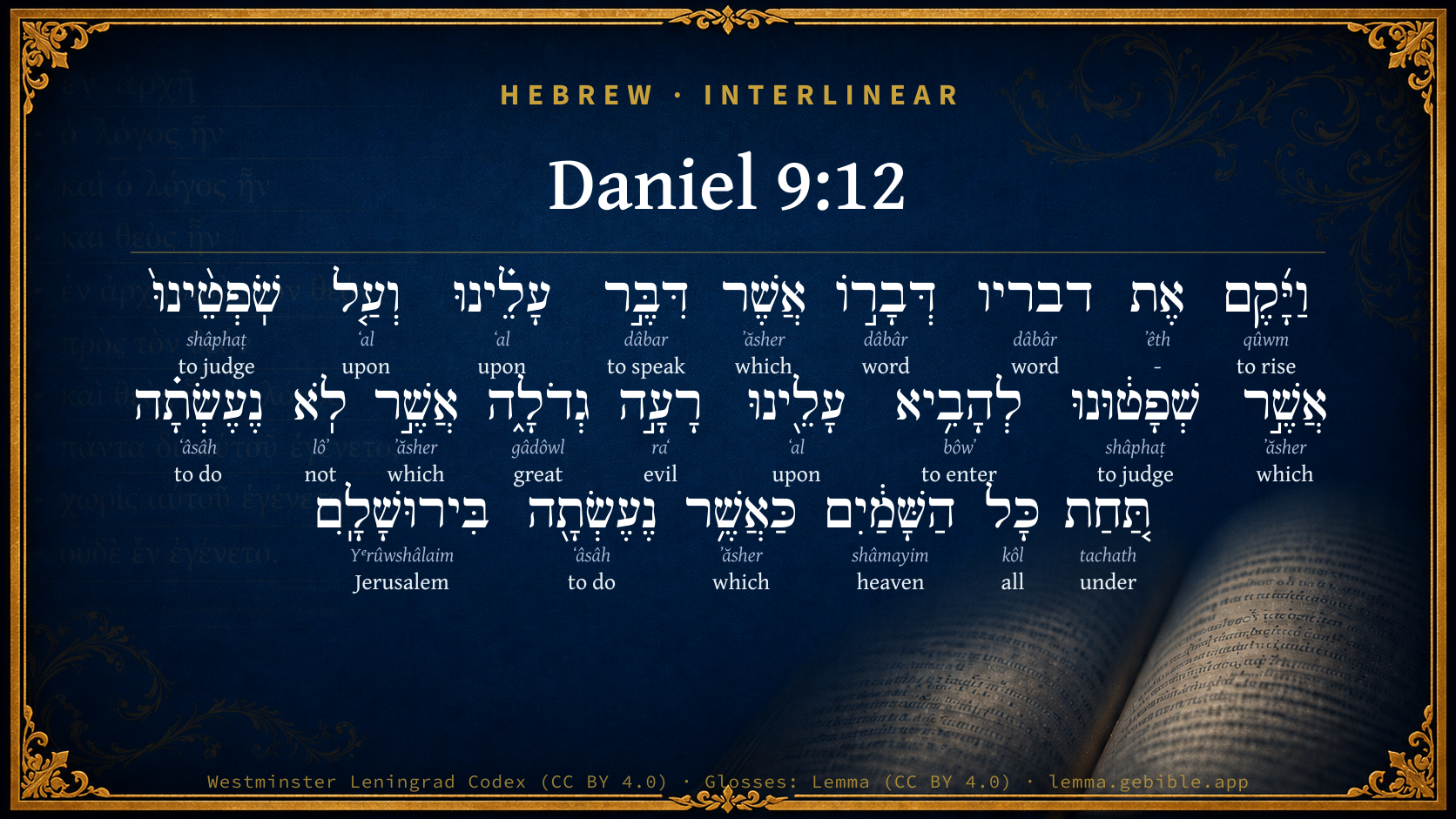
Hebrew (Westminster Leningrad Codex) Daniel 9:12 appears in the Hebrew Old Testament. The text above is from the Westminster Leningrad Codex. Each word links to its Strong’s number, a concise gloss, and parsing drawn from the Open Scriptures Hebrew Bible morphology. Click any word for its full Brown-Driver-Briggs (BDB) entry.
Download image
Cite this verse

Daniel 9:12 (World English Bible). Public Domain. Lemma interlinear Bible study tool, https://lemma.gebible.app/v/daniel/9/12.

Show BibTeX & RIS
BibTeX
RIS
English Translation
He has confirmed his words, which he spoke against us, and against our judges who judged us, by bringing on us a great evil; for under the whole sky has not been done as has been done on Jerusalem.
World English Bible · Public Domain
Download a study sheet

One document with this verse’s original text, its word-by-word gloss line, the meaning frame, cross-references with their text, attributed commentary, and full source and license credits — printable, and it pastes into notes with its structure intact.

This verse Autodidact and up

Study sheet (.html) Plain text (.txt)

A passage Seminary Student

Up to 50 verses in one chapter. A passage sheet keeps up to 6 commentary sources and 12 cross-references per verse, in the order this page ranks them, and says so on the sheet whenever that leaves anything out. Ask for a single verse and you get the Autodidact verse sheet above.

Everything on this page stays free to read, with no account — the sheet is a download of what is already on screen, not access to it.

Want to remove ads? Support Godless Engineer
Compare translations 3

The same verse in 3 English versions, stacked beneath the original-language interlinear above. Click any original word for its lexicon entry.

Each is an independent rendering of the whole verse — the interlinear is not word-aligned to these translations.

Highlighted words mark where these versions differ — a whole-verse word diff, not a word-by-word alignment.

  • World English Bible Public Domain
    He has confirmed his words, which he spoke against us, and against our judges who judged us, by bringing on us a great evil; for under the whole sky has not been done as has been done on Jerusalem.
  • King James Version Public Domain
    And he hath confirmed his words, which he spake against us, and against our judges that judged us, by bringing upon us a great evil: for under the whole heaven hath not been done as hath been done upon Jerusalem.
  • unfoldingWord Literal Text CC BY-SA 4.0
    He has confirmed his words, which he spoke against us and against our rulers who ruled us, to bring on us a great calamity. For under the whole heaven there has not been done anything like what has been done to Jerusalem.

unfoldingWord Literal Text — © unfoldingWord, licensed CC BY-SA 4.0. Word-aligned USFM3 via Door43 (git.door43.org/unfoldingWord/en_ult).

Versions to compare (up to 4)

3 of 4 selected

Show all 18 translations

Every available English version of this verse, each an independent rendering of the whole verse.

  • World English Bible Public Domain
    He has confirmed his words, which he spoke against us, and against our judges who judged us, by bringing on us a great evil; for under the whole sky has not been done as has been done on Jerusalem.
  • Berean Standard Bible Public Domain
    You have carried out the words spoken against us and against our rulers by bringing upon us a great disaster. For under all of heaven, nothing has ever been done like what has been done to Jerusalem.
  • Majority Standard Bible Public Domain
    You have carried out the words spoken against us and against our rulers by bringing upon us a great disaster. For under all of heaven, nothing has ever been done like what has been done to Jerusalem.
  • King James Version Public Domain
    And he hath confirmed his words, which he spake against us, and against our judges that judged us, by bringing upon us a great evil: for under the whole heaven hath not been done as hath been done upon Jerusalem.
  • American Standard Version (1901) Public Domain
    And he hath confirmed his words, which he spake against us, and against our judges that judged us, by bringing upon us a great evil; for under the whole heaven hath not been done as hath been done upon Jerusalem.
  • Revised Version (1885) Public Domain
    And he hath confirmed his words, which he spake against us, and against our judges that judged us, by bringing upon us a great evil: for under the whole heaven hath not been done as hath been done upon Jerusalem.
  • Geneva Bible (1599) Public Domain
    And he hath confirmed his wordes, which he spake against vs, and against our iudges that iudged vs, by bringing vpon vs a great plague: for vnder the whole heauen hath not bene the like, as hath bene brought vpon Ierusalem.
  • Douay-Rheims (1899) Public Domain
    And he hath confirmed his words which he spoke against us, and against our princes that judged us, that he would bring in upon us a great evil, such as never was under all the heaven, according to that which hath been done in Jerusalem.
  • Young's Literal Translation Public Domain
    `And He confirmeth His words that He hath spoken against us, and against our judges who have judged us, to bring in upon us great evil, in that it hath not been done under the whole heavens as it hath been done in Jerusalem,
  • Literal Standard Version CC BY-SA 4.0
    And He confirms His words that He has spoken against us, and against our judges who have judged us, to bring great calamity on us, in that it has not been done under the whole heavens as it has been done in Jerusalem,
  • Unlocked Literal Bible CC BY-SA 4.0
    Yahweh has confirmed the words that he spoke against us and against our rulers over us, by bringing on us a great disaster. For under the whole of heaven there has not been done anything that could compare with what has been done to Jerusalem.
  • unfoldingWord Literal Text CC BY-SA 4.0
    He has confirmed his words, which he spoke against us and against our rulers who ruled us, to bring on us a great calamity. For under the whole heaven there has not been done anything like what has been done to Jerusalem.
  • Darby Bible Public Domain
    And he hath performed his words, which he spoke against us, and against our judges that judged us, by bringing upon us a great evil; so that there hath not been done under the whole heaven as hath been done upon Jerusalem.
  • World Messianic Bible Public Domain
    He has confirmed his words, which he spoke against us and against our judges who judged us, by bringing on us a great evil; for under the whole sky, such has not been done as has been done to Jerusalem.
  • Webster's Bible Public Domain
    And he hath confirmed his words, which he spoke against us, and against our judges that judged us, by bringing upon us a great evil: for under the whole heaven it hath not been done as it hath been done upon Jerusalem.
  • Free Bible Version CC BY-SA 4.0
    You have carried out what you warned us about, against us and against our rulers—such a terrible punishment brought upon Jerusalem, the worst that has ever happened in the whole world.
  • Bible in Basic English Public Domain
    And he has given effect to his words which he said against us and against those who were our judges, by sending a great evil on us: for under all heaven there has not been done what has been done to Jerusalem.
  • JPS Tanakh (1917) Public Domain
    And He hath confirmed His word, which He spoke against us, and against our judges that judged us, by bringing upon us a great evil; so that under the whole heaven hath not been done as hath been done upon Jerusalem.

Literal Standard Version (2020), Covenant Press — licensed CC BY-SA 4.0. Text via the HelloAO Bible API (eBible.org). Unlocked Literal Bible (unfoldingWord) — licensed CC BY-SA 4.0. Text via the HelloAO Bible API (eBible.org). unfoldingWord Literal Text — © unfoldingWord, licensed CC BY-SA 4.0. Word-aligned USFM3 via Door43 (git.door43.org/unfoldingWord/en_ult). Free Bible Version, Dr. Jonathan Gallagher — licensed CC BY-SA 4.0. Text via the HelloAO Bible API (eBible.org).

Word by word

More ways to search: Search by grammar → Find every occurrence → Compare this word →

Practice this passage: Drill this verse → Learn its vocabulary →

שֹֽׁפְטֵ֨ינוּ֙
shâphaṭ
H8199
“judging · us”
Verb, Qal, Participle Active, Masculine, Plural, Construct + Suffix, Personal, 1st Person, Common, Plural
Part of Speech
Verb
Stem
Qal
Form
Participle Active
Gender
Masculine
Number
Plural
State
Construct
Full BDB Definition

Origin: a primitive root

TWOT: 2443

to judge, govern, vindicate, punish - (Qal) - to act as law-giver or judge or governor (of God, man) - to rule, govern, judge - to decide controversy (of God, man) - to execute judgment - discriminating (of man) - vindicating - condemning and punishing - at theophanic advent for final judgment - (Niphal) - to enter into controversy, plead, have controversy together - to be judged - (Poel) judge, opponent-at-law (participle)
  1. וַיָּ֜קֶם qûwm H6965 “and · to rise” Conjunction + Verb, Hiphil, Sequential Imperfect, 3rd Person, Masculine, Singular
  2. אֶת ʼêth H853 “-” Particle, Direct Object
  3. דבריו dâbâr H1697 “words · his” Noun, Common, Masculine, Plural, Construct + Suffix, Personal, 3rd Person, Masculine, Singular
  4. דְּבָר֣וֹ dâbâr H1697 “word · his” Noun, Common, Masculine, Singular, Construct + Suffix, Personal, 3rd Person, Masculine, Singular
  5. אֲשֶׁר ʼăsher H834 “which” Particle, Relative
  6. דִּבֶּ֣ר dâbar H1696 “to speak” Verb, Piel, Perfect, 3rd Person, Masculine, Singular
  7. עָלֵ֗ינוּ ʻal H5921 “upon · us” Preposition + Suffix, Personal, 1st Person, Common, Plural
  8. וְעַ֤ל ʻal H5921 “and · upon” Conjunction + Preposition
  9. אֲשֶׁ֣ר ʼăsher H834 “which” Particle, Relative
  10. שְׁפָט֔וּנוּ shâphaṭ H8199 “to judge · us” Verb, Qal, Perfect, 3rd Person, Common, Plural + Suffix, Personal, 1st Person, Common, Plural
  11. לְהָבִ֥יא bôwʼ H935 “to enter” Preposition + Verb, Hiphil, Infinitive Construct
  12. עָלֵ֖ינוּ ʻal H5921 “upon · us” Preposition + Suffix, Personal, 1st Person, Common, Plural
  13. רָעָ֣ה raʻ H7451 “evil” Noun, Common, Feminine, Singular, Absolute
  14. גְדֹלָ֑ה gâdôwl H1419 “great” Adjective, Adjective, Feminine, Singular, Absolute
  15. אֲשֶׁ֣ר ʼăsher H834 “which” Particle, Relative
  16. לֹֽא lôʼ H3808 “not” Particle, Negative
  17. נֶעֶשְׂתָ֗ה ʻâsâh H6213 “to do” Verb, Niphal, Perfect, 3rd Person, Feminine, Singular
  18. תַּ֚חַת tachath H8478 “under” Preposition
  19. כָּל kôl H3605 “all of” Noun, Common, Masculine, Singular, Construct
  20. הַשָּׁמַ֔יִם shâmayim H8064 “the · heaven(s)” Particle, Definite Article + Noun, Common, Masculine, Plural, Absolute
  21. כַּאֲשֶׁ֥ר ʼăsher H834 “like/as · which” Preposition + Particle, Relative
  22. נֶעֶשְׂתָ֖ה ʻâsâh H6213 “to do” Verb, Niphal, Perfect, 3rd Person, Feminine, Singular
  23. בִּירוּשָׁלִָֽם Yᵉrûwshâlaim H3389 “in/at · Jerusalem” Preposition + Noun, Proper

About this verse

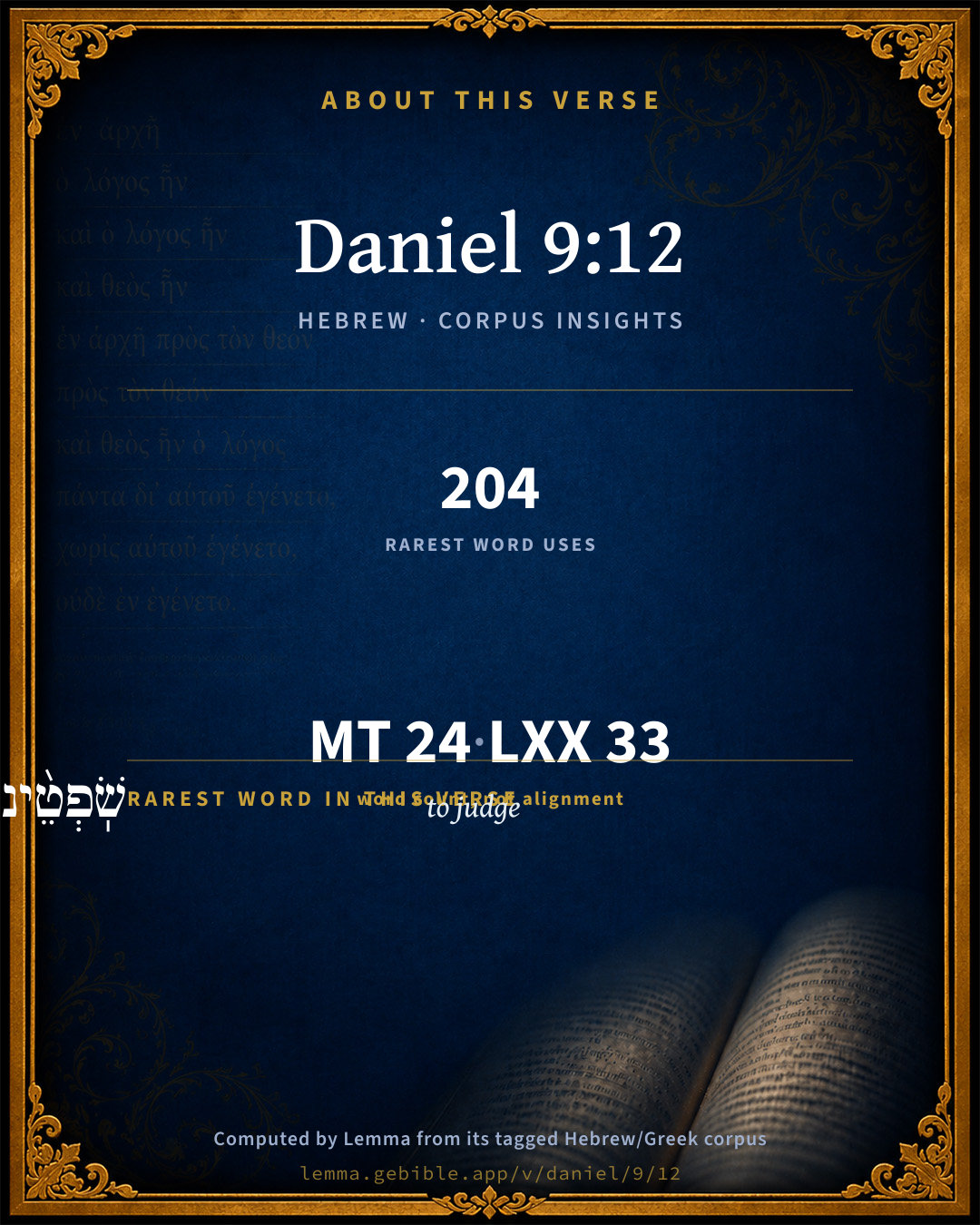
These counts appear in no published source. They are computed here, from the morphology-tagged text and Lemma’s own curated glosses. What Lemma adds →

24
words
16
distinct lemmas
Prophets
section

Grammatical profile

  • 7 verbs
  • 6 nouns
  • 1 adjective
  • 4 prepositions
  • 6 particles

Verb forms

  • וַיָּ֜קֶם Hiphil · Sequential Imperfect
  • דִּבֶּ֣ר Piel · Perfect
  • שֹֽׁפְטֵ֨ינוּ֙ Qal · Participle Active
  • שְׁפָט֔וּנוּ Qal · Perfect
  • לְהָבִ֥יא Hiphil · Infinitive Construct
  • נֶעֶשְׂתָ֗ה Niphal · Perfect
  • נֶעֶשְׂתָ֖ה Niphal · Perfect

Repetition

Words recur within this verse — often emphatic in Hebrew:

  • עָלֵ֗ינוּ upon H5921 ×3
  • דבריו word H1697 ×2
  • שֹֽׁפְטֵ֨ינוּ֙ to judge H8199 ×2
  • נֶעֶשְׂתָ֗ה to do H6213 ×2
  • אֲשֶׁר which H834 ×4

Hebrew & Septuagint length

In English translation the verse runs 39 words from the Hebrew and 40 from the Septuagint (LXX English) — closely comparable.

A rough comparison of the two English renderings, which tokenize alike — not a word-level alignment.

Word counts can differ between the Hebrew and the Greek without any difference in meaning — e.g. the Hebrew direct-object marker אֵת has no separate Greek word, and Greek often adds the article ὁ.

In the original languages it is 24 Hebrew tokens and 33 Greek tokens — but the two are counted differently (Hebrew bundles its prefixes and suffixes into one token; the Greek is in lemma form), so that isn’t a like-for-like length.

Cross-references

23

Topical passages linked to Daniel 9:12 in the Treasury of Scripture Knowledge — connected by theme and wording, ordered by reader-vote popularity; previews shown in the World English Bible.

  • Ezekiel 5:9 I will do in you that which I have not done, and whereunto I will not do any more the like, because of all your abominations.
  • Lamentations 1:12 Is it nothing to you, all you who pass by? Look, and see if there be any sorrow like my sorrow, which is brought on me, With which Yahweh has afflicted [me] in the day of his fierce anger.
  • Job 12:17 He leads counselors away stripped. He makes judges fools.
  • Isaiah 44:26 who confirms the word of his servant, and performs the counsel of his messengers; who says of Jerusalem, She shall be inhabited; and of the cities of Judah, They shall be built, and I will raise up the waste places of it;
  • Lamentations 2:13 What shall I testify to you? what shall I liken to you, daughter of Jerusalem? What shall I compare to you, that I may comfort you, virgin daughter of Zion? For your breach is great like the sea: who can heal you?
  • Lamentations 2:17 Yahweh has done that which he purposed; he has fulfilled his word that he commanded in the days of old; He has thrown down, and has not pitied: He has caused the enemy to rejoice over you; he has exalted the horn of your adversaries.
  • 1 Kings 3:9 Give your servant therefore an understanding heart to judge your people, that I may discern between good and evil; for who is able to judge this your great people?
  • Psalms 2:10 Now therefore be wise, you kings. Be instructed, you judges of the earth.
  • Psalms 82:2–3 "How long will you judge unjustly, And show partiality to the wicked?" Selah.
  • Psalms 148:11 Kings of the earth and all peoples; Princes and all judges of the earth;
  • Proverbs 8:16 By me princes rule; Nobles, and all the righteous rulers of the earth.
  • Jeremiah 44:2–6 Thus says Yahweh of Hosts, the God of Israel: You have seen all the evil that I have brought on Jerusalem, and on all the cities of Judah; and, behold, this day they are a desolation, and no man dwells therein,
  • Lamentations 4:6 For the iniquity of the daughter of my people is greater than the sin of Sodom, That was overthrown as in a moment, and no hands were laid on her.
  • Ezekiel 13:6 They have seen falsehood and lying divination, who say, Yahweh says; but Yahweh has not sent them: and they have made men to hope that the word would be confirmed.
  • Joel 2:2 A day of darkness and gloominess, A day of clouds and thick darkness. As the dawn spreading on the mountains, A great and strong people; There has never been the like, Neither will there be any more after them, Even to the years of many generations.
  • Amos 3:2 "You only have I chosen of all the families of the earth. Therefore I will punish you for all of your sins."
  • Zechariah 1:6 But my words and my decrees, which I commanded my servants the prophets, didn't they overtake your fathers? "Then they repented and said, 'Just as Yahweh of Hosts determined to do to us, according to our ways, and according to our practices, so he has dealt with us.'"
  • Zechariah 1:8 "I had a vision in the night, and, behold, a man riding on a red horse, and he stood among the myrtle trees that were in a ravine; and behind him there were red, brown, and white horses.
  • Matthew 5:18 For most assuredly, I tell you, until heaven and earth pass away, not even one smallest letter or one tiny pen stroke shall in any way pass away from the law, until all things are accomplished.
  • Matthew 24:21 for then there will be great oppression, such as has not been from the beginning of the world until now, no, nor ever will be.
  • Mark 13:19 For in those days there will be oppression, such as there has not been the like from the beginning of the creation which God created until now, and never will be.
  • Luke 21:22 For these are days of vengeance, that all things which are written may be fulfilled.
  • Romans 15:8 Now I say that Christ has been made a minister of the circumcision for the truth of God, that he might confirm the promises given to the fathers,

Cross-references courtesy of OpenBible.info (CC BY 4.0).

Hebrew and Greek witnesses Masoretic Hebrew ↔ Greek Septuagint

The same verse in the two great witnesses to the Old Testament, shown verse-for-verse.

These are two independent witnesses, not word-aligned to each other, and the Septuagint is shown in lemma (dictionary) form.

Hebrew Daniel 9:12 Masoretic · Westminster Leningrad Codex

וַיָּ֜קֶם אֶת דבריו דְּבָר֣וֹ אֲשֶׁר דִּבֶּ֣ר עָלֵ֗ינוּ וְעַ֤ל שֹֽׁפְטֵ֨ינוּ֙ אֲשֶׁ֣ר שְׁפָט֔וּנוּ לְהָבִ֥יא עָלֵ֖ינוּ רָעָ֣ה גְדֹלָ֑ה אֲשֶׁ֣ר לֹֽא נֶעֶשְׂתָ֗ה תַּ֚חַת כָּל הַשָּׁמַ֔יִם כַּאֲשֶׁ֥ר נֶעֶשְׂתָ֖ה בִּירוּשָׁלִָֽם

He has confirmed his words, which he spoke against us, and against our judges who judged us, by bringing on us a great evil; for under the whole sky has not been done as has been done on Jerusalem.

World English Bible · Public Domain

Greek LXX Daniel 9:12 Septuagint · lemma form

καί ἵστημι ἐγώ ὁ πρόσταγμα αὐτός ὅσος λαλέω ἐπί ἐγώ καί ἐπί ὁ κριτής ἐγώ ὅσος κρίνω ἐγώ ἐπιἄγω ἐπί ἐγώ κακός μέγας οἷος οὐ γίγνομαι ὑπό ὁ οὐρανός καθότι γίγνομαι ἐν ἰερουσαλήμ

And he has confirmed his words, which he spoke against us, and against our judges who judged us, by bringing upon us great evils, such as have not happened under the whole heaven, according to what has happened in Jerusalem.

LXX2012 (modern English Septuagint) · Public Domain

On this verse, The Pulpit Commentary discusses the Septuagint’s reading. Read the note in Commentary ↓

Hebrew: Westminster Leningrad Codex (CC BY 4.0). Greek: Septuagint (public domain); English from LXX2012 (modern English Septuagint) (Public Domain). How the Septuagint differs from the Hebrew →

Commentary

Notes on Daniel 9:12 from classic Christian and Jewish commentators (each source and its license shown beneath its notes). The classic Christian expositions comment on the surrounding passage and are grouped to its opening verse, so a note may address several verses; the Jewish commentaries on the Tanakh (Rashi and others) are per-verse, so they appear only where the commentator wrote on this verse.

Lemma curates 59 commentaries, every one of them public domain or Creative Commons licensed, each selected and text-cleaned for this edition rather than reprinted as found. About our sources →

Trapp's Complete Commentary

John Trapp

Dan 9:12 And he hath confirmed his words, which he spake against us, and against our judges that judged us, by bringing upon us a great evil: for under the whole heaven hath not been done as hath been done upon Jerusalem.

Ver. 12. And he hath confirmed his words.] What he had spoken with his mouth he hath fulfilled with his hand. There is an infallibility, as in God’s promises, so in his menaces.

And against our judges.] By whose remissness all was out of order; hence they smarted before and above others.

For under the whole heaven.] This verse is an abridgment of Jeremiah’s Lamentations.

John Trapp, A Commentary or Exposition upon All the Books of the Old and New Testament (1647–1656) — public domain. Text from a community e-Sword module.

Tyndale Open Study Notes

Tyndale Open Resources

9:12 God’s act of driving Israel into exile for breaking his covenant was unique in all of history. Israel’s exodus from Egypt, their exile, and their return from Babylon are still unequaled (see also Jer 29:10).

Tyndale Open Study Notes — © Tyndale Open Resources, licensed CC BY-SA 4.0. Text via the HelloAO Bible API.

Geneva Bible (1599)

Geneva Bible translators

Or, governed us.

Geneva Bible (1599) marginal notes — public domain. Text via Bolls.life.

Jamieson, Fausset & Brown

Robert Jamieson, A. R. Fausset & David Brown

confirmed his words--showed by the punishments we suffer, that His words were no idle threats.

under . . . heaven hath not been done as . . . upon Jerusalem-- (Lam 1:12).

Jamieson, Fausset & Brown — Commentary Critical and Explanatory on the Whole Bible (1871) — public domain (CC PDM 1.0). Text via the HelloAO Bible API.

John Calvin's Commentaries

Daniel pursues the same sentiment, shewing how the Israelites had no cause whatever for expostulating with God on account of their being so heavily afflicted, and no reason for doubting either its origin or intention. For now all had come to pass exactly as it had been long ago predicted. God, therefore, has stirred up his word against us; as if he had said, there is no reason why we should strive with God, for we behold his truthfulness in the punishments which he has inflicted upon us, and his threats are no mere vain scarecrows, or fabulous inventions manufactured to frighten children. God now really proves how seriously he had spoken. What then is the use of our turning our backs upon him, or why should we seek vain excuses when God’s truthfulness shines brightly in our destruction? Do we wish to deprive God of his truthfulness? surely whatever our earnestness we shall never succeed. Let, therefore, this suffice to condemn us, — God has predicted everything which occurs, and thus effectually and experimentally proves himself an avenger. God, therefore, ratified his word; that is, God’s word would have remained without the slightest efficacy and rigor, unless this curse had been suspended over our head; but while we lie prostrate and almost buried under our calamities, God’s word is borne aloft; that is, God makes his truthfulness conspicuously visible, which otherwise would scarcely be perceptible at all. Unless God punished the wickedness of men, who would not treat the threatening of his law as childish? But when he demonstrates by certain proofs the very best reasons for terrifying mankind, efficacy and rigor are immediately imparted to his words. Besides this, Daniel here intends to cast off all subterfuges, and to cause the people candidly to acknowledge, and really to feel themselves justly afflicted. He says, against us and against our judges, who judged us. Again, Daniel throws down all haughtiness of the flesh, with the view of exalting God alone and of preventing any mortal splendor from obscuring the authority of the Law. For we know how the common people think they have a shield for the defense of all their crimes, when they can quote the example of kings and judges. At this very day, whenever we argue against the superstitions of the Papacy, they say, “Well! if we do make a mistake, yet God has set over us both kings and bishops who rule us after their manner, why then should we be blamed when we have God’s command for following those who are endued with power and dignity?” As, therefore, the vulgar generally catch at a subterfuge like this, Daniel again affirms, that although those who transgress God’s law are endowed with great worldly authority, yet they are not exempt from either blame or punishment, nor can the ordinary multitude be excused if they follow their example. Therefore, as he had spoken by Moses against our judges who judged us, he says; that is, although power had been conferred upon them for ruling us, yet the whole ordination of it is from God: yet after they had utterly abused their government, and violated God’s justice, and thus had endeavored to draw down God, if possible, from his elevation, Daniel asserts that their loftiness will by no means shelter them from the consequences of transgression.

He afterwards adds, To bring upon us a great evil, which has never happened under the whole heavens, as it has now occurred at Jerusalem. Here Daniel foresaw an objection which had some slight force in it. Although God had deservedly punished the Israelites, yet when he displayed his anger against them more severely than against other nations, he might seem forgetful of his equity. Daniel here removes all appearance of incongruity, even if God is more severe against his elect people then against profane nations, because the impiety of this people was far greater than that of all others on account of their ingratitude, contumacy, and impracticable obstinacy, as we have already said. Since the Israelites surpassed all nations in malice, ingratitude, and all kinds of iniquity, Daniel here declares how thoroughly their disastrous afflictions were deserved. Again, we are here reminded, whenever God severely chastises his Church, of that principle to which we must return, namely, our impiety is the more detestable to God the nearer he approaches us; and the kinder he is to us, the more chargeable we are, unless in our turn we prove ourselves grateful and obedient. This state of things ought not to seem troublesome to us, as vengeance begins at the house of God, and he puts forth examples of his wrath against his own people far more tremendous than against others; this, I say, we ought not to take ill, as I have already explained the reason of it. It does not surprise us to find the Gentiles groping in darkness, but when God shines upon us and we resist him with determined willfulness, we are doubly impious. This comparison, therefore, must be noticed, as evil was poured out upon Jerusalem; meaning, no similar punishment was inflicted upon other nations, for what happened to Jerusalem, says Daniel, never occurred under the whole heaven. It follows, —

John Calvin's Commentaries (1540-1563) — public domain. Text from the Calvin Translation Society English edition (1840s-50s) via the Christian Classics Ethereal Library (ccel.org). Calvin's coverage is partial (roughly two-thirds of the Bible); uncommented books and verses are honest gaps, never fabricated. The 19th-century editor's footnotes and remarks are omitted so the notes are faithfully Calvin's own voice.

Ellicott's Commentary for English Readers

(12) Our judges.—Used in a wide sense to signify kings, princes, and rulers generally. (Comp. Hos_7:7.)

A Bible Commentary for English Readers, edited by Charles John Ellicott (1878–1897) — public domain. Text from a community e-Sword module.

The Cambridge Bible for Schools and Colleges

gen. ed. J. J. S. Perowne

12. confirmed his words] The phrase as Neh_9:8; cf. Deu_9:5, 1Ki_8:20, al. with this verse, cf. Bar_2:1-2.

judges] apparently a general term for rulers, as Psa_2:10.

by bringing, &c.] to ‘bring evil upon’ is a phrase common in Jer., as Jer_35:17, Jer_36:31 (where ‘pronounced’ is lit. spake, as here).

for] better, so that, such that, 1Ki_3:12.

under the whole heaven] cf. on Dan_7:27.

The Cambridge Bible for Schools and Colleges (gen. ed. J. J. S. Perowne; Cambridge University Press, 1878–1918) — public domain. Text from a community e-Sword module.

John Gill's Exposition

And he hath confirmed his words which he spake against us,.... That is, he hath made good his threatenings of wrath and vengeance, in case of disobedience to his law:

and against our judges that judged us; kings, and inferior governors, that ruled over them, who perverted justice, and did not execute righteous judgment; and against them the Lord performed what he threatened:

by bringing upon us a great evil; the desolation of the whole land, the destruction of Jerusalem; the death of many by the sword, famine, and pestilence, and the captivity of the rest; all which was a great punishment considered in itself, but, when compared with their offences, was less than they deserved:

for under the whole heaven hath not been done as hath been done upon Jerusalem; its walls broken down, its houses burnt with fire, even the palaces of the king and nobles, and the temple of the Lord itself; and all its inhabitants destroyed, dispersed, or carried captive; see Lam 1:12.

John Gill's Exposition of the Whole Bible (1746–1763) — public domain (CC PDM 1.0). Text via the HelloAO Bible API.

Albert Barnes' Notes on the Bible

And he hath confirmed his words ... - By bringing upon the people all that he had threatened in case of their disobedience. Daniel saw that there was a complete fulfillment of all that he had said would come upon them. As all this had been threatened, he could not complain; and as he had confirmed his words in regard to the threatening, he had the same reason to think that he would in regard to his promises. What Daniel here says was true in his time, and in reference to his people will be found to be true at all times, and in reference to all people. Nothing is more certain than that God will “confirm” all the words that he has over spoken, and that no sinner can hope to escape on the ground that God will be found to be false to his threatenings, or that he has forgotten them, or that he is indifferent to them.

Against our judges that judged us - Our magistrates or rulers.

For under the whole heaven - In all the world.

Hath not been done as hath been done upon Jerusalem - In respect to the slaughter, and the captivity, and the complete desolation. No one can show that at that time this was not literally true. The city was in a state of complete desolation; its temple was in ruins; its people had been slain or borne into captivity.

Albert Barnes' Notes on the Bible (1834–1885) — public domain. Text from a community e-Sword/MySword module.

Matthew Poole's English Annotations

He hath confirmed his words which he spake against us: by this it appears that God’s judgments threatened against sin are to be feared, because of the great and terrible God, Dan 9:4; Deu 7:9,10; Ne 1:8.

Against our judges that judged us; whose place and duty it was to govern the people, to judge their causes, and to appoint others for it; wherein if there be a failure, as there often was, it was a sin and judgment upon the people, and upon the rulers and judges themselves also, of which we find many instances and complaints in Scripture, Psa 2:2,9,10; 58:1,2.

Jerusalem; a place privileged many ways above all others, chiefly by the signal presence of God there, and his promises to it, Psa 76:1,2; yet when sin is found there, as it was in Jerusalem, to the height, as in Sodom, it was punished to the height. Read the book of Lamentations.

Matthew Poole's English Annotations on the Holy Bible (1683–1685) — public domain. Text from a community e-Sword/MySword module.

Whedon's Commentary on the Bible

Daniel D. Whedon

12, 13. Because of Israel’s extreme sensitiveness, better training, higher ideals, and nobler possibilities the loss of her land and temple cut her deeper than any such loss could have wounded a heathen people. (See notes Eze_5:9.) All this ruin had fallen upon the nation wholly because of the people’s sins and their failure to repent and recognize the truth of the prophetic promises and warnings. R.V. reads, “have discernment in thy truth;” that is, gain a knowledge of the true way of safety and life.

Daniel D. Whedon (gen. ed.), Commentary on the Old and New Testaments (1874–1909) — public domain. Text from a community e-Sword module.

The Pulpit Commentary

And he hath confirmed his words, which he spake against us. and against our judges that judged us, by bringing upon us a great evil: for under the whole heaven hath not been done as hath been done upon Jerusalem. The LXX differs somewhat, "And he hath confirmed against us (esthsen hJmin) his words (prostagmata), such as he spake against us, and against our judges, such great evils as thou didst adjudge us (ekrinav hJmin), to bring upon us." The rest is farily in accordance with the Massoretic. It is clear that in the text before the LXX translator the word was shephattanoo instead of shephatoonoo, that is to say, t (tau) instead of w (vav). These letters in earlier scripts were liable to be confounded. The meaning assigned to shaphat in this reading is unusual; but this is rather in favour of it being the true reading; and the return to the second person, while awkward, also has weight. Theodotion and the Peshitta do not call for remark. The use of the word "judges" for rulers generally ought to be noted. If we take the Massoretic reading, there may be a reminiscence of 2Ki_23:22. Among the Carthaginians the principal magistrates bore the title suffetes , equivalent to shopheteen. Under the whole heaven hath not been done as bath been done upon Jerusalem. Such language is to be regarded in any case as the exaggeration of grief; but it would have something like a justification twice in the history of Jerusalem, and only twice after the capture of Jerusalem by Nebuchadnezzar, and after its capture by Titus. No one has maintained that the origin of Daniel is so late as the latter event; hence we are thrown back upon the former. With the fact before him that temples had been plundered everywhere, and desecrated, and cities sacked, the writer could not have regarded the case of Jerusalem, and its temple, in the days of Epiphanes, as unique under all heaven. After the capture of Jerusalem by. Nebuchadnezzar, the temple was left in rums and the city deserted. Such measure, so far as we know, was not meted out by Nebuchadnezzar to any other city. Only rarely had even the Ninevite monarchs taken such terrible vengeance on rebellious subjects.

The Pulpit Commentary (1880–1919), ed. H.D.M. Spence-Jones & Joseph S. Exell — public domain. Text from a community e-Sword module.

John Wesley's Explanatory Notes

Judged us - Whose duty it was to govern the people, and to judge their causes; wherein if there was a failure, it was a sin, and judgment upon the people, and upon the rulers and Judges themselves also. Upon Jerusalem - A place privileged many ways above all others, and punished above all others.

John Wesley, Explanatory Notes Upon the Whole Bible (1754–1765) — public domain. Text via the GEBible commentary corpus.

unfoldingWord translationNotes

Door43 World Missions Community

General Information:

Daniel continues praying to the Lord about the people of Israel.

For under the whole of heaven

This is an idiom. AT: "For in the whole world" (See: Idiom)

there has not been done anything

"nothing has been done." This can be stated in active form. AT: "nothing has happened" (See: Active or Passive)

what has been done to Jerusalem

This can be stated in active form. AT: "what you have done to Jerusalem" (See: Active or Passive)

As it is written in the law of Moses

This can be stated in active form. AT: "As Moses wrote in the law" (See: Active or Passive)

turning away from our iniquities

Here stopping evil activity is spoken of as turning away from them. AT: "stopping our evil actions" (See: Idiom)

Yahweh has kept the disaster ready

"Yahweh has prepared this disaster"

we have not obeyed his voice

Here "voice" refers to the things that Yahweh commanded. AT: "we have not done what he told us to do" (See: Metonymy)

translationWords

confirm

word

rule

heaven

Jerusalem

written

law

beg

mercy

Yahweh

God

turn

iniquity

true

righteous

works

obey

voice

unfoldingWord translationNotes — © Distant Shores Media and the Door43 World Missions Community, licensed CC BY-SA 4.0. Source: git.door43.org/Door43/en_tn.

Rashi

Rabbi Shlomo Yitzchaki (Rashi)

as was done in Jerusalem the sword, slaying, the burning of the city; and they humbled women and put captives into neck irons.

Rashi on the Tanakh — English translations: “The Judaica Press complete Tanach with Rashi, translated by A. J. Rosenberg” (CC BY 4.0); “Pentateuch with Rashi's commentary by M. Rosenbaum and A.M. Silbermann, 1929-1934” (public domain); “The Metsudah Tanach series, Lakewood, N.J” (CC BY 4.0); and “The Book of Joshua, Metsudah Publications, 1997” (CC BY 4.0). Text via Sefaria.

Lesson kit

Teaching starters — assembled from the data on this page, not authored interpretation. Every prompt links to the verse data it draws on. Edit before teaching.

Daniel, in the Prophets, opens this verse with 24 words (16 distinct Hebrew lemmas). Its most distinctive word is shâphaṭ (“to judge”). A historical commentator’s framing appears above. Read the whole chapter for the surrounding context.

Discussion questions

  1. The word shâphaṭ carries the sense “to judge.” How does it shape the verse?
  2. How does Ezekiel 5:9, which shares this passage’s theme, read alongside this verse?
  3. What does the repetition of “upon” (3× in this one verse) do in this verse?
  4. The translations on this page render this verse differently — a whole-verse word diff, not a word-by-word alignment. What might account for the different wordings?
  5. «וַיָּ֜קֶם» is a Hiphil Sequential Imperfect verb. How does that grammatical form shape the action described?
  6. Compare how Trapp's Complete Commentary and Tyndale Open Study Notes read this verse. Where do they agree or differ?

Things to notice

Reading settings

Reading text

Shown beneath each verse's original-language words.

Old Testament
Old Testament edition

Read the OT as the Masoretic Hebrew (MT) or the Greek Septuagint (LXX).

English shown for the Greek Septuagint (in the Hebrew ↔ Greek comparison).

Comparing translations? Open the Compare panel on any verse page to stack up to four side by side.