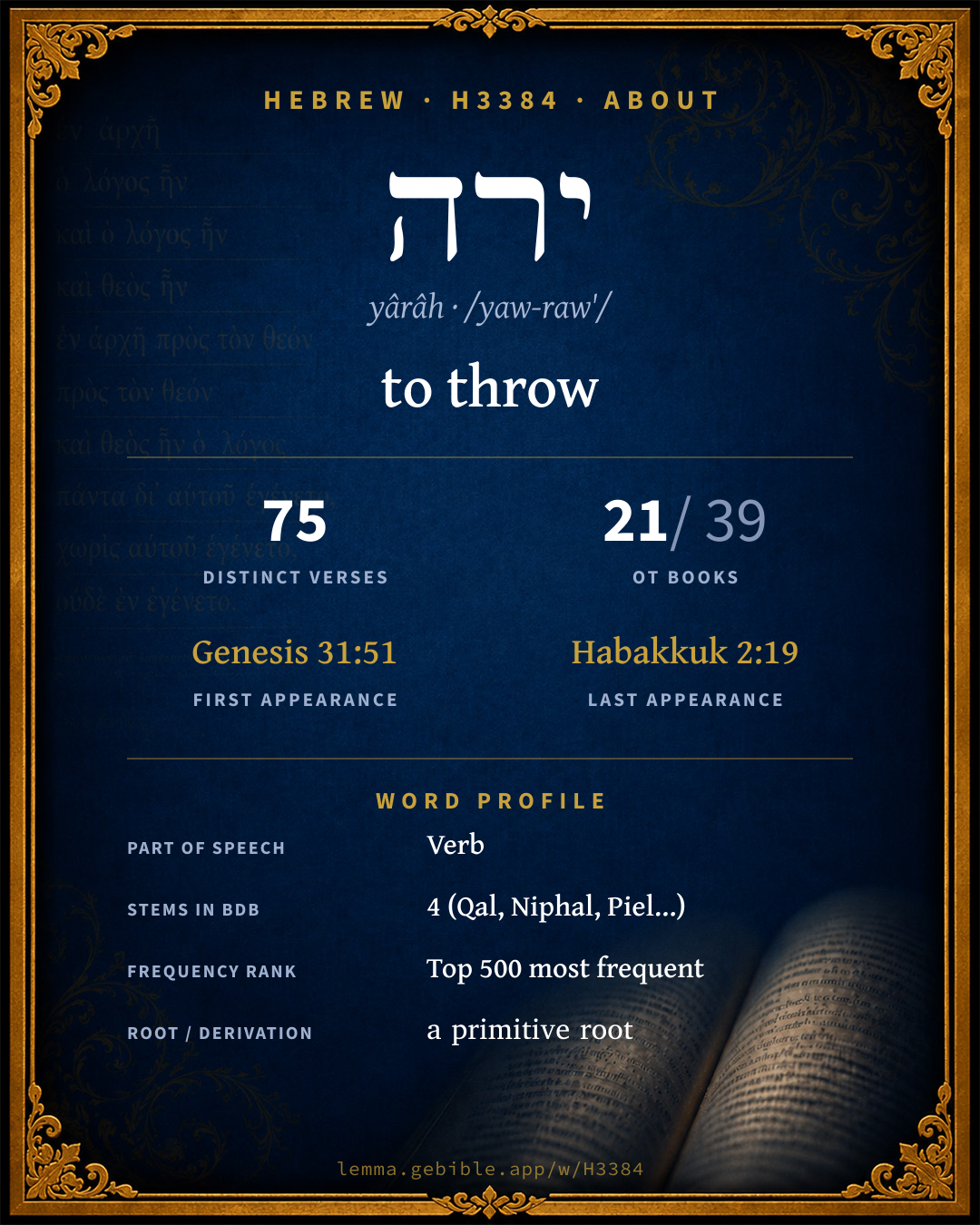
יָרָה
to throw
also: shoot, cast, pour fuller range ↓
Full lexicon entry — Brown-Driver-Briggs (BDB)
From Brown-Driver-Briggs (BDB)
Where this word appears
See every Hiphil verb in the Hebrew Bible →
Grammar key — what these labels mean
Part of speech
- Verb
- An action or state-of-being word.
- Noun
- A naming word — a person, place, thing, or idea.
Noun type
- Common
- A common noun — a general class of person, place, or thing (“king,” “city,” “water”), not a specific name.
Stem
- Hiphil
- The causative active stem (“he caused / brought about”). Here: ‘throw’
- Qal
- The basic, simple active stem — the plain form of the verb (“he wrote”). Here: ‘fear’
- Hophal
- The passive counterpart of the Hiphil (“he was caused to…”).
- Niphal
- Usually the simple passive or reflexive of the Qal (“he was written”). Here: ‘be fearful’
Form
- Imperfect
- An incomplete, ongoing, or future action (“he will / would write”).
- Participle Active
- A verbal adjective expressing ongoing or characteristic action (“writing / one who writes”).
- Imperative
- A direct command (“write!”).
- Perfect
- A completed action or state — Hebrew marks aspect (completeness) more than strict tense (“he wrote”).
- Sequential Imperfect
- An imperfect with prefixed waw — the standard past-narrative form (waw-consecutive imperfect).
- Infinitive Construct
- A bound verbal noun, frequently with prepositions (“to write / in writing”).
- Sequential Perfect
- A perfect with prefixed waw continuing a preceding imperfect or command (waw-consecutive perfect).
- Infinitive Absolute
- An unbound verbal noun, often intensifying or standing in for a finite verb.
State
- Absolute
- The independent form of a noun, not bound to a following word.
- Construct
- A noun bound to a following noun in a possessive / “of” relationship (the construct chain).
Person
- 3rd Person
- The one spoken about (“he / she / it / they”).
- 2nd Person
- The one addressed (“you”).
- 1st Person
- The speaker (“I / we”).
Gender
- Masculine
- Grammatically masculine.
- Feminine
- Grammatically feminine.
- Common
- Either gender — not distinguished for this form.
Number
- Singular
- One.
- Plural
- More than one (in Hebrew, generally three or more).
Grammatical forms 30 distinct
- Verb, Hiphil, Imperfect, 3rd Person, Masculine, Singular 13 times (15%)
- Verb, Hiphil, Imperfect, 3rd Person, Masculine, Plural 9 times (10%)
- Verb, Hiphil, Participle Active, Masculine, Singular, Absolute 6 times (7%)
- Verb, Hiphil, Infinitive Construct 5 times (6%)
- Verb, Hiphil, Participle Active, Masculine, Plural, Absolute 4 times (5%)
- Verb, Hiphil, Imperative, 2nd Person, Masculine, Singular 4 times (5%)
- Verb, Qal, Perfect, 3rd Person, Masculine, Singular 4 times (5%)
- Verb, Hiphil, Sequential Imperfect, 3rd Person, Masculine, Singular 4 times (5%)
+22 more forms (37 occurrences)
Parsed forms decoded from the imported morphology (morphhb / Westminster Leningrad Codex — WLC text public domain, morphhb tagging CC BY 4.0), counted across 86 parsed occurrences — not distinct verses.
Every verse where H3384 appears — 75 distinct verses across 21 books. Click any verse to open its interlinear word-by-word view. Verse text shown in the World English Bible for context — . Each verse’s Hebrew form is shown with its reference; the English is not keyword-highlighted, since the data carries no word-level English alignment. Use “Compare translations” on any verse to read it across multiple English versions. This concordance covers the Hebrew Bible; Septuagint (Greek Old Testament) occurrences are not indexed here.
Genesis 2 verses
Exodus 7 verses
- Exodus 4:12 וְ/הוֹרֵיתִ֖י/ךָ conj + Hiphil pf 1cs + sfx pers 2ms Now therefore go, and I will be with your mouth, and teach you what you shall speak."
- Exodus 4:15 וְ/הוֹרֵיתִ֣י conj + Hiphil wpf 1cs You shall speak to him, and put the words in his mouth. I will be with your mouth, and with his mouth, and will teach you what you shall do.
- Exodus 15:4 יָרָ֣ה Qal pf 3ms Pharaoh's chariots and his host has he cast into the sea; His chosen captains are sunk in the Red Sea.
- Exodus 15:25 וַ/יּוֹרֵ֤/הוּ conj + Hiphil wimpf 3ms + sfx pers 3ms Then he cried to Yahweh. Yahweh shown him a tree, and he threw it into the waters, and the waters were made sweet. There he made a statute and an ordinance for them, and there he tested them;
- Exodus 19:13 יָרֹ֣ה יִיָּרֶ֔ה Qal inf.abs Niphal impf 3ms No hand shall touch him, but he shall surely be stoned or shot through; whether it is animal or man, he shall not live.' When the trumpet sounds long, they shall come up to the mountain."
- Exodus 24:12 לְ/הוֹרֹתָֽ/ם prep + Hiphil inf.cs + sfx pers 3mp Yahweh said to Moses, "Come up to me on the mountain, and stay here, and I will give you the tables of stone with the law and the commands that I have written, that you may teach them."
- Exodus 35:34 וּ/לְ/הוֹרֹ֖ת conj + prep + Hiphil inf.cs He has put in his heart that he may teach, both he, and Oholiab, the son of Ahisamach, of the tribe of Dan.
Leviticus 2 verses
Numbers 1 verse
Deuteronomy 4 verses
- Deuteronomy 17:10 יוֹרֽוּ/ךָ Hiphil impf 3mp + sfx pers 2ms You shall do according to the tenor of the sentence which they shall show you from that place which Yahweh shall choose; and you shall observe to do according to all that they shall teach you:
- Deuteronomy 17:11 יוֹר֗וּ/ךָ Hiphil impf 3mp + sfx pers 2ms according to the tenor of the law which they shall teach you, and according to the judgment which they shall tell you, you shall do; you shall not turn aside from the sentence which they shall show you, to the right hand, nor to the left.
- Deuteronomy 24:8 יוֹר֨וּ Hiphil impf 3mp Take heed in the plague of leprosy, that you observe diligently, and do according to all that the priests the Levites shall teach you: as I commanded them, so you shall observe to do.
- Deuteronomy 33:10 יוֹר֤וּ Hiphil impf 3mp They shall teach Jacob your ordinances, Israel your law: They shall put incense before you, Whole burnt offering on your altar.
Joshua 1 verse
Judges 1 verse
1 Samuel 5 verses
- 1 Samuel 12:23 וְ/הוֹרֵיתִ֣י conj + Hiphil wpf 1cs Moreover as for me, far be it from me that I should sin against Yahweh in ceasing to pray for you: but I will instruct you in the good and the right way.
- 1 Samuel 20:20 אוֹרֶ֑ה Hiphil impf 1cs I will shoot three arrows on the side of it, as though I shot at a mark.
- 1 Samuel 20:36 מוֹרֶ֑ה יָרָ֥ה Hiphil ptcp.act ms Qal pf 3ms He said to his boy, Run, find now the arrows which I shoot. As the boy ran, he shot an arrow beyond him.
- 1 Samuel 20:37 יָרָ֖ה Qal pf 3ms When the boy was come to the place of the arrow which Jonathan had shot, Jonathan cried after the boy, and said, Isn't the arrow beyond you?
- 1 Samuel 31:3 הַ/מּוֹרִ֖ים מֵ/הַ/מּוֹרִֽים ptcl def.art + Hiphil ptcp.act mp prep + ptcl def.art + n c mp The battle went sore against Saul, and the archers overtook him; and he was greatly distressed by reason of the archers.
2 Samuel 2 verses
- 2 Samuel 11:20 יֹר֖וּ Hiphil impf 3mp it shall be that, if the king's wrath arise, and he tells you, 'Why did you go so near to the city to fight? Didn't you know that they would shoot from the wall?
- 2 Samuel 11:24 ו/יראו וַ/יֹּר֨וּ ה/מוראים הַ/מּוֹרִ֤ים conj + Hiphil wimpf 3mp conj + Hiphil wimpf 3mp ptcl def.art + Hiphil ptcp.act mp ptcl def.art + Hiphil ptcp.act mp The shooters shot at your servants from off the wall; and some of the king's servants are dead, and your servant Uriah the Hittite is dead also.
1 Kings 1 verse
2 Kings 5 verses
- 2 Kings 12:2 הוֹרָ֔/הוּ Hiphil pf 3ms + sfx pers 3ms Jehoash did that which was right in the eyes of Yahweh all his days in which Jehoiada the priest instructed him.
- 2 Kings 13:17 יְרֵה֙ וַ/יּ֔וֹר Qal impv 2ms conj + Hiphil wimpf 3ms He said, Open the window eastward; and he opened it. Then Elisha said, Shoot; and he shot. He said, Yahweh's arrow of victory, even the arrow of victory over Syria; for you shall strike the Syrians in Aphek, until you have consumed them.
- 2 Kings 17:27 וְ/יֹרֵ֕/ם conj + Hiphil impf 3ms + sfx pers 3mp Then the king of Assyria commanded, saying, Carry there one of the priests whom you brought from there; and let them go and dwell there, and let him teach them the law of the god of the land.
- 2 Kings 17:28 מוֹרֶ֣ה Hiphil ptcp.act ms So one of the priests whom they had carried away from Samaria came and lived in Bethel, and taught them how they should fear Yahweh.
- 2 Kings 19:32 יוֹרֶ֥ה Hiphil impf 3ms Therefore thus says Yahweh concerning the king of Assyria, He shall not come to this city, nor shoot an arrow there, neither shall he come before it with shield, nor cast up a mound against it.
1 Chronicles 1 verse
2 Chronicles 4 verses
- 2 Chronicles 6:27 תוֹרֵ֛/ם Hiphil impf 2ms + sfx pers 3mp then hear in heaven, and forgive the sin of your servants, and of your people Israel, when you teach them the good way in which they should walk; and send rain on your land, which you have given to your people for an inheritance.
- 2 Chronicles 15:3 מוֹרֶ֖ה Hiphil ptcp.act ms Now for a long season Israel was without the true God, and without a teaching priest, and without law:
- 2 Chronicles 26:15 לִ/ירוֹא֙ prep + Qal inf.cs He made in Jerusalem engines, invented by skillful men, to be on the towers and on the battlements, with which to shoot arrows and great stones. His name spread far abroad; for he was marvelously helped, until he was strong.
- 2 Chronicles 35:23 וַ/יֹּרוּ֙ הַ/יֹּרִ֔ים conj + Hiphil wimpf 3mp ptcl def.art + Qal ptcp.act mp The archers shot at king Josiah; and the king said to his servants, Have me away; for I am sore wounded.
Job 9 verses
- Job 6:24 ה֭וֹרוּ/נִי Hiphil impv 2mp + sfx pers 1cs "Teach me, and I will hold my peace; Cause me to understand wherein I have erred.
- Job 8:10 י֭וֹרוּ/ךָ Hiphil impf 3mp + sfx pers 2ms Shall they not teach you, tell you, And utter words out of their heart?
- Job 12:7 וְ/תֹרֶ֑/ךָּ conj + Hiphil impf 3fs + sfx pers 2ms "But ask the animals, now, and they shall teach you; The birds of the sky, and they shall tell you.
- Job 12:8 וְ/תֹרֶ֑/ךָּ conj + Hiphil impf 3fs + sfx pers 2ms Or speak to the earth, and it shall teach you; The fish of the sea shall declare to you.
- Job 27:11 אוֹרֶ֣ה Hiphil impf 1cs I will teach you about the hand of God. That which is with the Almighty will I not conceal.
- Job 30:19 הֹרָ֥/נִי Hiphil pf 3ms + sfx pers 1cs He has cast me into the mire. I have become like dust and ashes.
- Job 34:32 הֹרֵ֑/נִי Hiphil impv 2ms + sfx pers 1cs Teach me that which I don't see. If I have done iniquity, I will do it no more'?
- Job 36:22 מוֹרֶֽה n c ms Behold, God is exalted in his power. Who is a teacher like him?
- Job 38:6 יָ֝רָ֗ה Qal pf 3ms Whereupon were the foundations of it fastened? Or who laid its cornerstone,
Psalms 11 verses
- Psalms 11:2 לִ/יר֥וֹת prep + Qal inf.cs For, behold, the wicked bend their bows. They set their arrows on the strings, That they may shoot in darkness at the upright in heart.
- Psalms 25:8 יוֹרֶ֖ה Hiphil impf 3ms Good and upright is Yahweh, Therefore he will instruct sinners in the way.
- Psalms 25:12 י֝וֹרֶ֗/נּוּ Hiphil impf 3ms + sfx pers 3ms What man is he who fears Yahweh? He shall instruct him in the way that he shall choose.
- Psalms 27:11 ה֤וֹרֵ֥/נִי Hiphil impv 2ms + sfx pers 1cs Teach me your way, Yahweh. Lead me in a straight path, because of my enemies.
- Psalms 32:8 וְֽ/אוֹרְ/ךָ֗ conj + Hiphil impf 1cs + sfx pers 2ms I will instruct you and teach you in the way which you shall go. I will counsel you with my eye on you.
- Psalms 45:4 וְ/תוֹרְ/ךָ֖ conj + Hiphil impf 3fs + sfx pers 2ms In your majesty ride on victoriously on behalf of truth, humility, and righteousness. Let your right hand display awesome deeds.
- Psalms 64:4 לִ/יר֣וֹת יֹ֝רֻ֗/הוּ prep + Qal inf.cs Hiphil impf 3mp + sfx pers 3ms To shoot innocent men from ambushes. They shoot at him suddenly and fearlessly.
- Psalms 64:7 וַ/יֹּרֵ֗/ם conj + Hiphil wimpf 3ms + sfx pers 3mp But God will shoot at them. They will be suddenly struck down with an arrow.
- Psalms 86:11 ה֘וֹרֵ֤/נִי Hiphil impv 2ms + sfx pers 1cs Teach me your way, Yahweh. I will walk in your truth. Make my heart undivided to fear your name.
- Psalms 119:33 הוֹרֵ֣/נִי Hiphil impv 2ms + sfx pers 1cs Teach me, Yahweh, the way of your statutes. I will keep them to the end.
- Psalms 119:102 הוֹרֵתָֽ/נִי Hiphil pf 2ms + sfx pers 1cs I have not turned aside from your ordinances, For you have taught me.
Proverbs 6 verses
- Proverbs 4:4 וַ/יֹּרֵ֗/נִי conj + Hiphil wimpf 3ms + sfx pers 1cs He taught me, and said to me: "Let your heart retain my words. Keep my commandments, and live.
- Proverbs 4:11 הֹרֵתִ֑י/ךָ Hiphil pf 1cs + sfx pers 2ms I have taught you in the way of wisdom. I have led you in straight paths.
- Proverbs 5:13 מוֹרָ֑/י n c mp cs + sfx pers 1cs Neither have I obeyed the voice of my teachers, Nor turned my ear to those who instructed me!
- Proverbs 6:13 מֹ֝רֶ֗ה Hiphil ptcp.act ms Who winks with his eyes, who signals with his feet, Who motions with his fingers;
- Proverbs 11:25 יוֹרֶֽא Hophal impf 3ms The liberal soul shall be made fat. He who waters shall be watered also himself.
- Proverbs 26:18 הַ/יֹּרֶ֥ה ptcl def.art + Qal ptcp.act ms Like a madman who shoots firebrands, arrows, and death,
Isaiah 6 verses
- Isaiah 2:3 וְ/יֹרֵ֨/נוּ֙ conj + Hiphil impf 3ms + sfx pers 1cp Many peoples shall go and say, "Come, let's go up to the mountain of Yahweh, To the house of the God of Jacob; And he will teach us of his ways, And we will walk in his paths. For out of Zion the law shall go forth, And the word of Yahweh from Jerusalem.
- Isaiah 9:15 מֽוֹרֶה Hiphil ptcp.act ms The elder and the honorable man, he is the head; and the prophet who teaches lies, he is the tail.
- Isaiah 28:9 יוֹרֶ֣ה Hiphil impf 3ms Whom will he teach knowledge? and whom will he make to understand the message? those who are weaned from the milk, and drawn from the breasts?
- Isaiah 28:26 יוֹרֶֽ/נּוּ Hiphil impf 3ms + sfx pers 3ms For his God does instruct him aright, [and] does teach him.
- Isaiah 30:20 מוֹרֶ֔י/ךָ מוֹרֶֽי/ךָ n c mp cs + sfx pers 2ms n c mp cs + sfx pers 2ms Though the Lord give you the bread of adversity and the water of affliction, yet shall not your teachers be hidden anymore, but your eyes shall see your teachers;
- Isaiah 37:33 יוֹרֶ֥ה Hiphil impf 3ms Therefore thus says Yahweh concerning the king of Assyria, He shall not come to this city, nor shoot an arrow there, neither shall he come before it with shield, nor cast up a mound against it.
Ezekiel 1 verse
Hosea 2 verses
- Hosea 6:3 י֥וֹרֶה Hiphil impf 3ms Let us acknowledge Yahweh. Let us press on to know Yahweh. As surely as the sun rises, Yahweh will appear. He will come to us like the rain, Like the spring rain that waters the earth."
- Hosea 10:12 וְ/יֹרֶ֥ה conj + Hiphil impf 3ms Sow to yourselves in righteousness, Reap according to kindness. Break up your fallow ground; For it is time to seek Yahweh, Until he comes and rains righteousness on you.
Micah 2 verses
- Micah 3:11 יוֹר֔וּ Hiphil impf 3mp Her leaders judge for bribes, And her priests teach for a price, And her prophets of it tell forturnes for money: Yet they lean on Yahweh, and say, Isn't Yahweh in the midst of us? No disaster will come on us.
- Micah 4:2 וְ/יוֹרֵ֨/נוּ֙ conj + Hiphil impf 3ms + sfx pers 1cp Many nations will go and say, "Come, and let us go up to the mountain of Yahweh, And to the house of the God of Jacob; And he will teach us of his ways, And we will walk in his paths." For out of Zion will go forth the law, And the word of Yahweh from Jerusalem;
Habakkuk 2 verses
- Habakkuk 2:18 וּ/מ֣וֹרֶה conj + Hiphil ptcp.act ms "What value does the engraved image have, that its maker has engraved it; the molten image, even the teacher of lies, that he who fashions its form trusts in it, to make mute idols?
- Habakkuk 2:19 יוֹרֶ֔ה Hiphil impf 3ms Woe to him who says to the wood, 'Awake!' or to the mute stone, 'Arise!' Shall this teach? Behold, it is overlaid with gold and silver, and there is no breath at all in the midst of it.
About this entry
At a glance — auto-summarized from this page’s data, not written by a person. Every figure links to its source below. This summary describes the numbers; it doesn’t interpret them.
At its core, ירה (yârâh) means “to throw.” The King James Version usually renders it “teach,” while modern versions prefer “teach me” (Berean Standard Bible) and “shoot” (unfoldingWord Literal Text) — see the renderings breakdown. Spanning 75 verses in 21 books, it ranks among the moderately common words of the Hebrew Bible. Scripture first uses it in Genesis 31:51. Different stems carry different senses — BDB groups them under 4 stems, among them Qal and Niphal. Dig into 75-verse concordance and the renderings breakdown below.
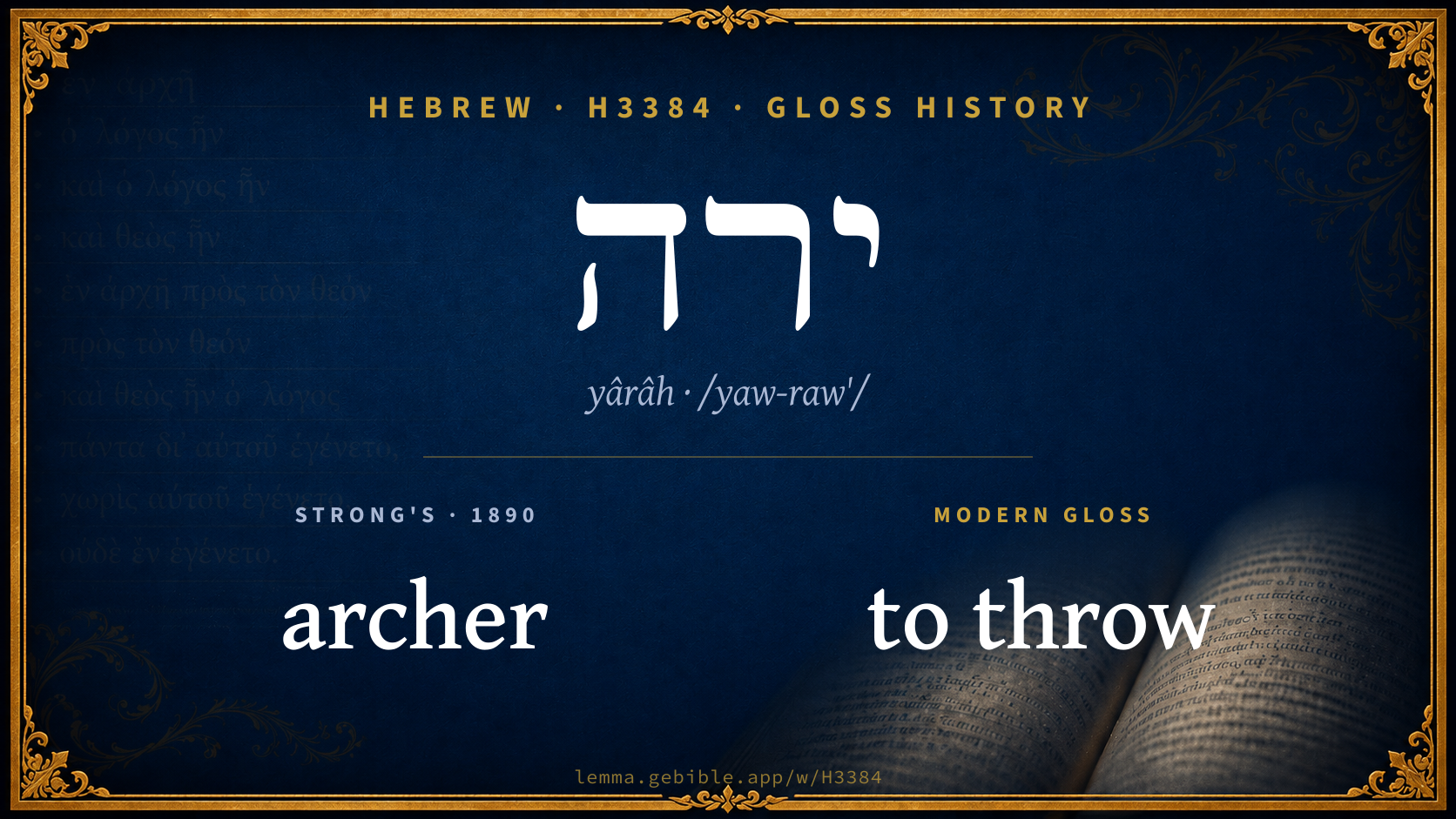
Gloss history
Strong's 1890 vs modern scholarship
About this word
Strong's H3384 catalogs a Hebrew word from the Hebrew Old Testament.
These counts are not copied from any lexicon or concordance. They are computed here, from the morphology-tagged Hebrew Old Testament. What Lemma adds →
- 75
- distinct verses
- The word appears in 75 distinct verses.
- 21 / 39
- OT books
- The word appears in 21 of 39 Old Testament books.
- #475
- by frequency
- Top 500 most frequent Hebrew words (rank 475 of 8,640 Hebrew words by occurrence).
View all 75 occurrences in the concordance →
By section of the Old Testament
By traditional corpus
Conventional, traditional groupings — biblical authorship is debated, so this is a traditional corpus grouping, not an authorship claim. Each share is this word’s portion of its verses in that division of the Hebrew canon. Each figure is a share of the word’s 75 distinct verses.
- Writings (Ketuvim) 31 verses · 41%
- Prophets (Nevi'im) 28 verses · 37%
- Torah (Pentateuch) 16 verses · 21%
How translations render this word
Counts come from each version’s own published word-to-Strong’s tagging or interlinear alignment — an approximate guide to how each version renders this word, not a word-level alignment the data otherwise carries. Because each total is that version’s own tagged count, the per-version totals vary from one another and need not match the appearance or distinct-verse counts above. These counts may also differ from a printed concordance because Lemma counts each distinctly tagged rendering and does not collapse phrase taggings into a single head-word total. This is a fixed set of word-tagged versions (KJV, ASV, BSB, ULT) and does not change with the reading translation you choose elsewhere. Each version’s license is shown beside its name below (and on Sources).
BDB lists this Strong’s number as 4 distinct words (homographs). Each count above pools all of them and is not split by sense — see the Senses section below. A low-frequency rendering may belong to a different one of those words, not the primary meaning.
- King James Version†: Teach 7×, Archers 5×, Shoot 5×
- American Standard Version†: Teach 6×, They shall teach 4×, Shall teach 3×
- Berean Standard Bible†: Teach me 5×, Archers 4×, Shoot 4×
- unfoldingWord Literal Text†: Shoot 6×, And 5×, Shooters 5×
King James Version Public Domain
Renders H3384 across 84† tagged occurrences — most commonly:
Plus 44 renderings that appear only once — usually multi-word phrases or single function words the recovered tagging swept in, not distinct renderings.
American Standard Version Public Domain
Renders H3384 across 82† tagged occurrences — most commonly:
Plus 49 renderings that appear only once — usually multi-word phrases or single function words the recovered tagging swept in, not distinct renderings.
Berean Standard Bible Public Domain
Renders H3384 across 78† tagged occurrences — most commonly:
Plus 50 renderings that appear only once — usually multi-word phrases or single function words the recovered tagging swept in, not distinct renderings. Not rendered by a distinct English word in 2 further occurrences.
unfoldingWord Literal Text CC BY-SA 4.0
Renders H3384 across 96† tagged occurrences — most commonly:
Plus other, less common renderings. Plus 49 renderings that appear only once — usually multi-word phrases or single function words the recovered tagging swept in, not distinct renderings.
35 senses and sub-senses in the full BDB
Hebrew verbs can shift meaning by stem (binyan): Qal is the basic action, Niphal is often passive or reflexive, Piel often intensifies or makes it factitive, and Hiphil is typically causative. The senses below are grouped under the stem BDB assigns to each.
What do BDB’s symbols mean?
BDB uses these scholarly abbreviations:
| Symbol | Meaning |
|---|---|
| 𝔊 | the Septuagint (the ancient Greek translation, LXX) |
| 𝔙 | the Vulgate (the Latin translation) |
| 𝔖 | the Syriac version (the Peshitta) |
| 𝔗 | the Targum (the Aramaic translation) |
| ψ | the Psalms |
| √ | root (the underlying root or stem) |
| ‖ | parallel passage (a synonymous or contrasted parallel) |
| † | the dagger: every passage where the word occurs is cited |
The 35 senses and sub-senses the full Brown-Driver-Briggs lexicon distinguishes for this word, in lexicon order (not ranked by frequency), with BDB’s own verbatim wording and sub-sense lettering. Shown in Hebrew script with BDB’s own scholarly abbreviations. The condensed entry is in the Lexicon Entry tab. See also the Forms in the corpus table below.
ירה I fear (NH id.
Qal
- Pf. יר׳ Gn 19:30 + 14 times; 3 f. יָֽרְאָה Je 3:8 ψ 76:9; יָרֵ֑אָה Gn 18:15; pl. 2 m. יְרֵאתֶם Nu 12:8 + 2 times; + 23 times Pf.; Impf. יִירָא Am 3:8 + 3 times; וַיִּירָא Gn 28:17 + 5 times; וַיִּרָא Je 26:21 + 5 times; pl. יִירְאוּ (יִֽרְאוּ) 23:4 +; יִרָאוּן Dt 13:12, +, etc.; 136 times Impf.; Imv. יְרָא Pr 3:7 + 3 times; יְראוּ Jos 24:14 + 2 times; Inf. cstr. יְרֹא Jos 22:25; לֵרֹא 1 S 18:29 (Ges§ 69, R. i.); לְיִרְאָה Dt 4:10 + 13 times; sf. יִרְאָתוֹ 2 S 3:11; יִרְאָתָם Is 29:13; יְרָאתֶם Jos 4:24 (read יִרְאָתָם Bö§ 1081 a Ew337 b Di etc.); Pt. יָרֵא Gn 32:12 + 15 times; cstr. יְרֵא 22:12 + 10 times; pl. יְרֵאִים Je 42:11 + 6 times; cstr. יִרְאֵי Ex 18:21 + 12 times; f. cstr. יִרְאַת Pr 31:30;— e.g. Genesis 19:30
- 1. fear, be afraid (not in P):
- a. abs. Gn 3:10; 18:15; 32:8; 43:18 Ex 14:10 (J), Gn 20:8; 28:17; 42:35 Ex 2:14 Jos 10:2 (E), Dt 20:8; 31:8 Ju 7:3; 8:20 1 S 4:7; 17:11, 24; 23:3; 28:5; 31:4 = 1 Ch 10:4, 2 K 10:4 2 Ch 20:3 Ne 2:2; 6:13 Is 54:14 Je 3:8; 23:4; 26:21 Am 3:8 Jon 1:5, 10 ψ 27:3; 46:3; 49:6 (but Bae reads ראה) 56:4, 5, 12; 64:5, 10; 76:9; 112:8; 118:6 Pr 14:16 Jb 6:21; 11:15; (וּ, י)אַל־תִּירָא fear not Gn 15:1; 21:17; 35:17; 50:19, 21 Ex 20:20 Jos 10:25 (E), Gn 26:24; 43:23 Ex 14:13 Jos 8:1 (J), Dt 1:21; 20:3; 31:6 Ju 4:18; 6:23 1 S 4:20; 12:20; 22:23; 23:17; 28:13 2 S 9:7; 13:28 1 K 17:13 2 K 6:16 1 Ch 22:13; 28:20 2 Ch 20:17 Is 7:4; 35:4; 40:9; 41:10, 13, 14; 43:1, 5; 44:2; 54:4 Je 30:10; 46:27, 28 Jo 2:21, 22 Zp 3:16 Hg 2:5 Zc 8:13, 15 ψ 49:17 La 3:57 Dn 10:12, 19 Ru 3:11; יִשְׁמְעוּ וי׳ hear and fear Dt 13:12; 17:13; 19:20; 21:21; (י)ראו וי׳ see and fear ψ 40:4; 52:8 Is 41:5 Zc 9:5. e.g. Genesis 3:10
- b. c. acc. rei or pers. Nu 14:9(×2) (J), 21:34 (E), Dt 3:2, 22 Ju 6:27 1 S 15:24 2 S 3:11 1 K 1:51 Is 8:12; 51:7; 57:11 Ez 3:9; 11:8 Hb 3:2 (acc. פעלךָ in corrected rhythm), ψ 23:4 Dn 1:10; acc. of God (י׳) 1 S 12:18 2 S 6:9 = 1 Ch 13:12 Is 57:11 Je 5:22 Jon 1:16 Jb 9:35; 37:24. e.g. Numbers 14:9
- c. with מִן be afraid of, Dt 1:29; 2:4; 7:18; 20:1; 28:10 Jos 10:8 (D) 1 S 28:20 2 K 25:24 Is 10:24; 51:12 Je 10:5; 42:11, 16 Ez 2:6(×3) Mi 7:17 ψ 3:7; 27:1; 65:9; 91:5; 112:7; 119:120 Pr 3:25; 31:21 Jb 5:21, 22 Ec 12:5; with מִפְּנֵי Dt 5:5; 7:19 Jos 9:24; 11:6 (D), 1 S 7:7; 18:29; 21:13 1 K 1:50 2 K 1:15; 19:6 (= Is 37:6) 25:26 2 Ch 20:15; 32:7 Ne 4:8 Je 1:8; 41:18; 42:11(×2); מִלִּפְנֵי 1 S 18:12, with בְּ because of, for Je 51:46. e.g. Deuteronomy 1:29
- d. with inf. and לְ fear to do a thing Gn 19:30; 26:7 (J), Nu 12:8 (E), Ju 7:10 2 S 1:14; 10:19; 12:18; with infin. and מִן, afraid of doing Gn 46:3 Ex 3:6 (E), 1 S 3:15 Je 40:9 Jb 32:6. e.g. Genesis 19:30
- e. with פֶּן fear lest Gn 31:31 (E) 32:12 (J). e.g. Genesis 31:31
- 2. stand in awe of, with מן and inf. וַיִּירְאוּ מִגֶּשֶׁת אֵלָיו Ex 34:30 (P) and they stood in awe of drawing nigh unto him; יִירְאוּ מֵיהוה וגו׳ ψ 33:8 let all the earth stand in awe of Yahweh; וְיָרֵאתָ מֵאֱלהֶיךָ and thou shalt stand in awe of thy God Lv 19:14, 32; 25:17, 36, 43 (all H); with מִפְּנֵי, of the king Solomon 1 K 3:28; מִפְּנֵי י׳ אלהים Ex 9:30 (J?); מפני י׳ Hg 1:12; (אלהים) י׳ מלפני stand in awe before (God) Ec 3:14; 8:12, 13. e.g. Exodus 34:30
- 3. fear, reverence, honour, e.g. parents Lv 19:3 (H), Moses and Joshua Jos 4:14(×2), the oath 1 S 14:26 Ec 9:2, commandment Pr 13:13, the sanctuary Lv 19:30; 26:2 (H), other gods Ju 6:10 2 K 17:7, 35, 37, 38; elsewhere of God: e.g. Leviticus 19:3
- a. abs. Je 44:10. e.g. Jeremiah 44:10
- b. with acc. (ה)אלהים Gn 42:18 Ex 1:17, 21; 18:21 (E), Dt 25:18 ψ 55:20; 66:16 Jb 1:1, 8, 9; 2:3 Ec 5:6; 7:18; 8:12; 12:13 Ne 7:2; יר׳ יהוה Ex 14:31 (J), Jos 22:25 (P), 24:14 (E), 1 S 12:14, 24 1 K 18:3, 12 2 K 4:1; 17:25, 28, 32, 33, 34, 41 Is 50:10 Je 26:19 Ho 10:3 Jon 1:9 Mal 3:16(×2) ψ 15:4; 22:24; 25:12; 34:10; 112:1; 115:11, 13; 118:4; 128:1, 4; 135:20 Pr 3:7; 14:2; 24:21; 31:30; יר׳ י׳ אֱלֹהֶיךָ (and other sfs.) Dt 6:2, 13, 24; 10:12, 20; 14:23; 17:19; 31:12, 13 Jos 4:24 (D), 2 K 17:39 Je 5:24; with sfs. referring to Yahweh or Elohim Dt 4:10; 5:26; 8:6; 13:5 1 K 8:40, 43 = 2 Ch 6:31, 33, 2 K 17:36 Is 25:3; 29:13 Je 10:7; 32:39 Mal 2:5; 3:5 Zp 3:7 ψ 22:26; 25:14; 31:20; 33:18; 34:8, 10; 60:6; 67:8; 72:5; 85:10; 103:11, 13, 17; 111:5; 119:63, 74, 79; 145:19; 147:11; הַיָּרֵא אֶת־דְּבַר י׳ Ex 9:20 he that feared the word of Yahweh (J); the name (of Yahweh) Dt 28:58 Is 59:19 Mal 3:20 ψ 61:6; 86:11; 102:16 Ne 1:11. e.g. Genesis 42:18
Niphal
- Impf. 2 m. תִּוָּרֵא ψ 130:4; Pt. נוֹרָא Gn 28:17 + 33 times; f. נוֹרָאָה Is 21:1; pl. נוֹרָאוֹת 64:2 + 5 times; נוֹרָאֹת Dt 10:21; נֹרָאוֹת 2 S 7:23; sf. נוֹרְאוֹתֶיךָ ψ 145:6;— e.g. Psalms 130:4
- 1. be fearful, dreadful, e.g. wilderness Dt 1:19; 8:15, land Is 21:1, people 18:2, 7 Hb 1:7, ice (in sim.) כְּעֵין הַקֶּרַח הנ׳ Ez 1:22 (del. 𝔊 Co). e.g. Deuteronomy 1:19
- 2. cause astonishment and awe: of Yahweh himself ψ 47:3; 68:36; 76:8; נוֹרָא תְהִלֹּת awe-inspiring in praises Ex 15:11 (song); עַל־אלוהּ נוֹרָא הוֹד awe-inspiring majesty (is) upon Eloah Jb 37:22; c. לְ, to kings of the earth ψ 76:13; c. על of hostile nations Zp 2:11; of י׳’s doings Ex 34:10 (J) ψ 66:3, 5; (ה)נוראות wonderful, glorious things, of Messianic king 45:5; of Yahweh himself Dt 10:21 2 S 7:23 = 1 Ch 17:21 Is 64:2 ψ 106:22; 145:6; נו׳ adverbially in ψ 65:6; 139:14 Ges§ 118. 5. b DaSynt. § 70(b); יוֹם י׳ הגדול והנורא the great and awful day of Yahweh Jo 3:4 Mal 3:23 cf. Jo 2:11. e.g. Psalms 47:3
- 3. inspire reverence, godly fear, and awe:
- a. as attribute of God, לְמַעַן תִּוָּרֵא that thou mightest be revered ψ 130:4; (ה)גָּדוֹל ו(ה)נוֹרָא (the) great and awful (God) Dt 7:21; 10:17 Ne 1:5; 4:8; 9:32 Dn 9:4; with עַל, above all gods ψ 96:4 = 1 Ch 16:25; above the angels round about him ψ 89:8. e.g. Psalms 130:4
- b. of the name of Yahweh Dt 28:58 ψ 99:3; 111:9 Mal 1:14. e.g. Deuteronomy 28:58
- c. of sacred things: מלאךְ האלהים Ju 13:6; place of theophany Gn 28:17 (E). e.g. Judges 13:6
Piel
- Pf. 3 m. sf. יֵֽרְאֻנִי 2 S 14:15; Inf. sf. לְיָֽרְאֵנִי Ne 6:19; לְיָֽרְאָם 2 Ch 32:18; Pt. pl. מְיָֽרְאִים Ne 6:9, 14 make afraid, terrify, with acc. e.g. 2 Samuel 14:15
ירה II verb. v. supr. Pt.
ירה III throw, shoot (NH shoot, Hiph. teach
Qal
- Pf. יר׳ Ex 15:4 + 3 times; 1 s. יָרִיתִי Gn 31:51 Jos 18:6; Impf. 1 pl. sf. וַנִּירָם Nu 21:30 (SS after 𝔊 וְנִינָם, see Ges§ 76 (2) e); Imv. יְרֵה 2 K 13:17; Inf. abs. יָרֹה Ex 19:13; cstr. לִיר(וֹ)ת ψ 11:2; 64:5; Pt. יֹרֶה Pr 26:18; pl. יוֹרִים 1 Ch 10:3; יֹרִים 2 Ch 35:23;— e.g. Exodus 15:4
- 1. throw, cast, with acc.: cast lots Jos 18:6 (E); army into (בְּ) the sea Ex 15:4 (song). e.g. Joshua 18:6
- 2. cast (= lay, set), corner-stone Jb 38:6; pillar Gn 31:51 (E; v. Zinj. supr.) e.g. Job 38:6
- 3. shoot arrows, abs. Ex 19:13 (E) 2 K 13:17; acc. of arrows 1 S 20:36, 37 Pr 26:18; acc. pers. Nu 21:30 (song, E) ψ 64:5; with לְ pers. 11:2; י(וֹ)רִים archers 1 Ch 10:3 2 Ch 35:23. e.g. Exodus 19:13
- 4. throw water, rain: Ho 6:3, but v. יוֹרֶה early rain (cf. Hiph. 3). e.g. Hosea 6:3
Niphal
- Impf. יִיָּרֶה shot through (with arrows) Ex 19:13 (E). e.g. Exodus 19:13
Hiphil
- Pf. 3 ms. sf. הֹרַנִי Jb 30:19 (הֹרָנִי Baer); הוֹרָהוּ 2 K 12:3; הוֹרֵתָ֑נִי ψ 119:102; 1 s. וְהוֹרֵיתִ֫י Ex 4:15 1 S 12:23; sf. הֹרֵיתִיךָ Pr 4:11; הוֹרֵיתִיךָ Ex 4:12; Impf. יוֹרֶה ψ 25:8 + 5 times; וַיּוֹר 2 K 13:17 (for this and other forms see Ges§ 76 (2) e); וַיֹּרֵנִי Pr 4:4; יוֹרֵנוּ Ju 13:8 + 2 times; יוֹרֶנּוּ ψ 25:12 Is 28:26; וַיּוֹרֵהוּ Ex 15:25; יֹרֵם 2 K 17:27 ψ 64:8; 2 f. sf. תּוֹרְךָ ψ 45:5; תֹּרֶ֑ךָּ Jb 12:7, 8; 2 m. sf. תּוֹרֵם 1 K 8:36 = 2 Ch 6:27; 1 s. אוֹרֶה 1 S 20:20 Jb 27:11; sf. אוֹרְךָ ψ 32:8; 3 mpl. יוֹרוּ Dt 24:8 + 3 times; יֹרוּ 2 S 11:20 2 Ch 35:23; יֹרֻהוּ ψ 64:5; יוֹרוּךָ Dt 17:10 + 2 times; Imv. sf. הֹרֵנִי Jb 34:32; הוֹרֵנִי ψ 27:11 + 2 times; pl. sf. הוֹרוּנִי Jb 6:24; Inf. cstr. הוֹרֹת Gn 46:28 + 3 times; הוֹרֹתָם Ex 24:12; Pt. מוֹרֶה 1 S 20:36 + 5 times; מֹרֶה Pr 6:13; pl. מוֹרִים 1 S 31:3 + 2 times; sf. מוֹרָ֑י Pr 5:13; מוֹרֶיךָ Is 30:20(×2);— e.g. Job 30:19
- 1. throw, cast, with ל, into the mire Jb 30:19. e.g. Job 30:19
- 2. shoot (arrows) 1 S 20:20, 36 2 S 11:20 2 K 13:17; 19:32 = Is 37:33; with ל, of pers. 2 Ch 35:23; acc. pers. ψ 64:5, 8; מוֹרִים archers 1 S 31:3(×2) 1 Ch 10:3. e.g. 1 Samuel 20:20
- 3. throw water, rain: וְיוֹרֶה צֶדֶק לָכֶם Ho 10:12 and rain righteousness for you (Thes al. under 5); hence מוֹרֶה early rain (cf. Qal 4). e.g. Hosea 10:12
- 4. point out, shew: לְהוֹרֹת לְפָנָיו גּשְׁנָה Gn 46:28 (J) to point out before him (the way) to Goshen; מֹרֶה בְּאֶצְבְּעֹתָיו Pr 6:13 pointing out with his fingers; acc. pers. et rei Ex 15:25 (JE) ψ 45:5 Jb 6:24. e.g. Genesis 46:28
- 5. direct, teach, instruct:
- a. of men, abs. Bezalel in handicraft Ex 35:34 (P); c. acc. pers., a father his son Pr 4:4; the ancients Job Jb 8:10; the animals and the earth, the friends of Job 12:7, 8; c. 2 acc. Is 28:9; בּדֶרֶךְ in the way 1 S 12:23 ψ 25:8; 32:8 Pr 4:11; בְּיַד־אֵל concerning the hand of Ēl Jb 27:11.—מוֹרֶה שֶׁקֶר teaching lies is used of prophet Is 9:14. e.g. Exodus 35:34
- b. specially of the authoritative direction (v. תּוֹרָה) given by priests on matters of ceremonial observance, with acc. rei and לְ pers. Dt 33:10 (song), they teach thy judgments to Jacob, and thy direction (law) to Israel; double acc. 17:10, 11 according to the direction, wherewith they direct thee; 24:8 (on leprosy), Lv 10:11 (P), abs. 14:57 (P), 2 Ch 15:3 כֹּהֵן מוֹרֶה, Ez 44:23 the Zadokite priests את־עמי יֹרוּ בֵּין קֹדֶשׁ לְחֹל; Mi 3:11 the priests give such ‘direction’ for hire; less technically, of Moses Ex 24:12 (E), of Jehoiada 2 K 12:3, of the Samaritan priests 2 K 17:27, 28. e.g. Deuteronomy 33:10
- c. of God; c. acc. pers. Is 28:26 ψ 119:102; double acc. Ex 4:12, 15 (J), Ju 13:8 Jb 34:32 1 K 8:36 (= אֶל הַדֶּרֶךְ 2 Ch 6:27), ψ 27:11; 86:11; 119:33; acc. pers. בְּדֶרֶךְ ψ 25:12; מִדְּרָכָיו of his ways Is 2:3 = Mi 4:2. e.g. Isaiah 28:26
- d. of idol-image Hb 2:18 (מוֹרֶה שָׁ֑קֶר), v 19. e.g. Habakkuk 2:18
ירה IV [m.] early rain, which falls in Palestine from the last of October until the first of December, opp. מַלְקוֹשׁ
Senses from the full Brown-Driver-Briggs lexicon (Brown, Driver, Briggs; Oxford 1906 — public domain), digitized via Sefaria, supplemented by the OpenScriptures HebrewLexicon (CC BY 4.0). Full attribution on Sources.
Word origin
I. vb. fear (NH id.; Assyrian îrû, id.; Hpt KAT2 Gloss i., COTGloss)—
II. adj. verb. v. supr. Pt.
I. vb. throw, shoot (NH shoot, Hiph. teach; Aramaic Aph. אוֹרִי teach; Ethiopic ወረወ jecit; Amh. warê is information, news, v. NöZMG 1886, 724; Assyrian ârû, lead, guide, DlHWB 241; têrtu, law, DlHA 49; Zinj. ירי set, found, DHMSendsch. 57, cf. 2 infr.—Buhl distinguished 3√ √ ירה: i. = throw, cf. mod. Arabic warra; ii. Hiph. = moisten, cf. רוה; iii. Hiph. = teach, cf. ראה, Arabic رأى, رَوَى; but evidence for this division hardly sufficient)—
I. n.[m.] early rain, which falls in Palestine from the last of October until the first of December, opp. מַלְקוֹשׁ: Dt 11:14 Je 5:24 Ho 6:3 (where MT makes יו׳ Pt., or Hiph. Impf., but v. We); cf. also i. מוֹרֶה. Vid. further RobBR i, 429 f. ChaplinPEF 1883, 8 ff. KleinZPV iv, 72 f.
— Brown-Driver-Briggs (Oxford 1906, public domain), digitized via Sefaria, supplemented by the OpenScriptures HebrewLexicon (CC BY 4.0). See Sources.
Origin: a primitive root
Jastrow Dictionary
A second Hebrew/Aramaic lexicon for comparison, covering Aramaic and post-biblical (Talmudic, Targumic, Midrashic) usage that the biblical-Hebrew BDB does not. Matched by lemma rather than by Strong’s number, so a lemma may carry more than one Jastrow headword (shown separately below), and the entries cover usage well beyond the Bible.
יָרָה
- , v. ירי
ירי
- to permeate, penetrate; to shoot forth. Nidd. 43ᵃ; Ḥag. 15ᵃ [read:] כל … שאינו יוֹרֶה כחץ אינה מזרעת (Ms. M. אינו מוליד; Ms. M. 2 שאינה יוֹרָה, v. Rabb. D. S. a. l. note) a spermatic emission which does not permeate (shoot forth) like an arrow, cannot fructify; Yeb. 65ᵃ היא קיימא לה בי׳ כחץ she can feel it whether the emission is permeating &c. Sifré Deut. 42 יוֹרֶה שמתכון … יורד וכ׳ the rain is called yoreh (shooting), for it is aimed at the earth with deliberation, and does not come down in a storm; Taan. 6ᵃ יורה שיורד בנחת.—2) to throw, shoot. Yalk. Gen. 133 לִירוֹת בב׳ ידיו to throw spears with both hands; v. infra.
- 1. to permeate. Sifré l. c. שמוֹרֶה ומרוה הארץ וכ׳ for it (the yoreh, v. supra) pervades and satisfies the earth and gives her drink down to the deep (Taan. l. c., Yalk. Deut. 863 only שמַרְוֶה).—[Y. Maasr. I, 49ᵃ top משיורו וכ׳, read: משיִרְווּ, v. רָוָה a. מַרְוִית.]
- 2. to point, aim at, shoot, cast. Lam. R. to I, 18 שלש … הוֹרוּ בו three hundred arrows did they shoot into his body; Y. Kidd. I, 61ᵃ bot. יורו במשיח וכ׳ (read: הורו or יָירוּ, Kal). Yalk. Gen. l. c. (fr. Midr. Vayisu) היה מוֹרֶה חניתית וכ׳ he threw spears with both hands &c. Ex. R. s. 3 (ref. to והיריתיך, Ex. IV, 12) מורה אני וכ׳ I shall shoot my words into thy mouth like an arrow; a. fr. e.g. Exodus 4:12
- 3. to point out, to direct, teach, instruct; to decide. Hor. I, 1 הוֹרוּ ב"ד וכ׳ if a court has (through error) directed to transgress one of the commands &c. Ib. 2 ה׳ ב"ד וידעו וכ׳ if a court has given a decision and finding out its mistake reversed it. Yeb. X, 2 הוֹרוּהָ ב"ד לינשא if a court instructed her that she may marry again. Ber. 31ᵇ; Erub. 63ᵃ כל המוֹרֶה הלכה בפני וכ׳ whoever decides a law-point in the presence of his teacher. Ab. V, 8 המוֹרִים בתורה וכ׳ who decide in religious matters against the law (by means of sophistry). Sabb. 19ᵇ ה׳ … כר׳ וכ׳ R. … decided in agreement with the opinion of &c.; a. fr. [Erub. 65ᵃ (a citation, from Sirach X, 26?; v., however, Rabb. D. S. a. l. note 70) בצר אל יוֹרֶה he who is in trouble, should give no opinion—applied by analogy to prayer in an unsettled condition of mind.]
A Dictionary of the Targumim, the Talmud Babli and Yerushalmi, and the Midrashic Literature (Marcus Jastrow; London, Luzac, 1903) — Public Domain. Digitized via Sefaria. Digitized via Sefaria. Full attribution on Sources.
Forms in the corpus
The 80 distinct written forms H3384 takes in the Hebrew Bible, most frequent first — each parse links to that stem’s occurrences in the concordance. Hebrew forms include their vowel points and cantillation, so a single lemma takes many written forms.
The 60 most common forms are shown; 20 rarer forms follow in the full concordance.
Same root — word family
Other BDB entries built from the same root as H3384, grouped by Strong’s listed origin. These share a root / origin per the lexicon — not necessarily a shared meaning. Each links to that word’s own entry.
Derived from this word
Proper names from this root
People and places named from this root — a name, not an additional meaning of the word.
- יורה Yôwrâh H3139 Jorah
- יורי Yôwray H3140 Jorai
- ירואל Yᵉrûwʼêl H3385 Jeruel
- יריאל Yᵉrîyʼêl H3400 Jeriel
- יריה Yᵉrîyâh H3404 Jerijah
Compare all same-root words → Showing 4 of 9 — not the complete family. 5 of the same-root words are proper names (people or places). They share a root, not necessarily a meaning.
Septuagint verse parallels
This word appears in 70 verses that also exist in the Greek Old Testament (Septuagint), out of the 75 Hebrew verses it occurs in. You can read those verses in Greek by switching the Old Testament edition to the Septuagint.
Read these verses in the Septuagint
- Genesis 46:28
- Exodus 4:12
- Leviticus 10:11
- Numbers 21:30
- Deuteronomy 17:10
- Joshua 18:6
- Judges 13:8
- 1 Samuel 12:23
- 2 Samuel 11:20
- 1 Kings 8:36
- 2 Kings 12:2
- 1 Chronicles 10:3
This is a verse-level parallel only — the same verses exist in both the Hebrew and Greek Old Testaments. No word-level Hebrew↔Greek correspondence is claimed: the data carries no such alignment, so no Greek word is shown as this Hebrew word’s translation. Coverage is not total — the Septuagint omits the deuterocanon and renumbers the Psalms, so some Hebrew verses have no direct Greek parallel.