
1 Kings 12:21

Hebrew (Westminster Leningrad Codex) 1 Kings 12:21 appears in the Hebrew Old Testament. The text above is from the Westminster Leningrad Codex. Each word links to its Strong’s number, a concise gloss, and parsing drawn from the Open Scriptures Hebrew Bible morphology. Click any word for its full Brown-Driver-Briggs (BDB) entry.
Download image
Cite this verse

1 Kings 12:21 (World English Bible). Public Domain. Lemma interlinear Bible study tool, https://lemma.gebible.app/v/1-kings/12/21.

Show BibTeX & RIS
BibTeX
RIS
English Translation
When Rehoboam was come to Jerusalem, he assembled all the house of Judah, and the tribe of Benjamin, a hundred and eighty thousand chosen men, who were warriors, to fight against the house of Israel, to bring the kingdom again to Rehoboam the son of Solomon.
World English Bible · Public Domain
Download a study sheet

One document with this verse’s original text, its word-by-word gloss line, the meaning frame, cross-references with their text, attributed commentary, and full source and license credits — printable, and it pastes into notes with its structure intact.

This verse Autodidact and up

Study sheet (.html) Plain text (.txt)

A passage Seminary Student

Up to 50 verses in one chapter. A passage sheet keeps up to 6 commentary sources and 12 cross-references per verse, in the order this page ranks them, and says so on the sheet whenever that leaves anything out. Ask for a single verse and you get the Autodidact verse sheet above.

Everything on this page stays free to read, with no account — the sheet is a download of what is already on screen, not access to it.

Want to remove ads? Support Godless Engineer
Compare translations 3

The same verse in 3 English versions, stacked beneath the original-language interlinear above. Click any original word for its lexicon entry.

Each is an independent rendering of the whole verse — the interlinear is not word-aligned to these translations.

Highlighted words mark where these versions differ — a whole-verse word diff, not a word-by-word alignment.

  • World English Bible Public Domain
    When Rehoboam was come to Jerusalem, he assembled all the house of Judah, and the tribe of Benjamin, a hundred and eighty thousand chosen men, who were warriors, to fight against the house of Israel, to bring the kingdom again to Rehoboam the son of Solomon.
  • King James Version Public Domain
    And when Rehoboam was come to Jerusalem, he assembled all the house of Judah, with the tribe of Benjamin, an hundred and fourscore thousand chosen men, which were warriors, to fight against the house of Israel, to bring the kingdom again to Rehoboam the son of Solomon.
  • unfoldingWord Literal Text CC BY-SA 4.0
    And Rehoboam entered Jerusalem, and he assembled all of the house of Judah and the tribe of Benjamin, 180,000 chosen makers of war, to fight with the house of Israel to return the kingdom to Rehoboam, the son of Solomon.

unfoldingWord Literal Text — © unfoldingWord, licensed CC BY-SA 4.0. Word-aligned USFM3 via Door43 (git.door43.org/unfoldingWord/en_ult).

Versions to compare (up to 4)

3 of 4 selected

Show all 18 translations

Every available English version of this verse, each an independent rendering of the whole verse.

  • World English Bible Public Domain
    When Rehoboam was come to Jerusalem, he assembled all the house of Judah, and the tribe of Benjamin, a hundred and eighty thousand chosen men, who were warriors, to fight against the house of Israel, to bring the kingdom again to Rehoboam the son of Solomon.
  • Berean Standard Bible Public Domain
    And when Rehoboam arrived in Jerusalem, he mobilized the whole house of Judah and the tribe of Benjamin—180,000 chosen warriors—to fight against the house of Israel and restore the kingdom to Rehoboam son of Solomon.
  • Majority Standard Bible Public Domain
    And when Rehoboam arrived in Jerusalem, he mobilized the whole house of Judah and the tribe of Benjamin—180,000 chosen warriors—to fight against the house of Israel and restore the kingdom to Rehoboam son of Solomon.
  • King James Version Public Domain
    And when Rehoboam was come to Jerusalem, he assembled all the house of Judah, with the tribe of Benjamin, an hundred and fourscore thousand chosen men, which were warriors, to fight against the house of Israel, to bring the kingdom again to Rehoboam the son of Solomon.
  • American Standard Version (1901) Public Domain
    And when Rehoboam was come to Jerusalem, he assembled all the house of Judah, and the tribe of Benjamin, a hundred and fourscore thousand chosen men, that were warriors, to fight against the house of Israel, to bring the kingdom again to Rehoboam the son of Solomon.
  • Revised Version (1885) Public Domain
    And when Rehoboam was come to Jerusalem, he assembled all the house of Judah, and the tribe of Benjamin, an hundred and fourscore thousand chosen men, which were warriors, to fight against the house of Israel, to bring the kingdom again to Rehoboam the son of Solomon.
  • Geneva Bible (1599) Public Domain
    And when Rehoboam was come to Ierusalem, he gathered all the house of Iudah with the tribe of Beniamin an hundreth and foure score thousand of chosen men (which were good warriours) to fight against the house of Israel, and to bring the kingdome againe to Rehoboam the sonne of Salomon.
  • Douay-Rheims (1899) Public Domain
    And Roboam came to Jerusalem, and gathered together all the house of Juda, and the tribe of Benjamin, a hundred four- score thousand chosen men for war, to fight against the house of Israel and to bring the kingdom again under Roboam the son of Solomon.
  • Young's Literal Translation Public Domain
    And Rehoboam cometh to Jerusalem, and assembleth all the house of Judah and the tribe of Benjamin, a hundred and eighty thousand chosen warriors, to fight with the house of Israel, to bring back the kingdom to Rehoboam son of Solomon.
  • Literal Standard Version CC BY-SA 4.0
    And Rehoboam comes to Jerusalem, and assembles all the house of Judah and the tribe of Benjamin, one hundred and eighty thousand chosen warriors, to fight with the house of Israel, to bring back the kingdom to Rehoboam son of Solomon.
  • Unlocked Literal Bible CC BY-SA 4.0
    When Rehoboam arrived in Jerusalem, he assembled all the house of Judah and the tribe of Benjamin; there were 180,000 chosen men who were soldiers, to fight against the house of Israel, to restore the kingdom to Rehoboam son of Solomon.
  • unfoldingWord Literal Text CC BY-SA 4.0
    And Rehoboam entered Jerusalem, and he assembled all of the house of Judah and the tribe of Benjamin, 180,000 chosen makers of war, to fight with the house of Israel to return the kingdom to Rehoboam, the son of Solomon.
  • Darby Bible Public Domain
    And Rehoboam came to Jerusalem; and he assembled all the house of Judah, with the tribe of Benjamin, a hundred and eighty thousand chosen men apt for war, to fight against the house of Israel, that he might bring the kingdom again to Rehoboam the son of Solomon.
  • World Messianic Bible Public Domain
    When Rehoboam had come to Jerusalem, he assembled all the house of Judah and the tribe of Benjamin, a hundred and eighty thousand chosen men who were warriors, to fight against the house of Israel, to bring the kingdom again to Rehoboam the son of Solomon.
  • Webster's Bible Public Domain
    And when Rehoboam had come to Jerusalem, he assembled all the house of Judah, with the tribe of Benjamin, a hundred and eighty thousand chosen men, who were warriors, to fight against the house of Israel, to bring the kingdom again to Rehoboam the son of Solomon.
  • Free Bible Version CC BY-SA 4.0
    When Rehoboam arrived in Jerusalem, he gathered the men from the households of Judah and Benjamin— 180,000 chosen warriors—to go and fight against Israel to bring the kingdom back to Rehoboam, son of Solomon.
  • Bible in Basic English Public Domain
    When Rehoboam came to Jerusalem, he got together all the men of Judah and the tribe of Benjamin, a hundred and eighty thousand of his best fighting-men, to make war against Israel and get the kingdom back for Rehoboam, the son of Solomon.
  • JPS Tanakh (1917) Public Domain
    And when Rehoboam was come to Jerusalem, be assembled all the house of Judah, and the tribe of Benjamin, a hundred and fourscore thousand chosen men that were warriors, to fight against the house of Israel, to bring the kingdom back to Rehoboam the son of Solomon.

Literal Standard Version (2020), Covenant Press — licensed CC BY-SA 4.0. Text via the HelloAO Bible API (eBible.org). Unlocked Literal Bible (unfoldingWord) — licensed CC BY-SA 4.0. Text via the HelloAO Bible API (eBible.org). unfoldingWord Literal Text — © unfoldingWord, licensed CC BY-SA 4.0. Word-aligned USFM3 via Door43 (git.door43.org/unfoldingWord/en_ult). Free Bible Version, Dr. Jonathan Gallagher — licensed CC BY-SA 4.0. Text via the HelloAO Bible API (eBible.org).

Word by word

More ways to search: Search by grammar → Find every occurrence → Compare this word →

Practice this passage: Drill this verse → Learn its vocabulary →

הַמְּלוּכָ֔ה
mᵉlûwkâh
H4410
“the · kingship”
Particle, Definite Article + Noun, Common, Feminine, Singular, Absolute
Part of Speech
Particle + Noun
Type
Common
Gender
Feminine
Number
Singular
State
Absolute
Full BDB Definition

Origin: pass. participle of H4427

TWOT: 1199d

kingship, royalty, kingly office
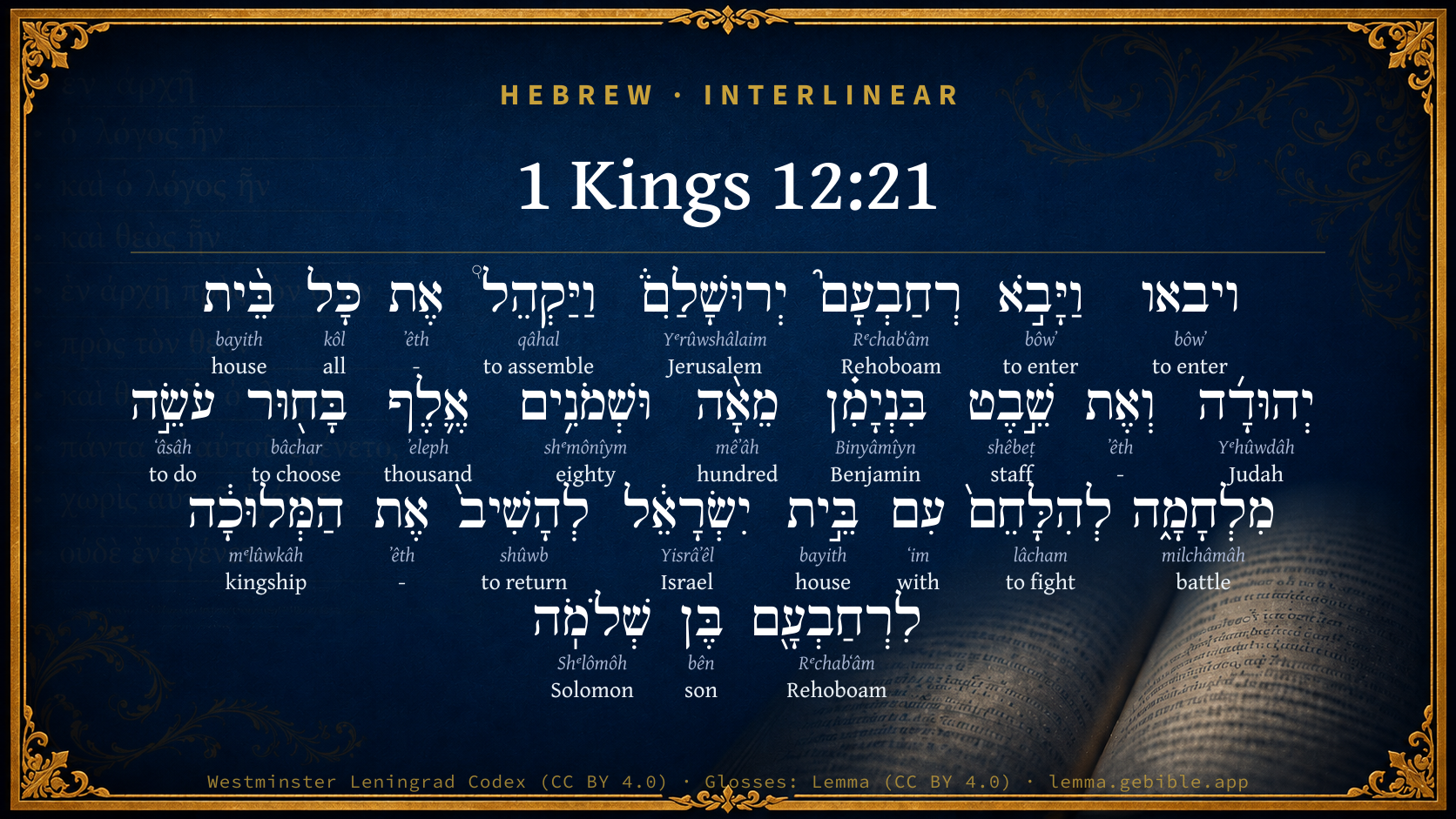
  1. ויבאו bôwʼ H935 “and · to enter” Conjunction + Verb, Qal, Sequential Imperfect, 3rd Person, Masculine, Plural
  2. וַיָּבֹ֣א bôwʼ H935 “and · to enter” Conjunction + Verb, Qal, Sequential Imperfect, 3rd Person, Masculine, Singular
  3. רְחַבְעָם֮ Rᵉchabʻâm H7346 “Rehoboam” Noun, Proper
  4. יְרוּשָׁלִַם֒ Yᵉrûwshâlaim H3389 “Jerusalem” Noun, Proper
  5. וַיַּקְהֵל֩ qâhal H6950 “and · to assemble” Conjunction + Verb, Hiphil, Sequential Imperfect, 3rd Person, Masculine, Singular
  6. אֶת ʼêth H853 “-” Particle, Direct Object
  7. כָּל kôl H3605 “all of” Noun, Common, Masculine, Singular, Construct
  8. בֵּ֨ית bayith H1004 “house of” Noun, Common, Masculine, Singular, Construct
  9. יְהוּדָ֜ה Yᵉhûwdâh H3063 “Judah” Noun, Proper
  10. וְאֶת ʼêth H853 “and · -” Conjunction + Particle, Direct Object
  11. שֵׁ֣בֶט shêbeṭ H7626 “staff of” Noun, Common, Masculine, Singular, Construct
  12. בִּנְיָמִ֗ן Binyâmîyn H1144 “Benjamin” Noun, Proper
  13. מֵאָ֨ה mêʼâh H3967 “hundred” Adjective, Cardinal number, Both, Singular, Absolute
  14. וּשְׁמֹנִ֥ים shᵉmônîym H8084 “and · eighty” Conjunction + Adjective, Cardinal number, Both, Plural, Absolute
  15. אֶ֛לֶף ʼeleph H505 “thousand” Adjective, Cardinal number, Both, Singular, Absolute
  16. בָּח֖וּר bâchar H977 “chosen” Verb, Qal, Participle Passive, Masculine, Singular, Absolute
  17. עֹשֵׂ֣ה ʻâsâh H6213 “doing” Verb, Qal, Participle Active, Masculine, Singular, Construct
  18. מִלְחָמָ֑ה milchâmâh H4421 “battle” Noun, Common, Feminine, Singular, Absolute
  19. לְהִלָּחֵם֙ lâcham H3898 “to fight” Preposition + Verb, Niphal, Infinitive Construct
  20. עִם ʻim H5973 “with” Preposition
  21. בֵּ֣ית bayith H1004 “house of” Noun, Common, Masculine, Singular, Construct
  22. יִשְׂרָאֵ֔ל Yisrâʼêl H3478 “Israel” Noun, Proper
  23. לְהָשִׁיב֙ shûwb H7725 “to return” Preposition + Verb, Hiphil, Infinitive Construct
  24. אֶת ʼêth H853 “-” Particle, Direct Object
  25. לִרְחַבְעָ֖ם Rᵉchabʻâm H7346 “to/for · Rehoboam” Preposition + Noun, Proper
  26. בֶּן bên H1121 “son of” Noun, Common, Masculine, Singular, Construct
  27. שְׁלֹמֹֽה Shᵉlômôh H8010 “Solomon” Noun, Proper

About this verse

These counts appear in no published source. They are computed here, from the morphology-tagged text and Lemma’s own curated glosses. What Lemma adds →

28
words
23
distinct lemmas
Historical
section

Notable vocabulary

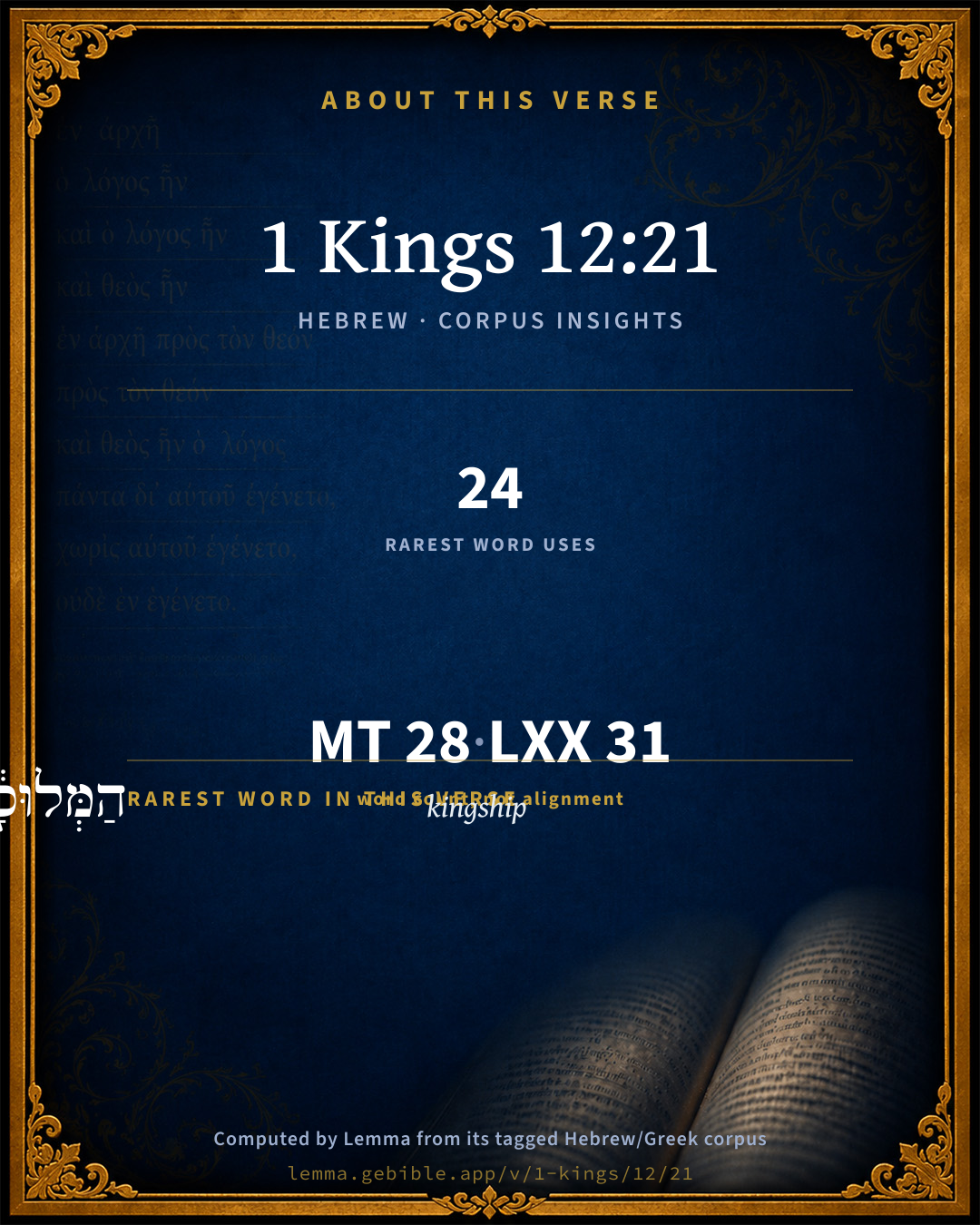
The rarest word here is הַמְּלוּכָ֔ה kingship H4410 — appearing just 24 times in the whole Hebrew Bible.

Shared distinctive vocabulary

הַמְּלוּכָ֔ה kingship H4410 occurs in 23 verses of the Hebrew Bible. Also found in:

Grammatical profile

  • 7 verbs
  • 14 nouns
  • 3 adjectives
  • 1 preposition
  • 3 particles

Verb forms

  • ויבאו Qal · Sequential Imperfect
  • וַיָּבֹ֣א Qal · Sequential Imperfect
  • וַיַּקְהֵל֩ Hiphil · Sequential Imperfect
  • בָּח֖וּר Qal · Participle Passive
  • עֹשֵׂ֣ה Qal · Participle Active
  • לְהִלָּחֵם֙ Niphal · Infinitive Construct
  • לְהָשִׁיב֙ Hiphil · Infinitive Construct

Repetition

Words recur within this verse — often emphatic in Hebrew:

  • ויבאו to enter H935 ×2
  • רְחַבְעָם֮ Rehoboam H7346 ×2
  • בֵּ֨ית house H1004 ×2

Hebrew & Septuagint length

In English translation the verse runs 46 words from the Hebrew and 42 from the Septuagint (LXX English) — closely comparable.

A rough comparison of the two English renderings, which tokenize alike — not a word-level alignment.

Word counts can differ between the Hebrew and the Greek without any difference in meaning — e.g. the Hebrew direct-object marker אֵת has no separate Greek word, and Greek often adds the article ὁ.

In the original languages it is 28 Hebrew tokens and 31 Greek tokens — but the two are counted differently (Hebrew bundles its prefixes and suffixes into one token; the Greek is in lemma form), so that isn’t a like-for-like length.

Cross-references

6

Topical passages linked to 1 Kings 12:21 in the Treasury of Scripture Knowledge — connected by theme and wording, ordered by reader-vote popularity; previews shown in the World English Bible.

  • 2 Chronicles 11:1–3 When Rehoboam was come to Jerusalem, he assembled the house of Judah and Benjamin, one hundred eighty thousand chosen men, who were warriors, to fight against Israel, to bring the kingdom again to Rehoboam.
  • 1 Chronicles 21:5 Joab gave up the sum of the numbering of the people to David. All those of Israel were one million one hundred thousand men who drew sword: and in Judah were four hundred seventy thousand men who drew sword.
  • 2 Chronicles 14:8 Asa had an army that bore bucklers and spears, out of Judah three hundred thousand; and out of Benjamin, that bore shields and drew bows, two hundred eighty thousand: all these were mighty men of valor.
  • 2 Chronicles 14:11 Asa cried to Yahweh his God, and said, Yahweh, there is none besides you to help, between the mighty and him who has no strength: help us, Yahweh our God; for we rely on you, and in your name are we come against this multitude. Yahweh, you are our God; don't let man prevail against you.
  • 2 Chronicles 17:14–19 This was the numbering of them according to their fathers' houses: Of Judah, the captains of thousands: Adnah the captain, and with him mighty men of valor three hundred thousand;
  • Proverbs 21:30–31 There is no wisdom nor understanding Nor counsel against Yahweh.

Cross-references courtesy of OpenBible.info (CC BY 4.0).

Hebrew and Greek witnesses Masoretic Hebrew ↔ Greek Septuagint

The same verse in the two great witnesses to the Old Testament, shown verse-for-verse.

These are two independent witnesses, not word-aligned to each other, and the Septuagint is shown in lemma (dictionary) form.

Hebrew 1 Kings 12:21 Masoretic · Westminster Leningrad Codex

ויבאו וַיָּבֹ֣א רְחַבְעָם֮ יְרוּשָׁלִַם֒ וַיַּקְהֵל֩ אֶת כָּל בֵּ֨ית יְהוּדָ֜ה וְאֶת שֵׁ֣בֶט בִּנְיָמִ֗ן מֵאָ֨ה וּשְׁמֹנִ֥ים אֶ֛לֶף בָּח֖וּר עֹשֵׂ֣ה מִלְחָמָ֑ה לְהִלָּחֵם֙ עִם בֵּ֣ית יִשְׂרָאֵ֔ל לְהָשִׁיב֙ אֶת הַמְּלוּכָ֔ה לִרְחַבְעָ֖ם בֶּן שְׁלֹמֹֽה

When Rehoboam was come to Jerusalem, he assembled all the house of Judah, and the tribe of Benjamin, a hundred and eighty thousand chosen men, who were warriors, to fight against the house of Israel, to bring the kingdom again to Rehoboam the son of Solomon.

World English Bible · Public Domain

Greek LXX 1 Kings 12:21 Septuagint · lemma form

καί ροβοαμ εἰςἔρχομαι εἰς ἰερουσαλήμ καί ἐκἐκκλησιάζω ὁ συναγωγή ιουδα καί σκῆπτρον βενιαμίν ἑκατόν καί εἴκοσι χιλιάς νεανίας ποιέω πόλεμος ὁ πολεμέω πρός οἶκος ἰσραήλ ἐπιστρέφω ὁ βασιλεία ροβοαμ υἱός σαλωμών

And Roboam went into Jerusalem, and he assembled the congregation of Juda, and the tribe of Benjamin, one hundred and twenty thousand young men, warriors, to fight against the house of Israel, to recover the kingdom to Roboam the son of Solomon.

LXX2012 (modern English Septuagint) · Public Domain

On this verse, The Cambridge Bible for Schools and Colleges discusses the Septuagint’s reading. Read the note in Commentary ↓

Hebrew: Westminster Leningrad Codex (CC BY 4.0). Greek: Septuagint (public domain); English from LXX2012 (modern English Septuagint) (Public Domain). How the Septuagint differs from the Hebrew →

Targum (Aramaic paraphrase)

1

The Targum is the ancient Jewish Aramaic paraphrase of the Hebrew Scriptures — an interpretive translation, not the Hebrew text itself. Onkelos (literal) and Pseudo-Jonathan (expansive) render the Torah, and Jonathan the Prophets. Coverage is partial: where no permissively-licensed English translation exists for a verse, only the Aramaic is shown. This is verse-level text, not a word-by-word alignment to the Hebrew.

  1. Targum Jonathan Prophets (Joshua–Malachi)
    וַאֲתָא רְחַבְעָם לִירוּשְׁלֵם וּכְנַשׁ יַת כָּל בֵּית יְהוּדָה וְיַת שִׁבְטָא דְבֵית בִּנְיָמִין מְאָה וְתַמְנָן אַלְפִין גְבַר גִבַּר עָבְדֵי קְרָבָא לְאַגָחָא קְרָבָא עִם בֵּית יִשְׂרָאֵל לַאֲתָבָא יַת מַלְכוּתָא לִרְחַבְעָם בַּר שְׁלֹמֹה:

    (no public-domain English translation for this verse)

    Targum Jonathan — Aramaic: “Mikraot Gedolot” (public domain). English: “Sefaria Community Translation” (CC0 1.0 (public-domain dedication)); “London "Chaldee Paraphrase," 1871” (public domain). Text via Sefaria.

Commentary

Notes on 1 Kings 12:21 from classic Christian and Jewish commentators (each source and its license shown beneath its notes). The classic Christian expositions comment on the surrounding passage and are grouped to its opening verse, so a note may address several verses; the Jewish commentaries on the Tanakh (Rashi and others) are per-verse, so they appear only where the commentator wrote on this verse.

Lemma curates 59 commentaries, every one of them public domain or Creative Commons licensed, each selected and text-cleaned for this edition rather than reprinted as found. About our sources →

Trapp's Complete Commentary

John Trapp

1Ki 12:21 And when Rehoboam was come to Jerusalem, he assembled all the house of Judah, with the tribe of Benjamin, an hundred and fourscore thousand chosen men, which were warriors, to fight against the house of Israel, to bring the kingdom again to Rehoboam the son of Solomon.

Ver. 21. To fight against the house of Israel.] But this was not the way now; since the counsel of the Lord, that must stand. Rehoboam should rather have taken up such a motto, as afterwards Otho II. Emperor of Germany did, Pacem cum hominibus, cum vitiis bellum; Let us quarrel with our friends, {a} and not with our fellow creatures.

{a} [Sic. (?) Faults.]

John Trapp, A Commentary or Exposition upon All the Books of the Old and New Testament (1647–1656) — public domain. Text from a community e-Sword module.

The Expositor's Bible

"JEROBOAM THE SON OF NEBAT, WHO MADE ISRAEL TO SIN"

1Ki_12:21-23.

"For from Israel is even this; the workman made it and it is no god: yea, the calf of Samaria shall be broken in pieces."

- Hos_8:6

THE condemnation of the first king of Israel sounds like a melancholy and menacing refrain through the whole history of the Northern Kingdom. Let us consider the extent and nature of his crime; for though the condemnation is most true if we judge merely by the issue of Jeroboams acts a mans guilt cannot always be measured by the immensity of its unforeseen consequences, nor can his actions and intentions be always fairly judged after the lapse of centuries. The moral judgments recorded in the Book of Kings concerning legal and ritual offences are measured by the standard of mens consciences nearly a century after Josiahs Reformation in B.C. 623, not by that which prevailed in B.C. 937, when Jeroboam came to the throne. It seems clear that, even in the opinion of his contemporaries, Jeroboam was unfaithful to the duties of the call which he had received from God; but it would be an error to suppose that his sin was, in itself, so heinous as those of which both Solomon and Rehoboam and other kings of Judah were guilty. "Calf-worship," as it was contemptuously called in later days, did not present itself as "calf-worship" to Jeroboam or his people. To them it was only the more definite adoration of Jehovah under the guise of the cherubic emblem which Solomon had himself enshrined in the Temple and Moses himself had sanctioned in the Tabernacle. There is not a word to show that they were cognizant of the book which had narrated the fierce reprobation by Moses of Aarons "golden calf" in the wilderness. Jeroboams chief sin was not that as a king he tolerated, or even set up, a sort of idolatry, but that he induced the whole body of his subjects to share in his evil innovations.

The charge brought against him was threefold. First, he set up the golden calves at Dan and Bethel. Secondly, he "made priests from among all the people, which were not of the sons of Levi." Thirdly, he established his "harvest feast" not on the fifteenth day of the seventh month, which was the Feast of Tabernacles, but on the fifteenth day of the eighth month. In estimating these sins let us endeavor-for it is a sacred duty-to be just.

1. We read in the Authorized Version that "he made priests of the lowest of the people," and this tends to increase the prejudice against him. But to have done this willfully would have been entirely against his own interests. The more honorable his priests were, the more was his new worship likely to succeed. The Hebrew only says that "he made priests of all classes of the people," or, as the Revised Version renders it, "from among all the people." No doubt this would appear to have been a heinous innovation, judged from the practice of later ages; it is not clear that it was equally so in the days of Jeroboam. If David, unrebuked, made his sons priests; if Ira the Ithrite was a priest; if Solomon, by his own fiat, altered the succession of the priesthood; if Solomon (no less than Jeroboam) arrogated to himself priestly functions on public occasions, the opinion as to priestly rights may not have existed in the days of Jeroboam, or may only have existed in an infinitely weaker form than in the days of the post-exilic chronicler. An incidental notice in another book shows us that in Dan, at any rate, he did not disturb the Levitic ministry. There the descendants of Jonathan, the son of Gershom, the grandson of Moses, continued their priestly functions from the day when that unworthy descendant of the mighty lawgiver was seduced to conduct a grossly irregular cult for a few shillings a year, down to the day when the golden calf at Dan was carried away by Tiglath-Pileser, King of Assyria. If the Levites preferred to abide by the ministrations of Jerusalem, and migrated in large numbers to the south, Jeroboam may have held that necessity compelled him to appoint priests who were not of the House of Levi. Neither for this, nor for his new feast of Tabernacles, nor for the calf-worship, were the kings of Israel condemned (so far as is recorded) even by such mighty prophets as Elijah and Elisha.

In choosing Dan and Bethel as the seats for his new altars, the king was not actuated by purely arbitrary considerations. They were ancient and venerated shrines of pilgrimage and worship {Jdg_18:30; Jdg_20:18; Jdg_20:26 1Sa_10:3} He did not create any sacredness which was not already attached to them in the popular imagination. In point of fact he would have served the ends of a worldly policy much better if he had chosen Shechem; for Dan and Bethel were the two farthest parts of his kingdom. Dan was in constant danger from the Syrians, and Bethel, which is only twelve miles from Jerusalem, more than once fell into the hands of the kings of Judah, though they neither retained possession of it, nor disturbed the shrines, nor threw down the "calf" of the new worship. Jeroboam could not have created the "calf-worship" if he had not found everything prepared for its acceptance. Dan had been, since the earliest days, the seat of a chapelry and ephod served by the lineal descendants of Moses in unbroken succession; Bethel was associated with some of the nations holiest memories since the days of their forefather Israel.

2. Again, if in Jeroboams day the Priestly Code was in existence, he was clearly guilty of unjustifiable willfulness in altering the time for observing the Feast of Tabernacles from the seventh to the eighth month. But if there be little or no contemporary trace of any observation of the Feast of Tabernacles-if, as Nehemiah tells us, it had not once been properly observed from the days of Joshua to his own, or if Jeroboam was unaware of any sacred legislation on the subject-the writers of the tenth century may have judged too severely the fixing of a date for the Feast of Ingathering, which may have seemed more suitable to the conditions of the northern and western tribes. For in parts of that region the harvest ripens a month earlier than in Judah, and the festival was meant to be kept at the season of harvest.

3. These, however, were but incidental and subordinate matters compared with the setting up of the golden calves.

Jeroboam felt that if his people flocked to do sacrifice at the new and gorgeous Temple in Jerusalem they would return to their old monarchy and put him to death. He wished to avoid the fate of Ishbosheth {2Sa_4:7} He believed that he should be doing both a popular and a politic act if he saved them from the burden of this long journey and again decentralized the cult which Solomon had so recently centralized. He determined, therefore, to furnish the Ten Tribes with high places, and temples of high places, and objects of worship which might rival the golden cherubim of Zion, and be honored with festal music and royal pomp.

He never dreamed either of apostatizing from Jehovah, or of establishing the worship of idols. He broke the Second Commandment under pretence of helping the people to keep the first. The images which he set up were not meant to be substitutes for the one God, the God of their fathers, the God who had brought them from the land of Egypt; they were regarded as figures of Jehovah under the well understood and universally adopted emblem of a young bull, the symbol of fertility and strength. Some have fancied that he was influenced by his Egyptian reminiscences, and perhaps by Ano, his traditional Egyptian bride. This is an obvious error. In Egypt living bulls were worshipped under the names of Apis and Mnevis, not idol-figures. Egyptian gods would have been strange reminders of Him who delivered His people from Egyptian tyranny. It would have been insensate, by quoting the very words of Aaron, to recall to the minds of the people the disasters which had followed the worship of the golden calf in the wilderness. Beyond all question, Jeroboam neither did nor would have dreamed of bidding his whole people to abandon their faith and worship Egyptian idols, which never found any favor among the Israelites. He only encouraged, them to worship Jehovah under the form of the cherubim. Whatever may have been the aspect of the cherubim in the Oracle of the Temple, cherubic emblems appeared profusely amid its ornamentation, and the most conspicuous object in its courts was the molten sea, supported on the backs of twelve bulls. It is true that later prophets and poets, like Hosea and the Psalmist, spoke in scorn of his images as mere "calves," and spoke of him as likening his Maker to "an ox that eateth hay." They even came in due time to regard them as figures of Baal and Astarte, but this view is falsified by the entire annals of the Northern Kingdom from its commencement to its close. Jeroboam was, and always regarded himself as, a worshipper of Jehovah. He named his son and destined successor Abijah ("Jehovah is my Father"). Rehoboam himself was a far worse offender than he was, so far as the sanction of idolatry was concerned.

And yet he sinned, and yet he made Israel to sin. It is true that he did not sin against the full extent of the light and knowledge vouchsafed to men in later days. The sift of which he was guilty was the sin of worldly policy. With professions of religion on his lips he pandered to the rude and sensuous instinct which makes materialism in worship so much more attractive to all weak minds than spirituality. Proclaiming as his motive the rights of the people, he accelerated their religious degeneracy. "The means to strengthen or ruin the civil power," says Lowth, "is either to establish or destroy the right worship of God. The way to destroy religion is to embrace the dispenser of it. This is to give the royal stamp to a piece of lead." If we may trust to Jewish tradition, there were some families in Israel who, though they clung to their old homes, and would not migrate to the south, yet refused to worship what is, not quite justly, called "the heifer Baal." The legendary Tobit (1. 4-7) boasts that "when all the tribes of Naphthali fell from the house of Jerusalem and sacrificed to the heifer Baal I alone went often to Jerusalem at the feasts," and, in general, observed the provisions of the Levitic law.

There seems to have been but little religion in Jeroboams temperament. In every other great national gathering at Shechem and other sacred places we read of religious rites. {1Sa_10:19; 2Sa_5:1-3; 1Ki_8:1-5} No mention is made of them, no allusion occurs respecting them, in the assembly to which Jeroboam owed his throne. He might at least have consulted Abijah, who had given him, when he was still a subject, the Divine promise and sanction of royalty. He might, had he chosen, have followed a higher and purer guidance than that of his own personal misgiving and his own arbitrary will. The error which he committed was this-he trusted in policy, not in the Living God. "It was," says Dean Stanley, "precisely the policy of Abder-Rahman, Caliph of Spain, when he arrested the movement of his subjects to Mecca, by the erection of a Holy Place of the Zeca at Cordova, and of Abd-el-Malik when he built the Dome of the Rock at Jerusalem, because of his quarrel with the authorities at Mecca." He was not guilty of revolt, for he acted under prophetic sanction; nor of idolatry, for he did not abandon the worship of Jehovah; but he broke the unity and tampered with the spiritual conception of the national worship. From worshipping God under a gross material symbol, the Israelites gradually learnt to worship other gods altogether; and the venerable sanctuaries of Dan and Bethel prepared the way for the temples of Ashtaroth and Bethel at Samaria and Jezreel. The religion of the kingdom of Israel at last sank lower than that of the kingdom of Judah against which it had revolted. The sin of Jeroboam the son of Nebat, who made Israel to sin, is the sin again and again repeated in the policy, half-worldly, half religious, which has prevailed through large tracts of ecclesiastical history. Many are the forms of worship which, with high pretensions, have been nothing else but so many various and opposite ways of breaking the Second Commandment. Many a time has the end been held to justify the means, and the Divine character been degraded by the pretence, or even the sincere intention, of upholding His cause, for the sake of secular aggrandizement; for the sake of binding together good systems, which it was feared would otherwise fall to pieces; for the sake of supporting the faith of the multitude for fear they should otherwise fall away to rival sects, or lest the enemy should come and take away their place and nation. False arguments have been used in support of religious truths, false miracles promulgated or tolerated, false readings in the sacred text defended And so the faith of mankind has been undermined by the very means intended to preserve it. The whole subsequent history is a record of the mode by which, with the best intentions, a Church and nation may be corrupted.

This view of Dean Stanley is confirmed by another wise teacher, Professor F.D. Maurice. Jeroboam, he says,

"did not trust the Living God. He thought, not that his kingdom stood upon a Divine foundation, but that it was to be upheld by certain Divine props and sanctions. The two doctrines seem closely akin. Many regard them as identical. In truth there is a whole heaven between them. The king who believes that his kingdom has a Divine foundation confesses his own subjection and responsibility to an actual living ruler. The king who desires to surround himself with Divine sanctions would fain make himself supreme, knows that he cannot, and would therefore seek help from the fear men have of an invisible power in which they have ceased to believe. He wants a God as the support of his authority. What God he cares very little."

And thus, to quote once more, "The departure from spiritual principles out of political motives surely leads to destruction, and is here portrayed for all times."

William Robertson Nicoll, ed., The Expositor's Bible (London: Hodder & Stoughton, 1887–1910) — public domain. 65 of 66 books (1 Corinthians is not separately keyed, as that volume carries no machine-parseable verse references); section-level commentary keyed to the opening verse. Introductory and overview sections not keyed to a specific passage are excluded.

Tyndale Open Study Notes

Tyndale Open Resources

12:21-24 Rehoboam resolved to restore the kingdom to himself by force, but he turned back when confronted with the message of the Lord through Shemaiah. The expression man of God emphasizes a prophet’s relationship to the Lord as his messenger. God’s prophets played a leading role in the history of the divided kingdom. Shemaiah apparently authored a history of Rehoboam’s reign (2 Chr 12:15).

Tyndale Open Study Notes — © Tyndale Open Resources, licensed CC BY-SA 4.0. Text via the HelloAO Bible API.

Geneva Bible (1599)

Geneva Bible translators

For as yet he perceived not that the Lord had so appointed it.

Geneva Bible (1599) marginal notes — public domain. Text via Bolls.life.

The Cambridge Bible for Schools and Colleges

gen. ed. J. J. S. Perowne

21–24. Rehoboam prepares to make war on Israel but this is forbidden by the Prophet Shemaiah (2Ch_11:1-4)

21. all the house of Judah, with the tribe of Benjamin] Called in 2 Chron. ‘the house of Judah and Benjamin.’ Thus Benjamin is shewn to have been, as it were, reckoned with Judah rather than as a separate tribe.

an hundred and fourscore thousand] The LXX. gives the number as 120,000. Though apparently enormous, neither number is excessive when we recall Joab’s numbering (2Sa_24:9), at which time the men of Judah were found to be 500,000. But subsistence for so large a population must have been very difficult to find in so small a state.

The Cambridge Bible for Schools and Colleges (gen. ed. J. J. S. Perowne; Cambridge University Press, 1878–1918) — public domain. Text from a community e-Sword module.

John Gill's Exposition

Speak unto Rehoboam the son of Solomon king of Judah,.... He is called king before, but of what tribe or tribes is not expressly said, only it is implied in Kg1 12:17 and he is only acknowledged king of Judah by the Lord himself:

and unto all the house of Judah and Benjamin; which made but one house, as before but one tribe, Kg1 11:36.

and to the remnant of the people; of the other tribes that might dwell among them at Jerusalem, and especially Simeon, whose inheritance was within the tribe of Judah, Jos 19:1.

saying: as follows.

John Gill's Exposition of the Whole Bible (1746–1763) — public domain (CC PDM 1.0). Text via the HelloAO Bible API.

Albert Barnes' Notes on the Bible

The adhesion of Benjamin to Judah at this time comes upon us as a surprise. By blood Benjamin was far more closely connected with Ephraim than with Judah. All the traditions of Benjamin were antagonistic to Judah, and hitherto the weak tribe had been accustomed to lean constantly on its strong northern neighhour. But it would seem that, in the half-century which had elapsed since the revolt of Sheba, the son of Bichri 2Sa 20:1, the feelings of the Benjamites had undergone a complete change. This is best accounted for by the establishment of the religious and political capital at Jerusalem, on the border line of the two tribes Jos 15:8; Jos 18:16, from where it resulted that the new metropolis stood partly within the territory of either, and was in a certain sense common to both. One of the gates of Jerusalem was “the high gate of Benjamin” Jer 20:2; and probably Benjamites formed a considerable part of the population. The whole tribe also, we may well believe, was sincerely attached to the temple worship, in which they could participate far more freely and more constantly than the members of remoter tribes, and to which the habits of forty years had now accustomed them.

On the number of the Israelites, see Exo 12:37, notes; and 2Sa 24:9, notes. The number mentioned here is moderate, compared with the numbers given both previously and subsequently 2Ch 13:3; 2Ch 17:14-18.

Albert Barnes' Notes on the Bible (1834–1885) — public domain. Text from a community e-Sword/MySword module.

Haydock's Catholic Bible Commentary

Fourscore. [Eighty.] Septuagint, "twenty." (Du Hamel) --- But the Alexandrian copy agrees with the Hebrew. (Haydock)

George Leo Haydock (1774–1849), Haydock's Catholic Family Bible and Commentary, 1859 edition — public domain. Excludes Psalms (Douay-Rheims chapter numbering differs from Protestant) and Deuterocanonical books (Catholic canon only).

Matthew Poole's English Annotations

With the tribe of Benjamin, i.e. that part of it which was next to Judah, and joined with them. See Poole "1Ki 11:13".

Against the house of Israel, i.e. the families or tribes (for these words are promiscuously used one for the other) of Israel.

Matthew Poole's English Annotations on the Holy Bible (1683–1685) — public domain. Text from a community e-Sword/MySword module.

Whedon's Commentary on the Bible

Daniel D. Whedon

21. With the tribe of Benjamin — It was natural that this tribe, lying as it did upon the border of Judah, and having Jerusalem, the royal city of David, even within its own territory, should adhere to the southern kingdom.

Daniel D. Whedon (gen. ed.), Commentary on the Old and New Testaments (1874–1909) — public domain. Text from a community e-Sword module.

The Pulpit Commentary

And when Rehoboam was come to Jerusalem, he assembled all the house of Judah with Heb. and the tribe of Benjamin, It is at first sight somewhat surprising that Benjamin, so long the rival of Judah, and which had so long resisted the rule of David, should on this occasion have detached itself from the leadership of Ephraim, its near and powerful neighbour, and a tribe, too, with which it had a sort of hereditary connexion. That a sort of jealousy existed at one time between the tribes of Benjamin and Judah, consequent, no doubt, on the transference of the sceptre from the house of Saul to that of David, is very evident. A thousand men of Benjamin constituted the following of the rebel Shimei. (2Sa_19:17) The rising of Sheba the Benjamite, again, (2Sa_20:1) proves that the enmity and discontent were not even then subdued. But when the ten tribes fell away, Benjamin seems never to have faltered in its allegiance. The change is easily accounted for. It was the glory of Benjamin that Jerusalem, the joy of the whole earth, the civil and religious capital of the nation, was largely within its border. "The city of the Jebusite" was in the lot of Benjamin. (Jos_18:28) But it was also on the boundary line of Judah. This fact had, no doubt, brought the two tribes into close contact, and had given them interests in common, in fact had "riveted them together as by a cramp" (Blunt, pp. 167, 174, who traces "a gradual tendency of the ten tribes to become confederate under Ephraim," and a growing alliance and community of interests between Judah and Benjamin); and now Benjamin could not fail to see that separation from Judah would mean the loss of Jerusalem (which would be largely peopled by the men of Judah, David"s tribe, and would be practically in their hands), while adhesion to Ephraim would not prevent the establishment of another sanctuary further north. The traditions of fifty years, consequently, and the common interest in the capital, prevailed over hereditary ties and ancient feuds, and decided Benjamin to cast in its lot with Judah; the more so, as the heads of this tribe may have felt, after once furnishing Israel with its king, as jealous of Ephraim as they had once been of Judah. It must not be forgotten, however, that some portions of Benjamin, including Bethel, Gilgal, and Jericho, were incorporated in the northern kingdom (Ewald), a hundred and fourscore thousand chosen men the LXX has eJkaton kai ejikosi=120, 000, but the larger number need create no astonishment. At the time of David"s census, the men of Judah numbered if the figures can be depended on 500, 000, while Abijah could muster some 18 years afterwards an army of 400, 000, (2Ch_13:3) which were warriors lit., making war, to fight against the house of Israel, to bring the kingdom again to Rehoboam, the son of Solomon. It is characteristic of Rehoboam that he proposes forthwith to subdue the rebellious tribes by force. Probably he had no idea to what extent the tribes would prove disloyal.

Vers. 21-24.

The Message of Shemaiah.

In the order of Providence the words of the prophet Ahijah became so far translated into history, that ten of the tribes of Israel had revolted from the son of Solomon and had made the son of Nebat their king. Rehoboam, unwilling to lose so important a portion of his kingdom, was now mustering a formidable army to reduce them to submission. At this juncture the word of the Lord came to Shemaiah. Let us consider

I THE MESSAGE.

1. It was the word of Jehovah.

(1) So it is worthy of all respect. It is the word of Infinite Wisdom and Knowledge. It is the word of the Supreme Arbiter.

(2) God does not speak immediately to men upon ordinary occasions. Indirectly He speaks to us evermore and in a million voices.

(3) Happy is that people among whom the voice of God is heard. This was eminently the happiness of Israel. It was a sad day in Israel when there was "no open vision". (1Sa_3:1)

2. It came by the hand of Shemaiah.

(1) God spake "in divers manners." By audible voice, as from Sinai; by urim, as in the temple; by dream; and by prophet, as in the present case.

(2) Ahijah was a man of God. Such in general were the prophets. But sometimes it pleased God to use persons of equivocal character; Balaam, Pharaoh, Nebuchadnezzar, Caiaphas. (Joh_11:49-52)

3. It came to the whole community.

(1) To Rehoboam. He was first mentioned as the head. Also because he was the principal cause of the mischief which he now sought to repair.

(2) To Judah and Benjamin. These tribes were so united as to be viewed as "one tribe," and are unitedly called "Judah." The temple was actually within Benjamin"s boundary.

(3) To the remnant of the people. These consisted of priests and Levites, and godly people out of all the tribes who were unwilling to separate themselves from the house of David. (2Ch 11:18-16)

4. It commanded peace.

(1) They were not to fight with their brethren. The case must be extreme that can justify a civil war. What miseries must have ensued if 180, 000 warriors of Judah had encountered a corresponding army of Israel!

(2) They were to submit to a revolution which was from the Lord. Not that God was the author of it, but permitted to be brought about by the king and his people for the punishment of their wickedness. "What is brought about in the course of God"s providence is considered and spoken of as done by Him as a general would say that he drew the enemy into a snare, which he had only laid in his way" (Julius Bate).

II ITS RECEPTION.

1. They hearkened to the word.

(1) They recognized it as the word of God. Shemaiah was known to be a "man of God." His message also agreed to that of Ahijah, the fulfilment of a part of which pledged the fulfilment of the remainder.

(2) To resist now would be to fight against God. This would be a hopeless business. But is not this the attitude of every sinner?

2. They returned to their houses.

(1) The remnant of Israel were naturally glad to be spared the horrors of a war with their brethren.

(2) So were the people of Judah and Benjamin. People are generally averse to war unless stirred up to it by their rulers. What a responsibility rests with war makers!

(3) Rehoboam is powerless without the people. He is now thoroughly cowed. The discipline was good for him. This was seen in the next three years of his reign. It were well if all men recognised God"s word when it comes to them. We have God"s word written in the Scriptures of truth. Do we take it homo to guide and control our conduct?

Vers. 21-33.

I AN ERROR THAT COULD NOT BE REPAIRED (verse 21-24). Rehoboam had zeal and strength behind him in his attempt to bring back the tribes by force. One hundred and eighty thousand men responded to his call; but all were dispersed at the lifting up of God"s hand. The attempt was forbidden,

1. Because of the ties of kindred. These were forgotten by Rehoboam when he threatened the people with a heavier yoke. Tyranny is possible only in the denial of the brotherhood of man. It was forgotten now as he gathered his hosts together. Wars are impossible in the recognition of the brotherhood of man. This is God"s word to the nations, to England as to the rest: "Ye shall not fight against your brethren.

2. Because the loss was of God. "This thing is from Me." These two thoughts assuage anger and beget repentance; they who are against us are our brethren, and the blow is from our Father"s hand. Our mistakes are permitted, and we eat their bitter fruit in God"s righteous judgment. Keep the way of love and lowly dependence on God. Every other is full of mistake and irreparable loss.

II THE BLINDNESS OF WORLDLY POLICY (vers. 25-33). Judged from a merely human standpoint, Jeroboam showed commendable foresight, and took effectual precautions against a great and possible danger. Yet he did not look far enough or high enough. The range of his vision did not embrace the mightiest of all forces. It shut out God, and every step he took ensured the destruction of the power he sought to guard,

1. His fear was unbelief. There did seem to be a danger in the recourse of the tribes to Jerusalem, but he had God"s promise that he would build him a sure house if he would do that which was right in God"s sight (11:38). Do not our fears go right in the face of the promises of God?

2. It was base forgetfulness of God"s mercy. The Lord had fulfilled part of what He had said. The very circumstances in which the fear arose (the possession of the kingdom) were thus its answer. Our fears not only deny God"s promises, but also the testimony of the past. Unbelief and ingratitude are the first steps in the path of sin. (Rom_1:21)

3. His defiance of God. When unbelief has shut Him out of the heart, His commandments are lightly esteemed. To suit the exigencies of state, God"s ordinances were overturned, other holy places were set up, the commandment against image worship broken, the priesthood and the feast time changed. Jeroboam"s sin lives still in our statecraft, in the conduct of our business, etc. God"s purpose regarding us and the world is nothing! His commandments are the only things that with safety can be disregarded!

4. His misdirected ingenuity. He cleverly takes advantage

(1) of the jealousy of the tribes. Why should Jerusalem be the only holy place, or Levi the one servant of God?

(2) He only repeats the sin, and quotes the words, of Aaron, and the fathers. (Exo_32:4)

(3) He uses places already consecrated, Bethel by Jacob"s vision and altar, and Dan, the shrine of Micah"s image. (Jud_1:18:30)

(4) He hides zeal for his own safety under the plea of care for the people"s convenience (ver. 28). Misused ability cannot shield from God"s judgment. In every step he took he was the more surely sealing his own

doom, and ensuring the final extinction of his people. "Be not deceived, God is not mocked. U.

The Pulpit Commentary (1880–1919), ed. H.D.M. Spence-Jones & Joseph S. Exell — public domain. Text from a community e-Sword module.

unfoldingWord translationNotes

Door43 World Missions Community

all the house of Judah and the tribe of Benjamin

Here "house" is a metonym that represents a tribe or descendants. And, here "tribe" refers specifically to the soldiers from those tribes. AT: "all the soldiers from the tribes of Judah and Benjamin" (See: Metonymy)

180,000 chosen men

"one hundred eighty thousand chosen men" (See: Numbers)

the house of Israel

Here "house" represents the kingdom made up of the 10 northern tribes of Israel. AT: "the kingdom of Israel" or "the people of the northern tribes of Israel" (See: Metonymy)

translationWords

Rehoboam

Jerusalem

house

Judah

Benjamin

restore

kingdom

son

Solomon

unfoldingWord translationNotes — © Distant Shores Media and the Door43 World Missions Community, licensed CC BY-SA 4.0. Source: git.door43.org/Door43/en_tn.

Rashi

Rabbi Shlomo Yitzchaki (Rashi)

And the tribe of Binyomin. Who were situated on the border, because the boundaries of Yehudah and Binyomin were adjacent.

Rashi on the Tanakh — English translations: “The Judaica Press complete Tanach with Rashi, translated by A. J. Rosenberg” (CC BY 4.0); “Pentateuch with Rashi's commentary by M. Rosenbaum and A.M. Silbermann, 1929-1934” (public domain); “The Metsudah Tanach series, Lakewood, N.J” (CC BY 4.0); and “The Book of Joshua, Metsudah Publications, 1997” (CC BY 4.0). Text via Sefaria.

Lesson kit

Teaching starters — assembled from the data on this page, not authored interpretation. Every prompt links to the verse data it draws on. Edit before teaching.

1 Kings, in the Historical, opens this verse with 28 words (23 distinct Hebrew lemmas). Its most distinctive word is mᵉlûwkâh (“kingship”). A historical commentator’s framing appears above. Read the whole chapter for the surrounding context.

Discussion questions

  1. What does “kingship” (mᵉlûwkâh) contribute to the verse as a whole?
  2. How does 1 Samuel 10:16, which shares the word «kingship», read alongside this verse?
  3. What does the repetition of “to enter” (2× in this one verse) do in this verse?
  4. These translations render this verse differently. What is at stake in choosing one wording over another?
  5. «ויבאו» is a Qal Sequential Imperfect verb. How does that grammatical form shape the action described?
  6. Compare how Trapp's Complete Commentary and The Expositor's Bible read this verse. Where do they agree or differ?

Things to notice

Reading settings

Reading text

Shown beneath each verse's original-language words.

Old Testament
Old Testament edition

Read the OT as the Masoretic Hebrew (MT) or the Greek Septuagint (LXX).

English shown for the Greek Septuagint (in the Hebrew ↔ Greek comparison).

Comparing translations? Open the Compare panel on any verse page to stack up to four side by side.