2 Chronicles 33:21

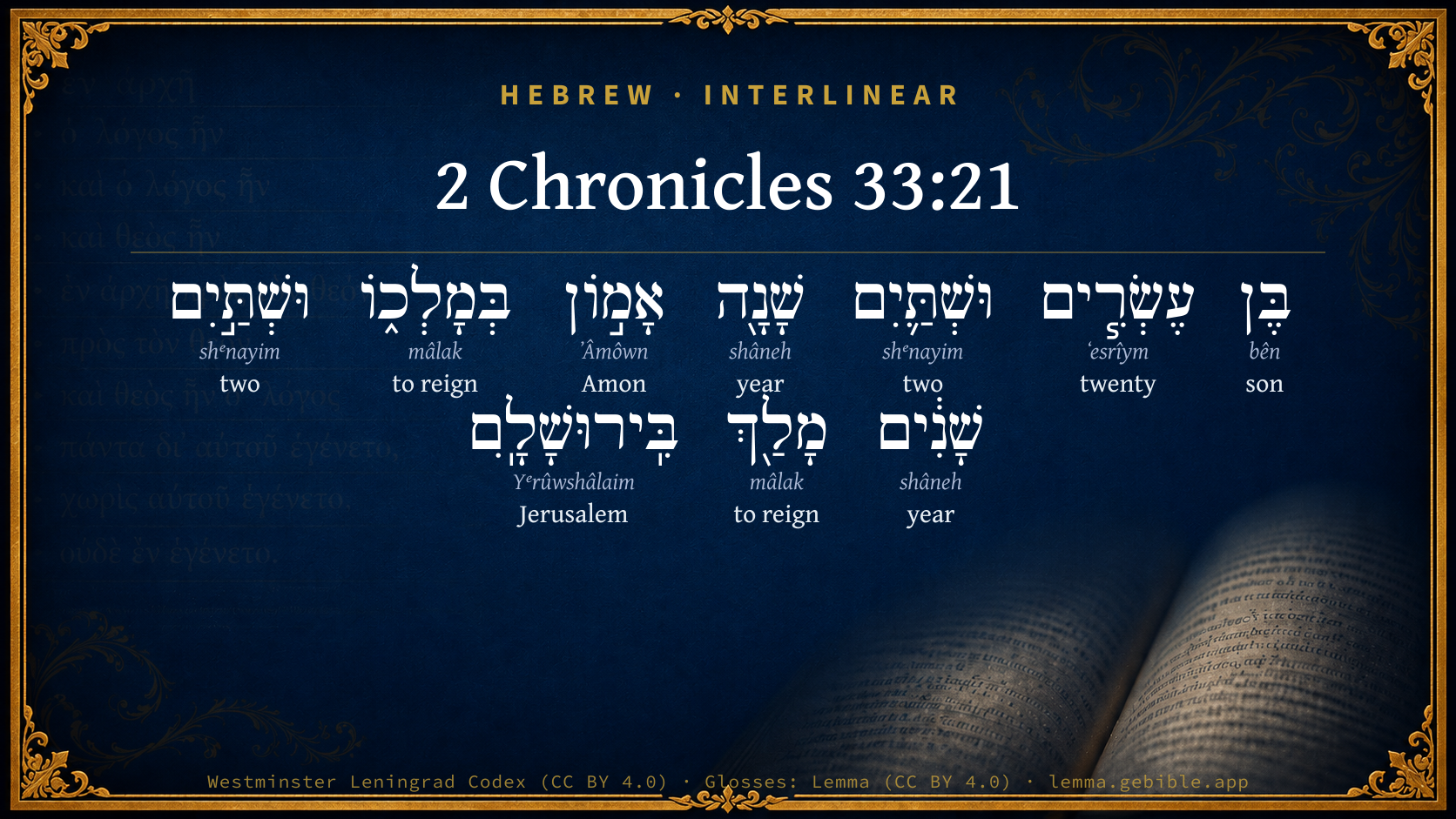
Hebrew (Westminster Leningrad Codex) 2 Chronicles 33:21 appears in the Hebrew Old Testament. The text above is from the Westminster Leningrad Codex. Each word links to its Strong’s number, a concise gloss, and parsing drawn from the Open Scriptures Hebrew Bible morphology. Click any word for its full Brown-Driver-Briggs (BDB) entry.
Download image
Cite this verse

2 Chronicles 33:21 (World English Bible). Public Domain. Lemma interlinear Bible study tool, https://lemma.gebible.app/v/2-chronicles/33/21.

Show BibTeX & RIS
BibTeX
RIS
English Translation
Amon was twenty-two years old when he began to reign; and he reigned two years in Jerusalem.
World English Bible · Public Domain
Download a study sheet

One document with this verse’s original text, its word-by-word gloss line, the meaning frame, cross-references with their text, attributed commentary, and full source and license credits — printable, and it pastes into notes with its structure intact.

This verse Autodidact and up

Study sheet (.html) Plain text (.txt)

A passage Seminary Student

Up to 50 verses in one chapter. A passage sheet keeps up to 6 commentary sources and 12 cross-references per verse, in the order this page ranks them, and says so on the sheet whenever that leaves anything out. Ask for a single verse and you get the Autodidact verse sheet above.

Everything on this page stays free to read, with no account — the sheet is a download of what is already on screen, not access to it.

Want to remove ads? Support Godless Engineer
Compare translations 3

The same verse in 3 English versions, stacked beneath the original-language interlinear above. Click any original word for its lexicon entry.

Each is an independent rendering of the whole verse — the interlinear is not word-aligned to these translations.

Highlighted words mark where these versions differ — a whole-verse word diff, not a word-by-word alignment.

  • World English Bible Public Domain
    Amon was twenty-two years old when he began to reign; and he reigned two years in Jerusalem.
  • King James Version Public Domain
    Amon was two and twenty years old when he began to reign, and reigned two years in Jerusalem.
  • unfoldingWord Literal Text CC BY-SA 4.0
    A son of 22 years was Amon when he became king; and two years he reigned in Jerusalem.

unfoldingWord Literal Text — © unfoldingWord, licensed CC BY-SA 4.0. Word-aligned USFM3 via Door43 (git.door43.org/unfoldingWord/en_ult).

Versions to compare (up to 4)

3 of 4 selected

Show all 18 translations

Every available English version of this verse, each an independent rendering of the whole verse.

  • World English Bible Public Domain
    Amon was twenty-two years old when he began to reign; and he reigned two years in Jerusalem.
  • Berean Standard Bible Public Domain
    Amon was twenty-two years old when he became king, and he reigned in Jerusalem two years.
  • Majority Standard Bible Public Domain
    Amon was twenty-two years old when he became king, and he reigned in Jerusalem two years.
  • King James Version Public Domain
    Amon was two and twenty years old when he began to reign, and reigned two years in Jerusalem.
  • American Standard Version (1901) Public Domain
    Amon was twenty and two years old when he began to reign; and he reigned two years in Jerusalem.
  • Revised Version (1885) Public Domain
    Amon was twenty and two years old when he began to reign; and he reigned two years in Jerusalem.
  • Geneva Bible (1599) Public Domain
    Amon was two and twentie yeere olde, when he began to reigne, and reigned two yeere in Ierusalem.
  • Douay-Rheims (1899) Public Domain
    Amen was two and twenty years old when he began to reign, and he reigned two years in Jerusalem.
  • Young's Literal Translation Public Domain
    A son of twenty and two years `is' Amon in his reigning, and two years he hath reigned in Jerusalem,
  • Literal Standard Version CC BY-SA 4.0
    Amon [is] a son of twenty-two years in his reigning, and he has reigned two years in Jerusalem,
  • Unlocked Literal Bible CC BY-SA 4.0
    Amon was twenty-two years old when he began to reign; he reigned two years in Jerusalem.
  • unfoldingWord Literal Text CC BY-SA 4.0
    A son of 22 years was Amon when he became king; and two years he reigned in Jerusalem.
  • Darby Bible Public Domain
    Amon was twenty-two years old when he began to reign; and he reigned two years in Jerusalem.
  • World Messianic Bible Public Domain
    Amon was twenty-two years old when he began to reign; and he reigned two years in Jerusalem.
  • Webster's Bible Public Domain
    Amon was two and twenty years old when he began to reign, and reigned two years in Jerusalem.
  • Free Bible Version CC BY-SA 4.0
    Amon was twenty-two when he became king, and he reigned in Jerusalem for two years.
  • Bible in Basic English Public Domain
    Amon was twenty-two years old when he became king; and he was ruling for two years in Jerusalem.
  • JPS Tanakh (1917) Public Domain
    Amon was twenty and two years old when he began to reign; and he reigned two years in Jerusalem.

Literal Standard Version (2020), Covenant Press — licensed CC BY-SA 4.0. Text via the HelloAO Bible API (eBible.org). Unlocked Literal Bible (unfoldingWord) — licensed CC BY-SA 4.0. Text via the HelloAO Bible API (eBible.org). unfoldingWord Literal Text — © unfoldingWord, licensed CC BY-SA 4.0. Word-aligned USFM3 via Door43 (git.door43.org/unfoldingWord/en_ult). Free Bible Version, Dr. Jonathan Gallagher — licensed CC BY-SA 4.0. Text via the HelloAO Bible API (eBible.org).

Word by word

More ways to search: Search by grammar → Find every occurrence → Compare this word →

Practice this passage: Drill this verse → Learn its vocabulary →

אָמ֣וֹן
ʼÂmôwn
H526
“Amon”
Noun, Proper
Part of Speech
Noun
Type
Proper
Full BDB Definition

Origin: the same as H525

TWOT: None

Amon = "skilled workman" or " master workman" - a king of Judah, son of Manasseh - a governor of Samaria - a descendant of a servant of Solomon
  1. בֶּן bên H1121 “son of” Noun, Common, Masculine, Singular, Construct
  2. עֶשְׂרִ֧ים ʻesrîym H6242 “twenty” Adjective, Cardinal number, Both, Plural, Absolute
  3. וּשְׁתַּ֛יִם shᵉnayim H8147 “and · two” Conjunction + Adjective, Cardinal number, Feminine, Dual, Absolute
  4. שָׁנָ֖ה shâneh H8141 “year” Noun, Common, Feminine, Singular, Absolute
  5. בְּמָלְכ֑וֹ mâlak H4427 “in/at · to reign · him” Preposition + Verb, Qal, Infinitive Construct + Suffix, Personal, 3rd Person, Masculine, Singular
  6. וּשְׁתַּ֣יִם shᵉnayim H8147 “and · two” Conjunction + Adjective, Cardinal number, Feminine, Dual, Absolute
  7. שָׁנִ֔ים shâneh H8141 “years” Noun, Common, Feminine, Plural, Absolute
  8. מָלַ֖ךְ mâlak H4427 “to reign” Verb, Qal, Perfect, 3rd Person, Masculine, Singular
  9. בִּֽירוּשָׁלִָֽם Yᵉrûwshâlaim H3389 “in/at · Jerusalem” Preposition + Noun, Proper

About this verse

These counts appear in no published source. They are computed here, from the morphology-tagged text and Lemma’s own curated glosses. What Lemma adds →

10
words
7
distinct lemmas
Historical
section

Notable vocabulary

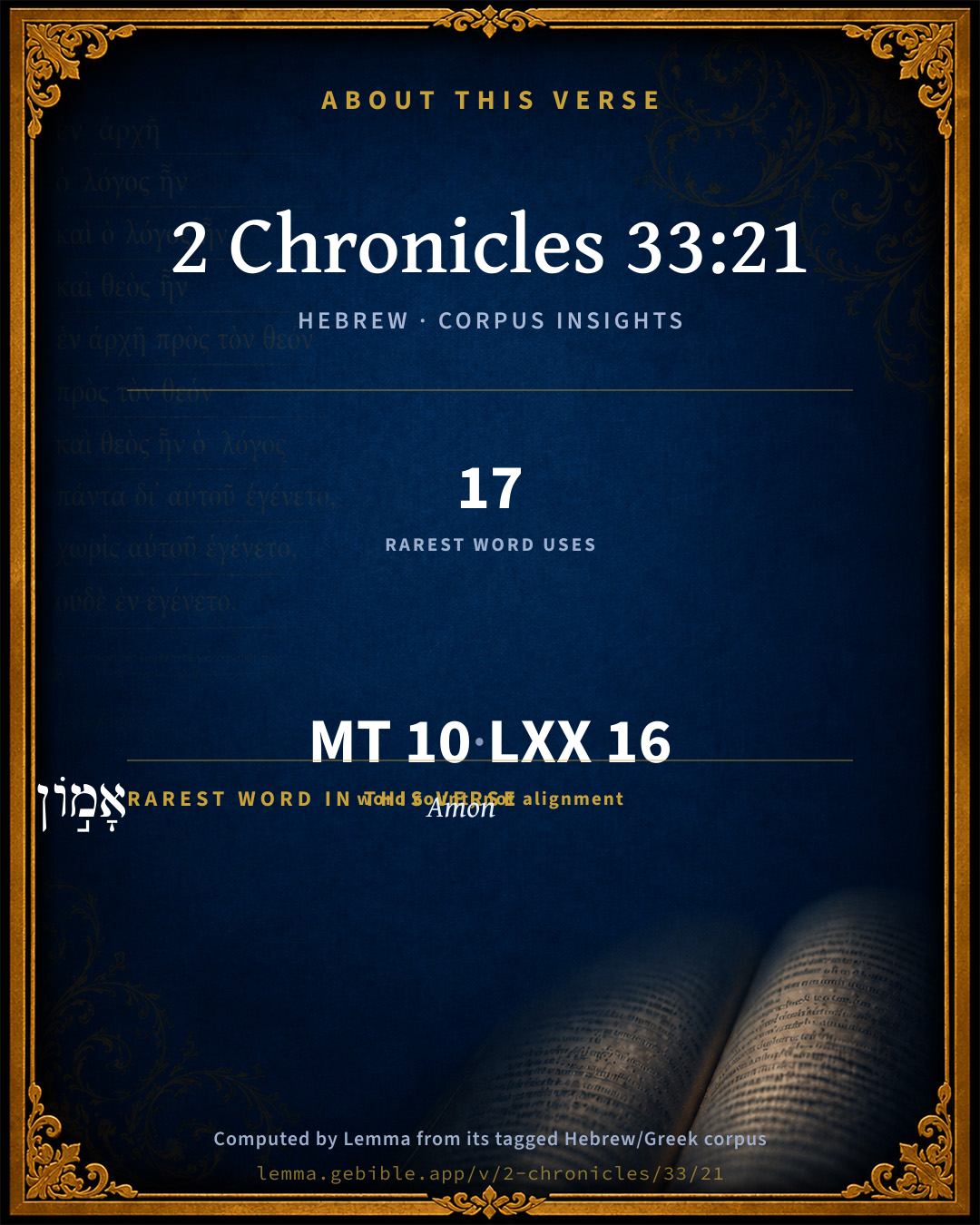
The rarest word here is אָמ֣וֹן Amon H526 — appearing just 17 times in the whole Hebrew Bible.

Shared distinctive vocabulary

אָמ֣וֹן Amon H526 occurs in 17 verses of the Hebrew Bible. Also found in:

Grammatical profile

  • 2 verbs
  • 5 nouns
  • 3 adjectives

Verb forms

  • בְּמָלְכ֑וֹ Qal · Infinitive Construct
  • מָלַ֖ךְ Qal · Perfect

Repetition

Words recur within this verse — often emphatic in Hebrew:

  • וּשְׁתַּ֛יִם two H8147 ×2
  • שָׁנָ֖ה year H8141 ×2
  • בְּמָלְכ֑וֹ to reign H4427 ×2

Hebrew & Septuagint length

In English translation the verse runs 17 words from the Hebrew and 19 from the Septuagint (LXX English) — closely comparable.

A rough comparison of the two English renderings, which tokenize alike — not a word-level alignment.

Word counts can differ between the Hebrew and the Greek without any difference in meaning — e.g. the Hebrew direct-object marker אֵת has no separate Greek word, and Greek often adds the article ὁ.

In the original languages it is 10 Hebrew tokens and 16 Greek tokens — but the two are counted differently (Hebrew bundles its prefixes and suffixes into one token; the Greek is in lemma form), so that isn’t a like-for-like length.

Cross-references

4

Topical passages linked to 2 Chronicles 33:21 in the Treasury of Scripture Knowledge — connected by theme and wording, ordered by reader-vote popularity; previews shown in the World English Bible.

  • 2 Kings 21:19–24 Amon was twenty-two years old when he began to reign; and he reigned two years in Jerusalem: and his mother's name was Meshullemeth the daughter of Haruz of Jotbah.
  • 2 Chronicles 33:1 Manasseh was twelve years old when he began to reign; and he reigned fifty-five years in Jerusalem.
  • Luke 12:19–20 I will tell my soul, "Soul, you have many goods laid up for many years. Take your ease, eat, drink, be merry."'
  • James 4:13–15 Come now, you who say, "Today or tomorrow let's go into this city, and spend a year there, trade, and make a profit."

Cross-references courtesy of OpenBible.info (CC BY 4.0).

Hebrew and Greek witnesses Masoretic Hebrew ↔ Greek Septuagint

The same verse in the two great witnesses to the Old Testament, shown verse-for-verse.

These are two independent witnesses, not word-aligned to each other, and the Septuagint is shown in lemma (dictionary) form.

Hebrew 2 Chronicles 33:21 Masoretic · Westminster Leningrad Codex

בֶּן עֶשְׂרִ֧ים וּשְׁתַּ֛יִם שָׁנָ֖ה אָמ֣וֹן בְּמָלְכ֑וֹ וּשְׁתַּ֣יִם שָׁנִ֔ים מָלַ֖ךְ בִּֽירוּשָׁלִָֽם

Amon was twenty-two years old when he began to reign; and he reigned two years in Jerusalem.

World English Bible · Public Domain

Greek LXX 2 Chronicles 33:21 Septuagint · lemma form

εἰμί εἴκοσι καί δύο ἔτος αμων ἐν ὁ βασιλεύω αὐτός καί δύο ἔτος βασιλεύω ἐν ἰερουσαλήμ

Amon was twenty and two years old when he began to reign, and he reigned two years in Jerusalem.

LXX2012 (modern English Septuagint) · Public Domain

Hebrew: Westminster Leningrad Codex (CC BY 4.0). Greek: Septuagint (public domain); English from LXX2012 (modern English Septuagint) (Public Domain). How the Septuagint differs from the Hebrew →

Commentary

Notes on 2 Chronicles 33:21 from classic Christian and Jewish commentators (each source and its license shown beneath its notes). The classic Christian expositions comment on the surrounding passage and are grouped to its opening verse, so a note may address several verses; the Jewish commentaries on the Tanakh (Rashi and others) are per-verse, so they appear only where the commentator wrote on this verse.

Lemma curates 59 commentaries, every one of them public domain or Creative Commons licensed, each selected and text-cleaned for this edition rather than reprinted as found. About our sources →

Ellicott's Commentary for English Readers

THE REIGN OF AMON (2Ch_33:21-25. Comp. 2Ki_21:19-26).

(21) Amon was two and twenty years old.—So 2Ki_21:19, which adds his mother’s name and parentage.

A Bible Commentary for English Readers, edited by Charles John Ellicott (1878–1897) — public domain. Text from a community e-Sword module.

Trapp's Complete Commentary

John Trapp

2Ch 33:21 Amon [was] two and twenty years old when he began to reign, and reigned two years in Jerusalem.

Ver. 21. Amon was twenty and two years old.] See 2Ki 21:19.

And reigned two years.] Twelve, saith the Greeks. Perhaps he reigned ten years in his father’s absence, as Philo saith he did.

John Trapp, A Commentary or Exposition upon All the Books of the Old and New Testament (1647–1656) — public domain. Text from a community e-Sword module.

Tyndale Open Study Notes

Tyndale Open Resources

33:21 Amon’s short reign was from 642 to 640 BC.

Tyndale Open Study Notes — © Tyndale Open Resources, licensed CC BY-SA 4.0. Text via the HelloAO Bible API.

Matthew Henry's Commentary

We have little recorded concerning Amon, but enough unless it were better. Here is,

I. His great wickedness. He did as Manasseh had done in the days of his apostasy, v. 22. Those who think this an evidence that Manasseh did not truly repent forget how many good kings had wicked sons. Only it should seem that Manasseh was in this defective, that, when he cast out the images, he did not utterly deface and destroy them, according to the law which required Israel to burn the images with fire, Deu 7:2. How necessary that law was this instance shows; for the carved images being only thrown by, and not burnt, Amon knew where to find them, soon set them up, and sacrificed to them. It is added, to represent him exceedingly sinful and to justify God in cutting him off so soon, 1. That he out-did his father in sinning: He trespassed more and more, Ch2 33:23. His father did ill, but he did worse. Those that were joined to idols grew more and more mad upon them. 2. That he came short of his father in repenting: He humbled not himself before the Lord, as his father had humbled himself. He fell like him, but did not get up again like him. It is not so much sin as impenitence in sin that ruins men, not so much that they offend as that they do not humble themselves for their offences, not the disease, but the neglect of the remedy.

II. His speedy destruction. He reigned but two years and then his servants conspired against him and slew him, Ch2 33:24. Perhaps when Amon sinned as his father did in the beginning of his days he promised himself that he should repent as his father did in the latter end of his days. But his case shows what a madness it is to presume upon that. If he hoped to repent when he was old, he was wretchedly disappointed; for he was cut off when he was young. He rebelled against God, and his own servants rebelled against him. Herein God was righteous, but they were wicked, and justly did the people of the land put them to death as traitors. The lives of kings are particularly under the protection of Providence and the laws both of God and man.

Matthew Henry's Commentary on the Whole Bible (1708–1710) — public domain (CC PDM 1.0). Text via the HelloAO Bible API.

Adam Clarke's Commentary

Verse 21. Amon - reigned two years] See on 2Kg 21:19.

Adam Clarke's Commentary on the Bible (1810–1826) — public domain. Text from a community e-Sword/MySword module.

The Cambridge Bible for Schools and Colleges

gen. ed. J. J. S. Perowne

21–25 (= 2Ki_21:19-26). Amon’s short Reign. Josiah succeeds him

21. in Jerusalem] The Chronicler omits here Amon’s mother’s name; cp. 2Ch_33:1.

The Cambridge Bible for Schools and Colleges (gen. ed. J. J. S. Perowne; Cambridge University Press, 1878–1918) — public domain. Text from a community e-Sword module.

The Pulpit Commentary

The long reign of Manasseh of fifty-five years a signal and merciful instance of space given for repentance ended, his death met him presumably at the age of sixty-seven. The son who succeeded him was twenty-two years old, born therefore not before his father was forty-five years old. This may be an indication that it was indeed not one son only whom Manasseh "caused to pass through the fire" (ver. 6). He emulated the sins of the former life of his father, but did not, like him, repent. It will be noted that in ver. 19 of the parallel his mother"s name is given as "Meshulle-meth, the daughter of Haruz, of Jotbah," of whom nothing is known.

Vers. 21-25.

The forfeited heritage.

It is but very little we know or think of Amon: his name is unfamiliar, for his life was uneventful. And yet why should not he have had as happy, as glorious, as useful a career as David, or as Hezekiah, or as Josiah? He had a very fair opportunity before him, but he lost it by his own folly. Let us look at

I THE GOLDEN CHANCE THAT WAS BEFORE HIM. He was heir to the throne of Judah. Measured by some monarchies, ancient and modern, that was small enough. But it was no despicable fortune. As our own country"s history shows, we must not reckon the worth of a kingdom by its geographical dimensions. Under David and Solomon the kingdom of Israel was a real power, if not a "great power" in that age. And then it was open to Amon to conciliate the tribes of Israel as his noble grandfather had done, and perhaps to win them back. At any rate, the kingdom of Judah was itself no mean heritage; its men and women were far above the average of humanity in intelligence, in civilization, in an appreciation of freedom, in courage, in all the elements of human power. To govern Judah might well satisfy the ambition of a strong and aspiring mind. And there was one thing about Judah that could not be claimed either for Assyria or Egypt. It was the chosen dwelling-place of God; if he were hut worshipped and honoured there, his presence and his power would be a more sure guarantee of national independence and prosperity than countless hosts of armed men or of chariots of war. Judah was the home of God, and therefore of truth and of heavenly wisdom. To reign there was a choice heritage for a true man.

II THE RECKLESSNESS WITH WHICH HE THREW IT AWAY.

1. He deliberately chose the evil course. At two and twenty he had not hisfather"s excuse for being led astray. The stern discipline through which Manasseh, had passed, and the mercy he had found in a forgiving God, surely should have affected and controlled his son. But he disregarded and defied the lessons which were written in such large characters before his face, and chose the evil way (ver. 22).

2. He declined to be corrected and restored; he persisted in the path ofwrong (ver. 23).

3. He excited the hatred of those whom he governed, and brought about anearly and ignominious death, enjoying but two brief years of kingly rule (ver. 24).

Thus, after a dishonourable and reactionary reign, he came to a miserable and inglorious end, and thus he forfeited his heritage.

1. There is a very goodly heritage before us as the children of men. It will probably include something fair and bright of this world"s estate, some pure enjoyment of which we may partake gladly and gratefully. It will certainly include the knowledge of God; the opportunity of worshipping and of serving him everywhere and in every relation we sustain; the means of cultivating a holy and a noble character; openings for usefulness in many ways, and particularly in the way of helping others on in the path of life; the opportunity of preparing for a far broader sphere and a far fuller life in the kingdom of heaven.

2. We may find ourselves tempted to forfeit this good estate. It is alienableby a sinful preference of the lower good, by a guilty disregard of Divine voices, by a perilous postponement of sacred obligation to some future time.

3. It is our true wisdom and our bounden duty to take at once that decisive step (of self-surrender to our Lord) which places us within the kingdom of God, and secures for us the lasting friendship of a Divine Redeemer. C.

Vers. 21-25.

Manasseh and Amen father and son: a parallel and a contrast.

I MANASSEH AND AMON RESEMBLED EACH OTHER. Both were:

1. Men. No higher dignity attainable on earth than that of manhood; higherthan any purely temporal or social distinction is that of having been made in the Divine image.

1. Kings. Though often desecrated and abused, the position of a sovereign is one of great honour and responsibility. As vicegerents of Jehovah, the

2. theocratic potentates of Israel and Judah stood upon the highest possible pinnacle of kingly renown.

3. Idolaters. Amen did that which was evil in the sight of the Lord, as did Manasseh his father (ver. 22). "Like father, like son," is the common experience the exceptions only proving the rule.

4. Sufferers. Manasseh taken captive by Esarhaddon or Assur-bani-pal; Amen conspired against and killed by his own servants.

II MANASSEH AND AMON DIFFERED FROM EACH OTHER. They contrasted in:

1. Names. Manasseh was so called (probably, at least) after an Israelitish tribe (see homiletics on vers. 1-20); Amen was named after an Egyptian god. The first was most likely traceable to Hezekiah"s piety; the second due to Manasseh"s impiety.

2. Reigns. Manasseh ruled Judah for fifty-five years; Amen for two. God determines to nations and individuals, to kings and subjects, the bounds of their habitations and the length of their days. (Act_17:26)

3. Careers. Manasseh repented, turned to Jehovah, and lived; Amon died as he had lived, an insensate idolater and hardened transgressor.

4. Ends. Manasseh died a natural, Amon a violent death.

Learn

(1) the resemblances and

(2) the differences which exist between man and man, in the home, in the world, in the Church. W.

The Pulpit Commentary (1880–1919), ed. H.D.M. Spence-Jones & Joseph S. Exell — public domain. Text from a community e-Sword module.

Keil & Delitzsch

C. F. Keil & F. Delitzsch

The reign of Amon. Cf. Kg2 21:19-26. - Both accounts agree; only in the Chronicle, as is also the case with Manasseh and Ahaz, the name of his mother is omitted, and the description of his godless deeds is somewhat more brief than in Kings, while the remark is added that he did not humble himself like Manasseh, but increased the guilt. In the account of his death there is nothing said of his funeral, nor is there any reference to the sources of his history. See the commentary on Kg2 21:19.

Keil & Delitzsch — Biblical Commentary on the Old Testament (1861–1891) — public domain (CC PDM 1.0). Text via the HelloAO Bible API. (Old Testament only.)

unfoldingWord translationNotes

Door43 World Missions Community

twenty-two years old

"22 years old" (See: Numbers)

what was evil in the sight of Yahweh

Here Yahweh's "sight" refers to how he judges or decides on the value of something. See how you translated a similar phrase in 2 Chronicles 14:2. AT: "things that Yahweh said were evil" or "the things that Yahweh considers evil" (See: Metaphor)

this same Amon trespassed more and more

"Amon sinned again and again" or "Amon continued to sin"

translationWords

reign

Jerusalem

evil

sacrifice

image

unfoldingWord translationNotes — © Distant Shores Media and the Door43 World Missions Community, licensed CC BY-SA 4.0. Source: git.door43.org/Door43/en_tn.

Lesson kit

Teaching starters — assembled from the data on this page, not authored interpretation. Every prompt links to the verse data it draws on. Edit before teaching.

2 Chronicles, in the Historical, opens this verse with 10 words (7 distinct Hebrew lemmas). Its most distinctive word is ʼÂmôwn (“Amon”). A historical commentator’s framing appears above. Read the whole chapter for the surrounding context.

Discussion questions

  1. How does “Amon” (ʼÂmôwn) shape what this verse is saying?
  2. How does 1 Kings 22:26, which shares the word «Amon», read alongside this verse?
  3. What does the repetition of “two” (2× in this one verse) do in this verse?
  4. These translations render this verse differently; the difference is in the English rendering, not the original. What questions does that raise?
  5. «בְּמָלְכ֑וֹ» is a Qal Infinitive Construct verb. How does that grammatical form shape the action described?
  6. Compare how Ellicott's Commentary for English Readers and Trapp's Complete Commentary read this verse. Where do they agree or differ?

Things to notice

Reading settings

Reading text

Shown beneath each verse's original-language words.

Old Testament
Old Testament edition

Read the OT as the Masoretic Hebrew (MT) or the Greek Septuagint (LXX).

English shown for the Greek Septuagint (in the Hebrew ↔ Greek comparison).

Comparing translations? Open the Compare panel on any verse page to stack up to four side by side.