

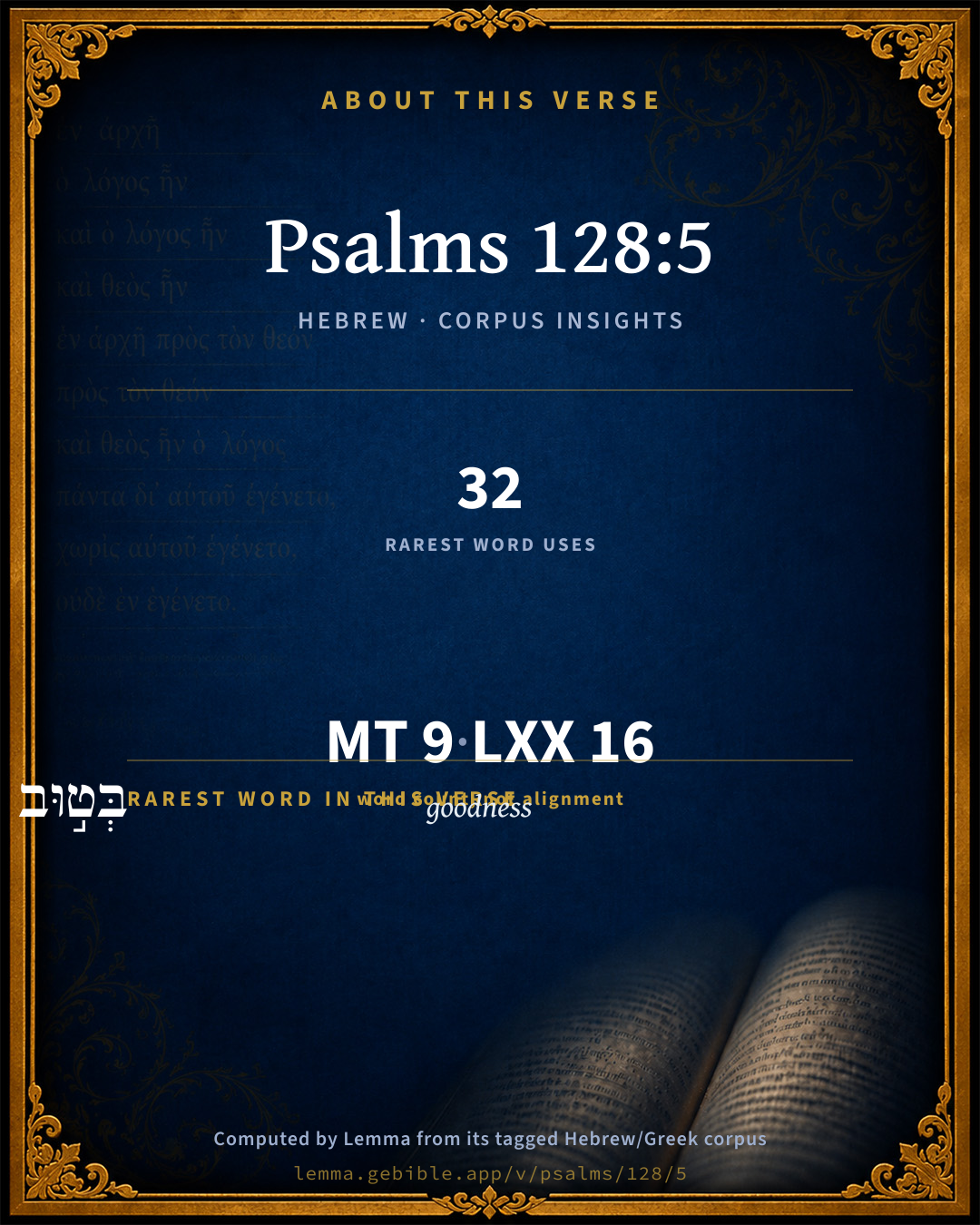
Psalms 128:5

Hebrew (Westminster Leningrad Codex) Psalms 128:5 appears in the Hebrew Old Testament. The text above is from the Westminster Leningrad Codex. Each word links to its Strong’s number, a concise gloss, and parsing drawn from the Open Scriptures Hebrew Bible morphology. Click any word for its full Brown-Driver-Briggs (BDB) entry.
Download image
Cite this verse

Psalms 128:5 (World English Bible). Public Domain. Lemma interlinear Bible study tool, https://lemma.gebible.app/v/psalms/128/5.

Show BibTeX & RIS
BibTeX
RIS
English Translation
May Yahweh bless you out of Zion, And may you see the good of Jerusalem all the days of your life.
World English Bible · Public Domain
Download a study sheet

One document with this verse’s original text, its word-by-word gloss line, the meaning frame, cross-references with their text, attributed commentary, and full source and license credits — printable, and it pastes into notes with its structure intact.

This verse Autodidact and up

Study sheet (.html) Plain text (.txt)

A passage Seminary Student

Up to 50 verses in one chapter. A passage sheet keeps up to 6 commentary sources and 12 cross-references per verse, in the order this page ranks them, and says so on the sheet whenever that leaves anything out. Ask for a single verse and you get the Autodidact verse sheet above.

Everything on this page stays free to read, with no account — the sheet is a download of what is already on screen, not access to it.

Want to remove ads? Support Godless Engineer
Compare translations 3

The same verse in 3 English versions, stacked beneath the original-language interlinear above. Click any original word for its lexicon entry.

Each is an independent rendering of the whole verse — the interlinear is not word-aligned to these translations.

Highlighted words mark where these versions differ — a whole-verse word diff, not a word-by-word alignment.

  • World English Bible Public Domain
    May Yahweh bless you out of Zion, And may you see the good of Jerusalem all the days of your life.
  • King James Version Public Domain
    The LORD shall bless thee out of Zion: and thou shalt see the good of Jerusalem all the days of thy life.
  • unfoldingWord Literal Text CC BY-SA 4.0
    May Yahweh bless you from Zion, that you may look on the good of Jerusalem all of the days of your life,

unfoldingWord Literal Text — © unfoldingWord, licensed CC BY-SA 4.0. Word-aligned USFM3 via Door43 (git.door43.org/unfoldingWord/en_ult).

Versions to compare (up to 4)

3 of 4 selected

Show all 18 translations

Every available English version of this verse, each an independent rendering of the whole verse.

  • World English Bible Public Domain
    May Yahweh bless you out of Zion, And may you see the good of Jerusalem all the days of your life.
  • Berean Standard Bible Public Domain
    May the LORD bless you from Zion, that you may see the prosperity of Jerusalem all the days of your life,
  • Majority Standard Bible Public Domain
    May the LORD bless you from Zion, that you may see the prosperity of Jerusalem all the days of your life,
  • King James Version Public Domain
    The LORD shall bless thee out of Zion: and thou shalt see the good of Jerusalem all the days of thy life.
  • American Standard Version (1901) Public Domain
    Jehovah bless thee out of Zion: And see thou the good of Jerusalem all the days of thy life.
  • Revised Version (1885) Public Domain
    The LORD shall bless thee out of Zion: and thou shalt see the good of Jerusalem all the days of thy life.
  • Geneva Bible (1599) Public Domain
    The Lord out of Zion shall blesse thee, and thou shalt see the wealth of Ierusalem all the dayes of thy life.
  • Douay-Rheims (1899) Public Domain
    Blessed is the man that hath filled the desire with them; he shall not be confounded when he shall speak to his enemies in the gate.
  • Young's Literal Translation Public Domain
    Jehovah doth bless thee out of Zion, Look, then, on the good of Jerusalem, All the days of thy life,
  • Literal Standard Version CC BY-SA 4.0
    YHWH blesses you out of Zion, || Look, then, on the good of Jerusalem, || All the days of your life,
  • Unlocked Literal Bible CC BY-SA 4.0
    May Yahweh bless you from Zion; may you see the prosperity of Jerusalem all the days of your life.
  • unfoldingWord Literal Text CC BY-SA 4.0
    May Yahweh bless you from Zion, that you may look on the good of Jerusalem all of the days of your life,
  • Darby Bible Public Domain
    Jehovah will bless thee out of Zion; and mayest thou see the good of Jerusalem all the days of thy life,
  • World Messianic Bible Public Domain
    May the LORD bless you out of Zion, and may you see the good of Jerusalem all the days of your life.
  • Webster's Bible Public Domain
    The LORD shall bless thee out of Zion: and thou shalt see the good of Jerusalem all the days of thy life.
  • Free Bible Version CC BY-SA 4.0
    May the Lord go on blessing you from Zion; may you see Jerusalem prosper all the days of your life.
  • Bible in Basic English Public Domain
    May the Lord send you blessing out of Zion: may you see the good of Jerusalem all the days of your life.
  • JPS Tanakh (1917) Public Domain
    The LORD bless thee out of Zion; and see thou the good of Jerusalem all the days of thy life;

Literal Standard Version (2020), Covenant Press — licensed CC BY-SA 4.0. Text via the HelloAO Bible API (eBible.org). Unlocked Literal Bible (unfoldingWord) — licensed CC BY-SA 4.0. Text via the HelloAO Bible API (eBible.org). unfoldingWord Literal Text — © unfoldingWord, licensed CC BY-SA 4.0. Word-aligned USFM3 via Door43 (git.door43.org/unfoldingWord/en_ult). Free Bible Version, Dr. Jonathan Gallagher — licensed CC BY-SA 4.0. Text via the HelloAO Bible API (eBible.org).

Word by word

More ways to search: Search by grammar → Find every occurrence → Compare this word →

Practice this passage: Drill this verse → Learn its vocabulary →

בְּט֣וּב
ṭûwb
H2898
“in/at · goodness of”
Preposition + Noun, Common, Masculine, Singular, Construct
Part of Speech
Preposition + Noun
Type
Common
Gender
Masculine
Number
Singular
State
Construct
Full BDB Definition

Origin: from H2895

TWOT: 793b

goods, good things, goodness - good things - goods, property - fairness, beauty, joy, prosperity, goodness (abstract) - goodness (of taste, discernment) - goodness (of God) (abstract)
  1. יְבָרֶכְךָ֥ bârak H1288 “to bless · you” Verb, Piel, Imperfect, 3rd Person, Masculine, Singular + Suffix, Personal, 2nd Person, Masculine, Singular
  2. יְהוָ֗ה Yᵉhôvâh H3068 “LORD” Noun, Proper
  3. מִצִּ֫יּ֥וֹן Tsîyôwn H6726 “from · Zion” Preposition + Noun, Proper
  4. וּ֭רְאֵה râʼâh H7200 “and · see” Conjunction + Verb, Qal, Imperative, 2nd Person, Masculine, Singular
  5. יְרוּשָׁלִָ֑ם Yᵉrûwshâlaim H3389 “Jerusalem” Noun, Proper
  6. כֹּ֝֗ל kôl H3605 “all of” Noun, Common, Masculine, Singular, Construct
  7. יְמֵ֣י yôwm H3117 “days of” Noun, Common, Masculine, Plural, Construct
  8. חַיֶּֽיךָ chay H2416 “living things · your” Noun, Common, Masculine, Plural, Construct + Suffix, Personal, 2nd Person, Masculine, Singular

About this verse

These counts appear in no published source. They are computed here, from the morphology-tagged text and Lemma’s own curated glosses. What Lemma adds →

9
words
9
distinct lemmas
Wisdom
section

Shared distinctive vocabulary

בְּט֣וּב goodness H2898 occurs in 31 verses of the Hebrew Bible. Also found in:

Grammatical profile

  • 2 verbs
  • 7 nouns

Verb forms

  • יְבָרֶכְךָ֥ Piel · Imperfect
  • וּ֭רְאֵה Qal · Imperative

Hebrew & Septuagint length

In English translation the verse runs 21 words from the Hebrew and 22 from the Septuagint (LXX English) — closely comparable.

A rough comparison of the two English renderings, which tokenize alike — not a word-level alignment.

Word counts can differ between the Hebrew and the Greek without any difference in meaning — e.g. the Hebrew direct-object marker אֵת has no separate Greek word, and Greek often adds the article ὁ.

In the original languages it is 9 Hebrew tokens and 16 Greek tokens — but the two are counted differently (Hebrew bundles its prefixes and suffixes into one token; the Greek is in lemma form), so that isn’t a like-for-like length.

Cross-references

8

Topical passages linked to Psalms 128:5 in the Treasury of Scripture Knowledge — connected by theme and wording, ordered by reader-vote popularity; previews shown in the World English Bible.

  • Psalms 20:2 Send you help from the sanctuary, Grant you support from Zion,
  • Psalms 134:3 May Yahweh bless you from Zion; Even he who made heaven and earth.
  • Psalms 118:26 Blessed is he who comes in the name of Yahweh! We have blessed you out of the house of Yahweh.
  • Psalms 122:6 Pray for the peace of Jerusalem. Those who love you will prosper.
  • Isaiah 33:20 Look on Zion, the city of our solemnities: your eyes shall see Jerusalem a quiet habitation, a tent that shall not be removed, the stakes of it shall never be plucked up, neither shall any of the cords of it be broken.
  • Ephesians 1:3 Blessed be the God and Father of our Lord Jesus Christ, who has blessed us with every spiritual blessing in the heavenly places in Christ;
  • Isaiah 2:3 Many peoples shall go and say, "Come, let's go up to the mountain of Yahweh, To the house of the God of Jacob; And he will teach us of his ways, And we will walk in his paths. For out of Zion the law shall go forth, And the word of Yahweh from Jerusalem.
  • Psalms 135:21 Blessed be Yahweh from Zion, Who dwells at Jerusalem. Praise Yah!

Cross-references courtesy of OpenBible.info (CC BY 4.0).

Hebrew and Greek witnesses Masoretic Hebrew ↔ Greek Septuagint

The same verse in the two great witnesses to the Old Testament, shown verse-for-verse.

You’re reading Greek Psalm 127 (Hebrew Psalm 128). The Septuagint counts the superscription, so verse numbers can differ from the Hebrew — chapter-level alignment, not verse-by-verse. Numbering follows Rahlfs.

These are two independent witnesses, not word-aligned to each other, and the Septuagint is shown in lemma (dictionary) form.

Hebrew Psalms 128:5 Masoretic · Westminster Leningrad Codex

יְבָרֶכְךָ֥ יְהוָ֗ה מִצִּ֫יּ֥וֹן וּ֭רְאֵה בְּט֣וּב יְרוּשָׁלִָ֑ם כֹּ֝֗ל יְמֵ֣י חַיֶּֽיךָ

May Yahweh bless you out of Zion, And may you see the good of Jerusalem all the days of your life.

World English Bible · Public Domain

Greek LXX Greek Psalm 127:5 Septuagint · lemma form

εὐλογέω σύ κύριος ἐκ σιων καί ὁράω ὁ ἀγαθός ἰερουσαλήμ πᾶς ὁ ἡμέρα ὁ ζωή σύ

May the Lord bless you out of Sion; and may you see the prosperity of Jerusalem all the days of your life.

LXX2012 (modern English Septuagint) · Public Domain

Hebrew: Westminster Leningrad Codex (CC BY 4.0). Greek: Septuagint (public domain); English from LXX2012 (modern English Septuagint) (Public Domain). How the Septuagint differs from the Hebrew →

Commentary

Notes on Psalms 128:5 from classic Christian and Jewish commentators (each source and its license shown beneath its notes). The classic Christian expositions comment on the surrounding passage and are grouped to its opening verse, so a note may address several verses; the Jewish commentaries on the Tanakh (Rashi and others) are per-verse, so they appear only where the commentator wrote on this verse.

Lemma curates 59 commentaries, every one of them public domain or Creative Commons licensed, each selected and text-cleaned for this edition rather than reprinted as found. About our sources →

Trapp's Complete Commentary

John Trapp

Psa 128:5 The LORD shall bless thee out of Zion: and thou shalt see the good of Jerusalem all the days of thy life.

Ver. 5. The Lord shall bless thee out of Zion] viz. With spiritual benedictions, Eph 1:3, and these are far better than all other that heaven and earth afford, Psa 134:3.

And thou shalt see the good of Jerusalem] i.e. The prosperity of the Church, without which all other comforts are to a good soul but as so many Ichabods; a good Christian enjoys them not, but is even sick at heart of the afflictions of Joseph, Amo 6:6.

John Trapp, A Commentary or Exposition upon All the Books of the Old and New Testament (1647–1656) — public domain. Text from a community e-Sword module.

The Biblical Illustrator

Joseph S. Exell

Psa_128:5-6

The Lord shall bless thee out of Zion.

Blessing out of Zion

1. What measure soever of things temporal the Lord shall give to the man that feareth Him, He reserveth unto him all the promises of righteousness and life which the Lords Word holdeth forth to the Church, and of those he shall be sure.

2. The godly man shall not want succession, if God see it good for him, or if not children of his body, yet followers of his faith and footsteps in piety, whom he hath been instrumental to convert.

3. Whatsoever estate the Church of God be in during the godly mans life-time, he shall behold in the mirror of the Lords Word, and in the sensible feeling of his own experience, he shall perceive and take up the blessed condition of the true Church of God, and rejoice therein all his days. (D. Dickson.)

And thou shalt see the good of Jerusalem all the days of thy life.--

Religion the highest good

Is Christianity a good thing for man? Has it fulfilled worthy ideals? Does it give a satisfying revelation of God? Is it pitilessly opposed to all fresh light which comes from nature and science? Would the world get on as well or better without it?

I. The good of Jerusalem is seen in that it speaks good of man. The Christian revelation stands supreme in the honour, worth, and dignity it puts on man; he is sacred from the first, as having been made in the Divine image; sacred, so that even in solitude, where he can do no harm to others, he can sin against himself, by sullying the Divine image in his soul. Take away the Christian ideal, and human life becomes altogether a different thing in kind!--an altogether inferior thing, a mean thing enough, something which may be made more or less civilized, more or less worth living, but bereft of loftiness and grandeur. The Gospel alone in this great universe reveals man to himself, and in doing that it transfigures all else. Walking in the light of Christ, under the influence of His Cross and under the inspiration of His Spirit, life has a noble purpose, sorrow a sweet sanctity, suffering a sublime consolation, and death itself is a stingless transition to glory, honour, immortality, and eternal life.

II. The good of Jerusalem is seen in that it is a present good. It is unfair to the Gospel to represent it as a system of future felicity, to be purchased at the surrender of present good, as profitable only for the life that is to come. The Christian morality has its seat within the soul. It is not a righteousness built up from without, but makes the good man out of the good treasures of the heart. Christianity rests alike its morality and its religion on the answering convictions of the great soul within us. Because we have the truth within us we can hear and know Gods voice. Thus, too, the Christian nations have had a morality of the Home, as well as of the State; a morality that has condemned slavery, even when it was sleek and profitable; a morality that has made divorce an evil; a morality that has made the thought of evil and the imagination of vice guilt before God. The Gospel has been tested, lived, and tried enough to make us say, Thou shalt see the good of Jerusalem all the days of thy life.

III. The good of Jerusalem is seen in that it is the highest good. Its ideal of good is not mere outward prosperity and pleasure. It can sacrifice these. It can feel a thrill of higher joy, as these, if needs be, are trampled under feet. It can bring a deep delight even when the crown of thorns is on the temple, and when the sword of human power is at the heart. We can get no joy of heroism, in the mere utilities and expediencies of earthly life. The highest good may be to drain the cup of sorrow; the highest good may he in bearing a cruel cross. Whether you think of the good of Jerusalem as meaning a restful conscience, a life at peace with God, or a joyful hope of immortality, it is the higher good, and could the sainted heroes and martyrs of old time come back to earth from the felicities of heaven, they would choose the good of Jerusalem to all other good which this world could offer them, did it exclude conscience and Christ.

IV. The good of Jerusalem is seen in that it is a unique good. None can present aught like it to us, in type or kind. It stands alone. We cannot, I know, exactly analyze the morality, the honour, the civil integrity, the home fidelity, the philanthropic charity, the moral earnestness of English life; something may come from custom, something from native instinct, something from public estimate, but he must be impervious to truth who does not acknowledge how very much we owe to what my subject means by Jerusalem. There is a might of influence at work in it which has no other fountain so high, no other channel so deep, no other onward flow so vital and Divine.

V. The good of Jerusalem is seen in that it is a prospective good. All that goes to make a saintly character here, goes to make heaven there! The innumerable array of saints, who walk in white, surround us, like the snow-clad mountains around Jerusalem, and with them we look to enjoy through eternal ages the good of Jerusalem all the days of our life, where there are pleasures for evermore. (W. M. Statham.)

The happiness of a godly life

In every age the practice of religion and virtue has appeared to all prudent inquirers the likeliest and surest way to avoid the miseries of life, and secure the enjoyments of it. The first advantage which the psalmist promises to the pious comprehends in general health and success in their affairs (verse 2). The next is a particular blessing of the nearest concern; the possession of domestic and conjugal felicity in the midst of a large and well-ordered family (verse 3). But still, as good persons can never thoroughly relish their own private welfare, if the community suffers at the same time, or calamities are likely to befall it soon, an assurance is given them in the last place that their exemplary obedience to the laws of God will, through His mercy, contribute to their being witnesses of the prosperity, both of their country and their descendants, during a long course of years (verses 5, 6). In which concluding part of this most pleasing view even of the present condition of religious and virtuous persons, we have it signified to us--

I. That a large portion of their happiness consists in the flourishing state of their country. Everything hath an influence on our enjoyments, in proportion to the share which it hath in our affections. And affection to the public never fails to be remarkably strong in worthy breasts. It shows a rightness and greatness of mind, capable of being affected by a common interest: it shows the most amiable of virtues, love, towards a large part of our fellow-creatures, and implies nothing contrary towards the rest. For the real good of every people in the world is compatible with the real good of every other. To rule and to oppress is no good to any: and peace and liberty and friendly intercourse for mutual convenience all the nations of the earth may enjoy at once.

II. That the happiness accruing to good men from the flourishing state of their country is greatly increased by the prospect that their own posterity will continue to flourish with it. How strongly must such a hope induce them to secure by good example and instruction this highest honour and blessedness to such as are to inherit their dignities! And how warm a return of most affectionate gratitude will they merit and receive from mankind, if virtue and liberty shall not only be supported by them in the present age, but transmitted to succeeding ones, by their pious care of forming their progeny to the knowledge and the love of public good! The prospect only of childrens children would have little joy in it without that of peace upon Israel: without a reasonable expectation of their contributing to the true glory of the family, from which they spring, and the true happiness of the nation over which they are to preside. But when due provision is made for this, both sovereign and people may take up the words of the psalmist (Psa_127:4-5).

III. That both depend on the Divine benediction (Psa_127:1-2; Psa_127:4). It is not indeed possible for us in many cases to discern particularly in what manner the providence of God conducts things: but we may plainly discern, in general, that as the whole course of nature is nothing else than the free appointment which He hath been pleased to make; as the motions of the inanimate world proceed from those which He originally impressed upon it; and all the thoughts and actions of intelligent beings are doubtless absolutely subject to the influence of their Maker; since we see they are greatly subject, and often when they perceive it not, to that of their fellow-creatures; it must be in His power by various ways--perhaps the more effectual for being unknown--to dispose of everything so as may best answer His wise purposes of mercy or correction. And as He evidently can do this, it is likewise evidently worthy of Him to do it; for the highest of His titles is that of the moral governor of the universe; and therefore we may firmly believe the Scripture assuring us that He doth it in fact; that He makes all things work together for good to them that love Him, and curses the very blessings of those who love Him not. (T. Seeker.)

Seeing the good of Jerusalem

The good of Jerusalem was an universal benefit; and it is a source of rejoicing to every believer. His interest is identified with the welfare of the Church; and God blesses him when He blesses Zion. Is it not so? There is no security for national peace, no security for domestic happiness, except through the diffusion of that truth of which the Church is the depositary. Wherever Christianity appears, she waves the olive-branch to the shouting nations, and elevates those affections which make home the scene of quiet, enduring bliss. Mankind are all lying under the curse of a broken law; and it is the belief of the Gospel alone which reconciles man to God, delivers him from the plague of his own heart, makes him holy and useful on earth, and prepares him for the blissful activity of heaven. These things being so, the Christian is delighted to see the Church raised up from the dust, and enlivened with the presence of the life-giving Spirit. A burden is taken off his mind when he beholds a breach made in some huge wall of heathenism or Mohammedanism, through which the minister of Christ may enter, unfurl the banner of redemption, and scatter abroad those leaves of the tree of life which are for the healing of the nations. He watches with intense interest the operations of Divine providence, and loves to trace the majestic steps of Him who is making all things subservient to His own glory and to the salvation of the world. For this he labours, and for this he prays. His work sends him to his prayers, and his prayers send him to his work. (N. McMichael.)

And peace upon Israel.--

Peace upon Israel

O happy land, where Home and Church and State are one system of which the common lifeblood is religion! No other nation thrives like that in which piety is pure and prosperous. Through one rejoicing citizen or household God makes many happy; and the good man is blessed in the blessedness he diffuses. It is a circle of blessing, the Lord, the saint, and the neighbour; closet prayer, family worship and temple service; the Home, the Church and the State. Like the cloud falling upon the earth, the river running to the sea, and the ocean rising to the sky, it is a perpetual round of fertility, beauty and thanksgiving, regarded with complacence by the radiant Artificer enthroned in the heavens. All goes on together. It is not the Church blest now, the government next, and then the citizen, but each supporting and supported by the rest, and all depending on Gods unfailing blessing. The Christian country is His habitation, His vine is the branching Church, and His olive-plants are God-fearing people. The profitableness of walking in the ways of the Lord is not the brightness of a transient summer. No winter comes to chill the felicity, and check its circulation. Thou shalt see the good of Jerusalem all the days of thy life. Those days shall not be few. Nothing so surely as holy wisdom and understanding prolongs life. It is interesting to see some aged statesman toiling for the public good, though he must soon leave all the work to others. A more beautiful and useful sight is a Christian still cheerfully praying and labouring for the Churchs and the countrys welfare as he draws near the grave. Work on, old pilgrim. Thou mayest not live to enjoy the results of philanthropic movements in which thou art taking part. The longest life closes at last; and prosperous Israel outlives the happy Israelite. Do not, therefore, fret. Thy reward will follow. The true Israelite survives the outward Israel. The land thou lovest and servest is a type of the better land which thou shalt shortly enter. According to ancient thought, not only the life that now is, but that which is to come, is indicated in the double sentence, Happy shalt thou be, and it shall be well with thee. The Source of thy blessedness will not dry up, but gush forth more plentifully in the valley of shadows. The Spring of thy joys will more nearly reveal Himself in death. After ages and ages, more than ages will remain to thee of perfect felicity. Never declining, ever advancing, thy bliss will be eternal. For ever and ever blessed is every one that feareth the Lord; that walketh in His ways. Religion on earth is the seed in the ground; its mighty growth is in heaven. (E. J. Robinson.)

.

Psa_129:1-8

The Biblical Illustrator, edited by Joseph S. Exell (c. 1880s–1900s) — public domain. Text from a community e-Sword module.

Joseph Benson's Commentary

Psa 128:5-6. The Lord shall bless thee out of Zion — Where the ark of the covenant was, and where the pious Israelites attended to offer their devotions. He will bless thee with those spiritual and everlasting blessings which are to be had nowhere but in Zion, and from the God who dwells in Zion, blessings which flow, not from common providence, but from special grace, and with all other mercies which thou shalt ask of God in Zion. And thou shalt see the good of Jerusalem — The prosperity of that city to which thou belongest, and which is the only seat of God’s worship and special presence, and whose good, therefore, is very delightful to every pious Israelite, and upon whose peace and safety those of every citizen of it depend, as every seaman is concerned in the safety of the ship in which he sails. Thou shalt see thy children’s children — Thy family shall be built up and continued, and thou shalt have the pleasure of seeing it; and peace upon Israel — Not only upon Jerusalem, and parts adjacent, but upon all the tribes and people of Israel. Thy private comforts shall not be allayed and imbittered by public troubles, but thou shalt see the welfare of God’s church and of thy native country, which every man that fears God is no less concerned for than for the prosperity of his own family. For a good man can have little comfort in seeing his children’s children, unless, withal, he sees peace upon Israel, and have hopes of transmitting the entail of religion, pure and entire, to those that shall come after him.

Joseph Benson's Commentary on the Old and New Testaments (1811–1818) — public domain. Text from a community e-Sword module.

J. A. Alexander on Psalms

Joseph Addison Alexander

5. (Psa 128:5) Jehovah bless thee out of Zion, and look thou upon the welfare of Jerusalem. The consecution of the future and imperative is the same as in Psa 110:2. The latter might, therefore, be translated as a promise, the Lord shall bless thee, but the optative meaning seems more natural in this connection. In either case, the imperative conveys substantially the same idea. See above, on Psa 37:3-4; Psa 37:27. From Zion, as his earthly residence, the seat of the theocracy. See above, on Psa 20:2. Look upon, with joy and triumph. See above, on Psa 22:17, Psa 37:14. Welfare, literally goodness, not of character but of condition, good fortune. The Hebrew word occurs above, Psa 119:66.

Joseph Addison Alexander, The Psalms Translated and Explained (1850) — public domain. Text from a community e-Sword module.

Geneva Bible (1599)

Geneva Bible translators

For except God blessed his Church publicly, this private blessing were nothing.

Because of the spiritual blessing which God hath made to his Church, these temporal things shall be granted.

Geneva Bible (1599) marginal notes — public domain. Text via Bolls.life.

Adam Clarke's Commentary

Verse 5. The Lord shall bless thee out of Zion] In all thy approaches to him in his house by prayer, by sacrifice, and by offering, thou shalt have his especial blessing. Thou shalt thrive every where, and in all things.

And thou shalt see the good of Jerusalem] Thou shalt see the cause of God flourish in thy lifetime, and his Church in great prosperity.

Adam Clarke's Commentary on the Bible (1810–1826) — public domain. Text from a community e-Sword/MySword module.

John Calvin's Commentaries

5. Jehovah shall bless thee from Zion. Some, would have this sentence to be a prayer, and therefore they resolve the future tense into the optative mood. But it seems rather to be a continued statement of the same doctrine previously dwelt on, the Prophet now expressing more plainly that the benefits which he has recounted are to be ascribed to God as their author. Although the gifts of God often present themselves before our eyes, yet through the obscurity which false imaginations throw around them our perception of them is dim and imperfect. Hence this repetition of the sentiment, That whenever true believers meet with any prosperous events in the course of their life, it is the effect of the divine blessing, is not to be deemed superfluous. The persons described are said to be blessed from Zion, to lead them to call to remembrance the covenant into which God had entered with them, for he had graciously promised to be favorable to the observers of his law; and these principles of godliness they had imbibed from their infancy. The Prophet, therefore, declares that it is no novel doctrine or something before unheard of which he adduces, the law having long ago taught them that it is made manifest even by the temporary benefits conferred on those who serve God, that the pains taken in serving him are not thrown away; and he affirms that of this they shall actually have the experience. What is added concerning the good of Jerusalem is to be regarded as en-joining upon the godly the duty not only of seeking their own individual welfare, or of being devoted to their own peculiar interests, but rather of having it as chief desire to see the Church of God in a flourishing condition. It would be a very unreasonable thing for each member to desire what may be profitable for itself, while in the meantime the body was neglected. From our extreme proneness to err in that respect, the Prophet, with good reason, recommends solicitude about the public welfare; and he mingles together domestic blessings and the common benefits of the Church in such a way as to show us that they are things joined together, and which it is unlawful to put asunder.

John Calvin's Commentaries (1540-1563) — public domain. Text from the Calvin Translation Society English edition (1840s-50s) via the Christian Classics Ethereal Library (ccel.org). Calvin's coverage is partial (roughly two-thirds of the Bible); uncommented books and verses are honest gaps, never fabricated. The 19th-century editor's footnotes and remarks are omitted so the notes are faithfully Calvin's own voice.

Ellicott's Commentary for English Readers

(5) Shall . . . shalt.—Here and in the next verse the optative is plainly required: “May Jehovah,” &c. “mayst thou see,” &c. The patriotic sentiment could not wait long for expression in such a psalm. No people ever perceived more strongly than the Jews the connection between the welfare of the state and that of the family.

A Bible Commentary for English Readers, edited by Charles John Ellicott (1878–1897) — public domain. Text from a community e-Sword module.

The Cambridge Bible for Schools and Colleges

gen. ed. J. J. S. Perowne

5. The Lord shall bless thee] It is possible to render thus, and to take the imperatives in the next two lines (lit. and see thou) as equivalent to emphatic futures (cp. Gen_12:2): but it is preferable to render, Jehovah bless thee … that thou mayest see the welfare of Jerusalem … yea, see thy sons’ sons. See Driver, Tenses, § 65.

out of Zion] Where He sits enthroned as King. Cp. Psa_134:3; Psa_114:7; Psa_20:2.

The Cambridge Bible for Schools and Colleges (gen. ed. J. J. S. Perowne; Cambridge University Press, 1878–1918) — public domain. Text from a community e-Sword module.

John Gill's Exposition

Yea, thou shall see thy children's children,.... A numerous race of descendants from him, which are the crown and glory of old men, Pro 17:6; this is also true of Christ's spiritual children by his church in successive ages, Isa 59:21;

and peace upon Israel: all kind of prosperity, temporal and spiritual; peace, and abundance of it; as will be in the latter day, in the spiritual reign of Christ, Psa 72:8. It may be considered as a wish or prayer, with which the psalm is concluded; let "peace be upon Israel" (a), as in Psa 125:5; see Gal 6:16.

(a) "pax sit super Israele", Cocceius; so Gejerus.

Next: Psalms Chapter 129

John Gill's Exposition of the Whole Bible (1746–1763) — public domain (CC PDM 1.0). Text via the HelloAO Bible API.

Albert Barnes' Notes on the Bible

The Lord shall bless thee out of Zion - Will not merely bless thee in the field and in the house, but will add blessings that seem to come more directly out of Zion, or that seem to be more directly connected with religion: shall bless thee with religious influences in thine own family; shall bless thee by permitting thee to see the growth of the church and the conversion of souls.

And thou shalt see the good of Jerusalem - The prosperity, the happiness of Jerusalem: that is, the good of the church; the advancement of pure religion. The Hebrew might be rendered, “And look thou upon the good of Jerusalem” - in the imperative; and, thus rendered, it would be a command to regard, in these circumstances, the welfare of Jerusalem, or the prosperity of the church; but the language will also admit of the other construction, and the connection seems to require it. Thus understood, it is a promise that he who is referred to would be permitted to enjoy a view of the continual prosperity of religion in the world.

All the days of thy life - To the very close of life. No higher blessing could be promised to a pious man than that he should see religion always prospering; that the last view which he would have of the world should be the rapid advances of religion; that he should die in a revival of religion.

Albert Barnes' Notes on the Bible (1834–1885) — public domain. Text from a community e-Sword/MySword module.

Matthew Poole's English Annotations

Out of Zion; from the ark in Zion, and with those spiritual and everlasting blessings which are to be had no where but in Zion, and from the God who dwelleth in Zion, and with all other mercies which thou shalt ask of God in Zion.

The good of Jerusalem; the prosperity of that city to which thou belongest, and which is the only seat of God’s special presence, and of his worship, whose felicity therefore is very delightful to every good man, and upon whose peace the peace and safety of every member of it depends, as every seaman is concerned in the safety of the ship in which he is.

Matthew Poole's English Annotations on the Holy Bible (1683–1685) — public domain. Text from a community e-Sword/MySword module.

The Treasury of David

Charles H. Spurgeon

Ver. 5. The Loud shall bless thee out of Zion. A spiritual blessing shall be received by the gracious man, and this shall crown all his temporal mercies. He is one among the many who make up God's inheritance; his tent is part and parcel of the encampment around the tabernacle; and therefore, when the benediction is pronounced at the centre it shall radiate to him ill his place. The blessing of the house of God shall be upon his house. The priestly benediction which is recorded in Nu 6:24-26, runs thus: "The Lord bless thee, and keep thee: the Lord make his face shine upon thee, and be gracious unto thee: the Lord lift up his countenance upon thee, and give thee peace." This is it which shall come upon the head of the God fearing man. Zion was the centre of blessing, and to it the people looked when they sought for mercy: from the altar of sacrifice, from the mercy seat, from the Shekinah light, yea, from Jehovah himself, the blessing shall come to each one of his holy people. And thou shalt see the good of Jerusalem all the days of thy life. He shall have a patriot's joy as well as a patriarch's peace. God shall give him to see his country prosper, and its metropolitan city flourish. When tent mercies are followed by temple mercies, and these are attended by national mercies, the man, the worshipper, the patriot is trebly favoured of the Lord. This favour is to be permanent throughout the good man's life, and that life is to be a long one, for he is to see his sons' sons. Many a time does true religion bring such blessings to men; and when these good things are denied them, they have a greater reward as a compensation.

Ver. 5. Thou shalt see the good of Jerusalem, etc. What is added concerning "the good of Jerusalem" is to be regarded as enjoining upon the godly the duty not only of seeking their own individual welfare, or of being devoted to their own peculiar interests; but rather of having it as their chief desire to see the Church of God in a flourishing condition. It would be a very unreasonable thing for each member to desire what may be profitable for itself, while in the meantime the body was neglected. From our extreme proneness to err in this respect, the prophet, with good reason, recommends solicitude about the public welfare; and lie mingles together domestic blessings and the common benefits of the church in such a way as to show us that they are things joined together, and which it is unlawful to put asunder. John Calvin.

Ver. 5. The blessing out of Zion. See Nu 6:24-26.

Ver. 5. Two priceless mercies.

1. The house of God a blessing to our house. It is connected with our own salvation, edification, consolation, etc. It is our hope for the conversion of our children and servants, etc. It is the place of their education, and for the formation of helpful friendship, etc.

2. Our house a blessing to God's house. Personal interest in the church, hospitality, generosity, service, etc. Children aiding holy work. Wife useful, etc.

Psalms 128:6*

Charles H. Spurgeon's The Treasury of David (1869–1885) — public domain. Psalms only. Text from a community e-Sword/MySword module.

Whedon's Commentary on the Bible

Daniel D. Whedon

5. Out of Zion—The Hebrew knows no blessing apart from the Church, the covenant, and worship of God. The blessing must come from Zion, if it comes from God.

See the good of Jerusalem—Next to his Church ranks his country, his nation. With the good of Jerusalem is connected all individual good. The religious-civic type of this psalm suits the lofty patriotism and piety of the time of David and the former part of Solomon’s reign, and as fitly the time of the return of the exiles.

Daniel D. Whedon (gen. ed.), Commentary on the Old and New Testaments (1874–1909) — public domain. Text from a community e-Sword module.

The Pulpit Commentary

The Lord shall bless thee out of Zion. To the Israelite all blessings came out of Zion, which he regarded as God"s earthly dwelling-place. And thou shalt see the good of Jerusalem all the days of thy life. The "good of Jerusalem" seems to mean here the "good fortune," or "prosperity," of Jerusalem. To see this would add still further to the blessedness of God"s faithful servant.

The Pulpit Commentary (1880–1919), ed. H.D.M. Spence-Jones & Joseph S. Exell — public domain. Text from a community e-Sword module.

Rashi

Rabbi Shlomo Yitzchaki (Rashi)

from Zion which is the gate of heaven. Moreover, in the merit of Zion they would be fruitful and multiply, as it is written (I Kings 4:20): “Judah and Israel [were] many.”

the good of Jerusalem And you shall rejoice with all the good.

Rashi on the Tanakh — English translations: “The Judaica Press complete Tanach with Rashi, translated by A. J. Rosenberg” (CC BY 4.0); “Pentateuch with Rashi's commentary by M. Rosenbaum and A.M. Silbermann, 1929-1934” (public domain); “The Metsudah Tanach series, Lakewood, N.J” (CC BY 4.0); and “The Book of Joshua, Metsudah Publications, 1997” (CC BY 4.0). Text via Sefaria.

Lesson kit

Teaching starters — assembled from the data on this page, not authored interpretation. Every prompt links to the verse data it draws on. Edit before teaching.

Psalms, in the Wisdom, opens this verse with 9 words (9 distinct Hebrew lemmas). Its most distinctive word is ṭûwb (“goodness”). A historical commentator’s framing appears above. Read the whole chapter for the surrounding context.

Discussion questions

  1. How does “goodness” (ṭûwb) shape what this verse is saying?
  2. Genesis 24:10 shares the word «goodness» with this verse. How do the two illuminate each other?
  3. These translations render this verse differently. What is at stake in choosing one wording over another?
  4. The verb «יְבָרֶכְךָ֥» is Piel Imperfect. How does its form color the action?
  5. Reading how Trapp's Complete Commentary and The Biblical Illustrator read this verse, where do the two commentators agree and where do they part?

Things to notice

Reading settings

Reading text

Shown beneath each verse's original-language words.

Old Testament
Old Testament edition

Read the OT as the Masoretic Hebrew (MT) or the Greek Septuagint (LXX).

English shown for the Greek Septuagint (in the Hebrew ↔ Greek comparison).

Comparing translations? Open the Compare panel on any verse page to stack up to four side by side.