
2 Chronicles 34:29

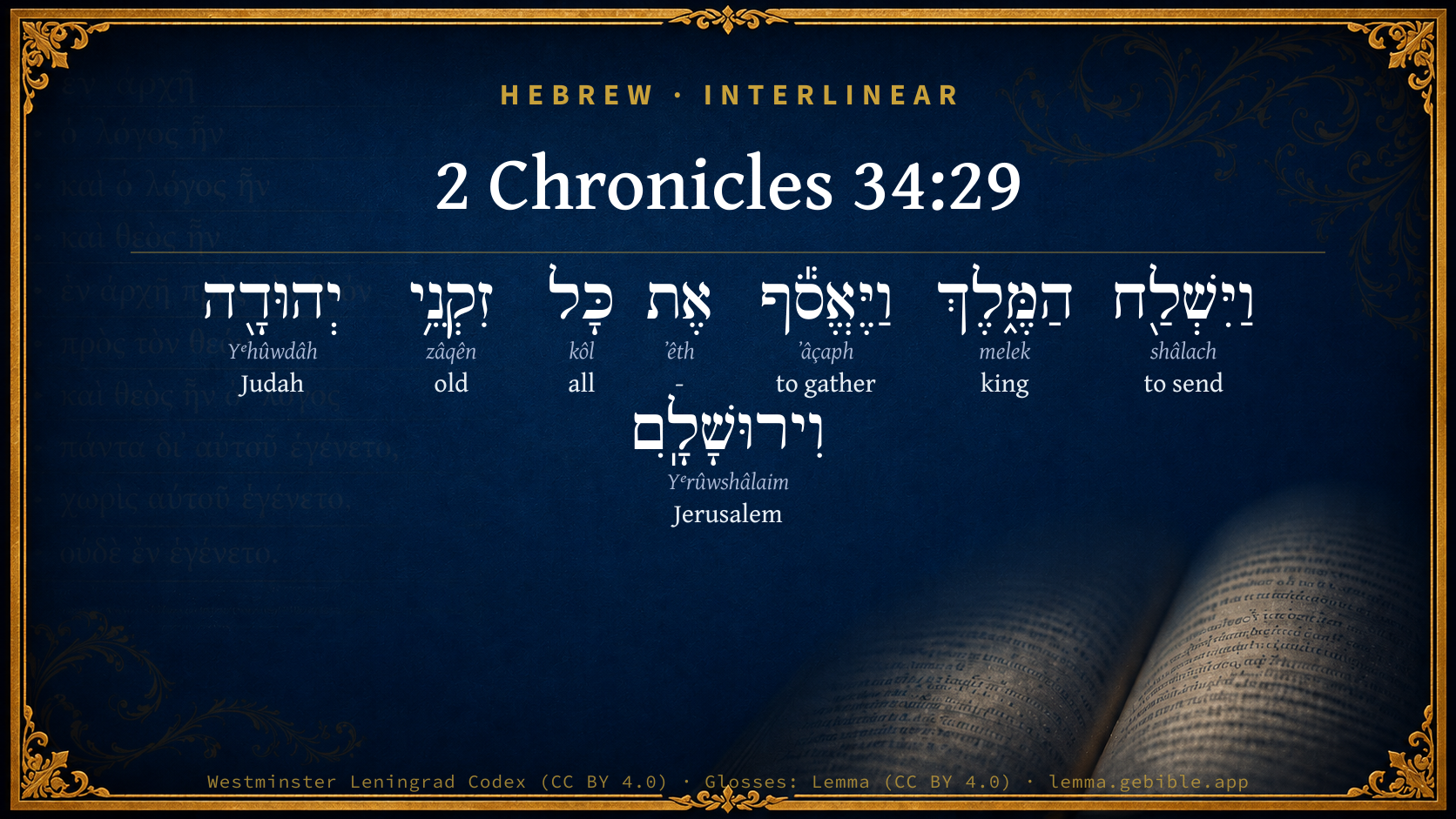
Hebrew (Westminster Leningrad Codex) 2 Chronicles 34:29 appears in the Hebrew Old Testament. The text above is from the Westminster Leningrad Codex. Each word links to its Strong’s number, a concise gloss, and parsing drawn from the Open Scriptures Hebrew Bible morphology. Click any word for its full Brown-Driver-Briggs (BDB) entry.
Download image
Cite this verse

2 Chronicles 34:29 (World English Bible). Public Domain. Lemma interlinear Bible study tool, https://lemma.gebible.app/v/2-chronicles/34/29.

Show BibTeX & RIS
BibTeX
RIS
English Translation
Then the king sent and gathered together all the elders of Judah and Jerusalem.
World English Bible · Public Domain
Download a study sheet

One document with this verse’s original text, its word-by-word gloss line, the meaning frame, cross-references with their text, attributed commentary, and full source and license credits — printable, and it pastes into notes with its structure intact.

This verse Autodidact and up

Study sheet (.html) Plain text (.txt)

A passage Seminary Student

Up to 50 verses in one chapter. A passage sheet keeps up to 6 commentary sources and 12 cross-references per verse, in the order this page ranks them, and says so on the sheet whenever that leaves anything out. Ask for a single verse and you get the Autodidact verse sheet above.

Everything on this page stays free to read, with no account — the sheet is a download of what is already on screen, not access to it.

Want to remove ads? Support Godless Engineer
Compare translations 3

The same verse in 3 English versions, stacked beneath the original-language interlinear above. Click any original word for its lexicon entry.

Each is an independent rendering of the whole verse — the interlinear is not word-aligned to these translations.

Highlighted words mark where these versions differ — a whole-verse word diff, not a word-by-word alignment.

  • World English Bible Public Domain
    Then the king sent and gathered together all the elders of Judah and Jerusalem.
  • King James Version Public Domain
    Then the king sent and gathered together all the elders of Judah and Jerusalem.
  • unfoldingWord Literal Text CC BY-SA 4.0
    And the king sent, and he gathered all the elders of Judah and Jerusalem.

unfoldingWord Literal Text — © unfoldingWord, licensed CC BY-SA 4.0. Word-aligned USFM3 via Door43 (git.door43.org/unfoldingWord/en_ult).

Versions to compare (up to 4)

3 of 4 selected

Show all 18 translations

Every available English version of this verse, each an independent rendering of the whole verse.

  • World English Bible Public Domain
    Then the king sent and gathered together all the elders of Judah and Jerusalem.
  • Berean Standard Bible Public Domain
    Then the king summoned all the elders of Judah and Jerusalem.
  • Majority Standard Bible Public Domain
    Then the king summoned all the elders of Judah and Jerusalem.
  • King James Version Public Domain
    Then the king sent and gathered together all the elders of Judah and Jerusalem.
  • American Standard Version (1901) Public Domain
    Then the king sent and gathered together all the elders of Judah and Jerusalem.
  • Revised Version (1885) Public Domain
    Then the king sent and gathered together all the elders of Judah and Jerusalem.
  • Geneva Bible (1599) Public Domain
    Then the King sent and gathered all the Elders of Iudah and Ierusalem.
  • Douay-Rheims (1899) Public Domain
    And he called together all the ancients of Juda and Jerusalem.
  • Young's Literal Translation Public Domain
    And the king sendeth and gathereth all the elders of Judah and Jerusalem,
  • Literal Standard Version CC BY-SA 4.0
    And the king sends and gathers all the elderly of Judah and Jerusalem,
  • Unlocked Literal Bible CC BY-SA 4.0
    Then the king sent messengers and gathered together all the elders of Judah and Jerusalem.
  • unfoldingWord Literal Text CC BY-SA 4.0
    And the king sent, and he gathered all the elders of Judah and Jerusalem.
  • Darby Bible Public Domain
    And the king sent and gathered all the elders of Judah and of Jerusalem.
  • World Messianic Bible Public Domain
    Then the king sent and gathered together all the elders of Judah and Jerusalem.
  • Webster's Bible Public Domain
    Then the king sent and convened all the elders of Judah and Jerusalem.
  • Free Bible Version CC BY-SA 4.0
    Then the king summoned all the elders of Judah and Jerusalem.
  • Bible in Basic English Public Domain
    Then the king sent and got together all the responsible men of Judah and of Jerusalem.
  • JPS Tanakh (1917) Public Domain
    Then the king sent and gathered together all the elders of Judah and Jerusalem.

Literal Standard Version (2020), Covenant Press — licensed CC BY-SA 4.0. Text via the HelloAO Bible API (eBible.org). Unlocked Literal Bible (unfoldingWord) — licensed CC BY-SA 4.0. Text via the HelloAO Bible API (eBible.org). unfoldingWord Literal Text — © unfoldingWord, licensed CC BY-SA 4.0. Word-aligned USFM3 via Door43 (git.door43.org/unfoldingWord/en_ult). Free Bible Version, Dr. Jonathan Gallagher — licensed CC BY-SA 4.0. Text via the HelloAO Bible API (eBible.org).

Word by word

More ways to search: Search by grammar → Find every occurrence → Compare this word →

Practice this passage: Drill this verse → Learn its vocabulary →

About this verse

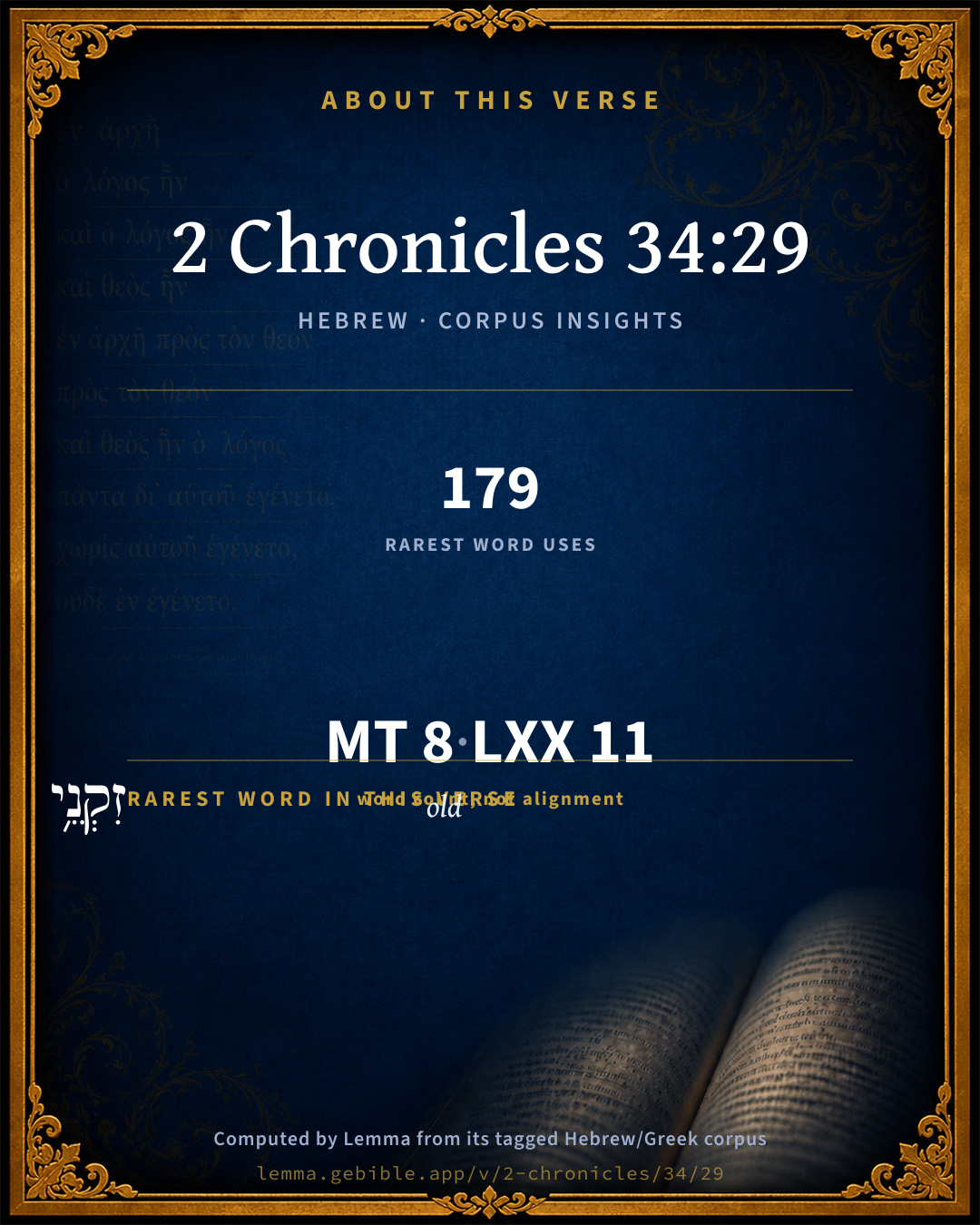
These counts appear in no published source. They are computed here, from the morphology-tagged text and Lemma’s own curated glosses. What Lemma adds →

8
words
8
distinct lemmas
Historical
section

Grammatical profile

  • 2 verbs
  • 4 nouns
  • 1 adjective
  • 1 particle

Verb forms

  • וַיִּשְׁלַ֖ח Qal · Sequential Imperfect
  • וַיֶּאֱסֹ֕ף Qal · Sequential Imperfect

Hebrew & Septuagint length

In English translation the verse runs 14 words from the Hebrew and 12 from the Septuagint (LXX English) — closely comparable.

A rough comparison of the two English renderings, which tokenize alike — not a word-level alignment.

Word counts can differ between the Hebrew and the Greek without any difference in meaning — e.g. the Hebrew direct-object marker אֵת has no separate Greek word, and Greek often adds the article ὁ.

In the original languages it is 8 Hebrew tokens and 11 Greek tokens — but the two are counted differently (Hebrew bundles its prefixes and suffixes into one token; the Greek is in lemma form), so that isn’t a like-for-like length.

Cross-references

5

Topical passages linked to 2 Chronicles 34:29 in the Treasury of Scripture Knowledge — connected by theme and wording, ordered by reader-vote popularity; previews shown in the World English Bible.

  • 2 Kings 23:1–3 The king sent, and they gathered to him all the elders of Judah and of Jerusalem.
  • 1 Samuel 12:23 Moreover as for me, far be it from me that I should sin against Yahweh in ceasing to pray for you: but I will instruct you in the good and the right way.
  • 1 Chronicles 29:2–9 Now I have prepared with all my might for the house of my God the gold for the [things of] gold, and the silver for the [things of] silver, and the brass for the [things of] brass, the iron for the [things of] iron, and wood for the [things of] wood; onyx stones, and [stones] to be set, stones for inlaid work, and of various colors, and all manner of precious stones, and marble stones in abundance.
  • 2 Chronicles 30:2 For the king had taken counsel, and his princes, and all the assembly in Jerusalem, to keep the Passover in the second month.
  • Mark 14:8 She has done what she could. She has anointed my body beforehand for the burying.

Cross-references courtesy of OpenBible.info (CC BY 4.0).

Hebrew and Greek witnesses Masoretic Hebrew ↔ Greek Septuagint

The same verse in the two great witnesses to the Old Testament, shown verse-for-verse.

These are two independent witnesses, not word-aligned to each other, and the Septuagint is shown in lemma (dictionary) form.

Hebrew 2 Chronicles 34:29 Masoretic · Westminster Leningrad Codex

וַיִּשְׁלַ֖ח הַמֶּ֑לֶךְ וַיֶּאֱסֹ֕ף אֶת כָּל זִקְנֵ֥י יְהוּדָ֖ה וִירוּשָׁלִָֽם

Then the king sent and gathered together all the elders of Judah and Jerusalem.

World English Bible · Public Domain

Greek LXX 2 Chronicles 34:29 Septuagint · lemma form

καί ἀποστέλλω ὁ βασιλεύς καί συνἄγω ὁ πρεσβύτερος ἰουδά καί ἰερουσαλήμ

And the king sent and gathered the elders of Juda and Jerusalem.

LXX2012 (modern English Septuagint) · Public Domain

Hebrew: Westminster Leningrad Codex (CC BY 4.0). Greek: Septuagint (public domain); English from LXX2012 (modern English Septuagint) (Public Domain). How the Septuagint differs from the Hebrew →

Commentary

Notes on 2 Chronicles 34:29 from classic Christian and Jewish commentators (each source and its license shown beneath its notes). The classic Christian expositions comment on the surrounding passage and are grouped to its opening verse, so a note may address several verses; the Jewish commentaries on the Tanakh (Rashi and others) are per-verse, so they appear only where the commentator wrote on this verse.

Lemma curates 59 commentaries, every one of them public domain or Creative Commons licensed, each selected and text-cleaned for this edition rather than reprinted as found. About our sources →

Trapp's Complete Commentary

John Trapp

2Ch 34:29 Then the king sent and gathered together all the elders of Judah and Jerusalem.

Ver. 29-33. See 2Ki 23:1-3, &c.

John Trapp, A Commentary or Exposition upon All the Books of the Old and New Testament (1647–1656) — public domain. Text from a community e-Sword module.

Tyndale Open Study Notes

Tyndale Open Resources

34:29-32 Renewal of the covenant was the most significant event in Josiah’s reform.

Tyndale Open Study Notes — © Tyndale Open Resources, licensed CC BY-SA 4.0. Text via the HelloAO Bible API.

Matthew Henry's Commentary

We have here an account of the further advances which Josiah made towards the reformation of his kingdom upon the hearing of the law read and the receipt of the message God sent him by the prophetess. Happy the people that had such a king; for here we find that, 1. They were well taught. He did not go about to force them to do their duty, till he had first instructed them in it. He called all the people together, great and small, young and old, rich and poor, high and low. He that hath ears to hear, let him hear the words of the book of the covenant; for they are all concerned in those words. To put an honour upon the service, and to engage attention the more, though there were priests and Levites present, the king himself read the book to the people (Ch2 34:30), and he read it, no doubt, in such a manner as to show that he was himself affected with it, which would be a means of affecting the hearers. 2. They were well fixed. The articles of agreement between God and Israel being read, that they might intelligently covenant with God, both king and people with great solemnity did as it were subscribe the articles. The king in his place covenanted to keep God's commandments with all his heart and soul, according to what was written in the book (Ch2 34:31), and urged the people to declare their consent likewise to this covenant, and solemnly to promise that they would faithfully perform, fulfil, and keep, all and every thing that was on their part to be done, according to this covenant: this they did; they could not for shame do otherwise. He caused all that were present to stand to it (Ch2 34:32), and made them all to serve, even to serve the Lord their God (Ch2 34:33), to do it and to make a business of it. he did all he could to bring them to it - to serve, even to serve; the repetition denotes that this was the only thing his heart was set on; he aimed at nothing else in what he did but to engage them to God and their duty. 3. They were well tended, were honest with good looking to. All his days they departed not from following the Lord; he kept them, with much ado, from running into idolatry again. All his days were days of restraint upon them; but this intimated that there was in them a bent to backslide, a strong inclination to idolatry. Many of them wanted nothing but to have him out of the way, and then they would have their high places and their images up again. And therefore we find that in the days of Josiah (Jer 3:6) God charged it upon treacherous Judah that she had not returned to him with all her heart, but feignedly (Ch2 34:10), nay, had played the harlot (Ch2 34:8) and thereby had even justified backsliding Israel, Ch2 34:11. In the twenty-third year of this reign, four or five years after this, they had gone on to provoke God to anger with the works of their hands (Jer 25:3-7); and, which is very observable, it is from the beginning of Josiah's reformation, his twelfth or thirteenth year, that the iniquity of the house of Judah, which brought ruin upon them, and which the prophet was to bear lying on his right side, was dated (Eze 4:6), for thence to the destruction of Jerusalem was just forty years. Josiah was sincere in what he did, but the generality of the people were averse to it and hankered after their idols still; so that the reformation, though well designed and well prosecuted by the prince, had little or no effect upon the people. It was with reluctancy that they parted with their idols; still they were in heart joined to them, and wished for them again. This God saw, and therefore from that time, when one would have thought the foundations had been laid for a perpetual security and peace, from that very time did the decree go forth for their destruction. Nothing hastens the ruin of a people nor ripens them for it more than the baffling of hopeful attempts for reformation and a hypocritical return to God. Be not deceived, God is not mocked.

Matthew Henry's Commentary on the Whole Bible (1708–1710) — public domain (CC PDM 1.0). Text via the HelloAO Bible API.

Ellicott's Commentary for English Readers

(29-33) The king reads the Book to the assembly, and renews the covenant. (Comp. 2Ki_23:1)

A Bible Commentary for English Readers, edited by Charles John Ellicott (1878–1897) — public domain. Text from a community e-Sword module.

The Cambridge Bible for Schools and Colleges

gen. ed. J. J. S. Perowne

29–33 (cp. 2Ki_23:1-3). The Renewal of the Covenant with Jehovah

This renewal of the covenant should be compared with Hezekiah’s great service of atonement for the breach of the covenant (2Ch_29:20 ff.). See also Exo_24:3-8.

The Cambridge Bible for Schools and Colleges (gen. ed. J. J. S. Perowne; Cambridge University Press, 1878–1918) — public domain. Text from a community e-Sword module.

The Pulpit Commentary

The wise, religious, and unselfish conduct of the king is clearly betokened in the course he took, as narrated here and in the succeeding three verses.

Vers. 29-33.

Communication and continuance.

Josiah"s wise and devout concern, when he discovered the Word and knew more fully the will of God, was to communicate his own earnestness to others, and to secure for future years this new and good departure. He took the most natural and wise measures to attain his object.

1. He summoned all the elders in particular and all the people who couldmeet together, and made known to them in its fulness the truth that had been revealed to himself (vers. 29, 30).

2. He pledged all those who were with him, and who represented thenation, to continuance in the service of Jehovah (vers. 31, 32).

3. He took away the standing temptation from the path of the people. Hethus made obedience easier while he made the sense of obligation firmer.

I OUR DUTY TO COMMUNICATE DIVINE TRUTH. When we consider:

1. How essential to life and all that life includes is the familiar knowledgeof the will of God.

2. How possible and how practicable it is for all who know the will of Godin Jesus Christ to pass it on to others.

3. How willingly men will listen if we give them the simplest and bestguarantee of our sincerity consistency of conduct and excellency of spirit; we shall see how right and how urgent it is upon us that we should all "hold forth the Word of life," make known the goodness and the grace of our Lord Jesus Christ.

II OUR DUTY TO SECURE IT SO FAR AS LIES IN OUR POWER. The text suggests three ways of doing this.

1. Pledge ourselves to abide in its light. Josiah covenanted for himself to "keep his commandments with all his heart to perform the words written in this book." That was his first, plain duty. And that is ours also; to undertake, solemnly and openly before God and his people, to walk in righteousness and in holy service; to" take the vows of the Lord" upon us. By so doing we give the strongest possible and the greatest practical encouragement to all others to come and "do likewise.

2. Induce others to enter into the same solemn undertaking. As the kingwith his countrymen (ver. 32), so we with our kindred and friends, with our fellow-worshippers and neighbours, should do all in our power to pledge them to the service of God. "Join us," we should say, "in taking a solemn and sacred pledge to live consciously in the presence and continuously in the service of the Divine Saviour." In every considerable company of worshippers there are those who are unpledged, but who, for their own sake and for that of others related to them, ought to be the avowed disciples of Christ. It is our sacred duty, it is our high privilege, it will prove a service rich in the best reward, to speak the encouraging and inviting word which will lead them to take this important step.

1. Remove temptation from the path of those who might not be able toresist it. This is ground on which we must exhibit both understanding and earnestness, both sagacity and self-sacrifice. There are things which may be said. to be "abominations" (ver. 33) because they prove to be irresistible and ruinous temptations to some sincere disciples. In these cases, it is not enough to warn against them we must go further than that; we must do anything and everything that is needful to get the temptation as much out of the path of our neighbours as the images which were ground to dust

2. (ver. 4) were removed from the way of the people of Judah. We may add a fourth measure which may be suggested by the twenty-ninth verse:

3. Prevail upon our friends to come into the near presence and under thepower of the truth of God; and this not (as in the text) on one particular occasion, but frequently and regularly. For much fellowship with Christ and much hearkening to his voice as he speaks to us in the sanctuary will give strength unto the soul. C.

Vers. 29-33.

Judah"s last national covenant.

I THE CIRCUMSTANCES.

1. The time.

(1) In the eighteenth year of Josiah"s reign, or in Josiah"s twenty-sixth year; not so early as the covenant made by Asa in the fifteenth year of his reign, (2Ch_15:10) or as that made by Jehoiada in the first year of Joash"s reign, (2Ch_23:16) or as that projected by Hezekiah also in the first year of his reign. (2Ch_29:10) But better late than never.

(2) After the purgation of the land and the house. It is necessary as well as fitting that works of repentance and reformation should be followed up by resolutions after new obedience, that the casting out of false gods should be supplemented by the bringing in of the true God, that "ceasing to do evil" should be accompanied by "learning to do well". (Isa_1:16, Isa_1:17)

(3) While Josiah was under the devout impressions produced by the reading of the book of the Law. Seasons when the heart is affected by a sense of God"s nearness or a conviction of its own sinfulness should be improved by drawing closer its relations to God. (2Co_7:11)

2. The place.

(1) The city of Jerusalem, which had been swept clean from its idolatries an indispensable preliminary to meeting with God.

(2) The temple on Moriah, where Jehovah had set his Name. They who would have dealings with a God of grace must seek him at the times, in the places, and by the ways he himself has appointed.

II THE PARTIES.

1. The king. As was most appropriate, Josiah led the way. Though sovereigns have no right under the gospel to enforce religion on their subjects, they may nevertheless, by means of personal example, persuade their subjects to embrace religion.

2. The elders. These were the heads of the houses, and therefore the representatives of the inhabitants both of Judah and Jerusalem. Unless the chiefs in a state and the fathers in a family precede, it is not likely the inferiors in the former or the children in the latter will follow after in the paths of piety.

3. The priests and Levites. Instead of "the Levites," 2 Kings (2Ki_23:2) reads "prophets," which has been explained by supposing that the prophets, among whom probably were Jeremiah, Baruch, Zephaniah, and Urijah, belonged to priestly and Levitical families, or that they were Levites whose duty it was to preach and to interpret the Law (2Ch_17:8, 2Ch_17:9; cf. (Deu_17:18 Deu_31:9 Deu_33:10) Those who ascribe it to an error of the pen are uncertain whether that error should be charged against the author of the Kings (Keil) or against the Chronicler (Bertheau).

4. The people. Great and small the people of distinction and the lower classes, perhaps also the grown-up persons and the children were assembled as participants in this high transaction. (cf. Deu_1:17)

III THE PRELIMINARIES.

1. The reading of the book of the covenant. The part read most likely included Exodus 24., the readers being, not the king himself (Adam Clarke), but others, presumably Shaphan, Hilkiah, Jeremiah, etc. The reading was "in their ears," from which may be inferred that it was audible and distinct.

2. The standing of the king in his place. This was the platform beside the brazen altar, upon which the sovereign was accustomed to stand in high religious and national ceremonies. (2Ch_6:13 2Ch_23:13)

IV THE ENGAGEMENTS.

1. To walk after the Lord. The common phrase for observing the worship of Jehovah (2Ch_11:17; 2Ki_17:8 2Ki_21:22; Mic_4:5 Mic_6:16) Distinguish the similar phrases, "to walk before God" (2Ch_6:14; Gen_17:1) and "to walk with God". (Gen_5:24) The ideas in the first are perhaps those of imitation and obedience; in the second, those of sincerity and purity; in the third, those of communion and concord.

2. To keep his commandments and his testimonies and his statutes. Explanatory of the foregoing; to walk after Jehovah, signifying to keep his commandments, etc. The three terms commandments, testimonies, statutes occasionally occur together or in contiguity, (Psa_19:7, 8 119:21, 22, 23) and though etymologically distinguishable, are practically synonymous. They are employed here perhaps for variety, but chiefly for emphasis. (Ecc_4:12) The obedience required by Jehovah and promised by the people was not formal and superficial, but earnest and sincere all the heart, and with all the soul." God for Christ"s sake may accept less, but for his own sake he never can demand less, while God"s people and Christ"s should strive never to present less.

3. To perform the words of the covenant written in the book of the Law. The ultimate standard of duty for king and people was to be the words of the book, and neither the opinions of others nor the imaginations of themselves. So for Christians the supreme rule of faith and practice is the Holy Scriptures.

V THE RESULTS.

1. The people assented to the covenant. At the king"s command whether with perfect free-will (2Ki_23:3) is not clear they bound themselves to its observance (ver. 32). Without the concurrence of the will there can be no true religious service.

2. The king purged the land of Israel from abominations. He allowed no external observance of idolatry. To cleanse the hearts of his people from idol-worship was beyond his power. Human enactments, by whatever power promulgated, can only effect external reformation; the regeneration of the heart and renewal of the mind are competent to God alone.

3. The nation kept true to the covenant while Josiah lived. The practice of idolatry had been suppressed, but the spirit of idolatry had not been killed. After Josiah"s death it again raised its head, (2Ch_36:5 2Ki_23:32) as it had frequently done before after periods of reformation.

LESSONS.

1. The Word of God the supreme directory to a Christian both for faith andpractice.

2. The prime duty of man to keep God"s commandments and testimonies.

3. The highest evidence of piety in either individual or nation is holiness. W.

The Pulpit Commentary (1880–1919), ed. H.D.M. Spence-Jones & Joseph S. Exell — public domain. Text from a community e-Sword module.

Keil & Delitzsch

C. F. Keil & F. Delitzsch

The reading of the book of the law in the temple, and the solemn renewal of the covenant, to which the king assembled the elders of Judah and Jerusalem, with all the people, after the saying of the prophetess Huldah had been reported to him, are recorded in Kg2 23:1-3 as they are in the Chronicle, and have been commented upon at the former passage. Only Ch2 34:32, the contents of which correspond to the words, "And the whole people entered into the covenant" (Kg2 23:3), will need explanation. ויּעמד is usually translated, "he caused the people to enter into the covenant" (after 2 Kings). This is in substance correct, but exegetically cannot be defended, since בּבּרית does not precede, so as to allow of its here being supplied from the context. ויּעמד only signifies, he caused all who were in Jerusalem and Benjamin to stand, and they did according to the covenant of God; whence we can easily supply in the first clause, "and to do according to the covenant." The collocation, "in Jerusalem and in Benjamin," is an abbreviation of the complete formula, "in Jerusalem and Judah and Benjamin;" then in the following clause only the inhabitants of Jerusalem are named as representatives of the inhabitants of the whole kingdom.

Keil & Delitzsch — Biblical Commentary on the Old Testament (1861–1891) — public domain (CC PDM 1.0). Text via the HelloAO Bible API. (Old Testament only.)

unfoldingWord translationNotes

Door43 World Missions Community

all the men of Judah and the inhabitants of Jerusalem

This is a generalization. AT: "many other people" (See: Hyperbole and Generalization)

from great to small

This merism includes everyone in between. AT: "from the most important to the least important" (See: Merism)

He then read in their hearing

"Then the king read aloud so that they could hear"

that had been found

This can be translated in active form. AT: "that Hilkiah had found" or "that they had found" (See: Active or Passive)

translationWords

messenger

elder

priest

Levi

covenant

house of God

unfoldingWord translationNotes — © Distant Shores Media and the Door43 World Missions Community, licensed CC BY-SA 4.0. Source: git.door43.org/Door43/en_tn.

Lesson kit

Teaching starters — assembled from the data on this page, not authored interpretation. Every prompt links to the verse data it draws on. Edit before teaching.

2 Chronicles, in the Historical, opens this verse with 8 words (8 distinct Hebrew lemmas). Its most distinctive word is zâqên (“old”). A historical commentator’s framing appears above. Read the whole chapter for the surrounding context.

Discussion questions

  1. What does “old” (zâqên) contribute to the verse as a whole?
  2. 2 Kings 23:1–3 shares this passage’s theme. How do the two illuminate each other?
  3. The translations on this page render this verse differently — a whole-verse word diff, not a word-by-word alignment. What might account for the different wordings?
  4. The verb «וַיִּשְׁלַ֖ח» is Qal Sequential Imperfect. How does its form color the action?
  5. Reading how Trapp's Complete Commentary and Tyndale Open Study Notes read this verse, where do the two commentators agree and where do they part?

Things to notice

Reading settings

Reading text

Shown beneath each verse's original-language words.

Old Testament
Old Testament edition

Read the OT as the Masoretic Hebrew (MT) or the Greek Septuagint (LXX).

English shown for the Greek Septuagint (in the Hebrew ↔ Greek comparison).

Comparing translations? Open the Compare panel on any verse page to stack up to four side by side.