
2 Chronicles 30:5

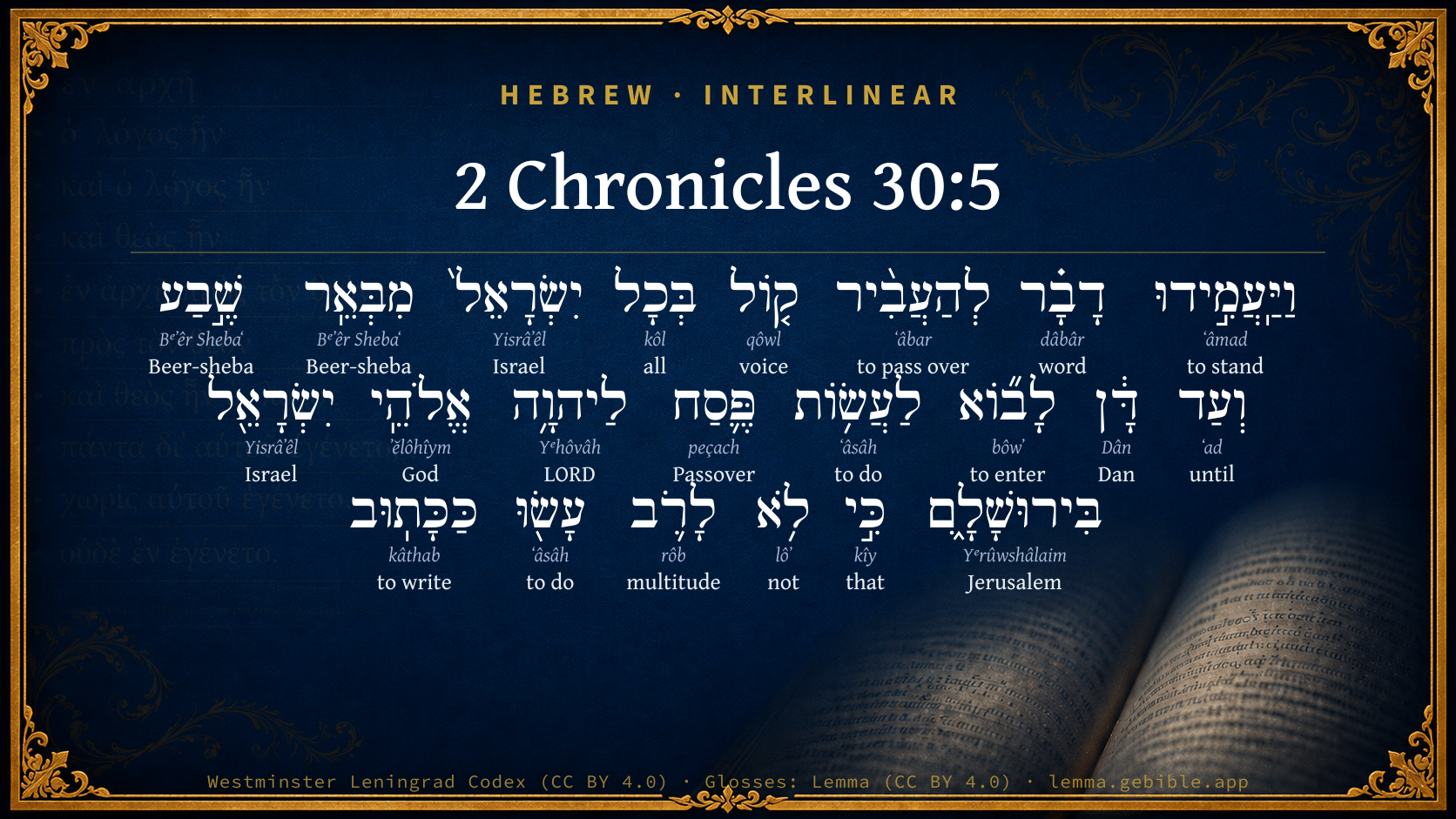
Hebrew (Westminster Leningrad Codex) 2 Chronicles 30:5 appears in the Hebrew Old Testament. The text above is from the Westminster Leningrad Codex. Each word links to its Strong’s number, a concise gloss, and parsing drawn from the Open Scriptures Hebrew Bible morphology. Click any word for its full Brown-Driver-Briggs (BDB) entry.
Download image
Cite this verse

2 Chronicles 30:5 (World English Bible). Public Domain. Lemma interlinear Bible study tool, https://lemma.gebible.app/v/2-chronicles/30/5.

Show BibTeX & RIS
BibTeX
RIS
English Translation
So they established a decree to make proclamation throughout all Israel, from Beersheba even to Dan, that they should come to keep the Passover to Yahweh, the God of Israel, at Jerusalem: for they had not kept it in great numbers in such sort as it is written.
World English Bible · Public Domain
Download a study sheet

One document with this verse’s original text, its word-by-word gloss line, the meaning frame, cross-references with their text, attributed commentary, and full source and license credits — printable, and it pastes into notes with its structure intact.

This verse Autodidact and up

Study sheet (.html) Plain text (.txt)

A passage Seminary Student

Up to 50 verses in one chapter. A passage sheet keeps up to 6 commentary sources and 12 cross-references per verse, in the order this page ranks them, and says so on the sheet whenever that leaves anything out. Ask for a single verse and you get the Autodidact verse sheet above.

Everything on this page stays free to read, with no account — the sheet is a download of what is already on screen, not access to it.

Want to remove ads? Support Godless Engineer
Compare translations 3

The same verse in 3 English versions, stacked beneath the original-language interlinear above. Click any original word for its lexicon entry.

Each is an independent rendering of the whole verse — the interlinear is not word-aligned to these translations.

Highlighted words mark where these versions differ — a whole-verse word diff, not a word-by-word alignment.

  • World English Bible Public Domain
    So they established a decree to make proclamation throughout all Israel, from Beersheba even to Dan, that they should come to keep the Passover to Yahweh, the God of Israel, at Jerusalem: for they had not kept it in great numbers in such sort as it is written.
  • King James Version Public Domain
    So they established a decree to make proclamation throughout all Israel, from Beersheba even to Dan, that they should come to keep the passover unto the LORD God of Israel at Jerusalem: for they had not done it of a long time in such sort as it was written.
  • unfoldingWord Literal Text CC BY-SA 4.0
    And they caused to stand a word to cause a voice to pass over among all Israel, from Beersheba and to Dan to come to do a Passover to Yahweh, the God of Israel, in Jerusalem; for they had not in abundance done as was written.

unfoldingWord Literal Text — © unfoldingWord, licensed CC BY-SA 4.0. Word-aligned USFM3 via Door43 (git.door43.org/unfoldingWord/en_ult).

Versions to compare (up to 4)

3 of 4 selected

Show all 18 translations

Every available English version of this verse, each an independent rendering of the whole verse.

  • World English Bible Public Domain
    So they established a decree to make proclamation throughout all Israel, from Beersheba even to Dan, that they should come to keep the Passover to Yahweh, the God of Israel, at Jerusalem: for they had not kept it in great numbers in such sort as it is written.
  • Berean Standard Bible Public Domain
    So they established a decree to circulate a proclamation throughout Israel, from Beersheba to Dan, that the people should come to keep the Passover of the LORD, the God of Israel, in Jerusalem. For they had not observed it as a nation as prescribed.
  • Majority Standard Bible Public Domain
    So they established a decree to circulate a proclamation throughout Israel, from Beersheba to Dan, that the people should come to keep the Passover of the LORD, the God of Israel, in Jerusalem. For they had not observed it in great numbers as prescribed.
  • King James Version Public Domain
    So they established a decree to make proclamation throughout all Israel, from Beersheba even to Dan, that they should come to keep the passover unto the LORD God of Israel at Jerusalem: for they had not done it of a long time in such sort as it was written.
  • American Standard Version (1901) Public Domain
    So they established a decree to make proclamation throughout all Israel, from Beer-sheba even to Dan, that they should come to keep the passover unto Jehovah, the God of Israel, at Jerusalem: for they had not kept it in great numbers in such sort as it is written.
  • Revised Version (1885) Public Domain
    So they established a decree to make proclamation throughout all Israel, from Beer-sheba even to Dan, that they should come to keep the passover unto the LORD, the God of Israel, at Jerusalem: for they had not kept it in great numbers in such sort as it is written.
  • Geneva Bible (1599) Public Domain
    And they decreed to make proclamation throughout all Israel from Beersheba euen to Dan, that they should come to keepe the Passeouer vnto the Lord God of Israel at Ierusalem: for they had not done it of a great time, as it was written.
  • Douay-Rheims (1899) Public Domain
    And the thing pleased the king, and all the people.
  • Young's Literal Translation Public Domain
    and they establish the thing, to cause to pass over an intimation into all Israel, from Beer-Sheba even unto Dan, to come in to make a passover to Jehovah, God of Israel, in Jerusalem, for not for a long time had they done as it is written.
  • Literal Standard Version CC BY-SA 4.0
    and they establish the thing, to cause an intimation to pass over into all Israel, from Beer-Sheba even to Dan, to come to make a Passover to YHWH, God of Israel, in Jerusalem; for they had not done as it is written for a long time.
  • Unlocked Literal Bible CC BY-SA 4.0
    So they agreed to make a proclamation throughout all Israel, from Beersheba to Dan, that the people should come to celebrate the Passover to Yahweh, the God of Israel, in Jerusalem. For they had not observed it with large numbers of people according to what was written.
  • unfoldingWord Literal Text CC BY-SA 4.0
    And they caused to stand a word to cause a voice to pass over among all Israel, from Beersheba and to Dan to come to do a Passover to Yahweh, the God of Israel, in Jerusalem; for they had not in abundance done as was written.
  • Darby Bible Public Domain
    So they established a decree to make proclamation throughout Israel from Beer-sheba even to Dan, that they should come to hold the passover to Jehovah the God of Israel, at Jerusalem; because they had not held it for a long time as it was written.
  • World Messianic Bible Public Domain
    So they established a decree to make proclamation throughout all Israel, from Beersheba even to Dan, that they should come to keep the Passover to the LORD, the God of Israel, at Jerusalem, for they had not kept it in great numbers in the way it is written.
  • Webster's Bible Public Domain
    So they established a decree to make proclamation throughout all Israel, from Beer-sheba even to Dan, that they should come to keep the passover to the LORD God of Israel at Jerusalem: for they had not done it of a long time in the manner as it was written.
  • Free Bible Version CC BY-SA 4.0
    So they decided to send an announcement to everyone in Israel, from Beersheba to Dan, inviting people to come and keep the Passover to the Lord, the God of Israel, in Jerusalem, for many had not done as the Law required.
  • Bible in Basic English Public Domain
    So it was ordered that word was to be sent out through all Israel, from Beer-sheba to Dan, that they were to come to keep the Passover to the Lord, the God of Israel, at Jerusalem: because they had not kept it in great numbers in agreement with the law.
  • JPS Tanakh (1917) Public Domain
    So they established a decree to make proclamation throughout all Israel, from Beer-sheba even to Dan, that they should come to keep the passover unto the LORD, the God of Israel, at Jerusalem; for they had not kept it in great numbers according as it is written.

Literal Standard Version (2020), Covenant Press — licensed CC BY-SA 4.0. Text via the HelloAO Bible API (eBible.org). Unlocked Literal Bible (unfoldingWord) — licensed CC BY-SA 4.0. Text via the HelloAO Bible API (eBible.org). unfoldingWord Literal Text — © unfoldingWord, licensed CC BY-SA 4.0. Word-aligned USFM3 via Door43 (git.door43.org/unfoldingWord/en_ult). Free Bible Version, Dr. Jonathan Gallagher — licensed CC BY-SA 4.0. Text via the HelloAO Bible API (eBible.org).

Word by word

More ways to search: Search by grammar → Find every occurrence → Compare this word →

Practice this passage: Drill this verse → Learn its vocabulary →

פֶּ֛סַח
peçach
H6453
“Passover”
Noun, Common, Masculine, Singular, Absolute
Part of Speech
Noun
Type
Common
Gender
Masculine
Number
Singular
State
Absolute
Full BDB Definition

Origin: from H6452

TWOT: 1786a

passover - sacrifice of passover - animal victim of the passover - festival of the passover
  1. וַיַּֽעֲמִ֣ידוּ ʻâmad H5975 “and · to stand” Conjunction + Verb, Hiphil, Sequential Imperfect, 3rd Person, Masculine, Plural
  2. דָבָ֗ר dâbâr H1697 “word” Noun, Common, Masculine, Singular, Absolute
  3. לְהַעֲבִ֨יר ʻâbar H5674 “to pass over” Preposition + Verb, Hiphil, Infinitive Construct
  4. ק֤וֹל qôwl H6963 “voice” Noun, Common, Masculine, Singular, Absolute
  5. בְּכָל kôl H3605 “in/at · all of” Preposition + Noun, Common, Masculine, Singular, Construct
  6. יִשְׂרָאֵל֙ Yisrâʼêl H3478 “Israel” Noun, Proper
  7. מִבְּאֵֽר Bᵉʼêr Shebaʻ H884 “from · Beer-sheba” Preposition + Noun, Proper
  8. שֶׁ֣בַע Bᵉʼêr Shebaʻ H884 “Beer-sheba” Adjective, Cardinal number, Feminine, Singular, Absolute
  9. וְעַד ʻad H5704 “and · until” Conjunction + Preposition
  10. דָּ֔ן Dân H1835 “Dan” Noun, Proper
  11. לָב֞וֹא bôwʼ H935 “to enter” Preposition + Verb, Qal, Infinitive Construct
  12. לַעֲשׂ֥וֹת ʻâsâh H6213 “to do” Preposition + Verb, Qal, Infinitive Construct
  13. לַיהוָ֥ה Yᵉhôvâh H3068 “to/for · LORD” Preposition + Noun, Proper
  14. אֱלֹהֵֽי ʼĕlôhîym H430 “God(s) of” Noun, Common, Masculine, Plural, Construct
  15. יִשְׂרָאֵ֖ל Yisrâʼêl H3478 “Israel” Noun, Proper
  16. בִּירוּשָׁלִָ֑ם Yᵉrûwshâlaim H3389 “in/at · Jerusalem” Preposition + Noun, Proper
  17. כִּ֣י kîy H3588 “that” Conjunction
  18. לֹ֥א lôʼ H3808 “not” Particle, Negative
  19. לָרֹ֛ב rôb H7230 “to/for · multitude” Preposition + Noun, Common, Both, Singular, Absolute
  20. עָשׂ֖וּ ʻâsâh H6213 “to do” Verb, Qal, Perfect, 3rd Person, Common, Plural
  21. כַּכָּתֽוּב kâthab H3789 “like/as the · written” Preposition, Determined + Verb, Qal, Participle Passive, Masculine, Singular, Absolute

About this verse

These counts appear in no published source. They are computed here, from the morphology-tagged text and Lemma’s own curated glosses. What Lemma adds →

22
words
19
distinct lemmas
Historical
section

Shared distinctive vocabulary

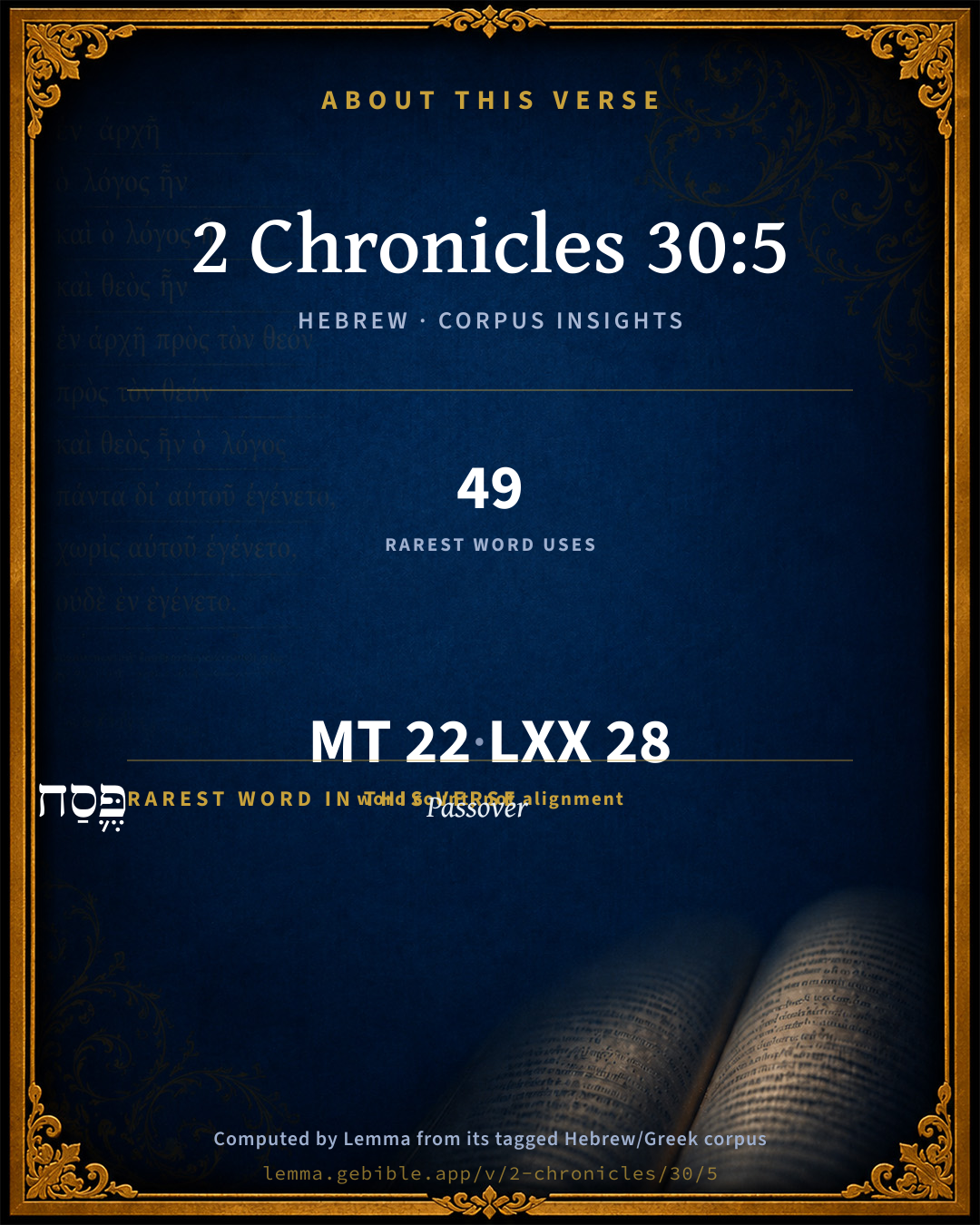
פֶּ֛סַח Passover H6453 occurs in 46 verses of the Hebrew Bible. Also found in:

Grammatical profile

  • 6 verbs
  • 12 nouns
  • 1 adjective
  • 1 preposition
  • 1 conjunction
  • 1 particle

Verb forms

  • וַיַּֽעֲמִ֣ידוּ Hiphil · Sequential Imperfect
  • לְהַעֲבִ֨יר Hiphil · Infinitive Construct
  • לָב֞וֹא Qal · Infinitive Construct
  • לַעֲשׂ֥וֹת Qal · Infinitive Construct
  • עָשׂ֖וּ Qal · Perfect
  • כַּכָּתֽוּב Qal · Participle Passive

Repetition

Words recur within this verse — often emphatic in Hebrew:

  • יִשְׂרָאֵל֙ Israel H3478 ×2
  • מִבְּאֵֽר Beer-sheba H884 ×2
  • לַעֲשׂ֥וֹת to do H6213 ×2

Hebrew & Septuagint length

In English translation the verse runs 48 words from the Hebrew and 45 from the Septuagint (LXX English) — closely comparable.

A rough comparison of the two English renderings, which tokenize alike — not a word-level alignment.

Word counts can differ between the Hebrew and the Greek without any difference in meaning — e.g. the Hebrew direct-object marker אֵת has no separate Greek word, and Greek often adds the article ὁ.

In the original languages it is 22 Hebrew tokens and 28 Greek tokens — but the two are counted differently (Hebrew bundles its prefixes and suffixes into one token; the Greek is in lemma form), so that isn’t a like-for-like length.

Cross-references

14

Topical passages linked to 2 Chronicles 30:5 in the Treasury of Scripture Knowledge — connected by theme and wording, ordered by reader-vote popularity; previews shown in the World English Bible.

  • Judges 20:1 Then all the children of Israel went out, and the congregation was assembled as one man, from Dan even to Beersheba, with the land of Gilead, to Yahweh at Mizpah.
  • Leviticus 23:2 "Speak to the children of Israel, and tell them, 'The set feasts of Yahweh, which you shall proclaim to be holy convocations, even these are my set feasts.
  • Leviticus 23:4 "'These are the set feasts of Yahweh, even holy convocations, which you shall proclaim in their appointed season.
  • Deuteronomy 12:32 Whatever thing I command you, that shall you observe to do: you shall not add thereto, nor diminish from it.
  • 2 Chronicles 24:9 They made a proclamation through Judah and Jerusalem, to bring in for Yahweh the tax that Moses the servant of God laid on Israel in the wilderness.
  • 2 Chronicles 35:18 There was no Passover like that kept in Israel from the days of Samuel the prophet; neither did any of the kings of Israel keep such a Passover as Josiah kept, and the priests, and the Levites, and all Judah and Israel who were present, and the inhabitants of Jerusalem.
  • 2 Chronicles 36:22 Now in the first year of Cyrus king of Persia, that the word of Yahweh by the mouth of Jeremiah might be accomplished, Yahweh stirred up the spirit of Cyrus king of Persia, so that he made a proclamation throughout all his kingdom, and [put it] also in writing, saying,
  • Ezra 6:8–12 Moreover I make a decree what you shall do to these elders of the Jews for the building of this house of God: that of the king's goods, even of the tribute beyond the River, expenses be given with all diligence to these men, that they be not hindered.
  • Esther 3:12–15 Then were the king's scribes called in the first month, on the thirteenth day of it; and there was written according to all that Haman commanded to the king's satraps, and to the governors who were over every province, and to the princes of every people, to every province according to the writing of it, and to every people after their language; in the name of king Ahasuerus was it written, and it was sealed with the king's ring.
  • Esther 8:8–10 Write you also to the Jews, as it pleases you, in the king's name, and seal it with the king's ring; for the writing which is written in the king's name, and sealed with the king's ring, may no man reverse.
  • Esther 9:20–21 Mordecai wrote these things, and sent letters to all the Jews who were in all the provinces of the king Ahasuerus, both near and far,
  • Daniel 4:1–33 Nebuchadnezzar the king, to all the peoples, nations, and languages, who dwell in all the earth: Peace be multiplied to you.
  • Daniel 6:8 Now, O king, establish the interdict, and sign the writing, that it not be changed, according to the law of the Medes and Persians, which doesn't alter.
  • 1 Corinthians 11:2 Now I praise you, brothers, that you remember me in all things, and hold firm the traditions, even as I delivered them to you.

Cross-references courtesy of OpenBible.info (CC BY 4.0).

Hebrew and Greek witnesses Masoretic Hebrew ↔ Greek Septuagint

The same verse in the two great witnesses to the Old Testament, shown verse-for-verse.

These are two independent witnesses, not word-aligned to each other, and the Septuagint is shown in lemma (dictionary) form.

Hebrew 2 Chronicles 30:5 Masoretic · Westminster Leningrad Codex

וַיַּֽעֲמִ֣ידוּ דָבָ֗ר לְהַעֲבִ֨יר ק֤וֹל בְּכָל יִשְׂרָאֵל֙ מִבְּאֵֽר שֶׁ֣בַע וְעַד דָּ֔ן לָב֞וֹא לַעֲשׂ֥וֹת פֶּ֛סַח לַיהוָ֥ה אֱלֹהֵֽי יִשְׂרָאֵ֖ל בִּירוּשָׁלִָ֑ם כִּ֣י לֹ֥א לָרֹ֛ב עָשׂ֖וּ כַּכָּתֽוּב

So they established a decree to make proclamation throughout all Israel, from Beersheba even to Dan, that they should come to keep the Passover to Yahweh, the God of Israel, at Jerusalem: for they had not kept it in great numbers in such sort as it is written.

World English Bible · Public Domain

Greek LXX 2 Chronicles 30:5 Septuagint · lemma form

καί ἵστημι λόγος διαἔρχομαι κήρυγμα ἐν πᾶς ἰσραήλ ἀπό βηρσαβεε ἕως δαν ἔρχομαι ποιέω ὁ φασεκ κύριος θεός ἰσραήλ ἐν ἰερουσαλήμ ὅτι πλῆθος οὐ ποιέω κατά ὁ γραφή

And they established a decree that a proclamation should go through all Israel, from Bersabee to Dan, that they should come and keep the passover to the Lord God of Israel at Jerusalem: for the multitude had not done it lately according to the scripture.

LXX2012 (modern English Septuagint) · Public Domain

On this verse, Ellicott's Commentary for English Readers discusses the Septuagint’s reading. Read the note in Commentary ↓

Hebrew: Westminster Leningrad Codex (CC BY 4.0). Greek: Septuagint (public domain); English from LXX2012 (modern English Septuagint) (Public Domain). How the Septuagint differs from the Hebrew →

Commentary

Notes on 2 Chronicles 30:5 from classic Christian and Jewish commentators (each source and its license shown beneath its notes). The classic Christian expositions comment on the surrounding passage and are grouped to its opening verse, so a note may address several verses; the Jewish commentaries on the Tanakh (Rashi and others) are per-verse, so they appear only where the commentator wrote on this verse.

Lemma curates 59 commentaries, every one of them public domain or Creative Commons licensed, each selected and text-cleaned for this edition rather than reprinted as found. About our sources →

Trapp's Complete Commentary

John Trapp

2Ch 30:5 So they established a decree to make proclamation throughout all Israel, from Beersheba even to Dan, that they should come to keep the passover unto the LORD God of Israel at Jerusalem: for they had not done [it] of a long [time in such sort] as it was written.

Ver. 5. For they had not done it of a long time.] So easily falleth religion to the ground under bad princes and priests: such as were Ahaz and Uriah.

John Trapp, A Commentary or Exposition upon All the Books of the Old and New Testament (1647–1656) — public domain. Text from a community e-Sword module.

Joseph Benson's Commentary

2Ch 30:5. So they established a decree — They fixed a resolution; to make proclamation throughout all Israel — Hezekiah, it is certain, had no right to invite Hoshea’s subjects to repair to Jerusalem, to the celebration of his passover; yet for the doing of this we may well presume that he had encouragement from Hoshea himself; who, as to the matter of religion, has a better character in Scripture than any of his predecessors, from the time of the division of the two kingdoms. But the truth was, that both the golden calves, which had caused this political separation, were now taken away; that of Dan by Tiglath-pileser, and that of Beth-el by his son Shalmaneser; and therefore some of the apostate Israelites, being thus deprived of their idols, began to return to the Lord, and to go up to Jerusalem to worship, some time before Hezekiah made them this invitation to his passover. See Prideaux and Dodd. They had not done it of a long time, &c., as it was written — In such a manner as God had commanded them to keep it. Indeed, the ten tribes had never kept it since the division of the kingdom by Jeroboam; at least, not in the way in which Moses had prescribed, being hindered by his threatening interdicts from going to Jerusalem; where only it could be kept according to the law. And as for Judah, it appears, from 2Ch 30:26, that they had never kept this feast with such solemnity since the time of Solomon.

Joseph Benson's Commentary on the Old and New Testaments (1811–1818) — public domain. Text from a community e-Sword module.

Tyndale Open Study Notes

Tyndale Open Resources

30:5 Hezekiah dispatched couriers from Beersheba . . . to Dan, the traditional designation for the entire nation, including even the now-desolate territories of Israel’s northern tribes.

Tyndale Open Study Notes — © Tyndale Open Resources, licensed CC BY-SA 4.0. Text via the HelloAO Bible API.

Geneva Bible (1599)

Geneva Bible translators

In such sort and perfection as God had appointed.

From one end of the land to the other, North and South.

Geneva Bible (1599) marginal notes — public domain. Text via Bolls.life.

Ellicott's Commentary for English Readers

(5) So they established a decree.—And they decreed a proposal (he‘ĕmîd dâbâr). (Comp. 2Ch_30:8; Psa_105:10, “and hath decreed it unto Jacob for a law.”)

To make proclamation.—Literally, to make a voice pass. (Comp. 2Ch_24:9; 2Ch_36:22.)

From Beer-sheba even to Dan.—Reversing the ancient form of the phrase, to suit the present case. (Comp. Jdg_20:1; 2Ch_19:4.)

For they had not . . . written.—Rather, For not in multitude (larôb) had they kept it, according to the Scripture. The people had not been in the habit of “coming in their numbers” to the feast. (Comp. the like use of larôb in 2Ch_30:13; 2Ch_30:24.) See the Law respecting the Passover, Exo_12:1-20; Deu_16:1-8; from which it appears that the obligation to observe it was universal, and according to the latter passage, which is probably referred to in the phrase “according to what is written.” Jerusalem was the only legitimate place for the festival. It is implied that ever since the division of the kingdom, and perhaps earlier, the Passover had been inadequately celebrated. (Comp. 2Ki_23:22.) LXX. well, ὅτι πλῆθος οὐκ ἐποίησεν κατὰ τὴν γραφήν; Vulg., “multi enim non fecerant, sicut lege praescriptum est; Syriac and Arabic, “because their wealth had grown greatly”(!)

A Bible Commentary for English Readers, edited by Charles John Ellicott (1878–1897) — public domain. Text from a community e-Sword module.

The Cambridge Bible for Schools and Colleges

gen. ed. J. J. S. Perowne

5. to make proclamation] A phrase characteristic of the Chronicler.

they had not done it of a long time in such sort as it was written] R.V. they had not kept it in great numbers in such sort as it is written. The statement applies to Israel, not to Judah; for the first time an attempt is made to draw Israel en masse to a regular Passover at Jerusalem. R.V. mg. however agrees with A.V. in reading “of a long time” for “in great numbers.”

The Cambridge Bible for Schools and Colleges (gen. ed. J. J. S. Perowne; Cambridge University Press, 1878–1918) — public domain. Text from a community e-Sword module.

John Gill's Exposition

So the posts went with the letters from the king and his princes throughout all Israel and Judah,.... Both through the kingdoms of the ten tribes of Israel, and the kingdom of the two tribes of Judah and Benjamin:

and according to the commandment of the king, saying; so they were ordered by the king to say, when they delivered the letters which by the king's commandment they carried; or this was the purport of them, as follows, especially of those that were sent to the ten tribes:

ye children of Israel, turn again unto the Lord God of Abraham, Isaac, and Israel; from whom they had revolted, and from whose worship they had departed, by setting up and serving the calves at Dan and Bethel:

and he will return to the remnant of you that are escaped out of the hand of the king of Assyria; Pul and Tiglathpileser, who had both invaded their land, and the latter had taken many of their cities, and carried the inhabitants captive, Kg2 15:19.

John Gill's Exposition of the Whole Bible (1746–1763) — public domain (CC PDM 1.0). Text via the HelloAO Bible API.

Albert Barnes' Notes on the Bible

They had not done it ... - Some prefer, “they had not kept it in full numbers, as it was written” - i. e. “they (the Israelites of the northern kingdom) had not (for some while) kept the Passover in full numbers, as the Law required.”

Albert Barnes' Notes on the Bible (1834–1885) — public domain. Text from a community e-Sword/MySword module.

Haydock's Catholic Bible Commentary

Many. None had kept the Phase this year. H. --- But those of Israel had not done it for a long time. Grotius --- Heb. "for they had not long before done according to the Scripture." Sept. "the multitude had not done," &c. C. --- Yet, even in the worst times, Tobias, (i. 6.) and other zealous souls, contrived to comply with their duty. H.

George Leo Haydock (1774–1849), Haydock's Catholic Family Bible and Commentary, 1859 edition — public domain. Excludes Psalms (Douay-Rheims chapter numbering differs from Protestant) and Deuterocanonical books (Catholic canon only).

Matthew Poole's English Annotations

They established a decree; they fixed this resolution. In such sort as it was written, i. e. so as God had commanded them to do it, to wit, that all the males in Israel should do it; which express command of God they ought to have obeyed, rather than the wicked commands or edicts of men to the contrary; which was both the judgment and practice of the priests and Levites, and other godly Israelites, as is manifest from 2Ch 15:8, &c.

Matthew Poole's English Annotations on the Holy Bible (1683–1685) — public domain. Text from a community e-Sword/MySword module.

Whedon's Commentary on the Bible

Daniel D. Whedon

5. They had not done it of a long time — לרב, here rendered of a long time, means rather, in a multitude, or in great numbers. The sense of the passage is, that the Israelites of the whole land had not observed the passover in a great multitude, as directed in the law. The law required the excision of every one who neglected the passover. Num_9:13.

Daniel D. Whedon (gen. ed.), Commentary on the Old and New Testaments (1874–1909) — public domain. Text from a community e-Sword module.

The Pulpit Commentary

Of a long time. Though the idea expressed in this rendering must, under any circumstances, attach to this passage, yet it can scarcely be understood to be given in the one Hebrew word we have here (brol) out of nearly a hundred and fifty occurrences of the word, and often with its present preposition, this is the solitary occasion of its being turned into a mark of time. The translation should read, for they had not kept it in multitude, i.e. in proper multitudes, and in the multitude of an undivided and holy kingdom. The force of the reference lies in the fact just stated, that Hezekiah, ignoring all the worse precedents of now many generations, and ignoring the iniquity of the duality of the kingdom, manfully caused his writ to run from south to north unchecked! As it was written; i.e. in the book of the Law of Moses. So runs the full and frequent and honoured phrase: hvmAtrwOT rpseb bWtKK (2Ki_14:6; 1Ki_2:3; Jos_3:3-4; 2Ch_35:26, etc.)

The Pulpit Commentary (1880–1919), ed. H.D.M. Spence-Jones & Joseph S. Exell — public domain. Text from a community e-Sword module.

Rashi

Rabbi Shlomo Yitzchaki (Rashi)

from Beersheba to Dan This is the boundary of the Ten Tribes.

because for many years The meaning is that many years had passed in which they had not performed it according to its law.

Rashi on the Tanakh — English translations: “The Judaica Press complete Tanach with Rashi, translated by A. J. Rosenberg” (CC BY 4.0); “Pentateuch with Rashi's commentary by M. Rosenbaum and A.M. Silbermann, 1929-1934” (public domain); “The Metsudah Tanach series, Lakewood, N.J” (CC BY 4.0); and “The Book of Joshua, Metsudah Publications, 1997” (CC BY 4.0). Text via Sefaria.

Lesson kit

Teaching starters — assembled from the data on this page, not authored interpretation. Every prompt links to the verse data it draws on. Edit before teaching.

2 Chronicles, in the Historical, opens this verse with 22 words (19 distinct Hebrew lemmas). Its most distinctive word is peçach (“Passover”). A historical commentator’s framing appears above. Read the whole chapter for the surrounding context.

Discussion questions

  1. How does “Passover” (peçach) shape what this verse is saying?
  2. Exodus 12:11 shares the word «Passover» with this verse. How do the two illuminate each other?
  3. “Israel” occurs 2× in this one verse. What is the effect of the repetition?
  4. These translations render this verse differently. What is at stake in choosing one wording over another?
  5. The verb «וַיַּֽעֲמִ֣ידוּ» is Hiphil Sequential Imperfect. How does its form color the action?
  6. Reading how Trapp's Complete Commentary and Joseph Benson's Commentary read this verse, where do the two commentators agree and where do they part?

Things to notice

Reading settings

Reading text

Shown beneath each verse's original-language words.

Old Testament
Old Testament edition

Read the OT as the Masoretic Hebrew (MT) or the Greek Septuagint (LXX).

English shown for the Greek Septuagint (in the Hebrew ↔ Greek comparison).

Comparing translations? Open the Compare panel on any verse page to stack up to four side by side.