Ezekiel 21:20

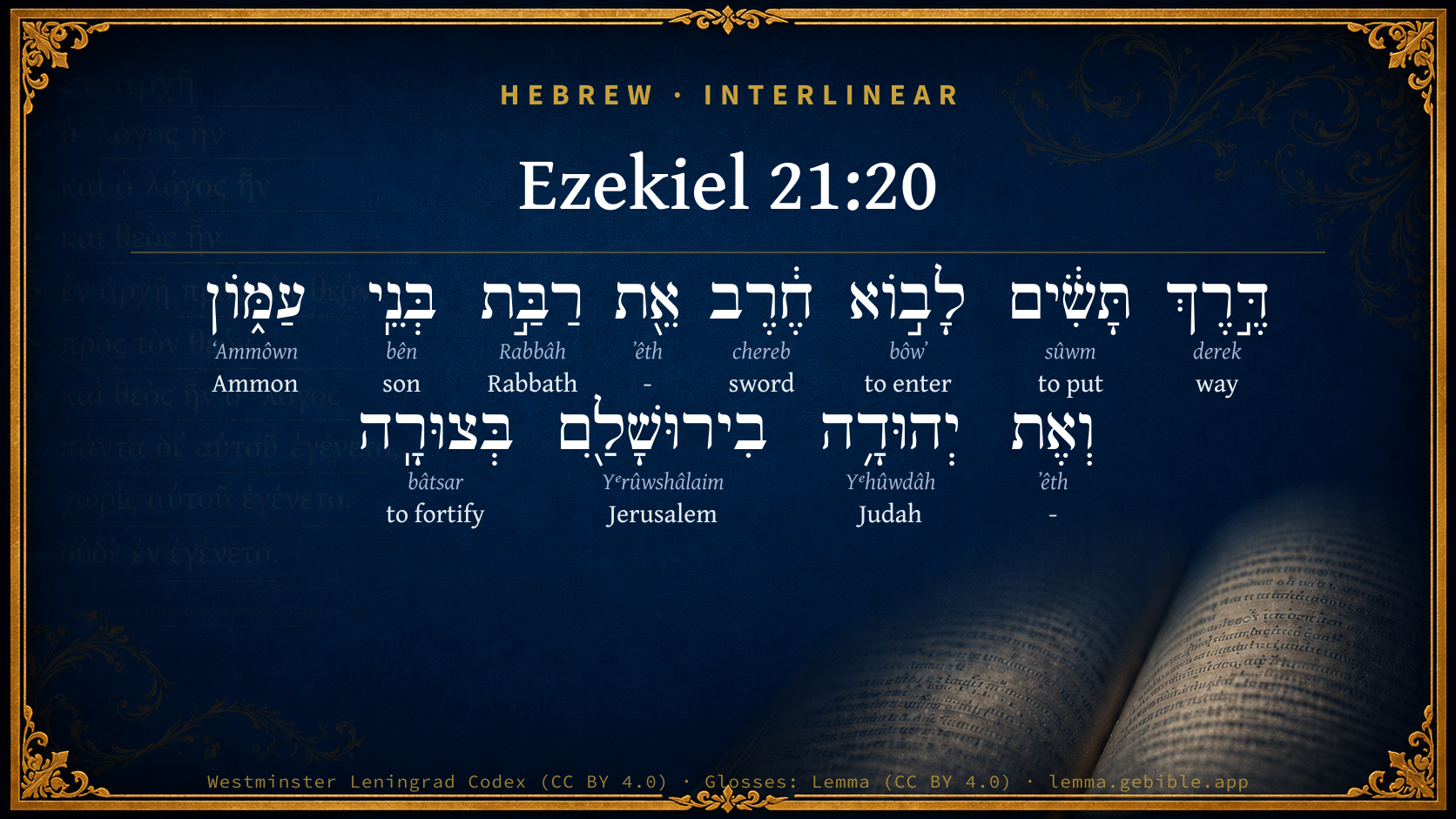
Hebrew (Westminster Leningrad Codex) Ezekiel 21:20 appears in the Hebrew Old Testament. The text above is from the Westminster Leningrad Codex. Each word links to its Strong’s number, a concise gloss, and parsing drawn from the Open Scriptures Hebrew Bible morphology. Click any word for its full Brown-Driver-Briggs (BDB) entry.
Download image
Cite this verse

Ezekiel 21:20 (World English Bible). Public Domain. Lemma interlinear Bible study tool, https://lemma.gebible.app/v/ezekiel/21/20.

Show BibTeX & RIS
BibTeX
RIS
English Translation
You shall appoint a way for the sword to come to Rabbah of the children of Ammon, and to Judah in Jerusalem the fortified.
World English Bible · Public Domain
Download a study sheet

One document with this verse’s original text, its word-by-word gloss line, the meaning frame, cross-references with their text, attributed commentary, and full source and license credits — printable, and it pastes into notes with its structure intact.

This verse Autodidact and up

Study sheet (.html) Plain text (.txt)

A passage Seminary Student

Up to 50 verses in one chapter. A passage sheet keeps up to 6 commentary sources and 12 cross-references per verse, in the order this page ranks them, and says so on the sheet whenever that leaves anything out. Ask for a single verse and you get the Autodidact verse sheet above.

Everything on this page stays free to read, with no account — the sheet is a download of what is already on screen, not access to it.

Want to remove ads? Support Godless Engineer
Compare translations 3

The same verse in 3 English versions, stacked beneath the original-language interlinear above. Click any original word for its lexicon entry.

Each is an independent rendering of the whole verse — the interlinear is not word-aligned to these translations.

Highlighted words mark where these versions differ — a whole-verse word diff, not a word-by-word alignment.

  • World English Bible Public Domain
    You shall appoint a way for the sword to come to Rabbah of the children of Ammon, and to Judah in Jerusalem the fortified.
  • King James Version Public Domain
    Appoint a way, that the sword may come to Rabbath of the Ammonites, and to Judah in Jerusalem the defenced.
  • unfoldingWord Literal Text CC BY-SA 4.0
    Mark one road for the Babylonian army to come to Rabbah, the city of the Ammonites. Mark the other to lead the army to Judah and the city of Jerusalem, which is fortified.

unfoldingWord Literal Text — © unfoldingWord, licensed CC BY-SA 4.0. Word-aligned USFM3 via Door43 (git.door43.org/unfoldingWord/en_ult).

Versions to compare (up to 4)

3 of 4 selected

Show all 18 translations

Every available English version of this verse, each an independent rendering of the whole verse.

  • World English Bible Public Domain
    You shall appoint a way for the sword to come to Rabbah of the children of Ammon, and to Judah in Jerusalem the fortified.
  • Berean Standard Bible Public Domain
    Mark out one road for the sword to come against Rabbah of the Ammonites, and another against Judah into fortified Jerusalem.
  • Majority Standard Bible Public Domain
    Mark out one road for the sword to come against Rabbah of the Ammonites, and another against Judah into fortified Jerusalem.
  • King James Version Public Domain
    Appoint a way, that the sword may come to Rabbath of the Ammonites, and to Judah in Jerusalem the defenced.
  • American Standard Version (1901) Public Domain
    Thou shalt appoint a way for the sword to come to Rabbah of the children of Ammon, and to Judah in Jerusalem the fortified.
  • Revised Version (1885) Public Domain
    Thou shalt appoint a way, for the sword to come to Rabbah of the children of Ammon, and to Judah in Jerusalem the defenced.
  • Geneva Bible (1599) Public Domain
    Appoint a way, that the sworde may come to Rabbath of the Ammonites, and to Iudah in Ierusalem the strong citie.
  • Douay-Rheims (1899) Public Domain
    Thou shalt make a way that the sword may come to Rabbath of the children of Ammon, and to Juda unto Jerusalem the strong city.
  • Young's Literal Translation Public Domain
    A way appoint for the coming of the sword, Unto Rabbath of the sons of Ammon, And to Judah, in Jerusalem -- the fenced.
  • Literal Standard Version CC BY-SA 4.0
    Appoint a way for the coming of the sword, || To Rabbath of the sons of Ammon, || And to Judah, in fortified Jerusalem.
  • Unlocked Literal Bible CC BY-SA 4.0
    Mark one road for the Babylonian army to come to Rabbah, the city of the Ammonites. Mark the other to lead the army to Judah and the city of Jerusalem, which is fortified.
  • unfoldingWord Literal Text CC BY-SA 4.0
    Mark one road for the Babylonian army to come to Rabbah, the city of the Ammonites. Mark the other to lead the army to Judah and the city of Jerusalem, which is fortified.
  • Darby Bible Public Domain
    Appoint a way for the coming of the sword to Rabbah of the children of Ammon, and to Judah at the fenced [city] of Jerusalem.
  • World Messianic Bible Public Domain
    You shall appoint a way for the sword to come to Rabbah of the children of Ammon, and to Judah in Jerusalem the fortified.
  • Webster's Bible Public Domain
    Appoint a way, that the sword may come to Rabbah of the Ammonites, and to Judah in Jerusalem the fortified.
  • Free Bible Version CC BY-SA 4.0
    Have one sign point down the road for an attack on the Ammonite city of Rabbah, and another to attack Judah and the fortified city of Jerusalem.
  • Bible in Basic English Public Domain
    Put a pillar at the top of the road for the sword to come to Rabbah in the land of the children of Ammon, and to Judah and to Jerusalem in the middle of her.
  • JPS Tanakh (1917) Public Domain
    (21-25) Thou shalt make a way, that the sword may come to Rabbah of the children of Ammon, and to Judah in Jerusalem the fortified.

Literal Standard Version (2020), Covenant Press — licensed CC BY-SA 4.0. Text via the HelloAO Bible API (eBible.org). Unlocked Literal Bible (unfoldingWord) — licensed CC BY-SA 4.0. Text via the HelloAO Bible API (eBible.org). unfoldingWord Literal Text — © unfoldingWord, licensed CC BY-SA 4.0. Word-aligned USFM3 via Door43 (git.door43.org/unfoldingWord/en_ult). Free Bible Version, Dr. Jonathan Gallagher — licensed CC BY-SA 4.0. Text via the HelloAO Bible API (eBible.org).

Word by word

More ways to search: Search by grammar → Find every occurrence → Compare this word →

Practice this passage: Drill this verse → Learn its vocabulary →

About this verse

These counts appear in no published source. They are computed here, from the morphology-tagged text and Lemma’s own curated glosses. What Lemma adds →

12
words
11
distinct lemmas
Prophets
section

Notable vocabulary

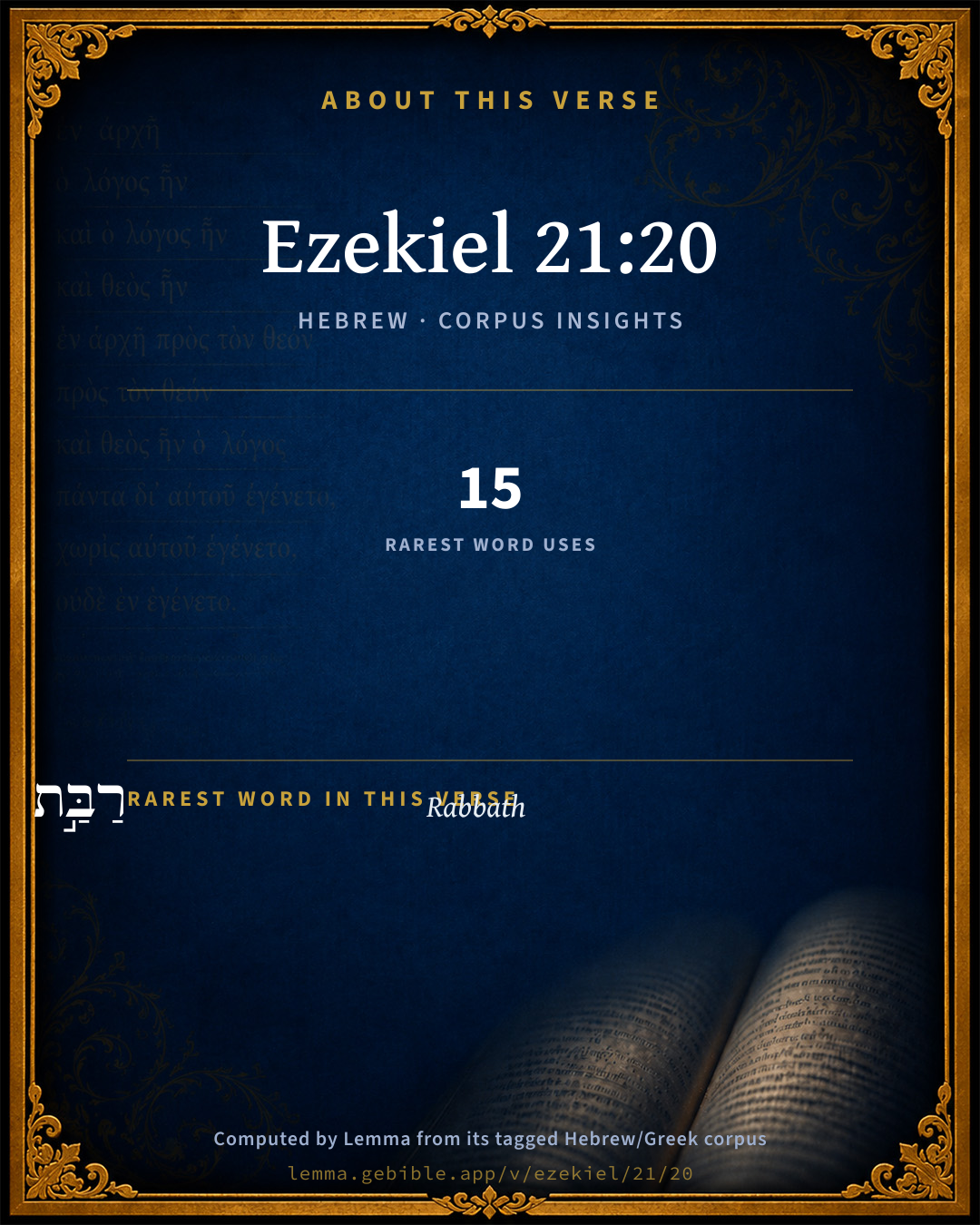
The rarest word here is רַבַּ֣ת Rabbath H7237 — appearing just 15 times in the whole Hebrew Bible.

Shared distinctive vocabulary

רַבַּ֣ת Rabbath H7237 occurs in 14 verses of the Hebrew Bible. Also found in:

Grammatical profile

  • 2 verbs
  • 7 nouns
  • 1 adjective
  • 2 particles

Verb forms

  • תָּשִׂ֔ים Qal · Imperfect
  • לָב֣וֹא Qal · Infinitive Construct

Hebrew & Septuagint length

In English translation the verse runs 24 words from the Hebrew and 23 from the Septuagint (LXX English) — closely comparable.

A rough comparison of the two English renderings, which tokenize alike — not a word-level alignment.

Word counts can differ between the Hebrew and the Greek without any difference in meaning — e.g. the Hebrew direct-object marker אֵת has no separate Greek word, and Greek often adds the article ὁ.

Cross-references

13

Topical passages linked to Ezekiel 21:20 in the Treasury of Scripture Knowledge — connected by theme and wording, ordered by reader-vote popularity; previews shown in the World English Bible.

  • Jeremiah 49:2 Therefore, behold, the days come, says Yahweh, that I will cause an alarm of war to be heard against Rabbah of the children of Ammon; and it shall become a desolate heap, and her daughters shall be burned with fire: then shall Israel possess those who did possess him, says Yahweh.
  • Amos 1:14 But I will kindle a fire in the wall of Rabbah, And it will devour its palaces, With shouting in the day of battle, With a tempest in the day of the whirlwind;
  • Deuteronomy 3:11 (For only Og king of Bashan remained of the remnant of the Rephaim; behold, his bedstead was a bedstead of iron; isn't it in Rabbah of the children of Ammon? nine cubits was the length of it, and four cubits the breadth of it, after the cubit of a man.)
  • Ezekiel 25:5 I will make Rabbah a stable for camels, and the children of Ammon a couching-place for flocks: and you shall know that I am Yahweh.
  • Psalms 48:12–13 Walk about Zion, and go around her. Number its towers;
  • Psalms 125:1–2 Those who trust in Yahweh are as Mount Zion, Which can't be moved, but remains forever.
  • 2 Samuel 5:9 David lived in the stronghold, and called it the city of David. David built round about from Millo and inward.
  • 2 Samuel 12:26 Now Joab fought against Rabbah of the children of Ammon, and took the royal city.
  • 2 Chronicles 26:9 Moreover Uzziah built towers in Jerusalem at the corner gate, and at the valley gate, and at the turning [of the wall], and fortified them.
  • 2 Chronicles 32:5 He took courage, and built up all the wall that was broken down, and raised [it] up to the towers, and the other wall outside, and strengthened Millo [in] the city of David, and made weapons and shields in abundance.
  • 2 Chronicles 33:14 Now after this he built an outer wall to the city of David, on the west side of Gihon, in the valley, even to the entrance at the fish gate; and he compassed Ophel about [with it], and raised it up to a very great height: and he put valiant captains in all the fortified cities of Judah.
  • Isaiah 22:10 and you numbered the houses of Jerusalem, and you broke down the houses to fortify the wall;
  • Lamentations 4:12 The kings of the earth didn't believe, neither all the inhabitants of the world, That the adversary and the enemy would enter into the gates of Jerusalem.

Cross-references courtesy of OpenBible.info (CC BY 4.0).

Hebrew and Greek witnesses Masoretic Hebrew ↔ Greek Septuagint

The same verse in the two great witnesses to the Old Testament, shown verse-for-verse.

These are two independent witnesses, not word-aligned to each other, and the Septuagint is shown in lemma (dictionary) form.

Hebrew Ezekiel 21:20 Masoretic · Westminster Leningrad Codex

דֶּ֣רֶךְ תָּשִׂ֔ים לָב֣וֹא חֶ֔רֶב אֵ֖ת רַבַּ֣ת בְּנֵֽי עַמּ֑וֹן וְאֶת יְהוּדָ֥ה בִירוּשָׁלִַ֖ם בְּצוּרָֽה

You shall appoint a way for the sword to come to Rabbah of the children of Ammon, and to Judah in Jerusalem the fortified.

World English Bible · Public Domain

Greek LXX Ezekiel 21:20 Septuagint · lemma form

ὅπως θραύω ὁ καρδία καί πληθύνω ὁ ἀσθενέω ἐπί πᾶς πύλη αὐτός παραδίδωμι εἰς σφάγιον ῥομφαία εὖ γίγνομαι εἰς σφαγή εὖ γίγνομαι εἰς στίλβωσις

that the sword may enter in upon Rabbath of the children of Ammon, and upon Judea, and upon Jerusalem in the midst thereof.

LXX2012 (modern English Septuagint) · Public Domain

On this verse, The Cambridge Bible for Schools and Colleges discusses the Septuagint’s reading. Read the note in Commentary ↓

Hebrew: Westminster Leningrad Codex (CC BY 4.0). Greek: Septuagint (public domain); English from LXX2012 (modern English Septuagint) (Public Domain). How the Septuagint differs from the Hebrew →

Targum (Aramaic paraphrase)

1

The Targum is the ancient Jewish Aramaic paraphrase of the Hebrew Scriptures — an interpretive translation, not the Hebrew text itself. Onkelos (literal) and Pseudo-Jonathan (expansive) render the Torah, and Jonathan the Prophets. Coverage is partial: where no permissively-licensed English translation exists for a verse, only the Aramaic is shown. This is verse-level text, not a word-by-word alignment to the Hebrew.

  1. Targum Jonathan Prophets (Joshua–Malachi)
    בְּדִיל לְמִתְבַּר לִבְּהוֹן וּלְאַסְגָאָה מַתְקַלְהוֹן עַל כָּל קִרְוֵיהוֹן מַנִיתִי קָטְלֵי חַרְבָּא וֵי חַרְבָּא אִשְׁתְּלִיפַת לְמִקְטֵל אִשְׁתְּנִינִת לְשֵׁיצָאָה:

    (no public-domain English translation for this verse)

    Targum Jonathan — Aramaic: “Mikraot Gedolot” (public domain). English: “Sefaria Community Translation” (CC0 1.0 (public-domain dedication)); “London "Chaldee Paraphrase," 1871” (public domain). Text via Sefaria.

Commentary

Notes on Ezekiel 21:20 from classic Christian and Jewish commentators (each source and its license shown beneath its notes). The classic Christian expositions comment on the surrounding passage and are grouped to its opening verse, so a note may address several verses; the Jewish commentaries on the Tanakh (Rashi and others) are per-verse, so they appear only where the commentator wrote on this verse.

Lemma curates 59 commentaries, every one of them public domain or Creative Commons licensed, each selected and text-cleaned for this edition rather than reprinted as found. About our sources →

Trapp's Complete Commentary

John Trapp

Eze 21:20 Appoint a way, that the sword may come to Rabbath of the Ammonites, and to Judah in Jerusalem the defenced.

Ver. 20. And to Judah in Jerusalem the defenced.] Either against the one or the other of them - not against both at once, {a} for they were both strong, and Jerusalem was well aware of it - for they had both revolted from Nebuchadnezzar, and one of them was enough at once to undertake.

{a} Ne Hercules quidem contra duos.

John Trapp, A Commentary or Exposition upon All the Books of the Old and New Testament (1647–1656) — public domain. Text from a community e-Sword module.

Geneva Bible (1599)

Geneva Bible translators

That is, to the tribe of Judah that kept themselves in Jerusalem.

Geneva Bible (1599) marginal notes — public domain. Text via Bolls.life.

Jamieson, Fausset & Brown

Robert Jamieson, A. R. Fausset & David Brown

Rabbath of the Ammonites--distinct from Rabbah in Judah (Sa2 12:26). Rabbath is put first, as it was from her that Jerusalem, that doomed city, had borrowed many of her idols.

to Judah in Jerusalem--instead of simply putting "Jerusalem," to imply the sword was to come not merely to Judah, but to its people within Jerusalem, defended though it was; its defenses on which the Jews relied so much would not keep the foe out.

Jamieson, Fausset & Brown — Commentary Critical and Explanatory on the Whole Bible (1871) — public domain (CC PDM 1.0). Text via the HelloAO Bible API.

The Cambridge Bible for Schools and Colleges

gen. ed. J. J. S. Perowne

20. On Rabbah cf. Eze_25:5.

in Jerusalem] unto Jerus. For “the defenced” LXX. reads: “in the midst of it,” i.e. of Judah.

The Cambridge Bible for Schools and Colleges (gen. ed. J. J. S. Perowne; Cambridge University Press, 1878–1918) — public domain. Text from a community e-Sword module.

John Gill's Exposition

At his right hand was the divination for Jerusalem,.... All his divinations, whether by arrows, or by images, or by liver, all directed him to his right hand, to turn to that which led to Jerusalem; and thus what appeared to him to be the effect of divination was overruled by the providence of God, to direct him to go and do what he designed he should:

to appoint captains to open the mouth in the slaughter; upon which he appointed his several captains and officers their distinct bodies of men they were to lead on to the siege of Jerusalem; and give them the word of command when to attack the place, scale the walls, or make breaches in it, and fall upon the enemy, and make a slaughter of them. The word for "captains" signifies "rams"; and Joseph Kimchi interprets it of battering rams, to beat down walls; but these are after mentioned; and is both by Jarchi and David Kimchi explained of general officers of the army; and so the Targum,

"to appoint generals to open the gates, that the slayer may enter by them:''

to lift up the voice with shouting; which is usually done in sieges, when a shout is made, and a place is stormed; both to animate the besiegers, and to terrify the besieged:

to appoint battering rams against the gates; to break them down, or break through them, and so make way for the army to enter in; these were engines used in sieges, to beat down walls, and make breaches in them, that the besiegers might enter; so called from the iron heads of them, which resembled rams; and are thus described by Josephus (o),

"the ram is a huge beam, not unlike the mast of a ship; the top of it is capped with a thick piece of iron, in the form of a ram's head, from whence it has its name: this is hung by the middle with ropes to another beam, which lies across, supported by a couple of posts; and thus hanging equally balanced, is, by a great number of men violently thrust backwards and forwards, and so beats the wall with its iron head; nor is there any tower so strong, or wall so broad, as to resist its repeated strokes.''

Vitruvius (p) says it was invented by the Carthaginians at the siege of Cadiz; but Pliny (q) affirms it was invented by Epeus at the siege of Troy; but the first mention of them is made by Ezekiel here, and in Eze 4:2, and Diodorus Siculus (r) affirms they were not known in the times of Sardanapalus, when Nineveh was taken by Arbaces. The Targum interprets it of officers set at the gates, as before; and so Jarchi:

to cast a mount; made up of earth, to raise their batteries upon: and

to build a fort; to cast out their arrows from thence, and protect the besiegers; See Gill on Eze 4:1.

(o) De Bello Jud. l. 3. c. 7. sect. 19. Vid. Valtrinum de Re Militari Roman. l. 5. c. 6. p. 526. (p) De Architectura, l. 10. c. 19. (q) Nat. Hist. l. 7. c. 56. (r) Bibliothec. l. 2. p. 113.

John Gill's Exposition of the Whole Bible (1746–1763) — public domain (CC PDM 1.0). Text via the HelloAO Bible API.

Haydock's Catholic Bible Commentary

Rabbath. They had formed a league with Sedecias, and Nabuchodonosor thought of punishing them first. (Haydock) --- But they joined his forces, Jeremias xii. 6., and xxvii. 3.

George Leo Haydock (1774–1849), Haydock's Catholic Family Bible and Commentary, 1859 edition — public domain. Excludes Psalms (Douay-Rheims chapter numbering differs from Protestant) and Deuterocanonical books (Catholic canon only).

Matthew Poole's English Annotations

This royal city of the Ammonites, it seems, the king of Babylon had a quarrel with, as well as with Jerusalem, and he was resolved, when he came out of Babylon, to set upon one of them. There were two or three cities of this name Rabba, or Rabbath; one in the tribe of Judah, one in Issachar, one in Moab; but this in the text is distinguished by Rabbath of the Ammonites.

The Ammonites were the children of Lot’s daughter by incestuous mixture.

To Judah i.e. the Jews, the land for the people of the land. In Jerusalem; particularly against Jerusalem, whose fortifications do now as little discourage as they shall ere long hinder Nebuchadnezzar from taking the city and destroying it

Matthew Poole's English Annotations on the Holy Bible (1683–1685) — public domain. Text from a community e-Sword/MySword module.

Whedon's Commentary on the Bible

Daniel D. Whedon

20. Rabbath (R.V., “Rabbah”) was the capital of the Ammonites (Amo_1:14), later called Philadelphia. (See also Eze_25:5.) The king can hardly decide whether to first carry his arms against this city or Jerusalem, but the magic arrow settles the question.

In Jerusalem the defensed — LXX., and Jerusalem in her midst.

Daniel D. Whedon (gen. ed.), Commentary on the Old and New Testaments (1874–1909) — public domain. Text from a community e-Sword module.

John Wesley's Explanatory Notes

To Judah - The Jews.

John Wesley, Explanatory Notes Upon the Whole Bible (1754–1765) — public domain. Text via the GEBible commentary corpus.

Rashi

Rabbi Shlomo Yitzchaki (Rashi)

In order to melt Heb. לָמוּג, an expression of moving. Another explanation: an expression of something melting.

and to increase the stumbling blocks Heb. וְהַרְבֵּה, and to increase the stumbling blocks, and so every הַרְבֵּה in Scripture is an expression of increasing, an infinitive.

the scream of the sword Heb. אִבְחֳת. Some interpret [this as] טִבְחַת, the slaughter of, the ‘teth’ in place of the ‘aleph,’ by the code of א"ט ב"ח [whereby ‘aleph’ is interchangeable with ‘teth,’ ‘beth’ with ‘cheth,’ etc.] [This appears to be Jonathan’s interpretation.] Others interpret it as אִבְעַת an expression of בְּעָתָה [fright], but this cannot be because the ‘tav’ in אִבְחֳת is not part of the radical, and it comes only for the construct state, whereas the ‘tav’ in בְּעָתָה is a radical. Therefore, I say that אִבְחֳתחֶרֶב means the sounding of the voice of those slain by the sword, an expression of barking (נְבִיחָה) glapissement in French, yelping, for the ‘nun’ in נְבִיחָה is a defective radical, like the ‘nun’ in נְשִּׁיכָה biting, and the ‘aleph’ comes in its place, like (Job 13:17): “and...my speech (אַחְוָתִי) in your ears”; (II Kings 4:2), “except a jug (אָסוּךְ) of oil.” Menachem (p. 12) explained it as fear of the sword. It has no counterpart, but is interpreted according to the context.

Woe, it is made to glitter Alas and alack! For it is made into a furbished and polished blade.

enwrapped for the slaughter And enwrapped in a cloth until it would be grasped in the hand for slaughter on the day of war. Some interpret מְעֻטָה as a form of the word for diminishing (מִעוּט), for it diminishes when they sharpen it, but it is an error that they have made, for the absence of the ‘vav’ and the ‘dagesh’ in the ‘teth’ indicate about it that the ‘mem’ is not a radical, [but,] like the ‘mem’ of מְעֻנָה, afflicted, מְעֻטָה, enwrapped, and (Songs 5:14) מְעֻלֶפֶת, “overlaid with sapphires.” Menachem (p. 132) associated it as an expression of thought, like (Dan. 2:14): “answered with counsel (עֵטָא) and discretion.” Dunash, however, interprets it (p. 78) like (Ps. 104:2): “[You] enwrap (עֹטֶה) Yourself with light like a garment.”

Rashi on the Tanakh — English translations: “The Judaica Press complete Tanach with Rashi, translated by A. J. Rosenberg” (CC BY 4.0); “Pentateuch with Rashi's commentary by M. Rosenbaum and A.M. Silbermann, 1929-1934” (public domain); “The Metsudah Tanach series, Lakewood, N.J” (CC BY 4.0); and “The Book of Joshua, Metsudah Publications, 1997” (CC BY 4.0). Text via Sefaria.

Lesson kit

Teaching starters — assembled from the data on this page, not authored interpretation. Every prompt links to the verse data it draws on. Edit before teaching.

Ezekiel, in the Prophets, opens this verse with 12 words (11 distinct Hebrew lemmas). Its most distinctive word is Rabbâh (“Rabbath”). A historical commentator’s framing appears above. Read the whole chapter for the surrounding context.

Discussion questions

  1. How does “Rabbath” (Rabbâh) shape what this verse is saying?
  2. Deuteronomy 3:11 shares the word «Rabbath» with this verse. How do the two illuminate each other?
  3. These translations render this verse differently. What is at stake in choosing one wording over another?
  4. The verb «תָּשִׂ֔ים» is Qal Imperfect. How does its form color the action?
  5. Reading how Trapp's Complete Commentary and Geneva Bible (1599) read this verse, where do the two commentators agree and where do they part?

Things to notice

Reading settings

Reading text

Shown beneath each verse's original-language words.

Old Testament
Old Testament edition

Read the OT as the Masoretic Hebrew (MT) or the Greek Septuagint (LXX).

English shown for the Greek Septuagint (in the Hebrew ↔ Greek comparison).

Comparing translations? Open the Compare panel on any verse page to stack up to four side by side.