
Isaiah 33:20

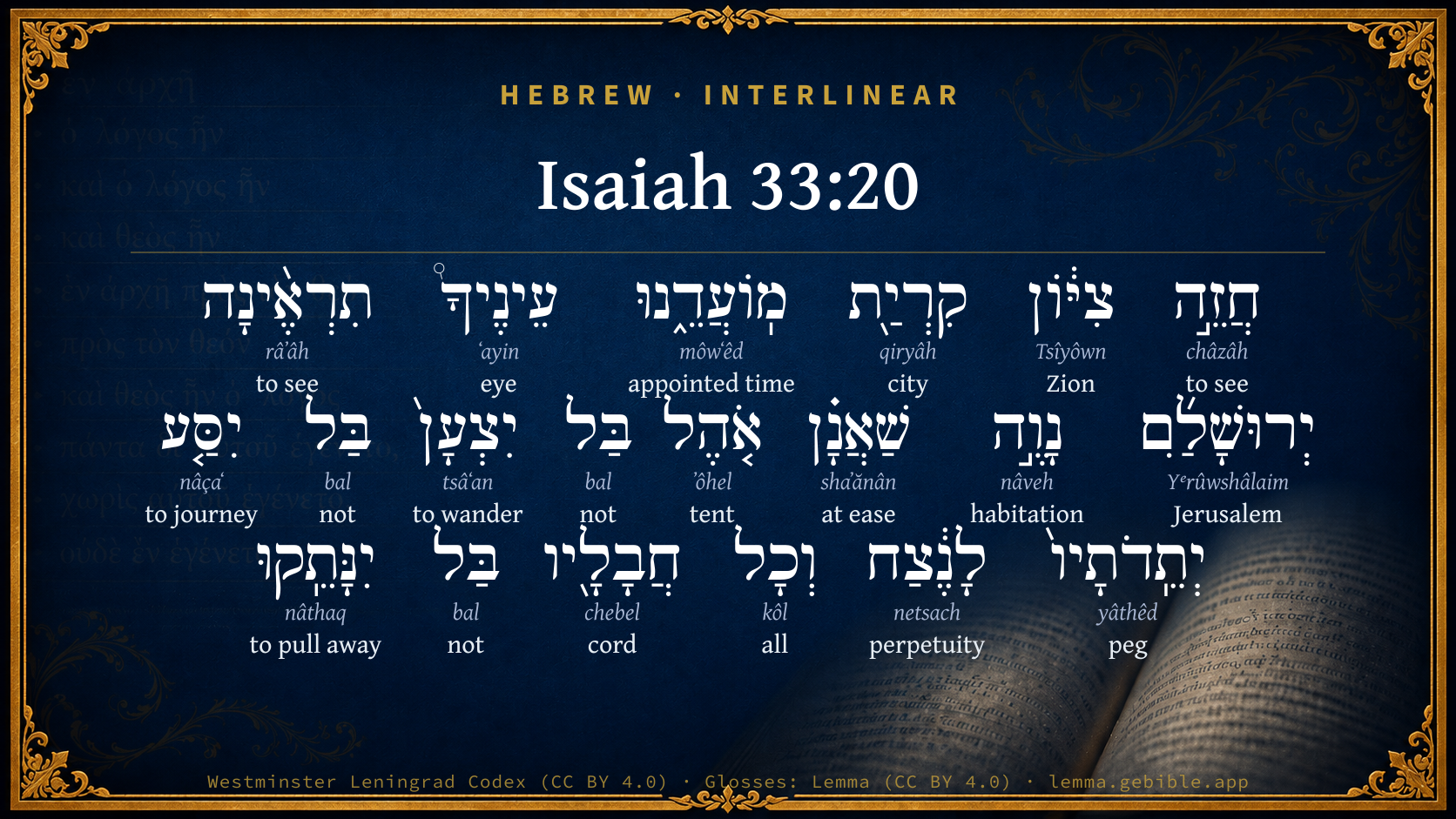
Hebrew (Westminster Leningrad Codex) Isaiah 33:20 appears in the Hebrew Old Testament. The text above is from the Westminster Leningrad Codex. Each word links to its Strong’s number, a concise gloss, and parsing drawn from the Open Scriptures Hebrew Bible morphology. Click any word for its full Brown-Driver-Briggs (BDB) entry.
Download image
Cite this verse

Isaiah 33:20 (World English Bible). Public Domain. Lemma interlinear Bible study tool, https://lemma.gebible.app/v/isaiah/33/20.

Show BibTeX & RIS
BibTeX
RIS
English Translation
Look on Zion, the city of our solemnities: your eyes shall see Jerusalem a quiet habitation, a tent that shall not be removed, the stakes of it shall never be plucked up, neither shall any of the cords of it be broken.
World English Bible · Public Domain
Highlights
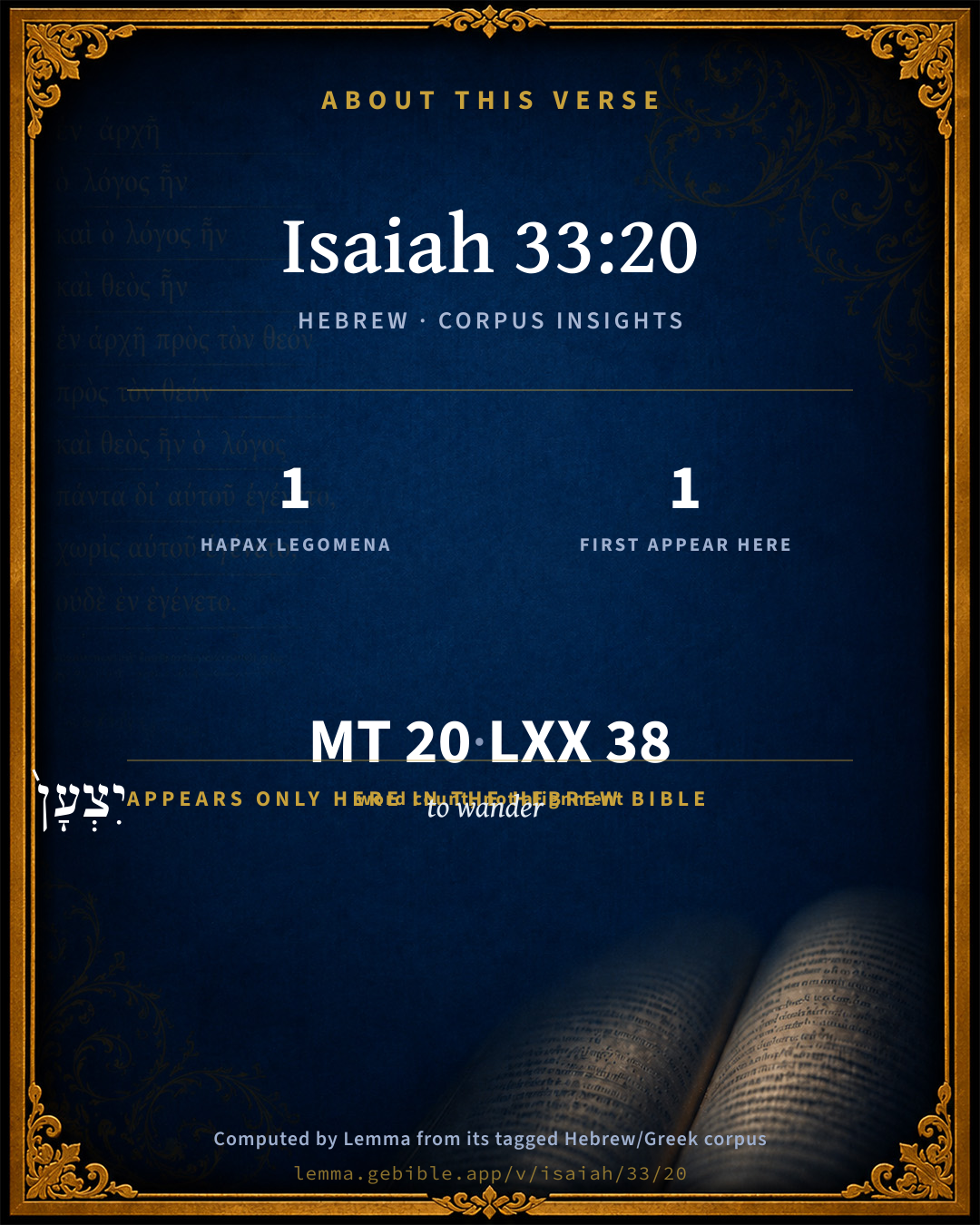
  • 1 hapax legomenon — only here in the Hebrew Bible
  • 1 first appearance in the Hebrew Bible
Full analysis ↓
Download a study sheet

One document with this verse’s original text, its word-by-word gloss line, the meaning frame, cross-references with their text, attributed commentary, and full source and license credits — printable, and it pastes into notes with its structure intact.

This verse Autodidact and up

Study sheet (.html) Plain text (.txt)

A passage Seminary Student

Up to 50 verses in one chapter. A passage sheet keeps up to 6 commentary sources and 12 cross-references per verse, in the order this page ranks them, and says so on the sheet whenever that leaves anything out. Ask for a single verse and you get the Autodidact verse sheet above.

Everything on this page stays free to read, with no account — the sheet is a download of what is already on screen, not access to it.

Want to remove ads? Support Godless Engineer
Compare translations 3

The same verse in 3 English versions, stacked beneath the original-language interlinear above. Click any original word for its lexicon entry.

Each is an independent rendering of the whole verse — the interlinear is not word-aligned to these translations.

Highlighted words mark where these versions differ — a whole-verse word diff, not a word-by-word alignment.

  • World English Bible Public Domain
    Look on Zion, the city of our solemnities: your eyes shall see Jerusalem a quiet habitation, a tent that shall not be removed, the stakes of it shall never be plucked up, neither shall any of the cords of it be broken.
  • King James Version Public Domain
    Look upon Zion, the city of our solemnities: thine eyes shall see Jerusalem a quiet habitation, a tabernacle that shall not be taken down; not one of the stakes thereof shall ever be removed, neither shall any of the cords thereof be broken.
  • unfoldingWord Literal Text CC BY-SA 4.0
    Gaze Zion, the city of our appointed festivals. Your eyes will see Jerusalem, a secure habitation, a tent one will not take down, one will not pull up its stakes forever, and all of its cords will not be broken.

unfoldingWord Literal Text — © unfoldingWord, licensed CC BY-SA 4.0. Word-aligned USFM3 via Door43 (git.door43.org/unfoldingWord/en_ult).

Versions to compare (up to 4)

3 of 4 selected

Show all 18 translations

Every available English version of this verse, each an independent rendering of the whole verse.

  • World English Bible Public Domain
    Look on Zion, the city of our solemnities: your eyes shall see Jerusalem a quiet habitation, a tent that shall not be removed, the stakes of it shall never be plucked up, neither shall any of the cords of it be broken.
  • Berean Standard Bible Public Domain
    Look upon Zion, the city of our appointed feasts. Your eyes will see Jerusalem, a peaceful pasture, a tent that does not wander; its tent pegs will not be pulled up, nor will any of its cords be broken.
  • Majority Standard Bible Public Domain
    Look upon Zion, the city of our appointed feasts. Your eyes will see Jerusalem, a peaceful pasture, a tent that does not wander; its tent pegs will not be pulled up, nor will any of its cords be broken.
  • King James Version Public Domain
    Look upon Zion, the city of our solemnities: thine eyes shall see Jerusalem a quiet habitation, a tabernacle that shall not be taken down; not one of the stakes thereof shall ever be removed, neither shall any of the cords thereof be broken.
  • American Standard Version (1901) Public Domain
    Look upon Zion, the city of our solemnities: thine eyes shall see Jerusalem a quiet habitation, a tent that shall not be removed, the stakes whereof shall never be plucked up, neither shall any of the cords thereof be broken.
  • Revised Version (1885) Public Domain
    Look upon Zion, the city of our solemnities: thine eyes shall see Jerusalem a quiet habitation, a tent that shall not be removed, the stakes whereof shall never be plucked up, neither shall any of the cords thereof be broken.
  • Geneva Bible (1599) Public Domain
    Looke vpon Zion the citie of our solemne feastes: thine eyes shall see Ierusalem a quiet habitation, a Tabernacle that can not be remooued: and the stakes thereof can neuer be taken away, neither shall any of the cordes thereof be broken.
  • Douay-Rheims (1899) Public Domain
    Look upon Sion the city of our solemnity: thy eyes shall see Jerusalem, a rich habitation, a tabernacle that cannot be removed: neither shall the nails thereof be taken away for ever, neither shall any of the cords thereof be broken:
  • Young's Literal Translation Public Domain
    See Zion, the city of our meetings, Thine eyes see Jerusalem a quiet habitation, A tent not taken down, Not removed are its pins for ever, And none of its cords are broken.
  • Literal Standard Version CC BY-SA 4.0
    See Zion, the city of our meetings, || Your eyes see Jerusalem—a quiet habitation, || A tent not taken down, its pins are not removed forever, || And none of its cords are broken.
  • Unlocked Literal Bible CC BY-SA 4.0
    Look at Zion, the city of our feasts; your eyes will see Jerusalem as a quiet habitation, a tent that will not be removed, whose stakes will never be pulled up nor will any of its cords be broken.
  • unfoldingWord Literal Text CC BY-SA 4.0
    Gaze Zion, the city of our appointed festivals. Your eyes will see Jerusalem, a secure habitation, a tent one will not take down, one will not pull up its stakes forever, and all of its cords will not be broken.
  • Darby Bible Public Domain
    Look upon Zion, the city of our solemnities: thine eyes shall see Jerusalem a quiet habitation, a tent that shall not be removed, the stakes whereof shall never be pulled up, neither shall any of its cords be broken;
  • World Messianic Bible Public Domain
    Look at Zion, the city of our appointed festivals. Your eyes will see Jerusalem, a quiet habitation, a tent that won’t be removed. Its stakes will never be plucked up, nor will any of its cords be broken.
  • Webster's Bible Public Domain
    Look upon Zion, the city of our solemnities: thy eyes shall see Jerusalem a quiet habitation, a tabernacle that shall not be taken down; not one of its stakes shall ever be removed, neither shall any of its cords be broken.
  • Free Bible Version CC BY-SA 4.0
    On the contrary, you'll see Zion as a festival city. You will view Jerusalem as a quiet and peaceful place. It will be like a tent that's never taken down, whose tent-pegs are never pulled up, whose guy ropes never snap.
  • Bible in Basic English Public Domain
    Let your eyes be resting on Zion, the town of our holy feasts: you will see Jerusalem, a quiet resting-place, a tent which will not be moved, whose tent-pins will never be pulled up, and whose cords will never be broken.
  • JPS Tanakh (1917) Public Domain
    Look upon Zion, the city of our solemn gatherings; thine eyes shall see Jerusalem a peaceful habitation, a tent that shall not be removed, the stakes whereof shall never be plucked up, neither shall any of the cords thereof be broken.

Literal Standard Version (2020), Covenant Press — licensed CC BY-SA 4.0. Text via the HelloAO Bible API (eBible.org). Unlocked Literal Bible (unfoldingWord) — licensed CC BY-SA 4.0. Text via the HelloAO Bible API (eBible.org). unfoldingWord Literal Text — © unfoldingWord, licensed CC BY-SA 4.0. Word-aligned USFM3 via Door43 (git.door43.org/unfoldingWord/en_ult). Free Bible Version, Dr. Jonathan Gallagher — licensed CC BY-SA 4.0. Text via the HelloAO Bible API (eBible.org).

Word by word

More ways to search: Search by grammar → Find every occurrence → Compare this word →

Practice this passage: Drill this verse → Learn its vocabulary →

יִצְעָן֙
tsâʻan
H6813
“to wander”
Verb, Qal, Imperfect, 3rd Person, Masculine, Singular
Part of Speech
Verb
Stem
Qal
Form
Imperfect
Person
3rd Person
Gender
Masculine
Number
Singular
Full BDB Definition

Origin: a primitive root

TWOT: 1945

(Qal) to wander, travel
  1. חֲזֵ֣ה châzâh H2372 “see” Verb, Qal, Imperative, 2nd Person, Masculine, Singular
  2. צִיּ֔וֹן Tsîyôwn H6726 “Zion” Noun, Proper
  3. קִרְיַ֖ת qiryâh H7151 “city of” Noun, Common, Feminine, Singular, Construct
  4. מֽוֹעֲדֵ֑נוּ môwʻêd H4150 “appointed time · our” Noun, Common, Masculine, Singular, Construct + Suffix, Personal, 1st Person, Common, Plural
  5. עֵינֶיךָ֩ ʻayin H5869 “eyes · your” Noun, Common, Both, Dual, Construct + Suffix, Personal, 2nd Person, Masculine, Singular
  6. תִרְאֶ֨ינָה râʼâh H7200 “to see” Verb, Qal, Imperfect, 3rd Person, Feminine, Plural
  7. יְרוּשָׁלִַ֜ם Yᵉrûwshâlaim H3389 “Jerusalem” Noun, Proper
  8. נָוֶ֣ה nâveh H5116 “habitation” Noun, Common, Both, Singular, Absolute
  9. שַׁאֲנָ֗ן shaʼănân H7600 “at ease” Adjective, Adjective, Masculine, Singular, Absolute
  10. אֹ֤הֶל ʼôhel H168 “tent” Noun, Common, Masculine, Singular, Absolute
  11. בַּל bal H1077 “not” Particle, Negative
  12. בַּל bal H1077 “not” Particle, Negative
  13. יִסַּ֤ע nâçaʻ H5265 “to journey” Verb, Qal, Imperfect, 3rd Person, Masculine, Singular
  14. יְתֵֽדֹתָיו֙ yâthêd H3489 “pegs · his” Noun, Common, Feminine, Plural, Construct + Suffix, Personal, 3rd Person, Masculine, Singular
  15. לָנֶ֔צַח netsach H5331 “to/for · perpetuity” Preposition + Noun, Common, Masculine, Singular, Absolute
  16. וְכָל kôl H3605 “and · all of” Conjunction + Noun, Common, Masculine, Singular, Construct
  17. חֲבָלָ֖יו chebel H2256 “cords · his” Noun, Common, Both, Plural, Construct + Suffix, Personal, 3rd Person, Masculine, Singular
  18. בַּל bal H1077 “not” Particle, Negative
  19. יִנָּתֵֽקוּ nâthaq H5423 “to pull away” Verb, Niphal, Imperfect, 3rd Person, Masculine, Plural

About this verse

These counts appear in no published source. They are computed here, from the morphology-tagged text and Lemma’s own curated glosses. What Lemma adds →

20
words
18
distinct lemmas
Prophets
section

Notable vocabulary

1 hapax legomenon — a word that appears only here in the entire Hebrew Bible:

  • יִצְעָן֙ to wander H6813

First appearance in Scripture

This word makes its first canonical appearance in the Hebrew Bible here:

  • יִצְעָן֙ to wander H6813

Shared distinctive vocabulary

שַׁאֲנָ֗ן at ease H7600 occurs in 10 verses of the Hebrew Bible. Also found in:

Grammatical profile

  • 5 verbs
  • 11 nouns
  • 1 adjective
  • 3 particles

Verb forms

  • חֲזֵ֣ה Qal · Imperative
  • תִרְאֶ֨ינָה Qal · Imperfect
  • יִצְעָן֙ Qal · Imperfect
  • יִסַּ֤ע Qal · Imperfect
  • יִנָּתֵֽקוּ Niphal · Imperfect

Repetition

A word recurs within this verse — often emphatic in Hebrew:

Hebrew & Septuagint length

In English translation the verse runs 42 words from the Hebrew and 40 from the Septuagint (LXX English) — closely comparable.

A rough comparison of the two English renderings, which tokenize alike — not a word-level alignment.

Word counts can differ between the Hebrew and the Greek without any difference in meaning — e.g. the Hebrew direct-object marker אֵת has no separate Greek word, and Greek often adds the article ὁ.

In the original languages it is 20 Hebrew tokens and 38 Greek tokens — but the two are counted differently (Hebrew bundles its prefixes and suffixes into one token; the Greek is in lemma form), so that isn’t a like-for-like length.

Cross-references

12

Topical passages linked to Isaiah 33:20 in the Treasury of Scripture Knowledge — connected by theme and wording, ordered by reader-vote popularity; previews shown in the World English Bible.

  • Psalms 46:5 God is in her midst. She shall not be moved. God will help her at dawn.
  • Isaiah 32:18 My people shall abide in a peaceable habitation, and in safe dwellings, and in quiet resting-places.
  • Isaiah 54:2 Enlarge the place of your tent, and let them stretch forth the curtains of your habitations; don't spare: lengthen your cords, and strengthen your stakes.
  • Deuteronomy 12:5 But to the place which Yahweh your God shall choose out of all your tribes, to put his name there, even to his habitation shall you seek, and there you shall come;
  • Psalms 48:12–13 Walk about Zion, and go around her. Number its towers;
  • Psalms 78:68–69 But chose the tribe of Judah, Mount Zion which he loved.
  • Psalms 125:1–2 Those who trust in Yahweh are as Mount Zion, Which can't be moved, but remains forever.
  • Psalms 128:5 May Yahweh bless you out of Zion, And may you see the good of Jerusalem all the days of your life.
  • Isaiah 37:33 Therefore thus says Yahweh concerning the king of Assyria, He shall not come to this city, nor shoot an arrow there, neither shall he come before it with shield, nor cast up a mound against it.
  • Ezekiel 48:35 It shall be eighteen thousand [reeds] round about: and the name of the city from that day shall be, Yahweh is there.
  • Matthew 16:18 I also tell you that you are Peter, and on this rock I will build my assembly, and the gates of Hades will not prevail against it.
  • Revelation 3:12 He who overcomes, I will make him a pillar in the temple of my God, and he will go out from there no more. I will write on him the name of my God, and the name of the city of my God, the new Jerusalem, which comes down out of heaven from my God, and my own new name.

Cross-references courtesy of OpenBible.info (CC BY 4.0).

Hebrew and Greek witnesses Masoretic Hebrew ↔ Greek Septuagint

The same verse in the two great witnesses to the Old Testament, shown verse-for-verse.

These are two independent witnesses, not word-aligned to each other, and the Septuagint is shown in lemma (dictionary) form.

Hebrew Isaiah 33:20 Masoretic · Westminster Leningrad Codex

חֲזֵ֣ה צִיּ֔וֹן קִרְיַ֖ת מֽוֹעֲדֵ֑נוּ עֵינֶיךָ֩ תִרְאֶ֨ינָה יְרוּשָׁלִַ֜ם נָוֶ֣ה שַׁאֲנָ֗ן אֹ֤הֶל בַּל יִצְעָן֙ בַּל יִסַּ֤ע יְתֵֽדֹתָיו֙ לָנֶ֔צַח וְכָל חֲבָלָ֖יו בַּל יִנָּתֵֽקוּ

Look on Zion, the city of our solemnities: your eyes shall see Jerusalem a quiet habitation, a tent that shall not be removed, the stakes of it shall never be plucked up, neither shall any of the cords of it be broken.

World English Bible · Public Domain

Greek LXX Isaiah 33:20 Septuagint · lemma form

ἰδού σιων ὁ πόλις ὁ σωτήριον ἐγώ ὁ ὀφθαλμός σύ ὁράω ἰερουσαλήμ πόλις πλούσιος σκηνή ὅς οὐ μή σείω οὐδέ μή κινέω ὁ πάσσαλος ὁ σκηνή αὐτός εἰς ὁ αἰών χρόνος οὐδέ ὁ σχοινίον αὐτός οὐ μή διαῥήγνυμι

Behold the city of Sion, our refuge: your eyes shall behold Jerusalem, a rich city, tabernacles which shall not be shaken, neither shall the pins of her tabernacle be moved for ever, neither shall her cords be at all broken:

LXX2012 (modern English Septuagint) · Public Domain

Hebrew: Westminster Leningrad Codex (CC BY 4.0). Greek: Septuagint (public domain); English from LXX2012 (modern English Septuagint) (Public Domain). How the Septuagint differs from the Hebrew →

Targum (Aramaic paraphrase)

1

The Targum is the ancient Jewish Aramaic paraphrase of the Hebrew Scriptures — an interpretive translation, not the Hebrew text itself. Onkelos (literal) and Pseudo-Jonathan (expansive) render the Torah, and Jonathan the Prophets. Coverage is partial: where no permissively-licensed English translation exists for a verse, only the Aramaic is shown. This is verse-level text, not a word-by-word alignment to the Hebrew.

  1. Targum Jonathan Prophets (Joshua–Malachi)
    תֶּחֱזֵי בְּמַפַּלְתְּהוֹן צִיוֹן קִרְיַת זִמְנָנָא עֵינָךְ יֶחֱזְיָן בְּנֶחָמַת יְרוּשְׁלֶם בְּאַצְלָחוּתָא בִּשְׁלֵוָתָא בְּמַשְׁכְּנָא דְלָא מִתְפְּרַק וְלָא מִשְׁתַּלְפָן סִכּוֹהִי לַעֲלַם וְכָל אַטוֹנוֹהִי לָא יִתְפַסְקוּן:

    O Zion, thou shalt see their fall; O city of our festivals, thine eyes shall see the consolation of Jerusalem in her prosperity and security, like a tabernacle that is not taken down, and whose pegs are not drawn out for ever, and whose cords shall not be broken.

    Targum Jonathan — Aramaic: “Mikraot Gedolot” (public domain). English: “Sefaria Community Translation” (CC0 1.0 (public-domain dedication)); “London "Chaldee Paraphrase," 1871” (public domain). Text via Sefaria.

Commentary

Notes on Isaiah 33:20 from classic Christian and Jewish commentators (each source and its license shown beneath its notes). The classic Christian expositions comment on the surrounding passage and are grouped to its opening verse, so a note may address several verses; the Jewish commentaries on the Tanakh (Rashi and others) are per-verse, so they appear only where the commentator wrote on this verse.

Lemma curates 59 commentaries, every one of them public domain or Creative Commons licensed, each selected and text-cleaned for this edition rather than reprinted as found. About our sources →

Trapp's Complete Commentary

John Trapp

Isa 33:20 Look upon Zion, the city of our solemnities: thine eyes shall see Jerusalem a quiet habitation, a tabernacle [that] shall not be taken down; not one of the stakes thereof shall ever be removed, neither shall any of the cords thereof be broken.

Ver. 20. Look upon Zion, the city of our solemnities.] Where God is daily and duly served, and is therefore her shield and exceeding great reward. {Gen 17:1} If that heathen king, hearing of his enemies’ approach while he was sacrificing, could answer, Eγω δε θυω, I am serving my gods, and therefore fear not their force, how much more cause had Zion to be confident, and to sing. {as Psa 46:1-7} See Psa 48:12-13.

John Trapp, A Commentary or Exposition upon All the Books of the Old and New Testament (1647–1656) — public domain. Text from a community e-Sword module.

The Biblical Illustrator

Joseph S. Exell

Isa_33:20-24

Look upon Zion, the city of our solemnities--

Isaiahs imagery

Among the images which crowd the concluding verses of this chapter, we may perhaps, without fancifulness, distinguish an under-current of thoughts suggested by the circumstances of the times at which this prophecy was delivered; the promised quiet seems to point to the existing commotion; the tabernacle which shall not be taken down, reminds us not only of the fast-founded Temple which had replaced the tabernacle, and become the fixed centre of their solemnities, but also of the tents of Sennacherib s hosts, then, as now, made of black camels or goats hair, now blackening the valleys round Jerusalem, but soon to be swept away like the thistle-down before the whirlwind; the broad rivers and streams suggest the thought that though Hezekiahs precautions would have secured the absolutely necessary supply of water for the beleaguered city, they felt the want of that abundance of it which is still more grateful in an Eastern climate than in our own; while the promise that the inhabitants should no longer say, I am sick, favours the conjecture that the illness of Hezekiah may have been one instance of the disease which usually attends on the confinement and discomforts of a city shut-up against an enemy in the field.

(Sir E. Strachey, Bart.)

The privileges and stability of the Church

Jerusalem, after this period, was never long preserved from hostile invasions, therefore our attention is turned from it to that glorious city against which the gates of hell shall never prevail. Let us--

I. TAKE THOSE VIEWS OF THE CHURCH OF CHRIST WHICH OUR TEXT RECOMMENDS.

1. As a solemn city. The city of our solemnities. The Church of the Lord on earth is called the holy people; the redeemed of the Lord; sought out, a city not forsaken. It is that great city, the holy Jerusalem. It is Mount Zion, the city of the living God. It is the holy city, which is the mother of us all. The orders and laws necessary for the city of Zion are contained in these lively oracles, which may also be considered as the charter of the privileges of its happy and active citizens. Peace is within its walls, and prosperity within its palaces; and everything is conducted well, being managed by Him who is the God of order, and not of confusion. Its great King ever dwells in the midst of it, and its walls are continually before Him. The immunities, for which its inhabitants are distinguished, are numerous and inestimable; including deliverance from the bondage of corruption and sin, together with a full enjoyment of a right to the tree of life, and to all the blessings they can need. Its walls are called salvation, and its gates praise; its streets are all pleasant, and its towers may well strike the eye with admiration. It is well called the city of our solemnities.

This name may be applied to Jerusalem on account of the most solemn feasts that were there made; the solemn assemblies that were there held; and the solemn sacrifices which were there offered. Nor is the term at all inapplicable to the Church of God, which consists of serious believers, who enter into the most solemn engagements with Jehovah; who are employed in the most solemn exercises of mind that can possibly be imagined; and whose minds are peculiarly affected with the solemnities of death and judgment. Real religion is altogether a solemn thing.

2. As a quiet habitation. It is builded together for an habitation of God through the Spirit. God Himself is the householder, for He hath chosen Zion, and desired it for His habitation; and here, too, dwell all the faithful, There is something very consolatory in the idea, that all the worthies now in glory, that ever trusted in Christ, were all members of that Church which is one; and that all real believers are considered by Jehovah as forming a part of it. This dwelling-place of the just is remarkable for the security which is there enjoyed, and the peace which pervades the whole. It is a quiet habitation; here the Prince of Peace takes up His residence, and reigns: here the work of righteousness is peace, and the effect of righteousness, quietness and assurance for ever; and Gods people dwell here in a peaceable habitation.

3. An immovable tabernacle. A tabernacle that shall not be taken down; not one of the stakes thereof shall ever be removed, neither shall any of the cords thereof be broken. The Church militant is but a tabernacle when contrasted with the inconceivable excellencies of the paradise of God. Divine glory is manifested to us, and known by us here, but in part; but there we shall know even as we are known. The Church of God may often change its place. This is shown us by the state of those cities in which once the cause of our Redeemer prospered, but where now His name is never heard. The Jerusalem Church, though it might verify the promise in the text, by experiencing a long space of peace, and season of rest from war, together with the restoration and continuance of their sacred privileges, has now lost all its excellence, and Ichabod (the glory is departed) may evidently be seen inscribed upon it. The true Church typified by it, shall never be taken down whilst the world itself remains.

II. ENFORCE THAT ATTENTION TO THE CHURCH OF GOD WHICH THE TEXT DEMANDS. Look upon Zion.

1. Look upon it, angels, with complacency and delight!

2. Look upon it, sinners, with astonishment and desire!

3. Look upon it, Christians, with wonder, love, and praise! (T. Spencer.)

Gods promises to His Church

To our Zion, to the Church of Christ, are promised explicitly such gifts as those of the text--unity, truth, success. Of which of them, it may be asked, can we make our boast?

I. THE UNITY OF THE CHURCH WAS TO BE ONE CHIEF NOTE OF ITS DIVINE ORIGIN. What is our state? Visible unity seems to be no more a mark of the Church of Christ. Of those whose faces are all turned one way, to the place where Jesus the crucified sits on the right hand of God, the east and west have been rent asunder, so that none can re-knit the torn garment of the Lord. And west and east are again divided, each within itself; and we, that are but a section of the Western Church, are torn and torn again. Gods promise cannot have been in vain. Man must have hindered it; God hath not forgotten it.

II. But if unity has been lost, TRUTH HAS BEEN PRESERVED TO US. And this is our consolation. If the Church be not the great ocean--vast, bright, fresh, a counterpart of the blue heaven above it--still she is like the hundred lakes that nestle among the sheltering hills; they know not each other, but every one of them reflects, and truly, the firmament above. So far as salvation by Christ is brought home to men by the teaching of the churches, so long there is an underlying bond of agreement which outward misunderstanding cannot cancel.

III. Humiliating to us are those PROMISES OF GREAT SUCCESS which are a part of our charter. The power of the truth we teach, the presence of the Holy Ghost, to turn the outward word into an inward life, seem to assure us of great success in gathering in souls to Christ. There is much love amongst us, even with our strife; there is a warm and growing zeal in works of good. Without the presence of the Spirit these things could not be. (Archbishop Thomson.)

Jerusalem imperilled yet secure

(Isa_33:20-23):--As the existence of Jerusalem was imperilled, the first promise of Isaiah was that Jerusalem should still exist--Thine eyes shall see Jerusalem a quiet habitation, and so on; but, further, inasmuch as during the siege many unbelieving persons had found fault with the position of Jerusalem, because it was not surrounded by a river, the promise is given that she shall have a glorious position--There the glorious Lord will be unto us a place of broad rivers and streams; nay, more than this, as a climax of blessing, she is promised perpetual triumph over all her enemies, since in her streams shall go no galley with oars, neither shall gallant ship pass thereby; or, if they come they shall prove a wreck--Thy tacklings are loosed; they could not well strengthen their mast, they could not spread the sail. (C. H. Spurgeon.)

The Church of God

I. The first promise made to the Church of God in our text is one SECURING TO HER AN EVERLASTING EXISTENCE. The Church is not a temporary institution; it shall never be removed.

1. The Jerusalem of God shall exist as she is. What was she in those days? The city of solemnities; the place where prayer and praise were wont to be made. So is she to continue throughout all generations.

2. As a quiet habitation, which we would desire it to be.

(1) The Church of God is always a quiet habitation, even when her enemies surround her. Some of you may have seen in the Exhibition a Belgian picture representing the reading of the statute of the Duke of Alva in the Flemish towns, establishing the Inquisition. Godly merchants are listening in deep solemnity of sorrow; the young maiden weeps upon her sisters bosom; the aged woman turns her streaming eyes to heaven. All this the painter could depict, but he could not paint the deep heaven-born peace which still possessed the souls of the threatened ones.

(2) But how quiet is she when her enemies are not allowed to prey upon her! Then had the churches rest, says the Holy Ghost in the Acts of the Apostles.

(3) We know what quiet means in our communion with one another.

3. Our text seems to indicate that there were some persons who doubted all this, and said, Well, but you speak of this city as though it could stand an attack. It cannot; it is such a feeble place; it is like a tent; it can soon be stormed; a gust of wind can blow it over. The Lord anticipates this difficulty, and shows that the feebleness of Jerusalem should be no reason why she should not still continue to exist. She is a tabernacle--a mere tent; but she is a tabernacle that shall not be taken down. The Churchs feebleness, because it drives her to God, is the Churchs strength.

4. To complete this part of the promise, the city, notwithstanding all her feebleness, is to be for ever complete.

(1) If I understand the last two sentences,--Not one of the stakes thereof shall ever be removed, neither shall any of the cords thereof be broken, we learn here that all the true members of the Church are safe. Some of them may be driven into the earth as the stakes are driven, with a heavy mallet; but the strokes of tribulation shall only give them a better hold, and minister stability to the whole structure.

(2) This also relates to the doctrines of the Gospel.

(3) The ordinances.

II. THE PRE-EMINENT POSITION (verse 21).

III. ETERNAL SAFETY (verses 22, 23). (C. H. Spurgeon.)

The Biblical Illustrator, edited by Joseph S. Exell (c. 1880s–1900s) — public domain. Text from a community e-Sword module.

Joseph Benson's Commentary

Isa 33:20-22. Look upon Zion — Contemplate Zion’s beauty and safety, and her glorious and peculiar privileges; the city of our solemnities — This was the chief part of Zion’s glory and happiness, that God was solemnly worshipped, and the solemn assemblies and feasts kept in her. Thine eyes shall see Jerusalem a quiet habitation, &c. — What is here predicted was but very obscurely and imperfectly fulfilled in the literal Zion; but was, and will be, clearly and fully accomplished in the mystical Zion, the church of God, in the times of the gospel, against which we are assured the gates of hell shall not prevail, Mat 16:18. There — In and about Zion, the glorious Lord will be a place of broad rivers — Though we have nothing but a small and contemptible brook to defend and refresh us, yet God will be as sure a defence, and source of consolation to us, as if we were surrounded with great rivers. Wherein shall go no galley — No ships of the enemies shall be able to come into this river to annoy us. For the Lord is our judge — To judge for us, to plead our cause against our enemies, as the ancient judges of Israel did. The Lord is our lawgiver, &c. — Our chief governor, to whom it belongs to give laws, and to defend his people.

Joseph Benson's Commentary on the Old and New Testaments (1811–1818) — public domain. Text from a community e-Sword module.

The Preacher's Complete Homiletical Commentary

Joseph S. Exell (gen. ed.)

CHARACTERISTICS OF THE CHURCH OF CHRIST

Isa_33:20. Look upon Zion, &c.

It is probable that when this prophecy was delivered the city of Jerusalem was threatened with an immediate siege; but Jehovah engages to defend it from the attacks of its enemies, the Assyrians, and to render it at once quiet and secure. But yet the text appears to have a direct reference to the privileges and stability of the Gospel Church, for Jerusalem, after this period, was never long preserved from hostile invasions; therefore our attention is turned from it to that glorious city against which the gates of hell shall never prevail. (See pp. 228, 229.)

I. The Church of Christ is “the city of our solemnities.” Jerusalem was thus described because of the solemn assemblies that were there held, the solemn feasts that were there celebrated, and the solemn sacrifices which were there offered. And it is in the Church that individual believers come together, and unite in the enjoyment of divine grace, and in the presentation of “sacrifices” with which “God is well pleased” (Heb_13:15-16) [1228]

[1228] As the earth’s loftiest peaks rise not in their snows on some isolated hill that stands like a lonely pyramid on a level plain, but where the mountains, as in the Alps, or Andes, or Himalayan range, are grouped and massed together, so the saint’s most heavenly happiness is not attained in solitude, nor even amid domestic scenes, but where religious life exists in its social character.—Guthrie.

II. The Church of Christ is “a quiet habitation” [1231] All genuine believers dwell in it, and peace is at once the bequest of Christ (Joh_14:27) and the fruit of the Spirit (Gal_5:22).

[1231] See THE PEACEABLE HABITATION, chap. Isa_32:18, page 368.

III. The Church of Christ is “a tabernacle that shall not be taken down.” “A tabernacle” in contrast with the superior glories of the New Jerusalem in heaven. A tabernacle, because it may often change its place, as in fact it has already done. But it shall never be “taken down” in the sense of being destroyed (H. E. I. 1246–1251).

IV. Such a contemplation of Zion as our text calls for will awaken—

1. In angels complacency and delight;

2. In sinners astonishment at its wondrous preservation, in spite of all their efforts to destroy it, and desire to share in its privileges; and

3. In Christians wonder, love, and praise.—Thomas Spencer: Twenty-one Sermons, pp. 196–206.

The Preacher's Complete Homiletical Commentary (gen. ed. Joseph S. Exell; Funk & Wagnalls, c. 1892) — public domain (pre-1929). A full-Bible homiletical/sermon-outline anthology covering 65 of 66 books (2 John is absent from the source module). Text from a community e-Sword module.

Jamieson, Fausset & Brown

Robert Jamieson, A. R. Fausset & David Brown

solemnities--solemn assemblies at the great feasts (see on Isa 30:29; Psa 42:4; Psa 48:12).

not . . . taken down . . . removed--image from captives "removed" from their land (Isa 36:17). There shall be no more "taking away" to an enemy's land. Or else, from nomads living in shifting tents. The saints, who sojourned once in tabernacles as pilgrims, shall have a "building of God--eternal in the heavens" (Co2 5:1; Heb 11:9-10; compare Isa 54:2).

stakes--driven into the ground; to these the "cords" were fastened. Christ's Church shall never fall (Mat 16:18). So individual believers (Rev 3:12).

Jamieson, Fausset & Brown — Commentary Critical and Explanatory on the Whole Bible (1871) — public domain (CC PDM 1.0). Text via the HelloAO Bible API.

Adam Clarke's Commentary

Verse 20. Look upon Zion - "Thou shalt see Zion"] For חזה chazeh, "see," read תחזה techezeh, "thou shalt see," with the Chaldee. - Houbigant. At the end of this verse we find in the Masoretic Bibles this note, חצי הספר chatsi hassepher, "the middle of the book;" that is the middle of the book of Isaiah.

Adam Clarke's Commentary on the Bible (1810–1826) — public domain. Text from a community e-Sword/MySword module.

Ellicott's Commentary for English Readers

(20) Look upon Zion . . .—The words sound like an echo of Psalms 46, 48, which were probably written by the sons of Korah on the destruction of Sennacherib’s army. Men had seen Zion desecrated by Ahaz, besieged by Sennacherib; now they should see it once again as it had been at the beginning of Hezekiah’s reign, emphatically a “city of solemnities,” a tent that shall not be removed, the latter words probably referring to Sennacherib’s threat of deportation (Isa_36:17).

A Bible Commentary for English Readers, edited by Charles John Ellicott (1878–1897) — public domain. Text from a community e-Sword module.

The Cambridge Bible for Schools and Colleges

gen. ed. J. J. S. Perowne

20. For solemnities, render festal assembly.

a tabernacle that shall not be taken down] Better (as R.V.), a tent that shall not be removed. For the figure, cf. Jer_10:20.

20, 21. The permanent peace and inviolability of Jerusalem, the centre of the true religion: see ch. Isa_32:18.

The Cambridge Bible for Schools and Colleges (gen. ed. J. J. S. Perowne; Cambridge University Press, 1878–1918) — public domain. Text from a community e-Sword module.

John Gill's Exposition

Look upon Zion,.... Instead of such terrible objects as before described, a very amiable and lovely one is presented to view; even Zion, the church of God, beloved by him, chosen for his habitation, a strong city, a perfection of beauty, and the joy of the whole earth. The Targum is,

"O Zion, thou shalt see their fall;''

the fall of her enemies before mentioned; as at this time the church will see the fall both of the eastern and western antichrist. But the words are an exhortation to the saints and people of God, to behold the safety, peace, and prosperity of the church, now freed from all its enemies:

the city of our solemnities; a "city", for its situation, foundation, walls, and building; for its number and sorts of inhabitants; for its wholesome laws and choice privileges: a city of "solemnities", where the saints solemnly assemble together for religious worship; where the word of God is, solemnly preached, and where the ordinances are solemnly administered, and the sacrifices of prayer and praise are solemnly offered up:

thine eyes shall see Jerusalem a quiet habitation; or the church of God in Gospel times, and particularly in the latter day: see Heb 12:22 and by which name the church is called in its more glorious state, Rev 21:2 which is the "habitation" of God, Father, Son, and Spirit; and of saints, where they dwell, or however will in the latter day, safely, quietly, pleasantly, and comfortably; for then will it be, and be "seen" and enjoyed, as a "quiet" one; for now will the saints live in peace one with another; there will be no more envy, vexations, animosities, and divisions; this will be the Philadelphian church state, when brotherly love shall everywhere prevail, and when they shall also be entirely free from the persecutions of enemies; none shall hurt and destroy in all the holy mountain, Isa 11:9. Some render it a "sheepfold" (f); Christ is the shepherd, the saints are his sheep, the church is the fold where they are gathered, fed, and preserved, and lie in safety, and peace: and

a tabernacle that shall not be taken down; as the tabernacle of Moses was; or the tents of shepherds, soldiers, and sojourners are, to which the allusion may be; and so is expressive of the continuance of the church, which shall not now be removed from place to place, as it has been, but shall be fixed and settled all over the world, and so remain to the end of time, an immovable tabernacle; and especially so it will be when the tabernacle of God is with men, and he shall dwell with them, Rev 21:3,

not one of the stakes thereof shall ever be removed, neither shall any of the cords thereof be broken; alluding to tents and tabernacles made of curtains, fastened by cords to stakes, by which they are supported. Not only ministers of the Gospel, but every true believer, is as a "stake" or pillar in the church of God, which shall never be removed, Rev 3:12 never removed from the heart and love of God; nor out of the hands of Christ, and an interest in him; nor out of the family of God, or from the privileges of it; nor from Christ's body, the church, which is his fulness. The "cords" with which these are all held together, which shall never be broken, are the everlasting love of God, electing grace, the covenant and its promises, the word and ordinances, which always remain firm and sure, and secure the stability and continuance of the church of God.

(f) "caulam", Junius & Tremellius, Piscator.

John Gill's Exposition of the Whole Bible (1746–1763) — public domain (CC PDM 1.0). Text via the HelloAO Bible API.

Albert Barnes' Notes on the Bible

Look upon Zion - Lowth renders this, ‘Thou shalt see Zion,’ by Changing the Hebrew text in conformity with the Chaldee. There is no doubt that this accords with the sense of the passage, but there is no authority for the change It stands in contrast with what had been said in Isa 33:19. There, the prophet had said that they should no more see those foreign armies that were coming to invade them. Here he directs them to look upon Zion, implying that they should be permitted to behold Zion in a situation such as he proceeds to describe it. ‘You shall not see that foreign army carrying desolation as they design through the city and the land. They shall be destroyed. But behold Zion! Her you shall see quiet, prosperous, happy, peaceful.’

The city of our solemnities - Where the religious solemnities of the nation were celebrated.

A quiet habitation - Free from invasion, and from the terrors of war.

A tabernacle - A tent; a dwelling, such as was common in the nomadic mode of life in the East. The whole city is described under the image of a tent that is fixed and undisturbed, where the family may reside in safety and comfort.

Not one of the stakes thereof - The ‘stakes’ here refer to the poles or fixtures which were driven into the ground in order to fasten the tent, to enable them to spread it, or to the small stakes or pins that were driven in the ground in order to secure the cords by which the tent was extended. The drawing in the book will give you an idea of the mode in which tents were commonly pitched, and will serve to explain this passage, as well as the similar passage in Isa 54:2.

Shall ever be removed - It shall be a fixed and permanent habitation. The word ‘ever’ must mean an indefinite period of duration. Sennacherib had designed to blot out the name of the people of God, and destroy their separate and independent existence. The prophet says that that should never be done. Jerusalem, the residence of his people and the emblem of his church, would be safe, and would not be destroyed. There would always be a safe and quiet abode for the friends of the Most High. In this sense it accords with the declaration of the Saviour, that the gates of hell should not prevail against his church.

Neither shall any of the cords thereof be broken - Cords were used in tents to fasten the cloth to the poles, or to fasten it to the pins which had been driven into the ground, in order to extend the cloth, and to make it firm.

Albert Barnes' Notes on the Bible (1834–1885) — public domain. Text from a community e-Sword/MySword module.

Haydock's Catholic Bible Commentary

CHAPTER XXXIII.

Broken. It was taken 125 years afterwards. The Church remains till the end of time, (Calmet) whereas both the prophets and history assure us, that Jerusalem was subject to destruction. (Worthington)

George Leo Haydock (1774–1849), Haydock's Catholic Family Bible and Commentary, 1859 edition — public domain. Excludes Psalms (Douay-Rheims chapter numbering differs from Protestant) and Deuterocanonical books (Catholic canon only).

Matthew Poole's English Annotations

Look upon Zion; contemplate Zion’s beauty and safety, and her glorious and peculiar privileges; it is an object worthy of thy deepest meditation.

The city of our solemnities: this he mentions, as the chief part of Zion’s glory and happiness, that God was solemnly worshipped, and the solemn assemblies and feasts kept in her. A quiet habitation, &c.; which was but very obscurely and imperfectly fulfilled in the literal Zion; but was clearly and fully accomplished in the mystical Zion, the church of God in the times of the gospel, against which, we are assured, that the gates of hell shall not prevail, Mat 16:18.

Matthew Poole's English Annotations on the Holy Bible (1683–1685) — public domain. Text from a community e-Sword/MySword module.

Whedon's Commentary on the Bible

Daniel D. Whedon

20-22. But Zion in her victory and glory may be seen, and the command is to look upon her, now a quiet habitation, where religious worship may be resumed in peace. A tabernacle… not to be taken down — The figure of the tent is applied — a symbol of simple, holy, old patriarchal life — well pitched against storms, and secure against marauders.

There — That is, in Jerusalem, the Lord is ever present, glorious in spiritual agency and results — like to physical and civil affairs, to broad, fertilizing streams all around, upon which no galley with oars, nor staunch war ship, shall venture — but the scene shall be evermore one of peace, plenty, and security. For the Lord, our judge, lawgiver, and king, shall save us.

Daniel D. Whedon (gen. ed.), Commentary on the Old and New Testaments (1874–1909) — public domain. Text from a community e-Sword module.

The Pulpit Commentary

Look upon Zion, etc.; i.e. turn thy thoughts, O Judah, from the past to the present from the time of the siege to the time after the siege terminated. The city of our solemnities; or, of our festal meetings ; the city where we celebrate our Passovers, our Feasts of Weeks, our Feasts of Ingathering, and the like. A tent that shall not be taken down. There is, perhaps, a reference to Sennacherib"s threat to remove the entire population from Jerusalem to a far country. (Isa_36:19) This threat should not take effect. Not one of the stakes thereof shall ever be removed. By "the stakes" are meant "the tent-pegs," to which the ropes are fastened which keep the tent firm. (comp. Exo_27:10 Exo_38:18, 31 Jud_1:4:21) The promise that they shall "never" be removed must be understood either as conditional on the people"s walking uprightly (ver. 15), or as a promise of a long continuance merely.

The Pulpit Commentary (1880–1919), ed. H.D.M. Spence-Jones & Joseph S. Exell — public domain. Text from a community e-Sword module.

John Wesley's Explanatory Notes

Look upon - Contemplate Zion's glorious and peculiar privileges. Solemnities - This was the chief part of Zion's glory, that God was solemnly worshipped, and the solemn assemblies and feasts kept in her. Quiet - This was but imperfectly fulfilled in the literal Zion; but clearly and fully in the mystical Zion, the church of God, in the times of the gospel.

John Wesley, Explanatory Notes Upon the Whole Bible (1754–1765) — public domain. Text via the GEBible commentary corpus.

Keil & Delitzsch

C. F. Keil & F. Delitzsch

And how will Jerusalem look when Asshur has been dashed to pieces on the strong fortress? The prophet passes over here into the tone of Psa 48:1-14 (Psa 48:13, Psa 48:14). Psa 46:1-11 and Psa 48:1-14 probably belong to the time of Jehoshaphat; but they are equally applicable to the deliverance of Jerusalem in the time of Hezekiah. "Look upon Zion, the castle of our festal meeting. Thine eyes will see Jerusalem, a pleasant place, a tent that does not wander about, whose pegs are never drawn, and none of whose cords are ever broken." Jerusalem stands there unconquered and inviolable, the fortress where the congregation of the whole land celebrates its feasts, a place full of good cheer (Isa 32:18), in which everything is now arranged for a continuance. Jerusalem has come out of tribulation stronger than ever - not a nomadic wandering tent (tsâ‛am, a nomad word, to wander, lit., to pack up = tâ‛an in Gen 45:17), but one set up for a permanent dwelling.

Keil & Delitzsch — Biblical Commentary on the Old Testament (1861–1891) — public domain (CC PDM 1.0). Text via the HelloAO Bible API. (Old Testament only.)

J. A. Alexander on Isaiah

Joseph Addison Alexander

“Behold Zion the city of our festivals.” Instead of the presence of foreign enemies, see Jerusalem once more the scene of stated solemnities. The address is to the people as an individual. “Thine eyes shall see Jerusalem a quiet home, a tent (that) shall not be removed” (or taken down). The whole of this description is drawn from the usages of nomadic life. “Its stakes shall not be pulled up forever, and all its cords shall not be broken,” or in our idiom, none of its cords shall be broken. The peculiar beauty of the imagery lies in ascribing permanence to a tent, which from its very nature must be moveable. This may either imply a previous state of agitation and instability, or that the church, though weak in herself, should be strengthened and established by the power of God.

Joseph Addison Alexander, The Prophecies of Isaiah (1846–1847; New York: Scribner, 1870–1878) — public domain. Text from a community e-Sword module.

unfoldingWord translationNotes

Door43 World Missions Community

General Information:

Isaiah continues to speak to the people of Judah.

the city of our feasts

This means that they have their festival and feasts at this city. AT: "the city where we have our feasts" or "they city where we celebrate our festivals" (See: Possession)

your eyes will see

The people are referred to by their "eyes" to emphasize what they are seeing. AT: "you will see" (See: Synecdoche)

a tent that will not be removed

This speaks of Zion being secure and well establish as if it were secure tent. This can be stated in active form and written as a new sentence. AT: "it will be secure, like a tent that no one will ever remove" (See: Metaphor and Active or Passive)

whose stakes will never be pulled up nor will any of its cords be broken

This is part of the metaphor that compares Zion to a secure tent. This can be stated in active form. AT: "whose stakes no one will ever pull up and whose cords no one will ever break" (See: Metaphor and Active or Passive)

Yahweh in majesty will be with us, in a place of broad rivers and streams

Here "us" refers to Isaiah and includes the people of Judah. This speaks of the safety of living with Yahweh as if it were a place that has rivers around it so that enemies cannot attack it. AT: "Yahweh who is majestic will be with us, and we will be safe as if we were in a place surrounded by broad rivers" (See: Inclusive "We" and Metaphor)

will travel it

"will travel the river"

translationWords

Zion

feast

Jerusalem

tent

Yahweh

majesty

unfoldingWord translationNotes — © Distant Shores Media and the Door43 World Missions Community, licensed CC BY-SA 4.0. Source: git.door43.org/Door43/en_tn.

Rashi

Rabbi Shlomo Yitzchaki (Rashi)

See Zion But whom will you see in your heart to be regarded as a kingdom and a ruling power? Zion, which is the city of our meeting place.

that shall not fall (יִצְעָן) shall not be lowered. Comp. (Jud. 4:11) “Elon-bezaanannim (אֵלוֹן בְּצַעֲנַנִּים),” which is rendered as: the plain of pits (מִישׁוֹר אַגְנַיָּא), which are pits in the fields, called kombes in O.F. Comp. (Baba Kamma 61b) “The pits of the earth (אַגְנֵי דְאַרְעָא) they are considered,” where water gathers from the mountains and the hills. I believe that the ‘beth’ of the word בְּצַעֲנַנִּים is not radical, but is a prefix.

whose pegs shall never be moved (יִסַּע) The pegs with which they tie the ropes of the tent he shall not move them from the earth, from the place into which they are thrust. Comp. (I Kings 5:31) “And they quarried (וַיַּסִּעוּ) great stones.” Also (Jud. 16:3), “And he plucked them (וַיִּסּעֵם) together with the bolt,” an expression of uprooting.

Rashi on the Tanakh — English translations: “The Judaica Press complete Tanach with Rashi, translated by A. J. Rosenberg” (CC BY 4.0); “Pentateuch with Rashi's commentary by M. Rosenbaum and A.M. Silbermann, 1929-1934” (public domain); “The Metsudah Tanach series, Lakewood, N.J” (CC BY 4.0); and “The Book of Joshua, Metsudah Publications, 1997” (CC BY 4.0). Text via Sefaria.

Ibn Ezra

Rabbi Abraham ibn Ezra

Look upon Zion, etc. We need not look at the king of Assyria, we should rather look at Zion.

מועדנו It has here its usual meaning: our solemnities or our sanctuary; comp. מעדי אל The synagogues of God (Ps. 74:8).

כאהל═אהל As a tent.

יצען Hap. leg. It means, shall fall.

יתדותיו ובל יסע Not one of the stakes thereof shall ever be removed. חבליו The cords thereof.

Ibn Ezra on the Tanakh — English translations: “Sefaria Community Translation” (CC0 1.0 (public-domain dedication)); “Yalkut, Sifsei Chachomim Chumash, Metsudah Publications, 2009” (CC BY 4.0); and “Commentary of Ibn Ezra on Isaiah - trans. by M. Friedlander, 1873” (public domain). Text via Sefaria.

Lesson kit

Teaching starters — assembled from the data on this page, not authored interpretation. Every prompt links to the verse data it draws on. Edit before teaching.

Isaiah, in the Prophets, opens this verse with 20 words (18 distinct Hebrew lemmas). Its most distinctive word is tsâʻan (“to wander”). A historical commentator’s framing appears above. Read the whole chapter for the surrounding context.

Discussion questions

  1. What does “to wander” (tsâʻan) contribute to the verse as a whole?
  2. 1 word here appears nowhere else in the Hebrew Bible. Why might the author reach for such rare wording?
  3. This is the first place “to wander” appears in Scripture (first appears here). What does its debut here establish?
  4. How does 2 Kings 19:28, which shares the word «at ease», read alongside this verse?
  5. What does the repetition of “not” (3× in this one verse) do in this verse?
  6. These translations render this verse differently; the difference is in the English rendering, not the original. What questions does that raise?
  7. «חֲזֵ֣ה» is a Qal Imperative verb. How does that grammatical form shape the action described?
  8. Compare how Trapp's Complete Commentary and The Biblical Illustrator read this verse. Where do they agree or differ?

Things to notice

  • 1 word in this verse appears nowhere else in the Hebrew Bible.
  • 1 word makes its first canonical appearance in Scripture here.
  • This verse counts 20 Hebrew ↔ 38 Greek words.
  • These translations choose different wording for 27 words in this verse.
  • “not” occurs 3× in this single verse.

Reading settings

Reading text

Shown beneath each verse's original-language words.

Old Testament
Old Testament edition

Read the OT as the Masoretic Hebrew (MT) or the Greek Septuagint (LXX).

English shown for the Greek Septuagint (in the Hebrew ↔ Greek comparison).

Comparing translations? Open the Compare panel on any verse page to stack up to four side by side.