
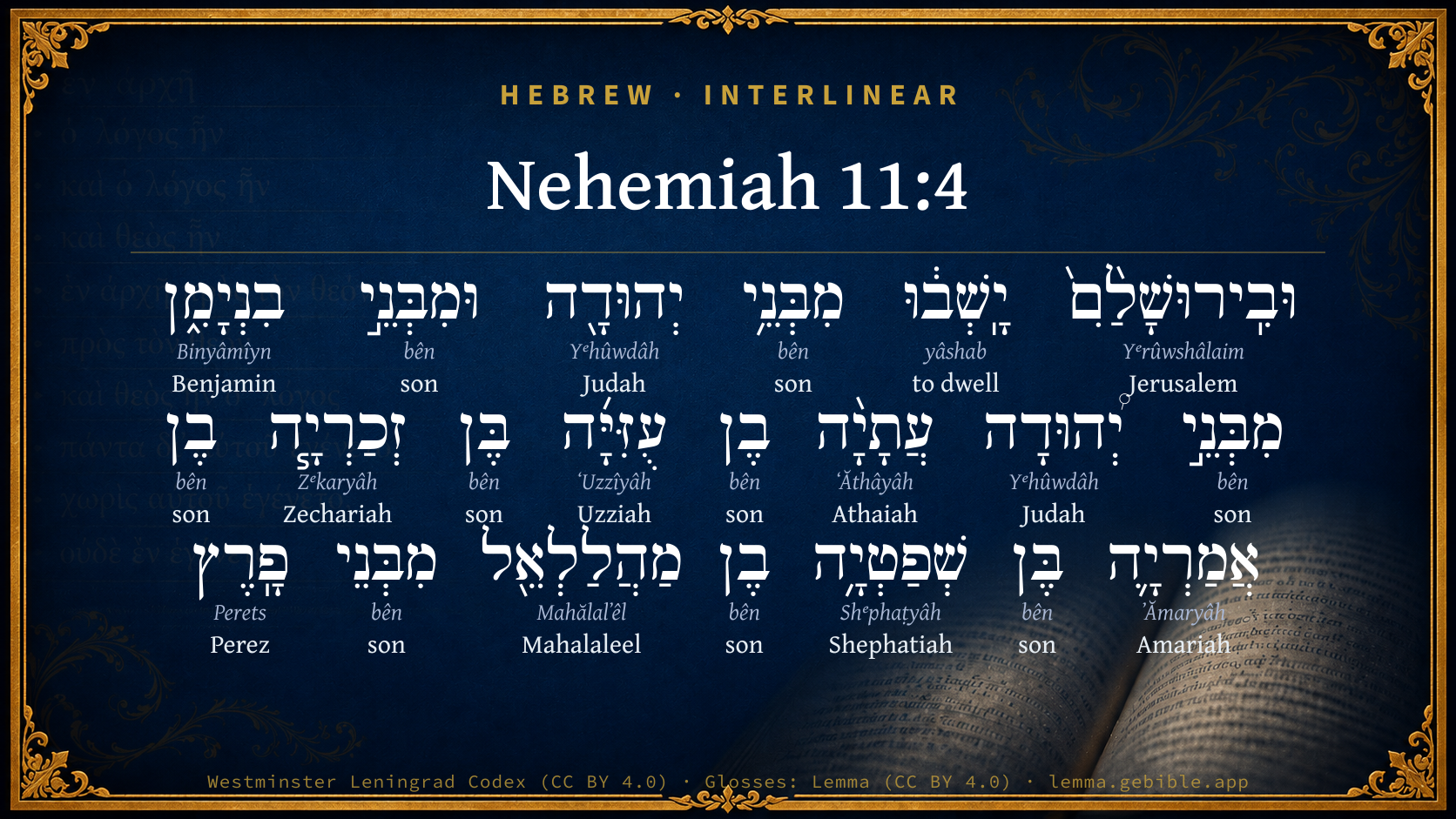
Nehemiah 11:4

Hebrew (Westminster Leningrad Codex) Nehemiah 11:4 appears in the Hebrew Old Testament. The text above is from the Westminster Leningrad Codex. Each word links to its Strong’s number, a concise gloss, and parsing drawn from the Open Scriptures Hebrew Bible morphology. Click any word for its full Brown-Driver-Briggs (BDB) entry.
Download image
Cite this verse

Nehemiah 11:4 (World English Bible). Public Domain. Lemma interlinear Bible study tool, https://lemma.gebible.app/v/nehemiah/11/4.

Show BibTeX & RIS
BibTeX
RIS
English Translation
In Jerusalem lived certain of the children of Judah, and of the children of Benjamin. Of the children of Judah: Athaiah the son of Uzziah, the son of Zechariah, the son of Amariah, the son of Shephatiah, the son of Mahalalel, of the children of Perez;
World English Bible · Public Domain
Highlights
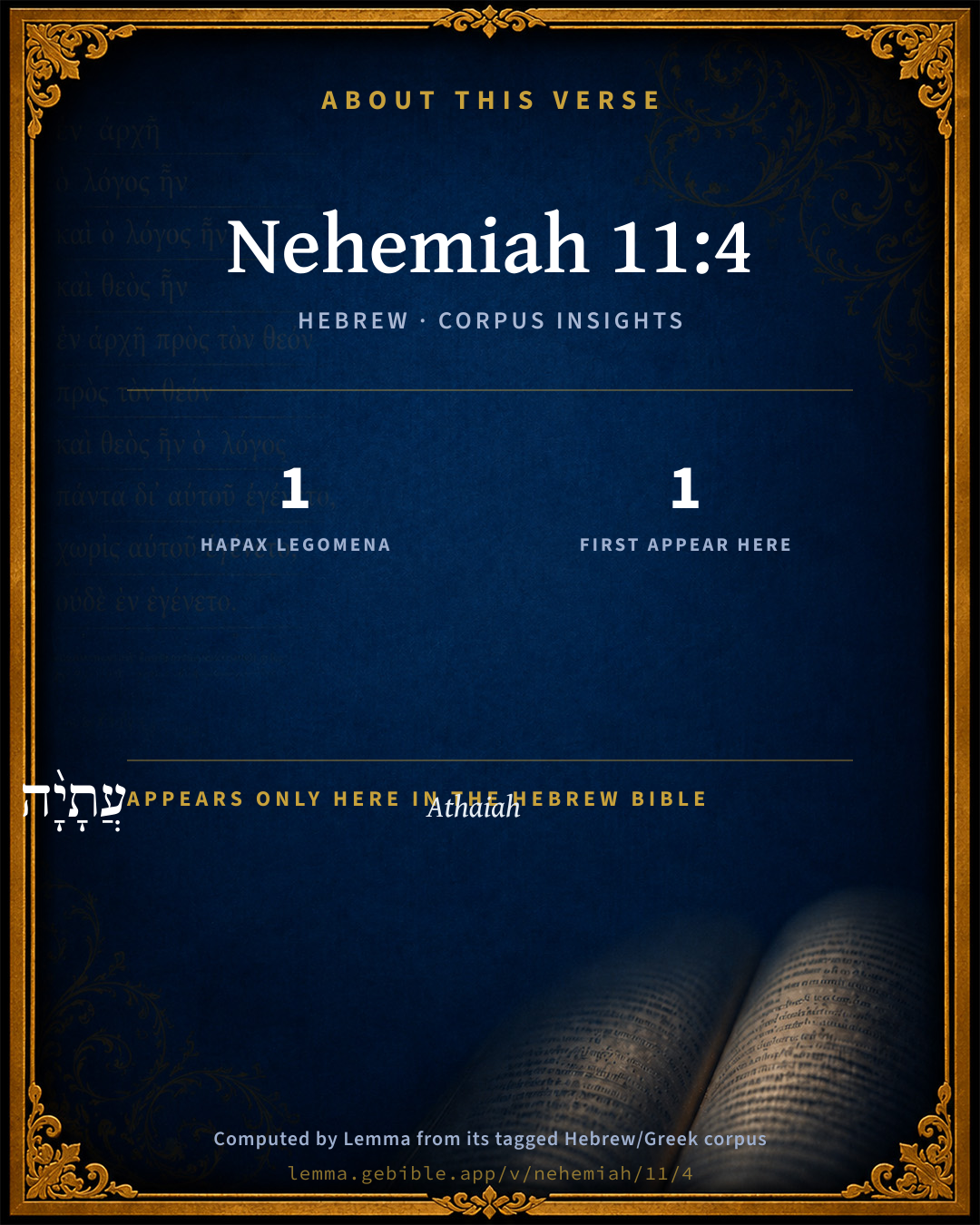
  • 1 hapax legomenon — only here in the Hebrew Bible
  • 1 first appearance in the Hebrew Bible
Full analysis ↓
Download a study sheet

One document with this verse’s original text, its word-by-word gloss line, the meaning frame, cross-references with their text, attributed commentary, and full source and license credits — printable, and it pastes into notes with its structure intact.

This verse Autodidact and up

Study sheet (.html) Plain text (.txt)

A passage Seminary Student

Up to 50 verses in one chapter. A passage sheet keeps up to 6 commentary sources and 12 cross-references per verse, in the order this page ranks them, and says so on the sheet whenever that leaves anything out. Ask for a single verse and you get the Autodidact verse sheet above.

Everything on this page stays free to read, with no account — the sheet is a download of what is already on screen, not access to it.

Want to remove ads? Support Godless Engineer
Compare translations 3

The same verse in 3 English versions, stacked beneath the original-language interlinear above. Click any original word for its lexicon entry.

Each is an independent rendering of the whole verse — the interlinear is not word-aligned to these translations.

Highlighted words mark where these versions differ — a whole-verse word diff, not a word-by-word alignment.

  • World English Bible Public Domain
    In Jerusalem lived certain of the children of Judah, and of the children of Benjamin. Of the children of Judah: Athaiah the son of Uzziah, the son of Zechariah, the son of Amariah, the son of Shephatiah, the son of Mahalalel, of the children of Perez;
  • King James Version Public Domain
    And at Jerusalem dwelt certain of the children of Judah, and of the children of Benjamin. Of the children of Judah; Athaiah the son of Uzziah, the son of Zechariah, the son of Amariah, the son of Shephatiah, the son of Mahalaleel, of the children of Perez;
  • unfoldingWord Literal Text CC BY-SA 4.0
    And some from the sons of Judah and from the sons of Benjamin dwelt in Jerusalem. Those from the sons of Judah were: Athaiah, the son of Uzziah, the son of Zechariah, the son of Amariah, the son of Shephatiah, the son of Mahalalel, from the sons of Perez;

unfoldingWord Literal Text — © unfoldingWord, licensed CC BY-SA 4.0. Word-aligned USFM3 via Door43 (git.door43.org/unfoldingWord/en_ult).

Versions to compare (up to 4)

3 of 4 selected

Show all 18 translations

Every available English version of this verse, each an independent rendering of the whole verse.

  • World English Bible Public Domain
    In Jerusalem lived certain of the children of Judah, and of the children of Benjamin. Of the children of Judah: Athaiah the son of Uzziah, the son of Zechariah, the son of Amariah, the son of Shephatiah, the son of Mahalalel, of the children of Perez;
  • Berean Standard Bible Public Domain
    while some of the descendants of Judah and Benjamin settled in Jerusalem.) From the descendants of Judah: Athaiah son of Uzziah, the son of Zechariah, the son of Amariah, the son of Shephatiah, the son of Mahalalel, a descendant of Perez;
  • Majority Standard Bible Public Domain
    while some of the descendants of Judah and Benjamin settled in Jerusalem.) From the descendants of Judah: Athaiah son of Uzziah, the son of Zechariah, the son of Amariah, the son of Shephatiah, the son of Mahalalel, a descendant of Perez;
  • King James Version Public Domain
    And at Jerusalem dwelt certain of the children of Judah, and of the children of Benjamin. Of the children of Judah; Athaiah the son of Uzziah, the son of Zechariah, the son of Amariah, the son of Shephatiah, the son of Mahalaleel, of the children of Perez;
  • American Standard Version (1901) Public Domain
    And in Jerusalem dwelt certain of the children of Judah, and of the children of Benjamin. Of the children of Judah: Athaiah the son of Uzziah, the son of Zechariah, the son of Amariah, the son of Shephatiah, the son of Mahalalel, of the children of Perez;
  • Revised Version (1885) Public Domain
    And in Jerusalem dwelt certain of the children of Judah, and of the children of Benjamin. Of the children of Judah: Athaiah the son of Uzziah, the son of Zechariah, the son of Amariah, the son of Shephatiah, the son of Mahalalel, of the children of Perez;
  • Geneva Bible (1599) Public Domain
    And in Ierusalem dwelt certaine of the children of Iudah, and of the children of Beniamin. Of the sonnes of Iudah, Athaiah, the sonne of Vziiah, the sonne of Zechariah, the sonne of Amariah, the sonne of Shephatiah, the sonne of Mahaleel, of the sonnes of Perez,
  • Douay-Rheims (1899) Public Domain
    And in Jerusalem there dwelt some of the children of Juda, and some of the children of Benjamin: of the children of Juda, Athaias the son of Aziam, the son of Zacharias, the son of Amarias, the son of Saphatias, the son of Malaleel: of the sons of Phares,
  • Young's Literal Translation Public Domain
    And in Jerusalem have dwelt of the sons of Judah, and of the sons of Benjamin. Of the sons of Judah: Athaiah son of Uzziah, son of Zechariah, son of Amariah, son of Shephatiah, son of Mahalaleel, of the sons of Perez;
  • Literal Standard Version CC BY-SA 4.0
    And in Jerusalem have dwelt of the sons of Judah, and of the sons of Benjamin. Of the sons of Judah: Athaiah son of Uzziah, son of Zechariah, son of Amariah, son of Shephatiah, son of Mahalaleel, of the sons of Perez;
  • Unlocked Literal Bible CC BY-SA 4.0
    In Jerusalem lived some of the descendants of Judah and some of the descendants of Benjamin. The people from Judah included: Athaiah son of Uzziah son of Zechariah son of Amariah son of Shephatiah son of Mahalalel, a descendant of Perez.
  • unfoldingWord Literal Text CC BY-SA 4.0
    And some from the sons of Judah and from the sons of Benjamin dwelt in Jerusalem. Those from the sons of Judah were: Athaiah, the son of Uzziah, the son of Zechariah, the son of Amariah, the son of Shephatiah, the son of Mahalalel, from the sons of Perez;
  • Darby Bible Public Domain
    And in Jerusalem dwelt some of the children of Judah and of the children of Benjamin. Of the children of Judah: Athaiah the son of Uzziah, the son of Zechariah, the son of Amariah, the son of Shephatiah, the son of Mahalaleel, of the children of Pherez;
  • World Messianic Bible Public Domain
    Some of the children of Judah and of the children of Benjamin lived in Jerusalem. Of the children of Judah: Athaiah the son of Uzziah, the son of Zechariah, the son of Amariah, the son of Shephatiah, the son of Mahalalel, of the children of Perez;
  • Webster's Bible Public Domain
    And at Jerusalem dwelt certain of the children of Judah, and of the children of Benjamin. Of the children of Judah; Athaiah the son of Uzziah, the son of Zechariah, the son of Amariah, the son of Shephatiah, the son of Mahalaleel, of the children of Perez;
  • Free Bible Version CC BY-SA 4.0
    However, some of the people of Judah and Benjamin moved to Jerusalem.) From the tribe of Judah: Athaiah the son of Uzziah, son of Zechariah, son of Amariah, son of Shephatiah, son of Mahalalel, of the sons of Perez;
  • Bible in Basic English Public Domain
    And in Jerusalem there were living certain of the children of Judah and of Benjamin. Of the children of Judah: Athaiah, the son of Uzziah, the son of Zechariah, the son of Amariah, the son of Shephatiah, the son of Mahalalel, of the children of Perez;
  • JPS Tanakh (1917) Public Domain
    And in Jerusalem dwelt certain of the children of Judah, and of the children of Benjamin. Of the children of Judah: Athaiah the son of Uzziah, the son of Zechariah, the son of Amariah, the son of Shephatiah, the son of Mahalalel, of the children of Perez;

Literal Standard Version (2020), Covenant Press — licensed CC BY-SA 4.0. Text via the HelloAO Bible API (eBible.org). Unlocked Literal Bible (unfoldingWord) — licensed CC BY-SA 4.0. Text via the HelloAO Bible API (eBible.org). unfoldingWord Literal Text — © unfoldingWord, licensed CC BY-SA 4.0. Word-aligned USFM3 via Door43 (git.door43.org/unfoldingWord/en_ult). Free Bible Version, Dr. Jonathan Gallagher — licensed CC BY-SA 4.0. Text via the HelloAO Bible API (eBible.org).

Word by word

More ways to search: Search by grammar → Find every occurrence → Compare this word →

Practice this passage: Drill this verse → Learn its vocabulary →

עֲתָיָ֨ה
ʻĂthâyâh
H6265
“Athaiah”
Noun, Proper
Part of Speech
Noun
Type
Proper
Full BDB Definition

Origin: from H5790 and H3050

TWOT: None

Athaiah = "Jehovah has helped" - a descendant of Judah through Perez; dwelt at Jerusalem after the return from exile in Babylon
  1. וּבִֽירוּשָׁלִַ֨ם֙ Yᵉrûwshâlaim H3389 “and · in/at · Jerusalem” Conjunction + Preposition + Noun, Proper
  2. יָֽשְׁב֔וּ yâshab H3427 “to dwell” Verb, Qal, Perfect, 3rd Person, Common, Plural
  3. מִבְּנֵ֥י bên H1121 “from · sons of” Preposition + Noun, Common, Masculine, Plural, Construct
  4. יְהוּדָ֖ה Yᵉhûwdâh H3063 “Judah” Noun, Proper
  5. וּמִבְּנֵ֣י bên H1121 “and · from · sons of” Conjunction + Preposition + Noun, Common, Masculine, Plural, Construct
  6. בִנְיָמִ֑ן Binyâmîyn H1144 “Benjamin” Noun, Proper
  7. מִבְּנֵ֣י bên H1121 “from · sons of” Preposition + Noun, Common, Masculine, Plural, Construct
  8. יְ֠הוּדָה Yᵉhûwdâh H3063 “Judah” Noun, Proper
  9. בֶן bên H1121 “son of” Noun, Common, Masculine, Singular, Construct
  10. עֻזִּיָּ֜ה ʻUzzîyâh H5818 “Uzziah” Noun, Proper
  11. בֶּן bên H1121 “son of” Noun, Common, Masculine, Singular, Construct
  12. זְכַרְיָ֧ה Zᵉkaryâh H2148 “Zechariah” Noun, Proper
  13. בֶן bên H1121 “son of” Noun, Common, Masculine, Singular, Construct
  14. אֲמַרְיָ֛ה ʼĂmaryâh H568 “Amariah” Noun, Proper
  15. בֶּן bên H1121 “son of” Noun, Common, Masculine, Singular, Construct
  16. שְׁפַטְיָ֥ה Shᵉphaṭyâh H8203 “Shephatiah” Noun, Proper
  17. בֶן bên H1121 “son of” Noun, Common, Masculine, Singular, Construct
  18. מַהֲלַלְאֵ֖ל Mahălalʼêl H4111 “Mahalaleel” Noun, Proper
  19. מִבְּנֵי bên H1121 “from · sons of” Preposition + Noun, Common, Masculine, Plural, Construct
  20. פָֽרֶץ Perets H6557 “Perez” Noun, Proper

About this verse

These counts appear in no published source. They are computed here, from the morphology-tagged text and Lemma’s own curated glosses. What Lemma adds →

21
words
12
distinct lemmas
Historical
section

Notable vocabulary

1 hapax legomenon — a word that appears only here in the entire Hebrew Bible:

  • עֲתָיָ֨ה Athaiah H6265

First appearance in Scripture

This word makes its first canonical appearance in the Hebrew Bible here:

  • עֲתָיָ֨ה Athaiah H6265

Shared distinctive vocabulary

מַהֲלַלְאֵ֖ל Mahalaleel H4111 occurs in 7 verses of the Hebrew Bible. Also found in:

Grammatical profile

  • 1 verb
  • 20 nouns

Verb forms

  • יָֽשְׁב֔וּ Qal · Perfect

Repetition

Words recur within this verse — often emphatic in Hebrew:

  • מִבְּנֵ֥י son H1121 ×9
  • יְהוּדָ֖ה Judah H3063 ×2

Cross-references

5

Topical passages linked to Nehemiah 11:4 in the Treasury of Scripture Knowledge — connected by theme and wording, ordered by reader-vote popularity; previews shown in the World English Bible.

  • Genesis 38:29 It happened, as he drew back his hand, that behold, his brother came out, and she said, "Why have you made a breach for yourself?" Therefore his name was called Perez.
  • Ruth 4:18 Now this is the history of the generations of Perez: Perez became the father of Hezron,
  • 1 Chronicles 9:3–9 In Jerusalem lived of the children of Judah, and of the children of Benjamin, and of the children of Ephraim and Manasseh:
  • Matthew 1:3 Judah became the father of Perez and Zerah by Tamar. Perez became the father of Hezron. Hezron became the father of Ram.
  • Luke 3:33 the son of Amminadab, the son of Aram, the son of Joram, the son of Hezron, the son of Perez, the son of Judah,

Cross-references courtesy of OpenBible.info (CC BY 4.0).

Hebrew and Greek witnesses Masoretic Hebrew ↔ Greek Septuagint

The same verse in the two great witnesses to the Old Testament, shown verse-for-verse.

These are two independent witnesses, not word-aligned to each other, and the Septuagint is shown in lemma (dictionary) form.

Hebrew Nehemiah 11:4 Masoretic · Westminster Leningrad Codex

וּבִֽירוּשָׁלִַ֨ם֙ יָֽשְׁב֔וּ מִבְּנֵ֥י יְהוּדָ֖ה וּמִבְּנֵ֣י בִנְיָמִ֑ן מִבְּנֵ֣י יְ֠הוּדָה עֲתָיָ֨ה בֶן עֻזִּיָּ֜ה בֶּן זְכַרְיָ֧ה בֶן אֲמַרְיָ֛ה בֶּן שְׁפַטְיָ֥ה בֶן מַהֲלַלְאֵ֖ל מִבְּנֵי פָֽרֶץ

In Jerusalem lived certain of the children of Judah, and of the children of Benjamin. Of the children of Judah: Athaiah the son of Uzziah, the son of Zechariah, the son of Amariah, the son of Shephatiah, the son of Mahalalel, of the children of Perez;

World English Bible · Public Domain

Greek LXX Structure differs

The Septuagint has no separate book of Nehemiah. Its Greek text is the second half of Esdras B (2 Esdras), chapters 11–23; Ezra is the first half (1–10).

A verse-for-verse comparison isn’t shown here because the chapters and verses don’t line up. Switch to the LXX edition with the MT / LXX toggle above to read the Greek directly.

Hebrew: Westminster Leningrad Codex (CC BY 4.0). Greek: Septuagint (public domain); English from a public-domain English Septuagint. How the Septuagint differs from the Hebrew →

Commentary

Notes on Nehemiah 11:4 from classic Christian and Jewish commentators (each source and its license shown beneath its notes). The classic Christian expositions comment on the surrounding passage and are grouped to its opening verse, so a note may address several verses; the Jewish commentaries on the Tanakh (Rashi and others) are per-verse, so they appear only where the commentator wrote on this verse.

Lemma curates 59 commentaries, every one of them public domain or Creative Commons licensed, each selected and text-cleaned for this edition rather than reprinted as found. About our sources →

Jamieson, Fausset & Brown

Robert Jamieson, A. R. Fausset & David Brown

at Jerusalem dwelt certain of the children of Judah--The discrepancy that is apparent between this [Neh. 11:4-36] and the list formerly given in Ch1 9:1-9, arose not only from the Jewish and Oriental practice of changing or modifying the names of persons from a change of circumstances, but from the alterations that must have been produced in the course of time. The catalogue in Chronicles contains those who came with the first detachment of returned exiles, while the list in this passage probably included also those who returned with Ezra and Nehemiah; or it was most probably made out afterwards, when several had died, or some, who had been inserted as going on the journey, remained, and others came in their stead.

Jamieson, Fausset & Brown — Commentary Critical and Explanatory on the Whole Bible (1871) — public domain (CC PDM 1.0). Text via the HelloAO Bible API.

Trapp's Complete Commentary

John Trapp

Neh 11:4 And at Jerusalem dwelt [certain] of the children of Judah, and of the children of Benjamin. Of the children of Judah; Athaiah the son of Uzziah, the son of Zechariah, the son of Amariah, the son of Shephatiah, the son of Mahalaleel, of the children of Perez;

Ver. 4. Certain of the children of Judah, &c.] Yea, and of the children of Ephraim and Manasseh too, 1Ch 9:3; where the same is set down as here, but the number is greater. And why? Here only those are reckoned who inhabited Jerusalem by lot; but there the volunteers also. See Neh 11:2.

John Trapp, A Commentary or Exposition upon All the Books of the Old and New Testament (1647–1656) — public domain. Text from a community e-Sword module.

Tyndale Open Study Notes

Tyndale Open Resources

11:4 Perez was one of Judah’s sons (Gen 38:29).

Tyndale Open Study Notes — © Tyndale Open Resources, licensed CC BY-SA 4.0. Text via the HelloAO Bible API.

Geneva Bible (1599)

Geneva Bible translators

Which came of Perez the son of Judah.

Geneva Bible (1599) marginal notes — public domain. Text via Bolls.life.

Ellicott's Commentary for English Readers

(4) Perez.—In 1 Chronicles 9 the descendants of Perez (or Phares) are not given; but the descendants of Zerah, present there, are absent here. This may be a question of the right reading of the text.

(4-19) The heads in Jerusalem: as compared with 1 Chronicles 9, by no means complete. Judah and Benjamin are represented, with priests and Levites and porters.

A Bible Commentary for English Readers, edited by Charles John Ellicott (1878–1897) — public domain. Text from a community e-Sword module.

The Cambridge Bible for Schools and Colleges

gen. ed. J. J. S. Perowne

4. And at Jerusalem] R.V. And in Jerusalem. In the Chronicles list after ‘the children of Benjamin’ are mentioned ‘and of the children of Ephraim and Manasseh.’

Athaiah the son of Uzziah, &c.] In 1Ch_9:4 the house of Perez is represented by ‘Uthai the son of Ammihud.’ The suggestion that ‘Athaiah’ and ‘Uthai’ are identical appears plausible at first sight. But the names of their respective ancestors are different; and it is possible that two different men are intended. If the great similarity of the names forbids us to believe that two separate personages can be referred to, we must conclude that the two lists are epitomes and have preserved different representative names from the completer genealogy in the original document.

Mahalaleel] R.V. Mahalalel.

Perez] or Pharez. Cf. Gen_38:29; 1Ch_4:1.

The Cambridge Bible for Schools and Colleges (gen. ed. J. J. S. Perowne; Cambridge University Press, 1878–1918) — public domain. Text from a community e-Sword module.

John Gill's Exposition

And Maaseiah,.... Who seems to be the same with Asaiah, Ch1 9:5 and whose genealogy is carried up through Baruch, Colhozeh, Hazaiah, Adaiah, Joiarib, Zechariah, to Shiloni; perhaps the same with Shelah, another son of Judah, see Ch1 9:5.

.

Nehemiah 11:6

neh 11:6

neh 11:6

neh 11:6All the sons of Perez that dwelt at Jerusalem were four hundred threescore and eight valiant men. And so well qualified to defend the city against its enemies.

John Gill's Exposition of the Whole Bible (1746–1763) — public domain (CC PDM 1.0). Text via the HelloAO Bible API.

Albert Barnes' Notes on the Bible

See the margin reference notes. Both accounts appear to be extracts from a public official register which Nehemiah caused to be made of his census. The census itself seems to have been confined to the dwellers at Jerusalem. The subjoined table exhibits the differences between the accounts of the entire population of Jerusalem as given in Nehemiah and in Chronicles:

1 Chron

Nehemiah

Tribes of Judah

Of Pharez

468

Of Zerah

690

Tribe of Benjamin

956

928

Tribe of Levi

Priests

1760

1192

Levites

284

Porters

212

172

According to Nehemiah’s numbers, supplemented from Chronicles, the entire adult male population of the city was 3,734, which would give a total population of 14,936. According to Chronicles, supplemented from Nehemiah, the adult males were 4,370, and consequently the entire population, would have been 17,480. As the Nethinims and the Israelites of Ephraim and Manasseh 1Ch 9:3 are not included in either list, we may conclude that the actual number of the inhabitants, after the efforts recorded in Neh 11:1-2, was not much short of 20,000.

Neh 11:16

The outward business of the house of God - Such as the collection of the newly-imposed tax Neh 10:32, the providing of the regular sacrifices, the renewal of vestments, and the like.

Neh 11:17

The principal to begin the thanksgiving - i. e., “the precentor,” or “leader of the choir.”

Albert Barnes' Notes on the Bible (1834–1885) — public domain. Text from a community e-Sword/MySword module.

Haydock's Catholic Bible Commentary

Benjamin, as well as of Ephraim and Manasses, 1 Paralipomenon ix. 3. The difference between this last record and the present, arises from Nehemias including many who returned with Esdras and with himself. (Calmet)

George Leo Haydock (1774–1849), Haydock's Catholic Family Bible and Commentary, 1859 edition — public domain. Excludes Psalms (Douay-Rheims chapter numbering differs from Protestant) and Deuterocanonical books (Catholic canon only).

Matthew Poole's English Annotations

The children of Judah and of Benjamin; for to these two tribes this city anciently and most properly belonged, although some also of other tribes dwelt in it; of which, and other things relating to this catalogue, see 1Ch 9:3, &c.

Athaiah, and his family and relations with him, and under him as their head, as appears from Neh 11:6.

Matthew Poole's English Annotations on the Holy Bible (1683–1685) — public domain. Text from a community e-Sword/MySword module.

The Pulpit Commentary

At Jerusalem dwelt certain of the children of Judah, and of the children of Benjamin. It is not meant that all the dwellers in Jerusalem were of these two tribes, since among them were certainly Levites (vers. 10-19), Ephraimites, and Mansesites, together with Nethinims (ver. 21) who were of no tribe, and probably some representatives of all or most of the other tribes. (see the comment on Ezr_2:70) But the present purpose of Nehemiah is to mention especially the Jewish and Benjamite chiefs. Athaiah, or Uthai, as the name is given in 1Ch_9:4. The son of Uzziah. The ancestors assigned to Athaiah here and in 1Ch 9. are wholly different, with the single exception of Pharez or Perez, the son of Judah. Both lists are of course abbreviations of a far longer one, and it has happened that the two writers have in no ease selected for mention the same name.

The Pulpit Commentary (1880–1919), ed. H.D.M. Spence-Jones & Joseph S. Exell — public domain. Text from a community e-Sword module.

Rashi

Rabbi Shlomo Yitzchaki (Rashi)

of the children of Judah: Athaiah, etc. He returns to explain who those ‘of the children of Judah’ were, and the entire chapter enumerates only the great and esteemed ones among them.

Rashi on the Tanakh — English translations: “The Judaica Press complete Tanach with Rashi, translated by A. J. Rosenberg” (CC BY 4.0); “Pentateuch with Rashi's commentary by M. Rosenbaum and A.M. Silbermann, 1929-1934” (public domain); “The Metsudah Tanach series, Lakewood, N.J” (CC BY 4.0); and “The Book of Joshua, Metsudah Publications, 1997” (CC BY 4.0). Text via Sefaria.

Lesson kit

Teaching starters — assembled from the data on this page, not authored interpretation. Every prompt links to the verse data it draws on. Edit before teaching.

Nehemiah, in the Historical, opens this verse with 21 words (12 distinct Hebrew lemmas). Its most distinctive word is ʻĂthâyâh (“Athaiah”). A historical commentator’s framing appears above. Read the whole chapter for the surrounding context.

Discussion questions

  1. What does “Athaiah” (ʻĂthâyâh) contribute to the verse as a whole?
  2. 1 word here appears nowhere else in the Hebrew Bible. Why might the author reach for such rare wording?
  3. This is the first place “Athaiah” appears in Scripture (first appears here). What does its debut here establish?
  4. How does Genesis 5:12, which shares the word «Mahalaleel», read alongside this verse?
  5. What does the repetition of “son” (9× in this one verse) do in this verse?
  6. These translations render this verse differently. What is at stake in choosing one wording over another?
  7. «יָֽשְׁב֔וּ» is a Qal Perfect verb. How does that grammatical form shape the action described?
  8. Compare how Jamieson, Fausset & Brown and Trapp's Complete Commentary read this verse. Where do they agree or differ?

Things to notice

  • 1 word in this verse appears nowhere else in the Hebrew Bible.
  • 1 word makes its first canonical appearance in Scripture here.
  • These translations choose different wording for 8 words in this verse.
  • “son” occurs 9× in this single verse.
  • 12 distinct Hebrew lemmas span 21 words in this verse.

Reading settings

Reading text

Shown beneath each verse's original-language words.

Old Testament
Old Testament edition

Read the OT as the Masoretic Hebrew (MT) or the Greek Septuagint (LXX).

English shown for the Greek Septuagint (in the Hebrew ↔ Greek comparison).

Comparing translations? Open the Compare panel on any verse page to stack up to four side by side.