
2 Chronicles 32:12

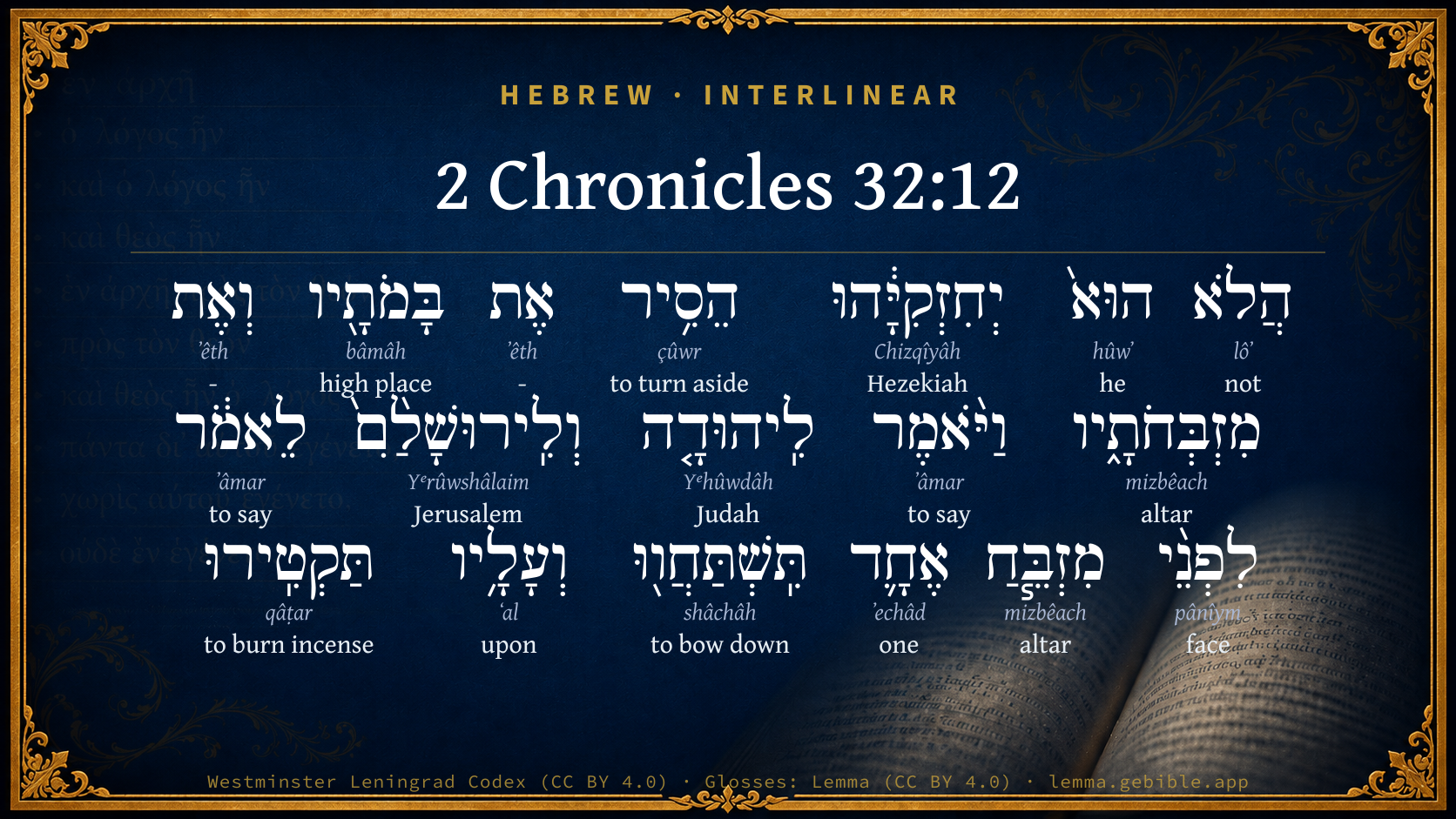
Hebrew (Westminster Leningrad Codex) 2 Chronicles 32:12 appears in the Hebrew Old Testament. The text above is from the Westminster Leningrad Codex. Each word links to its Strong’s number, a concise gloss, and parsing drawn from the Open Scriptures Hebrew Bible morphology. Click any word for its full Brown-Driver-Briggs (BDB) entry.
Download image
Cite this verse

2 Chronicles 32:12 (World English Bible). Public Domain. Lemma interlinear Bible study tool, https://lemma.gebible.app/v/2-chronicles/32/12.

Show BibTeX & RIS
BibTeX
RIS
English Translation
Has not the same Hezekiah taken away his high places and his altars, and commanded Judah and Jerusalem, saying, You shall worship before one altar, and on it shall you burn incense?
World English Bible · Public Domain
Download a study sheet

One document with this verse’s original text, its word-by-word gloss line, the meaning frame, cross-references with their text, attributed commentary, and full source and license credits — printable, and it pastes into notes with its structure intact.

This verse Autodidact and up

Study sheet (.html) Plain text (.txt)

A passage Seminary Student

Up to 50 verses in one chapter. A passage sheet keeps up to 6 commentary sources and 12 cross-references per verse, in the order this page ranks them, and says so on the sheet whenever that leaves anything out. Ask for a single verse and you get the Autodidact verse sheet above.

Everything on this page stays free to read, with no account — the sheet is a download of what is already on screen, not access to it.

Want to remove ads? Support Godless Engineer
Compare translations 3

The same verse in 3 English versions, stacked beneath the original-language interlinear above. Click any original word for its lexicon entry.

Each is an independent rendering of the whole verse — the interlinear is not word-aligned to these translations.

Highlighted words mark where these versions differ — a whole-verse word diff, not a word-by-word alignment.

  • World English Bible Public Domain
    Has not the same Hezekiah taken away his high places and his altars, and commanded Judah and Jerusalem, saying, You shall worship before one altar, and on it shall you burn incense?
  • King James Version Public Domain
    Hath not the same Hezekiah taken away his high places and his altars, and commanded Judah and Jerusalem, saying, Ye shall worship before one altar, and burn incense upon it?
  • unfoldingWord Literal Text CC BY-SA 4.0
    Did not he, Hezekiah, take away his high places and his altars and he said to Judah and to Jerusalem, saying, ‘Before one altar you all must worship, and on it you all must make sacrifice’?

unfoldingWord Literal Text — © unfoldingWord, licensed CC BY-SA 4.0. Word-aligned USFM3 via Door43 (git.door43.org/unfoldingWord/en_ult).

Versions to compare (up to 4)

3 of 4 selected

Show all 18 translations

Every available English version of this verse, each an independent rendering of the whole verse.

  • World English Bible Public Domain
    Has not the same Hezekiah taken away his high places and his altars, and commanded Judah and Jerusalem, saying, You shall worship before one altar, and on it shall you burn incense?
  • Berean Standard Bible Public Domain
    Did not Hezekiah himself remove His high places and His altars and say to Judah and Jerusalem, ‘You must worship before one altar, and on it you shall burn sacrifices’?
  • Majority Standard Bible Public Domain
    Did not Hezekiah himself remove His high places and His altars and say to Judah and Jerusalem, ‘You must worship before one altar, and on it you shall burn sacrifices’?
  • King James Version Public Domain
    Hath not the same Hezekiah taken away his high places and his altars, and commanded Judah and Jerusalem, saying, Ye shall worship before one altar, and burn incense upon it?
  • American Standard Version (1901) Public Domain
    Hath not the same Hezekiah taken away his high places and his altars, and commanded Judah and Jerusalem, saying, Ye shall worship before one altar, and upon it shall ye burn incense?
  • Revised Version (1885) Public Domain
    Hath not the same Hezekiah taken away his high places and his altars, and commanded Judah and Jerusalem, saying, Ye shall worship before one altar, and upon it shall ye burn incense?
  • Geneva Bible (1599) Public Domain
    Hath not the same Hezekiah taken away his hie places and his altars, and commanded Iudah and Ierusalem, saying, Ye shall worshippe before one altar, and burne incense vpon it?
  • Douay-Rheims (1899) Public Domain
    Is it not this same Ezechias, that hath destroyed his high places, and his altars, and commanded Juda and Jerusalem, saying: You shall worship before one altar, and upon it you shall burn incense?
  • Young's Literal Translation Public Domain
    Hath not Hezekiah himself turned aside His high places, and His altars, and speaketh to Judah and to Jerusalem, saying, Before one altar ye bow yourselves, and on it ye make perfume?
  • Literal Standard Version CC BY-SA 4.0
    Has Hezekiah himself not turned aside His high places and His altars, and speaks to Judah and to Jerusalem, saying, You bow yourselves before one altar and you make incense on it?
  • Unlocked Literal Bible CC BY-SA 4.0
    Has not this same Hezekiah taken away his high places and his altars and commanded Judah and Jerusalem, 'On one altar you must worship, and on it you must burn your sacrifices'?
  • unfoldingWord Literal Text CC BY-SA 4.0
    Did not he, Hezekiah, take away his high places and his altars and he said to Judah and to Jerusalem, saying, ‘Before one altar you all must worship, and on it you all must make sacrifice’?
  • Darby Bible Public Domain
    Has not the same Hezekiah removed his high places and his altars, and commanded Judah and Jerusalem saying, Ye shall worship before *one* altar, and burn incense upon it?
  • World Messianic Bible Public Domain
    Hasn’t the same Hezekiah taken away his high places and his altars, and commanded Judah and Jerusalem, saying, ‘You shall worship before one altar, and you shall burn incense on it’?
  • Webster's Bible Public Domain
    Hath not the same Hezekiah taken away his high places and his altars, and commanded Judah and Jerusalem, saying, Ye shall worship before one altar, and burn incense upon it?
  • Free Bible Version CC BY-SA 4.0
    Wasn't it Hezekiah who destroyed the high places and altars of this god and told Judah and Jerusalem, ‘You must worship at this one altar, and offer sacrifices on it alone’?
  • Bible in Basic English Public Domain
    Has not this same Hezekiah taken away his high places and his altars, saying to Judah and Jerusalem, Give worship before one altar only, burning offerings on it?
  • JPS Tanakh (1917) Public Domain
    Hath not the same Hezekiah taken away His high places and His altars, and commanded Judah and Jerusalem, saying: Ye shall worship before one altar, and upon it shall ye offer?

Literal Standard Version (2020), Covenant Press — licensed CC BY-SA 4.0. Text via the HelloAO Bible API (eBible.org). Unlocked Literal Bible (unfoldingWord) — licensed CC BY-SA 4.0. Text via the HelloAO Bible API (eBible.org). unfoldingWord Literal Text — © unfoldingWord, licensed CC BY-SA 4.0. Word-aligned USFM3 via Door43 (git.door43.org/unfoldingWord/en_ult). Free Bible Version, Dr. Jonathan Gallagher — licensed CC BY-SA 4.0. Text via the HelloAO Bible API (eBible.org).

Word by word

More ways to search: Search by grammar → Find every occurrence → Compare this word →

Practice this passage: Drill this verse → Learn its vocabulary →

בָּמֹתָ֖יו
bâmâh
H1116
“high places · his”
Noun, Common, Feminine, Plural, Construct + Suffix, Personal, 3rd Person, Masculine, Singular
Part of Speech
Noun
Type
Common
Gender
Feminine
Number
Plural
State
Construct
Full BDB Definition

Origin: from an unused root (meaning to be high)

TWOT: 253

high place, ridge, height, bamah (technical name for cultic platform) - high place, mountain - high places, battlefields - high places (as places of worship) - funeral mound?
  1. הֲלֹא lôʼ H3808 “not” Particle, Interrogative + Particle, Negative
  2. הוּא֙ hûwʼ H1931 “he” Pronoun, Personal, 3rd Person, Masculine, Singular
  3. יְחִזְקִיָּ֔הוּ Chizqîyâh H2396 “Hezekiah” Noun, Proper
  4. הֵסִ֥יר çûwr H5493 “to turn aside” Verb, Hiphil, Perfect, 3rd Person, Masculine, Singular
  5. אֶת ʼêth H853 “-” Particle, Direct Object
  6. וְאֶת ʼêth H853 “and · -” Conjunction + Particle, Direct Object
  7. מִזְבְּחֹתָ֑יו mizbêach H4196 “altars · his” Noun, Common, Masculine, Plural, Construct + Suffix, Personal, 3rd Person, Masculine, Singular
  8. וַיֹּ֨אמֶר ʼâmar H559 “and · to say” Conjunction + Verb, Qal, Sequential Imperfect, 3rd Person, Masculine, Singular
  9. לִֽיהוּדָ֤ה Yᵉhûwdâh H3063 “to/for · Judah” Preposition + Noun, Proper
  10. וְלִֽירוּשָׁלִַ֨ם֙ Yᵉrûwshâlaim H3389 “and · to/for · Jerusalem” Conjunction + Preposition + Noun, Proper
  11. לֵאמֹ֔ר ʼâmar H559 “to say” Preposition + Verb, Qal, Infinitive Construct
  12. לִפְנֵ֨י pânîym H6440 “to/for · face(s) of” Preposition + Noun, Common, Both, Plural, Construct
  13. מִזְבֵּ֧חַ mizbêach H4196 “altar” Noun, Common, Masculine, Singular, Absolute
  14. אֶחָ֛ד ʼechâd H259 “one” Adjective, Cardinal number, Masculine, Singular, Absolute
  15. תִּֽשְׁתַּחֲו֖וּ shâchâh H7812 “to bow down” Verb, Hishtaphel, Imperfect, 2nd Person, Masculine, Plural
  16. וְעָלָ֥יו ʻal H5921 “and · upon · him” Conjunction + Preposition + Suffix, Personal, 3rd Person, Masculine, Singular
  17. תַּקְטִֽירוּ qâṭar H6999 “to burn incense” Verb, Hiphil, Imperfect, 2nd Person, Masculine, Plural

About this verse

These counts appear in no published source. They are computed here, from the morphology-tagged text and Lemma’s own curated glosses. What Lemma adds →

18
words
15
distinct lemmas
Historical
section

Grammatical profile

  • 5 verbs
  • 7 nouns
  • 1 adjective
  • 1 pronoun
  • 1 preposition
  • 3 particles

Verb forms

  • הֵסִ֥יר Hiphil · Perfect
  • וַיֹּ֨אמֶר Qal · Sequential Imperfect
  • לֵאמֹ֔ר Qal · Infinitive Construct
  • תִּֽשְׁתַּחֲו֖וּ Hishtaphel · Imperfect
  • תַּקְטִֽירוּ Hiphil · Imperfect

Repetition

Words recur within this verse — often emphatic in Hebrew:

  • מִזְבְּחֹתָ֑יו altar H4196 ×2
  • וַיֹּ֨אמֶר to say H559 ×2

Hebrew & Septuagint length

In English translation the verse runs 32 words from the Hebrew and 36 from the Septuagint (LXX English) — closely comparable.

A rough comparison of the two English renderings, which tokenize alike — not a word-level alignment.

Word counts can differ between the Hebrew and the Greek without any difference in meaning — e.g. the Hebrew direct-object marker אֵת has no separate Greek word, and Greek often adds the article ὁ.

In the original languages it is 18 Hebrew tokens and 31 Greek tokens — but the two are counted differently (Hebrew bundles its prefixes and suffixes into one token; the Greek is in lemma form), so that isn’t a like-for-like length.

Cross-references

11

Topical passages linked to 2 Chronicles 32:12 in the Treasury of Scripture Knowledge — connected by theme and wording, ordered by reader-vote popularity; previews shown in the World English Bible.

  • 2 Chronicles 31:1 Now when all this was finished, all Israel who were present went out to the cities of Judah, and broke in pieces the pillars, and hewed down the Asherim, and broke down the high places and the altars out of all Judah and Benjamin, in Ephraim also and Manasseh, until they had destroyed them all. Then all the children of Israel returned, every man to his possession, into their own cities.
  • Exodus 27:1–8 "You shall make the altar of acacia wood, five cubits long, and five cubits broad; the altar shall be foursquare: and its height shall be three cubits.
  • Exodus 30:1–6 "You shall make an altar to burn incense on. You shall make it of acacia wood.
  • Exodus 40:26–29 He put the golden altar in the tent of meeting before the veil;
  • Deuteronomy 12:13–14 Take heed to yourself that you don't offer your burnt offerings in every place that you see;
  • Deuteronomy 12:26–27 Only your holy things which you have, and your vows, you shall take, and go to the place which Yahweh shall choose:
  • 1 Kings 7:48 Solomon made all the vessels that were in the house of Yahweh: the golden altar, and the table whereupon the show bread was, of gold;
  • 2 Kings 18:4 He removed the high places, and broke the pillars, and cut down the Asherah: and he broke in pieces the brazen serpent that Moses had made; for to those days the children of Israel did burn incense to it; and he called it Nehushtan.
  • 2 Kings 18:22 But if you tell me, We trust in Yahweh our God; isn't that he whose high places and whose altars Hezekiah has taken away, and has said to Judah and to Jerusalem, You shall worship before this altar in Jerusalem?
  • 2 Chronicles 4:1 Moreover he made an altar of brass, twenty cubits the length of it, and twenty cubits the breadth of it, and ten cubits the height of it.
  • Isaiah 36:7 But if you tell me, We trust in Yahweh our God: isn't that he, whose high places and whose altars Hezekiah has taken away, and has said to Judah and to Jerusalem, You shall worship before this altar?

Cross-references courtesy of OpenBible.info (CC BY 4.0).

Hebrew and Greek witnesses Masoretic Hebrew ↔ Greek Septuagint

The same verse in the two great witnesses to the Old Testament, shown verse-for-verse.

These are two independent witnesses, not word-aligned to each other, and the Septuagint is shown in lemma (dictionary) form.

Hebrew 2 Chronicles 32:12 Masoretic · Westminster Leningrad Codex

הֲלֹא הוּא֙ יְחִזְקִיָּ֔הוּ הֵסִ֥יר אֶת בָּמֹתָ֖יו וְאֶת מִזְבְּחֹתָ֑יו וַיֹּ֨אמֶר לִֽיהוּדָ֤ה וְלִֽירוּשָׁלִַ֨ם֙ לֵאמֹ֔ר לִפְנֵ֨י מִזְבֵּ֧חַ אֶחָ֛ד תִּֽשְׁתַּחֲו֖וּ וְעָלָ֥יו תַּקְטִֽירוּ

Has not the same Hezekiah taken away his high places and his altars, and commanded Judah and Jerusalem, saying, You shall worship before one altar, and on it shall you burn incense?

World English Bible · Public Domain

Greek LXX 2 Chronicles 32:12 Septuagint · lemma form

οὐ οὗτος εἰμί εζεκιας ὅς περιαἱρέω ὁ θυσιαστήριον αὐτός καί ὁ ὑψηλός αὐτός καί εἶπον ὁ ἰουδά καί ὁ καταοἰκέω ἰερουσαλήμ λέγω κατέναντι ὁ θυσιαστήριον οὗτος προςκυνέω καί ἐπί αὐτός θυμιάω

Is not this Ezekias who has taken down his altars and his high places and has spoken to Juda and the dwellers in Jerusalem, saying, You⌃ shall worship before this altar and burn incense upon it?

LXX2012 (modern English Septuagint) · Public Domain

Hebrew: Westminster Leningrad Codex (CC BY 4.0). Greek: Septuagint (public domain); English from LXX2012 (modern English Septuagint) (Public Domain). How the Septuagint differs from the Hebrew →

Commentary

Notes on 2 Chronicles 32:12 from classic Christian and Jewish commentators (each source and its license shown beneath its notes). The classic Christian expositions comment on the surrounding passage and are grouped to its opening verse, so a note may address several verses; the Jewish commentaries on the Tanakh (Rashi and others) are per-verse, so they appear only where the commentator wrote on this verse.

Lemma curates 59 commentaries, every one of them public domain or Creative Commons licensed, each selected and text-cleaned for this edition rather than reprinted as found. About our sources →

Trapp's Complete Commentary

John Trapp

2Ch 32:12 Hath not the same Hezekiah taken away his high places and his altars, and commanded Judah and Jerusalem, saying, Ye shall worship before one altar, and burn incense upon it?

Ver. 12. Hath not the same Hezekiah taken away his high places?] So saith Antichrist, Have not your reformers taken away the abbeys, monasteries, altars, crosses, &c.? And as there wanted not some in Jerusalem who were of the same mind with Sennacherib’s messengers, so neither wanteth there among us a malignant party, that grumble and grind their teeth at our happy Reformation.

John Trapp, A Commentary or Exposition upon All the Books of the Old and New Testament (1647–1656) — public domain. Text from a community e-Sword module.

Geneva Bible (1599)

Geneva Bible translators

Thus the wicked put no difference between true religion and false, God and idols: for Hezekiah only destroyed idolatry, and placed true religion. Thus the Papists slander the servants of God: for when they destroy idolatry, they say that they abolish religion.

Geneva Bible (1599) marginal notes — public domain. Text via Bolls.life.

Ellicott's Commentary for English Readers

(12) The same Hezekiah.—Hezekiah himself.

Ye shall worship . . . upon it.—Literally, before one altar shall ye worship, and thereon shall ye burn incense. Comp. 2Ki_18:22 : “Is it not He whose high places and altars Hezekiah hath taken away, and commanded Judah and Jerusalem, Before this altar shall ye worship in Jerusalem?” The chronicler is even more emphatic than Kings in asserting the sole validity of the Brazen Altar in the Temple Court.

A Bible Commentary for English Readers, edited by Charles John Ellicott (1878–1897) — public domain. Text from a community e-Sword module.

The Cambridge Bible for Schools and Colleges

gen. ed. J. J. S. Perowne

12. his high places] Cp. 2Ki_18:4, R.V. The “high places” (bâmôth) were properly sanctuaries of Jehovah, and not necessarily idolatrous in themselves. Yet in practice the bamoth were found to give shelter to heathen worship, and idolatrous symbols, e.g. the ashçrah, the relics of Canaanite worship, were often placed beside them. It was found in fact that the purity of sacrificial worship could be best preserved by separating it from all places having heathen associations and restricting it to Jerusalem. Hezekiah acted vigorously in accordance with this experience and removed the bâmôth throughout the country.

burn incense upon it] R.V. upon it shall ye burn incense.

The Cambridge Bible for Schools and Colleges (gen. ed. J. J. S. Perowne; Cambridge University Press, 1878–1918) — public domain. Text from a community e-Sword module.

John Gill's Exposition

He wrote also letters to rail on the Lord God of Israel,.... See Kg2 19:9.

.

2 Chronicles 32:18

ch2 32:18

ch2 32:18

ch2 32:18Then they cried with a loud voice in the Jews' speech unto the people of Jerusalem that were on the wall,.... The messengers of Sennacherib, particularly Rabshakeh the chief speaker; though they were desired to speak in the Syrian language, Isa 36:11,

but this they did to affright them, and to trouble them, that they might take the city; to throw them into terror and confusion, that they might prevail upon them to deliver up the city to them.

John Gill's Exposition of the Whole Bible (1746–1763) — public domain (CC PDM 1.0). Text via the HelloAO Bible API.

Haydock's Catholic Bible Commentary

His altars. Rabsaces was ignorant of the law, and upbraids the king for a commendable action. C. --- Thus our adversaries foolishly blame us for keeping holy days and abstinence. H.

George Leo Haydock (1774–1849), Haydock's Catholic Family Bible and Commentary, 1859 edition — public domain. Excludes Psalms (Douay-Rheims chapter numbering differs from Protestant) and Deuterocanonical books (Catholic canon only).

The Pulpit Commentary

This misrepresenting of Hezekiah"s pious actions is thought by some to have been innocent ignorance on the part of Sennacherib. Yet it is scarcely credible.

The Pulpit Commentary (1880–1919), ed. H.D.M. Spence-Jones & Joseph S. Exell — public domain. Text from a community e-Sword module.

Scofield Reference Notes

C. I. Scofield

high places

(See Scofield "1Ki 3:2").

The Scofield Reference Bible (1917 edition), notes by C. I. Scofield — public domain. Text from a community e-Sword module.

Rashi

Rabbi Shlomo Yitzchaki (Rashi)

Did not he - Hezekiah - who trusts in his God, did he not transgress? Now even if He had the ability to help him, He would not help him, because he sinned against Him, for he removed His high places and His altars, saying to Judah and to Jerusalem: Before one altar you shall prostrate yourselves Now is it not preferable that the Judeans prostrate themselves before one altar and the Jerusalemites before one, or two and more? What does one altar avail such a large people? For they thought that all those high places that he had removed, as above (31:1): “and cut off the asherim, etc.” were built in the name of the God of Israel.

Rashi on the Tanakh — English translations: “The Judaica Press complete Tanach with Rashi, translated by A. J. Rosenberg” (CC BY 4.0); “Pentateuch with Rashi's commentary by M. Rosenbaum and A.M. Silbermann, 1929-1934” (public domain); “The Metsudah Tanach series, Lakewood, N.J” (CC BY 4.0); and “The Book of Joshua, Metsudah Publications, 1997” (CC BY 4.0). Text via Sefaria.

Lesson kit

Teaching starters — assembled from the data on this page, not authored interpretation. Every prompt links to the verse data it draws on. Edit before teaching.

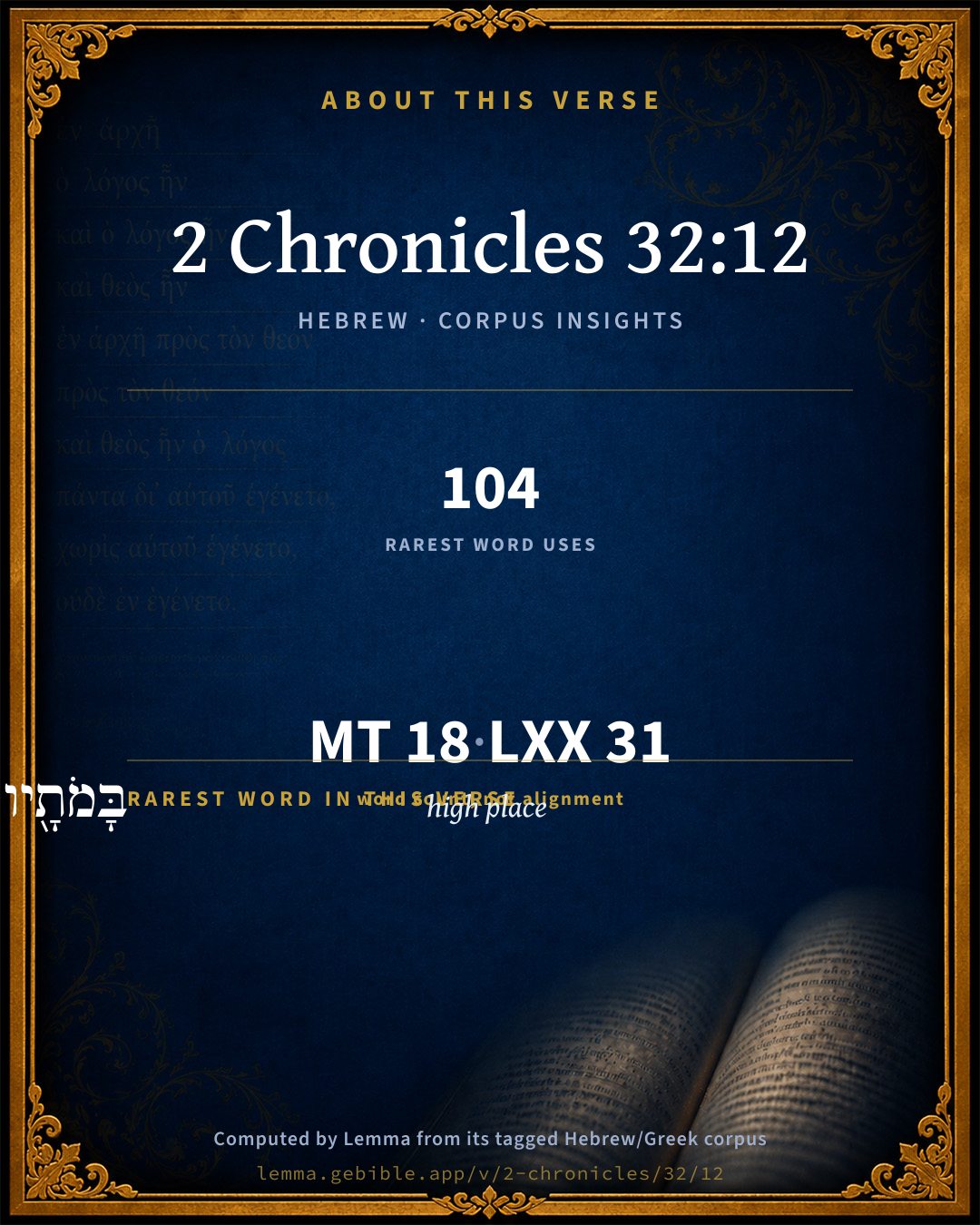
2 Chronicles, in the Historical, opens this verse with 18 words (15 distinct Hebrew lemmas). Its most distinctive word is bâmâh (“high place”). A historical commentator’s framing appears above. Read the whole chapter for the surrounding context.

Discussion questions

  1. What does “high place” (bâmâh) contribute to the verse as a whole?
  2. 2 Chronicles 31:1 shares this passage’s theme. How do the two illuminate each other?
  3. “altar” occurs 2× in this one verse. What is the effect of the repetition?
  4. These translations render this verse differently; the difference is in the English rendering, not the original. What questions does that raise?
  5. The verb «הֵסִ֥יר» is Hiphil Perfect. How does its form color the action?
  6. Reading how Trapp's Complete Commentary and Geneva Bible (1599) read this verse, where do the two commentators agree and where do they part?

Things to notice

Reading settings

Reading text

Shown beneath each verse's original-language words.

Old Testament
Old Testament edition

Read the OT as the Masoretic Hebrew (MT) or the Greek Septuagint (LXX).

English shown for the Greek Septuagint (in the Hebrew ↔ Greek comparison).

Comparing translations? Open the Compare panel on any verse page to stack up to four side by side.