

Ezra 7:9

Hebrew (Westminster Leningrad Codex) Ezra 7:9 appears in the Hebrew Old Testament. The text above is from the Westminster Leningrad Codex. Each word links to its Strong’s number, a concise gloss, and parsing drawn from the Open Scriptures Hebrew Bible morphology. Click any word for its full Brown-Driver-Briggs (BDB) entry.
Download image
Cite this verse

Ezra 7:9 (World English Bible). Public Domain. Lemma interlinear Bible study tool, https://lemma.gebible.app/v/ezra/7/9.

Show BibTeX & RIS
BibTeX
RIS
English Translation
For on the first [day] of the first month began he to go up from Babylon; and on the first [day] of the fifth month came he to Jerusalem, according to the good hand of his God on him.
World English Bible · Public Domain
Highlights
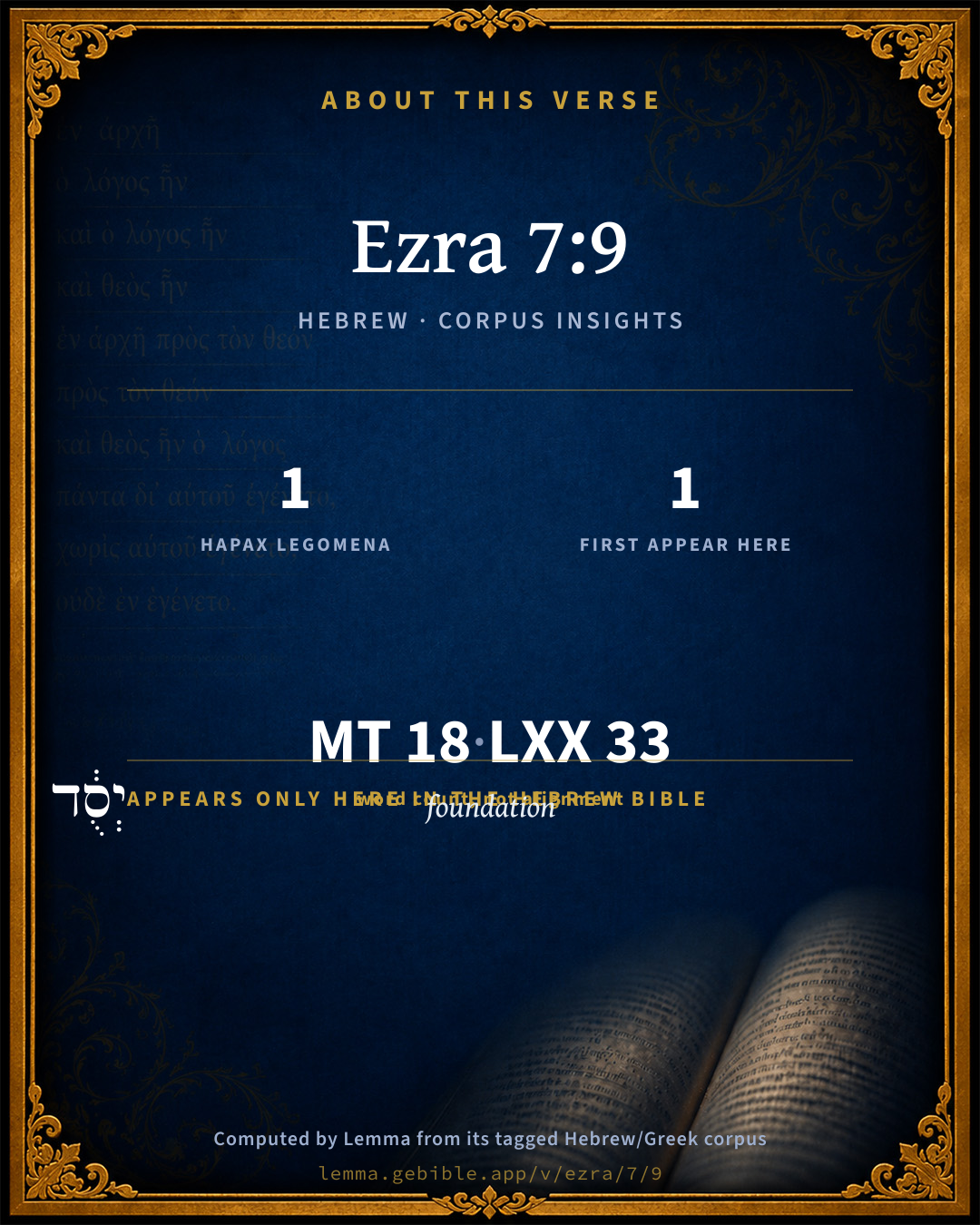
  • 1 hapax legomenon — only here in the Hebrew Bible
  • 1 first appearance in the Hebrew Bible
Full analysis ↓
Download a study sheet

One document with this verse’s original text, its word-by-word gloss line, the meaning frame, cross-references with their text, attributed commentary, and full source and license credits — printable, and it pastes into notes with its structure intact.

This verse Autodidact and up

Study sheet (.html) Plain text (.txt)

A passage Seminary Student

Up to 50 verses in one chapter. A passage sheet keeps up to 6 commentary sources and 12 cross-references per verse, in the order this page ranks them, and says so on the sheet whenever that leaves anything out. Ask for a single verse and you get the Autodidact verse sheet above.

Everything on this page stays free to read, with no account — the sheet is a download of what is already on screen, not access to it.

Want to remove ads? Support Godless Engineer
Compare translations 3

The same verse in 3 English versions, stacked beneath the original-language interlinear above. Click any original word for its lexicon entry.

Each is an independent rendering of the whole verse — the interlinear is not word-aligned to these translations.

Highlighted words mark where these versions differ — a whole-verse word diff, not a word-by-word alignment.

  • World English Bible Public Domain
    For on the first [day] of the first month began he to go up from Babylon; and on the first [day] of the fifth month came he to Jerusalem, according to the good hand of his God on him.
  • King James Version Public Domain
    For upon the first day of the first month began he to go up from Babylon, and on the first day of the fifth month came he to Jerusalem, according to the good hand of his God upon him.
  • unfoldingWord Literal Text CC BY-SA 4.0
    For on the first of the first month was the beginning of the ascent from Babylon. And on the first of the fifth month he came to Jerusalem, according to the good hand of his God upon him.

unfoldingWord Literal Text — © unfoldingWord, licensed CC BY-SA 4.0. Word-aligned USFM3 via Door43 (git.door43.org/unfoldingWord/en_ult).

Versions to compare (up to 4)

3 of 4 selected

Show all 18 translations

Every available English version of this verse, each an independent rendering of the whole verse.

  • World English Bible Public Domain
    For on the first [day] of the first month began he to go up from Babylon; and on the first [day] of the fifth month came he to Jerusalem, according to the good hand of his God on him.
  • Berean Standard Bible Public Domain
    He had begun the journey from Babylon on the first day of the first month, and he arrived in Jerusalem on the first day of the fifth month, for the gracious hand of his God was upon him.
  • Majority Standard Bible Public Domain
    He had begun the journey from Babylon on the first day of the first month, and he arrived in Jerusalem on the first day of the fifth month, for the gracious hand of his God was upon him.
  • King James Version Public Domain
    For upon the first day of the first month began he to go up from Babylon, and on the first day of the fifth month came he to Jerusalem, according to the good hand of his God upon him.
  • American Standard Version (1901) Public Domain
    For upon the first `day' of the first month began he to go up from Babylon; and on the first `day' of the fifth month came he to Jerusalem, according to the good hand of his God upon him.
  • Revised Version (1885) Public Domain
    For upon the first day of the first month began he to go up from Babylon, and on the first day of the fifth month came he to Jerusalem, according to the good hand of his God upon him.
  • Geneva Bible (1599) Public Domain
    For vpon the first day of the first moneth began he to goe vp from Babel, and on the first day of the fift moneth came he to Ierusalem, according to the good hande of his God that was vpon him.
  • Douay-Rheims (1899) Public Domain
    For upon the first day of the first month he began to go up from Babylon, and on the first day of the fifth month he came to Jerusalem according to the good hand of his God upon him.
  • Young's Literal Translation Public Domain
    for on the first of the month he hath founded the ascent from Babylon, and on the first of the fifth month he hath come in unto Jerusalem, according to the good hand of his God upon him,
  • Literal Standard Version CC BY-SA 4.0
    for on the first of the month he has founded the ascent from Babylon, and on the first of the fifth month he has come to Jerusalem, according to the good hand of his God on him,
  • Unlocked Literal Bible CC BY-SA 4.0
    He left Babylon on the first day of the first month. It was on the first day of the fifth month that he arrived in Jerusalem, since the good hand of God was with him.
  • unfoldingWord Literal Text CC BY-SA 4.0
    For on the first of the first month was the beginning of the ascent from Babylon. And on the first of the fifth month he came to Jerusalem, according to the good hand of his God upon him.
  • Darby Bible Public Domain
    For upon the first of the first month the project of going up from Babylon was determined on, and on the first of the fifth month he came to Jerusalem, according to the good hand of his God upon him.
  • World Messianic Bible Public Domain
    For on the first day of the first month he began to go up from Babylon; and on the first day of the fifth month he came to Jerusalem, according to the good hand of his God on him.
  • Webster's Bible Public Domain
    For upon the first day of the first month he began to go from Babylon, and on the first day of the fifth month he came to Jerusalem, according to the good hand of his God upon him.
  • Free Bible Version CC BY-SA 4.0
    He had started the journey from Babylon on the first day of the first month, and he arrived in Jerusalem on the first day of the fifth month, his gracious God going with him.
  • Bible in Basic English Public Domain
    For, starting his journey from Babylon on the first day of the first month, he came to Jerusalem on the first day of the fifth month, by the good help of his God.
  • JPS Tanakh (1917) Public Domain
    For upon the first day of the first month began he to go up from Babylon, and on the first day of the fifth month came he to Jerusalem, according to the good hand of his God upon him.

Literal Standard Version (2020), Covenant Press — licensed CC BY-SA 4.0. Text via the HelloAO Bible API (eBible.org). Unlocked Literal Bible (unfoldingWord) — licensed CC BY-SA 4.0. Text via the HelloAO Bible API (eBible.org). unfoldingWord Literal Text — © unfoldingWord, licensed CC BY-SA 4.0. Word-aligned USFM3 via Door43 (git.door43.org/unfoldingWord/en_ult). Free Bible Version, Dr. Jonathan Gallagher — licensed CC BY-SA 4.0. Text via the HelloAO Bible API (eBible.org).

Word by word

More ways to search: Search by grammar → Find every occurrence → Compare this word →

Practice this passage: Drill this verse → Learn its vocabulary →

יְסֻ֔ד
yᵉçud
H3246
“foundation of”
Noun, Common, Masculine, Singular, Construct
Part of Speech
Noun
Type
Common
Gender
Masculine
Number
Singular
State
Construct
Full BDB Definition

Origin: from H3245

TWOT: 875a

a beginning, foundation, that being founded
  1. כִּ֗י kîy H3588 “that” Conjunction
  2. בְּאֶחָד֙ ʼechâd H259 “in/at · one” Preposition + Adjective, Cardinal number, Masculine, Singular, Absolute
  3. לַחֹ֣דֶשׁ chôdesh H2320 “to/for the · month” Preposition, Determined + Noun, Common, Masculine, Singular, Absolute
  4. הָרִאשׁ֔וֹן riʼshôwn H7223 “the · first” Particle, Definite Article + Adjective, Adjective, Masculine, Singular, Absolute
  5. ה֣וּא hûwʼ H1931 “he” Pronoun, Personal, 3rd Person, Masculine, Singular
  6. הַֽמַּעֲלָ֖ה maʻălâh H4609 “the · step” Particle, Definite Article + Noun, Common, Feminine, Singular, Absolute
  7. מִבָּבֶ֑ל Bâbel H894 “from · Babylon” Preposition + Noun, Proper
  8. וּבְאֶחָ֞ד ʼechâd H259 “and · in/at · one” Conjunction + Preposition + Adjective, Cardinal number, Masculine, Singular, Absolute
  9. לַחֹ֣דֶשׁ chôdesh H2320 “to/for the · month” Preposition, Determined + Noun, Common, Masculine, Singular, Absolute
  10. הַחֲמִישִׁ֗י chămîyshîy H2549 “the · fifth” Particle, Definite Article + Adjective, Ordinal number, Masculine, Singular, Absolute
  11. בָּ֚א bôwʼ H935 “to enter” Verb, Qal, Perfect, 3rd Person, Masculine, Singular
  12. אֶל ʼêl H413 “to” Preposition
  13. יְר֣וּשָׁלִַ֔ם Yᵉrûwshâlaim H3389 “Jerusalem” Noun, Proper
  14. כְּיַד yâd H3027 “like/as · hand of” Preposition + Noun, Common, Both, Singular, Construct
  15. אֱלֹהָ֖יו ʼĕlôhîym H430 “God(s) · his” Noun, Common, Masculine, Plural, Construct + Suffix, Personal, 3rd Person, Masculine, Singular
  16. הַטּוֹבָ֥ה ṭôwb H2896 “the · good” Particle, Definite Article + Adjective, Adjective, Feminine, Singular, Absolute
  17. עָלָֽיו ʻal H5921 “upon · him” Preposition + Suffix, Personal, 3rd Person, Masculine, Singular

About this verse

These counts appear in no published source. They are computed here, from the morphology-tagged text and Lemma’s own curated glosses. What Lemma adds →

18
words
16
distinct lemmas
Historical
section

Notable vocabulary

1 hapax legomenon — a word that appears only here in the entire Hebrew Bible:

  • יְסֻ֔ד foundation H3246

First appearance in Scripture

This word makes its first canonical appearance in the Hebrew Bible here:

  • יְסֻ֔ד foundation H3246

Shared distinctive vocabulary

הַחֲמִישִׁ֗י fifth H2549 occurs in 44 verses of the Hebrew Bible. Also found in:

Grammatical profile

  • 1 verb
  • 8 nouns
  • 5 adjectives
  • 1 pronoun
  • 2 prepositions
  • 1 conjunction

Verb forms

  • בָּ֚א Qal · Perfect

Repetition

Words recur within this verse — often emphatic in Hebrew:

  • בְּאֶחָד֙ one H259 ×2
  • לַחֹ֣דֶשׁ month H2320 ×2

Hebrew & Septuagint length

In English translation the verse runs 39 words from the Hebrew and 39 from the Septuagint (LXX English) — the same length.

A rough comparison of the two English renderings, which tokenize alike — not a word-level alignment.

Word counts can differ between the Hebrew and the Greek without any difference in meaning — e.g. the Hebrew direct-object marker אֵת has no separate Greek word, and Greek often adds the article ὁ.

In the original languages it is 18 Hebrew tokens and 33 Greek tokens — but the two are counted differently (Hebrew bundles its prefixes and suffixes into one token; the Greek is in lemma form), so that isn’t a like-for-like length.

Cross-references

3

Topical passages linked to Ezra 7:9 in the Treasury of Scripture Knowledge — connected by theme and wording, ordered by reader-vote popularity; previews shown in the World English Bible.

  • Ezra 7:6 this Ezra went up from Babylon: and he was a ready scribe in the law of Moses, which Yahweh, the God of Israel, had given; and the king granted him all his request, according to the hand of Yahweh his God on him.
  • Nehemiah 2:8 and a letter to Asaph the keeper of the king's forest, that he may give me timber to make beams for the gates of the castle which appertains to the house, and for the wall of the city, and for the house that I shall enter into. The king granted me, according to the good hand of my God on me.
  • Nehemiah 2:18 I told them of the hand of my God which was good on me, as also of the king's words that he had spoken to me. They said, Let us rise up and build. So they strengthened their hands for the good [work].

Cross-references courtesy of OpenBible.info (CC BY 4.0).

Hebrew and Greek witnesses Masoretic Hebrew ↔ Greek Septuagint

The same verse in the two great witnesses to the Old Testament, shown verse-for-verse.

These are two independent witnesses, not word-aligned to each other, and the Septuagint is shown in lemma (dictionary) form.

Hebrew Ezra 7:9 Masoretic · Westminster Leningrad Codex

כִּ֗י בְּאֶחָד֙ לַחֹ֣דֶשׁ הָרִאשׁ֔וֹן ה֣וּא יְסֻ֔ד הַֽמַּעֲלָ֖ה מִבָּבֶ֑ל וּבְאֶחָ֞ד לַחֹ֣דֶשׁ הַחֲמִישִׁ֗י בָּ֚א אֶל יְר֣וּשָׁלִַ֔ם כְּיַד אֱלֹהָ֖יו הַטּוֹבָ֥ה עָלָֽיו

For on the first [day] of the first month began he to go up from Babylon; and on the first [day] of the fifth month came he to Jerusalem, according to the good hand of his God on him.

World English Bible · Public Domain

Greek LXX Ezra 7:9 Septuagint · lemma form

ὅτι ἐν εἷς ὁ μήν ὁ πρῶτος αὐτός θεμελιόω ὁ ἀνάβασις ὁ ἀπό βαβυλών ἐν δέ ὁ πρῶτος ὁ μήν ὁ πέμπτος ἔρχομαι εἰς ἰερουσαλήμ ὅτι χείρ θεός αὐτός εἰμί ἀγαθός ἐπί αὐτός

For in the first day of the first month he began the going up from Babylon, and in the first day of the fifth month, they came to Jerusalem, for the good hand of his God was upon him.

LXX2012 (modern English Septuagint) · Public Domain

In the Septuagint this is one book — Esdras B (2 Esdras): Ezra is chapters 1–10, Nehemiah 11–23.

On this verse, The Cambridge Bible for Schools and Colleges discusses the Septuagint’s reading. Read the note in Commentary ↓

Hebrew: Westminster Leningrad Codex (CC BY 4.0). Greek: Septuagint (public domain); English from LXX2012 (modern English Septuagint) (Public Domain). How the Septuagint differs from the Hebrew →

Commentary

Notes on Ezra 7:9 from classic Christian and Jewish commentators (each source and its license shown beneath its notes). The classic Christian expositions comment on the surrounding passage and are grouped to its opening verse, so a note may address several verses; the Jewish commentaries on the Tanakh (Rashi and others) are per-verse, so they appear only where the commentator wrote on this verse.

Lemma curates 59 commentaries, every one of them public domain or Creative Commons licensed, each selected and text-cleaned for this edition rather than reprinted as found. About our sources →

Trapp's Complete Commentary

John Trapp

Ezr 7:9 For upon the first [day] of the first month began he to go up from Babylon, and on the first [day] of the fifth month came he to Jerusalem, according to the good hand of his God upon him.

Ver. 9. According to the good hand of his God upon him] {See Trapp on "Ezr 7:6"} In all thy ways acknowledge God, and he shall direct thy paths, Pro 3:6. Commit thy way unto the Lord, trust also upon him, and he shall bring it to pass, Psa 37:5. Holy Ezra had experimented all this (as also had Eliezer, Gen 24:56), and therefore ascribeth his good success to God’s good providence.

John Trapp, A Commentary or Exposition upon All the Books of the Old and New Testament (1647–1656) — public domain. Text from a community e-Sword module.

Joseph Benson's Commentary

Ezr 7:9. According to the good hand of his God upon him — There was great reason to acknowledge the favour and protection of God, in conducting them safe to Jerusalem; for the journey was long and difficult, and they had many impediments, (going with wives and children, flocks and herds,) and were not without enemies, by whom they were in danger of being waylaid. These, however, Ezra did not fear, but relied on the divine protection, as he told the king, Ezr 8:2, being inspired with supernatural courage and fortitude.

Joseph Benson's Commentary on the Old and New Testaments (1811–1818) — public domain. Text from a community e-Sword module.

Tyndale Open Study Notes

Tyndale Open Resources

7:9 Ezra and his entourage had arranged to leave Babylon on April 8 but did not actually leave until April 19, 458 BC (8:31). In those intervening eleven days, he organized the group and assembled it at the Ahava Canal, searched for more Levites, and proclaimed a fast. • To make the 800-mile journey in four months, Ezra’s party would have walked an average of about ten miles per day, five days per week. Ezra knew that his success was attributable only to the gracious hand of his God (see also 7:6, 28; 8:22, 31).

Tyndale Open Study Notes — © Tyndale Open Resources, licensed CC BY-SA 4.0. Text via the HelloAO Bible API.

The Cambridge Bible for Schools and Colleges

gen. ed. J. J. S. Perowne

9. began he to go up] R.V. marg. Heb. that was the foundation of the going up. The R.V. and A.V. paraphrase the words.

The Hebrew text is intelligible; but (1) the word as here vocalized is very unusual, (2) the metaphor is ponderous and awkward, (3) the construction, shown in a literal translation “for upon the first day of the first month—that (i.e. that month) was the foundation of the going up from Babylon—and on the first day of the fifth month came he to Jerusalem”, is almost intolerably involved and harsh, especially as the verb ‘came’ in the latter half of the verse has no subject expressed in the original, and presupposes the mention of a subject in an earlier clause.

The LXX. render “for upon the first day of the first month he (i.e. Ezra) laid the foundation of his going up” (αὐτὸς ἐθεμελίωσε τὴν ἀνάβασιν), treating the word rendered “foundation” as a simple verb (i.e. ‘yasad’ for ‘y‘sûd’), cf. Vulg. ‘cœpit adscendere’.

Another method of explaining the verse makes Ezra the subject and reads the disputed word as if it were an intensive form (i.e. ‘yissêd’) of the verb “to lay the foundation of”, with the meaning ‘appoint’, as in Est_1:8 “the king had appointed”. This gives a good sense, as follows;

‘On the first day &c. he (i.e. Ezra) had appointed or determined to go up (the going up)’.

The rendezvous apparently took place on the 9th day of the 1st month (Nisan), and the journey did not commence until the 12th day (see chap. Ezr_8:15; Ezr_8:31).

upon the first day of the first month] i.e. 1st of Nisan (= Assyrian Nisanu), part of March and April.

on the first day of the fifth month] The journey lasted throughout 18 days of Nisan, and the three months Iyyar, Sivan, and Tammuz; in all about 108 days. As the crow flies, the distance from Babylon to Jerusalem is over 500 miles. But the road followed by Ezra’s caravan made a long detour by Carchemish so as to avoid the desert, and could hardly have been less than 900 miles. As the march was taken in the height of summer (April–August), the travellers probably moved only in the early morning and at night. A caravan with women and children and household effects would move more slowly than a trained and lightly equipped force. There is nothing therefore in the length of time spent in the march to cause any surprise. See on Ezr_8:32.

according to the good hand of his God &c.] Cf. note on Ezr_7:6.

The Cambridge Bible for Schools and Colleges (gen. ed. J. J. S. Perowne; Cambridge University Press, 1878–1918) — public domain. Text from a community e-Sword module.

John Gill's Exposition

For Ezra had prepared his heart to seek the law of the Lord,.... To attain to the knowledge of it, that he might be master of it, and expert in it, and know what was not to be done, and what to be done; he had set his heart upon this, bent his studies this way, and taken a great deal of pains in searching into it, in reading of it, and meditating on it:

and to do it; he was not only concerned to get the theory of it, but to put it in practice, to exercise himself in it, that it might be habitual to him; and the rather, as his view and intentions were not merely for the sake of himself, but

to teach in Israel statutes and judgments: and therefore it was not only necessary that he should have a large and competent knowledge of the laws, moral, ceremonial, and civil, but that he should act according to them himself, that so by his example, as well as by his instructions, he might teach the people.

John Gill's Exposition of the Whole Bible (1746–1763) — public domain (CC PDM 1.0). Text via the HelloAO Bible API.

Albert Barnes' Notes on the Bible

The direct distance of Babylon from Jerusalem is about 520 miles; and the circuitous route by Carchemish and the Orontes valley, which was ordinarily taken by armies or large bodies of men, is about 900 miles. The time occupied in the journey is long, and is perhaps to be accounted for by the dangers alluded to in Ezr 8:22, Ezr 8:31.

Albert Barnes' Notes on the Bible (1834–1885) — public domain. Text from a community e-Sword/MySword module.

Haydock's Catholic Bible Commentary

Month. Thus four entire months were spent on the journey, as they did not go the shortest way, and had much baggage, &c. (Calmet)

George Leo Haydock (1774–1849), Haydock's Catholic Family Bible and Commentary, 1859 edition — public domain. Excludes Psalms (Douay-Rheims chapter numbering differs from Protestant) and Deuterocanonical books (Catholic canon only).

Whedon's Commentary on the Bible

Daniel D. Whedon

9. First… fifth month — So the journey occupied precisely four months — from April through July. But they tarried twelve days at the river of Ahava. Ezr_8:15; Ezr_8:21; Ezr_8:31.

Daniel D. Whedon (gen. ed.), Commentary on the Old and New Testaments (1874–1909) — public domain. Text from a community e-Sword module.

The Pulpit Commentary

According to the good hand of his God. For the meaning of this phrase, see comment on ver. 6. The special favour of God here intended would seem to be deliverance from certain enemies who designed to attack the caravan on the way (see the next chapter, vers. 21-23, 31).

HOMILIES BY A. MACKENNAL Vers. 9, 10.

Ezra and his mission.

Two generations had elapsed between the close of Ezra 6. and the events with which the final chapters of the book are concerned. The prophetic voice was silent; Haggai and Zechariah had long since passed away. Zerubbabel, the last representative of the house of David, in whose person some had looked for a restoration of the Jewish kingdom, was dead. The high priesthood, which had been filled by the saintly Jeshua, was occupied by Eliashib, who became connected by marriage with two conspicuous enemies of the faith of Israel. His grandson married a daughter of Sanballat the Horonite; he himself "was allied unto Tobiab," to whom he gave a residence "in the courts of the house of God". (Neh_13:4-7, Neh_13:28) Darius had been succeeded by Xerxes, the story of whose pride, lasciviousness, passion, and feebleness is one of the most ignoble of the records of classic history. He was the Ahasuerus of the book of Esther. We may judge from the book of Esther how unfavourable the times were for carrying on the national and spiritual restoration of Israel. The full extent of the debasement of the settlers in Palestine was not known in Babylon; it broke on both Ezra and Nehemiah with painful surprise. (Ezr 9 Ne 13) But enough was known to awaken concern; he desired "to teach in Israel statutes and judgments." Filled with this pious desire, he obtained permission to go up to Jerusalem.

I THE CHARACTER OF EZRA. He was a priest, but he was still more a scribe; tradition assigns to him a leading part in the formation of the canon of Jewish Scriptures. The beginning of the study of Hebrew literature belongs to this period; the dignity of the pursuit invested the name "scribe" with honour, changed the mere registrar of documents and chronicler of events into the scholar and teacher. The change of language consequent on the deportation of the Hebrews into Babylon rendered it necessary that some should draw the inspiring record of the past from the obscurity of a dead or dying language, and make the people acquainted with their Divine-mission and the duties that mission imposed upon them. Above all, the law of the Lord was the object of Ezra"s reverence; he was "a ready scribe in the law of Moses, which the Lord God of Israel had given;" he "had prepared his heart to seek the law of the Lord, and to do and teach it." The character of Ezra was intimately associated with his vocation: his were the habits of the student; his virtues were not those of the statesman, the warrior, or the priest, but the virtues of the scholar; it was his not to give, but to interpret, laws.

1. The profound piety of the man first strikes us. The precepts of the law were to him "the words of God;" behind the writings he saw the august personal authority of the ever-living Ruler of his people. He lived in awe of his will; he had a deep conviction of the evil of sin against him, so deep that it impressed itself on others; they who sympathised with his purpose were those who "trembled at the words of the God of Israel". (Ezr_9:4 Ezr_10:3) He had a vivid consciousness of his mission, and the nearness of God to him in its fulfilment; again and again he refers his success to "the good hand of his God upon him.

2. Ezra had courage, but it was the courage of the student; not impulsive, but meditative. He knew and feared the dangers of the way; but he knew how to conquer fear. (Ezr_8:21-23) He needed to be aroused to effort, and when he was called to action he prepared himself for it by consecration. (Ezr_10:4, Ezr_10:5) There is a physical, and there is also a moral, courage; that is the most enduring bravery which knowing of dangers, faces them, trembles but advances, which supplies the lack of impulse by resolve. The "fear of the Lord" casts out all other fear.

3. The sensitive conscience and tender sympathy of the recluse are also his. Contrast his manifestation of feeling with that of Nehemiah when confronted with glaring impiety. (ch. 9: Ne 13) Nehemiah is indignant, Ezra is overwhelmed. Nehemiah "contends," Ezra weeps. Nehemiah curses the transgressors, and smites them, and plucks off their hair, and "makes them" amend; Ezra is prostrate from morning until evening, solemnly intercedes with God on their behalf, and wins the people to concern and repentance. This is the sacrificial spirit, feeling and confessing the sins of others as our own, bearing their transgressions, and recovering them by suffering; it is the lesson of the cross, the Christian spirit.

4. The firmness, even ruthlessness, with which he commands the separation of the husbands from their wives and children also bespeak the man of the study. None have shewn themselves more able to rise above family ties, none have more imperiously demanded this sacrifice from others, than those whose lofty ideal, cherished in the cell, has known none of the abatement which we learn to make in social intercourse. There is room for such men in history, and a work sometimes which none can do so well as they. Here are, unquestionably, the elements of a noble character. Not the only noble type, nor need we inquire if the noblest; enough that his was the character required for the reforms he inaugurated. Nehemiah was not called to do over again the work Ezra did. The style of Nehemiah"s record (Neh_13:23-28) indicates a very different state of things from that which Ezra found. This is the true test of the value of a man"s character, that he is fit for the work he has to do; the test of his worth is that he does it effectually.

II THE REFORMATION EZRA WROUGHT. He went up on a twofold errand. His own object was to teach the people "the words of the commandment of the Lord, and of his statutes to Israel." Disobedience of these had always been the crying sin of the nation, and had entailed on it its; (Ezr_9:7) the new favour God had extended to them would be forfeited if they disregarded his laws. (Ezr_9:14) And the disobedience that would provoke God might be through ignorance as well as through presumption. A nation perishes through ignorance; the violation of the Divine order brings social disorganisation and rain, it needs not that the violation be wilful. In the sacrifice offered on his arrival, together with the renewal of consecration the burnt offering, and the feast of thanksgiving the peace-offering, there occurs again the touching sin-offering, twelvehe-goats are sacrificed to acknowledge and ask pardon for sins of ignorance. In the disordered state of the times it was certain there must have been many defects in the people"s service, many errors, many transgressions of which they were not conscious, and these must be confessed. Then he was charged with a double mission from Artaxerxes, the gentle prince at that time reigning over Persia. The furnishing of the temple was to be proceeded with; he was laden with gifts for this purpose; (Ezr_8:25-27) he was charged to attend to its service, and empowered to draw from the royal revenues what was needed for a stately ritual. (Ezr_7:16, Ezr_7:17, Ezr_7:22) He was also commissioned to set magistrates and judges over the people charged with the administration of Jewish law, and he was empowered to execute it. (Ezr_7:25, Ezr_7:26) Artaxerxes knew that the law of the Lord was more than a mere ritual, that it prescribed social customs and regulated the life of the people, and he sympathised with Nehemiah"s desire to re-establish its rule. One great reform, however, overshadows all other works of Ezra; when this is-recorded the book abruptly closes, as if Ezra"s work was done. The story of Ezra"s dismay at hearing of the marriages of the Jews with the heathen, and his prompt dissolution of the marriages, is so far removed from the tolerant spirit of modern Christendom that it needs some special observations.

1. These were idolatrous heathen, not monotheistic heathen like the Persians; they were the heathen of Syria, whose worship was fouled with lust and blood. The term "abominations," as applied to their customs, is no mere outburst of Jewish arrogance; the tolerant modern spirit is revolted by the record. Intermarriage with them meant sharing in their festivals, and exposed the Jews to the utmost peril (cf. Neh_13:26) The past sufferings of the people should have warned them against this new folly; it seemed like provoking God, so soon to forget the past. (Ezr_9:6-15) The inter- marriage of the people, and especially of the priests, with idolatrous women was unfaithfulness to the purpose for which they had been restored from Babylon; a betrayal of the confidence reposed in them by Cyrus and his successors; a denial of the testimony of Zerubbabel and Jeshua; (Ezr_4:3) it argued indifference to their national position, contempt of their Divine calling.

2. The demand for divorce seems inconsistent with Paul"s counsel, (1Co_7:14) and the hopeful charity on which it is based; with many of Christ"s words, and the spirit of Christ"s life; it seems to argue the terror of the separatist rather than the confidence of the strong believer. We must not, however, argue the question from a Christian, but from a Jewish, stand- point; it is as foolish to look into the Old Testament for modern ethics as for modern science. The immense moral force of the gospel renders possible a genial and tolerant spirit which was not possible to an earnest Jew. As a matter of fact, the seductions of idolatry had always proved stronger than the attraction of Judaism; the heathen corrupted the Hebrew, the Hebrew did not convert the heathen. Judaism, with all its signal merits, was not a missionary faith; its office was protest, not evangelisation; the spiritual power of the gospel was not in it the cross, and resurrection, and the gift of the Holy Spirit. The presence of these forces in Christianity is the reason of its tolerant spirit; it moves freely in a world which it has power to change and sanctify; its work is not to protest, but to reclaim; the Son of man came not to judge the world, but to save the world. Some practical lessons:

1. A lesson of wisdom. Force of character is needed as well as a pure religious faith to render Christian intercourse with the world a safe thing. The stronger will draw the weaker; and it is not always the Christian who is the stronger. "All things are lawful for me, but all things are not expedient. All things are lawful, but all things edify not. All things are lawful, but I will not be brought under the power of any.

2. No sacrifice is too great which is needed that we may preserve our spiritual integrity. Natural tastes and faculties the eye, and hand, and foot; the tenderest ties father and mother, sister and brother, wife and husband.

3. The true object of toleration. It is that the noblest, holiest influence may prevail. Christian tolerance is not indifference to truth and falsehood, evil and good; it is not a passive grace, a mere easy disposition; it is an intensely active, a missionary grace. It is bent on overcoming evil with good. If it were otherwise, it would neither be fidelity to God nor charity to man. M.

The Pulpit Commentary (1880–1919), ed. H.D.M. Spence-Jones & Joseph S. Exell — public domain. Text from a community e-Sword module.

Scofield Reference Notes

C. I. Scofield

first month i.e. April.

fifth month i.e. August.

The Scofield Reference Bible (1917 edition), notes by C. I. Scofield — public domain. Text from a community e-Sword module.

Rashi

Rabbi Shlomo Yitzchaki (Rashi)

was the commencement of the ascent the foundation of the commencement of the ascent.

according to the...hand of his God as the hand of the Holy One, blessed be He, caused him to succeed, for His hand was good upon him to make him succeed in his way.

Rashi on the Tanakh — English translations: “The Judaica Press complete Tanach with Rashi, translated by A. J. Rosenberg” (CC BY 4.0); “Pentateuch with Rashi's commentary by M. Rosenbaum and A.M. Silbermann, 1929-1934” (public domain); “The Metsudah Tanach series, Lakewood, N.J” (CC BY 4.0); and “The Book of Joshua, Metsudah Publications, 1997” (CC BY 4.0). Text via Sefaria.

Lesson kit

Teaching starters — assembled from the data on this page, not authored interpretation. Every prompt links to the verse data it draws on. Edit before teaching.

Ezra, in the Historical, opens this verse with 18 words (16 distinct Hebrew lemmas). Its most distinctive word is yᵉçud (“foundation”). A historical commentator’s framing appears above. Read the whole chapter for the surrounding context.

Discussion questions

  1. What does “foundation” (yᵉçud) contribute to the verse as a whole?
  2. This verse holds 1 word here found nowhere else in the Hebrew Bible. What might the rare word draw attention to?
  3. The word “foundation” first appears here in Scripture. What is being introduced at this debut?
  4. Genesis 1:23 shares the word «fifth» with this verse. How do the two illuminate each other?
  5. “one” occurs 2× in this one verse. What is the effect of the repetition?
  6. These translations render this verse differently; the difference is in the English rendering, not the original. What questions does that raise?
  7. The verb «בָּ֚א» is Qal Perfect. How does its form color the action?
  8. Reading how Trapp's Complete Commentary and Joseph Benson's Commentary read this verse, where do the two commentators agree and where do they part?

Things to notice

  • 1 word in this verse appears nowhere else in the Hebrew Bible.
  • 1 word makes its first canonical appearance in Scripture here.
  • This verse counts 18 Hebrew ↔ 33 Greek words.
  • These translations choose different wording for 7 words in this verse.
  • “one” occurs 2× in this single verse.

Reading settings

Reading text

Shown beneath each verse's original-language words.

Old Testament
Old Testament edition

Read the OT as the Masoretic Hebrew (MT) or the Greek Septuagint (LXX).

English shown for the Greek Septuagint (in the Hebrew ↔ Greek comparison).

Comparing translations? Open the Compare panel on any verse page to stack up to four side by side.