
2 Chronicles 36:4

Hebrew (Westminster Leningrad Codex) 2 Chronicles 36:4 appears in the Hebrew Old Testament. The text above is from the Westminster Leningrad Codex. Each word links to its Strong’s number, a concise gloss, and parsing drawn from the Open Scriptures Hebrew Bible morphology. Click any word for its full Brown-Driver-Briggs (BDB) entry.
Download image
Cite this verse

2 Chronicles 36:4 (World English Bible). Public Domain. Lemma interlinear Bible study tool, https://lemma.gebible.app/v/2-chronicles/36/4.

Show BibTeX & RIS
BibTeX
RIS
English Translation
The king of Egypt made Eliakim his brother king over Judah and Jerusalem, and changed his name to Jehoiakim. Neco took Joahaz his brother, and carried him to Egypt.
World English Bible · Public Domain
Download a study sheet

One document with this verse’s original text, its word-by-word gloss line, the meaning frame, cross-references with their text, attributed commentary, and full source and license credits — printable, and it pastes into notes with its structure intact.

This verse Autodidact and up

Study sheet (.html) Plain text (.txt)

A passage Seminary Student

Up to 50 verses in one chapter. A passage sheet keeps up to 6 commentary sources and 12 cross-references per verse, in the order this page ranks them, and says so on the sheet whenever that leaves anything out. Ask for a single verse and you get the Autodidact verse sheet above.

Everything on this page stays free to read, with no account — the sheet is a download of what is already on screen, not access to it.

Want to remove ads? Support Godless Engineer
Compare translations 3

The same verse in 3 English versions, stacked beneath the original-language interlinear above. Click any original word for its lexicon entry.

Each is an independent rendering of the whole verse — the interlinear is not word-aligned to these translations.

Highlighted words mark where these versions differ — a whole-verse word diff, not a word-by-word alignment.

  • World English Bible Public Domain
    The king of Egypt made Eliakim his brother king over Judah and Jerusalem, and changed his name to Jehoiakim. Neco took Joahaz his brother, and carried him to Egypt.
  • King James Version Public Domain
    And the king of Egypt made Eliakim his brother king over Judah and Jerusalem, and turned his name to Jehoiakim. And Necho took Jehoahaz his brother, and carried him to Egypt.
  • unfoldingWord Literal Text CC BY-SA 4.0
    And the king of Egypt made Eliakim his brother king over Judah and Jerusalem. And he turned his name to Jehoiakim. And Joahaz his brother Necho took, and he brought him to Egypt.

unfoldingWord Literal Text — © unfoldingWord, licensed CC BY-SA 4.0. Word-aligned USFM3 via Door43 (git.door43.org/unfoldingWord/en_ult).

Versions to compare (up to 4)

3 of 4 selected

Show all 18 translations

Every available English version of this verse, each an independent rendering of the whole verse.

  • World English Bible Public Domain
    The king of Egypt made Eliakim his brother king over Judah and Jerusalem, and changed his name to Jehoiakim. Neco took Joahaz his brother, and carried him to Egypt.
  • Berean Standard Bible Public Domain
    Then Neco king of Egypt made Eliakim brother of Jehoahaz king over Judah and Jerusalem, and he changed Eliakim’s name to Jehoiakim. But Neco took Eliakim’s brother Jehoahaz and carried him off to Egypt.
  • Majority Standard Bible Public Domain
    Then Neco king of Egypt made Eliakim brother of Jehoahaz king over Judah and Jerusalem, and he changed Eliakim’s name to Jehoiakim. But Neco took Eliakim’s brother Jehoahaz and carried him off to Egypt.
  • King James Version Public Domain
    And the king of Egypt made Eliakim his brother king over Judah and Jerusalem, and turned his name to Jehoiakim. And Necho took Jehoahaz his brother, and carried him to Egypt.
  • American Standard Version (1901) Public Domain
    And the king of Egypt made Eliakim his brother king over Judah and Jerusalem, and changed his name to Jehoiakim. And Neco took Joahaz his brother, and carried him to Egypt.
  • Revised Version (1885) Public Domain
    And the king of Egypt made Eliakim his brother king over Judah and Jerusalem, and changed his name to Jehoiakim. And Neco took Joahaz his brother, and carried him to Egypt.
  • Geneva Bible (1599) Public Domain
    And the King of Egypt made Eliakim his brother King ouer Iudah and Ierusalem, and turned his name to Iehoiakim: and Necho tooke Iehoahaz his brother, and caryed him to Egypt.
  • Douay-Rheims (1899) Public Domain
    And he made Eliakim his brother king in his stead, over Juda and Jerusalem: and he turned his name to Joakim: but he took Joachaz with him, and carried him away into Egypt.
  • Young's Literal Translation Public Domain
    and the king of Egypt causeth Eliakim his brother to reign over Judah and Jerusalem, and turneth his name to Jehoiakim; and Jehoahaz his brother hath Necho taken, and bringeth him in to Egypt.
  • Literal Standard Version CC BY-SA 4.0
    and the king of Egypt causes his brother Eliakim to reign over Judah and Jerusalem, and turns his name to Jehoiakim; and Necho has taken his brother Jehoahaz and brings him to Egypt.
  • Unlocked Literal Bible CC BY-SA 4.0
    The king of Egypt made Eliakim, who was the brother of Jehoahaz, king over Judah and Jerusalem (and changed Eliakim's name to Jehoiakim). Then Necho took Eliakim's brother Jehoahaz and brought him to Egypt.
  • unfoldingWord Literal Text CC BY-SA 4.0
    And the king of Egypt made Eliakim his brother king over Judah and Jerusalem. And he turned his name to Jehoiakim. And Joahaz his brother Necho took, and he brought him to Egypt.
  • Darby Bible Public Domain
    And the king of Egypt made Eliakim his brother king over Judah and Jerusalem, and changed his name to Jehoiakim. And Necho took Jehoahaz his brother, and carried him to Egypt.
  • World Messianic Bible Public Domain
    The king of Egypt made Eliakim his brother king over Judah and Jerusalem, and changed his name to Jehoiakim. Neco took Joahaz his brother, and carried him to Egypt.
  • Webster's Bible Public Domain
    And the king of Egypt made Eliakim his brother king over Judah and Jerusalem, and changed his name to Jehoiakim. And Necho took Jehoahaz his brother, and carried him to Egypt.
  • Free Bible Version CC BY-SA 4.0
    Neco, king of Egypt, made Eliakim, Jehoahaz's brother, king over Judah and Jerusalem, and he changed Eliakim's name to Jehoiakim. Neco took Eliakim's brother Jehoahaz back with him to Egypt.
  • Bible in Basic English Public Domain
    And the king of Egypt made Eliakim his brother king over Judah and Jerusalem, changing his name to Jehoiakim. And Neco took his brother Jehoahaz away to Egypt.
  • JPS Tanakh (1917) Public Domain
    And the king of Egypt made Eliakim his brother king over Judah and Jerusalem, and changed his name to Jehoiakim. And Neco took Joahaz his brother, and carried him to Egypt.

Literal Standard Version (2020), Covenant Press — licensed CC BY-SA 4.0. Text via the HelloAO Bible API (eBible.org). Unlocked Literal Bible (unfoldingWord) — licensed CC BY-SA 4.0. Text via the HelloAO Bible API (eBible.org). unfoldingWord Literal Text — © unfoldingWord, licensed CC BY-SA 4.0. Word-aligned USFM3 via Door43 (git.door43.org/unfoldingWord/en_ult). Free Bible Version, Dr. Jonathan Gallagher — licensed CC BY-SA 4.0. Text via the HelloAO Bible API (eBible.org).

Word by word

More ways to search: Search by grammar → Find every occurrence → Compare this word →

Practice this passage: Drill this verse → Learn its vocabulary →

נְכ֔וֹ
Nᵉkôw
H5224
“Necho”
Noun, Proper
Part of Speech
Noun
Type
Proper
Full BDB Definition

Origin: probably of Egyptian origin

TWOT: None

Necho = "lame" - the Pharaoh of Egypt in the time of king Josiah of Judah
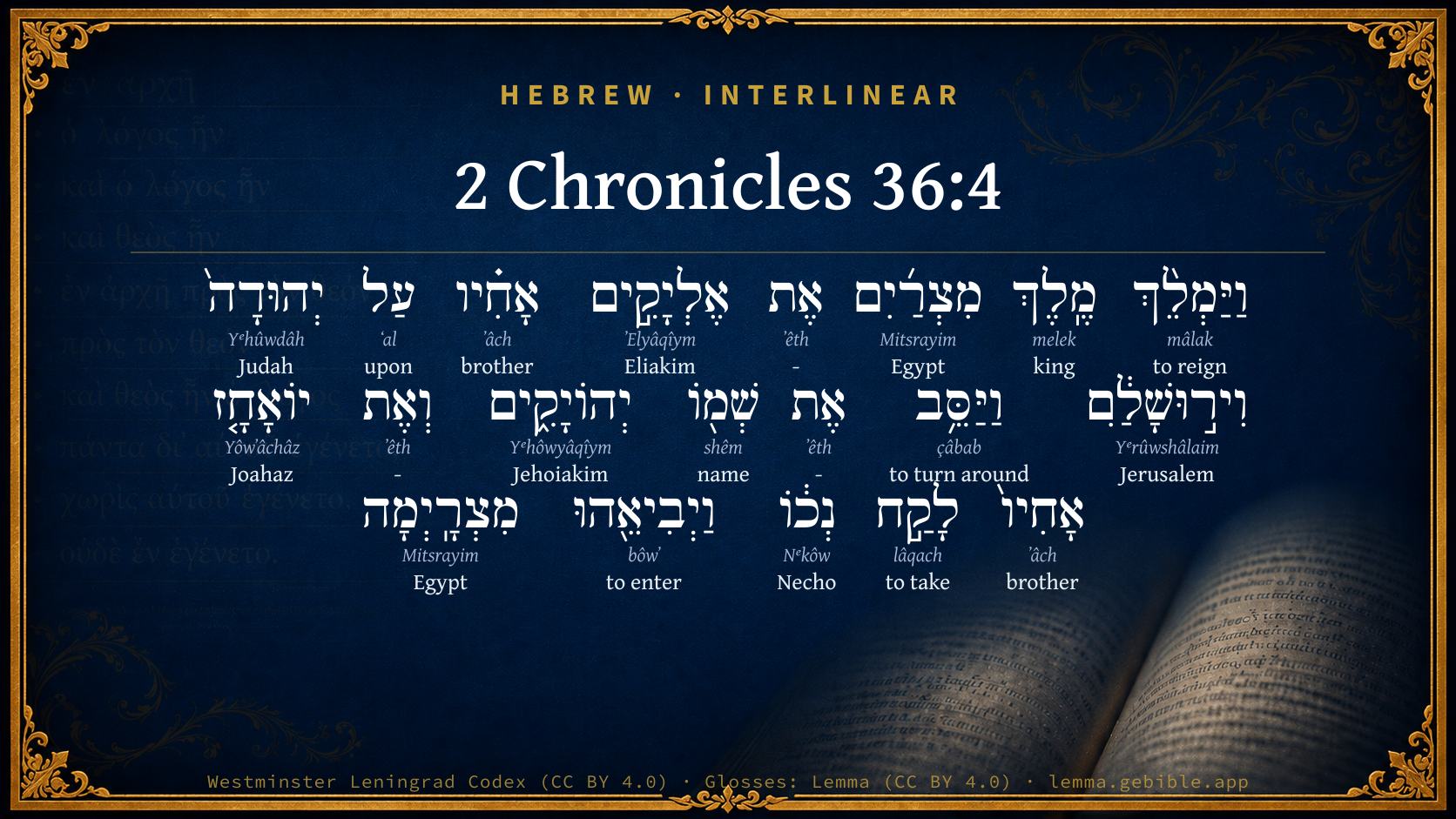
  1. וַיַּמְלֵ֨ךְ mâlak H4427 “and · to reign” Conjunction + Verb, Hiphil, Sequential Imperfect, 3rd Person, Masculine, Singular
  2. מֶֽלֶךְ melek H4428 “king of” Noun, Common, Masculine, Singular, Construct
  3. מִצְרַ֜יִם Mitsrayim H4714 “Egypt” Noun, Proper
  4. אֶת ʼêth H853 “-” Particle, Direct Object
  5. אֶלְיָקִ֣ים ʼElyâqîym H471 “Eliakim” Noun, Proper
  6. אָחִ֗יו ʼâch H251 “brother · his” Noun, Common, Masculine, Singular, Construct + Suffix, Personal, 3rd Person, Masculine, Singular
  7. עַל ʻal H5921 “upon” Preposition
  8. יְהוּדָה֙ Yᵉhûwdâh H3063 “Judah” Noun, Proper
  9. וִיר֣וּשָׁלִַ֔ם Yᵉrûwshâlaim H3389 “and · Jerusalem” Conjunction + Noun, Proper
  10. וַיַּסֵּ֥ב çâbab H5437 “and · to turn around” Conjunction + Verb, Hiphil, Sequential Imperfect, 3rd Person, Masculine, Singular
  11. אֶת ʼêth H853 “-” Particle, Direct Object
  12. שְׁמ֖וֹ shêm H8034 “name · his” Noun, Common, Masculine, Singular, Construct + Suffix, Personal, 3rd Person, Masculine, Singular
  13. יְהוֹיָקִ֑ים Yᵉhôwyâqîym H3079 “Jehoiakim” Noun, Proper
  14. וְאֶת ʼêth H853 “and · -” Conjunction + Particle, Direct Object
  15. יוֹאָחָ֤ז Yôwʼâchâz H3099 “Joahaz” Noun, Proper
  16. אָחִיו֙ ʼâch H251 “brother · his” Noun, Common, Masculine, Singular, Construct + Suffix, Personal, 3rd Person, Masculine, Singular
  17. לָקַ֣ח lâqach H3947 “to take” Verb, Qal, Perfect, 3rd Person, Masculine, Singular
  18. וַיְבִיאֵ֖הוּ bôwʼ H935 “and · to enter · him” Conjunction + Verb, Hiphil, Sequential Imperfect, 3rd Person, Masculine, Singular + Suffix, Personal, 3rd Person, Masculine, Singular
  19. מִצְרָֽיְמָה Mitsrayim H4714 “Egypt · toward” Noun, Proper + Suffix, Demonstrative

About this verse

These counts appear in no published source. They are computed here, from the morphology-tagged text and Lemma’s own curated glosses. What Lemma adds →

20
words
16
distinct lemmas
Historical
section

Notable vocabulary

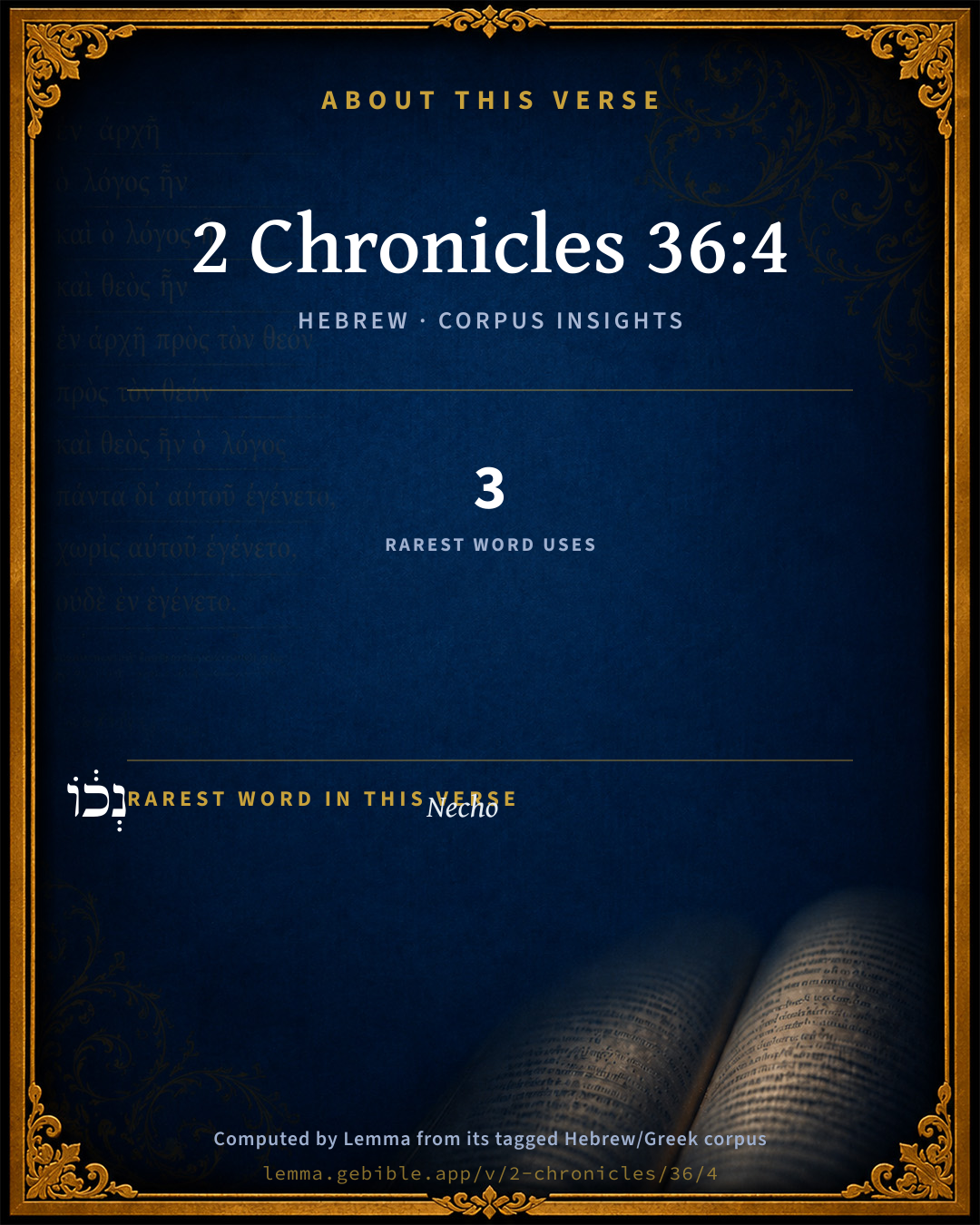
The rarest word here is נְכ֔וֹ Necho H5224 — appearing just 3 times in the whole Hebrew Bible.

Shared distinctive vocabulary

נְכ֔וֹ Necho H5224 occurs in 3 verses of the Hebrew Bible. Also found in:

Grammatical profile

  • 4 verbs
  • 12 nouns
  • 1 preposition
  • 3 particles

Verb forms

  • וַיַּמְלֵ֨ךְ Hiphil · Sequential Imperfect
  • וַיַּסֵּ֥ב Hiphil · Sequential Imperfect
  • לָקַ֣ח Qal · Perfect
  • וַיְבִיאֵ֖הוּ Hiphil · Sequential Imperfect

Repetition

Words recur within this verse — often emphatic in Hebrew:

  • מִצְרַ֜יִם Egypt H4714 ×2
  • אָחִ֗יו brother H251 ×2

Hebrew & Septuagint length

In English translation the verse runs 29 words from the Hebrew and 92 from the Septuagint (LXX English) — the Septuagint runs noticeably longer here. See the side-by-side →

A rough comparison of the two English renderings, which tokenize alike — not a word-level alignment.

Word counts can differ between the Hebrew and the Greek without any difference in meaning — e.g. the Hebrew direct-object marker אֵת has no separate Greek word, and Greek often adds the article ὁ.

Cross-references

4

Topical passages linked to 2 Chronicles 36:4 in the Treasury of Scripture Knowledge — connected by theme and wording, ordered by reader-vote popularity; previews shown in the World English Bible.

  • Jeremiah 22:10–12 Don't you weep for the dead, neither bemoan him; but weep sore for him who goes away; for he shall return no more, nor see his native country.
  • 2 Kings 23:34–35 Pharaoh Necoh made Eliakim the son of Josiah king in the room of Josiah his father, and changed his name to Jehoiakim: but he took Jehoahaz away; and he came to Egypt, and died there.
  • 1 Chronicles 3:15 The sons of Josiah: the firstborn Johanan, the second Jehoiakim, the third Zedekiah, the fourth Shallum.
  • Ezekiel 19:3–4 She brought up one of her cubs: he became a young lion, and he learned to catch the prey; he devoured men.

Cross-references courtesy of OpenBible.info (CC BY 4.0).

Hebrew and Greek witnesses Masoretic Hebrew ↔ Greek Septuagint

The same verse in the two great witnesses to the Old Testament, shown verse-for-verse.

Here the Septuagint runs noticeably longer than the Hebrew — LXX2012 (modern English Septuagint) 92 words vs World English Bible 29. A rough length comparison of the two English translations, not a word-level alignment — read both below.

These are two independent witnesses, not word-aligned to each other, and the Septuagint is shown in lemma (dictionary) form.

Hebrew 2 Chronicles 36:4 Masoretic · Westminster Leningrad Codex

וַיַּמְלֵ֨ךְ מֶֽלֶךְ מִצְרַ֜יִם אֶת אֶלְיָקִ֣ים אָחִ֗יו עַל יְהוּדָה֙ וִיר֣וּשָׁלִַ֔ם וַיַּסֵּ֥ב אֶת שְׁמ֖וֹ יְהוֹיָקִ֑ים וְאֶת יוֹאָחָ֤ז אָחִיו֙ לָקַ֣ח נְכ֔וֹ וַיְבִיאֵ֖הוּ מִצְרָֽיְמָה

The king of Egypt made Eliakim his brother king over Judah and Jerusalem, and changed his name to Jehoiakim. Neco took Joahaz his brother, and carried him to Egypt.

World English Bible · Public Domain

Greek LXX 2 Chronicles 36:4 Septuagint · lemma form

καί καταἵστημι φαραώ νεχαω ὁ ελιακιμ υἱός ιωσίας βασιλεύς ἰουδά ἀντί ιωσίας ὁ πατήρ αὐτός καί μεταστρέφω ὁ ὄνομα αὐτός ιωακιμ καί ὁ ιωαχαζ ἀδελφός αὐτός λαμβάνω φαραώ νεχαω καί εἰςἄγω αὐτός εἰς αἴγυπτος καί ἀποθνήσκω ἐκεῖ καί ὁ ἀργύριον καί ὁ χρυσίον δίδωμι ὁ φαραώ τότε ἄρχω ὁ γῆ φορολογέω ὁ δίδωμι ὁ ἀργύριον ἐπί στόμα φαραώ καί ἕκαστος κατά δύναμις ἀποαἰτέω ὁ ἀργύριον καί ὁ χρυσίον παρά ὁ λαός ὁ γῆ δίδωμι ὁ φαραώ νεχαω

And Pharao Nechao made Eliakim the son of Josias king over Juda in the room of his father Josias, and changed his name to Joakim. And Pharao Nechao took his brother Joachaz and brought him into Egypt, and he died there: but he had given the silver and gold to Pharao. At that time the land began to be taxed to give the money at the command of Pharao; and every one as he could borrowed the silver and the gold of the people of the land, to give to Pharao Nechao.

LXX2012 (modern English Septuagint) · Public Domain

On this verse, Ellicott's Commentary for English Readers discusses the Septuagint’s reading. Read the note in Commentary ↓

Hebrew: Westminster Leningrad Codex (CC BY 4.0). Greek: Septuagint (public domain); English from LXX2012 (modern English Septuagint) (Public Domain). How the Septuagint differs from the Hebrew →

Commentary

Notes on 2 Chronicles 36:4 from classic Christian and Jewish commentators (each source and its license shown beneath its notes). The classic Christian expositions comment on the surrounding passage and are grouped to its opening verse, so a note may address several verses; the Jewish commentaries on the Tanakh (Rashi and others) are per-verse, so they appear only where the commentator wrote on this verse.

Lemma curates 59 commentaries, every one of them public domain or Creative Commons licensed, each selected and text-cleaned for this edition rather than reprinted as found. About our sources →

Trapp's Complete Commentary

John Trapp

2Ch 36:4 And the king of Egypt made Eliakim his brother king over Judah and Jerusalem, and turned his name to Jehoiakim. And Necho took Jehoahaz his brother, and carried him to Egypt.

2Ch 36:5 Jehoiakim [was] twenty and five years old when he began to reign, and he reigned eleven years in Jerusalem: and he did [that which was] evil in the sight of the LORD his God.

Ver. 4, 5. See on 2Ki 23:34-35, &c.

John Trapp, A Commentary or Exposition upon All the Books of the Old and New Testament (1647–1656) — public domain. Text from a community e-Sword module.

Jamieson, Fausset & Brown

Robert Jamieson, A. R. Fausset & David Brown

carried him--Jehoahaz.

to Egypt--There he died (Jer 22:10-12).

Jamieson, Fausset & Brown — Commentary Critical and Explanatory on the Whole Bible (1871) — public domain (CC PDM 1.0). Text via the HelloAO Bible API.

Ellicott's Commentary for English Readers

(4) And the king of Egypt made Eliakim.—The verse agrees with 2Ki_23:34.

Carried him to Egypt.—Made him come. Kings, “and he came to Egypt, and died there.” Comp. Jer_22:10-12. The LXX. adds: and the silver and the gold he gave to the Pharaoh. Then the land began to be assessed, in order to give the money into the mouth of Pharaoh. And each according to ability used to demand the silver and the gold from the people of the land to give to Pharaoh-necho.”

A Bible Commentary for English Readers, edited by Charles John Ellicott (1878–1897) — public domain. Text from a community e-Sword module.

The Cambridge Bible for Schools and Colleges

gen. ed. J. J. S. Perowne

4. turned his name to Jehoiakim] This name is compounded with the divine name Jehovah. Probably Neco made the new king swear fealty by Jehovah, and then declared his official name to be Jehoiakim, in order that he and his people might have something to remind them of the oath he had taken.

to Egypt] He died in Egypt; 2Ki_23:34; Jer_22:12.

The Cambridge Bible for Schools and Colleges (gen. ed. J. J. S. Perowne; Cambridge University Press, 1878–1918) — public domain. Text from a community e-Sword module.

Haydock's Catholic Bible Commentary

Brother. From the time of David, the son had always succeeded his father. W.

George Leo Haydock (1774–1849), Haydock's Catholic Family Bible and Commentary, 1859 edition — public domain. Excludes Psalms (Douay-Rheims chapter numbering differs from Protestant) and Deuterocanonical books (Catholic canon only).

The Pulpit Commentary

Eliakim. The meaning of the word is "God sets up;" the meaning of Jehoiakim is "Jehovah sets up." An Egyptian king knew and recognized the word "God," but possibly meant to taunt the "Jehovah" of the Jew.

The Pulpit Commentary (1880–1919), ed. H.D.M. Spence-Jones & Joseph S. Exell — public domain. Text from a community e-Sword module.

Rashi

Rabbi Shlomo Yitzchaki (Rashi)

and he changed his name to Jehoiakim It is the custom of kings and princes to bestow a by-name upon their servants as they wish. An example is (Gen. 41:45): “And Pharaoh named Joseph, etc.,” and so (Num. 13:16): “and Moses called Hoshea the son of Nun, Joshua,” and so, (Dan. 1:7): “Now the chief officer gave them names, etc.” All this is to make known that he rules over him to name him as he desires.

and he changed his name to Jehoiakim Why did he change his name to Jehoiakim? It is explained above that after Pharaoh slew Josiah, he appointed a king and fined them by imposing a tribute of enslavement upon them.

Rashi on the Tanakh — English translations: “The Judaica Press complete Tanach with Rashi, translated by A. J. Rosenberg” (CC BY 4.0); “Pentateuch with Rashi's commentary by M. Rosenbaum and A.M. Silbermann, 1929-1934” (public domain); “The Metsudah Tanach series, Lakewood, N.J” (CC BY 4.0); and “The Book of Joshua, Metsudah Publications, 1997” (CC BY 4.0). Text via Sefaria.

Lesson kit

Teaching starters — assembled from the data on this page, not authored interpretation. Every prompt links to the verse data it draws on. Edit before teaching.

2 Chronicles, in the Historical, opens this verse with 20 words (16 distinct Hebrew lemmas). Its most distinctive word is Nᵉkôw (“Necho”). The Greek Septuagint runs longer here. A historical commentator’s framing appears above. Read the whole chapter for the surrounding context.

Discussion questions

  1. What does “Necho” (Nᵉkôw) contribute to the verse as a whole?
  2. How does 2 Chronicles 35:20, which shares the word «Necho», read alongside this verse?
  3. What does the repetition of “Egypt” (2× in this one verse) do in this verse?
  4. The Septuagint runs longer here than the Hebrew. What might account for the difference?
  5. The translations on this page render this verse differently — a whole-verse word diff, not a word-by-word alignment. What might account for the different wordings?
  6. «וַיַּמְלֵ֨ךְ» is a Hiphil Sequential Imperfect verb. How does that grammatical form shape the action described?
  7. Compare how Trapp's Complete Commentary and Jamieson, Fausset & Brown read this verse. Where do they agree or differ?

Things to notice

Reading settings

Reading text

Shown beneath each verse's original-language words.

Old Testament
Old Testament edition

Read the OT as the Masoretic Hebrew (MT) or the Greek Septuagint (LXX).

English shown for the Greek Septuagint (in the Hebrew ↔ Greek comparison).

Comparing translations? Open the Compare panel on any verse page to stack up to four side by side.