
Ezekiel 33:21

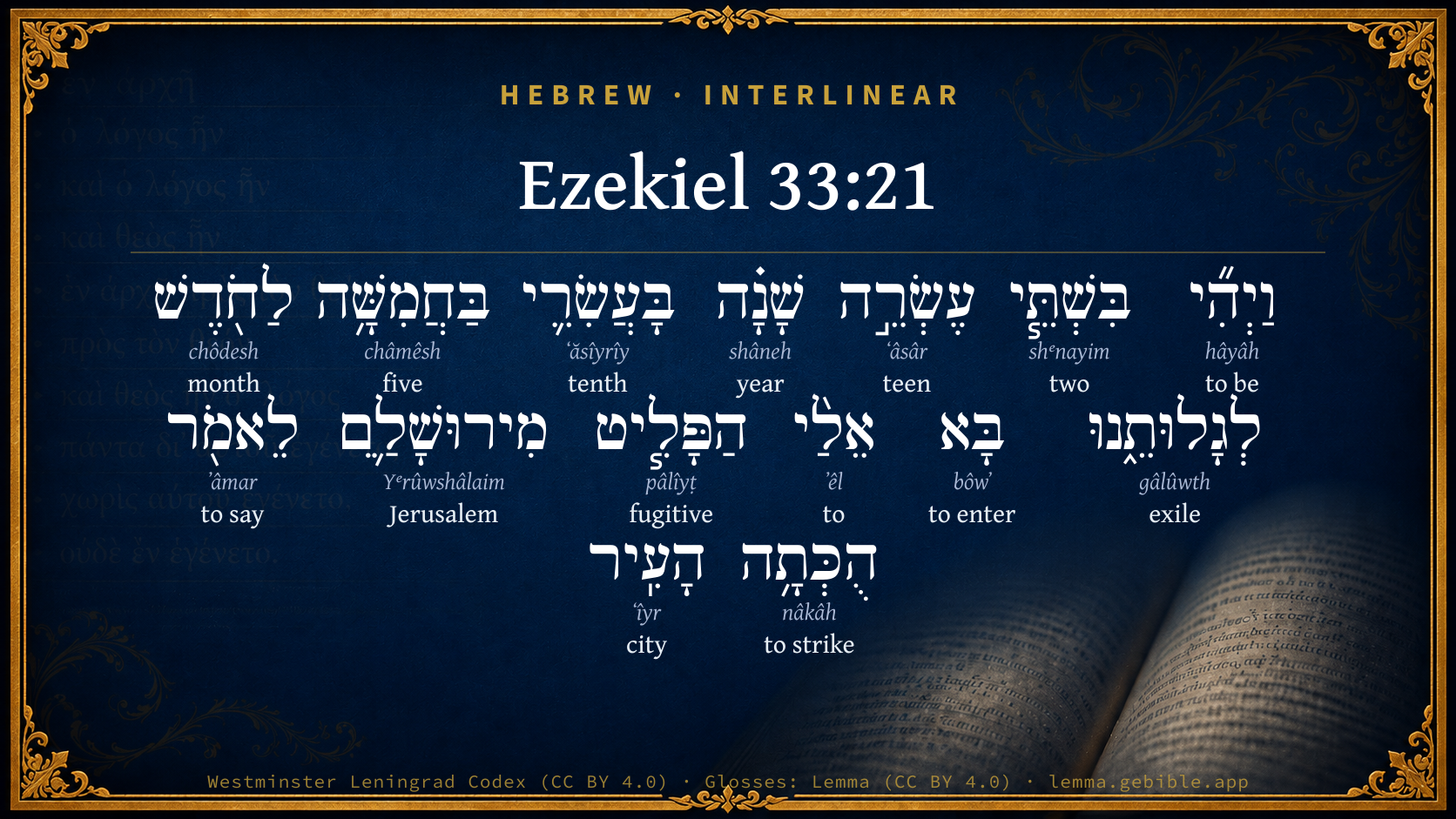
Hebrew (Westminster Leningrad Codex) Ezekiel 33:21 appears in the Hebrew Old Testament. The text above is from the Westminster Leningrad Codex. Each word links to its Strong’s number, a concise gloss, and parsing drawn from the Open Scriptures Hebrew Bible morphology. Click any word for its full Brown-Driver-Briggs (BDB) entry.
Download image
Cite this verse

Ezekiel 33:21 (World English Bible). Public Domain. Lemma interlinear Bible study tool, https://lemma.gebible.app/v/ezekiel/33/21.

Show BibTeX & RIS
BibTeX
RIS
English Translation
It happened in the twelfth year of our captivity, in the tenth [month], in the fifth [day] of the month, that one who had escaped out of Jerusalem came to me, saying, The city has been struck.
World English Bible · Public Domain
Download a study sheet

One document with this verse’s original text, its word-by-word gloss line, the meaning frame, cross-references with their text, attributed commentary, and full source and license credits — printable, and it pastes into notes with its structure intact.

This verse Autodidact and up

Study sheet (.html) Plain text (.txt)

A passage Seminary Student

Up to 50 verses in one chapter. A passage sheet keeps up to 6 commentary sources and 12 cross-references per verse, in the order this page ranks them, and says so on the sheet whenever that leaves anything out. Ask for a single verse and you get the Autodidact verse sheet above.

Everything on this page stays free to read, with no account — the sheet is a download of what is already on screen, not access to it.

Want to remove ads? Support Godless Engineer
Compare translations 3

The same verse in 3 English versions, stacked beneath the original-language interlinear above. Click any original word for its lexicon entry.

Each is an independent rendering of the whole verse — the interlinear is not word-aligned to these translations.

Highlighted words mark where these versions differ — a whole-verse word diff, not a word-by-word alignment.

  • World English Bible Public Domain
    It happened in the twelfth year of our captivity, in the tenth [month], in the fifth [day] of the month, that one who had escaped out of Jerusalem came to me, saying, The city has been struck.
  • King James Version Public Domain
    And it came to pass in the twelfth year of our captivity, in the tenth month, in the fifth day of the month, that one that had escaped out of Jerusalem came unto me, saying, The city is smitten.
  • unfoldingWord Literal Text CC BY-SA 4.0
    It happened in the twelfth year, on the fifth day of the tenth month of our captivity, that a fugitive came to me from Jerusalem and said, “The city has been captured!”

unfoldingWord Literal Text — © unfoldingWord, licensed CC BY-SA 4.0. Word-aligned USFM3 via Door43 (git.door43.org/unfoldingWord/en_ult).

Versions to compare (up to 4)

3 of 4 selected

Show all 18 translations

Every available English version of this verse, each an independent rendering of the whole verse.

  • World English Bible Public Domain
    It happened in the twelfth year of our captivity, in the tenth [month], in the fifth [day] of the month, that one who had escaped out of Jerusalem came to me, saying, The city has been struck.
  • Berean Standard Bible Public Domain
    In the twelfth year of our exile, on the fifth day of the tenth month, a fugitive from Jerusalem came to me and reported, “The city has been taken!”
  • Majority Standard Bible Public Domain
    In the twelfth year of our exile, on the fifth day of the tenth month, a fugitive from Jerusalem came to me and reported, “The city has been taken!”
  • King James Version Public Domain
    And it came to pass in the twelfth year of our captivity, in the tenth month, in the fifth day of the month, that one that had escaped out of Jerusalem came unto me, saying, The city is smitten.
  • American Standard Version (1901) Public Domain
    And it came to pass in the twelfth year of our captivity, in the tenth `month', in the fifth `day' of the month, that one that had escaped out of Jerusalem came unto me, saying, The city is smitten.
  • Revised Version (1885) Public Domain
    And it came to pass in the twelfth year of our captivity, in the tenth month, in the fifth day of the month, that one that had escaped out of Jerusalem came unto me, saying, The city is smitten.
  • Geneva Bible (1599) Public Domain
    Also in the twelfth yere of our captiuitie, in the tenth moneth, and in the fift day of the moneth, one that had escaped out of Ierusalem, came vnto me, and said, The citie is smitten.
  • Douay-Rheims (1899) Public Domain
    And it came to pass in the twelfth year of our captivity, in the tenth month, in the fifth day of the month, that there came to me one that was fled from Jerusalem, saying: The city is laid waste.
  • Young's Literal Translation Public Domain
    And it cometh to pass, in the twelfth year -- in the tenth `month', in the fifth of the month -- of our removal, come in unto me doth one who is escaped from Jerusalem, saying, `The city hath been smitten.'
  • Literal Standard Version CC BY-SA 4.0
    And it comes to pass, in the twelfth year—in the tenth [month], in the fifth of the month—of our removal, one who is escaped from Jerusalem comes to me, saying, “The city has been struck.”
  • Unlocked Literal Bible CC BY-SA 4.0
    It happened in the twelfth year, on the fifth day of the tenth month of our captivity, that a fugitive came to me from Jerusalem and said, “The city has been captured!”
  • unfoldingWord Literal Text CC BY-SA 4.0
    It happened in the twelfth year, on the fifth day of the tenth month of our captivity, that a fugitive came to me from Jerusalem and said, “The city has been captured!”
  • Darby Bible Public Domain
    And it came to pass in the twelfth year of our captivity, in the tenth [month], on the fifth of the month, that one who had escaped out of Jerusalem came unto me, saying, The city is smitten!
  • World Messianic Bible Public Domain
    In the twelfth year of our captivity, in the tenth month, in the fifth day of the month, one who had escaped out of Jerusalem came to me, saying, “The city has been defeated!”
  • Webster's Bible Public Domain
    And it came to pass in the twelfth year of our captivity, in the tenth month, in the fifth day of the month, that one that had escaped out of Jerusalem came to me, saying, The city is smitten.
  • Free Bible Version CC BY-SA 4.0
    On the fifth day of the tenth month of the twelfth year of our exile, a refugee who'd escaped from Jerusalem arrived and told me, “The city has been captured!”
  • Bible in Basic English Public Domain
    Now in the twelfth year after we had been taken away prisoners, in the tenth month, on the fifth day of the month, one who had got away in flight from Jerusalem came to me, saying, The town has been taken.
  • JPS Tanakh (1917) Public Domain
    And it came to pass in the twelfth year of our captivity, in the tenth month, in the fifth day of the month, that one that had escaped out of Jerusalem came unto me, saying: 'The city is smitten.'

Literal Standard Version (2020), Covenant Press — licensed CC BY-SA 4.0. Text via the HelloAO Bible API (eBible.org). Unlocked Literal Bible (unfoldingWord) — licensed CC BY-SA 4.0. Text via the HelloAO Bible API (eBible.org). unfoldingWord Literal Text — © unfoldingWord, licensed CC BY-SA 4.0. Word-aligned USFM3 via Door43 (git.door43.org/unfoldingWord/en_ult). Free Bible Version, Dr. Jonathan Gallagher — licensed CC BY-SA 4.0. Text via the HelloAO Bible API (eBible.org).

Word by word

More ways to search: Search by grammar → Find every occurrence → Compare this word →

Practice this passage: Drill this verse → Learn its vocabulary →

לְגָלוּתֵ֑נוּ
gâlûwth
H1546
“to/for · exile · our”
Preposition + Noun, Common, Feminine, Singular, Construct + Suffix, Personal, 1st Person, Common, Plural
Part of Speech
Preposition + Noun
Type
Common
Gender
Feminine
Number
Singular
State
Construct
Full BDB Definition

Origin: from H1540

TWOT: 350b

exile, exiles - (TWOT) captivity
  1. וַיְהִ֞י hâyâh H1961 “and · to be” Conjunction + Verb, Qal, Sequential Imperfect, 3rd Person, Masculine, Singular
  2. בִּשְׁתֵּ֧י shᵉnayim H8147 “in/at · two” Preposition + Adjective, Cardinal number, Feminine, Dual, Construct
  3. עֶשְׂרֵ֣ה ʻâsâr H6240 “teen” Adjective, Cardinal number, Feminine, Singular, Absolute
  4. שָׁנָ֗ה shâneh H8141 “year” Noun, Common, Feminine, Singular, Absolute
  5. בָּעֲשִׂרִ֛י ʻăsîyrîy H6224 “in/at the · tenth” Preposition, Determined + Adjective, Ordinal number, Masculine, Singular, Absolute
  6. בַּחֲמִשָּׁ֥ה châmêsh H2568 “in/at the · five” Preposition, Determined + Adjective, Cardinal number, Masculine, Singular, Absolute
  7. לַחֹ֖דֶשׁ chôdesh H2320 “to/for the · month” Preposition, Determined + Noun, Common, Masculine, Singular, Absolute
  8. בָּא bôwʼ H935 “to enter” Verb, Qal, Perfect, 3rd Person, Masculine, Singular
  9. אֵלַ֨י ʼêl H413 “to · me” Preposition + Suffix, Personal, 1st Person, Common, Singular
  10. הַפָּלִ֧יט pâlîyṭ H6412 “the · fugitive” Particle, Definite Article + Noun, Common, Masculine, Singular, Absolute
  11. מִירוּשָׁלִַ֛ם Yᵉrûwshâlaim H3389 “from · Jerusalem” Preposition + Noun, Proper
  12. לֵאמֹ֖ר ʼâmar H559 “to say” Preposition + Verb, Qal, Infinitive Construct
  13. הֻכְּתָ֥ה nâkâh H5221 “to strike” Verb, Hophal, Perfect, 3rd Person, Feminine, Singular
  14. הָעִֽיר ʻîyr H5892 “the · city” Particle, Definite Article + Noun, Common, Feminine, Singular, Absolute

About this verse

These counts appear in no published source. They are computed here, from the morphology-tagged text and Lemma’s own curated glosses. What Lemma adds →

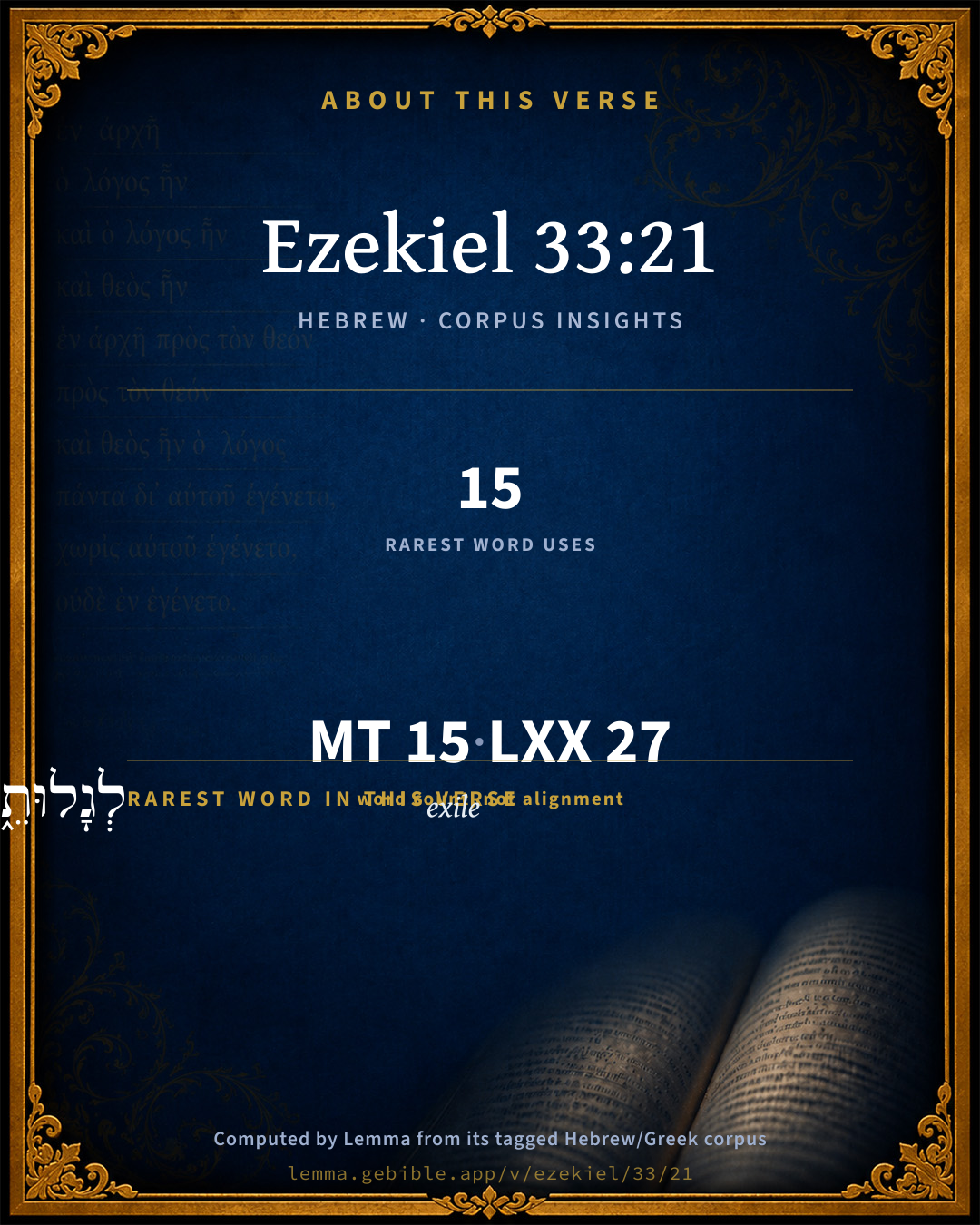
15
words
15
distinct lemmas
Prophets
section

Notable vocabulary

The rarest word here is לְגָלוּתֵ֑נוּ exile H1546 — appearing just 15 times in the whole Hebrew Bible.

Shared distinctive vocabulary

לְגָלוּתֵ֑נוּ exile H1546 occurs in 14 verses of the Hebrew Bible. Also found in:

Grammatical profile

  • 4 verbs
  • 6 nouns
  • 4 adjectives
  • 1 preposition

Verb forms

  • וַיְהִ֞י Qal · Sequential Imperfect
  • בָּא Qal · Perfect
  • לֵאמֹ֖ר Qal · Infinitive Construct
  • הֻכְּתָ֥ה Hophal · Perfect

Hebrew & Septuagint length

In English translation the verse runs 37 words from the Hebrew and 38 from the Septuagint (LXX English) — closely comparable.

A rough comparison of the two English renderings, which tokenize alike — not a word-level alignment.

Word counts can differ between the Hebrew and the Greek without any difference in meaning — e.g. the Hebrew direct-object marker אֵת has no separate Greek word, and Greek often adds the article ὁ.

In the original languages it is 15 Hebrew tokens and 27 Greek tokens — but the two are counted differently (Hebrew bundles its prefixes and suffixes into one token; the Greek is in lemma form), so that isn’t a like-for-like length.

Cross-references

10

Topical passages linked to Ezekiel 33:21 in the Treasury of Scripture Knowledge — connected by theme and wording, ordered by reader-vote popularity; previews shown in the World English Bible.

  • Ezekiel 1:2 In the fifth [day] of the month, which was the fifth year of king Jehoiachin's captivity,
  • 2 Kings 24:4–7 and also for the innocent blood that he shed; for he filled Jerusalem with innocent blood: and Yahweh would not pardon.
  • 2 Kings 25:4 Then a breach was made in the city, and all the men of war [fled] by night by the way of the gate between the two walls, which was by the king's garden (now the Chaldeans were against the city round about); and [the king] went by the way of the Arabah.
  • 2 Kings 25:10 All the army of the Chaldeans, who were [with] the captain of the guard, broke down the walls of Jerusalem round about.
  • 2 Chronicles 36:17–21 Therefore he brought on them the king of the Chaldeans, who killed their young men with the sword in the house of their sanctuary, and had no compassion on young man or virgin, old man or gray-headed: he gave them all into his hand.
  • Jeremiah 39:1–8 It happened when Jerusalem was taken, (in the ninth year of Zedekiah king of Judah, in the tenth month, came Nebuchadrezzar king of Babylon and all his army against Jerusalem, and besieged it;
  • Jeremiah 52:4–14 It happened in the ninth year of his reign, in the tenth month, in the tenth day of the month, that Nebuchadrezzar king of Babylon came, he and all his army, against Jerusalem, and encamped against it; and they built forts against it round about.
  • Ezekiel 24:26–27 that in that day he who escapes shall come to you, to cause you to hear it with your ears?
  • Ezekiel 32:1 It happened in the twelfth year, in the twelfth month, in the first [day] of the month, that the word of Yahweh came to me, saying,
  • Ezekiel 40:1 In the five and twentieth year of our captivity, in the beginning of the year, in the tenth [day] of the month, in the fourteenth year after that the city was struck, in the same day, the hand of Yahweh was on me, and he brought me there.

Cross-references courtesy of OpenBible.info (CC BY 4.0).

Hebrew and Greek witnesses Masoretic Hebrew ↔ Greek Septuagint

The same verse in the two great witnesses to the Old Testament, shown verse-for-verse.

These are two independent witnesses, not word-aligned to each other, and the Septuagint is shown in lemma (dictionary) form.

Hebrew Ezekiel 33:21 Masoretic · Westminster Leningrad Codex

וַיְהִ֞י בִּשְׁתֵּ֧י עֶשְׂרֵ֣ה שָׁנָ֗ה בָּעֲשִׂרִ֛י בַּחֲמִשָּׁ֥ה לַחֹ֖דֶשׁ לְגָלוּתֵ֑נוּ בָּא אֵלַ֨י הַפָּלִ֧יט מִירוּשָׁלִַ֛ם לֵאמֹ֖ר הֻכְּתָ֥ה הָעִֽיר

It happened in the twelfth year of our captivity, in the tenth [month], in the fifth [day] of the month, that one who had escaped out of Jerusalem came to me, saying, The city has been struck.

World English Bible · Public Domain

Greek LXX Ezekiel 33:21 Septuagint · lemma form

καί γίγνομαι ἐν ὁ δωδέκατος ἔτος ἐν ὁ δωδέκατος μήν πέμπτος ὁ μήν ὁ αἰχμαλωσία ἐγώ ἔρχομαι ὁ ἀνασώζω πρός ἐγώ ἀπό ἰερουσαλήμ λέγω ἁλίσκω ὁ πόλις

And it came to pass in the tenth year of our captivity, in the twelfth month, on the fifth day of the month, that one that had escaped from Jerusalem came to me, saying, The city is taken.

LXX2012 (modern English Septuagint) · Public Domain

On this verse, Haydock's Catholic Bible Commentary discusses the Septuagint’s reading. Read the note in Commentary ↓

Hebrew: Westminster Leningrad Codex (CC BY 4.0). Greek: Septuagint (public domain); English from LXX2012 (modern English Septuagint) (Public Domain). How the Septuagint differs from the Hebrew →

Targum (Aramaic paraphrase)

1

The Targum is the ancient Jewish Aramaic paraphrase of the Hebrew Scriptures — an interpretive translation, not the Hebrew text itself. Onkelos (literal) and Pseudo-Jonathan (expansive) render the Torah, and Jonathan the Prophets. Coverage is partial: where no permissively-licensed English translation exists for a verse, only the Aramaic is shown. This is verse-level text, not a word-by-word alignment to the Hebrew.

  1. Targum Jonathan Prophets (Joshua–Malachi)
    וַהֲוָה בְּתַרְתֵּי עַסְרֵי שְׁנִין בַּעֲשִׂירָאָה בְּחַמְשָׁא לְיַרְחָא לְגָלוּתָנָא אֲתָא לְוָתִי מְשֵׁיזְבָא מִירוּשְׁלֵם לְמֵימָר אִתְּרַעַת קַרְתָּא:

    (no public-domain English translation for this verse)

    Targum Jonathan — Aramaic: “Mikraot Gedolot” (public domain). English: “Sefaria Community Translation” (CC0 1.0 (public-domain dedication)); “London "Chaldee Paraphrase," 1871” (public domain). Text via Sefaria.

Commentary

Notes on Ezekiel 33:21 from classic Christian and Jewish commentators (each source and its license shown beneath its notes). The classic Christian expositions comment on the surrounding passage and are grouped to its opening verse, so a note may address several verses; the Jewish commentaries on the Tanakh (Rashi and others) are per-verse, so they appear only where the commentator wrote on this verse.

Lemma curates 59 commentaries, every one of them public domain or Creative Commons licensed, each selected and text-cleaned for this edition rather than reprinted as found. About our sources →

Matthew Henry's Commentary

Here we have,

I. The tidings brought to Ezekiel of the burning of Jerusalem by the Chaldeans. The city was burnt in the eleventh year of the captivity and the fifth month, Jer 52:12, Jer 52:13. Tidings hereof were brought to the prophet by one that was an eye-witness of the destruction, in the twelfth year, and the tenth month (Eze 33:21), which was a year and almost five months after the thing was done; we may well suppose that, there being a constant correspondence at this time more than ever kept up between Jerusalem and Babylon, he had heard the news long before. But this was the first time he had an account of it from a refugee, from one who escaped, who could be particular, and would be pathetic, in the narrative of it. And the sign given him was the coming of such a one to him as had himself narrowly escaped the flames (Eze 24:26): He that escapes in that day shall come unto thee, to cause thee to hear it with thy ears, to hear it more distinctly than ever, from one that could say, Quaeque ipse miserrima vidi - These miserable scenes I saw.

II. The divine impressions and influences he was under, to prepare him for those heavy tidings (Eze 33:22): The hand of the Lord was upon me before he came, and had opened my mouth to speak to the house of Israel what we had in the former part of this chapter. And now he was no more dumb; he prophesied now with more freedom and boldness, being by the event proved a true prophet, to the confusion of those that contradicted him. All the prophecies from ch. 24 to this chapter have relation purely to the nations about, it is probable that the prophet, when he received them from the Lord, did not deliver them by word of mouth, but in writing; for he could not Say to the Ammonites, Say unto Tyrus, Say unto Pharaoh, etc., so and so, but by letters directed to the persons concerned, as Zacharias, when he could not speak, wrote; and herein he was as truly executing his prophetic office as ever. Note, Even silenced ministers may be doing a great deal of good by writing letters and making visits. But now the prophet's mouth is opened, that he may speak to the children of his people. It is probable that he had, during these three years, been continually speaking to them as a friend, putting them in mind of what he had formerly delivered to them, but that he never spoke to them as a prophet, by inspiration, till now, when the hand of the Lord came upon him, renewed his commission, gave him fresh instructions, and opened his mouth, furnished him with power to speak to the people as he ought to speak.

III. The particular message he was entrusted with, relating to these Jews that yet remained in the land of Israel, and inhabited the wastes of that land, Eze 33:24. See what work sin had made. The cities of Israel had now become the wastes of Israel, for they lay all in ruins; some few that had escaped the sword and captivity still continued there and began to think of re-settling. This was so long after the destruction of Jerusalem that it was some time before this that Gedaliah (a modest humble man) and his friends were slain; but probably at this time Johanan, and the proud men that joined with him, were at the height (Jer 43:2); and before they came to a resolution to go into Egypt, wherein Jeremiah opposed them, it is probable that the project was to establish themselves in the wastes of the land of Israel, in which Ezekiel here opposed them, and probably despatched the message away by the person that brought him the news of Jerusalem's destruction. Or, perhaps, those here prophesied against might be some other party of Jews, that remained in the land, hoping to take root there and to be sole masters of it, after Johanan and his forces had gone into Egypt. Now here we have,

1. An account of the pride of these remaining Jews, who dwelt in the wastes of the land of Israel. Though the providence of God concerning them had been very humbling, and still was very threatening, yet they were intolerably haughty and secure, and promised themselves peace. He that brought the news to the prophet that Jerusalem was smitten could not tell him (it is likely) what these people said, but God tells him, They say, "The land is given us for inheritance, Eze 33:24. Our partners being gone, it is now all our own by survivorship, or, for want of heirs, it comes to us as occupants; we shall now be placed alone in the midst of the earth and have it all to ourselves." This argues great stupidity under the weighty hand of God, and a reigning selfishness and narrow-spiritedness; they pleased themselves in the ruin of their country as long as they hoped to find their own account in it, cared not though it were all waste, so that they might have the sole property - a poor inheritance to be proud of! They have the impudence to compare their case with Abraham's, glorying in this, We have Abraham to our father. "Abraham," say they, "was one, one family, and he inherited the land, and lived many years in the peaceable enjoyment of it; but we are many, many families, more numerous than he; the land is given us for inheritance." (1.) They think they can make out as good a title from God to this land as Abraham could: "If God gave this land to him, who was but one worshipper of him, as a reward of his service, much more will he give it to us, who are many worshippers of him, as the reward of our service." This shows the great conceit they had of the own merits, as if they were greater than those of Abraham their father, who yet was not justified by works. (2.) They think they can make good the possession of this land against the Chaldeans and all others invaders, as well as Abraham could against those that were competitors with him for it: "If he, who was but one, could hold it, much more shall we, who are many, and have many more at command than his 300 trained servants." This shows the confidence they had in their own might; they had got possession, and were resolved to keep it.

2. A check to this pride. Since God's providences did neither humble them nor terrify them, he sends them a message sufficient to do both.

(1.) To humble them, he tells them of the wickedness they still persisted in, which rendered them utterly unworthy to possess this land, so that they could not expect God should give it to them. They had been followed with one judgment after another, but they had not profited by those means of grace as might be expected; they were still unreformed, and how could they expect that they should possess the land? "Shall you possess the land? What! such wicked people as you are? How shall I put thee among the children, and give thee a pleasant land? Jer 3:19. Surely you never reflect upon yourselves, else you would rather wonder that you are in the land of the living than expect to possess this land. For do you now know how bad you are?" [1.] "You make no conscience of forbidden fruit, forbidden food: You eat with the blood," directly contrary to one of the precepts given to Noah and his sons when God gave them possession of the earth, Gen 9:4. [2.] "Idolatry, that covenant-breaking sin, that sin which the jealous God has been in a particular manner provoked by to lay your country waste, is still the sin that most easily besets you and which you have a strong inclination to: You lift up your eyes towards your idols, which is a sign that though perhaps you do not bow your knee to them so much as you have done, yet you set your hearts upon them and hanker after them." [3.] "You are as fierce, and cruel, and barbarous as ever: You shed blood, innocent blood." [4.] "You confide in your own strength, your own arm, your own bow, and have no dependence on, or regard to, God and his providence: You stand upon your sword (Eze 33:26); you think to carry all before you, and make all your own, by force of arms." How can those expect the inheritance of Isaac (as these did) who are of Ishmael's disposition, that had his hand against every man (Gen 16:12), and Esau's resolution to live by his sword? Gen 27:40. We met with those (Gen 32:27) who, when they died, thought they could not lie easy underground unless they had their swords under their heads. Here we meet with those who, while they live, think they cannot stand firmly above ground unless they have their swords under their feet, as if swords were both the softest pillows and the strongest pillars; though it was sin, it was sin, that first drew the sword. But, blessed be God, there are those who know better, who stand upon the support of the divine power and promise and lay their heads in the bosom of divine love, not trusting in their own sword, Psa 44:3. [5.] "You are guilty of all manner of abominations, and, particularly, you defile every one his neighbour's wife, which is an abomination of the first magnitude, and shall you possess the land? What! such vile miscreants as you?" Note, Those cannot expect to possess the land, nor to enjoy any true comfort or happiness here or hereafter, who live in rebellion against the Lord.

(2.) To terrify them, he tells them of the further judgments God had in store for them, which should make them utterly unable to possess this land, so that they could not stand it out against the enemy. Do they say that they shall possess the land? God has said they shall not, he has sworn it, As I live, saith the Lord. Though he has sworn that he delights not in the death of sinners, yet he has sworn also that those who persist in impenitency and unbelief shall not enter into his rest. [1.] Those that are in the cities, here called the wastes, shall fall by the sword, either by the sword of the Chaldeans, who come to avenge the murder of Gedaliah, or by one another's swords, in their intestine broils. [2.] Those that are in the open field shall be devoured by wild beasts, which swarmed, of course, in the country when it was dispeopled, and there were none to master them and keep them under, Exo 23:29. When the army of the enemy had quitted the country still there was no safety in it. Noisome beasts constituted one of the four sore judgments, Eze 14:15. [3.] Those that are in the forts and in the caves, that think themselves safe in artificial or natural fastnesses, because men's eyes cannot discover them nor men's darts reach them, there the arrows of the Almighty shall find them out; they shall die of the pestilence. [4.] The whole land, even the land of Israel, that had been the glory of all lands, shall be most desolate, Eze 33:28. It shall be desolation, desolation, all over as desolate as desolation itself can make it. The mountain of Israel, the fruitful mountains, Zion itself the holy mountain not excepted, shall be desolate, the roads unfrequented, the houses uninhabited, that none shall pass through; as it was threatened (Deu 28:62), You shall be left few in number. [5.] The pomp of her strength, whatever she glories in as her pomp and trusts to as her strength, shall be made to cease. [6.] The cause of all this was very bad; it is for all their abominations which they have committed. It is sin that does all this mischief, that makes nations desolate; and therefore we ought to call it an abomination. [7.] Yet the effect of all this will be very good: Then shall they know that I am the Lord, am their Lord, and shall return to their allegiance, when I have made the land most desolate. Those are untractable unteachable indeed that are not made to know their dependence upon God when all their creature-comforts fail them and are made desolate.

Matthew Henry's Commentary on the Whole Bible (1708–1710) — public domain (CC PDM 1.0). Text via the HelloAO Bible API.

Trapp's Complete Commentary

John Trapp

Eze 33:21 And it came to pass in the twelfth year of our captivity, in the tenth [month], in the fifth [day] of the month, [that] one that had escaped out of Jerusalem came unto me, saying, The city is smitten.

Ver. 21. In the twelfth year.] Some read the eleventh year; and indeed it was wonder that such ill news came no sooner, for αι βλαβαι ποδωκεις, saith Sophocles.

That one that had escaped.] {a} This God had promised. {Eze 24:26}

The city is smitten,] i.e., Sacked and burnt. This man spoke much in few.

{a} Superates tragis.

John Trapp, A Commentary or Exposition upon All the Books of the Old and New Testament (1647–1656) — public domain. Text from a community e-Sword module.

Joseph Benson's Commentary

Eze 33:21. In the twelfth year of our captivity, &c. — According to this reading, the news of the taking and burning of Jerusalem was brought to that part of the Babylonish dominions where the Jewish captives were placed in a year, five months, and twenty-six days after the calamity happened: see Jer 52:12. But eight MSS. having עשׁתיinstead of שׂתי, Bishop Newcome, and some others, think the preferable reading is, the eleventh year. If this be adopted, only about six months passed between the taking of Jerusalem and the communication of that event to Ezekiel. One that had escaped out of Jerusalem came unto me — According to what God had foretold to him should be the case, as is mentioned Eze 24:26, and which was to be as a new commission unto him to speak unto the people; from doing which, by the command of God, he had ceased for near three years before; the prophetic influence, or impulse, not coming upon him during that time.

Joseph Benson's Commentary on the Old and New Testaments (1811–1818) — public domain. Text from a community e-Sword module.

Dummelow's Commentary on the Holy Bible

J. R. Dummelow

The Prophet, the Survivors, and the Exiles

In Eze_24:27 it was announced to Ezekiel that the silence which began with his wife's death and the siege of Jerusalem would be ended when fugitives from the captured cities should arrive in Babylonia. This took place a year and five months (but see on Eze_33:21) after Jerusalem fell, and Ezekiel began once more to receive and proclaim messages from God. This passage contains two of these. The first was directed against the wicked survivors who remained in the land of Israel and boasted that it would still be theirs. They were destined to perish, and the land to be utterly desolated, in order that God's wrath against their sin might be shown to the uttermost (Eze_33:23-29). The second describes the changed attitude of the exiles towards Ezekiel. They were now interested in his words, discussing them in their gatherings, and listening eagerly to what he had to say. Yet their interest had more of curiosity than of earnestness. Not till the final punishment of the wicked survivors took place would they recognise Ezekiel as a prophet indeed (Eze_33:30-33).

21. The twelfth year, the tenth month] December 585-January 584 b.c. The Syriac Bible reads 'the eleventh year.' Five months seem more likely than a year and five months as the time to be allowed for a journey from Palestine to Babylonia.

22. Was] RV 'had been.' Ezekiel had come under the power of divine inspiration the previous evening, when the truths in Eze_33:1-20 had shaped themselves in his mind. The prophecy against the wicked survivors (Eze_33:23-29) was probably called forth by information which the fugitives brought as to their attitude.

24. They that in habit, etc.] the surviving wicked remnant in the land of Israel. Their wickedness is described in Eze_33:25, Eze_33:26. For an historical account of the events in Palestine after the fall of Jerusalem see Jeremiah 40-43. The survivors to whom Ezekiel refera are probably the anti-Babylonian party, led by Ishmael, the son of Nethaniah, who were responsible for the murder of Gedaliah: see Intro.

Abraham was one, etc.] These survivors reasoned—'If Abraham, who was only one man, obtained this land for his descendants, much more may we, who are many, hope to do so in spite of all that has happened.' For a sounder use of the same argument see Isa_51:2.

28. From Jer_52:30 we learn that there was a further deportation of 745 Jews to Babylonia five years after the fall of Jerusalem.

30. The children of thy people] the exiles of the first captivity. Still are talking against thee] RV 'talk of thee.'

32. The exiles listened to Ezekiel's words as they would to music, which was entertaining but had no practical influence on their lives.

33. When this Cometh to pass] the utter desolation of Palestine foretold in Eze_33:27, Eze_33:28.

J. R. Dummelow, A Commentary on the Holy Bible (Macmillan, 1909) — public domain. Text from a community e-Sword module.

Keil & Delitzsch

C. F. Keil & F. Delitzsch

Tidings of the Fall of Jerusalem, and the Consequences with Regard to the Prophet

Eze 33:21. And it came to pass in the twelfth year, in the tenth (month), on the fifth of the month after our being taken captive, there came to me a fugitive from Jerusalem, and said, The city is smitten. Eze 33:22. And the hand of Jehovah had come upon me in the evening before the arrival of the fugitive, and He opened my mouth, till he came to me in the morning; and so was my mouth opened, and I was silent no more. - In these verses the fulfilment of the promise made by God to the prophet in Eze 24:25-27, after the prediction of the destruction of Jerusalem, is recorded. The chronological datum, as to the precise time at which the messenger arrived with the account of the destruction of Jerusalem, serves to mark with precision the point of time at which the obstacle was removed, and the prophet was able to speak and prophesy without restraint. - The fact that the tidings of the destruction of Jerusalem, which took place in the fifth month of the eleventh year, are said to have only reached the exiles in the tenth month of the twelfth year, that is to say, nearly a year and a half after it occurred, does not warrant our following the Syriac, as Doederlein and Hitzig have done, calling in question the correctness of the text and substituting the eleventh year for the twelfth. With the distance at which Ezekiel was living, namely, in northern Mesopotamia, and with the fearful confusion which followed the catastrophe, a year and a half might very easily pass by before a fugitive arrived with the information. But Hitzig's assertion, that Ezekiel would contradict himself, inasmuch as, according to Eze 26:1-2, he received intelligence of the affair in the eleventh year, is founded upon a misinterpretation of the passage quoted. It is not stated there that Ezekiel received this information through a fugitive or any man whatever, but simply that God had revealed to him the fall of Jerusalem even before it occurred. לגלוּתינוּ, after our being led away (Eze 33:21 and Eze 40:1), coincides with לגלוּת המּלך in Eze 1:2. הכּתה, smitten, i.e., conquered and destroyed, exterminated. In the clause 'ויד יהוה , the verb היתה is a pluperfect, and אלי stands for עלי, according to the later usage. The formula indicates the translation of the prophet into an ecstatic state (see the comm. on Eze 1:3), in which his mouth was opened to speak, that is to say, the silence imposed upon him was taken away. The words, "till he came to me in the morning," etc., are not to be understood as signifying that the prophet's mouth had only been opened for the time from evening till morning; for this would be opposed to the following sentence. They simply affirm that the opening of the mouth took place before the arrival of the fugitive, the night before the morning of his arrival. ויּפּתח פּי, which follows, is an emphatic repetition, introduced as a link with which to connect the practically important statement that from that time forward he was not speechless any more. - It was in all probability shortly afterwards that Ezekiel was inspired with the word of God which follows in Eze 33:23-33, as we may infer from the contents of the word itself, which laid the foundation for the prophet's further prophesying. But nothing can be gathered from Eze 33:22 with regard to the time when this and the following words of God (as far as Ezekiel 39), of which no chronological data are given, were communicated to the prophet and uttered by him. His being "silent no more" by no means involves immediate or continuous speaking, but simply recalls the command to be speechless. There is no ground for the assumption that all these words of God were communicated to him in one night (Hvernick, Hengstenberg, and others), either in Eze 33:22 or in the contents of these divine revelations.

Keil & Delitzsch — Biblical Commentary on the Old Testament (1861–1891) — public domain (CC PDM 1.0). Text via the HelloAO Bible API. (Old Testament only.)

Tyndale Open Study Notes

Tyndale Open Resources

33:21 A survivor arrived from Jerusalem, bringing eyewitness testimony of the city’s fall. This news took more than five months to reach the exiles.

Tyndale Open Study Notes — © Tyndale Open Resources, licensed CC BY-SA 4.0. Text via the HelloAO Bible API.

Geneva Bible (1599)

Geneva Bible translators

When the Prophet was led away captive with Jeconiah.

Geneva Bible (1599) marginal notes — public domain. Text via Bolls.life.

Jamieson, Fausset & Brown

Robert Jamieson, A. R. Fausset & David Brown

twelfth year . . . tenth month--a year and a half after the capture of the city (Jer 39:2; Jer 52:5-6), in the eleventh year and fourth month. The one who escaped (as foretold, Eze 24:26) may have been so long on the road through fear of entering the enemy's country [HENDERSON]; or, the singular is used for the plural in a collective sense, "the escaped remnant." Compare similar phrases, "the escaped of Moab," Isa 15:9; "He that escapeth of them," Amo 9:1. Naturally the reopening of the prophet's mouth for consolation would be deferred till the number of the escaped remnant was complete: the removal of such a large number would easily have occupied seventeen or eighteen months.

Jamieson, Fausset & Brown — Commentary Critical and Explanatory on the Whole Bible (1871) — public domain (CC PDM 1.0). Text via the HelloAO Bible API.

Adam Clarke's Commentary

Verse 21. In the twelfth year of our captivity, in the tenth month, in the fifth day of the month] Instead of the twelfth year, the eleventh is the reading of seven of Kennicott's MSS., one of De Rossi's, and the Syriac. My own, mentioned in the preceding chapter, reads with the present text. This was on Wednesday, Jan. 25, A.M. 3416 or 3417.

One that had escaped out of Jerusalem] After it had been taken by the Chaldeans.

Came unto me, saying, THE CITY IS SMITTEN.] This very message God had promised to the prophet, Eze 24:26.

Adam Clarke's Commentary on the Bible (1810–1826) — public domain. Text from a community e-Sword/MySword module.

Ellicott's Commentary for English Readers

(21) In the twelfth year.—Comp. 2Ki_25:8; Jer_52:12. It was now a year and five months since the final destruction of Jerusalem and the Temple, and this seems to be a long time to be occupied in carrying the news to Chaldea. The news itself must have reached Babylon long since, but Ezekiel was to receive the tidings, doubtless with full and circumstantial details, from the mouth of a fugitive, and there are reasons why this could not well have occurred earlier. After the capture of the city, the general, Nebuzaradan, took the mass of the people and the abundant spoil to carry them to Babylon (Jer_52:15-27). He first took them to Nebuchadnezzar at Riblah, where a few were executed, and some time must have been occupied in settling the affairs of the desolated land. After this, the journey of the captives, carrying along with them the weighty spoil, was a slow one, and perhaps with frequent halts. We know from Ezr_7:9 that the returning captives, not thus hindered, occupied exactly four months in the journey from Babylon to Jerusalem. It is not surprising, therefore, that it should have been four times as long from the capture of Jerusalem to the arrival of the captives in Chaldea. This prophecy was nearly two months before that recorded in Ezekiel 32.

A Bible Commentary for English Readers, edited by Charles John Ellicott (1878–1897) — public domain. Text from a community e-Sword module.

The Cambridge Bible for Schools and Colleges

gen. ed. J. J. S. Perowne

21. The date here given is about a year and a half after the city’s fall. Considering the constant intercourse between the mother country and the exiles this period is very long. Some MSS. as well as the Syr. read eleventh year, leaving about six months for the news to travel by messenger. (Eleven and twelve are easily confused in Heb.).

our captivity] That of Jehoiachin, ch. Eze_1:2. “One that had escaped,” lit. the fugitive, may refer to one or more, cf. Eze_24:26.

21, 22. Fugitives from Judaea arrive among the exiles announcing that the city had fallen. This confirmation of all the prophet’s anticipations, which the exiles had received with so much incredulity, opened his mouth, gave him confidence to speak before his fellow exiles. And he announces what shall be the fate of those left in the land (Eze_33:23-29).

The Cambridge Bible for Schools and Colleges (gen. ed. J. J. S. Perowne; Cambridge University Press, 1878–1918) — public domain. Text from a community e-Sword module.

John Gill's Exposition

Then the word of the Lord came unto me,.... After the messenger had delivered his message, and he had received it, and conversed with him about it:

saying: as follows:

John Gill's Exposition of the Whole Bible (1746–1763) — public domain (CC PDM 1.0). Text via the HelloAO Bible API.

Albert Barnes' Notes on the Bible

The date shows an interval of 112 years from the taking of Jerusalem Jer 52:12. The general news that the city was taken must have reached them, but it was only when the messenger arrived that the prophet’s mouth was opened. It is not improbable that a body of men after the destruction of the city joined their brethren in Chaldaea; if so this would account for the lapse of time, and supply a reason why Ezekiel on their arrival should commence a new series of prophecies.

Albert Barnes' Notes on the Bible (1834–1885) — public domain. Text from a community e-Sword/MySword module.

Haydock's Catholic Bible Commentary

Twelfth. Roman Septuagint, "tenth." Syriac, "eleventh year,...in the twelfth month;" which Theodoret thinks more probable, as the city was taken in the ninth of the fourth month of that year. Yet even so, it is strange that the news should not arrive before. Some think (Calmet) that the messenger came also to announce what happened after the death of Godolias. (Sanctius) --- Captivity. Here it is evident that the prophet dates from that event, chap. i., &c. (Haydock) --- As he prophesied on the very day when the city was besieged, (chap. xxiv. 2.) so ([chap. xxiv.] ver. 26.) he foretold that one should come three years after to inform him of the capture. (Worthington) --- Then the people would believe him, (ibid.[chap. xxiv.] ver. 27.; Calmet) and he would open his mouth boldly, ver. 22. (Haydock)

George Leo Haydock (1774–1849), Haydock's Catholic Family Bible and Commentary, 1859 edition — public domain. Excludes Psalms (Douay-Rheims chapter numbering differs from Protestant) and Deuterocanonical books (Catholic canon only).

Matthew Poole's English Annotations

In the tenth month, in the fifth day of the month; that is one year and five months after the thing was done, and temple burnt, and the city sacked.

One that had escaped; one whose own care, but God’s wonderful providence had much more, befriended him; perhaps it might be one of those that yielded to the Babylonians before, but was resolved to see the upshot of all.

Saying; likely giving a particular account of the whole.

The city; Jerusalem. Smitten; taken and plundered, the inhabitants slain or captives, and the city sacked, razed, and burnt.

Matthew Poole's English Annotations on the Holy Bible (1683–1685) — public domain. Text from a community e-Sword/MySword module.

Whedon's Commentary on the Bible

Daniel D. Whedon

21. In the twelfth year — The fall of the city took place in the fourth month of the eleventh year (Jer_39:2; Jer_52:6). It seems incredible that Ezekiel should not hear of this for eighteen months. It is probable that the manuscripts are right that read “eleventh year.” The two numbers are very similar in Hebrew.

One that had escaped… came — Who was the fugitive? Plumptre suggests that Baruch may have been sent by Jeremiah to bear these sad tidings to his brother prophet (compare Jer_45:5), and Skinner thinks perhaps it was a captive “who had trudged the weary road to Babylon in chains under the escort of Nebuzaradan” (Jer_39:9).

Daniel D. Whedon (gen. ed.), Commentary on the Old and New Testaments (1874–1909) — public domain. Text from a community e-Sword module.

The Pulpit Commentary

In the twelfth year, etc. The capture of Jerusalem took place in the fourth month of the eleventh year (Jer_39:2 Jer_52:6) from the captivity of Jehoiachin and the beginning of Zedekiah"s reign. Are we to assume some error of transcription? or is it within the limits of probability that eighteen months would pass without any direct communication from Jerusalem of what had passed there? There is, I conceive, nothing improbable in what is stated. The exiles of Tel-Ahib were not on the highroads of commerce or of war. All previous communications were cut off by the presence of the Chaldean armies. In the words, one that had escaped, the prophet clearly referred to the intimation given him at the time of his wife"s death. (Eze_24:26) When the fugitive entered he saw that the hour had at last come. One would give much to know who the fugitive was, but we can only conjecture. Had Baruch been sent by Jeremiah to bear the tidings to his brother prophet? Such a mission would have been a fulfillment of Jer_45:5. A later tradition ascribes to Baruch a prominent part as a teacher among the exiles of Babylon (RAPC Bar 1:2) shortly after the destruction of Jerusalem.

Evil tidings.

Ezekiel had relatedly and most plainly foretold the capture of Jerusalem. He waited in sad suspense for the fulfillment of his inspired prediction. At last it came; and one who had escaped from Jerusalem, and who had fled eastward, brought the tidings to the children of the Captivity.

I THESE TIDINGS AFFECTED EZEKIEL AS A MAN, AROUSING HIS SYMPATHY.

II THESE TIDINGS AFFECTED HIM AS A PATRIOT, AFFLICTING HIM WITH HUMILIATION. Jerusalem was the metropolis of his country, of his race, it was the scene of events famous in national story. It had been won by the prowess of David; it had been adorned by the opulence and splendor of Solomon; it had been the emporium of commerce, and the home of the learned and the great. It had been the chosen seat of the sanctuary of Jehovah. How could a true-hearted Hebrew like Ezekiel hear of the capture and fall of the city of David, without feeling his heart sore and anguished because of his country"s bitter humiliation?

III THESE TIDINGS AFFECTED HIM, AS A DEVOUT ISRAELITE, WITH SINCERE DISTRESS. Ezekiel looked upon this event as a chastisement from God inflicted because of the unfaithfulness of the people, and their neglect to use their privileges and opportunities as they should have done. When the blow fell, his fears were realized and his sorrow was stirred within him, because of this consequence of Judah"s sins, and because of the evidence afforded of the displeasure of the righteous God.

IV THESE TIDINGS AFFECTED HIM AS A PROPHET WHO RECOGNIZED HEREIN THE FULFILMENT OF THE INSPIRED PREDICTION. What befell Jerusalem was what Ezekiel had, in the name of the Lord, repeatedly and plainly foretold. He could not but be confirmed in the veracity of his God and in the authenticity of his own commission, when the word which he had spoken was fulfilled, and when the disaster of which he had faithfully warned his fellow-countrymen fell upon them in all its destructiveness and desolation. T.

Vers. 21-29Right, not might, the foundation of stable empire.

The shortest path to gaining empire over men seems to be might, or might conjoined with cunning. But "things are not what they seem." The throne whose foundations have been well and slowly laid will attain to greater permanence. The oak that has been rooting itself for a hundred years will resist many a howling tempest. Things unseen are the things that endure.

I WE HAVE AN INSTANCE OF DIVINE CHASTISEMENT UNHEEDED. "The city is smitten." The city of which they had been so proud, the city which had seemed an impregnable stronghold, was captured by the invader. Their honored sanctuary was leveled to the ground. Precious lives were sacrificed. Their honor was trampled in the dust. Judah"s scepter was broken. It had been long time announced that this would be the outcome of Jehovah"s anger, and now the warning had been completely verified. If this painful event did not afflict their souls as an unmistakable chastisement for sin, then nothing would. The tree that remains fruitless, after skilful and severe pruning, is hopelessly barren. Affliction not Converted into blessing becomes a great disaster. Black clouds that dissolve not in rain become magazines of thunderbolts.

II AN INSTANCE OF FALLACIOUS REASONING. Although their numbers were decimated by war, they discovered that they were yet more in number than when Abraham dwelt in the land. He was in a minority of one, yet his posterity attained possession. These, his degenerate progeny, were still a strong body compared with solitary Abraham. Therefore their case was not utterly forlorn. True, they had been defeated, driven back, pressed into the barren hills and wastes of the laud, yet they could still muster a thousand or two. This was enough to regain a conquest. Their confidence was in numbers in themselves. "We are many; the land is given us.

III THE IMPORTANT ELEMENT OMITTED. The vital omission was this, that Abraham had God at his back, and all the resources of heaven for his defense; they had set God against them as their foe, and all the forces of righteousness were leagued for their overthrow. Their banners were stained with vice and crime. They had forsaken God, and had sought unto idols. No marvel, then, that God had forsaken them. Violence; adultery, sensuality, and murder cried to Heaven for vengeance, and did not cry m vain. The pleasures of sin had blinded their eyes to the real facts of the case. They had forgotten that God had declared himself the Arbiter in the field of war, and a moment"s reflection would have convinced them that God was with their adversary. The white escutcheon of their father Abraham had been by them basely defiled; and the worst feature was this they perceived it not.

IV AN INSTANCE OF JUDICIAL VISITATION. The great Judge of men had pronounced his verdict, and all their boastful expectations were reversed. Over against their boast, "The land is given us for inheritance," God placed his edict, "The mountains of Israel shall be desolate, that none shall pass through." The ministers of Divine vengeance had received their commission, and the time for revoking it had passed. Wild beasts, the pestilence, and the sword had heard the fiat of God, and proceeded to do their deadly work. No fortress could protect them against such insidious enemies. Into every secret cave of the mountains wild beasts and miasma would force their way. The army of God is a hundredfold more difficult to oppose or to elude than any host of human king. Sane men will promptly yield.

V THE GREAT LESSON LEARNT TOO LATE. "Then shall they know that I am the Lord." The light which they had sullenly barred out of their minds all their lifetime shall find its way within in the hour of death. Some men will listen to no warning voice except the warning voice of death. They learn at last what, had they learnt before, would have been their salvation. But now to them the lesson is useless; it serves only to admonish others. Crowds of men are practical infidels all through life, although they profess to believe in a reigning God; but death scatters the clouds of unbelief, and is a startling revelation of the invisible world. Amid the excitements and the turmoil of life they would not reflect, nor ponder, nor decide. They preferred to remain in the haze of doubt. At no point would they brace up their moral energy to say, "I know." Yet there comes an hour when faith, and righteousness, and God, and judgment will be real. "Then shall they know. D.

The Pulpit Commentary (1880–1919), ed. H.D.M. Spence-Jones & Joseph S. Exell — public domain. Text from a community e-Sword module.

John Wesley's Explanatory Notes

Smitten - Taken and plundered.

John Wesley, Explanatory Notes Upon the Whole Bible (1754–1765) — public domain. Text via the GEBible commentary corpus.

Scofield Reference Notes

C. I. Scofield

tenth month

i.e. January.

The Scofield Reference Bible (1917 edition), notes by C. I. Scofield — public domain. Text from a community e-Sword module.

Kretzmann's Popular Commentary

Paul E. Kretzmann

The Relation of the People to Ezekiel

v. 21. And it came to pass in the twelfth year of our captivity, in the tenth month, in the fifth day of the month, that is, a year and a half after the capture of Jerusalem, since Ezekiel was living in a very remote part of Babylon, that one that had escaped out of Jerusalem came unto me, saying, The city is smitten, the appalling news of the overthrow of Jerusalem thus being brought to the prophet’s attention in a most abrupt manner.

v. 22. Now, the hand of the Lord was upon me in the evening, causing a kind of ecstasy to fall upon him, afore he that was escaped came and had opened my mouth, which had formerly been closed, until he came to me in the morning, that is, this opening happened during the night, before the arrival of the messenger; and my mouth was opened, and I was no more dumb. Cf.Ezekiel 24:26-27.

v. 23. Then the word of the Lord came unto me, saying,

v. 24. Son of man, they that inhabit those wastes of the land of Israel, the few dwellers in the ruins of the cities of Israel, speak, saying, Abraham was one, and he inherited the land; but we are many; the land is given us for inheritance. Their argument was: If Abraham as an individual person received the land of Canaan for his possession, then surely the same God will not deny to us, the many rightful heirs of Abraham, the possession thus solemnly transmitted to him.

v. 25. Wherefore say unto them, Thus saith the Lord God, Ye eat with the blood, that is, without letting the blood drain out on the ground, as the ordinance of the Lord prescribed, Levitcus 3:17, and lift up your eyes toward your idols, in gross idolatry, and shed blood, by freely committing deeds of violence; and shall ye possess the land? Did they think that the Lord would permit them to retain possession of the heritage of their fathers with such transgressions found in their midst?

v. 26. Ye stand upon your sword, depending upon the forceful application of what they desired, ye work abomination, by committing base crimes without a show of regard for God’s will, and ye defile every one his neighbor’s wife, sins against the Sixth Commandment being unusually prevalent at that time; and shall ye possess the land? The rhetorical question places a double emphasis upon the Lord’s horror at their transgressions and the demand of His holiness for the proper punishment of the transgressors.

v. 27. Say thou thus unto them, Thus saith the Lord God, the God of the covenant, who is at the same time the Ruler of the universe, As I live, the most solemn oath which He is able to swear, surely they that are in the wastes, having sought refuge in the ruined cities and towns, shall fall by the sword, and him that is in the open field will I give to the beasts to be devoured, for the beasts of prey multiplied rapidly in the devastated country, and they that be in the forts, in mountain fastnesses, and in the caves, many of which, according to the account of Josephus, were inaccessible, shall die of the pestilence, unable to escape the punishment of the Lord.

v. 28. For I will lay the land most desolate, making it an utter waste, Jer 4:27; Jer 12:11, and the pomp of her strength, upon which she depended and of which she boasted, shall cease; and the mountains of Israel shall be desolate that none shall pass through, all the regular routes of travel through the land being abandoned and only an occasional horde of nomads being seen.

v. 29. Then shall they know that I am the Lord, this conviction being forced upon them in spite of all their efforts to deny His power, when I have laid the land most desolate because of all their abominations which they have committed. Note the force of the description in setting forth the continued state of desolation, on account of which some commentators think of the ruined state of the country, not only during the Exile, but also after the destruction of Jerusalem by the Romans.

v. 30. Also, thou son of man, the children of thy people, namely, those among the exiles in Babylon, still are talking against thee by the walls and in the doors of the houses, both when they met in public and when they felt secure in the privacy of their own homes, and speak one to another, every one to his brother, with a show of interest which was far from proceeding from a willing obedience to the Lord’s commands, saying, Come, I pray you, and hear what is the word that cometh forth from the Lord. Their sole motive was an obstinate curiosity, for they were not really concerned about keeping the will of the Lord; therefore Ezekiel was not to be deceived by this hollow mockery.

v. 31. And they come unto thee as the people cometh, in an assembly or crowd, as students flock to a teacher, and they sit before thee as My people, pretending to be the people of the Lord, and they hear thy words, in a respectful attitude, apparently earnest and willing, but they will not do them, op. Mat 13:20-21; Jas 1:23-24; for with their mouth they show much love, literally, "for the pleasant things in their mouth they are doing," that is, they follow after, and perform, only such things as please them for the time being, but their heart goeth after their covetousness, they have their minds set on advantages which they hope to get.

v. 32. And, lo, thou art unto them as a very lovely song of one that hath a pleasant voice, like a singer who charms with the sound of his voice, and can play well on an instrument, in accompanying his singing; for they hear thy words, but they do them not, giving no heed to their import nor obeying their admonition.

v. 33. And when this cometh to pass, namely, the prophecy concerning the desolation of the entire land of Israel, (lo, it will come, this emphatic declaration being inserted as a final warning,) then shall they know that a prophet hath been among them, that it was God’s message which Ezekiel proclaimed to them. As in those days, thus, too, many people of modern times are still willing enough to listen to a good speaker and even praise his eloquence, but they are altogether unwilling to follow his words, to apply the lessons of God’s Word iii their own lives. It is a form of hypocrisy which is bound to bring God’s punishment upon those who are guilty of such sham.

Paul E. Kretzmann, Popular Commentary of the Bible (1921–1924) — public domain. Text from a community e-Sword module.

unfoldingWord translationNotes

Door43 World Missions Community

It happened

This phrase is used here to mark the beginning of a new part of the story. If your language has a way for doing this, you could consider using it here.

the twelfth year ... fifth day ... tenth month

"year 12 ... day 5 ... month 10" (See: Ordinal Numbers)

on the fifth day of the tenth month

This is the tenth month of the Hebrew calendar. The fifth day is near the beginning of January on Western calendars. (See: Hebrew Months and Ordinal Numbers)

of our captivity

Here "our" refers to Ezekiel and the Israelites who have been in Babylon since the time the Babylonians forced King Jehoiachin to leave Jerusalem, but not to the reader. AT: "after we became captives" or "after the Babylonians took us as captives to Babylon" (See: Exclusive and Inclusive "We" and Assumed Knowledge and Implicit Information)

a fugitive came to me from Jerusalem

"someone escaped from Jerusalem and came to me" The Babylonians had destroyed Jerusalem and killed the people of Jerusalem, but a few people escaped.

The city has been captured

The phrase "the city" refers to "Jerusalem." This can be stated in active form. AT: "The Babylonians have destroyed Jerusalem" (See: Active or Passive)

The hand of Yahweh had been on me

The word "hand" is often used to refer to someone's power or action. A person with his hand on another person has power over that person. See how you translated a similar phrase in Ezekiel 1:3. AT: "Yahweh was controlling me" (See: Metonymy)

my mouth was opened

This phrase is an idiom that means to be able to speak. It can be stated in active form. See how you translated "I will open your mouth" in Ezekiel 3:27. AT: "I was able to speak" or "Yahweh enabled me to speak" (See: Idiom and Active or Passive)

dawn

The word "dawn" refers to the time early in the morning when the light of the sun first appears.

I was no longer mute

"I was no longer forced to be silent" or "I was no longer unable to speak" Ezekiel had been unable to speak anything except prophetic words since Ezekiel 3:26.

translationWords

year

day

captive

Jerusalem

hand

Yahweh

unfoldingWord translationNotes — © Distant Shores Media and the Door43 World Missions Community, licensed CC BY-SA 4.0. Source: git.door43.org/Door43/en_tn.

Lesson kit

Teaching starters — assembled from the data on this page, not authored interpretation. Every prompt links to the verse data it draws on. Edit before teaching.

Ezekiel, in the Prophets, opens this verse with 15 words (15 distinct Hebrew lemmas). Its most distinctive word is gâlûwth (“exile”). A historical commentator’s framing appears above. Read the whole chapter for the surrounding context.

Discussion questions

  1. The word gâlûwth carries the sense “exile.” How does it shape the verse?
  2. 2 Kings 25:27 shares the word «exile» with this verse. How do the two illuminate each other?
  3. The translations on this page render this verse differently — a whole-verse word diff, not a word-by-word alignment. What might account for the different wordings?
  4. The verb «וַיְהִ֞י» is Qal Sequential Imperfect. How does its form color the action?
  5. Reading how Matthew Henry's Commentary and Trapp's Complete Commentary read this verse, where do the two commentators agree and where do they part?

Things to notice

Reading settings

Reading text

Shown beneath each verse's original-language words.

Old Testament
Old Testament edition

Read the OT as the Masoretic Hebrew (MT) or the Greek Septuagint (LXX).

English shown for the Greek Septuagint (in the Hebrew ↔ Greek comparison).

Comparing translations? Open the Compare panel on any verse page to stack up to four side by side.