
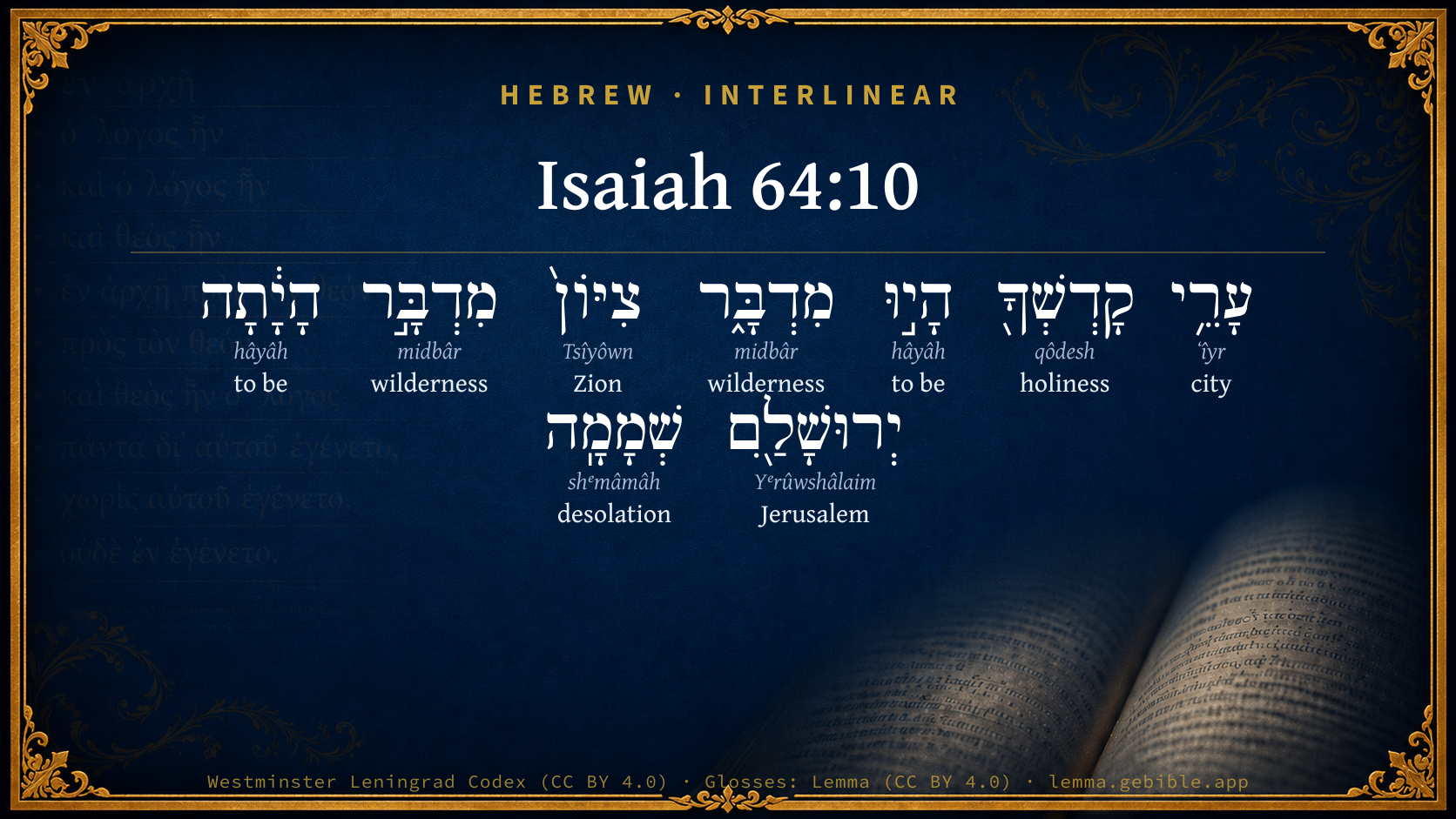
Isaiah 64:10

Hebrew (Westminster Leningrad Codex) Isaiah 64:10 appears in the Hebrew Old Testament. The text above is from the Westminster Leningrad Codex. Each word links to its Strong’s number, a concise gloss, and parsing drawn from the Open Scriptures Hebrew Bible morphology. Click any word for its full Brown-Driver-Briggs (BDB) entry.
Download image
Cite this verse

Isaiah 64:10 (World English Bible). Public Domain. Lemma interlinear Bible study tool, https://lemma.gebible.app/v/isaiah/64/10.

Show BibTeX & RIS
BibTeX
RIS
English Translation
Your holy cities are become a wilderness, Zion is become a wilderness, Jerusalem a desolation.
World English Bible · Public Domain
Download a study sheet

One document with this verse’s original text, its word-by-word gloss line, the meaning frame, cross-references with their text, attributed commentary, and full source and license credits — printable, and it pastes into notes with its structure intact.

This verse Autodidact and up

Study sheet (.html) Plain text (.txt)

A passage Seminary Student

Up to 50 verses in one chapter. A passage sheet keeps up to 6 commentary sources and 12 cross-references per verse, in the order this page ranks them, and says so on the sheet whenever that leaves anything out. Ask for a single verse and you get the Autodidact verse sheet above.

Everything on this page stays free to read, with no account — the sheet is a download of what is already on screen, not access to it.

Want to remove ads? Support Godless Engineer
Compare translations 3

The same verse in 3 English versions, stacked beneath the original-language interlinear above. Click any original word for its lexicon entry.

Each is an independent rendering of the whole verse — the interlinear is not word-aligned to these translations.

Highlighted words mark where these versions differ — a whole-verse word diff, not a word-by-word alignment.

  • World English Bible Public Domain
    Your holy cities are become a wilderness, Zion is become a wilderness, Jerusalem a desolation.
  • King James Version Public Domain
    Thy holy cities are a wilderness, Zion is a wilderness, Jerusalem a desolation.
  • unfoldingWord Literal Text CC BY-SA 4.0
    The cities of your holiness have become a wilderness. Zion has become a wilderness; Jerusalem, a devastation.

unfoldingWord Literal Text — © unfoldingWord, licensed CC BY-SA 4.0. Word-aligned USFM3 via Door43 (git.door43.org/unfoldingWord/en_ult).

Versions to compare (up to 4)

3 of 4 selected

Show all 18 translations

Every available English version of this verse, each an independent rendering of the whole verse.

  • World English Bible Public Domain
    Your holy cities are become a wilderness, Zion is become a wilderness, Jerusalem a desolation.
  • Berean Standard Bible Public Domain
    Your holy cities have become a wilderness. Zion has become a wasteland and Jerusalem a desolation.
  • Majority Standard Bible Public Domain
    Your holy cities have become a wilderness. Zion has become a wasteland and Jerusalem a desolation.
  • King James Version Public Domain
    Thy holy cities are a wilderness, Zion is a wilderness, Jerusalem a desolation.
  • American Standard Version (1901) Public Domain
    Thy holy cities are become a wilderness, Zion is become a wilderness, Jerusalem a desolation.
  • Revised Version (1885) Public Domain
    Thy holy cities are become a wilderness, Zion is become a wilderness, Jerusalem a desolation.
  • Geneva Bible (1599) Public Domain
    Thine holy cities lye waste: Zion is a wildernes, and Ierusalem a desart.
  • Douay-Rheims (1899) Public Domain
    The city of thy sanctuary is become a desert, Sion is made a desert, Jerusalem is desolate.
  • Young's Literal Translation Public Domain
    Thy holy cities have been a wilderness, Zion a wilderness hath been, Jerusalem a desolation.
  • Literal Standard Version CC BY-SA 4.0
    Your holy cities have been a wilderness, || Zion has been a wilderness, || Jerusalem a desolation.
  • Unlocked Literal Bible CC BY-SA 4.0
    Your holy cities have become a wilderness; Zion has become a wilderness, Jerusalem a desolation.
  • unfoldingWord Literal Text CC BY-SA 4.0
    The cities of your holiness have become a wilderness. Zion has become a wilderness; Jerusalem, a devastation.
  • Darby Bible Public Domain
    Thy holy cities are become a wilderness, Zion is a wilderness, Jerusalem a desolation.
  • World Messianic Bible Public Domain
    Your holy cities have become a wilderness. Zion has become a wilderness, Jerusalem a desolation.
  • Webster's Bible Public Domain
    \\64:11\\Our holy and our beautiful house, where our fathers praised thee, is burned with fire: and all our pleasant things are laid waste.
  • Free Bible Version CC BY-SA 4.0
    Your holy cities have been turned into a wilderness; Zion has become a desert; yes, even Jerusalem is an abandoned ruin.
  • Bible in Basic English Public Domain
    Our holy and beautiful house, where our fathers gave praise to you, is burned with fire; and all the things of our desire have come to destruction.
  • JPS Tanakh (1917) Public Domain
    (64-9) Thy holy cities are become a wilderness, Zion is become a wilderness, Jerusalem a desolation.

Literal Standard Version (2020), Covenant Press — licensed CC BY-SA 4.0. Text via the HelloAO Bible API (eBible.org). Unlocked Literal Bible (unfoldingWord) — licensed CC BY-SA 4.0. Text via the HelloAO Bible API (eBible.org). unfoldingWord Literal Text — © unfoldingWord, licensed CC BY-SA 4.0. Word-aligned USFM3 via Door43 (git.door43.org/unfoldingWord/en_ult). Free Bible Version, Dr. Jonathan Gallagher — licensed CC BY-SA 4.0. Text via the HelloAO Bible API (eBible.org).

Word by word

More ways to search: Search by grammar → Find every occurrence → Compare this word →

Practice this passage: Drill this verse → Learn its vocabulary →

About this verse

These counts appear in no published source. They are computed here, from the morphology-tagged text and Lemma’s own curated glosses. What Lemma adds →

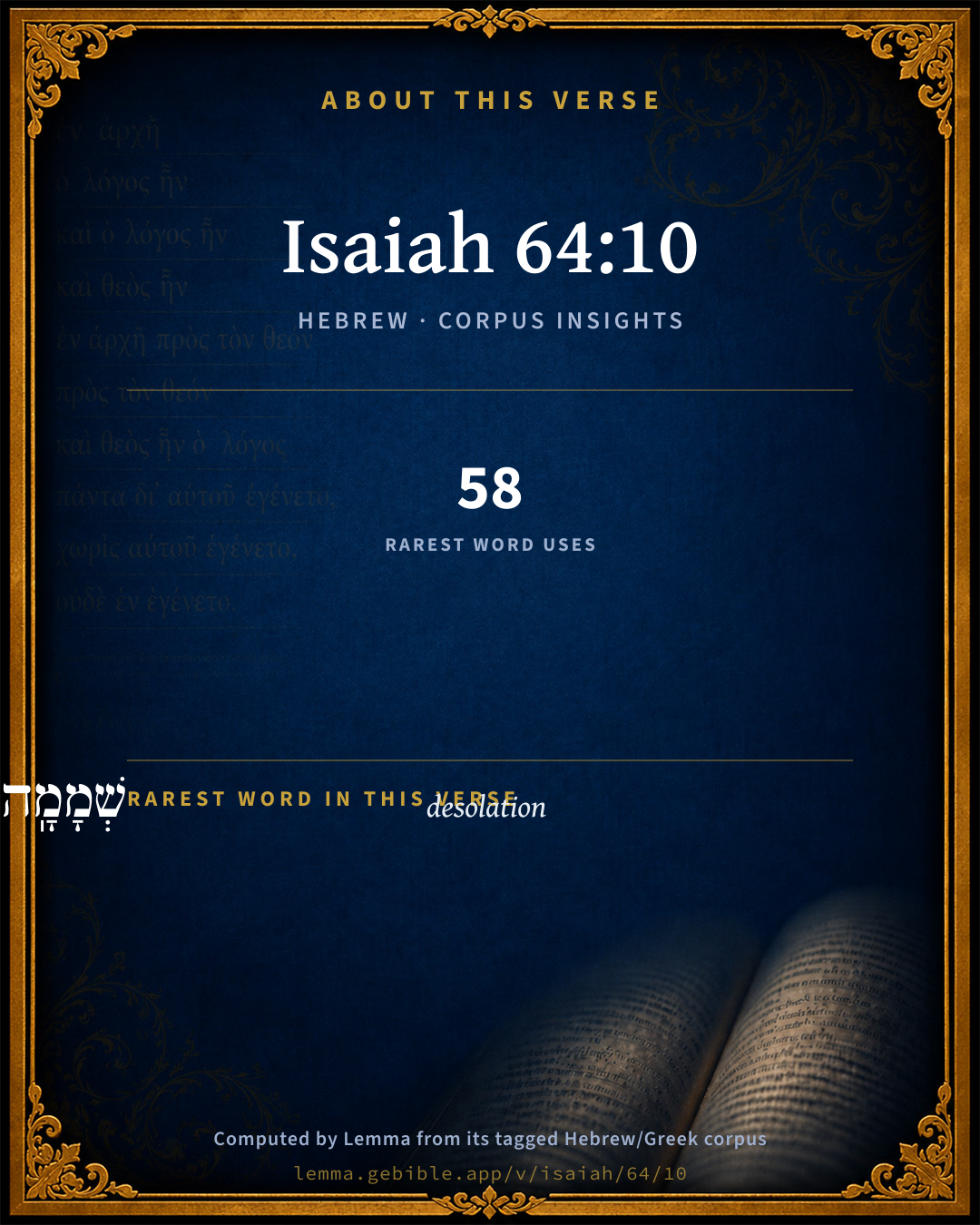
9
words
7
distinct lemmas
Prophets
section

Shared distinctive vocabulary

שְׁמָמָֽה desolation H8077 occurs in 54 verses of the Hebrew Bible. Also found in:

Grammatical profile

  • 2 verbs
  • 7 nouns

Verb forms

  • הָי֣וּ Qal · Perfect
  • הָיָ֔תָה Qal · Perfect

Repetition

Words recur within this verse — often emphatic in Hebrew:

  • הָי֣וּ to be H1961 ×2
  • מִדְבָּ֑ר wilderness H4057 ×2

Hebrew & Septuagint length

In English translation the verse runs 15 words from the Hebrew and 17 from the Septuagint (LXX English) — closely comparable.

A rough comparison of the two English renderings, which tokenize alike — not a word-level alignment.

Word counts can differ between the Hebrew and the Greek without any difference in meaning — e.g. the Hebrew direct-object marker אֵת has no separate Greek word, and Greek often adds the article ὁ.

Cross-references

13

Topical passages linked to Isaiah 64:10 in the Treasury of Scripture Knowledge — connected by theme and wording, ordered by reader-vote popularity; previews shown in the World English Bible.

  • Isaiah 1:7 Your country is desolate. Your cities are burned with fire. Strangers devour your land in your presence, And it is desolate, As overthrown by strangers.
  • Luke 21:24 They will fall by the edge of the sword, and will be led captive into all the nations. Jerusalem will be trampled down by the Gentiles, until the times of the Gentiles are fulfilled.
  • 2 Kings 25:9 He burnt the house of Yahweh, and the king's house; and all the houses of Jerusalem, even every great house, burnt he with fire.
  • 2 Chronicles 36:19–21 They burnt the house of God, and broke down the wall of Jerusalem, and burnt all the palaces of it with fire, and destroyed all the goodly vessels of it.
  • Psalms 79:1–7 God, the nations have come into your inheritance. They have defiled your holy temple. They have laid Jerusalem in heaps.
  • Lamentations 1:1–4 How does the city sit solitary, that was full of people! She has become as a widow, who was great among the nations! She who was a princess among the provinces is become tributary!
  • Lamentations 2:4–8 He has bent his bow like an enemy, he has stood with his right hand as an adversary, Has killed all that were pleasant to the eye: In the tent of the daughter of Zion he has poured out his wrath like fire.
  • Lamentations 5:18 For the mountain of Zion, which is desolate: The foxes walk on it.
  • Daniel 9:26–27 After the sixty-two weeks the Anointed One shall be cut off, and shall have nothing: and the people of the prince who shall come shall destroy the city and the sanctuary; and the end of it shall be with a flood, and even to the end shall be war; desolations are determined.
  • Daniel 12:7 I heard the man clothed in linen, who was above the waters of the river, when he held up his right hand and his left hand to heaven, and swore by him who lives forever that it shall be for a time, times, and a half; and when they have made an end of breaking in pieces the power of the holy people, all these things shall be finished.
  • Micah 3:12 Therefore Zion for your sake will be plowed like a field, And Jerusalem will become heaps of rubble, And the mountain of the temple like the high places of a forest.
  • Revelation 11:1–2 A reed like a rod was given to me. Someone said, "Rise, and measure God's temple, and the altar, and those who worship in it.
  • Luke 21:21 Then let those who are in Judea flee to the mountains. Let those who are in the midst of her depart. Let those who are in the country not enter therein.

Cross-references courtesy of OpenBible.info (CC BY 4.0).

Hebrew and Greek witnesses Masoretic Hebrew ↔ Greek Septuagint

The same verse in the two great witnesses to the Old Testament, shown verse-for-verse.

These are two independent witnesses, not word-aligned to each other, and the Septuagint is shown in lemma (dictionary) form.

Hebrew Isaiah 64:10 Masoretic · Westminster Leningrad Codex

עָרֵ֥י קָדְשְׁךָ֖ הָי֣וּ מִדְבָּ֑ר צִיּוֹן֙ מִדְבָּ֣ר הָיָ֔תָה יְרוּשָׁלִַ֖ם שְׁמָמָֽה

Your holy cities are become a wilderness, Zion is become a wilderness, Jerusalem a desolation.

World English Bible · Public Domain

Greek LXX Isaiah 64:10 Septuagint · lemma form

ὁ οἶκος ὁ ἅγιος ἐγώ καί ὁ δόξα ὅς εὐλογέω ὁ πατήρ ἐγώ γίγνομαι πυρίκαυστος καί πᾶς ὁ ἔνδοξος συνπίπτω

The city of your holiness has become desolate, Sion has become as a wilderness, Jerusalem a curse.

LXX2012 (modern English Septuagint) · Public Domain

On this verse, Ellicott's Commentary for English Readers discusses the Septuagint’s reading. Read the note in Commentary ↓

Hebrew: Westminster Leningrad Codex (CC BY 4.0). Greek: Septuagint (public domain); English from LXX2012 (modern English Septuagint) (Public Domain). How the Septuagint differs from the Hebrew →

Targum (Aramaic paraphrase)

1

The Targum is the ancient Jewish Aramaic paraphrase of the Hebrew Scriptures — an interpretive translation, not the Hebrew text itself. Onkelos (literal) and Pseudo-Jonathan (expansive) render the Torah, and Jonathan the Prophets. Coverage is partial: where no permissively-licensed English translation exists for a verse, only the Aramaic is shown. This is verse-level text, not a word-by-word alignment to the Hebrew.

  1. Targum Jonathan Prophets (Joshua–Malachi)
    בֵּית קוּדְשָׁנָא וְתוּשְׁבַּחְתָּנָא אֲתַר דִפְלָחוּ קֳדָמָךְ אֲבְהָתָנָא הֲוָה לִיקֵידַת נוּר וְכָל בֵּית רַנְגָנָא הֲוָה לְחָרְבָּא:

    The house of our holiness and of our glory, where our fathers worshipped Thee, is burned up with fire: and every place of our desire hath become a waste.

    Targum Jonathan — Aramaic: “Mikraot Gedolot” (public domain). English: “Sefaria Community Translation” (CC0 1.0 (public-domain dedication)); “London "Chaldee Paraphrase," 1871” (public domain). Text via Sefaria.

Commentary

Notes on Isaiah 64:10 from classic Christian and Jewish commentators (each source and its license shown beneath its notes). The classic Christian expositions comment on the surrounding passage and are grouped to its opening verse, so a note may address several verses; the Jewish commentaries on the Tanakh (Rashi and others) are per-verse, so they appear only where the commentator wrote on this verse.

Lemma curates 59 commentaries, every one of them public domain or Creative Commons licensed, each selected and text-cleaned for this edition rather than reprinted as found. About our sources →

Trapp's Complete Commentary

John Trapp

Isa 64:10 Thy holy cities are a wilderness, Zion is a wilderness, Jerusalem a desolation.

Ver. 10. Thy holy cities are a wilderness.] And is that for thine honour. "Behold, see, we beseech thee."

John Trapp, A Commentary or Exposition upon All the Books of the Old and New Testament (1647–1656) — public domain. Text from a community e-Sword module.

Joseph Benson's Commentary

Isa 64:10-12. Thy holy cities — Zion and Jerusalem, mentioned immediately after; or other cities also in the land of Judea besides these two; called holy, because God had his synagogues in them, in which he was worshipped, Psa 74:8. Zion is a wilderness, &c. — Utterly waste: not only the ordinary cities, but Zion and Jerusalem themselves are in a state of ruin and desolation. Our holy and beautiful house — Our temple. Not only our principal cities, but even our temple, which we thought sacred and inviolable, in which we gloried, because it was thine, and our fathers’ house, and ours: the place where thy holy service was performed, and thy glory and presence were wont to be manifested. Where our fathers praised thee — They do not presume to mention themselves, having been every way so very abominable; but put the Lord in mind of their fathers, many of whom were his faithful servants, having praised him there. Is burned up with fire — This relates to the burning of the temple by the Romans, who made an entire destruction of it, according to our Saviour’s prediction, Mat 24:2. And all our pleasant things are laid waste — Not only the pleasant land, but all that was magnificent, ornamental, or desirable in Jerusalem, or any other city, town, or place. Wilt thou refrain, or, contain, thyself for, or, at, these things — Wilt thou behold them unmoved, as an indifferent spectator? Wilt thou neither show thy compassion toward thy servants, nor thy resentment toward thine enemies? Wilt thou hold thy peace — Wilt thou be as one that regards not? And afflict us very sore — And persist to afflict us in thy continued hot displeasure?

Joseph Benson's Commentary on the Old and New Testaments (1811–1818) — public domain. Text from a community e-Sword module.

Tyndale Open Study Notes

Tyndale Open Resources

64:10 holy cities: All the cities of Judah were considered holy to God. However, the Temple in the host city of Jerusalem was the most holy place.

Tyndale Open Study Notes — © Tyndale Open Resources, licensed CC BY-SA 4.0. Text via the HelloAO Bible API.

Geneva Bible (1599)

Geneva Bible translators

Which were dedicated to thy service, and to call upon thy Name.

Geneva Bible (1599) marginal notes — public domain. Text via Bolls.life.

Jamieson, Fausset & Brown

Robert Jamieson, A. R. Fausset & David Brown

holy cities--No city but Jerusalem is called "the holy city" (Isa 48:2; Isa 52:1); the plural, therefore, refers to the upper and the lower parts of the same city Jerusalem [VITRINGA]; or all Judea was holy to God, so its cities were deemed "holy" [MAURER]. But the parallelism favors VITRINGA. Zion and Jerusalem (the one city) answering to "holy cities."

Jamieson, Fausset & Brown — Commentary Critical and Explanatory on the Whole Bible (1871) — public domain (CC PDM 1.0). Text via the HelloAO Bible API.

Ellicott's Commentary for English Readers

(10) Thy holy cities . . .—There is no other instance of the plural, and this probably led the LXX. and Vulg. to substitute the singular. It probably rests on the thought that the whole land was holy (Zec_2:12), and that this attribute extended, therefore, to all its cities, especially to those which were connected with historical memories. Possibly, however, Zion and Jerusalem—the former identified with the Temple, the latter with the people of Jehovah—are thought of as two distinct cities, locally united. The “wilderness” is, as elsewhere, rather open pasture-land than a sandy desert.

A Bible Commentary for English Readers, edited by Charles John Ellicott (1878–1897) — public domain. Text from a community e-Sword module.

The Cambridge Bible for Schools and Colleges

gen. ed. J. J. S. Perowne

10. Thy holy cities] is a phrase which does not occur elsewhere, and both LXX. and Vulg. substitute the sing. for the plur. It is not necessary, however, to follow them. If the land is holy (Zec_2:12) there is no reason why the epithet should not be applied to all its cities.

10, 11. The evidences of Jehovah’s displeasure are to be seen on every hand, in the desolation and ruin of the sacred places.

The Cambridge Bible for Schools and Colleges (gen. ed. J. J. S. Perowne; Cambridge University Press, 1878–1918) — public domain. Text from a community e-Sword module.

John Gill's Exposition

Thy holy cities are a wilderness,.... Meaning either Zion, the city of David, and Jerusalem; the one called the upper, the other the lower city; now uninhabited, and a mere wilderness: or else the other cities of Judea, in which were formerly synagogues for religious service, and in which dwelt many godly families where the worship of God was kept up; but now a desert, at least quite devoid of true religion and godliness.

Zion is a wilderness, Jerusalem a desolation; which are either explanative of the holy cities in the preceding clauses, or are mentioned as distinct from them; the account proceeding from the lesser to the metropolitan cities, which fared no better than they did, but equally lay desolate; and which fulfilled the prophecy in Mic 3:12 and was the case of those cities, at the destruction of them by Titus; and to this day are in a ruinous condition in the hands of the Turks.

John Gill's Exposition of the Whole Bible (1746–1763) — public domain (CC PDM 1.0). Text via the HelloAO Bible API.

Albert Barnes' Notes on the Bible

Thy holy cities are a wilderness - It is to be remembered that this is supposed to be spoken near the close of the exile in Babylon. In accordance with the usual custom in this book, Isaiah throws himself forward by prophetic anticipation into that future period, and describes the scene as if it were passing before his eyes (see the Introduction, Section 7). He uses language such as the exiles would use; he puts arguments into their mouths which it would be proper for them to use; he describes the feelings which they would then have. The phrase, ‘thy holy cities,’ may either mean the cities of the holy land - which belonged to God, and were ‘holy,’ as they pertained to his people; or it may mean, as many critics have supposed, the different parts of Jerusalem. A part of Jerusalem was built on Mount Zion, and was called the ‘upper city,’ in contradistinction from that built on Mount Acra, which was called the ‘lower city.’ But I think it more probable that the prophet refers to the cities throughout the land that were laid waste.

Are a wilderness - They were uninhabited, and were lying in ruins.

Zion is a wilderness - On the name ‘Zion,’ see the notes at Isa 1:8. The idea here is, that Jerusalem was laid waste. Its temple was burned; its palaces destroyed; its houses uninhabited. This is to be regarded as being uttered at the close of the exile, after Jerusalem had been lying in ruins for seventy years - a time during which any forsaken city would be in a condition which might not improperly be called a desert. When Nebuchadnezzar conquered Jerusalem, he burned the temple, broke down the wall, and consumed all the palaces with fire (2Ch 36:19). We have only to conceive what must have been the state of the city seventy years after this, to see the force of the description here.

Albert Barnes' Notes on the Bible (1834–1885) — public domain. Text from a community e-Sword/MySword module.

Haydock's Catholic Bible Commentary

Desolate, under Antiochus Epiphanes, 1 Machabees i. 31., and iv. 38. (Calmet)

George Leo Haydock (1774–1849), Haydock's Catholic Family Bible and Commentary, 1859 edition — public domain. Excludes Psalms (Douay-Rheims chapter numbering differs from Protestant) and Deuterocanonical books (Catholic canon only).

Matthew Poole's English Annotations

Thy holy cities; either Zion and Jerusalem, being the cities they instance in: q.d. Thy holy cities, viz. Zion and Jerusalem: or rather, other cities also in the land of Judea besides those two; called holy, either,

1. Because they were built upon God’s inheritance, Isa 63:17. Or,

2. Because they were inhabited by the Jews, who were a holy people, Deu 7:6; Dan 12:7. Or,

3. Because God had his synagogues in them, Psa 74:8. For all which reasons also they are called thy cities.

A desolation; utterly waste; not only the ordinary cities, but even Jerusalem and Zion themselves; the one called the upper Jerusalem, or the city of David, because it was built upon Mount Zion; the other the lower city, because it lay under the hill of Zion in the valley: he particularizeth Zion and Jerusalem, though he had mentioned the other cities before, because the chiefest of the cities; it being usual, notwithstanding the mentioning of generals, in which all the particulars or individuals are included, to name the particular again; as, and from the hand of Saul, Psa 18:1.

Matthew Poole's English Annotations on the Holy Bible (1683–1685) — public domain. Text from a community e-Sword/MySword module.

Whedon's Commentary on the Bible

Daniel D. Whedon

10, 11. Thy holy cities are a wilderness — In the interest of anti-supernaturalism many German and some English interpreters claim support from these verses. They advocate a pseudo-Isaiah, an unknown prophet who lived at or before the time of the Exile, and wrote these later prophecies. They assume miracle and predictive prophecy to be impossible, and that Isaiah, who wrote seven hundred years prior to events and facts here delineated, cannot be the author. This is a cool begging of the whole question; and, being so, is unworthy of further notice.

Our holy…house… burned — The reference here is to the burning of the temple. But which temple? The first one was destroyed by Nebuchadnezzar, the second by the Romans in A.D. 70, besides being twice polluted — first by Syrians, and next by the Romans. Nothing shows it certain that the temple referred to was the one destroyed by the Babylonians, but the description of the burning and the long unrestored desolation points most suitably to the ruin effected by the Romans. The “holy cities” apply more seemly to those of Jerusalem and Judah. This view renders more impressive the deep confession of the chapter and the closing appeal of the people to God as their Father, and tohis power as of a potter over the clay.

Daniel D. Whedon (gen. ed.), Commentary on the Old and New Testaments (1874–1909) — public domain. Text from a community e-Sword module.

The Pulpit Commentary

Thy holy cities are a wilderness. Commonly Jerusalem stands alone as "the holy city"; (Isa_48:2 Isa_56:1 Dan_9:24 Neh_11:1, Neh_11:18) but here the epithet is applied to the cities of Judah generally. They were all in a certain sense "holy," as being comprised within the limits of "the holy land" (Zec_2:12) and "the holy border". (Psa_78:54) Zion... Jerusalem. (see the comment on Isa_62:1)

The Pulpit Commentary (1880–1919), ed. H.D.M. Spence-Jones & Joseph S. Exell — public domain. Text from a community e-Sword module.

J. A. Alexander on Isaiah

Joseph Addison Alexander

“Thy holy cities are a desert, Zion is a desert, Jerusalem a waste.” By holy cities, some understand the towns of Judah; others Jerusalem alone, considered as consisting of two towns, the upper and the lower, here called Zion and Jerusalem, though each of these names sometimes comprehends the whole, and the latter is dual in its very form. If the writer had intended to employ the terms in the former sense, he would hardly have confined his specifications in the other clause to Zion and Jerusalem. In any case, these must be regarded as the chief if not the only subjects of his proposition. On the whole, the true sense of the verse, expressed or implied, appears to be that Zion has long been a desolation and Jerusalem a waste.

Joseph Addison Alexander, The Prophecies of Isaiah (1846–1847; New York: Scribner, 1870–1878) — public domain. Text from a community e-Sword module.

unfoldingWord translationNotes

Door43 World Missions Community

General Information:

The people of Israel continue speaking to Yahweh.

Your holy cities have become a wilderness

This emphasizes that the cities have been destroyed and no one lives there.

Our holy and beautiful temple, where our fathers praised you, has been destroyed by fire

This can be stated in active form. AT: "The enemy has destroyed our holy and beautiful temple, where our fathers praised you, by fire" (See: Active or Passive)

How can you still hold back, Yahweh? How can you remain silent and continue to humiliate us?

They use questions to express their frustration because God has not yet come to help them. AT: "Please do not hold back, Yahweh! Please do not remain silent and continue to humiliate us!" (See: Rhetorical Question)

translationWords

holy

desert

Zion

Jerusalem

desolate

temple

ancestor

praise

ruin

unfoldingWord translationNotes — © Distant Shores Media and the Door43 World Missions Community, licensed CC BY-SA 4.0. Source: git.door43.org/Door43/en_tn.

Ibn Ezra

Rabbi Abraham ibn Ezra

Our holy and our beautiful house. The temple.

Where our fathers praised Thee through the mouth of the Levites, the singers. by singing, and this was done in the temple by the Levites. In a more general sense it is paraphrased in Targum Jonathan: דפלחו קדמך אבהתנא where our ancestors worshipped Thee.

Ibn Ezra on the Tanakh — English translations: “Sefaria Community Translation” (CC0 1.0 (public-domain dedication)); “Yalkut, Sifsei Chachomim Chumash, Metsudah Publications, 2009” (CC BY 4.0); and “Commentary of Ibn Ezra on Isaiah - trans. by M. Friedlander, 1873” (public domain). Text via Sefaria.

Lesson kit

Teaching starters — assembled from the data on this page, not authored interpretation. Every prompt links to the verse data it draws on. Edit before teaching.

Isaiah, in the Prophets, opens this verse with 9 words (7 distinct Hebrew lemmas). Its most distinctive word is shᵉmâmâh (“desolation”). A historical commentator’s framing appears above. Read the whole chapter for the surrounding context.

Discussion questions

  1. What does “desolation” (shᵉmâmâh) contribute to the verse as a whole?
  2. Exodus 23:29 shares the word «desolation» with this verse. How do the two illuminate each other?
  3. “to be” occurs 2× in this one verse. What is the effect of the repetition?
  4. These translations render this verse differently; the difference is in the English rendering, not the original. What questions does that raise?
  5. The verb «הָי֣וּ» is Qal Perfect. How does its form color the action?
  6. Reading how Trapp's Complete Commentary and Joseph Benson's Commentary read this verse, where do the two commentators agree and where do they part?

Things to notice

  • These translations choose different wording for 7 words in this verse.
  • “to be” occurs 2× in this single verse.
  • 7 distinct Hebrew lemmas span 9 words in this verse.

Reading settings

Reading text

Shown beneath each verse's original-language words.

Old Testament
Old Testament edition

Read the OT as the Masoretic Hebrew (MT) or the Greek Septuagint (LXX).

English shown for the Greek Septuagint (in the Hebrew ↔ Greek comparison).

Comparing translations? Open the Compare panel on any verse page to stack up to four side by side.