
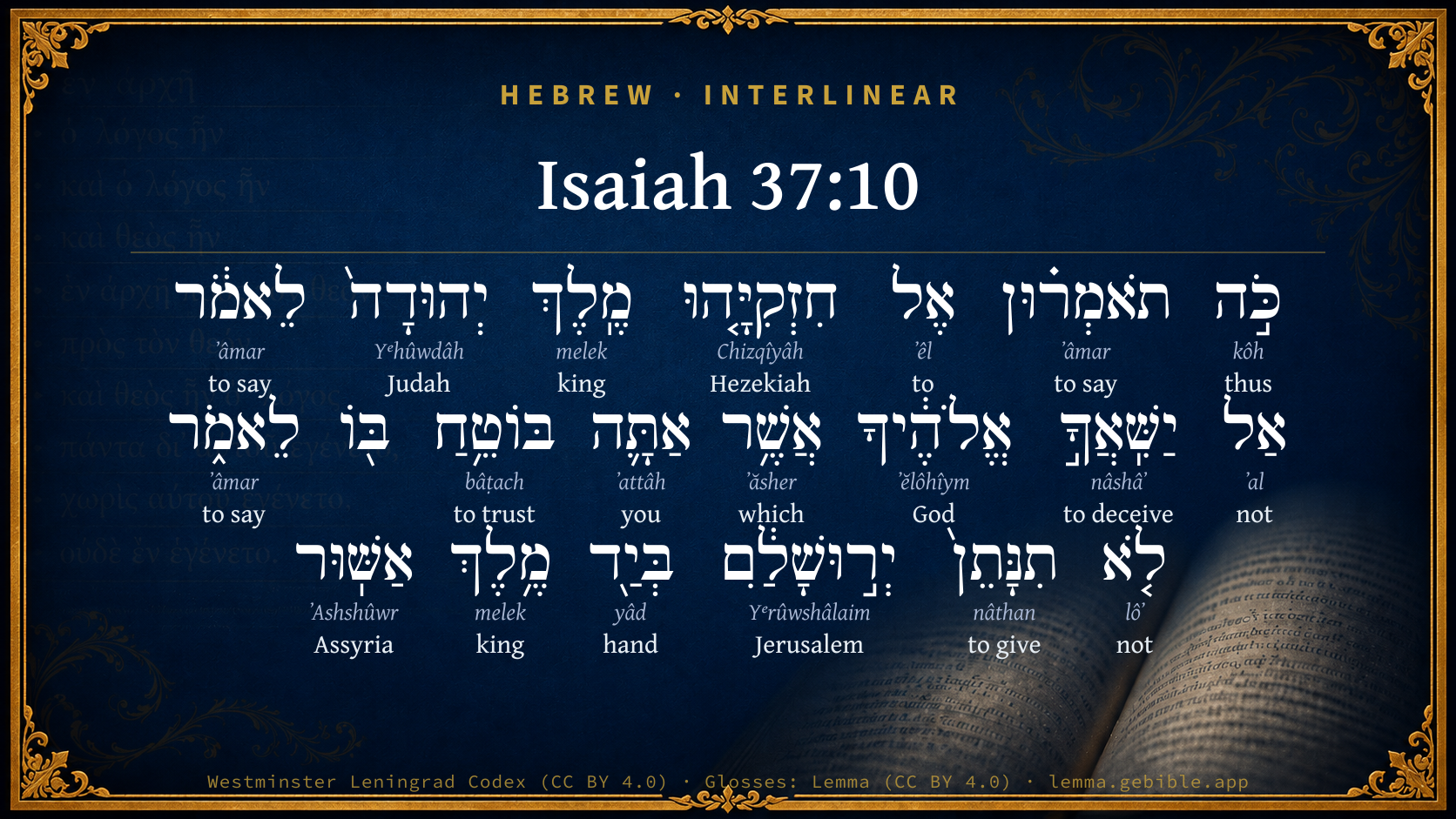
Isaiah 37:10

Hebrew (Westminster Leningrad Codex) Isaiah 37:10 appears in the Hebrew Old Testament. The text above is from the Westminster Leningrad Codex. Each word links to its Strong’s number, a concise gloss, and parsing drawn from the Open Scriptures Hebrew Bible morphology. Click any word for its full Brown-Driver-Briggs (BDB) entry.
Download image
Cite this verse

Isaiah 37:10 (World English Bible). Public Domain. Lemma interlinear Bible study tool, https://lemma.gebible.app/v/isaiah/37/10.

Show BibTeX & RIS
BibTeX
RIS
English Translation
Thus shall you speak to Hezekiah king of Judah, saying, Don't let your God in whom you trust deceive you, saying, Jerusalem shall not be given into the hand of the king of Assyria.
World English Bible · Public Domain
Download a study sheet

One document with this verse’s original text, its word-by-word gloss line, the meaning frame, cross-references with their text, attributed commentary, and full source and license credits — printable, and it pastes into notes with its structure intact.

This verse Autodidact and up

Study sheet (.html) Plain text (.txt)

A passage Seminary Student

Up to 50 verses in one chapter. A passage sheet keeps up to 6 commentary sources and 12 cross-references per verse, in the order this page ranks them, and says so on the sheet whenever that leaves anything out. Ask for a single verse and you get the Autodidact verse sheet above.

Everything on this page stays free to read, with no account — the sheet is a download of what is already on screen, not access to it.

Want to remove ads? Support Godless Engineer
Compare translations 3

The same verse in 3 English versions, stacked beneath the original-language interlinear above. Click any original word for its lexicon entry.

Each is an independent rendering of the whole verse — the interlinear is not word-aligned to these translations.

Highlighted words mark where these versions differ — a whole-verse word diff, not a word-by-word alignment.

  • World English Bible Public Domain
    Thus shall you speak to Hezekiah king of Judah, saying, Don't let your God in whom you trust deceive you, saying, Jerusalem shall not be given into the hand of the king of Assyria.
  • King James Version Public Domain
    Thus shall ye speak to Hezekiah king of Judah, saying, Let not thy God, in whom thou trustest, deceive thee, saying, Jerusalem shall not be given into the hand of the king of Assyria.
  • unfoldingWord Literal Text CC BY-SA 4.0
    “Thus you shall say to Hezekiah, the king of Judah, saying, ‘Do not let your God, in whom you are trusting, deceive you, saying, “Jerusalem will not be given into the hand of the king of Assyria.”

unfoldingWord Literal Text — © unfoldingWord, licensed CC BY-SA 4.0. Word-aligned USFM3 via Door43 (git.door43.org/unfoldingWord/en_ult).

Versions to compare (up to 4)

3 of 4 selected

Show all 18 translations

Every available English version of this verse, each an independent rendering of the whole verse.

  • World English Bible Public Domain
    Thus shall you speak to Hezekiah king of Judah, saying, Don't let your God in whom you trust deceive you, saying, Jerusalem shall not be given into the hand of the king of Assyria.
  • Berean Standard Bible Public Domain
    “Give this message to Hezekiah king of Judah: ‘Do not let your God, in whom you trust, deceive you by saying that Jerusalem will not be delivered into the hand of the king of Assyria.
  • Majority Standard Bible Public Domain
    “Give this message to Hezekiah king of Judah: ‘Do not let your God, in whom you trust, deceive you by saying that Jerusalem will not be delivered into the hand of the king of Assyria.
  • King James Version Public Domain
    Thus shall ye speak to Hezekiah king of Judah, saying, Let not thy God, in whom thou trustest, deceive thee, saying, Jerusalem shall not be given into the hand of the king of Assyria.
  • American Standard Version (1901) Public Domain
    Thus shall ye speak to Hezekiah king of Judah, saying, Let not thy God in whom thou trustest deceive thee, saying, Jerusalem shall not be given into the hand of the king of Assyria.
  • Revised Version (1885) Public Domain
    Thus shall ye speak to Hezekiah king of Judah, saying, Let not thy God in whom thou trustest deceive thee, saying, Jerusalem shall not be given into the hand of the king of Assyria.
  • Geneva Bible (1599) Public Domain
    Thus shall ye speake to Hezekiah King of Iudah, saying, Let not thy God deceiue thee, in whom thou trustest, saying, Ierusalem shall not be giuen into the hand of the King of Asshur.
  • Douay-Rheims (1899) Public Domain
    Thus shall you speak to Ezechias the king of Juda, saying: Let not thy God deceive thee, in whom thou trustest, saying: Jerusalem shall not be given into the hands of the king of the Assyrians.
  • Young's Literal Translation Public Domain
    `Thus do ye speak unto Hezekiah king of Judah, saying, Let not thy God lift thee up in whom thou art trusting, saying, Jerusalem is not given into the hand of the king of Asshur.
  • Literal Standard Version CC BY-SA 4.0
    “Thus you speak to Hezekiah king of Judah, saying, Do not let your God in whom you are trusting lift you up, saying, Jerusalem is not given into the hand of the king of Asshur.
  • Unlocked Literal Bible CC BY-SA 4.0
    “Say to Hezekiah, king of Judah, 'Do not let your God in whom you trust deceive you, saying, “Jerusalem will not be given into the hand of the king of Assyria.”
  • unfoldingWord Literal Text CC BY-SA 4.0
    “Thus you shall say to Hezekiah, the king of Judah, saying, ‘Do not let your God, in whom you are trusting, deceive you, saying, “Jerusalem will not be given into the hand of the king of Assyria.”
  • Darby Bible Public Domain
    Thus shall ye speak to Hezekiah king of Judah, saying: Let not thy God, upon whom thou reliest, deceive thee, saying, Jerusalem shall not be delivered into the hand of the king of Assyria.
  • World Messianic Bible Public Domain
    “Thus you shall speak to Hezekiah king of Judah, saying, ‘Don’t let your God in whom you trust deceive you, saying, “Jerusalem won’t be given into the hand of the king of Assyria.”
  • Webster's Bible Public Domain
    Thus shall ye speak to Hezekiah king of Judah, saying, Let not thy God in whom thou trustest, deceive thee, saying, Jerusalem shall not be given into the hand of the king of Assyria.
  • Free Bible Version CC BY-SA 4.0
    “Tell Hezekiah, king of Judah: ‘Don't let your God, the one you're trusting in, fool you by saying that Jerusalem won't fall into the hands of the king of Assyria.
  • Bible in Basic English Public Domain
    This is what you are to say to Hezekiah, king of Judah: Let not your God, in whom is your faith, give you a false hope, saying, Jerusalem will not be given into the hands of the king of Assyria.
  • JPS Tanakh (1917) Public Domain
    'Thus shall ye speak to Hezekiah king of Judah, saying: Let not thy God in whom thou trustest beguile thee, saying: Jerusalem shall not be given into the hand of the king of Assyria.

Literal Standard Version (2020), Covenant Press — licensed CC BY-SA 4.0. Text via the HelloAO Bible API (eBible.org). Unlocked Literal Bible (unfoldingWord) — licensed CC BY-SA 4.0. Text via the HelloAO Bible API (eBible.org). unfoldingWord Literal Text — © unfoldingWord, licensed CC BY-SA 4.0. Word-aligned USFM3 via Door43 (git.door43.org/unfoldingWord/en_ult). Free Bible Version, Dr. Jonathan Gallagher — licensed CC BY-SA 4.0. Text via the HelloAO Bible API (eBible.org).

Word by word

More ways to search: Search by grammar → Find every occurrence → Compare this word →

Practice this passage: Drill this verse → Learn its vocabulary →

יַשִּֽׁאֲךָ֣
nâshâʼ
H5377
“to deceive · you”
Verb, Hiphil, Jussive, 3rd Person, Masculine, Singular + Suffix, Personal, 2nd Person, Masculine, Singular
Part of Speech
Verb
Stem
Hiphil
Form
Jussive
Person
3rd Person
Gender
Masculine
Number
Singular
Full BDB Definition

Origin: a primitive root

TWOT: 1425

to beguile, deceive - (Niphal) to be beguiled - (Hiphil) to beguile, deceive - (Qal) utterly (infinitif)
  1. כֹּ֣ה kôh H3541 “thus” Adverb
  2. תֹאמְר֗וּן ʼâmar H559 “to say” Verb, Qal, Imperfect, 2nd Person, Masculine, Plural + Suffix, n
  3. אֶל ʼêl H413 “to” Preposition
  4. חִזְקִיָּ֤הוּ Chizqîyâh H2396 “Hezekiah” Noun, Proper
  5. מֶֽלֶךְ melek H4428 “king of” Noun, Common, Masculine, Singular, Construct
  6. יְהוּדָה֙ Yᵉhûwdâh H3063 “Judah” Noun, Proper
  7. לֵאמֹ֔ר ʼâmar H559 “to say” Preposition + Verb, Qal, Infinitive Construct
  8. אַל ʼal H408 “not” Particle, Negative
  9. אֱלֹהֶ֔יךָ ʼĕlôhîym H430 “God(s) · your” Noun, Common, Masculine, Plural, Construct + Suffix, Personal, 2nd Person, Masculine, Singular
  10. אֲשֶׁ֥ר ʼăsher H834 “which” Particle, Relative
  11. אַתָּ֛ה ʼattâh H859 “you” Pronoun, Personal, 2nd Person, Masculine, Singular
  12. בּוֹטֵ֥חַ bâṭach H982 “trusting” Verb, Qal, Participle Active, Masculine, Singular, Absolute
  13. לֵאמֹ֑ר ʼâmar H559 “to say” Preposition + Verb, Qal, Infinitive Construct
  14. לֹ֤א lôʼ H3808 “not” Particle, Negative
  15. תִנָּתֵן֙ nâthan H5414 “to give” Verb, Niphal, Imperfect, 3rd Person, Feminine, Singular
  16. יְר֣וּשָׁלִַ֔ם Yᵉrûwshâlaim H3389 “Jerusalem” Noun, Proper
  17. בְּיַ֖ד yâd H3027 “in/at · hand of” Preposition + Noun, Common, Both, Singular, Construct
  18. מֶ֥לֶךְ melek H4428 “king of” Noun, Common, Masculine, Singular, Construct
  19. אַשּֽׁוּר ʼAshshûwr H804 “Assyria” Noun, Proper

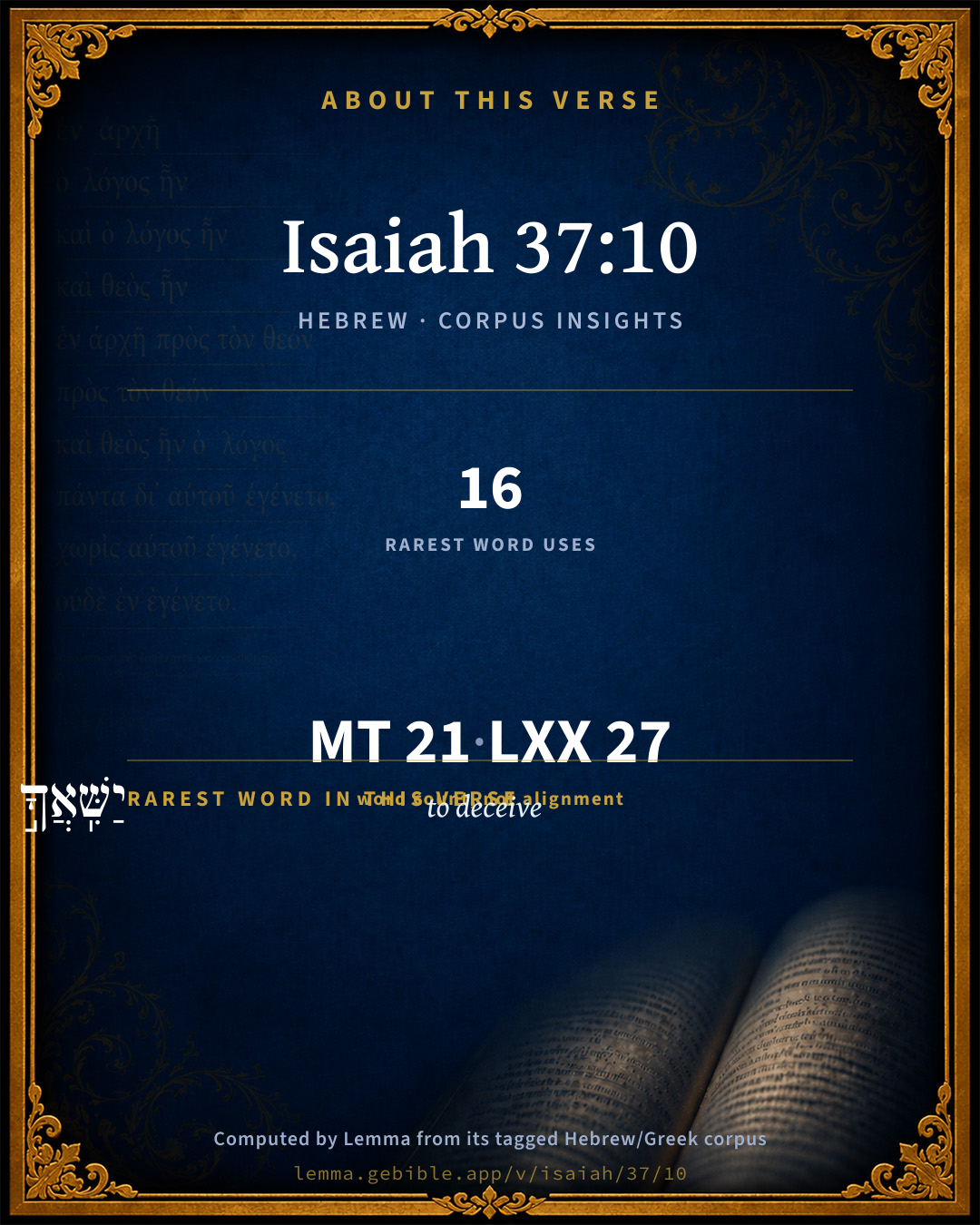
About this verse

These counts appear in no published source. They are computed here, from the morphology-tagged text and Lemma’s own curated glosses. What Lemma adds →

21
words
17
distinct lemmas
Prophets
section

Notable vocabulary

The rarest word here is יַשִּֽׁאֲךָ֣ to deceive H5377 — appearing just 16 times in the whole Hebrew Bible.

Shared distinctive vocabulary

יַשִּֽׁאֲךָ֣ to deceive H5377 occurs in 15 verses of the Hebrew Bible. Also found in:

Grammatical profile

  • 6 verbs
  • 8 nouns
  • 1 pronoun
  • 2 prepositions
  • 1 adverb
  • 3 particles

Verb forms

  • תֹאמְר֗וּן Qal · Imperfect
  • לֵאמֹ֔ר Qal · Infinitive Construct
  • יַשִּֽׁאֲךָ֣ Hiphil · Jussive
  • בּוֹטֵ֥חַ Qal · Participle Active
  • לֵאמֹ֑ר Qal · Infinitive Construct
  • תִנָּתֵן֙ Niphal · Imperfect

Repetition

Words recur within this verse — often emphatic in Hebrew:

  • תֹאמְר֗וּן to say H559 ×3
  • מֶֽלֶךְ king H4428 ×2

Hebrew & Septuagint length

In English translation the verse runs 34 words from the Hebrew and 34 from the Septuagint (LXX English) — the same length.

A rough comparison of the two English renderings, which tokenize alike — not a word-level alignment.

Word counts can differ between the Hebrew and the Greek without any difference in meaning — e.g. the Hebrew direct-object marker אֵת has no separate Greek word, and Greek often adds the article ὁ.

In the original languages it is 21 Hebrew tokens and 27 Greek tokens — but the two are counted differently (Hebrew bundles its prefixes and suffixes into one token; the Greek is in lemma form), so that isn’t a like-for-like length.

Cross-references

9

Topical passages linked to Isaiah 37:10 in the Treasury of Scripture Knowledge — connected by theme and wording, ordered by reader-vote popularity; previews shown in the World English Bible.

  • Isaiah 36:15 neither let Hezekiah make you trust in Yahweh, saying, Yahweh will surely deliver us; this city shall not be given into the hand of the king of Assyria.
  • 2 Kings 18:5 He trusted in Yahweh, the God of Israel; so that after him was none like him among all the kings of Judah, nor [among them] that were before him.
  • 2 Kings 19:10–13 Thus shall you speak to Hezekiah king of Judah, saying, Don't let your God in whom you trust deceive you, saying, Jerusalem shall not be given into the hand of the king of Assyria.
  • 2 Chronicles 32:7–8 Be strong and of good courage, don't be afraid nor dismayed for the king of Assyria, nor for all the multitude who is with him; for there is a greater with us than with him:
  • 2 Chronicles 32:15–19 Now therefore don't let Hezekiah deceive you, nor persuade you after this manner, neither believe you him; for no god of any nation or kingdom was able to deliver his people out of my hand, and out of the hand of my fathers: how much less shall your God deliver you out of my hand?
  • Psalms 22:8 "He trusts in Yahweh; Let him deliver him; Let him rescue him, since he delights in him."
  • Isaiah 36:4 Rabshakeh said to them, Say you now to Hezekiah, Thus says the great king, the king of Assyria, What confidence is this in which you trust?
  • Isaiah 36:20 Who are they among all the gods of these countries, that have delivered their country out of my hand, that Yahweh should deliver Jerusalem out of my hand?
  • Matthew 27:43 He trusts in God. Let God deliver him now, if he wants him; for he said, 'I am the Son of God.'"

Cross-references courtesy of OpenBible.info (CC BY 4.0).

Hebrew and Greek witnesses Masoretic Hebrew ↔ Greek Septuagint

The same verse in the two great witnesses to the Old Testament, shown verse-for-verse.

These are two independent witnesses, not word-aligned to each other, and the Septuagint is shown in lemma (dictionary) form.

Hebrew Isaiah 37:10 Masoretic · Westminster Leningrad Codex

כֹּ֣ה תֹאמְר֗וּן אֶל חִזְקִיָּ֤הוּ מֶֽלֶךְ יְהוּדָה֙ לֵאמֹ֔ר אַל יַשִּֽׁאֲךָ֣ אֱלֹהֶ֔יךָ אֲשֶׁ֥ר אַתָּ֛ה בּוֹטֵ֥חַ בּ֖וֹ לֵאמֹ֑ר לֹ֤א תִנָּתֵן֙ יְר֣וּשָׁלִַ֔ם בְּיַ֖ד מֶ֥לֶךְ אַשּֽׁוּר

Thus shall you speak to Hezekiah king of Judah, saying, Don't let your God in whom you trust deceive you, saying, Jerusalem shall not be given into the hand of the king of Assyria.

World English Bible · Public Domain

Greek LXX Isaiah 37:10 Septuagint · lemma form

οὕτως εἶπον εζεκιας βασιλεύς ὁ ἰουδαία μή σύ ἀπατάω ὁ θεός σύ ἐπί ὅς πείθω εἰμί ἐπί αὐτός λέγω οὐ μή παραδίδωμι ἰερουσαλήμ εἰς χείρ βασιλεύς ἀσσύριος

Thus shall you⌃ say to Ezekias king of Judea, Let not your God, in whom you trust, deceive you, saying, Jerusalem shall not be delivered into the hand of the king of the Assyrians.

LXX2012 (modern English Septuagint) · Public Domain

Hebrew: Westminster Leningrad Codex (CC BY 4.0). Greek: Septuagint (public domain); English from LXX2012 (modern English Septuagint) (Public Domain). How the Septuagint differs from the Hebrew →

Targum (Aramaic paraphrase)

1

The Targum is the ancient Jewish Aramaic paraphrase of the Hebrew Scriptures — an interpretive translation, not the Hebrew text itself. Onkelos (literal) and Pseudo-Jonathan (expansive) render the Torah, and Jonathan the Prophets. Coverage is partial: where no permissively-licensed English translation exists for a verse, only the Aramaic is shown. This is verse-level text, not a word-by-word alignment to the Hebrew.

  1. Targum Jonathan Prophets (Joshua–Malachi)
    כְּדֵין תֵּימְרוּן לְחִזְקִיָהוּ מְלַךְ שִׁבְטָא דְבֵית יְהוּדָה לְמֵימָר לָא יַטְעִינָךְ אֱלָהָךְ דִי אַתְּ רָחֵיץ בֵּיהּ לְמֵימָר לָא תִתְמְסַר יְרוּשְׁלֵם בְּיַד מַלְכָּא דְאַתּוּר:

    Thus shall ye speak to Hezekiah, king of the tribe of the house of Judah, saying, Let not thy God, in whom thou trustest, cause thee to err, saying, Jerusalem shall not be delivered into the hand of the king of Assyria.

    Targum Jonathan — Aramaic: “Mikraot Gedolot” (public domain). English: “Sefaria Community Translation” (CC0 1.0 (public-domain dedication)); “London "Chaldee Paraphrase," 1871” (public domain). Text via Sefaria.

Commentary

Notes on Isaiah 37:10 from classic Christian and Jewish commentators (each source and its license shown beneath its notes). The classic Christian expositions comment on the surrounding passage and are grouped to its opening verse, so a note may address several verses; the Jewish commentaries on the Tanakh (Rashi and others) are per-verse, so they appear only where the commentator wrote on this verse.

Lemma curates 59 commentaries, every one of them public domain or Creative Commons licensed, each selected and text-cleaned for this edition rather than reprinted as found. About our sources →

The Biblical Illustrator

Joseph S. Exell

Isa_37:10

Let not thy God, in whom thou trustest, deceive thee

A piece of satanic advice

I.

LET US WEIGH THIS PIECE OF SATANIC ADVICE. It is a very dangerous temptation for three reasons.

1. Because it appeals to the natural pride of the heart. There is a universal instinct which makes a man abhor the idea of being deceived. There is something in the very idea which rouses all the pride that lies latent in every heart.

2. There is no disguising the fact that if God did deceive us we are in a hopeless plight, and therefore there is force in the temptation.

3. The methods of Gods government being beyond our comprehension, sometimes appear to incline towards the tempters suggestion,--from appearances one might say, God is going to leave us in the lurch.

II. LET US TURN ROUND AND TEAR THE ADVICE UP.

1. We may tear it up because it comes too late. If God be a deceiver we are already so thoroughly deceived, and have been so for years, that it is rather late in the day to come and advise us not to be.

2. We may tear it up, because if God deceive us we may be quite certain that there is nobody else that would not. From all we know of our God, His holiness, His righteousness, and His faithfulness, if He can deceive us, then are we quite certain that there are none to be trusted

3. There is not one atom of evidence to support the libel. Search the world through, and see if you can find a man who will deliberately say, I have tried God, I have trusted Him, and He has deceived me.

4. There is overwhelming evidence to refute it. Never yet did man trust his God and be put to shame. Heaven and earth and hell declare that Jehovah never hath deceived and never can deceive. (A. G. Brown.)

Sennacherib versus Jehovah

Never before in his experience had Sennacherib heard of a God who could resist his progress; he believed in the almighty power of Asshur. (B. Blake, B. D.)

The Biblical Illustrator, edited by Joseph S. Exell (c. 1880s–1900s) — public domain. Text from a community e-Sword module.

Geneva Bible (1599)

Geneva Bible translators

Thus God would have him to utter a most horrible blasphemy before his destruction: as to call the author of all truth, a deceiver: some gather hereby that Shebna had disclosed unto Sennacherib the answer that Isaiah sent to the king.

Geneva Bible (1599) marginal notes — public domain. Text via Bolls.life.

Jamieson, Fausset & Brown

Robert Jamieson, A. R. Fausset & David Brown

He tries to influence Hezekiah himself, as Rab-shakeh had addressed the people.

God . . . deceive--(Compare Num 23:19).

Jamieson, Fausset & Brown — Commentary Critical and Explanatory on the Whole Bible (1871) — public domain (CC PDM 1.0). Text via the HelloAO Bible API.

The Cambridge Bible for Schools and Colleges

gen. ed. J. J. S. Perowne

10–13. Sennacherib’s letter to Hezekiah. It is in substance a repetition of the chief argument of the Rabshakeh, with the unimportant modification that Hezekiah is here regarded as deceived by his God, while the Rabshakeh chose to represent him as a deceiver of his people.

The Cambridge Bible for Schools and Colleges (gen. ed. J. J. S. Perowne; Cambridge University Press, 1878–1918) — public domain. Text from a community e-Sword module.

John Gill's Exposition

Behold, thou hast heard what the kings of Assyria have done to all lands, by destroying them utterly,.... He boasts of the achievements of himself and his ancestors, and of more than was true; and which, if it had been true, was more to their disgrace than honour, namely, utterly to destroy kingdoms, and their inhabitants, to gratify their lusts; but though many had been destroyed by them, yet not all; not Ethiopia, whose king was come out to make war with him, and of whom he seems to be afraid; nor Egypt, which was in confederacy with Ethiopia; nor Judea, he was now invading; but this he said in a taunting way, to terrify Hezekiah:

and shalt thou be delivered? canst thou expect it? surely thou canst not. Is it probable? yea, is it possible thou shouldest be delivered? it is not; as sure as other lands have been destroyed, so sure shall thine.

John Gill's Exposition of the Whole Bible (1746–1763) — public domain (CC PDM 1.0). Text via the HelloAO Bible API.

Albert Barnes' Notes on the Bible

Let not thy God deceive thee - The similar message which had been sent by Rabshakeh Isa 36:14-15 had been sent mainly to the people to induce them not to put confidence in Hezekiah, as if he would deceive them by leading them to rely on the aid of Yahweh. As that had failed, he, as a last resort, sent a similar message to Hezekiah himself, designed to alienate his mind from God, and assuring him that resistance would be vain. To convince him, he referred him Isa 37:11-13 to the conquests of the Assyrians, and assured him that it would be impossible to resist a nation that had subdued so many ethers. He had it not in his power to add Egypt to the list of subdued kingdoms, or it would have been done.

Albert Barnes' Notes on the Bible (1834–1885) — public domain. Text from a community e-Sword/MySword module.

Whedon's Commentary on the Bible

Daniel D. Whedon

10-13. Sennacherib, in his arrogance and ignorance, again insults the God of Israel by lowering him to the grade of the national gods around, and boasts of the great things his predecessors had done.

Gozan — Situated on the Chaboras — the river Chebor of Ezekiel — which flows from the north into the Euphrates.

Haran — Farther west than “Gozan.” From here Abram went to Canaan.

Children of Eden — If by this is meant the tribe of Eden, (see Eze_27:23,) situated on the border of Media, which is not unlikely, then a long curve of territory was made by Sennacherib to denote the extensiveness of Assyrian conquest. Nobody now knows where Hena or Ivah lay.

Daniel D. Whedon (gen. ed.), Commentary on the Old and New Testaments (1874–1909) — public domain. Text from a community e-Sword module.

The Pulpit Commentary

Let not thy God, in whom thou trustest, deceive thee. Sennacherib recognized Jehovah as a god, the God of the Jews, but put him on a par with the other "gods of the nations" (ver. 11), and (lid not believe in his being able to contend with Asshur. If he were really, through his priests or prophets, giving Hezekiah assurances of protection and deliverance, he could only be "deceiving" him.

The God in whom we trust.

To trust in God

I OUGHT TO SEEM TO US THE MOST SIMPLE AND NATURAL THING.

1. All power is his. We shrink from weakness as a support, but we lean our whole weight on strength with perfect willingness and readiness: and it is Almighty God; it is he to whom "all power is given in heaven and on earth," who invites our confidence.

2. All wisdom is his. Power without wisdom may lead astray, may work more harm than help: it is the only wise God "who asks us to put our trust in him.

3. All kindness is his. Power with wisdom but without love might be arrayed against us, might overwhelm us with confusion: it is the God whose "new, best Name is love," that offers us the shelter of his wing.

4. All faithfulness is his. Love that might last but a little while is of little worth; it might change into indifference or even into hatred and hostility: it is the "Father of lights with whom is no variableness," it is "Jesus Christ, the same yesterday, and to-day, and for ever," who says to us, "Come unto me," "Trust in me," "Abide in me," "Cast all your care on me." Surely it should be the simplest, the most natural, thing to yield instant and eager response to the Divine invitation, and to put our heart"s whole trust in "the Lord our God." Yet to trust in him

II IS MUCH MORE RARE THAT IT SHOULD BE. Do we find men leaning on God, and so leaning on him that their hearts are full of peace, of spiritual rest, of hope, of heavenly joy? Is "the God in whom we trust" a phrase that has as large and lull a meaning to our minds as it should have? Is not a living, sustaining, rejoicing trust in God a comparatively rare, rather than a constant and universal thing, even in Christian hearts? And why is it so, if so it be? Is it not because we allow ourselves to be so sadly imposed upon by the temporal and the superficial? We persist in representing to ourselves that the visible, the audible, the tangible, the material, is the real, the, true, and the substantial. We, who walk by faith and not by sight, whose life is spiritual, who are citizens of heaven, ought to understand that it is this which is illusive, evanescent, unreal, and that the invisible, the intangible, the eternal, is the real and the reliable; we ought to know and to realize that he, whom not having seen we love, the invisible but ever-present, the almighty and never-failing, Saviour, is the One who is worthy of our confidence, and in the deepest and fullest sense it should be true that it is the Lord in whom we trust.

III IS A PRIVILEGE OF WHICH WE NEED TO AVAIL OURSELVES CONTINUALLY.

1. In prosperity, for Gods sake. For God wills that we should be ever trusting in him, "in whom are all our springs," and from whom we derive everything we enjoy. To trace our well-being to ourselves, and to trust in the arm of flesh instead of referring all to the living God, brings down his deep displeasure. (see Deu_10:8-18)

2. In adversity, for our own sake. For then God alone can help and save us. We ourselves shall have failed; misfortune, disaster, will have baffled and beaten us; our friends will fail us; human sympathy and succour will avail somewhat, but it will leave much more undone than it will do. Divine interposition alone will supply our need the pity of the Divine Friend; the help of the heavenly Father; the ministry of the Holy Ghost, the Comforter and the Sanctifier of the hearts of men. C.

The Pulpit Commentary (1880–1919), ed. H.D.M. Spence-Jones & Joseph S. Exell — public domain. Text from a community e-Sword module.

Keil & Delitzsch

C. F. Keil & F. Delitzsch

The message. "Thus shall ye say to Hizkiyahu king of Judah, saying, Let not thy God in whom thou trustest deceive thee, saying, Jerusalem will not be given into the hand of the king of Asshur. Behold, thou hast surely heard what (K. that which) the kings of Asshur have done to all lands, to lay the ban upon them; and thou, thou shouldst be delivered?! Have the gods of the nations, which my fathers destroyed, delivered them: Gozan, and Haran, and Rezeph, and the Benē-‛Eden, which are in Tellasar? Where is (K. where is he) the king of Hamath, and the king of Arpad, and the king of 'Ir-Sepharvaim, Hena', and 'Ivah?"Although ארץ is feminine, אותם (K. אתם), like להחרימם, points back to the lands (in accordance with the want of any thoroughly developed distinction of the genders in Hebrew); likewise אשׁר quas pessumdederunt. There is historical importance in the fact, that here Sennacherib attributes to his fathers (Sargon and the previous kings of the Derketade dynasty which he had overthrown) what Rabshakeh on the occasion of the first mission had imputed to Sennacherib himself. On Gozan, see p. 33. It is no doubt identical with the Zuzan of the Arabian geographers, which is described as a district of outer Armenia, situated on the Chabur, e.g., in the Merasid. ("The Chabur is the Chabur of el-Hasaniye, a district of Mosul, to the east of the Tigris; it comes down from the mountains of the land of Zuzan, flows through a broad and thickly populated country in the north of Mosul, which is called outer Armenia, and empties itself into the Tigris." Ptolemy, on the other hand (Isa 37:18, Isa 37:14), is acquainted with a Mesopotamian Gauzanitis; and, looking upon northern Mesopotamia as the border land of Armenia, he says, κατέχει δὲ τῆς ξηώρας τὰ μὲν πρὸς τῆ Αρμενία ἡ Ανθεμουσία (not far from Edessa) ὑφ ἥν ἡ Χαλκῖτις ὑπὸ δὲ ταύτην ἡ Γαυζανῖτις, possibly the district of Gulzan, in which Nisibin, the ancient Nisibis, still stands.

(Note: See Oppert, Expdition, i. 60.)

For Hrn (Syr. Horon; Joseph. Charran of Mesopotamia), the present Harrn, not far from Charmelik, see Genesis, p. 327. The Harran in the Guta of Damascus (on the southern arm of the Harus), which Beke has recently identified with it, is not connected with it in any way. Retseph is the Rhesapha of Ptol. v. 18, 6, below Thapsacus, the present Rusafa in the Euphrates-valley of ez-Zor, between the Euphrates and Tadmur (Palmyra; see Robinson, Pal.). Telassar, with which the Targum (ii. iii.) and Syr. confound the Ellasar of Gen 14:1, i.e., Artemita (Artamita), is not the Thelseae of the Itin. Antonini and of the Notitia dignitatum - in which case the Benē-‛Eden might be the tribe of Bt Genn (Bettegene) on the southern slope of Lebanon (i.e., the 'Eden of Coelesyria, Amo 1:5; the Paradeisos of Ptol. v. 15, 20; Paradisus, Plin. v. 19) - but the Thelser of the Tab. Peuting., on the eastern side of the Tigris; and Benē-‛Eden is the tribe of the 'Eden mentioned by Ezekiel (Eze 27:23) after Haran and Ctesiphon. Consequently the enumeration of the warlike deeds describes a curve, which passes in a north-westerly direction through Hamath and Arpad, and then returns in Sepharvaim to the border of southern Mesopotamia and Babylonia. 'Ir-Sepharvaim is like 'Ir-Nchs, 'Ir-shemesh, etc. The legends connect the name with the sacred books. The form of the name is inexplicable; but the name itself probably signifies the double shore (after the Aramaean), as the city, which was the southernmost of the leading places of Mesopotamia, was situated on the Euphrates. The words ועוּה הנע, if not take as proper names, would signify, "he has taken away, and overthrown;" but in that case we should expect ועוּוּ הניעוּ or ועוּיתי הניעתי. They are really the names of cities which it is no longer possible to trace. Hena' is hardly the well-known Avatho on the Euphrates, as Gesenius, V. Niebuhr, and others suppose; and 'Ivah, the seat of the Avvı̄m (Kg2 17:31), agrees still less, so far as the sound of the word is concerned, with "the province of Hebeh (? Hebeb: Ritter, Erdk. xi. 707), situated between Anah and the Chabur on the Euphrates," with which V. Niebuhr combines it.

(Note: For other combinations of equal value, see Oppert, Expdition, i. 220.)

Keil & Delitzsch — Biblical Commentary on the Old Testament (1861–1891) — public domain (CC PDM 1.0). Text via the HelloAO Bible API. (Old Testament only.)

J. A. Alexander on Isaiah

Joseph Addison Alexander

“Thus shall ye say to Hezekiah, king of Judah, Let not thy God deceive thee, in whom thou trustest, saying, Jerusalem shall not be given into the hand of the king of Assyria.” This recognition of Hezekiah’s royal dignity, of which Rabshakeh seemed to take no notice, if significant at all, as some interpreters imagine, may be accounted for upon the ground, that in this message the design of the Assyrian was not to destroy the people’s confidence in Hezekiah, but the king’s own confidence in God. For the same reason, Sennacherib’s blasphemy is much more open and direct than that of Rabshakeh. The word saying may be referred either to Hezekiah or to God. The English Version makes the last construction necessary, by changing the collocation of the words; but many others understand the sense to be, ‘in whom thou trustest, saying’. On the whole, it is best, in a case so doubtful, to retain the Hebrew collocation with all its ambiguity.

Joseph Addison Alexander, The Prophecies of Isaiah (1846–1847; New York: Scribner, 1870–1878) — public domain. Text from a community e-Sword module.

Scofield Reference Notes

C. I. Scofield

trustest

(See Scofield "Psa 2:12")

The Scofield Reference Bible (1917 edition), notes by C. I. Scofield — public domain. Text from a community e-Sword module.

Lesson kit

Teaching starters — assembled from the data on this page, not authored interpretation. Every prompt links to the verse data it draws on. Edit before teaching.

Isaiah, in the Prophets, opens this verse with 21 words (17 distinct Hebrew lemmas). Its most distinctive word is nâshâʼ (“to deceive”). A historical commentator’s framing appears above. Read the whole chapter for the surrounding context.

Discussion questions

  1. The word nâshâʼ carries the sense “to deceive.” How does it shape the verse?
  2. Genesis 3:13 shares the word «to deceive» with this verse. How do the two illuminate each other?
  3. “to say” occurs 3× in this one verse. What is the effect of the repetition?
  4. These translations render this verse differently. What is at stake in choosing one wording over another?
  5. The verb «תֹאמְר֗וּן» is Qal Imperfect. How does its form color the action?
  6. Reading how The Biblical Illustrator and Geneva Bible (1599) read this verse, where do the two commentators agree and where do they part?

Things to notice

Reading settings

Reading text

Shown beneath each verse's original-language words.

Old Testament
Old Testament edition

Read the OT as the Masoretic Hebrew (MT) or the Greek Septuagint (LXX).

English shown for the Greek Septuagint (in the Hebrew ↔ Greek comparison).

Comparing translations? Open the Compare panel on any verse page to stack up to four side by side.