
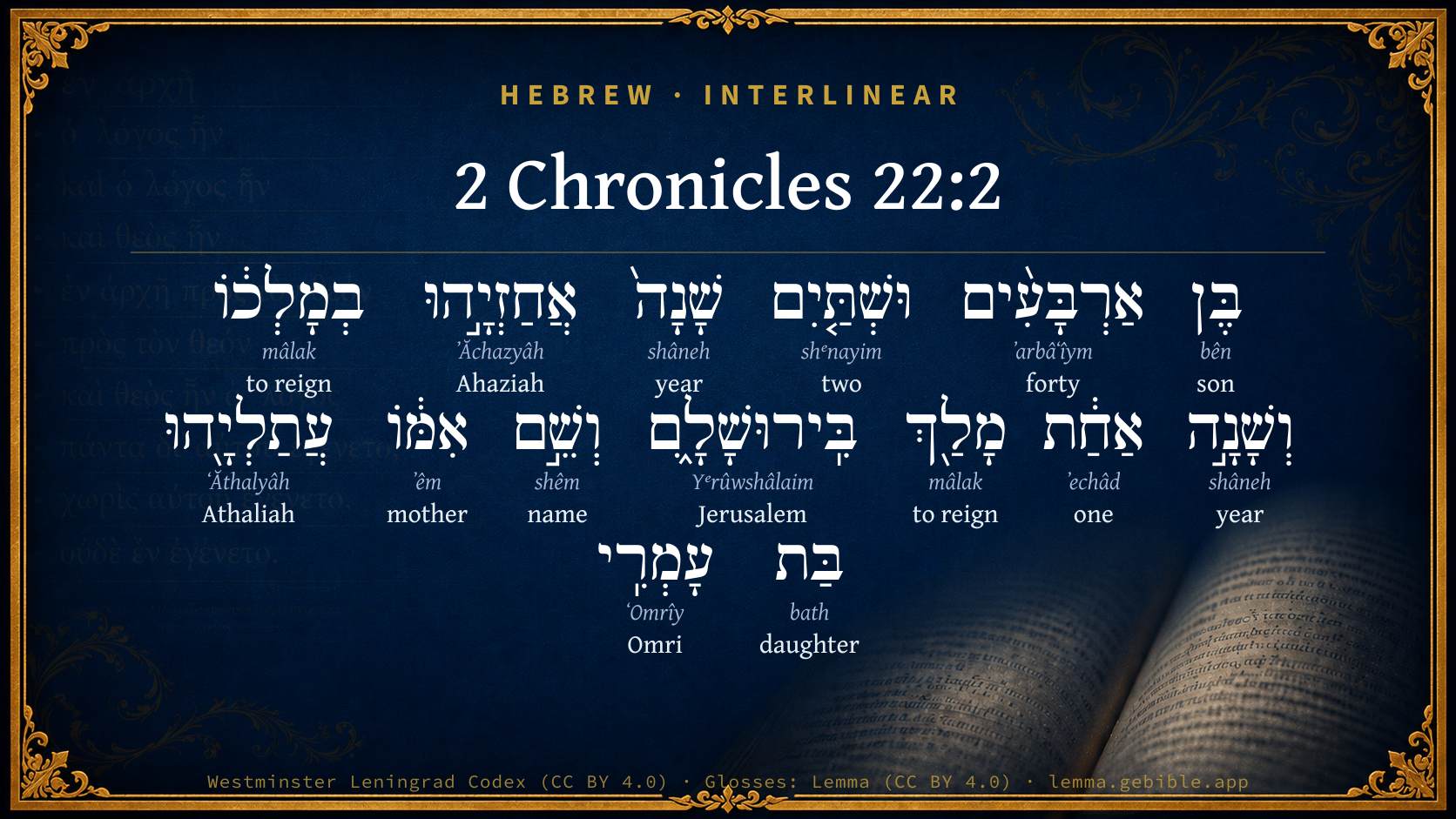
2 Chronicles 22:2

Hebrew (Westminster Leningrad Codex) 2 Chronicles 22:2 appears in the Hebrew Old Testament. The text above is from the Westminster Leningrad Codex. Each word links to its Strong’s number, a concise gloss, and parsing drawn from the Open Scriptures Hebrew Bible morphology. Click any word for its full Brown-Driver-Briggs (BDB) entry.
Download image
Cite this verse

2 Chronicles 22:2 (World English Bible). Public Domain. Lemma interlinear Bible study tool, https://lemma.gebible.app/v/2-chronicles/22/2.

Show BibTeX & RIS
BibTeX
RIS
English Translation
Forty-two years old was Ahaziah when he began to reign; and he reigned one year in Jerusalem: and his mother's name was Athaliah the daughter of Omri.
World English Bible · Public Domain
Download a study sheet

One document with this verse’s original text, its word-by-word gloss line, the meaning frame, cross-references with their text, attributed commentary, and full source and license credits — printable, and it pastes into notes with its structure intact.

This verse Autodidact and up

Study sheet (.html) Plain text (.txt)

A passage Seminary Student

Up to 50 verses in one chapter. A passage sheet keeps up to 6 commentary sources and 12 cross-references per verse, in the order this page ranks them, and says so on the sheet whenever that leaves anything out. Ask for a single verse and you get the Autodidact verse sheet above.

Everything on this page stays free to read, with no account — the sheet is a download of what is already on screen, not access to it.

Want to remove ads? Support Godless Engineer
Compare translations 3

The same verse in 3 English versions, stacked beneath the original-language interlinear above. Click any original word for its lexicon entry.

Each is an independent rendering of the whole verse — the interlinear is not word-aligned to these translations.

Highlighted words mark where these versions differ — a whole-verse word diff, not a word-by-word alignment.

  • World English Bible Public Domain
    Forty-two years old was Ahaziah when he began to reign; and he reigned one year in Jerusalem: and his mother's name was Athaliah the daughter of Omri.
  • King James Version Public Domain
    Forty and two years old was Ahaziah when he began to reign, and he reigned one year in Jerusalem. His mother's name also was Athaliah the daughter of Omri.
  • unfoldingWord Literal Text CC BY-SA 4.0
    A son of 42 years was Ahaziah when he became king, and one year he reigned in Jerusalem. And the name of his mother was Athaliah, the daughter of Omri.

unfoldingWord Literal Text — © unfoldingWord, licensed CC BY-SA 4.0. Word-aligned USFM3 via Door43 (git.door43.org/unfoldingWord/en_ult).

Versions to compare (up to 4)

3 of 4 selected

Show all 18 translations

Every available English version of this verse, each an independent rendering of the whole verse.

  • World English Bible Public Domain
    Forty-two years old was Ahaziah when he began to reign; and he reigned one year in Jerusalem: and his mother's name was Athaliah the daughter of Omri.
  • Berean Standard Bible Public Domain
    Ahaziah was twenty-two years old when he became king, and he reigned in Jerusalem one year. His mother’s name was Athaliah, the granddaughter of Omri.
  • Majority Standard Bible Public Domain
    Ahaziah was twenty-two years old when he became king, and he reigned in Jerusalem one year. His mother’s name was Athaliah, the granddaughter of Omri.
  • King James Version Public Domain
    Forty and two years old was Ahaziah when he began to reign, and he reigned one year in Jerusalem. His mother's name also was Athaliah the daughter of Omri.
  • American Standard Version (1901) Public Domain
    Forty and two years old was Ahaziah when he began to reign; and he reigned one year in Jerusalem: and his mother's name was Athaliah the daughter of Omri.
  • Revised Version (1885) Public Domain
    Forty and two years old was Ahaziah when he began to reign; and he reigned one year in Jerusalem: and his mother’s name was Athaliah the daughter of Omri.
  • Geneva Bible (1599) Public Domain
    Two and fourtie yeere olde was Ahaziah when he began to reigne, and he reigned one yeere in Ierusalem. and his mothers name was Athaliah the daughter of Omri.
  • Douay-Rheims (1899) Public Domain
    Ochozias was forty-two years old when he began to reign, and he reigned one year in Jerusalem, and the name of his mother was Athalia the daughter of Amri.
  • Young's Literal Translation Public Domain
    A son of twenty and two years `is' Ahaziah in his reigning, and one year he hath reigned in Jerusalem, and the name of his mother `is' Athaliah daughter of Omri;
  • Literal Standard Version CC BY-SA 4.0
    Ahaziah [is] a son of twenty-two years in his reigning, and he has reigned one year in Jerusalem, and the name of his mother [is] Athaliah daughter of Omri;
  • Unlocked Literal Bible CC BY-SA 4.0
    Ahaziah was twenty-two years old when he began to reign; he reigned for one year in Jerusalem. His mother's name was Athaliah; she was the daughter of Omri.
  • unfoldingWord Literal Text CC BY-SA 4.0
    A son of 42 years was Ahaziah when he became king, and one year he reigned in Jerusalem. And the name of his mother was Athaliah, the daughter of Omri.
  • Darby Bible Public Domain
    Ahaziah was twenty-two years old when he began to reign; and he reigned one year in Jerusalem; and his mother's name was Athaliah, daughter of Omri.
  • World Messianic Bible Public Domain
    Ahaziah was forty-two years old when he began to reign, and he reigned one year in Jerusalem. His mother’s name was Athaliah the daughter of Omri.
  • Webster's Bible Public Domain
    Forty and two years old was Ahaziah when he began to reign, and he reigned one year in Jerusalem. His mother's name also was Athaliah the daughter of Omri.
  • Free Bible Version CC BY-SA 4.0
    Ahaziah was twenty-two when he became king, and he reigned in Jerusalem for one year. His mother's name was Athaliah, the granddaughter of Omri.
  • Bible in Basic English Public Domain
    Ahaziah was twenty-two years old when he became king, and he was ruling in Jerusalem for one year. His mother's name was Athaliah, the daughter of Omri.
  • JPS Tanakh (1917) Public Domain
    Forty and two years old was Ahaziah when he began to reign; and he reigned one year in Jerusalem; and his mother's name was Athaliah the daughter of Omri.

Literal Standard Version (2020), Covenant Press — licensed CC BY-SA 4.0. Text via the HelloAO Bible API (eBible.org). Unlocked Literal Bible (unfoldingWord) — licensed CC BY-SA 4.0. Text via the HelloAO Bible API (eBible.org). unfoldingWord Literal Text — © unfoldingWord, licensed CC BY-SA 4.0. Word-aligned USFM3 via Door43 (git.door43.org/unfoldingWord/en_ult). Free Bible Version, Dr. Jonathan Gallagher — licensed CC BY-SA 4.0. Text via the HelloAO Bible API (eBible.org).

Word by word

More ways to search: Search by grammar → Find every occurrence → Compare this word →

Practice this passage: Drill this verse → Learn its vocabulary →

עֲתַלְיָ֖הוּ
ʻĂthalyâh
H6271
“Athaliah”
Noun, Proper
Part of Speech
Noun
Type
Proper
Full BDB Definition

Origin: from the same as H6270 and H3050

TWOT: None

Athaliah = "afflicted of the Lord" - son of Jeroham of the tribe of Benjamin (noun proper masculine) - father of Jeshaiah of the sons of Elam who was one of the heads of a family who returned with Ezra from exile (noun proper masculine) - the daughter of Ahab and Jezebel and the wife of king Jehoram of Judah; killer of all the members of the royal family of Judah with the exception of one baby named Joash who was hidden by the high priest Jehoiada until 6 years had passed and Jehoiada led the revolution to put him on the throne, overthrowing Athaliah and putting her to death (noun proper feminine)
  1. בֶּן bên H1121 “son of” Noun, Common, Masculine, Singular, Construct
  2. אַרְבָּעִ֨ים ʼarbâʻîym H705 “forty” Adjective, Cardinal number, Both, Plural, Absolute
  3. וּשְׁתַּ֤יִם shᵉnayim H8147 “and · two” Conjunction + Adjective, Cardinal number, Feminine, Dual, Absolute
  4. שָׁנָה֙ shâneh H8141 “year” Noun, Common, Feminine, Singular, Absolute
  5. אֲחַזְיָ֣הוּ ʼĂchazyâh H274 “Ahaziah” Noun, Proper
  6. בְמָלְכ֔וֹ mâlak H4427 “in/at · to reign · him” Preposition + Verb, Qal, Infinitive Construct + Suffix, Personal, 3rd Person, Masculine, Singular
  7. וְשָׁנָ֣ה shâneh H8141 “and · year” Conjunction + Noun, Common, Feminine, Singular, Absolute
  8. אַחַ֔ת ʼechâd H259 “one” Adjective, Cardinal number, Feminine, Singular, Absolute
  9. מָלַ֖ךְ mâlak H4427 “to reign” Verb, Qal, Perfect, 3rd Person, Masculine, Singular
  10. בִּֽירוּשָׁלִָ֑ם Yᵉrûwshâlaim H3389 “in/at · Jerusalem” Preposition + Noun, Proper
  11. וְשֵׁ֣ם shêm H8034 “and · name of” Conjunction + Noun, Common, Masculine, Singular, Construct
  12. אִמּ֔וֹ ʼêm H517 “mother · his” Noun, Common, Feminine, Singular, Construct + Suffix, Personal, 3rd Person, Masculine, Singular
  13. בַּת bath H1323 “daughter of” Noun, Common, Feminine, Singular, Construct
  14. עָמְרִֽי ʻOmrîy H6018 “Omri” Noun, Proper

About this verse

These counts appear in no published source. They are computed here, from the morphology-tagged text and Lemma’s own curated glosses. What Lemma adds →

15
words
13
distinct lemmas
Historical
section

Notable vocabulary

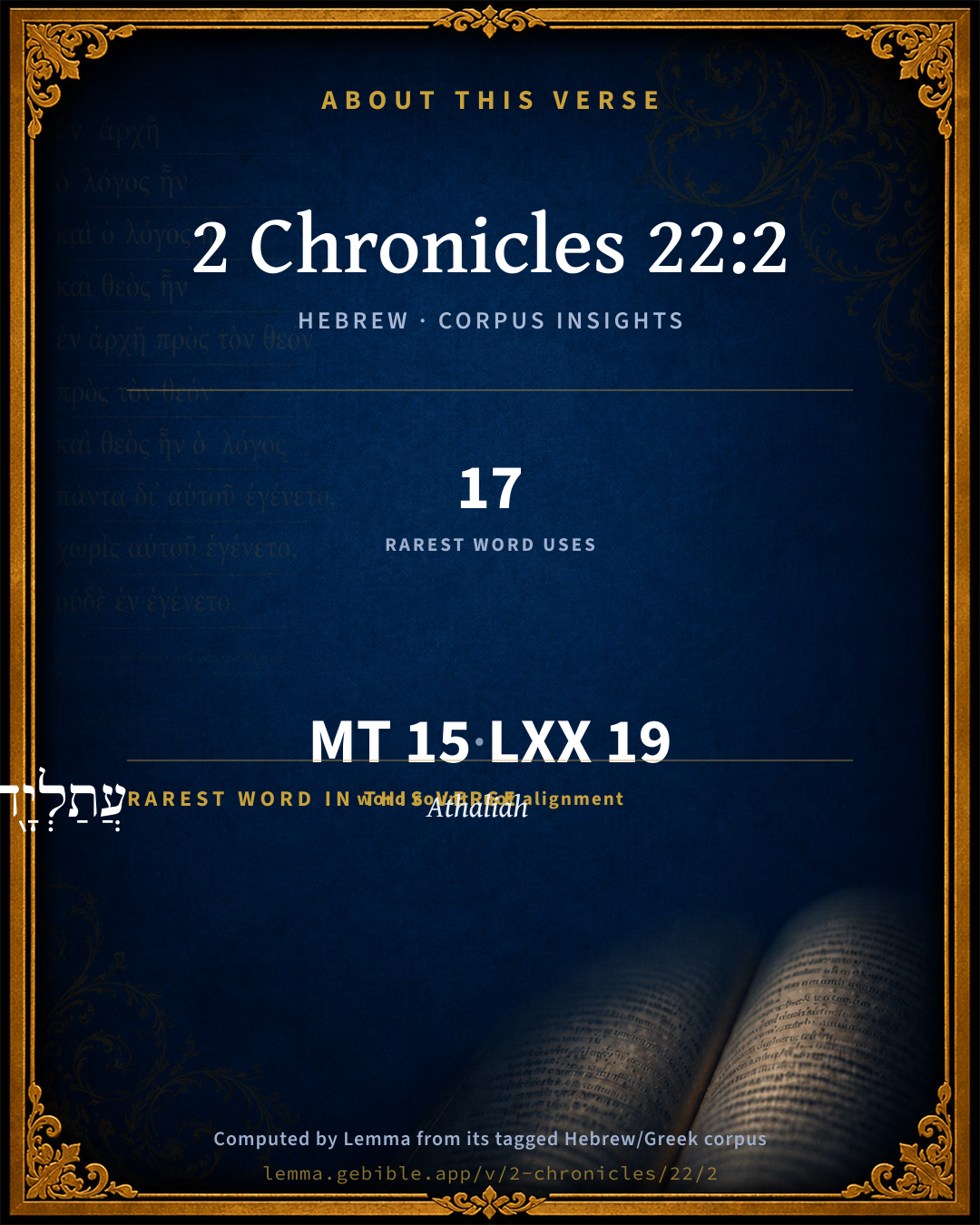
The rarest word here is עֲתַלְיָ֖הוּ Athaliah H6271 — appearing just 17 times in the whole Hebrew Bible.

Shared distinctive vocabulary

עֲתַלְיָ֖הוּ Athaliah H6271 occurs in 17 verses of the Hebrew Bible. Also found in:

Grammatical profile

  • 2 verbs
  • 10 nouns
  • 3 adjectives

Verb forms

  • בְמָלְכ֔וֹ Qal · Infinitive Construct
  • מָלַ֖ךְ Qal · Perfect

Repetition

Words recur within this verse — often emphatic in Hebrew:

  • שָׁנָה֙ year H8141 ×2
  • בְמָלְכ֔וֹ to reign H4427 ×2

Hebrew & Septuagint length

In English translation the verse runs 27 words from the Hebrew and 27 from the Septuagint (LXX English) — the same length.

A rough comparison of the two English renderings, which tokenize alike — not a word-level alignment.

Word counts can differ between the Hebrew and the Greek without any difference in meaning — e.g. the Hebrew direct-object marker אֵת has no separate Greek word, and Greek often adds the article ὁ.

In the original languages it is 15 Hebrew tokens and 19 Greek tokens — but the two are counted differently (Hebrew bundles its prefixes and suffixes into one token; the Greek is in lemma form), so that isn’t a like-for-like length.

Cross-references

3

Topical passages linked to 2 Chronicles 22:2 in the Treasury of Scripture Knowledge — connected by theme and wording, ordered by reader-vote popularity; previews shown in the World English Bible.

  • 1 Kings 16:28 So Omri slept with his fathers, and was buried in Samaria; and Ahab his son reigned in his place.
  • 2 Kings 8:26 Twenty-two years old was Ahaziah when he began to reign; and he reigned one year in Jerusalem. His mother's name was Athaliah the daughter of Omri king of Israel.
  • 2 Chronicles 21:6 He walked in the way of the kings of Israel, as did the house of Ahab; for he had the daughter of Ahab as wife: and he did that which was evil in the sight of Yahweh.

Cross-references courtesy of OpenBible.info (CC BY 4.0).

Hebrew and Greek witnesses Masoretic Hebrew ↔ Greek Septuagint

The same verse in the two great witnesses to the Old Testament, shown verse-for-verse.

These are two independent witnesses, not word-aligned to each other, and the Septuagint is shown in lemma (dictionary) form.

Hebrew 2 Chronicles 22:2 Masoretic · Westminster Leningrad Codex

בֶּן אַרְבָּעִ֨ים וּשְׁתַּ֤יִם שָׁנָה֙ אֲחַזְיָ֣הוּ בְמָלְכ֔וֹ וְשָׁנָ֣ה אַחַ֔ת מָלַ֖ךְ בִּֽירוּשָׁלִָ֑ם וְשֵׁ֣ם אִמּ֔וֹ עֲתַלְיָ֖הוּ בַּת עָמְרִֽי

Forty-two years old was Ahaziah when he began to reign; and he reigned one year in Jerusalem: and his mother's name was Athaliah the daughter of Omri.

World English Bible · Public Domain

Greek LXX 2 Chronicles 22:2 Septuagint · lemma form

εἰμί εἴκοσι ἔτος οχοζιας βασιλεύω καί ἐνιαυτός εἷς βασιλεύω ἐν ἰερουσαλήμ καί ὄνομα ὁ μήτηρ αὐτός γοθολια θυγάτηρ αμβρι

Ochozias began to reign when he was twenty years old, and he reigned one year in Jerusalem: and his mother's name was Gotholia, the daughter of Ambri.

LXX2012 (modern English Septuagint) · Public Domain

On this verse, Adam Clarke's Commentary discusses the Septuagint’s reading. Read the note in Commentary ↓

Hebrew: Westminster Leningrad Codex (CC BY 4.0). Greek: Septuagint (public domain); English from LXX2012 (modern English Septuagint) (Public Domain). How the Septuagint differs from the Hebrew →

Commentary

Notes on 2 Chronicles 22:2 from classic Christian and Jewish commentators (each source and its license shown beneath its notes). The classic Christian expositions comment on the surrounding passage and are grouped to its opening verse, so a note may address several verses; the Jewish commentaries on the Tanakh (Rashi and others) are per-verse, so they appear only where the commentator wrote on this verse.

Lemma curates 59 commentaries, every one of them public domain or Creative Commons licensed, each selected and text-cleaned for this edition rather than reprinted as found. About our sources →

Trapp's Complete Commentary

John Trapp

2Ch 22:2 Forty and two years old [was] Ahaziah when he began to reign, and he reigned one year in Jerusalem. His mother’s name also [was] Athaliah the daughter of Omri.

Ver. 2. Forty and two years old.] Heb., The son of two and forty years was Ahaziah when he began to reign; i.e., in the last of the two and forty years of the house of Omri, in which it fell, and Ahaziah with it. See on 2Ki 8:26.

John Trapp, A Commentary or Exposition upon All the Books of the Old and New Testament (1647–1656) — public domain. Text from a community e-Sword module.

Joseph Benson's Commentary

2Ch 22:2. Forty and two years old was Ahaziah — It is said (2Ki 8:26) that he was but two and twenty years old when he began to reign; so that, it is probable, an error has been committed here by the copyist or transcriber. For some Greek copies have here twenty-two years old, and it is so in the Syriac and Arabic translations, and particularly in that most ancient copy of the Syriac, which was used by the church at Antioch in the primitive times, and to this day is kept in the church of Antioch, from which Archbishop Usher did, at his own great charge, get an exact copy transcribed. Athaliah the daughter of Omri — That is, of Omri’s family; or, of Ahab, Omri’s son. Grand-children are often called sons or daughters in the Scriptures.

Joseph Benson's Commentary on the Old and New Testaments (1811–1818) — public domain. Text from a community e-Sword module.

Tyndale Open Study Notes

Tyndale Open Resources

22:2-4 The queen mother, Athaliah, exercised significant influence over the king (see study note on 15:16). Athaliah was very much like her mother, Jezebel (see 22:10–23:15; cp. 1 Kgs 16:31–21:28), and she followed in the footsteps of her grandfather Omri (see 1 Kgs 16:21-26).

22:2 one year: Ahaziah, also known as Jehoahaz, reigned briefly over Judah in 841 BC.

Tyndale Open Study Notes — © Tyndale Open Resources, licensed CC BY-SA 4.0. Text via the HelloAO Bible API.

Geneva Bible (1599)

Geneva Bible translators

That is, after the death of his father.

Read 2 Chron. 21:20.

She was Ahab’s daughter, who was the son of Omri.

Geneva Bible (1599) marginal notes — public domain. Text via Bolls.life.

Jamieson, Fausset & Brown

Robert Jamieson, A. R. Fausset & David Brown

Forty and two years old was Ahaziah when he began to reign--(Compare Kg2 8:26). According to that passage, the commencement of his reign is dated in the twenty-second year of his age, and, according to this, in the forty-second year of the kingdom of his mother's family [LIGHTFOOT]. "If Ahaziah ascended the throne in the twenty-second year of his life, he must have been born in his father's nineteenth year. Hence, it may seem strange that he had older brothers; but in the East they marry early, and royal princes had, besides the wife of the first rank, usually concubines, as Jehoram had (Ch2 21:17); he might, therefore, in the nineteenth year of his age, very well have several sons" [KEIL] (compare Ch2 21:20; Kg2 8:17).

Athaliah the daughter of Omri--more properly, "granddaughter." The expression is used loosely, as the statement was made simply for the purpose of intimating that she belonged to that idolatrous race.

Jamieson, Fausset & Brown — Commentary Critical and Explanatory on the Whole Bible (1871) — public domain (CC PDM 1.0). Text via the HelloAO Bible API.

Adam Clarke's Commentary

Verse 2. Forty and two years old was Ahaziah] 2Kg 8:26. Ahaziah might have been twenty-two years old, according to 2Kg 8:26, but he could not have been forty-two, as stated here, without being two years older than his own father! See the note there. The Syriac and Arabic have twenty-two, and the Septuagint, in some copies, twenty. And it is very probable that the Hebrew text read so originally; for when numbers were expressed by single letters, it was easy to mistake מ mem, FORTY, for כ caph, TWENTY. And if this book was written by a scribe who used the ancient Hebrew letters, now called the Samaritan, the mistake was still more easy and probable, as the difference between [Samaritan] caph and [Samaritan] mem is very small, and can in many instances be discerned only by an accustomed eye.

The reading in 2Kg 8:26 is right, and any attempt to reconcile this in Chronicles with that is equally futile and absurd. Both readings cannot be true; is that therefore likely to be genuine that makes the son two years older than the father who begat him? Apage hae nugae!

Adam Clarke's Commentary on the Bible (1810–1826) — public domain. Text from a community e-Sword/MySword module.

Ellicott's Commentary for English Readers

(2) Forty and two years old.—An error of transcription. 2Ki_8:26, twenty and two; and so the Syriac and Arabic: the LXX. has “twenty.” Ahaziah could not have been forty when he succeeded, because his father was only forty when he died (2Ch_21:20).

Athaliah the daughter of Omri—i.e., granddaughter, she being daughter of Ahab and Jezebel. Kings adds, “king of Israel,” which the chronicler purposely omits. (Comp. Mic_6:16 : “The statutes of Omri,” “the works of the house of Ahab.”)

A Bible Commentary for English Readers, edited by Charles John Ellicott (1878–1897) — public domain. Text from a community e-Sword module.

The Cambridge Bible for Schools and Colleges

gen. ed. J. J. S. Perowne

2. Forty and two years old] LXX., ὢν εἴκοσι ἐτῶν agreeing nearly with 2Ki_8:26, “two-and-twenty years old” (Heb. and LXX.).

daughter of Omri] So 2Ki_8:26, but more correctly “daughter of Ahab” (2Ki_8:18).

The Cambridge Bible for Schools and Colleges (gen. ed. J. J. S. Perowne; Cambridge University Press, 1878–1918) — public domain. Text from a community e-Sword module.

John Gill's Exposition

Forty two and years old was Ahaziah when he began to reign,.... In Kg2 8:26, he is said to be but twenty two years old at his accession to the throne, which is undoubtedly most correct; for this makes him to be two years older than his father when he died, who was thirty two when he began to reign, and reigned eight years, Ch2 21:20, different ways are taken to solve this difficulty; some refer this to Jehoram, that he was forty two when Ahaziah began to reign, but he was but forty when he died; others to the age of Athaliah his mother, as if he was the son of one that was forty two, when he himself was but twenty two; but no instance is given of any such way of writing, nor any just reason for it; others make these forty two years reach to the twentieth of his son Joash, his age twenty two, his reign one, Athaliah six, and Joash thirteen; but the two principal solutions which seem most to satisfy learned men are, the one, that he was twenty two when he began to reign in his father's lifetime, and forty two when he began to reign in his own right; but then he must reign twenty years with his father, whereas his father reigned but eight years: to make this clear they observe (b), as Kimchi and Abarbinel, from whom this solution is taken, that he reigned eight years very happily when his son was twenty two, and taken on the throne with him, after which he reigned twenty more ingloriously, and died, when his son was forty two; this has been greedily received by many, but without any proof: the other is, that these forty two years are not the date of the age of Ahaziah, but of the reign of the family of Omri king of Israel; so the Jewish chronology (c); but how impertinent must the use of such a date be in the account of the reign of a king of Judah? all that can be said is, his mother was of that family, which is a trifling reason for such an unusual method of reckoning: it seems best to acknowledge a mistake of the copier, which might easily be made through a similarity of the numeral letters, forty two, for twenty two (d); and the rather since some copies of the Septuagint, and the Syriac and Arabic versions, read twenty two, as in Kings; particularly the Syriac version, used in the church of Antioch from the most early times; a copy of which Bishop Usher obtained at a very great price, and in which the number is twenty two, as he assures us; and that the difficulty here is owing to the carelessness of the transcribers is owned by Glassius (e), a warm advocate for the integrity of the Hebrew text, and so by Vitringa (f): and indeed it is more to the honour of the sacred Scriptures to acknowledge here and there a mistake in the copiers, especially in the historical books, where there is sometimes a strange difference of names and numbers, than to give in to wild and distorted interpretations of them, in order to reconcile them, where there is no danger with respect to any article of faith or manners; and, as a learned man (g) has observed of the New Testament,"it is an invincible reason for the Scripture's part, that other escapes should be so purposely and infinitely let pass, and yet no saving and substantial part at all scarce moved out of its place; to say the truth, these varieties of readings, in a few by-places, do the same office to the main Scriptures, as the variation of the compass to the whole magnet of the earth, the mariner knows so much the better for these how to steer his course;''and, with respect to some various readings in the Old Testament, Dr. Owen (h) observes, God has suffered this lesser variety to fall out, in or among the copies we have, for the quickening and exercising of our diligence in our search of his word:

he reigned one year in Jerusalem. His mother's name also was Athaliah, the daughter of Omri, see Kg2 8:26.

(b) In Hieron. Trad. Heb. in Paralip. fol. 85. E. (c) Seder Olam Rabba, c. 17. So Ben Gersom. (d) See Kennicott's Dissert. 1. p. 98. (e) Philolog. Sacr. p. 114. (f) Hypotypol Hist. Sacr. p. 67. (g) J. Gregory's Preface to his Works. (h) Divine Original of the Scripture, p. 14.

John Gill's Exposition of the Whole Bible (1746–1763) — public domain (CC PDM 1.0). Text via the HelloAO Bible API.

Albert Barnes' Notes on the Bible

For “42” read “22” (see the marginal reference). Ahaziah’s father, Jehoram, was but 40 when be died 2Ch 21:20.

Albert Barnes' Notes on the Bible (1834–1885) — public domain. Text from a community e-Sword/MySword module.

Haydock's Catholic Bible Commentary

Forty-two, &c. Diverse Greek Bibles read twenty-two, agreeably to 4 K. viii. 18., (Ch.) with the Syriac and Arabic. The Roman (C.) and Alexandrian Sept. have "twenty." H. --- Ochozias was the youngest son, and his father died at forty years of age, C. xxi. 20. C. --- Others would date from the birth of Amri, (Broughton) or of Athalia. But is most probable that we should read 22, as 4 K. C. --- The contradiction has so much perplexed the commentators, that Walton (prol. 36) puts it among the quædam Greek: apora; and De Dieu says, "I would rather plainly confess that this difficulty is to us inexplicable." The error here, "is plainly owing to a mistake of one of the Hebrew numeral letters," c, being put instead of m, which was formerly more similar than it is now. "In Origen’s Hexapla, one of the Greek copies (probably that found in Caracalla’s time) reads here cb, by rendering the number 22, Greek: eikosi kai duo, all which proofs make the mistake indubitable, and strongly recommend this method of correcting it." Kennicott --- Mariana, T., &c. had already suggested this plan, (H.) which is very plausible. D. --- Ochozias might reign twenty years with his father, and only one alone, 4 K. viii. 26. W.

George Leo Haydock (1774–1849), Haydock's Catholic Family Bible and Commentary, 1859 edition — public domain. Excludes Psalms (Douay-Rheims chapter numbering differs from Protestant) and Deuterocanonical books (Catholic canon only).

Matthew Poole's English Annotations

Forty and two years old was Ahaziah.

Object. He was then only twenty-two years old, as is affirmed, 2Ki 8:26. Besides, Joram his father died in his fortieth year, as is twice noted, 2Ch 21:5,20; how then can this be true?

Answ. 1. In the Hebrew it is, a son of forty-two years, &c., which is an ambiguous phrase; and though it doth for the most part, yet it doth not always, signify the age of the person, as is manifest from 1Sa 13:1, See Poole "1Sa 13:1". And therefore it is not necessary that this should note his age (as it is generally presumed to do, and that is the only ground of the difficulty); but it may note either,

1. The age of his mother Athaliah; who being so great, and infamous, and mischievous a person to the kingdom and royal family of Judah, it is not strange if her age be here described, especially seeing she herself did for a season sway this sceptre. Or rather,

2. Of the reign of that royal race and family from which by his mother he was descended, to wit, of the house of Omri, who reigned six years, 1Ki 16:23; Ahab his son reigned twenty-two years, 1Ki 16:29; Ahaziah his son two years, 1Ki 22:51; Joram his son twelve years, 2Ki 3:1; all which, put together, make up exactly these forty-two years; for Ahaziah began his reign in Joram’s twelfth year, 2Ki 8:25. And such a kind of computation of the years, not of the king’s person, but of his reign or kingdom, we had before, 2Ch 16:1, See Poole "2Ch 16:1". And so we have an account of the person’s age in 2Ki 8:26, and here of the kingdom to which he belonged.

Answ. 2. Some acknowledge an error in the transcribers of the present Hebrew copies, in which language the numeral letters for twenty-two and forty-two are so like, that they might easily be mistaken. For that it was read twenty-two here, as it is in the Book of Kings, in other Hebrew copies, they gather from hence, that it is at this day so read in divers ancient Greek copies, as also in those two ancient translations, the Syriac and the Arabic, and particularly in that famous and most ancient copy of the Syriac, which was used by the church of Antioch in the primitive times, and to this day is kept in the church of Antioch, from which that most reverend, learned, pious, and public-spirited archbishop Usher did at his own great charge get another copy transcribed, in which he hath published to all the world that he found it here written twenty and two years old, &c. Nor doth this overthrow the authority of the sacred text, as infidels would have it, partly because it is only an historical passage, of no importance to the substantial doctrines of faith and a good life; and partly because the question here is not whether this text be true, but which is the true reading of the text, whether that of the generality of present copies, or that which was used in the ancient copies, which the ancient and venerable translators above mentioned did follow; for it seems unreasonable and uncharitable to think that all of them would have conspired to have changed the text, and put in twenty and two for forty and two, if they had so read it in their Hebrew copies. Nor can this open any great door to those innumerable changes which some have boldly and rashly made in the Hebrew text without any such pretence of authority, as there is for this, which as they are affirmed without reason, or authority, or necessity, so they may as easily be rejected. If all this will not satisfy our present infidels, I desire them only to consider what hath been hinted before upon such occasions, that many difficulties which did seem unanswerable, being now fully cleared by later writers, it is but reasonable to think that this may be so in after-times, either by finding of some Hebrew copies in which it may be twenty and two years, &c., or by some other way.

The daughter of Omri, i.e. of Omri’s family; or of Ahab, Omri’s son. Grandchildren are oft called sons and daughters, as Mat 1:1, Luk 3:26.

Matthew Poole's English Annotations on the Holy Bible (1683–1685) — public domain. Text from a community e-Sword/MySword module.

The Pulpit Commentary

Forty and two; read, twenty and two, and see parallel, 2Ki_8:26; and note on our 2Ch_21:5. Daughter of Omri; i.e. granddaughter of Omri, as Omri was the father of Ahab.

The Pulpit Commentary (1880–1919), ed. H.D.M. Spence-Jones & Joseph S. Exell — public domain. Text from a community e-Sword module.

John Wesley's Explanatory Notes

Forty two years - Some acknowledge an error in the transcribers of the present Hebrew copies, in which language the numeral letters for 22 and

42 are so like, that they might easily be mistaken. For that it was read 22 here, as it is in the book of Kings, in other Hebrew copies, they gather from hence, that it is at this day so read in divers ancient Greek copies, as also in those two ancient translations, the Syriack and the Arabick, and particularly in that most ancient copy of the Syriack which was used by the church of Antioch in the primitive times, and to this day is kept in the church of Antioch. The daughter - Of Ahab, Omri's Son. Grand-children are often called sons and daughters.

John Wesley, Explanatory Notes Upon the Whole Bible (1754–1765) — public domain. Text via the GEBible commentary corpus.

Rashi

Rabbi Shlomo Yitzchaki (Rashi)

forty two years old But in II Kings (8:26), Scripture says: “twenty-two years old.” How is this possible? Moreover, according to this, the son was two years his father’s senior, [because Joram ascended the throne at thirty-two and died eight years later, making him forty years old upon his death,] but two years before Joram his father was born, this decree was issued upon the house of David that it would end with the house of Ahab, and so Scripture states (below verse 7): “And from God was Ahaziah’s downfall, etc.” and on the day that Asa took Omri’s daughter for Jehoshaphat his son, this decree was issued. So it was taught in Seder Olam (ch. 17) and in the Tosefta of Sotah (12:3). But throughout Scripture we do not find that Jehoshaphat married Omri’s daughter, but I did find (above 18:1): “and he allied himself in marriage with Ahab,” and perhaps that was his sister that he married, and in the thirty first year of Asa he married her, as it is said in (I Kings 16:23): “And (sic) in the thirty-first year of Asa, etc. Omri reigned.” And when Asa married his daughter to Jehoshaphat his son, Omri gained importance, and they slew Tibni. Figure from the thirty-first year of Asa until Ahaziah reigned, and you will find forty two years. Further, one verse states (II Kings 8:25): “In the twelfth year of Joram the son of Ahab, etc., Ahaziah the son of Joram reigned,” and another verse states (ibid. 9:29): “And in the eleventh year of Joram son of Ahab, Ahaziah became king.” Perforce, his father did not die until the twelfth year of Joram son of Ahab, because it is written (ibid. 8: 16f.): “In the fifth year of Joram the son of Ahab, etc., Joram the son of Jehoshaphat became king, etc., and he reigned eight years.” And that which Scripture states further, “In the eleventh year of Joram,” is because he reigned one year during his father’s lifetime since his father was smitten with severe illnesses, as it is written (above 21:18.): “And after all this, the Lord plagued him, etc.” (22: 1) “And the inhabitants of Jerusalem made Ahaziah, his youngest son, king,” for one year during his father’s lifetime, and that is what is written: “In the eleventh year of Joram.” And where Scripture says: “In the twelfth year of Joram,” it means that after his father died, it was the twelfth year of Joram.

Rashi on the Tanakh — English translations: “The Judaica Press complete Tanach with Rashi, translated by A. J. Rosenberg” (CC BY 4.0); “Pentateuch with Rashi's commentary by M. Rosenbaum and A.M. Silbermann, 1929-1934” (public domain); “The Metsudah Tanach series, Lakewood, N.J” (CC BY 4.0); and “The Book of Joshua, Metsudah Publications, 1997” (CC BY 4.0). Text via Sefaria.

Lesson kit

Teaching starters — assembled from the data on this page, not authored interpretation. Every prompt links to the verse data it draws on. Edit before teaching.

2 Chronicles, in the Historical, opens this verse with 15 words (13 distinct Hebrew lemmas). Its most distinctive word is ʻĂthalyâh (“Athaliah”). A historical commentator’s framing appears above. Read the whole chapter for the surrounding context.

Discussion questions

  1. How does “Athaliah” (ʻĂthalyâh) shape what this verse is saying?
  2. 2 Kings 8:26 shares the word «Athaliah» with this verse. How do the two illuminate each other?
  3. “year” occurs 2× in this one verse. What is the effect of the repetition?
  4. The translations on this page render this verse differently — a whole-verse word diff, not a word-by-word alignment. What might account for the different wordings?
  5. The verb «בְמָלְכ֔וֹ» is Qal Infinitive Construct. How does its form color the action?
  6. Reading how Trapp's Complete Commentary and Joseph Benson's Commentary read this verse, where do the two commentators agree and where do they part?

Things to notice

Reading settings

Reading text

Shown beneath each verse's original-language words.

Old Testament
Old Testament edition

Read the OT as the Masoretic Hebrew (MT) or the Greek Septuagint (LXX).

English shown for the Greek Septuagint (in the Hebrew ↔ Greek comparison).

Comparing translations? Open the Compare panel on any verse page to stack up to four side by side.