
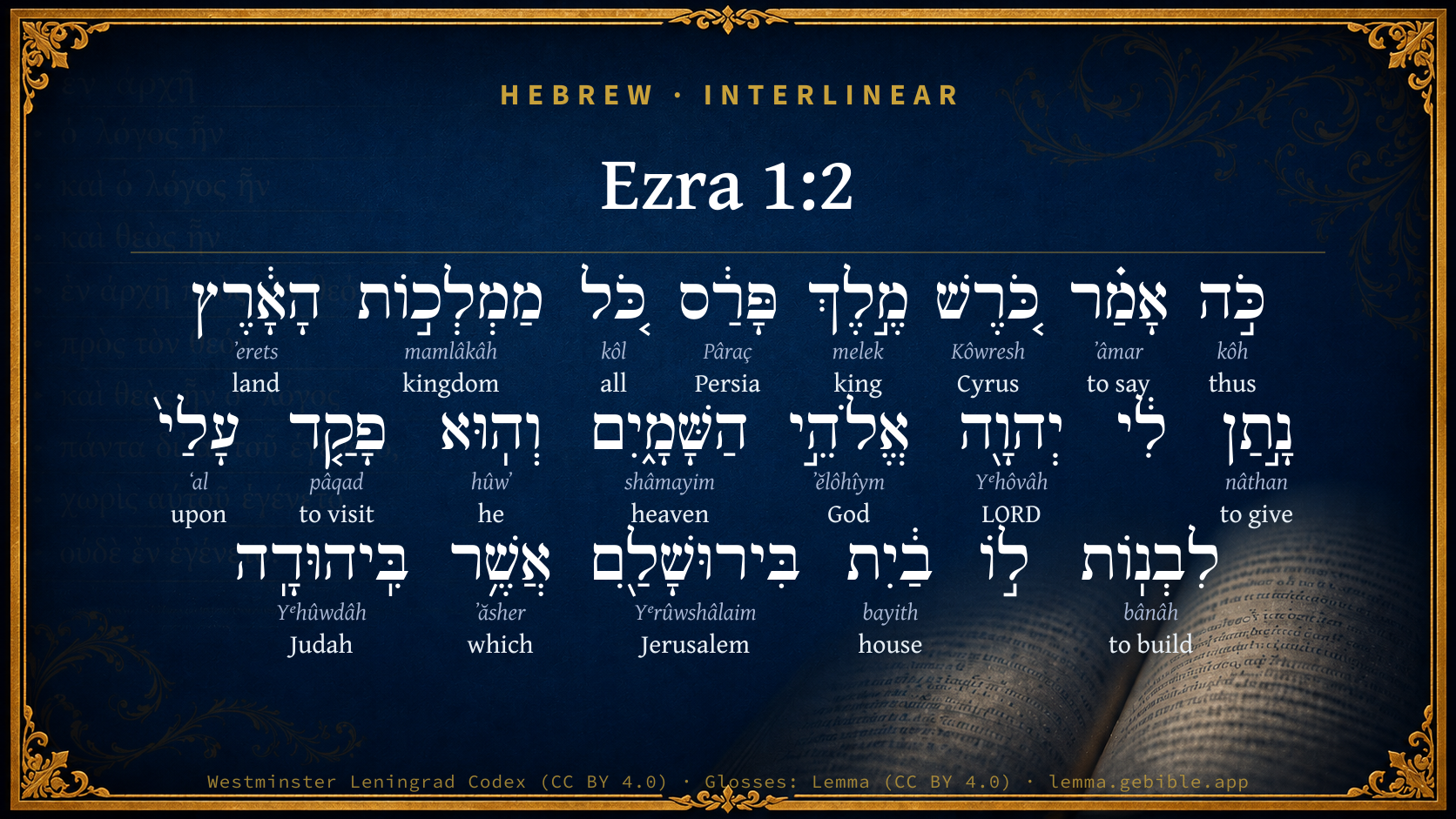
Ezra 1:2

Hebrew (Westminster Leningrad Codex) Ezra 1:2 appears in the Hebrew Old Testament. The text above is from the Westminster Leningrad Codex. Each word links to its Strong’s number, a concise gloss, and parsing drawn from the Open Scriptures Hebrew Bible morphology. Click any word for its full Brown-Driver-Briggs (BDB) entry.
Download image
Cite this verse

Ezra 1:2 (World English Bible). Public Domain. Lemma interlinear Bible study tool, https://lemma.gebible.app/v/ezra/1/2.

Show BibTeX & RIS
BibTeX
RIS
English Translation
Thus says Cyrus king of Persia, All the kingdoms of the earth has Yahweh, the God of heaven, given me; and he has charged me to build him a house in Jerusalem, which is in Judah.
World English Bible · Public Domain
Download a study sheet

One document with this verse’s original text, its word-by-word gloss line, the meaning frame, cross-references with their text, attributed commentary, and full source and license credits — printable, and it pastes into notes with its structure intact.

This verse Autodidact and up

Study sheet (.html) Plain text (.txt)

A passage Seminary Student

Up to 50 verses in one chapter. A passage sheet keeps up to 6 commentary sources and 12 cross-references per verse, in the order this page ranks them, and says so on the sheet whenever that leaves anything out. Ask for a single verse and you get the Autodidact verse sheet above.

Everything on this page stays free to read, with no account — the sheet is a download of what is already on screen, not access to it.

Want to remove ads? Support Godless Engineer
Compare translations 3

The same verse in 3 English versions, stacked beneath the original-language interlinear above. Click any original word for its lexicon entry.

Each is an independent rendering of the whole verse — the interlinear is not word-aligned to these translations.

Highlighted words mark where these versions differ — a whole-verse word diff, not a word-by-word alignment.

  • World English Bible Public Domain
    Thus says Cyrus king of Persia, All the kingdoms of the earth has Yahweh, the God of heaven, given me; and he has charged me to build him a house in Jerusalem, which is in Judah.
  • King James Version Public Domain
    Thus saith Cyrus king of Persia, The LORD God of heaven hath given me all the kingdoms of the earth; and he hath charged me to build him an house at Jerusalem, which is in Judah.
  • unfoldingWord Literal Text CC BY-SA 4.0
    “Thus says Cyrus, the king of Persia: Yahweh, the God of heaven, has given to me all the kingdoms of the earth, and he himself has appointed me to build for him a house in Jerusalem, which is in Judah.

unfoldingWord Literal Text — © unfoldingWord, licensed CC BY-SA 4.0. Word-aligned USFM3 via Door43 (git.door43.org/unfoldingWord/en_ult).

Versions to compare (up to 4)

3 of 4 selected

Show all 18 translations

Every available English version of this verse, each an independent rendering of the whole verse.

  • World English Bible Public Domain
    Thus says Cyrus king of Persia, All the kingdoms of the earth has Yahweh, the God of heaven, given me; and he has charged me to build him a house in Jerusalem, which is in Judah.
  • Berean Standard Bible Public Domain
    “This is what Cyrus king of Persia says: ‘The LORD, the God of heaven, who has given me all the kingdoms of the earth, has appointed me to build a house for Him at Jerusalem in Judah.
  • Majority Standard Bible Public Domain
    “This is what Cyrus king of Persia says: ‘The LORD, the God of heaven, who has given me all the kingdoms of the earth, has appointed me to build a house for Him at Jerusalem in Judah.
  • King James Version Public Domain
    Thus saith Cyrus king of Persia, The LORD God of heaven hath given me all the kingdoms of the earth; and he hath charged me to build him an house at Jerusalem, which is in Judah.
  • American Standard Version (1901) Public Domain
    Thus saith Cyrus king of Persia, All the kingdoms of the earth hath Jehovah, the God of heaven, given me; and he hath charged me to build him a house in Jerusalem, which is in Judah.
  • Revised Version (1885) Public Domain
    Thus saith Cyrus king of Persia, All the kingdoms of the earth hath the LORD, the God of heaven, given me; and he hath charged me to build him an house in Jerusalem, which is in Judah.
  • Geneva Bible (1599) Public Domain
    Thus saith Cyrus King of Persia, The Lord God of heauen hath giuen me all the kingdomes of the earth, and he hath commanded me to builde him an house in Ierusalem, which is in Iudah.
  • Douay-Rheims (1899) Public Domain
    Thus saith Cyrus king of the Persians: The Lord the God of heaven hath given to me all the kingdoms of the earth, and he hath charged me to build him a house in Jerusalem, which is in Judea.
  • Young's Literal Translation Public Domain
    `Thus said Cyrus king of Persia, All kingdoms of the earth hath Jehovah, God of the heavens, given to me, and He hath laid a charge on me to build to Him a house in Jerusalem, that `is' in Judah;
  • Literal Standard Version CC BY-SA 4.0
    “Thus said Cyrus king of Persia: YHWH, God of the heavens, has given all kingdoms of the earth to me, and He has laid a charge on me to build a house for Him in Jerusalem, that [is] in Judah;
  • Unlocked Literal Bible CC BY-SA 4.0
    “Cyrus, king of Persia, says: Yahweh, God of Heaven, gave me all the kingdoms of the earth, and he appointed me to build for him a house in Jerusalem in Judea.
  • unfoldingWord Literal Text CC BY-SA 4.0
    “Thus says Cyrus, the king of Persia: Yahweh, the God of heaven, has given to me all the kingdoms of the earth, and he himself has appointed me to build for him a house in Jerusalem, which is in Judah.
  • Darby Bible Public Domain
    Thus says Cyrus king of Persia: All the kingdoms of the earth has Jehovah the God of the heavens given to me, and he has charged me to build him a house at Jerusalem, which is in Judah.
  • World Messianic Bible Public Domain
    “Cyrus king of Persia says, ‘The LORD, the God of heaven, has given me all the kingdoms of the earth; and he has commanded me to build him a house in Jerusalem, which is in Judah.
  • Webster's Bible Public Domain
    Thus saith Cyrus king of Persia, The LORD God of heaven hath given me all the kingdoms of the earth; and he hath charged me to build him a house at Jerusalem, which is in Judah.
  • Free Bible Version CC BY-SA 4.0
    “This is what Cyrus king of Persia says: ‘The Lord, the God of heaven, who has given to me all the kingdoms of the earth, has given me the responsibility to build a Temple for him at Jerusalem in Judah.
  • Bible in Basic English Public Domain
    These are the words of Cyrus, king of Persia: The Lord God of heaven has given me all the kingdoms of the earth; and he has made me responsible for building a house for him in Jerusalem, which is in Judah.
  • JPS Tanakh (1917) Public Domain
    'Thus saith Cyrus king of Persia: All the kingdoms of the earth hath the LORD, the God of heaven, given me; and He hath charged me to build Him a house in Jerusalem, which is in Judah.

Literal Standard Version (2020), Covenant Press — licensed CC BY-SA 4.0. Text via the HelloAO Bible API (eBible.org). Unlocked Literal Bible (unfoldingWord) — licensed CC BY-SA 4.0. Text via the HelloAO Bible API (eBible.org). unfoldingWord Literal Text — © unfoldingWord, licensed CC BY-SA 4.0. Word-aligned USFM3 via Door43 (git.door43.org/unfoldingWord/en_ult). Free Bible Version, Dr. Jonathan Gallagher — licensed CC BY-SA 4.0. Text via the HelloAO Bible API (eBible.org).

Word by word

More ways to search: Search by grammar → Find every occurrence → Compare this word →

Practice this passage: Drill this verse → Learn its vocabulary →

כֹּ֚רֶשׁ
Kôwresh
H3566
“Cyrus”
Noun, Proper
Part of Speech
Noun
Type
Proper
Full BDB Definition

Origin: from the Persians

TWOT: None

Cyrus = "posses thou the furnace" - the king of Persia and conqueror of Babylon; first ruler of Persia to make a decree allowing the Israelite exiles to return to Jerusalem
  1. כֹּ֣ה kôh H3541 “thus” Adverb
  2. אָמַ֗ר ʼâmar H559 “to say” Verb, Qal, Perfect, 3rd Person, Masculine, Singular
  3. מֶ֣לֶךְ melek H4428 “king of” Noun, Common, Masculine, Singular, Construct
  4. פָּרַ֔ס Pâraç H6539 “Persia” Noun, Proper
  5. כֹּ֚ל kôl H3605 “all of” Noun, Common, Masculine, Singular, Construct
  6. מַמְלְכ֣וֹת mamlâkâh H4467 “kingdoms of” Noun, Common, Feminine, Plural, Construct
  7. הָאָ֔רֶץ ʼerets H776 “the · land” Particle, Definite Article + Noun, Common, Both, Singular, Absolute
  8. נָ֣תַן nâthan H5414 “to give” Verb, Qal, Perfect, 3rd Person, Masculine, Singular
  9. יְהוָ֖ה Yᵉhôvâh H3068 “LORD” Noun, Proper
  10. אֱלֹהֵ֣י ʼĕlôhîym H430 “God(s) of” Noun, Common, Masculine, Plural, Construct
  11. הַשָּׁמָ֑יִם shâmayim H8064 “the · heaven(s)” Particle, Definite Article + Noun, Common, Masculine, Plural, Absolute
  12. וְהֽוּא hûwʼ H1931 “and · he” Conjunction + Pronoun, Personal, 3rd Person, Masculine, Singular
  13. פָקַ֤ד pâqad H6485 “to visit” Verb, Qal, Perfect, 3rd Person, Masculine, Singular
  14. עָלַי֙ ʻal H5921 “upon · me” Preposition + Suffix, Personal, 1st Person, Common, Singular
  15. לִבְנֽוֹת bânâh H1129 “to build” Preposition + Verb, Qal, Infinitive Construct
  16. בַ֔יִת bayith H1004 “house” Noun, Common, Masculine, Singular, Absolute
  17. בִּירוּשָׁלִַ֖ם Yᵉrûwshâlaim H3389 “in/at · Jerusalem” Preposition + Noun, Proper
  18. אֲשֶׁ֥ר ʼăsher H834 “which” Particle, Relative
  19. בִּֽיהוּדָֽה Yᵉhûwdâh H3063 “in/at · Judah” Preposition + Noun, Proper

About this verse

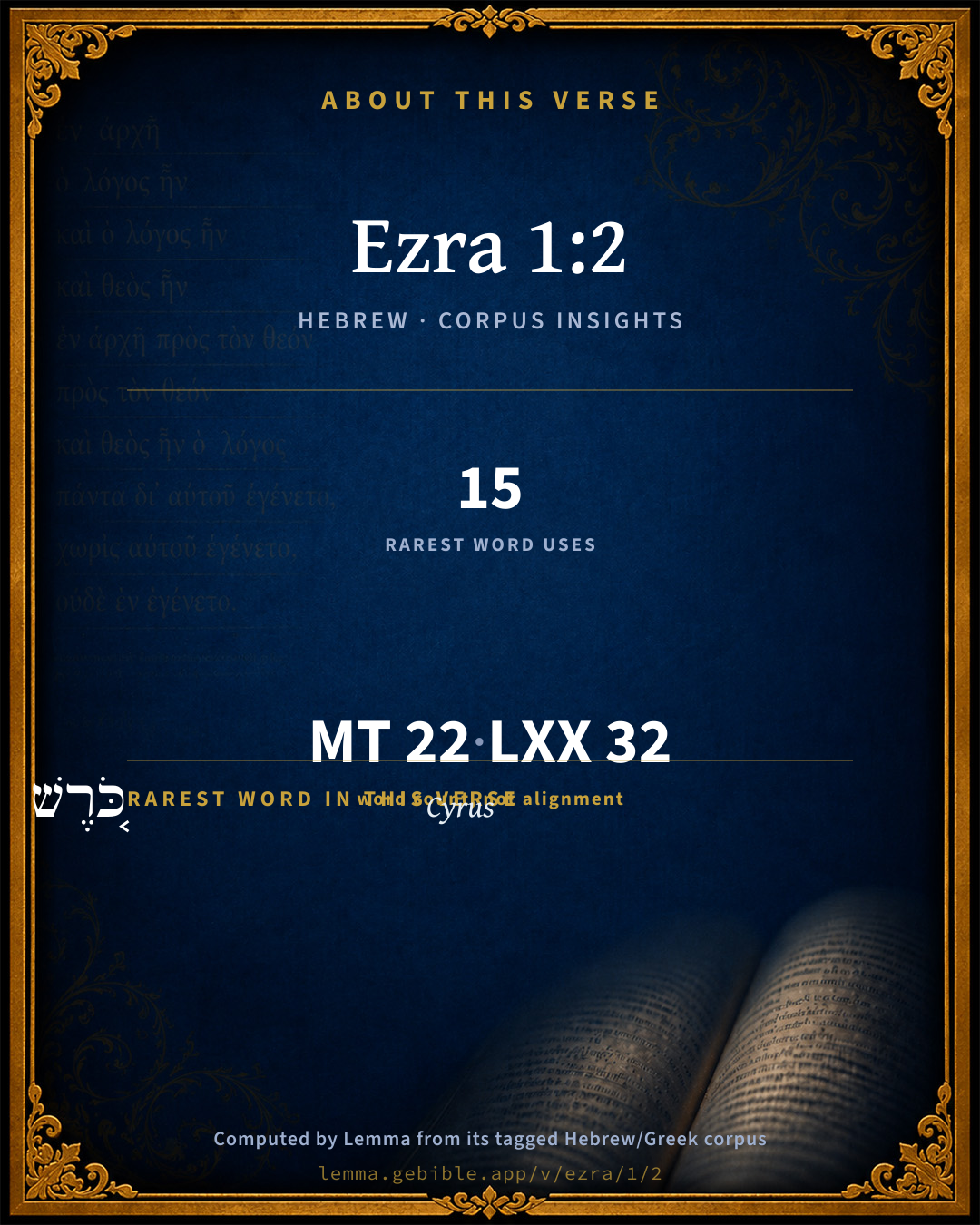
These counts appear in no published source. They are computed here, from the morphology-tagged text and Lemma’s own curated glosses. What Lemma adds →

22
words
20
distinct lemmas
Historical
section

Notable vocabulary

The rarest word here is כֹּ֚רֶשׁ Cyrus H3566 — appearing just 15 times in the whole Hebrew Bible.

Shared distinctive vocabulary

כֹּ֚רֶשׁ Cyrus H3566 occurs in 13 verses of the Hebrew Bible. Also found in:

Grammatical profile

  • 4 verbs
  • 12 nouns
  • 1 pronoun
  • 3 prepositions
  • 1 adverb
  • 1 particle

Verb forms

  • אָמַ֗ר Qal · Perfect
  • נָ֣תַן Qal · Perfect
  • פָקַ֤ד Qal · Perfect
  • לִבְנֽוֹת Qal · Infinitive Construct

Hebrew & Septuagint length

In English translation the verse runs 36 words from the Hebrew and 39 from the Septuagint (LXX English) — closely comparable.

A rough comparison of the two English renderings, which tokenize alike — not a word-level alignment.

Word counts can differ between the Hebrew and the Greek without any difference in meaning — e.g. the Hebrew direct-object marker אֵת has no separate Greek word, and Greek often adds the article ὁ.

In the original languages it is 22 Hebrew tokens and 32 Greek tokens — but the two are counted differently (Hebrew bundles its prefixes and suffixes into one token; the Greek is in lemma form), so that isn’t a like-for-like length.

Cross-references

14

Topical passages linked to Ezra 1:2 in the Treasury of Scripture Knowledge — connected by theme and wording, ordered by reader-vote popularity; previews shown in the World English Bible.

  • Isaiah 45:12–13 I have made the earth, and created man on it: I, even my hands, have stretched out the heavens; and all their host have I commanded.
  • Isaiah 44:26–45:1 who confirms the word of his servant, and performs the counsel of his messengers; who says of Jerusalem, She shall be inhabited; and of the cities of Judah, They shall be built, and I will raise up the waste places of it;
  • Daniel 5:19–21 and because of the greatness that he gave him, all the peoples, nations, and languages trembled and feared before him: whom he would he killed, and whom he would he kept alive; and whom he would he raised up, and whom he would he put down.
  • Daniel 5:23 but have lifted up yourself against the Lord of heaven; and they have brought the vessels of his house before you, and you and your lords, your wives and your concubines, have drunk wine from them; and you have praised the gods of silver and gold, of brass, iron, wood, and stone, which don't see, nor hear, nor know; and the God in whose hand your breath is, and whose are all your ways, you have not glorified.
  • 1 Kings 8:27 But will God in very deed dwell on the earth? behold, heaven and the heaven of heavens can't contain you; how much less this house that I have built!
  • 2 Chronicles 2:12 Huram said moreover, Blessed be Yahweh, the God of Israel, that made heaven and earth, who has given to David the king a wise son, endowed with discretion and understanding, that should build a house for Yahweh, and a house for his kingdom.
  • Isaiah 66:1 Thus says Yahweh, heaven is my throne, and the earth is my footstool: what manner of house will you build to me? and what place shall be my rest?
  • Jeremiah 10:11 Thus shall you say to them, The gods that have not made the heavens and the earth, these shall perish from the earth, and from under the heavens.
  • Jeremiah 27:6–7 Now have I given all these lands into the hand of Nebuchadnezzar the king of Babylon, my servant; and the animals of the field also have I given him to serve him.
  • Daniel 2:21 He changes the times and the seasons; he removes kings, and sets up kings; he gives wisdom to the wise, and knowledge to those who have understanding;
  • Daniel 2:28 but there is a God in heaven who reveals secrets, and he has made known to the king Nebuchadnezzar what shall be in the latter days. Your dream, and the visions of your head on your bed, are these:
  • Daniel 2:37–38 You, O king, are king of kings, to whom the God of heaven has given the kingdom, the power, and the strength, and the glory;
  • Daniel 4:25 that you shall be driven from men, and your dwelling shall be with the animals of the field, and you shall be made to eat grass as oxen, and shall be wet with the dew of the sky, and seven times shall pass over you; until you know that the Most High rules in the kingdom of men, and gives it to whoever he will.
  • Daniel 4:32 and you shall be driven from men; and they dwelling shall be with the animals of the field; you shall be made to eat grass as oxen; and seven times shall pass over you; until you know that the Most High rules in the kingdom of men, and gives it to whoever he will.

Cross-references courtesy of OpenBible.info (CC BY 4.0).

Hebrew and Greek witnesses Masoretic Hebrew ↔ Greek Septuagint

The same verse in the two great witnesses to the Old Testament, shown verse-for-verse.

These are two independent witnesses, not word-aligned to each other, and the Septuagint is shown in lemma (dictionary) form.

Hebrew Ezra 1:2 Masoretic · Westminster Leningrad Codex

כֹּ֣ה אָמַ֗ר כֹּ֚רֶשׁ מֶ֣לֶךְ פָּרַ֔ס כֹּ֚ל מַמְלְכ֣וֹת הָאָ֔רֶץ נָ֣תַן לִ֔י יְהוָ֖ה אֱלֹהֵ֣י הַשָּׁמָ֑יִם וְהֽוּא פָקַ֤ד עָלַי֙ לִבְנֽוֹת ל֣וֹ בַ֔יִת בִּירוּשָׁלִַ֖ם אֲשֶׁ֥ר בִּֽיהוּדָֽה

Thus says Cyrus king of Persia, All the kingdoms of the earth has Yahweh, the God of heaven, given me; and he has charged me to build him a house in Jerusalem, which is in Judah.

World English Bible · Public Domain

Greek LXX Ezra 1:2 Septuagint · lemma form

οὕτως εἶπον κῦρος βασιλεύς πέρσης πᾶς ὁ βασιλεία ὁ γῆ δίδωμι ἐγώ κύριος ὁ θεός ὁ οὐρανός καί αὐτός ἐπισκέπτομαι ἐπί ἐγώ ὁ οἰκοδομέω αὐτός οἶκος ἐν ἰερουσαλήμ ὁ ἐν ὁ ἰουδαία

Thus said Cyrus king of the Persians, The Lord God of heaven has given me all the kingdoms of the earth, and he has given me a charge to build him a house in Jerusalem that is in Judea.

LXX2012 (modern English Septuagint) · Public Domain

In the Septuagint this is one book — Esdras B (2 Esdras): Ezra is chapters 1–10, Nehemiah 11–23.

On this verse, The Pulpit Commentary discusses the Septuagint’s reading. Read the note in Commentary ↓

Hebrew: Westminster Leningrad Codex (CC BY 4.0). Greek: Septuagint (public domain); English from LXX2012 (modern English Septuagint) (Public Domain). How the Septuagint differs from the Hebrew →

Commentary

Notes on Ezra 1:2 from classic Christian and Jewish commentators (each source and its license shown beneath its notes). The classic Christian expositions comment on the surrounding passage and are grouped to its opening verse, so a note may address several verses; the Jewish commentaries on the Tanakh (Rashi and others) are per-verse, so they appear only where the commentator wrote on this verse.

Lemma curates 59 commentaries, every one of them public domain or Creative Commons licensed, each selected and text-cleaned for this edition rather than reprinted as found. About our sources →

Trapp's Complete Commentary

John Trapp

Ezr 1:2 Thus saith Cyrus king of Persia, The LORD God of heaven hath given me all the kingdoms of the earth; and he hath charged me to build him an house at Jerusalem, which [is] in Judah.

Ver. 2. The Lord God of heaven hath given me] This good language Cyrus might well learn of Daniel, who flourished under his reign, Dan 5:28, and probably acquainted him with the prophecies that went before of him, Isa 44:28; Isa 45:1. Jaddeus, the high priest, did the like, many years after, to Alexander the Great; who not only thereupon spared the Jews, but highly honoured them, as Josephus relateth. Here, then, we see this potentate of the earth giveth unto the Lord the glory due unto his name, Psa 29:1-2, acknowledging him the blessed and only potentate, 1Ti 6:16. One that both is in the heavens, and also doeth whatsoever he pleaseth, both in heaven and in earth, Psa 115:3; Psa 135:6. The God of heaven, saith he, hath given me all the kingdoms of the earth. This was far better than that of Alexander the Great, whom, when Lysippus had pictured looking up to heaven with this posy, Iupiter asserui terrain mihi, tu assere ccelum, &c., Alexander was so delighted with it, that he proclaimed that none should take his picture but Lysippus (Plin. lib. 6, cap. 16).

All the kingdoms of the earth] i.e. Many of them, so that he was Aυτοκρατωρ, a mighty monarch, an absolute emperor. But to be κοσμοκρατωρ, sole lord of the whole world, was never yet granted to any; though the great Cham of Cataia is reported to cause his trumpets to be sounded every day as soon as he hath dined, in token that he giveth leave to other princes of the earth (whom he supposeth to be his vassals) to go to dinner. And the proud Spaniard, who affecteth to be catholic monarch, was well laughed at by Sir Francis Drake and his company, for his device of a Pegasus, flying out of a globe of the earth set up in the Indies with this motto - totus non sufficit orbis. But he affecteth a universal monarchy; and so perhaps did Cyrus, which maketh him here speak so largely

And he hath charged me] Et ipse commisit mihi, so Junius rendereth it. The word signifieth to visit one, either for the better or the worse. But according to the Chaldee and Syriac use, it signifieth to charge or command, as it is here, and 2Ch 36:22, fitly rendered. But how knew Cyrus this charge of Almighty God, otherwise than by books? Like as Daniel (who probably showed him those prophecies of Isaiah concerning him) understood by Jer 25:12; Jer 29:10, that the seventy years’ captivity were accomplished; and by Eze 31:1-3, &c. (which he had read, likely, and revolved) he was the better able to give a right interpretation of Nebuchadnezzar’s dream, Dan 4:19-27.

To build him an house at Jerusalem] i.e. To rebuild that which had been once built by Solomon (whence Hegesippus, not having the Hebrew tongue, will have Jerusalem so named; quasi ιερος Sολομωντος, Solomon’s temple), a stately house indeed, and one of the seven wonders of the world. For albeit it was but one hundred and twenty feet long, and forty feet broad, whereas the temple at Ephesus was two hundred forty and five feet long, and two hundred and twenty feet broad; yet for costly and choice materials, for intricate and exact workmanship, for spiritual employment, and for mystical signification, never was there the like edifice in the world. And happy had it been for Cyrus, it, laying aside all his warlike expeditions and achievements, he had wholly applied himself to the building of his holy house, and to the study of those things that there he might have learned for his soul’s health.

Jerusalem, which is in Judah] Jerusalem was part of it in Judah, and part in the tribe of Benjamin. The house here mentioned, viz. the temple, stood in Benjamin, as was foretold it should by Moses, four hundred and forty years before it was first built by Solomon, Deu 33:12, "And of Benjamin he said, The beloved of the Lord," that is, Benjamin, his darling, "shall dwell in safety by him; and the Lord shall cover him all the day long, and he shall dwell between his shoulders," that is, betwixt those two mountains, Moriah and Sion, wherein the temple was built. Now because Benjamin was the least of all the tribes of Israel, and because so much of it as lay within Judah {Jos 19:1; Jos 19:9} was comprised under Judah, {1Ki 11:13} therefore is the temple here said to be in "Jerusalem, which is in Judah." Hereby also this Jerusalem in Judah is distinguished from any other Jerusalem, if there were any place in the world so called besides. We read of Pope Sylvester II. (who sold his soul to the devil for the popedom), that, saying mass in a certain church in Rome, called Jerusalem, he fell suddenly into a fever, whereof he died, the devil claiming his own; for the bargain between them was, that he should continue pope till he sang mass in Jerusalem: and now intellexit se a Diabolo amphibolia vocis circumventum: little dreamed the pope of any other Jerusalem but this in Judah, and this cost him his life, A.D. 1003. Eusebius telleth us (Lib. 5, cap. 17) that Montanus, the haeresiarch, called his Pepuza and Tymium (two pelting parishes in Phrygia) Jerusalem; as if they had been the only churches in the world. Hofman, the Anabaptist, had the like conceit of Strasburg, in Germany, and Becold, of Munster; both which places they called the new Jerusalem.

John Trapp, A Commentary or Exposition upon All the Books of the Old and New Testament (1647–1656) — public domain. Text from a community e-Sword module.

Joseph Benson's Commentary

Ezr 1:2. The Lord God of heaven — It is observable, says Mr. Locke, that God, in the former books, is called the Lord of hosts, but in the last of Chronicles, in this, in Nehemiah, and Daniel, that is, in the books written after the captivity, he is styled the God of heaven, and not Lord of hosts, though the sense of both expressions is the same. Probably those who showed or interpreted to Cyrus the prophecy of Isaiah concerning himself, acquainted him that the God, whose prophet Isaiah was, was worshipped by the Jews, not as the God of their particular country merely, but as the Creator and Lord of heaven and earth. And Cyrus, though it is likely he did not entirely forsake the religion of his country, yet might acknowledge and revere Jehovah, the God of the Hebrews, as the true and great God. For, though the Jews were strictly commanded to worship one God, and not to admit another into fellowship with him, yet many in the heathen nations, while they worshipped idols, acknowledged a true and supreme God, and often worshipped the gods of other countries in common with their own. Hath given me all the kingdoms of the earth — All in those parts of the world; all those large dominions which the Assyrians and Babylonians had possessed: the eastern kings were wont, as they are still, to speak magnificently of their dominions. The gift of these Cyrus ascribes to the great God, through the above-mentioned prophecy of Isaiah concerning him, which must have carried a great evidence with it, especially to him who was so highly encouraged by it; or through some special illumination which God had vouchsafed to him, as he had to Nebuchadnezzar and Darius, and some other heathen princes. And he hath charged me to build him a house at Jerusalem — So he might conclude from the prophecy just referred to, (Isa 45:13,) where God says of Cyrus, He shall build my city, of which the temple was a principal part, and more plainly from Isa 44:28, He shall say to Jerusalem, Thou shalt be built; and to the temple, Thy foundation shall be laid.

Joseph Benson's Commentary on the Old and New Testaments (1811–1818) — public domain. Text from a community e-Sword module.

The Pulpit Commentary

Thus saith Cyrus. Persian inscriptions do not ordinarily commence in this way; but the formula "says Darius the king," "says Xerxes the king" is frequent in them. King of Persia. So the Behistun inscription: "I am Darius, the great king, the king of kings, the king of Persia. " The Lord God of heaven, Yehovah Elohey hashshamayim. "God of heaven" seems to have been a usual title of the Supreme Being among the Persians, (see below Ezr_6:9, 10 7:12, 23) and perhaps designated Ormuzd in contradistinction to Ahriman, who was lord of the infernal regions. The use of the term "Jehovah," instead of Ormuzd, is remarkable, and was probably limited to the Hebrew transcript of the proclamation. Hath given me all the kingdoms of the earth. An acknowledgment that they have.received and hold their royal power from Ormuzd is universal on the part of all the Persian kings who have left inscriptions of any length; but they do not often indulge in such a hyperbole as this of Cyrus. Artaxerxes Ochus, however, calls himself "king of this world" (Rawlinson, "Cuneiform Inser.," vol. 1. p. 341). The mention of the "kingdoms of the earth" is appropriate, since Cyrus had not inherited his empire, but built it up by the conquest of a vast number of independent states ("Herod." 1. passim). His earn feeling that God had in all cases given him the victory harmonizes with the statement of Isaiah in Isa_45:1. He hath charged me to build him a house at Jerusalem. The he is emphatic, and is expressed by aujtov in the Septuagint and ipse in the Vulgate. He himself, Jehovah-Elohim, has given it me in charge to build him a house. Most critics rightly explain by referring to Isa_44:28, and accepting the statement of Josephus ("Ant. Jud:," 11:1) that the passage was shown to Cyrus shortly after his capture of Babylon. He understood the prophecy as a command, and proceeded to obey it. Which is in Judah. The addition of this clause marks strongly the oblivion into which the ruined city had fallen. Apparently, it was necessary, to recall its situation to men"s minds by an express mention of the province whereof it had been the capital. Note the repetition of the clause in the next verse.

Vers. 2-4.

The edict.

When the proclamation, which captive Israel had heard of with such interest and expectation, came to be examined, what was it found to contain? Besides a proper preamble, showing in whose name and by whose authority it was issued, three principal things; viz.,

1. a remarkable confession;

2. a satisfactory permission; and

3. a considerate command.

I A REMARKABLE CONFESSION. A confession or acknowledgment

1. Of Jehovah"s existence. Cyrus, brought up as a worshipper of Ormuzd, begins his proclamation here by mentioning Jehovah by name.

2. Of Jehovah"s greatness. Jehovah the "God of heaven so he goes on to describe himi.e. according to Persian usage (see Keil in loc. ), the supreme God, the Most High. This the more remarkable because neither Nebuchadnezzar nor Darius before, nor Artaxerxes afterwards, when much impressed with the power of Jehovah the God of the Jews, speak of him in this way. (comp. Dan_2:47 Dan_3:29 Dan_6:26; Ezr_7:15; also Ezr_6:12)

3. Of Jehovah"s goodness. "He has given me all the kingdoms of the earth." How great a possession! how true a gift! This language very significant from the lips of a Persian king (comp. "By the grace of Ormuzd I am king," as quoted in Lange on this passage).

4. Of Jehovah"s authority. "He hath charged me." With all this authority laid upon me, I am under his authority still. (comp. Mat_8:9) Cyrus speaks here of himself just as God had spoken before of Nebuchadnezzar. (Jer_25:9 Jer_27:6) And

5. Of Jehovah"s will. "He hath charged me to build him an house." This is the special thing which he desires me to accomplish. Also a significant acknowledgment, if we suppose (and there is really no other supposition before us) that Cyrus understood the declarations of Isaiah respecting him (see above) to imply a charge of this kind. At the same time, with all that we know from other sources of the singular integrity of his character, and with all that we can infer from the Bible of his probable intimacy with and respect for Daniel, only a natural thing in his case. Who so likely as his prime minister Daniel to draw up this "king"s speech;" and if he drew it up, to commence it in this way? Certain it is that no beginning, taking it for all in all, could have been more full of hope and promise to the Jews.

II A SATISFACTORY PERMISSION (ver. 3).

1. Satisfactory as to its object. The great thing that Israel needed for their true restoration and deliverance from captivity was the restoration of Jehovah"s House. On the one hand, there could be no restoration of Israel without that of Jerusalem . (see Psa_137:1, Psa_137:5, Psa_137:6; Dan_6:10 Dan_9:16) and no true restoration of Jerusalem without that of the Temple. (see Psa_122:4, Psa_122:9, etc.) On the other hand, with Jerusalem and its Temple restored, and all Israel going up to its feasts, the whole people, even if in part dispersed, would still be one nation, one Church. (comp. Act_26:7) This seems to have been the exact ideal of the post-captivity Church. Israel before the captivity was national, local, and centralized; identified with one race, one land, one house. The true Israel since Christ has been none of the three (Mat_28:19, Mat_28:20; 1Co_1:2; Gal_4:26) Israel in the intermediate centuries was in a kind of intermediate condition, still national and still centralized, but only local in part in part, on the contrary, becoming almost as much dispersed as the "Catholic" Church is itself. (Act_2:5-11) In these intermediate centuries, therefore, the importance of the" house," as a central bond by which to prevent the dispersion from ending in total obliteration, was almost greater than ever. Accordingly this whole book of Ezra has to do in the main with this question, and may be called, not inaptly, the Book of the Restoration of the House. Also the prophecies of Zechariah are greatly concerned with the same subject, and the prophecy of Haggai in particular does not speak of much else. This also is the great object of this permission of Cyrus: "Let him go up and build the house;" the great topic, in fact, of the whole proclamation being mentioned in some way in each verse. See, finally, how it is all summed up on a subsequent page: "Let the house be builded". (Ezr_6:3) In other words, "Let that be done which is needed the most." So Cyrus speaks in this place.

2. The manner of the permission was equally satisfactory. It was very definite, being addressed, it seems, to all Israel, and yet to Israel alone, as was right (see beginning of ver. 3). Contrast the Samaritans afterwards, who offered to help in building God"s house, though none of his people. It was very cordial. "Jehovah" . (see 2Ch_36:23) "his God be with him, and let him go up." Cyrus would not only have them go up, but go up with a blessing, such a blessing as he himself had already received. Compare the words of Jacob. (Gen_48:16) It was very complete. Cyrus would have them "go," or leave where they were; (Isa_51:14) he would have them go up, or reach the place they desired; (Psa_122:2) he would have them "go up and build," i.e. do the very thing that was needed. What could he do more to show his goodwill?

III The CONSIDERATE COMMAND which we have in ver. 4 seems to answer this question. Besides saying "Be ye warmed and filled". (Jam_2:16) he "gave" to the Israelites in various ways what was "needed" in their case. He did so, partly, so we understand the words, by a tax. There were various places in his dominions where some of the "remnant" of Israel ("whosoever remaineth": comp. Neh_1:2, etc.; Hag_2:3, etc.) were "sojourning" as strangers. In any such "place," if any Israelites wished to go up, the men of that place were hereby commanded (the request of such a sovereign would be a special command) to assist them by their gifts. But this was not all. The king helped the Israelites also in their great undertaking by his personal gifts. So we understand those gifts distinguished as "freewill offerings," and mentioned at the end of ver. 4 (and again at end of ver. 6) as being "beside." Not improbably we find these afterwards partly specified in Ezr_6:3, Ezr_6:4. At any rate, we learn from that passage that the king did give of "his own." Both by his people, therefore, and by himself he did what he could. So far as a mere proclamation could do such a thing, he not only permitted, he enabled them to go up. In this proclamation, as thus understood, may we not see a picture of that great declaration of liberty to the captives, (Luk_4:18) the gospel of Christ Jesus? How many the points of resemblance. How "definite" its language. "Whosoever will, let him come". (Rev_22:17) How "cordial" its invitations. "I will in no wise cast. (Joh_6:37) How "complete" its provisions (Joh_4:14; Col_2:10, etc., etc.) How ample and "considerate" its gifts, God Almighty both, as it were, taxing the whole world for the benefit of his true servants (Rom_8:28; 1Co_3:21, 1Co_3:22) and also being pleased to give them indeed of" his own" (Joh_3:16; Rom_8:32)

NOTE. It is interesting to observe how the intermediate condition of Israel or the Church in the "fourteen generations" between Salathiel and Christ, (Mat_1:17) as above noted, by leading to the establishment of synagogues throughout the Roman world, prepared for the subsequent founding of the New Testament Church or Israel. See, inter alia, how the synagogues are mentioned in Act_9:2, 20 13:5, 14, etc.; Act_14:1; Act_16:13 (the Proseucha); Act_17:1, 2 (as his manner was), Act_17:10, Act_17:17; Act_18:4; Act_19:8, etc., etc. The effect also of so many thousand Jews coming up to Jerusalem at the time of Christ"s death (the Passover) and at the descent of the Spirit (the Pentecost) should be considered in this connection.

The Pulpit Commentary (1880–1919), ed. H.D.M. Spence-Jones & Joseph S. Exell — public domain. Text from a community e-Sword module.

The Expositor's Bible

THE ROYAL EDICT

Ezr_1:2-4; Ezr_1:7-11

IT has been asserted that the Scripture version of the edict of Cyrus cannot be an exact rendering of the original, because it ascribes to the Great King some knowledge of the God of the Jews, and even some faith in Him. For this reason it has been suggested that either the chronicler or some previous writer who translated the decree out of the Persian language, in which of course it must have been first issued, inserted the word Jehovah in place of the name of Ormazd or some other god worshipped by Cyrus, and shaped the phrases generally so as to commend them to Jewish sympathies. Are we driven to this position? We have seen that when Cyrus got possession of Babylon he had no scruple in claiming the indigenous divinity Merodach as his god. Is it not then entirely in accordance with his eclectic habit of mind-not to mention his diplomatic art in humouring the prejudices of his subjects-that he should draw up a decree in which he designed to show favour to an exceptionally religious people in language that would be congenial to them? Like most men of higher intelligence even among polytheistic races, Cyrus may have believed in one supreme Deity, who, he may have supposed, was worshipped under different names by different nations. The final clause of Ezr_1:3 is misleading, as it stands in the Authorised Version; and the Revisers, with their habitual caution, have only so far improved upon it as to permit the preferable rendering to appear in the margin, where we have generally to look for the opinions of the more scholarly as well as the more courageous critics. Yet even the Authorised Version renders the same words correctly in the very next verse. There is no occasion to print the clause, "He is the God," as a parenthesis, so as to make Cyrus inform the world that Jehovah is the one real divinity. The more probable rendering in idea is also the more simple one in construction. Removing the superfluous brackets, we read right on: "He is the God which is in Jerusalem"-i.e., we have an indication who "Jehovah" is for the information of strangers to the Jews who may read the edict. With this understanding let us examine the leading items of the decree. It was proclaimed by the mouth of kings messengers, and it was also preserved in writing, so that possibly the original inscription may be recovered from among the burnt clay records that lie buried in the ruins of Persian cities. The edict is addressed to the whole empire. Cyrus announces to all his subjects his intention to rebuild the temple at Jerusalem. Then he specialises the aim of the decree by granting a license to the Jews to go up to Jerusalem and undertake this work. It is a perfectly free offer to all Jews in exile without exception. "Who is there among you" - i.e., among all the subjects of the empire-"of all His" (Jehovahs) "people, his God be with him, and let him go up to Jerusalem," etc. In particular we may observe the following points:-

First, Cyrus begins by acknowledging that "the God of Heaven"-whom he identifies with the Hebrew "Jehovah," in our version of the edict-has given him his dominions. It is possible to treat this introductory sentence as a superficial formula; but there is no reason for so ungenerous an estimate of it. If we accept the words in their honest intention, we must see in them a recognition of the hand of God in the setting up of kingdoms. Two opposite kinds of experience awaken in men a conviction of Gods presence in their lives-great calamities and great successes. The influence of the latter experience is not so often acknowledged as that of the former, but probably it is equally effective, at least in extreme instances. There is something awful in the success of a world-conqueror. When the man is a destroyer, spreading havoc and misery, like Attila, he regards himself as a "Scourge of God"; and when he is a vulgar impersonation of selfish greed like Napoleon, he thinks he is swept on by a mighty tide of destiny. In both instances the results are too stupendous to be attributed to purely human energy. But in the case of Cyrus, an enlightened and noble-minded hero is bringing liberty and favour to the victims of a degraded tyranny, so that he is hailed by some of them as the Anointed King raised up by their God, and therefore it is not unnatural that he should ascribe his brilliant destiny to a Divine influence.

Secondly, Cyrus actually asserts that God has charged him to build Him a temple at Jerusalem. Again, this may be the language of princely courtesy; but the noble spirit which breathes through the decree encourages us to take a higher view of it, and to refrain from reading minimising comments between the lines. It is probable that those eager, patriotic Jews who had got the ear of Cyrus-or he would never have issued such a decree as this - may have urged their suit by showing him predictions like that of Isa_44:28, in which God describes Himself as One "that saith of Cyrus, He is My shepherd, and shall perform all My pleasure; even saying of Jerusalem, Let her be built; and, Let the foundations of the temple be laid." Possibly Cyrus is here alluding to that very utterance, although, as we have seen, Josephus is incorrect in inserting a reference to Hebrew prophecy in the very words of the decree, and in suggesting that the fulfilment of prophecy was the chief end Cyrus had in view.

It is a historical fact that Cyrus did help to build the temple; he supplied funds from the public treasury for that object. We can understand his motives for doing so. If he desired the favour of the God of the Jews, he would naturally aid in restoring His shrine. Nabonidas had fallen, it was thought, through neglecting the worship of the gods. Cyrus seems to have been anxious to avoid this mistake, and to have given attention to the cultivation of their favour. If, as seems likely, some of the Jews had impressed his mind with the greatness of Jehovah, he might have desired to promote the building of the temple at Jerusalem with exceptional assiduity.

In the next place, Cyrus gives the captive Jews leave to go up to Jerusalem. The edict is purely permissive. There is to be no expulsion of Jews from Babylon. Those exiles who did not choose to avail themselves of the boon so eagerly coveted by the patriotic few were allowed to remain unmolested in peace and prosperity. The restoration was voluntary. This free character of the movement would give it a vigour quite out of proportion to the numbers of those who took part in it, and would, at the same time, ensure a certain elevation of tone and spirit. It is an image of the Divine restoration of souls, which is confined to those who accept it of their own free will.

Further, the object of the return, as it is distinctly specified, is simply to rebuild the temple, not-at all events in the first instance-to build up and fortify a city on the ruins of Jerusalem; much less does it imply a complete restoration of Palestine to the Jews, with a wholesale expulsion of its present inhabitants from their farms and vineyards. Cyrus does not seem to have contemplated any such revolution. The end in view was neither social nor political, but purely religious. That more would come out of it, that the returning exiles must have houses to live in and must protect those houses from the brigandage of the Bedouin, and that they must have fields producing food to support them and their families, are inevitable consequences. Here is the germ and nucleus of a national restoration. Still it remains true that the immediate object-the only object named in the decree-is the rebuilding of the temple. Thus we see from the first that the idea which characterises the restoration is religious. The exiles return as a Church. The goal of their pilgrimage is a holy site. The one work they are to aim at achieving is to further the worship of their God.

Lastly, the inhabitants of the towns in which the Jews have been settled are directed to make contributions towards the work. It is not quite clear whether these "Benevolences" are to be entirely voluntary. A royal exhortation generally assumes something of the character of a command. Probably rich men were requisitioned to assist in providing the gold and silver and other stores, together with the beasts of burden which would be needed for the great expedition. This was to supplement what Cyrus calls "the free-will offering for the house of God that is in Jerusalem"-i.e., either the gifts of the Jews who remained in Babylon, or possibly his own contribution from the funds of the state. We are reminded of the Hebrews spoiling the Egyptians at the Exodus. The prophet Haggai saw in this a promise of future supplies, when the wealth of foreign nations would be poured into the temple treasury in donations of larger dimensions from the heathen. "For thus saith the Lord of hosts," he writes, "Yet once, it is a little while, and I will shake the heavens, and the earth, and the sea, and the dry land; and the desirable things of all nations shall come, and I will fill this house with glory, saith the Lord of hosts. The silver is mine, and the gold is mine, saith the Lord of hosts." {Hag_2:6-8}

The assumed willingness of their neighbours to contribute at a hint from the king suggests that the exiles were not altogether unpopular. On the other hand, it is quite possible that, under the oppression of Nabonidas, they had suffered much wrong from these neighbours. A public persecution always entails a large amount of private cruelty, because the victims are not protected by the law from the greed and petty spite of those who are mean enough to take advantage of their helpless condition. Thus it may be that Cyrus was aiming at a just return in his recommendation to his subjects to aid the Jews.

Such was the decree. Now let us look at the execution of it.

In the first place, there was a ready response on the part of some of the Jews, seen especially in the conduct of their leaders, who "rose up," bestirring themselves to prepare for the expedition, like expectant watchers released from their weary waiting and set free for action. The social leaders are mentioned first, which is a clear indication that the theocracy, so characteristic of the coming age, was not yet the recognised order. A little later the clergy will be placed before the laity, but at present the laity are still named before the clergy. The order is domestic. The leaders are the heads of great families-"the chief of the fathers." For such people to be named first is also an indication that the movement did not originate in the humbler classes. Evidently a certain aristocratic spirit permeated it. The wealthy merchants may have been loath to leave their centres of commerce, but the nobility of blood and family were at the head of the crusade. We have not yet reached the age of the democracy. It is clear, further, that there was some organisation among the exiles. They were not a mere crowd of refugees. The leaders were of the tribes of Judah and Benjamin. We shall have to consider the relation of the Ten Tribes to the restoration later on; here it may be enough to observe in passing that representatives of the Southern Kingdom take the lead in a return to Jerusalem, the capital of that kingdom. Next come the ecclesiastical leaders, the priests and Levites. Already we find these two orders named separately-an important fact in relation to the development of Judaism that will meet us again, with some hints here and there to throw light upon the meaning of it.

There is another side to this response. It was by no means the case that the whole of the exiles rose up in answer to the edict of Cyrus; only those leaders and only those people responded "whose spirit God had raised." The privilege was offered to all the Jews, but it was not accepted by all. We cannot but be impressed by the religious faith and the inspired insight of our historian in this matter. He saw that Cyrus issued his edict because the Lord had stirred up his spirit; now he attributes the prompting to make use of the proffered liberty to a similar Divine influence. Thus the return was a movement of heaven-sent impulses throughout. Ezekiels vision of the dry bones showed the deplorable condition of the Northern Kingdom in his day-stripped bare, shattered to fragments, scattered abroad. The condition of Judah was only second to this ghastly national ruin. But now to Judah there had come the breath of the Divine Spirit which Ezekiel saw promised for Israel, and a living army was rising up in new energy. Here we may discover the deeper, the more vital source of the return. Without this the edict of Cyrus would have perished as a dead letter. Even as it was, only those people who felt the breath of the Divine afflatus rose up for the arduous undertaking. So today there is no return to the heavenly Jerusalem and no rebuilding the fallen temple of human nature except in the power of the Spirit of God. Regeneration always goes hand in hand with redemption-the work of the Spirit with the work of the Christ. In the particular case before us, the special effect of the Divine influence is "to raise the spirit"-i.e., to infuse life, to rouse to activity and hope and high endeavour. A people thus equipped is fit for any expedition of toil or peril. Like Gideons little, sifted army, the small band of inspired men who rose up to accept the decree of Cyrus carried within their breasts a superhuman power, and therefore a promise of ultimate success. The aim with which they set out confirmed the religious character of the whole enterprise. They accepted the limitation and they gladly adopted the one definite purpose suggested in the edict of Cyrus. They proceeded "to build the house of the Lord which is in Jerusalem." This was their only confessed aim. It would have been impossible for patriots such as these Jews were not to feel some national hopes and dreams stirring within them; still we have no reason to believe that the returning exiles were not loyal to the spirit of the decree of the Great King. The religious aim was the real occasion of the expedition. So much the more need was there to go in the Spirit and strength of God. Only they whose spirit God has raised are fit to build Gods temple, because work for God must be done in the Spirit of God.

Secondly, the resident neighbours fell in with the recommendation of the king ungrudgingly, and gave rich contributions for the expedition. They could not go themselves, but they could have a share in the work by means of their gifts-as the home church can share in the foreign mission she supports. The acceptance of these bounties by the Jews does not well accord with their subsequent conduct when they refused the aid of their Samaritan neighbours in the actual work of building the temple. It has an ugly look, as though they were willing to take help from all sources excepting where any concessions in return would be expected on the part of those who were befriending them. However, it is just to remember that the aid was invited and offered by Cyrus, not solicited by the Jews.

Thirdly, the execution of the decree appears to have been honestly and effectively promoted by its author. In accordance with his generous encouragement of the Jews to rebuild their temple, Cyrus restored the sacred vessels that had been carried off by Nebuchadnezzar on the occasion of the first Chaldaean raid on Jerusalem, and deposited in a temple at Babylon nearly seventy years before the time of the return. No doubt these things were regarded as of more importance than other spoils of war. It would be supposed that the patron god of the conquered people was humiliated when the instruments of his worship were offered to Bel or Nebo. Perhaps it was thought that some charm attaching to them would bring luck to the city in which they were guarded. When Nabonidas was seized with frantic terror at the approach of the Persian hosts, he brought the idols of the surrounding nations to Babylon for his protection. The reference to the temple vessels, and the careful and detailed enumeration of them, without the mention of any image, is a clear proof that, although before the captivity the majority of the Jews may have consisted of idolaters, there was no idol in the temple at Jerusalem. Had there been one there Nebuchadnezzar would most certainly have carried it off as the greatest trophy of victory. In default of images, he had to make the most of the gold and silver plate used in the sacrificial ceremonies.

Viewed in this connection, the restitution of the stolen vessels by Cyrus appears to be more than an act of generosity or justice. A certain religious import belongs to it. It put an end to an ancient insult offered by Babylon to the God of Israel; and it might be taken as an act of homage offered to Jehovah by Cyrus. Yet it was only a restitution, a return of what was Gods before, and so a type of every gift man makes to God.

It has been noticed that the total number of the vessels restored does not agree with the sum of the numbers of the several kinds of vessels. The total is 5400; but an addition of the list of the vessels only amounts to 2499. Perhaps the less valuable articles are omitted from the detailed account; or possibly there is some error of transcription, and if so the question is, in which direction shall we find it? It may be that the total was too large. On the other hand, in 1 Esdras nearly the same high total is given-viz., 5469 - and there the details are made to agree with it by an evidently artificial manipulation of the numbers. {RAPC 1 Esdras 2:14} This gives some probability to the view that the total is correct, and that the error must be in the numbers of the several items. The practical importance of these considerations is that they lead us to a high estimate of the immense wealth of the Old Temple treasures. Thus they suggest the reflection that much devotion and generosity had been shown in collecting such stores of gold and silver in previous ages. They help us to picture the sumptuous ritual of the first temple, with the "barbaric splendour" of a rich display of the precious metals. Therefore they show that the generosity of Cyrus in restoring so great a hoard was genuine and considerable. It might have been urged that after the treasures had been lying for two generations in a heathen temple the original owners had lost all claim upon them. It might have been said that they had been contaminated by this long residence among the abominations of Babylonian idolatry. The restoration of them swept away all such ideas. What was once Gods belongs to Him by right forever. His property is inalienable; His claims never lapse with time, never fail through change.

It is not without significance that the treasurer who handed over their temple-property to the Jews was named "Mithredath"-a word that means "given by Mithra," or "devoted to Mithra." This suggests that the Persian sun-god was honoured among the servants of Cyrus, and yet that one who by name at least was especially associated with this divinity was constrained to honour the God of Israel. Next to Judaism and Christianity, the worship of Mithra showed the greatest vitality of all religions in Western Asia, and later even in Europe. So vigorous was it as recently as the commencement of the Christian era, that M. Renan has remarked, that if the Roman world had not become Christian it would have become Mithrastic. In those regions where the dazzling radiance and burning heat of the sun are felt as they are not even imagined in our chill, gloomy climate, it was naturally supposed that if any visible God existed He must be found in the great fiery centre of the worlds light and life. Our own day has seen the scientific development of the idea that the suns force is the source of all the energy of nature. In the homage paid by one of the ancient followers of Mithra, the sun-god, to the God of Israel, may we not see an image of the recognition of the claims of the Supreme by our priests of the sun-Kepler, Newton, Faraday? Men must be more blind than the slaves of Mithra if they cannot recognise an awful, invisible energy behind and above the forces of the solar system-nay more, a living Spirit-God!

William Robertson Nicoll, ed., The Expositor's Bible (London: Hodder & Stoughton, 1887–1910) — public domain. 65 of 66 books (1 Corinthians is not separately keyed, as that volume carries no machine-parseable verse references); section-level commentary keyed to the opening verse. Introductory and overview sections not keyed to a specific passage are excluded.

Tyndale Open Study Notes

Tyndale Open Resources

1:2 Though Cyrus speaks of the Lord, the God of heaven, Cyrus actually was a Zoroastrian. His proclamation, written in Hebrew, was probably political propaganda to gain Jewish support for his rule. In a similar statement to the Babylonians, Cyrus claimed to worship their chief god, Marduk. However, his words here do reflect that God had appointed him to build him a Temple at Jerusalem (see Isa 44:28; 45:1, 13). He might have learned of such prophecies from Daniel, who served in his court as a high government official (Cyrus is apparently referred to by his Median name, Darius, in Dan 6:1-28; 9:1). God had long planned to raise up Cyrus and give him a vision to restore worship at Jerusalem (Isa 44:28; 45:13; 48:14-15).

Tyndale Open Study Notes — © Tyndale Open Resources, licensed CC BY-SA 4.0. Text via the HelloAO Bible API.

Geneva Bible (1599)

Geneva Bible translators

For he was chief Monarch, and had many nations under his dominion, which this heathen king confesseth to have received of the living God.

Geneva Bible (1599) marginal notes — public domain. Text via Bolls.life.

Jamieson, Fausset & Brown

Robert Jamieson, A. R. Fausset & David Brown

The Lord God of heaven hath given me all the kingdoms of the earth--Though this is in the Oriental style of hyperbole (see also Dan 4:1), it was literally true that the Persian empire was the greatest ruling power in the world at that time.

he hath charged me to build him an house at Jerusalem--The phraseology of this proclamation, independently of the express testimony of JOSEPHUS, affords indisputable evidence that Cyrus had seen (probably through means of Daniel, his venerable prime minister and favorite) those prophecies in which, two hundred years before he was born, his name, his victorious career, and the important services he should render to the Jews were distinctly foretold (Isa 44:28; Isa 46:1-4). The existence of predictions so remarkable led him to acknowledge that all his kingdoms were gifts bestowed on him by "the Lord God of heaven," and prompted him to fulfil the duty which had been laid upon him long before his birth. This was the source and origin of the great favor he showed to the Jews. The proclamation, though issued "in the first year of Cyrus" [Ezr 1:1], did not take effect till the year following.

Jamieson, Fausset & Brown — Commentary Critical and Explanatory on the Whole Bible (1871) — public domain (CC PDM 1.0). Text via the HelloAO Bible API.

Adam Clarke's Commentary

Verse 2. The Lord God of heaven] It is not unworthy of remark, that in all the books written prior to the captivity, Jehovah is called The Lord of Hosts; but in all the books written after the captivity, as 2 Chronicles, Ezra Nehemiah, and Daniel, he is styled The God of Heaven. The words however have the same meaning.

All the kingdoms of the earth. At this time the empire of the Medo-Persians was very extensive: according to ancient writers, Cyrus, at this time, reigned over the Medes, Persians, Hyrcanians, Armenians, Syrians, Assyrians, Arabians, Cappadocians, Phrygians, Lydians Phoenicians, Babylonians, Bactrians, Indians, Saci, Cilicians, Paphlagonians, Moriandrians, and many others. His empire extended on the EAST, to the Red Sea; on the NORTH, to the Euxine Sea; on the WEST, to the island of Cyprus and Egypt; and on the SOUTH, to Ethiopia.

Adam Clarke's Commentary on the Bible (1810–1826) — public domain. Text from a community e-Sword/MySword module.

The Cambridge Bible for Schools and Colleges

gen. ed. J. J. S. Perowne

2. The Lord God of heaven hath given me all the kingdoms of the earth] R.V. all the kingdoms of the earth hath the Lord, the God of heaven, given me. More correctly, (1) bringing out the emphasis implied by the position of the words in the original; (2) showing more accurately the usage of the Divine name.

The acknowledgment that all earthly sway is derived from Heavenly authority forms the basis of the decree. ‘All the kingdoms of the earth’, the universality of the mission, with which Cyrus is divinely entrusted, justifies his action in dealing with the fortunes of a part.

The Lord God of heaven] literally ‘Jahveh (i.e. Jehovah), the God of heaven’. This use of the sacred name of the God of the Jews in the decree of Cyrus gives occasion to the question, whether Cyrus knew, and, if he knew, believed in and worshipped the God of the Jews.

Commentators generally used to hold this view. This was not unnatural. For (1) they considered these verses to reproduce verbatim the decree of Cyrus: (2) they very generally supposed that Cyrus, being a Persian, was also a monotheist, who favoured the Jews on account of their monotheism, and saw in Jahveh a local representation of the One God that he adored: (3) they accepted and reproduced the statement of Josephus that Cyrus, having seen in Isaiah the Jewish prophecies relating to himself, recognised their fulfilment, and worshipped and believed in Jahveh: (4) they derived support for their view from analogous utterances of allegiance to the God of the Jews recorded of Nebuchadnezzar and Darius in Dan_3:28-29; Dan_4:2-37; Dan_6:25-28.

But (1) it is evident that the edict in these verses is recorded in the words of the Hebrew translator and presented in its Jewish form. (2) Recent discoveries have shown that Cyrus was no monotheist. His own inscriptions testify to his having been a polytheist to the last. He acted as High Priest towards the great deities of Babylon. He constantly styles himself and his son Cambyses the worshippers of Nebo and Merodach. (3) The policy of the victorious monarch was to include among the lesser divinities of his Pantheon the gods of the subjugated countries, and to secure the favour of those who presided over different territories. The deities of whom he avowed himself the servant were (a) those of his own land, who had protected him in his career of victory, (b) those of the conquered kingdoms who had transferred to him their favour, and had thus permitted him to be victorious.

Whether Josephus’ story that Cyrus had seen the prophecies of Isaiah is correct or not we cannot say. There is nothing in it intrinsically impossible. On the other hand, it was a very probable hypothesis to suggest itself to the mind of a Jew by which to account for Cyrus’ benevolent action towards his race (see note on Ezr_1:4).

When Cyrus here, in his edict, made use of a Divine name, he (a) either referred to one of the great gods whom he especially worshipped, e.g. Merodach, Nebo, Bel, for which the Hebrew version has reverently substituted the name of Jahveh: (b) or actually referred by name to Jahveh, as the god of the people, in whose favour the edict was promulgated.

The author of the book presupposes the acquaintance of heathen people with the popular use of the sacred Name which the Jew of later days was forbidden to pronounce.

God of heaven] A title, found also in Darius’ letter, chap. Ezr_6:9-10, and in Artaxerxes’ letter, Ezr_7:12; Ezr_7:21; Ezr_7:23. It is found in the Jewish reply reported in Tattenai’s letter Ezr_5:12. In Nehemiah it occurs Ezr_1:4-5, Ezr_2:4; Ezr_2:20; cf. Psa_136:26; Dan_2:18-19; Dan_2:44. Like the similar phrase ‘the God of heaven and earth’ (Ezr_5:11) the title implies boundless sovereignty. For ‘Heaven’ combined the ideas of infinite space, cf. 1Ki_8:27; Jer_31:37, the forces of nature, cf. Psa_19:1, and the dwelling-place of Spiritual beings (cf. Isa_66:1; 1Ki_8:30; Psa_2:4; Psa_115:3.)

given me] An expression of pious humility on the part of Cyrus in acknowledgment of the fact that he had won by his sword, and not inherited, the kingdoms of his empire.

he] Very emphatic in the original (cf. LXX. αὐτὸς. Vulgate ipse).

hath charged me] The Divine mission which Cyrus probably unconsciously discharged is described in Isa_44:24-28; Isa_45:1-13. The view that he was shown these prophecies and was influenced by reading them has been already referred to. Some have also supposed that Cyrus was actuated by statements of Daniel as to his duty towards the chosen people. For neither view is there any historical evidence.

a house] i.e. a Temple.

at Jerusalem which is in Judah] with geographical detail, Judah being a small and obscure province, unknown probably in many quarters of the great Persian Empire.

The Cambridge Bible for Schools and Colleges (gen. ed. J. J. S. Perowne; Cambridge University Press, 1878–1918) — public domain. Text from a community e-Sword module.

John Gill's Exposition

Thus saith Cyrus king of Persia,.... Of whom, and this edict of his, Isaiah prophesied two hundred years before he was born, Isa 44:28

the Lord God of heaven hath given me all the kingdoms of the earth; many he had conquered before he took Babylon, and then the whole Babylonian monarchy fell into his hands. Herodotus (l) says, he ruled over all Asia; Xenophon (m) reckons up many nations that were under his government, Medes and Hyrcanians, Syrians, Assyrians, Arabians, Cappadocians, both the Phrygians, Carians, Phoenicians, Babylonians, Bactrians, Indians, Cilicians, Sacae or Scythians, Paphlagonians, Megadinians, and many other nations, the Greeks inhabiting Asia, and the Cyprians, and Egyptians; and elsewhere he says (n), the borders of his kingdom were, to the east the Red sea, to the north the Euxine Pontus, to the west Cyprus and Egypt, and to the south Ethiopia. And the possession of these kingdoms Cyrus ascribes, not to his own martial courage and skill, but to the providence and disposal of the God of heaven, which he seems to have had some notion of:

and he hath charged me to build an house at Jerusalem, which is in Judah; in the prophecy of Isaiah, which, according to Josephus (o), he had seen and read, and believed it to be a charge upon him, and a command unto him to rebuild the temple at Jerusalem; however, to give leave for the rebuilding of it, and to encourage to it, and assist in it; an Arabic writer says (p), that Cyrus married a sister of Zerubbabel, and that it was at her request that the Jews had leave to return; which is merely fabulous.

(l) Clio, sive, l. 1. c. 130. So Sallust, Bell. Catalin. p. 2. (m) Cyropaedia, l. 1. in principio. (n) L. 8. c. 48. (o) Antiqu. l. 11. c. 1. sect. 1, 2. (p) Abulpharag. Hist. Dynast. Dyn. 5. p. 82.

John Gill's Exposition of the Whole Bible (1746–1763) — public domain (CC PDM 1.0). Text via the HelloAO Bible API.

Albert Barnes' Notes on the Bible

The Lord God of heaven - Or, “Yahweh, the God of heaven.” In the original Persian, the document probably ran - “ Ormazd, the God of heaven.” The Hebrew transcript took “Yahweh” as the equivalent of “Ormazd.” The Persian notion of a single Supreme Being - Ahura-Mazda, “the much-knowing, or much-bestowing Spirit” - did, in fact, approach nearly to the Jewish conception of Yahweh.

Hath given me all the kingdoms ... - There is a similar formula at the commencement of the great majority of Persian inscriptions.

He hath charged me to build him an house - It is a reasonable conjecture that, on the capture of Babylon, Cyrus was brought into contact with Daniel, who drew his attention to the prophecy of Isaiah Isa 44:28; and that Cyrus accepted this prophecy as a “charge” to rebuild the temple.

Albert Barnes' Notes on the Bible (1834–1885) — public domain. Text from a community e-Sword/MySword module.

Haydock's Catholic Bible Commentary

Earth, which had belonged to the king of Babylon. (Haydock) --- This may be an hyperbole, or allusion to Isaias xlv. 1. (Menochius) --- The dominions of Cyrus were very extensive, (Xenophon, Cyrop. i. and viii.) reaching from Ethiopia to the Euxine sea, &c. He acknowledges that he received all from the hand of God. Nabuchodonosor makes a similar confession of his supreme dominion; (Daniel ii. 47.) and the potentates of Egypt and of Rome, procured sacrifices to be offered to him. But what advantage did they derive from this sterile knowledge of his divinity? since they did not honour him accordingly, but wished to join his worship with that of idols; though the force of miracles and of reason must have convinced them that there is but one God. (Calmet) --- House, or temple, Isaias xliv. 28. --- Judea. So the Septuagint read, but the Hebrew has "Juda," all along. The whole country now began to be know by the former name. (Haydock)

George Leo Haydock (1774–1849), Haydock's Catholic Family Bible and Commentary, 1859 edition — public domain. Excludes Psalms (Douay-Rheims chapter numbering differs from Protestant) and Deuterocanonical books (Catholic canon only).

Matthew Poole's English Annotations

All the kingdoms of the earth, to wit, in those parts of the world; all that vast empire formerly under the Assyrians and Babylonians. The gift of which he ascribes to the great God, either by virtue of those common notions which were in the minds of the heathens, who though they worshipped idols, yet many of them did acknowledge a true and supreme God; or by that clear and express prophecy of Isaiah concerning him, Isa 44:28; 45:1,13, so long before he was born; which prophecy the Jews had doubtlessly showed him, which also carried a great evidence with it, especially to him, who was so highly gratified and encouraged by it; or by a special illumination which God vouchsafed to him, as he did to Nebuchadnezzar and Darius, and some others of the heathen princes.

He hath charged me; either by his prophets, Isaiah formerly, or Daniel now; or by an inward suggestion to his mind.

Matthew Poole's English Annotations on the Holy Bible (1683–1685) — public domain. Text from a community e-Sword/MySword module.

Whedon's Commentary on the Bible

Daniel D. Whedon

2. Thus saith Cyrus — “There are probably few things more surprising to the intelligent student of Scripture than the religious tone of the proclamations which are assigned in Ezra to Cyrus, Darius, and Artaxerxes. Compare Ezr_6:8-10; Ezr_7:12; Ezr_7:23. Two things are especially remarkable in these passages — first, the strongly marked religious character, very unusual in heathen documents; and, secondly, the distinctness with which they assert the unity of God, and thence identify the God of the Persians with the God of the Jews. Both these points receive abundant illustration from the Persian cuneiform inscriptions, in which the recognition of a single supreme God — Ormazd — and the clear and constant ascription to him of the direction of all mundane affairs, are leading features. In all the Persian monuments of any length, the monarch makes the acknowledgment that ‘Ormazd has bestowed on him his empire.’ Every success that is gained is ‘by the grace of Ormazd.’ The name of Ormazd occurs in almost every other paragraph of the Behistun inscription. No public monuments with such a pervading religious spirit have ever been discovered among the records of any heathen nation as those of the Persian kings; and through them all, down to the time of Artaxerxes Ochus, the name of Ormazd stands alone and unapproachable as that of the Supreme Lord of earth and heaven.” — RAWLINSON, Hist. Evid., p. 147.

The same distinguished writer says in another work: “The conquest of Babylon by Persia was practically, if not a death-blow, at least a severe wound, to that sensuous idol-worship which had for more than twenty centuries been the almost universal religion in the countries between the Mediterranean and the Zagros mountain range. That religion never recovered itself — was never reinstated. It survived, a longer or shorter time, in places. To a slight extent it corrupted Zoroastrianism; but, on the whole, from the date of the fall of Babylon it declined. ‘Bel bowed down, Nebo stooped,’ (Isa_46:1;) ‘Merodach was broken in pieces;’ judgment was done upon the Babylonian graven images, (Jer_50:2; Jer_51:52;) and the system of which they formed a necessary part having once fallen from its proud pre-eminence, gradually decayed and vanished.

“Parallel with the decline of the old Semitic idolatry was the advance of its direct antithesis, pure spiritual monotheism. The same blow which laid the Babylonian religion in the dust struck off the fetters from Judaism. Purified and refined by the precious discipline of adversity, the Jewish system which Cyrus, feeling towards it a natural sympathy, protected, upheld, and replaced in its proper locality, advanced from this time in influence and importance, leavening little by little the foul mass of superstition and impurity which came in contact with it. Proselytism grew more common. The Jews spread themselves wider. The return from the captivity, which Cyrus authorized almost immediately after the capture of Babylon, is the starting-point from which we may trace a gradual enlightenment of the heathen world by the dissemination of Jewish beliefs and practices; such dissemination being greatly helped by the high estimation in which the Jewish system was held by the civil authority, both while the empire of the Persians lasted, and when power passed to the Macedonians.” — Ancient Monarchies, vol. iii, p. 385.

Lord God of heaven — The writer uses Jehovah, “LORD,” instead of Ormazd, in this edict. A common formula in the Persian inscriptions is, “The great God Ormazd, who gave both earth and heaven to mankind.”

Given me all the kingdoms — In the Behistun inscription, Darius says, “Ormazd granted me the empire. By the grace of Ormazd I hold this empire.”

Charged me to build him a house at Jerusalem — Bertheau thinks that our author entirely recast Cyrus’s edict from his own theocratic standpoint. The king’s proclamation probably contained abundant references to Ormazd as the God by whose grace and direction he received and administered the kingdom, and our historian, acknowledging no other God than Jehovah, translated the edict in the form we now have it, substituting Jehovah for Ormazd, and otherwise altering it to suit his own religious ideas. This supposition may be partly true. Cyrus did not issue his proclamation in the Hebrew language, and, probably after the manner of the Persian inscriptions, he used the name of Ormazd and not Jehovah, and in these respects our author may have modified the phraseology in his translation; but, granting even this, it is not only possible, but highly probable, that, as Josephus and the older expositors hold, Cyrus had been shown Isaiah’s prophecies, where Jehovah says of Cyrus, “He shall say to Jerusalem, Thou shalt be built; and to the temple, Thy foundation shall be laid.” Isa_44:28. Nor is it in the least improbable that Daniel, who stood high in the court of Babylon under Darius and Cyrus, (Dan_6:2; Dan_6:28,) advised Cyrus of Isaiah’s prophecies, and also had something to do with the drawing up of this proclamation. The king regarded these prophecies as a divine charge to build the temple.

Daniel D. Whedon (gen. ed.), Commentary on the Old and New Testaments (1874–1909) — public domain. Text from a community e-Sword module.

John Wesley's Explanatory Notes

All, &c. - In those parts of the world; all that vast empire formerly under the Assyrians and Babylonians. The gift of which he ascribes to the great God; by that express prophecy of Isaiah concerning him, Isaiah xliv, 28; xlv, 1, 13, so long before he was born; which prophecy the Jews had doubtlessly shewed him, which also carried a great evidence with it, especially to him who was so highly encouraged by it: or by a special illumination which God vouchsafed to him, as he did to Nebuchadnezzar and Darius, and some other Heathen princes.

John Wesley, Explanatory Notes Upon the Whole Bible (1754–1765) — public domain. Text via the GEBible commentary corpus.

Rashi

Rabbi Shlomo Yitzchaki (Rashi)

So said Cyrus, the king of Persia...delivered to me that I am the king and ruler over all the kingdoms.

and He commanded me He commanded me through Isaiah the prophet to build for Him the Temple in Jerusalem, as it says in the Book of Isaiah (44:28): “Who says to Cyrus, ‘He is My shepherd, and all My desire he shall fulfill,’ and to say to Jerusalem, ‘It shall be built, and the Temple shall be founded.’” (ibid. 45:1): “So said the Lord to His anointed one, to Cyrus, whose right hand I held....” And this prophecy was already stated by lsaiah.

in Jerusalem, which is in Judea whch is in the province of Judea.

Rashi on the Tanakh — English translations: “The Judaica Press complete Tanach with Rashi, translated by A. J. Rosenberg” (CC BY 4.0); “Pentateuch with Rashi's commentary by M. Rosenbaum and A.M. Silbermann, 1929-1934” (public domain); “The Metsudah Tanach series, Lakewood, N.J” (CC BY 4.0); and “The Book of Joshua, Metsudah Publications, 1997” (CC BY 4.0). Text via Sefaria.

Lesson kit

Teaching starters — assembled from the data on this page, not authored interpretation. Every prompt links to the verse data it draws on. Edit before teaching.

Ezra, in the Historical, opens this verse with 22 words (20 distinct Hebrew lemmas). Its most distinctive word is Kôwresh (“Cyrus”). A historical commentator’s framing appears above. Read the whole chapter for the surrounding context.

Discussion questions

  1. The word Kôwresh carries the sense “Cyrus.” How does it shape the verse?
  2. How does 2 Chronicles 36:22, which shares the word «Cyrus», read alongside this verse?
  3. The translations on this page render this verse differently — a whole-verse word diff, not a word-by-word alignment. What might account for the different wordings?
  4. «אָמַ֗ר» is a Qal Perfect verb. How does that grammatical form shape the action described?
  5. Compare how Trapp's Complete Commentary and Joseph Benson's Commentary read this verse. Where do they agree or differ?

Things to notice

Reading settings

Reading text

Shown beneath each verse's original-language words.

Old Testament
Old Testament edition

Read the OT as the Masoretic Hebrew (MT) or the Greek Septuagint (LXX).

English shown for the Greek Septuagint (in the Hebrew ↔ Greek comparison).

Comparing translations? Open the Compare panel on any verse page to stack up to four side by side.