
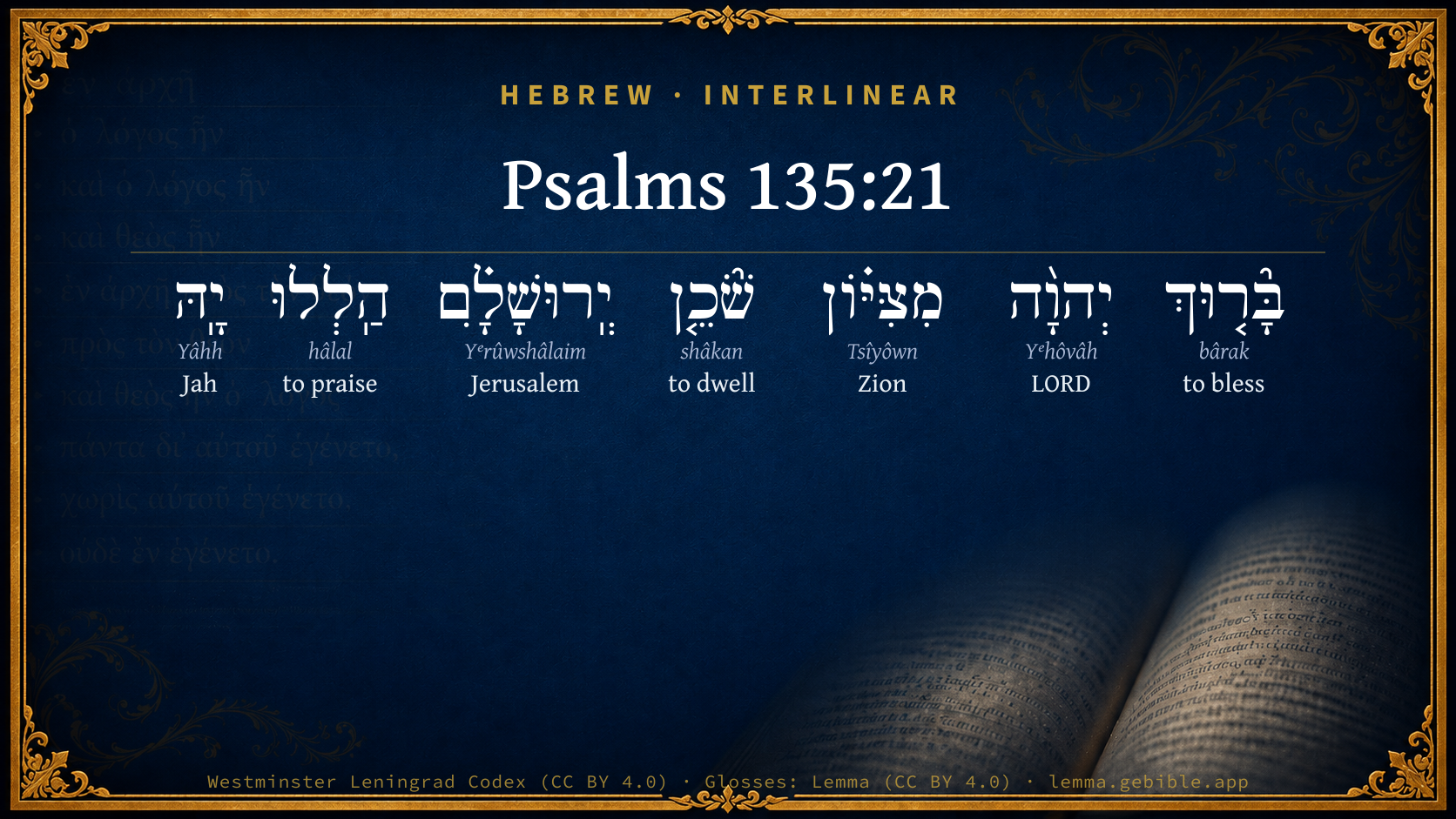
Psalms 135:21

Hebrew (Westminster Leningrad Codex) Psalms 135:21 appears in the Hebrew Old Testament. The text above is from the Westminster Leningrad Codex. Each word links to its Strong’s number, a concise gloss, and parsing drawn from the Open Scriptures Hebrew Bible morphology. Click any word for its full Brown-Driver-Briggs (BDB) entry.
Download image
Cite this verse

Psalms 135:21 (World English Bible). Public Domain. Lemma interlinear Bible study tool, https://lemma.gebible.app/v/psalms/135/21.

Show BibTeX & RIS
BibTeX
RIS
English Translation
Blessed be Yahweh from Zion, Who dwells at Jerusalem. Praise Yah!
World English Bible · Public Domain
Download a study sheet

One document with this verse’s original text, its word-by-word gloss line, the meaning frame, cross-references with their text, attributed commentary, and full source and license credits — printable, and it pastes into notes with its structure intact.

This verse Autodidact and up

Study sheet (.html) Plain text (.txt)

A passage Seminary Student

Up to 50 verses in one chapter. A passage sheet keeps up to 6 commentary sources and 12 cross-references per verse, in the order this page ranks them, and says so on the sheet whenever that leaves anything out. Ask for a single verse and you get the Autodidact verse sheet above.

Everything on this page stays free to read, with no account — the sheet is a download of what is already on screen, not access to it.

Want to remove ads? Support Godless Engineer
Compare translations 3

The same verse in 3 English versions, stacked beneath the original-language interlinear above. Click any original word for its lexicon entry.

Each is an independent rendering of the whole verse — the interlinear is not word-aligned to these translations.

Highlighted words mark where these versions differ — a whole-verse word diff, not a word-by-word alignment.

  • World English Bible Public Domain
    Blessed be Yahweh from Zion, Who dwells at Jerusalem. Praise Yah!
  • King James Version Public Domain
    Blessed be the LORD out of Zion, which dwelleth at Jerusalem. Praise ye the LORD.
  • unfoldingWord Literal Text CC BY-SA 4.0
    Blessed Yahweh from Zion, the one dwelling Jerusalem. Hallelu Yah!

unfoldingWord Literal Text — © unfoldingWord, licensed CC BY-SA 4.0. Word-aligned USFM3 via Door43 (git.door43.org/unfoldingWord/en_ult).

Versions to compare (up to 4)

3 of 4 selected

Show all 17 translations

Every available English version of this verse, each an independent rendering of the whole verse.

  • World English Bible Public Domain
    Blessed be Yahweh from Zion, Who dwells at Jerusalem. Praise Yah!
  • Berean Standard Bible Public Domain
    Blessed be the LORD from Zion—He who dwells in Jerusalem. Hallelujah!
  • Majority Standard Bible Public Domain
    Blessed be the LORD from Zion—He who dwells in Jerusalem. Hallelujah!
  • King James Version Public Domain
    Blessed be the LORD out of Zion, which dwelleth at Jerusalem. Praise ye the LORD.
  • American Standard Version (1901) Public Domain
    Blessed be Jehovah out of Zion, Who dwelleth at Jerusalem. Praise ye Jehovah.
  • Revised Version (1885) Public Domain
    Blessed be the LORD out of Zion, who dwelleth at Jerusalem. Praise ye the LORD.
  • Geneva Bible (1599) Public Domain
    Praised bee the Lord out of Zion, which dwelleth in Ierusalem. Praise ye the Lord.
  • Young's Literal Translation Public Domain
    Blessed `is' Jehovah from Zion, Inhabiting Jerusalem -- praise ye Jah!
  • Literal Standard Version CC BY-SA 4.0
    Blessed [is] YHWH from Zion, || Inhabiting Jerusalem—praise YAH!
  • Unlocked Literal Bible CC BY-SA 4.0
    Blessed be Yahweh in Zion, he who lives in Jerusalem. Praise Yahweh.
  • unfoldingWord Literal Text CC BY-SA 4.0
    Blessed Yahweh from Zion, the one dwelling Jerusalem. Hallelu Yah!
  • Darby Bible Public Domain
    Blessed be Jehovah out of Zion, who dwelleth at Jerusalem! Hallelujah!
  • World Messianic Bible Public Domain
    Blessed be the LORD from Zion, who dwells in Jerusalem. Praise the LORD!
  • Webster's Bible Public Domain
    Blessed be the LORD out of Zion, who dwelleth at Jerusalem. Praise ye the LORD.
  • Free Bible Version CC BY-SA 4.0
    Praise the Lord from Zion, for he lives in Jerusalem! Praise the Lord!
  • Bible in Basic English Public Domain
    Praise be to the Lord out of Zion, even to the Lord whose house is in Jerusalem, Let the Lord be praised.
  • JPS Tanakh (1917) Public Domain
    Blessed be the LORD out of Zion, who dwelleth at Jerusalem. Hallelujah.

Literal Standard Version (2020), Covenant Press — licensed CC BY-SA 4.0. Text via the HelloAO Bible API (eBible.org). Unlocked Literal Bible (unfoldingWord) — licensed CC BY-SA 4.0. Text via the HelloAO Bible API (eBible.org). unfoldingWord Literal Text — © unfoldingWord, licensed CC BY-SA 4.0. Word-aligned USFM3 via Door43 (git.door43.org/unfoldingWord/en_ult). Free Bible Version, Dr. Jonathan Gallagher — licensed CC BY-SA 4.0. Text via the HelloAO Bible API (eBible.org).

Word by word

More ways to search: Search by grammar → Find every occurrence → Compare this word →

Practice this passage: Drill this verse → Learn its vocabulary →

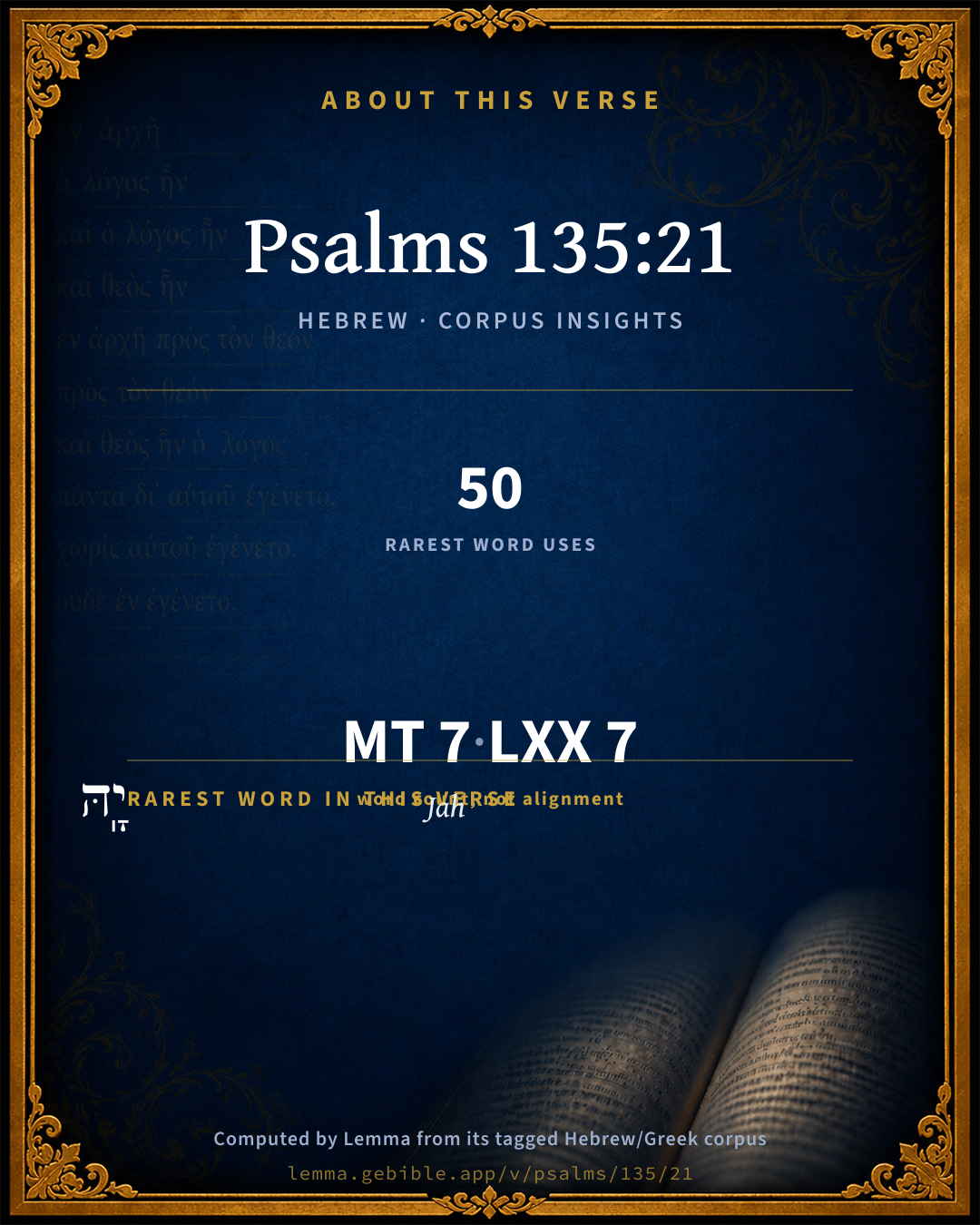
About this verse

These counts appear in no published source. They are computed here, from the morphology-tagged text and Lemma’s own curated glosses. What Lemma adds →

7
words
7
distinct lemmas
Wisdom
section

Shared distinctive vocabulary

יָֽהּ Jah H3050 occurs in 46 verses of the Hebrew Bible. Also found in:

Grammatical profile

  • 3 verbs
  • 4 nouns

Verb forms

  • בָּ֘ר֤וּךְ Qal · Participle Passive
  • שֹׁ֘כֵ֤ן Qal · Participle Active
  • הַֽלְלוּ Piel · Imperative

Hebrew & Septuagint length

In English translation the verse runs 11 words from the Hebrew and 10 from the Septuagint (LXX English) — closely comparable.

A rough comparison of the two English renderings, which tokenize alike — not a word-level alignment.

Word counts can differ between the Hebrew and the Greek without any difference in meaning — e.g. the Hebrew direct-object marker אֵת has no separate Greek word, and Greek often adds the article ὁ.

In the original languages it is 7 Hebrew tokens and 7 Greek tokens — but the two are counted differently (Hebrew bundles its prefixes and suffixes into one token; the Greek is in lemma form), so that isn’t a like-for-like length.

Cross-references

8

Topical passages linked to Psalms 135:21 in the Treasury of Scripture Knowledge — connected by theme and wording, ordered by reader-vote popularity; previews shown in the World English Bible.

  • Psalms 134:3 May Yahweh bless you from Zion; Even he who made heaven and earth.
  • Psalms 132:13–14 For Yahweh has chosen Zion. He has desired it for his habitation.
  • 2 Chronicles 6:6 but I have chosen Jerusalem, that my name might be there; and have chosen David to be over my people Israel.
  • Psalms 76:2 His tent is also in Salem; His dwelling place in Zion.
  • Psalms 128:5 May Yahweh bless you out of Zion, And may you see the good of Jerusalem all the days of your life.
  • Isaiah 12:6 Cry aloud and shout, you inhabitant of Zion; for great in the midst of you is the Holy One of Israel!"
  • Psalms 48:1 Great is Yahweh, and greatly to be praised, In the city of our God, in his holy mountain.
  • Psalms 48:9 We have thought about your loving kindness, God, In the midst of your temple.

Cross-references courtesy of OpenBible.info (CC BY 4.0).

Hebrew and Greek witnesses Masoretic Hebrew ↔ Greek Septuagint

The same verse in the two great witnesses to the Old Testament, shown verse-for-verse.

You’re reading Greek Psalm 134 (Hebrew Psalm 135). The Septuagint counts the superscription, so verse numbers can differ from the Hebrew — chapter-level alignment, not verse-by-verse. Numbering follows Rahlfs.

These are two independent witnesses, not word-aligned to each other, and the Septuagint is shown in lemma (dictionary) form.

Hebrew Psalms 135:21 Masoretic · Westminster Leningrad Codex

בָּ֘ר֤וּךְ יְהוָ֨ה מִצִּיּ֗וֹן שֹׁ֘כֵ֤ן יְֽרוּשָׁלִָ֗ם הַֽלְלוּ יָֽהּ

Blessed be Yahweh from Zion, Who dwells at Jerusalem. Praise Yah!

World English Bible · Public Domain

Greek LXX Greek Psalm 134:21 Septuagint · lemma form

εὐλογητός κύριος ἐκ σιων ὁ κατοίκος ἰερουσαλήμ

Blessed in Sion be the Lord, who dwells in Jerusalem.

LXX2012 (modern English Septuagint) · Public Domain

On this verse, The Cambridge Bible for Schools and Colleges discusses the Septuagint’s reading. Read the note in Commentary ↓

Hebrew: Westminster Leningrad Codex (CC BY 4.0). Greek: Septuagint (public domain); English from LXX2012 (modern English Septuagint) (Public Domain). How the Septuagint differs from the Hebrew →

Commentary

Notes on Psalms 135:21 from classic Christian and Jewish commentators (each source and its license shown beneath its notes). The classic Christian expositions comment on the surrounding passage and are grouped to its opening verse, so a note may address several verses; the Jewish commentaries on the Tanakh (Rashi and others) are per-verse, so they appear only where the commentator wrote on this verse.

Lemma curates 59 commentaries, every one of them public domain or Creative Commons licensed, each selected and text-cleaned for this edition rather than reprinted as found. About our sources →

Trapp's Complete Commentary

John Trapp

Psa 135:21 Blessed be the LORD out of Zion, which dwelleth at Jerusalem. Praise ye the LORD.

Ver. 21. Blessed be the Lord out of Zion] Therehence he blesseth, Psa 134:3, and there he is to be blessed.

Which dwelleth at Jerusalem] That was the seat of his royal residence, per inhabitationis gratiam, saith Austin, by the presence of his grace; who, by his essence and power, is everywhere.

Enter, prmsenter, Deus hic et ubique potenter.

John Trapp, A Commentary or Exposition upon All the Books of the Old and New Testament (1647–1656) — public domain. Text from a community e-Sword module.

The Biblical Illustrator

Joseph S. Exell

Psa_135:21

Blessed be the Lord out of Zion.

Thankfulness

I. The psalmists expressions of thankfulness.

1. We are taught by the whole of this psalm that these expressions spring from a grateful memory. Everywhere around him he beholds some memorial of the Divine goodness, some landmark of the ancient inheritance of his fathers, some footprint of the Divine mercy and power, which has lingered on from generation to generation, through calms and storms, judgments and blessings. And surely we also can recall the past, with its evidences of Gods love and pity.

2. The expressions of thankfulness, observe, are specially appropriate to the Church in her present state of trial. It is out of Zion the voice of blessing is to go up to heaven. It is in our gatherings on the Sabbath that the heart is to give free scope to its grateful memories and feelings. The Church of God is still in the wilderness; but though in the wilderness, battling with wrong, and with the visible and invisible enemies of her path, still she is able to raise the anthem--Blessed be the Lord out of Zion, which dwelleth at Jerusalem.

II. The reasonableness of this thankfulness.

1. This might be urged from the Divine Presence of the Lord, which dwelleth at Jerusalem. It was the fact of this recognized Presence, this Shield, this Refuge, this Strength, which gave the deep, full impulse to the thankfulness of the Jewish heart; so should it act with us. There is no comfort so great and so lasting to a right-minded Christian man as the consciousness of the Almighty Presence.

2. The reasonableness of thanksgiving arises, too, not only from a sense of duty, and of manifold blessings bestowed from day to day, but also from the gracious truth that Gods dwelling is to be found on earth; that He has not deserted it, nor given it over to destruction. And the fact that this meaning is conveyed to us by the naming of Jerusalem is very certain. Thus we are not directed to look for the Divine Presence out of our own spheres of existence, far away beyond the limits of our comprehension, but to look for it at our very doors, even within our own hearts. Is not this a cause of thankfulness?

3. In the fact of Gods dwelling at Jerusalem we find another reason for thankfulness in the form of His dwelling, namely, the symbol of the Shekinah, the visible glory between the wings of the cherubim overshadowing the mercy-seat. Thus, in the presence of Christ, our God and Saviour, we have a protection, a shelter, and a security against danger. (W. D. Horwood.)

.

Psa_136:1-26

The Biblical Illustrator, edited by Joseph S. Exell (c. 1880s–1900s) — public domain. Text from a community e-Sword module.

The Treasury of David

Charles H. Spurgeon

Ver. 21. The conclusion, Ps 135:21, alludes to the conclusion of the preceding Psalm. There, the Lord blesses thee out of Zion; here, let him be blessed out of Zion. The praise proceeds from the same place from which the blessing issues. For Zion is the place where the community dwells with God. E. W. Hengstenberg.

Ver. 21. Praise ye the LORD. When the song of praise is sung unto God, the work of his praise is not ended, but must be continued, renewed, and followed still: "Praise ye the LORD." David Dickson.

Ver. 21. Bless, Praise. We are not only to bless God, but to praise him: "All thy works shall praise thee, O LORD; and thy saints shall bless thee." Blessing relateth to his benefits, praise to his excellencies. We bless him for what he is to us, we praise him for what he is in himself. Now, whether we bless him, or praise him; it is still to increase our love to him, and delight in him; for God is not affected with the flattery of empty praises; yet this is an especial duty, which is of use to you, as all other duties are. It doth you good to consider him as an infinite and eternal Being, and of glorious and incomprehensible majesty. It is pleasant and profitable to us. Thomas Manton.

Ver. 21.

1. The double fact.

a) Blessing perpetually ascending from Zion to God.

b) God perpetually blessing his people by dwelling with them in Zion.

2. The double reason for praise, which is found in the double fact, and concerns every member of the church.

Charles H. Spurgeon's The Treasury of David (1869–1885) — public domain. Psalms only. Text from a community e-Sword/MySword module.

J. A. Alexander on Psalms

Joseph Addison Alexander

21. (Psa 135:21) Blessed (be) Jehovah from Zion—inhabiting Jerusalem—Hallelujah! There is here an allusion to Psa 134:3. As Jehovah blesses out of Zion, so also he is blessed out of Zion, by the diffusion of his praise, as from a radiating centre. This is said to be the only place in which Jerusalem is put for Zion, as the earthly residence of God. But see above, on Psa 126:2, and compare Psa 125:1-2.

Joseph Addison Alexander, The Psalms Translated and Explained (1850) — public domain. Text from a community e-Sword module.

Adam Clarke's Commentary

Verse 21. Blessed be the Lord out of Zion] Who has once more restored our temple and city, and now condescends to dwell with us in Jerusalem.

ANALYSIS OF THE HUNDRED AND THIRTY-FIFTH PSALM

In this Psalm the prophet invites the servants of God, and especially his ministers, to praise God, Ps 135:1-2, from arguments drawn,

I. From his goodness, particularly in choosing Israel, Ps 135:3-4.

II. From the greatness and power showed in his works, Ps 135:5-8.

III. From his justice showed to the enemies of Israel, Ps 135:1-13.

IV. From his loving-kindness extended and promised still to his servants, Ps 135:13-14.

V. Having derided the vanity of idols, Ps 135:15-19, he returns to his exhortation calling upon them to bless God, Ps 135:19-21.

I. He calls upon the ministers of religion especially to attend the recitation of Divine praises:-

1. "Praise ye the Lord," c.

2. "Ye that stand."

And now, repeating his words again, he produces his reason of inducement: -

1. Because the Lord is worthy of praise: "For he is good," &c. Not comparatively, but absolutely good.

2. "Sing praises unto his name," &c. Because it is no painful duty, but pleasant.

3. Praise him for his love to Israel for this you owe him gratitude: "For the Lord hath chosen Jacob," c. 2. "And Israel for his peculiar treasure."

II. The next argument he uses is drawn from his greatness.

1. From his empire and universal dominion in heaven and earth: "Whatsoever the Lord pleased," &c. Nothing is impossible to him: but he does all from his free will, not from any necessity.

2. "He doth all things," &c. In all places heaven, earth, seas, and hell.

And these last words the prophet amplifies, -

1. In the earth. Causing the vapours to ascend from the ends of the earth, from all parts, which are endued with several qualities.

2. In the air. "He maketh lightning for rain."

3. In the water. "For he bringeth the winds out of his treasuries." Nothing is more obscure than the generation of the winds.

III. The fourth argument the prophet uses to persuade men to praise God, is from the vengeance he executes on the enemies of his people.

1. Upon the Egyptians. "Who smote the firstborn of Egypt," &c.

2. "Who sent tokens and wonders," &c. "And he smote great nations," &c.

IV. To the commemoration of the justice God exercised upon their enemies, the prophet exhorts them to extol God.

1. "Thy name, O Lord," &c.

2. "And thy memorial," &c.

And the reason is drawn from his mercy.

1. "For the Lord will judge his people." Judge their cause, and deliver them.

2. "And he will repent himself," &c. If they repent, and turn to him.

The prophet, having proved that God is great in himself, now proves that he is above all gods, which are but vanity.

1. From their composition: "Silver and gold."

2. From their makers: "The work of men's hands."

3. From their impotency: "They have mouths," &c.

4. From the nature of their worshippers : "They that make them," &c.

Lastly, he invites all true worshippers of God to praise him, because they are lively images of the living God, from whom all their faculties have proceeded. To this he invites -

1. All Israel: "Bless the Lord, O house of Israel."

2. The priests: "Bless the Lord, O house of Aaron."

3. The Levites: "Bless the Lord, O house of Levi."

4. Lastly, all the laity: "Ye that fear the Lord bless the Lord."

To which he adds his own note, concluding -

1. "Blessed be the Lord out of Zion." Where he shows his presence by the ark.

2. "Which dwelleth at Jerusalem." Who, though in essence he is every where, yet more especially manifests his presence in his Church by his indwelling Spirit.

Therefore, let all the people bless the Lord for his great mercy: but let the citizens of Zion and Jerusalem never cease to praise him.

Adam Clarke's Commentary on the Bible (1810–1826) — public domain. Text from a community e-Sword/MySword module.

Ellicott's Commentary for English Readers

(21) Out of Zion.—As in Psa_128:5, Jehovah blesses the covenant people out of Zion, so here they bless him out of Zion—that is the place where the reciprocal relation is best and chiefly realised. This localisation is made more emphatic by the addition of the name Jerusalem to Zion. (Comp. Psa_76:2; Psa_125:1-2.)

A Bible Commentary for English Readers, edited by Charles John Ellicott (1878–1897) — public domain. Text from a community e-Sword module.

The Cambridge Bible for Schools and Colleges

gen. ed. J. J. S. Perowne

21. Blessed be Jehovah out of Zion] This final adoration corresponds to the prayer with which Psalms 134 concludes. From Zion, which is His earthly dwelling-place, Jehovah’s blessing goes forth upon His people: from Zion where they meet to worship, must ring out His people’s answer of adoring praise.

Praise ye the Lord] Hallelujah; omitted by the LXX.

The Cambridge Bible for Schools and Colleges (gen. ed. J. J. S. Perowne; Cambridge University Press, 1878–1918) — public domain. Text from a community e-Sword module.

Matthew Poole's English Annotations

Blessed be the Lord out of Zion; by the assemblies of his people in Zion or Jerusalem.

Which dwelleth at Jerusalem: this clause may be added either to distinguish the true God from the gods which were worshipped in other places and countries; or as a reason why they should bless God, because he had blessed and honoured that place with his gracious and glorious presence.

Matthew Poole's English Annotations on the Holy Bible (1683–1685) — public domain. Text from a community e-Sword/MySword module.

Whedon's Commentary on the Bible

Daniel D. Whedon

21. Same as Psa_134:3, which see.

Daniel D. Whedon (gen. ed.), Commentary on the Old and New Testaments (1874–1909) — public domain. Text from a community e-Sword module.

The Pulpit Commentary

Blessed be the Lord out of Zion. As God gives his people blessings "out of Zion", (Psa_134:3) so they praise and bless him most appropriately out of the same place. Which dwelleth at Jerusalem. (comp. Psa_76:2 Psa_48:1-3) Praise ye the Lord (see the comment on ver. 1).

God"s earthly dwelling-place.

As in Psa_128:5, Jehovah blesses the covenant people out of Zion, so here they bless him out of Zion that is the place where the reciprocal relation is best and chiefly realized. What ideas can be properly associated with God"s having a permanent abode on earth? We must be careful to distinguish between ideas that may be cherished, and ideas that must be dismissed as unworthy.

I GOD"S EARTHLY DWELLING-PLACE CENTRALIZES THE RELIGION AND THE NATION. "In Jerusalem is the place where men ought to worship." Under some circumstances it may be a good thing to have religion localized; but advancing development makes such localization a hindrance and an evil. "The time now is when neither on Gerizim nor at Jerusalem shall men worship the Father." The material help is only wanted until the spiritual has come. Then man himself is God"s dwelling-place.

II GOD"S EARTHLY DWELLING-PLACE DECLARES GOD"S RELATIVITY TO MAN. We often think of man as in God"s image; but there is an answering truth God is in man"s image. That God should want an earthly dwelling-place convinces men that he is one of themselves; seeing he wants what they want. So God"s temple dwelling-place was the foreshadowing of, and preparation for, his incarnation in his Son, and for the spiritual indwelling by the Holy Ghost.

III GOD"S EARTHLY DWELLING-PLACE CONVINCES OF THE IMMEDIACY OF HIS KNOWLEDGE. God absent in heaven is thought of as knowing by report. God actually and always present knows at once, is immediately interested, and can instantly act. Illustrate by the moral effect of the absence of an earthly king, and the moral effect of the sense of his presence.

IV GOD"S EARTHLY DWELLING-PLACE BECOMES A PERPETUAL CALL TO DUTY, AND INSPIRATION OF GOODNESS. The sense of service is quickened when that service may be called for at any hour; and the hope of winning the King"s approval renews holy endeavor. God"s dwelling with men is real, but unseen. No Jew would doubt that God was in his holy temple. But no Jew ever saw him. That unseen presence helped to the later conception of God dwelling unseen in the temple of man"s soul, apprehended as the Holy Ghost. R.T.

The Pulpit Commentary (1880–1919), ed. H.D.M. Spence-Jones & Joseph S. Exell — public domain. Text from a community e-Sword module.

Lesson kit

Teaching starters — assembled from the data on this page, not authored interpretation. Every prompt links to the verse data it draws on. Edit before teaching.

Psalms, in the Wisdom, opens this verse with 7 words (7 distinct Hebrew lemmas). Its most distinctive word is Yâhh (“Jah”). A historical commentator’s framing appears above. Read the whole chapter for the surrounding context.

Discussion questions

  1. What does “Jah” (Yâhh) contribute to the verse as a whole?
  2. Exodus 15:2 shares the word «Jah» with this verse. How do the two illuminate each other?
  3. These translations render this verse differently. What is at stake in choosing one wording over another?
  4. The verb «בָּ֘ר֤וּךְ» is Qal Participle Passive. How does its form color the action?
  5. Reading how Trapp's Complete Commentary and The Biblical Illustrator read this verse, where do the two commentators agree and where do they part?

Things to notice

Reading settings

Reading text

Shown beneath each verse's original-language words.

Old Testament
Old Testament edition

Read the OT as the Masoretic Hebrew (MT) or the Greek Septuagint (LXX).

English shown for the Greek Septuagint (in the Hebrew ↔ Greek comparison).

Comparing translations? Open the Compare panel on any verse page to stack up to four side by side.