Ecclesiastes 2:9

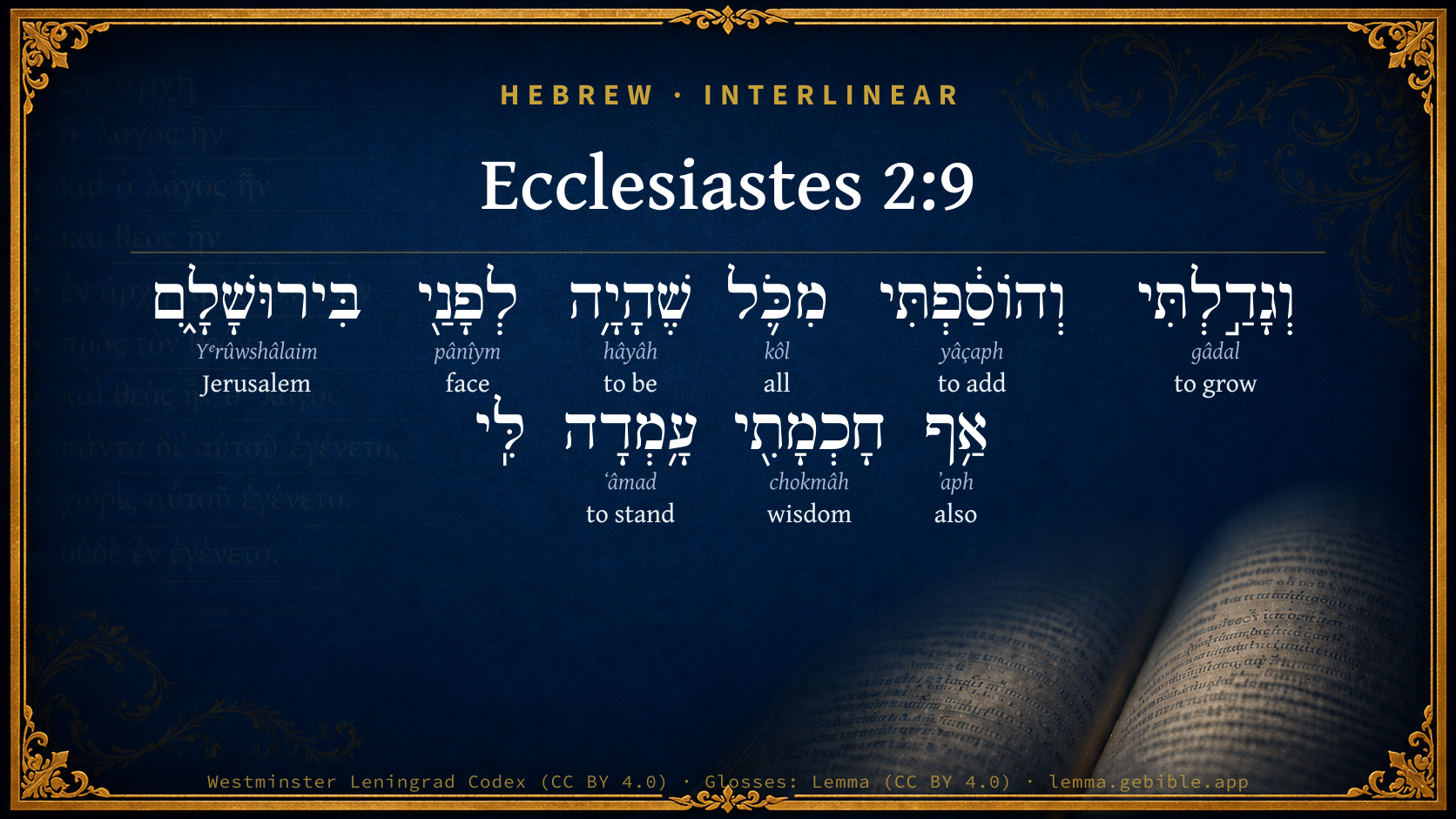
Hebrew (Westminster Leningrad Codex) Ecclesiastes 2:9 appears in the Hebrew Old Testament. The text above is from the Westminster Leningrad Codex. Each word links to its Strong’s number, a concise gloss, and parsing drawn from the Open Scriptures Hebrew Bible morphology. Click any word for its full Brown-Driver-Briggs (BDB) entry.
Download image
Cite this verse

Ecclesiastes 2:9 (World English Bible). Public Domain. Lemma interlinear Bible study tool, https://lemma.gebible.app/v/ecclesiastes/2/9.

Show BibTeX & RIS
BibTeX
RIS
English Translation
So I was great, and increased more than all who were before me in Jerusalem. My wisdom also remained with me.
World English Bible · Public Domain
Download a study sheet

One document with this verse’s original text, its word-by-word gloss line, the meaning frame, cross-references with their text, attributed commentary, and full source and license credits — printable, and it pastes into notes with its structure intact.

This verse Autodidact and up

Study sheet (.html) Plain text (.txt)

A passage Seminary Student

Up to 50 verses in one chapter. A passage sheet keeps up to 6 commentary sources and 12 cross-references per verse, in the order this page ranks them, and says so on the sheet whenever that leaves anything out. Ask for a single verse and you get the Autodidact verse sheet above.

Everything on this page stays free to read, with no account — the sheet is a download of what is already on screen, not access to it.

Want to remove ads? Support Godless Engineer
Compare translations 3

The same verse in 3 English versions, stacked beneath the original-language interlinear above. Click any original word for its lexicon entry.

Each is an independent rendering of the whole verse — the interlinear is not word-aligned to these translations.

Highlighted words mark where these versions differ — a whole-verse word diff, not a word-by-word alignment.

  • World English Bible Public Domain
    So I was great, and increased more than all who were before me in Jerusalem. My wisdom also remained with me.
  • King James Version Public Domain
    So I was great, and increased more than all that were before me in Jerusalem: also my wisdom remained with me.
  • unfoldingWord Literal Text CC BY-SA 4.0
    So I became great, and I increased more than all who were to my face in Jerusalem. Also, my wisdom stood by me.

unfoldingWord Literal Text — © unfoldingWord, licensed CC BY-SA 4.0. Word-aligned USFM3 via Door43 (git.door43.org/unfoldingWord/en_ult).

Versions to compare (up to 4)

3 of 4 selected

Show all 18 translations

Every available English version of this verse, each an independent rendering of the whole verse.

  • World English Bible Public Domain
    So I was great, and increased more than all who were before me in Jerusalem. My wisdom also remained with me.
  • Berean Standard Bible Public Domain
    So I became great and surpassed all in Jerusalem who had preceded me; and my wisdom remained with me.
  • Majority Standard Bible Public Domain
    So I became great and surpassed all in Jerusalem who had preceded me; and my wisdom remained with me.
  • King James Version Public Domain
    So I was great, and increased more than all that were before me in Jerusalem: also my wisdom remained with me.
  • American Standard Version (1901) Public Domain
    So I was great, and increased more than all that were before me in Jerusalem: also my wisdom remained with me.
  • Revised Version (1885) Public Domain
    So I was great, and increased more than all that were before me in Jerusalem: also my wisdom remained with me.
  • Geneva Bible (1599) Public Domain
    And I was great, and increased aboue all that were before me in Ierusalem: also my wisedome remained with me.
  • Douay-Rheims (1899) Public Domain
    And I surpassed in riches all that were before me in Jerusalem: my wisdom also remained with me.
  • Young's Literal Translation Public Domain
    And I became great, and increased above every one who had been before me in Jerusalem; also, my wisdom stood with me.
  • Literal Standard Version CC BY-SA 4.0
    And I became great, and increased above everyone who had been before me in Jerusalem; also, my wisdom stood with me.
  • Unlocked Literal Bible CC BY-SA 4.0
    So I became greater and wealthier than all who were before me in Jerusalem, and my wisdom remained with me.
  • unfoldingWord Literal Text CC BY-SA 4.0
    So I became great, and I increased more than all who were to my face in Jerusalem. Also, my wisdom stood by me.
  • Darby Bible Public Domain
    And I became great, and increased more than all that had been before me in Jerusalem: also my wisdom remained with me.
  • World Messianic Bible Public Domain
    So I was great, and increased more than all who were before me in Jerusalem. My wisdom also remained with me.
  • Webster's Bible Public Domain
    So I was great, and increased more than all that were before me in Jerusalem: also my wisdom remained with me.
  • Free Bible Version CC BY-SA 4.0
    I became great—greater than anyone in Jerusalem before me. All the while my wisdom stayed with me.
  • Bible in Basic English Public Domain
    And I became great; increasing more than all who had been before me in Jerusalem, and my wisdom was still with me.
  • JPS Tanakh (1917) Public Domain
    So I was great, and increased more than all that were before me in Jerusalem; also my wisdom stood me in stead.

Literal Standard Version (2020), Covenant Press — licensed CC BY-SA 4.0. Text via the HelloAO Bible API (eBible.org). Unlocked Literal Bible (unfoldingWord) — licensed CC BY-SA 4.0. Text via the HelloAO Bible API (eBible.org). unfoldingWord Literal Text — © unfoldingWord, licensed CC BY-SA 4.0. Word-aligned USFM3 via Door43 (git.door43.org/unfoldingWord/en_ult). Free Bible Version, Dr. Jonathan Gallagher — licensed CC BY-SA 4.0. Text via the HelloAO Bible API (eBible.org).

Word by word

More ways to search: Search by grammar → Find every occurrence → Compare this word →

Practice this passage: Drill this verse → Learn its vocabulary →

וְגָדַ֣לְתִּי
gâdal
H1431
“and · to grow”
Conjunction + Verb, Qal, Perfect, 1st Person, Common, Singular
Part of Speech
Conjunction + Verb
Stem
Qal
Form
Perfect
Person
1st Person
Gender
Common
Number
Singular
Full BDB Definition

Origin: a primitive root

TWOT: 315

to grow, become great or important, promote, make powerful, praise, magnify, do great things - (Qal) - to grow up - to become great - to be magnified - (Piel) - to cause to grow - to make great, powerful - to magnify - (Pual) to be brought up - (Hiphil) - to make great - to magnify - to do great things - (Hithpael) to magnify oneself
  1. וְהוֹסַ֔פְתִּי yâçaph H3254 “and · to add” Conjunction + Verb, Hiphil, Perfect, 1st Person, Common, Singular
  2. מִכֹּ֛ל kôl H3605 “from · all” Preposition + Noun, Common, Masculine, Singular, Absolute
  3. שֶׁהָיָ֥ה hâyâh H1961 “who/which · to be” Particle, Relative + Verb, Qal, Perfect, 3rd Person, Masculine, Singular
  4. לְפָנַ֖י pânîym H6440 “to/for · face(s) · my” Preposition + Noun, Common, Both, Plural, Construct + Suffix, Personal, 1st Person, Common, Singular
  5. בִּירוּשָׁלִָ֑ם Yᵉrûwshâlaim H3389 “in/at · Jerusalem” Preposition + Noun, Proper
  6. אַ֥ף ʼaph H637 “also” Particle, Accusative
  7. חָכְמָתִ֖י chokmâh H2451 “wisdom · my” Noun, Common, Feminine, Singular, Construct + Suffix, Personal, 1st Person, Common, Singular
  8. עָ֥מְדָה ʻâmad H5975 “to stand” Verb, Qal, Perfect, 3rd Person, Feminine, Singular

About this verse

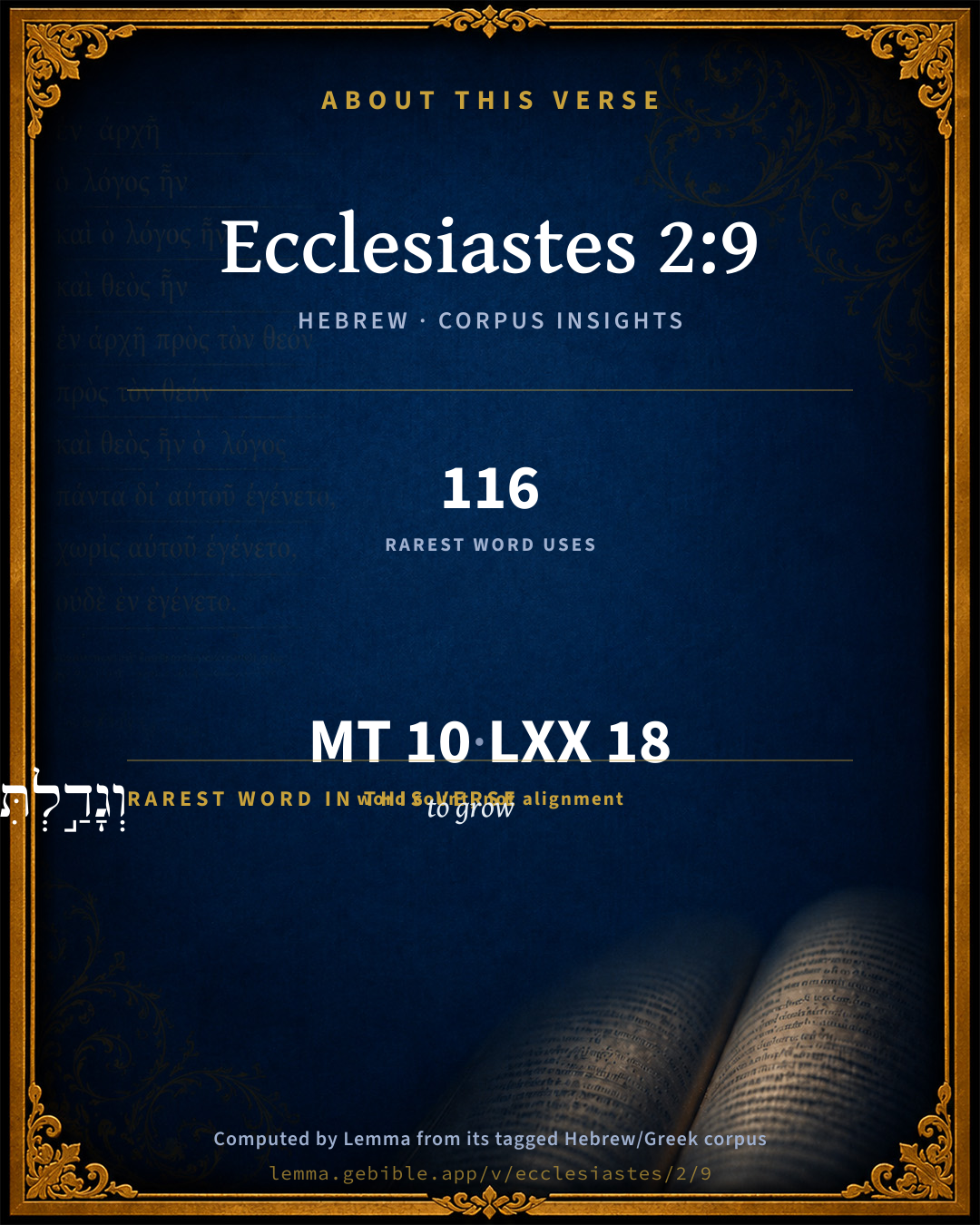
These counts appear in no published source. They are computed here, from the morphology-tagged text and Lemma’s own curated glosses. What Lemma adds →

10
words
9
distinct lemmas
Wisdom
section

Grammatical profile

  • 4 verbs
  • 4 nouns
  • 1 preposition
  • 1 particle

Verb forms

  • וְגָדַ֣לְתִּי Qal · Perfect
  • וְהוֹסַ֔פְתִּי Hiphil · Perfect
  • שֶׁהָיָ֥ה Qal · Perfect
  • עָ֥מְדָה Qal · Perfect

Hebrew & Septuagint length

In English translation the verse runs 21 words from the Hebrew and 20 from the Septuagint (LXX English) — closely comparable.

A rough comparison of the two English renderings, which tokenize alike — not a word-level alignment.

Word counts can differ between the Hebrew and the Greek without any difference in meaning — e.g. the Hebrew direct-object marker אֵת has no separate Greek word, and Greek often adds the article ὁ.

In the original languages it is 10 Hebrew tokens and 18 Greek tokens — but the two are counted differently (Hebrew bundles its prefixes and suffixes into one token; the Greek is in lemma form), so that isn’t a like-for-like length.

Cross-references

7

Topical passages linked to Ecclesiastes 2:9 in the Treasury of Scripture Knowledge — connected by theme and wording, ordered by reader-vote popularity; previews shown in the World English Bible.

  • 1 Chronicles 29:25 Yahweh magnified Solomon exceedingly in the sight of all Israel, and bestowed on him such royal majesty as had not been on any king before him in Israel.
  • Ecclesiastes 1:16 I said to myself, "Behold, I have obtained for myself great wisdom above all who were before me in Jerusalem. Yes, my heart has had great experience of wisdom and knowledge."
  • 1 Kings 10:23 So king Solomon exceeded all the kings of the earth in riches and in wisdom.
  • 2 Chronicles 9:22–23 So king Solomon exceeded all the kings of the earth in riches and wisdom.
  • 1 Kings 3:12 behold, I have done according to your word: behold, I have given you a wise and an understanding heart; so that there has been none like you before you, neither after you shall any arise like you.
  • 1 Kings 10:7 However I didn't believe the words, until I came, and my eyes had seen it: and, behold, the half was not told me; your wisdom and prosperity exceed the fame which I heard.
  • 2 Chronicles 1:1 Solomon the son of David was strengthened in his kingdom, and Yahweh his God was with him, and magnified him exceedingly.

Cross-references courtesy of OpenBible.info (CC BY 4.0).

Hebrew and Greek witnesses Masoretic Hebrew ↔ Greek Septuagint

The same verse in the two great witnesses to the Old Testament, shown verse-for-verse.

These are two independent witnesses, not word-aligned to each other, and the Septuagint is shown in lemma (dictionary) form.

Hebrew Ecclesiastes 2:9 Masoretic · Westminster Leningrad Codex

וְגָדַ֣לְתִּי וְהוֹסַ֔פְתִּי מִכֹּ֛ל שֶׁהָיָ֥ה לְפָנַ֖י בִּירוּשָׁלִָ֑ם אַ֥ף חָכְמָתִ֖י עָ֥מְדָה לִּֽי

So I was great, and increased more than all who were before me in Jerusalem. My wisdom also remained with me.

World English Bible · Public Domain

Greek LXX Ecclesiastes 2:9 Septuagint · lemma form

καί μεγαλύνω καί προςτίθημι παρά πᾶς ὁ γίγνομαι ἔμπροσθεν ἐγώ ἐν ἰερουσαλήμ καί γέ σοφία ἐγώ ἵστημι ἐγώ

So I became great, and advanced beyond all that were before in Jerusalem: also my wisdom was established to me.

LXX2012 (modern English Septuagint) · Public Domain

On this verse, The Pulpit Commentary discusses the Septuagint’s reading. Read the note in Commentary ↓

Hebrew: Westminster Leningrad Codex (CC BY 4.0). Greek: Septuagint (public domain); English from LXX2012 (modern English Septuagint) (Public Domain). How the Septuagint differs from the Hebrew →

Commentary

Notes on Ecclesiastes 2:9 from classic Christian and Jewish commentators (each source and its license shown beneath its notes). The classic Christian expositions comment on the surrounding passage and are grouped to its opening verse, so a note may address several verses; the Jewish commentaries on the Tanakh (Rashi and others) are per-verse, so they appear only where the commentator wrote on this verse.

Lemma curates 59 commentaries, every one of them public domain or Creative Commons licensed, each selected and text-cleaned for this edition rather than reprinted as found. About our sources →

Trapp's Complete Commentary

John Trapp

Ecc 2:9 So I was great, and increased more than all that were before me in Jerusalem: also my wisdom remained with me.

Ver. 9. Also my wisdom remained with me.] Outward things are dead things, and cannot touch the soul, a lively spirit, unless by way of taint. Solomon, if not at first, yet at length, was fearfully tainted by them, making good that of the poet -

“Stultitiam patiuntur opes …

Ardua res haec est, opibus non tradere mores,

Et cum tot Croesos viceris, esse Numam.”

- Martial.

John Trapp, A Commentary or Exposition upon All the Books of the Old and New Testament (1647–1656) — public domain. Text from a community e-Sword module.

Joseph Benson's Commentary

Ecc 2:9-10. So I was great — In riches, and power, and glory. My wisdom remained — As yet I was not wholly seduced from God. And whatsoever mine eyes desired — Whatsoever was grateful to my senses, or my heart desired; I kept not from them — I denied myself nothing, at least, of lawful delights, but went to the very bounds of them; which was the occasion of his falling afterward into sinful pleasures. I withheld not my heart, &c. — As my heart was vehemently set upon pleasure, so I did not resist, or curb it therein, but made all possible provision to gratify it. For my heart rejoiced — I had the comfort of all my labours, and was not hindered from the full enjoyment of them by sickness or war, or any other calamity. This was my portion — This present enjoyment of them was all the benefit which I could expect from all my labours. So that I made the best of them.

Joseph Benson's Commentary on the Old and New Testaments (1811–1818) — public domain. Text from a community e-Sword module.

Tyndale Open Study Notes

Tyndale Open Resources

2:9 I became greater: Cp. 1 Kgs 10:23. • Solomon’s wisdom enabled his successful rise in power and prosperity (see 1 Kgs 3:2-14; 4:20-34).

Tyndale Open Study Notes — © Tyndale Open Resources, licensed CC BY-SA 4.0. Text via the HelloAO Bible API.

Geneva Bible (1599)

Geneva Bible translators

For all this God did not take his gift of wisdom from me.

Geneva Bible (1599) marginal notes — public domain. Text via Bolls.life.

Jamieson, Fausset & Brown

Robert Jamieson, A. R. Fausset & David Brown

great--opulent (Gen 24:35; Job 1:3; see Kg1 10:23).

remained-- (Ecc 2:3).

Jamieson, Fausset & Brown — Commentary Critical and Explanatory on the Whole Bible (1871) — public domain (CC PDM 1.0). Text via the HelloAO Bible API.

Ellicott's Commentary for English Readers

(9-11) Kohéleth carried out his plan of tempering his enjoyment with discretion, but while he took his fill of the pleasure that fell to his lot, he found in it no abiding profit. He goes on in the following paragraph to complain that the wisdom and other advantages he possessed in his search for happiness render his failure the more disheartening.

A Bible Commentary for English Readers, edited by Charles John Ellicott (1878–1897) — public domain. Text from a community e-Sword module.

The Cambridge Bible for Schools and Colleges

gen. ed. J. J. S. Perowne

9. I was great, and increased] There is something significant in the repetition of the formula of ch. Ecc_1:16. The king had surpassed all others in wisdom, he was now surpassing all others in magnificence.

also my wisdom remained with me] The thought expressed seems to be, as in Ecc_2:3, that the seeker, though he plunged into the pleasures of a sensual life, was never altogether their slave. They were for him experiments which he watched as with an intellectual impartiality. Like Goethe, he analysed his voluptuousness, and studied his own faculties of enjoyment.

The Cambridge Bible for Schools and Colleges (gen. ed. J. J. S. Perowne; Cambridge University Press, 1878–1918) — public domain. Text from a community e-Sword module.

John Gill's Exposition

So I was great,.... Became famous for the great works wrought by him before mentioned;

and increased more than all that were before me in Jerusalem; the Targum adds, "in riches"; but it seems rather to respect his fame and glory among men; though in general it may include his increase of wealth, power, and honour, and everything that contributed to his external happiness;

also my wisdom remained with me; the Targum adds, "and it helped me"; which he exercised and showed in the government of his kingdom, in the conduct of his family, in his personal deportment and behaviour; amidst all his pleasures, he did not neglect the study of natural knowledge, nor give himself up to sordid and sinful lusts; and so was a better judge of pleasure, whether true happiness consisted in it or not.

John Gill's Exposition of the Whole Bible (1746–1763) — public domain (CC PDM 1.0). Text via the HelloAO Bible API.

Haydock's Catholic Bible Commentary

Wisdom, not that which was supernatural, and could not be found amid such delights, ver. 3., and James iii. 17. I knew that all this was vanity. (Calmet) Video meliora proboque,

Deteriora sequor. (Ovid) (Haydock)

George Leo Haydock (1774–1849), Haydock's Catholic Family Bible and Commentary, 1859 edition — public domain. Excludes Psalms (Douay-Rheims chapter numbering differs from Protestant) and Deuterocanonical books (Catholic canon only).

Matthew Poole's English Annotations

I was great, in riches, and power, and glory.

Also my wisdom remained with me; as yet I was not wholly besotted and seduced from God by these things, as I was afterwards; I still had the use of my reason, whereby I was capable of searching after and finding satisfaction, if it was to be had in those things.

Matthew Poole's English Annotations on the Holy Bible (1683–1685) — public domain. Text from a community e-Sword/MySword module.

Whedon's Commentary on the Bible

Daniel D. Whedon

9. So I was great — The result of all these efforts, his wisdom standing by to guide him, was the unrivalled greatness of the “Grand Monarch.” He developed every resource of his kingdom, and by alliances and commerce enhanced his wealth.

Daniel D. Whedon (gen. ed.), Commentary on the Old and New Testaments (1874–1909) — public domain. Text from a community e-Sword module.

The Pulpit Commentary

So I was great. (see on Ecc_1:16) This refers to the magnificence and extent of his possessions and luxury, as the former passage to the surpassing excellence of his wisdom. We may compare the mention of Abraham, (Gen_26:13) "The man waxed great, and grew more and more until he became very great". (sc Job_1:3) Also my wisdom remained with me; perseveravit mecum (Vulgate); ejstaqh moi (Septuagint). In accordance with the purpose mentioned in ver. 3, he retained command of himself, studying philosophically the effects and nature of the pleasures of which he partook, and keeping ever in view the object of his pursuit. Voluptuousness was not the end which he sought, but one of the means to obtain the end; and what he calls his wisdom is not pure Divine wisdom that comes from above, but an earthly prudence and self-restraint.

The Pulpit Commentary (1880–1919), ed. H.D.M. Spence-Jones & Joseph S. Exell — public domain. Text from a community e-Sword module.

John Wesley's Explanatory Notes

Great - In riches, and power, and glory. My wisdom remained - As yet I was not wholly seduced from God.

John Wesley, Explanatory Notes Upon the Whole Bible (1754–1765) — public domain. Text via the GEBible commentary corpus.

Keil & Delitzsch

C. F. Keil & F. Delitzsch

"And I became great, and was always greater than all that were before me in Jerusalem: also my wisdom remained with me. And all that mine eyes desired I kept not from them, I refused not any kind of joy to my heart; for my heart had joy of all my labour: and this was my portion of all my labour. And I turned myself to all the works which my hands had done, and to the labour which I had laboured to accomplish: and, behold, all was vain, and windy effort, and there was no true profit under the sun." In vehosaphti there is here no obj. as at Ecc 1:16; the obj. is the gedullah, the greatness, to be concluded and thought of from vegadalti, "and I became great." To the impers. היה for היוּ, 7b, cf. 7a, Ecc 1:16, Ecc 1:10. He became great, and always greater, viz., in the possession of all the good things, the possession of which seemed to make a man happy on this earth. And what he resolved upon, in the midst of this dulcis insania, viz., to deport himself as a wise man, he succeeded in doing: his wisdom forsook him not, viz., the means adapted to the end, and ruling over this colossal apparatus of sensual lust; אף, as e.g., at Psa 16:6, belongs to the whole clause; and עמד, with ל, does not mean here to stand by, sustain (Herzfeld, Ewald, Elster), which it might mean as well as על עמד, Dan 12:1, but to continue, as Jerome, and after him, Luther, translates: sapientia quoquo perseveravit mecum; the Targ. connects the ideas of continuance (lxx, Syr., Venet.) and of help; but the idea intended is that of continuance, for נהג, e.g., does not refer to helping, but self-maintaining.

Ecc 2:10

Thus become great and also continuing wise, he was not only in a condition to procure for himself every enjoyment, but he also indulged himself in everything; all that his eyes desired, i.e., all that they saw, and after which they made him lust (Deu 14:26) (cf. Jo1 2:16), that he did not refuse to them (אצל, subtrahere), and he kept not back his heart from any kind of joy (מנע, with min of the thing refused, as at Num 24:11, etc., oftener with min, of him to whom it is refused, e.g., Gen 30:2), for (here, after the foregoing negations, coinciding with immo) his heart had joy of all his work; and this, viz., this enjoyment in full measure, was his part of all his work. The palindromic form is like Ecc 1:6; Ecc 4:1. We say in Heb. as well as in German: to have joy in (an, ב), anything, joy over (ber, על) anything, or joy of (von, מן) anything; Koheleth here purposely uses min, for he wishes to express not that the work itself was to him an object and reason of joy, but that it became to him a well of joy (cf. Pro 5:18; Ch2 20:27). Falsely, Hahn and others: after my work (min, as e.g., Psa 73:20), for thereby the causative connection is obliterated: min is the expression of the mediate cause, as the concluding sentence says: Joy was that which he had of all his work - this itself brought care and toil to him; joy, made possible to him thereby, was the share which came to him from it.

Ecc 2:11

But was this חלק a יתרון - was this gain that fell to him a true, satisfying, pure gain? With the words uphanithi ani he proposes this question, and answers it. פּנה (to turn to) is elsewhere followed by expressions of motion to an end; here, as at Job 6:28, by בּ, by virtue of a constructio praegnans: I turned myself, fixing my attention on all my works which my hands accomplished. La'asoth is, as at Gen 2:3 (vid., l.c.), equivalent to perficiendo, carrying out, viz., such works of art and of all his labour. The exclamation "behold" introduces the summa summarum. Regardingיתרון, vid., Ecc 1:3. Also this way of finding out that which was truly good showed itself to be false. Of all this enjoyment, there remained nothing but the feeling of emptiness. What he strove after appeared to him as the wind; the satisfaction he sought to obtain at such an expense was nothing else than a momentary delusion. And since in this search after the true happiness of life he was in a position more favourable for such a purpose than almost any other man, he is constrained to draw the conclusion that there is no יתרון, i.e., no real enduring and true happiness, from all labour under the sun.

Keil & Delitzsch — Biblical Commentary on the Old Testament (1861–1891) — public domain (CC PDM 1.0). Text via the HelloAO Bible API. (Old Testament only.)

unfoldingWord translationNotes

Door43 World Missions Community

than all who were before me in Jerusalem

This refers to all the previous rulers of Jerusalem. AT: "than all the kings who had ruled before me in Jerusalem" (See: Assumed Knowledge and Implicit Information)

my wisdom remained with me

This is an idiom. "I continued to act wisely" or "I continued to be wise" (See: Idiom)

Whatever my eyes desired ... from them

Here the author refers to himself by his "eyes" to emphasize what he sees. AT: "Whatever I saw and desired ... from myself" (See: Synecdoche)

I did not withhold from them

This can be stated positively. AT: "I got for them"

I did not withhold my heart from any pleasure

Here the author refers to himself by his "heart" to emphasize his desires. This can be stated positively and the word "pleasure" can be expressed as a verb. AT: "I did not keep myself from any pleasure" or "I allowed myself to enjoy everything that made me happy" (See: Synecdoche and Abstract Nouns)

my heart rejoiced

Here the author refers to himself by his "heart" to emphasize his desires. AT: "I rejoiced" (See: Synecdoche)

translationWords

wise

heart

joy

labor

reward

unfoldingWord translationNotes — © Distant Shores Media and the Door43 World Missions Community, licensed CC BY-SA 4.0. Source: git.door43.org/Door43/en_tn.

Rashi

Rabbi Shlomo Yitzchaki (Rashi)

also my wisdom remained with me Also, I did not forsake my wisdom because of all these affairs, and it remained with me; I did not forget it. Another explanation: It stood by me to aid me against all these.

Rashi on the Tanakh — English translations: “The Judaica Press complete Tanach with Rashi, translated by A. J. Rosenberg” (CC BY 4.0); “Pentateuch with Rashi's commentary by M. Rosenbaum and A.M. Silbermann, 1929-1934” (public domain); “The Metsudah Tanach series, Lakewood, N.J” (CC BY 4.0); and “The Book of Joshua, Metsudah Publications, 1997” (CC BY 4.0). Text via Sefaria.

Lesson kit

Teaching starters — assembled from the data on this page, not authored interpretation. Every prompt links to the verse data it draws on. Edit before teaching.

Ecclesiastes, in the Wisdom, opens this verse with 10 words (9 distinct Hebrew lemmas). Its most distinctive word is gâdal (“to grow”). A historical commentator’s framing appears above. Read the whole chapter for the surrounding context.

Discussion questions

  1. How does “to grow” (gâdal) shape what this verse is saying?
  2. How does 1 Chronicles 29:25, which shares this passage’s theme, read alongside this verse?
  3. These translations render this verse differently. What is at stake in choosing one wording over another?
  4. «וְגָדַ֣לְתִּי» is a Qal Perfect verb. How does that grammatical form shape the action described?
  5. Compare how Trapp's Complete Commentary and Joseph Benson's Commentary read this verse. Where do they agree or differ?

Things to notice

Reading settings

Reading text

Shown beneath each verse's original-language words.

Old Testament
Old Testament edition

Read the OT as the Masoretic Hebrew (MT) or the Greek Septuagint (LXX).

English shown for the Greek Septuagint (in the Hebrew ↔ Greek comparison).

Comparing translations? Open the Compare panel on any verse page to stack up to four side by side.