2 Chronicles 32:10

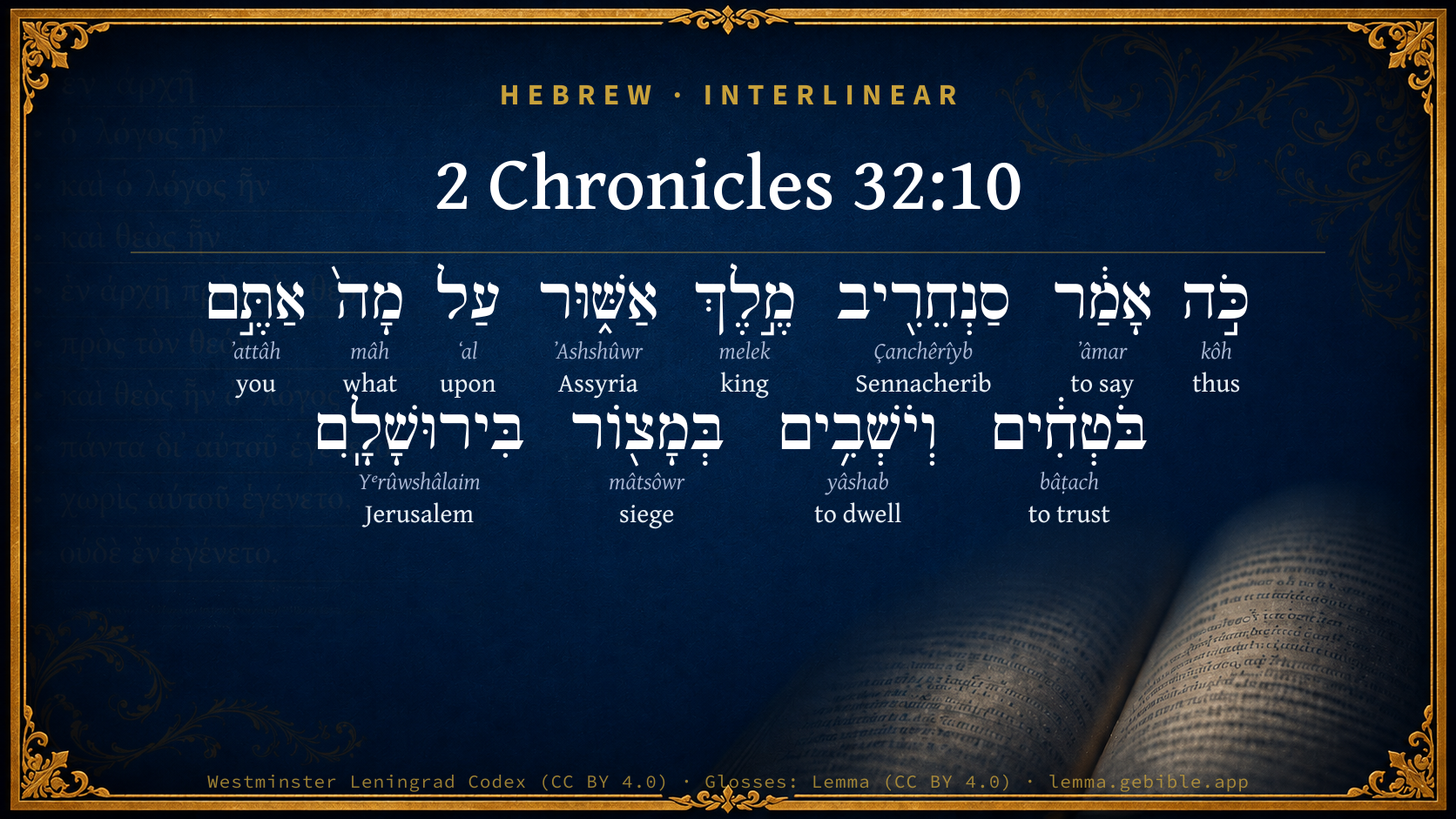
Hebrew (Westminster Leningrad Codex) 2 Chronicles 32:10 appears in the Hebrew Old Testament. The text above is from the Westminster Leningrad Codex. Each word links to its Strong’s number, a concise gloss, and parsing drawn from the Open Scriptures Hebrew Bible morphology. Click any word for its full Brown-Driver-Briggs (BDB) entry.
Download image
Cite this verse

2 Chronicles 32:10 (World English Bible). Public Domain. Lemma interlinear Bible study tool, https://lemma.gebible.app/v/2-chronicles/32/10.

Show BibTeX & RIS
BibTeX
RIS
English Translation
Thus says Sennacherib king of Assyria, Whereon do you trust, that you abide the siege in Jerusalem?
World English Bible · Public Domain
Download a study sheet

One document with this verse’s original text, its word-by-word gloss line, the meaning frame, cross-references with their text, attributed commentary, and full source and license credits — printable, and it pastes into notes with its structure intact.

This verse Autodidact and up

Study sheet (.html) Plain text (.txt)

A passage Seminary Student

Up to 50 verses in one chapter. A passage sheet keeps up to 6 commentary sources and 12 cross-references per verse, in the order this page ranks them, and says so on the sheet whenever that leaves anything out. Ask for a single verse and you get the Autodidact verse sheet above.

Everything on this page stays free to read, with no account — the sheet is a download of what is already on screen, not access to it.

Want to remove ads? Support Godless Engineer
Compare translations 3

The same verse in 3 English versions, stacked beneath the original-language interlinear above. Click any original word for its lexicon entry.

Each is an independent rendering of the whole verse — the interlinear is not word-aligned to these translations.

Highlighted words mark where these versions differ — a whole-verse word diff, not a word-by-word alignment.

  • World English Bible Public Domain
    Thus says Sennacherib king of Assyria, Whereon do you trust, that you abide the siege in Jerusalem?
  • King James Version Public Domain
    Thus saith Sennacherib king of Assyria, Whereon do ye trust, that ye abide in the siege in Jerusalem?
  • unfoldingWord Literal Text CC BY-SA 4.0
    “Thus says Sennacherib, the king of Assyria: On what are you all trusting and dwelling in siege in Jerusalem?

unfoldingWord Literal Text — © unfoldingWord, licensed CC BY-SA 4.0. Word-aligned USFM3 via Door43 (git.door43.org/unfoldingWord/en_ult).

Versions to compare (up to 4)

3 of 4 selected

Show all 18 translations

Every available English version of this verse, each an independent rendering of the whole verse.

  • World English Bible Public Domain
    Thus says Sennacherib king of Assyria, Whereon do you trust, that you abide the siege in Jerusalem?
  • Berean Standard Bible Public Domain
    “This is what Sennacherib king of Assyria says: What is the basis of your confidence, that you remain in Jerusalem under siege?
  • Majority Standard Bible Public Domain
    “This is what Sennacherib king of Assyria says: What is the basis of your confidence, that you remain in Jerusalem under siege?
  • King James Version Public Domain
    Thus saith Sennacherib king of Assyria, Whereon do ye trust, that ye abide in the siege in Jerusalem?
  • American Standard Version (1901) Public Domain
    Thus saith Sennacherib king of Assyria, Whereon do ye trust, that ye abide the siege in Jerusalem?
  • Revised Version (1885) Public Domain
    Thus saith Sennacherib king of Assyria, Whereon do ye trust, that ye abide the siege in Jerusalem?
  • Geneva Bible (1599) Public Domain
    Thus saith Saneherib the King of Asshur, Wherein doe ye trust, that ye will remaine in Ierusalem, during the siege?
  • Douay-Rheims (1899) Public Domain
    Thus saith Sennacherib king of the Assyrians: In whom do you trust, that you sit still besieged in Jerusalem?
  • Young's Literal Translation Public Domain
    `Thus said Sennacherib king of Asshur, On what are ye trusting and abiding in the bulwark, in Jerusalem?
  • Literal Standard Version CC BY-SA 4.0
    “Thus said Sennacherib king of Asshur: On what are you trusting and abiding in the bulwark in Jerusalem?
  • Unlocked Literal Bible CC BY-SA 4.0
    “This is what Sennacherib, king of Assyria, says: What are you relying on in order to endure a siege in Jerusalem?
  • unfoldingWord Literal Text CC BY-SA 4.0
    “Thus says Sennacherib, the king of Assyria: On what are you all trusting and dwelling in siege in Jerusalem?
  • Darby Bible Public Domain
    Thus says Sennacherib king of Assyria: On what do ye rely that ye abide in the siege in Jerusalem?
  • World Messianic Bible Public Domain
    Sennacherib king of Assyria says, “In whom do you trust, that you remain under siege in Jerusalem?
  • Webster's Bible Public Domain
    Thus saith Sennacherib king of Assyria, On what do ye trust, that ye abide in the siege in Jerusalem?
  • Free Bible Version CC BY-SA 4.0
    “This is what Sennacherib, king of Assyria, says. What are you going to trust in to help you survive when I come to attack Jerusalem?
  • Bible in Basic English Public Domain
    Sennacherib, king of Assyria, says, In what are you placing your hope, waiting here in the walled town of Jerusalem?
  • JPS Tanakh (1917) Public Domain
    'Thus saith Sennacherib king of Assyria: Whereon do ye trust, that ye abide the siege in Jerusalem?

Literal Standard Version (2020), Covenant Press — licensed CC BY-SA 4.0. Text via the HelloAO Bible API (eBible.org). Unlocked Literal Bible (unfoldingWord) — licensed CC BY-SA 4.0. Text via the HelloAO Bible API (eBible.org). unfoldingWord Literal Text — © unfoldingWord, licensed CC BY-SA 4.0. Word-aligned USFM3 via Door43 (git.door43.org/unfoldingWord/en_ult). Free Bible Version, Dr. Jonathan Gallagher — licensed CC BY-SA 4.0. Text via the HelloAO Bible API (eBible.org).

Word by word

More ways to search: Search by grammar → Find every occurrence → Compare this word →

Practice this passage: Drill this verse → Learn its vocabulary →

סַנְחֵרִ֖יב
Çanchêrîyb
H5576
“Sennacherib”
Noun, Proper
Part of Speech
Noun
Type
Proper
Full BDB Definition

Origin: of foreign origin

TWOT: None

Sennacherib = "Sin multiplied brothers" (Sin = the moon) - son of Sargon, father of Esarhaddon, and king of Assyria from 705-681 BC; attacked Judah during the reign of king Hezekiah and Judah was delivered when in response to the prayer of Hezekiah an angel smote 185,000 Assyrian soldiers
  1. כֹּ֣ה kôh H3541 “thus” Adverb
  2. אָמַ֔ר ʼâmar H559 “to say” Verb, Qal, Perfect, 3rd Person, Masculine, Singular
  3. מֶ֣לֶךְ melek H4428 “king of” Noun, Common, Masculine, Singular, Construct
  4. אַשּׁ֑וּר ʼAshshûwr H804 “Assyria” Noun, Proper
  5. עַל ʻal H5921 “upon” Preposition
  6. מָה֙ mâh H4100 “what” Particle, Interrogative
  7. אַתֶּ֣ם ʼattâh H859 “you” Pronoun, Personal, 2nd Person, Masculine, Plural
  8. בֹּטְחִ֔ים bâṭach H982 “trusting” Verb, Qal, Participle Active, Masculine, Plural, Absolute
  9. וְיֹשְׁבִ֥ים yâshab H3427 “and · dwelling” Conjunction + Verb, Qal, Participle Active, Masculine, Plural, Absolute
  10. בְּמָצ֖וֹר mâtsôwr H4692 “in/at · siege” Preposition + Noun, Common, Masculine, Singular, Absolute
  11. בִּירוּשָׁלִָֽם Yᵉrûwshâlaim H3389 “in/at · Jerusalem” Preposition + Noun, Proper

About this verse

These counts appear in no published source. They are computed here, from the morphology-tagged text and Lemma’s own curated glosses. What Lemma adds →

12
words
12
distinct lemmas
Historical
section

Notable vocabulary

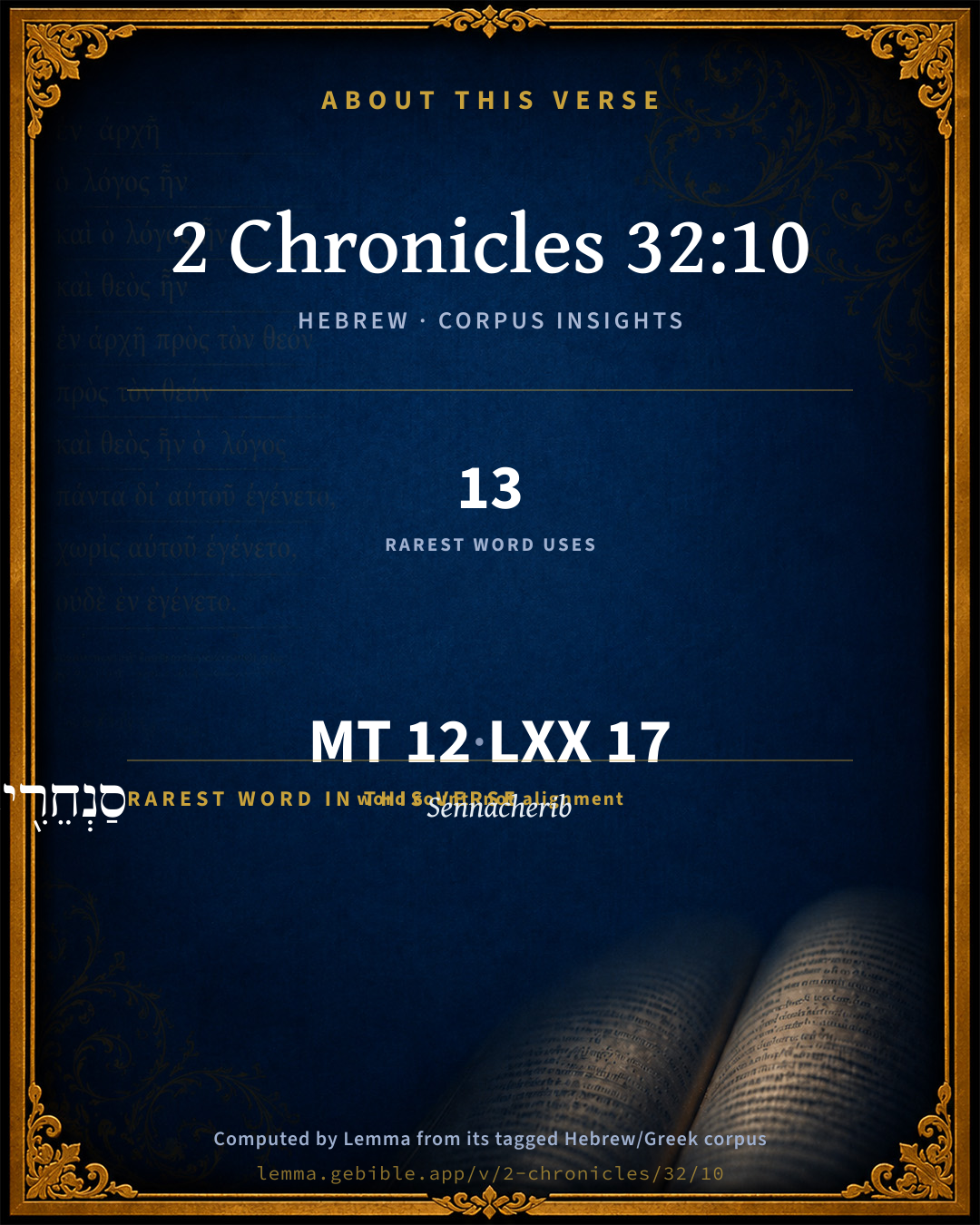
The rarest word here is סַנְחֵרִ֖יב Sennacherib H5576 — appearing just 13 times in the whole Hebrew Bible.

Shared distinctive vocabulary

סַנְחֵרִ֖יב Sennacherib H5576 occurs in 13 verses of the Hebrew Bible. Also found in:

Grammatical profile

  • 3 verbs
  • 5 nouns
  • 1 pronoun
  • 1 preposition
  • 1 adverb
  • 1 particle

Verb forms

  • אָמַ֔ר Qal · Perfect
  • בֹּטְחִ֔ים Qal · Participle Active
  • וְיֹשְׁבִ֥ים Qal · Participle Active

Hebrew & Septuagint length

In English translation the verse runs 17 words from the Hebrew and 21 from the Septuagint (LXX English) — closely comparable.

A rough comparison of the two English renderings, which tokenize alike — not a word-level alignment.

Word counts can differ between the Hebrew and the Greek without any difference in meaning — e.g. the Hebrew direct-object marker אֵת has no separate Greek word, and Greek often adds the article ὁ.

In the original languages it is 12 Hebrew tokens and 17 Greek tokens — but the two are counted differently (Hebrew bundles its prefixes and suffixes into one token; the Greek is in lemma form), so that isn’t a like-for-like length.

Cross-references

2

Topical passages linked to 2 Chronicles 32:10 in the Treasury of Scripture Knowledge — connected by theme and wording, ordered by reader-vote popularity; previews shown in the World English Bible.

  • 2 Kings 18:19 Rabshakeh said to them, Say you now to Hezekiah, Thus says the great king, the king of Assyria, What confidence is this in which you trust?
  • Isaiah 36:4 Rabshakeh said to them, Say you now to Hezekiah, Thus says the great king, the king of Assyria, What confidence is this in which you trust?

Cross-references courtesy of OpenBible.info (CC BY 4.0).

Hebrew and Greek witnesses Masoretic Hebrew ↔ Greek Septuagint

The same verse in the two great witnesses to the Old Testament, shown verse-for-verse.

These are two independent witnesses, not word-aligned to each other, and the Septuagint is shown in lemma (dictionary) form.

Hebrew 2 Chronicles 32:10 Masoretic · Westminster Leningrad Codex

כֹּ֣ה אָמַ֔ר סַנְחֵרִ֖יב מֶ֣לֶךְ אַשּׁ֑וּר עַל מָה֙ אַתֶּ֣ם בֹּטְחִ֔ים וְיֹשְׁבִ֥ים בְּמָצ֖וֹר בִּירוּשָׁלִָֽם

Thus says Sennacherib king of Assyria, Whereon do you trust, that you abide the siege in Jerusalem?

World English Bible · Public Domain

Greek LXX 2 Chronicles 32:10 Septuagint · lemma form

οὕτως λέγω σενναχηριμ ὁ βασιλεύς ἀσσύριος ἐπί τίς σύ πείθω καί καταἧμαι ἐν ὁ περιοχή ἐν ἰερουσαλήμ

Thus says Sennacherim king of the Assyrians, On what do you⌃ trust, that you⌃ will remain in the siege in Jerusalem?

LXX2012 (modern English Septuagint) · Public Domain

Hebrew: Westminster Leningrad Codex (CC BY 4.0). Greek: Septuagint (public domain); English from LXX2012 (modern English Septuagint) (Public Domain). How the Septuagint differs from the Hebrew →

Commentary

Notes on 2 Chronicles 32:10 from classic Christian and Jewish commentators (each source and its license shown beneath its notes). The classic Christian expositions comment on the surrounding passage and are grouped to its opening verse, so a note may address several verses; the Jewish commentaries on the Tanakh (Rashi and others) are per-verse, so they appear only where the commentator wrote on this verse.

Lemma curates 59 commentaries, every one of them public domain or Creative Commons licensed, each selected and text-cleaned for this edition rather than reprinted as found. About our sources →

Ellicott's Commentary for English Readers

(10) Whereon . . . the siege.—Rather, Whereon are ye trusting, and why are ye sitting in distress in Jerusalem? The phrase sitting or abiding in distress occurs in Jer_10:17. (Comp. also Deu_28:53.)

2Ch_32:10-15 reproduce in brief the leading ideas of 2Ki_18:19-25; 2Ki_18:28-35.

A Bible Commentary for English Readers, edited by Charles John Ellicott (1878–1897) — public domain. Text from a community e-Sword module.

Trapp's Complete Commentary

John Trapp

2Ch 32:10 Thus saith Sennacherib king of Assyria, Whereon do ye trust, that ye abide in the siege in Jerusalem?

Ver. 10. Whereon do ye trust.] Like rhetoric hereunto useth Antichrist, where he would seduce. See Sadolet’s sugared Epistle to the Citizens of Geneva, written in Calvin’s absence, who fully and elegantly answered it from Strasburg, where for a while he lived an exile.

John Trapp, A Commentary or Exposition upon All the Books of the Old and New Testament (1647–1656) — public domain. Text from a community e-Sword module.

Tyndale Open Study Notes

Tyndale Open Resources

32:10-19 The Assyrian king’s threats clarified the critical issues for the people of Jerusalem. The real question was whether or not to trust in God. The enemy king suggested that Hezekiah could not be trusted (32:11-12) because he had offended the Lord by tearing down God’s shrines and altars. However, just the opposite was true. This reform was Hezekiah’s greatest act of faithfulness to the Lord. The question came down to whether God could be trusted against the power of Assyria (32:11-15).

Tyndale Open Study Notes — © Tyndale Open Resources, licensed CC BY-SA 4.0. Text via the HelloAO Bible API.

Adam Clarke's Commentary

Verse 10. Thus saith Sennacherib] See all these circumstances largely explained 2Kg 18:17-36.

Adam Clarke's Commentary on the Bible (1810–1826) — public domain. Text from a community e-Sword/MySword module.

The Cambridge Bible for Schools and Colleges

gen. ed. J. J. S. Perowne

10. abide in the siege] R.V. abide the siege.

in Jerusalem] Isaiah promised deliverance in Jerusalem; e.g. in Isa_29:8; Isa_30:19.

The Cambridge Bible for Schools and Colleges (gen. ed. J. J. S. Perowne; Cambridge University Press, 1878–1918) — public domain. Text from a community e-Sword module.

John Gill's Exposition

Doth not Hezekiah persuade you to give over yourselves to die by famine, and by thirst,.... Suggesting that would be their case if they did not surrender:

saying, the Lord our God shall deliver us out of the hand of the king of Assyria? See Gill on Isa 36:15.

John Gill's Exposition of the Whole Bible (1746–1763) — public domain (CC PDM 1.0). Text via the HelloAO Bible API.

The Pulpit Commentary

In the siege. This Authorized Version rendering is manifestly incorrect, though, if we simply omit the article, and tender in siege, we shall probably have Sennacherib"s exact idea. He spoke not of the literal technical thing siege, but of the distress and confinement that the apprehension of the siege did not fail to bring. This so to say moral tone to the rendering of the word (rwOxmB) is much to be preferred to that of the margin, "in the fortress or stronghold."

The Pulpit Commentary (1880–1919), ed. H.D.M. Spence-Jones & Joseph S. Exell — public domain. Text from a community e-Sword module.

Rashi

Rabbi Shlomo Yitzchaki (Rashi)

In what do you trust It is written (I Kings 18:5): “He trusted in the Lord God of Israel,” and it is also written there: (verse 7) “and he rebelled against the king of Assyria.” Therefore, he asked, “In what do you trust” that you have rebelled against me?

stay in the siege in Jerusalem as it is written (here): “to die by famine and thirst.”

Rashi on the Tanakh — English translations: “The Judaica Press complete Tanach with Rashi, translated by A. J. Rosenberg” (CC BY 4.0); “Pentateuch with Rashi's commentary by M. Rosenbaum and A.M. Silbermann, 1929-1934” (public domain); “The Metsudah Tanach series, Lakewood, N.J” (CC BY 4.0); and “The Book of Joshua, Metsudah Publications, 1997” (CC BY 4.0). Text via Sefaria.

Lesson kit

Teaching starters — assembled from the data on this page, not authored interpretation. Every prompt links to the verse data it draws on. Edit before teaching.

2 Chronicles, in the Historical, opens this verse with 12 words (12 distinct Hebrew lemmas). Its most distinctive word is Çanchêrîyb (“Sennacherib”). A historical commentator’s framing appears above. Read the whole chapter for the surrounding context.

Discussion questions

  1. How does “Sennacherib” (Çanchêrîyb) shape what this verse is saying?
  2. 2 Kings 18:13 shares the word «Sennacherib» with this verse. How do the two illuminate each other?
  3. These translations render this verse differently; the difference is in the English rendering, not the original. What questions does that raise?
  4. The verb «אָמַ֔ר» is Qal Perfect. How does its form color the action?
  5. Reading how Ellicott's Commentary for English Readers and Trapp's Complete Commentary read this verse, where do the two commentators agree and where do they part?

Things to notice

Reading settings

Reading text

Shown beneath each verse's original-language words.

Old Testament
Old Testament edition

Read the OT as the Masoretic Hebrew (MT) or the Greek Septuagint (LXX).

English shown for the Greek Septuagint (in the Hebrew ↔ Greek comparison).

Comparing translations? Open the Compare panel on any verse page to stack up to four side by side.