
2 Chronicles 34:9

Hebrew (Westminster Leningrad Codex) 2 Chronicles 34:9 appears in the Hebrew Old Testament. The text above is from the Westminster Leningrad Codex. Each word links to its Strong’s number, a concise gloss, and parsing drawn from the Open Scriptures Hebrew Bible morphology. Click any word for its full Brown-Driver-Briggs (BDB) entry.
Download image
Cite this verse

2 Chronicles 34:9 (World English Bible). Public Domain. Lemma interlinear Bible study tool, https://lemma.gebible.app/v/2-chronicles/34/9.

Show BibTeX & RIS
BibTeX
RIS
English Translation
They came to Hilkiah the high priest, and delivered the money that was brought into the house of God, which the Levites, the keepers of the threshold, had gathered of the hand of Manasseh and Ephraim, and of all the remnant of Israel, and of all Judah and Benjamin, and of the inhabitants of Jerusalem.
World English Bible · Public Domain
Download a study sheet

One document with this verse’s original text, its word-by-word gloss line, the meaning frame, cross-references with their text, attributed commentary, and full source and license credits — printable, and it pastes into notes with its structure intact.

This verse Autodidact and up

Study sheet (.html) Plain text (.txt)

A passage Seminary Student

Up to 50 verses in one chapter. A passage sheet keeps up to 6 commentary sources and 12 cross-references per verse, in the order this page ranks them, and says so on the sheet whenever that leaves anything out. Ask for a single verse and you get the Autodidact verse sheet above.

Everything on this page stays free to read, with no account — the sheet is a download of what is already on screen, not access to it.

Want to remove ads? Support Godless Engineer
Compare translations 3

The same verse in 3 English versions, stacked beneath the original-language interlinear above. Click any original word for its lexicon entry.

Each is an independent rendering of the whole verse — the interlinear is not word-aligned to these translations.

Highlighted words mark where these versions differ — a whole-verse word diff, not a word-by-word alignment.

  • World English Bible Public Domain
    They came to Hilkiah the high priest, and delivered the money that was brought into the house of God, which the Levites, the keepers of the threshold, had gathered of the hand of Manasseh and Ephraim, and of all the remnant of Israel, and of all Judah and Benjamin, and of the inhabitants of Jerusalem.
  • King James Version Public Domain
    And when they came to Hilkiah the high priest, they delivered the money that was brought into the house of God, which the Levites that kept the doors had gathered of the hand of Manasseh and Ephraim, and of all the remnant of Israel, and of all Judah and Benjamin; and they returned to Jerusalem.
  • unfoldingWord Literal Text CC BY-SA 4.0
    And they came to Hilkiah, the great priest, and they gave the money that had been brought to the house of God, that the Levites gathered, the keepers of the threshold, from the hand of Manasseh and Ephraim, and from all the remnant of Israel, and from all Judah and Benjamin, and the inhabitants of Jerusalem.

unfoldingWord Literal Text — © unfoldingWord, licensed CC BY-SA 4.0. Word-aligned USFM3 via Door43 (git.door43.org/unfoldingWord/en_ult).

Versions to compare (up to 4)

3 of 4 selected

Show all 18 translations

Every available English version of this verse, each an independent rendering of the whole verse.

  • World English Bible Public Domain
    They came to Hilkiah the high priest, and delivered the money that was brought into the house of God, which the Levites, the keepers of the threshold, had gathered of the hand of Manasseh and Ephraim, and of all the remnant of Israel, and of all Judah and Benjamin, and of the inhabitants of Jerusalem.
  • Berean Standard Bible Public Domain
    So they went to Hilkiah the high priest and gave him the money that had been brought into the house of God, which the Levites at the doors had collected from the people of Manasseh and Ephraim, from all the remnant of Israel, Judah, and Benjamin, and from the people of Jerusalem.
  • Majority Standard Bible Public Domain
    So they went to Hilkiah the high priest and gave him the money that had been brought into the house of God, which the Levites who guarded the doors had collected from the people of Manasseh and Ephraim, from all the remnant of Israel, from all Judah and Benjamin, and from the people of Jerusalem.
  • King James Version Public Domain
    And when they came to Hilkiah the high priest, they delivered the money that was brought into the house of God, which the Levites that kept the doors had gathered of the hand of Manasseh and Ephraim, and of all the remnant of Israel, and of all Judah and Benjamin; and they returned to Jerusalem.
  • American Standard Version (1901) Public Domain
    And they came to Hilkiah the high priest, and delivered the money that was brought into the house of God, which the Levites, the keepers of the threshold, had gathered of the hand of Manasseh and Ephraim, and of all the remnant of Israel, and of all Judah and Benjamin, and of the inhabitants of Jerusalem.
  • Revised Version (1885) Public Domain
    And they came to Hilkiah the high priest, and delivered the money that was brought into the house of God, which the Levites, the keepers of the door, had gathered of the hand of Manasseh and Ephraim, and of all the remnant of Israel, and of all Judah and Benjamin, and of the inhabitants of Jerusalem.
  • Geneva Bible (1599) Public Domain
    And when they came to Hilkiah the hie Priest, they deliuered ye money that was brought into the house of God, which the Leuites that kept the doore, had gathered at the hand of Manasseh, and Ephraim, and of all the residue of Israel, and of all Iudah and Beniamin, and of the inhabitantes of Ierusalem.
  • Douay-Rheims (1899) Public Domain
    And they came to Helcias the high priest: and received of him the money which had been brought into the house of the Lord, and which the Levites and porters had gathered together from Manasses, and Ephraim, and all the remnant of Israel, and from all Juda, and Benjamin, and the inhabitants of Jerusalem,
  • Young's Literal Translation Public Domain
    And they come in unto Hilkiah the high priest, and they give the money that is brought in to the house of God, that the Levites, keeping the threshold, have gathered from the hand of Manasseh, and Ephraim, and from all the remnant of Israel, and from all Judah, and Benjamin, and the inhabitants of Jerusalem,
  • Literal Standard Version CC BY-SA 4.0
    And they come to Hilkiah the high priest, and they give the money that is brought into the house of God, that the Levites, keeping the threshold, have gathered from the hand of Manasseh, and Ephraim, and from all the remnant of Israel, and from all Judah, and Benjamin, and the inhabitants of Jerusalem,
  • Unlocked Literal Bible CC BY-SA 4.0
    They went to Hilkiah, the high priest, and entrusted to him the money that had been brought into the house of God, that the Levites, the guards of the doors, had gathered from Manasseh and Ephraim, from all the remnant of Israel, from all Judah and Benjamin, and from the inhabitants of Jerusalem.
  • unfoldingWord Literal Text CC BY-SA 4.0
    And they came to Hilkiah, the great priest, and they gave the money that had been brought to the house of God, that the Levites gathered, the keepers of the threshold, from the hand of Manasseh and Ephraim, and from all the remnant of Israel, and from all Judah and Benjamin, and the inhabitants of Jerusalem.
  • Darby Bible Public Domain
    And they came to Hilkijah the high priest, and they delivered [to them] the money that had been brought into the house of God, which the Levites that kept the doors had gathered of the hand of Manasseh and Ephraim, and of all the remnant of Israel, and of all Judah and Benjamin, and of the inhabitants of Jerusalem.
  • World Messianic Bible Public Domain
    They came to Hilkiah the high priest and delivered the money that was brought into God’s house, which the Levites, the keepers of the threshold, had gathered from the hands of Manasseh, Ephraim, of all the remnant of Israel, of all Judah and Benjamin, and of the inhabitants of Jerusalem.
  • Webster's Bible Public Domain
    And when they came to Hilkiah the high priest, they delivered the money that was brought into the house of God, which the Levites that kept the doors had collected from the hand of Manasseh and Ephraim, and from all the remnant of Israel, and from all Judah and Benjamin; and they returned to Jerusalem.
  • Free Bible Version CC BY-SA 4.0
    They went to Hilkiah the high priest and gave him the money that had been brought to God's Temple. The Levites at the entrances had collected this money from the people of Manasseh and Ephraim, from what was left of the people of Israel, as well as contributions from Judah, Benjamin, and the people of Jerusalem.
  • Bible in Basic English Public Domain
    And they came to Hilkiah, the chief priest, and gave him all the money which had been taken into the house of God, which the Levites, the keepers of the door, had got from Manasseh and Ephraim and those of Israel who had not been taken away as prisoners, and from all Judah and Benjamin and the people of Jerusalem.
  • JPS Tanakh (1917) Public Domain
    And they came to Hilkiah the high priest, and delivered the money that was brought into the house of God, which the Levites, the keepers of the door, had gathered of the hand of Manasseh and Ephraim, and of all the remnant of Israel, and of all Judah and Benjamin, and they returned to Jerusalem.

Literal Standard Version (2020), Covenant Press — licensed CC BY-SA 4.0. Text via the HelloAO Bible API (eBible.org). Unlocked Literal Bible (unfoldingWord) — licensed CC BY-SA 4.0. Text via the HelloAO Bible API (eBible.org). unfoldingWord Literal Text — © unfoldingWord, licensed CC BY-SA 4.0. Word-aligned USFM3 via Door43 (git.door43.org/unfoldingWord/en_ult). Free Bible Version, Dr. Jonathan Gallagher — licensed CC BY-SA 4.0. Text via the HelloAO Bible API (eBible.org).

Word by word

More ways to search: Search by grammar → Find every occurrence → Compare this word →

Practice this passage: Drill this verse → Learn its vocabulary →

הַסַּ֜ף
çaph
H5592
“the · basin”
Particle, Definite Article + Noun, Common, Masculine, Singular, Absolute
Part of Speech
Particle + Noun
Type
Common
Gender
Masculine
Number
Singular
State
Absolute
Full BDB Definition

Origin: from H5605 , in its original sense of containing

TWOT: 1538a , 1538b

a spreading out, basin, goblet, bowl - basin, goblet - threshold, sill - threshold, sill, door-keeper
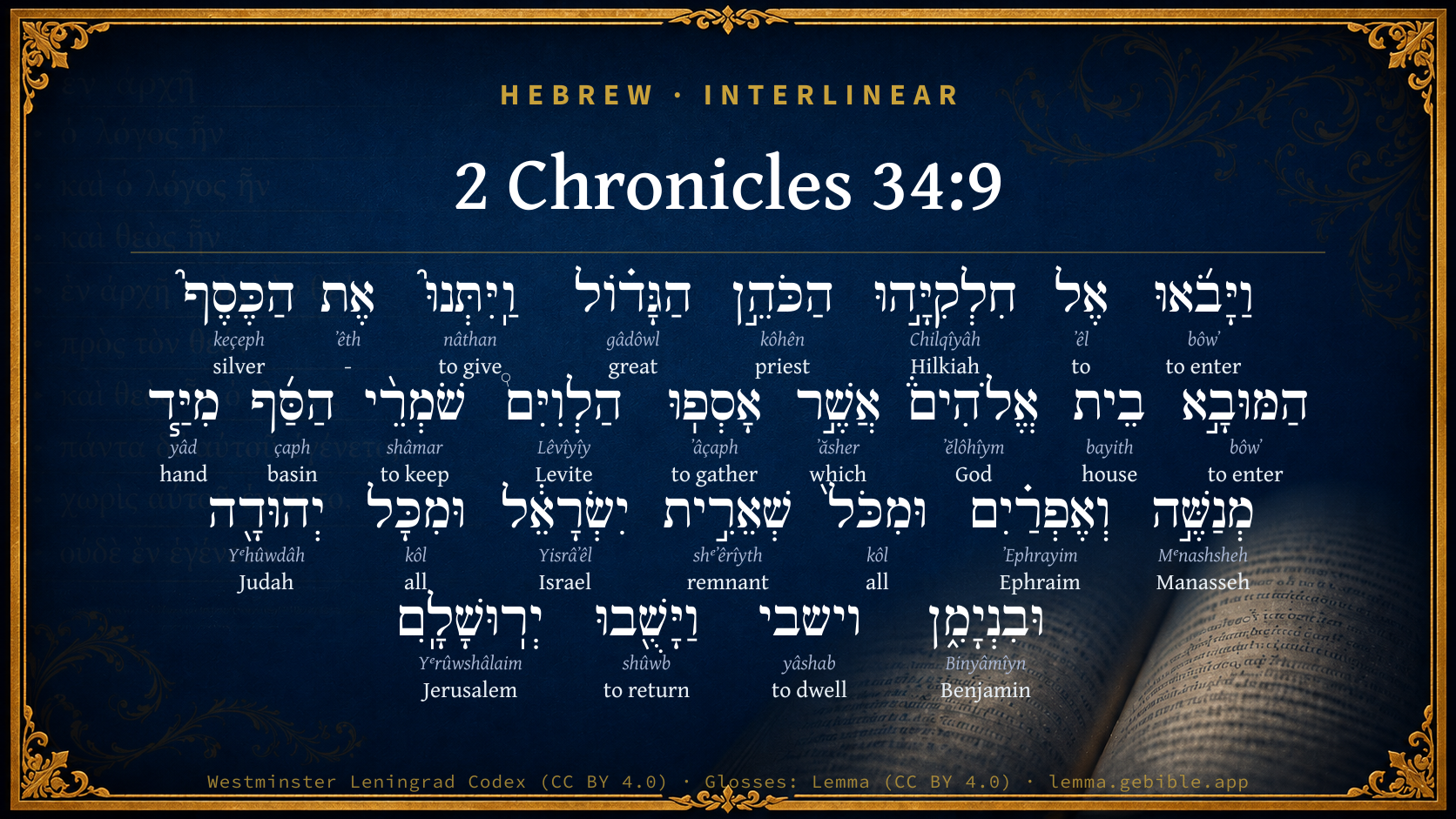
  1. וַיָּבֹ֜אוּ bôwʼ H935 “and · to enter” Conjunction + Verb, Qal, Sequential Imperfect, 3rd Person, Masculine, Plural
  2. אֶל ʼêl H413 “to” Preposition
  3. חִלְקִיָּ֣הוּ Chilqîyâh H2518 “Hilkiah” Noun, Proper
  4. הַכֹּהֵ֣ן kôhên H3548 “the · priest” Particle, Definite Article + Noun, Common, Masculine, Singular, Absolute
  5. הַגָּד֗וֹל gâdôwl H1419 “the · great” Particle, Definite Article + Adjective, Adjective, Masculine, Singular, Absolute
  6. וַֽיִּתְּנוּ֮ nâthan H5414 “and · to give” Conjunction + Verb, Qal, Sequential Imperfect, 3rd Person, Masculine, Plural
  7. אֶת ʼêth H853 “-” Particle, Direct Object
  8. הַכֶּסֶף֮ keçeph H3701 “the · silver” Particle, Definite Article + Noun, Common, Masculine, Singular, Absolute
  9. הַמּוּבָ֣א bôwʼ H935 “the · entered” Particle, Definite Article + Verb, Hophal, Participle Passive, Masculine, Singular, Absolute
  10. בֵית bayith H1004 “house of” Noun, Common, Masculine, Singular, Construct
  11. אֱלֹהִים֒ ʼĕlôhîym H430 “God(s)” Noun, Common, Masculine, Plural, Absolute
  12. אֲשֶׁ֣ר ʼăsher H834 “which” Particle, Relative
  13. אָסְפֽוּ ʼâçaph H622 “to gather” Verb, Qal, Perfect, 3rd Person, Common, Plural
  14. הַלְוִיִּם֩ Lêvîyîy H3881 “the · Levites” Particle, Definite Article + Noun, Gentilic, Masculine, Plural, Absolute
  15. שֹׁמְרֵ֨י shâmar H8104 “keeping” Verb, Qal, Participle Active, Masculine, Plural, Construct
  16. מִיַּ֧ד yâd H3027 “from · hand of” Preposition + Noun, Common, Both, Singular, Construct
  17. מְנַשֶּׁ֣ה Mᵉnashsheh H4519 “Manasseh” Noun, Proper
  18. וְאֶפְרַ֗יִם ʼEphrayim H669 “and · Ephraim” Conjunction + Noun, Proper
  19. וּמִכֹּל֙ kôl H3605 “and · from · all of” Conjunction + Preposition + Noun, Common, Masculine, Singular, Construct
  20. שְׁאֵרִ֣ית shᵉʼêrîyth H7611 “remnant of” Noun, Common, Feminine, Singular, Construct
  21. יִשְׂרָאֵ֔ל Yisrâʼêl H3478 “Israel” Noun, Proper
  22. וּמִכָּל kôl H3605 “and · from · all of” Conjunction + Preposition + Noun, Common, Masculine, Singular, Construct
  23. יְהוּדָ֖ה Yᵉhûwdâh H3063 “Judah” Noun, Proper
  24. וּבִנְיָמִ֑ן Binyâmîyn H1144 “and · Benjamin” Conjunction + Noun, Proper
  25. וישבי yâshab H3427 “and · dwelling” Conjunction + Verb, Qal, Participle Active, Masculine, Plural, Construct
  26. וַיָּשֻׁ֖בוּ shûwb H7725 “and · to return” Conjunction + Verb, Qal, Sequential Imperfect, 3rd Person, Masculine, Plural
  27. יְרֽוּשָׁלִָֽם Yᵉrûwshâlaim H3389 “Jerusalem” Noun, Proper

About this verse

These counts appear in no published source. They are computed here, from the morphology-tagged text and Lemma’s own curated glosses. What Lemma adds →

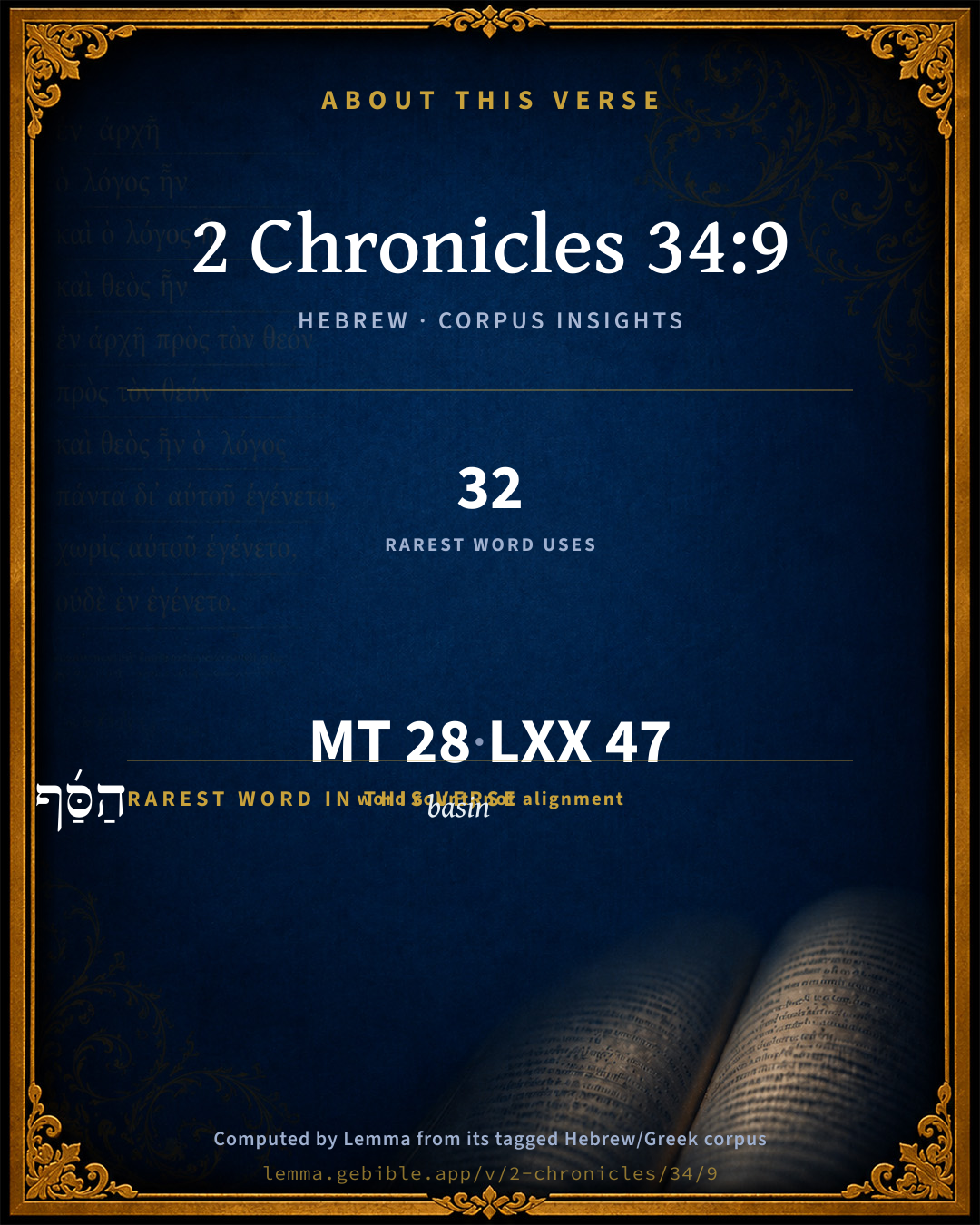
28
words
26
distinct lemmas
Historical
section

Shared distinctive vocabulary

הַסַּ֜ף basin H5592 occurs in 28 verses of the Hebrew Bible. Also found in:

Grammatical profile

  • 7 verbs
  • 17 nouns
  • 1 adjective
  • 1 preposition
  • 2 particles

Verb forms

  • וַיָּבֹ֜אוּ Qal · Sequential Imperfect
  • וַֽיִּתְּנוּ֮ Qal · Sequential Imperfect
  • הַמּוּבָ֣א Hophal · Participle Passive
  • אָסְפֽוּ Qal · Perfect
  • שֹׁמְרֵ֨י Qal · Participle Active
  • וישבי Qal · Participle Active
  • וַיָּשֻׁ֖בוּ Qal · Sequential Imperfect

Repetition

Words recur within this verse — often emphatic in Hebrew:

  • וַיָּבֹ֜אוּ to enter H935 ×2
  • וּמִכֹּל֙ all H3605 ×2

Hebrew & Septuagint length

In English translation the verse runs 55 words from the Hebrew and 62 from the Septuagint (LXX English) — closely comparable.

A rough comparison of the two English renderings, which tokenize alike — not a word-level alignment.

Word counts can differ between the Hebrew and the Greek without any difference in meaning — e.g. the Hebrew direct-object marker אֵת has no separate Greek word, and Greek often adds the article ὁ.

In the original languages it is 28 Hebrew tokens and 47 Greek tokens — but the two are counted differently (Hebrew bundles its prefixes and suffixes into one token; the Greek is in lemma form), so that isn’t a like-for-like length.

Cross-references

12

Topical passages linked to 2 Chronicles 34:9 in the Treasury of Scripture Knowledge — connected by theme and wording, ordered by reader-vote popularity; previews shown in the World English Bible.

  • 2 Chronicles 30:10 So the posts passed from city to city through the country of Ephraim and Manasseh, even to Zebulun: but they ridiculed them, and mocked them.
  • 2 Chronicles 30:18 For a multitude of the people, even many of Ephraim and Manasseh, Issachar and Zebulun, had not cleansed themselves, yet did they eat the Passover otherwise than it is written. For Hezekiah had prayed for them, saying, The good Yahweh pardon everyone
  • 2 Chronicles 35:8 His princes gave for a freewill-offering to the people, to the priests, and to the Levites. Hilkiah and Zechariah and Jehiel, the rulers of the house of God, gave to the priests for the Passover offerings two thousand and six hundred [small cattle], and three hundred oxen.
  • 2 Kings 22:4–7 Go up to Hilkiah the high priest, that he may sum the money which is brought into the house of Yahweh, which the keepers of the threshold have gathered of the people:
  • 2 Kings 23:4 The king commanded Hilkiah the high priest, and the priests of the second order, and the keepers of the threshold, to bring forth out of the temple of Yahweh all the vessels that were made for Baal, and for the Asherah, and for all the host of the sky, and he burned them outside of Jerusalem in the fields of the Kidron, and carried the ashes of them to Bethel.
  • 2 Chronicles 24:11–14 It was so, that whenever the chest was brought to the king's officers by the hand of the Levites, and when they saw that there was much money, the king's scribe and the chief priest's officer came and emptied the chest, and took it, and carried it to its place again. Thus they did day by day, and gathered money in abundance.
  • 2 Chronicles 31:1 Now when all this was finished, all Israel who were present went out to the cities of Judah, and broke in pieces the pillars, and hewed down the Asherim, and broke down the high places and the altars out of all Judah and Benjamin, in Ephraim also and Manasseh, until they had destroyed them all. Then all the children of Israel returned, every man to his possession, into their own cities.
  • 2 Chronicles 34:14–15 When they brought out the money that was brought into the house of Yahweh, Hilkiah the priest found the book of the law of Yahweh [given] by Moses.
  • 2 Chronicles 34:18 Shaphan the scribe told the king, saying, Hilkiah the priest has delivered me a book. Shaphan read therein before the king.
  • 2 Chronicles 34:20 The king commanded Hilkiah, and Ahikam the son of Shaphan, and Abdon the son of Micah, and Shaphan the scribe, and Asaiah the king's servant, saying,
  • 2 Chronicles 34:22 So Hilkiah, and they whom the king [had commanded], went to Huldah the prophetess, the wife of Shallum the son of Tokhath, the son of Hasrah, keeper of the wardrobe; (now she lived in Jerusalem in the second quarter;) and they spoke to her to that effect.
  • Philippians 4:8 Finally, brothers, whatever things are true, whatever things are honorable, whatever things are just, whatever things are pure, whatever things are lovely, whatever things are of good report; if there is any virtue, and if there is any praise, think about these things.

Cross-references courtesy of OpenBible.info (CC BY 4.0).

Hebrew and Greek witnesses Masoretic Hebrew ↔ Greek Septuagint

The same verse in the two great witnesses to the Old Testament, shown verse-for-verse.

These are two independent witnesses, not word-aligned to each other, and the Septuagint is shown in lemma (dictionary) form.

Hebrew 2 Chronicles 34:9 Masoretic · Westminster Leningrad Codex

וַיָּבֹ֜אוּ אֶל חִלְקִיָּ֣הוּ הַכֹּהֵ֣ן הַגָּד֗וֹל וַֽיִּתְּנוּ֮ אֶת הַכֶּסֶף֮ הַמּוּבָ֣א בֵית אֱלֹהִים֒ אֲשֶׁ֣ר אָסְפֽוּ הַלְוִיִּם֩ שֹׁמְרֵ֨י הַסַּ֜ף מִיַּ֧ד מְנַשֶּׁ֣ה וְאֶפְרַ֗יִם וּמִכֹּל֙ שְׁאֵרִ֣ית יִשְׂרָאֵ֔ל וּמִכָּל יְהוּדָ֖ה וּבִנְיָמִ֑ן וישבי וַיָּשֻׁ֖בוּ יְרֽוּשָׁלִָֽם

They came to Hilkiah the high priest, and delivered the money that was brought into the house of God, which the Levites, the keepers of the threshold, had gathered of the hand of Manasseh and Ephraim, and of all the remnant of Israel, and of all Judah and Benjamin, and of the inhabitants of Jerusalem.

World English Bible · Public Domain

Greek LXX 2 Chronicles 34:9 Septuagint · lemma form

καί ἔρχομαι πρός χελκιας ὁ ἱερεύς ὁ μέγας καί δίδωμι ὁ ἀργύριον ὁ εἰςφέρω εἰς οἶκος θεός ὅς συνἄγω ὁ λευείτης φυλάσσω ὁ πύλη ἐκ χείρ μανασσή καί ἐφράιμ καί ὁ ἄρχων καί ἀπό πᾶς κατάλοιπος ἐν ἰσραήλ καί υἱός ἰουδά καί βενιαμίν καί οἰκέω ἐν ἰερουσαλήμ

And they came to Chelcias the high priest, and gave the money that was brought into the house of God, which the Levites who kept the gate collected of the hand of Manasse and Ephraim, and of the princes, and of every one that was left in Israel, and of the children of Juda and Benjamin, and of the dwellers in Jerusalem.

LXX2012 (modern English Septuagint) · Public Domain

On this verse, The Cambridge Bible for Schools and Colleges discusses the Septuagint’s reading. Read the note in Commentary ↓

Hebrew: Westminster Leningrad Codex (CC BY 4.0). Greek: Septuagint (public domain); English from LXX2012 (modern English Septuagint) (Public Domain). How the Septuagint differs from the Hebrew →

Commentary

Notes on 2 Chronicles 34:9 from classic Christian and Jewish commentators (each source and its license shown beneath its notes). The classic Christian expositions comment on the surrounding passage and are grouped to its opening verse, so a note may address several verses; the Jewish commentaries on the Tanakh (Rashi and others) are per-verse, so they appear only where the commentator wrote on this verse.

Lemma curates 59 commentaries, every one of them public domain or Creative Commons licensed, each selected and text-cleaned for this edition rather than reprinted as found. About our sources →

Ellicott's Commentary for English Readers

(9) And when they came . . . they delivered.—And they came . . . and they gave. In 2Ki_22:3-7, the contents of 2Ch_34:9-12 a are given in the form of the king’s instructions to Shaphan. Here we are told that those instructions were carried out. “They delivered (wayyittĕnû) is substituted for the difficult wĕyattçm of Kings (i.e., “and let him pay out”).

From the hand of Manasseh . . . Benjamin.—Kings, “from the people.” Reuss oddly imagines that these words denote “a kind of organised collection throughout all Palestine,” and then proceeds to draw an inference unfavourable to the chronicler.

And they returned to Jerusalem.—This is the meaning of the Qri or Hebrew margin. The Hebrew text has, “and the inhabitants of Jerusalem,” which is correct.

A Bible Commentary for English Readers, edited by Charles John Ellicott (1878–1897) — public domain. Text from a community e-Sword module.

Trapp's Complete Commentary

John Trapp

2Ch 34:9 And when they came to Hilkiah the high priest, they delivered the money that was brought into the house of God, which the Levites that kept the doors had gathered of the hand of Manasseh and Ephraim, and of all the remnant of Israel, and of all Judah and Benjamin; and they returned to Jerusalem.

Ver. 9. And when they came to Hilkiah the high priest.] See 2Ki 22:4.

They delivered the money, &c.] The like was done. {2Ki 12:10-11} Only things are here more exactly set down.

Which the Levites had gathered.] The Pope, under pretext of repairing St Peter’s Church in Rome, gathered great sums of money by his pardon mongers in Germany, and England, and elsewhere, till people grew wiser.

John Trapp, A Commentary or Exposition upon All the Books of the Old and New Testament (1647–1656) — public domain. Text from a community e-Sword module.

Geneva Bible (1599)

Geneva Bible translators

Or, they returned to Jerusalem.

Geneva Bible (1599) marginal notes — public domain. Text via Bolls.life.

Adam Clarke's Commentary

Verse 9. And they returned to Jerusalem.] Instead of וישבו vaiyashubu, "they returned," we should read יושבי yoshebey, "the inhabitants;" a reading which is supported by many MSS., printed editions, and all the versions, as well as by necessity and common sense. 2Ch 19:8, where a similar mistake is rectified.

Adam Clarke's Commentary on the Bible (1810–1826) — public domain. Text from a community e-Sword/MySword module.

The Cambridge Bible for Schools and Colleges

gen. ed. J. J. S. Perowne

9. And when they came … they delivered] R.V. And they came … and delivered. The matter is somewhat differently stated in 2 Kin. according to which they are sent to Hilkiah with a message to him to “sum” i.e. to reckon the total of the money collected in the Temple.

the Levites that kept the doors] R.V. the Levites, the keepers of the door. In 2Ki_12:9 the keepers of the doors are called priests; cp. ib. 2Ki_25:18.

of the hand of Manasseh etc.] In 2 Kin. simply “of the people.”

and they returned to Jerusalem] R.V. and of the inhabitants of Jerusalem. The A.V. (cp. for the meaning of this rendering, 2Ch_24:5) follows one reading of the Hebrew (the Ḳ’rî), the R.V., in agreement with the LXX., follows the other reading (C’thib).

The Cambridge Bible for Schools and Colleges (gen. ed. J. J. S. Perowne; Cambridge University Press, 1878–1918) — public domain. Text from a community e-Sword module.

John Gill's Exposition

And they put it,.... The king's ministers did:

in the hand of the workmen that had the oversight of the house of the Lord; whose business it was to inspect the temple, and see what repairs were necessary, and to overlook the workmen in making those repairs; the names of these overseers are in Ch2 34:12,

and they gave it to the workmen that wrought in the house of the Lord, to repair and mend the house; that is, the overseers gave the money they received to the labourers, as the hire of their labour, and the reward of their work, and to buy materials with, as follows.

John Gill's Exposition of the Whole Bible (1746–1763) — public domain (CC PDM 1.0). Text via the HelloAO Bible API.

Matthew Poole's English Annotations

i.e. The Levites, who had gone abroad through all Josiah’s kingdom to gather money for this good use, and now came with it to Jerusalem, to lodge it in the treasuries of the Lord’s house.

Matthew Poole's English Annotations on the Holy Bible (1683–1685) — public domain. Text from a community e-Sword/MySword module.

The Pulpit Commentary

Hilkiah the high priest. Of Hilkiah"s ancestors and descendants we learn something in the following references: 1Ch_6:13, 14 9:11; 2Ki_25:18; Neh_11:11; Ezr_7:1. They delivered. This means that Hilkiah"s people delivered of what they had collected to Shaphan and his colleagues, who again in their turn (ver. 10) "put it into the hand of the workmen," etc. This is certainly the meaning of 2Ki_22:4-9. And they returned to Jerusalem; translate, and of the dwellers in Jerusalem. Note Keri, and see 2Ch_35:18; and Septuagint rendering here and there.

The Pulpit Commentary (1880–1919), ed. H.D.M. Spence-Jones & Joseph S. Exell — public domain. Text from a community e-Sword module.

Rashi

Rabbi Shlomo Yitzchaki (Rashi)

which the Levites who guarded the threshold had gathered from the hands of Manasseh and Ephraim, etc. from their ruins round about.

Rashi on the Tanakh — English translations: “The Judaica Press complete Tanach with Rashi, translated by A. J. Rosenberg” (CC BY 4.0); “Pentateuch with Rashi's commentary by M. Rosenbaum and A.M. Silbermann, 1929-1934” (public domain); “The Metsudah Tanach series, Lakewood, N.J” (CC BY 4.0); and “The Book of Joshua, Metsudah Publications, 1997” (CC BY 4.0). Text via Sefaria.

Lesson kit

Teaching starters — assembled from the data on this page, not authored interpretation. Every prompt links to the verse data it draws on. Edit before teaching.

2 Chronicles, in the Historical, opens this verse with 28 words (26 distinct Hebrew lemmas). Its most distinctive word is çaph (“basin”). A historical commentator’s framing appears above. Read the whole chapter for the surrounding context.

Discussion questions

  1. How does “basin” (çaph) shape what this verse is saying?
  2. Exodus 12:22 shares the word «basin» with this verse. How do the two illuminate each other?
  3. “to enter” occurs 2× in this one verse. What is the effect of the repetition?
  4. These translations render this verse differently. What is at stake in choosing one wording over another?
  5. The verb «וַיָּבֹ֜אוּ» is Qal Sequential Imperfect. How does its form color the action?
  6. Reading how Ellicott's Commentary for English Readers and Trapp's Complete Commentary read this verse, where do the two commentators agree and where do they part?

Things to notice

Reading settings

Reading text

Shown beneath each verse's original-language words.

Old Testament
Old Testament edition

Read the OT as the Masoretic Hebrew (MT) or the Greek Septuagint (LXX).

English shown for the Greek Septuagint (in the Hebrew ↔ Greek comparison).

Comparing translations? Open the Compare panel on any verse page to stack up to four side by side.