
Ezekiel 16:3

Hebrew (Westminster Leningrad Codex) Ezekiel 16:3 appears in the Hebrew Old Testament. The text above is from the Westminster Leningrad Codex. Each word links to its Strong’s number, a concise gloss, and parsing drawn from the Open Scriptures Hebrew Bible morphology. Click any word for its full Brown-Driver-Briggs (BDB) entry.
Download image
Cite this verse

Ezekiel 16:3 (World English Bible). Public Domain. Lemma interlinear Bible study tool, https://lemma.gebible.app/v/ezekiel/16/3.

Show BibTeX & RIS
BibTeX
RIS
English Translation
and say, Thus says the Lord Yahweh to Jerusalem: Your birth and your birth is of the land of the Canaanite; the Amorite was your father, and your mother was a Hittite.
World English Bible · Public Domain
Highlights
  • 1 first appearance in the Hebrew Bible
Full analysis ↓
Download a study sheet

One document with this verse’s original text, its word-by-word gloss line, the meaning frame, cross-references with their text, attributed commentary, and full source and license credits — printable, and it pastes into notes with its structure intact.

This verse Autodidact and up

Study sheet (.html) Plain text (.txt)

A passage Seminary Student

Up to 50 verses in one chapter. A passage sheet keeps up to 6 commentary sources and 12 cross-references per verse, in the order this page ranks them, and says so on the sheet whenever that leaves anything out. Ask for a single verse and you get the Autodidact verse sheet above.

Everything on this page stays free to read, with no account — the sheet is a download of what is already on screen, not access to it.

Want to remove ads? Support Godless Engineer
Compare translations 3

The same verse in 3 English versions, stacked beneath the original-language interlinear above. Click any original word for its lexicon entry.

Each is an independent rendering of the whole verse — the interlinear is not word-aligned to these translations.

Highlighted words mark where these versions differ — a whole-verse word diff, not a word-by-word alignment.

  • World English Bible Public Domain
    and say, Thus says the Lord Yahweh to Jerusalem: Your birth and your birth is of the land of the Canaanite; the Amorite was your father, and your mother was a Hittite.
  • King James Version Public Domain
    And say, Thus saith the Lord GOD unto Jerusalem; Thy birth and thy nativity is of the land of Canaan; thy father was an Amorite, and thy mother an Hittite.
  • unfoldingWord Literal Text CC BY-SA 4.0
    and declare, ‘The Lord Yahweh says this to Jerusalem: Your beginning and your birth took place in the land of Canaan; your father was an Amorite, and your mother was a Hittite.

unfoldingWord Literal Text — © unfoldingWord, licensed CC BY-SA 4.0. Word-aligned USFM3 via Door43 (git.door43.org/unfoldingWord/en_ult).

Versions to compare (up to 4)

3 of 4 selected

Show all 18 translations

Every available English version of this verse, each an independent rendering of the whole verse.

  • World English Bible Public Domain
    and say, Thus says the Lord Yahweh to Jerusalem: Your birth and your birth is of the land of the Canaanite; the Amorite was your father, and your mother was a Hittite.
  • Berean Standard Bible Public Domain
    and tell her that this is what the Lord GOD says to Jerusalem: Your origin and your birth were in the land of the Canaanites. Your father was an Amorite and your mother a Hittite.
  • Majority Standard Bible Public Domain
    and tell her that this is what the Lord GOD says to Jerusalem: Your origin and your birth were in the land of the Canaanites. Your father was an Amorite and your mother a Hittite.
  • King James Version Public Domain
    And say, Thus saith the Lord GOD unto Jerusalem; Thy birth and thy nativity is of the land of Canaan; thy father was an Amorite, and thy mother an Hittite.
  • American Standard Version (1901) Public Domain
    and say, Thus saith the Lord Jehovah unto Jerusalem: Thy birth and thy nativity is of the land of the Canaanite; the Amorite was thy father, and thy mother was a Hittite.
  • Revised Version (1885) Public Domain
    and say, Thus saith the Lord GOD unto Jerusalem: Thy birth and thy nativity is of the land of the Canaanite; the Amorite was thy father, and thy mother was an Hittite.
  • Geneva Bible (1599) Public Domain
    And say, Thus saith the Lord God vnto Ierusalem, Thine habitation and thy kindred is of the land of Canaan: thy father was an Amorite, and thy mother an Hittite.
  • Douay-Rheims (1899) Public Domain
    And thou shalt say: Thus saith the Lord God to Jerusalem: Thy root, and thy nativity is of the land of Chanaan, thy father was an Amorrhite, and thy mother a Cethite.
  • Young's Literal Translation Public Domain
    Thus said the Lord Jehovah to Jerusalem: Thy birth and thy nativity `Are' of the land of the Canaanite, Thy father the Amorite, and thy mother a Hittite.
  • Literal Standard Version CC BY-SA 4.0
    Thus said Lord YHWH to Jerusalem: Your birth and your nativity || [Are] of the land of the Canaanite, || Your father the Amorite, and your mother a Hittite.
  • Unlocked Literal Bible CC BY-SA 4.0
    and declare, 'The Lord Yahweh says this to Jerusalem: Your beginning and your birth took place in the land of Canaan; your father was an Amorite, and your mother was a Hittite.
  • unfoldingWord Literal Text CC BY-SA 4.0
    and declare, ‘The Lord Yahweh says this to Jerusalem: Your beginning and your birth took place in the land of Canaan; your father was an Amorite, and your mother was a Hittite.
  • Darby Bible Public Domain
    and say, Thus saith the Lord Jehovah unto Jerusalem: Thy birth and thy nativity is of the land of the Canaanite: thy father was an Amorite, and thy mother a Hittite.
  • World Messianic Bible Public Domain
    and say, ‘The Lord GOD says to Jerusalem: “Your origin and your birth is of the land of the Canaanite. An Amorite was your father, and your mother was a Hittite.
  • Webster's Bible Public Domain
    And say, Thus saith the Lord GOD to Jerusalem; Thy birth and thy nativity is of the land of Canaan; thy father was an Amorite, and thy mother a Hittite.
  • Free Bible Version CC BY-SA 4.0
    Tell Jerusalem that this is what the Lord God says to her: You really are a Canaanite, both by your birth and parentage. Your father was an Amorite, and your mother was a Hittite.
  • Bible in Basic English Public Domain
    And say, This is what the Lord has said to Jerusalem: Your start and your birth was from the land of the Canaanite; an Amorite was your father and your mother was a Hittite.
  • JPS Tanakh (1917) Public Domain
    and say: Thus saith the Lord GOD unto Jerusalem: Thine origin and thy nativity is of the land of the Canaanite; the Amorite was thy father, and thy mother was a Hittite.

Literal Standard Version (2020), Covenant Press — licensed CC BY-SA 4.0. Text via the HelloAO Bible API (eBible.org). Unlocked Literal Bible (unfoldingWord) — licensed CC BY-SA 4.0. Text via the HelloAO Bible API (eBible.org). unfoldingWord Literal Text — © unfoldingWord, licensed CC BY-SA 4.0. Word-aligned USFM3 via Door43 (git.door43.org/unfoldingWord/en_ult). Free Bible Version, Dr. Jonathan Gallagher — licensed CC BY-SA 4.0. Text via the HelloAO Bible API (eBible.org).

Word by word

More ways to search: Search by grammar → Find every occurrence → Compare this word →

Practice this passage: Drill this verse → Learn its vocabulary →

מְכֹרֹתַ֨יִךְ֙
mᵉkûwrâh
H4351
“origins · your”
Noun, Common, Feminine, Plural, Construct + Suffix, Personal, 2nd Person, Feminine, Singular
Part of Speech
Noun
Type
Common
Gender
Feminine
Number
Plural
State
Construct
Full BDB Definition

Origin: from the same as H3564 in the sense of dipping

TWOT: 1033c

origin
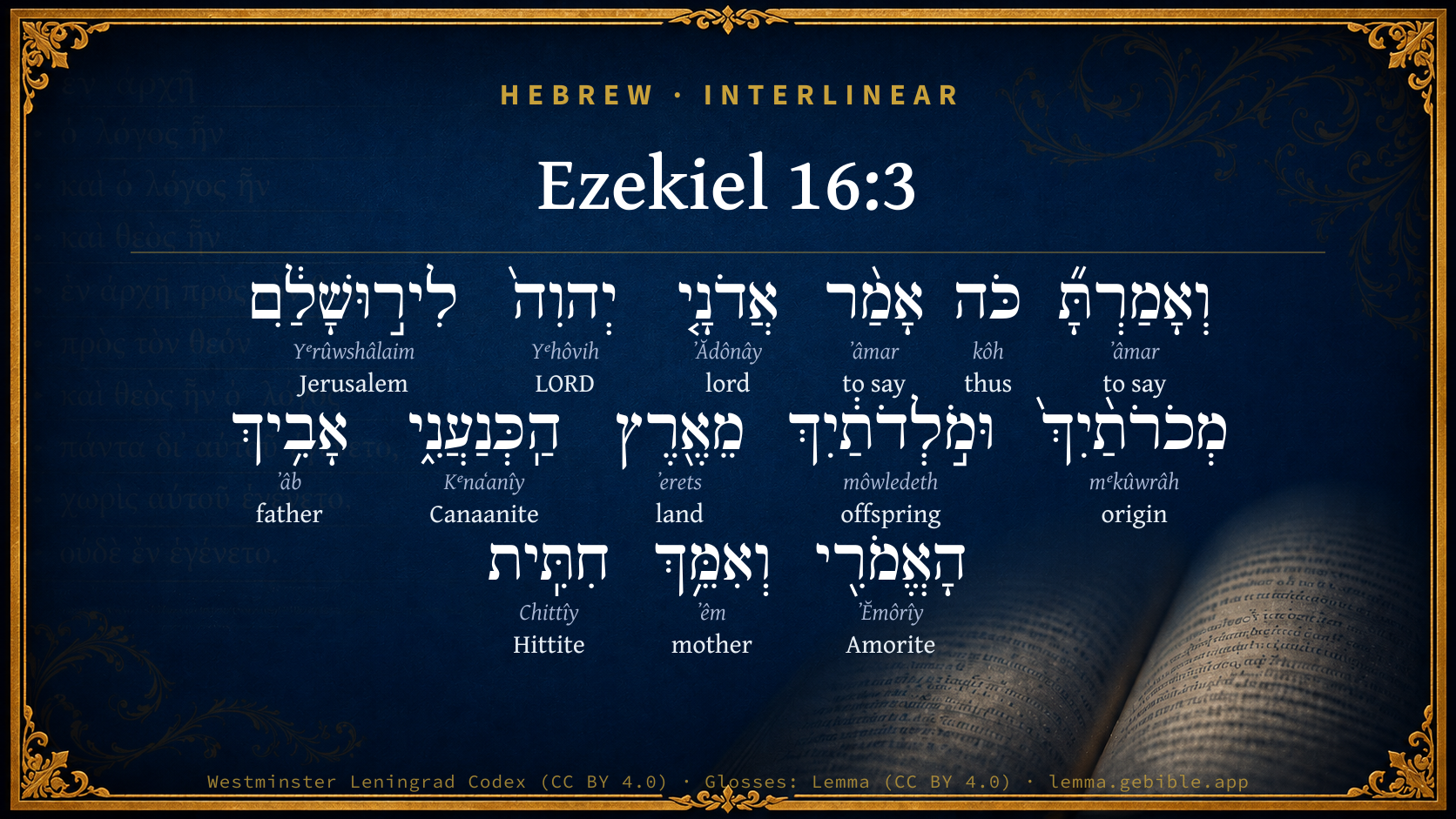
  1. וְאָמַרְתָּ֞ ʼâmar H559 “and · to say” Conjunction + Verb, Qal, Sequential Perfect, 2nd Person, Masculine, Singular
  2. כֹּה kôh H3541 “thus” Adverb
  3. אָמַ֨ר ʼâmar H559 “to say” Verb, Qal, Perfect, 3rd Person, Masculine, Singular
  4. אֲדֹנָ֤י ʼĂdônây H136 “Lord · my” Noun, Common, Masculine, Plural, Construct + Suffix, Personal, 1st Person, Common, Singular
  5. יְהוִה֙ Yᵉhôvih H3069 “LORD” Noun, Proper
  6. לִיר֣וּשָׁלִַ֔ם Yᵉrûwshâlaim H3389 “to/for · Jerusalem” Preposition + Noun, Proper
  7. וּמֹ֣לְדֹתַ֔יִךְ môwledeth H4138 “and · offspring · your” Conjunction + Noun, Common, Feminine, Plural, Construct + Suffix, Personal, 2nd Person, Feminine, Singular
  8. מֵאֶ֖רֶץ ʼerets H776 “from · land of” Preposition + Noun, Common, Both, Singular, Construct
  9. הַֽכְּנַעֲנִ֑י Kᵉnaʻanîy H3669 “the · Canaanite” Particle, Definite Article + Noun, Gentilic, Masculine, Singular, Absolute
  10. אָבִ֥יךְ ʼâb H1 “father · your” Noun, Common, Masculine, Singular, Construct + Suffix, Personal, 2nd Person, Feminine, Singular
  11. הָאֱמֹרִ֖י ʼĔmôrîy H567 “the · Amorite” Particle, Definite Article + Noun, Gentilic, Masculine, Singular, Absolute
  12. וְאִמֵּ֥ךְ ʼêm H517 “and · mother · your” Conjunction + Noun, Common, Feminine, Singular, Construct + Suffix, Personal, 2nd Person, Feminine, Singular
  13. חִתִּֽית Chittîy H2850 “Hittite” Noun, Gentilic, Masculine, Singular, Absolute

About this verse

These counts appear in no published source. They are computed here, from the morphology-tagged text and Lemma’s own curated glosses. What Lemma adds →

14
words
13
distinct lemmas
Prophets
section

Notable vocabulary

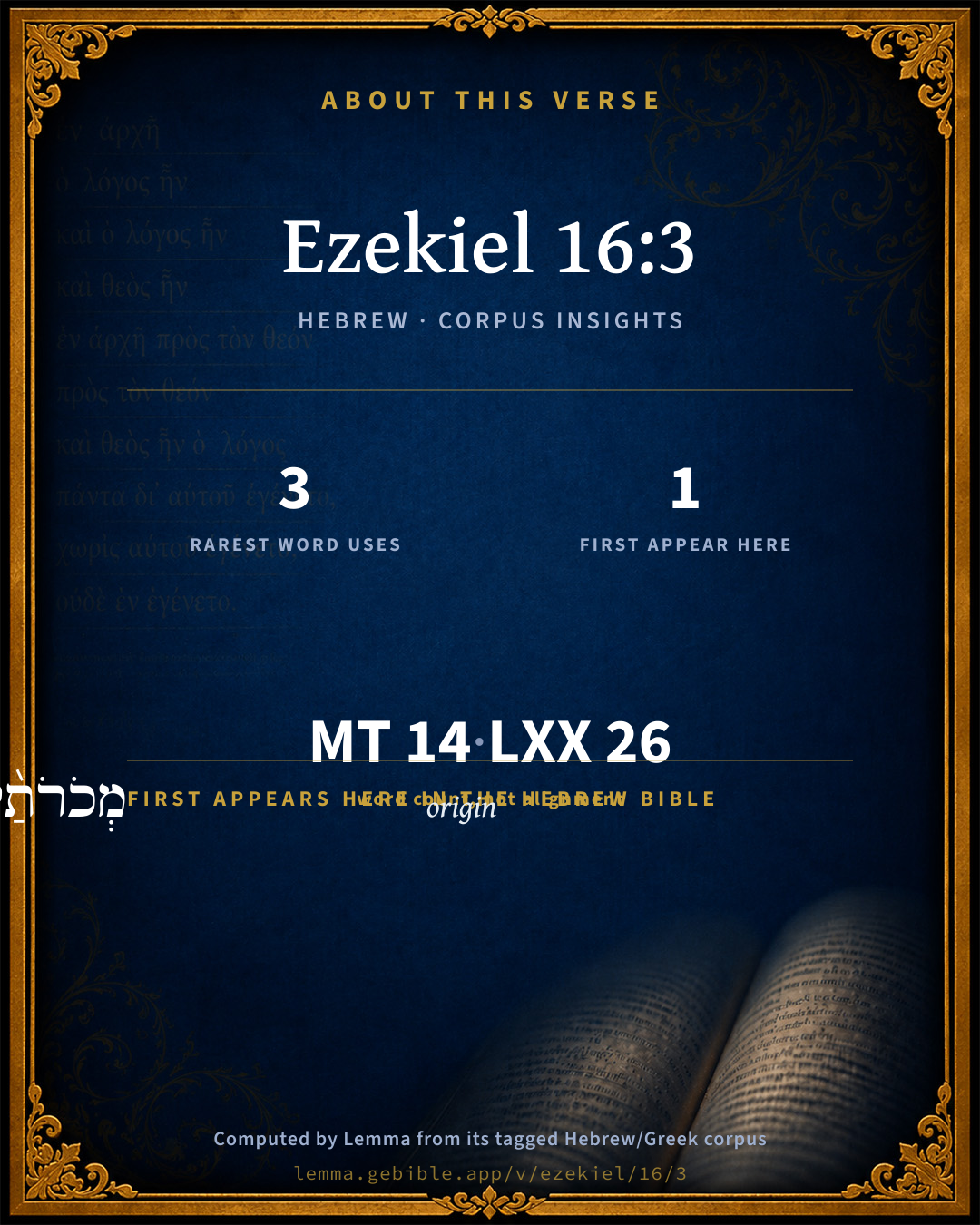
The rarest word here is מְכֹרֹתַ֨יִךְ֙ origin H4351 — appearing just 3 times in the whole Hebrew Bible.

First appearance in Scripture

This word makes its first canonical appearance in the Hebrew Bible here:

  • מְכֹרֹתַ֨יִךְ֙ origin H4351

Shared distinctive vocabulary

מְכֹרֹתַ֨יִךְ֙ origin H4351 occurs in 3 verses of the Hebrew Bible. Also found in:

Grammatical profile

  • 2 verbs
  • 11 nouns
  • 1 adverb

Verb forms

  • וְאָמַרְתָּ֞ Qal · Sequential Perfect
  • אָמַ֨ר Qal · Perfect

Repetition

A word recurs within this verse — often emphatic in Hebrew:

  • וְאָמַרְתָּ֞ to say H559 ×2

Hebrew & Septuagint length

In English translation the verse runs 32 words from the Hebrew and 31 from the Septuagint (LXX English) — closely comparable.

A rough comparison of the two English renderings, which tokenize alike — not a word-level alignment.

Word counts can differ between the Hebrew and the Greek without any difference in meaning — e.g. the Hebrew direct-object marker אֵת has no separate Greek word, and Greek often adds the article ὁ.

In the original languages it is 14 Hebrew tokens and 26 Greek tokens — but the two are counted differently (Hebrew bundles its prefixes and suffixes into one token; the Greek is in lemma form), so that isn’t a like-for-like length.

Cross-references

20

Topical passages linked to Ezekiel 16:3 in the Treasury of Scripture Knowledge — connected by theme and wording, ordered by reader-vote popularity; previews shown in the World English Bible.

  • Ezekiel 16:45 You are the daughter of your mother, who loathes her husband and her children; and you are the sister of your sisters, who loathed their husbands and their children: your mother was a Hittite, and your father an Amorite.
  • Isaiah 51:1–2 Listen to me, you who follow after righteousness, you who seek Yahweh: look to the rock whence you were hewn, and to the hold of the pit whence you were dug.
  • Deuteronomy 20:17 but you shall utterly destroy them: the Hittite, and the Amorite, the Canaanite, and the Perizzite, the Hivite, and the Jebusite; as Yahweh your God has commanded you;
  • Nehemiah 9:7 You are Yahweh the God, who did choose Abram, and brought him forth out of Ur of the Chaldees, and gave him the name of Abraham,
  • John 8:44 You are of your Father, the devil, and you want to do the desires of your father. He was a murderer from the beginning, and doesn't stand in the truth, because there is no truth in him. When he speaks a lie, he speaks on his own; for he is a liar, and the father of it.
  • Genesis 15:16 In the fourth generation they will come here again, for the iniquity of the Amorite is not yet full."
  • 1 Kings 21:26 He did very abominably in following idols, according to all that the Amorites did, whom Yahweh cast out before the children of Israel.)
  • Isaiah 1:10 Hear the word of Yahweh, you rulers of Sodom! Listen to the law of our God, you people of Gomorrah!
  • Ezekiel 21:30 Cause it to return into its sheath. In the place where you were created, in the land of your birth, will I judge you.
  • Luke 3:7 He said therefore to the multitudes who went out to be baptized by him, "You offspring of vipers, who warned you to flee from the wrath to come?
  • Genesis 11:29 Abram and Nahor took wives. The name of Abram's wife was Sarai, and the name of Nahor's wife, Milcah, the daughter of Haran who was also the father of Iscah.
  • Deuteronomy 7:1 When Yahweh your God shall bring you into the land where you go to possess it, and shall cast out many nations before you, the Hittite, and the Girgashite, and the Amorite, and the Canaanite, and the Perizzite, and the Hivite, and the Jebusite, seven nations greater and mightier than you;
  • Ezra 9:1 Now when these things were done, the princes drew near to me, saying, The people of Israel, and the priests and the Levites, have not separated themselves from the peoples of the lands, [doing] according to their abominations, even of the Canaanites, the Hittites, the Perizzites, the Jebusites, the Ammonites, the Moabites, the Egyptians, and the Amorites.
  • 1 John 3:10 In this the children of God are revealed, and the children of the devil. Whoever doesn't do righteousness is not of God, neither is he who doesn't love his brother.
  • Genesis 11:25 Nahor lived after he became the father of Terah one hundred nineteen years, and became the father of sons and daughters.
  • Joshua 24:14 Now therefore fear Yahweh, and serve him in sincerity and in truth; and put away the gods which your fathers served beyond the River, and in Egypt; and serve you Yahweh.
  • 2 Kings 21:11 Because Manasseh king of Judah has done these abominations, and has done wickedly above all that the Amorites did, who were before him, and has made Judah also to sin with his idols;
  • Matthew 3:7 But when he saw many of the Pharisees and Sadducees coming for his baptism, he said to them, "You offspring of vipers, who warned you to flee from the wrath to come?
  • Matthew 11:24 But I tell you that it will be more tolerable for the land of Sodom, on the day of judgment, than for you."
  • Ephesians 2:3 among whom we also all once lived in the lust of our flesh, doing the desires of the flesh and of the mind, and were by nature children of wrath, even as the rest.

Cross-references courtesy of OpenBible.info (CC BY 4.0).

Hebrew and Greek witnesses Masoretic Hebrew ↔ Greek Septuagint

The same verse in the two great witnesses to the Old Testament, shown verse-for-verse.

These are two independent witnesses, not word-aligned to each other, and the Septuagint is shown in lemma (dictionary) form.

Hebrew Ezekiel 16:3 Masoretic · Westminster Leningrad Codex

וְאָמַרְתָּ֞ כֹּה אָמַ֨ר אֲדֹנָ֤י יְהוִה֙ לִיר֣וּשָׁלִַ֔ם מְכֹרֹתַ֨יִךְ֙ וּמֹ֣לְדֹתַ֔יִךְ מֵאֶ֖רֶץ הַֽכְּנַעֲנִ֑י אָבִ֥יךְ הָאֱמֹרִ֖י וְאִמֵּ֥ךְ חִתִּֽית

and say, Thus says the Lord Yahweh to Jerusalem: Your birth and your birth is of the land of the Canaanite; the Amorite was your father, and your mother was a Hittite.

World English Bible · Public Domain

Greek LXX Ezekiel 16:3 Septuagint · lemma form

καί εἶπον ὅδε λέγω κύριος ὁ ἰερουσαλήμ ὁ ῥίζα σύ καί ὁ γένεσις σύ ἐκ γῆ χανααν ὁ πατήρ σύ ἀμορραῖος καί ὁ μήτηρ σύ χετταία

and you shall say, Thus says the Lord to Jerusalem; Your root and your birth are of the land of Chanaan: your father was an Amorite, and your mother a Chettite.

LXX2012 (modern English Septuagint) · Public Domain

On this verse, Joseph Benson's Commentary discusses the Septuagint’s reading. Read the note in Commentary ↓

Hebrew: Westminster Leningrad Codex (CC BY 4.0). Greek: Septuagint (public domain); English from LXX2012 (modern English Septuagint) (Public Domain). How the Septuagint differs from the Hebrew →

Targum (Aramaic paraphrase)

1

The Targum is the ancient Jewish Aramaic paraphrase of the Hebrew Scriptures — an interpretive translation, not the Hebrew text itself. Onkelos (literal) and Pseudo-Jonathan (expansive) render the Torah, and Jonathan the Prophets. Coverage is partial: where no permissively-licensed English translation exists for a verse, only the Aramaic is shown. This is verse-level text, not a word-by-word alignment to the Hebrew.

  1. Targum Jonathan Prophets (Joshua–Malachi)
    וְתֵימַר כִּדְנַן אֲמַר יְיָ אֱלֹהִים לְיָתְבֵי יְרוּשְׁלֵם תּוֹתְבַתְכוֹן וְיַלְדוּתְכוֹן מֵאַרְעָא כְּנַעֲנָאֵי תַּמָן אִתְגְלֵיתִי עַל אַבְרָהָם אֲבוּכוֹן בֵּין בִּתְרַיָא וְאוֹדַעְתֵּיהּ דְאַתּוּן נַחֲתִין לְמִצְרַיִם בִּדְרַע מְרוֹמָם אֲנָא פָּרֵק יַתְכוֹן וּבִזְכוּת אֲבָהָתְכוֹן אֲנָא מְתָרֵיךְ מִן קֳדָמֵיכוֹן יַת אֱמוֹרָאֵי וּמְשֵׁיצַי יַת חִתָּאֵי:

    And say: Thus said the LORD God to the residents of Jerusalem: Your settlement and youth was from the land of the Canaanites; there I was revealed upon Abraham your father between the pieces, and I showed him that you would go down to Egypt, with a high hand I would liberate you, and by merit of your ancestors I would drive out from before you the Amorites and expelled the Hittites.

    Targum Jonathan — Aramaic: “Mikraot Gedolot” (public domain). English: “Sefaria Community Translation” (CC0 1.0 (public-domain dedication)); “London "Chaldee Paraphrase," 1871” (public domain). Text via Sefaria.

Commentary

Notes on Ezekiel 16:3 from classic Christian and Jewish commentators (each source and its license shown beneath its notes). The classic Christian expositions comment on the surrounding passage and are grouped to its opening verse, so a note may address several verses; the Jewish commentaries on the Tanakh (Rashi and others) are per-verse, so they appear only where the commentator wrote on this verse.

Lemma curates 59 commentaries, every one of them public domain or Creative Commons licensed, each selected and text-cleaned for this edition rather than reprinted as found. About our sources →

Trapp's Complete Commentary

John Trapp

Eze 16:3 And say, Thus saith the Lord GOD unto Jerusalem; Thy birth and thy nativity [is] of the land of Canaan; thy father [was] an Amorite, and thy mother an Hittite.

Ver. 3. Thy birth.] Heb., Thy cutting out. Compare Isa 51:1.

And thy nativity.] Vide insignem genealogiam, vide γενεθλοιν pudendum. Mutato heroine de te fabula narratur. Cicero {a} saith the old Britons were as barbarous as the Scythians.

Thy father was an Amorite.] {b} An Amorite thou mayest seem to be rather than an Abramite; for thou hast filled the land, as they did, {Ezr 9:11} from end to end with thine uncleanness.

And thy mother an Hittite.] Those worst of women. {Gen 27:46}

{a} De Nat. Deor.

{b} Duris genuit te cautibus horrens Caucasus. - Virg.

John Trapp, A Commentary or Exposition upon All the Books of the Old and New Testament (1647–1656) — public domain. Text from a community e-Sword module.

The Biblical Illustrator

Joseph S. Exell

Eze_16:3

Thy father was an Amorite and thy mother an Hittite.

Hieroglyphics of truth

I. Man is essentially religious. Religion in the heart of man is something that pertains to the land of Canaan. It has not been invented by man, or created in his soul by human science or culture: it is not a product of education or civilisation. It is part of mans nature more truly than the raindrop is part of the cloud from which it falls, or than the river is part of the sea from which it flows and to which it returns. It is in the soul as fire is in the flint; as the oak is in the acorn, or as the day is in the dawn. Religion belongs to the soul, as hunger and thirst belong to the body. Hunger and thirst may not create bread, any more than the organ of vision can create light, or the organ of hearing sound; but bread and water, light and sound, would be useless without these organs. Were it not that man is essentially religious, all our preaching of the Gospel, and all our missionary labours at home and abroad, would be vain. Go with me in thought, and view the ruins of the temple of Heliopolis on the borders of Arabia, or the gigantic ruins of Luxor and Thebes on the banks of the Nile, or those of Baalbeck in the valley between the Lebanons. Whence the origin and purpose of these ancient temples? These temples, it may be said, were largely the outcome or expressions of mans religious beliefs--superstitious beliefs, if you will. But whence the origin of these superstitious beliefs? What was their root cause? Their root cause was mans religious nature. The word superstition means a resting upon, yes, resting upon mans natural religious convictions.

II. May by nature is morally corrupt. Thy father was an Amorite and thy mother an Hittite. The Amorites and Hittites, though born in the land of Canaan, were aliens to the commonwealth of Israel, and strangers to the covenants with promise; they were without God and without hope in the world. This doctrine of human depravity or moral corruption applies to all races and to men of all ranks. Sin in the soul is not the result of evil habits, as some suppose, nor the issue of a false education and corrupting companionship and circumstances. It is not a thing like cold, which a man may or may not take in certain circumstances, and which, if taken, may develop into consumption or some other disease. No. We are all horn with it. It is a constitutional malady. Apart from the doctrine of sin--original sin in the soul; I know not the doctrine of salvation, even in theory. Apart from the doctrine of mans natural alienation from God, I know not the meaning of Christs mission to the world. What would be the meaning of physicians were there no human ailments? or of drugs were there no human diseases? or of bread and water were there no such things as hunger and thirst? Without sin in the soul, the Gospel could have no meaning, and the Cross could have no power.

III. Christianity is Gods remedy for mans malady. He who at the beginning said, Let there be light, and there was light, now says to all men Live. The description given in the context of mans state by nature, speaks of death, moral and spiritual of orphanage and great feebleness. There is a great amount of life in the world, and man is not without life. It is called natural life; but natural life is somewhat as the river Jordan, that ends its flow in the Dead Sea. Human life, at the best, is as the grass, and its glory as the flower. It does not last, and its duration is a contradiction of our supreme desires. Death is not natural to man. Man was not made to die, as some men seem to suppose, but to live; hence the fear of death makes men subject to bondage. The keynote of Christianity is life, life that cannot die. I am come, said Jesus, that ye might have life, and that ye might have it more abundantly. To all who hear and believe the Gospel, God says Live. Is there any other religion in all the world that can be compared with the Christian religion in this respect? Christianity, as a system of truth, is in harmony with the soundest deductions of enlightened reason; Christianity, as exhibited in the Person and work of Jesus Christ, is the complement of the deepest cravings, the strongest desires, and the universal wants of humanity. It makes man great with the hopes which cheer the just. It lifts him as from the dunghill, and sets him among princes. While it fosters the conviction that heaven is needed to complete his life on earth, it opens the way, and gives him health and power to reach it. It makes him hopeful, useful, and great. (J. K. Campbell, D. D.)

The Biblical Illustrator, edited by Joseph S. Exell (c. 1880s–1900s) — public domain. Text from a community e-Sword module.

Joseph Benson's Commentary

Eze 16:3. Thus saith the Lord God unto Jerusalem — Unto the whole race of the Jews, and especially to the natives and inhabitants of that proud city, who thought it a singular privilege to be born or to live there, counting it a more holy place than the rest of the land of Canaan. Thy birth and thy nativity — The LXX. render it, Η ριζα σου και η γενεσις, thy root and thy generation, and so also the Vulgate. The word rendered birth, or root, however, מכרתין, seems rather to mean, commerce, or dealings, appearing to be derived from מכר, to sell. Accordingly Buxtorf translates it commercia tua, thy dealings. Houbigant, indeed, whom Bishop Newcome inclines to follow, prefers deriving the word from כרה, to dig, referring to Isa 51:1, and then the sense will be, thy origin, or thy rise, and thy nativity, is of the land of Canaan. If understood of the city of Jerusalem, the assertion is strictly true. It was a Canaanitish city, or strong hold, possessed and inhabited by the Jebusites, till David took it from them: see 2Sa 5:6. The father, therefore, of this city, might be properly said to be an Amorite, and its mother, a Hittite; these names comprehending all the idolatrous nations of Canaan, of which the Jebusites were a branch. Or if the Jews or Israelites be intended, their progenitors, Abraham, Isaac, and Jacob, sojourned in the land of Canaan long before the possession of it was given to their posterity; and the two latter were natives of that country. But as those are said to be our parents, in Scripture language, whose manners we imitate, the Jews or Israelites, may be here represented as being of Canaanitish origin, because they followed the manners of the idolatrous inhabitants of that country, rather than those of the pious patriarchs: see Eze 16:45; Joh 8:44; Mat 3:7. There is an expression of the same import in the history of Susannah, Eze 16:56, that seems to be borrowed from this passage, O thou seed of Canaan, and not of Judah, beauty hath deceived thee, and lust hath perverted thy heart.

Joseph Benson's Commentary on the Old and New Testaments (1811–1818) — public domain. Text from a community e-Sword module.

Geneva Bible (1599)

Geneva Bible translators

Thou boastest to be of the seed of Abraham, but thou art degenerate and followest the abominations of the wicked Canaanites, as children do the manners of their fathers, Isa. 1:4 and 57:3.

Geneva Bible (1599) marginal notes — public domain. Text via Bolls.life.

Jamieson, Fausset & Brown

Robert Jamieson, A. R. Fausset & David Brown

birth . . . nativity--thy origin and birth; literally, "thy diggings" (compare Isa 51:1) "and thy bringings forth."

of . . . Canaan--in which Abraham, Isaac, and Jacob sojourned before going to Egypt, and from which thou didst derive far more of thy innate characteristics than from the virtues of those thy progenitors (Eze 21:30).

an Amorite . . . an Hittite--These, being the most powerful tribes, stand for the whole of the Canaanite nations (compare Jos 1:4; Amo 2:9), which were so abominably corrupt as to have been doomed to utter extermination by God (Lev 18:24-25, Lev 18:28; Deu 18:12). Translate rather, "the Amorite . . . the Canaanite," that is, these two tribes personified; their wicked characteristics, respectively, were concentrated in the parentage of Israel (Gen 15:16). "The Hittite" is made their "mother"; alluding to Esau's wives, daughters of Heth, whose ways vexed Rebekah (Gen 26:34-35; Gen 27:46), but pleased the degenerate descendants of Jacob, so that these are called, in respect of morals, children of the Hittite (compare Eze 16:45).

Jamieson, Fausset & Brown — Commentary Critical and Explanatory on the Whole Bible (1871) — public domain (CC PDM 1.0). Text via the HelloAO Bible API.

Adam Clarke's Commentary

Verse 3. Thy birth and thy nativity is of the land of Canaan] It would dishonour Abraham to say that you sprung from him: ye are rather Canaanites than Israelites. The Canaanites were accursed; so are ye.

Thy father was an Amorite, and thy mother a Hittite.] These tribes were the most famous, and probably the most corrupt, of all the Canaanites. So Isaiah calls the princes of Judah rulers of Sodom, Isa 1:10; and John the Baptist calls the Pharisees a generation or brood of vipers, Mt 3:7. There is a fine specimen of this kind of catachresis in Dido's invective against AEneas: -

Nec tibi Diva parens, generis nec Dardanus auctor,

Perflde; sed duris genuit te cautibus horrens

Caucasus, Hyrcanaeque admorunt ubera tigres.

AEn. lib. iv. 365.

"False as thou art, and more than false, forsworn;

Not sprung from noble blood, nor goddess born:

But hewn from hardened entrails of a rock,--

And rough Hyrcanian tigers gave thee suck."

DRYDEN.

This is strong: but the invective of the prophet exceeds it far. It is the essence of degradation to its subject; and shows the Jews to be as base and contemptible as they were abominable and disgusting.

Adam Clarke's Commentary on the Bible (1810–1826) — public domain. Text from a community e-Sword/MySword module.

John Calvin's Commentaries

A question arises here — When God had adopted Abraham two hundred years previously, why was not that covenant taken into account? for he here seems not to magnify his own faithfulness and the constancy of his promise when he rejects the Jews as sprung from the Canaanites or Amorites; but this only shows what they were in themselves: for although he never departed from his purpose, and his election was never in vain, yet we must hold, as far as the people were concerned, that they are looked upon as profane Gentiles. For we know how they corrupted themselves in Egypt. Since, then, they were so degenerate and so utterly unlike their fathers, it is not surprising if God says that they were sprung from Canaanites and Amorites. For by Hosea he says, that they were all born of a harlot, and that the place of their birth was a house of ill fame. (Hosea 2:4.) This must be understood metaphorically: since here God does not; chide the women who had been false to their husbands, and had borne an adulterous offspring; but he simply means that the Jews were unworthy of being called or reputed Abraham’s seed. Why so? for although God remained firm in his covenant, yet if we consider the character of the Jews, they had entirely cut themselves off by their faithlessness. Since, then, they did not differ from the profane Gentiles, they are deservedly rejected with reproach, and are called an offspring of Canaan, as in other places. Now therefore, we understand the intention of the Prophet, or rather of the Holy Spirit. For if God had only said that he would pity that race when reduced to extreme misery, it would not have been subjected to such severe and heavy reproof, as we shall see. Hence God not only relates his kindness towards them, but at the same time shows from what state he had taken the Jews when he first aided them, and what, was their condition when he deigned to draw them out of such great misery. Moreover, since he was at hand to take them up, their redemption was founded on covenant, and so they were led forth, because God had promised Abraham four centuries ago that he would be the liberator of the people. That they should not be ignorant of the favor by which God had bound himself to Abraham, the Prophet meets them, and pronounces them a seed of Canaan, having nothing in common with Abraham, because, as far as they were concerned, according to common usage, God’s promise was extinct, and their adoption dead and buried. Since they had acted so perfidiously, they could no longer boast themselves to be Abraham’s children. Hence he says, thy habitations, that is, the place of their origin. Jerome translates it “root;” but the word “nativity” suits better, or native soil, or condition of birth in the land of Canaan: and thy father an Amorite and thy mother a Hittite There were other tribes of Canaan, but two or three kinds are put here for the whole. Now it follows —

John Calvin's Commentaries (1540-1563) — public domain. Text from the Calvin Translation Society English edition (1840s-50s) via the Christian Classics Ethereal Library (ccel.org). Calvin's coverage is partial (roughly two-thirds of the Bible); uncommented books and verses are honest gaps, never fabricated. The 19th-century editor's footnotes and remarks are omitted so the notes are faithfully Calvin's own voice.

Ellicott's Commentary for English Readers

(3) Thy birth and thy nativity is of the land of Canaan.—In the original the words “births” and “nativities” are in the plural, already indicating what the whole context makes plain, that the reference is not to the natural, but to the spiritual origin of Israel. So our Lord says to the Jews of His time, “Ye are of your father, the devil” (Joh_8:44; comp. Mat_3:9); and Isaiah addresses his contemporaries as “rulers of Sodom” and “people of Gomorrha” (Isa_1:10). The word births, as indicated by the margin, comes from a verb meaning to cut or dig out, as stone from the quarry; and there is a play upon this sense in Isa_51:1. Israel’s character, her spiritual nativity, was thoroughly Canaanitish.

An Amorite . . . an Hittite.—These two tribes, especially the former, as the most prominent in Canaan, are frequently put for the whole (Gen_15:16; Deu_1:44, with Num_14:45; Jos_10:5; 2Ki_21:11, &c). The dealings of the patriarchs in Canaan were particularly with the Hittites (Genesis 23; Gen_26:34-35; Gen_27:46; Gen_28:1; Gen_28:6-8). This once great and powerful nation had almost faded from history; but their monuments and inscriptions are just now beginning to be discovered and deciphered.

A Bible Commentary for English Readers, edited by Charles John Ellicott (1878–1897) — public domain. Text from a community e-Sword module.

The Cambridge Bible for Schools and Colleges

gen. ed. J. J. S. Perowne

3. Thy birth … land of Canaan] of the Canaanite. “Birth” is origin (ch. Eze_21:30, Eze_29:14), the figure being taken from a mine or a quarry, cf. Isa_51:1, “Look unto the rock whence ye are hewn, and to the hole of the pit whence ye are digged.” When Jerusalem’s origin is said to be from the land of the Canaanite several references seem combined, e.g. the fact that Jerusalem was a Canaanite city; that Israel first became a family in Canaan (Eze_16:4); and that having originated there its moral character corresponded to its Canaanite origin and had cleaved to it all through its history.

an Amorite] the Amorite. The Amorites and Hittites are named as the two chief Canaanitish peoples, the whole population being sometimes called the Amorites (Gen_15:16; Amo_2:9), and at other times the Hittites (Jos_1:4). Jerusalem has the one for father, and the other for mother (Eze_16:45).

The Cambridge Bible for Schools and Colleges (gen. ed. J. J. S. Perowne; Cambridge University Press, 1878–1918) — public domain. Text from a community e-Sword module.

John Gill's Exposition

And as for thy nativity, in the day thou wast born,.... Which refers either to the time when Abraham was called out of Ur of the Chaldeans, who had before been an idolater; or rather to the time when the children of Israel were in Egypt, and there grew and multiplied, and became a numerous body of people; who, upon their coming out of it, were brought into some form, and became a nation or body politic, which may be called the day of their birth as a people; see Hos 2:3;

thy navel was not cut; alluding to what is done to a newborn infant, when the midwife immediately takes care to cut the navel string, by which the child adheres to its mother, and takes in its breath and nourishment in the womb; but now, being of no longer use that way, it is cut and tied up, for the safety both of mother and child, who otherwise would be in great danger; and this denotes the desperate condition the Israelites were in when in Egypt, where they were greatly oppressed and afflicted, and in very imminent danger of being destroyed; to which the Targum refers it:

neither wast thou washed in water to supple thee: which also is done, to an infant as soon as born, to cleanse it from the menstruous blood, to make the flesh sleek, and smooth, and amiable; which, as Kimchi and Ben Melech observe, is done in hot water:

thou wast not salted at all; which was done, either by sprinkling salt upon it, or using salt and water (h), as a detersive of uncleanness, to prevent putrefaction, to dry up the humours, and harden the flesh, and consolidate the parts:

nor swaddled at all; to bring the several members of the body into form and shape; see Luk 2:7; and these things being of necessity to be done immediately, were, as Kimchi observes, lawful to be done even on a sabbath day, according to the traditions of the elders (i).

(h) Vid. Alex. ab Alex. Genial. Dier. l. 2. c. 25. (i) Vid. T. Bab. Sabbat, fol. 129. 2.

John Gill's Exposition of the Whole Bible (1746–1763) — public domain (CC PDM 1.0). Text via the HelloAO Bible API.

Albert Barnes' Notes on the Bible

Birth - See the margin; the word represents “origin” under the figure of “cutting out stone from a quarry” (compare Isa 51:1).

An Amorite - the Amorite, a term denoting the whole people. The Amorites, being a principal branch of the Canaanites, are often taken to represent the whole stock Gen 15:16; 2Ki 21:11.

An Hittite - Compare Gen 26:34. The main idea is that the Israelites by their doings proved themselves to be the very children of the idolatrous nations who once occupied the land of Canaan. Compare Deu 20:17.

Albert Barnes' Notes on the Bible (1834–1885) — public domain. Text from a community e-Sword/MySword module.

Haydock's Catholic Bible Commentary

Cethite, or "Hethite." These two were probably the most abandoned of Chanaan. Daniel (xiii. 56.) give the infamous judges the like appellation; and Isaias (i. 10.) calls the Jews princes of Sodom. (Calmet) --- So Dido says to Eneas: Nec te diva parens, generis nec Dardanus auctor

Perfide sed duris genuit te cautibus, &c. (Virgil, Æneid iv.) (Haydock)

--- But we nowhere find such a vehement and continued reprimand. The prophet seems to quit his proper character to make (Calmet) the abominations of the people known and detested, chap. iii. 8. (Haydock)

George Leo Haydock (1774–1849), Haydock's Catholic Family Bible and Commentary, 1859 edition — public domain. Excludes Psalms (Douay-Rheims chapter numbering differs from Protestant) and Deuterocanonical books (Catholic canon only).

Matthew Poole's English Annotations

The proud and blinded Jews thought their original more pure than that of the heathen; this was an old tradition among them, now that the prophet is to acquaint them with the truth of their polluted original, which they will storm and fret at, he comes thus prefacing his discourse with a Divine commission.

The Lord God; who is omniscient, knows all we are and do, who is so just and true, speaks not any thing but the very truth, who is supreme Judge and determiner of controversies. He tells the prophet what they were, and commands him to tell them.

Unto Jerusalem, i.e. the whole race of the Jews, as Eze 16:2. Or, perhaps, in more special manner the inhabitants and natives of that proud city, who thought it a singular privilege to be born there, which the Jews counted more holy than the rest of the land of Canaan.

Thy birth; thine habitation and thy kindred, so our English of the time of 2 Elizabeth. Thy root whence thou didst spring, the rock whence thou wast cut, the place where thou grewest up, the company and commerce thou didst use, all were of the land of Canaan, and thou hast a fulness of their vicious nature, manners, and practices, both in civil and religious things, as vile and obnoxious to my curse as Canaan itself.

Thy father: if the prophet refer to Abraham, it must be understood of his state and religion before God called him, when he, as his father and kindred, worshipped strange gods beyond the river, Jos 24:14, with Eze 16:2. If the prophet refer to those that were in Egypt, the Jews’ ancestors that dwelt there, it is certain that many of them forgot Abraham’s God, closed with the Egyptian idolatry, and were polluted with idols, Jos 24:2. If you refer it as a figurative speech, and call them fathers whom we reverence, consult, obey, and imitate, as well we may call such fathers, these were not the best and holiest of men, Mat 3:7; 12:34; 23:33. O ye Jews, be it known to you, whatever you think, you have no cause to boast of your nobler or purer descent, your fountain was corrupt and poisonous.

Was; might have been, for likeness of manners.

An Amorite; either because this comprehended all the rest of the cursed nations; or because the Amorites, as the most powerful and mighty, so were the most wicked among them; it was the Amorites which were filling up their sins, Gen 15:16.

Thy mother: sometimes the ill nature of a father is corrected in the child by the sweetness of the mother, but you Jews were not so happy, your mother was as bad every whit as your father; both prodigiously vile in their inclination, civil converse, and choice of their religion, and in the practice of it. The daughters of Heth were women of ill fame and worse manners, Gen 27:46, enough to make a good soul weary of life. Such is your race, O ye Jews.

Matthew Poole's English Annotations on the Holy Bible (1683–1685) — public domain. Text from a community e-Sword/MySword module.

Whedon's Commentary on the Bible

Daniel D. Whedon

3. Land of Canaan — Though Abraham came from Babylonia his religious training was in Palestine, as also the religious origin of the nation. It is an interesting fact that the name “Land of Canaan” is found in inscriptions back as far as Moses’s day, and earlier.

Thy father was an Amorite, and thy mother a Hittite — Of course this is a description of religious conditions. It is by no means certain that Abraham came of Hittite and Amorite origin, but certainly the Hittite and Amorite impurities of religion influenced primitive Israel. The fact that Jerusalem was once a Hittite city does not bear on the argument here, except possibly by making the illustration more vivid. (Compare Mat_23:33; Joh_8:44.) The close relations of the early Israelites with the Amorites and Hittites is seen from the fact that all Palestine, previous to the Exodus, was called in the Babylonian inscriptions the “land of the Amorites” and in Egyptian inscriptions in the time of Shalmaneser II, the “land of the Hittites.” (Compare Gen_15:16; Amo_2:9; Jos_1:4.) The writer believes that he has observed Amorite and Hittite characteristics even in the modern populations of Philistia.

Daniel D. Whedon (gen. ed.), Commentary on the Old and New Testaments (1874–1909) — public domain. Text from a community e-Sword module.

The Pulpit Commentary

The section on which we now enter, with its companion picture in ch. 23., forms the most terrible, one might almost say the most repellent, part of Ezekiel"s prophetic utterances. We have, as it were, his story of the harlot"s progress, his biography of the Messalina of the nations. We shudder as we read it, just as we shudder in reading the sixth satire of Juvenal. The prophet speaks, like the satirist, of things which we have learnt, mainly under the teaching of Christian purity, to veil in a reticent reserve, with a Lucretian and Dante-like vividness. The nearest parallel, indeed, which literature presents to it is found in the "Epistola ad Florentinos" of the latter poet. We need to remember, as we read it, that his standard was not ours, that those for whom he wrote had done or witnessed the things which he describes, that there was in them no nerve of pudicity to shock. He did not write virginibus puerisque, but for men to whom the whole imagery was a familiar thing. It is obvious, however, that the interpreter lives under ether conditions than the prophet, and cannot always follow him in the minuteness of his descriptions.

The thought that underlies Ezekiel"s parable, that Israel was the bride of Jehovah, and that her sin was that of the adulterous wife, was sufficiently familiar. Isaiah (Isa_1:21) had spoken of the "faithful city that had become a harlot." Jeremiah (Jer_2:2) had represented Jehovah as remembering "the kindness of her youth, the love of her espousals." What is characteristic of Ezekiel"s treatment of that image is that he does not recognize any period in which Israel had been as a faithful wife. But even here he had a forerunner in Hosea, who, in order that his own life might be itself a parable, was ordered to take to himself "a wife of whoredom," one, i.e., whose character was tainted before her marriage. (Hos_1:2) Ezekiel would seem to have dwelt upon that thought, and to have expanded it into the terrible history that follows.

Thy birth and thy nativity, etc. A prosaic literalism (as e.g. in interpreters like Hitzig and Kliefert) has seen in Ezekiel"s language the assertion of an ethnological fact. "The Jebusite city," the prophet is supposed to say," was never really of pure Israelite descent. Its people are descended from Canaanites, Amorites, Hittites, and are tainted, as by a law of heredite, with the vices of their forefathers." So taken, the passage would remind us of the scorn with which Dante (ut supra) speaks of the cruel and base herd of Fiesole, who corrupted the once noble stock of the inhabitants of Florence (so also "Inf.," 15:62). Rightly understood, it is believed that Ezekiel"s words imply the very opposite of this. As Isaiah (Isa_1:10) had spoken of "the rulers of Sodom, and the people of Gomorrah;" as Deu_32:32 had spoken of the vine of Israel becoming as "the vine of Sodom;" as our Lord speaks of the Jews of his time as not being "the children of Abraham"; (Joh_8:39) so Ezekiel, using the strongest form of Eastern vituperation, taunts the people of Jerusalem with acting as if they were descended, not from Abraham, Isaac, and Jacob, but from the earlier heathen inhabitants of what was afterwards the land of Israel. It is not necessary to enter into a history of the three nations whom he names. Briefly, the Canaanites represented the dwellers in the lowland country west of the valley of the Jordan the plains of Philistia, Sharon, Esdraelon, and Phoenicia; and their leading representatives in Ezekiel"s time were the cities of Tyre and Zidon. The Amorites were people of the mountains, at first, west of the Jordan, on the heights over the Dead Sea and as far as Hebron, but afterwards, under Sihon, on the high tablelands east of the Jordan. The Hittites, on whose history much light has been thrown by recent Egyptian and other discoveries, appear first in the history of the purchase of the cave of Macphelab, at Kirjath-arba, or Hebron, and that history implies commerce and culture. Esau"s marriage with the daughters of two Hittite chiefs implies, perhaps, a recognition of their value as allies. (Gen_26:34) They are always numbered with the other six nations, whom the Israelites were to conquer or expel (generally in conjunction with the Canaanites and Amorites as the three first, though not always in the same order,. (Exo_3:8 Exo_13:5 Exo_33:2 Exo_34:11) And this fact obviously determined Ezekiel"s choice. In the later historical books they appear but seldom. One Hittite captain, Uriah, occupies a high position in David"s army. (2Sa_11:3) The kings of the Hittites trade with Solomon, and give their daughters to him in marriage. (1Ki_10:29) They meet us for the last time as possible allies of the kings of Judah, (2Ki_7:6) and in the list of the older nations in Ezr_9:1 and Neh_9:8. Then they disappear from the page of history till the discovery and decipherment of Egyptian records in our own time shows them to have been among the mighty nations that have passed with their rulers into the Hades of departed kingdoms.

Ver. 3. Evil parentage.

The Jews boasted of their descent from Ahraham, but Ezekiel told them that they were children of the Canaanite aborigines of their land, because it was from those people that they drew their present character.

I ORIGINAL PARENTAGE MAY BE LOST. A man may inherit the throne of a great king, but if he has a mean and servile disposition, and inherits no kingly nature, he is not a true son of his father. Titles and estates may pass from men of high powers to imbeciles. The good name of a worthy Christian man may be borne by a worthless descendant. We cannot entail character. No man can be certain that his children will follow his example, however good and attractive that may be, and when it is not followed the true man is not represented by his children. Thus Christ would not permit his contemporaries to call themselves Abraham"s children. (Joh_8:39-41) This does not mean that he disputed their genealogical records. Apart from those prosaic tests of pure blood were the more serious signs of apostasy and disinheritance. In like manner, it is possible to lose the status of Divine sonship, although by nature we are all God"s children. It may even be surmised that Ezekiel had lost the recollection of the true origin of the Israelites, and had come to regard them as descendants of the Canaanites.

II A NEW PARENTAGE MAY BE ACQUIRED. The Jews were not Amorites and Hittites by natural descent. But though on their entering Canaan there was an express understanding that they were to drive out the inhabitants of the land and form no league with them, they lolled in that enterprise, leaving many of the original inhabitants in their midst, from whom they contracted habits of idolatry. We are all more or less influenced by our surroundings, and it is therefore of great importance that we should not choose hurtful companions. But there is a way of resisting a bad example when we cannot escape from its physical proximity. To yield to it is a sign of weakness and sin. The result is to make us spiritually the children of those we follow. The most vital inheritance is that of character. Though the blood of Abraham flowed in the veins of the apostate Jews, the spirit of Amorites and Hittites had possession of their minds and hearts. Therefore the chief part of their lives was derived from the adopted ancestors. A natural Christian parentage is of little account if a spiritual parentage of sin has been accepted by the degenerate children.

III THE EXCHANGE OF AN ORIGINAL WORTHY PARENTAGE FOR A NEW EVIL PARENTAGE IS AN UNSPEAKABLE DISGRACE. Israel had been accustomed to despise the Canaanites. To have to own a father and mother among those effete subject races was a shame for the proud conquerors of Canaan. But a worse disgrace lay in the abandonment of the lofty spirit of the patriarchs and the adoption of the degraded character of the heathen. It is a shame when the children of Christian parents sink into the condition of children of this world. They know better; they have seen worthy examples; they have been trained under good influences; they have received high privileges. We expect the sow to wallow in the mire, but when a person of higher origin follows her example he degrades himself far below the shameful state of the unclean animal.

The Pulpit Commentary (1880–1919), ed. H.D.M. Spence-Jones & Joseph S. Exell — public domain. Text from a community e-Sword module.

John Wesley's Explanatory Notes

Jerusalem - The whole race of the Jews. Thy birth - Thy root whence thou didst spring. Thy father - Abraham, before God called him, (as his father and kindred) worshipped strange gods beyond the river, Josh. xxiv, 14. An Amorite - This comprehended all the rest of the cursed nations.

John Wesley, Explanatory Notes Upon the Whole Bible (1754–1765) — public domain. Text via the GEBible commentary corpus.

Rashi

Rabbi Shlomo Yitzchaki (Rashi)

your dwelling place Heb. מְכֹרֹתַיִך, like מְגוּרוֹתַיִךְ, your dwelling place [interchanging כ and ג], and Menachem (p. 110) connected the word to the idea of birth. He similarly explained (Gen. 49: 5): “weapons of violence are their birth (מְכֵרוֹתֵיהֶם)” (Deut. 18:8); “besides what he has from his birth (מִמְכָּרָיו)” (II Kings 12:6); “each one from his kinsman (מַכָּרוֹ).” They all mean birth.

your father, etc., and your mother Abraham and Sarah took their greatness from there, and the children of Heth gave her a grave.

Rashi on the Tanakh — English translations: “The Judaica Press complete Tanach with Rashi, translated by A. J. Rosenberg” (CC BY 4.0); “Pentateuch with Rashi's commentary by M. Rosenbaum and A.M. Silbermann, 1929-1934” (public domain); “The Metsudah Tanach series, Lakewood, N.J” (CC BY 4.0); and “The Book of Joshua, Metsudah Publications, 1997” (CC BY 4.0). Text via Sefaria.

Lesson kit

Teaching starters — assembled from the data on this page, not authored interpretation. Every prompt links to the verse data it draws on. Edit before teaching.

Ezekiel, in the Prophets, opens this verse with 14 words (13 distinct Hebrew lemmas). Its most distinctive word is mᵉkûwrâh (“origin”). A historical commentator’s framing appears above. Read the whole chapter for the surrounding context.

Discussion questions

  1. What does “origin” (mᵉkûwrâh) contribute to the verse as a whole?
  2. This is the first place “origin” appears in Scripture (first appears here). What does its debut here establish?
  3. How does Ezekiel 21:30, which shares the word «origin», read alongside this verse?
  4. What does the repetition of “to say” (2× in this one verse) do in this verse?
  5. The translations on this page render this verse differently — a whole-verse word diff, not a word-by-word alignment. What might account for the different wordings?
  6. «וְאָמַרְתָּ֞» is a Qal Sequential Perfect verb. How does that grammatical form shape the action described?
  7. Compare how Trapp's Complete Commentary and The Biblical Illustrator read this verse. Where do they agree or differ?

Things to notice

Reading settings

Reading text

Shown beneath each verse's original-language words.

Old Testament
Old Testament edition

Read the OT as the Masoretic Hebrew (MT) or the Greek Septuagint (LXX).

English shown for the Greek Septuagint (in the Hebrew ↔ Greek comparison).

Comparing translations? Open the Compare panel on any verse page to stack up to four side by side.