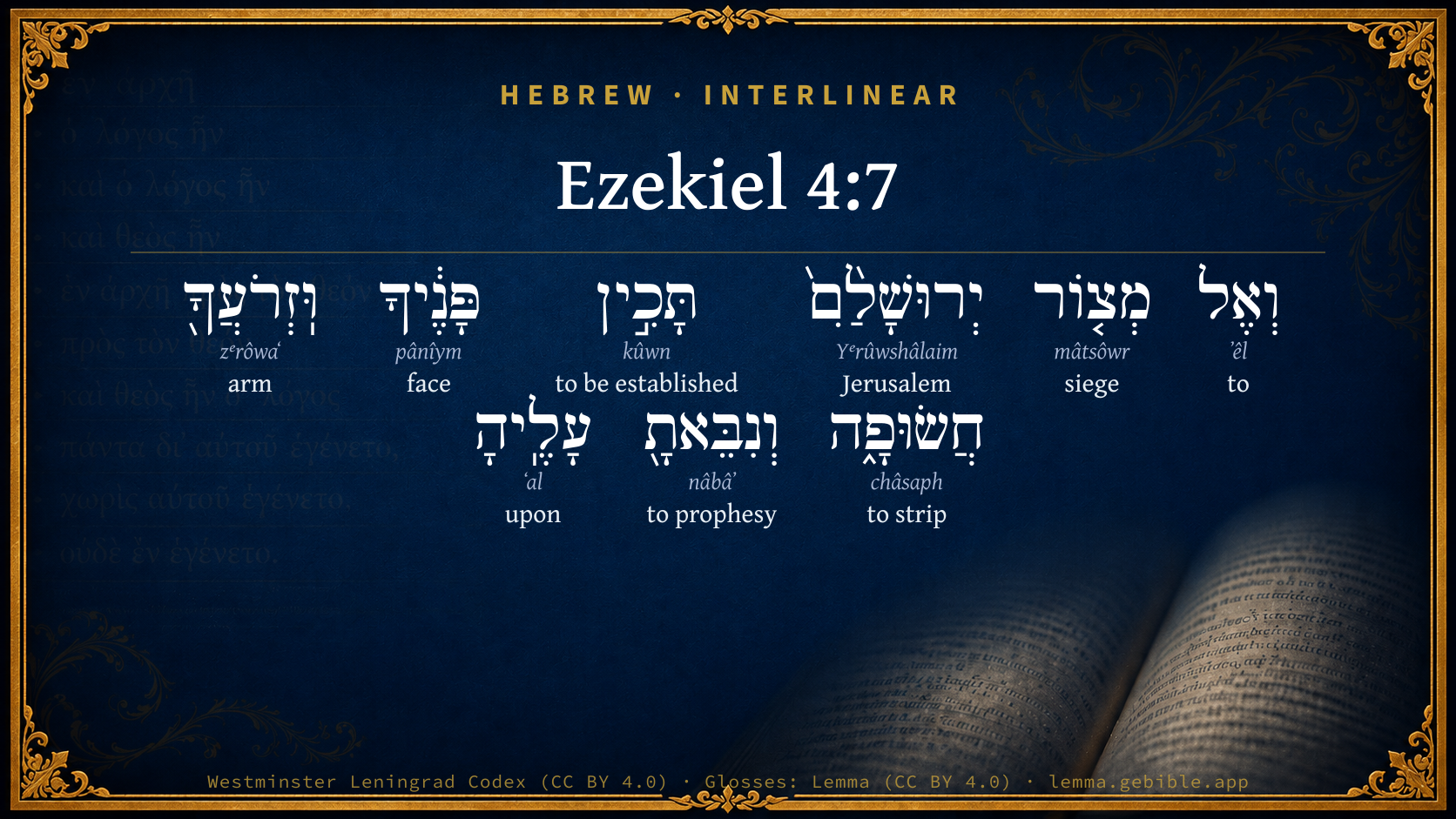
Ezekiel 4:7

Hebrew (Westminster Leningrad Codex) Ezekiel 4:7 appears in the Hebrew Old Testament. The text above is from the Westminster Leningrad Codex. Each word links to its Strong’s number, a concise gloss, and parsing drawn from the Open Scriptures Hebrew Bible morphology. Click any word for its full Brown-Driver-Briggs (BDB) entry.
Download image
Cite this verse

Ezekiel 4:7 (World English Bible). Public Domain. Lemma interlinear Bible study tool, https://lemma.gebible.app/v/ezekiel/4/7.

Show BibTeX & RIS
BibTeX
RIS
English Translation
You shall set your face toward the siege of Jerusalem, with your arm uncovered; and you shall prophesy against it.
World English Bible · Public Domain
Download a study sheet

One document with this verse’s original text, its word-by-word gloss line, the meaning frame, cross-references with their text, attributed commentary, and full source and license credits — printable, and it pastes into notes with its structure intact.

This verse Autodidact and up

Study sheet (.html) Plain text (.txt)

A passage Seminary Student

Up to 50 verses in one chapter. A passage sheet keeps up to 6 commentary sources and 12 cross-references per verse, in the order this page ranks them, and says so on the sheet whenever that leaves anything out. Ask for a single verse and you get the Autodidact verse sheet above.

Everything on this page stays free to read, with no account — the sheet is a download of what is already on screen, not access to it.

Want to remove ads? Support Godless Engineer
Compare translations 3

The same verse in 3 English versions, stacked beneath the original-language interlinear above. Click any original word for its lexicon entry.

Each is an independent rendering of the whole verse — the interlinear is not word-aligned to these translations.

Highlighted words mark where these versions differ — a whole-verse word diff, not a word-by-word alignment.

  • World English Bible Public Domain
    You shall set your face toward the siege of Jerusalem, with your arm uncovered; and you shall prophesy against it.
  • King James Version Public Domain
    Therefore thou shalt set thy face toward the siege of Jerusalem, and thine arm shall be uncovered, and thou shalt prophesy against it.
  • unfoldingWord Literal Text CC BY-SA 4.0
    Set your face toward Jerusalem that is under siege, and with your arm uncovered prophesy against it.

unfoldingWord Literal Text — © unfoldingWord, licensed CC BY-SA 4.0. Word-aligned USFM3 via Door43 (git.door43.org/unfoldingWord/en_ult).

Versions to compare (up to 4)

3 of 4 selected

Show all 18 translations

Every available English version of this verse, each an independent rendering of the whole verse.

  • World English Bible Public Domain
    You shall set your face toward the siege of Jerusalem, with your arm uncovered; and you shall prophesy against it.
  • Berean Standard Bible Public Domain
    You must turn your face toward the siege of Jerusalem with your arm bared, and prophesy against it.
  • Majority Standard Bible Public Domain
    You must turn your face toward the siege of Jerusalem with your arm bared, and prophesy against it.
  • King James Version Public Domain
    Therefore thou shalt set thy face toward the siege of Jerusalem, and thine arm shall be uncovered, and thou shalt prophesy against it.
  • American Standard Version (1901) Public Domain
    And thou shalt set thy face toward the siege of Jerusalem, with thine arm uncovered; and thou shalt prophesy against it.
  • Revised Version (1885) Public Domain
    And thou shalt set thy face toward the siege of Jerusalem, with thine arm uncovered; and thou shalt prophesy against it.
  • Geneva Bible (1599) Public Domain
    Therefore thou shalt direct thy face towarde the siege of Ierusalem, and thine arme shalbe vncouered, and thou shalt prophesie against it.
  • Douay-Rheims (1899) Public Domain
    And thou shalt turn thy face to the siege of Jerusalem, and thy arm shall be stretched out: and thou shalt prophesy against it.
  • Young's Literal Translation Public Domain
    `And unto the siege of Jerusalem thou dost prepare thy face, and thine arm `is' uncovered, and thou hast prophesied concerning it.
  • Literal Standard Version CC BY-SA 4.0
    And to the siege of Jerusalem you prepare your face, and your arm [is] uncovered, and you have prophesied concerning it.
  • Unlocked Literal Bible CC BY-SA 4.0
    Set your face toward Jerusalem that is under siege, and with your arm uncovered prophesy against it.
  • unfoldingWord Literal Text CC BY-SA 4.0
    Set your face toward Jerusalem that is under siege, and with your arm uncovered prophesy against it.
  • Darby Bible Public Domain
    And thou shalt set thy face toward the siege of Jerusalem, and thine arm shall be uncovered, and thou shalt prophesy against it.
  • World Messianic Bible Public Domain
    You shall set your face toward the siege of Jerusalem, with your arm uncovered; and you shall prophesy against it.
  • Webster's Bible Public Domain
    Therefore thou shalt set thy face towards the siege of Jerusalem, and thy arm shall be uncovered, and thou shalt prophesy against it.
  • Free Bible Version CC BY-SA 4.0
    Keep your face towards the siege of Jerusalem with your arm bared, and prophesy against it.
  • Bible in Basic English Public Domain
    And let your face be turned to where Jerusalem is shut in, with your arm uncovered, and be a prophet against it.
  • JPS Tanakh (1917) Public Domain
    And thou shalt set thy face toward the siege of Jerusalem, with thine arm uncovered; and thou shalt prophesy against it.

Literal Standard Version (2020), Covenant Press — licensed CC BY-SA 4.0. Text via the HelloAO Bible API (eBible.org). Unlocked Literal Bible (unfoldingWord) — licensed CC BY-SA 4.0. Text via the HelloAO Bible API (eBible.org). unfoldingWord Literal Text — © unfoldingWord, licensed CC BY-SA 4.0. Word-aligned USFM3 via Door43 (git.door43.org/unfoldingWord/en_ult). Free Bible Version, Dr. Jonathan Gallagher — licensed CC BY-SA 4.0. Text via the HelloAO Bible API (eBible.org).

Word by word

More ways to search: Search by grammar → Find every occurrence → Compare this word →

Practice this passage: Drill this verse → Learn its vocabulary →

חֲשׂוּפָ֑ה
châsaph
H2834
“stripped”
Verb, Qal, Participle Passive, Feminine, Singular, Absolute
Part of Speech
Verb
Stem
Qal
Form
Participle Passive
Gender
Feminine
Number
Singular
State
Absolute
Full BDB Definition

Origin: a primitive root

TWOT: 766

to strip, strip off, lay bare, make bare, draw out - (Qal) - to strip off - to strip, lay bare - to draw (water), skim, take from the surface
  1. וְאֶל ʼêl H413 “and · to” Conjunction + Preposition
  2. מְצ֤וֹר mâtsôwr H4692 “siege of” Noun, Common, Masculine, Singular, Construct
  3. יְרוּשָׁלִַ֨ם֙ Yᵉrûwshâlaim H3389 “Jerusalem” Noun, Proper
  4. תָּכִ֣ין kûwn H3559 “to be established” Verb, Hiphil, Imperfect, 2nd Person, Masculine, Singular
  5. פָּנֶ֔יךָ pânîym H6440 “face(s) · your” Noun, Common, Both, Plural, Construct + Suffix, Personal, 2nd Person, Masculine, Singular
  6. וּֽזְרֹעֲךָ֖ zᵉrôwaʻ H2220 “and · arm · your” Conjunction + Noun, Common, Both, Singular, Construct + Suffix, Personal, 2nd Person, Masculine, Singular
  7. וְנִבֵּאתָ֖ nâbâʼ H5012 “and · to prophesy” Conjunction + Verb, Niphal, Sequential Perfect, 2nd Person, Masculine, Singular
  8. עָלֶֽיהָ ʻal H5921 “upon · her” Preposition + Suffix, Personal, 3rd Person, Feminine, Singular

About this verse

These counts appear in no published source. They are computed here, from the morphology-tagged text and Lemma’s own curated glosses. What Lemma adds →

9
words
9
distinct lemmas
Prophets
section

Notable vocabulary

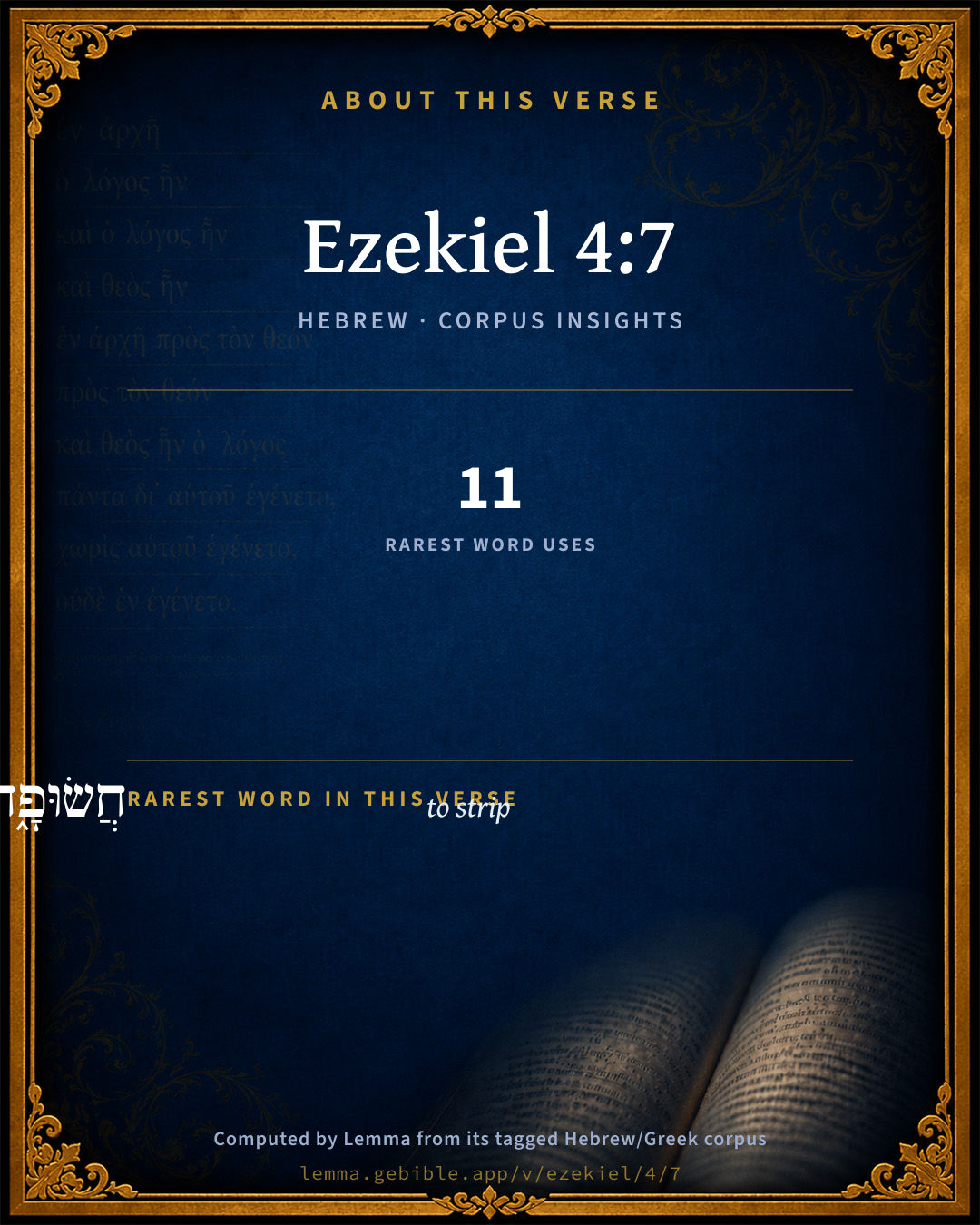
The rarest word here is חֲשׂוּפָ֑ה to strip H2834 — appearing just 11 times in the whole Hebrew Bible.

Shared distinctive vocabulary

חֲשׂוּפָ֑ה to strip H2834 occurs in 10 verses of the Hebrew Bible. Also found in:

Grammatical profile

  • 3 verbs
  • 4 nouns
  • 2 prepositions

Verb forms

  • תָּכִ֣ין Hiphil · Imperfect
  • חֲשׂוּפָ֑ה Qal · Participle Passive
  • וְנִבֵּאתָ֖ Niphal · Sequential Perfect

Hebrew & Septuagint length

In English translation the verse runs 20 words from the Hebrew and 21 from the Septuagint (LXX English) — closely comparable.

A rough comparison of the two English renderings, which tokenize alike — not a word-level alignment.

Word counts can differ between the Hebrew and the Greek without any difference in meaning — e.g. the Hebrew direct-object marker אֵת has no separate Greek word, and Greek often adds the article ὁ.

Cross-references

4

Topical passages linked to Ezekiel 4:7 in the Treasury of Scripture Knowledge — connected by theme and wording, ordered by reader-vote popularity; previews shown in the World English Bible.

  • Isaiah 52:10 Yahweh has made bare his holy arm in the eyes of all the nations; and all the ends of the earth have seen the salvation of our God.
  • Ezekiel 21:2 Son of man, set your face toward Jerusalem, and drop [your word] toward the sanctuaries, and prophesy against the land of Israel;
  • Ezekiel 4:3 Take for yourself an iron pan, and set it for a wall of iron between you and the city: and set your face toward it, and it shall be besieged, and you shall lay siege against it. This shall be a sign to the house of Israel.
  • Ezekiel 6:2 Son of man, set your face toward the mountains of Israel, and prophesy to them,

Cross-references courtesy of OpenBible.info (CC BY 4.0).

Hebrew and Greek witnesses Masoretic Hebrew ↔ Greek Septuagint

The same verse in the two great witnesses to the Old Testament, shown verse-for-verse.

These are two independent witnesses, not word-aligned to each other, and the Septuagint is shown in lemma (dictionary) form.

Hebrew Ezekiel 4:7 Masoretic · Westminster Leningrad Codex

וְאֶל מְצ֤וֹר יְרוּשָׁלִַ֨ם֙ תָּכִ֣ין פָּנֶ֔יךָ וּֽזְרֹעֲךָ֖ חֲשׂוּפָ֑ה וְנִבֵּאתָ֖ עָלֶֽיהָ

You shall set your face toward the siege of Jerusalem, with your arm uncovered; and you shall prophesy against it.

World English Bible · Public Domain

Greek LXX Ezekiel 4:7 Septuagint · lemma form

καί εἰς ὁ συγκλεισμός ἰερουσαλήμ ἑτοιμάζω ὁ πρόσωπον σύ καί ὁ βραχίων σύ στερεόω καί προφητεύω ἐπί αὐτός

So you shall set your face to the siege of Jerusalem, and shall strengthen your arm, and shall prophesy against it.

LXX2012 (modern English Septuagint) · Public Domain

On this verse, John Gill's Exposition discusses the Septuagint’s reading. Read the note in Commentary ↓

Hebrew: Westminster Leningrad Codex (CC BY 4.0). Greek: Septuagint (public domain); English from LXX2012 (modern English Septuagint) (Public Domain). How the Septuagint differs from the Hebrew →

Targum (Aramaic paraphrase)

1

The Targum is the ancient Jewish Aramaic paraphrase of the Hebrew Scriptures — an interpretive translation, not the Hebrew text itself. Onkelos (literal) and Pseudo-Jonathan (expansive) render the Torah, and Jonathan the Prophets. Coverage is partial: where no permissively-licensed English translation exists for a verse, only the Aramaic is shown. This is verse-level text, not a word-by-word alignment to the Hebrew.

  1. Targum Jonathan Prophets (Joshua–Malachi)
    וְלִצְיָר יְרוּשְׁלֵם תְּתַקֵין אַפָּךְ וְדַרְעָךְ תַּתְקֵיף וְתִתְנַבֵּי עֲלָהּ:

    (no public-domain English translation for this verse)

    Targum Jonathan — Aramaic: “Mikraot Gedolot” (public domain). English: “Sefaria Community Translation” (CC0 1.0 (public-domain dedication)); “London "Chaldee Paraphrase," 1871” (public domain). Text via Sefaria.

Commentary

Notes on Ezekiel 4:7 from classic Christian and Jewish commentators (each source and its license shown beneath its notes). The classic Christian expositions comment on the surrounding passage and are grouped to its opening verse, so a note may address several verses; the Jewish commentaries on the Tanakh (Rashi and others) are per-verse, so they appear only where the commentator wrote on this verse.

Lemma curates 59 commentaries, every one of them public domain or Creative Commons licensed, each selected and text-cleaned for this edition rather than reprinted as found. About our sources →

Trapp's Complete Commentary

John Trapp

Eze 4:7 Therefore thou shalt set thy face toward the siege of Jerusalem, and thine arm [shall be] uncovered, and thou shalt prophesy against it.

Ver. 7. Set thy face toward the siege of Jerusalem.] Steel thy countenance, be stern and resolute, to show that the Chaldees should be so. Thus this prophet proceedeth to write, as it were, in hieroglyphics, and to preach in emblems.

And thine arm shall be uncovered,] i.e., Thou shalt do thy work bodily; which, when soldiers and servants set themselves to do, they make bare their arms, ut fine expeditiores, for quicker despatch. Even orators also pleaded with their right arm, as Oecolampadius here noteth, stripped up and stretched out.

And thou shalt prophesy against it.] By these signs and dumb shows at least. See Eze 3:26.

John Trapp, A Commentary or Exposition upon All the Books of the Old and New Testament (1647–1656) — public domain. Text from a community e-Sword module.

Joseph Benson's Commentary

Eze 4:7-8. Thou shalt set thy face toward the siege of Jerusalem — Thou shalt look toward Jerusalem, or toward the portraiture of it upon the tile, with a threatening countenance, as men do toward the city which they are besieging. And thine arm shall be uncovered — Or, stretched out, as the Vulgate reads it. Their habits were anciently so contrived, that their right arms were disengaged from their upper garments, that they might be the more ready for action. So ancient statues and coins represent heroes with their right arms bare, and out of the sleeves of their garments. Thus God is said to make bare his arm, Isa 52:10, where he is represented as subduing his adversaries, and bringing salvation to his people. And thou shalt prophesy against it — Thou shalt signify by these signs what shall happen to it. And, behold, I will lay bands upon thee — See Eze 3:25. God is said to do what was done in consequence of his command. And thou shalt not turn thee from one side to another — This may mean, that the Lord would powerfully enable, and even constrain him to lie quietly in the posture appointed him, till the days were accomplished, in the sense explained in note on Eze 4:4, this being intended to signify that the Chaldeans should continue the siege, and should be, as it were, fixed and fastened there, as by bonds, till the city was taken. This evidently seems to have been a real transaction, and not a vision, otherwise it does not appear how it could have been a sign to the people; for how could any thing be a sign to them, of which they were not eye-witnesses? Till thou hast ended the days of thy siege — “The three hundred and ninety days, mentioned Eze 4:5; Eze 4:9, it seems, were designed, not only to signify the years of Israel’s sin, but the continuance of the siege of Jerusalem. That siege lasted, from the beginning to the end of it, seventeen months, as appears from 2Ki 25:1-4. But the king of Egypt, coming to relieve the city, was the occasion of raising the siege for some time, as appears from Jer 37:3. So that it may reasonably be gathered from the authority of the text, joined to the circumstances of the story, that the siege lasted about thirteen months, or three hundred and ninety days.”

Joseph Benson's Commentary on the Old and New Testaments (1811–1818) — public domain. Text from a community e-Sword module.

Tyndale Open Study Notes

Tyndale Open Resources

4:7 Throughout the depiction, Ezekiel continued to represent God. With his arm bared, he stared at the siege of Jerusalem and prophesied her destruction.

Tyndale Open Study Notes — © Tyndale Open Resources, licensed CC BY-SA 4.0. Text via the HelloAO Bible API.

Geneva Bible (1599)

Geneva Bible translators

In token of a speedy vengeance.

Geneva Bible (1599) marginal notes — public domain. Text via Bolls.life.

Jamieson, Fausset & Brown

Robert Jamieson, A. R. Fausset & David Brown

arm . . . uncovered--to be ready for action, which the long Oriental garment usually covered it would prevent (Isa 52:10).

thou shalt prophesy against it--This gesture of thine will be a tacit prophecy against it.

Jamieson, Fausset & Brown — Commentary Critical and Explanatory on the Whole Bible (1871) — public domain (CC PDM 1.0). Text via the HelloAO Bible API.

John Calvin's Commentaries

It is added, and towards the siege of Jerusalem thou shalt set or establish thy face Either meaning may be received; either directing and ordering, or establishing and strengthening; although the word directing or ordering pleases me better in this place. He had said, indeed, before, thou shalt direct thy face until Jerusalem shall be besieged; but in my opinion God simply here orders his Prophet to be intent on the overthrow of the city. And thine arm shall be made bare; that is, for expedition: for we know that orientals use flowing tunics and long robes, so that they cannot execute any business without putting off their garments. Hence the Prophet is here ordered to make bare his arm, just as if any one should take his coat half off, and throw it over the other side, that he might have one arm free. Such was the dress of the Prophet, but by a vision, as I have said. Afterwards it is added, that thou, shalt prophesy against it Again God repeats what we saw yesterday: for nothing had been colder than that the Prophet should make bare his arm, and direct his face against towards the siege of a painted city. Had the picture been only an empty one, the spectacle might be justly condemned; but God adds the meaning to the figures, that the prophecy may have more force: as if he had said, I see that these signs are not of themselves of much moment, and you may object to me, why do you concern yourself with these trifles? But whatever you do shall be a certain seal of prophecy. Now we see why God joins the word “prophecy.” Then he adds, Behold I will place upon thee ropes, so that thou canst not turn from, side to side, until thou hast completed the days of thy siege God here signifies that his decree concerning the siege of Jerusalem was inviolable: for as he held his servant so bound down, by this the firmness of his decree was designated, because the Jews thought that they could extricate themselves by their deceits. For we know that they always flattered themselves when the Prophets threatened them. Therefore God signifies that the siege of the city was certain until it was taken; because the Prophet should be bound with cords, and should not move himself, nor turn from one side to the other. And hence we understand, from the figure here used, that the Jews should suffer the same punishments as the ten tribes. Just as if God should say that the time determined for the destruction of the kingdom of Israel had come, and that the same end would happen to the Jews; for ill whatever direction they might escape, yet the same execution of God’s judgment would arrive, as if the matter had been already determined. Now it follows:

John Calvin's Commentaries (1540-1563) — public domain. Text from the Calvin Translation Society English edition (1840s-50s) via the Christian Classics Ethereal Library (ccel.org). Calvin's coverage is partial (roughly two-thirds of the Bible); uncommented books and verses are honest gaps, never fabricated. The 19th-century editor's footnotes and remarks are omitted so the notes are faithfully Calvin's own voice.

Ellicott's Commentary for English Readers

(7) Set thy face is a common Scriptural expression for any steadfast purpose. (See Lev_17:10; Lev_20:3; Lev_20:5-6; Lev_26:17; 2Ch_20:3, marg., &c.) It is a particularly favourite phrase with Ezekiel (Eze_15:7; Eze_20:46, &c.). Here this steadfastness of purpose was to be exercised “toward the siege of Jerusalem;” there would be no relenting in this matter—God’s purpose of judgment should surely be fulfilled. Further symbolism to the same effect is added, “Thine arm shall be uncovered,” withdrawn from the loose sleeve of the Oriental robe, and made ready for battle. (Comp. Isa_52:10.) Withal he is to “prophesy against it,” doubtless by words suited to his actions.

A Bible Commentary for English Readers, edited by Charles John Ellicott (1878–1897) — public domain. Text from a community e-Sword module.

The Cambridge Bible for Schools and Colleges

gen. ed. J. J. S. Perowne

7. Therefore thou shalt set] With R.V., and thou shalt set … with thine arm uncovered. In this verse the prophet resumes Eze_4:1-3, representing the besiegers; he sets his face towards the siege, presses it steadily and with determination; his arm is bare—the instrument with which he works unentangled and effective (Isa_52:10); and he prophesies against the city, for all that is done to Jerusalem is but the irresistible word of the Lord against it taking effect.

The Cambridge Bible for Schools and Colleges (gen. ed. J. J. S. Perowne; Cambridge University Press, 1878–1918) — public domain. Text from a community e-Sword module.

John Gill's Exposition

Therefore thou shalt set thy face toward the siege at Jerusalem,.... All the while he was lying either on the left side or the right, his face was to be directed to the siege of Jerusalem, portrayed upon the tile, and to all the preparations made for that purpose, to show that all had reference to that and that it wound certainly be; for, as the prophet represented the Chaldean army the directing and setting his face to the siege shows their resolution and inflexibleness, that they were determined upon taking the city, and nothing should divert them from it:

and thine arm shall be uncovered; which was usual in fighting in those times and countries; for, wearing long garments, they were obliged to turn them up on the arm, or lay them aside, that they might more expeditiously handle their weapons, and engage with the enemy: in this form the soldiers in Trajan's column are figured fighting; and it is related that the Africans used to fight with their arms uncovered (h); thus Scanderbeg in later times used to fight the Turks. The design of the phrase is to show how ready, diligent, and expeditious, the Chaldeans would be in carrying on the siege. The Targum renders it,

"thou shalt strengthen thine arm;''

and so do the Septuagint, Syriac, and Arabic versions:

and thou shall prophesy against it: meaning not so much by words, if at all, but by these actions, gestures, and habit; for they all foretold what would certainly come to pass.

(h) Vid. Lydium de Re Militari, l. 4. c. 3. p. 160.

John Gill's Exposition of the Whole Bible (1746–1763) — public domain (CC PDM 1.0). Text via the HelloAO Bible API.

Albert Barnes' Notes on the Bible

Therefore thou shalt set thy face - Or, “And etc.” i. e., direct thy mind to that subject.

Thine arm shall be uncovered - A sign of the execution of vengeance Isa 52:10.

Albert Barnes' Notes on the Bible (1834–1885) — public domain. Text from a community e-Sword/MySword module.

Haydock's Catholic Bible Commentary

Siege, which shall be most terrible; (Haydock) 390 days: the pillage shall last other forty. (Tirinus) --- So many years have the people transgressed. --- Out. Hebrew, "naked." Thus various barbarians fight. --- Prophesy, not by words, (chap. viii. 26.) but by actions. (Menochius)

George Leo Haydock (1774–1849), Haydock's Catholic Family Bible and Commentary, 1859 edition — public domain. Excludes Psalms (Douay-Rheims chapter numbering differs from Protestant) and Deuterocanonical books (Catholic canon only).

Matthew Poole's English Annotations

Therefore, Heb. And, while thou liest on thy side, thou shalt fix thy countenance on the portrait of besieged Jerusalem, with angry and menacing looks.

Jerusalem; not which was in the land of Judah, but that described in the tile, the emblem of the other.

Thine arm, thy right arm, the stronger and more ready to act, shall be uncovered, naked and stretched out, as being ready to strike and slay.

Thou shalt prophesy against it: this very emblem doth threaten, which is a visional prediction, and no doubt Ezekiel unfolded these riddles on just occasions, and this was a prophesying to them, sometimes by signs, and sometimes by words.

Matthew Poole's English Annotations on the Holy Bible (1683–1685) — public domain. Text from a community e-Sword/MySword module.

Whedon's Commentary on the Bible

Daniel D. Whedon

7. The foregoing calculation makes more dramatic the continuance of the siege. That siege is sure to be successful. The uncovered arm of the prophet represents that the arm of Jehovah is “made bare” and ready for action (Psa_98:1; Isa_52:10). The prophecy has gone forth, and not only has it foretold the captivity of the city, but it has even reckoned the years in which the inhabitants of Jerusalem shall be held in captivity. Nothing could be more startling than the sight of the silent prophet prostrate upon the earth with “set face” and bare arm outstretched against the city which had always stood for the Israelite nation and its religion. There were no words spoken (Eze_3:26). It was in this sign-language he was to “prophesy against it.”

Daniel D. Whedon (gen. ed.), Commentary on the Old and New Testaments (1874–1909) — public domain. Text from a community e-Sword module.

The Pulpit Commentary

Thine arm shall be uncovered. This, as in Isa_52:10, was the symbol of energetic action. The prophet was to be, as it were, no apathetic spectator of the siege which he was thus dramatizing, but is as the representative of the Divine commission to control and guide it. The picture of the prophet"s attitude, not merely resting on his side and folding his hands, as a man at ease might do, but looking intently, with bare outstretched arm, at the scene portrayed by him, must, we may well imagine, have added to the startling effect of the whole procedure. We note the phrase, "set thy face," as specially characteristic of Ezekiel. (here, and, though the Hebrew verb is not the same, Eze_14:8 Eze_15:7) The words "prophesy against it" may imply some spoken utterance of the nature of a "woe," like that of the son of Ananus (see above), but hardly, I think, a prolonged address.

The Pulpit Commentary (1880–1919), ed. H.D.M. Spence-Jones & Joseph S. Exell — public domain. Text from a community e-Sword module.

John Wesley's Explanatory Notes

Set - While thou liest on thy side thou shalt fix thy countenance on the portrait of besieged Jerusalem. Uncovered - Naked and stretched out as being ready to strike.

John Wesley, Explanatory Notes Upon the Whole Bible (1754–1765) — public domain. Text via the GEBible commentary corpus.

Rashi

Rabbi Shlomo Yitzchaki (Rashi)

And to the siege of Jerusalem which is engraved on the brick, you shall direct your face; when you lie on your left side, the brick should be opposite you, and so too when you lie on your right.

and your arm shall be bared toward them (Other editions read: opposite it), like a fighting man. This symbolizes Nebuchadnezzar, who will fight against it.

bared Heb. חֲשּׂוּפָה, like גְלוּיָה.

Rashi on the Tanakh — English translations: “The Judaica Press complete Tanach with Rashi, translated by A. J. Rosenberg” (CC BY 4.0); “Pentateuch with Rashi's commentary by M. Rosenbaum and A.M. Silbermann, 1929-1934” (public domain); “The Metsudah Tanach series, Lakewood, N.J” (CC BY 4.0); and “The Book of Joshua, Metsudah Publications, 1997” (CC BY 4.0). Text via Sefaria.

Lesson kit

Teaching starters — assembled from the data on this page, not authored interpretation. Every prompt links to the verse data it draws on. Edit before teaching.

Ezekiel, in the Prophets, opens this verse with 9 words (9 distinct Hebrew lemmas). Its most distinctive word is châsaph (“to strip”). A historical commentator’s framing appears above. Read the whole chapter for the surrounding context.

Discussion questions

  1. What does “to strip” (châsaph) contribute to the verse as a whole?
  2. Psalms 29:9 shares the word «to strip» with this verse. How do the two illuminate each other?
  3. The translations on this page render this verse differently — a whole-verse word diff, not a word-by-word alignment. What might account for the different wordings?
  4. The verb «תָּכִ֣ין» is Hiphil Imperfect. How does its form color the action?
  5. Reading how Trapp's Complete Commentary and Joseph Benson's Commentary read this verse, where do the two commentators agree and where do they part?

Things to notice

Reading settings

Reading text

Shown beneath each verse's original-language words.

Old Testament
Old Testament edition

Read the OT as the Masoretic Hebrew (MT) or the Greek Septuagint (LXX).

English shown for the Greek Septuagint (in the Hebrew ↔ Greek comparison).

Comparing translations? Open the Compare panel on any verse page to stack up to four side by side.