Song of Solomon 8:4

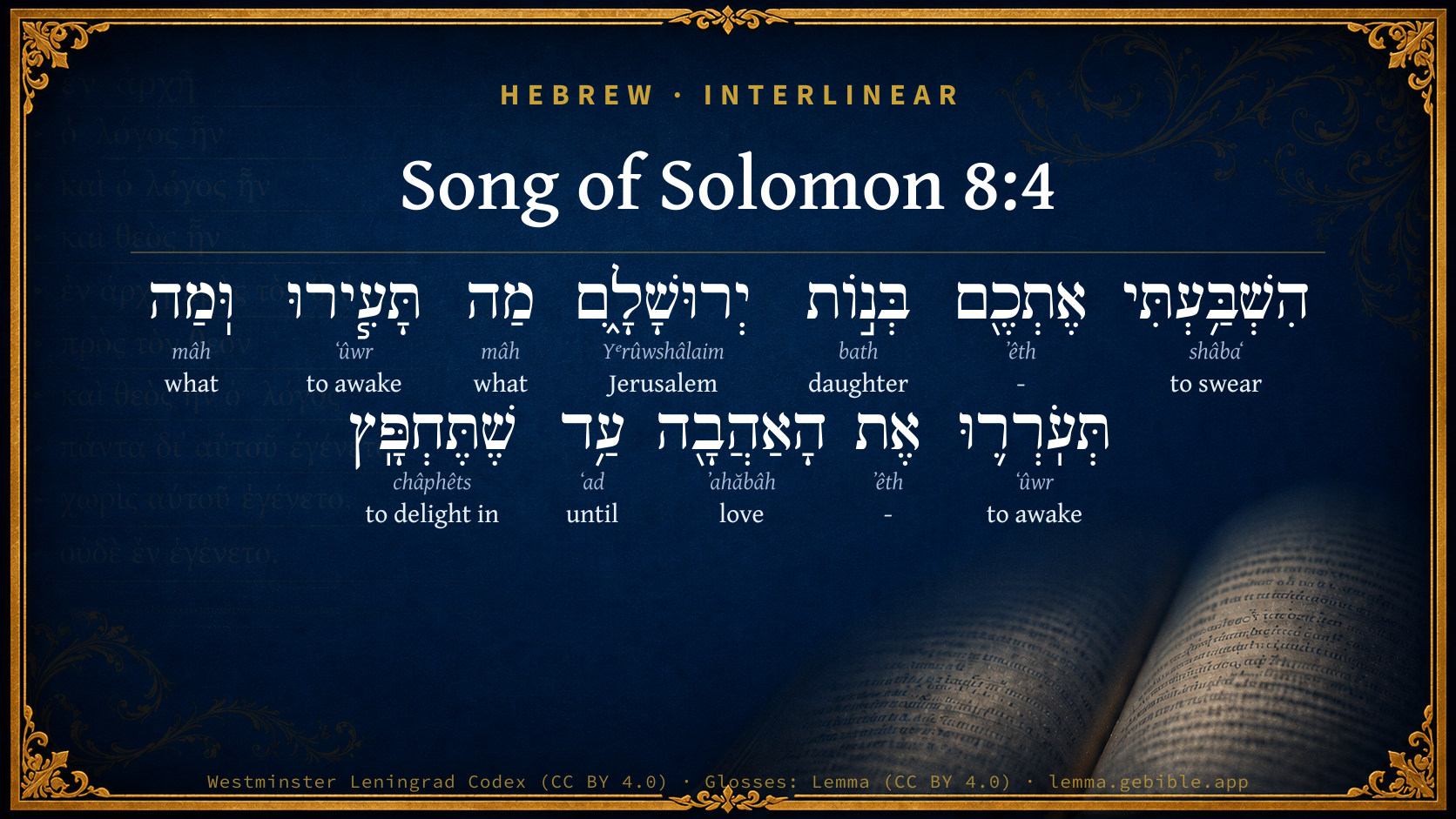
Hebrew (Westminster Leningrad Codex) Song of Solomon 8:4 appears in the Hebrew Old Testament. The text above is from the Westminster Leningrad Codex. Each word links to its Strong’s number, a concise gloss, and parsing drawn from the Open Scriptures Hebrew Bible morphology. Click any word for its full Brown-Driver-Briggs (BDB) entry.
Download image
Cite this verse

Song of Solomon 8:4 (World English Bible). Public Domain. Lemma interlinear Bible study tool, https://lemma.gebible.app/v/song-of-solomon/8/4.

Show BibTeX & RIS
BibTeX
RIS
English Translation
I adjure you, daughters of Jerusalem, That you not stir up, nor awaken love, Until it so desires. Friends
World English Bible · Public Domain
Download a study sheet

One document with this verse’s original text, its word-by-word gloss line, the meaning frame, cross-references with their text, attributed commentary, and full source and license credits — printable, and it pastes into notes with its structure intact.

This verse Autodidact and up

Study sheet (.html) Plain text (.txt)

A passage Seminary Student

Up to 50 verses in one chapter. A passage sheet keeps up to 6 commentary sources and 12 cross-references per verse, in the order this page ranks them, and says so on the sheet whenever that leaves anything out. Ask for a single verse and you get the Autodidact verse sheet above.

Everything on this page stays free to read, with no account — the sheet is a download of what is already on screen, not access to it.

Want to remove ads? Support Godless Engineer
Compare translations 3

The same verse in 3 English versions, stacked beneath the original-language interlinear above. Click any original word for its lexicon entry.

Each is an independent rendering of the whole verse — the interlinear is not word-aligned to these translations.

Highlighted words mark where these versions differ — a whole-verse word diff, not a word-by-word alignment.

  • World English Bible Public Domain
    I adjure you, daughters of Jerusalem, That you not stir up, nor awaken love, Until it so desires. Friends
  • King James Version Public Domain
    I charge you, O daughters of Jerusalem, that ye stir not up, nor awake my love, until he please.
  • unfoldingWord Literal Text CC BY-SA 4.0
    I adjure you, daughters of Jerusalem, do not awaken and do not stir love until it desires.

unfoldingWord Literal Text — © unfoldingWord, licensed CC BY-SA 4.0. Word-aligned USFM3 via Door43 (git.door43.org/unfoldingWord/en_ult).

Versions to compare (up to 4)

3 of 4 selected

Show all 18 translations

Every available English version of this verse, each an independent rendering of the whole verse.

  • World English Bible Public Domain
    I adjure you, daughters of Jerusalem, That you not stir up, nor awaken love, Until it so desires. Friends
  • Berean Standard Bible Public Domain
    O daughters of Jerusalem, I adjure you: Do not arouse or awaken love until the time is right.
  • Majority Standard Bible Public Domain
    O daughters of Jerusalem, I adjure you: Do not arouse or awaken love until the time is right.
  • King James Version Public Domain
    I charge you, O daughters of Jerusalem, that ye stir not up, nor awake my love, until he please.
  • American Standard Version (1901) Public Domain
    I adjure you, O daughters of Jerusalem, That ye stir not up, nor awake `my' love, Until he please.
  • Revised Version (1885) Public Domain
    I adjure you, O daughters of Jerusalem, that ye stir not up, nor awaken love, until it please.
  • Geneva Bible (1599) Public Domain
    I charge you, O daughters of Ierusale, that you stir not vp, nor waken my loue, vntil she please.
  • Douay-Rheims (1899) Public Domain
    I adjure you, O daughters of Jerusalem, that you stir not up, nor awake my love till she please.
  • Young's Literal Translation Public Domain
    I have adjured you, daughters of Jerusalem, How ye stir up, And how ye wake the love till she please!
  • Literal Standard Version CC BY-SA 4.0
    I have adjured you, daughters of Jerusalem, || How you stir up, || And how you wake the love until she pleases!
  • Unlocked Literal Bible CC BY-SA 4.0
    I want you to swear, daughters of Jerusalem, that you will not interrupt our lovemaking until it is over. The women of Jerusalem speaking
  • unfoldingWord Literal Text CC BY-SA 4.0
    I adjure you, daughters of Jerusalem, do not awaken and do not stir love until it desires.
  • Darby Bible Public Domain
    I charge you, daughters of Jerusalem,... Why should ye stir up, why awake [my] love, till he please?
  • World Messianic Bible Public Domain
    I adjure you, daughters of Jerusalem, that you not stir up, nor awaken love, until it so desires.
  • Webster's Bible Public Domain
    I charge you, O daughters of Jerusalem, that ye stir not, nor awake my love, until he please.
  • Free Bible Version CC BY-SA 4.0
    Women of Jerusalem, swear to me that you won't disturb our love until the right time.
  • Bible in Basic English Public Domain
    I say to you, O daughters of Jerusalem, do not let love be moved till it is ready.
  • JPS Tanakh (1917) Public Domain
    'I adjure you, O daughters of Jerusalem: Why should ye awaken, or stir up love, until it please?'

Literal Standard Version (2020), Covenant Press — licensed CC BY-SA 4.0. Text via the HelloAO Bible API (eBible.org). Unlocked Literal Bible (unfoldingWord) — licensed CC BY-SA 4.0. Text via the HelloAO Bible API (eBible.org). unfoldingWord Literal Text — © unfoldingWord, licensed CC BY-SA 4.0. Word-aligned USFM3 via Door43 (git.door43.org/unfoldingWord/en_ult). Free Bible Version, Dr. Jonathan Gallagher — licensed CC BY-SA 4.0. Text via the HelloAO Bible API (eBible.org).

Word by word

More ways to search: Search by grammar → Find every occurrence → Compare this word →

Practice this passage: Drill this verse → Learn its vocabulary →

הָאַהֲבָ֖ה
ʼahăbâh
H160
“the · love”
Particle, Definite Article + Noun, Common, Feminine, Singular, Absolute
Part of Speech
Particle + Noun
Type
Common
Gender
Feminine
Number
Singular
State
Absolute
Full BDB Definition

Origin: f of H158

TWOT: 29c

love - human love for human object - of man toward man - of man toward himself - between man and woman - sexual desire - God's love to His people
  1. הִשְׁבַּ֥עְתִּי shâbaʻ H7650 “to swear” Verb, Hiphil, Perfect, 1st Person, Common, Singular
  2. אֶתְכֶ֖ם ʼêth H853 “- · you” Particle, Direct Object + Suffix, Personal, 2nd Person, Masculine, Plural
  3. בְּנ֣וֹת bath H1323 “daughters of” Noun, Common, Feminine, Plural, Construct
  4. יְרוּשָׁלִָ֑ם Yᵉrûwshâlaim H3389 “Jerusalem” Noun, Proper
  5. מַה mâh H4100 “what” Particle, Interrogative
  6. תָּעִ֧ירוּ ʻûwr H5782 “to awake” Verb, Hiphil, Imperfect, 2nd Person, Masculine, Plural
  7. וּֽמַה mâh H4100 “and · what” Conjunction + Particle, Interrogative
  8. תְּעֹֽרְר֛וּ ʻûwr H5782 “to awake” Verb, Polel, Imperfect, 2nd Person, Masculine, Plural
  9. אֶת ʼêth H853 “-” Particle, Direct Object
  10. עַ֥ד ʻad H5704 “until” Preposition
  11. שֶׁתֶּחְפָּֽץ châphêts H2654 “who/which · to delight in” Particle, Relative + Verb, Qal, Imperfect, 3rd Person, Feminine, Singular

About this verse

These counts appear in no published source. They are computed here, from the morphology-tagged text and Lemma’s own curated glosses. What Lemma adds →

12
words
9
distinct lemmas
Wisdom
section

Shared distinctive vocabulary

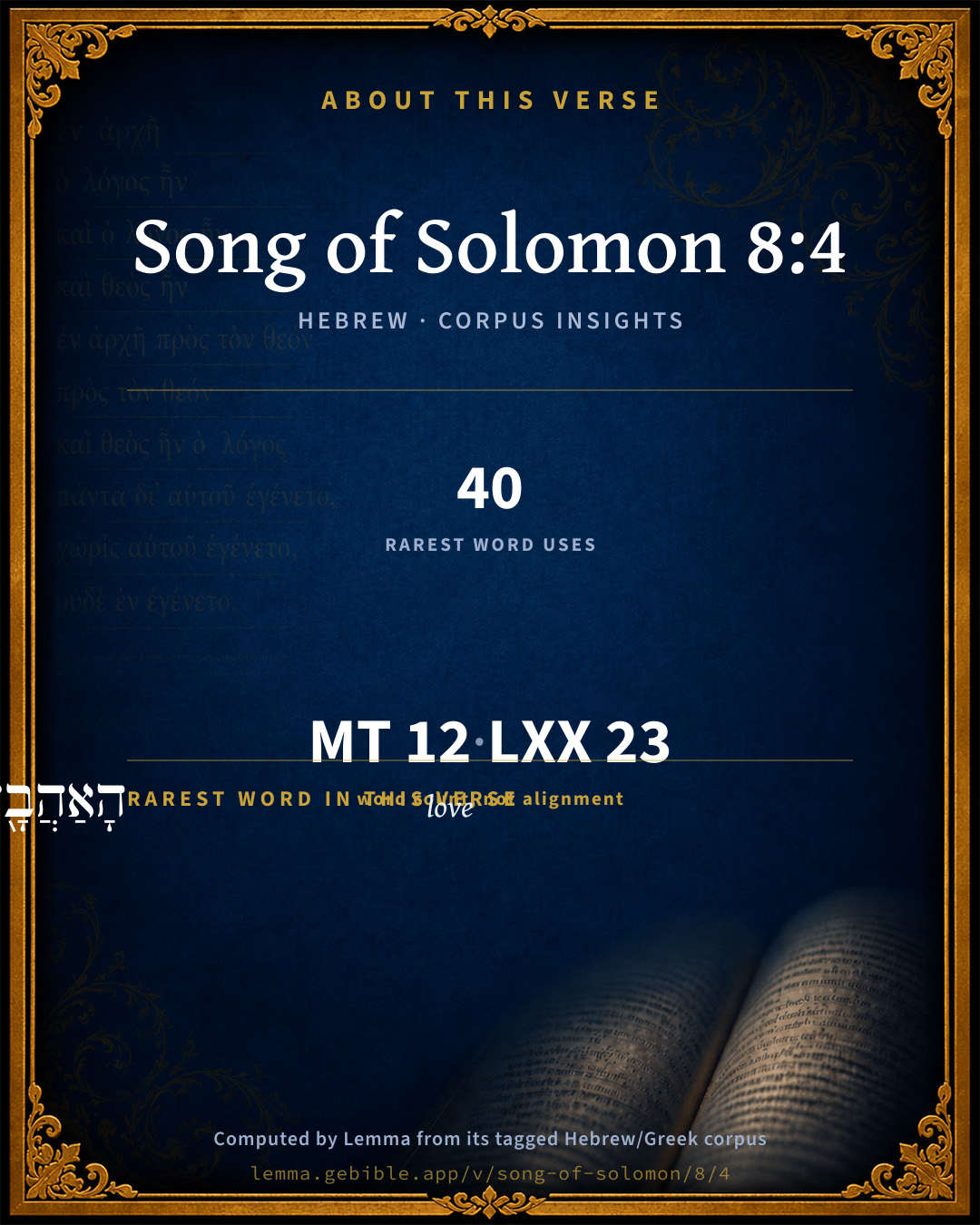
הָאַהֲבָ֖ה love H160 occurs in 37 verses of the Hebrew Bible. Also found in:

Grammatical profile

  • 4 verbs
  • 3 nouns
  • 1 preposition
  • 4 particles

Verb forms

  • הִשְׁבַּ֥עְתִּי Hiphil · Perfect
  • תָּעִ֧ירוּ Hiphil · Imperfect
  • תְּעֹֽרְר֛וּ Polel · Imperfect
  • שֶׁתֶּחְפָּֽץ Qal · Imperfect

Repetition

Words recur within this verse — often emphatic in Hebrew:

  • תָּעִ֧ירוּ to awake H5782 ×2
  • מַה what H4100 ×2

Hebrew & Septuagint length

In English translation the verse runs 19 words from the Hebrew and 26 from the Septuagint (LXX English) — closely comparable.

A rough comparison of the two English renderings, which tokenize alike — not a word-level alignment.

Word counts can differ between the Hebrew and the Greek without any difference in meaning — e.g. the Hebrew direct-object marker אֵת has no separate Greek word, and Greek often adds the article ὁ.

In the original languages it is 12 Hebrew tokens and 23 Greek tokens — but the two are counted differently (Hebrew bundles its prefixes and suffixes into one token; the Greek is in lemma form), so that isn’t a like-for-like length.

Cross-references

2

Topical passages linked to Song of Solomon 8:4 in the Treasury of Scripture Knowledge — connected by theme and wording, ordered by reader-vote popularity; previews shown in the World English Bible.

  • Song of Solomon 2:7 I adjure you, daughters of Jerusalem, By the roes, or by the hinds of the field, That you not stir up, nor awaken love, Until it so desires.
  • Song of Solomon 3:5 I adjure you, daughters of Jerusalem, By the roes, or by the hinds of the field, That you not stir up, nor awaken love, Until it so desires.

Cross-references courtesy of OpenBible.info (CC BY 4.0).

Hebrew and Greek witnesses Masoretic Hebrew ↔ Greek Septuagint

The same verse in the two great witnesses to the Old Testament, shown verse-for-verse.

These are two independent witnesses, not word-aligned to each other, and the Septuagint is shown in lemma (dictionary) form.

Hebrew Song of Solomon 8:4 Masoretic · Westminster Leningrad Codex

הִשְׁבַּ֥עְתִּי אֶתְכֶ֖ם בְּנ֣וֹת יְרוּשָׁלִָ֑ם מַה תָּעִ֧ירוּ וּֽמַה תְּעֹֽרְר֛וּ אֶת הָאַהֲבָ֖ה עַ֥ד שֶׁתֶּחְפָּֽץ

I adjure you, daughters of Jerusalem, That you not stir up, nor awaken love, Until it so desires. Friends

World English Bible · Public Domain

Greek LXX Song of Solomon 8:4 Septuagint · lemma form

ὁρκίζω σύ θυγάτηρ ἰερουσαλήμ ἐν ὁ δύναμις καί ἐν ὁ ἰσχύς ὁ ἀγρός τίς ἐγείρω καί τίς ἐκἐγείρω ὁ ἀγάπη ἕως ἄν θέλω

I have charged you, you⌃ daughters of Jerusalem, by the virtues of the field, that you⌃ stir not up, nor awake my love, until he please.

LXX2012 (modern English Septuagint) · Public Domain

On this verse, The Cambridge Bible for Schools and Colleges discusses the Septuagint’s reading. Read the note in Commentary ↓

Hebrew: Westminster Leningrad Codex (CC BY 4.0). Greek: Septuagint (public domain); English from LXX2012 (modern English Septuagint) (Public Domain). How the Septuagint differs from the Hebrew →

Commentary

Notes on Song of Solomon 8:4 from classic Christian and Jewish commentators (each source and its license shown beneath its notes). The classic Christian expositions comment on the surrounding passage and are grouped to its opening verse, so a note may address several verses; the Jewish commentaries on the Tanakh (Rashi and others) are per-verse, so they appear only where the commentator wrote on this verse.

Lemma curates 59 commentaries, every one of them public domain or Creative Commons licensed, each selected and text-cleaned for this edition rather than reprinted as found. About our sources →

Trapp's Complete Commentary

John Trapp

Son 8:4 I charge you, O daughters of Jerusalem, that ye stir not up, nor awake [my] love, until he please.

Ver. 4. I charge you, O daughters of Jerusalem.] {See Trapp on "Son 2:7"}

Why should you stir up?] What shall you get by it? or what reason can ye give for it? But lust is headlong, and considers not what an "evil and bitter thing sin is." {Jer 2:19} Besides, it so blears the understanding that a man shall think he hath reason to be mad, and that there is great sense in sinning.

John Trapp, A Commentary or Exposition upon All the Books of the Old and New Testament (1647–1656) — public domain. Text from a community e-Sword module.

Tyndale Open Study Notes

Tyndale Open Resources

8:4 Promise me: For the third time, the woman encourages the young women of Jerusalem to retain their virginity (see 2:7; 3:5). The virtue of virginity is confirmed in 8:8-9.

Tyndale Open Study Notes — © Tyndale Open Resources, licensed CC BY-SA 4.0. Text via the HelloAO Bible API.

Geneva Bible (1599)

Geneva Bible translators

Read Song 3:5.

Geneva Bible (1599) marginal notes — public domain. Text via Bolls.life.

Ellicott's Commentary for English Readers

(4) I charge you.—See Note, Son_2:6-7.

A Bible Commentary for English Readers, edited by Charles John Ellicott (1878–1897) — public domain. Text from a community e-Sword module.

The Cambridge Bible for Schools and Colleges

gen. ed. J. J. S. Perowne

4. I charge you, O daughters of Jerusalem] Rather, as in R.V., I adjure you … nor awaken love, until it please. This verse is a repetition of Son_2:7 and Son_3:5 with the difference that, instead of im = that … not, we have here mah = why. The A.V. translates this mah as ‘not.’ Cp. Job_31:1, where an interrogative mah is translated οὐ by the LXX and non by the Vulg. But in form our clause is interrogative, ‘Why would ye stir up or awake love until it should please?’ i.e. you see it was quite unnecessary to try to rouse love before its time. Your experience must teach you how vain it has been to attempt to arouse it prematurely, and how certain it would be to awake at the proper time.

The Cambridge Bible for Schools and Colleges (gen. ed. J. J. S. Perowne; Cambridge University Press, 1878–1918) — public domain. Text from a community e-Sword module.

Albert Barnes' Notes on the Bible

That ye stir not up - literally, as in the margin. For “my love” read as before love. The omission of “the roes and hinds” here is noticeable. Hebrew scholars regard this charge here and elsewhere Son 2:7; Son 3:5 as an admonition to Israel not to attempt obtaining a possession of, or restoration to, the promised land, and union or reunion there with the Holy One, before being inwardly prepared for it by the trials of the wilderness and the exile. This interpretation comes very near to what appears to be the genuine literal meaning (see Son 2:7 note). They suppose the words here to be addressed by Messiah to Israel in “the wilderness of the people” Eze 20:35, in the latter day, and the former words Son 3:5 by Moses in the wilderness of Sinai.

Albert Barnes' Notes on the Bible (1834–1885) — public domain. Text from a community e-Sword/MySword module.

Haydock's Catholic Bible Commentary

Jerusalem. Septuagint add, "by the armies and powers of the field," as [in] chap. ii. 7., and iii. 5. (Haydock) --- The spouse presently awakes after the sixth night, and goes out. (Calmet) --- Christ admonishes all not to disturb those who would serve him. (Worthington)

George Leo Haydock (1774–1849), Haydock's Catholic Family Bible and Commentary, 1859 edition — public domain. Excludes Psalms (Douay-Rheims chapter numbering differs from Protestant) and Deuterocanonical books (Catholic canon only).

Matthew Poole's English Annotations

This verse is here repeated again, from Son 2:7; 3:5, See Poole "2:7", See Poole "Son 3:5".

Matthew Poole's English Annotations on the Holy Bible (1683–1685) — public domain. Text from a community e-Sword/MySword module.

Whedon's Commentary on the Bible

Daniel D. Whedon

4. This verse differs slightly from Son_2:7; Son_3:5, and is more forcible. That ye stir, etc. — Hebrew, Why should ye stir, or awake, my affection to make it wish another? This is an appeal to them to see for themselves that she is perfectly content and happy in her Beloved. The scene now changes. The Chorus of the Daughters of Jerusalem — the ladies of the court and palace — no more appear. The Enamoured and the Beloved go from the city to the open fields on their way to the village in which is their home. The Chorus is now composed of villagers. Shulem, the native place of the happy pair, is so situated, that to reach it one crosses the plain of Esdraelon.

Daniel D. Whedon (gen. ed.), Commentary on the Old and New Testaments (1874–1909) — public domain. Text from a community e-Sword module.

The Pulpit Commentary

I adjure you, O daughters of Jerusalem, that ye stir not up, nor awaken love, until it please. This, of course, as the refrain of the song, must be taken as a general sentiment. Love is its own lord. Let it have free course. Let it perfect itself in its own best way. The form of the adjuration is abbreviated in this case. The omission of the words, "By the roes and by the hinds of the field," is not without its significance. Is it not intended to intimate that the natural love, to which reference was made by the introduction of the beautiful wild creatures of the field, is now no more in the thoughts of the bride, because it has been sublimated into the higher sisterly love of which she has been speaking? She is not merely the lovely woman on whom the king dotes because of her personal beauty; she is his companion and dearest friend. He opens his heart to her. He teaches her. He lifts her up to his own level. She participates in his royal dignity and majesty. The erwv of her first estate of love is now exalted into the agaph , which is the grace never to be without its sphere, abiding forever. We must not press too closely the poetic form of the song. Something must be allowed for the framework in which the main ideas are set before us. It may not be possible to answer the question Who are intended to be symbolized by the daughters of Jerusalem? There is no necessity to seek further into the meaning of the whole poem than its widest and most general application. But the daughters of Jerusalem are in a lower position, a less favoured relation to the bridegroom, than the bride herself. We may, therefore, without hesitation, accept the view that by the adjuration is intended the appeal of the higher spiritual life against all that is below it; the ideal love calling upon all that is around it and all that is related to it to rise with it to perfection. The individual soul is thus represented claiming the full realization of its spiritual possibilities. The Church of God thus remonstrates against all that hinders her advancement, restrains her life, and interrupts her blessedness. Jerusalem has many daughters. They are not all in perfect sympathy with the bride. When they listen to the adjurations of the most spiritual, the most devoted, the most heavenly and Christ-like of those who are named by the Name of the Lord, they will themselves be lifted up into the bridal joy of "the marriage supper of the Lamb."

The Pulpit Commentary (1880–1919), ed. H.D.M. Spence-Jones & Joseph S. Exell — public domain. Text from a community e-Sword module.

unfoldingWord translationNotes

Door43 World Missions Community

I want you to swear

See how you translated this in Song of Songs 2:7

daughters of Jerusalem

"young women of Jerusalem." These young women could not hear her and were not present, but the woman speaks as if they were present and could hear her. See how you translated this in Song of Songs 2:7. (See: Apostrophe)

that you will ... until it is over

See how you translated this in Song of Songs 2:7.

translationWords

oath

Jerusalem

had relations with

unfoldingWord translationNotes — © Distant Shores Media and the Door43 World Missions Community, licensed CC BY-SA 4.0. Source: git.door43.org/Door43/en_tn.

Rashi

Rabbi Shlomo Yitzchaki (Rashi)

I adjure you Now the congregation of Israel addresses the nations, “Even though I complain and lament, my Beloved holds on to my hand, and He is my support in my exile; therefore, I adjure you.”

why should you awaken, and why should you arouse for it will not avail you.

Rashi on the Tanakh — English translations: “The Judaica Press complete Tanach with Rashi, translated by A. J. Rosenberg” (CC BY 4.0); “Pentateuch with Rashi's commentary by M. Rosenbaum and A.M. Silbermann, 1929-1934” (public domain); “The Metsudah Tanach series, Lakewood, N.J” (CC BY 4.0); and “The Book of Joshua, Metsudah Publications, 1997” (CC BY 4.0). Text via Sefaria.

Lesson kit

Teaching starters — assembled from the data on this page, not authored interpretation. Every prompt links to the verse data it draws on. Edit before teaching.

Song of Solomon, in the Wisdom, opens this verse with 12 words (9 distinct Hebrew lemmas). Its most distinctive word is ʼahăbâh (“love”). A historical commentator’s framing appears above. Read the whole chapter for the surrounding context.

Discussion questions

  1. How does “love” (ʼahăbâh) shape what this verse is saying?
  2. How does Deuteronomy 7:8, which shares the word «love», read alongside this verse?
  3. What does the repetition of “to awake” (2× in this one verse) do in this verse?
  4. These translations render this verse differently. What is at stake in choosing one wording over another?
  5. «הִשְׁבַּ֥עְתִּי» is a Hiphil Perfect verb. How does that grammatical form shape the action described?
  6. Compare how Trapp's Complete Commentary and Tyndale Open Study Notes read this verse. Where do they agree or differ?

Things to notice

Reading settings

Reading text

Shown beneath each verse's original-language words.

Old Testament
Old Testament edition

Read the OT as the Masoretic Hebrew (MT) or the Greek Septuagint (LXX).

English shown for the Greek Septuagint (in the Hebrew ↔ Greek comparison).

Comparing translations? Open the Compare panel on any verse page to stack up to four side by side.