
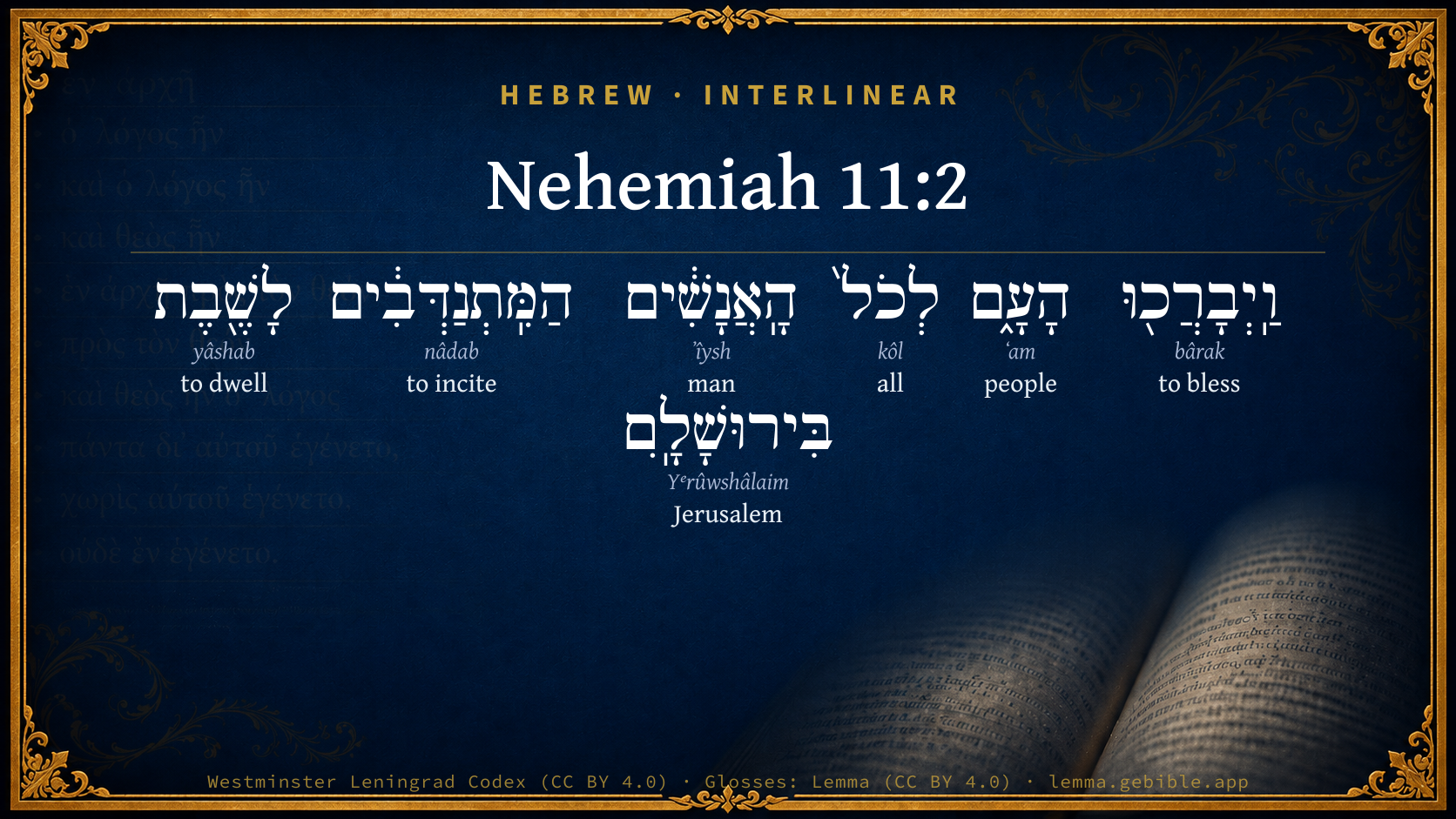
Nehemiah 11:2

Hebrew (Westminster Leningrad Codex) Nehemiah 11:2 appears in the Hebrew Old Testament. The text above is from the Westminster Leningrad Codex. Each word links to its Strong’s number, a concise gloss, and parsing drawn from the Open Scriptures Hebrew Bible morphology. Click any word for its full Brown-Driver-Briggs (BDB) entry.
Download image
Cite this verse

Nehemiah 11:2 (World English Bible). Public Domain. Lemma interlinear Bible study tool, https://lemma.gebible.app/v/nehemiah/11/2.

Show BibTeX & RIS
BibTeX
RIS
English Translation
The people blessed all the men who willingly offered themselves to dwell in Jerusalem.
World English Bible · Public Domain
Download a study sheet

One document with this verse’s original text, its word-by-word gloss line, the meaning frame, cross-references with their text, attributed commentary, and full source and license credits — printable, and it pastes into notes with its structure intact.

This verse Autodidact and up

Study sheet (.html) Plain text (.txt)

A passage Seminary Student

Up to 50 verses in one chapter. A passage sheet keeps up to 6 commentary sources and 12 cross-references per verse, in the order this page ranks them, and says so on the sheet whenever that leaves anything out. Ask for a single verse and you get the Autodidact verse sheet above.

Everything on this page stays free to read, with no account — the sheet is a download of what is already on screen, not access to it.

Want to remove ads? Support Godless Engineer
Compare translations 3

The same verse in 3 English versions, stacked beneath the original-language interlinear above. Click any original word for its lexicon entry.

Each is an independent rendering of the whole verse — the interlinear is not word-aligned to these translations.

Highlighted words mark where these versions differ — a whole-verse word diff, not a word-by-word alignment.

  • World English Bible Public Domain
    The people blessed all the men who willingly offered themselves to dwell in Jerusalem.
  • King James Version Public Domain
    And the people blessed all the men, that willingly offered themselves to dwell at Jerusalem.
  • unfoldingWord Literal Text CC BY-SA 4.0
    And the people blessed all the men, the ones who freely offered to dwell in Jerusalem. ts\*

unfoldingWord Literal Text — © unfoldingWord, licensed CC BY-SA 4.0. Word-aligned USFM3 via Door43 (git.door43.org/unfoldingWord/en_ult).

Versions to compare (up to 4)

3 of 4 selected

Show all 18 translations

Every available English version of this verse, each an independent rendering of the whole verse.

  • World English Bible Public Domain
    The people blessed all the men who willingly offered themselves to dwell in Jerusalem.
  • Berean Standard Bible Public Domain
    And the people blessed all the men who volunteered to live in Jerusalem.
  • Majority Standard Bible Public Domain
    And the people blessed all the men who volunteered to live in Jerusalem.
  • King James Version Public Domain
    And the people blessed all the men, that willingly offered themselves to dwell at Jerusalem.
  • American Standard Version (1901) Public Domain
    And the people blessed all the men that willingly offered themselves to dwell in Jerusalem.
  • Revised Version (1885) Public Domain
    And the people blessed all the men that willingly offered themselves to dwell in Jerusalem.
  • Geneva Bible (1599) Public Domain
    And the people thanked all the men that were willing to dwell in Ierusalem.
  • Douay-Rheims (1899) Public Domain
    And the people blessed all the men that willingly offered themselves to dwell in Jerusalem.
  • Young's Literal Translation Public Domain
    and the people give a blessing to all the men who are offering themselves willingly to dwell in Jerusalem.
  • Literal Standard Version CC BY-SA 4.0
    and the people give a blessing to all the men who are offering themselves willingly to dwell in Jerusalem.
  • Unlocked Literal Bible CC BY-SA 4.0
    Then the people blessed all those who willingly offered to live in Jerusalem.
  • unfoldingWord Literal Text CC BY-SA 4.0
    And the people blessed all the men, the ones who freely offered to dwell in Jerusalem. ts\*
  • Darby Bible Public Domain
    And the people blessed all the men that willingly offered themselves to dwell in Jerusalem.
  • World Messianic Bible Public Domain
    The people blessed all the men who willingly offered themselves to dwell in Jerusalem.
  • Webster's Bible Public Domain
    And the people blessed all the men that willingly offered themselves to dwell at Jerusalem.
  • Free Bible Version CC BY-SA 4.0
    Everyone praised those who were willing to move to Jerusalem.
  • Bible in Basic English Public Domain
    And the people gave a blessing to all the men who were freely offering to take up their places in Jerusalem.
  • JPS Tanakh (1917) Public Domain
    And the people blessed all the men that willingly offered themselves to dwell in Jerusalem.

Literal Standard Version (2020), Covenant Press — licensed CC BY-SA 4.0. Text via the HelloAO Bible API (eBible.org). Unlocked Literal Bible (unfoldingWord) — licensed CC BY-SA 4.0. Text via the HelloAO Bible API (eBible.org). unfoldingWord Literal Text — © unfoldingWord, licensed CC BY-SA 4.0. Word-aligned USFM3 via Door43 (git.door43.org/unfoldingWord/en_ult). Free Bible Version, Dr. Jonathan Gallagher — licensed CC BY-SA 4.0. Text via the HelloAO Bible API (eBible.org).

Word by word

More ways to search: Search by grammar → Find every occurrence → Compare this word →

Practice this passage: Drill this verse → Learn its vocabulary →

הַמִּֽתְנַדְּבִ֔ים
nâdab
H5068
“the · inciting”
Particle, Definite Article + Verb, Hithpael, Participle Active, Masculine, Plural, Absolute
Part of Speech
Particle + Verb
Stem
Hithpael
Form
Participle Active
Gender
Masculine
Number
Plural
State
Absolute
Full BDB Definition

Origin: a primitive root

TWOT: 1299

to incite, impel, make willing - (Qal) to incite, impel - (Hithpael) - to volunteer - to offer free-will offerings
  1. וַֽיְבָרֲכ֖וּ bârak H1288 “and · to bless” Conjunction + Verb, Piel, Sequential Imperfect, 3rd Person, Masculine, Plural
  2. הָעָ֑ם ʻam H5971 “the · people” Particle, Definite Article + Noun, Common, Masculine, Singular, Absolute
  3. לְכֹל֙ kôl H3605 “to/for · all of” Preposition + Noun, Common, Masculine, Singular, Construct
  4. הָֽאֲנָשִׁ֔ים ʼîysh H376 “the · men” Particle, Definite Article + Noun, Common, Masculine, Plural, Absolute
  5. לָשֶׁ֖בֶת yâshab H3427 “to dwell” Preposition + Verb, Qal, Infinitive Construct
  6. בִּירוּשָׁלִָֽם Yᵉrûwshâlaim H3389 “in/at · Jerusalem” Preposition + Noun, Proper

About this verse

These counts appear in no published source. They are computed here, from the morphology-tagged text and Lemma’s own curated glosses. What Lemma adds →

7
words
7
distinct lemmas
Historical
section

Notable vocabulary

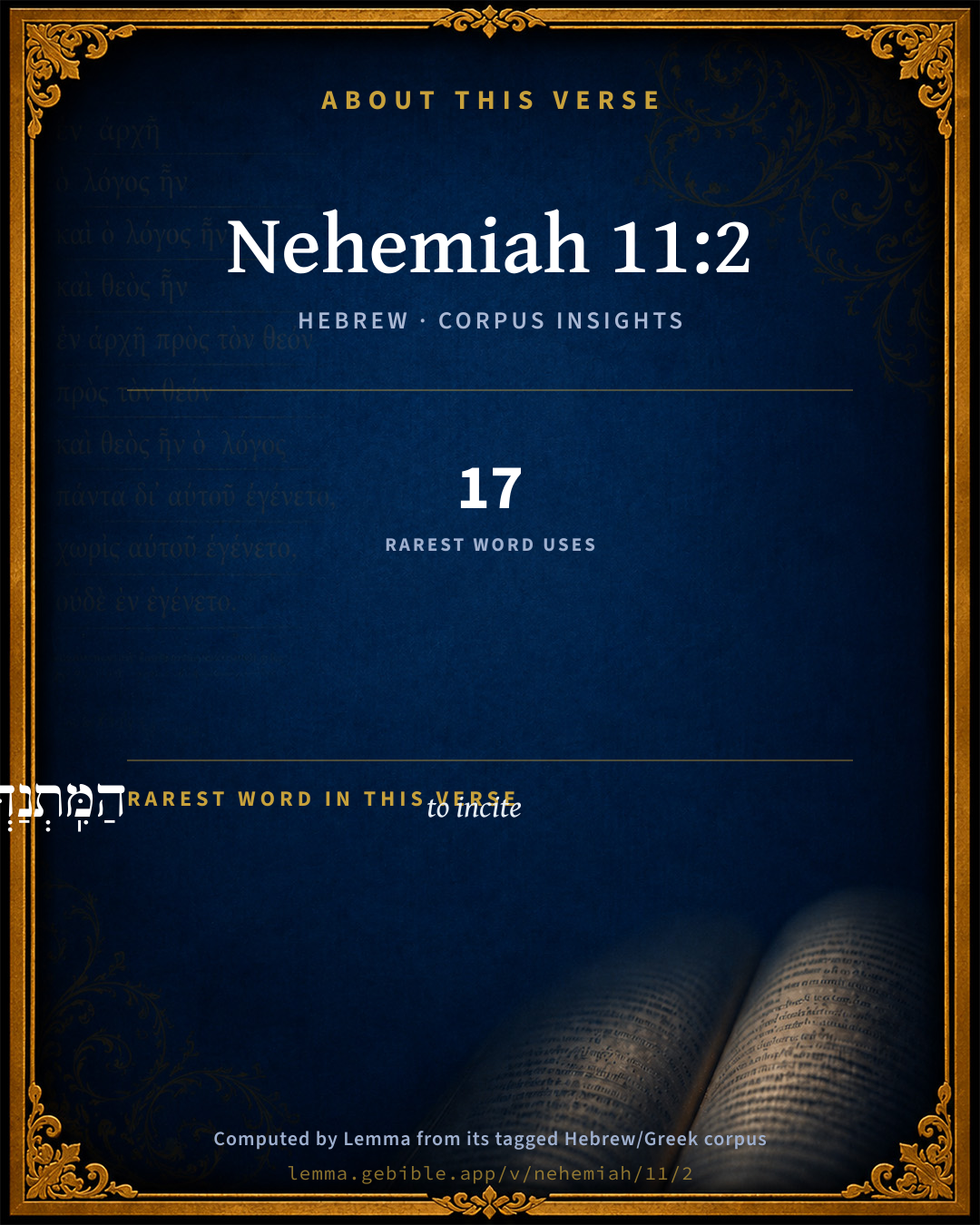
The rarest word here is הַמִּֽתְנַדְּבִ֔ים to incite H5068 — appearing just 17 times in the whole Hebrew Bible.

Shared distinctive vocabulary

הַמִּֽתְנַדְּבִ֔ים to incite H5068 occurs in 15 verses of the Hebrew Bible. Also found in:

Grammatical profile

  • 3 verbs
  • 4 nouns

Verb forms

  • וַֽיְבָרֲכ֖וּ Piel · Sequential Imperfect
  • הַמִּֽתְנַדְּבִ֔ים Hithpael · Participle Active
  • לָשֶׁ֖בֶת Qal · Infinitive Construct

Cross-references

5

Topical passages linked to Nehemiah 11:2 in the Treasury of Scripture Knowledge — connected by theme and wording, ordered by reader-vote popularity; previews shown in the World English Bible.

  • Judges 5:9 My heart is toward the governors of Israel, Who offered themselves willingly among the people: Bless you Yahweh.
  • 2 Corinthians 8:16–17 But thanks be to God, who puts the same earnest care for you into the heart of Titus.
  • Deuteronomy 24:13 you shall surely restore to him the pledge when the sun goes down, that he may sleep in his garment, and bless you: and it shall be righteousness to you before Yahweh your God.
  • Job 29:13 The blessing of him who was ready to perish came on me, And I caused the widow's heart to sing for joy.
  • Job 31:20 If his heart hasn't blessed me, If he hasn't been warmed with my sheep's fleece;

Cross-references courtesy of OpenBible.info (CC BY 4.0).

Hebrew and Greek witnesses Masoretic Hebrew ↔ Greek Septuagint

The same verse in the two great witnesses to the Old Testament, shown verse-for-verse.

These are two independent witnesses, not word-aligned to each other, and the Septuagint is shown in lemma (dictionary) form.

Hebrew Nehemiah 11:2 Masoretic · Westminster Leningrad Codex

וַֽיְבָרֲכ֖וּ הָעָ֑ם לְכֹל֙ הָֽאֲנָשִׁ֔ים הַמִּֽתְנַדְּבִ֔ים לָשֶׁ֖בֶת בִּירוּשָׁלִָֽם

The people blessed all the men who willingly offered themselves to dwell in Jerusalem.

World English Bible · Public Domain

Greek LXX Structure differs

The Septuagint has no separate book of Nehemiah. Its Greek text is the second half of Esdras B (2 Esdras), chapters 11–23; Ezra is the first half (1–10).

A verse-for-verse comparison isn’t shown here because the chapters and verses don’t line up. Switch to the LXX edition with the MT / LXX toggle above to read the Greek directly.

Hebrew: Westminster Leningrad Codex (CC BY 4.0). Greek: Septuagint (public domain); English from a public-domain English Septuagint. How the Septuagint differs from the Hebrew →

Commentary

Notes on Nehemiah 11:2 from classic Christian and Jewish commentators (each source and its license shown beneath its notes). The classic Christian expositions comment on the surrounding passage and are grouped to its opening verse, so a note may address several verses; the Jewish commentaries on the Tanakh (Rashi and others) are per-verse, so they appear only where the commentator wrote on this verse.

Lemma curates 59 commentaries, every one of them public domain or Creative Commons licensed, each selected and text-cleaned for this edition rather than reprinted as found. About our sources →

Trapp's Complete Commentary

John Trapp

Neh 11:2 And the people blessed all the men, that willingly offered themselves to dwell at Jerusalem.

Ver. 2. And the people blessed all the men, that willingly offered themselves] All the volunteers, those Liberi et libentes, free willing ones, that, moved with a zeal for God and his service, seated themselves at Jerusalem, though it were little for their safety or profit. Sincerity is an enemy to sinisterity; it strains out self-respects, and procures a man great respect in the hearts of good people, who are ready to commend them and pray for them, as here.

John Trapp, A Commentary or Exposition upon All the Books of the Old and New Testament (1647–1656) — public domain. Text from a community e-Sword module.

Joseph Benson's Commentary

Neh 11:2. The people blessed all the men that willingly offered themselves — Besides those who were chosen by lot, it seems there were some that voluntarily chose to go and live there, whom the people highly commended, beseeching God to bless and prosper them: for indeed they were worthy to be honoured, because they denied themselves, and their own safety and profit, for the public good, and the glory of God; seeking the restoration of their nation, the defence of their city, and the welfare of their country, and having zeal for the divine service performed there; for, no doubt, more profit accrued to those who settled in the country where they chose, and had as much ground to cultivate as they wished, than to those who were confined to the city, and the small portion of land which lay about it.

Joseph Benson's Commentary on the Old and New Testaments (1811–1818) — public domain. Text from a community e-Sword module.

Adam Clarke's Commentary

Verse 2. All the men that willingly offered] Some volunteered their services, which was considered a sacrifice to patriotism at that time, as Jerusalem afforded very few advantages, and was a place of considerable danger; hence the people spoke well of them, and no doubt prayed for God's blessing upon them.

Adam Clarke's Commentary on the Bible (1810–1826) — public domain. Text from a community e-Sword/MySword module.

The Cambridge Bible for Schools and Colleges

gen. ed. J. J. S. Perowne

2. that willingly offered themselves] Another group is here distinguished, i.e. those who volunteered to go and dwell in Jerusalem. They are not to be confused with those who were sent there, being chosen ‘by lot.’ They went of their own accord, moved by public spirit. The blessing of their countrymen shows the enthusiasm aroused by their patriotic action; at the same time, it may denote that residence in Jerusalem was recognised to be fraught with danger. To dwell in the ‘holy city’ was also to defend it from its many enemies, see chap. Neh_7:4. It is not stated that they were accepted as substitutes for those chosen by lot.

According to this explanation we are told in these two verses of three classes of dwellers in Jerusalem: (a) the princes, (b) ten per cent. of the inhabitants of the other towns selected by lot and forcibly transferred, and (c) those who voluntarily migrated to the capital.

The Cambridge Bible for Schools and Colleges (gen. ed. J. J. S. Perowne; Cambridge University Press, 1878–1918) — public domain. Text from a community e-Sword module.

John Gill's Exposition

And the people blessed all the men that willingly offered themselves to dwell at Jerusalem. Who were not taken by lot, but of their own accord settled at Jerusalem; they praised them for it, and wished them all happiness and prosperity, since they denied themselves of ease and profit for the sake of the public good; and it is this which makes the difference between the list of the inhabitants of Jerusalem in Ch1 9:2 &c. and this here, that takes in all that settled there, whether voluntarily or by lot; this only such as were fixed by the lot, and of them only those who were of greatest note and esteem, as Jarchi observes, and so it follows.

&c. and this here, that takes in all that settled there, whether voluntarily or by lot; this only such as were fixed by the lot, and of them only those who were of greatest note and esteem, as Jarchi observes, and so it follows.

Nehemiah 11:3

neh 11:3

neh 11:3

neh 11:3Now these are the chief of the province that dwelt in Jerusalem,.... That is, of Judea, reduced to a province by the king of Babylon, and now a province of the Persian monarchy:

but in the cities of Judah dwelt everyone in his possession in their cities; in which they or their ancestors had formerly dwelt: to wit, Israel: the people in general of the tribes of Judah and Benjamin, and such of the other tribes that returned with them:

the priests, and the Levites, and the Nethinims, and the children of Solomon's servants; of whom see Ezr 2:55.

John Gill's Exposition of the Whole Bible (1746–1763) — public domain (CC PDM 1.0). Text via the HelloAO Bible API.

Haydock's Catholic Bible Commentary

Blessed. Applauding their zeal and disinterestedness, as the city was yet only a heap of ruins. (Calmet) --- Some from the other ten tribes returned; but the transactions of three tribes are more particularly noticed. (Ven. Bede) (Worthington)

George Leo Haydock (1774–1849), Haydock's Catholic Family Bible and Commentary, 1859 edition — public domain. Excludes Psalms (Douay-Rheims chapter numbering differs from Protestant) and Deuterocanonical books (Catholic canon only).

Matthew Poole's English Annotations

Because they denied themselves, and their own safety and profit, for the public good; for this city was the butt of all the malicious plots of their enemies; and for the present it was rather chargeable than beneficial to its inhabitants; whereas the country did more easily and certainly afford them supplies.

Matthew Poole's English Annotations on the Holy Bible (1683–1685) — public domain. Text from a community e-Sword/MySword module.

Whedon's Commentary on the Bible

Daniel D. Whedon

2. The men, that willingly offered themselves — Those who, being chosen by lot, willingly consented to remove their residence to Jerusalem. The words do not imply that any on whom the lot fell showed unwillingness to remove to the holy city. Doubtless all who were thus chosen cheerfully acquiesced, and, consulting not their own security so much as the public good, received the blessings of a grateful people.

Daniel D. Whedon (gen. ed.), Commentary on the Old and New Testaments (1874–1909) — public domain. Text from a community e-Sword module.

The Pulpit Commentary

The men that willingly offered themselves. Besides those on whom the lot fell, a certain number volunteered to change their residence and to transfer themselves and families from their country homes to Jerusalem. The people called down blessings upon them for their patriotism.

Volunteers.

"And the people blessed all the men that willingly offered themselves," etc. A large part of the work done for the good of the community is done by volunteers men and women who "willingly offer themselves" to do what in the abstract has no more claim on them than on others; and do it gratuitously. This is especially seen in the various departments of service in connection with religion and charity. Church officers, Sunday-school teachers, visitors of the poor, etc. Amount and value of their labours. Imagine them to cease! Notice

I WHENCE VOLUNTARY DEVOTEMENT TO PARTICULAR CHRISTIAN SERVICES SPRINGS. It may, doubtless, arise in some cases from unworthy motives; but we speak of true Christian willingness as directed towards this or that branch of service.

1. Earnest piety and benevolence in general. (see on Neh_3:20) Without which no service is truly Christian.

2. Felt aptitude and ability for the work chosen. Well is it when this feeling is not a delusion, and the willing are really the able; well also when the able are the willing, and so the work is not left to pious incompetence.

3. Special inclination for it. Which may arise from the congenial nature of the work, or the associations to which it introduces, or the special opportunities it is believed to afford for getting as well as doing good.

II THE REWARD OF THOSE WHO DISPLAY IT.

1. The commendation of others. "The people blessed," etc. The expectation of this should not be a principal motive, if only to prevent disappointment. For though a measure of it is usual, it is not always bestowed; and the opposite treatment is possible. Some who will do nothing themselves occupy themselves in reflections on those who are employed in good works. Others, however, will commend; some from hearty appreciation the appreciation of gratitude from those who receive benefit, of sympathy from those of like mind, who are themselves at work, or who would, but cannot, devote themselves to such service, and rejoice that others both can and will. Commendations of less value will perhaps come from another quarter, i.e. from some who are too selfish or indolent to do their part; but feel more at ease in their negligence from knowing that others are generous and active. To praise them is felt as all but equivalent to cooperating with them, and it is a great deal cheaper. If commendation from others is altogether wanting, there will be

2. The pleasure of doing good. That satisfaction which springs from a sense of doing our duty, that delight which is inseparable from the exercise of benevolent affections, and that which arises from the perception of good done.

3. Personal benefit. Growth in goodness and nobleness. Increased likeness to Christ and to God.

4. The Divine commendation and recompense.

The Pulpit Commentary (1880–1919), ed. H.D.M. Spence-Jones & Joseph S. Exell — public domain. Text from a community e-Sword module.

John Wesley's Explanatory Notes

Blessed - Because they denied themselves, and their own safety and profit for the publick good; for this city was the butt of all the malicious plots of their enemies; and for the present it was rather chargeable than beneficial to its inhabitants.

John Wesley, Explanatory Notes Upon the Whole Bible (1754–1765) — public domain. Text via the GEBible commentary corpus.

Rashi

Rabbi Shlomo Yitzchaki (Rashi)

who volunteered whose spirit inspired them to volunteer to dwell in Jerusalem to guard the city from enemies.

Rashi on the Tanakh — English translations: “The Judaica Press complete Tanach with Rashi, translated by A. J. Rosenberg” (CC BY 4.0); “Pentateuch with Rashi's commentary by M. Rosenbaum and A.M. Silbermann, 1929-1934” (public domain); “The Metsudah Tanach series, Lakewood, N.J” (CC BY 4.0); and “The Book of Joshua, Metsudah Publications, 1997” (CC BY 4.0). Text via Sefaria.

Lesson kit

Teaching starters — assembled from the data on this page, not authored interpretation. Every prompt links to the verse data it draws on. Edit before teaching.

Nehemiah, in the Historical, opens this verse with 7 words (7 distinct Hebrew lemmas). Its most distinctive word is nâdab (“to incite”). A historical commentator’s framing appears above. Read the whole chapter for the surrounding context.

Discussion questions

  1. The word nâdab carries the sense “to incite.” How does it shape the verse?
  2. How does Exodus 25:2, which shares the word «to incite», read alongside this verse?
  3. The translations on this page render this verse differently — a whole-verse word diff, not a word-by-word alignment. What might account for the different wordings?
  4. «וַֽיְבָרֲכ֖וּ» is a Piel Sequential Imperfect verb. How does that grammatical form shape the action described?
  5. Compare how Trapp's Complete Commentary and Joseph Benson's Commentary read this verse. Where do they agree or differ?

Things to notice

Reading settings

Reading text

Shown beneath each verse's original-language words.

Old Testament
Old Testament edition

Read the OT as the Masoretic Hebrew (MT) or the Greek Septuagint (LXX).

English shown for the Greek Septuagint (in the Hebrew ↔ Greek comparison).

Comparing translations? Open the Compare panel on any verse page to stack up to four side by side.