Isaiah 31:5

Hebrew (Westminster Leningrad Codex) Isaiah 31:5 appears in the Hebrew Old Testament. The text above is from the Westminster Leningrad Codex. Each word links to its Strong’s number, a concise gloss, and parsing drawn from the Open Scriptures Hebrew Bible morphology. Click any word for its full Brown-Driver-Briggs (BDB) entry.
Download image
Cite this verse

Isaiah 31:5 (World English Bible). Public Domain. Lemma interlinear Bible study tool, https://lemma.gebible.app/v/isaiah/31/5.

Show BibTeX & RIS
BibTeX
RIS
English Translation
As birds hovering, so will Yahweh of Hosts protect Jerusalem; he will protect and deliver [it], he will pass over and preserve [it].
World English Bible · Public Domain
Download a study sheet

One document with this verse’s original text, its word-by-word gloss line, the meaning frame, cross-references with their text, attributed commentary, and full source and license credits — printable, and it pastes into notes with its structure intact.

This verse Autodidact and up

Study sheet (.html) Plain text (.txt)

A passage Seminary Student

Up to 50 verses in one chapter. A passage sheet keeps up to 6 commentary sources and 12 cross-references per verse, in the order this page ranks them, and says so on the sheet whenever that leaves anything out. Ask for a single verse and you get the Autodidact verse sheet above.

Everything on this page stays free to read, with no account — the sheet is a download of what is already on screen, not access to it.

Want to remove ads? Support Godless Engineer
Compare translations 3

The same verse in 3 English versions, stacked beneath the original-language interlinear above. Click any original word for its lexicon entry.

Each is an independent rendering of the whole verse — the interlinear is not word-aligned to these translations.

Highlighted words mark where these versions differ — a whole-verse word diff, not a word-by-word alignment.

  • World English Bible Public Domain
    As birds hovering, so will Yahweh of Hosts protect Jerusalem; he will protect and deliver [it], he will pass over and preserve [it].
  • King James Version Public Domain
    As birds flying, so will the LORD of hosts defend Jerusalem; defending also he will deliver it; and passing over he will preserve it.
  • unfoldingWord Literal Text CC BY-SA 4.0
    Like birds flying, thus Yahweh of Armies will cover over Jerusalem, covering and delivering, passing over and rescuing.”

unfoldingWord Literal Text — © unfoldingWord, licensed CC BY-SA 4.0. Word-aligned USFM3 via Door43 (git.door43.org/unfoldingWord/en_ult).

Versions to compare (up to 4)

3 of 4 selected

Show all 18 translations

Every available English version of this verse, each an independent rendering of the whole verse.

  • World English Bible Public Domain
    As birds hovering, so will Yahweh of Hosts protect Jerusalem; he will protect and deliver [it], he will pass over and preserve [it].
  • Berean Standard Bible Public Domain
    Like birds hovering overhead, so the LORD of Hosts will protect Jerusalem. He will shield it and deliver it; He will pass over it and preserve it.”
  • Majority Standard Bible Public Domain
    Like birds hovering overhead, so the LORD of Hosts will protect Jerusalem. He will shield it and deliver it; He will pass over it and preserve it.”
  • King James Version Public Domain
    As birds flying, so will the LORD of hosts defend Jerusalem; defending also he will deliver it; and passing over he will preserve it.
  • American Standard Version (1901) Public Domain
    As birds hovering, so will Jehovah of hosts protect Jerusalem; he will protect and deliver `it', he will pass over and preserve `it'.
  • Revised Version (1885) Public Domain
    As birds flying, so will the LORD of hosts protect Jerusalem; he will protect and deliver it, he will pass over and preserve it.
  • Geneva Bible (1599) Public Domain
    As birds that flie, so shall the Lord of hostes defend Ierusalem by defending and deliuering, by passing through and preseruing it.
  • Douay-Rheims (1899) Public Domain
    As birds dying, so will the Lord of hosts protect Jerusalem, protecting and delivering, passing over and saving.
  • Young's Literal Translation Public Domain
    As birds flying, so doth Jehovah of Hosts Cover over Jerusalem, covering and delivering, Passing over, and causing to escape.'
  • Literal Standard Version CC BY-SA 4.0
    As birds flying, so does YHWH of Hosts || Cover over Jerusalem, covering and delivering, || Passing over, and causing to escape.”
  • Unlocked Literal Bible CC BY-SA 4.0
    Like birds in flight, so Yahweh of hosts will protect Jerusalem; he will protect and rescue as he passes over it and preserves it.
  • unfoldingWord Literal Text CC BY-SA 4.0
    Like birds flying, thus Yahweh of Armies will cover over Jerusalem, covering and delivering, passing over and rescuing.”
  • Darby Bible Public Domain
    As birds with outstretched wings, so will Jehovah of hosts cover Jerusalem; covering, he will also deliver, passing over, he will rescue [it].
  • World Messianic Bible Public Domain
    As birds hovering, so the LORD of Hosts will protect Jerusalem. He will protect and deliver it. He will pass over and preserve it.”
  • Webster's Bible Public Domain
    As birds flying, so will the LORD of hosts defend Jerusalem; defending also he will deliver it; and passing over he will preserve it.
  • Free Bible Version CC BY-SA 4.0
    Like birds that hover above, so the Lord Almighty will take care of Jerusalem. He will protect it and save it; he will pass over it and rescue it.
  • Bible in Basic English Public Domain
    Like birds with outstretched wings, so will the Lord of armies be a cover to Jerusalem; he will be a cover and salvation for it, going over it he will keep it from danger.
  • JPS Tanakh (1917) Public Domain
    As birds hovering, so will the LORD of hosts protect Jerusalem; He will deliver it as He protecteth it, He will rescue it as He passeth over.

Literal Standard Version (2020), Covenant Press — licensed CC BY-SA 4.0. Text via the HelloAO Bible API (eBible.org). Unlocked Literal Bible (unfoldingWord) — licensed CC BY-SA 4.0. Text via the HelloAO Bible API (eBible.org). unfoldingWord Literal Text — © unfoldingWord, licensed CC BY-SA 4.0. Word-aligned USFM3 via Door43 (git.door43.org/unfoldingWord/en_ult). Free Bible Version, Dr. Jonathan Gallagher — licensed CC BY-SA 4.0. Text via the HelloAO Bible API (eBible.org).

Word by word

More ways to search: Search by grammar → Find every occurrence → Compare this word →

Practice this passage: Drill this verse → Learn its vocabulary →

יָגֵ֛ן
gânan
H1598
“to defend”
Verb, Qal, Imperfect, 3rd Person, Masculine, Singular
Part of Speech
Verb
Stem
Qal
Form
Imperfect
Person
3rd Person
Gender
Masculine
Number
Singular
Full BDB Definition

Origin: a primitive root

TWOT: 367

to defend, cover, surround - (Qal) to defend - (Hiphil) to defend
  1. כְּצִפֳּרִ֣ים tsippôwr H6833 “like/as · birds” Preposition + Noun, Common, Both, Plural, Absolute
  2. עָפ֔וֹת ʻûwph H5774 “flying” Verb, Qal, Participle Active, Feminine, Plural, Absolute
  3. כֵּ֗ן kên H3651 “thus” Particle, Demonstrative
  4. יְהוָ֥ה Yᵉhôvâh H3068 “LORD” Noun, Proper
  5. צְבָא֖וֹת tsâbâʼ H6635 “armies” Noun, Common, Both, Plural, Absolute
  6. עַל ʻal H5921 “upon” Preposition
  7. יְרֽוּשָׁלִָ֑ם Yᵉrûwshâlaim H3389 “Jerusalem” Noun, Proper
  8. גָּנ֥וֹן gânan H1598 “to defend” Verb, Qal, Infinitive Absolute
  9. וְהִצִּ֖יל nâtsal H5337 “and · to rescue” Conjunction + Verb, Hiphil, Sequential Perfect, 3rd Person, Masculine, Singular
  10. פָּסֹ֥חַ pâçach H6452 “to skip” Verb, Qal, Infinitive Absolute
  11. וְהִמְלִֽיט mâlaṭ H4422 “and · to escape” Conjunction + Verb, Hiphil, Sequential Perfect, 3rd Person, Masculine, Singular

About this verse

These counts appear in no published source. They are computed here, from the morphology-tagged text and Lemma’s own curated glosses. What Lemma adds →

12
words
11
distinct lemmas
Prophets
section

Notable vocabulary

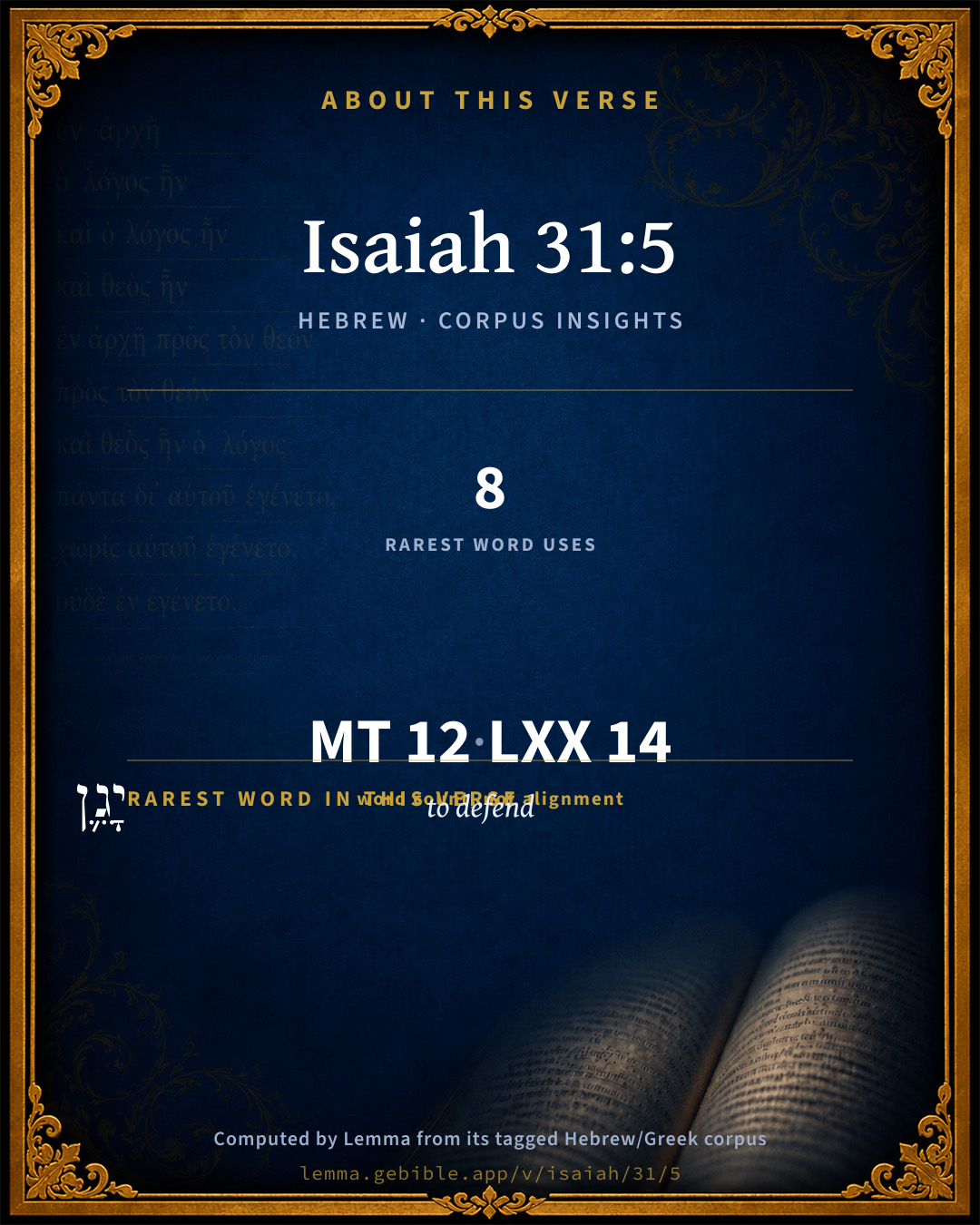
The rarest word here is יָגֵ֛ן to defend H1598 — appearing just 8 times in the whole Hebrew Bible.

Shared distinctive vocabulary

יָגֵ֛ן to defend H1598 occurs in 7 verses of the Hebrew Bible. Also found in:

Grammatical profile

  • 6 verbs
  • 4 nouns
  • 1 preposition
  • 1 particle

Verb forms

  • עָפ֔וֹת Qal · Participle Active
  • יָגֵ֛ן Qal · Imperfect
  • גָּנ֥וֹן Qal · Infinitive Absolute
  • וְהִצִּ֖יל Hiphil · Sequential Perfect
  • פָּסֹ֥חַ Qal · Infinitive Absolute
  • וְהִמְלִֽיט Hiphil · Sequential Perfect

Repetition

A word recurs within this verse — often emphatic in Hebrew:

  • יָגֵ֛ן to defend H1598 ×2

Hebrew & Septuagint length

In English translation the verse runs 23 words from the Hebrew and 22 from the Septuagint (LXX English) — closely comparable.

A rough comparison of the two English renderings, which tokenize alike — not a word-level alignment.

Word counts can differ between the Hebrew and the Greek without any difference in meaning — e.g. the Hebrew direct-object marker אֵת has no separate Greek word, and Greek often adds the article ὁ.

In the original languages it is 12 Hebrew tokens and 14 Greek tokens — but the two are counted differently (Hebrew bundles its prefixes and suffixes into one token; the Greek is in lemma form), so that isn’t a like-for-like length.

Cross-references

9

Topical passages linked to Isaiah 31:5 in the Treasury of Scripture Knowledge — connected by theme and wording, ordered by reader-vote popularity; previews shown in the World English Bible.

  • Psalms 91:4 He will cover you with his feathers. Under his wings you will take refuge. His faithfulness is your shield and rampart.
  • Psalms 37:40 Yahweh helps them, and rescues them. He rescues them from the wicked, and saves them, Because they have taken refuge in him.
  • Deuteronomy 32:11 As an eagle that stirs up her nest, That flutters over her young, He spread abroad his wings, he took them, He bore them on his feathers.
  • Isaiah 37:35 For I will defend this city to save it, for my own sake, and for my servant David's sake.
  • Isaiah 38:6 I will deliver you and this city out of the hand of the king of Assyria; and I will defend this city.
  • Exodus 19:4 'You have seen what I did to the Egyptians, and how I bore you on eagles' wings, and brought you to myself.
  • Psalms 46:5 God is in her midst. She shall not be moved. God will help her at dawn.
  • Isaiah 10:14 and my hand has found as a nest the riches of the peoples; and as one gathers eggs that are forsaken, have I gathered all the earth: and there was none that moved the wing, or that opened the mouth, or chirped.
  • Exodus 12:27 that you shall say, 'It is the sacrifice of Yahweh's Passover, who passed over the houses of the children of Israel in Egypt, when he struck the Egyptians, and spared our houses.'" The people bowed their heads and worshiped.

Cross-references courtesy of OpenBible.info (CC BY 4.0).

Hebrew and Greek witnesses Masoretic Hebrew ↔ Greek Septuagint

The same verse in the two great witnesses to the Old Testament, shown verse-for-verse.

These are two independent witnesses, not word-aligned to each other, and the Septuagint is shown in lemma (dictionary) form.

Hebrew Isaiah 31:5 Masoretic · Westminster Leningrad Codex

כְּצִפֳּרִ֣ים עָפ֔וֹת כֵּ֗ן יָגֵ֛ן יְהוָ֥ה צְבָא֖וֹת עַל יְרֽוּשָׁלִָ֑ם גָּנ֥וֹן וְהִצִּ֖יל פָּסֹ֥חַ וְהִמְלִֽיט

As birds hovering, so will Yahweh of Hosts protect Jerusalem; he will protect and deliver [it], he will pass over and preserve [it].

World English Bible · Public Domain

Greek LXX Isaiah 31:5 Septuagint · lemma form

ὡς ὄρνεον πέτομαι οὕτως ὑπερἀσπίζω κύριος ὑπέρ ἰερουσαλήμ καί ἐκαἱρέω καί περιποιέω καί σώζω

As birds flying, so shall the Lord of hosts defend; he shall defend Jerusalem, and he shall rescue, and save and deliver.

LXX2012 (modern English Septuagint) · Public Domain

On this verse, Adam Clarke's Commentary discusses the Septuagint’s reading. Read the note in Commentary ↓

Hebrew: Westminster Leningrad Codex (CC BY 4.0). Greek: Septuagint (public domain); English from LXX2012 (modern English Septuagint) (Public Domain). How the Septuagint differs from the Hebrew →

Targum (Aramaic paraphrase)

1

The Targum is the ancient Jewish Aramaic paraphrase of the Hebrew Scriptures — an interpretive translation, not the Hebrew text itself. Onkelos (literal) and Pseudo-Jonathan (expansive) render the Torah, and Jonathan the Prophets. Coverage is partial: where no permissively-licensed English translation exists for a verse, only the Aramaic is shown. This is verse-level text, not a word-by-word alignment to the Hebrew.

  1. Targum Jonathan Prophets (Joshua–Malachi)
    כְּעוֹפָא דְטָאִים כֵּן תִּתְגְלֵי גְבוּרְתֵּהּ דַייָ צְבָאוֹת עַל יְרוּשְׁלֵם יָגֵין וִישֵׁיזֵיב יַצִיל וְיַעְדֵי:

    As a bird by flying, so the power of the Lord of hosts shall be revealed; He shall protect, He shall deliver, He shall save, and He shall make to pass away.

    Targum Jonathan — Aramaic: “Mikraot Gedolot” (public domain). English: “Sefaria Community Translation” (CC0 1.0 (public-domain dedication)); “London "Chaldee Paraphrase," 1871” (public domain). Text via Sefaria.

Commentary

Notes on Isaiah 31:5 from classic Christian and Jewish commentators (each source and its license shown beneath its notes). The classic Christian expositions comment on the surrounding passage and are grouped to its opening verse, so a note may address several verses; the Jewish commentaries on the Tanakh (Rashi and others) are per-verse, so they appear only where the commentator wrote on this verse.

Lemma curates 59 commentaries, every one of them public domain or Creative Commons licensed, each selected and text-cleaned for this edition rather than reprinted as found. About our sources →

Adam Clarke's Commentary

Verse 5. Passing over - "Leaping forward"] The generality of interpreters observe in this place an allusion to the deliverance which God vouchsafed to his people when he destroyed the first-born of the Egyptians, and exempted those of the Israelites sojourning among them by a peculiar interposition. The same word is made use of here which is used upon that occasion, and which gave the name to the feast which was instituted in commemoration of that deliverance, פסח pesach. But the difficulty is to reconcile the commonly received meaning of that word with the circumstances of the similitude here used to illustrate the deliverance represented as parallel to the deliverance in Egypt.

"As the mother birds hovering over their young,

So shall JEHOVAH God of hosts protect Jerusalem;

Protecting and delivering, passing over, and rescuing her."

This difficulty is, I think, well solved by Vitringa, whose remark is the more worthy of observation, as it leads to the true meaning of an important word, which hitherto seems greatly to have been misunderstood, though Vitringa himself, as it appears to me, has not exactly enough defined the precise meaning of it. He says, "פסח pasach signifies to cover, to protect by covering: σκεπασω ὑμας, Septuagint. JEHOVAH obteget ostium; 'The Lord will cover or protect the door:'" whereas it means that particular action or motion by which God at that time placed himself in such a situation as to protect the house of the Israelite against the destroying angel; to spring forward, to throw one's self in the way, in order to cover and protect. Cocceius comes nearer to the true meaning than Vitringa, by rendering it gradum facere, to march, to step forward; Lexicon in voc. The common meaning of the word פסח pasach upon other occasions is to halt, to be lame, to leap, as in a rude manner of dancing, (as the prophets of Baal did, 1Kg 18:26,) all which agrees very well together; for the motion of a lame person is a perpetual springing forward, by throwing himself from the weaker upon the stronger leg. The common notion of God's passage over the houses of the Israelites is, that in going through the land of Egypt to smite the first-born, seeing the blood on the door of the houses of the Israelites, he passed over, or skipped, those houses, and forbore to smite them. But that this is not the true notion of the thing, will be plain from considering the words of the sacred historian, where he describes very explicitly the action: "For JEHOVAH will pass through to smite the Egyptians; and when he seeth the blood on the lintels and on the two side posts, JEHOVAH will spring forward over (or before) the door, ופסח יהוה על הפתח upasach Yehovah al happethach, and will not suffer the destroyer to come into your houses to smite you," Ex 12:23. Here are manifestly two distinct agents, with which the notion of passing over is not consistent, for that supposes but one agent. The two agents are the destroying angel passing through to smite every house, and JEHOVAH the Protector keeping pace with him; and who, seeing the door of the Israelite marked with the blood, the token prescribed, leaps forward, throws himself with a sudden motion in the way, opposes the destroying angel, and covers and protects that house against the destroying angel, nor suffers him to smite it. In this way of considering the action, the beautiful similitude of the bird protecting her young answers exactly to the application by the allusion to the deliverance in Egypt. As the mother bird spreads her wings to cover her young, throws herself before them, and opposes the rapacious bird that assaults them, so shall JEHOVAH protect, as with a shield, Jerusalem from the enemy, protecting and delivering, springing forward and rescuing her; ὑπερβαινων, as the three other Greek interpreters, Aquila, Symmachus, and Theodotion, render it. The Septuagint, περιποιησεται instead of which MS. Pachom. has περιβησεται, circumeundo proteget, "in going about he shall protect," which I think is the true reading. - Homer, II. viii. 329, expresses the very same image by this word: -

Αιας δ' ουκ αμελησε κασιγνητοιο πεσοντος,

Αλλα θεων περιβη, και οἱ σακος αμφεκαλυψε:

"____ But Ajax his broad shield displayed,

And screened his brother with a mighty shade."

______ Ὁς Χρυσην αμφιβεβηκας. Il. i. 37

Which the scholiast explains by περιβεβηκας, ὑπερμαχεις, i.e., "Thou who strictly guardest Chryses." - L. On this verse Kimchi says, "The angel of the Lord which destroyed the Assyrians is compared to a lion, Isa 31:4, for his strength: and here (Isa 31:5) to flying birds, for his swiftness.

Adam Clarke's Commentary on the Bible (1810–1826) — public domain. Text from a community e-Sword/MySword module.

Trapp's Complete Commentary

John Trapp

Isa 31:5 As birds flying, so will the LORD of hosts defend Jerusalem; defending also he will deliver [it; and] passing over he will preserve it.

Ver. 5. As birds flying, so will the Lord of hosts.] This is the second similitude; the eagle, when she flieth highest of all from the nest, and seemeth to set herself among the clouds, still keeps her eye on her nest, so that if any come near her young ones to offend them, she makes all possible speed for their defence. Such an eagle is Almighty God, {Deu 22:11} such a hen is Jesus Christ. {Mat 23:37 Psa 91:1-2} The Church is God’s nest; who dare meddle with it? Sennacherib had threatened to destroy nest and young ones together, because he had done so elsewhere, and none dared wag the wing at him, {Isa 10:14} but he found it otherwise here. {Isa 37:33}

John Trapp, A Commentary or Exposition upon All the Books of the Old and New Testament (1647–1656) — public domain. Text from a community e-Sword module.

The Biblical Illustrator

Joseph S. Exell

Isa_31:5

As birds flying

Three pictures of one reality

I.

THE VERY STRIKING AND BEAUTIFUL PICTURES. There are three of them.

1. As birds flying, &c. The original shows that it is the mother-bird that is thought about. And the picture rises at once of her fluttering over the nest, where the callow chickens are unable to fly and to help themselves. It is a kind of echo of the grand old metaphor in the song that is attributed to Moses, which speaks of the eagle fluttering over her nest, and taking care of her young. Jerusalem was as a nest on which, for long centuries, that infinite Divine love had brooded. It was but a poor brood that had been hatched out, but yet as birds flying He had watched over the city. Can you not almost see the mother-bird, made bold by maternal love, swooping down upon the intruder that sought to rob the nest, and spreading her broad pinion over the callow fledglings that lie below? That is what God does with us. It is a poor brood that is hatched out. That does not matter; still the Love bends down and helps. Nobody but a prophet could have ventured on such a metaphor as that, and nobody but Jesus Christ would have ventured to mend it and say, As a hen gathereth her chickens under her wings, when there are hawks in the sky. So He, in all the past ages, was the One that as birds flying . . . defended His people, and would have gathered them under His wings, only they would not. Now, beautiful as this metaphor is, as it stands, it seems to me, like some brilliant piece of colouring, to derive additional beauty from its connection with the background upon which it stands out. For just a verse before the prophet has given another emblem of what God is and does. Like as a lion, &c. Look at these two pictures side by side; on the one hand the lion, with his paw on his prey, and the angry growl that answers when the shepherds vainly try to drag it away from him. That is God. Ay! but that is only one aspect of God. As birds flying, so the Lord will defend Jerusalem. We have to take that into account, too. This generation is very fond of talking about Gods love; does it believe in Gods wrath? Has it pondered that tremendous phrase, the wrath of the Lamb? The lion that growls, and the mother-bird that hovers--God is like them both.

2. The second picture is not so obvious to English readers, but it is equally striking. The word that is translated in our text twice defend and defending, means literally shielding. Thus we have the same general idea as that in the previous metaphor of the mother-bird hovering above the nest. God is like a shield held over us, and so flinging off from the broad and burnished surface of the almighty buckler, all the darts that any foe can launch against us.

3. Passing over, He will deliver. The word that is there rendered passing over is almost a technical word in the Old Testament, because it is that employed in reference to the Passover. And so you see the swiftness of genius with which the prophet changes his whole scene. We are swept back to that night when the Destroying Angel stalked through the land, and passed over the doors on which the blood had been sprinkled.

II. THE REALITY MEANT BY THESE PICTURES. They mean the absolute promise from God of protection for His people from every evil.

III. THE WAY BY WHICH WE CAN MAKE THE REALITY OF THESE PICTURES OURS. All the promises and prophecies of the Old Testament are conditional, and there are many of them that were never fulfilled, and were spoken in order that they might not be fulfilled, because the people took warning.

1. Put thou thy trust in God, and God is to thee the hovering bird, the broad shield, the angel that passes over.

2. But having thus fled thither, we must continue there, if we would continue under His protection. Such continuance of safety because of continuous faith is possible only by continued communion.

3. Another condition of Divine protection is obedience. (A. Maclaren, D. D.)

A twofold representation of God

Like a lion descending from the mountains (Psa_76:4) to seize its prey, whom the shepherds are impotent to dismay, so Jehovah at the head of the Assyrian battalions, will advance against Jerusalem; the city is already within His grasp--when suddenly the image changes, and the impetuous lion is transformed into a bird protecting and shielding its threatened nest. (Prof. S. R. Driver, D. D.)

Gods care for His people

Egyptian horses cannot fly, but as birds flying, so will the Lord of hosts defend Jerusalem. The image is clear and impressive. There lies the fair city, more a thought than a thing, a poem in architecture, Gods poetry set forth in types and letters of stone, and the Lord Himself is as a thousand birds, curling, circling, watching, protecting His loved Zion. No figure is to be driven to its furthest issues; we are to take out of it that which is substantial in reason and in truth: and from this figure we extract the doctrine that God hovers about His people, cares for them, watches them, sometimes sends a raven, it may be, to help them when they come out of their dream-sleep, wondering in daze and bewilderment what the universe was made for, and what they themselves can do, Any image that brings God nearer to us is an image that the memory should treasure. The Lord knows what the issue of trusting in Egyptian horses will be, and what the end of all idolatry will be. (J. Parker, D. D.)

The Biblical Illustrator, edited by Joseph S. Exell (c. 1880s–1900s) — public domain. Text from a community e-Sword module.

Lange's Commentary on the Holy Scriptures

2.—JEHOVAH PROTECTS HIS EARTHLY HOME THAT HONORS HIM

Isa_31:5-9

5     As birds flying, so will the Lord of hosts defend Jerusalem;

Defending also he will deliver it;

And passing over he will preserve it.

6     Turn ye unto him

From whom the children of Israel have deeply revolted.

7     For in that day every man shall cast away

His idols of silver, and 8 his idols of gold,

Which your own hands have made unto you 9 for a sin.

8     Then shall the Assyrian fall with the sword, not of a 10 mighty man;

And the sword, not of a 11 mean man, shall devour him:

But he shall flee 12 from the sword.

And his young men shall be13 14 discomfited.

9     And he 15 shall pass over to 16 his strong hold for fear,

And his princes shall be afraid of the ensign,

Saith the Lord, whose fire is in Zion,

And his furnace in Jerusalem.

TEXTUAL AND GRAMMATICAL

Isa_31:5. גָנַן Hiph. הֵגֵן = “to make a cover,” is always joined to על (אֶל) Isa_37:35; Isa_38:6 comp. 2Ki_19:34; 2Ki_20:6; Zec_9:15 or בְּעַד Zec_12:8.—גנון והציל פסוח והמליט is to be judged grammatically thus: 1). The infinn. absol., are to be regarded as put after the verb. fin. [יָגֵן; 2) the perfects והציל and והמליט signify by means of the Vav consec. the immediate consequences of that fact of the future intimated by יגן גנון פסוח, which may be expressed by “that.” There is accordingly no reason for regarding הִצִּיל and הִמְלִיט (with Gesenius in loc.), as rare infinitive forms.

Isa_31:6. After העמיקו סרה one might look for מִמֶּנּוּ, or perhaps, too, according to the connection, לוִֹ. But אֲשֶׁר is to be construed as a relative word in the broadest sense, or as universal relative adverb (“where”), that involves any kind of relative reference, however determined. העמיקו comp. Isa_1:5; Hos_5:2; Hos_9:9.—I would not take בני ישׂראל as vocative to שׁוּבוּ, because the third person העמיקו intervenes: it must be regarded as the subject of העמיקו.

Isa_31:7. חֵטְא is in the accusative as the casus adverbialis signifying the (inward) modality: “sinful-fashion,” as quite similarly the substantives שֶׁקֶר ,בֶּטַח ,מֵישָׁרִים ,הֶבֶל ,אֱמֶת, are used.

Isa_31:8. לֹא אִישׁ, etc., comp. לֹא אִל Deu_32:5; Amo_6:13; Jer_16:20; לֹא עֵץ Jer_10:15, etc. On the distinction between אישׁ and אדם comp. Isa_2:9.—חרב תאכלנו comp. Isa_1:20.—נם לו dat. ethicus, comp.Jer_2:22; Jer_36:9.—היה למם “to be held in villanage, made to serve, made a slave” (Gen_49:15; Deu_20:11, etc.), only here in Isaiah.

Isa_31:9. אוּר “fire, flame,” is quite an Isaianic word, For excepting Eze_5:2, it occurs only in Isa_44:16; Isa_47:14; Isa_1:11, and here.—מָגֹור only here in Isaiah.

EXEGETICAL AND CRITICAL

1. Judah gains nothing by self-elected human means. But the Lord will help in His fashion. As a bird spreads its feathers over its young, so the Lord protects Jerusalem (Isa_31:5). But, of course, only on condition that it turns from its deep falling away to its God (Isa_31:6). And this condition will be fulfilled; Israel shall cast away its idols (Isa_31:7). And so then Assyria shall be destroyed in all its parts by the sword of the Lord. This will certainly happen, for Jehovah has said it, who has His dwelling in Zion (Isa_31:8-9).

2. As birds flying——in Jerusalem.

Isa_31:5-8. עָפוֹת; is not predicate, but attribute of צפרים; therefore not “as birds fly,” but as “flying birds.” Of course the form of expression is short, and only suggestive. For it is not said what sort of flying is meant. One sees from the res comparata that the Prophet thinks of birds that, hovering over their young, protect them (comp. Deu_32:11). That עוּף may mean such hovering appears from its being used for every sort of flying (Deu_4:17; Isa_6:6; Isa_11:14; Isa_60:8; Zec_5:1-2; Psa_18:11). [These citations prove the very reverse of the Author’s idea.—Tr.] צפור is used sometimes as masculine, sometimes as feminine. Being used here as feminine, one sees that the Prophet thinks of the female bird, therefore of maternal love. In פסוח [from which is derived פֶסַח, “passover”] there lies a plain allusion (comparable to that in Isa_30:19) to that sparing of the avenging angel in “passing over” the Israelites, Exo_12:13; Exo_12:23; Exo_12:27 (the only passages, with the text, in which the word occurs in this sense).

[Most readers will likely hesitate to take the Author’s leap from Isa_31:4 to Isa_31:5, but will rather agree with the almost universal sentiment that embraces them in one paragraph. The transition to light is plainly marked (even rhetorically marked by “turn ye”), at Isa_31:6. The Author’s division is prompted by the interpretation of the simile of Isa_31:5, which is the common, perhaps the universal interpretation. If this interpretation is correct, and the Author’s interpretation of the simile of Isa_31:4 be correct, then the division he makes of the context seems necessary. Certainly the view of Isa_31:4 given above seems obvious. The simile expresses “the intensity of God’s purpose” (Barnes). Jerusalem, as the object of His anger, shall not escape Him, or be wrested from Him, no matter how many Egypts may be summoned to thwart Him. This is in perfect accord with the many passages that construe these alliances as rebellion against God Himself. Why shall we not let this clear sense prescribe the meaning of the next simile ? The Author shows how, vice versa, the supposed obvious meaning of Isa_31:5 has controlled the interpretation of Isa_31:4 (see above). The simile of Isa_31:5, then, is but a change of figure, such as is common in Isaiah, and represents by the motions of a bird of prey what was before represented by a beast of prey. It is a picture to the very life. עפות describes the strong-winged bird. It covers (גנון with עַל) its quarry with its wings, and snatches it away (הציל, the common primary sense of נצל in Isa. who frequently uses it in both parts; see List at the end of the volume; comp. also Isa_38:6, where both גנן and נצל occur and imply the same figure as here); passing over (פסוח), say the heads of those that would frighten it from its prey, it gets off with it (המליט; comp. Job_20:20 and FuerstLex. s.v.מלט). To this there seems absolutely no objection. The Author’s inference, from the use of צִפּוֹר in the feminine, is not well grounded, seeing that the word is always feminine, there being only two exceptions (see Fuerst’sLex.). Moreover the word is explicitly used by Ezekiel (Eze_39:4; Eze_39:17) of birds of prey along with beasts of prey. The interpretation just given has the advantage of imparting to our context consistent sense and rhetorical harmony.—Tr.]

But to that protecting and sparing grace of God is attached a condition, which is expressed Isa_31:6. Israel must turn back from its idols (Isa_31:7) to its God. As we supply in thought this condition here, so at Isa_31:7 we must supply the thought that Israel is ready to fulfil this condition. In that day points into the time that the Prophet has before his eyes in all these promises. It is the day of salvation that begins with the deliverance from Assyria as its first morning twilight, and continues to the end of all days (comp. Isa_30:26). Within this time will fall the entire conversion of Israel from idols. But the precise moment of this the Prophet does not declare. For he does not distinguish the stages of time. He does not see the things one after the other, but beside one another. Idols of silver,etc.—See Isa_2:20; comp. Isa_30:22; Isa_27:9; Isa_17:8. What has just been said is confirmed anew by Isa_31:8. For there it appears as if the overthrow of Assyria would follow the time in which Israel would renounce the worship of idols, whereas in fact the reverse was true. [Why may not 2Ki_18:1-8, with the history of Sennacherib following, be taken as a literal fulfilment, in its degree, and in the actual order of the text? So Barnes.—Tr.] The Prophet even sees Assyria’s fall along with the events of the last time. To determine the exact time relation is not his affair. It is enough for him to settle the “that” of the great facts of the future. The “when” can only become perfectly clear by the fulfilment.

For the understanding of Isa_31:9 it must first of all be settled that Assyria shall fall, not by human, but by God’s power! By this means we will avoid several explanations that are prosaic or far-fetched. The antithesis to שָׂרִים, “princes” (comp. also Isa_32:2) suggests that by סלע is to be understood the king of Assyria (Luther, Hendewerk, Delitzsch). This hitherto strong and never shaken refuge of His army shall now suddenly abscond and disappear (comp. Isa_40:27; Deu_26:13; 1Ki_22:24, etc.). The parallelism with ממגור indicates that מנם refers not to the Assyrian standard that the princes desert, but to the Jewish, whose appearance is enough to put them to cowardly flight. Israel may assuredly rely on this comforting promise, for it proceeds from the mouth of God, who has chosen Zion above every other place in the whole earth as His dwelling-place. It is implied that He Himself is interested in bringing to nought the plan of the Assyrian; for it would, so to speak, have driven Jehovah Himself out of His own favorite dwelling. אַוּר is the fire at which one warms himself, and תּנּוּר is the oven in which one cooks, and especially bakes bread. It never signifies the hearth for sacrificial fire. The expression is anthropomorphic, but for Israel uncommonly honorable and comforting. For by it Zion is signified to be not a mere place of worship, but actually the earthly home of Jehovah. [“But this use of fire and furnace is not only foreign from the usage of the Scriptures, but from the habits of the Orientals, who have no such association of ideas between hearth and home. The true explanation of the clause seems to be that which supposes an allusion both to the sacred fire on the altar and to the consuming fire of God’s presence, whose altar flames in Zion, and whose wrath shall thence flame to destroy His enemies.”—J. A. Alexander,in loc.].

Footnotes:

[8]Hob. the idols of his gold.

[9]with.

[10]Omit mighty.

[11]Omit mean.

[12]Or, for fear of the sword.

[13]Or, tributary.

[14]Heb. for melting, or tribute.

[15]Heb. his rock shall pass away for fear.

[16]Or, his strength.

Lange's Commentary on the Holy Scriptures (Critical, Doctrinal, and Homiletical), ed. John Peter Lange, English translation edited by Philip Schaff (1864–1880) — public domain. Text from a community e-Sword module.

MacLaren's Expositions of Holy Scripture

Alexander MacLaren

Isaiah

THREE PICTURES OF ONE REALITY

Isa 31:5.

The immediate occasion of this very remarkable promise is, of course, the peril in which Jerusalem was placed by Sennacherib’s invasion; and the fulfilment of the promise was the destruction of his army before its gates. But the promise here, like all God’s promises, is eternal in substance, and applies to a community only because it applies to each member of that community. Jerusalem was saved, and that meant that every house in Jerusalem was saved, and every man in it the separate object of the divine protection So that all the histories of Scripture, and all the histories of men in the world, are but transitory illustrations of perennial principles, and every atom of the consolation and triumph of this verse comes to each of us, as truly as it did to the men that with tremulous heart began to take cheer, as they listened to Isaiah. There is a wonderful saying in one of the other prophets which carries that lesson, where, bringing down the story of Jacob’s struggle with the angel of Peniel to the encouragement of the existing generation, he says,’ He spake to us.’ They were hundreds of years after the patriarch, and yet had fallen heirs to all that God had ever said to him So, from that point of view, I am not spiritualising, or forcing the meaning of these words, when I bring them direct into the lives of each one of ourselves.

I. And, first, I would note the very striking and beautiful pictures that are given in these verses.

There are three of them, on each of which I must touch briefly. ‘As birds flying, so will the Lord of hosts defend Jerusalem.’ The form of the words in the original shows that it is the mother-bird that is thought about. And the picture rises at once of her fluttering over the nest, where the callow chickens are, unable to fly and to help themselves. It is a kind of echo of the grand metaphor in the song that is attributed to Moses, which speaks of the eagle fluttering over her nest, and taking care of her young. Jerusalem was as a nest on which, for long centuries, that infinite divine love had brooded. It was but a poor brood that had been hatched out, but yet ‘as birds flying’ He had watched over the city. Can you not almost see the mother-bird, made bold by maternal love, swooping down upon the intruder that sought to rob the nest, and spreading her broad pinion over the callow fledglings that lie below? That is what God does with us. As I said, it is a poor brood that is hatched out. That does not matter; still the Love bends down and helps. Nobody but a prophet could have ventured on such a metaphor as that, and nobody but Jesus Christ would have ventured to mend it and say, ‘As a hen gathereth her chickens under her wings,’ when there are hawks in the sky. So He, in all the past ages, was the One that ‘as birds flying . . . defended’ His people, and would have gathered them under His wings, only they would not.

Now, beautiful as this metaphor is, as it stands, it seems to me, like some brilliant piece of colouring, to derive additional beauty from its connection with the background upon which it stands out. For just a verse before the prophet has given another emblem of what God is and does, and if you will carry with you all those thoughts of tenderness and maternal care and solicitude, and then connect them with that verse, I think the thought of His tenderness will start up into new beauty. For here is what precedes the text: ‘Like as a lion, and the young lion roaring on his prey when a multitude of shepherds is called forth against him, he will not be afraid of their voice, nor bow himself for the noise of them. So shall the Lord of hosts come down to fight for Mount Zion.’ Look at these two pictures side by side, on the one hand the lion, with his paw on his prey, and the angry growl that answers when the shepherds vainly try to drag it away from him. That is God. Ay! but that is only an aspect of God. ‘As birds flying, so the Lord will defend Jerusalem.’ We have to take that into account too. This generation is very fond of talking about God’s love; does it believe in God’s wrath? It is very fond of speaking about the gentleness of Jesus; has it pondered that tremendous phrase, ‘the wrath of the Lamb’? The lion that growls, and the mother-bird that hovers-God is like them both. That is the first picture that is here.

The second one is not so obvious to English readers, but it is equally striking, though I do not mean to dwell upon it. The word that is translated in our text twice, ‘defend’ and ‘defending’-’So will the Lord of hosts defend Jerusalem, and defending will deliver’-means, literally, ‘shielding.’ Thus we have the same general idea as that in the previous metaphor of the mother-bird hovering above the nest: God is like a shield held over us, and so flinging off front the broad and burnished surface of the Almighty buckler, all the darts that any foe can launch against as. ‘Our God is a Sun and Shield.’ I need not enlarge on this familiar metaphor.

But the third picture I wish to point to in more detail: ‘Passing over, He will deliver.’ Now, the word that is there rendered ‘passing over,’ is almost a technical word in the Old Testament, because it is that employed in reference to the Passover. And so you see the swiftness of genius with which the prophet changes his whole scene. We had the nest and the mother-bird, we had the battlefield and the shield; now we are swept away back to that night when the Destroying Angel stalked through the land, and ‘passed over’ the doors on which the blood had been sprinkled. And thus this God, who in one aspect may be likened to the mother-bird hovering with her little breast full of tenderness, and made brave by maternal love conquering natural timidity, and in another aspect may be likened to the broad shield behind which a man stands safe, may also be likened to that Destroying Angel that went through Egypt, and smote wherever there were not the tokens of the blood on the lintels, and ‘passed over’ wherever there were. Of course, the original fulfilment of this third picture is the historical case of the army of Sennacherib; outside the walls, widespread desolation; inside the walls, an untroubled night of peace. That night in Egypt is paralleled, in the old Jewish hymn that is still sung at the Passover, with the other night when Sennacherib’s men were slain; and the parallel is based on our text. So, then, here is another illustration of what I started with saying, that the past events of Scripture are transient expressions of perennial principles and tendencies. For the Passover night was not to be to the contemporaries of the prophet an event receding ever further into the dim distance, but it was a present event, and to be reproduced in that catastrophe when ‘in the morning when they arose, they were all dead corpses.’ And the event is being repeated to-day, and will be for each of us, if we will.

So, then, there are these three pictures-the Nest and the Mother-bird, the Battlefield and the Shield, Egypt and the Destroying Angel.

II. We note the reality meant by these pictures.

They mean the absolute promise from God of protection for His people from every evil. We are not to cut it down, not to say that it applies absolutely in regard to the spiritual world, but that it does not apply in regard to temporal things. Yes, it does entirely, only you have to rise to the height of God’s conception of what is good and what is evil in regard to outward things, before you understand how completely, and without qualification or deduction, this promise is fulfilled to every man that puts his trust in Him. Of course, I do not need to remind you, for your own lives will do so sufficiently, that this hovering protector, this strong Shield, this Destroying Angel that passes by our houses if the blood is on the threshold, does not guarantee us any exemption from the common ‘ills that flesh is heir to.’ We all know that well enough. But what does it guarantee? That all the poison shall be wiped off the arrow, that all the evil shall be taken out of the evil, that it will change its character, that if we observe the conditions, the sharpest sorrow will come to us with this written on it by the Father’s hand, ‘With My love to My child’; that pain will be discipline, and discipline will be blessed. Ah! dear friends! I am sure there are many of us that can set to our seals that God is true in this matter, and that we have found that His rod does blossom, and that our sorest sorrows have been our greatest mercies, drawing us nearer to Him; ‘Defending He will deliver, and passing over He will preserve.’

III. And now let me remind you of the way by which we can make the reality of these pictures ours.

You know that all the promises and prophecies of the Old Testament are conditional, and that there are many of them that were never fulfilled, and were spoken in order that they might not be fulfilled, if only the people took warning. I wish folk would carry a little more consciously in their minds that principle in interpreting them all, and in asking about their fulfilment. Not only in regard to these ancient events, but in regard to our individual experience, God’s promises and threatenings are conditional.

Take that first metaphor of the hovering mother-bird. Listen to this expansion of it in one of the psalms: ‘He shall cover thee with His feathers, and under His wings shalt thou trust.’ The word for trust here means to ‘fly into a refuge.’ Can you not see the picture? A little brood round the parent bird, frightened by some beast of prey, or hovering hawk in the sky, and fluttering under its wings, and all safe and huddled together there close against the warm breast, and in amongst the downy feathers. ‘Under His wings shalt thou trust.’ Put thou thy trust in God, and God is to thee the hovering bird, the broad shield, the Angel that ‘passes over.’

Take the other picture of the Passover night. Only by our individual faith in Jesus Christ as our individual Saviour can we put the blood on our door-posts so that the Destroying Angel shall pass by. So, if we would have the sweetness of such words as these fulfilled in our daily lives, however disturbed and troubled and sorrowful and solitary they may be, the first condition is that under His wings shall we flee for refuge, and we do so by trust in Him.

But having thus fled thither, we must continue there, if we would continue under His protection. Such continuance of safety because of continuous faith is possible only by continued communion. Remember our Lord’s expansion of the metaphor in His lament: ‘How often would I have gathered thy children together as a hen gathereth her chickens under her wings, and ye would not.’ We can resist the drawing. We can get away from the shelter of the wing. We can lift up our wills against Him. And what becomes of the chicken that does not run to the mother’s pinions when the hawk is hovering? That is what becomes of the man that stops outside the refuge in Christ, or that by failure of his faith departs from that refuge. ‘Ye would not; therefore your house is left unto you desolate.’ That house, in the Jerusalem which God ‘defends,’ is not defended.

Another condition of divine protection is obedience. We need not expect that God will take care of us, and preserve us, when we did not ask His leave to get into the dangerous place that we find ourselves in. Many of us do the converse of what the Apostle condemns, we begin ‘in the flesh,’ and think we shall end ‘in the Spirit’; which being translated is, we do not ask God’s leave to do certain things, to enter into certain engagements or arrangements with other people, and the like, and then we expect God to come and help us in or out of them. That is by no means an uncommon form of delusion. You remember what Jesus Christ said when the Devil tried to entice Him to do a thing of that sort, by quoting Scripture to Him-’He shall give His angels charge concerning Thee, to keep Thee in all Thy ways. Cast Thyself down. Trust to the promise as a kind of parachute to keep Thee from falling bruised on the stones of the Temple-court.’ Christ’s answer was: ‘Thou shalt not tempt the Lord thy God.’ You will not get God’s protection in ways of your own choosing.

And so, brethren, ‘all things work together for good to them that love,’ to them that trust, to them that keep close, to them that obey. And for such the old faithful promise will be faithful and new once more, ‘Because He hath set His love upon Me, therefore will I deliver Him’-that will be the summing up of our lives; ‘and I will set Him on high because He hath known My Name,’ that will be the meaning of our deaths.

Alexander MacLaren, Expositions of Holy Scripture (1904–1910) — public domain. Text from a community e-Sword module.

Jamieson, Fausset & Brown

Robert Jamieson, A. R. Fausset & David Brown

As in the image of "the lion," the point of comparison is the fearless might of Jehovah; so in that of the birds, it is His solicitous affection (Deu 32:11; Psa 91:4; Mat 23:37).

flying--Rather, "which defend" their young with their wings; "to fly" is a secondary meaning of the Hebrew word [MAURER]. "Hovering over" to protect their young [G. V. SMITH].

passing over--as the destroying angel passing over, so as to spare the blood-marked houses of the Israelites on the first passover (Exo 12:13, Exo 12:23, Exo 12:27). He passed, or leaped forward [LOWTH], to destroy the enemy and to spare His people.

Jamieson, Fausset & Brown — Commentary Critical and Explanatory on the Whole Bible (1871) — public domain (CC PDM 1.0). Text via the HelloAO Bible API.

Ellicott's Commentary for English Readers

(5) As birds flying . . .—The picture that follows (Æschylean, as the former was Homeric; see “Æsch. Agam. 49-54, though there the point is the wailing of the parent birds over the plundered nest) is, at least, not doubtful in its meaning, whether it be meant as a counterpart or antithesis to that which precedes it. The eagles hovering over their nest, and scaring off man or beast that attacked their nestlings, supplied the most vivid image possible of protection. (Comp. the image, like, but not the same, in Deu_32:11.)

Passing over.—The word is the same as that used in connection with the Passover festival, and may perhaps imply a reference to it.

A Bible Commentary for English Readers, edited by Charles John Ellicott (1878–1897) — public domain. Text from a community e-Sword module.

The Cambridge Bible for Schools and Colleges

gen. ed. J. J. S. Perowne

5. Jehovah’s protection of Jerusalem is expressed by a very different figure—that of birds hovering over their nests. The word for birds denotes especially small, sparrow-like, birds; and its use here might seem less appropriate than in Psa_11:1 as a synonym for timidity. It is, however, frequently used of birds in general (e.g. Psa_8:8).

passing over] The verb is that from which the word Pesaḥ (Passover) is derived; it occurs again only in Exo_12:13; Exo_12:23; Exo_12:27. For preserve read rescue.

6 contains the only summons to repentance in this whole series of discourses. It must not be understood as implying that the deliverance of Jerusalem is conditional upon a national repentance. The verse is connected with Isa_31:7; and the thought is that the approaching deliverance will be a decisive manifestation of the sole deity of Jehovah, which will put idolatry to shame; and therefore the prophet calls on his hearers to realise the magnitude of their sin in having forsaken the one true God.

have deeply revolted] cf. Isa_1:5. In spite of the change from second to third person (cf. Isa_1:29, Isa_5:8), the words children of Israel should probably be translated as a vocative.

The Cambridge Bible for Schools and Colleges (gen. ed. J. J. S. Perowne; Cambridge University Press, 1878–1918) — public domain. Text from a community e-Sword module.

John Gill's Exposition

As birds flying, so will the Lord of hosts defend Jerusalem,.... As the preceding metaphor expresses the mighty power of God, this his tenderness and affection, as well as his speed and swiftness in the deliverance of his people. As birds in the air, at a distance, especially the eagle, have their eye upon their nests, and their young ones in them, and when in danger fly to their assistance, and hover over them, and about them, to keep off those that would hurt them, or carry them away; so the Lord, on high, sees his people when in distress, and hastens to help them, and does surround, protect, and defend them: thus the Lord did, when Sennacherib with his army besieged Jerusalem; who boasted, with respect to other nations, that he had "found as a nest the riches of the people", and that "there was none that moved the wing against him", Isa 10:14 to which it is thought the allusion is here:

defending also he will deliver it; from present distress, the siege of the Assyrian army:

and passing over he will preserve it; passing over the city of Jerusalem to the army of the king of Assyria, that lay encamped against it; and smiting that by an angel with a sudden destruction, preserved the city from the ruin it was threatened with. The allusion is rightly thought to be to the Lord's passing over the houses of the Israelites, when he destroyed the firstborn in Egypt, Exo 12:23 where the same word is used as here, and nowhere else.

John Gill's Exposition of the Whole Bible (1746–1763) — public domain (CC PDM 1.0). Text via the HelloAO Bible API.

Albert Barnes' Notes on the Bible

As birds flying - This is another comparison indicating substantially the same thing as the former, that Yahweh would protect Jerusalem. The idea here is, that He would do it in the same manner as birds defend their young by hovering over them, securing them under their wings, and leaping forward, if they are suddenly attacked, to defend them. Our Saviour has used a similar figure to indicate his readiness to have defended and saved the same city Mat 23:27, and it is possible that he may have had this passage in his eye. The phrase ‘birds flying,’ may denote the “rapidity” with which birds fly to defend their young, and hence, the rapidity with which God would come to defend Jerusalem; or it may refer to the fact that birds, when their young are attacked, fly, or flutter around them to defend them; they will not leave them.

And passing over - פסוח pâsoach. Lowth renders this, ‘Leaping forward.’ This word, which is usually applied in some of its forms to the Passover Exo 12:13, Exo 12:23, Exo 12:27; Num 9:4; Jos 5:11; 2Ch 30:18, properly means, as a verb, “to pass over,” and hence, to preserve or spare. The idea in the passage is, that Yahweh would protect Jerusalem, as a bird defends its young.

Albert Barnes' Notes on the Bible (1834–1885) — public domain. Text from a community e-Sword/MySword module.

Haydock's Catholic Bible Commentary

Over. He will protect Jerusalem, notwithstanding the menaces of Sennacherib, as he did his people from the destroying angel.

George Leo Haydock (1774–1849), Haydock's Catholic Family Bible and Commentary, 1859 edition — public domain. Excludes Psalms (Douay-Rheims chapter numbering differs from Protestant) and Deuterocanonical books (Catholic canon only).

Matthew Poole's English Annotations

As birds flying; which come from above, and so cannot be kept off; which fly swiftly, and engage themselves Valiantly and resolutely, when they perceive that their young ones are in eminent danger. He seems to allude, and to oppose this, to those boasting expressions of the Assyrian, Isa 10:14; compare Deu 32:11,12; Mt 23:37.

Passing over; the destroying angel shall pass over Jerusalem untouched, and shall fall upon the Assyrians. He seems to allude to the history of God’s passing over and sparing the houses of the Israelites, when he slew the Egyptians, in which this word is constantly used, Exo 12:12,23,27.

Matthew Poole's English Annotations on the Holy Bible (1683–1685) — public domain. Text from a community e-Sword/MySword module.

The Pulpit Commentary

As birds flying; rather, as birds hovering, or fluttering, ever their young, to protect them. A second simile, expressive of tenderness, as the former one was of power and strength. Defending, also, etc. Translate, defending and delivering, passing over and preserving. In the word "passing over" there seems to be a reference to the institution of the Passover, when the angel, sometimes identified with Jehovah himself, "passed ever" and spared the Israelites.

The Pulpit Commentary (1880–1919), ed. H.D.M. Spence-Jones & Joseph S. Exell — public domain. Text from a community e-Sword module.

John Wesley's Explanatory Notes

As birds - Which come from above, and so cannot be kept off; which fly swiftly, and engage resolutely, when their young ones are in danger. Passing over - The destroying angel shall pass over Jerusalem.

John Wesley, Explanatory Notes Upon the Whole Bible (1754–1765) — public domain. Text via the GEBible commentary corpus.

Keil & Delitzsch

C. F. Keil & F. Delitzsch

Jehovah suddenly arrests the work of punishment, and the love which the wrath enfolds within itself begins to appear. "Like fluttering birds, so will Jehovah of Hosts screen Jerusalem; screening and delivering, sparing and setting free." The prophet uses the plural, "like fluttering birds," with an object - namely, not so much to represent Jehovah Himself, as the tender care and, as it were, maternal love, into which His leonine fierceness would be changed. This is indicated by the fact, that he attaches the feminine ‛âphōth to the common gender tsippŏrı̄m. The word pâsōăch recals to mind the deliverance from Egypt (as in Isa 30:29) in a very significant manner. The sparing of the Israelites by the destroyer passing over their doors, from which the passover derived its name, would be repeated once more. We may see from this, that in and along with Assyria, Jehovah Himself, whose instrument of punishment Assyria was, would take the filed against Jerusalem (Isa 29:2-3); but His attitude towards Jerusalem is suddenly changed into one resembling the action of birds, as they soar round and above their threatened nests. On the inf. abs. kal (gânōn) after the hiphil, see Ewald, 312, b; and on the continuance of the inf. abs. in the finite verb, 350, a. This generally takes place through the future, but here through the preterite, as in Jer 23:14; Gen 26:13, and Sa1 2:26 (if indeed vegâdēl is the third pers. preterite there).

Keil & Delitzsch — Biblical Commentary on the Old Testament (1861–1891) — public domain (CC PDM 1.0). Text via the HelloAO Bible API. (Old Testament only.)

J. A. Alexander on Isaiah

Joseph Addison Alexander

“As birds flying (over or around their nests), so will Jehovah cover over (or protect) Jerusalem, cover and rescue, pass over and save.” The verb here is the one used to denote the passing over of the houses in Egypt by the destroying angel to which there may be an allusion here.

Joseph Addison Alexander, The Prophecies of Isaiah (1846–1847; New York: Scribner, 1870–1878) — public domain. Text from a community e-Sword module.

Kretzmann's Popular Commentary

Paul E. Kretzmann

Jehovah Protects those who Fear Him

v. 5. As birds flying, fluttering over a brood of fledglings, so will the Lord of hosts defend Jerusalem, hovering over its inhabitants with anxious care; defending also He will deliver it, and passing over He will preserve it, as the destroying angel passed over the blood-marked houses of the children of Israel in Goshen at the time of the first Passover, Exo 12:13; Exodus 23-27.

v. 6. Turn ye unto Him, the God of the covenant, the God of love, from whom the children of Israel have deeply revolted. The result of such true repentance is now pictured:

v. 7. For in that day, when the Lord visits His people, especially with the dawning of the Messianic era, every man shall cast away his idols of silver and his idols of gold, renouncing idolatry in every form, which your own hands have made unto you for a sin, whereby they contracted guilt in great measure.

v. 8. Then shall the Assyrian, representative of the world-power hostile to the true Lord, fall with the sword, not of a mighty man, that of a human champion, and the sword, not of a mean man, of a human adversary, shall devour him; but he shall flee from the sword, namely, the weapon employed by the Lord, and his young men shall be discomfited, become subject to slavery, the former masters being humiliated most deeply.

v. 9. And he shall pass over to his stronghold for fear, that is, the king of Assyria, hitherto the strong refuge of his people, would flee in terror, and his princes shall be afraid of the ensign, scattered in wild confusion before the onslaught of Jehovah, saith the Lord, whose fire is in Zion and His furnace in Jerusalem, the light of His divine presence shining forth from His holy congregation. With God in her midst, with the illuminating light of His Word and with the destroying power of His wrath over against His enemies, the Church of God of all times is secure.

Paul E. Kretzmann, Popular Commentary of the Bible (1921–1924) — public domain. Text from a community e-Sword module.

unfoldingWord translationNotes

Door43 World Missions Community

General Information:

Yahweh continues speaking.

Like birds in flight, so Yahweh of hosts will protect Jerusalem

Here the way that Yahweh protects Jerusalem is compared to the way that a mother bird protects her baby birds in their nest. (See: Simile)

he will protect and rescue as he passes over it and preserves it

This speaks of how Yahweh protects and rescues Jerusalem, describing him as a bird that flies over the city. AT: "he will protect and rescue the city from it's enemies" (See: Metaphor)

Yahweh of hosts

See how you translated this phrase in Isaiah 1:9.

Jerusalem

This refers to the people who live there. AT: "the people of Jerusalem" (See: Metonymy)

Return to him from whom you have deeply turned away

"Return to the one against whom you have rebelled"

that your own hands have sinfully made

Here the people are referred to by their "hands" the emphasize that they made something with their hands. AT: "that you have sinned by making with you own hands" (See: Synecdoche)

translationWords

Jerusalem

turn

people of God

Israel

false god

silver

gold

unfoldingWord translationNotes — © Distant Shores Media and the Door43 World Missions Community, licensed CC BY-SA 4.0. Source: git.door43.org/Door43/en_tn.

Rashi

Rabbi Shlomo Yitzchaki (Rashi)

passing over (פָּסוֹחַ) passing over. Alternatively, it may be interpreted as an expression of sparing.

and rescuing He will extricate Israel from the strait. This is an expression of rescue (esmoucer in O. F.).

Rashi on the Tanakh — English translations: “The Judaica Press complete Tanach with Rashi, translated by A. J. Rosenberg” (CC BY 4.0); “Pentateuch with Rashi's commentary by M. Rosenbaum and A.M. Silbermann, 1929-1934” (public domain); “The Metsudah Tanach series, Lakewood, N.J” (CC BY 4.0); and “The Book of Joshua, Metsudah Publications, 1997” (CC BY 4.0). Text via Sefaria.

Ibn Ezra

Rabbi Abraham ibn Ezra

כצפרים As birds. This noun is feminine, although it has the plural termination ־ִים (comp. פילגשים concubines, signifying exclusively a female being, and still with the masculine termination); it is therefore followed by the feminine form עפות flying.

עפות is a participle. Comp. רצות ושבוּת running and returning (Ez. 1:14).

יגן He will cover. Comp. מגן shield (Gen. 15:1). As the birds cover with their wings their young ones, in order to protect them, so will the Lord, etc.

וְהִצִּיל And to deliver. Although there is a Hirek under the ה, it is nevertheless infinitive.

פסוח To pass over. Comp. ופסח and he will pass over (Ex. 12:23)

Ibn Ezra on the Tanakh — English translations: “Sefaria Community Translation” (CC0 1.0 (public-domain dedication)); “Yalkut, Sifsei Chachomim Chumash, Metsudah Publications, 2009” (CC BY 4.0); and “Commentary of Ibn Ezra on Isaiah - trans. by M. Friedlander, 1873” (public domain). Text via Sefaria.

Lesson kit

Teaching starters — assembled from the data on this page, not authored interpretation. Every prompt links to the verse data it draws on. Edit before teaching.

Isaiah, in the Prophets, opens this verse with 12 words (11 distinct Hebrew lemmas). Its most distinctive word is gânan (“to defend”). A historical commentator’s framing appears above. Read the whole chapter for the surrounding context.

Discussion questions

  1. How does “to defend” (gânan) shape what this verse is saying?
  2. 2 Kings 19:34 shares the word «to defend» with this verse. How do the two illuminate each other?
  3. “to defend” occurs 2× in this one verse. What is the effect of the repetition?
  4. These translations render this verse differently. What is at stake in choosing one wording over another?
  5. The verb «עָפ֔וֹת» is Qal Participle Active. How does its form color the action?
  6. Reading how Adam Clarke's Commentary and Trapp's Complete Commentary read this verse, where do the two commentators agree and where do they part?

Things to notice

Reading settings

Reading text

Shown beneath each verse's original-language words.

Old Testament
Old Testament edition

Read the OT as the Masoretic Hebrew (MT) or the Greek Septuagint (LXX).

English shown for the Greek Septuagint (in the Hebrew ↔ Greek comparison).

Comparing translations? Open the Compare panel on any verse page to stack up to four side by side.