
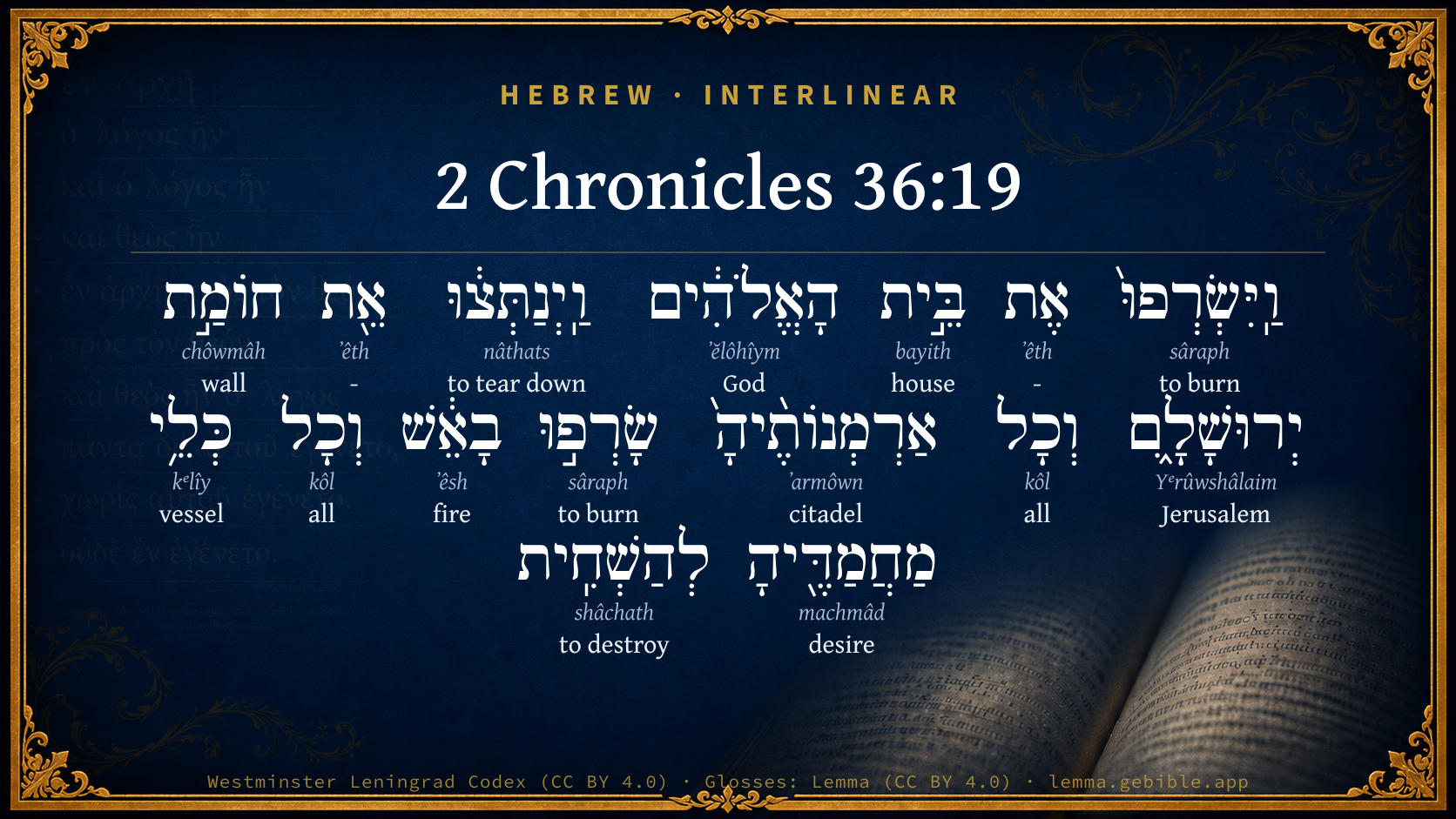
2 Chronicles 36:19

Hebrew (Westminster Leningrad Codex) 2 Chronicles 36:19 appears in the Hebrew Old Testament. The text above is from the Westminster Leningrad Codex. Each word links to its Strong’s number, a concise gloss, and parsing drawn from the Open Scriptures Hebrew Bible morphology. Click any word for its full Brown-Driver-Briggs (BDB) entry.
Download image
Cite this verse

2 Chronicles 36:19 (World English Bible). Public Domain. Lemma interlinear Bible study tool, https://lemma.gebible.app/v/2-chronicles/36/19.

Show BibTeX & RIS
BibTeX
RIS
English Translation
They burnt the house of God, and broke down the wall of Jerusalem, and burnt all the palaces of it with fire, and destroyed all the goodly vessels of it.
World English Bible · Public Domain
Download a study sheet

One document with this verse’s original text, its word-by-word gloss line, the meaning frame, cross-references with their text, attributed commentary, and full source and license credits — printable, and it pastes into notes with its structure intact.

This verse Autodidact and up

Study sheet (.html) Plain text (.txt)

A passage Seminary Student

Up to 50 verses in one chapter. A passage sheet keeps up to 6 commentary sources and 12 cross-references per verse, in the order this page ranks them, and says so on the sheet whenever that leaves anything out. Ask for a single verse and you get the Autodidact verse sheet above.

Everything on this page stays free to read, with no account — the sheet is a download of what is already on screen, not access to it.

Want to remove ads? Support Godless Engineer
Compare translations 3

The same verse in 3 English versions, stacked beneath the original-language interlinear above. Click any original word for its lexicon entry.

Each is an independent rendering of the whole verse — the interlinear is not word-aligned to these translations.

Highlighted words mark where these versions differ — a whole-verse word diff, not a word-by-word alignment.

  • World English Bible Public Domain
    They burnt the house of God, and broke down the wall of Jerusalem, and burnt all the palaces of it with fire, and destroyed all the goodly vessels of it.
  • King James Version Public Domain
    And they burnt the house of God, and brake down the wall of Jerusalem, and burnt all the palaces thereof with fire, and destroyed all the goodly vessels thereof.
  • unfoldingWord Literal Text CC BY-SA 4.0
    And they burned the house of God, and they tore down the wall of Jerusalem; and all of its palaces they burned with fire, and all the precious objects, destroyed.

unfoldingWord Literal Text — © unfoldingWord, licensed CC BY-SA 4.0. Word-aligned USFM3 via Door43 (git.door43.org/unfoldingWord/en_ult).

Versions to compare (up to 4)

3 of 4 selected

Show all 18 translations

Every available English version of this verse, each an independent rendering of the whole verse.

  • World English Bible Public Domain
    They burnt the house of God, and broke down the wall of Jerusalem, and burnt all the palaces of it with fire, and destroyed all the goodly vessels of it.
  • Berean Standard Bible Public Domain
    Then the Chaldeans set fire to the house of God and broke down the wall of Jerusalem. They burned down all the palaces and destroyed every article of value.
  • Majority Standard Bible Public Domain
    Then the Chaldeans set fire to the house of God and broke down the wall of Jerusalem. They burned down all the palaces and destroyed every article of value.
  • King James Version Public Domain
    And they burnt the house of God, and brake down the wall of Jerusalem, and burnt all the palaces thereof with fire, and destroyed all the goodly vessels thereof.
  • American Standard Version (1901) Public Domain
    And they burnt the house of God, and brake down the wall of Jerusalem, and burnt all the palaces thereof with fire, and destroyed all the goodly vessels thereof.
  • Revised Version (1885) Public Domain
    And they burnt the house of God, and brake down the wall of Jerusalem, and burnt all the palaces thereof with fire, and destroyed all the goodly vessels thereof.
  • Geneva Bible (1599) Public Domain
    And they burnt the house of God, and brake downe the wall of Ierusalem, and burnt all the palaces thereof with fire, and all the precious vessels thereof, to destroy all.
  • Douay-Rheims (1899) Public Domain
    And the enemies set fire to the house of God, and broke down the wall of Jerusalem, burnt all the towers, and whatsoever was precious they destroyed.
  • Young's Literal Translation Public Domain
    And they burn the house of God, and break down the wall of Jerusalem, and all its palaces they have burnt with fire, and all its desirable vessels -- to destruction.
  • Literal Standard Version CC BY-SA 4.0
    And they burn the house of God, and break down the wall of Jerusalem, and they have burned all its palaces with fire, and all its desirable vessels—to destruction.
  • Unlocked Literal Bible CC BY-SA 4.0
    They burned down the house of God, broke down the wall of Jerusalem, burned all its palaces, and destroyed all the beautiful things in it.
  • unfoldingWord Literal Text CC BY-SA 4.0
    And they burned the house of God, and they tore down the wall of Jerusalem; and all of its palaces they burned with fire, and all the precious objects, destroyed.
  • Darby Bible Public Domain
    And they burned the house of God, and broke down the wall of Jerusalem, and burned all the palaces thereof with fire, and all the precious vessels thereof were given up to destruction.
  • World Messianic Bible Public Domain
    They burned God’s house, broke down the wall of Jerusalem, burned all its palaces with fire, and destroyed all of its valuable vessels.
  • Webster's Bible Public Domain
    And they burnt the house of God, and broke down the wall of Jerusalem, and burnt all its palaces with fire, and destroyed all its goodly vessels.
  • Free Bible Version CC BY-SA 4.0
    Then the Babylonians burned down God's Temple and demolished Jerusalem's walls. They set fire to all the palaces and destroyed everything that had any value.
  • Bible in Basic English Public Domain
    And the house of God was burned and the wall of Jerusalem broken down; all its great houses were burned with fire and all its beautiful vessels given up to destruction.
  • JPS Tanakh (1917) Public Domain
    And they burnt the house of God, and broke down the wall of Jerusalem, and burnt all the palaces thereof with fire, and destroyed all the goodly vessels thereof.

Literal Standard Version (2020), Covenant Press — licensed CC BY-SA 4.0. Text via the HelloAO Bible API (eBible.org). Unlocked Literal Bible (unfoldingWord) — licensed CC BY-SA 4.0. Text via the HelloAO Bible API (eBible.org). unfoldingWord Literal Text — © unfoldingWord, licensed CC BY-SA 4.0. Word-aligned USFM3 via Door43 (git.door43.org/unfoldingWord/en_ult). Free Bible Version, Dr. Jonathan Gallagher — licensed CC BY-SA 4.0. Text via the HelloAO Bible API (eBible.org).

Word by word

More ways to search: Search by grammar → Find every occurrence → Compare this word →

Practice this passage: Drill this verse → Learn its vocabulary →

מַחֲמַדֶּ֖יהָ
machmâd
H4261
“desires · her”
Noun, Common, Masculine, Plural, Construct + Suffix, Personal, 3rd Person, Feminine, Singular
Part of Speech
Noun
Type
Common
Gender
Masculine
Number
Plural
State
Construct
Full BDB Definition

Origin: from H2530

TWOT: 673d , 673e

desire, desirable thing, pleasant thing
  1. וַֽיִּשְׂרְפוּ֙ sâraph H8313 “and · to burn” Conjunction + Verb, Qal, Sequential Imperfect, 3rd Person, Masculine, Plural
  2. אֶת ʼêth H853 “-” Particle, Direct Object
  3. בֵּ֣ית bayith H1004 “house of” Noun, Common, Masculine, Singular, Construct
  4. הָאֱלֹהִ֔ים ʼĕlôhîym H430 “the · God(s)” Particle, Definite Article + Noun, Common, Masculine, Plural, Absolute
  5. וַֽיְנַתְּצ֔וּ nâthats H5422 “and · to tear down” Conjunction + Verb, Piel, Sequential Imperfect, 3rd Person, Masculine, Plural
  6. אֵ֖ת ʼêth H853 “-” Particle, Direct Object
  7. חוֹמַ֣ת chôwmâh H2346 “wall of” Noun, Common, Feminine, Singular, Construct
  8. יְרוּשָׁלִָ֑ם Yᵉrûwshâlaim H3389 “Jerusalem” Noun, Proper
  9. וְכָל kôl H3605 “and · all of” Conjunction + Noun, Common, Masculine, Singular, Construct
  10. אַרְמְנוֹתֶ֨יהָ֙ ʼarmôwn H759 “citadels · her” Noun, Common, Masculine, Plural, Construct + Suffix, Personal, 3rd Person, Feminine, Singular
  11. שָׂרְפ֣וּ sâraph H8313 “to burn” Verb, Qal, Perfect, 3rd Person, Common, Plural
  12. בָאֵ֔שׁ ʼêsh H784 “in/at the · fire” Preposition, Determined + Noun, Common, Both, Singular, Absolute
  13. וְכָל kôl H3605 “and · all of” Conjunction + Noun, Common, Masculine, Singular, Construct
  14. כְּלֵ֥י kᵉlîy H3627 “vessels of” Noun, Common, Masculine, Plural, Construct
  15. לְהַשְׁחִֽית shâchath H7843 “to destroy” Preposition + Verb, Hiphil, Infinitive Construct

About this verse

These counts appear in no published source. They are computed here, from the morphology-tagged text and Lemma’s own curated glosses. What Lemma adds →

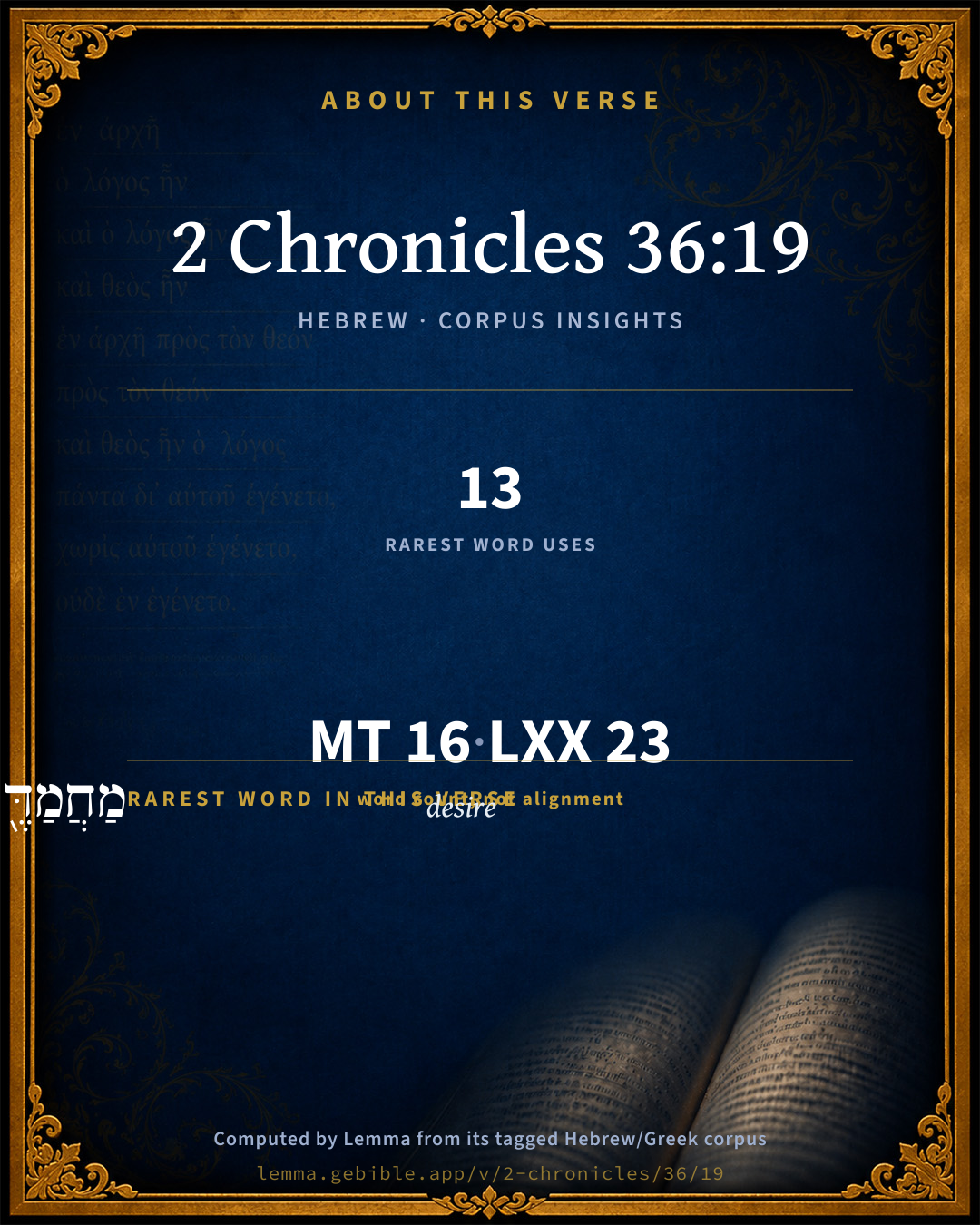
16
words
13
distinct lemmas
Historical
section

Notable vocabulary

The rarest word here is מַחֲמַדֶּ֖יהָ desire H4261 — appearing just 13 times in the whole Hebrew Bible.

Shared distinctive vocabulary

מַחֲמַדֶּ֖יהָ desire H4261 occurs in 13 verses of the Hebrew Bible. Also found in:

Grammatical profile

  • 4 verbs
  • 10 nouns
  • 2 particles

Verb forms

  • וַֽיִּשְׂרְפוּ֙ Qal · Sequential Imperfect
  • וַֽיְנַתְּצ֔וּ Piel · Sequential Imperfect
  • שָׂרְפ֣וּ Qal · Perfect
  • לְהַשְׁחִֽית Hiphil · Infinitive Construct

Repetition

Words recur within this verse — often emphatic in Hebrew:

  • וַֽיִּשְׂרְפוּ֙ to burn H8313 ×2
  • וְכָל all H3605 ×2

Hebrew & Septuagint length

In English translation the verse runs 30 words from the Hebrew and 27 from the Septuagint (LXX English) — closely comparable.

A rough comparison of the two English renderings, which tokenize alike — not a word-level alignment.

Word counts can differ between the Hebrew and the Greek without any difference in meaning — e.g. the Hebrew direct-object marker אֵת has no separate Greek word, and Greek often adds the article ὁ.

In the original languages it is 16 Hebrew tokens and 23 Greek tokens — but the two are counted differently (Hebrew bundles its prefixes and suffixes into one token; the Greek is in lemma form), so that isn’t a like-for-like length.

Cross-references

12

Topical passages linked to 2 Chronicles 36:19 in the Treasury of Scripture Knowledge — connected by theme and wording, ordered by reader-vote popularity; previews shown in the World English Bible.

  • Psalms 79:1 God, the nations have come into your inheritance. They have defiled your holy temple. They have laid Jerusalem in heaps.
  • 1 Kings 9:8 Though this house is so high, yet shall everyone who passes by it be astonished, and shall hiss; and they shall say, Why has Yahweh done thus to this land, and to this house?
  • 2 Kings 25:9–11 He burnt the house of Yahweh, and the king's house; and all the houses of Jerusalem, even every great house, burnt he with fire.
  • Psalms 74:4–8 Your adversaries have roared in the midst of your assembly. They have set up their standards as signs.
  • Psalms 79:7 For they have devoured Jacob, And destroyed his homeland.
  • Isaiah 64:10–11 Your holy cities are become a wilderness, Zion is become a wilderness, Jerusalem a desolation.
  • Jeremiah 7:4 Don't you trust in lying words, saying, The temple of Yahweh, the temple of Yahweh, the temple of Yahweh, are these.
  • Jeremiah 7:14 therefore will I do to the house which is called by my name, in which you trust, and to the place which I gave to you and to your fathers, as I did to Shiloh.
  • Jeremiah 52:13–15 and he burned the house of Yahweh, and the king's house; and all the houses of Jerusalem, even every great house, burned he with fire.
  • Lamentations 4:1 How is the gold become dim! [how] is the most pure gold changed! The stones of the sanctuary are poured out at the head of every street.
  • Micah 3:12 Therefore Zion for your sake will be plowed like a field, And Jerusalem will become heaps of rubble, And the mountain of the temple like the high places of a forest.
  • Luke 21:6 "As for these things which you see, the days will come, in which there will not be left here one stone on another that will not be thrown down."

Cross-references courtesy of OpenBible.info (CC BY 4.0).

Hebrew and Greek witnesses Masoretic Hebrew ↔ Greek Septuagint

The same verse in the two great witnesses to the Old Testament, shown verse-for-verse.

These are two independent witnesses, not word-aligned to each other, and the Septuagint is shown in lemma (dictionary) form.

Hebrew 2 Chronicles 36:19 Masoretic · Westminster Leningrad Codex

וַֽיִּשְׂרְפוּ֙ אֶת בֵּ֣ית הָאֱלֹהִ֔ים וַֽיְנַתְּצ֔וּ אֵ֖ת חוֹמַ֣ת יְרוּשָׁלִָ֑ם וְכָל אַרְמְנוֹתֶ֨יהָ֙ שָׂרְפ֣וּ בָאֵ֔שׁ וְכָל כְּלֵ֥י מַחֲמַדֶּ֖יהָ לְהַשְׁחִֽית

They burnt the house of God, and broke down the wall of Jerusalem, and burnt all the palaces of it with fire, and destroyed all the goodly vessels of it.

World English Bible · Public Domain

Greek LXX 2 Chronicles 36:19 Septuagint · lemma form

καί ἐνπίμπρημι ὁ οἶκος κύριος καί κατασκάπτω ὁ τεῖχος ἰερουσαλήμ καί ὁ βάρις αὐτός ἐνπίμπρημι ἐν πῦρ καί πᾶς σκεῦος ὡραῖος εἰς ἀφανισμός

And he burnt the house of the Lord, and broke down the wall of Jerusalem, and burnt its palaces with fire, and utterly destroyed every beautiful vessel.

LXX2012 (modern English Septuagint) · Public Domain

Hebrew: Westminster Leningrad Codex (CC BY 4.0). Greek: Septuagint (public domain); English from LXX2012 (modern English Septuagint) (Public Domain). How the Septuagint differs from the Hebrew →

Commentary

Notes on 2 Chronicles 36:19 from classic Christian and Jewish commentators (each source and its license shown beneath its notes). The classic Christian expositions comment on the surrounding passage and are grouped to its opening verse, so a note may address several verses; the Jewish commentaries on the Tanakh (Rashi and others) are per-verse, so they appear only where the commentator wrote on this verse.

Lemma curates 59 commentaries, every one of them public domain or Creative Commons licensed, each selected and text-cleaned for this edition rather than reprinted as found. About our sources →

Trapp's Complete Commentary

John Trapp

2Ch 36:19 And they burnt the house of God, and brake down the wall of Jerusalem, and burnt all the palaces thereof with fire, and destroyed all the goodly vessels thereof.

Ver. 19. And they burnt the house of God.] Which those Jews had so fearfully profaned.

And burnt all the palaces thereof.] See 2Ki 25:9.

John Trapp, A Commentary or Exposition upon All the Books of the Old and New Testament (1647–1656) — public domain. Text from a community e-Sword module.

Tyndale Open Study Notes

Tyndale Open Resources

36:19 The Temple was destroyed in August 586 BC (see 2 Kgs 25:8; Jer 52:12).

Tyndale Open Study Notes — © Tyndale Open Resources, licensed CC BY-SA 4.0. Text via the HelloAO Bible API.

Adam Clarke's Commentary

Verse 19. They burnt the house of God] Here was an end to the temple; the most superb and costly edifice ever erected by man.

Brake down the wall of Jerusalem] So it ceased to be a fortified city.

Burnt all the palaces] So it was no longer a dwelling-place for kings or great men.

Destroyed all the goodly vessels] Beat up all the silver and gold into masses, keeping only a few of the finest in their own shape. See 2Ch 36:18.

Adam Clarke's Commentary on the Bible (1810–1826) — public domain. Text from a community e-Sword/MySword module.

Ellicott's Commentary for English Readers

(19) They burnt the house of God.—2Ki_25:9.

Brake down the wall . . .—Jer_39:8; 2Ki_25:9-10.

And destroyed all the goodly vessels.—Literally, And all her delightsome vessels were for destroying (lĕhashchîth). (Comp. Isa_64:11): “all our pleasant things are laid waste.” 2Ki_25:13 speaks of the breaking-up of the great vessels of the Temple, for the sake of carrying off their material more easily.

Servants to him and his sons . . . kingdom Of Persia.—A fulfilment of Jeremiah’s prophecy concerning Nebuchadnezzar: “And all nations shall serve him, and his son, and his son’s son, until the time of his own land come” (Jer_27:7). Comp. also Isaiah’s word to Hezekiah (2Ki_20:18.)

A Bible Commentary for English Readers, edited by Charles John Ellicott (1878–1897) — public domain. Text from a community e-Sword module.

The Cambridge Bible for Schools and Colleges

gen. ed. J. J. S. Perowne

19. brake down the wall] The Heb. verb here used (nittçç) implies probably a more thorough breaking down than the pâraç of 2Ch_25:23 (see note); 2Ch_26:6.

The Cambridge Bible for Schools and Colleges (gen. ed. J. J. S. Perowne; Cambridge University Press, 1878–1918) — public domain. Text from a community e-Sword module.

John Gill's Exposition

To fulfil the word of the Lord by the mouth of Jeremiah,.... That is, the Jews were so long servants in Babylon, as in the preceding verse, to accomplish Jeremiah's prophecy of it, Ch2 25:12.

until the land had enjoyed her sabbaths; the sabbatical years, or seventh year sabbaths, which, according to the law of the land, was to rest from being tilled, Lev 25:4, which law had been neglected by the Jews, and now, whether they would or not, the land should have rest for want of persons to till it:

for as long as she lay desolate she kept sabbath, to fulfil threescore and ten years; as threatened in Lev 26:34 on which text Jarchi observes, that at the destruction of the first temple the law concerning the sabbath, or rest of the land had been neglected four hundred and thirty years, in which space were sixty nine sabbatical years; and, according to Maimonides (d), it was at the end of a sabbatic year that the city and temple were destroyed, and so just seventy years had been neglected, and the land was tilled in them as in other years, and now it had rest that exact number of years; but of this we cannot be certain, though it is probable.

(d) Hilchot Shemitah Veyobel, c. 10. sect. 3.

John Gill's Exposition of the Whole Bible (1746–1763) — public domain (CC PDM 1.0). Text via the HelloAO Bible API.

The Pulpit Commentary

Vers. 19, 20. (Compare the parallel, 2Ki_25:1-12; Jer_39:1-10 Jer_52:24-30) The reign of the kingdom of Persia; i.e. the ascending on the throne of the Persian king. The immediate successor of Nebuchadnezzar was his son Evil-Merodach.

The Pulpit Commentary (1880–1919), ed. H.D.M. Spence-Jones & Joseph S. Exell — public domain. Text from a community e-Sword module.

Keil & Delitzsch

C. F. Keil & F. Delitzsch

They burnt the house of God; they pulled down the walls of Jerusalem, and burnt all the palaces of the city with fire, and all the costly vessels were devoted to destruction. On להשׁחית, cf. Ch2 12:12.

Keil & Delitzsch — Biblical Commentary on the Old Testament (1861–1891) — public domain (CC PDM 1.0). Text via the HelloAO Bible API. (Old Testament only.)

Lesson kit

Teaching starters — assembled from the data on this page, not authored interpretation. Every prompt links to the verse data it draws on. Edit before teaching.

2 Chronicles, in the Historical, opens this verse with 16 words (13 distinct Hebrew lemmas). Its most distinctive word is machmâd (“desire”). A historical commentator’s framing appears above. Read the whole chapter for the surrounding context.

Discussion questions

  1. The word machmâd carries the sense “desire.” How does it shape the verse?
  2. How does 1 Kings 20:6, which shares the word «desire», read alongside this verse?
  3. What does the repetition of “to burn” (2× in this one verse) do in this verse?
  4. These translations render this verse differently; the difference is in the English rendering, not the original. What questions does that raise?
  5. «וַֽיִּשְׂרְפוּ֙» is a Qal Sequential Imperfect verb. How does that grammatical form shape the action described?
  6. Compare how Trapp's Complete Commentary and Tyndale Open Study Notes read this verse. Where do they agree or differ?

Things to notice

Reading settings

Reading text

Shown beneath each verse's original-language words.

Old Testament
Old Testament edition

Read the OT as the Masoretic Hebrew (MT) or the Greek Septuagint (LXX).

English shown for the Greek Septuagint (in the Hebrew ↔ Greek comparison).

Comparing translations? Open the Compare panel on any verse page to stack up to four side by side.