2 Samuel 11:12

Hebrew (Westminster Leningrad Codex) 2 Samuel 11:12 appears in the Hebrew Old Testament. The text above is from the Westminster Leningrad Codex. Each word links to its Strong’s number, a concise gloss, and parsing drawn from the Open Scriptures Hebrew Bible morphology. Click any word for its full Brown-Driver-Briggs (BDB) entry.
Download image
Cite this verse

2 Samuel 11:12 (World English Bible). Public Domain. Lemma interlinear Bible study tool, https://lemma.gebible.app/v/2-samuel/11/12.

Show BibTeX & RIS
BibTeX
RIS
English Translation
David said to Uriah, Stay here today also, and tomorrow I will let you depart. So Uriah abode in Jerusalem that day, and the next day.
World English Bible · Public Domain
Download a study sheet

One document with this verse’s original text, its word-by-word gloss line, the meaning frame, cross-references with their text, attributed commentary, and full source and license credits — printable, and it pastes into notes with its structure intact.

This verse Autodidact and up

Study sheet (.html) Plain text (.txt)

A passage Seminary Student

Up to 50 verses in one chapter. A passage sheet keeps up to 6 commentary sources and 12 cross-references per verse, in the order this page ranks them, and says so on the sheet whenever that leaves anything out. Ask for a single verse and you get the Autodidact verse sheet above.

Everything on this page stays free to read, with no account — the sheet is a download of what is already on screen, not access to it.

Want to remove ads? Support Godless Engineer
Compare translations 3

The same verse in 3 English versions, stacked beneath the original-language interlinear above. Click any original word for its lexicon entry.

Each is an independent rendering of the whole verse — the interlinear is not word-aligned to these translations.

Highlighted words mark where these versions differ — a whole-verse word diff, not a word-by-word alignment.

  • World English Bible Public Domain
    David said to Uriah, Stay here today also, and tomorrow I will let you depart. So Uriah abode in Jerusalem that day, and the next day.
  • King James Version Public Domain
    And David said to Uriah, Tarry here to day also, and to morrow I will let thee depart. So Uriah abode in Jerusalem that day, and the morrow.
  • unfoldingWord Literal Text CC BY-SA 4.0
    And David said to Uriah, “Stay here today also, and tomorrow I will send you back.” So Uriah stayed in Jerusalem on that day and into the next day.

unfoldingWord Literal Text — © unfoldingWord, licensed CC BY-SA 4.0. Word-aligned USFM3 via Door43 (git.door43.org/unfoldingWord/en_ult).

Versions to compare (up to 4)

3 of 4 selected

Show all 18 translations

Every available English version of this verse, each an independent rendering of the whole verse.

  • World English Bible Public Domain
    David said to Uriah, Stay here today also, and tomorrow I will let you depart. So Uriah abode in Jerusalem that day, and the next day.
  • Berean Standard Bible Public Domain
    “Stay here one more day,” David said to Uriah, “and tomorrow I will send you back.” So Uriah stayed in Jerusalem that day and the next.
  • Majority Standard Bible Public Domain
    “Stay here one more day,” David said to Uriah, “and tomorrow I will send you back.” So Uriah stayed in Jerusalem that day and the next.
  • King James Version Public Domain
    And David said to Uriah, Tarry here to day also, and to morrow I will let thee depart. So Uriah abode in Jerusalem that day, and the morrow.
  • American Standard Version (1901) Public Domain
    And David said to Uriah, Tarry here to-day also, and to-morrow I will let thee depart. So Uriah abode in Jerusalem that day, and the morrow.
  • Revised Version (1885) Public Domain
    And David said to Uriah, Tarry here today also, and tomorrow I will let thee depart. So Uriah abode in Jerusalem that day, and the morrow.
  • Geneva Bible (1599) Public Domain
    Then Dauid sayd vnto Vriah, Tary yet this day, and to morow I will send thee away. So Vriah abode in Ierusalem that day, and the morowe.
  • Douay-Rheims (1899) Public Domain
    Then David said to Urias: Tarry here to day, and to morrow I will send thee away. Urias tarried in Jerusalem that day and the next.
  • Young's Literal Translation Public Domain
    And David saith unto Uriah, `Abide in this `place' also to-day, and to-morrow I send thee away;' and Uriah abideth in Jerusalem, on that day, and on the morrow,
  • Literal Standard Version CC BY-SA 4.0
    And David says to Uriah, “Also abide in this [place] today, and tomorrow I send you away”; and Uriah abides in Jerusalem on that day and on the next day,
  • Unlocked Literal Bible CC BY-SA 4.0
    So David said to Uriah, “Stay here today also, and tomorrow I will let you leave.” So Uriah stayed in Jerusalem that day and the next day.
  • unfoldingWord Literal Text CC BY-SA 4.0
    And David said to Uriah, “Stay here today also, and tomorrow I will send you back.” So Uriah stayed in Jerusalem on that day and into the next day.
  • Darby Bible Public Domain
    And David said to Urijah, Abide here to-day also, and to-morrow I will let thee depart. And Urijah abode in Jerusalem that day and the morrow.
  • World Messianic Bible Public Domain
    David said to Uriah, “Stay here today also, and tomorrow I will let you depart.” So Uriah stayed in Jerusalem that day and the next day.
  • Webster's Bible Public Domain
    And David said to Uriah, Tarry here to-day also, and to-morrow I will let thee depart. So Uriah abode in Jerusalem that day and the morrow.
  • Free Bible Version CC BY-SA 4.0
    David told him, “Stay here today, and tomorrow I'll send you back.” So Uriah stayed in Jerusalem that day, and the next.
  • Bible in Basic English Public Domain
    And David said to Uriah, Be here today, and after that I will let you go. So Uriah was in Jerusalem that day and the day after.
  • JPS Tanakh (1917) Public Domain
    And David said to Uriah: 'Tarry here to-day also, and to-morrow I will let thee depart.' So Uriah abode in Jerusalem that day, and the morrow.

Literal Standard Version (2020), Covenant Press — licensed CC BY-SA 4.0. Text via the HelloAO Bible API (eBible.org). Unlocked Literal Bible (unfoldingWord) — licensed CC BY-SA 4.0. Text via the HelloAO Bible API (eBible.org). unfoldingWord Literal Text — © unfoldingWord, licensed CC BY-SA 4.0. Word-aligned USFM3 via Door43 (git.door43.org/unfoldingWord/en_ult). Free Bible Version, Dr. Jonathan Gallagher — licensed CC BY-SA 4.0. Text via the HelloAO Bible API (eBible.org).

Word by word

More ways to search: Search by grammar → Find every occurrence → Compare this word →

Practice this passage: Drill this verse → Learn its vocabulary →

וּמִֽמָּחֳרָֽת
mochŏrâth
H4283
“and · from · morrow”
Conjunction + Preposition + Noun, Common, Feminine, Singular, Absolute
Part of Speech
Conjunction + Preposition + Noun
Type
Common
Gender
Feminine
Number
Singular
State
Absolute
Full BDB Definition

Origin: from the same as H4279

TWOT: 1185b

the morrow, the day after
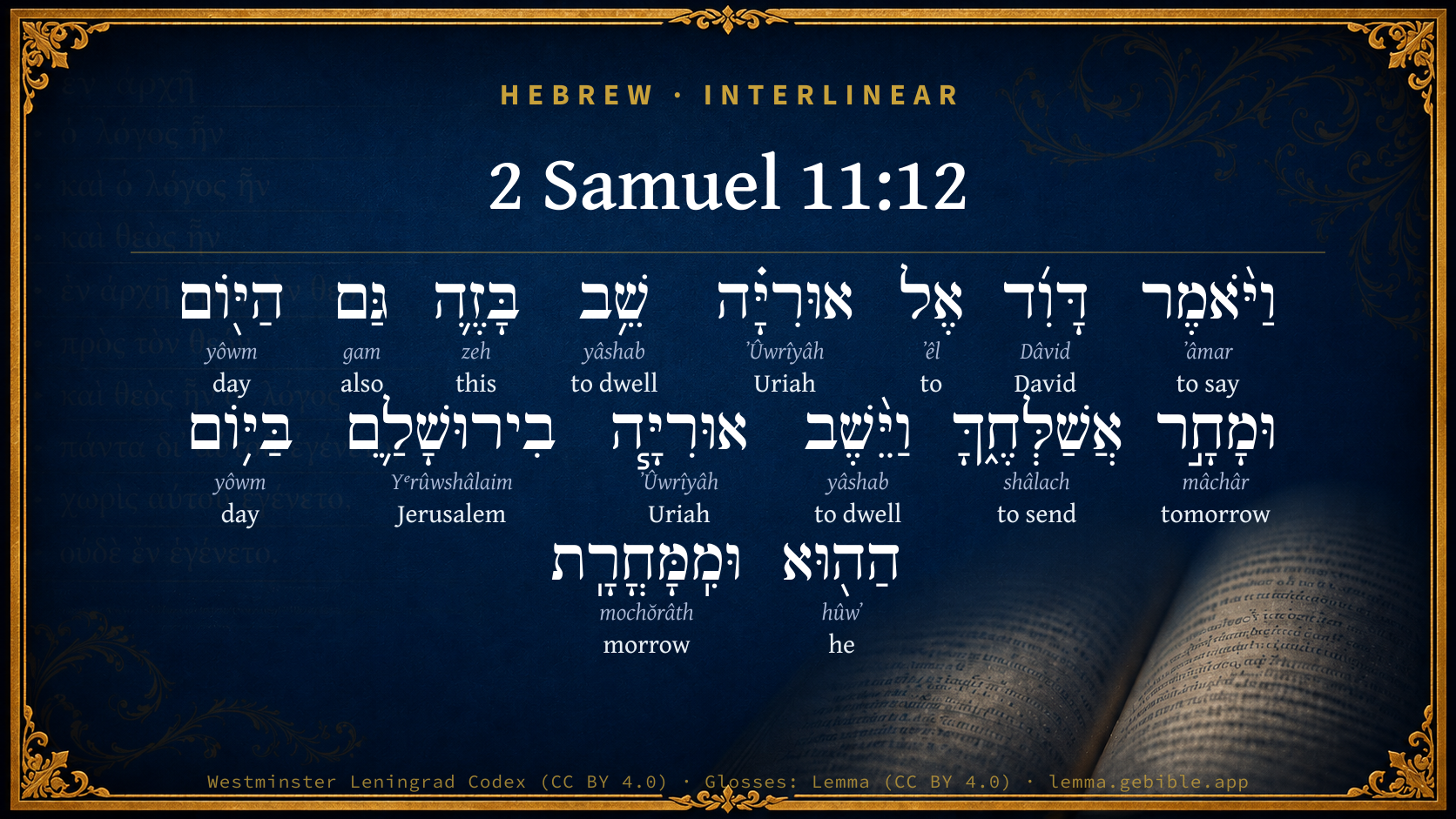
  1. וַיֹּ֨אמֶר ʼâmar H559 “and · to say” Conjunction + Verb, Qal, Sequential Imperfect, 3rd Person, Masculine, Singular
  2. דָּוִ֜ד Dâvid H1732 “David” Noun, Proper
  3. אֶל ʼêl H413 “to” Preposition
  4. אוּרִיָּ֗ה ʼÛwrîyâh H223 “Uriah” Noun, Proper
  5. שֵׁ֥ב yâshab H3427 “dwell” Verb, Qal, Imperative, 2nd Person, Masculine, Singular
  6. בָּזֶ֛ה zeh H2088 “in/at · this” Preposition + Pronoun, Demonstrative, Masculine, Singular
  7. גַּם gam H1571 “also” Particle, Accusative
  8. הַיּ֖וֹם yôwm H3117 “the · day” Particle, Definite Article + Noun, Common, Masculine, Singular, Absolute
  9. וּמָחָ֣ר mâchâr H4279 “and · tomorrow” Conjunction + Noun, Common, Masculine, Singular, Absolute
  10. אֲשַׁלְּחֶ֑ךָּ shâlach H7971 “to send · you” Verb, Piel, Imperfect, 1st Person, Common, Singular + Suffix, Personal, 2nd Person, Common, Singular
  11. וַיֵּ֨שֶׁב yâshab H3427 “and · to dwell” Conjunction + Verb, Qal, Sequential Imperfect, 3rd Person, Masculine, Singular
  12. אוּרִיָּ֧ה ʼÛwrîyâh H223 “Uriah” Noun, Proper
  13. בִירוּשָׁלִַ֛ם Yᵉrûwshâlaim H3389 “in/at · Jerusalem” Preposition + Noun, Proper
  14. בַּיּ֥וֹם yôwm H3117 “in/at the · day” Preposition, Determined + Noun, Common, Masculine, Singular, Absolute
  15. הַה֖וּא hûwʼ H1931 “the · he” Particle, Definite Article + Pronoun, Personal, 3rd Person, Masculine, Singular

About this verse

These counts appear in no published source. They are computed here, from the morphology-tagged text and Lemma’s own curated glosses. What Lemma adds →

16
words
13
distinct lemmas
Historical
section

Shared distinctive vocabulary

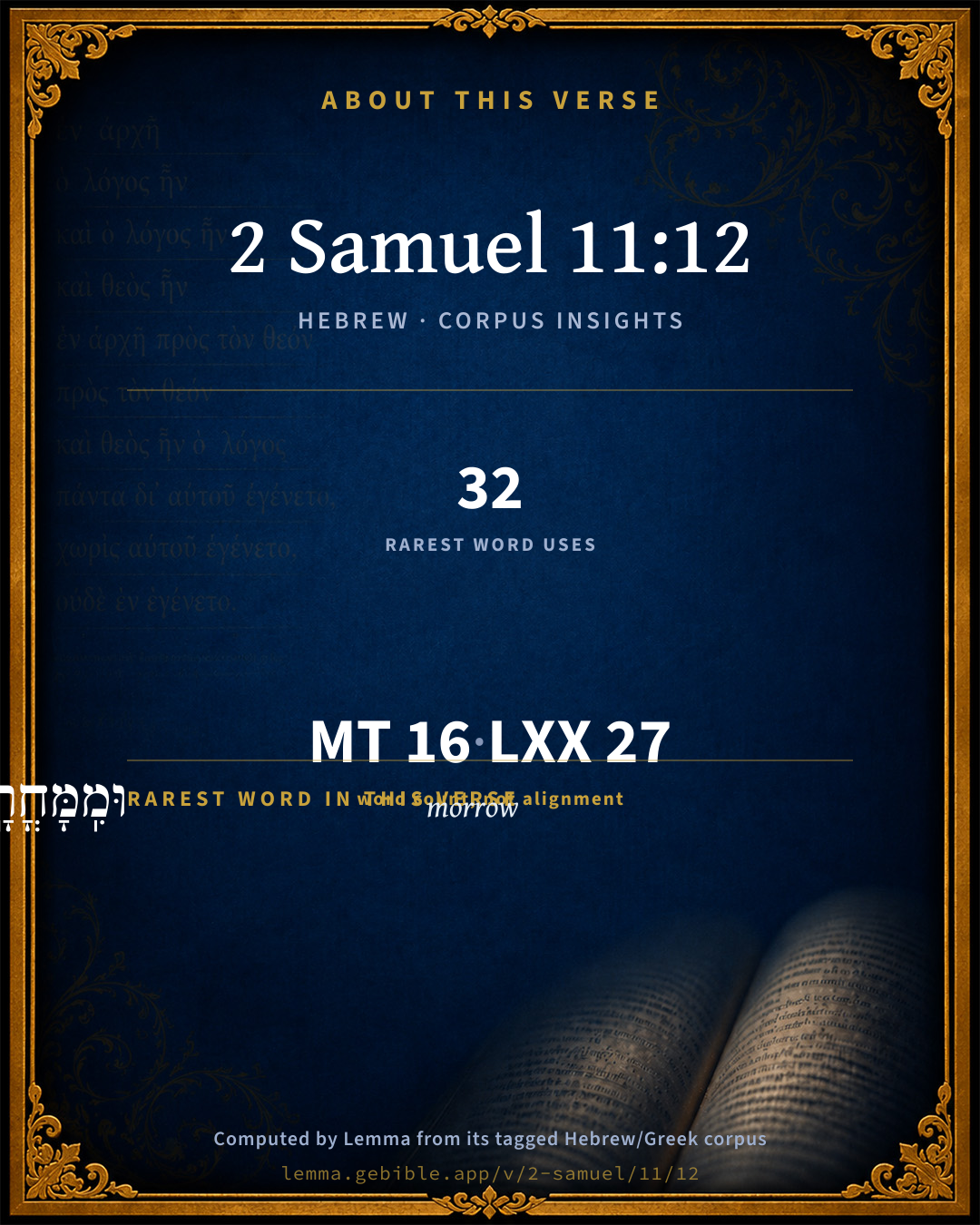
וּמִֽמָּחֳרָֽת morrow H4283 occurs in 32 verses of the Hebrew Bible. Also found in:

Grammatical profile

  • 4 verbs
  • 8 nouns
  • 2 pronouns
  • 1 preposition
  • 1 particle

Verb forms

  • וַיֹּ֨אמֶר Qal · Sequential Imperfect
  • שֵׁ֥ב Qal · Imperative
  • אֲשַׁלְּחֶ֑ךָּ Piel · Imperfect
  • וַיֵּ֨שֶׁב Qal · Sequential Imperfect

Repetition

Words recur within this verse — often emphatic in Hebrew:

  • אוּרִיָּ֗ה Uriah H223 ×2
  • שֵׁ֥ב to dwell H3427 ×2
  • הַיּ֖וֹם day H3117 ×2

Hebrew & Septuagint length

In English translation the verse runs 26 words from the Hebrew and 27 from the Septuagint (LXX English) — closely comparable.

A rough comparison of the two English renderings, which tokenize alike — not a word-level alignment.

Word counts can differ between the Hebrew and the Greek without any difference in meaning — e.g. the Hebrew direct-object marker אֵת has no separate Greek word, and Greek often adds the article ὁ.

In the original languages it is 16 Hebrew tokens and 27 Greek tokens — but the two are counted differently (Hebrew bundles its prefixes and suffixes into one token; the Greek is in lemma form), so that isn’t a like-for-like length.

Cross-references

2

Topical passages linked to 2 Samuel 11:12 in the Treasury of Scripture Knowledge — connected by theme and wording, ordered by reader-vote popularity; previews shown in the World English Bible.

  • Jeremiah 2:22–23 For though you wash yourself with lye, and use much soap, yet your iniquity is marked before me, says the Lord Yahweh.
  • Jeremiah 2:37 From there also shall you go forth, with your hands on your head: for Yahweh has rejected those in whom you trust, and you shall not prosper with them.

Cross-references courtesy of OpenBible.info (CC BY 4.0).

Hebrew and Greek witnesses Masoretic Hebrew ↔ Greek Septuagint

The same verse in the two great witnesses to the Old Testament, shown verse-for-verse.

These are two independent witnesses, not word-aligned to each other, and the Septuagint is shown in lemma (dictionary) form.

Hebrew 2 Samuel 11:12 Masoretic · Westminster Leningrad Codex

וַיֹּ֨אמֶר דָּוִ֜ד אֶל אוּרִיָּ֗ה שֵׁ֥ב בָּזֶ֛ה גַּם הַיּ֖וֹם וּמָחָ֣ר אֲשַׁלְּחֶ֑ךָּ וַיֵּ֨שֶׁב אוּרִיָּ֧ה בִירוּשָׁלִַ֛ם בַּיּ֥וֹם הַה֖וּא וּמִֽמָּחֳרָֽת

David said to Uriah, Stay here today also, and tomorrow I will let you depart. So Uriah abode in Jerusalem that day, and the next day.

World English Bible · Public Domain

Greek LXX 2 Samuel 11:12 Septuagint · lemma form

καί εἶπον δαυίδ πρός ουριας καταἵζω ἐνταῦθα καί γέ σήμερον καί αὔριον ἐκ ἀποστέλλω σύ καί καταἵζω ουριας ἐν ἰερουσαλήμ ἐν ὁ ἡμέρα ἐκεῖνος καί ὁ ἐπαύριον

And David said to Urias, Remain here today also, and to-morrow I will let you go. So Urias remained in Jerusalem that day and the day following.

LXX2012 (modern English Septuagint) · Public Domain

Hebrew: Westminster Leningrad Codex (CC BY 4.0). Greek: Septuagint (public domain); English from LXX2012 (modern English Septuagint) (Public Domain). How the Septuagint differs from the Hebrew →

Targum (Aramaic paraphrase)

1

The Targum is the ancient Jewish Aramaic paraphrase of the Hebrew Scriptures — an interpretive translation, not the Hebrew text itself. Onkelos (literal) and Pseudo-Jonathan (expansive) render the Torah, and Jonathan the Prophets. Coverage is partial: where no permissively-licensed English translation exists for a verse, only the Aramaic is shown. This is verse-level text, not a word-by-word alignment to the Hebrew.

  1. Targum Jonathan Prophets (Joshua–Malachi)
    וַאֲמַר דָוִד לְאוּרִיָה תִּיב הָכָא אַף יוֹמָא דֵין וּמְחַר אַשְׁלְחִינָךְ וִיתֵיב אוּרִיָה בִּירוּשְׁלֵם בְּיוֹמָא הַהוּא וּבֵיוֹמָא דְבַתְרוֹהִי:

    (no public-domain English translation for this verse)

    Targum Jonathan — Aramaic: “Mikraot Gedolot” (public domain). English: “Sefaria Community Translation” (CC0 1.0 (public-domain dedication)); “London "Chaldee Paraphrase," 1871” (public domain). Text via Sefaria.

Commentary

Notes on 2 Samuel 11:12 from classic Christian and Jewish commentators (each source and its license shown beneath its notes). The classic Christian expositions comment on the surrounding passage and are grouped to its opening verse, so a note may address several verses; the Jewish commentaries on the Tanakh (Rashi and others) are per-verse, so they appear only where the commentator wrote on this verse.

Lemma curates 59 commentaries, every one of them public domain or Creative Commons licensed, each selected and text-cleaned for this edition rather than reprinted as found. About our sources →

Trapp's Complete Commentary

John Trapp

2Sa 11:12 And David said to Uriah, Tarry here to day also, and to morrow I will let thee depart. So Uriah abode in Jerusalem that day, and the morrow.

Ver. 12. Tarry here today also.] All this was the worse in David, because done upon deliberation, and in cold blood, seeking a cover for his sin, plotting and ploughing up further wickedness, not leaving till he had wiped off all his comfortables. {Psa 51:1-19} Take heed that your hearts be not hardened by the deceitfulness of sin, {Heb 3:13} those sensual sins especially, - those "fleshly lusts that war against the soul," {1Pe 2:11} that "take away the heart," {Hos 4:11} that disable nature, and so set it in a far greater distance from grace, which is seated in the powers of nature.

John Trapp, A Commentary or Exposition upon All the Books of the Old and New Testament (1647–1656) — public domain. Text from a community e-Sword module.

Joseph Benson's Commentary

2Sa 11:12-13. Tarry here to-day — He pretended still more kindness to him in giving him time to rest himself after his journey; and perhaps pretended also that he could not sooner finish the despatches which he intended to send by him to Joab. When David had called him in — Invited him to supper the night before he went away. And he made him drunk — He made him merry, as the Hebrew word often signifies. He caused him to drink more than was proper. What mean and shameful contrivances did David employ against this brave man! How base is sin, how low it will make men stoop, and what vile and unworthy things it will induce them to do! This was a great addition, to David’s sin, that by one evil he endeavoured to effect another; by intoxicating Uriah he strove to make him forget his oath before mentioned.

Joseph Benson's Commentary on the Old and New Testaments (1811–1818) — public domain. Text from a community e-Sword module.

John Gill's Exposition

And David said to Uriah, tarry here today also,.... In his court, when he found he could not persuade him to go to his own house:

and tomorrow I will let thee depart: after he had tried one method more with him:

so Uriah abode in Jerusalem that day and the morrow; not in his own house, but the king's palace.

John Gill's Exposition of the Whole Bible (1746–1763) — public domain (CC PDM 1.0). Text via the HelloAO Bible API.

Whedon's Commentary on the Bible

Daniel D. Whedon

12. Tarry here to-day, also, and to-morrow — He hopes yet to contrive some artifice to overreach him.

Daniel D. Whedon (gen. ed.), Commentary on the Old and New Testaments (1874–1909) — public domain. Text from a community e-Sword module.

unfoldingWord translationNotes

Door43 World Missions Community

he ate and drank before him

"Uriah ate and drank with David"

down to his house

Possible meanings of the word "down" are 1) Uriah's house was located at a lower elevation than the king's palace or 2) Uriah's house was of lesser importance than the king's palace. See how you translated the similar phrase "down to your house" in 2 Samuel 11:8. AT: "to his house" (See: Idiom)

translationWords

Jerusalem

drunk

unfoldingWord translationNotes — © Distant Shores Media and the Door43 World Missions Community, licensed CC BY-SA 4.0. Source: git.door43.org/Door43/en_tn.

Lesson kit

Teaching starters — assembled from the data on this page, not authored interpretation. Every prompt links to the verse data it draws on. Edit before teaching.

2 Samuel, in the Historical, opens this verse with 16 words (13 distinct Hebrew lemmas). Its most distinctive word is mochŏrâth (“morrow”). A historical commentator’s framing appears above. Read the whole chapter for the surrounding context.

Discussion questions

  1. What does “morrow” (mochŏrâth) contribute to the verse as a whole?
  2. Genesis 19:34 shares the word «morrow» with this verse. How do the two illuminate each other?
  3. “Uriah” occurs 2× in this one verse. What is the effect of the repetition?
  4. These translations render this verse differently. What is at stake in choosing one wording over another?
  5. The verb «וַיֹּ֨אמֶר» is Qal Sequential Imperfect. How does its form color the action?
  6. Reading how Trapp's Complete Commentary and Joseph Benson's Commentary read this verse, where do the two commentators agree and where do they part?

Things to notice

Reading settings

Reading text

Shown beneath each verse's original-language words.

Old Testament
Old Testament edition

Read the OT as the Masoretic Hebrew (MT) or the Greek Septuagint (LXX).

English shown for the Greek Septuagint (in the Hebrew ↔ Greek comparison).

Comparing translations? Open the Compare panel on any verse page to stack up to four side by side.