
Ezekiel 11:15

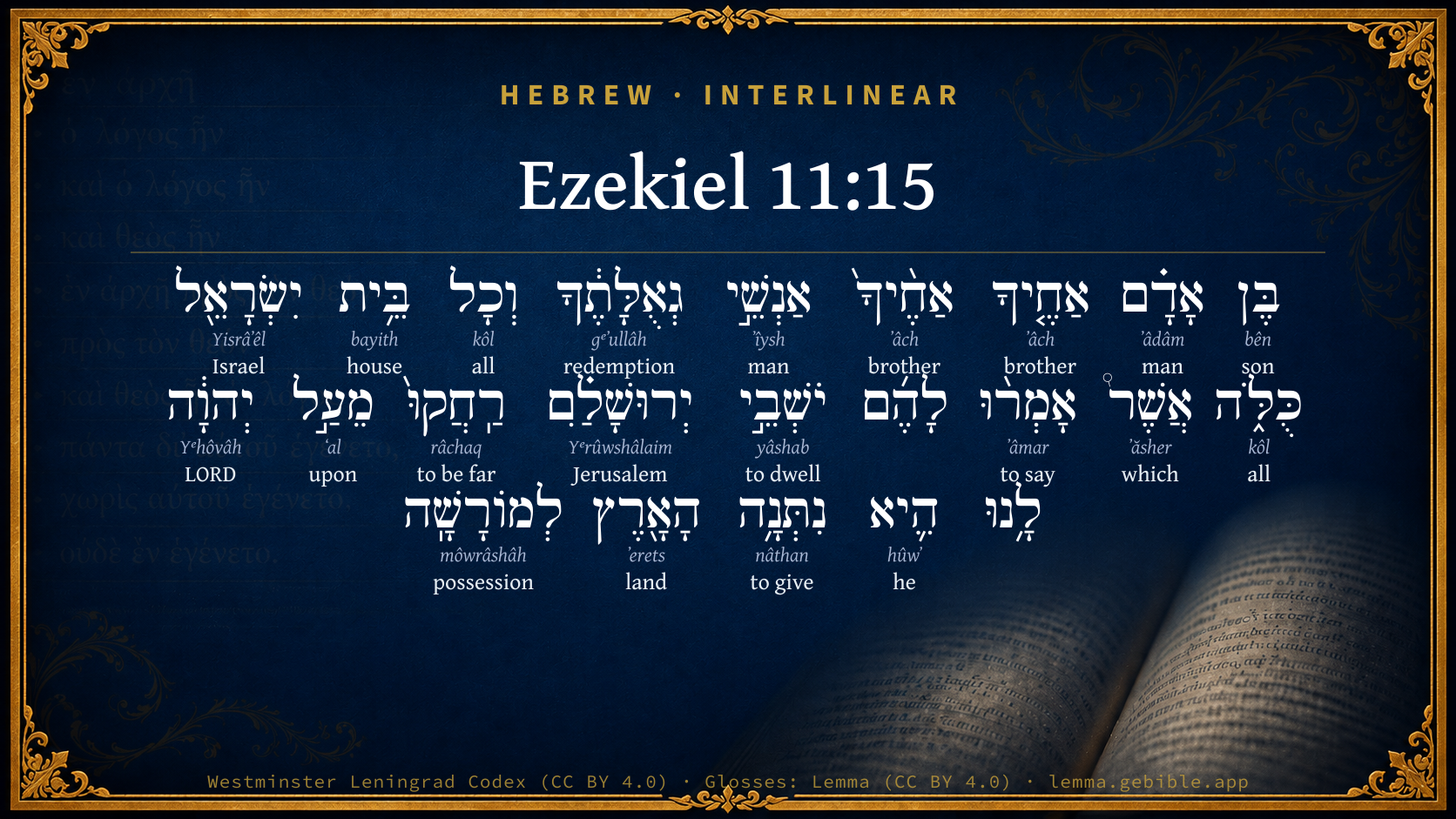
Hebrew (Westminster Leningrad Codex) Ezekiel 11:15 appears in the Hebrew Old Testament. The text above is from the Westminster Leningrad Codex. Each word links to its Strong’s number, a concise gloss, and parsing drawn from the Open Scriptures Hebrew Bible morphology. Click any word for its full Brown-Driver-Briggs (BDB) entry.
Download image
Cite this verse

Ezekiel 11:15 (World English Bible). Public Domain. Lemma interlinear Bible study tool, https://lemma.gebible.app/v/ezekiel/11/15.

Show BibTeX & RIS
BibTeX
RIS
English Translation
Son of man, your brothers, even your brothers, the men of your relatives, and all the house of Israel, all of them, [are they] to whom the inhabitants of Jerusalem have said, Get you far from Yahweh; to us is this land given for a possession.
World English Bible · Public Domain
Download a study sheet

One document with this verse’s original text, its word-by-word gloss line, the meaning frame, cross-references with their text, attributed commentary, and full source and license credits — printable, and it pastes into notes with its structure intact.

This verse Autodidact and up

Study sheet (.html) Plain text (.txt)

A passage Seminary Student

Up to 50 verses in one chapter. A passage sheet keeps up to 6 commentary sources and 12 cross-references per verse, in the order this page ranks them, and says so on the sheet whenever that leaves anything out. Ask for a single verse and you get the Autodidact verse sheet above.

Everything on this page stays free to read, with no account — the sheet is a download of what is already on screen, not access to it.

Want to remove ads? Support Godless Engineer
Compare translations 3

The same verse in 3 English versions, stacked beneath the original-language interlinear above. Click any original word for its lexicon entry.

Each is an independent rendering of the whole verse — the interlinear is not word-aligned to these translations.

Highlighted words mark where these versions differ — a whole-verse word diff, not a word-by-word alignment.

  • World English Bible Public Domain
    Son of man, your brothers, even your brothers, the men of your relatives, and all the house of Israel, all of them, [are they] to whom the inhabitants of Jerusalem have said, Get you far from Yahweh; to us is this land given for a possession.
  • King James Version Public Domain
    Son of man, thy brethren, even thy brethren, the men of thy kindred, and all the house of Israel wholly, are they unto whom the inhabitants of Jerusalem have said, Get you far from the LORD: unto us is this land given in possession.
  • unfoldingWord Literal Text CC BY-SA 4.0
    “Son of man, your brothers! Your brothers! The men of your clan and all the house of Israel! All of them are those of whom it is said by those living in Jerusalem, ‘They are far away from Yahweh! This land was given to us as our possession.’

unfoldingWord Literal Text — © unfoldingWord, licensed CC BY-SA 4.0. Word-aligned USFM3 via Door43 (git.door43.org/unfoldingWord/en_ult).

Versions to compare (up to 4)

3 of 4 selected

Show all 18 translations

Every available English version of this verse, each an independent rendering of the whole verse.

  • World English Bible Public Domain
    Son of man, your brothers, even your brothers, the men of your relatives, and all the house of Israel, all of them, [are they] to whom the inhabitants of Jerusalem have said, Get you far from Yahweh; to us is this land given for a possession.
  • Berean Standard Bible Public Domain
    “Son of man, your brothers—your relatives, your fellow exiles, and the whole house of Israel—are those of whom the people of Jerusalem have said, ‘They are far away from the LORD; this land has been given to us as a possession.’
  • Majority Standard Bible Public Domain
    “Son of man, your brothers—your relatives, your fellow exiles, and the whole house of Israel—are those of whom the people of Jerusalem have said, ‘They are far away from the LORD; this land has been given to us as a possession.’
  • King James Version Public Domain
    Son of man, thy brethren, even thy brethren, the men of thy kindred, and all the house of Israel wholly, are they unto whom the inhabitants of Jerusalem have said, Get you far from the LORD: unto us is this land given in possession.
  • American Standard Version (1901) Public Domain
    Son of man, thy brethren, even thy brethren, the men of thy kindred, and all the house of Israel, all of them, `are they' unto whom the inhabitants of Jerusalem have said, Get you far from Jehovah; unto us is this land given for a possession.
  • Revised Version (1885) Public Domain
    Son of man, thy brethren, even thy brethren, the men of thy kindred, and all the house of Israel, all of them, are they unto whom the inhabitants of Jerusalem have said, Get you far from the LORD; unto us is this land given for a possession:
  • Geneva Bible (1599) Public Domain
    Sonne of man, thy brethren, euen thy brethren, the men of thy kindred, and all the house of Israel, wholy are they vnto whome the inhabitants of Ierusalem haue said, Depart ye farre from the Lord: for the lande is giuen vs in possession.
  • Douay-Rheims (1899) Public Domain
    Son of man, thy brethren, thy brethren, thy kinsmen, and all the house of Israel, all they to whom the inhabitants of Jerusalem have said: Get ye far from the Lord, the land is given in possession to us.
  • Young's Literal Translation Public Domain
    `Son of man, thy brethren, thy brethren, men of thy kindred, and all the house of Israel -- all of it, `are' they to whom inhabitants of Jerusalem have said, Keep far off from Jehovah;
  • Literal Standard Version CC BY-SA 4.0
    “Son of man, your brothers, your brothers, men of your family, and all the house of Israel—all of it—[are] they to whom inhabitants of Jerusalem have said, Keep far off from YHWH;
  • Unlocked Literal Bible CC BY-SA 4.0
    “Son of man, your brothers! Your brothers! The men of your clan and all the house of Israel! All of them are those of whom it is said by those living in Jerusalem, 'They are far away from Yahweh! This land was given to us as our possession.'
  • unfoldingWord Literal Text CC BY-SA 4.0
    “Son of man, your brothers! Your brothers! The men of your clan and all the house of Israel! All of them are those of whom it is said by those living in Jerusalem, ‘They are far away from Yahweh! This land was given to us as our possession.’
  • Darby Bible Public Domain
    Son of man, [it is] thy brethren, thy brethren, the men of thy kindred, and all the house of Israel, the whole of it, unto whom the inhabitants of Jerusalem say, Get you far from Jehovah: unto us is this land given for a possession.
  • World Messianic Bible Public Domain
    “Son of man, your brothers, even your brothers, the men of your relatives, and all the house of Israel, all of them, are the ones to whom the inhabitants of Jerusalem have said, ‘Go far away from the LORD. This land has been given to us for a possession.’
  • Webster's Bible Public Domain
    Son of man, thy brethren, even thy brethren, the men of thy kindred, and all the house of Israel wholly, are they to whom the inhabitants of Jerusalem have said, Retire far from the LORD: to us is this land given in possession.
  • Free Bible Version CC BY-SA 4.0
    “Son of man, your brothers, including your relatives, your fellow exiles, and all the other Israelites, are those the people of Jerusalem were referring to when they said, ‘They are far away from the Lord. This country was given to us and we are to own it.’
  • Bible in Basic English Public Domain
    Son of man, your countrymen, your relations, and all the children of Israel, all of them, are those to whom the people of Jerusalem have said, Go far from the Lord; this land is given to us for a heritage:
  • JPS Tanakh (1917) Public Domain
    'Son of man, as for thy brethren, even thy brethren, the men of thy kindred, and all the house of Israel, all of them, concerning whom the inhabitants of Jerusalem have said: Get you far from the LORD! unto us is this land given for a possession;

Literal Standard Version (2020), Covenant Press — licensed CC BY-SA 4.0. Text via the HelloAO Bible API (eBible.org). Unlocked Literal Bible (unfoldingWord) — licensed CC BY-SA 4.0. Text via the HelloAO Bible API (eBible.org). unfoldingWord Literal Text — © unfoldingWord, licensed CC BY-SA 4.0. Word-aligned USFM3 via Door43 (git.door43.org/unfoldingWord/en_ult). Free Bible Version, Dr. Jonathan Gallagher — licensed CC BY-SA 4.0. Text via the HelloAO Bible API (eBible.org).

Word by word

More ways to search: Search by grammar → Find every occurrence → Compare this word →

Practice this passage: Drill this verse → Learn its vocabulary →

לְמוֹרָשָֽׁה
môwrâshâh
H4181
“to/for · possession”
Preposition + Noun, Common, Feminine, Singular, Absolute
Part of Speech
Preposition + Noun
Type
Common
Gender
Feminine
Number
Singular
State
Absolute
Full BDB Definition

Origin: from H4180

TWOT: 920e

a possession
  1. בֶּן bên H1121 “son of” Noun, Common, Masculine, Singular, Construct
  2. אָדָ֗ם ʼâdâm H120 “man” Noun, Common, Masculine, Singular, Absolute
  3. אַחֶ֤יךָ ʼâch H251 “brothers · your” Noun, Common, Masculine, Plural, Construct + Suffix, Personal, 2nd Person, Masculine, Singular
  4. אַחֶ֨יךָ֙ ʼâch H251 “brothers · your” Noun, Common, Masculine, Plural, Construct + Suffix, Personal, 2nd Person, Masculine, Singular
  5. אַנְשֵׁ֣י ʼîysh H376 “men of” Noun, Common, Masculine, Plural, Construct
  6. גְאֻלָּתֶ֔ךָ gᵉʼullâh H1353 “redemption · your” Noun, Common, Feminine, Singular, Construct + Suffix, Personal, 2nd Person, Masculine, Singular
  7. וְכָל kôl H3605 “and · all of” Conjunction + Noun, Common, Masculine, Singular, Construct
  8. בֵּ֥ית bayith H1004 “house of” Noun, Common, Masculine, Singular, Construct
  9. יִשְׂרָאֵ֖ל Yisrâʼêl H3478 “Israel” Noun, Proper
  10. כֻּלֹּ֑ה kôl H3605 “all · her” Noun, Common, Masculine, Singular, Construct + Suffix, Personal, 3rd Person, Feminine, Singular
  11. אֲשֶׁר֩ ʼăsher H834 “which” Particle, Relative
  12. אָמְר֨וּ ʼâmar H559 “to say” Verb, Qal, Perfect, 3rd Person, Common, Plural
  13. יֹשְׁבֵ֣י yâshab H3427 “dwelling” Verb, Qal, Participle Active, Masculine, Plural, Construct
  14. יְרוּשָׁלִַ֗ם Yᵉrûwshâlaim H3389 “Jerusalem” Noun, Proper
  15. רַֽחֲקוּ֙ râchaq H7368 “be far” Verb, Qal, Imperative, 2nd Person, Masculine, Plural
  16. מֵעַ֣ל ʻal H5921 “from · upon” Preposition + Preposition
  17. יְהוָ֔ה Yᵉhôvâh H3068 “LORD” Noun, Proper
  18. הִ֛יא hûwʼ H1931 “he” Pronoun, Personal, 3rd Person, Feminine, Singular
  19. נִתְּנָ֥ה nâthan H5414 “to give” Verb, Niphal, Perfect, 3rd Person, Feminine, Singular
  20. הָאָ֖רֶץ ʼerets H776 “the · land” Particle, Definite Article + Noun, Common, Both, Singular, Absolute

About this verse

These counts appear in no published source. They are computed here, from the morphology-tagged text and Lemma’s own curated glosses. What Lemma adds →

23
words
19
distinct lemmas
Prophets
section

Notable vocabulary

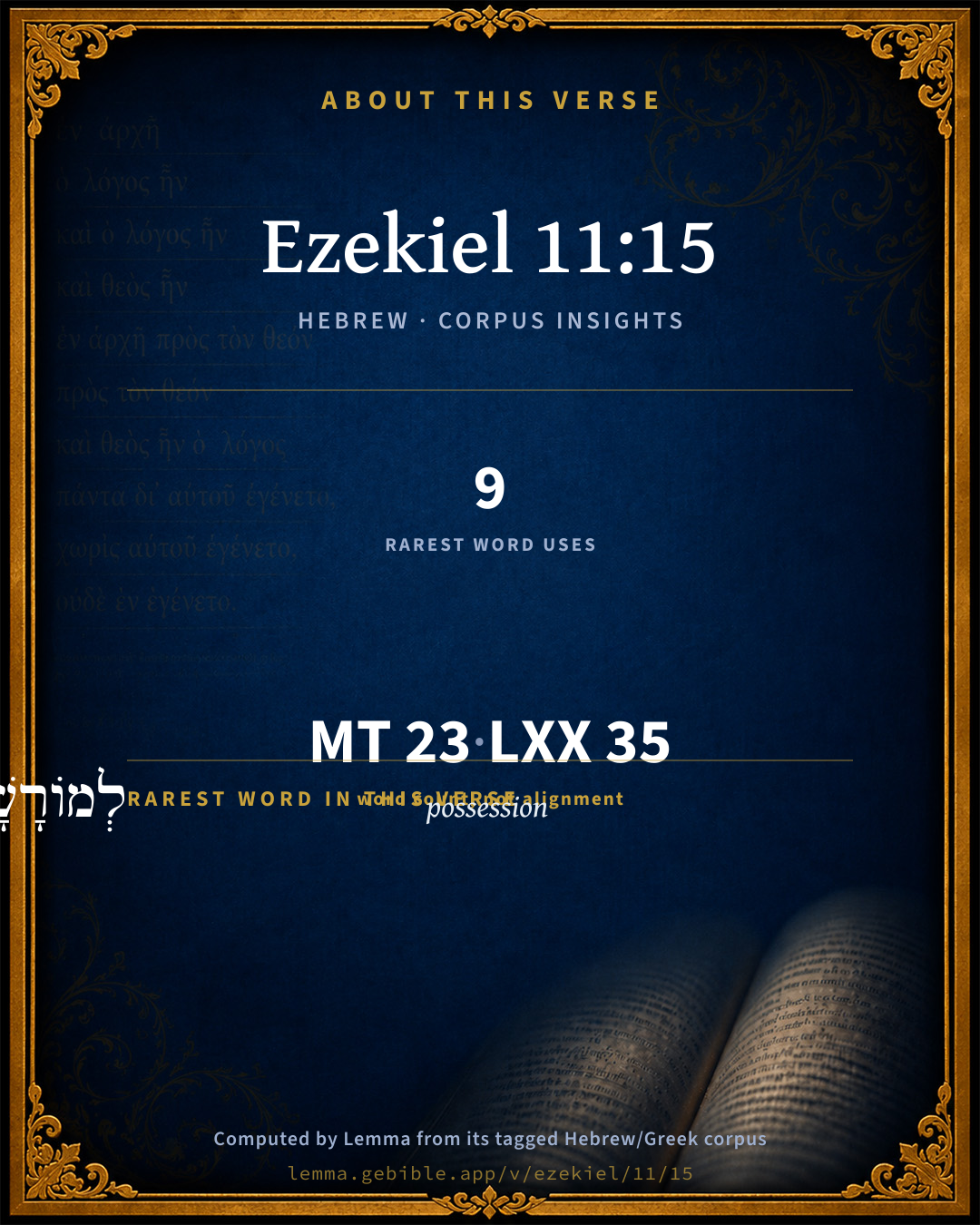
The rarest word here is לְמוֹרָשָֽׁה possession H4181 — appearing just 9 times in the whole Hebrew Bible.

Shared distinctive vocabulary

לְמוֹרָשָֽׁה possession H4181 occurs in 9 verses of the Hebrew Bible. Also found in:

Grammatical profile

  • 4 verbs
  • 14 nouns
  • 1 pronoun
  • 3 prepositions
  • 1 particle

Verb forms

  • אָמְר֨וּ Qal · Perfect
  • יֹשְׁבֵ֣י Qal · Participle Active
  • רַֽחֲקוּ֙ Qal · Imperative
  • נִתְּנָ֥ה Niphal · Perfect

Repetition

Words recur within this verse — often emphatic in Hebrew:

  • אַחֶ֤יךָ brother H251 ×2
  • וְכָל all H3605 ×2

Hebrew & Septuagint length

In English translation the verse runs 46 words from the Hebrew and 45 from the Septuagint (LXX English) — closely comparable.

A rough comparison of the two English renderings, which tokenize alike — not a word-level alignment.

Word counts can differ between the Hebrew and the Greek without any difference in meaning — e.g. the Hebrew direct-object marker אֵת has no separate Greek word, and Greek often adds the article ὁ.

In the original languages it is 23 Hebrew tokens and 35 Greek tokens — but the two are counted differently (Hebrew bundles its prefixes and suffixes into one token; the Greek is in lemma form), so that isn’t a like-for-like length.

Cross-references

5

Topical passages linked to Ezekiel 11:15 in the Treasury of Scripture Knowledge — connected by theme and wording, ordered by reader-vote popularity; previews shown in the World English Bible.

  • Ezekiel 33:24 Son of man, they who inhabit those waste places in the land of Israel speak, saying, Abraham was one, and he inherited the land: but we are many; the land is given us for inheritance.
  • Isaiah 65:5 who say, Stand by yourself, don't come near to me, for I am holier than you. These are a smoke in my nose, a fire that burns all the day.
  • Isaiah 66:5 Hear the word of Yahweh, you who tremble at his word: Your brothers who hate you, who cast you out for my name's sake, have said, Let Yahweh be glorified, that we may see your joy; but it is those who shall be disappointed.
  • Jeremiah 24:1–5 Yahweh shown me, and, behold, two baskets of figs set before the temple of Yahweh, after that Nebuchadrezzar king of Babylon had carried away captive Jeconiah the son of Jehoiakim, king of Judah, and the princes of Judah, with the craftsmen and smiths, from Jerusalem, and had brought them to Babylon.
  • John 16:2 They will put you out of the synagogues. Yes, the time comes that whoever kills you will think that he offers service to God.

Cross-references courtesy of OpenBible.info (CC BY 4.0).

Hebrew and Greek witnesses Masoretic Hebrew ↔ Greek Septuagint

The same verse in the two great witnesses to the Old Testament, shown verse-for-verse.

These are two independent witnesses, not word-aligned to each other, and the Septuagint is shown in lemma (dictionary) form.

Hebrew Ezekiel 11:15 Masoretic · Westminster Leningrad Codex

בֶּן אָדָ֗ם אַחֶ֤יךָ אַחֶ֨יךָ֙ אַנְשֵׁ֣י גְאֻלָּתֶ֔ךָ וְכָל בֵּ֥ית יִשְׂרָאֵ֖ל כֻּלֹּ֑ה אֲשֶׁר֩ אָמְר֨וּ לָהֶ֜ם יֹשְׁבֵ֣י יְרוּשָׁלִַ֗ם רַֽחֲקוּ֙ מֵעַ֣ל יְהוָ֔ה לָ֥נוּ הִ֛יא נִתְּנָ֥ה הָאָ֖רֶץ לְמוֹרָשָֽׁה

Son of man, your brothers, even your brothers, the men of your relatives, and all the house of Israel, all of them, [are they] to whom the inhabitants of Jerusalem have said, Get you far from Yahweh; to us is this land given for a possession.

World English Bible · Public Domain

Greek LXX Ezekiel 11:15 Septuagint · lemma form

υἱός ἄνθρωπος ὁ ἀδελφός σύ καί ὁ ἀνήρ ὁ αἰχμαλωσία σύ καί πᾶς ὁ οἶκος ὁ ἰσραήλ συντελέω ὅς εἶπον αὐτός ὁ καταοἰκέω ἰερουσαλήμ μακράν ἀποἔχω ἀπό ὁ κύριος ἐγώ δίδωμι ὁ γῆ εἰς κληρονομία

Son of man, your brethren, and the men of your captivity, and all the house of Israel are come to the full, to whom the inhabitants of Jerusalem said, Keep you⌃ far away from the Lord: the land is given to us for an inheritance.

LXX2012 (modern English Septuagint) · Public Domain

On this verse, John Gill's Exposition discusses the Septuagint’s reading. Read the note in Commentary ↓

Hebrew: Westminster Leningrad Codex (CC BY 4.0). Greek: Septuagint (public domain); English from LXX2012 (modern English Septuagint) (Public Domain). How the Septuagint differs from the Hebrew →

Targum (Aramaic paraphrase)

1

The Targum is the ancient Jewish Aramaic paraphrase of the Hebrew Scriptures — an interpretive translation, not the Hebrew text itself. Onkelos (literal) and Pseudo-Jonathan (expansive) render the Torah, and Jonathan the Prophets. Coverage is partial: where no permissively-licensed English translation exists for a verse, only the Aramaic is shown. This is verse-level text, not a word-by-word alignment to the Hebrew.

  1. Targum Jonathan Prophets (Joshua–Malachi)
    בַּר אָדָם אֲחַךְ אֲחַךְ אֱנַשׁ קָרִיבָךְ וְכָל בֵּית יִשְׂרָאֵל כּוּלְהוֹן דְאָמְרִין לְהוֹן יַתְבֵי יְרוּשְׁלֵם אִתְרְחָקוּ מִדְחַלְתָּא דַייָ דִילָנָא הִיא אִתְיְהִיבַת אַרְעָא לְמֵירְתָּה:

    (no public-domain English translation for this verse)

    Targum Jonathan — Aramaic: “Mikraot Gedolot” (public domain). English: “Sefaria Community Translation” (CC0 1.0 (public-domain dedication)); “London "Chaldee Paraphrase," 1871” (public domain). Text via Sefaria.

Commentary

Notes on Ezekiel 11:15 from classic Christian and Jewish commentators (each source and its license shown beneath its notes). The classic Christian expositions comment on the surrounding passage and are grouped to its opening verse, so a note may address several verses; the Jewish commentaries on the Tanakh (Rashi and others) are per-verse, so they appear only where the commentator wrote on this verse.

Lemma curates 59 commentaries, every one of them public domain or Creative Commons licensed, each selected and text-cleaned for this edition rather than reprinted as found. About our sources →

Trapp's Complete Commentary

John Trapp

Eze 11:15 Son of man, thy brethren, [even] thy brethren, the men of thy kindred, and all the house of Israel wholly, [are] they unto whom the inhabitants of Jerusalem have said, Get you far from the LORD: unto us is this land given in possession.

Ver. 15. Thy brethren, even thy brethren,] i.e., Thine unbrotherly brethren of Jerusalem seek to unbrother and to unchurch thee and the rest of thy fellow captives. See Isa 65:5. Papists and sectaries deal so by us.

The men of thy kindred.] Viri vindiciarum tuarum, or they that have the right of redemption.

And all the house of Israel.] Tota domus Israelis, quanta quanta est. The Jerusalemites challenged the Lord, and the land, and all therein, to be theirs, excluding, and as it were excommunicating, the captives at Babylon, who were dear to God. So dealt the scribes and Pharisees by the Christians; {Joh 16:2 Act 26:9-11} so did the Rogatian heretics and the Donatists, who gave themselves out, as now the Papists do, to be the only Catholics. The Arians called the orthodox, by way of scorn and contempt, Ambrosians, Athanasians, Homousians, &c.

Get ye far from the Lord.] Gressus removete, profani: Ita in malam crucem: εις κορακας. Ye are cut off from the people of God, and may go whither you will; we are heirs and owners of the promises, ye are outcasts and abjects.

John Trapp, A Commentary or Exposition upon All the Books of the Old and New Testament (1647–1656) — public domain. Text from a community e-Sword module.

Tyndale Open Study Notes

Tyndale Open Resources

11:15-16 Those who remained in the land regarded the exiles as far away from the Lord, with no one to protect their interests in their family land holdings. Relatives (literally men of your redemption) would normally have redeemed Ezekiel’s family property if he fell into debt or other trouble. Since the exiles had been transported as family groups, there was no one left in Judah to guard their inherited properties. • he has given their land to us! Those remaining in the land considered the exiles to be under God’s judgment and their ancestral lands to have been forfeited. The very opposite was true. The future of Israel lay with the far-off exiles, as the Lord had gone into exile with them and would be a sanctuary to them during their time in exile (see 11:22-23).

Tyndale Open Study Notes — © Tyndale Open Resources, licensed CC BY-SA 4.0. Text via the HelloAO Bible API.

Geneva Bible (1599)

Geneva Bible translators

They that remained still at Jerusalem thus reproached them that were gone into captivity, as though they were cast off and forsaken of God.

Geneva Bible (1599) marginal notes — public domain. Text via Bolls.life.

Jamieson, Fausset & Brown

Robert Jamieson, A. R. Fausset & David Brown

thy brethren . . . brethren--The repetition implies, "Thy real brethren" are no longer the priests at Jerusalem with whom thou art connected by the natural ties of blood and common temple service, but thy fellow exiles on the Chebar, and the house of Israel whosoever of them belong to the remnant to be spared.

men of thy kindred--literally, "of thy redemption," that is, the nearest relatives, whose duty it was to do the part of Goel, or vindicator and redeemer of a forfeited inheritance (Lev 25:25). Ezekiel, seeing the priesthood doomed to destruction, as a priest, felt anxious to vindicate their cause, as if they were his nearest kinsmen and he their Goel. But he is told to look for his true kinsmen in those, his fellow exiles, whom his natural kinsmen at Jerusalem despised, and he is to be their vindicator. Spiritual ties, as in the case of Levi (Deu 33:9), the type of Messiah (Mat 12:47-50) are to supersede natural ones where the two clash. The hope of better days was to rise from the despised exiles. The gospel principle is shadowed forth here, that the despised of men are often the chosen of God and the highly esteemed among men are often an abomination before Him (Luk 16:15; Co1 1:26-28). "No door of hope but in the valley of Achor" ("trouble," Hos 2:15), [FAIRBAIRN].

Get you far . . . unto us is this land--the contemptuous words of those left still in the city at the carrying away of Jeconiah to the exiles, "However far ye be outcasts from the Lord and His temple, we are secure in our possession of the land."

Jamieson, Fausset & Brown — Commentary Critical and Explanatory on the Whole Bible (1871) — public domain (CC PDM 1.0). Text via the HelloAO Bible API.

Adam Clarke's Commentary

Verse 15. Get you far from the Lord] These are the words of the inhabitants of Jerusalem, against those of Israel who had been carried away to Babylon with Jeconiah. Go ye far from the Lord: but as for us, the land of Israel is given to us for a possession, we shall never be removed from it, and they shall never return to it.

Adam Clarke's Commentary on the Bible (1810–1826) — public domain. Text from a community e-Sword/MySword module.

Ellicott's Commentary for English Readers

(15) Thy brethren—i.e., those who were with Ezekiel in the Captivity. The expression is made emphatic by repetition, and by the addition, “men of thy kindred.” The people remaining in Jerusalem, with arrogant confidence in themselves, and without sympathy for the exiles, had said to them, by words and by deeds, “We are holier than you; we dwell in the chosen city, we have the Temple, the appointed priesthood and sacrifices, and we have in possession the land of the Church of God; you are outcasts.” The prophet is taught that these despised exiles, deprived of so many privileges, are yet his true brethren, and that he is to regard these as his true kindred rather than the corrupt priests at Jerusalem. In this word there is an allusion to the office of Göel, the next of kin, whose duty it was in every way to assist his impoverished or unfortunate kinsman. Still further, these exiles are called “all the house of Israel wholly; “the others, not these, are cast out, and God will make His people from those who are now undergoing His purifying chastisement. This contrast is carried out in the following verses.

A Bible Commentary for English Readers, edited by Charles John Ellicott (1878–1897) — public domain. Text from a community e-Sword module.

The Cambridge Bible for Schools and Colleges

gen. ed. J. J. S. Perowne

15. the men of thy kindred] Lit. the men of thy redemption. This could only mean, the men to be redeemed, or delivered, by thy intercession—the men for whom thou shouldst pray. Such a sense is difficult to draw from the words. In usage the term has not the meaning of “kindred.” Probably the word should be so read as to mean “exile”—the men of thy exile, i.e. thy fellow captives.

are they unto whom] It is better to regard the first words in the verse down to “wholly” as exclamations: “thy brethren, thy brethren, thy fellow exiles, and all the house of Israel, all of it! they unto whom …” The sentence is not strictly grammatical, but the exclamations give an answer to the prophet’s anxious question, “wilt thou make a full end of the remnant of Israel?” (Eze_11:13). The destruction of them of Jerusalem is no full end; the fellow-exiles of the prophet and all the house of Israel scattered abroad (ch. Eze_4:4, Eze_36:16) remain. The second half of the verse is loosely attached to the first—they to whom, &c.

Get ye far from the Lord] A slight alteration in a point would give the sense: of whom … have said (say), They are far from the Lord. The change is hardly necessary. Those left were in possession of the temple, the abode of Jehovah, and had the assurance of his presence, in which those gone forth had no part, for to go into a foreign land was to come under the dominion of other gods, according to the words of David, “For they have driven me out this day from having part in the inheritance of the Lord, saying, Go serve other gods” (1Sa_26:19, cf. Deu_4:28; Deu_28:36; Deu_28:64; Jer_16:13; Hos_9:3). See ch. Eze_8:12, Eze_9:9, for the expression of a different mood of feeling.

is this land given] is the land. Comp. the expression of similar pretensions, ch. Eze_33:24.

16 seq. Answer of Jehovah. It is true he has scattered the exiles among the nations; but he will again gather them.

The Cambridge Bible for Schools and Colleges (gen. ed. J. J. S. Perowne; Cambridge University Press, 1878–1918) — public domain. Text from a community e-Sword module.

John Gill's Exposition

Son of man, thy brethren, even thy brethren, the men of thy kindred,.... Or, "of thy redemption" (l); to whom the right of redemption of his lands and possessions belonged, as it did to those that were next akin. The Septuagint, by a mistake of the word, render it, "the men of thy captivity"; and so the Syriac and Arabic versions, following them. It is true those were his fellow captives who are here meant; some of them that were carried captive were his brethren by blood, and all by nation and religion; and these phrases, and the repetition, of them, are designed not only to excite the prophet's attention to, and to assure them of what is after declared; but to take off his concern for the inhabitants of Jerusalem, who had used his brethren ill, and to turn his thoughts and affections towards his friends in Chaldea. Kimchi thinks that these three expressions refer to three captivities; the captivity of the children of Gad and Reuben; the captivity of Samaria, or the ten tribes; and the captivity of Jehoiachin. It follows,

and all the house of Israel wholly are they; or,

"all the house of Israel, all of them,''

as the Targum; that is, all the whole house of Israel. The Septuagint render it, "all the house of Israel is made an end of"; the Syriac version, "shall be blotted out"; and the Arabic version, "shall be cut off"; all wrong; since these words are not a threatening to the ten tribes, or those of the Jews in captivity, for all that follows is in favour of them; but only point at the persons the prophet is turned unto, and who are the subject of the following discourse. A colon, or at least a semicolon, should be here put; since the accent "athnach" is upon the last word;

unto whom the inhabitants of Jerusalem have said, get ye far from the Lord; Kimchi interprets it, from the land of the Lord, the holy land; they being carried captive into a foreign country. The Targum is,

"from the fear of the Lord;''

the worship of the Lord; they being at a distance from the temple, and the service of it. These words are an insult of the inhabitants of Jerusalem upon the captives, suggesting that they were great sinners, and for their sins were taken away from their own land, and carried to Babylon; and that they deserved to be excommunicated from the house and people of God, and were so; and indeed this is a kind of a form of excommunication of them:

unto us is this land given in possession; you have forfeited your right to it, and are disinherited; we are sole heirs, and in the possession of it, and shall ever continue in it. The Syriac version reads this and the preceding clause as if they were the word of the Israelites to the inhabitants of Jerusalem, thus;

"because they said to them, O inhabitants of Jerusalem, depart from the Lord, for unto us is given this land for an inheritance.''

The Arabic version indeed makes them to be the words of the inhabitants of Jerusalem, but render the last clause thus; "to you" (that is, "the Israelites") "is given the land for an inheritance".

(l) "viri redemptionis tua", Montanus, Heb. "viri redempturae tuae", Piscator.

John Gill's Exposition of the Whole Bible (1746–1763) — public domain (CC PDM 1.0). Text via the HelloAO Bible API.

Albert Barnes' Notes on the Bible

Thy kindred - The original word is derived from a root, suggesting the ideas of “redeeming” and “avenging” as connected with the bond of “kindred.” The word, therefore, conveys here a special reproach to the proud Jews, who have been so ready to cast off the claims of blood-relationship, and at the same time a hope of restoration to those who have been rudely thrown aside.

Albert Barnes' Notes on the Bible (1834–1885) — public domain. Text from a community e-Sword/MySword module.

Haydock's Catholic Bible Commentary

Thy brethren, &c. He speaks of them that had been carried away captives before, who were despised by them that remained in Jerusalem; but, as the prophet here declares to them from God, should be in a more happy condition than they, and after some time return from their captivity. (Challoner) --- David had been insulted in like manner, 1 Kings xxvi. 19. (Calmet)

George Leo Haydock (1774–1849), Haydock's Catholic Family Bible and Commentary, 1859 edition — public domain. Excludes Psalms (Douay-Rheims chapter numbering differs from Protestant) and Deuterocanonical books (Catholic canon only).

Matthew Poole's English Annotations

Son of man: see Eze 2:1.

Thy brethren; thy nearest kindred, which it seems were left in Jerusalem, and were grown as bad as the rest, though theirs were of a priestly lineage. Their degeneracy and unjust censure is more noted in the repetition of the word brethren.

Of thy kindred; of the same parentage, to whom thou hadst right of redemption, if either their person or estate was to be sold; men who should have been as tender in affection as they were near in blood.

All the house of Israel; all that are now in captivity, be they more or less, of whatsoever condition and rank, these are the men of whom the Jerusalemites speak.

Have said; that is, censure and condemn as greatest sinners, and unworthy longer to dwell in the holy land, and tacitly infer that they were better, and should be safer now they were rid of them.

Get you far from the Lord; ye, or they, are gone far from the Lord; you are apostates, or irreligious, a company of backsliders: much as the heathens accused the Christians of atheism.

Unto us; who keep to the temple and holy city, and have not yielded to the Babylonish tyranny, who stand for our ancient privileges, are not, as you, betrayers of our country: thus you may suppose they boast.

This land; promised, holy, blest land, Canaan, where our fathers dwelt. This land is ours.

Given in possession; we shall never be put out of possession, but still it shall be our inheritance.

Matthew Poole's English Annotations on the Holy Bible (1683–1685) — public domain. Text from a community e-Sword/MySword module.

Whedon's Commentary on the Bible

Daniel D. Whedon

15. The men of thy kindred, etc. — The verse is very difficult, but should probably be translated: “Son of man, [behold] thy brethren! thy brethren, then, men of thy redemption and the whole house of Israel, the whole of it, even they, of whom the inhabitants of Jerusalem have said, They are from the Lord: unto us is the land given in possession.” The word “kindred” is literally “redemption,” and the “men of thy redemption” would mean the men who could be delivered by his intercessory prayers. The LXX. and the Peshito give, however, another reading, “the men of thy captivity;” that is, fellow-exiles. Jehovah, in his answer to Ezekiel’s cry of protest against making a full end of the house of Israel, assures the prophet that even if all the population of Jerusalem is destroyed, there will still be a “remnant” left. The real house of Israel can no longer be found in the holy city. The Jerusalemites boast that they are the true Israel, since they have the temple and the Lord of the temple with them (Eze_33:24), but the fact is that the Lord of the temple has gone with the captives into Babylon and will himself be to them both Lord and sanctuary.

Daniel D. Whedon (gen. ed.), Commentary on the Old and New Testaments (1874–1909) — public domain. Text from a community e-Sword module.

The Pulpit Commentary

The men of thy kindred, etc. The full force of the phrase can hardly be understood without remembering that the word for "kindred" implies the function and office of a goel, the redeemer and avenger of those among his relations who had suffered wrong (Lev_25:25, Lev_25:48; Num_5:8) and the point of the revelation is that Ezekiel is to find those who have this claim on him, his true "brethren," not only or chiefly in his natural relations in the priesthood, but in the companions of his exile (the LXX, following a different reading, gives, "the men of the Captivity"), and the whole house of Israel, who were in a like position, who were condemned by those who had been left in Jerusalem. As in Jeremiah"s vision, (Jer_24:1) they were the "good figs;" those in the city, the vile and worthless. They were the remnant, the residue, for whom there was a hope of better things. They were despised as far off from the Lord. They were really nearer to his presence than those who worshipped in the temple from which Jehovah had departed. Ewald and Smend take the words as indicative: "Ye are far," etc.

The Pulpit Commentary (1880–1919), ed. H.D.M. Spence-Jones & Joseph S. Exell — public domain. Text from a community e-Sword module.

John Wesley's Explanatory Notes

Thy brethren -- thy nearest kindred, which it seems were left in Jerusalem. Their degeneracy is more noted in the repetition of the word brethren. Gone far - Ye are gone far from the Lord; as much as the Heathens accused the Christians of atheism.

John Wesley, Explanatory Notes Upon the Whole Bible (1754–1765) — public domain. Text via the GEBible commentary corpus.

Rashi

Rabbi Shlomo Yitzchaki (Rashi)

Your brethren, your brethren The exile of Samaria and the exile of Jeconiah.

and the entire house of Israel who have gone into exile.

to whom...said About whom theythe dwellers of Jerusalem who have not been exiled with Jeconiah, over whom Nebuchadnezzar enthroned Zedekiahsaid. Now they ridicule their brethren who have been exiled, and say about them, “They have distanced themselves from the Lord.”

Rashi on the Tanakh — English translations: “The Judaica Press complete Tanach with Rashi, translated by A. J. Rosenberg” (CC BY 4.0); “Pentateuch with Rashi's commentary by M. Rosenbaum and A.M. Silbermann, 1929-1934” (public domain); “The Metsudah Tanach series, Lakewood, N.J” (CC BY 4.0); and “The Book of Joshua, Metsudah Publications, 1997” (CC BY 4.0). Text via Sefaria.

Lesson kit

Teaching starters — assembled from the data on this page, not authored interpretation. Every prompt links to the verse data it draws on. Edit before teaching.

Ezekiel, in the Prophets, opens this verse with 23 words (19 distinct Hebrew lemmas). Its most distinctive word is môwrâshâh (“possession”). A historical commentator’s framing appears above. Read the whole chapter for the surrounding context.

Discussion questions

  1. How does “possession” (môwrâshâh) shape what this verse is saying?
  2. How does Exodus 6:8, which shares the word «possession», read alongside this verse?
  3. What does the repetition of “brother” (2× in this one verse) do in this verse?
  4. The translations on this page render this verse differently — a whole-verse word diff, not a word-by-word alignment. What might account for the different wordings?
  5. «אָמְר֨וּ» is a Qal Perfect verb. How does that grammatical form shape the action described?
  6. Compare how Trapp's Complete Commentary and Tyndale Open Study Notes read this verse. Where do they agree or differ?

Things to notice

Reading settings

Reading text

Shown beneath each verse's original-language words.

Old Testament
Old Testament edition

Read the OT as the Masoretic Hebrew (MT) or the Greek Septuagint (LXX).

English shown for the Greek Septuagint (in the Hebrew ↔ Greek comparison).

Comparing translations? Open the Compare panel on any verse page to stack up to four side by side.