Isaiah 65:19

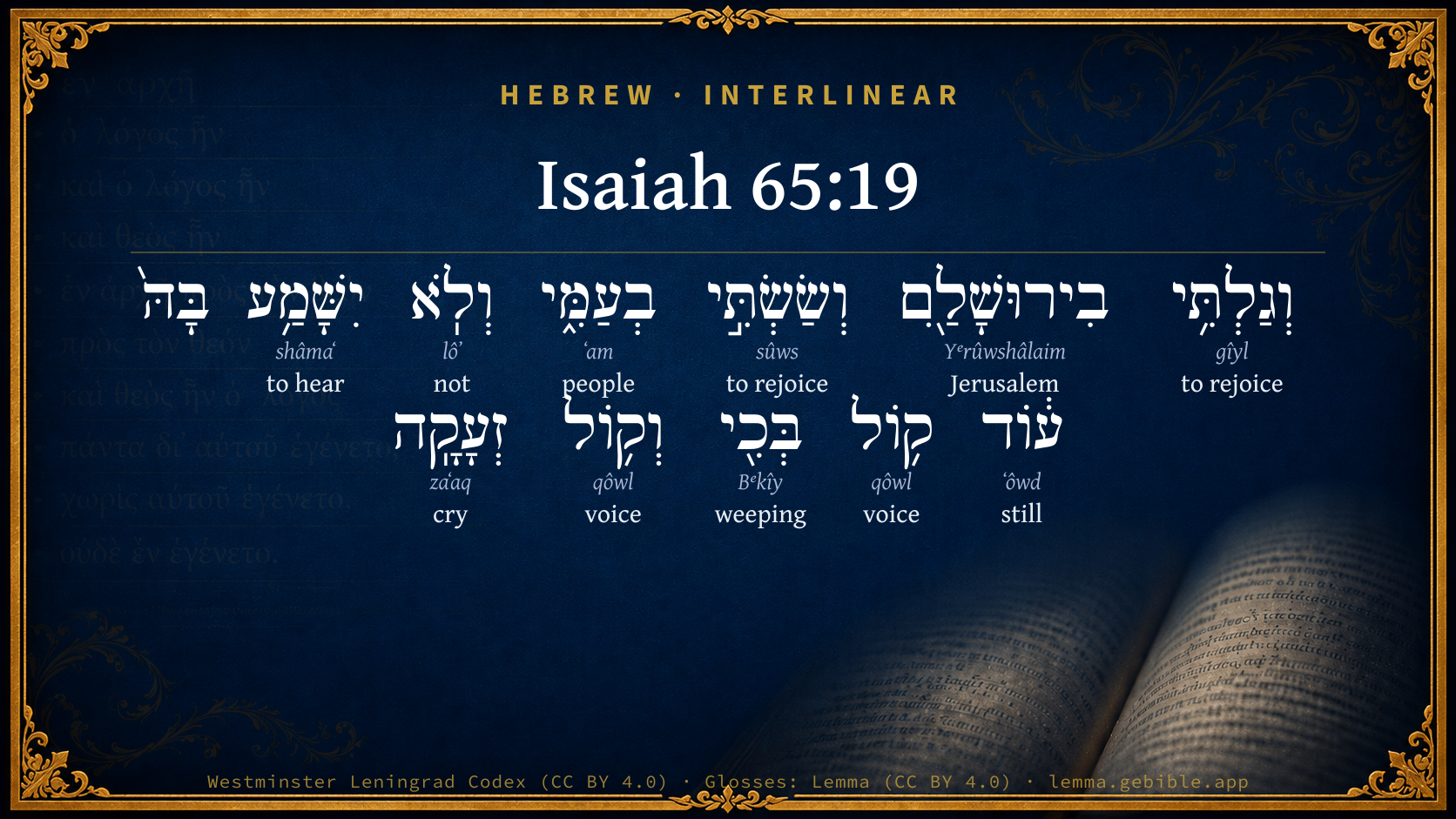
Hebrew (Westminster Leningrad Codex) Isaiah 65:19 appears in the Hebrew Old Testament. The text above is from the Westminster Leningrad Codex. Each word links to its Strong’s number, a concise gloss, and parsing drawn from the Open Scriptures Hebrew Bible morphology. Click any word for its full Brown-Driver-Briggs (BDB) entry.
Download image
Cite this verse

Isaiah 65:19 (World English Bible). Public Domain. Lemma interlinear Bible study tool, https://lemma.gebible.app/v/isaiah/65/19.

Show BibTeX & RIS
BibTeX
RIS
English Translation
I will rejoice in Jerusalem, and joy in my people; and there shall be heard in her no more the voice of weeping and the voice of crying.
World English Bible · Public Domain
Download a study sheet

One document with this verse’s original text, its word-by-word gloss line, the meaning frame, cross-references with their text, attributed commentary, and full source and license credits — printable, and it pastes into notes with its structure intact.

This verse Autodidact and up

Study sheet (.html) Plain text (.txt)

A passage Seminary Student

Up to 50 verses in one chapter. A passage sheet keeps up to 6 commentary sources and 12 cross-references per verse, in the order this page ranks them, and says so on the sheet whenever that leaves anything out. Ask for a single verse and you get the Autodidact verse sheet above.

Everything on this page stays free to read, with no account — the sheet is a download of what is already on screen, not access to it.

Want to remove ads? Support Godless Engineer
Compare translations 3

The same verse in 3 English versions, stacked beneath the original-language interlinear above. Click any original word for its lexicon entry.

Each is an independent rendering of the whole verse — the interlinear is not word-aligned to these translations.

Highlighted words mark where these versions differ — a whole-verse word diff, not a word-by-word alignment.

  • World English Bible Public Domain
    I will rejoice in Jerusalem, and joy in my people; and there shall be heard in her no more the voice of weeping and the voice of crying.
  • King James Version Public Domain
    And I will rejoice in Jerusalem, and joy in my people: and the voice of weeping shall be no more heard in her, nor the voice of crying.
  • unfoldingWord Literal Text CC BY-SA 4.0
    And I will be glad about Jerusalem, and I will rejoice in my people, and the sound of weeping and the sound of an outcry will no longer be heard in it. q1

unfoldingWord Literal Text — © unfoldingWord, licensed CC BY-SA 4.0. Word-aligned USFM3 via Door43 (git.door43.org/unfoldingWord/en_ult).

Versions to compare (up to 4)

3 of 4 selected

Show all 18 translations

Every available English version of this verse, each an independent rendering of the whole verse.

  • World English Bible Public Domain
    I will rejoice in Jerusalem, and joy in my people; and there shall be heard in her no more the voice of weeping and the voice of crying.
  • Berean Standard Bible Public Domain
    I will rejoice in Jerusalem and take delight in My people. The sounds of weeping and crying will no longer be heard in her.
  • Majority Standard Bible Public Domain
    I will rejoice in Jerusalem and take delight in My people. The sounds of weeping and crying will no longer be heard in her.
  • King James Version Public Domain
    And I will rejoice in Jerusalem, and joy in my people: and the voice of weeping shall be no more heard in her, nor the voice of crying.
  • American Standard Version (1901) Public Domain
    And I will rejoice in Jerusalem, and joy in my people; and there shall be heard in her no more the voice of weeping and the voice of crying.
  • Revised Version (1885) Public Domain
    And I will rejoice in Jerusalem, and joy in my people: and the voice of weeping shall be no more heard in her, nor the voice of crying.
  • Geneva Bible (1599) Public Domain
    And I wil reioyce in Ierusalem, and ioye in my people, and the voyce of weeping shall be no more heard in her, nor the voyce of crying.
  • Douay-Rheims (1899) Public Domain
    And I will rejoice in Jerusalem, and joy in my people, and the voice of weeping shall no more be heard in her, nor the voice of crying.
  • Young's Literal Translation Public Domain
    And I have rejoiced in Jerusalem, And have joyed in My people, And not heard in her any more Is the voice of weeping, and the voice of crying.
  • Literal Standard Version CC BY-SA 4.0
    And I have rejoiced in Jerusalem, || And have rejoiced in My people, || And the voice of weeping is not heard in her anymore, and the voice of crying.
  • Unlocked Literal Bible CC BY-SA 4.0
    I will rejoice over Jerusalem and be glad over my people; weeping and cries of distress will no longer be heard in her.
  • unfoldingWord Literal Text CC BY-SA 4.0
    And I will be glad about Jerusalem, and I will rejoice in my people, and the sound of weeping and the sound of an outcry will no longer be heard in it. q1
  • Darby Bible Public Domain
    And I will rejoice over Jerusalem, and will joy in my people; and the voice of weeping shall be no more heard in her, nor the voice of crying.
  • World Messianic Bible Public Domain
    I will rejoice in Jerusalem, and delight in my people; and the voice of weeping and the voice of crying will be heard in her no more.
  • Webster's Bible Public Domain
    And I will rejoice in Jerusalem, and joy in my people: and the voice of weeping shall be no more heard in her, nor the voice of crying.
  • Free Bible Version CC BY-SA 4.0
    I will be so happy over Jerusalem; I will celebrate among my people. The sound of weeping and cries for help won't ever be heard there again.
  • Bible in Basic English Public Domain
    And I will be glad over Jerusalem, and have joy in my people: and the voice of weeping will no longer be sounding in her, or the voice of grief.
  • JPS Tanakh (1917) Public Domain
    And I will rejoice in Jerusalem, and joy in My people; and the voice of weeping shall be no more heard in her, nor the voice of crying.

Literal Standard Version (2020), Covenant Press — licensed CC BY-SA 4.0. Text via the HelloAO Bible API (eBible.org). Unlocked Literal Bible (unfoldingWord) — licensed CC BY-SA 4.0. Text via the HelloAO Bible API (eBible.org). unfoldingWord Literal Text — © unfoldingWord, licensed CC BY-SA 4.0. Word-aligned USFM3 via Door43 (git.door43.org/unfoldingWord/en_ult). Free Bible Version, Dr. Jonathan Gallagher — licensed CC BY-SA 4.0. Text via the HelloAO Bible API (eBible.org).

Word by word

More ways to search: Search by grammar → Find every occurrence → Compare this word →

Practice this passage: Drill this verse → Learn its vocabulary →

זְעָקָֽה
zaʻaq
H2201
“cry”
Noun, Common, Feminine, Singular, Absolute
Part of Speech
Noun
Type
Common
Gender
Feminine
Number
Singular
State
Absolute
Full BDB Definition

Origin: from H2199

TWOT: 570a

cry, outcry - outcry - cry of distress - outcry, clamour
  1. וְגַלְתִּ֥י gîyl H1523 “and · to rejoice” Conjunction + Verb, Qal, Sequential Perfect, 1st Person, Common, Singular
  2. בִירוּשָׁלִַ֖ם Yᵉrûwshâlaim H3389 “in/at · Jerusalem” Preposition + Noun, Proper
  3. וְשַׂשְׂתִּ֣י sûws H7797 “and · to rejoice” Conjunction + Verb, Qal, Sequential Perfect, 1st Person, Common, Singular
  4. בְעַמִּ֑י ʻam H5971 “in/at · people · my” Preposition + Noun, Common, Masculine, Singular, Construct + Suffix, Personal, 1st Person, Common, Singular
  5. וְלֹֽא lôʼ H3808 “and · not” Conjunction + Particle, Negative
  6. יִשָּׁמַ֥ע shâmaʻ H8085 “to hear” Verb, Niphal, Imperfect, 3rd Person, Masculine, Singular
  7. ע֔וֹד ʻôwd H5750 “still” Adverb
  8. ק֥וֹל qôwl H6963 “voice of” Noun, Common, Masculine, Singular, Construct
  9. בְּכִ֖י Bᵉkîy H1065 “weeping” Noun, Common, Masculine, Singular, Absolute
  10. וְק֥וֹל qôwl H6963 “and · voice of” Conjunction + Noun, Common, Masculine, Singular, Construct

About this verse

These counts appear in no published source. They are computed here, from the morphology-tagged text and Lemma’s own curated glosses. What Lemma adds →

12
words
10
distinct lemmas
Prophets
section

Notable vocabulary

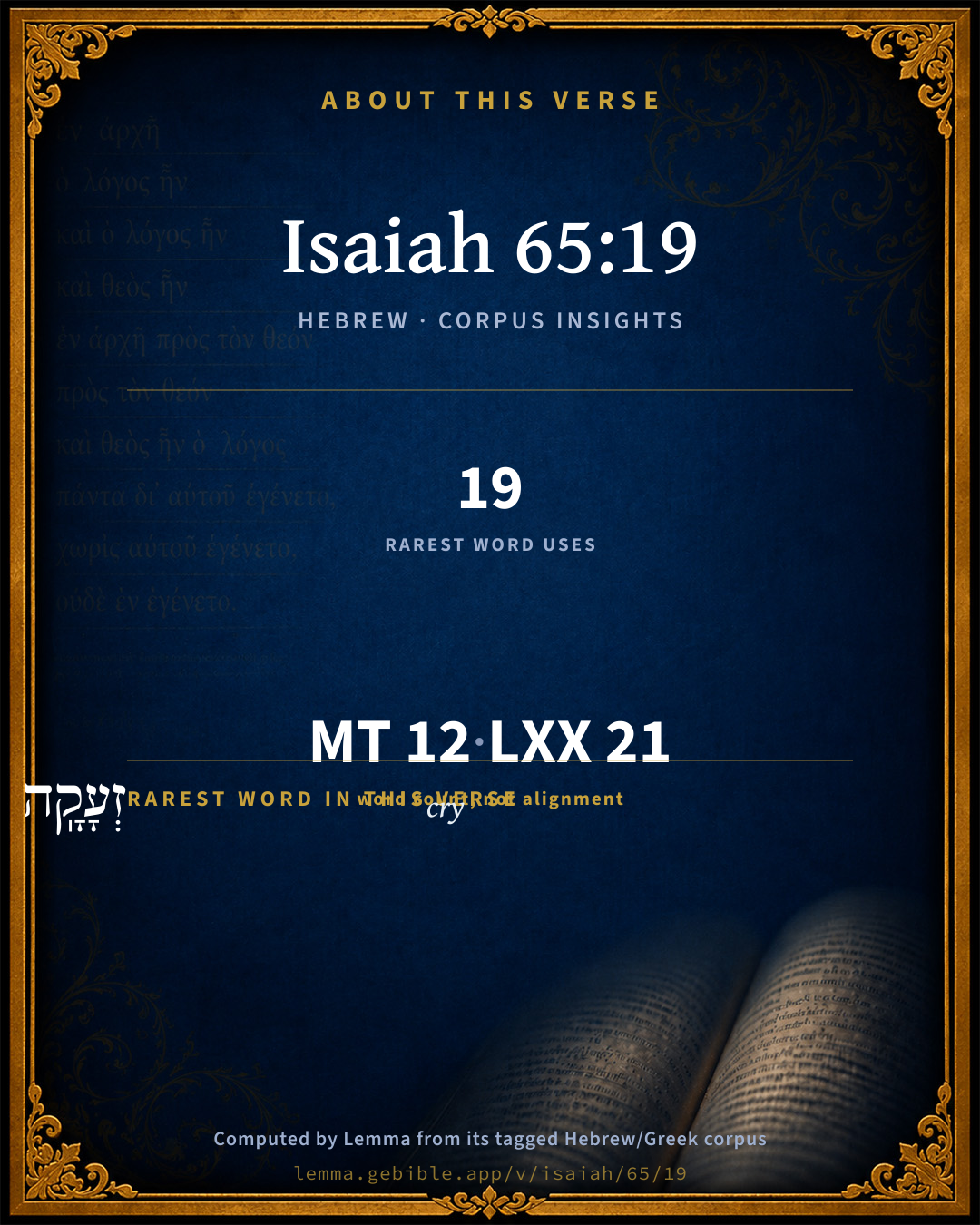
The rarest word here is זְעָקָֽה cry H2201 — appearing just 19 times in the whole Hebrew Bible.

Shared distinctive vocabulary

זְעָקָֽה cry H2201 occurs in 19 verses of the Hebrew Bible. Also found in:

Grammatical profile

  • 3 verbs
  • 6 nouns
  • 1 preposition
  • 1 adverb
  • 1 particle

Verb forms

  • וְגַלְתִּ֥י Qal · Sequential Perfect
  • וְשַׂשְׂתִּ֣י Qal · Sequential Perfect
  • יִשָּׁמַ֥ע Niphal · Imperfect

Repetition

A word recurs within this verse — often emphatic in Hebrew:

  • ק֥וֹל voice H6963 ×2

Hebrew & Septuagint length

In English translation the verse runs 28 words from the Hebrew and 31 from the Septuagint (LXX English) — closely comparable.

A rough comparison of the two English renderings, which tokenize alike — not a word-level alignment.

Word counts can differ between the Hebrew and the Greek without any difference in meaning — e.g. the Hebrew direct-object marker אֵת has no separate Greek word, and Greek often adds the article ὁ.

In the original languages it is 12 Hebrew tokens and 21 Greek tokens — but the two are counted differently (Hebrew bundles its prefixes and suffixes into one token; the Greek is in lemma form), so that isn’t a like-for-like length.

Cross-references

14

Topical passages linked to Isaiah 65:19 in the Treasury of Scripture Knowledge — connected by theme and wording, ordered by reader-vote popularity; previews shown in the World English Bible.

  • Revelation 21:4 He will wipe away from them every tear from their eyes. Death will be no more; neither will there be mourning, nor crying, nor pain, any more. The first things have passed away."
  • Isaiah 25:8 He has swallowed up death forever; and the Lord Yahweh will wipe away tears from off all faces; and the reproach of his people will he take away from off all the earth: for Yahweh has spoken it.
  • Revelation 7:17 for the Lamb who is in the midst of the throne shepherds them, and leads them to springs of waters of life. And God will wipe away every tear from their eyes."
  • Isaiah 35:10 and the ransomed of Yahweh shall return, and come with singing to Zion; and everlasting joy shall be on their heads: they shall obtain gladness and joy, and sorrow and sighing shall flee away.
  • Jeremiah 32:41 Yes, I will rejoice over them to do them good, and I will plant them in this land assuredly with my whole heart and with my whole soul.
  • Isaiah 51:3 For Yahweh has comforted Zion; he has comforted all her waste places, and has made her wilderness like Eden, and her desert like the garden of Yahweh; joy and gladness shall be found therein, thanksgiving, and the voice of melody.
  • Isaiah 51:11 The ransomed of Yahweh shall return, and come with singing to Zion; and everlasting joy shall be on their heads: they shall obtain gladness and joy; [and] sorrow and sighing shall flee away.
  • Isaiah 60:20 Your sun shall no more go down, neither shall your moon withdraw itself; for Yahweh will be your everlasting light, and the days of your mourning shall be ended.
  • Isaiah 62:4–5 You shall no more be termed Forsaken; neither shall your land any more be termed Desolate: but you shall be called Hephzibah, and your land Beulah; for Yahweh delights in you, and your land shall be married.
  • Zephaniah 3:17 Yahweh, your God, is in the midst of you, a mighty one who will save. He will rejoice over you with joy. He will rest in his love. He will rejoice over you with singing.
  • Song of Solomon 3:11 Go forth, you daughters of Zion, and see king Solomon, With the crown with which his mother has crowned him, In the day of his weddings, In the day of the gladness of his heart. Lover
  • Jeremiah 31:12 They shall come and sing in the height of Zion, and shall flow to the goodness of Yahweh, to the grain, and to the new wine, and to the oil, and to the young of the flock and of the herd: and their soul shall be as a watered garden; and they shall not sorrow any more at all.
  • Luke 15:5 When he has found it, he carries it on his shoulders, rejoicing.
  • Luke 15:3 He told them this parable.

Cross-references courtesy of OpenBible.info (CC BY 4.0).

Hebrew and Greek witnesses Masoretic Hebrew ↔ Greek Septuagint

The same verse in the two great witnesses to the Old Testament, shown verse-for-verse.

These are two independent witnesses, not word-aligned to each other, and the Septuagint is shown in lemma (dictionary) form.

Hebrew Isaiah 65:19 Masoretic · Westminster Leningrad Codex

וְגַלְתִּ֥י בִירוּשָׁלִַ֖ם וְשַׂשְׂתִּ֣י בְעַמִּ֑י וְלֹֽא יִשָּׁמַ֥ע בָּהּ֙ ע֔וֹד ק֥וֹל בְּכִ֖י וְק֥וֹל זְעָקָֽה

I will rejoice in Jerusalem, and joy in my people; and there shall be heard in her no more the voice of weeping and the voice of crying.

World English Bible · Public Domain

Greek LXX Isaiah 65:19 Septuagint · lemma form

καί ἀγαλλιάομαι ἐπί ἰερουσαλήμ καί εὐφραίνω ἐπί ὁ λαός ἐγώ καί οὐκέτι μή ἀκούω ἐν αὐτός φωνή κλαυθμός οὐδέ φωνή κραυγή

And I will rejoice in Jerusalem, and will be glad in my people: and there shall no more be heard in her the voice of weeping, or the voice of crying.

LXX2012 (modern English Septuagint) · Public Domain

Hebrew: Westminster Leningrad Codex (CC BY 4.0). Greek: Septuagint (public domain); English from LXX2012 (modern English Septuagint) (Public Domain). How the Septuagint differs from the Hebrew →

Targum (Aramaic paraphrase)

1

The Targum is the ancient Jewish Aramaic paraphrase of the Hebrew Scriptures — an interpretive translation, not the Hebrew text itself. Onkelos (literal) and Pseudo-Jonathan (expansive) render the Torah, and Jonathan the Prophets. Coverage is partial: where no permissively-licensed English translation exists for a verse, only the Aramaic is shown. This is verse-level text, not a word-by-word alignment to the Hebrew.

  1. Targum Jonathan Prophets (Joshua–Malachi)
    וַאֲבוּעַ בִּירוּשְׁלֵם וְיֶחְדוּן בָהּ עַמִי וְלָא יִשְׁתְּמַע בָּהּ עוֹד קַל דְבָכָן וְקַל דִמְצַוְחִין:

    And I will rejoice in Jerusalem, and my people shall be glad in her: and the voice of weeping shall be no more heard in her, nor the voice of those that cry.

    Targum Jonathan — Aramaic: “Mikraot Gedolot” (public domain). English: “Sefaria Community Translation” (CC0 1.0 (public-domain dedication)); “London "Chaldee Paraphrase," 1871” (public domain). Text via Sefaria.

Commentary

Notes on Isaiah 65:19 from classic Christian and Jewish commentators (each source and its license shown beneath its notes). The classic Christian expositions comment on the surrounding passage and are grouped to its opening verse, so a note may address several verses; the Jewish commentaries on the Tanakh (Rashi and others) are per-verse, so they appear only where the commentator wrote on this verse.

Lemma curates 59 commentaries, every one of them public domain or Creative Commons licensed, each selected and text-cleaned for this edition rather than reprinted as found. About our sources →

Trapp's Complete Commentary

John Trapp

Isa 65:19 And I will rejoice in Jerusalem, and joy in my people: and the voice of weeping shall be no more heard in her, nor the voice of crying.

Ver. 19. And I will rejoice in Jerusalem.] Well may Jerusalem then rejoice in God, who as in all her afflictions he is afflicted, so he taketh pleasure in the prosperity of his people.

And the voice of weeping.] See Isa 35:10; Isa 51:12 Rev 21:4.

John Trapp, A Commentary or Exposition upon All the Books of the Old and New Testament (1647–1656) — public domain. Text from a community e-Sword module.

Jamieson, Fausset & Brown

Robert Jamieson, A. R. Fausset & David Brown

(Isa 62:5).

weeping . . . no more-- (Isa 25:7-8; Isa 35:10; Rev 7:17; Rev 21:4), primarily, foretold of Jerusalem; secondarily, of all the redeemed.

Jamieson, Fausset & Brown — Commentary Critical and Explanatory on the Whole Bible (1871) — public domain (CC PDM 1.0). Text via the HelloAO Bible API.

Adam Clarke's Commentary

Verse 19. The voice of weeping, c.] "Because of untimely deaths shall no more be heard in thee for natural death shall not happen till men be full of days; as it is written, Isa 65:20: There shall be no more thence an infant of days, i.e., the people shall live to three or five hundred years of age, as in the days of the patriarchs; and if one die at one hundred years, it is because of his sin; and even at that age he shall be reputed an infant; and they shall say of him, An infant is dead. These things shall happen to Israel in the days of the Messiah." - Kimchi.

Adam Clarke's Commentary on the Bible (1810–1826) — public domain. Text from a community e-Sword/MySword module.

The Cambridge Bible for Schools and Colleges

gen. ed. J. J. S. Perowne

19. God Himself rejoices in the new city and people; cf. Isa_62:5.

and the voice of weeping &c.] Cf. ch. Isa_25:8, Isa_35:10.

The Cambridge Bible for Schools and Colleges (gen. ed. J. J. S. Perowne; Cambridge University Press, 1878–1918) — public domain. Text from a community e-Sword module.

John Gill's Exposition

And I will rejoice in Jerusalem, and joy in my people,.... God himself rejoices in his people, as they are considered in Christ; so he did from all eternity, and so he does at the conversion of them; which is the day of their espousals, and when he manifests his love to them, and rejoices over them to do them good, and continues to do so; and he rejoices in the exercise of his own grace in them, and will do so throughout the New Jerusalem state, and to all eternity. This seems chiefly to respect the time of the Jews' conversion, and the latter day glory; and will have its most complete accomplishment when the tabernacle of God shall be with men, and he shall dwell among them. Rev 20:3, and then what follows will be perfectly fulfilled,

and the voice of weeping shall be no more heard in her, nor the voice of crying; either on account of outward afflictions and persecutions; or on account of inward darkness, desertion, and temptation, or the prevalence of corruptions, Rev 21:4.

John Gill's Exposition of the Whole Bible (1746–1763) — public domain (CC PDM 1.0). Text via the HelloAO Bible API.

Albert Barnes' Notes on the Bible

And I will rejoice in Jerusalem - (See the notes at Isa 62:5).

And the voice of weeping shall no more be heard - (See the notes at Isa 25:7-8).

Albert Barnes' Notes on the Bible (1834–1885) — public domain. Text from a community e-Sword/MySword module.

Matthew Poole's English Annotations

The nature of joy lying in the satisfaction and. well pleasedness of the soul in the obtaining of the thing it hath willed, agreeth unto God, and joy and rejoicing are applied to him, Isa 62:5, and in this text; so also Jer 32:41; Zep 3:17.

The voice of weeping shall be no more heard in her, nor the voice of crying: such kind of promises are to be found Isa 35:10; 51:11; Jer 31:12; Rev 21:4, which must be understood either comparatively, they shall endure no such misery as formerly; or (if interpreted to a state in this life) as signifying only some long or eminent state of happiness; if as to another life, they may be taken strictly, as signifying perpetuity and perfection of joy and happiness.

Matthew Poole's English Annotations on the Holy Bible (1683–1685) — public domain. Text from a community e-Sword/MySword module.

The Pulpit Commentary

The voice of weeping shall be no more heard. (comp. Rev_21:4) The reasons there given are satisfactory: "There shall be no more death, neither sorrow... neither shall there be any more pain." But these reasons scarcely apply here. For Isaiah"s "new Jerusalem" is not without death (ver. 20), nor without sorrow, since it is not without sin (ver. 20), nor, as there is death there, is it without pain. Isaiah"s picture, according to Delitzsch, represents the millennial state, not the final condition of the redeemed; but this trait the absence of all weeping can only be literally true of the final state.

The Pulpit Commentary (1880–1919), ed. H.D.M. Spence-Jones & Joseph S. Exell — public domain. Text from a community e-Sword module.

J. A. Alexander on Isaiah

Joseph Addison Alexander

“And I will rejoice in Jerusalem, and joy in, my people; and there shall not be heard in her again the voice of weeping and the voice of crying.” Considered as the language of the Prophet himself, this would express his sympathetic interest in the joyous changes which awaited his people. But such an application would be wholly arbitrary, as Jehovah is undoubtedly the speaker in the foregoing verse, where He claims creative power; and even here there is an implication of divine authority in the promise that weeping shall no more be heard in her. There is something very beautiful in the association of ideas here expressed. God shall rejoice in His people, and they shall rejoice with Him. They shall no longer know what grief is, because He shall cease to grieve over them; their former distresses shall be forgotten by them and forever hidden from His eyes.

Joseph Addison Alexander, The Prophecies of Isaiah (1846–1847; New York: Scribner, 1870–1878) — public domain. Text from a community e-Sword module.

Ibn Ezra

Rabbi Abraham ibn Ezra

The voice of weeping for one that is slain, or dies too early, as explained in the next verse.

Ibn Ezra on the Tanakh — English translations: “Sefaria Community Translation” (CC0 1.0 (public-domain dedication)); “Yalkut, Sifsei Chachomim Chumash, Metsudah Publications, 2009” (CC BY 4.0); and “Commentary of Ibn Ezra on Isaiah - trans. by M. Friedlander, 1873” (public domain). Text via Sefaria.

Lesson kit

Teaching starters — assembled from the data on this page, not authored interpretation. Every prompt links to the verse data it draws on. Edit before teaching.

Isaiah, in the Prophets, opens this verse with 12 words (10 distinct Hebrew lemmas). Its most distinctive word is zaʻaq (“cry”). A historical commentator’s framing appears above. Read the whole chapter for the surrounding context.

Discussion questions

  1. The word zaʻaq carries the sense “cry.” How does it shape the verse?
  2. Genesis 18:20 shares the word «cry» with this verse. How do the two illuminate each other?
  3. “voice” occurs 2× in this one verse. What is the effect of the repetition?
  4. The translations on this page render this verse differently — a whole-verse word diff, not a word-by-word alignment. What might account for the different wordings?
  5. The verb «וְגַלְתִּ֥י» is Qal Sequential Perfect. How does its form color the action?
  6. Reading how Trapp's Complete Commentary and Jamieson, Fausset & Brown read this verse, where do the two commentators agree and where do they part?

Things to notice

Reading settings

Reading text

Shown beneath each verse's original-language words.

Old Testament
Old Testament edition

Read the OT as the Masoretic Hebrew (MT) or the Greek Septuagint (LXX).

English shown for the Greek Septuagint (in the Hebrew ↔ Greek comparison).

Comparing translations? Open the Compare panel on any verse page to stack up to four side by side.