
Isaiah 44:26

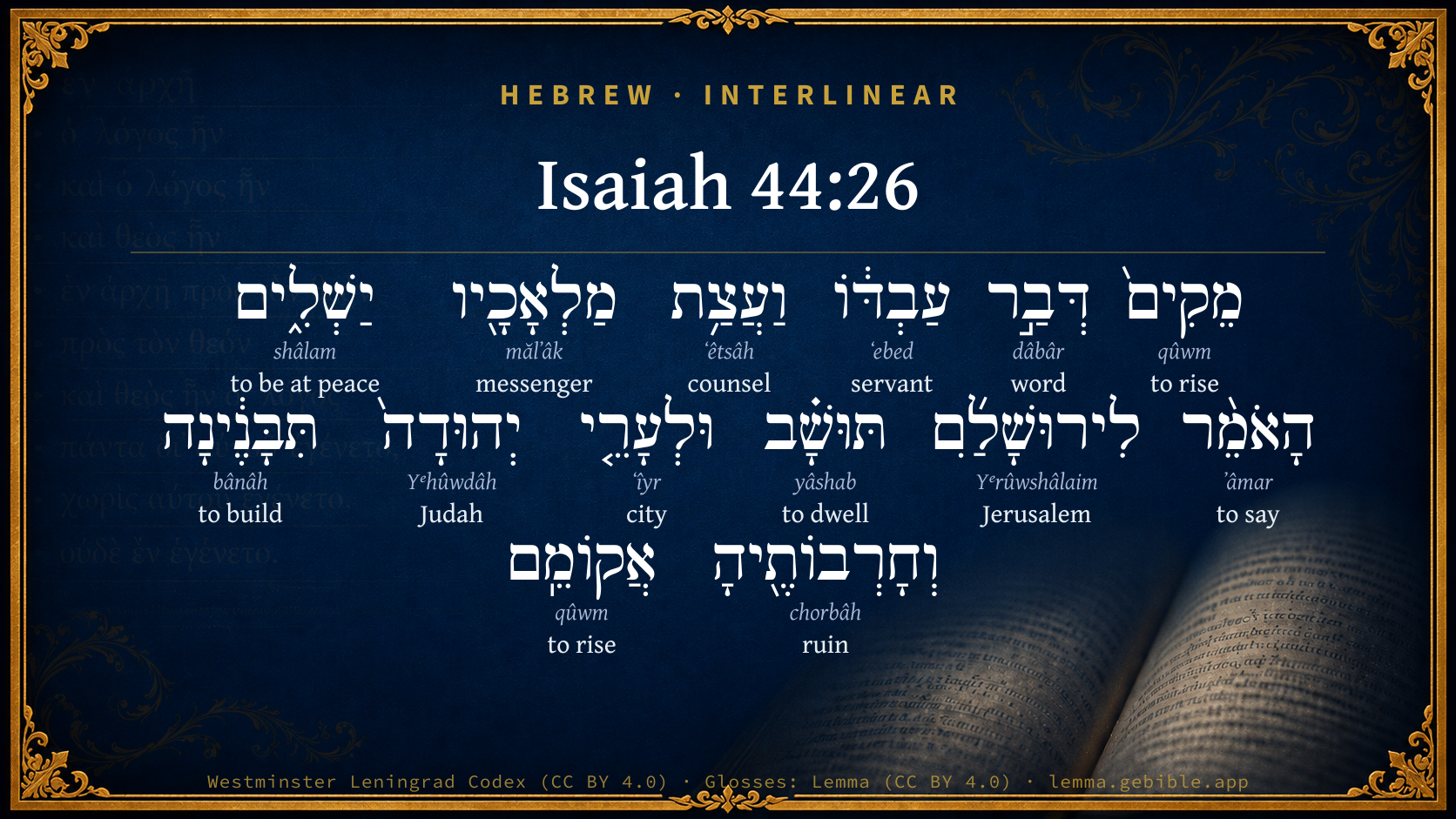
Hebrew (Westminster Leningrad Codex) Isaiah 44:26 appears in the Hebrew Old Testament. The text above is from the Westminster Leningrad Codex. Each word links to its Strong’s number, a concise gloss, and parsing drawn from the Open Scriptures Hebrew Bible morphology. Click any word for its full Brown-Driver-Briggs (BDB) entry.
Download image
Cite this verse

Isaiah 44:26 (World English Bible). Public Domain. Lemma interlinear Bible study tool, https://lemma.gebible.app/v/isaiah/44/26.

Show BibTeX & RIS
BibTeX
RIS
English Translation
who confirms the word of his servant, and performs the counsel of his messengers; who says of Jerusalem, She shall be inhabited; and of the cities of Judah, They shall be built, and I will raise up the waste places of it;
World English Bible · Public Domain
Download a study sheet

One document with this verse’s original text, its word-by-word gloss line, the meaning frame, cross-references with their text, attributed commentary, and full source and license credits — printable, and it pastes into notes with its structure intact.

This verse Autodidact and up

Study sheet (.html) Plain text (.txt)

A passage Seminary Student

Up to 50 verses in one chapter. A passage sheet keeps up to 6 commentary sources and 12 cross-references per verse, in the order this page ranks them, and says so on the sheet whenever that leaves anything out. Ask for a single verse and you get the Autodidact verse sheet above.

Everything on this page stays free to read, with no account — the sheet is a download of what is already on screen, not access to it.

Want to remove ads? Support Godless Engineer
Compare translations 3

The same verse in 3 English versions, stacked beneath the original-language interlinear above. Click any original word for its lexicon entry.

Each is an independent rendering of the whole verse — the interlinear is not word-aligned to these translations.

Highlighted words mark where these versions differ — a whole-verse word diff, not a word-by-word alignment.

  • World English Bible Public Domain
    who confirms the word of his servant, and performs the counsel of his messengers; who says of Jerusalem, She shall be inhabited; and of the cities of Judah, They shall be built, and I will raise up the waste places of it;
  • King James Version Public Domain
    That confirmeth the word of his servant, and performeth the counsel of his messengers; that saith to Jerusalem, Thou shalt be inhabited; and to the cities of Judah, Ye shall be built, and I will raise up the decayed places thereof:
  • unfoldingWord Literal Text CC BY-SA 4.0
    the one raising up the word of his servant, and he completes the counsel of his messengers, the one saying of Jerusalem, ‘It will be inhabited,’ and of the cities of Judah, ‘They will be built, and I will raise up its desolations’;

unfoldingWord Literal Text — © unfoldingWord, licensed CC BY-SA 4.0. Word-aligned USFM3 via Door43 (git.door43.org/unfoldingWord/en_ult).

Versions to compare (up to 4)

3 of 4 selected

Show all 18 translations

Every available English version of this verse, each an independent rendering of the whole verse.

  • World English Bible Public Domain
    who confirms the word of his servant, and performs the counsel of his messengers; who says of Jerusalem, She shall be inhabited; and of the cities of Judah, They shall be built, and I will raise up the waste places of it;
  • Berean Standard Bible Public Domain
    who confirms the message of His servant and fulfills the counsel of His messengers, who says of Jerusalem, ‘She will be inhabited,’ and of the cities of Judah, ‘They will be rebuilt, and I will restore their ruins,’
  • Majority Standard Bible Public Domain
    who confirms the message of His servant and fulfills the counsel of His messengers, who says of Jerusalem, ‘She will be inhabited,’ and of the cities of Judah, ‘They will be rebuilt, and I will restore their ruins,’
  • King James Version Public Domain
    That confirmeth the word of his servant, and performeth the counsel of his messengers; that saith to Jerusalem, Thou shalt be inhabited; and to the cities of Judah, Ye shall be built, and I will raise up the decayed places thereof:
  • American Standard Version (1901) Public Domain
    that confirmeth the word of his servant, and performeth the counsel of his messengers; that saith of Jerusalem, She shall be inhabited; and of the cities of Judah, They shall be built, and I will raise up the waste places thereof;
  • Revised Version (1885) Public Domain
    that confirmeth the word of his servant, and performeth the counsel of his messengers; that saith of Jerusalem, She shall be inhabited; and of the cities of Judah, They shall be built, and I will raise up the waste places thereof:
  • Geneva Bible (1599) Public Domain
    He confirmeth the worde of his seruant and performeth the counsell of his messengers, saying to Ierusalem, Thou shalt bee inhabited: and to the cities of Iudah, Yee shall be built vp, and I will repayre the decayed places thereof.
  • Douay-Rheims (1899) Public Domain
    That raise up the word of my servant and perform the counsel of my messengers, who say to Jerusalem: Thou shalt be inhabited: and to the cities of Juda: You shall be built, and I will raise up the wastes thereof.
  • Young's Literal Translation Public Domain
    Confirming the word of His servant, The counsel of His messengers it perfecteth, Who is saying of Jerusalem, She is inhabited, And of cities of Judah, They shall be built, and her wastes I raise up,
  • Literal Standard Version CC BY-SA 4.0
    Confirming the word of His servant, || He perfects the counsel of His messengers, || Who is saying of Jerusalem, || She is inhabited, || And of cities of Judah, || They will be built, and her ruins I raise up,
  • Unlocked Literal Bible CC BY-SA 4.0
    I, Yahweh, who confirmed the words of his servant and brings to pass the predictions of his messengers, who says of Jerusalem, 'She will be inhabited,' and of the towns of Judah, 'They will be built again, and I will raise up their ruins';
  • unfoldingWord Literal Text CC BY-SA 4.0
    the one raising up the word of his servant, and he completes the counsel of his messengers, the one saying of Jerusalem, ‘It will be inhabited,’ and of the cities of Judah, ‘They will be built, and I will raise up its desolations’;
  • Darby Bible Public Domain
    that confirmeth the word of his servant, and performeth the counsel of his messengers; that saith to Jerusalem, Thou shalt be inhabited; and to the cities of Judah, Ye shall be built up, and I will raise up their ruins;
  • World Messianic Bible Public Domain
    who confirms the word of his servant, and performs the counsel of his messengers; who says of Jerusalem, ‘She will be inhabited;’ and of the cities of Judah, ‘They will be built,’ and ‘I will raise up its waste places;’
  • Webster's Bible Public Domain
    That confirmeth the word of his servant, and performeth the counsel of his messengers; that saith to Jerusalem, Thou shalt be inhabited; and to the cities of Judah, Ye shall be built, and I will raise up her decayed places:
  • Free Bible Version CC BY-SA 4.0
    But I confirm the messages given by my servants, and fulfill what my messengers say. They state, ‘Jerusalem will be inhabited again, the towns of Judah will be rebuilt, your ruins will be repaired.’
  • Bible in Basic English Public Domain
    Who makes the word of his servants certain, and gives effect to the purposes of his representatives; who says of Jerusalem, Her people will come back to her; and of the towns of Judah, I will give orders for their building, and will make her waste places fertile again:
  • JPS Tanakh (1917) Public Domain
    That confirmeth the word of His servant, and performeth the counsel of His messengers; that saith of Jerusalem: 'She shall be inhabited'; and of the cities of Judah: 'They shall be built, and I will raise up the waste places thereof';

Literal Standard Version (2020), Covenant Press — licensed CC BY-SA 4.0. Text via the HelloAO Bible API (eBible.org). Unlocked Literal Bible (unfoldingWord) — licensed CC BY-SA 4.0. Text via the HelloAO Bible API (eBible.org). unfoldingWord Literal Text — © unfoldingWord, licensed CC BY-SA 4.0. Word-aligned USFM3 via Door43 (git.door43.org/unfoldingWord/en_ult). Free Bible Version, Dr. Jonathan Gallagher — licensed CC BY-SA 4.0. Text via the HelloAO Bible API (eBible.org).

Word by word

More ways to search: Search by grammar → Find every occurrence → Compare this word →

Practice this passage: Drill this verse → Learn its vocabulary →

וְחָרְבוֹתֶ֖יהָ
chorbâh
H2723
“and · ruins · her”
Conjunction + Noun, Common, Feminine, Plural, Construct + Suffix, Personal, 3rd Person, Feminine, Singular
Part of Speech
Conjunction + Noun
Type
Common
Gender
Feminine
Number
Plural
State
Construct
Full BDB Definition

Origin: from H2721

TWOT: 731d

a place laid waste, ruin, waste, desolation
  1. מֵקִים֙ qûwm H6965 “rising” Verb, Hiphil, Participle Active, Masculine, Singular, Absolute
  2. דְּבַ֣ר dâbâr H1697 “word of” Noun, Common, Masculine, Singular, Construct
  3. עַבְדּ֔וֹ ʻebed H5650 “servant · his” Noun, Common, Masculine, Singular, Construct + Suffix, Personal, 3rd Person, Masculine, Singular
  4. וַעֲצַ֥ת ʻêtsâh H6098 “and · counsel of” Conjunction + Noun, Common, Feminine, Singular, Construct
  5. מַלְאָכָ֖יו mălʼâk H4397 “messengers · his” Noun, Common, Masculine, Plural, Construct + Suffix, Personal, 3rd Person, Masculine, Singular
  6. יַשְׁלִ֑ים shâlam H7999 “to be at peace” Verb, Hiphil, Imperfect, 3rd Person, Masculine, Singular
  7. הָאֹמֵ֨ר ʼâmar H559 “the · saying” Particle, Definite Article + Verb, Qal, Participle Active, Masculine, Singular, Absolute
  8. לִירוּשָׁלִַ֜ם Yᵉrûwshâlaim H3389 “to/for · Jerusalem” Preposition + Noun, Proper
  9. תּוּשָׁ֗ב yâshab H3427 “to dwell” Verb, Hophal, Imperfect, 3rd Person, Feminine, Singular
  10. וּלְעָרֵ֤י ʻîyr H5892 “and · to/for · cities of” Conjunction + Preposition + Noun, Common, Feminine, Plural, Construct
  11. יְהוּדָה֙ Yᵉhûwdâh H3063 “Judah” Noun, Proper
  12. תִּבָּנֶ֔ינָה bânâh H1129 “to build” Verb, Niphal, Imperfect, 3rd Person, Feminine, Plural
  13. אֲקוֹמֵֽם qûwm H6965 “to rise” Verb, Polel, Imperfect, 1st Person, Common, Singular

About this verse

These counts appear in no published source. They are computed here, from the morphology-tagged text and Lemma’s own curated glosses. What Lemma adds →

14
words
13
distinct lemmas
Prophets
section

Shared distinctive vocabulary

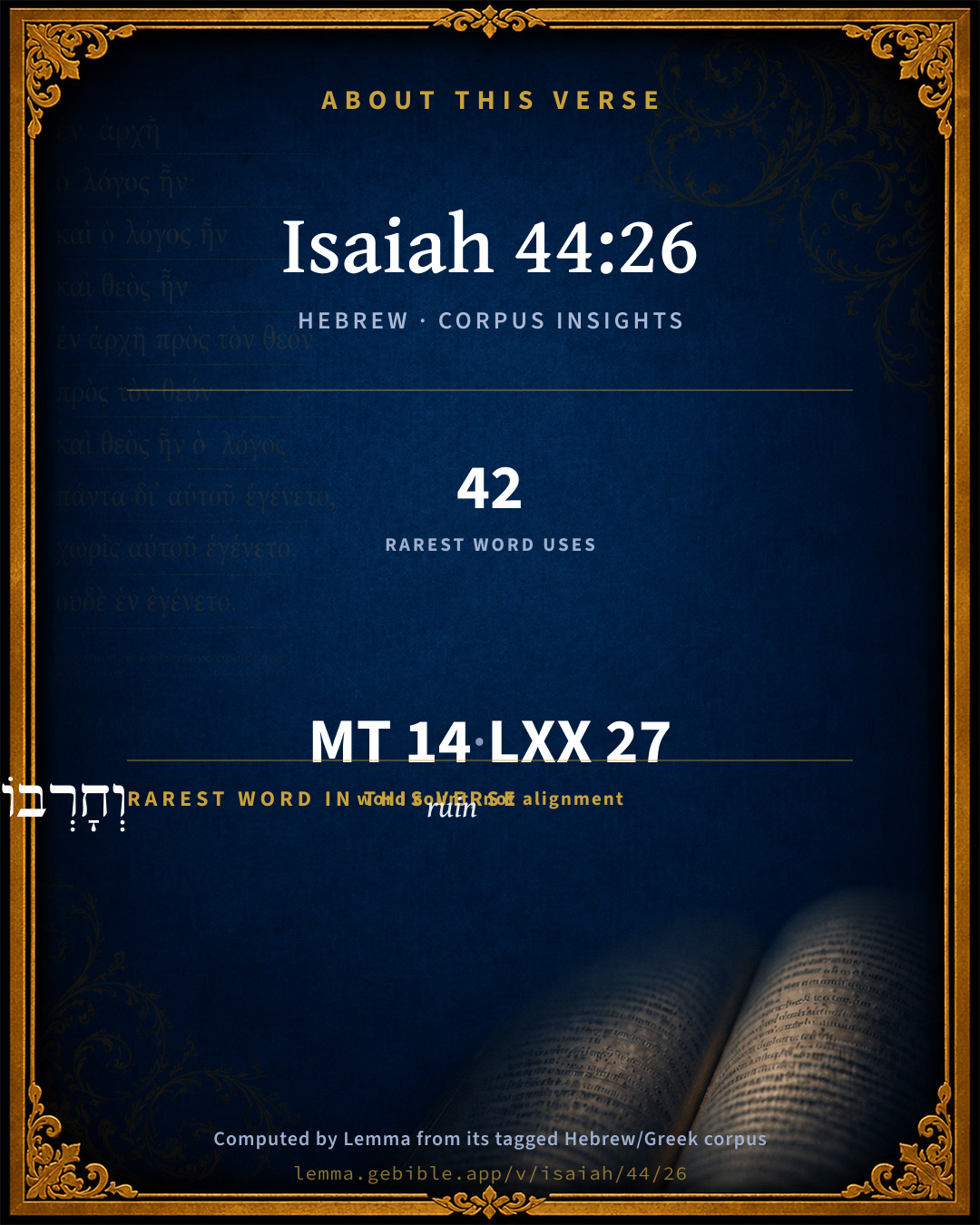
וְחָרְבוֹתֶ֖יהָ ruin H2723 occurs in 42 verses of the Hebrew Bible. Also found in:

Grammatical profile

  • 6 verbs
  • 8 nouns

Verb forms

  • מֵקִים֙ Hiphil · Participle Active
  • יַשְׁלִ֑ים Hiphil · Imperfect
  • הָאֹמֵ֨ר Qal · Participle Active
  • תּוּשָׁ֗ב Hophal · Imperfect
  • תִּבָּנֶ֔ינָה Niphal · Imperfect
  • אֲקוֹמֵֽם Polel · Imperfect

Repetition

A word recurs within this verse — often emphatic in Hebrew:

  • מֵקִים֙ to rise H6965 ×2

Hebrew & Septuagint length

In English translation the verse runs 42 words from the Hebrew and 39 from the Septuagint (LXX English) — closely comparable.

A rough comparison of the two English renderings, which tokenize alike — not a word-level alignment.

Word counts can differ between the Hebrew and the Greek without any difference in meaning — e.g. the Hebrew direct-object marker אֵת has no separate Greek word, and Greek often adds the article ὁ.

In the original languages it is 14 Hebrew tokens and 27 Greek tokens — but the two are counted differently (Hebrew bundles its prefixes and suffixes into one token; the Greek is in lemma form), so that isn’t a like-for-like length.

Cross-references

36

Topical passages linked to Isaiah 44:26 in the Treasury of Scripture Knowledge — connected by theme and wording, ordered by reader-vote popularity; previews shown in the World English Bible.

  • 1 Kings 18:36–38 It happened at the time of the offering of the [evening] offering, that Elijah the prophet came near, and said, Yahweh, the God of Abraham, of Isaac, and of Israel, let it be known this day that you are God in Israel, and that I am your servant, and that I have done all these things at your word.
  • Isaiah 42:9 Behold, the former things have happened, and new things do I declare. Before they spring forth I tell you of them.
  • Acts 2:25–28 For David says concerning him, 'I saw the Lord always before my face, For he is on my right hand, that I should not be moved.
  • 2 Peter 1:19–21 We have the more sure word of prophecy; whereunto you do well that you take heed, as to a lamp shining in a dark place, until the day dawns, and the day star arises in your hearts:
  • Nehemiah 1:3 They said to me, The remnant who are left of the captivity there in the province are in great affliction and reproach: the wall of Jerusalem also is broken down, and the gates of it are burned with fire.
  • Isaiah 60:10 Foreigners shall build up your walls, and their kings shall minister to you: for in my wrath I struck you, but in my favor have I had mercy on you.
  • Jeremiah 30:18 Thus says Yahweh: Behold, I will turn again the captivity of Jacob's tents, and have compassion on his dwelling-places; and the city shall be built on its own hill, and the palace shall be inhabited after its own manner.
  • Jeremiah 33:7 I will cause the captivity of Judah and the captivity of Israel to return, and will build them, as at the first.
  • Daniel 9:25 Know therefore and discern, that from the going forth of the commandment to restore and to build Jerusalem to the Anointed One, the prince, shall be seven weeks, and sixty-two weeks: it shall be built again, with street and moat, even in troubled times.
  • Ezra 2:70 So the priests, and the Levites, and some of the people, and the singers, and the porters, and the Nethinim, lived in their cities, and all Israel in their cities.
  • Isaiah 54:11–12 you afflicted, tossed with tempest, and not comforted, behold, I will set your stones in beautiful colors, and lay your foundations with sapphires.
  • Ezekiel 38:17 Thus says the Lord Yahweh: Are you he of whom I spoke in old time by my servants the prophets of Israel, who prophesied in those days for [many] years that I would bring you against them?
  • Amos 9:14 I will bring back the captivity of my people Israel, And they will rebuild the ruined cities, and inhabit them; and they will plant vineyards, and drink wine from them. They shall also make gardens, And eat the fruit of them.
  • Zechariah 1:6 But my words and my decrees, which I commanded my servants the prophets, didn't they overtake your fathers? "Then they repented and said, 'Just as Yahweh of Hosts determined to do to us, according to our ways, and according to our practices, so he has dealt with us.'"
  • Exodus 11:4–6 Moses said, "This is what Yahweh says: 'About midnight I will go out into the midst of Egypt,
  • Exodus 12:29–30 It happened at midnight, that Yahweh struck all the firstborn in the land of Egypt, from the firstborn of Pharaoh who sat on his throne to the firstborn of the captive who was in the dungeon; and all the firstborn of cattle.
  • 1 Kings 13:3–5 He gave a sign the same day, saying, This is the sign which Yahweh has spoken: Behold, the altar shall be torn, and the ashes that are on it shall be poured out.
  • Nehemiah 2:3 I said to the king, Let the king live forever: why should not my face be sad, when the city, the place of my fathers' tombs, lies waste, and the gates of it are consumed with fire?
  • Psalms 102:13–16 You will arise and have mercy on Zion; For it is time to have pity on her. Yes, the set time has come.
  • Psalms 147:2 Yahweh builds up Jerusalem. He gathers together the outcasts of Israel.
  • Isaiah 54:3 For you shall spread aboard on the right hand and on the left; and your seed shall possess the nations, and make the desolate cities to be inhabited.
  • Isaiah 58:12 Those who shall be of you shall build the old waste places; you shall raise up the foundations of many generations; and you shall be called The repairer of the breach, The restorer of paths to dwell in.
  • Jeremiah 31:4 Again will I build you, and you shall be built, O virgin of Israel: again shall you be adorned with your tambourines, and shall go forth in the dances of those who make merry.
  • Jeremiah 31:38–40 Behold, the days come, says Yahweh, that the city shall be built to Yahweh from the tower of Hananel to the gate of the corner.
  • Jeremiah 32:15 For thus says Yahweh of Hosts, the God of Israel: Houses and fields and vineyards shall yet again be bought in this land.
  • Jeremiah 32:44 Men shall buy fields for money, and subscribe the deeds, and seal them, and call witnesses, in the land of Benjamin, and in the places about Jerusalem, and in the cities of Judah, and in the cities of the hill-country, and in the cities of the lowland, and in the cities of the South: for I will cause their captivity to return, says Yahweh.
  • Ezekiel 36:10 and I will multiply men on you, all the house of Israel, even all of it; and the cities shall be inhabited, and the waste places shall be built;
  • Ezekiel 36:33–36 Thus says the Lord Yahweh: In the day that I cleanse you from all your iniquities, I will cause the cities to be inhabited, and the waste places shall be built.
  • Zechariah 2:4 and said to him, "Run, speak to this young man, saying, 'Jerusalem will be inhabited as villages without walls, because of the multitude of men and cattle in it.
  • Zechariah 12:6 In that day I will make the chieftains of Judah like a pan of fire among wood, and like a flaming torch among sheaves; and they will devour all the surrounding peoples, on the right hand and on the left; and Jerusalem will yet again dwell in their own place, even in Jerusalem.
  • Zechariah 14:10–11 All the land will be made like the Arabah, from Geba to Rimmon south of Jerusalem; and she will be lifted up, and will dwell in her place, from Benjamin's gate to the place of the first gate, to the corner gate, and from the tower of Hananel to the king's wine-presses.
  • Matthew 5:18 For most assuredly, I tell you, until heaven and earth pass away, not even one smallest letter or one tiny pen stroke shall in any way pass away from the law, until all things are accomplished.
  • Matthew 26:56 But all this has happened, that the Scriptures of the prophets might be fulfilled." Then all the disciples left him, and fled.
  • Luke 24:44 He said to them, "This is what I told you, while I was still with you, that all things which are written in the law of Moses, the prophets, and the psalms, concerning me must be fulfilled."
  • Nehemiah 3:1–32 Then Eliashib the high priest rose up with his brothers the priests, and they built the sheep gate; they sanctified it, and set up the doors of it; even to the tower of Hammeah they sanctified it, to the tower of Hananel.
  • Isaiah 61:4 They shall build the old wastes, they shall raise up the former desolations, and they shall repair the waste cities, the desolations of many generations.

Cross-references courtesy of OpenBible.info (CC BY 4.0).

Hebrew and Greek witnesses Masoretic Hebrew ↔ Greek Septuagint

The same verse in the two great witnesses to the Old Testament, shown verse-for-verse.

These are two independent witnesses, not word-aligned to each other, and the Septuagint is shown in lemma (dictionary) form.

Hebrew Isaiah 44:26 Masoretic · Westminster Leningrad Codex

מֵקִים֙ דְּבַ֣ר עַבְדּ֔וֹ וַעֲצַ֥ת מַלְאָכָ֖יו יַשְׁלִ֑ים הָאֹמֵ֨ר לִירוּשָׁלִַ֜ם תּוּשָׁ֗ב וּלְעָרֵ֤י יְהוּדָה֙ תִּבָּנֶ֔ינָה וְחָרְבוֹתֶ֖יהָ אֲקוֹמֵֽם

who confirms the word of his servant, and performs the counsel of his messengers; who says of Jerusalem, She shall be inhabited; and of the cities of Judah, They shall be built, and I will raise up the waste places of it;

World English Bible · Public Domain

Greek LXX Isaiah 44:26 Septuagint · lemma form

καί ἵστημι ῥῆμα παῖς αὐτός καί ὁ βουλή ὁ ἄγγελος αὐτός ἀληθεύω ὁ λέγω ἰερουσαλήμ καταοἱκέω καί ὁ πόλις ὁ ἰουδαία οἰκοδομέω καί ὁ ἔρημος αὐτός ἀνατέλλω

and confirming the word of his servant, and verifying the counsel of his messengers: who says to Jerusalem, You shall be inhabited; and to the cities of Idumea, You⌃ shall be built, and her desert places shall spring forth.

LXX2012 (modern English Septuagint) · Public Domain

On this verse, The Cambridge Bible for Schools and Colleges discusses the Septuagint’s reading. Read the note in Commentary ↓

Hebrew: Westminster Leningrad Codex (CC BY 4.0). Greek: Septuagint (public domain); English from LXX2012 (modern English Septuagint) (Public Domain). How the Septuagint differs from the Hebrew →

Targum (Aramaic paraphrase)

1

The Targum is the ancient Jewish Aramaic paraphrase of the Hebrew Scriptures — an interpretive translation, not the Hebrew text itself. Onkelos (literal) and Pseudo-Jonathan (expansive) render the Torah, and Jonathan the Prophets. Coverage is partial: where no permissively-licensed English translation exists for a verse, only the Aramaic is shown. This is verse-level text, not a word-by-word alignment to the Hebrew.

  1. Targum Jonathan Prophets (Joshua–Malachi)
    מְקַיֵם פִּתְגָמֵי עַבְדוֹהִי צַדִיקַיָא וּמְלַךְ שְׁלוּחוֹהִי מַשְׁלִים דַאֲמַר לִירוּשְׁלָם תִּתּוֹתַב וּלְקִרְוַיָא דְבֵית יְהוּדָה יִתְבַּנְיָן וְחָרְבָתָהָא אֲקוֹמֵם:

    That confirmeth the word of His righteous servants, and performeth the counsel of His messengers, that saith to Jerusalem, Thou shalt be inhabited; and concerning the cities of the house of Judah, They shall be built; and her desolated places I will raise up.

    Targum Jonathan — Aramaic: “Mikraot Gedolot” (public domain). English: “Sefaria Community Translation” (CC0 1.0 (public-domain dedication)); “London "Chaldee Paraphrase," 1871” (public domain). Text via Sefaria.

Commentary

Notes on Isaiah 44:26 from classic Christian and Jewish commentators (each source and its license shown beneath its notes). The classic Christian expositions comment on the surrounding passage and are grouped to its opening verse, so a note may address several verses; the Jewish commentaries on the Tanakh (Rashi and others) are per-verse, so they appear only where the commentator wrote on this verse.

Lemma curates 59 commentaries, every one of them public domain or Creative Commons licensed, each selected and text-cleaned for this edition rather than reprinted as found. About our sources →

Trapp's Complete Commentary

John Trapp

Isa 44:26 That confirmeth the word of his servant, and performeth the counsel of his messengers; that saith to Jerusalem, Thou shalt be inhabited; and to the cities of Judah, Ye shall be built, and I will raise up the decayed places thereof:

Ver. 26. That confirmeth the word of his servant,] i.e., Of myself and other prophets, saying the same with me.

That saith to Jerusalem.] Who then shall gainsay it? Is not God’s word his will, and his will his work?

John Trapp, A Commentary or Exposition upon All the Books of the Old and New Testament (1647–1656) — public domain. Text from a community e-Sword module.

Geneva Bible (1599)

Geneva Bible translators

Of Isaiah and the rest of his Prophets, which did assure the Church of God’s favor and deliverance.

Geneva Bible (1599) marginal notes — public domain. Text via Bolls.life.

Jamieson, Fausset & Brown

Robert Jamieson, A. R. Fausset & David Brown

servant--in a collective sense, for the prophets in general, who foretold the return from Babylon; answering to "His messengers" (plural, in the parallel clause) [MAURER]. Antitypically, and ultimately, Messiah, who is the consummating embodiment of all the prophets and messengers of God (Mal 3:1; Mat 21:34, Mat 21:36-37; Joh 10:36); hence the singular, "His servant."

counsel--predictions; prophets' counsels concern the future (compare "counsellor," Isa 41:28).

Jerusalem--regarded prophetically, as lying in ruins.

Jamieson, Fausset & Brown — Commentary Critical and Explanatory on the Whole Bible (1871) — public domain (CC PDM 1.0). Text via the HelloAO Bible API.

Ellicott's Commentary for English Readers

(26) That confirmeth the word of his servant.—The parallelism of “servant” in the singular with “messengers” in the plural suggests the thought that the prophet is not speaking of himself, but of Israel, as the ideal “servant of the Lord,” the prophetic nation represented by the individual “messengers” or prophets. Comp. as to the word Isa_42:19; Mal_3:1, and that prophet’s own name (“my messenger”).

A Bible Commentary for English Readers, edited by Charles John Ellicott (1878–1897) — public domain. Text from a community e-Sword module.

The Cambridge Bible for Schools and Colleges

gen. ed. J. J. S. Perowne

26. That confirmeth] is the antithesis to “that frustrateth” in Isa_44:25. (Cf. Jer_29:10; Jer_33:14).

the word of his servant … the counsel of his messengers] are parallel expressions for the word of prophecy. The sing. “servant” presents some difficulty. That it is equivalent to “prophet” is clear from the context; but that a particular prophet, such as Jeremiah or the writer himself, is meant is extremely improbable. It might conceivably be used of the prophets collectively, or of Israel as the bearer of the prophetic word, but the parallelism with “messengers” in the next clause is opposed to both these interpretations. The word should probably be pointed as a plural,—his servants; which is the reading of the Codex Alexandrinus of the LXX.

performeth] Lit. completeth.

that saith &c.] that saith of Jerusalem, Let her be inhabited; and of the cities of Judah, Let them be built. At this point, as Delitzsch observes, the transition is made to special predictions bearing on the restoration of Israel.

decayed places] R.V. waste places, or ruins.

The Cambridge Bible for Schools and Colleges (gen. ed. J. J. S. Perowne; Cambridge University Press, 1878–1918) — public domain. Text from a community e-Sword module.

John Gill's Exposition

That confirmeth the word of his servant, and performeth the counsel of his messengers,.... Who, as he confirmed the word of Isaiah and other prophets, and fulfilled their predictions concerning the captivity of the Jews, and their deliverance from it; so he has confirmed and established the word preached by his servants, the Gospel, which is the counsel of God, delivered out by his messengers, the apostles, and first preachers of it; it being attended with the demonstration of the spirit, and of power, to the conversion of sinners, and to the destruction of idolatry and Pagan worship. By the Lord's "servant" some understand Moses, as Jarchi; others Isaiah, as Kimchi and most interpreters; and why not Paul, as Cocceius? though the singular seems rather to be put for the plural, as the next clause explains it; and so the Arabic version renders it, "his servants"; to which the Targum agrees, paraphrasing it,

"confirming the words of his servants the righteous:''

that saith to Jerusalem, thou shalt be inhabited, and to the cities of Judah, ye shall be built, and I will raise up the decayed places thereof; all which suppose that Jerusalem, which, in the prophet's time, was full of inhabitants, should be emptied of them, by the sword, famine, pestilence, and captivity; yet, nevertheless, there should be a return of the Jews from captivity, and this city should be peopled and inhabited again; and also, that the cities of Judah, which were now in good circumstances, should be laid waste, and all the adjacent country be in a ruinous condition, all which should be rebuilt and restored to a flourishing state again. The Lord had said it, and it should be done; as accordingly it was. This may be understood, in a spiritual sense, of the building up of the church of God, and the setting up and establishing the interest of Christ, by the preaching of the Gospel.

John Gill's Exposition of the Whole Bible (1746–1763) — public domain (CC PDM 1.0). Text via the HelloAO Bible API.

Albert Barnes' Notes on the Bible

That confirmeth the word of his servant - Probably the word ‘servant’ here is to be taken in a collective sense, as referring to the prophets in general who had foretold the return of the Jews to their own land, and the rebuilding of Jerusalem. Or it may be, that the prophet refers more particularly to himself as having made a full prediction of this event. The parallel expression, ‘his messengers,’ however, is in the plural number, and thus it is rendered probable that the word here refers to the prophets collectively. The idea is, that it was a characteristic of God to establish the words of his servants the prophets, and that their predictions in regard to the return from the captivity in a special manner would be fulfilled.

The counsel of his messengers - The prophets whom he had sent to announce future events, and to give counsel and consolation to the nation.

That saith to Jerusalem - Jerusalem is here supposed to be lying in ruins, and the people to be in captivity in Babylon. In this situation, God is represented as addressing desolate Jerusalem, and saying, that it should be again inhabited, and that the cities of Judah should be rebuilt.

The decayed places - Margin, ‘Wastes.’ No land, probably, was ever more completely desolated than the land of Judea when its inhabitants were carried to Babylon.

Albert Barnes' Notes on the Bible (1834–1885) — public domain. Text from a community e-Sword/MySword module.

Haydock's Catholic Bible Commentary

Servant. The prophets and Jesus Christ, whose works never fail, Matthew xxiv. 35. (Calmet) --- In all this prediction of the Church, Isaias alludes to Jerusalem destroyed, and afterwards rebuilt. (Worthington)

George Leo Haydock (1774–1849), Haydock's Catholic Family Bible and Commentary, 1859 edition — public domain. Excludes Psalms (Douay-Rheims chapter numbering differs from Protestant) and Deuterocanonical books (Catholic canon only).

Matthew Poole's English Annotations

Of his servant; of his servants, the prophets, as appears from the next clause, which answers to this, where he useth the plural number,

his messengers; Isaiah and other prophets, whom God sent upon this errand, to foretell the destruction of Babylon, and the redemption of his people.

Matthew Poole's English Annotations on the Holy Bible (1683–1685) — public domain. Text from a community e-Sword/MySword module.

The Pulpit Commentary

That confirmeth the word of his servant; that is, of Isaiah himself, whom God calls "my Servant" in Isa_20:3. Thev"messengers" are the prophets generally. Before the return from the Captivity took place, it had been prophesied, not only by Isaiah, but by Jeremiah, (Jer_29:10-14) by Ezekiel, (Eze_39:25-28) by, (Joe_3:1) by Amos, (Amo_9:11-15) by Obadiah, (Oba_1:20) by, (Mic_4:10) and by Zephaniah. (Zep_3:14-20)

The Pulpit Commentary (1880–1919), ed. H.D.M. Spence-Jones & Joseph S. Exell — public domain. Text from a community e-Sword module.

J. A. Alexander on Isaiah

Joseph Addison Alexander

“Confirming the word of His servant, and the counsel of His messengers He will fulfill; the (One) saying to (or as to) Jerusalem,’ She shall be inhabited,’ and to (or as to) the cities of Judah, ‘They shall be built, and her ruins I will raise’.” With the frustration of the heathen prophecies is here contrasted the fulfillment of Jehovah’s, who is Himself represented as securing their accomplishment. The word translated ‘confirming’ has here the same sense as in Jer 29:10; Jer 33:14, viz. that of bringing a promise or prophecy to pass. ‘His servant’ may refer primarily and directly to the writer himself, but considered as one of a class, who are then distinctly mentioned in the other member as ‘His messengers’. The specific application of the title of God’s servant to the prophets is apparent from 2Ki 24:2; Jer 29:19; Jer 35:15; Jer 44:4. Most writers make ‘counsel’ a description of prophecy, considered as involving or suggesting counsel and advice with respect to the future. (Compare the similar application of the verb in Isa 41:28) The last clause, beginning with the words ‘the One saying’ might be considered as a more specific designation or description of His servant; viz. the (servant) saying etc. But this interpretation is precluded by the double repetition of the words in the two succeeding verses and in evident application to Jehovah Himself. ‘To raise up the ruins’ of a city is of course to rebuild it.

Joseph Addison Alexander, The Prophecies of Isaiah (1846–1847; New York: Scribner, 1870–1878) — public domain. Text from a community e-Sword module.

unfoldingWord translationNotes

Door43 World Missions Community

who confirmed the words of his servant and brings to pass the predictions of his messengers

Yahweh is saying the same thing twice to emphasize that it is only he, Yahweh, who causes the prophesies to be fulfilled. (See: Parallelism)

the words of his servant ... the predictions of his messengers

The abstract nouns "words" and "predictions" can be translated as verbs. AT: "what his servant declares ... what his messengers announce" (See: Abstract Nouns)

She will be inhabited

This can be stated in active form. AT: "People will live there again" (See: Active or Passive)

They will be built again

This can be stated in active form. AT: "People will rebuild them" (See: Active or Passive)

I will raise up their ruins

The phrase "ruins" refers to places that have been destroyed. Yahweh speaks of rebuilding them as if he were raising them up. AT: "I will rebuild what others have destroyed" (See: Metaphor)

translationWords

Yahweh

servant

Jerusalem

Judah

ruin

unfoldingWord translationNotes — © Distant Shores Media and the Door43 World Missions Community, licensed CC BY-SA 4.0. Source: git.door43.org/Door43/en_tn.

Rashi

Rabbi Shlomo Yitzchaki (Rashi)

He fulfills the word of His servant Moses.

and the counsel of His messengers One angel said to Jacob (Gen. 32:27), “Israel shall be your name,” and I fulfilled his words. Here too, I will fulfill the counsel of My prophets who say concerning Jerusalem, “It shall be settled.”

Rashi on the Tanakh — English translations: “The Judaica Press complete Tanach with Rashi, translated by A. J. Rosenberg” (CC BY 4.0); “Pentateuch with Rashi's commentary by M. Rosenbaum and A.M. Silbermann, 1929-1934” (public domain); “The Metsudah Tanach series, Lakewood, N.J” (CC BY 4.0); and “The Book of Joshua, Metsudah Publications, 1997” (CC BY 4.0). Text via Sefaria.

Ibn Ezra

Rabbi Abraham ibn Ezra

His servant. The prophet himself. The word of his servant, that Jerusalem shall be inhabited.

תושב Thou shalt be inhabited. Root ישב to dwell. Comp. תורד thou shalt be brought down (14:15) from ירד to go down.

Her decayed places. The decayed places of every city, or of Jerusalem.

Ibn Ezra on the Tanakh — English translations: “Sefaria Community Translation” (CC0 1.0 (public-domain dedication)); “Yalkut, Sifsei Chachomim Chumash, Metsudah Publications, 2009” (CC BY 4.0); and “Commentary of Ibn Ezra on Isaiah - trans. by M. Friedlander, 1873” (public domain). Text via Sefaria.

Lesson kit

Teaching starters — assembled from the data on this page, not authored interpretation. Every prompt links to the verse data it draws on. Edit before teaching.

Isaiah, in the Prophets, opens this verse with 14 words (13 distinct Hebrew lemmas). Its most distinctive word is chorbâh (“ruin”). A historical commentator’s framing appears above. Read the whole chapter for the surrounding context.

Discussion questions

  1. The word chorbâh carries the sense “ruin.” How does it shape the verse?
  2. How does Leviticus 26:31, which shares the word «ruin», read alongside this verse?
  3. What does the repetition of “to rise” (2× in this one verse) do in this verse?
  4. These translations render this verse differently. What is at stake in choosing one wording over another?
  5. «מֵקִים֙» is a Hiphil Participle Active verb. How does that grammatical form shape the action described?
  6. Compare how Trapp's Complete Commentary and Geneva Bible (1599) read this verse. Where do they agree or differ?

Things to notice

Reading settings

Reading text

Shown beneath each verse's original-language words.

Old Testament
Old Testament edition

Read the OT as the Masoretic Hebrew (MT) or the Greek Septuagint (LXX).

English shown for the Greek Septuagint (in the Hebrew ↔ Greek comparison).

Comparing translations? Open the Compare panel on any verse page to stack up to four side by side.