
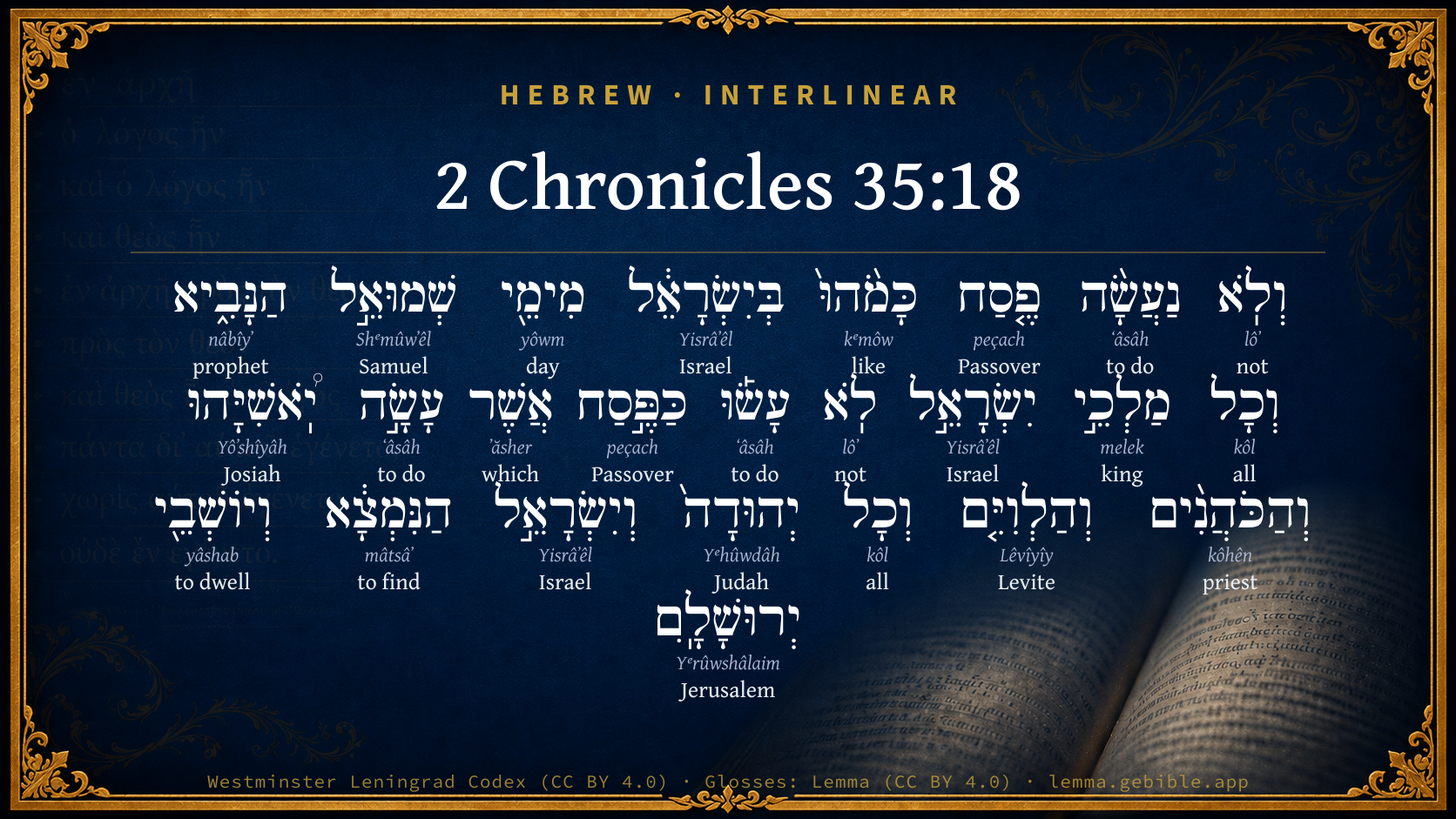
2 Chronicles 35:18

Hebrew (Westminster Leningrad Codex) 2 Chronicles 35:18 appears in the Hebrew Old Testament. The text above is from the Westminster Leningrad Codex. Each word links to its Strong’s number, a concise gloss, and parsing drawn from the Open Scriptures Hebrew Bible morphology. Click any word for its full Brown-Driver-Briggs (BDB) entry.
Download image
Cite this verse

2 Chronicles 35:18 (World English Bible). Public Domain. Lemma interlinear Bible study tool, https://lemma.gebible.app/v/2-chronicles/35/18.

Show BibTeX & RIS
BibTeX
RIS
English Translation
There was no Passover like that kept in Israel from the days of Samuel the prophet; neither did any of the kings of Israel keep such a Passover as Josiah kept, and the priests, and the Levites, and all Judah and Israel who were present, and the inhabitants of Jerusalem.
World English Bible · Public Domain
Download a study sheet

One document with this verse’s original text, its word-by-word gloss line, the meaning frame, cross-references with their text, attributed commentary, and full source and license credits — printable, and it pastes into notes with its structure intact.

This verse Autodidact and up

Study sheet (.html) Plain text (.txt)

A passage Seminary Student

Up to 50 verses in one chapter. A passage sheet keeps up to 6 commentary sources and 12 cross-references per verse, in the order this page ranks them, and says so on the sheet whenever that leaves anything out. Ask for a single verse and you get the Autodidact verse sheet above.

Everything on this page stays free to read, with no account — the sheet is a download of what is already on screen, not access to it.

Want to remove ads? Support Godless Engineer
Compare translations 3

The same verse in 3 English versions, stacked beneath the original-language interlinear above. Click any original word for its lexicon entry.

Each is an independent rendering of the whole verse — the interlinear is not word-aligned to these translations.

Highlighted words mark where these versions differ — a whole-verse word diff, not a word-by-word alignment.

  • World English Bible Public Domain
    There was no Passover like that kept in Israel from the days of Samuel the prophet; neither did any of the kings of Israel keep such a Passover as Josiah kept, and the priests, and the Levites, and all Judah and Israel who were present, and the inhabitants of Jerusalem.
  • King James Version Public Domain
    And there was no passover like to that kept in Israel from the days of Samuel the prophet; neither did all the kings of Israel keep such a passover as Josiah kept, and the priests, and the Levites, and all Judah and Israel that were present, and the inhabitants of Jerusalem.
  • unfoldingWord Literal Text CC BY-SA 4.0
    And a Passover was not done like it in Israel since the days of Samuel the prophet, and all the kings of Israel did not do like the Passover that Josiah did, and the priests and the Levites and all Judah and Israel who were found and the inhabitants of Jerusalem.

unfoldingWord Literal Text — © unfoldingWord, licensed CC BY-SA 4.0. Word-aligned USFM3 via Door43 (git.door43.org/unfoldingWord/en_ult).

Versions to compare (up to 4)

3 of 4 selected

Show all 18 translations

Every available English version of this verse, each an independent rendering of the whole verse.

  • World English Bible Public Domain
    There was no Passover like that kept in Israel from the days of Samuel the prophet; neither did any of the kings of Israel keep such a Passover as Josiah kept, and the priests, and the Levites, and all Judah and Israel who were present, and the inhabitants of Jerusalem.
  • Berean Standard Bible Public Domain
    No such Passover had been observed in Israel since the days of Samuel the prophet. None of the kings of Israel ever observed a Passover like the one that Josiah observed with the priests, the Levites, all Judah, the Israelites who were present, and the people of Jerusalem.
  • Majority Standard Bible Public Domain
    No such Passover had been observed in Israel since the days of Samuel the prophet. None of the kings of Israel ever observed a Passover like the one that Josiah observed with the priests, the Levites, all Judah, the Israelites who were present, and the people of Jerusalem.
  • King James Version Public Domain
    And there was no passover like to that kept in Israel from the days of Samuel the prophet; neither did all the kings of Israel keep such a passover as Josiah kept, and the priests, and the Levites, and all Judah and Israel that were present, and the inhabitants of Jerusalem.
  • American Standard Version (1901) Public Domain
    And there was no passover like to that kept in Israel from the days of Samuel the prophet; neither did any of the kings of Israel keep such a passover as Josiah kept, and the priests, and the Levites, and all Judah and Israel that were present, and the inhabitants of Jerusalem.
  • Revised Version (1885) Public Domain
    And there was no passover like to that kept in Israel from the days of Samuel the prophet; neither did any of the kings of Israel keep such a passover as Josiah kept, and the priests, and the Levites, and all Judah and Israel that were present, and the inhabitants of Jerusalem.
  • Geneva Bible (1599) Public Domain
    And there was no Passeouer kept like that, in Israel, from the dayes of Samuel the Prophet: neyther did all the Kings of Israel keepe such a Passeouer as Iosiah kept, and the Priestes and the Leuites, and all Iudah, and Israel that were present, and the inhabitants of Ierusalem.
  • Douay-Rheims (1899) Public Domain
    There was no phase like to this in Israel, from the days of Samuel the prophet: neither did any of all the kings of Israel keep such a phase as Josias kept, with the priests, and the Levites, and all Juda, and Israel that were found, and the inhabitants of Jerusalem.
  • Young's Literal Translation Public Domain
    And there hath not been made a passover like it in Israel from the days of Samuel the prophet, and none of the kings of Israel made such a passover as Josiah hath made, and the priests, and the Levites, and all Judah and Israel who are found, and the inhabitants of Jerusalem.
  • Literal Standard Version CC BY-SA 4.0
    And there has not been made a Passover like it in Israel from the days of Samuel the prophet, and none of the kings of Israel made such a Passover as Josiah has made, and the priests, and the Levites, and all Judah and Israel who are found, and the inhabitants of Jerusalem.
  • Unlocked Literal Bible CC BY-SA 4.0
    Such a Passover celebration had never been held in Israel from the days of the prophet Samuel, nor had any of the other kings of Israel ever celebrated such a Passover as Josiah did, along with the priests, Levites, and all the people of Judah and Israel who were present, and the inhabitants of Jerusalem.
  • unfoldingWord Literal Text CC BY-SA 4.0
    And a Passover was not done like it in Israel since the days of Samuel the prophet, and all the kings of Israel did not do like the Passover that Josiah did, and the priests and the Levites and all Judah and Israel who were found and the inhabitants of Jerusalem.
  • Darby Bible Public Domain
    And there was no passover like to that holden in Israel from the days of Samuel the prophet; neither did all the kings of Israel hold such a passover as Josiah held, and the priests, and the Levites, and all Judah and Israel that were present, and the inhabitants of Jerusalem.
  • World Messianic Bible Public Domain
    There was no Passover like that kept in Israel from the days of Samuel the prophet, nor did any of the kings of Israel keep such a Passover as Josiah kept—with the priests, the Levites, and all Judah and Israel who were present, and the inhabitants of Jerusalem.
  • Webster's Bible Public Domain
    And there was no passover like that kept in Israel from the days of Samuel the prophet; neither did all the kings of Israel keep such a passover as Josiah kept, and the priests, and the Levites, and all Judah and Israel that were present, and the inhabitants of Jerusalem.
  • Free Bible Version CC BY-SA 4.0
    No Passover like this had been held in Israel since the time of Samuel the prophet. None of the kings of Israel had ever held a Passover like the one that Josiah observed with the priests, the Levites, all of Judah, the Israelites who were there, and the people of Jerusalem.
  • Bible in Basic English Public Domain
    No Passover like it had been kept in Israel from the days of Samuel the prophet; and not one of the kings of Israel had ever kept a Passover like the one kept by Josiah and the priests and the Levites and all those of Judah and Israel who were present, and the people of Jerusalem.
  • JPS Tanakh (1917) Public Domain
    And there was no passover like to that kept in Israel from the days of Samuel the prophet; neither did any of the kings of Israel keep such a passover as Josiah kept, and the priests, and the Levites, and all Judah and Israel that were present, and the inhabitants of Jerusalem.

Literal Standard Version (2020), Covenant Press — licensed CC BY-SA 4.0. Text via the HelloAO Bible API (eBible.org). Unlocked Literal Bible (unfoldingWord) — licensed CC BY-SA 4.0. Text via the HelloAO Bible API (eBible.org). unfoldingWord Literal Text — © unfoldingWord, licensed CC BY-SA 4.0. Word-aligned USFM3 via Door43 (git.door43.org/unfoldingWord/en_ult). Free Bible Version, Dr. Jonathan Gallagher — licensed CC BY-SA 4.0. Text via the HelloAO Bible API (eBible.org).

Word by word

More ways to search: Search by grammar → Find every occurrence → Compare this word →

Practice this passage: Drill this verse → Learn its vocabulary →

פֶ֤סַח
peçach
H6453
“Passover”
Noun, Common, Masculine, Singular, Absolute
Part of Speech
Noun
Type
Common
Gender
Masculine
Number
Singular
State
Absolute
Full BDB Definition

Origin: from H6452

TWOT: 1786a

passover - sacrifice of passover - animal victim of the passover - festival of the passover
  1. וְלֹֽא lôʼ H3808 “and · not” Conjunction + Particle, Negative
  2. נַעֲשָׂ֨ה ʻâsâh H6213 “to do” Verb, Niphal, Perfect, 3rd Person, Masculine, Singular
  3. כָּמֹ֨הוּ֙ kᵉmôw H3644 “like · him” Preposition + Suffix, Personal, 3rd Person, Masculine, Singular
  4. בְּיִשְׂרָאֵ֔ל Yisrâʼêl H3478 “in/at · Israel” Preposition + Noun, Proper
  5. מִימֵ֖י yôwm H3117 “from · days of” Preposition + Noun, Common, Masculine, Plural, Construct
  6. שְׁמוּאֵ֣ל Shᵉmûwʼêl H8050 “Samuel” Noun, Proper
  7. הַנָּבִ֑יא nâbîyʼ H5030 “the · prophet” Particle, Definite Article + Noun, Common, Masculine, Singular, Absolute
  8. וְכָל kôl H3605 “and · all of” Conjunction + Noun, Common, Masculine, Singular, Construct
  9. מַלְכֵ֣י melek H4428 “kings of” Noun, Common, Masculine, Plural, Construct
  10. יִשְׂרָאֵ֣ל Yisrâʼêl H3478 “Israel” Noun, Proper
  11. לֹֽא lôʼ H3808 “not” Particle, Negative
  12. עָשׂ֡וּ ʻâsâh H6213 “to do” Verb, Qal, Perfect, 3rd Person, Common, Plural
  13. כַּפֶּ֣סַח peçach H6453 “like/as the · Passover” Preposition, Determined + Noun, Common, Masculine, Singular, Absolute
  14. אֲשֶׁר ʼăsher H834 “which” Particle, Relative
  15. עָשָׂ֣ה ʻâsâh H6213 “to do” Verb, Qal, Perfect, 3rd Person, Masculine, Singular
  16. יֹֽ֠אשִׁיָּהוּ Yôʼshîyâh H2977 “Josiah” Noun, Proper
  17. וְהַכֹּהֲנִ֨ים kôhên H3548 “and · the · priests” Conjunction + Particle, Definite Article + Noun, Common, Masculine, Plural, Absolute
  18. וְהַלְוִיִּ֤ם Lêvîyîy H3881 “and · the · Levites” Conjunction + Particle, Definite Article + Noun, Gentilic, Masculine, Plural, Absolute
  19. וְכָל kôl H3605 “and · all of” Conjunction + Noun, Common, Masculine, Singular, Construct
  20. יְהוּדָה֙ Yᵉhûwdâh H3063 “Judah” Noun, Proper
  21. וְיִשְׂרָאֵ֣ל Yisrâʼêl H3478 “and · Israel” Conjunction + Noun, Proper
  22. הַנִּמְצָ֔א mâtsâʼ H4672 “the · finding” Particle, Definite Article + Verb, Niphal, Participle Active, Masculine, Singular, Absolute
  23. וְיוֹשְׁבֵ֖י yâshab H3427 “and · dwelling” Conjunction + Verb, Qal, Participle Active, Masculine, Plural, Construct
  24. יְרוּשָׁלִָֽם Yᵉrûwshâlaim H3389 “Jerusalem” Noun, Proper

About this verse

These counts appear in no published source. They are computed here, from the morphology-tagged text and Lemma’s own curated glosses. What Lemma adds →

25
words
18
distinct lemmas
Historical
section

Shared distinctive vocabulary

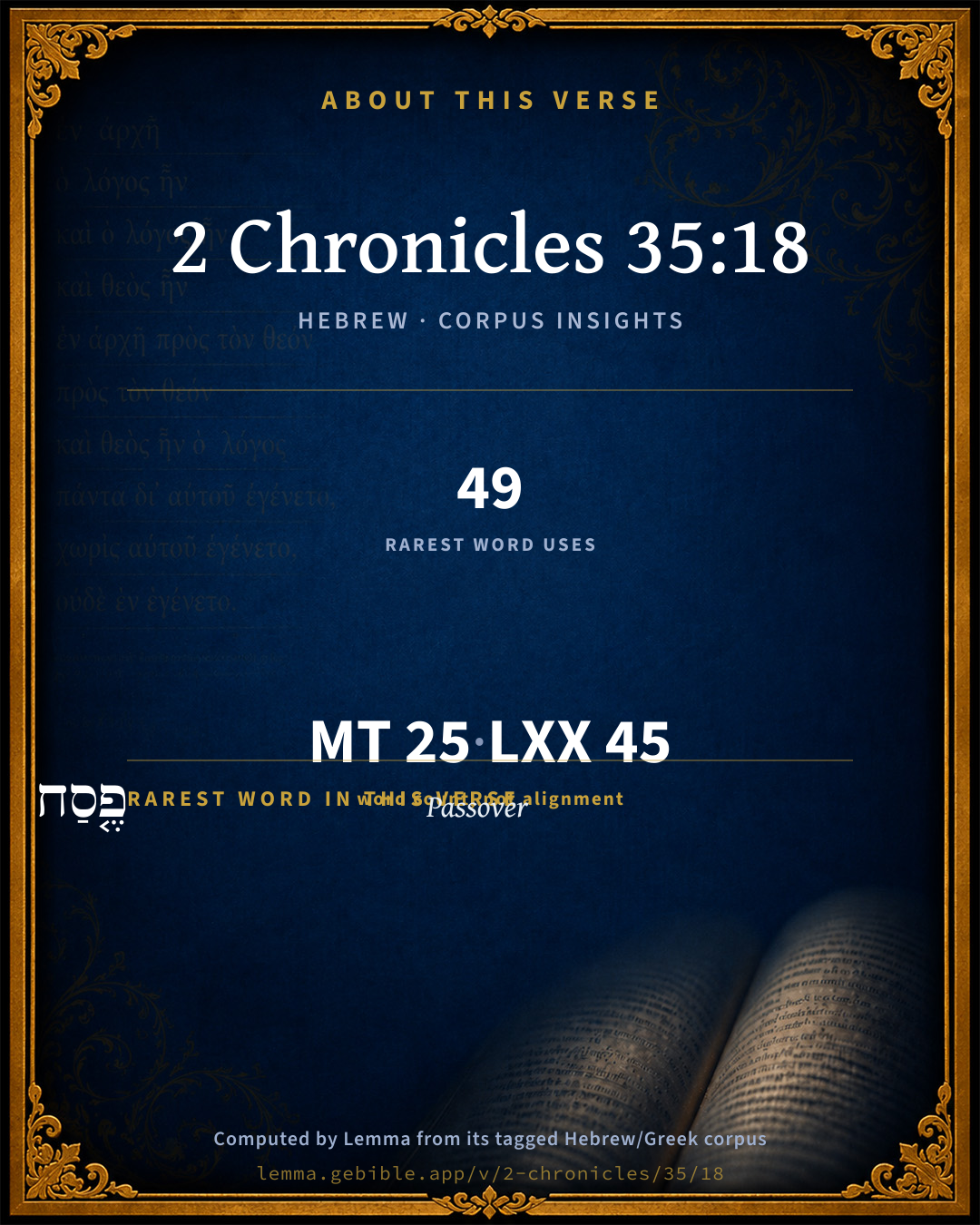
פֶ֤סַח Passover H6453 occurs in 46 verses of the Hebrew Bible. Also found in:

Grammatical profile

  • 5 verbs
  • 16 nouns
  • 1 preposition
  • 3 particles

Verb forms

  • נַעֲשָׂ֨ה Niphal · Perfect
  • עָשׂ֡וּ Qal · Perfect
  • עָשָׂ֣ה Qal · Perfect
  • הַנִּמְצָ֔א Niphal · Participle Active
  • וְיוֹשְׁבֵ֖י Qal · Participle Active

Repetition

Words recur within this verse — often emphatic in Hebrew:

  • נַעֲשָׂ֨ה to do H6213 ×3
  • בְּיִשְׂרָאֵ֔ל Israel H3478 ×3
  • פֶ֤סַח Passover H6453 ×2
  • וְכָל all H3605 ×2
  • וְלֹֽא not H3808 ×2

Hebrew & Septuagint length

In English translation the verse runs 50 words from the Hebrew and 52 from the Septuagint (LXX English) — closely comparable.

A rough comparison of the two English renderings, which tokenize alike — not a word-level alignment.

Word counts can differ between the Hebrew and the Greek without any difference in meaning — e.g. the Hebrew direct-object marker אֵת has no separate Greek word, and Greek often adds the article ὁ.

In the original languages it is 25 Hebrew tokens and 45 Greek tokens — but the two are counted differently (Hebrew bundles its prefixes and suffixes into one token; the Greek is in lemma form), so that isn’t a like-for-like length.

Cross-references

3

Topical passages linked to 2 Chronicles 35:18 in the Treasury of Scripture Knowledge — connected by theme and wording, ordered by reader-vote popularity; previews shown in the World English Bible.

  • 2 Kings 23:21–23 The king commanded all the people, saying, Keep the Passover to Yahweh your God, as it is written in this book of the covenant.
  • 2 Chronicles 30:5 So they established a decree to make proclamation throughout all Israel, from Beersheba even to Dan, that they should come to keep the Passover to Yahweh, the God of Israel, at Jerusalem: for they had not kept it in great numbers in such sort as it is written.
  • 2 Chronicles 30:26–27 So there was great joy in Jerusalem; for since the time of Solomon the son of David king of Israel there was not the like in Jerusalem.

Cross-references courtesy of OpenBible.info (CC BY 4.0).

Hebrew and Greek witnesses Masoretic Hebrew ↔ Greek Septuagint

The same verse in the two great witnesses to the Old Testament, shown verse-for-verse.

These are two independent witnesses, not word-aligned to each other, and the Septuagint is shown in lemma (dictionary) form.

Hebrew 2 Chronicles 35:18 Masoretic · Westminster Leningrad Codex

וְלֹֽא נַעֲשָׂ֨ה פֶ֤סַח כָּמֹ֨הוּ֙ בְּיִשְׂרָאֵ֔ל מִימֵ֖י שְׁמוּאֵ֣ל הַנָּבִ֑יא וְכָל מַלְכֵ֣י יִשְׂרָאֵ֣ל לֹֽא עָשׂ֡וּ כַּפֶּ֣סַח אֲשֶׁר עָשָׂ֣ה יֹֽ֠אשִׁיָּהוּ וְהַכֹּהֲנִ֨ים וְהַלְוִיִּ֤ם וְכָל יְהוּדָה֙ וְיִשְׂרָאֵ֣ל הַנִּמְצָ֔א וְיוֹשְׁבֵ֖י יְרוּשָׁלִָֽם

There was no Passover like that kept in Israel from the days of Samuel the prophet; neither did any of the kings of Israel keep such a Passover as Josiah kept, and the priests, and the Levites, and all Judah and Israel who were present, and the inhabitants of Jerusalem.

World English Bible · Public Domain

Greek LXX 2 Chronicles 35:18 Septuagint · lemma form

καί οὐ γίγνομαι φασεχ ὅμοιος αὐτός ἐν ἰσραήλ ἀπό ἡμέρα σαμουηλ ὁ προφήτης καί πᾶς βασιλεύς ἰσραήλ οὐ ποιέω ὡς ὁ φασεχ ὅς ποιέω ιωσίας καί ὁ ἱερεύς καί ὁ λευείτης καί πᾶς ἰουδά καί ἰσραήλ ὁ εὑρίσκω καί ὁ καταοἰκέω ἐν ἰερουσαλήμ ὁ κύριος

And there was no passover like it in Israel from the days of Samuel the prophet, or any king of Israel: they kept not such a passover as Josias, and the priests, and the Levites, and all Juda and Israel that were present, and the dwellers in Jerusalem, kept to the Lord.

LXX2012 (modern English Septuagint) · Public Domain

Hebrew: Westminster Leningrad Codex (CC BY 4.0). Greek: Septuagint (public domain); English from LXX2012 (modern English Septuagint) (Public Domain). How the Septuagint differs from the Hebrew →

Commentary

Notes on 2 Chronicles 35:18 from classic Christian and Jewish commentators (each source and its license shown beneath its notes). The classic Christian expositions comment on the surrounding passage and are grouped to its opening verse, so a note may address several verses; the Jewish commentaries on the Tanakh (Rashi and others) are per-verse, so they appear only where the commentator wrote on this verse.

Lemma curates 59 commentaries, every one of them public domain or Creative Commons licensed, each selected and text-cleaned for this edition rather than reprinted as found. About our sources →

Trapp's Complete Commentary

John Trapp

2Ch 35:18 And there was no passover like to that kept in Israel from the days of Samuel the prophet; neither did all the kings of Israel keep such a passover as Josiah kept, and the priests, and the Levites, and all Judah and Israel that were present, and the inhabitants of Jerusalem.

Ver. 18. And there was no passover like to that.] See 2Ki 23:22.

Neither did all the kings of Israel.] No, not Hezekiah; for at his passover the congregation was not so great, nor so well prepared; nor were the Levites and singers so well marshalled, nor the sacrifices so many, &c.

John Trapp, A Commentary or Exposition upon All the Books of the Old and New Testament (1647–1656) — public domain. Text from a community e-Sword module.

Joseph Benson's Commentary

2Ch 35:18. There was no passover like to that — The whole solemnity was performed exactly according to the law, whereas in Hezekiah’s passover there were several irregularities: likewise Josiah furnished the whole congregation with beasts for sacrifice at his own charge, which no king ever did before him.

Joseph Benson's Commentary on the Old and New Testaments (1811–1818) — public domain. Text from a community e-Sword module.

Tyndale Open Study Notes

Tyndale Open Resources

35:18 This Passover included a greater number of participants than the one Hezekiah had observed. In this Passover, the priests and Levites took a prominent and proper role, as Josiah had specifically required (35:15-16; cp. 30:3, 15).

Tyndale Open Study Notes — © Tyndale Open Resources, licensed CC BY-SA 4.0. Text via the HelloAO Bible API.

Geneva Bible (1599)

Geneva Bible translators

Hebrew, found.

Geneva Bible (1599) marginal notes — public domain. Text via Bolls.life.

Jamieson, Fausset & Brown

Robert Jamieson, A. R. Fausset & David Brown

there was no passover like to that kept in Israel from the days of Samuel--One feature by which this passover was distinguished was the liberality of Josiah. But what distinguished it above all preceding solemnities was, not the imposing grandeur of the ceremonies, nor the immensity of the assembled concourse of worshippers; for these, with the exception of a few from the kingdom of Israel, were confined to two tribes; but it was the ardent devotion of the king and people, the disregard of purely traditional customs, and the unusually strict adherence, even in the smallest minutiæ, to the forms of observance prescribed in the book of the law, the discovery of an original copy of which had produced so great a sensation. Instead of "from the days of Samuel," the author of the Book of Kings says, "from the days of the judges who judged Israel" [Kg2 23:22]. The meaning is the same in both passages, for Samuel concluded the era of the judges.

all Judah and Israel that were present--The great majority of the people of the northern kingdom were in exile, but some of the remaining inhabitants performed the journey to Jerusalem on this occasion. 37,600 paschal lambs and kids were used, which [Ch2 35:7], at ten to a company, would make 376,000 persons attending the feast.

Jamieson, Fausset & Brown — Commentary Critical and Explanatory on the Whole Bible (1871) — public domain (CC PDM 1.0). Text via the HelloAO Bible API.

Adam Clarke's Commentary

Verse 18. There was no passover like to that] "That which distinguished this passover from all the former was," says Calmet, "the great liberality of Josiah, who distributed to his people a greater number of victims than either David or Solomon had done."

Adam Clarke's Commentary on the Bible (1810–1826) — public domain. Text from a community e-Sword/MySword module.

Ellicott's Commentary for English Readers

(18) And there was no Passover like to that.—2Ki_23:22.

From the days of Samuel the prophet—Kings, “from the days of the judges that judged Israel,” of whom Samuel was the last and greatest (1Sa_7:15).

Neither did all the kings of Israel.—Kings, “and (from) all the days of the kings of Israel and the kings of Judah.” (Comp. 2chron xxx 26).

And the priests . . . Jerusalem.—Not in Kings. A characteristic addition.

Israel that were present.—Rather, Israel that was present, i.e., the remnant who had come from the ruined kingdom of the ten tribes. (Comp. 2Ch_34:33).

A Bible Commentary for English Readers, edited by Charles John Ellicott (1878–1897) — public domain. Text from a community e-Sword module.

The Cambridge Bible for Schools and Colleges

gen. ed. J. J. S. Perowne

18. there was no passover] Cp. what is said of Hezekiah’s Passover, 2Ch_30:26.

from the days of Samuel] Perhaps in allusion to 1Sa_9:12-13, though there is no word there to identify the feast mentioned with the Passover. In 2Ki_23:22 “from the days of the judges.”

The Cambridge Bible for Schools and Colleges (gen. ed. J. J. S. Perowne; Cambridge University Press, 1878–1918) — public domain. Text from a community e-Sword module.

John Gill's Exposition

And there was no passover like to that kept in Israel,.... So exactly according to the law, so universally by Israel and Judah, and with such liberality shown by the king, and the chief of the priests and Levites; of this, and the following verse; see Gill on Kg2 23:22; see Gill on Kg2 23:23

2 Chronicles 35:20

ch2 35:20

ch2 35:20

ch2 35:20After all this, when Josiah had prepared the temple,.... Purified it, and cleansed it from the filth in it, and from all idolatry, and had repaired it, and put the service of it in good order, and on a good footing, after which great prosperity in church and state might have been expected:

Necho king of Egypt came up to fight against Carchemish by Euphrates; now called Querquisia, supposed by some to be the same with the Cadytis of Herodotus, which that historian calls a great city of Syria, whither he says Necho went after the battle with the Syrians (x); of which See Gill on Isa 10:9 and of this king of Egypt; see Gill on Kg2 23:29, Jer 46:2.

and Josiah went out against him; or to meet him, and stop him from going through his land, which lay between Egypt and Syria; Egypt being on the south of Israel, and Euphrates on the north of it, as Jarchi observes.

(x) Euterpe, sive, l. 2. c. 159. & Galei not. in ib.

John Gill's Exposition of the Whole Bible (1746–1763) — public domain (CC PDM 1.0). Text via the HelloAO Bible API.

Haydock's Catholic Bible Commentary

As Josias kept. He displayed greater liberality (Estius. See 4 K. xxiii. 20.) and devotion; and the festival had also been neglected for some time. W.

George Leo Haydock (1774–1849), Haydock's Catholic Family Bible and Commentary, 1859 edition — public domain. Excludes Psalms (Douay-Rheims chapter numbering differs from Protestant) and Deuterocanonical books (Catholic canon only).

Whedon's Commentary on the Bible

Daniel D. Whedon

18. No passover like to that — Many passovers had been held in Israel since the days of Samuel, but none so memorable as this one. There was such a solemnity attending it, and such a careful adherence to the directions of the law, and so many representatives of the priests, and the Levites, and all Judah and Israel… and the inhabitants of Jerusalem, and withal, it was so preceded and followed by a dark record of national apostasy and sin, that it was remembered in Israelitish history as a most bright and blessed ray of light that had streamed through the thick darkness of the deepening night of Judah’s decline and fall.

The account of Josiah’s death (2Ch_35:20-27) is somewhat more fully given here than in Kings, but the principal differences have been sufficiently noted at 2Ki_23:26-30.

Daniel D. Whedon (gen. ed.), Commentary on the Old and New Testaments (1874–1909) — public domain. Text from a community e-Sword module.

The Pulpit Commentary

Upon this verse Professor Murphy says, "The Passover in Hezekiah"s time was great, (2Ch_30:26) but this was greater. For it was kept on the proper day in the first month, and was not a mere supplementary Passover; it was observed with due regularity, and not by worshippers some of whom were unclean; and if we allow thirteen persons for each lamb or kid, there were upwards of half a million communicants; while, so far as we know, there were only seventeen thousand sheep presented by Hezekiah and his princes, (2Ch_30:24) which would not supply more than half the number of partakers.

The Pulpit Commentary (1880–1919), ed. H.D.M. Spence-Jones & Joseph S. Exell — public domain. Text from a community e-Sword module.

John Wesley's Explanatory Notes

Like to that - The whole solemnity was performed exactly according to the law, whereas in Hezekiah's passover there were several irregularities: likewise Josiah furnished the whole congregation with beasts for sacrifice at his own charge, which no king ever did before him.

John Wesley, Explanatory Notes Upon the Whole Bible (1754–1765) — public domain. Text via the GEBible commentary corpus.

unfoldingWord translationNotes

Door43 World Missions Community

Such a Passover celebration had never been held in Israel

This can be stated in active form. AT: "There had never been such a Passover celebration in Israel" (See: Active or Passive)

held in Israel

This refers specifically to the nation of Israel as a whole, as it was before the northern kingdom and southern king split.

from the days

"from the time"

the other kings of Israel

Here "Israel" refers specifically to the northern kingdom of Israel.

This Passover was kept

This can be stated in active form. AT: "They observed this Passover" (See: Active or Passive)

was kept

This is an idiom. AT: "was observed" or "was celebrated" (See: Idiom)

the eighteenth year

"year 18" (See: Ordinal Numbers)

translationWords

prophet

Samuel

Israel

kingdom of Judah

kingdom of Israel

unfoldingWord translationNotes — © Distant Shores Media and the Door43 World Missions Community, licensed CC BY-SA 4.0. Source: git.door43.org/Door43/en_tn.

Rashi

Rabbi Shlomo Yitzchaki (Rashi)

And such a Passover sacrifice had not been made In II Kings (23:22) it is written: “For such a Passover sacrifice had not been performed since the time of the judges,” since the day that Israel was divided into two kingdoms, when the ten tribes separated from the kings of Judah and crowned a king over themselves. For all the time that they were two nations, the tribes of Judah and Benjamin made a Passover sacrifice for the sake of the Lord in Jerusalem, and these [made one] for the sake of pagan deities in Beth-El and in Dan. And this did not occur all the days of the judges, until Israel was divided into two families, and every generation had only one judge, and that judge would compel them to walk in the way of the Lord, as is explained in Judges (2:18): “and the Lord was with the judge and saved them from the hand of their enemies all the days of the judge.” And all the ten tribes would go to Shiloh and make a Passover sacrifice for the sake of the Lord. But such a Passover sacrifice had not been made all the days of the kings of Israel and Judah, that they should make a Passover sacrifice together. But in the days of Josiah, when the kingdom of the ten tribes had already ceased to exist, for since Jeremiah had returned the ten tribes, they did not crown another king, but Josiah reigned over them, and they all made a Passover sacrifice together in Jerusalem. This is the meaning of: “such a Passover sacrifice had not been performed...to the Lord in Jerusalem.” This interpretation, however, misleads me very much, and does not appear correct to me, for although Jeremiah had returned the ten tribes and Josiah reigned over them in Jerusalem, how is it possible that they did not make such a Passover sacrifice all the days of the judges and in the days of Samuel the Seer and in the days of David and Solomon, when Israel was dwelling in its land in peace and tranquility, and they had only one king, and their hearts were directed toward Heaven? Rather, this is the explanation, and this is the way Rabbi Eliezer the son of Rabbi Meshullam interpreted it to me: “And such a Passover sacrifice had not been made” ever, [it had never happened] that the king and the officers should supply enough animals for the Passover sacrifices and cattle for the festive peace offerings, and that he commanded the Levites to prepare for them and send each person according to how much he could eat.

Rashi on the Tanakh — English translations: “The Judaica Press complete Tanach with Rashi, translated by A. J. Rosenberg” (CC BY 4.0); “Pentateuch with Rashi's commentary by M. Rosenbaum and A.M. Silbermann, 1929-1934” (public domain); “The Metsudah Tanach series, Lakewood, N.J” (CC BY 4.0); and “The Book of Joshua, Metsudah Publications, 1997” (CC BY 4.0). Text via Sefaria.

Lesson kit

Teaching starters — assembled from the data on this page, not authored interpretation. Every prompt links to the verse data it draws on. Edit before teaching.

2 Chronicles, in the Historical, opens this verse with 25 words (18 distinct Hebrew lemmas). Its most distinctive word is peçach (“Passover”). A historical commentator’s framing appears above. Read the whole chapter for the surrounding context.

Discussion questions

  1. What does “Passover” (peçach) contribute to the verse as a whole?
  2. How does Exodus 12:11, which shares the word «Passover», read alongside this verse?
  3. What does the repetition of “to do” (3× in this one verse) do in this verse?
  4. The translations on this page render this verse differently — a whole-verse word diff, not a word-by-word alignment. What might account for the different wordings?
  5. «נַעֲשָׂ֨ה» is a Niphal Perfect verb. How does that grammatical form shape the action described?
  6. Compare how Trapp's Complete Commentary and Joseph Benson's Commentary read this verse. Where do they agree or differ?

Things to notice

Reading settings

Reading text

Shown beneath each verse's original-language words.

Old Testament
Old Testament edition

Read the OT as the Masoretic Hebrew (MT) or the Greek Septuagint (LXX).

English shown for the Greek Septuagint (in the Hebrew ↔ Greek comparison).

Comparing translations? Open the Compare panel on any verse page to stack up to four side by side.