
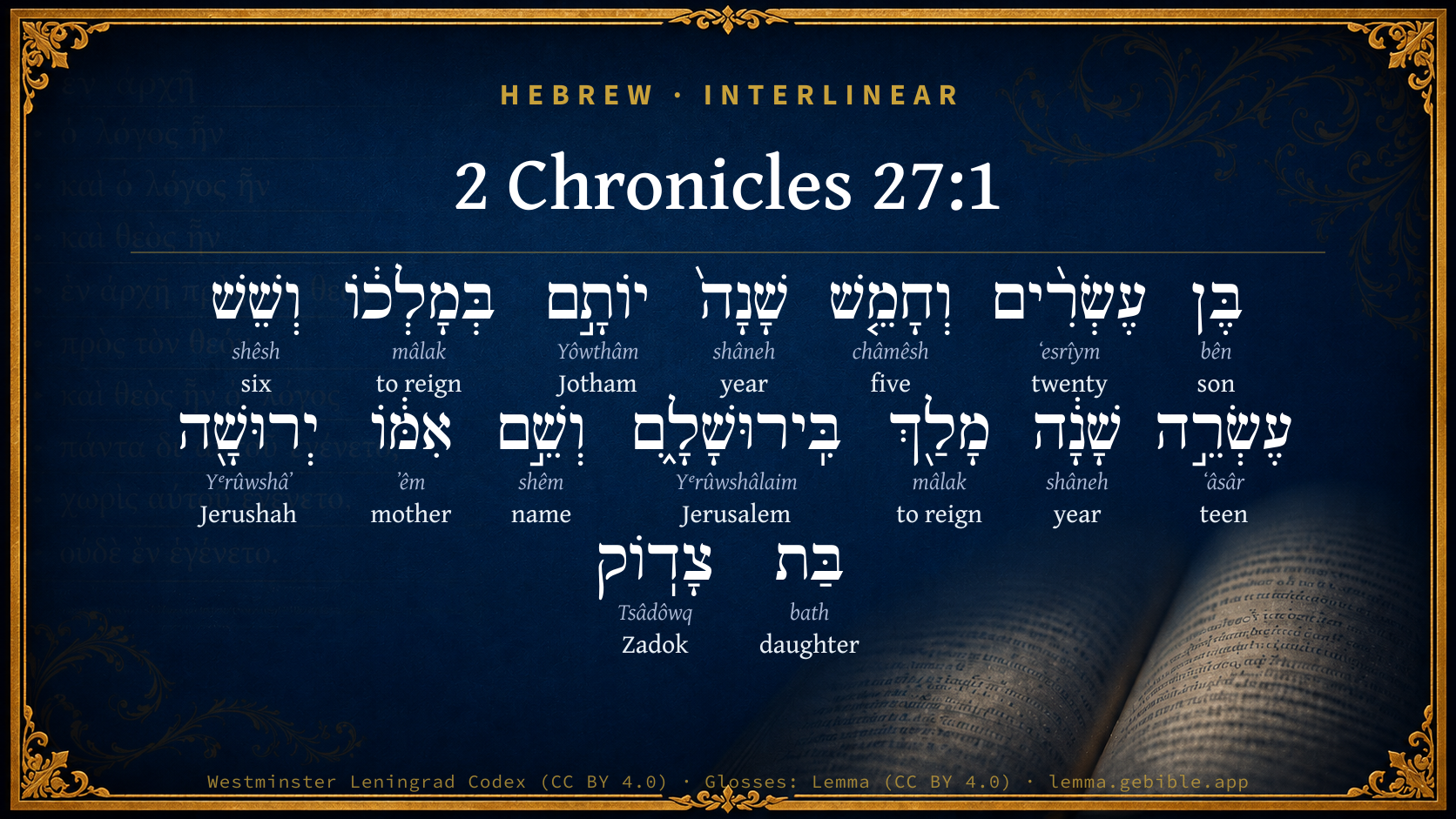
2 Chronicles 27:1

Hebrew (Westminster Leningrad Codex) 2 Chronicles 27:1 appears in the Hebrew Old Testament. The text above is from the Westminster Leningrad Codex. Each word links to its Strong’s number, a concise gloss, and parsing drawn from the Open Scriptures Hebrew Bible morphology. Click any word for its full Brown-Driver-Briggs (BDB) entry.
Download image
Cite this verse

2 Chronicles 27:1 (World English Bible). Public Domain. Lemma interlinear Bible study tool, https://lemma.gebible.app/v/2-chronicles/27/1.

Show BibTeX & RIS
BibTeX
RIS
English Translation
Jotham was twenty-five years old when he began to reign; and he reigned sixteen years in Jerusalem: and his mother's name was Jerushah the daughter of Zadok.
World English Bible · Public Domain
Download a study sheet

One document with this verse’s original text, its word-by-word gloss line, the meaning frame, cross-references with their text, attributed commentary, and full source and license credits — printable, and it pastes into notes with its structure intact.

This verse Autodidact and up

Study sheet (.html) Plain text (.txt)

A passage Seminary Student

Up to 50 verses in one chapter. A passage sheet keeps up to 6 commentary sources and 12 cross-references per verse, in the order this page ranks them, and says so on the sheet whenever that leaves anything out. Ask for a single verse and you get the Autodidact verse sheet above.

Everything on this page stays free to read, with no account — the sheet is a download of what is already on screen, not access to it.

Want to remove ads? Support Godless Engineer
Compare translations 3

The same verse in 3 English versions, stacked beneath the original-language interlinear above. Click any original word for its lexicon entry.

Each is an independent rendering of the whole verse — the interlinear is not word-aligned to these translations.

Highlighted words mark where these versions differ — a whole-verse word diff, not a word-by-word alignment.

  • World English Bible Public Domain
    Jotham was twenty-five years old when he began to reign; and he reigned sixteen years in Jerusalem: and his mother's name was Jerushah the daughter of Zadok.
  • King James Version Public Domain
    Jotham was twenty and five years old when he began to reign, and he reigned sixteen years in Jerusalem. His mother's name also was Jerushah, the daughter of Zadok.
  • unfoldingWord Literal Text CC BY-SA 4.0
    A son of 25 years was Jotham when he became king. And 16 years he reigned in Jerusalem. And the name of his mother was Jerushah, the daughter of Zadok.

unfoldingWord Literal Text — © unfoldingWord, licensed CC BY-SA 4.0. Word-aligned USFM3 via Door43 (git.door43.org/unfoldingWord/en_ult).

Versions to compare (up to 4)

3 of 4 selected

Show all 18 translations

Every available English version of this verse, each an independent rendering of the whole verse.

  • World English Bible Public Domain
    Jotham was twenty-five years old when he began to reign; and he reigned sixteen years in Jerusalem: and his mother's name was Jerushah the daughter of Zadok.
  • Berean Standard Bible Public Domain
    Jotham was twenty-five years old when he became king, and he reigned in Jerusalem sixteen years. His mother’s name was Jerushah daughter of Zadok.
  • Majority Standard Bible Public Domain
    Jotham was twenty-five years old when he became king, and he reigned in Jerusalem sixteen years. His mother’s name was Jerushah daughter of Zadok.
  • King James Version Public Domain
    Jotham was twenty and five years old when he began to reign, and he reigned sixteen years in Jerusalem. His mother's name also was Jerushah, the daughter of Zadok.
  • American Standard Version (1901) Public Domain
    Jotham was twenty and five years old when he began to reign; and he reigned sixteen years in Jerusalem: and his mother's name was Jerushah the daughter of Zadok.
  • Revised Version (1885) Public Domain
    Jotham was twenty and five years old when he began to reign; and he reigned sixteen years in Jerusalem: and his mother’s name was Jerushah the daughter of Zadok.
  • Geneva Bible (1599) Public Domain
    Iotham was fiue and twentie yere olde when he began to reigne, and reigned sixteene yeere in Ierusalem, and his mothers name was Ierushah the daughter of Zadok.
  • Douay-Rheims (1899) Public Domain
    Joatham was five and twenty years old when he began to reign, and he reigned sixteen years in Jerusalem: the name of his mother was Jerusa the daughter of Sadoc.
  • Young's Literal Translation Public Domain
    A son of twenty and five years `is' Jotham in his reigning, and sixteen years he hath reigned in Jerusalem, and the name of his mother `is' Jerushah daughter of Zadok.
  • Literal Standard Version CC BY-SA 4.0
    Jotham [is] a son of twenty-five years in his reigning, and he has reigned sixteen years in Jerusalem, and the name of his mother [is] Jerushah daughter of Zadok.
  • Unlocked Literal Bible CC BY-SA 4.0
    Jotham was twenty-five years old when he began to reign; he reigned sixteen years in Jerusalem. His mother's name was Jerushah; she was the daughter of Zadok.
  • unfoldingWord Literal Text CC BY-SA 4.0
    A son of 25 years was Jotham when he became king. And 16 years he reigned in Jerusalem. And the name of his mother was Jerushah, the daughter of Zadok.
  • Darby Bible Public Domain
    Jotham was twenty-five years old when he began to reign; and he reigned sixteen years in Jerusalem; and his mother's name was Jerushah, daughter of Zadok.
  • World Messianic Bible Public Domain
    Jotham was twenty-five years old when he began to reign, and he reigned sixteen years in Jerusalem. His mother’s name was Jerushah the daughter of Zadok.
  • Webster's Bible Public Domain
    Jotham was twenty and five years old when he began to reign and he reigned sixteen years in Jerusalem. His mother's name also was Jerushah, the daughter of Zadok.
  • Free Bible Version CC BY-SA 4.0
    Jotham was twenty-five when he became king, and he reigned in Jerusalem for sixteen years. His mother's name was Jerushah, daughter of Zadok.
  • Bible in Basic English Public Domain
    Jotham was twenty-five years old when he became king; and he was ruling in Jerusalem for sixteen years; and his mother's name was Jerushah, the daughter of Zadok.
  • JPS Tanakh (1917) Public Domain
    Jotham was twenty and five years old when he began to reign; and he reigned sixteen years in Jerusalem; and his mother's name was Jerushah the daughter of Zadok.

Literal Standard Version (2020), Covenant Press — licensed CC BY-SA 4.0. Text via the HelloAO Bible API (eBible.org). Unlocked Literal Bible (unfoldingWord) — licensed CC BY-SA 4.0. Text via the HelloAO Bible API (eBible.org). unfoldingWord Literal Text — © unfoldingWord, licensed CC BY-SA 4.0. Word-aligned USFM3 via Door43 (git.door43.org/unfoldingWord/en_ult). Free Bible Version, Dr. Jonathan Gallagher — licensed CC BY-SA 4.0. Text via the HelloAO Bible API (eBible.org).

Word by word

More ways to search: Search by grammar → Find every occurrence → Compare this word →

Practice this passage: Drill this verse → Learn its vocabulary →

יְרוּשָׁ֖ה
Yᵉrûwshâʼ
H3388
“Jerushah”
Noun, Proper
Part of Speech
Noun
Type
Proper
Full BDB Definition

Origin: passive participle of H3423

TWOT: None

Jerushah or Jerusha = "dispossessor" - the wife of king Uzziah and mother of king Jotham of Judah
  1. בֶּן bên H1121 “son of” Noun, Common, Masculine, Singular, Construct
  2. עֶשְׂרִ֨ים ʻesrîym H6242 “twenty” Adjective, Cardinal number, Both, Plural, Absolute
  3. וְחָמֵ֤שׁ châmêsh H2568 “and · five” Conjunction + Adjective, Cardinal number, Feminine, Singular, Absolute
  4. שָׁנָה֙ shâneh H8141 “year” Noun, Common, Feminine, Singular, Absolute
  5. יוֹתָ֣ם Yôwthâm H3147 “Jotham” Noun, Proper
  6. בְּמָלְכ֔וֹ mâlak H4427 “in/at · to reign · him” Preposition + Verb, Qal, Infinitive Construct + Suffix, Personal, 3rd Person, Masculine, Singular
  7. וְשֵׁשׁ shêsh H8337 “and · six” Conjunction + Adjective, Cardinal number, Feminine, Singular, Absolute
  8. עֶשְׂרֵ֣ה ʻâsâr H6240 “teen” Adjective, Cardinal number, Feminine, Singular, Absolute
  9. שָׁנָ֔ה shâneh H8141 “year” Noun, Common, Feminine, Singular, Absolute
  10. מָלַ֖ךְ mâlak H4427 “to reign” Verb, Qal, Perfect, 3rd Person, Masculine, Singular
  11. בִּֽירוּשָׁלִָ֑ם Yᵉrûwshâlaim H3389 “in/at · Jerusalem” Preposition + Noun, Proper
  12. וְשֵׁ֣ם shêm H8034 “and · name of” Conjunction + Noun, Common, Masculine, Singular, Construct
  13. אִמּ֔וֹ ʼêm H517 “mother · his” Noun, Common, Feminine, Singular, Construct + Suffix, Personal, 3rd Person, Masculine, Singular
  14. בַּת bath H1323 “daughter of” Noun, Common, Feminine, Singular, Construct
  15. צָדֽוֹק Tsâdôwq H6659 “Zadok” Noun, Proper

About this verse

These counts appear in no published source. They are computed here, from the morphology-tagged text and Lemma’s own curated glosses. What Lemma adds →

16
words
14
distinct lemmas
Historical
section

Notable vocabulary

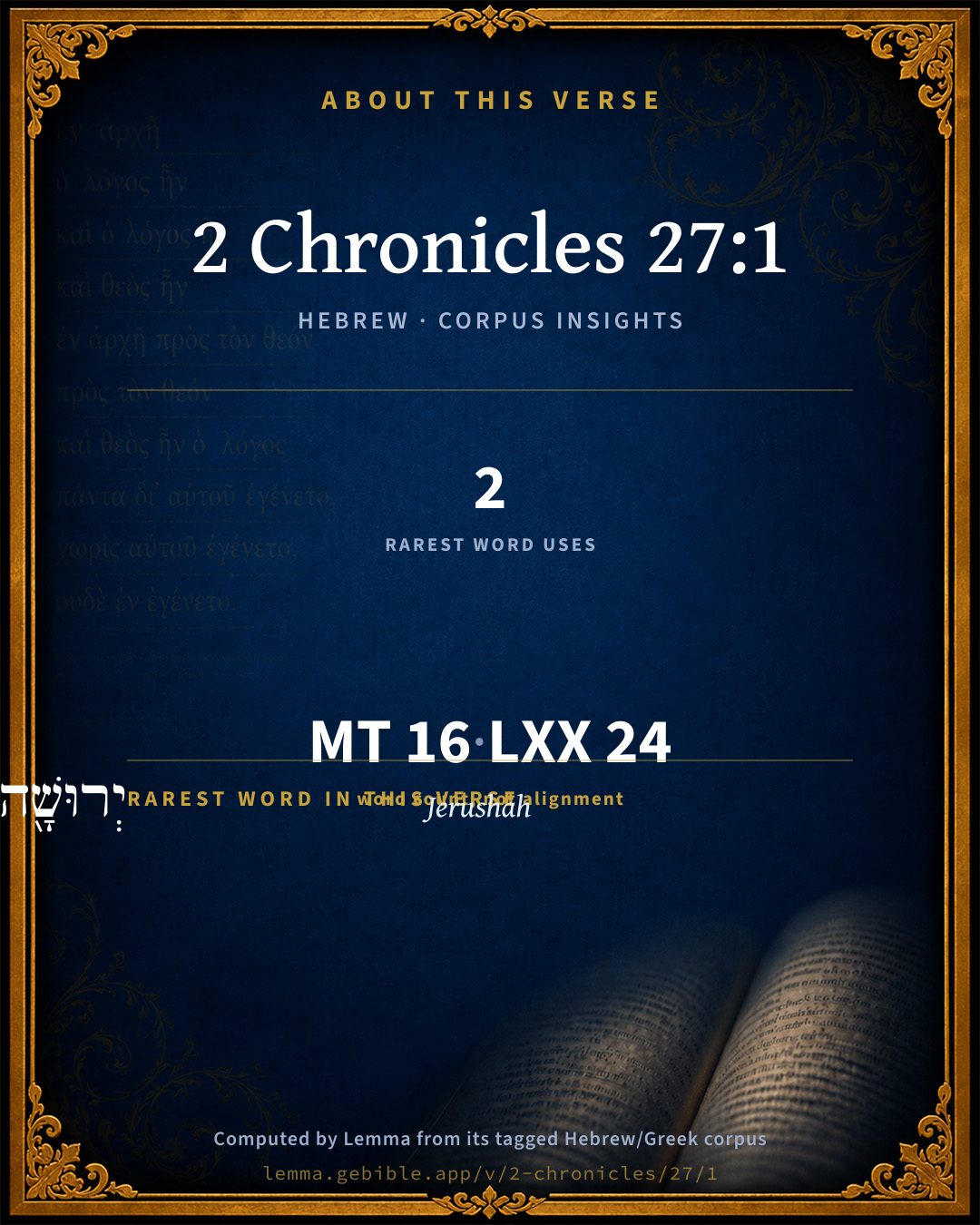
The rarest word here is יְרוּשָׁ֖ה Jerushah H3388 — appearing just 2 times in the whole Hebrew Bible.

Shared distinctive vocabulary

יְרוּשָׁ֖ה Jerushah H3388 occurs in 2 verses of the Hebrew Bible. Also found in:

Grammatical profile

  • 2 verbs
  • 10 nouns
  • 4 adjectives

Verb forms

  • בְּמָלְכ֔וֹ Qal · Infinitive Construct
  • מָלַ֖ךְ Qal · Perfect

Repetition

Words recur within this verse — often emphatic in Hebrew:

  • שָׁנָה֙ year H8141 ×2
  • בְּמָלְכ֔וֹ to reign H4427 ×2

Hebrew & Septuagint length

In English translation the verse runs 27 words from the Hebrew and 28 from the Septuagint (LXX English) — closely comparable.

A rough comparison of the two English renderings, which tokenize alike — not a word-level alignment.

Word counts can differ between the Hebrew and the Greek without any difference in meaning — e.g. the Hebrew direct-object marker אֵת has no separate Greek word, and Greek often adds the article ὁ.

In the original languages it is 16 Hebrew tokens and 24 Greek tokens — but the two are counted differently (Hebrew bundles its prefixes and suffixes into one token; the Greek is in lemma form), so that isn’t a like-for-like length.

Cross-references

6

Topical passages linked to 2 Chronicles 27:1 in the Treasury of Scripture Knowledge — connected by theme and wording, ordered by reader-vote popularity; previews shown in the World English Bible.

  • 1 Chronicles 3:12 Amaziah his son, Azariah his son, Jotham his son,
  • 2 Kings 15:32–38 In the second year of Pekah the son of Remaliah king of Israel began Jotham the son of Uzziah king of Judah to reign.
  • Isaiah 1:1 The vision of Isaiah the son of Amoz, which he saw concerning Judah and Jerusalem, in the days of Uzziah, Jotham, Ahaz, and Hezekiah, kings of Judah.
  • Hosea 1:1 The word of Yahweh that came to Hosea the son of Beeri, in the days of Uzziah, Jotham, Ahaz, and Hezekiah, kings of Judah, and in the days of Jeroboam the son of Joash, king of Israel.
  • Micah 1:1 The word of Yahweh that came to Micah the Morashtite in the days of Jotham, Ahaz, and Hezekiah, kings of Judah, which he saw concerning Samaria and Jerusalem.
  • Matthew 1:9 Uzziah became the father of Jotham. Jotham became the father of Ahaz. Ahaz became the father of Hezekiah.

Cross-references courtesy of OpenBible.info (CC BY 4.0).

Hebrew and Greek witnesses Masoretic Hebrew ↔ Greek Septuagint

The same verse in the two great witnesses to the Old Testament, shown verse-for-verse.

These are two independent witnesses, not word-aligned to each other, and the Septuagint is shown in lemma (dictionary) form.

Hebrew 2 Chronicles 27:1 Masoretic · Westminster Leningrad Codex

בֶּן עֶשְׂרִ֨ים וְחָמֵ֤שׁ שָׁנָה֙ יוֹתָ֣ם בְּמָלְכ֔וֹ וְשֵׁשׁ עֶשְׂרֵ֣ה שָׁנָ֔ה מָלַ֖ךְ בִּֽירוּשָׁלִָ֑ם וְשֵׁ֣ם אִמּ֔וֹ יְרוּשָׁ֖ה בַּת צָדֽוֹק

Jotham was twenty-five years old when he began to reign; and he reigned sixteen years in Jerusalem: and his mother's name was Jerushah the daughter of Zadok.

World English Bible · Public Domain

Greek LXX 2 Chronicles 27:1 Septuagint · lemma form

υἱός εἴκοσι πέντε ἔτος ιωαθαμ ἐν ὁ βασιλεύω αὐτός καί δέκα ἕξ ἔτος βασιλεύω ἐν ἰερουσαλήμ καί ὄνομα ὁ μήτηρ αὐτός ιερουσα θυγάτηρ σαδωκ

Joatham was twenty and five years old when he began to reign, and he reigned sixteen years in Jerusalem: and his mother's name was Jerusa, daughter of Sadoc.

LXX2012 (modern English Septuagint) · Public Domain

Hebrew: Westminster Leningrad Codex (CC BY 4.0). Greek: Septuagint (public domain); English from LXX2012 (modern English Septuagint) (Public Domain). How the Septuagint differs from the Hebrew →

Commentary

Notes on 2 Chronicles 27:1 from classic Christian and Jewish commentators (each source and its license shown beneath its notes). The classic Christian expositions comment on the surrounding passage and are grouped to its opening verse, so a note may address several verses; the Jewish commentaries on the Tanakh (Rashi and others) are per-verse, so they appear only where the commentator wrote on this verse.

Lemma curates 59 commentaries, every one of them public domain or Creative Commons licensed, each selected and text-cleaned for this edition rather than reprinted as found. About our sources →

Ellicott's Commentary for English Readers

XXVII.

REIGN OF JOTHAM. (Comp. 2Ki_15:32-38.)

LENGTH AND CHARACTER OF THE REIGN.

PUBLIC WORKS (2Ch_27:1-4).

(1) Jotham was twenty and five years old.—Word for word as 2Ki_15:33, only adding Jotham.

Jerushah, the daughter of Zadok.—Perhaps the high priest Zadok of 1Ch_6:12. (Comp. 2Ch_22:11.)

A Bible Commentary for English Readers, edited by Charles John Ellicott (1878–1897) — public domain. Text from a community e-Sword module.

The Cambridge Bible for Schools and Colleges

gen. ed. J. J. S. Perowne

Ch. 2Ch_27:1-6 (cp. 2Ki_15:32-35). Jotham Succeeds

1. he reigned sixteen years] It is probable that the independent reign of Jotham was shorter than this, indeed if Azariah (Uzziah) be really mentioned (cp. 2Ch_26:1, note) on an inscription of Tiglath-Pileser III. of b.c. 740, Jotham’s sole reign lasted probably less than six years, for Ahaz his successor seems to have begin to reign about b.c. 736.

The Cambridge Bible for Schools and Colleges (gen. ed. J. J. S. Perowne; Cambridge University Press, 1878–1918) — public domain. Text from a community e-Sword module.

Trapp's Complete Commentary

John Trapp

2Ch 27:1 Jotham [was] twenty and five years old when he began to reign, and he reigned sixteen years in Jerusalem. His mother’s name also [was] Jerushah, the daughter of Zadok.

Ver. 1. Jotham was twenty and five years old.] Twenty and five he was years old when his father was stricken with leprosy; from which time he reigned as king, even in his father’s days: after whose death the kingdom was more solemnly stablished to him alone. Hence he is said then to have begun his reign; and then was Ahaz twenty years old, Jotham being about forty.

John Trapp, A Commentary or Exposition upon All the Books of the Old and New Testament (1647–1656) — public domain. Text from a community e-Sword module.

Joseph Benson's Commentary

A.M. 3246. — B.C. 758.

Jotham reigns well and prospers, 2Ch 27:1-6. The conclusion of his reign, 2Ch 27:7-9.

2Ch 27:2. He did that which was right, &c. — He did according to all his father Uzziah did, except in his miscarriages. We must not imitate those we have the greatest esteem for, any further than they do well; and their failings must be warnings to us, to walk more circumspectly.

2Ch 27:3. He built the high gate, &c. — Otherwise called the new gate. He repaired it, for it was built before, 2Ch 11:5. On the wall of Ophel he built much — Ophel was a tower upon or near the wall of Jerusalem, which probably he fortified, as his father had other towers.

2Ch 27:5-6. He fought also with the Ammonites — Who, it seems, endeavoured to shake off the yoke, which from David’s time had been put upon them. So Jotham became mighty — In wealth, and power, and influence upon the neighbouring nations, who courted his friendship, and feared his displeasure; because he prepared his ways, &c. — Or, directed his ways, his counsels, and actions, by the rule of God’s law. The more steadfast we are in religion, the more mighty we are both for the resistance of that which is evil, and for the performance of that which is good.

2Ch 27:9. And Jotham slept with his fathers — He died in the midst of his days, being only forty-one years of age, finishing his course too soon, as we may be ready to say, considering his great usefulness, but finishing it with honour, and having the happiness of not outliving his reputation, as his last three mentioned predecessors outlived theirs. And Ahaz his son reigned in his stead — Whose character, in all respects, was the reverse of his. “When that wealth and powers,” says Henry, “which wise men have done good with, devolves upon fools, that will do hurt with it, it is lamentable, and shall be for a lamentation.”

Joseph Benson's Commentary on the Old and New Testaments (1811–1818) — public domain. Text from a community e-Sword module.

The Preacher's Complete Homiletical Commentary

Joseph S. Exell (gen. ed.)

CRITICAL NOTES.] This chapter is par. with 2Ki_15:32-38, and taken mainly from the same source or sources. Ampler than narrative in Kings, and given with certain religious reflections after manner of writer (cf. Speak. Com.). Jotham’s character (2Ch_27:1-2), Jotham’s buildings and wars (2Ch_27:3-6), Jotham’s death and successor (2Ch_27:7-9).

2Ch_27:1-2.—J.’s character. Right, better than his father, as he did not intrude into temple. 2Ch_27:2. Corruptly, which frustrated his efforts to reform (cf. 2Ki_15:35). For general character of corruption, see Isaiah 1-5.

2Ch_27:3-6.—J.’s conduct. Built, i.e., repaired. High gate, the north hill of temple. Ophel, i.e., the mound or eminence on south-eastern slope of temple hill. Much to defend Jerusalem in every direction. 2Ch_27:4. Mountains, hill tract of Judah. Castles (2Ch_18:12), forts to check invaders. Ammon, restless under the yoke of Uzziah (2Ch_26:8), revolted against Jotham. Revolt repressed, and higher tribute exacted. 2Ch_27:6. Prepared, marg. established; directed, disposed his ways aright (cf. Pro_21:29).

2Ch_27:7-9.—J.’s death. Wars besides with Ammon, in later years with Rezin and Pekah (cf. 2Ki_15:37). City, i.e., “with his fathers” (2Ki_15:38), in the sepulchre of the kings.

HOMILETICS

JOTHAM’S PROSPEROUS REIGN.—2Ch_27:1-8

I. He began by imitating his father in good, not evil ways. Amaziah considered a good king in the greater portion of his reign, though guilty of two great sins (cf. 2Ki_14:3 and 2Ch_25:2; 2Ch_25:14; 2Ch_25:16). J. imitated his father in all respects, except impious usurpation of priestly office. Far more easy to copy bad than good deeds. But J. took warning from his father’s folly and punishment, acted a wise part, and displayed a piety singular and conspicuous among “the people” who “did corruptly.”

II. He became powerful by the adoption of right measures. He detected the dangers, and desired the welfare of his kingdom.

1. His military measures. He strengthened Jerusalem, fortified country places, and repressed revolting nations. Wise to fortify against attack and guard weak places in character, churches, and kingdoms.

2. In religious measures. “He prepared his ways before the Lord his God” (2Ch_27:6). Earnest and whole-hearted in piety. Thoughts fixed on God, and desired to please him in life. “In all thy ways acknowledge him, and he shall direct thy paths.” This leads to power and prosperity, for both come from God. The more steadfast in religion, the more able to resist evil, perform good, and influence others.

PREPARATION AND STRENGTH.—2Ch_27:6

Here we get an insight into Jotham’s purpose and ways. He prepared his ways, exercised forethought, arrangement, and prayer.

I. All Strength is gained by preparation. Not the result of accident or negligence. Strength of body and mind, strength of character and position, result from exercise, discipline, and growth. The virtue of the soil, the events of Providence, the creation of the world, and the incarnation of Christ after long and silent preparation.

II. All preparation must be in recognition of God. This invests all acts with influence, and gives them religious character. “Prepare thy work without and make it fit for thyself in the field”.

1. In recognition of God’s supremacy. “Before the Lord”. God sovereign and supreme Ruler. All power in his hands, all events under his control.

2. In covenant with His mercy. “Before the Lord thy God”. Conscious of God’s presence and love; a sense of interest and sonship. Loving appropriation and humble dependence.

III. When a person thus prepares his ways before God, he will become mighty. “J. became mighty because he prepared his way”. Preparations never vain; rashness and haste lead to failure and misfortune. Strength and success gained by fixed resolve, entire consecration, and devout preparation. Mighty in prayer, influence for good given “before God”; required in Christian effort and in a sinful world. “Mighty through God”.

HOMILETIC HINTS AND SUGGESTIONS

2Ch_27:2. “According to all that his father Uzziah did”. One single act of impiety destroys not general good character of his reign [Speak. Com.]. People did corruptly, civil injustice and social cruelty; laborious service and empty ritual; foreign oppression and providential misery (cf. Isaiah 1-5). Jotham a witness for God in prevalent corruption and national faithlessness.

2Ch_27:1-9. Jotham’s life. His mother’s name and relations. His age at succession (2Ch_27:1). His great achievements: built cities, conquered enemies, and became mighty in fame, wealth, and power. His death a lamentation, and his son an unworthy successor. “Wrought a woeful change, being optimi patris pessimus filius” [Trapp].

The Preacher's Complete Homiletical Commentary (gen. ed. Joseph S. Exell; Funk & Wagnalls, c. 1892) — public domain (pre-1929). A full-Bible homiletical/sermon-outline anthology covering 65 of 66 books (2 John is absent from the source module). Text from a community e-Sword module.

The Annotated Bible

Arno C. Gaebelein

CHAPTER 27 The Reign of Jotham

1. The reign of Jotham (2Ch 27:1-6)

2. The death of Jotham (2Ch 27:7-9)

The record of the reign of Jotham is brief in both 2 Kings and in Chronicles. He did also what was right in the sight of the LORD. The statement “howbeit he entered not into the temple of the LORD” means that he did not act as Uzziah, his father did, when he intruded into the functions of the priesthood. However, in spite of the good example of the king, the people continued in their departure from Jehovah. “And the people did yet corruptly.” All the evils of a false worship continued and were not stopped. The state of the people is pictured by Isaiah in chapters 1-5 and also in the book of the prophet Micah. These portions of the Word of God are needed to get a better understanding of the conditions which prevailed during the reign of Jotham. Jotham was a godly man and in his reign of sixteen years did much good. All his wars were successful. “He became mighty, because he prepared his ways before the LORD his God.” And this statement is the key of all his success and prosperity. He lived and walked in the presence of the Lord. He was guided, strengthened and kept by Him. And this is what all God’s people need. It is still the way, the only way to blessing and success, to prepare our ways before the Lord. Jotham is one of the few Bible-characters of whom nothing evil is recorded. Yet the people over which he ruled continued in corruption and apostasy from God.

Arno C. Gaebelein, The Annotated Bible (1913–1922) — public domain. Text from a community e-Sword module.

Tyndale Open Study Notes

Tyndale Open Resources

27:1 After a co-regency of eleven years with his father, Uzziah (750–740 BC), Jotham became king in his own right and reigned five more years (740–735 BC). This represents the sixteen years mentioned in the text. Jotham lived at least four more years, for we read that Hoshea came to power in the northern kingdom “in the twentieth year of Jotham son of Uzziah” (2 Kgs 15:30). But Jotham’s son, Ahaz, had already begun a co-regency with Jotham. After Jotham’s sixteen official years, Ahaz began to rule in his father’s stead (see study note on 2 Kgs 16:1-2). However, Ahaz presumably had his official accession ceremony following his father’s death in 732 BC, so the author of 2 Chronicles reckons Ahaz’s official regnal years starting in 731 BC (see 2 Chr 28:1).

Tyndale Open Study Notes — © Tyndale Open Resources, licensed CC BY-SA 4.0. Text via the HelloAO Bible API.

Matthew Henry's Commentary

There is not much more related here concerning Jotham than we had before, Kg2 15:32, etc.

I. He reigned well. He did that which was right in the sight of the Lord; the course of his reign was good, and pleasing to God, whose favour he made his end, and his word his rule, and (which shows that he acted from a good principle) he prepared his ways before the Lord his God (Ch2 27:6), that is, he walked circumspectly and with much caution, contrived how to shun that which was evil and compass that which was good. He looked before him, and cast his affairs into such a posture and method as made the regular management of them the more easy. Or he established or fixed his ways before the Lord, that is, he walked steadily and constantly in the way of his duty, was uniform and resolute in it: not like some of those that went before him, who, though they had some good in them, lost their credit by their inconstancy and inconsistency with themselves. They had run well, but something hindered them. It was not so with Jotham. Two things are observed here in his character: - 1. What was amiss in his father he amended in himself (Ch2 27:2): He did according to all that his father did well and wisely; howbeit he would not imitate him in which he did amiss; for he entered not into the temple of the Lord to burn incense as his father did, but took warning by his fate not to dare so presumptuous a thing. Note, We must not imitate the best men, and those we have the greatest veneration for, any further than they did well; but, on the contrary, their falls, and the injurious consequences of them, must be warnings to us to walk the more circumspectly, that we stumble not at the same stone that they stumbled at. 2. What was amiss in his people he could not prevail to amend: The people did yet corruptly. Perhaps it reflects some blame upon him, that he was wanting in his part towards the reformation of the land. Men may be very good themselves, and yet not have courage and zeal to do what they might do towards the reforming of others. however it certainly reflects a great deal of blame upon the people, that they did not do what they might have done to improve the advantages of so good a reign: they had good instructions given them and a good example set before them, but they would not be reformed; so that even in the reign of their good kings, as well as in that of the bad ones, they were treasuring up wrath against the day of wrath; for they still did corruptly, and the founder melted in vain.

II. He prospered, and became truly reputable. 1. He built. He began with the gate of the house of the Lord, which he repaired, beautified, and raised. He then fortified the wall of Ophel, and built cities in the mountains of Judah (Ch2 27:3, Ch2 27:4), took all possible care for the fortifying of his country and the replenishing of it. 2. He conquered. He prevailed against the Ammonites, who had invaded Judah in Jehoshaphat's time, Ch2 20:1. He triumphed over them, and exacted great contributions from them, Ch2 27:5. He became mighty (Ch2 27:6) in wealth and power, and influence upon the neighbouring nations, who courted his friendship and feared his displeasure; and this he got by preparing his ways before the Lord his God. The more stedfast we are in religion the more mighty we are both for the resistance of that which is evil and for the performance of that which is good.

III. He finished his course too soon, but finished it with honour. He had the unhappiness to die in the midst of his days; but, to balance that, the happiness not to out-live his reputation, as the last three of his predecessors did. He died when he was but forty-one years of age (Ch2 27:8); but his wars and his ways, his wars abroad and his ways at home, were so glorious that they were recorded in the book of the kings of Israel, as well as of the kings of Judah, Ch2 27:7. The last words of the chapter are the most melancholy, as they inform us that Ahaz his son, whose character, in all respects, was the reverse of his, reigned in his stead. When the wealth and power with which wise men have done good devolve upon fools, that will do hurt with them, it is a lamentation, and shall be for a lamentation.

Matthew Henry's Commentary on the Whole Bible (1708–1710) — public domain (CC PDM 1.0). Text via the HelloAO Bible API.

Adam Clarke's Commentary

CHAPTER XXVII

Jotham succeeds his father Uzziah, and reigns well, 1, 2.

His buildings, 3, 4.

His successful wars, 5, 6.

General account of his acts, reign, and death, 7-9.

NOTES ON CHAP. XXVII

Adam Clarke's Commentary on the Bible (1810–1826) — public domain. Text from a community e-Sword/MySword module.

John Gill's Exposition

Jotham was twenty five years old,.... See Gill on Kg2 15:33.

.

2 Chronicles 27:2

ch2 27:2

ch2 27:2

ch2 27:2And he did that which was right,.... See Gill on Kg2 15:34,

howbeit, he entered not into the temple of the Lord; to burn incense, as his father did; he did according to his good ways, but not his evil ones:

and the people did yet corruptly; in sacrificing and burning incense in the high places, Kg2 15:35 which some think Joash himself did, and is meant in the preceding clause; but the sense given is best.

John Gill's Exposition of the Whole Bible (1746–1763) — public domain (CC PDM 1.0). Text via the HelloAO Bible API.

Albert Barnes' Notes on the Bible

This short chapter runs parallel with 2 Kings (marginal reference), and is taken mainly from the same source or sources which it amplifies.

Albert Barnes' Notes on the Bible (1834–1885) — public domain. Text from a community e-Sword/MySword module.

Dummelow's Commentary on the Holy Bible

J. R. Dummelow

The Reign of Jotham

This chapter repeats the substance of 2Ki_15:32-38, but expands the account of Jotham's buildings, and relates a war with Ammon about which Kings is silent.

2. The people did.. corruptly] If Isaiah 2 is rightly assigned to this reign, it furnishes illustrations of the historian's statement, for it represents idolatry, sorcery, and arrogance, as prevalent amongst the people (Isa_2:6-8, Isa_2:11.).

3. Ophel] the southern extremity of the Temple hill.

5. Measures] lit. 'cors': a 'cor' being rather more than 10 bushels, the whole quantity of each kind of grain was over 100,000 bushels. For such payments in kind cp. 2Ch_17:11; 2Ki_3:4.

J. R. Dummelow, A Commentary on the Holy Bible (Macmillan, 1909) — public domain. Text from a community e-Sword module.

The Pulpit Commentary

This chapter of nine verses is paralleled by the seven verses of 2Ki_15:32-38. It consists of personal particulars respecting Jotham (vers. 1, 2); his building and his wars (vers. 3-6); a reference to his further doings (ver. 7); an exact repetition of a part of the first verse (ver. 8); his death, burial, and. successor (ver. 9).

Jerushah. This name in the parallel is spelt with a final aleph instead of he. Nothing else is known of Jerushah, nor of her father Zadok.

HOMILETICS.

Vers. 1-9.

The blameless reign of a son who followed all that was good in a father"s example, and took warning of what was wrong in it.

The preacher may take occasion, from the apparently scant contents of this chapter, to enlarge on the general subject of example as a force in human life, pointing out its strong points and its weaker side; what is requisite to give it a steady and equable influence, and how there is only one perfect Example an Example always and in all things and by all worthy to be followed. Point may be given to the subject, as based on this chapter, by observing how it reminds us that

I NO HUMAN EXAMPLE CAN BE WORTHY TO BE FOLLOWED AND COPIED IN EVERY RESPECT. The most filial son may not look to the wisest, kindest, and most religious father as an absolutely safe guide and model in everything; and so, through the whole range and operation of the relationships, and the influences in them for good even, which affect our character and are prone to dominate our life.

II THE EXAMPLES OF THOSE WHOM WE BEST LOVE OF GREAT MEN, OF THE SAINTLIEST-KNOWN CHARACTERS, OF THOSE WHOM WE DESERVEDLY ADMIRE AND VENERATE MUST NOT BE MADE ANY SLAVISH MODEL, MUCH LESS PERVERTED INTO AN IDOLATROUS ONE. Nay, how very common it is, in such cases, to see that errors, defects, peculiarities, mannerisms, are what are copied first, while the weightier qualities and objects of imitation are overlooked! As if we imitate perfectly our human model, much is still wanting of Divine perfection, and which in our measure it is quite possible to incorporate; so, if we imitate slavishly, we are putting in what had better be left cut, and are often caught putting it in, even at the expense of omitting the worthier things.

III HUMAN EXAMPLE GIVES THE HELP OF WARMTH, SYMPATHY, AND AN ENCOURAGING INDUCEMENT TO ATTEMPT WHAT WE KNOW FROM IT THAT OTHERS HAVE DONE OR ATTAINED. It offers our thought and our moral nature a stepping-stone; it leads us on by the analogy to take the advantage of higher endeavour and of a higher model.

IV FOR THE DISCRIMINATION ABSOLUTELY NEEDED, WHEN WE ARE FOLLOWING HUMAN EXAMPLES, SINCERE ENDEAVOUR, CONSCIENTIOUS THOUGHT, AND HUMBLE PRAYER WILL DO VERY MUCH TO FIT US. As in so much else these three moderating and directing forces reap God"s blessing and gain safe practical results, so assuredly they will here, in what is a delicate grace to bloom and flourish in any circumstances, viz. that of discrimination. Jotham was made wise in this respect above many others, and his brief but very expressive and unique biography is therefore written without one single reproach or blot.

HOMILIES BY W. CLARKSON Vers. 1, 2.

Uzziah and Jotham, father and son.

From the slight materials we have here, and those still more scanty in the Book of Kings, we may glean

I THAT THE BEST PART OF UZZIAH"S FORTUNE WAS IN HIS FATHERHOOD. He did, indeed, enjoy a very good estate; the "lines fell to him in pleasant places, and he had a goodly heritage." He had the highest position in the land, power, wealth, a large and noble sphere for great natural ability and honourable ambition. (2Ch_26:6-15) But more precious than all of these to the king"s heart, we may be sure, was the possession of a true, loyal, godly son and successor. That which touches us in our home affections either stirs within us the deepest and purest joy or awakens the profoundest and most poignant grief. An unworthy son, a "thankless child," an heir who is likely to overturn all that we have laboriously built up, will make the very sweetest enjoyments and the fairest earthly possessions to lose ill their charm and be of no account to us. But such a son as Jotham is to his father the crown of prosperity and the comfort of adversity. From royal cares the king goes home to find, in conjugal and in filial affection, a contentment and a peace, an exhilaration and a joy, which no glittering gewgaws and no obsequious attentions are able to command. We do not know how highly Uzziah prized the virtue and the attachment of his son during his earlier and happier years, but we may be well assured that, when the hand of God was upon him, and he was separated from the society of men, he found in Jotham"s regency and in his filial sympathy a priceless mitigation to his loss, an invaluable treasure in his loneliness and his decline. Parents may think that their professional or household duties make it impossible for them to afford time for the teaching and training of their children, for the culture of their Christian character; but they ought to know that, whatever their other claims may be, they cannot afford to neglect their parental duty. If they do neglect it, they will leave undone that which will make them immeasurably poorer than they might become a few years further on.

II THAT THE BEST PART OF JOTHAM"S SUCCESSION WAS HIS FATHER"S CHARACTER. He inherited great things from his father, the king; but from his father, the servant of Jehovah, he gained one that outweighed them all the influence for good of a godly man. He "did what was right according to all that his father did." It was very largely, indeed, to his father"s example that he owed his own character for piety and purity. And what is there in the most splendid surroundings, or in the most attractive positions, that is to be compared with that? They will perish, but that will endure; they will soon lose their charm, but it will always he precious beyond all price; they are relatively, but that is intrinsically and eternally, valuable. We may not have to thank our parents for a fortune or a dowry it matters little; we may have to thank them for a bright and beautiful example that matters much, indeed everything.

III THAT JOTHAM LEARNT THE LESSON WHICH THE DIVINE FATHER TAUGHT, "Howbeit he entered not profanely and intrusively into the temple of the Lord." God rebuked his father, Uzziah, for this flagrant transgression, rebuking at the same time his pride of heart, his spiritual decline (see homily on. (2Ch_26:16-21, "A clouded close Doubtless Uzziah himself understood the meaning of that heavy blow, and bowed his heart beneath it; he "was in subjection to the Father of spirits, and lived." In that lingering death of leprosy he found life in penitence and in return to God. Jotham, his son, also learnt the lesson; and, instead of giving way to haughtiness of heart in the days when he was "mighty" (ver. 6), he retained his integrity before the Lord.

1. We may not plead our father"s deficiencies, excesses, or disobediences as an excuse for our own. If they erred or sinned, they also suffered for their error, for their guilt. And their experience should be a warning which we should heed, and not an example which we foolishly follow.

2. We should give God heartfelt thanks for all the gracious influenceswhich come to us in our home-life, and regard them as of the very best gifts that come from his Divine hand.

3. We should have it as a sacred and honourable ambition to confirm (andnot to destroy) the work of those who went before us. If we do thus live, our fathers will be living on in us and through us, and if we cannot immortalize their name, we can perpetuate their influence.

4. We may hope that such filial devotedness will be rewarded by parental rejoicing in those whom we shall leave behind, to whom we shall commit the fruit of our labour. C.

Vers. 1-9.

Features of an honourable life: Jotham.

But little of Jotham"s reign is recorded in Scripture, and his name is seldom on our lips. But he was a man of worth and wisdom; and, considering the comparative brevity of his life, we may say that he contributed much to his country. We learn from the account in the Second Book of Kings (2Ki_15:5)

I THAT HE SERVED A USEFUL APPRENTICESHIP. We find that, for some time during his father"s illness, he, "the king"s son, was over the house, judging the people of the land." This was an admirable arrangement for the country and for the young prince; for it had the advantage (which the son could not fail to obtain) of the experience of Uzziah; and he was learning the great art of ruling, while his responsibility was shared by one much wiser and stronger than he. It is an excellent thing for the you-, g, in every sphere, to be placed where they can be gathering wisdom before they carry the heavy burden of a weighty responsibility.

II THAT HE FOLLOWED IN THE FOOTSTEPS OF A WISE AND GOOD MAN. (Ver. 2.) (See previous homily on "Uzziah and Jotham, father and son.")

III THAT HE WORKED IN A WISE DIRECTION FROM WITHIN OUTWARD. First, "he built the high gate" of the temple (ver. 3); that was beginning at the very centre, at "the house of the Lord," which was morally, if not geographically, the central spot in the kingdom. Then he made some additions to the wall of Jerusalem (ver. 3). Then, moving outward, he built fortified cities in the mountains, and castles in the forests of Judah. And. then, going further afield, he warred with Ammon, and compelled it to pay tribute (ver. 5). This is the true order. Let solicitude and activity begin at the centre; let them begin at the very centre at a man"s own heart and character; let them move outward to those in the home circle, to the kindred, to the Church; and then to those still further away to fellow-countrymen, to fellow-men everywhere. A circumscribed activity is altogether a mistake; but we must begin with ourselves, becoming right at heart, and then we may and should move outward in our sympathies and our endeavours.

IV THAT HE ATTAINED GREAT POWER BY MAINTAINING HIS GODLY CHARACTER. (Ver. 6.) (See succeeding homily.)

V THAT HIS LIFE WAS DARKENED BY MANY SHADOWS AS WELL AS BRIGHTENED BY MANY BLESSINGS.

1. He could not effect all the reforms he would have liked to carry out, andhe had to witness some evil-doings which must have grieved his spirit. "The people did yet corruptly" (ver. 2).

2. Foreign invasion began to threaten the kingdom. (1Ki_15:3-7)

3. He found himself sick unto death at an age (forty-one) when he mighthave expected to do great things, and to be much to the people whom he ruled. It was an honourable and useful life that Jotham lived; one to be remembered and to be followed in its salient features. Like him

(1) we should see that we inherit that which is the best from our fathers;

(2) pursue the right steadfastly, without swerving, even to the end;

(3) beginning at home, we should extend our influence as far as we can send it;

(4) be prepared to lay down our weapons in the midst of our days. And how much better to die, as Jotham did, leading all men to wish that he had lived longer, than, as so many others have done, compelling their best friends to wish that they had died sooner! It matters little when the night of death comes; but it matters much that, during the day of life, we do our work well and bear our burden with a brave and patient heart. C.

The Pulpit Commentary (1880–1919), ed. H.D.M. Spence-Jones & Joseph S. Exell — public domain. Text from a community e-Sword module.

John Wesley's Explanatory Notes

Jotham reigns well and prospers, ver. 1-6. The conclusion of his reign, ver. 7-9.

John Wesley, Explanatory Notes Upon the Whole Bible (1754–1765) — public domain. Text via the GEBible commentary corpus.

Kretzmann's Popular Commentary

Paul E. Kretzmann

The Reign of Jotham.

v. 1. Jotham was twenty and five years old when he began to reign, and he reigned sixteen years in Jerusalem. Cf 2Ki 15:32-35. His mother’s name also was Jerushah, the daughter of Zadok, probably a descendant of the famous priest of that name.

v. 2. And he did that which was right in the sight of the Lord, according to all that his father Uzziah did, all but the burning of incense in the Temple; howbeit, he entered not into the Temple of the Lord, that is, the Sanctuary proper. And the people did yet corruptly, idolatry was still being carried on in the high places, for Jotham seems to have lacked real energy; his reign was pretty colorless.

v. 3. He built the high gate of the house of the Lord, that is, he repaired this gate on the upper side of the Temple area, and on the wall of Ophel, on the southern slope of the Temple mountain, he built much.

v. 4. Moreover, he built cities in the mountains of Judah; and in the forests, in the wooded and rugged places, where fortified cities could not well be erected, he built castles and towers, forts which would serve for purposes of defense.

v. 5. He fought also with the king of the Ammonites, who probably had attempted to revolt after paying tribute to Uzziah, and prevailed against them, they were unable to regain their independence. And the children of Ammon gave him the same year an hundred talents of silver and ten thousand measures of wheat (a measure, at that time, being almost six bushels) and ten thousand of barley. So much did the children of Ammon pay unto him, both the second year and the third, as the regular annual tribute.

v. 6. So Jotham became mighty, he held a position of some influence and authority among the surrounding nations, because he prepared his ways before the Lord, his God, he was established in his personal piety. It was only a little later, when the Syrians and Israel combined to attack the kingdom of Judah, that the Ammonites succeeded in regaining their independence, 2Ki 15:37.

v. 7. Now, the rest of the acts of Jotham, and all his wars and his ways, his entire manner of conducting his life, lo, they are written in the Book of the Kings of Israel and Judah.

v. 8. He was five and twenty years old when he began to reign, and reigned sixteen years in Jerusalem.

v. 9. And Jotham slept with his fathers, and they buried him in the City of David, with all the other kings of the dynasty of David; and Ahaz, his son, reigned in his stead. Even a ruler’s piety cannot keep the punishment of God from an idolatrous people if they persist in their wickedness.

Paul E. Kretzmann, Popular Commentary of the Bible (1921–1924) — public domain. Text from a community e-Sword module.

The Sermon Bible

William Robertson Nicoll (ed.)

2Ch 27:6

This text takes us behind the scenes, and admits us into those privacies of the king’s mind and habit where the real clues of every one’s character are to be found. We arrive at the secret of all strength, "preparation" and that preparation made "before the Lord his God."

I. God Himself is a God of preparations. All that God does He does measuredly and deliberately, and, as it seems to us, often slowly. There are intervals of hush before the bringing in of His great designs, and most frequently some heralding note to announce their approach.

II. The life of Christ is a remarkable series of preparations. There were those strange thirty years—ten-elevenths even of such a life as that—passed in the quietness and seclusion of preparation for three years’ work; and all that time, we have reason to believe, Christ grew.

III. Preparing times are never lost times. They suit the majesty of all that is true. We all have had to regret precipitancy, but very few of us in the retrospect of life will say that we ever acted too deliberately.

IV. Preparation "before God" lies in that general recognition of God which gives to whatever we are going to do a religious character, and invests it with religious influences. "Before the Lord." Sovereignty. Here is the acknowledgment of God’s supreme power, and authority, and right, and lordship. "His God." There is the loving appropriation, the sense of interest and sonship. The consciousness of sympathy, and help, and affection is in the acknowledgment, for if He is mine, I am His.

V. When a man prepares his ways before the Lord his God, the consequence is sure: he will grow mighty. He will do what he does strongly. And both his work and his own soul are sure to grow. This is just what we all want; we ought never to rest till we reach it—to be mighty in prayer, mighty in influence, mighty in good works, mighty in grace.

J. Vaughan, Sermons, 10th series, p. 13.

References: 2Ch 28:9.—R. Glover, Homiletic Quarterly, vol. iii., p. 563. 2Ch 28:10.—Spurgeon, Sermons, vol. vi., No. 294. 2Ch 28:23.—Ibid., My Sermon Notes: Genesis to Proverbs, p. 106.

The Sermon Bible, ed. William Robertson Nicoll (1888–1900) — public domain. Text from a community e-Sword module.

unfoldingWord translationNotes

Door43 World Missions Community

twenty-five years old ... sixteen years

"25 years old ... 16 years" (See: Numbers)

Jerushah

This is the name of a woman. (See: How to Translate Names)

He did what was right in the eyes of Yahweh

The eyes here represent seeing, and seeing represents judgment. Yahweh saw and approved of Jotham's actions. See how you translated this in 2 Chronicles 14:2. AT: "He did what Yahweh judged to be right" or "He did what Yahweh considered to be right" (See: Metaphor)

in everything

"in everything he did"

translationWords

Jotham

reign

Jerusalem

Zadok

Yahweh

Uzziah

temple

evil

unfoldingWord translationNotes — © Distant Shores Media and the Door43 World Missions Community, licensed CC BY-SA 4.0. Source: git.door43.org/Door43/en_tn.

Lesson kit

Teaching starters — assembled from the data on this page, not authored interpretation. Every prompt links to the verse data it draws on. Edit before teaching.

2 Chronicles, in the Historical, opens this verse with 16 words (14 distinct Hebrew lemmas). Its most distinctive word is Yᵉrûwshâʼ (“Jerushah”). A historical commentator’s framing appears above. Read the whole chapter for the surrounding context.

Discussion questions

  1. The word Yᵉrûwshâʼ carries the sense “Jerushah.” How does it shape the verse?
  2. 2 Kings 15:33 shares the word «Jerushah» with this verse. How do the two illuminate each other?
  3. “year” occurs 2× in this one verse. What is the effect of the repetition?
  4. These translations render this verse differently; the difference is in the English rendering, not the original. What questions does that raise?
  5. The verb «בְּמָלְכ֔וֹ» is Qal Infinitive Construct. How does its form color the action?
  6. Reading how Ellicott's Commentary for English Readers and The Cambridge Bible for Schools and Colleges read this verse, where do the two commentators agree and where do they part?

Things to notice

Reading settings

Reading text

Shown beneath each verse's original-language words.

Old Testament
Old Testament edition

Read the OT as the Masoretic Hebrew (MT) or the Greek Septuagint (LXX).

English shown for the Greek Septuagint (in the Hebrew ↔ Greek comparison).

Comparing translations? Open the Compare panel on any verse page to stack up to four side by side.