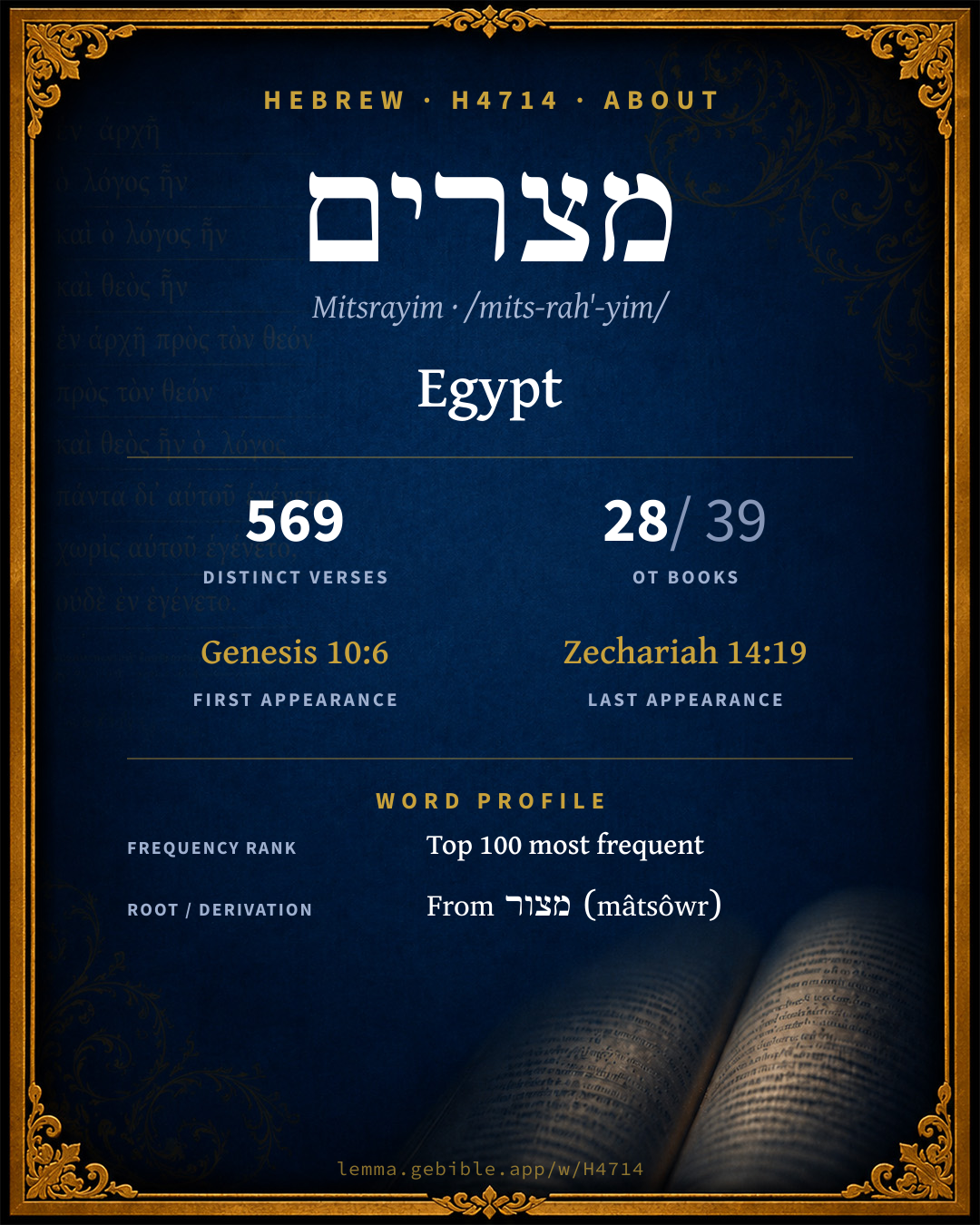
מִצְרַ֫יִם
Egypt
BDB lists 3 entries for ‘Egypt’ fuller range ↓
Full lexicon entry — Brown-Driver-Briggs (BDB)
From Brown-Driver-Briggs (BDB)
Where this word appears
Grammar key — what these labels mean
Part of speech
- Noun
- A naming word — a person, place, thing, or idea.
Noun type
- Proper
- A name of a specific person, place, or people (e.g. Abraham, Zion, Israel).
Page 3 of 3 — showing verses 401–569 of 569 distinct verses where H4714 appears, across 28 books. Click any verse to open its interlinear word-by-word view. Verse text shown in the World English Bible for context — . Each verse’s Hebrew form is shown with its reference; the English is not keyword-highlighted, since the data carries no word-level English alignment. Use “Compare translations” on any verse to read it across multiple English versions. This concordance covers the Hebrew Bible; Septuagint (Greek Old Testament) occurrences are not indexed here.
Isaiah 40 verses
- Isaiah 19:2 מִצְרַ֨יִם֙ בְּ/מִצְרַ֔יִם n Proper prep + n Proper I will stir up the Egyptians against the Egyptians: and they shall fight everyone against his brother, and everyone against his neighbor; city against city, [and] kingdom against kingdom.
- Isaiah 19:3 מִצְרַ֨יִם֙ n Proper The spirit of Egypt shall fail in the midst of it; and I will destroy the counsel of it: and they shall seek to the idols, and to the charmers, and to those who have familiar spirits, and to the wizards.
- Isaiah 19:4 מִצְרַ֔יִם n Proper I will give over the Egyptians into the hand of a cruel lord; and a fierce king shall rule over them, says the Lord, Yahweh of Hosts.
- Isaiah 19:12 מִצְרָֽיִם n Proper Where then are your wise men? and let them tell you now; and let them know what Yahweh of Hosts has purposed concerning Egypt.
- Isaiah 19:13 מִצְרַ֖יִם n Proper The princes of Zoan are become fools, the princes of Memphis are deceived; they have caused Egypt to go astray, who are the corner-stone of her tribes.
- Isaiah 19:14 מִצְרַ֨יִם֙ n Proper Yahweh has mixed a spirit of perverseness in the midst of her; and they have caused Egypt to go astray in every work of it, as a drunken man staggers in his vomit.
- Isaiah 19:15 לְ/מִצְרַ֖יִם prep + n Proper Neither shall there be for Egypt any work, which head or tail, palm-branch or rush, may do.
- Isaiah 19:16 מִצְרַ֖יִם n Proper In that day shall the Egyptians be like women; and they shall tremble and fear because of the shaking of the hand of Yahweh of Hosts, which he shakes over them.
- Isaiah 19:17 לְ/מִצְרַ֨יִם֙ prep + n Proper The land of Judah shall become a terror to Egypt; everyone to whom mention is made of it shall be afraid, because of the purpose of Yahweh of Hosts, which he purposes against it.
- Isaiah 19:18 מִצְרַ֗יִם n Proper In that day there shall be five cities in the land of Egypt that speak the language of Canaan, and swear to Yahweh of hosts; one shall be called The city of destruction.
- Isaiah 19:19 מִצְרָ֑יִם n Proper In that day shall there be an altar to Yahweh in the midst of the land of Egypt, and a pillar at the border of it to Yahweh.
- Isaiah 19:20 מִצְרָ֑יִם n Proper It shall be for a sign and for a witness to Yahweh of Hosts in the land of Egypt; for they shall cry to Yahweh because of oppressors, and he will send them a savior, and a defender, and he will deliver them.
- Isaiah 19:21 לְ/מִצְרַ֔יִם מִצְרַ֛יִם prep + n Proper n Proper Yahweh shall be known to Egypt, and the Egyptians shall know Yahweh in that day; yes, they shall worship with sacrifice and offering, and shall vow a vow to Yahweh, and shall perform it.
- Isaiah 19:22 מִצְרַ֖יִם n Proper Yahweh will strike Egypt, smiting and healing; and they shall return to Yahweh, and he will be entreated of them, and will heal them.
- Isaiah 19:23 מִ/מִּצְרַ֨יִם֙ בְּ/מִצְרַ֖יִם וּ/מִצְרַ֣יִם מִצְרַ֖יִם prep + n Proper prep + n Proper conj + n Proper n Proper In that day shall there be a highway out of Egypt to Assyria, and the Assyrian shall come into Egypt, and the Egyptian into Assyria; and the Egyptians shall worship with the Assyrians.
- Isaiah 19:24 לְ/מִצְרַ֖יִם prep + n Proper In that day shall Israel be the third with Egypt and with Assyria, a blessing in the midst of the earth;
- Isaiah 19:25 מִצְרַ֗יִם n Proper because Yahweh of Hosts has blessed them, saying, Blessed be Egypt my people, and Assyria the work of my hands, and Israel my inheritance.
- Isaiah 20:3 מִצְרַ֖יִם n Proper Yahweh said, Like as my servant Isaiah has walked naked and barefoot three years for a sign and a wonder concerning Egypt and concerning Ethiopia;
- Isaiah 20:4 מִצְרַ֜יִם מִצְרָֽיִם n Proper n Proper so shall the king of Assyria lead away the captives of Egypt, and the exiles of Ethiopia, young and old, naked and barefoot, and with buttocks uncovered, to the shame of Egypt.
- Isaiah 20:5 מִצְרַ֖יִם n Proper They shall be dismayed and confounded, because of Ethiopia their expectation, and of Egypt their glory.
- Isaiah 23:5 לְ/מִצְרָ֑יִם prep + n Proper When the report comes to Egypt, they shall be sorely pained at the report of Tyre.
- Isaiah 27:12 מִצְרָ֑יִם n Proper It shall happen in that day, that Yahweh will beat off [his fruit] from the flood of the River to the brook of Egypt; and you shall be gathered one by one, you children of Israel.
- Isaiah 27:13 מִצְרָ֑יִם n Proper It shall happen in that day, that a great trumpet shall be blown; and they shall come who were ready to perish in the land of Assyria, and those who were outcasts in the land of Egypt; and they shall worship Yahweh in the holy mountain at Jerusalem.
- Isaiah 30:2 מִצְרַ֔יִם מִצְרָֽיִם n Proper n Proper that set out to go down into Egypt, and have not asked at my mouth; to strengthen themselves in the strength of Pharaoh, and to take refuge in the shadow of Egypt!
- Isaiah 30:3 מִצְרַ֖יִם n Proper Therefore shall the strength of Pharaoh be your shame, and the refuge in the shadow of Egypt your confusion.
- Isaiah 30:7 וּ/מִצְרַ֕יִם conj + n Proper For Egypt helps in vain, and to no purpose: therefore have I called her Rahab who sits still.
- Isaiah 31:1 מִצְרַ֨יִם֙ n Proper Woe to those who go down to Egypt for help, and rely on horses, and trust in chariots because they are many, and in horsemen because they are very strong, but they don't look to the Holy One of Israel, neither seek Yahweh!
- Isaiah 31:3 וּ/מִצְרַ֤יִם conj + n Proper Now the Egyptians are men, and not God; and their horses flesh, and not spirit: and when Yahweh shall stretch out his hand, both he who helps shall stumble, and he who is helped shall fall, and they all shall be consumed together.
- Isaiah 36:6 מִצְרַ֔יִם מִצְרַ֔יִם n Proper n Proper Behold, you trust on the staff of this bruised reed, even on Egypt, whereon if a man lean, it will go into his hand, and pierce it: so is Pharaoh king of Egypt to all who trust on him.
- Isaiah 36:9 מִצְרַ֔יִם n Proper How then can you turn away the face of one captain of the least of my master's servants, and put your trust on Egypt for chariots and for horsemen?
- Isaiah 43:3 מִצְרַ֔יִם n Proper For I am Yahweh your God, the Holy One of Israel, your Savior; I have given Egypt as your ransom, Ethiopia and Seba in your place.
- Isaiah 45:14 מִצְרַ֥יִם n Proper Thus says Yahweh: "The labor of Egypt, and the merchandise of Ethiopia, and the Sabeans, men of stature, shall come over to you, and they shall be yours. They shall go after you. In chains they shall come over; and they shall fall down to you. They shall make supplication to you: 'Surely God is in you; and there is none else, there is no other god.
- Isaiah 52:4 מִצְרַ֛יִם n Proper For thus says the Lord Yahweh, My people went down at the first into Egypt to sojourn there: and the Assyrian has oppressed them without cause.
Jeremiah 54 verses
- Jeremiah 2:6 מִצְרָ֑יִם n Proper Neither said they, Where is Yahweh who brought us up out of the land of Egypt, who led us through the wilderness, through a land of deserts and of pits, through a land of drought and of the shadow of death, through a land that none passed through, and where no man lived?
- Jeremiah 2:18 מִצְרַ֔יִם n Proper Now what have you to do in the way to Egypt, to drink the waters of the Shihor? or what have you to do in the way to Assyria, to drink the waters of the River?
- Jeremiah 2:36 מִ/מִּצְרַ֨יִם֙ prep + n Proper Why go you about so much to change your way? you shall be ashamed of Egypt also, as you were ashamed of Assyria.
- Jeremiah 7:22 מִצְרָ֑יִם n Proper For I didn't speak to your fathers, nor command them in the day that I brought them out of the land of Egypt, concerning burnt offerings or sacrifices:
- Jeremiah 7:25 מִצְרַ֔יִם n Proper Since the day that your fathers came forth out of the land of Egypt to this day, I have sent to you all my servants the prophets, daily rising up early and sending them:
- Jeremiah 9:26 מִצְרַ֣יִם n Proper Egypt, and Judah, and Edom, and the children of Ammon, and Moab, and all that have the corners [of their hair] cut off, who dwell in the wilderness; for all the nations are uncircumcised, and all the house of Israel are uncircumcised in heart.
- Jeremiah 11:4 מִצְרַיִם֩ n Proper which I commanded your fathers in the day that I brought them forth out of the land of Egypt, out of the iron furnace, saying, Obey my voice, and do them, according to all which I command you: so shall you be my people, and I will be your God;
- Jeremiah 11:7 מִצְרַ֨יִם֙ n Proper For I earnestly protested to your fathers in the day that I brought them up out of the land of Egypt, even to this day, rising early and protesting, saying, Obey my voice.
- Jeremiah 16:14 מִצְרָֽיִם n Proper Therefore, behold, the days come, says Yahweh, that it shall no more be said, As Yahweh lives, who brought up the children of Israel out of the land of Egypt;
- Jeremiah 23:7 מִצְרָֽיִם n Proper Therefore, behold, the days come, says Yahweh, that they shall no more say, As Yahweh lives, who brought up the children of Israel out of the land of Egypt;
- Jeremiah 24:8 מִצְרָֽיִם n Proper As the bad figs, which can't be eaten, they are so bad, surely thus says Yahweh, So will I give up Zedekiah the king of Judah, and his princes, and the residue of Jerusalem, who remain in this land, and those who dwell in the land of Egypt,
- Jeremiah 25:19 מִצְרַ֛יִם n Proper Pharaoh king of Egypt, and his servants, and his princes, and all his people;
- Jeremiah 26:21 מִצְרָֽיִם n Proper and when Jehoiakim the king, with all his mighty-men, and all the princes, heard his words, the king sought to put him to death; but when Uriah heard it, he was afraid, and fled, and went into Egypt:
- Jeremiah 26:22 מִצְרָ֑יִם מִצְרָֽיִם n Proper n Proper and Jehoiakim the king sent men into Egypt, [namely], Elnathan the son of Achbor, and certain men with him, into Egypt;
- Jeremiah 26:23 מִ/מִּצְרַ֗יִם prep + n Proper and they fetched forth Uriah out of Egypt, and brought him to Jehoiakim the king, who killed him with the sword, and cast his dead body into the graves of the common people.
- Jeremiah 31:32 מִצְרָ֑יִם n Proper not according to the covenant that I made with their fathers in the day that I took them by the hand to bring them out of the land of Egypt; which my covenant they broke, although I was a husband to them, says Yahweh.
- Jeremiah 32:20 מִצְרַ֨יִם֙ n Proper who performed signs and wonders in the land of Egypt, even to this day, both in Israel and among [other] men; and made you a name, as in this day;
- Jeremiah 32:21 מִצְרָ֑יִם n Proper and brought forth your people Israel out of the land of Egypt with signs, and with wonders, and with a strong hand, and with an outstretched arm, and with great terror;
- Jeremiah 34:13 מִצְרַ֔יִם n Proper Thus says Yahweh, the God of Israel: I made a covenant with your fathers in the day that I brought them forth out of the land of Egypt, out of the house of bondage, saying,
- Jeremiah 37:5 מִ/מִּצְרָ֑יִם prep + n Proper Pharaoh's army was come forth out of Egypt; and when the Chaldeans who were besieging Jerusalem heard news of them, they broke up from Jerusalem.
- Jeremiah 37:7 מִצְרָֽיִם n Proper Thus says Yahweh, the God of Israel, Thus shall you tell the king of Judah, who sent you to me to inquire of me: Behold, Pharaoh's army, which is come forth to help you, shall return to Egypt into their own land.
- Jeremiah 41:17 מִצְרָֽיִם n Proper and they departed, and lived in Geruth Chimham, which is by Bethlehem, to go to enter into Egypt,
- Jeremiah 42:14 מִצְרַ֨יִם֙ n Proper saying, No; but we will go into the land of Egypt, where we shall see no war, nor hear the sound of the trumpet, nor have hunger of bread; and there will we dwell:
- Jeremiah 42:15 מִצְרַ֔יִם n Proper now therefore hear you the word of Yahweh, O remnant of Judah: Thus says Yahweh of Hosts, the God of Israel, If you indeed set your faces to enter into Egypt, and go to sojourn there;
- Jeremiah 42:16 מִצְרָ֑יִם מִצְרַ֖יִם n Proper n Proper then it shall happen, that the sword, which you fear, shall overtake you there in the land of Egypt; and the famine, about which you are afraid, shall follow hard after you there in Egypt; and there you shall die.
- Jeremiah 42:17 מִצְרַ֨יִם֙ n Proper So shall it be with all the men who set their faces to go into Egypt to sojourn there: they shall die by the sword, by the famine, and by the pestilence; and none of them shall remain or escape from the evil that I will bring on them.
- Jeremiah 42:18 מִצְרָ֑יִם n Proper For thus says Yahweh of Hosts, the God of Israel: As my anger and my wrath has been poured forth on the inhabitants of Jerusalem, so shall my wrath be poured forth on you, when you shall enter into Egypt; and you shall be an object of horror, and an astonishment, and a curse, and a reproach; and you shall see this place no more.
- Jeremiah 42:19 מִצְרָ֑יִם n Proper Yahweh has spoken concerning you, remnant of Judah, Don't you go into Egypt: know certainly that I have testified to you this day.
- Jeremiah 43:2 מִצְרַ֖יִם n Proper then spoke Azariah the son of Hoshaiah, and Johanan the son of Kareah, and all the proud men, saying to Jeremiah, You speak falsely: Yahweh our God has not sent you to say, You shall not go into Egypt to sojourn there;
- Jeremiah 43:7 מִצְרַ֔יִם n Proper and they came into the land of Egypt; for they didn't obey the voice of Yahweh: and they came to Tahpanhes.
- Jeremiah 43:11 מִצְרָ֑יִם n Proper He shall come, and shall strike the land of Egypt; such as are for death [shall be given] to death, and such as are for captivity to captivity, and such as are for the sword to the sword.
- Jeremiah 43:12 מִצְרַ֔יִם מִצְרַ֜יִם n Proper n Proper I will kindle a fire in the houses of the gods of Egypt; and he shall burn them, and carry them away captive: and he shall array himself with the land of Egypt, as a shepherd puts on his garment; and he shall go forth from there in peace.
- Jeremiah 43:13 מִצְרָ֑יִם מִצְרַ֖יִם n Proper n Proper He shall also break the pillars of Beth-shemesh, that is in the land of Egypt; and the houses of the gods of Egypt shall he burn with fire.
- Jeremiah 44:1 מִצְרָ֑יִם n Proper The word that came to Jeremiah concerning all the Jews who lived in the land of Egypt, who lived at Migdol, and at Tahpanhes, and at Memphis, and in the country of Pathros, saying,
- Jeremiah 44:8 מִצְרַ֔יִם n Proper in that you provoke me to anger with the works of your hands, burning incense to other gods in the land of Egypt, where you are gone to sojourn; that you may be cut off, and that you may be a curse and a reproach among all the nations of the earth?
- Jeremiah 44:12 מִצְרַיִם֮ מִצְרַ֣יִם n Proper n Proper I will take the remnant of Judah, that have set their faces to go into the land of Egypt to sojourn there, and they shall all be consumed; in the land of Egypt shall they fall; they shall be consumed by the sword and by the famine; they shall die, from the least even to the greatest, by the sword and by the famine; and they shall be an object of horror, [and] an astonishment, and a curse, and a reproach.
- Jeremiah 44:13 מִצְרַ֔יִם n Proper For I will punish those who dwell in the land of Egypt, as I have punished Jerusalem, by the sword, by the famine, and by the pestilence;
- Jeremiah 44:14 מִצְרָ֑יִם n Proper so that none of the remnant of Judah, who have gone into the land of Egypt to sojourn there, shall escape or be left, to return into the land of Judah, to which they have a desire to return to dwell there: for none shall return save such as shall escape.
- Jeremiah 44:15 מִצְרַ֖יִם n Proper Then all the men who knew that their wives burned incense to other gods, and all the women who stood by, a great assembly, even all the people who lived in the land of Egypt, in Pathros, answered Jeremiah, saying,
- Jeremiah 44:24 מִצְרָֽיִם n Proper Moreover Jeremiah said to all the people, and to all the women, Hear the word of Yahweh, all Judah who are in the land of Egypt:
- Jeremiah 44:26 מִצְרָ֑יִם מִצְרָֽיִם n Proper n Proper Therefore hear the word of Yahweh, all Judah who dwell in the land of Egypt: Behold, I have sworn by my great name, says Yahweh, that my name shall no more be named in the mouth of any man of Judah in all the land of Egypt, saying, As the Lord Yahweh lives.
- Jeremiah 44:27 מִצְרַ֛יִם n Proper Behold, I watch over them for evil, and not for good; and all the men of Judah who are in the land of Egypt shall be consumed by the sword and by the famine, until there be an end of them.
- Jeremiah 44:28 מִצְרַ֛יִם מִצְרַ֨יִם֙ n Proper n Proper Those who escape the sword shall return out of the land of Egypt into the land of Judah, few in number; and all the remnant of Judah, who have gone into the land of Egypt to sojourn there, shall know whose word shall stand, mine, or theirs.
- Jeremiah 44:30 מִצְרַ֨יִם֙ n Proper Thus says Yahweh, Behold, I will give Pharaoh Hophra king of Egypt into the hand of his enemies, and into the hand of those who seek his life; as I gave Zedekiah king of Judah into the hand of Nebuchadrezzar king of Babylon, who was his enemy, and sought his life.
- Jeremiah 46:2 לְ/מִצְרַ֗יִם מִצְרַ֔יִם prep + n Proper n Proper Of Egypt: concerning the army of Pharaoh Necoh king of Egypt, which was by the river Euphrates in Carchemish, which Nebuchadrezzar king of Babylon struck in the fourth year of Jehoiakim the son of Josiah, king of Judah.
- Jeremiah 46:8 מִצְרַ֨יִם֙ n Proper Egypt rises up like the Nile, and his waters toss themselves like the rivers: and he says, I will rise up, I will cover the earth; I will destroy cities and the inhabitants of it.
- Jeremiah 46:11 מִצְרָ֑יִם n Proper Go up into Gilead, and take balm, virgin daughter of Egypt: in vain do you use many medicines; there is no healing for you.
- Jeremiah 46:13 מִצְרָֽיִם n Proper The word that Yahweh spoke to Jeremiah the prophet, how that Nebuchadrezzar king of Babylon should come and strike the land of Egypt.
- Jeremiah 46:14 בְ/מִצְרַ֨יִם֙ prep + n Proper Declare you in Egypt, and publish in Migdol, and publish in Memphis and in Tahpanhes: say you, Stand forth, and prepare you; for the sword has devoured round about you.
- Jeremiah 46:17 מִצְרַ֨יִם֙ n Proper They cried there, Pharaoh king of Egypt is but a noise; he has let the appointed time pass by.
- Jeremiah 46:19 מִצְרָ֑יִם n Proper You daughter who dwell in Egypt, furnish yourself to go into captivity; for Memphis shall become a desolation, and shall be burnt up, without inhabitant.
- Jeremiah 46:20 מִצְרָ֑יִם n Proper Egypt is a very beautiful heifer; [but] destruction out of the north is come, it is come.
- Jeremiah 46:24 מִצְרָ֑יִם n Proper The daughter of Egypt shall be disappointed; she shall be delivered into the hand of the people of the north.
- Jeremiah 46:25 מִצְרַ֔יִם n Proper Yahweh of Hosts, the God of Israel, says: Behold, I will punish Amon of No, and Pharaoh, and Egypt, with her gods, and her kings; even Pharaoh, and those who trust in him:
Lamentations 1 verse
Ezekiel 48 verses
- Ezekiel 16:26 מִצְרַ֛יִם n Proper You have also committed sexual immorality with the Egyptians, your neighbors, great of flesh; and have multiplied your prostitution, to provoke me to anger.
- Ezekiel 17:15 מִצְרַ֔יִם n Proper But he rebelled against him in sending his ambassadors into Egypt, that they might give him horses and much people. Shall he prosper? shall he escape who does such things? shall he break the covenant, and yet escape?
- Ezekiel 19:4 מִצְרָֽיִם n Proper The nations also heard of him; he was taken in their pit; and they brought him with hooks to the land of Egypt.
- Ezekiel 20:5 מִצְרָ֑יִם n Proper and tell them, Thus says the Lord Yahweh: In the day when I chose Israel, and swore to the seed of the house of Jacob, and made myself known to them in the land of Egypt, when I swore to them, saying, I am Yahweh your God;
- Ezekiel 20:6 מִצְרָ֑יִם n Proper in that day I swore to them, to bring them forth out of the land of Egypt into a land that I had searched out for them, flowing with milk and honey, which is the glory of all lands.
- Ezekiel 20:7 מִצְרַ֖יִם n Proper I said to them, Cast you away every man the abominations of his eyes, and don't defile yourselves with the idols of Egypt; I am Yahweh your God.
- Ezekiel 20:8 מִצְרַ֖יִם מִצְרָֽיִם n Proper n Proper But they rebelled against me, and would not listen to me; they did not every man cast away the abominations of their eyes, neither did they forsake the idols of Egypt. Then I said I would pour out my wrath on them, to accomplish my anger against them in the midst of the land of Egypt.
- Ezekiel 20:9 מִצְרָֽיִם n Proper But I worked for my name's sake, that it should not be profaned in the sight of the nations, among which they were, in whose sight I made myself known to them, in bringing them forth out of the land of Egypt.
- Ezekiel 20:10 מִצְרָ֑יִם n Proper So I caused them to go forth out of the land of Egypt, and brought them into the wilderness.
- Ezekiel 20:36 מִצְרָ֑יִם n Proper Like as I entered into judgment with your fathers in the wilderness of the land of Egypt, so will I enter into judgment with you, says the Lord Yahweh.
- Ezekiel 23:3 בְ/מִצְרַ֔יִם prep + n Proper and they played the prostitute in Egypt; they played the prostitute in their youth; there were their breasts pressed, and there was handled the bosom of their virginity.
- Ezekiel 23:8 מִ/מִּצְרַ֨יִם֙ prep + n Proper Neither has she left her prostitution since [the days of] Egypt; for in her youth they lay with her, and they handled the bosom of her virginity; and they poured out their prostitution on her.
- Ezekiel 23:19 מִצְרָֽיִם n Proper Yet she multiplied her prostitution, remembering the days of her youth, in which she had played the prostitute in the land of Egypt.
- Ezekiel 23:21 מִ/מִּצְרַ֨יִם֙ prep + n Proper Thus you called to memory the lewdness of your youth, in the handling of your bosom by the Egyptians for the breasts of your youth.
- Ezekiel 23:27 מִצְרָ֑יִם וּ/מִצְרַ֖יִם n Proper conj + n Proper Thus will I make your lewdness to cease from you, and your prostitution [brought] from the land of Egypt; so that you shall not lift up your eyes to them, nor remember Egypt any more.
- Ezekiel 27:7 מִ/מִּצְרַ֨יִם֙ prep + n Proper Of fine linen with embroidered work from Egypt was your sail, that it might be to you for an ensign; blue and purple from the isles of Elishah was your awning.
- Ezekiel 29:2 מִצְרָ֑יִם מִצְרַ֖יִם n Proper n Proper Son of man, set your face against Pharaoh king of Egypt, and prophesy against him, and against all Egypt;
- Ezekiel 29:3 מִצְרַ֔יִם n Proper speak, and say, Thus says the Lord Yahweh: Behold, I am against you, Pharaoh king of Egypt, the great monster that lies in the midst of his rivers, that has said, My river is my own, and I have made it for myself.
- Ezekiel 29:6 מִצְרַ֔יִם n Proper All the inhabitants of Egypt shall know that I am Yahweh, because they have been a staff of reed to the house of Israel.
- Ezekiel 29:9 מִצְרַ֨יִם֙ n Proper The land of Egypt shall be a desolation and a waste; and they shall know that I am Yahweh. Because he has said, The river is mine, and I have made it;
- Ezekiel 29:10 מִצְרַ֗יִם n Proper therefore, behold, I am against you, and against your rivers, and I will make the land of Egypt an utter waste and desolation, from the tower of Seveneh even to the border of Ethiopia.
- Ezekiel 29:12 מִצְרַ֨יִם מִצְרַ֨יִם֙ n Proper n Proper I will make the land of Egypt a desolation in the midst of the countries that are desolate; and her cities among the cities that are laid waste shall be a desolation forty years; and I will scatter the Egyptians among the nations, and will disperse them through the countries.
- Ezekiel 29:13 מִצְרַ֔יִם n Proper For thus says the Lord Yahweh: At the end of forty years will I gather the Egyptians from the peoples where they were scattered;
- Ezekiel 29:14 מִצְרַ֔יִם n Proper and I will bring back the captivity of Egypt, and will cause them to return into the land of Pathros, into the land of their birth; and they shall be there a base kingdom.
- Ezekiel 29:19 מִצְרָ֑יִם n Proper Therefore thus says the Lord Yahweh: Behold, I will give the land of Egypt to Nebuchadrezzar king of Babylon; and he shall carry off her multitude, and take her spoil, and take her prey; and it shall be the wages for his army.
- Ezekiel 29:20 מִצְרָ֑יִם n Proper I have given him the land of Egypt as his recompense for which he served, because they worked for me, says the Lord Yahweh.
- Ezekiel 30:4 בְּ/מִצְרַ֔יִם בְּ/מִצְרָ֑יִם prep + n Proper prep + n Proper A sword shall come on Egypt, and anguish shall be in Ethiopia, when the slain shall fall in Egypt; and they shall take away her multitude, and her foundations shall be broken down.
- Ezekiel 30:6 מִצְרַ֔יִם n Proper Thus says Yahweh: They also who uphold Egypt shall fall; and the pride of her power shall come down: from the tower of Seveneh shall they fall in it by the sword, says the Lord Yahweh.
- Ezekiel 30:8 בְּ/מִצְרַ֔יִם prep + n Proper They shall know that I am Yahweh, when I have set a fire in Egypt, and all her helpers are destroyed.
- Ezekiel 30:9 מִצְרַ֔יִם n Proper In that day shall messengers go forth from before me in ships to make the careless Ethiopians afraid; and there shall be anguish on them, as in the day of Egypt; for, behold, it comes.
- Ezekiel 30:10 מִצְרַ֔יִם n Proper Thus says the Lord Yahweh: I will also make the multitude of Egypt to cease, by the hand of Nebuchadrezzar king of Babylon.
- Ezekiel 30:11 מִצְרַ֔יִם n Proper He and his people with him, the terrible of the nations, shall be brought in to destroy the land; and they shall draw their swords against Egypt, and fill the land with the slain.
- Ezekiel 30:13 מִצְרַ֖יִם מִצְרָֽיִם n Proper n Proper Thus says the Lord Yahweh: I will also destroy the idols, and I will cause the images to cease from Memphis; and there shall be no more a prince from the land of Egypt: and I will put a fear in the land of Egypt.
- Ezekiel 30:15 מִצְרָ֑יִם n Proper I will pour my wrath on Sin, the stronghold of Egypt; and I will cut off the multitude of No.
- Ezekiel 30:16 בְּ/מִצְרַ֔יִם prep + n Proper I will set a fire in Egypt: Sin shall be in great anguish, and No shall be broken up; and Memphis [shall have] adversaries in the day-time.
- Ezekiel 30:18 מִצְרַ֔יִם n Proper At Tehaphnehes also the day shall withdraw itself, when I shall break there the yokes of Egypt, and the pride of her power shall cease in her: as for her, a cloud shall cover her, and her daughters shall go into captivity.
- Ezekiel 30:19 בְּ/מִצְרָ֑יִם prep + n Proper Thus will I execute judgments on Egypt; and they shall know that I am Yahweh.
- Ezekiel 30:21 מִצְרַ֖יִם n Proper Son of man, I have broken the arm of Pharaoh king of Egypt; and, behold, it has not been bound up, to apply [healing] medicines, to put a bandage to bind it, that it be strong to hold the sword.
- Ezekiel 30:22 מִצְרַ֔יִם n Proper Therefore thus says the Lord Yahweh: Behold, I am against Pharaoh king of Egypt, and will break his arms, the strong [arm], and that which was broken; and I will cause the sword to fall out of his hand.
- Ezekiel 30:23 מִצְרַ֖יִם n Proper I will scatter the Egyptians among the nations, and will disperse them through the countries.
- Ezekiel 30:25 מִצְרָֽיִם n Proper I will hold up the arms of the king of Babylon; and the arms of Pharaoh shall fall down; and they shall know that I am Yahweh, when I shall put my sword into the hand of the king of Babylon, and he shall stretch it out on the land of Egypt.
- Ezekiel 30:26 מִצְרַ֨יִם֙ n Proper I will scatter the Egyptians among the nations, and disperse them through the countries; and they shall know that I am Yahweh.
- Ezekiel 31:2 מִצְרַ֖יִם n Proper Son of man, tell Pharaoh king of Egypt, and to his multitude: Whom are you like in your greatness?
- Ezekiel 32:2 מִצְרַ֔יִם n Proper Son of man, take up a lamentation over Pharaoh king of Egypt, and tell him, You were likened to a young lion of the nations: yet are you as a monster in the seas; and you did break forth with your rivers, and troubled the waters with your feet, and fouled their rivers.
- Ezekiel 32:12 מִצְרַ֔יִם n Proper By the swords of the mighty will I cause your multitude to fall; the terrible of the nations are they all: and they shall bring to nothing the pride of Egypt, and all the multitude of it shall be destroyed.
- Ezekiel 32:15 מִצְרַ֜יִם n Proper When I shall make the land of Egypt desolate and waste, a land destitute of that of which it was full, when I shall strike all those who dwell therein, then shall they know that I am Yahweh.
- Ezekiel 32:16 מִצְרַ֤יִם n Proper This is the lamentation with which they shall lament; the daughters of the nations shall lament therewith; over Egypt, and over all her multitude, shall they lament therewith, says the Lord Yahweh.
- Ezekiel 32:18 מִצְרַ֖יִם n Proper Son of man, wail for the multitude of Egypt, and cast them down, even her, and the daughters of the famous nations, to the lower parts of the earth, with those who go down into the pit.
Daniel 4 verses
- Daniel 9:15 מִצְרַ֨יִם֙ n Proper Now, Lord our God, who has brought your people forth out of the land of Egypt with a mighty hand, and have gotten you renown, as at this day; we have sinned, we have done wickedly.
- Daniel 11:8 מִצְרָ֑יִם n Proper Also their gods, with their molten images, [and] with their goodly vessels of silver and of gold, shall he carry captive into Egypt; and he shall refrain some years from the king of the north.
- Daniel 11:42 מִצְרַ֔יִם n Proper He shall stretch forth his hand also on the countries; and the land of Egypt shall not escape.
- Daniel 11:43 מִצְרָ֑יִם n Proper But he shall have power over the treasures of gold and of silver, and over all the precious things of Egypt; and the Libyans and the Ethiopians shall be at his steps.
Hosea 13 verses
- Hosea 2:15 מִצְרָֽיִם n Proper I will give her vineyards from there, And the valley of Achor for a door of hope; And she will respond there, As in the days of her youth, And as in the day when she came up out of the land of Egypt.
- Hosea 7:11 מִצְרַ֥יִם n Proper "Ephraim is like an easily deceived dove, without understanding. They call to Egypt. They go to Assyria.
- Hosea 7:16 מִצְרָֽיִם n Proper They return, but not to the Most High. They are like a faulty bow. Their princes will fall by the sword for the rage of their tongue. This will be their derision in the land of Egypt.
- Hosea 8:13 מִצְרַ֥יִם n Proper As for the sacrifices of my offerings, they sacrifice flesh and eat it; But Yahweh doesn't accept them. Now he will remember their iniquity, And punish their sins. They will return to Egypt.
- Hosea 9:3 מִצְרַ֔יִם n Proper They won't dwell in Yahweh's land; But Ephraim will return to Egypt, And they will eat unclean food in Assyria.
- Hosea 9:6 מִצְרַ֥יִם n Proper For, behold, they have gone away from destruction. Egypt will gather them up. Memphis will bury them. Nettles will possess their pleasant things of silver. Thorns will be in their tents.
- Hosea 11:1 וּ/מִ/מִּצְרַ֖יִם conj + prep + n Proper "When Israel was a child, then I loved him, And called my son out of Egypt.
- Hosea 11:5 מִצְרַ֔יִם n Proper "They won't return into the land of Egypt; But the Assyrian will be their king, Because they refused to repent.
- Hosea 11:11 מִ/מִּצְרַ֔יִם prep + n Proper They will come trembling like a bird out of Egypt, And like a dove out of the land of Assyria; And I will settle them in their houses," says Yahweh.
- Hosea 12:1 לְ/מִצְרַ֥יִם prep + n Proper Ephraim feeds on wind, And chases the east wind. He continually multiplies lies and desolation. They make a covenant with Assyria, And oil is carried into Egypt.
- Hosea 12:9 מִצְרָ֑יִם n Proper "But I am Yahweh your God from the land of Egypt. I will yet again make you to dwell in tents, As in the days of the solemn feast.
- Hosea 12:13 מִ/מִּצְרָ֑יִם prep + n Proper By a prophet Yahweh brought Israel up out of Egypt, And by a prophet he was preserved.
- Hosea 13:4 מִצְרָ֑יִם n Proper "Yet I am Yahweh your God from the land of Egypt; And you will know no god but me, And besides me there is no savior.
Joel 1 verse
Amos 7 verses
- Amos 2:10 מִצְרָ֑יִם n Proper Also I brought you up out of the land of Egypt, And led you forty years in the wilderness, To possess the land of the Amorite.
- Amos 3:1 מִצְרַ֖יִם n Proper Hear this word that Yahweh has spoken against you, children of Israel, against the whole family which I brought up out of the land of Egypt, saying:
- Amos 3:9 מִצְרָ֑יִם n Proper Proclaim in the palaces at Ashdod, And in the palaces in the land of Egypt, And say, "Assemble yourselves on the mountains of Samaria, And see what unrest is in her, And what oppression is among them."
- Amos 4:10 מִצְרַ֔יִם n Proper I sent plagues among you like I did Egypt. I have slain your young men with the sword, And have carried away your horses; And I filled your nostrils with the stench of your camp Yet you haven't returned to me," says Yahweh.
- Amos 8:8 מִצְרָֽיִם n Proper Won't the land tremble for this, And everyone mourn who dwells in it? Yes, it will rise up wholly like the River; And it will be stirred up and sink again, like the River of Egypt.
- Amos 9:5 מִצְרָֽיִם n Proper For the Lord, Yahweh of Hosts, is he who touches the land and it melts, and all who dwell in it will mourn; and it will rise up wholly like the River, and will sink again, like the River of Egypt.
- Amos 9:7 מִצְרַ֔יִם n Proper Are you not like the children of the Ethiopians to me, children of Israel?" says Yahweh. "Haven't I brought up Israel out of the land of Egypt, and the Philistines from Caphtor, and the Syrians from Kir?
Micah 2 verses
Nahum 1 verse
Haggai 1 verse
Zechariah 4 verses
- Zechariah 10:10 מִצְרַ֔יִם n Proper I will bring them again also out of the land of Egypt, And gather them out of Assyria; And I will bring them into the land of Gilead and Lebanon; And there won't be room enough for them.
- Zechariah 10:11 מִצְרַ֖יִם n Proper He will pass through the sea of affliction, And will strike the waves in the sea, And all the depths of the Nile will dry up; And the pride of Assyria will be brought down, And the scepter of Egypt will depart.
- Zechariah 14:18 מִצְרַ֧יִם n Proper If the family of Egypt doesn't go up, and doesn't come, neither will it rain on them. This will be the plague with which Yahweh will strike the nations that don't go up to keep the feast of tents.
- Zechariah 14:19 מִצְרָ֑יִם n Proper This will be the punishment of Egypt, and the punishment of all the nations that don't go up to keep the feast of tents.
About this entry
At a glance — auto-summarized from this page’s data, not written by a person. Every figure links to its source below. This summary describes the numbers; it doesn’t interpret them.
At its core, מצרים (Mitsrayim) means “Egypt.” It first appears in Genesis 10:6. It turns up in 569 verses across 28 books, one of the most common footprint. Each statement above links to its evidence; the full detail follows below.
Gloss history
Strong's 1890 vs modern scholarship
About this word
Strong's H4714 catalogs a Hebrew word from the Hebrew Old Testament.
These counts are not copied from any lexicon or concordance. They are computed here, from the morphology-tagged Hebrew Old Testament. What Lemma adds →
- 569
- distinct verses
- The word appears in 569 distinct verses.
- 28 / 39
- OT books
- The word appears in 28 of 39 Old Testament books.
- #76
- by frequency
- Top 100 most frequent Hebrew words (rank 76 of 8,640 Hebrew words by occurrence).
View all 569 occurrences in the concordance →
By section of the Old Testament
By traditional corpus
Conventional, traditional groupings — biblical authorship is debated, so this is a traditional corpus grouping, not an authorship claim. Each share is this word’s portion of its verses in that division of the Hebrew canon. Each figure is a share of the word’s 569 distinct verses.
- Torah (Pentateuch) 286 verses · 50%
- Prophets (Nevi'im) 239 verses · 42%
- Writings (Ketuvim) 44 verses · 8%
How translations render this word
Counts come from each version’s own published word-to-Strong’s tagging or interlinear alignment — an approximate guide to how each version renders this word, not a word-level alignment the data otherwise carries. Because each total is that version’s own tagged count, the per-version totals vary from one another and need not match the appearance or distinct-verse counts above. These counts may also differ from a printed concordance because Lemma counts each distinctly tagged rendering and does not collapse phrase taggings into a single head-word total. This is a fixed set of word-tagged versions (KJV, ASV, BSB, ULT) and does not change with the reading translation you choose elsewhere. Each version’s license is shown beside its name below (and on Sources).
- King James Version: Egypt 553×, Egyptians 73×, All the egyptians 7×
- American Standard Version: Egypt 537×, Egyptians 65×, All the egyptians 6×
- Berean Standard Bible: Egypt 552×, Egyptians 45×, Egypt’s 5×
- unfoldingWord Literal Text: Egypt 553×, Egyptians 22×, The 6×
King James Version Public Domain
Renders H4714 across 680 tagged occurrences — most commonly:
Plus 24 renderings that appear only once — usually multi-word phrases or single function words the recovered tagging swept in, not distinct renderings. Not rendered by a distinct English word in 1 further occurrence.
American Standard Version Public Domain
Renders H4714 across 680 tagged occurrences — most commonly:
Plus other, less common renderings. Plus 49 renderings that appear only once — usually multi-word phrases or single function words the recovered tagging swept in, not distinct renderings.
Berean Standard Bible Public Domain
Renders H4714 across 624 tagged occurrences — most commonly:
Plus 12 renderings that appear only once — usually multi-word phrases or single function words the recovered tagging swept in, not distinct renderings. Not rendered by a distinct English word in 17 further occurrences.
unfoldingWord Literal Text CC BY-SA 4.0
Renders H4714 across 596 tagged occurrences — most commonly:
Plus 5 renderings that appear only once — usually multi-word phrases or single function words the recovered tagging swept in, not distinct renderings.
Senses in the full BDB
What do BDB’s symbols mean?
BDB uses these scholarly abbreviations:
| Symbol | Meaning |
|---|---|
| 𝔊 | the Septuagint (the ancient Greek translation, LXX) |
| 𝔙 | the Vulgate (the Latin translation) |
| 𝔖 | the Syriac version (the Peshitta) |
| 𝔗 | the Targum (the Aramaic translation) |
| ψ | the Psalms |
| √ | root (the underlying root or stem) |
| ‖ | parallel passage (a synonymous or contrasted parallel) |
| † | the dagger: every passage where the word occurs is cited |
The 5 senses and sub-senses the full Brown-Driver-Briggs lexicon distinguishes for this word, in lexicon order (not ranked by frequency), with BDB’s own verbatim wording and sub-sense lettering. Shown in Hebrew script with BDB’s own scholarly abbreviations. The condensed entry is in the Lexicon Entry tab. See also the Forms in the corpus table below.
- 1.
- a. of land, Egypt, Gn 13:1 + 500 times, +, in all periods, incl. אֶרֶץ מ׳ 13:10 + c. 220 times (of course f., 47:6, 13); אַדְמַת מ׳ the soil of Egypt †47:20, 26; מֵימֵי מ׳ †Ex 7:19; 8:2; נְהַר מ׳ †Gn 15:18; יְאֹר מ׳ †Am 8:8; 9:5; יְאֹרֵי מ׳ †Is 7:18 (cf. מָצוֹר); שִׁיחוֹר מ׳ †1 Ch 13:5; לְשׁוֹן יָם־מ׳ †Is 11:15; נַחַל מ׳ Jos 15:4 + 6 times (v. these various wds.); land as productive Gn 45:20; 49:23, cf. שֵׁשׁ בְּרִקְמָה מִמּ׳ Ez 27:7, אֵטוּן מ׳ Pr 7:16; often ‖ כּוּשׁ, especially in proph. and poet. Is 20:3, 4, 5; 45:14 Ez 30:4, 9 +; ‖ אַשּׁוּר Ho 11:11; 12:1 Is 7:18 Je 2:18 +; incl. Upper Egypt (פַּתְרוֹס), as well as Lower, Je 44:1, cf. Ez 29:10; 30:6 appar. disting. from Upper Egypt Is 11:11, and poss. also Je 44:15 (cf. Gf Gie Buhl SS CheHpt. Isaiah); but פתרוס etc. in these vv somewhat dub. (cf. Du Gie). e.g. Genesis 13:1
- b. combinations are: (1) מ׳ as limit of motion: יָרַד מצרים(ה) Gn 43:15 Jos 24:4 + c. 12 times; בּוֹא מ׳ 1 S 12:8 + c. 26 times, בוא בְמ׳ †Is 19:23, בוא לְמ׳ †Je 44:28; שׁוּב מ׳ Ho 8:3 + 9 times, שׁוּב אֶל־מ׳ †Ho 11:5, שׁוּב לְאַרְצוֹ מ׳ †Je 37:7; בָּרַח מ׳ †1 K 11:40; שָׁלַח מ׳ †Je 26:22, so (+ אֶל־) v 22. In Je 42:16 b read בְּמ׳ with Gie. (2) מ׳ as point of departure (הֶעֱלָה) עָלָה מִן־(ארץ) מ׳ Gn 13:1 + c. 43 times; יָצָא (הוֹצִיא) מִן־(ארץ) מ׳ Ex 12:39 + c. 96 times; פָּדָה מִמּ׳ †2 S 7:23 (but del. GeiUrschr. 288 We Dr Kit Bu)=1 Ch 17:21; בּוֹא מִמּ׳ †2 Ch 12:3; 20:10; שׁוּב מִמּ׳ †Je 44:28 2 Ch 10:2; אָתָה מִמּ׳ †ψ 68:32; קָרָא מִמּ׳ †Ho 11:1. e.g. Genesis 43:15
- 2. of people:
- a. in table of nations, personif. as second son of Ham †Gn 10:6=1 Ch 1:8, cf. Gn 10:13=1 Ch 1:11. e.g. Genesis 10:6
- b. =Egypt (as a people), Egyptians Gn 41:56 + c. 134 times, incl. use=Egyptian kingdom, empire, i. e. land and people as political power; so c. vb. fs. אָֽבְדָה מ׳ Ex 10:7, cf. Ho 9:6 Jo 4:19 and (pron. fs.) Ez 30:18; c. vb. ms. Ex 12:33; 14:25 Is 19:16, 23, 25 Je 46:8; often c. vb. mpl. Gn 41:55 Is 19:21, 23 + 22 times; בְּנֵי מ׳ Ez 16:26; בְּתוּלַת בַּת מ׳ †Je 46:11, cf. v 19, 24.—In 1 K 10:28=2 Ch 1:16, 17, 2 K 7:6 WklAlttest. Unters. 171 f. thinks of Assyrian Muṣri in N. Syria. (On מִצְרַיִם as often=Muṣri in N. Arabia v. Wkl Altor. Unters. i. 24 ff., ii. 195, iii. 289, iv. 337 f.; MVG 1898, 1. 4). e.g. Genesis 41:56
Senses from the full Brown-Driver-Briggs lexicon (Brown, Driver, Briggs; Oxford 1906 — public domain), digitized via Sefaria, supplemented by the OpenScriptures HebrewLexicon (CC BY 4.0). Full attribution on Sources.
Word origin
n.pr.terr. et gent.f. Ex 10:7, m. Ex 12:33, mpl. Gn 41:55 etc. (v. infr. 2), Egypt, Egyptians (Ph. מצרם; Assyrian Mŭṣŭr, Muṣru, Miṣir, DlPar 308 SchrCOT Gloss. KGF 246 ff., TelAm. Miṣrî, Wkl TA 39 BezBM 152, and Mas̆rî Wkl l.c.; Arabic مَصْر Cairo, Egypt (Spiro); Min. Miṣru HomA. and A. (1892), 125; v. also EbÄgM 71 ff.; 𝔊 Αἴγυπτος;—deriv. and form dub.; יִם—ַusually regarded as dual term. (Upper and Lower Egypt? cf. Di Gn 10:6), but as loc. ending EMey Gesch. i. § 42 BaNB p. 319 R. 5; JenZA iv (1889), 268 ff. thinks מִצְרַיִם abs. formed by anal. of מַיִם, שָׁמַיִם from Miṣrî (cf. TelAm.); v. further Wkl infra, ad fin.);—מ׳ Gn 13:1 +; מִצְרָ֑יִם 37:36 +; מִצְרַ֫יְמָה 12:10 + 12 times, מִצְרָ֑יְמָה 12:11 + 4 times;—
— Brown-Driver-Briggs (Oxford 1906, public domain), digitized via Sefaria, supplemented by the OpenScriptures HebrewLexicon (CC BY 4.0). See Sources.
Derived from מצור (mâtsôwr) (H4693) — siege.
Jastrow Dictionary
A second Hebrew/Aramaic lexicon for comparison, covering Aramaic and post-biblical (Talmudic, Targumic, Midrashic) usage that the biblical-Hebrew BDB does not. Matched by lemma rather than by Strong’s number, so a lemma may carry more than one Jastrow headword (shown separately below), and the entries cover usage well beyond the Bible.
מֵצַר
- 1. narrow, pass. Ḥull. 50ᵇ (expl. כרס הפנימי) מן המי׳ ולמטה from where the stomach begins to narrow and downward (the animal being suspended with its head down).
- 2. distress. Midr. Till. to CXVIII, 5 מן המ׳ מדבר במצרים ‘out of distress’ (ib.) alludes to Egypt; Yalk. ib. 875.
- 3. a narrow path marking the boundary between fields, balk, ridge; in gen. boundary. B. Bath. 55ᵃ, v. חֲצָב II. Y. ib. III, beg. 13ᵈ; Y. Kidd. I, 60ᵈ top אפי׳ מי׳ בנתיים even the (common) balk between them; Y. Peah II, beg. 16ᵈ. B. Mets. 107ᵃ אילן העומד על המ׳ a tree standing on the balk. Ib. בממלא כל המ׳ כולו when it covers the entire width of the balk. B. Bath. 53ᵇ מי אמרינן האי מ׳ דהאי ארעא ודהאי ארעא הוא Ms. M. (ed. מ׳ דארעא חד הוא) do we say, this balk belongs to both fields (and taking possession of it means possession of both)? Ib. מ׳ אפסרא דארעא וכ׳ (Ms. O. מוֹסֵרָא; differ. in Ms. M.), v. אַפְסָרָא. Ib. 62ᵃ מ׳ ראובן וכ׳ the field which I sell thee is contiguous to Reuben’s on the east and on the west side; a. fr.—Pl. מְצָרִים boundary lines, bounds. Ib. 61ᵇ אע"פ שמָצַר לו מ׳ החיצונים although he defined (in the agreement) the outermost lines (of the group of buildings or fields), מ׳ הרחיב לו he intended only to give an amplified description of the situation (not to sell him the entire group). Ib. VII, 3 בסימניו ובמְצָרָיו (if he says, I sell thee a Beth Kor of land) giving its description and boundaries (and it turns out to be less than a Beth Kor); a. fr.—Sabb. 118ᵃ נחלה בלא מ׳ a boundless possession.
מִצְרַיִם
- (b. h.) pr. n. Egypt. Pes. IX, 5 פסח מ׳, v. דּוֹר. Ex. R. s. 1; a. v. fr.
A Dictionary of the Targumim, the Talmud Babli and Yerushalmi, and the Midrashic Literature (Marcus Jastrow; London, Luzac, 1903) — Public Domain. Digitized via Sefaria. Digitized via Sefaria. Full attribution on Sources.
Forms in the corpus
The 63 distinct written forms H4714 takes in the Hebrew Bible, most frequent first — each parse links to that state’s occurrences in the concordance. Hebrew forms include their vowel points and cantillation, so a single lemma takes many written forms.
| Form | Parsing | Example | Uses |
|---|---|---|---|
| מִצְרַ֔יִם | Noun, Proper | Amos 4:10 | 98 |
| מִצְרָ֑יִם | Noun, Proper | Amos 2:10 | 94 |
| מִצְרָֽיִם | Noun, Proper | Amos 8:8 | 91 |
| מִצְרַ֖יִם | Noun, Proper | Amos 3:1 | 58 |
| מִצְרַ֨יִם֙ | Noun, Proper | Daniel 9:15 | 30 |
| מִ/מִּצְרַ֔יִם | Noun, Proper | Deuteronomy 26:8 | 21 |
| מִ/מִּצְרָֽיִם | Noun, Proper | Deuteronomy 4:37 | 20 |
| מִ/מִּצְרָ֑יִם | Noun, Proper | Deuteronomy 4:20 | 19 |
| מִצְרַ֛יִם | Noun, Proper | Exodus 7:11 | 16 |
| בְּ/מִצְרָ֑יִם | Noun, Proper | Deuteronomy 6:21 | 15 |
| בְּ/מִצְרַ֔יִם | Noun, Proper | Deuteronomy 24:18 | 13 |
| מִצְרַ֗יִם | Noun, Proper | Deuteronomy 9:7 | 13 |
| מִ/מִּצְרַ֨יִם֙ | Noun, Proper | Exodus 13:3 | 11 |
| מִצְרַיִם֒ | Noun, Proper | Exodus 3:17 | 10 |
| מִצְרַ֜יִם | Noun, Proper | Deuteronomy 11:4 | 9 |
| מִ/מִּצְרַ֖יִם | Noun, Proper | Deuteronomy 6:21 | 8 |
| מִצְרָֽיְמָ/ה | Noun, Proper | Exodus 13:17 | 8 |
| בְּ/מִצְרָֽיִם | Noun, Proper | Exodus 3:16 | 7 |
| מִצְרַ֔יְמָ/ה | Noun, Proper | Deuteronomy 17:16 | 7 |
| בְּ/מִצְרַ֖יִם | Noun, Proper | Deuteronomy 1:30 | 6 |
| מִצְרָ֑יְמָ/ה | Noun, Proper | Exodus 1:1 | 6 |
| וּ/מִצְרַ֖יִם | Noun, Proper | Exodus 14:27 | 5 |
| מִצְרַיִם֮ | Noun, Proper | Deuteronomy 28:68 | 5 |
| מִ/מִּצְרַ֗יִם | Noun, Proper | Exodus 12:39 | 4 |
| מִצְרַ֣יִם | Noun, Proper | Jeremiah 9:26 | 4 |
| מִצְרַ֥יִם | Noun, Proper | Hosea 7:11 | 4 |
| בְ/מִצְרַ֔יִם | Noun, Proper | Ezekiel 23:3 | 3 |
| בְ/מִצְרַ֖יִם | Noun, Proper | Genesis 46:27 | 3 |
| בְ/מִצְרַ֨יִם֙ | Noun, Proper | Exodus 14:12 | 3 |
| מִצְרַ֖יְמָ/ה | Noun, Proper | Genesis 46:8 | 3 |
| מִצְרַ֨יְמָ/ה֙ | Noun, Proper | Genesis 12:10 | 3 |
| וּ/מִצְרַ֡יִם | Noun, Proper | Genesis 10:13 | 2 |
| לְ/מִצְרַ֖יִם | Noun, Proper | Isaiah 19:15 | 2 |
| לְ/מִצְרָ֑יִם | Noun, Proper | Exodus 19:4 | 2 |
| מִ/מִּצְרַ֛יִם | Noun, Proper | Exodus 12:39 | 2 |
| מִצְרַ֨יִם | Noun, Proper | Deuteronomy 7:15 | 2 |
| מִצְרַיִם֩ | Noun, Proper | 1 Kings 6:1 | 2 |
| בְ/מִצְרַ֨יִם | Noun, Proper | Psalms 106:7 | 1 |
| בְ/מִצְרָֽיִם | Noun, Proper | Exodus 1:5 | 1 |
| בְּ/מִצְרַ֗יִם | Noun, Proper | 1 Kings 11:21 | 1 |
| בְּ/מִצְרַ֛יִם | Noun, Proper | Deuteronomy 6:22 | 1 |
| בְּ֭/מִצְרַיִם | Noun, Proper | Psalms 78:43 | 1 |
| וּ/בְ/מִצְרַ֔יִם | Noun, Proper | Joshua 24:14 | 1 |
| וּ/לְ/מִצְרַ֔יִם | Noun, Proper | Exodus 18:8 | 1 |
| וּ/מִ/מִּצְרַ֖יִם | Noun, Proper | Hosea 11:1 | 1 |
| וּ/מִ/מִּצְרַ֜יִם | Noun, Proper | Isaiah 11:11 | 1 |
| וּ/מִצְרַ֕יִם | Noun, Proper | Isaiah 30:7 | 1 |
| וּ/מִצְרַ֣יִם | Noun, Proper | Isaiah 19:23 | 1 |
| וּ/מִצְרַ֤יִם | Noun, Proper | Isaiah 31:3 | 1 |
| לְ/מִצְרַ֔יִם | Noun, Proper | Isaiah 19:21 | 1 |
| לְ/מִצְרַ֗יִם | Noun, Proper | Jeremiah 46:2 | 1 |
| לְ/מִצְרַ֥יִם | Noun, Proper | Hosea 12:1 | 1 |
| לְ/מִצְרַ֨יִם֙ | Noun, Proper | Isaiah 19:17 | 1 |
| מִ/מִּצְרַ֜יִם | Noun, Proper | Genesis 13:1 | 1 |
| מִ/מִּצְרַ֣יִם | Noun, Proper | Psalms 80:8 | 1 |
| מִ/מִּצְרַ֤יִם | Noun, Proper | 2 Chronicles 1:17 | 1 |
| מִ/מִּצְרַ֨יִם | Noun, Proper | Joshua 5:4 | 1 |
| מִ/מִּצְרַיִם֒ | Noun, Proper | 1 Kings 8:16 | 1 |
| מִ/מִּצְרַיִם֮ | Noun, Proper | Joshua 24:32 | 1 |
| מִ֭צְרַיִם | Noun, Proper | Psalms 136:10 | 1 |
The 60 most common forms are shown; 3 rarer forms follow in the full concordance.
Same root — word family
Other BDB entries built from the same root as H4714, grouped by Strong’s listed origin. These share a root / origin per the lexicon — not necessarily a shared meaning. Each links to that word’s own entry.
Derives from
Proper names from this root
People and places named from this root — a name, not an additional meaning of the word.
Compare all same-root words → 2 of the same-root words are proper names (people or places). They share a root, not necessarily a meaning.
Bible dictionary
Public-domain dictionary articles matched to this entry by name (Egypt). A biblical name can be shared by more than one person or place, so an article may treat several.
Easton's Bible Dictionary · M. G. Easton, 1897
The land of the Nile and the pyramids, the oldest kingdom of which we have any record, holds a place of great significance in Scripture.
The Egyptians belonged to the white race, and their original home is still a matter of dispute. Many scholars believe that it was in Southern Arabia, and recent excavations have shown that the valley of the Nile was originally inhabited by a low-class population, perhaps belonging to the Nigritian stock, before the Egyptians of history entered it. The ancient Egyptian language, of which the latest form is Coptic, is distantly connected with the Semitic family of speech.
Egypt consists geographically of two halves, the northern being the Delta, and the southern Upper Egypt, between Cairo and the First Cataract. In the Old Testament, Northern or Lower Egypt is called Mazor, "the fortified land" (Isa. 19:6; 37: 25, where the A.V. mistranslates "defence" and "besieged places"); while Southern or Upper Egypt is Pathros, the Egyptian Pa-to-Res, or "the land of the south" (Isa. 11:11). But the whole country is generally mentioned under the dual name of Mizraim, "the two Mazors."
The civilization of Egypt goes back to a very remote antiquity. The two kingdoms of the north and south were united by Menes, the founder of the first historical dynasty of kings. The first six dynasties constitute what is known as the Old Empire, which had its capital at Memphis, south of Cairo, called in the Old Testament Moph (Hos. 9:6) and Noph. The native name was Mennofer, "the good place."
The Pyramids were tombs of the monarchs of the Old Empire, those of Gizeh being erected in the time of the Fourth Dynasty. After the fall of the Old Empire came a period of decline and obscurity. This was followed by the Middle Empire, the most powerful dynasty of which was the Twelfth. The Fayyum was rescued for agriculture by the kings of the Twelfth Dynasty; and two obelisks were erected in front of the temple of the sun-god at On or Heliopolis (near Cairo), one of which is still standing. The capital of the Middle Empire was Thebes, in Upper Egypt.
The Middle Empire was overthrown by the invasion of the Hyksos, or shepherd princes from Asia, who ruled over Egypt, more especially in the north, for several centuries, and of whom there were three dynasties of kings. They had their capital at Zoan or Tanis (now San), in the north-eastern part of the Delta. It was in the time of the Hyksos that Abraham, Jacob, and Joseph entered Egypt. The Hyksos were finally expelled about B.C. 1600, by the hereditary princes of Thebes, who founded the Eighteenth Dynasty, and carried the war into Asia. Canaan and Syria were subdued, as well as Cyprus, and the boundaries of the Egyptian Empire were fixed at the Euphrates. The Soudan, which had been conquered by the kings of the Twelfth Dynasty, was again annexed to Egypt, and the eldest son of the Pharaoh took the title of "Prince of Cush."
One of the later kings of the dynasty, Amenophis IV., or Khu-n-Aten, endeavoured to supplant the ancient state religion of Egypt by a new faith derived from Asia, which was a sort of pantheistic monotheism, the one supreme god being adored under the image of the solar disk. The attempt led to religious and civil war, and the Pharaoh retreated from Thebes to Central Egypt, where he built a new capital, on the site of the present Tell-el-Amarna. The cuneiform tablets that have been found there represent his foreign correspondence (about B.C. 1400). He surrounded himself with officials and courtiers of Asiatic, and more especially Canaanitish, extraction; but the native party succeeded eventually in overthrowing the government, the capital of Khu-n-Aten was destroyed, and the foreigners were driven out of the country, those that remained being reduced to serfdom.
The national triumph was marked by the rise of the Nineteenth Dynasty, in the founder of which, Rameses I., we must see the "new king, who knew not Joseph." His grandson, Rameses II., reigned sixty-seven years (B.C. 1348-1281), and was an indefatigable builder. As Pithom, excavated by Dr. Naville in 1883, was one of the cities he built, he must have been the Pharaoh of the Oppression. The Pharaoh of the Exodus may have been one of his immediate successors, whose reigns were short. Under them Egypt lost its empire in Asia, and was itself attacked by barbarians from Libya and the north.
The Nineteenth Dynasty soon afterwards came to an end; Egypt was distracted by civil war; and for a short time a Canaanite, Arisu, ruled over it.
Then came the Twentieth Dynasty, the second Pharaoh of which, Rameses III., restored the power of his country. In one of his campaigns he overran the southern part of Palestine, where the Israelites had not yet settled. They must at the time have been still in the wilderness. But it was during the reign of Rameses III. that Egypt finally lost Gaza and the adjoining cities, which were seized by the Pulista, or Philistines.
After Rameses III., Egypt fell into decay. Solomon married the daughter of one of the last kings of the Twenty-first Dynasty, which was overthrown by Shishak I., the general of the Libyan mercenaries, who founded the Twenty-second Dynasty (1 Kings 11:40; 14:25, 26). A list of the places he captured in Palestine is engraved on the outside of the south wall of the temple of Karnak.
In the time of Hezekiah, Egypt was conquered by Ethiopians from the Soudan, who constituted the Twenty-fifth Dynasty. The third of them was Tirhakah (2 Kings 19:9). In B.C. 674 it was conquered by the Assyrians, who divided it into twenty satrapies, and Tirhakah was driven back to his ancestral dominions. Fourteen years later it successfully revolted under Psammetichus I. of Sais, the founder of the Twenty-sixth Dynasty. Among his successors were Necho (2 Kings 23:29) and Hophra, or Apries (Jer. 37:5, 7, 11). The dynasty came to an end in B.C. 525, when the country was subjugated by Cambyses. Soon afterwards it was organized into a Persian satrapy.
The title of Pharaoh, given to the Egyptian kings, is the Egyptian Per-aa, or "Great House," which may be compared to that of "Sublime Porte." It is found in very early Egyptian texts.
The Egyptian religion was a strange mixture of pantheism and animal worship, the gods being adored in the form of animals. While the educated classes resolved their manifold deities into manifestations of one omnipresent and omnipotent divine power, the lower classes regarded the animals as incarnations of the gods.
Under the Old Empire, Ptah, the Creator, the god of Memphis, was at the head of the Pantheon; afterwards Amon, the god of Thebes, took his place. Amon, like most of the other gods, was identified with Ra, the sun-god of Heliopolis.
The Egyptians believed in a resurrection and future life, as well as in a state of rewards and punishments dependent on our conduct in this world. The judge of the dead was Osiris, who had been slain by Set, the representative of evil, and afterwards restored to life. His death was avenged by his son Horus, whom the Egyptians invoked as their "Redeemer." Osiris and Horus, along with Isis, formed a trinity, who were regarded as representing the sun-god under different forms.
Even in the time of Abraham, Egypt was a flourishing and settled monarchy. Its oldest capital, within the historic period, was Memphis, the ruins of which may still be seen near the Pyramids and the Sphinx. When the Old Empire of Menes came to an end, the seat of empire was shifted to Thebes, some 300 miles farther up the Nile. A short time after that, the Delta was conquered by the Hyksos, or shepherd kings, who fixed their capital at Zoan, the Greek Tanis, now San, on the Tanic arm of the Nile. All this occurred before the time of the new king "which knew not Joseph" (Ex. 1:8). In later times Egypt was conquered by the Persians (B.C. 525), and by the Greeks under Alexander the Great (B.C. 332), after whom the Ptolemies ruled the country for three centuries. Subsequently it was for a time a province of the Roman Empire; and at last, in A.D. 1517, it fell into the hands of the Turks, of whose empire it still forms nominally a part. Abraham and Sarah went to Egypt in the time of the shepherd kings. The exile of Joseph and the migration of Jacob to "the land of Goshen" occurred about 200 years later. On the death of Solomon, Shishak, king of Egypt, invaded Palestine (1 Kings 14:25). He left a list of the cities he conquered.
A number of remarkable clay tablets, discovered at Tell-el-Amarna in Upper Egypt, are the most important historical records ever found in connection with the Bible. They most fully confirm the historical statements of the Book of Joshua, and prove the antiquity of civilization in Syria and Palestine. As the clay in different parts of Palestine differs, it has been found possible by the clay alone to decide where the tablets come from when the name of the writer is lost. The inscriptions are cuneiform, and in the Aramaic language, resembling Assyrian. The writers are Phoenicians, Amorites, and Philistines, but in no instance Hittites, though Hittites are mentioned. The tablets consist of official dispatches and letters, dating from B.C. 1480, addressed to the two Pharaohs, Amenophis III. and IV., the last of this dynasty, from the kings and governors of Phoenicia and Palestine. There occur the names of three kings killed by Joshua, Adoni-zedec, king of Jerusalem, Japhia, king of Lachish (Josh. 10:3), and Jabin, king of Hazor (11:1); also the Hebrews (Abiri) are said to have come from the desert.
The principal prophecies of Scripture regarding Egypt are these, Isa. 19; Jer. 43: 8-13; 44:30; 46; Ezek. 29-32; and it might be easily shown that they have all been remarkably fulfilled. For example, the singular disappearance of Noph (i.e., Memphis) is a fulfilment of Jer. 46:19, Ezek. 30:13.
Smith's Bible Dictionary · William Smith, 1863
(land of the Copts), a country occupying the northeast angle of Africa. Its limits appear always to have been very nearly the same. It is bounded on the north by the Mediterranean Sea, on the east by Palestine, Arabia and the Red Sea, on the south by Nubia, and on the west by the Great Desert. It is divided into upper Egypt--the valley of the Nile--and lower Egypt, the plain of the Delta, from the Greek letter; it is formed by the branching mouths of the Nile, and the Mediterranean Sea. The portions made fertile by the Nile comprise about 9582 square geographical miles, of which only about 5600 is under cultivation.--Encyc. Brit. The Delta extends about 200 miles along the Mediterranean, and Egypt is 520 miles long from north to south from the sea to the First Cataract. Names.--The common name of Egypt in the Bible is "Mizraim." It is in the dual number, which indicates the two natural divisions of the country into an upper and a lower region. The Arabic name of Egypt--Mizr-- signifies "red mud." Egypt is also called in the Bible "the land of Ham," (Psalms 105:23,27) comp. Psalms 78:51--a name most probably referring to Ham the son of Noah--and "Rahab," the proud or insolent: these appear to be poetical appellations. The common ancient Egyptian name of the country is written in hieroglyphics Kem, which was perhaps pronounced Chem. This name signifies, in the ancient language and in Coptic, "black," on account of the blackness of its alluvial soil. We may reasonably conjecture that Kem is the Egyptian equivalent of Ham. GENERAL APPEARANCE, CLIMATE, ETC.--The general appearance of the country cannot have greatly changed since the days of Moses. The whole country is remarkable for its extreme fertility, which especially strikes the beholder when the rich green of the fields is contrasted with the utterly bare, yellow mountains or the sand-strewn rocky desert on either side. The climate is equable and healthy. Rain is not very unfrequent on the northern coast, but inland is very rare. Cultivation nowhere depends upon it. The inundation of the Nile fertilizes and sustains the country, and makes the river its chief blessing. The Nile was on this account anciently worshipped. The rise begins in Egypt about the summer solstice, and the inundation commences about two months later. The greatest height is attained about or somewhat after the autumnal equinox. The inundation lasts about three months. The atmosphere, except on the seacoast, is remarkably dry and clear, which accounts for the so perfect preservation of the monuments, with their pictures and inscriptions. The heat is extreme during a large part of the year. The winters are mild,--from 50
Hitchcock's Bible Names Dictionary · Roswell D. Hitchcock, 1869
that troubles or oppresses; anguish
Classic public-domain reference works; full attribution on Sources.
Septuagint verse parallels
This word appears in 541 verses that also exist in the Greek Old Testament (Septuagint), out of the 569 Hebrew verses it occurs in. You can read those verses in Greek by switching the Old Testament edition to the Septuagint.
Read these verses in the Septuagint
- Genesis 10:6
- Exodus 1:1
- Leviticus 11:45
- Numbers 1:1
- Deuteronomy 1:27
- Joshua 2:10
- Judges 2:1
- 1 Samuel 2:27
- 2 Samuel 7:6
- 1 Kings 6:1
- 2 Kings 7:6
- 1 Chronicles 1:8
This is a verse-level parallel only — the same verses exist in both the Hebrew and Greek Old Testaments. No word-level Hebrew↔Greek correspondence is claimed: the data carries no such alignment, so no Greek word is shown as this Hebrew word’s translation. Coverage is not total — the Septuagint omits the deuterocanon and renumbers the Psalms, so some Hebrew verses have no direct Greek parallel.