
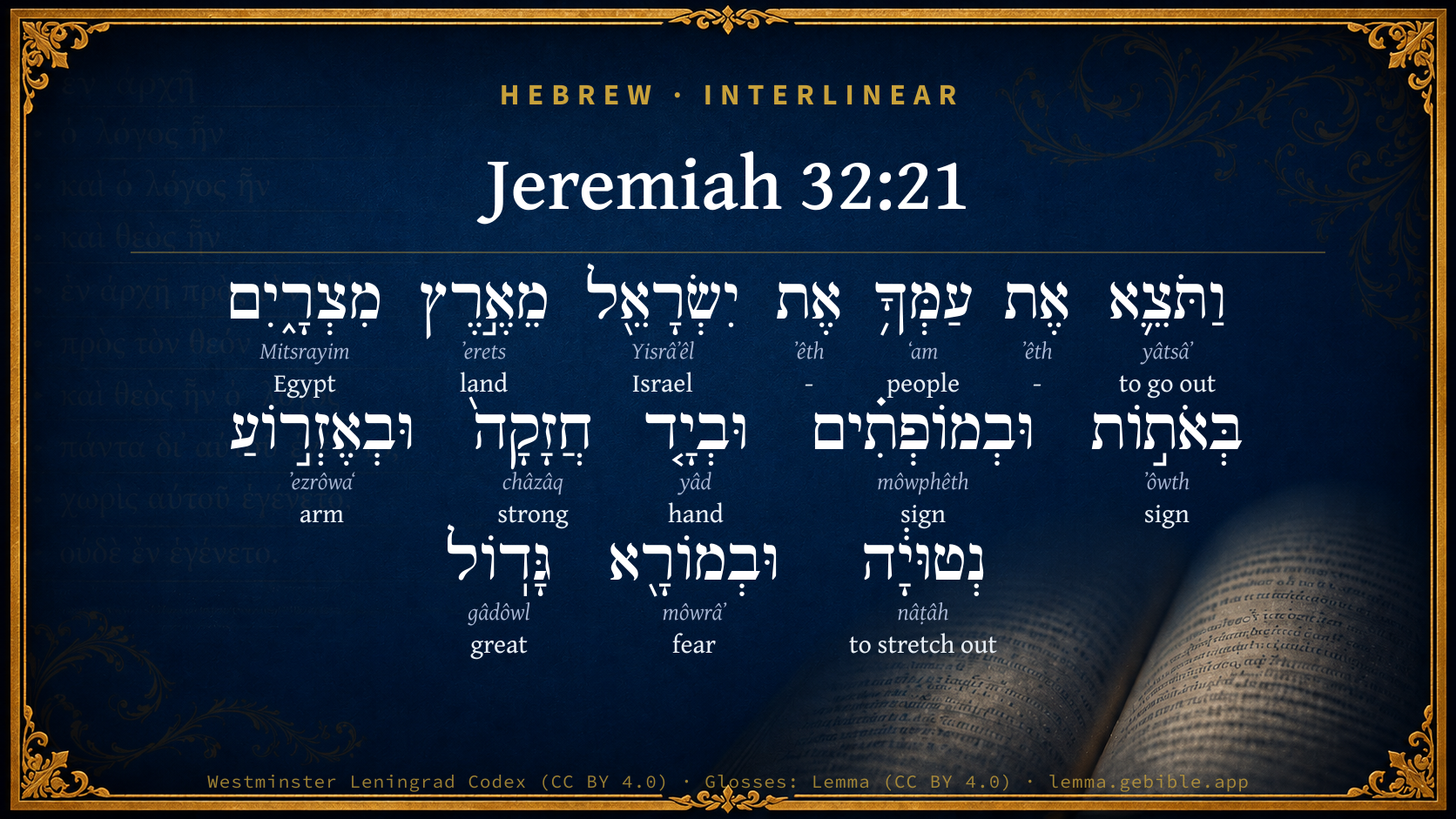
Jeremiah 32:21

Hebrew (Westminster Leningrad Codex) Jeremiah 32:21 appears in the Hebrew Old Testament. The text above is from the Westminster Leningrad Codex. Each word links to its Strong’s number, a concise gloss, and parsing drawn from the Open Scriptures Hebrew Bible morphology. Click any word for its full Brown-Driver-Briggs (BDB) entry.
Download image
Cite this verse

Jeremiah 32:21 (World English Bible). Public Domain. Lemma interlinear Bible study tool, https://lemma.gebible.app/v/jeremiah/32/21.

Show BibTeX & RIS
BibTeX
RIS
English Translation
and brought forth your people Israel out of the land of Egypt with signs, and with wonders, and with a strong hand, and with an outstretched arm, and with great terror;
World English Bible · Public Domain
Download a study sheet

One document with this verse’s original text, its word-by-word gloss line, the meaning frame, cross-references with their text, attributed commentary, and full source and license credits — printable, and it pastes into notes with its structure intact.

This verse Autodidact and up

Study sheet (.html) Plain text (.txt)

A passage Seminary Student

Up to 50 verses in one chapter. A passage sheet keeps up to 6 commentary sources and 12 cross-references per verse, in the order this page ranks them, and says so on the sheet whenever that leaves anything out. Ask for a single verse and you get the Autodidact verse sheet above.

Everything on this page stays free to read, with no account — the sheet is a download of what is already on screen, not access to it.

Want to remove ads? Support Godless Engineer
Compare translations 3

The same verse in 3 English versions, stacked beneath the original-language interlinear above. Click any original word for its lexicon entry.

Each is an independent rendering of the whole verse — the interlinear is not word-aligned to these translations.

Highlighted words mark where these versions differ — a whole-verse word diff, not a word-by-word alignment.

  • World English Bible Public Domain
    and brought forth your people Israel out of the land of Egypt with signs, and with wonders, and with a strong hand, and with an outstretched arm, and with great terror;
  • King James Version Public Domain
    And hast brought forth thy people Israel out of the land of Egypt with signs, and with wonders, and with a strong hand, and with a stretched out arm, and with great terror;
  • unfoldingWord Literal Text CC BY-SA 4.0
    For you brought your people Israel out from the land of Egypt with signs and wonders, with a strong hand, with a raised arm, and with great terror.

unfoldingWord Literal Text — © unfoldingWord, licensed CC BY-SA 4.0. Word-aligned USFM3 via Door43 (git.door43.org/unfoldingWord/en_ult).

Versions to compare (up to 4)

3 of 4 selected

Show all 18 translations

Every available English version of this verse, each an independent rendering of the whole verse.

  • World English Bible Public Domain
    and brought forth your people Israel out of the land of Egypt with signs, and with wonders, and with a strong hand, and with an outstretched arm, and with great terror;
  • Berean Standard Bible Public Domain
    You brought Your people Israel out of the land of Egypt with signs and wonders, with a strong hand and an outstretched arm, and with great terror.
  • Majority Standard Bible Public Domain
    You brought Your people Israel out of the land of Egypt with signs and wonders, with a strong hand and an outstretched arm, and with great terror.
  • King James Version Public Domain
    And hast brought forth thy people Israel out of the land of Egypt with signs, and with wonders, and with a strong hand, and with a stretched out arm, and with great terror;
  • American Standard Version (1901) Public Domain
    and didst bring forth thy people Israel out of the land of Egypt with signs, and with wonders, and with a strong hand, and with an outstretched arm, and with great terror;
  • Revised Version (1885) Public Domain
    and didst bring forth thy people Israel out of the land of Egypt with signs, and with wonders, and with a strong hand, and with a stretched out arm, and with great terror;
  • Geneva Bible (1599) Public Domain
    And hast brought thy people Israel out of the land of Egypt with signes, and with wonders, and with a strong hand, with a stretched out arme, and with great terrour,
  • Douay-Rheims (1899) Public Domain
    And hast brought forth thy people Israel, out of the land of Egypt with signs, and with wonders, and with a strong hand, and a stretched out arm, and with great terror.
  • Young's Literal Translation Public Domain
    `And Thou bringest forth Thy people Israel from the land of Egypt, with signs and with wonders, and by a strong hand, and by a stretched-out arm, and by great fear,
  • Literal Standard Version CC BY-SA 4.0
    And You bring forth Your people Israel from the land of Egypt, with signs and with wonders, and by a strong hand, and by an outstretched arm, and by great fear,
  • Unlocked Literal Bible CC BY-SA 4.0
    For you brought your people Israel out from the land of Egypt with signs and wonders, with a strong hand, with a raised arm, and with great terror.
  • unfoldingWord Literal Text CC BY-SA 4.0
    For you brought your people Israel out from the land of Egypt with signs and wonders, with a strong hand, with a raised arm, and with great terror.
  • Darby Bible Public Domain
    And thou broughtest forth thy people Israel out of the land of Egypt by signs, and by wonders, and by a powerful hand, and by a stretched-out arm, and by great terror;
  • World Messianic Bible Public Domain
    and brought your people Israel out of the land of Egypt with signs, with wonders, with a strong hand, with an outstretched arm, and with great terror;
  • Webster's Bible Public Domain
    And hast brought forth thy people Israel from the land of Egypt with signs, and with wonders, and with a strong hand, and with an out-stretched arm, and with great terror;
  • Free Bible Version CC BY-SA 4.0
    You led your people Israel out of Egypt with signs and miracles, with your great power and strength that terrified people.
  • Bible in Basic English Public Domain
    And have taken your people Israel out of the land of Egypt with signs and with wonders and with a strong hand and an outstretched arm, causing great fear;
  • JPS Tanakh (1917) Public Domain
    and didst bring forth Thy people Israel out of the land of Egypt with signs, and with wonders, and with a strong hand, and with an outstretched arm, and with great terror;

Literal Standard Version (2020), Covenant Press — licensed CC BY-SA 4.0. Text via the HelloAO Bible API (eBible.org). Unlocked Literal Bible (unfoldingWord) — licensed CC BY-SA 4.0. Text via the HelloAO Bible API (eBible.org). unfoldingWord Literal Text — © unfoldingWord, licensed CC BY-SA 4.0. Word-aligned USFM3 via Door43 (git.door43.org/unfoldingWord/en_ult). Free Bible Version, Dr. Jonathan Gallagher — licensed CC BY-SA 4.0. Text via the HelloAO Bible API (eBible.org).

Word by word

More ways to search: Search by grammar → Find every occurrence → Compare this word →

Practice this passage: Drill this verse → Learn its vocabulary →

וּבְאֶזְר֣וֹעַ
ʼezrôwaʻ
H248
“and · in/at · arm”
Conjunction + Preposition + Noun, Common, Feminine, Singular, Absolute
Part of Speech
Conjunction + Preposition + Noun
Type
Common
Gender
Feminine
Number
Singular
State
Absolute
Full BDB Definition

Origin: a variation for H2220

TWOT: 583b

arm
  1. וַתֹּצֵ֛א yâtsâʼ H3318 “and · to go out” Conjunction + Verb, Hiphil, Sequential Imperfect, 2nd Person, Masculine, Singular
  2. אֶת ʼêth H853 “-” Particle, Direct Object
  3. עַמְּךָ֥ ʻam H5971 “people · your” Noun, Common, Masculine, Singular, Construct + Suffix, Personal, 2nd Person, Masculine, Singular
  4. אֶת ʼêth H853 “-” Particle, Direct Object
  5. יִשְׂרָאֵ֖ל Yisrâʼêl H3478 “Israel” Noun, Proper
  6. מֵאֶ֣רֶץ ʼerets H776 “from · land of” Preposition + Noun, Common, Both, Singular, Construct
  7. מִצְרָ֑יִם Mitsrayim H4714 “Egypt” Noun, Proper
  8. בְּאֹת֣וֹת ʼôwth H226 “in/at · signs” Preposition + Noun, Common, Both, Plural, Absolute
  9. וּבְמוֹפְתִ֗ים môwphêth H4159 “and · in/at · signs” Conjunction + Preposition + Noun, Common, Masculine, Plural, Absolute
  10. וּבְיָ֤ד yâd H3027 “and · in/at · hand” Conjunction + Preposition + Noun, Common, Both, Singular, Absolute
  11. חֲזָקָה֙ châzâq H2389 “strong” Adjective, Adjective, Feminine, Singular, Absolute
  12. נְטוּיָ֔ה nâṭâh H5186 “stretched out” Verb, Qal, Participle Passive, Feminine, Singular, Absolute
  13. וּבְמוֹרָ֖א môwrâʼ H4172 “and · in/at · fear” Conjunction + Preposition + Noun, Common, Masculine, Singular, Absolute
  14. גָּדֽוֹל gâdôwl H1419 “great” Adjective, Adjective, Masculine, Singular, Absolute

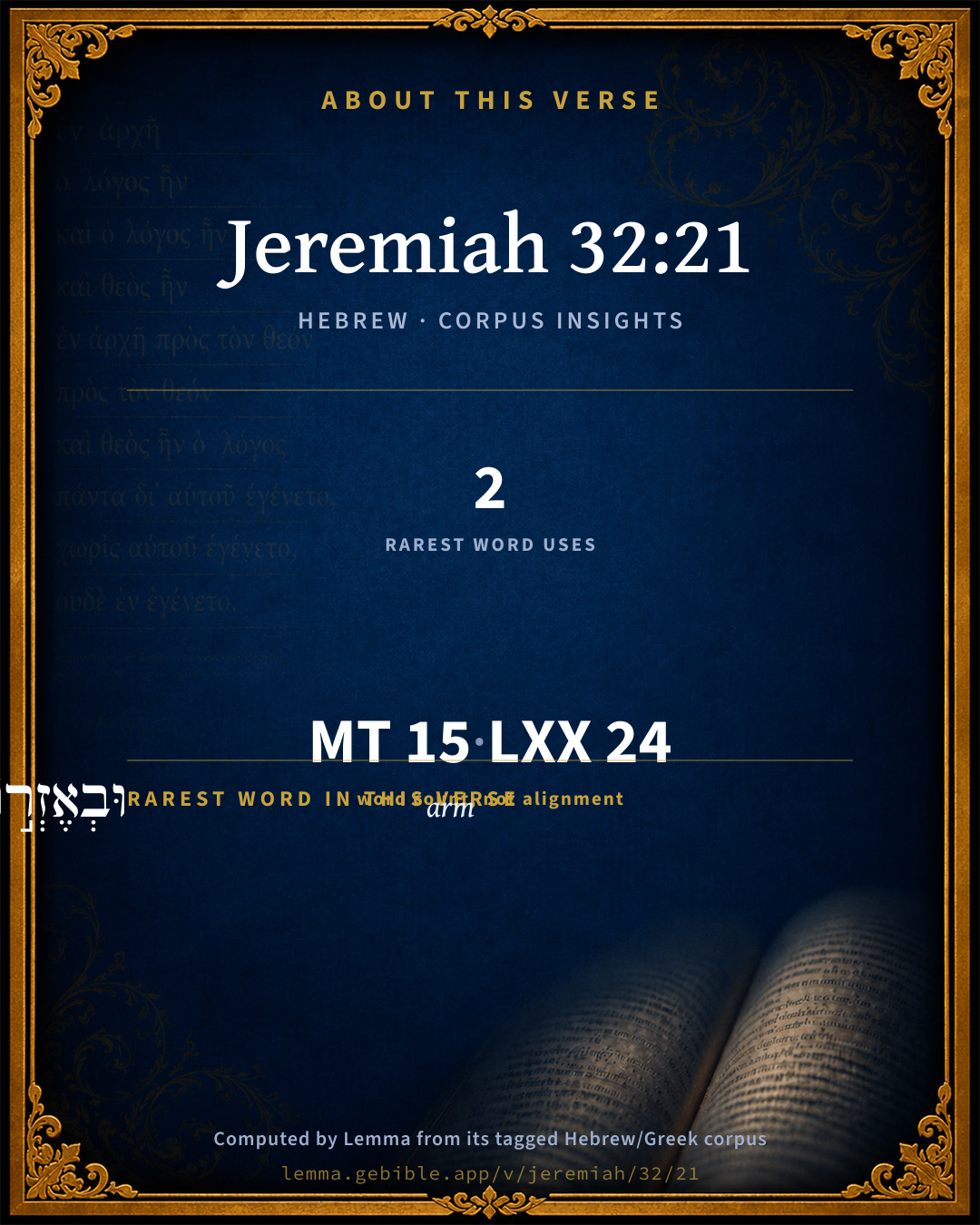
About this verse

These counts appear in no published source. They are computed here, from the morphology-tagged text and Lemma’s own curated glosses. What Lemma adds →

15
words
14
distinct lemmas
Prophets
section

Notable vocabulary

The rarest word here is וּבְאֶזְר֣וֹעַ arm H248 — appearing just 2 times in the whole Hebrew Bible.

Shared distinctive vocabulary

וּבְאֶזְר֣וֹעַ arm H248 occurs in 2 verses of the Hebrew Bible. Also found in:

Grammatical profile

  • 2 verbs
  • 9 nouns
  • 2 adjectives
  • 2 particles

Verb forms

  • וַתֹּצֵ֛א Hiphil · Sequential Imperfect
  • נְטוּיָ֔ה Qal · Participle Passive

Hebrew & Septuagint length

In the original languages it is 15 Hebrew tokens and 24 Greek tokens — but the two are counted differently (Hebrew bundles its prefixes and suffixes into one token; the Greek is in lemma form), so that isn’t a like-for-like length.

Cross-references

13

Topical passages linked to Jeremiah 32:21 in the Treasury of Scripture Knowledge — connected by theme and wording, ordered by reader-vote popularity; previews shown in the World English Bible.

  • Exodus 6:6 Therefore tell the children of Israel, 'I am Yahweh, and I will bring you out from under the burdens of the Egyptians, and I will rid you out of their bondage, and I will redeem you with an outstretched arm, and with great judgments:
  • Deuteronomy 26:8 and Yahweh brought us forth out of Egypt with a mighty hand, and with an outstretched arm, and with great terror, and with signs, and with wonders;
  • Exodus 6:1 Yahweh said to Moses, "Now you shall see what I will do to Pharaoh, for by a strong hand he shall let them go, and by a strong hand he shall drive them out of his land."
  • Exodus 13:9 It shall be for a sign to you on your hand, and for a memorial between your eyes, that the law of Yahweh may be in your mouth; for with a strong hand Yahweh has brought you out of Egypt.
  • Exodus 13:14 It shall be, when your son asks you in time to come, saying, 'What is this?' that you shall tell him, 'By strength of hand Yahweh brought us out from Egypt, from the house of bondage;
  • Deuteronomy 4:34 Or has God tried to go and take him a nation from the midst of [another] nation, by trials, by signs, and by wonders, and by war, and by a mighty hand, and by an outstretched arm, and by great terrors, according to all that Yahweh your God did for you in Egypt before your eyes?
  • 1 Kings 8:42 (for they shall hear of your great name, and of your mighty hand, and of your outstretched arm); when he shall come and pray toward this house;
  • 1 Chronicles 17:21 What one nation in the earth is like your people Israel, whom God went to redeem to himself for a people, to make you a name by great and awesome things, in driving out nations from before your people, whom you redeem out of Egypt?
  • Psalms 89:8–10 Yahweh, God of hosts, who is a mighty one, like you? Yah, your faithfulness is around you.
  • Psalms 105:37 He brought them forth with silver and gold. There was not one feeble person among his tribes.
  • Psalms 105:43 He brought forth his people with joy, His chosen with singing.
  • Psalms 136:11–12 And brought out Israel from among them; For his loving kindness endures forever;
  • Psalms 106:8–11 Nevertheless he saved them for his name's sake, That he might make his mighty power known.

Cross-references courtesy of OpenBible.info (CC BY 4.0).

Hebrew and Greek witnesses Masoretic Hebrew ↔ Greek Septuagint

The same verse in the two great witnesses to the Old Testament, shown verse-for-verse.

These are two independent witnesses, not word-aligned to each other, and the Septuagint is shown in lemma (dictionary) form.

Hebrew Jeremiah 32:21 Masoretic · Westminster Leningrad Codex

וַתֹּצֵ֛א אֶת עַמְּךָ֥ אֶת יִשְׂרָאֵ֖ל מֵאֶ֣רֶץ מִצְרָ֑יִם בְּאֹת֣וֹת וּבְמוֹפְתִ֗ים וּבְיָ֤ד חֲזָקָה֙ וּבְאֶזְר֣וֹעַ נְטוּיָ֔ה וּבְמוֹרָ֖א גָּדֽוֹל

and brought forth your people Israel out of the land of Egypt with signs, and with wonders, and with a strong hand, and with an outstretched arm, and with great terror;

World English Bible · Public Domain

Greek LXX Structure differs

In the Septuagint, Jeremiah is about an eighth shorter than the Hebrew and arranges its material differently — the Oracles Against the Nations (Hebrew chapters 46–51) appear in the middle of the Greek book, after 25:13. Because the chapter and verse boundaries do not line up, a verse-for-verse comparison with the Hebrew is not shown.

A verse-for-verse comparison isn’t shown here because the chapters and verses don’t line up. Switch to the LXX edition with the MT / LXX toggle above to read the Greek directly.

Hebrew: Westminster Leningrad Codex (CC BY 4.0). Greek: Septuagint (public domain); English from a public-domain English Septuagint. How the Septuagint differs from the Hebrew →

Targum (Aramaic paraphrase)

1

The Targum is the ancient Jewish Aramaic paraphrase of the Hebrew Scriptures — an interpretive translation, not the Hebrew text itself. Onkelos (literal) and Pseudo-Jonathan (expansive) render the Torah, and Jonathan the Prophets. Coverage is partial: where no permissively-licensed English translation exists for a verse, only the Aramaic is shown. This is verse-level text, not a word-by-word alignment to the Hebrew.

  1. Targum Jonathan Prophets (Joshua–Malachi)
    וְאַפֵּיקְתָּא יַת עַמָךְ יַת יִשְׂרָאֵל מֵאַרְעָא דְמִצְרָיִם בְּאָתִין וּבְמוֹפְתִין וּבְיָד תַּקִיפָא וּבְאֶדְרַע מְרָמַם וּבְחֶזְוָנָא רַבָּא:

    (no public-domain English translation for this verse)

    Targum Jonathan — Aramaic: “Mikraot Gedolot” (public domain). English: “Sefaria Community Translation” (CC0 1.0 (public-domain dedication)); “London "Chaldee Paraphrase," 1871” (public domain). Text via Sefaria.

Commentary

Notes on Jeremiah 32:21 from classic Christian and Jewish commentators (each source and its license shown beneath its notes). The classic Christian expositions comment on the surrounding passage and are grouped to its opening verse, so a note may address several verses; the Jewish commentaries on the Tanakh (Rashi and others) are per-verse, so they appear only where the commentator wrote on this verse.

Lemma curates 59 commentaries, every one of them public domain or Creative Commons licensed, each selected and text-cleaned for this edition rather than reprinted as found. About our sources →

Trapp's Complete Commentary

John Trapp

Jer 32:21 And hast brought forth thy people Israel out of the land of Egypt with signs, and with wonders, and with a strong hand, and with a stretched out arm, and with great terror;

Ver. 21. And hast made thee a name.] As Isa 63:11-13 Psa 136:10-21 Psa 105:44 Neh 9:24; Neh 9:26.

John Trapp, A Commentary or Exposition upon All the Books of the Old and New Testament (1647–1656) — public domain. Text from a community e-Sword module.

Tyndale Open Study Notes

Tyndale Open Resources

32:21 The first great miracle in Israel’s history was the exodus from Egypt, an act filled with mighty signs and wonders. These divine acts caused terror in Egypt and among the desert tribes.

Tyndale Open Study Notes — © Tyndale Open Resources, licensed CC BY-SA 4.0. Text via the HelloAO Bible API.

Jamieson, Fausset & Brown

Robert Jamieson, A. R. Fausset & David Brown

(Psa 136:11-12).

Jamieson, Fausset & Brown — Commentary Critical and Explanatory on the Whole Bible (1871) — public domain (CC PDM 1.0). Text via the HelloAO Bible API.

John Calvin's Commentaries

Jeremiah comes now nearer to the point in hand; for, after having spoken of the unequalled power of God, he now extols his righteous judgment in inflicting punishment on an ungodly and wicked people. For this end he refers to the favor of redemption, and he then adds that the land had been given to Israel which had been promised to their fathers. He afterwards states that this favor had been conferred on the ungrateful, for they immediately shook off the yoke and despised God their redeemer, together with his Law.

He then says, that the people had been brought up from the land of Egypt with signs and wonders This is an amplification, for God had in an unusual manner made it sufficiently evident that without his favor the people could not have been delivered from Egypt. For had it not been for the manifest display of God’s power in miracles and wonders, the Israelites might have appropriated to themselves the favor of God, or to some worldly instrumentality; but God’s favor appeared so resplendent in signs and wonders, that the liberation of the people could not have been ascribed either to fortune, or to the efforts of men, or to any other means. And for the same purpose he mentions the strong hand and the extended arm. He intimates by these words, that the people had been so delivered, that the hand of God, yea, his extended arm, openly appeared, that is, his power, as we have explained elsewhere, was manifested far and wide.

He refers at last to great terror: such was the haughtiness of their enemies, that they would have never suffered the people to depart, had they not been filled with great terror. As then the Egyptians had been by terror subdued, Jeremiah amplifies by this circumstance the favor of redemption, as though he had said, that God’s favor was not obscure, because the Israelites might have known by these extraordinary evidences that they were delivered by a divine power. For so great was the power, the valor, and cruelty of their enemies, that no hope of a free departure could have been entertained, had not God put forth his hand from heaven. It afterwards follows, —

John Calvin's Commentaries (1540-1563) — public domain. Text from the Calvin Translation Society English edition (1840s-50s) via the Christian Classics Ethereal Library (ccel.org). Calvin's coverage is partial (roughly two-thirds of the Bible); uncommented books and verses are honest gaps, never fabricated. The 19th-century editor's footnotes and remarks are omitted so the notes are faithfully Calvin's own voice.

Ellicott's Commentary for English Readers

(21-23) And hast brought forth thy people Israel . . .—The verses travel over ground so familiar as to require no comment, but the parallelism with Deu_26:8, with the other prophetic prayers above referred to, and with Psa_136:11-12, is significant. The thoughts of all true worshippers moved more or less in the same groove, and clothed themselves in the same language, when they meditated on the past history of their people.

A Bible Commentary for English Readers, edited by Charles John Ellicott (1878–1897) — public domain. Text from a community e-Sword module.

The Cambridge Bible for Schools and Colleges

gen. ed. J. J. S. Perowne

21. Almost the same as Deu_26:8. For the terror caused to neighbouring nations by the miracles attendant upon the Exodus cp. Exo_15:14; Deu_2:25; Deu_4:34.

The Cambridge Bible for Schools and Colleges (gen. ed. J. J. S. Perowne; Cambridge University Press, 1878–1918) — public domain. Text from a community e-Sword module.

John Gill's Exposition

And hast given them this land, which thou didst swear to their fathers to give them,.... Abraham, Isaac, and Jacob; so that God was faithful to his word, kept his covenant and oath; and the faithfulness of God is observed and acknowledged by the prophet, along with other perfections of God before taken notice of. The land of Canaan was a land of promise, confirmed by an oath, and was the pure gift of God to the Israelites, and not any merit of theirs; it was given them by him who had a right to dispose of it, and could make them a good title to it, and which they had; though before in the possession of others, who for their wickedness were driven out:

a land flowing with milk and honey: abounding with plenty of all good things, for the sustenance and comfort of human life; a very frequent description of the land of Canaan, and is expressive of the great kindness and goodness of God to this people.

John Gill's Exposition of the Whole Bible (1746–1763) — public domain (CC PDM 1.0). Text via the HelloAO Bible API.

Matthew Poole's English Annotations

The history of this we have in the eleven or twelve first chapters of Exodus. God sent ten plagues upon Egypt one after another, before Pharaoh would let them go; and when he pursued after them, divided the Red Sea for them, that they might pass through, and then brought the waters back upon the Egyptians, pursuing after them through the sea.

Matthew Poole's English Annotations on the Holy Bible (1683–1685) — public domain. Text from a community e-Sword/MySword module.

The Pulpit Commentary

Almost identical with Deu_26:8. The great terror which the Israelites inspired is constantly referred to. (see Exo_23:27 Jos_5:1)

The Pulpit Commentary (1880–1919), ed. H.D.M. Spence-Jones & Joseph S. Exell — public domain. Text from a community e-Sword module.

Lesson kit

Teaching starters — assembled from the data on this page, not authored interpretation. Every prompt links to the verse data it draws on. Edit before teaching.

Jeremiah, in the Prophets, opens this verse with 15 words (14 distinct Hebrew lemmas). Its most distinctive word is ʼezrôwaʻ (“arm”). A historical commentator’s framing appears above. Read the whole chapter for the surrounding context.

Discussion questions

  1. What does “arm” (ʼezrôwaʻ) contribute to the verse as a whole?
  2. How does Job 31:22, which shares the word «arm», read alongside this verse?
  3. These translations render this verse differently; the difference is in the English rendering, not the original. What questions does that raise?
  4. «וַתֹּצֵ֛א» is a Hiphil Sequential Imperfect verb. How does that grammatical form shape the action described?
  5. Compare how Trapp's Complete Commentary and Tyndale Open Study Notes read this verse. Where do they agree or differ?

Things to notice

Reading settings

Reading text

Shown beneath each verse's original-language words.

Old Testament
Old Testament edition

Read the OT as the Masoretic Hebrew (MT) or the Greek Septuagint (LXX).

English shown for the Greek Septuagint (in the Hebrew ↔ Greek comparison).

Comparing translations? Open the Compare panel on any verse page to stack up to four side by side.