
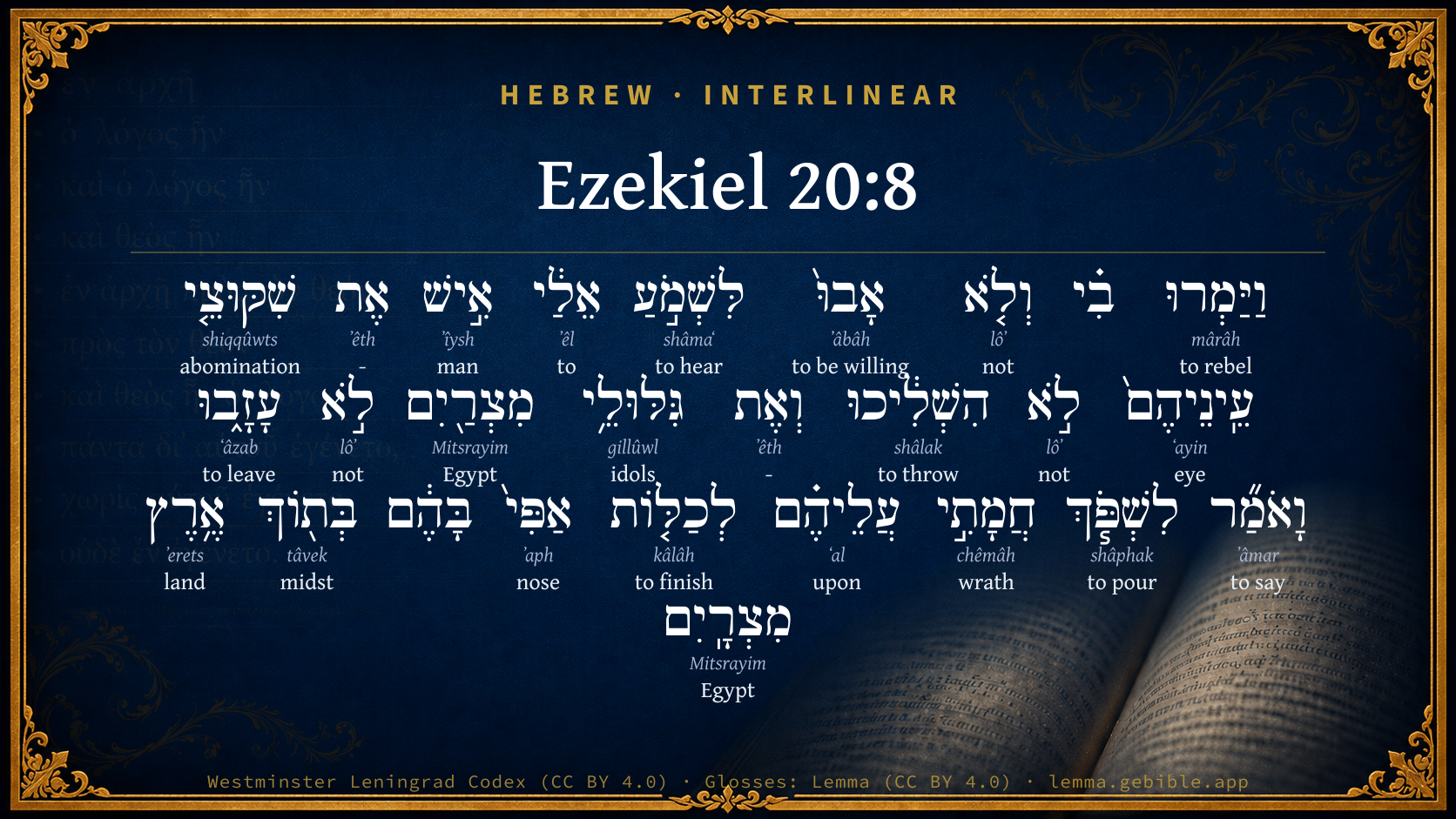
Ezekiel 20:8

Hebrew (Westminster Leningrad Codex) Ezekiel 20:8 appears in the Hebrew Old Testament. The text above is from the Westminster Leningrad Codex. Each word links to its Strong’s number, a concise gloss, and parsing drawn from the Open Scriptures Hebrew Bible morphology. Click any word for its full Brown-Driver-Briggs (BDB) entry.
Download image
Cite this verse

Ezekiel 20:8 (World English Bible). Public Domain. Lemma interlinear Bible study tool, https://lemma.gebible.app/v/ezekiel/20/8.

Show BibTeX & RIS
BibTeX
RIS
English Translation
But they rebelled against me, and would not listen to me; they did not every man cast away the abominations of their eyes, neither did they forsake the idols of Egypt. Then I said I would pour out my wrath on them, to accomplish my anger against them in the midst of the land of Egypt.
World English Bible · Public Domain
Download a study sheet

One document with this verse’s original text, its word-by-word gloss line, the meaning frame, cross-references with their text, attributed commentary, and full source and license credits — printable, and it pastes into notes with its structure intact.

This verse Autodidact and up

Study sheet (.html) Plain text (.txt)

A passage Seminary Student

Up to 50 verses in one chapter. A passage sheet keeps up to 6 commentary sources and 12 cross-references per verse, in the order this page ranks them, and says so on the sheet whenever that leaves anything out. Ask for a single verse and you get the Autodidact verse sheet above.

Everything on this page stays free to read, with no account — the sheet is a download of what is already on screen, not access to it.

Want to remove ads? Support Godless Engineer
Compare translations 3

The same verse in 3 English versions, stacked beneath the original-language interlinear above. Click any original word for its lexicon entry.

Each is an independent rendering of the whole verse — the interlinear is not word-aligned to these translations.

Highlighted words mark where these versions differ — a whole-verse word diff, not a word-by-word alignment.

  • World English Bible Public Domain
    But they rebelled against me, and would not listen to me; they did not every man cast away the abominations of their eyes, neither did they forsake the idols of Egypt. Then I said I would pour out my wrath on them, to accomplish my anger against them in the midst of the land of Egypt.
  • King James Version Public Domain
    But they rebelled against me, and would not hearken unto me: they did not every man cast away the abominations of their eyes, neither did they forsake the idols of Egypt: then I said, I will pour out my fury upon them, to accomplish my anger against them in the midst of the land of Egypt.
  • unfoldingWord Literal Text CC BY-SA 4.0
    But they rebelled against me and were unwilling to listen to me. Each man did not throw away the detestable things from before his eyes nor forsake the idols of Egypt, so I determined to pour out my fury upon them to satisfy my wrath among them in the middle of the land of Egypt.

unfoldingWord Literal Text — © unfoldingWord, licensed CC BY-SA 4.0. Word-aligned USFM3 via Door43 (git.door43.org/unfoldingWord/en_ult).

Versions to compare (up to 4)

3 of 4 selected

Show all 18 translations

Every available English version of this verse, each an independent rendering of the whole verse.

  • World English Bible Public Domain
    But they rebelled against me, and would not listen to me; they did not every man cast away the abominations of their eyes, neither did they forsake the idols of Egypt. Then I said I would pour out my wrath on them, to accomplish my anger against them in the midst of the land of Egypt.
  • Berean Standard Bible Public Domain
    But they rebelled against Me and refused to listen. None of them cast away the abominations before their eyes, and they did not forsake the idols of Egypt. So I resolved to pour out My wrath upon them and vent My anger against them in the land of Egypt.
  • Majority Standard Bible Public Domain
    But they rebelled against Me and refused to listen. None of them cast away the abominations before their eyes, and they did not forsake the idols of Egypt. So I resolved to pour out My wrath upon them and vent My anger against them in the land of Egypt.
  • King James Version Public Domain
    But they rebelled against me, and would not hearken unto me: they did not every man cast away the abominations of their eyes, neither did they forsake the idols of Egypt: then I said, I will pour out my fury upon them, to accomplish my anger against them in the midst of the land of Egypt.
  • American Standard Version (1901) Public Domain
    But they rebelled against me, and would not hearken unto me; they did not every man cast away the abominations of their eyes, neither did they forsake the idols of Egypt. Then I said I would pour out my wrath upon them, to accomplish my anger against them in the midst of the land of Egypt.
  • Revised Version (1885) Public Domain
    But they rebelled against me, and would not hearken unto me; they did not every man cast away the abominations of their eyes, neither did they forsake the idols of Egypt: then I said I would pour out my fury upon them, to accomplish my anger against them in the midst of the land of Egypt.
  • Geneva Bible (1599) Public Domain
    But they rebelled against me, and would not heare me: for none cast away the abominations of their eyes, neither did they forsake the idoles of Egypt: then I thought to powre out mine indignation vpon them, and to accomplish my wrath against them in the mids of the land of Egypt.
  • Douay-Rheims (1899) Public Domain
    But they provoked me, and would not hearken to me: they did not every man cast away the abominations of his eyes, neither did they forsake the idols of Egypt: and I said I would pour out my indignation upon them, and accomplish my wrath against them in the midst of the land of Egypt.
  • Young's Literal Translation Public Domain
    And -- they rebel against Me, And have not been willing to hearken to Me, Each, the detestable things of their eyes, They have not cast away, And the idols of Egypt have not forsaken, And I say -- to pour out My fury on them, To complete Mine anger against them, In the midst of the land of Egypt.
  • Literal Standard Version CC BY-SA 4.0
    And they rebel against Me, || And have not been willing to listen to Me, || Each has not cast away the detestable things of their eyes, || And have not forsaken the idols of Egypt, || And I speak—to pour out My fury on them, || To complete My anger against them, || In the midst of the land of Egypt.
  • Unlocked Literal Bible CC BY-SA 4.0
    But they rebelled against me and were unwilling to listen to me. Each man did not throw away the detestable things from before his eyes nor forsake the idols of Egypt, so I determined to pour out my fury upon them to satisfy my wrath among them in the middle of the land of Egypt.
  • unfoldingWord Literal Text CC BY-SA 4.0
    But they rebelled against me and were unwilling to listen to me. Each man did not throw away the detestable things from before his eyes nor forsake the idols of Egypt, so I determined to pour out my fury upon them to satisfy my wrath among them in the middle of the land of Egypt.
  • Darby Bible Public Domain
    But they rebelled against me, and would not hearken unto me: none of them cast away the abominations of his eyes, neither did they forsake the idols of Egypt. Then I thought to pour out my fury upon them, so as to accomplish mine anger against them in the midst of the land of Egypt.
  • World Messianic Bible Public Domain
    “‘“But they rebelled against me and wouldn’t listen to me. They didn’t all throw away the abominations of their eyes. They also didn’t forsake the idols of Egypt. Then I said I would pour out my wrath on them, to accomplish my anger against them in the middle of the land of Egypt.
  • Webster's Bible Public Domain
    But they rebelled against me, and would not hearken to me: they did not every man cast away the abominations of their eyes, neither did they forsake the idols of Egypt: then I said, I will pour out my fury upon them, to accomplish my anger against them in the midst of the land of Egypt.
  • Free Bible Version CC BY-SA 4.0
    But they rebelled against me and wouldn't do what I told them. None of them got rid of their disgusting pagan images, and they didn't give up worshiping the idols of Egypt. So I warned them that I would punish them in my anger there in Egypt.
  • Bible in Basic English Public Domain
    But they would not be controlled by me, and did not give ear to me; they did not put away the disgusting things to which their eyes were turned, or give up the images of Egypt: then I said I would let loose my passion on them to give full effect to my wrath against them in the land of Egypt.
  • JPS Tanakh (1917) Public Domain
    But they rebelled against Me, and would not hearken unto Me; they did not every man cast away the detestable things of their eyes, neither did they forsake the idols of Egypt; then I said I would pour out My fury upon them, to spend My anger upon them in the midst of the land of Egypt.

Literal Standard Version (2020), Covenant Press — licensed CC BY-SA 4.0. Text via the HelloAO Bible API (eBible.org). Unlocked Literal Bible (unfoldingWord) — licensed CC BY-SA 4.0. Text via the HelloAO Bible API (eBible.org). unfoldingWord Literal Text — © unfoldingWord, licensed CC BY-SA 4.0. Word-aligned USFM3 via Door43 (git.door43.org/unfoldingWord/en_ult). Free Bible Version, Dr. Jonathan Gallagher — licensed CC BY-SA 4.0. Text via the HelloAO Bible API (eBible.org).

Word by word

More ways to search: Search by grammar → Find every occurrence → Compare this word →

Practice this passage: Drill this verse → Learn its vocabulary →

שִׁקּוּצֵ֤י
shiqqûwts
H8251
“abominations of”
Noun, Common, Masculine, Plural, Construct
Part of Speech
Noun
Type
Common
Gender
Masculine
Number
Plural
State
Construct
Full BDB Definition

Origin: from H8262

TWOT: 2459b

detestable thing or idol, abominable thing, abomination, idol, detested thing
  1. וַיַּמְרוּ mârâh H4784 “and · to rebel” Conjunction + Verb, Hiphil, Sequential Imperfect, 3rd Person, Masculine, Plural
  2. וְלֹ֤א lôʼ H3808 “and · not” Conjunction + Particle, Negative
  3. אָבוּ֙ ʼâbâh H14 “to be willing” Verb, Qal, Perfect, 3rd Person, Common, Plural
  4. לִּשְׁמֹ֣עַ shâmaʻ H8085 “to hear” Preposition + Verb, Qal, Infinitive Construct
  5. אֵלַ֔י ʼêl H413 “to · me” Preposition + Suffix, Personal, 1st Person, Common, Singular
  6. אִ֣ישׁ ʼîysh H376 “man” Noun, Common, Masculine, Singular, Absolute
  7. אֶת ʼêth H853 “-” Particle, Direct Object
  8. עֵֽינֵיהֶם֙ ʻayin H5869 “eyes · their” Noun, Common, Both, Dual, Construct + Suffix, Personal, 3rd Person, Masculine, Plural
  9. לֹ֣א lôʼ H3808 “not” Particle, Negative
  10. הִשְׁלִ֔יכוּ shâlak H7993 “to throw” Verb, Hiphil, Perfect, 3rd Person, Common, Plural
  11. וְאֶת ʼêth H853 “and · -” Conjunction + Particle, Direct Object
  12. גִּלּוּלֵ֥י gillûwl H1544 “idols of” Noun, Common, Masculine, Plural, Construct
  13. מִצְרַ֖יִם Mitsrayim H4714 “Egypt” Noun, Proper
  14. לֹ֣א lôʼ H3808 “not” Particle, Negative
  15. עָזָ֑בוּ ʻâzab H5800 “to leave” Verb, Qal, Perfect, 3rd Person, Common, Plural
  16. וָאֹמַ֞ר ʼâmar H559 “and · to say” Conjunction + Verb, Qal, Sequential Imperfect, 1st Person, Common, Singular
  17. לִשְׁפֹּ֧ךְ shâphak H8210 “to pour” Preposition + Verb, Qal, Infinitive Construct
  18. חֲמָתִ֣י chêmâh H2534 “wrath · my” Noun, Common, Feminine, Singular, Construct + Suffix, Personal, 1st Person, Common, Singular
  19. עֲלֵיהֶ֗ם ʻal H5921 “upon · them” Preposition + Suffix, Personal, 3rd Person, Masculine, Plural
  20. לְכַלּ֤וֹת kâlâh H3615 “to finish” Preposition + Verb, Piel, Infinitive Construct
  21. אַפִּי֙ ʼaph H639 “nose · my” Noun, Common, Masculine, Singular, Construct + Suffix, Personal, 1st Person, Common, Singular
  22. בְּת֖וֹךְ tâvek H8432 “in/at · midst of” Preposition + Noun, Common, Masculine, Singular, Construct
  23. אֶ֥רֶץ ʼerets H776 “land of” Noun, Common, Both, Singular, Construct
  24. מִצְרָֽיִם Mitsrayim H4714 “Egypt” Noun, Proper

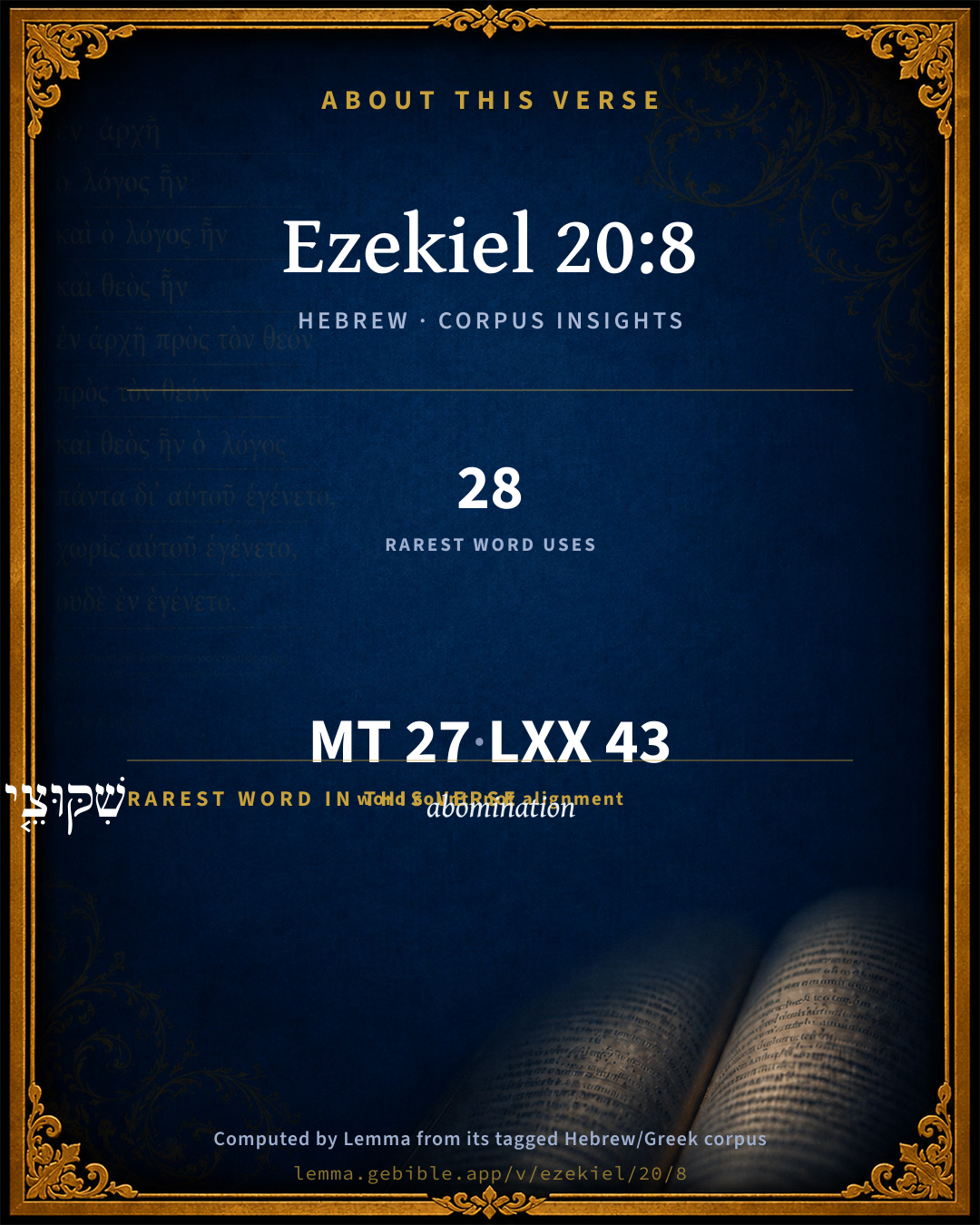
About this verse

These counts appear in no published source. They are computed here, from the morphology-tagged text and Lemma’s own curated glosses. What Lemma adds →

27
words
21
distinct lemmas
Prophets
section

Shared distinctive vocabulary

שִׁקּוּצֵ֤י abomination H8251 occurs in 26 verses of the Hebrew Bible. Also found in:

Grammatical profile

  • 8 verbs
  • 10 nouns
  • 4 prepositions
  • 5 particles

Verb forms

  • וַיַּמְרוּ Hiphil · Sequential Imperfect
  • אָבוּ֙ Qal · Perfect
  • לִּשְׁמֹ֣עַ Qal · Infinitive Construct
  • הִשְׁלִ֔יכוּ Hiphil · Perfect
  • עָזָ֑בוּ Qal · Perfect
  • וָאֹמַ֞ר Qal · Sequential Imperfect
  • לִשְׁפֹּ֧ךְ Qal · Infinitive Construct
  • לְכַלּ֤וֹת Piel · Infinitive Construct

Repetition

Words recur within this verse — often emphatic in Hebrew:

  • מִצְרַ֖יִם Egypt H4714 ×2
  • וְלֹ֤א not H3808 ×3

Hebrew & Septuagint length

In English translation the verse runs 56 words from the Hebrew and 50 from the Septuagint (LXX English) — closely comparable.

A rough comparison of the two English renderings, which tokenize alike — not a word-level alignment.

Word counts can differ between the Hebrew and the Greek without any difference in meaning — e.g. the Hebrew direct-object marker אֵת has no separate Greek word, and Greek often adds the article ὁ.

In the original languages it is 27 Hebrew tokens and 43 Greek tokens — but the two are counted differently (Hebrew bundles its prefixes and suffixes into one token; the Greek is in lemma form), so that isn’t a like-for-like length.

Cross-references

9

Topical passages linked to Ezekiel 20:8 in the Treasury of Scripture Knowledge — connected by theme and wording, ordered by reader-vote popularity; previews shown in the World English Bible.

  • Isaiah 63:10 But they rebelled, and grieved his holy Spirit: therefore he was turned to be their enemy, [and] himself fought against them.
  • Ezekiel 5:13 Thus shall my anger be accomplished, and I will cause my wrath toward them to rest, and I shall be comforted; and they shall know that I, Yahweh, have spoken in my zeal, when I have accomplished my wrath on them.
  • Ezekiel 7:8 Now will I shortly pour out my wrath on you, and accomplish my anger against you, and will judge you according to your ways; and I will bring on you all your abominations.
  • Ezekiel 20:7 I said to them, Cast you away every man the abominations of his eyes, and don't defile yourselves with the idols of Egypt; I am Yahweh your God.
  • Ezekiel 20:21 But the children rebelled against me; they didn't walk in my statutes, neither kept my ordinances to do them, which if a man do, he shall live in them; they profaned my Sabbaths. Then I said I would pour out my wrath on them, to accomplish my anger against them in the wilderness.
  • Exodus 32:4–6 He received what they handed him, and fashioned it with an engraving tool, and made it a molten calf; and they said, "These are your gods, Israel, which brought you up out of the land of Egypt."
  • Deuteronomy 9:7 Remember, don't forget, how you provoked Yahweh your God to wrath in the wilderness: from the day that you went forth out of the land of Egypt, until you came to this place, you have been rebellious against Yahweh.
  • Ezekiel 20:13 But the house of Israel rebelled against me in the wilderness: they didn't walk in my statutes, and they rejected my ordinances, which if a man keep, he shall live in them; and my Sabbaths they greatly profaned. Then I said I would pour out my wrath on them in the wilderness, to consume them.
  • Nehemiah 9:26 Nevertheless they were disobedient, and rebelled against you, and cast your law behind their back, and killed your prophets that testified against them to turn them again to you, and they committed awful blasphemies.

Cross-references courtesy of OpenBible.info (CC BY 4.0).

Hebrew and Greek witnesses Masoretic Hebrew ↔ Greek Septuagint

The same verse in the two great witnesses to the Old Testament, shown verse-for-verse.

These are two independent witnesses, not word-aligned to each other, and the Septuagint is shown in lemma (dictionary) form.

Hebrew Ezekiel 20:8 Masoretic · Westminster Leningrad Codex

וַיַּמְרוּ בִ֗י וְלֹ֤א אָבוּ֙ לִּשְׁמֹ֣עַ אֵלַ֔י אִ֣ישׁ אֶת שִׁקּוּצֵ֤י עֵֽינֵיהֶם֙ לֹ֣א הִשְׁלִ֔יכוּ וְאֶת גִּלּוּלֵ֥י מִצְרַ֖יִם לֹ֣א עָזָ֑בוּ וָאֹמַ֞ר לִשְׁפֹּ֧ךְ חֲמָתִ֣י עֲלֵיהֶ֗ם לְכַלּ֤וֹת אַפִּי֙ בָּהֶ֔ם בְּת֖וֹךְ אֶ֥רֶץ מִצְרָֽיִם

But they rebelled against me, and would not listen to me; they did not every man cast away the abominations of their eyes, neither did they forsake the idols of Egypt. Then I said I would pour out my wrath on them, to accomplish my anger against them in the midst of the land of Egypt.

World English Bible · Public Domain

Greek LXX Ezekiel 20:8 Septuagint · lemma form

καί ἀποἵστημι ἀπό ἐγώ καί οὐ θέλω εἰςἀκούω ἐγώ ὁ βδέλυγμα ὁ ὀφθαλμός αὐτός οὐ ἀποῥίπτω καί ὁ ἐπιτήδευμα αἴγυπτος οὐ ἐν καταλείπω καί εἶπον ὁ ἐκχέω ὁ θυμός ἐγώ ἐπί αὐτός ὁ συντελέω ὁ ὀργή ἐγώ ἐν αὐτός ἐν μέσος γῆ αἴγυπτος

But they revolted from me, and would not listen to me: they cast not away the abominations of their eyes, and forsook not the devices of Egypt: then I said that I would pour out my wrath upon them, to accomplish my wrath upon them in the midst of Egypt.

LXX2012 (modern English Septuagint) · Public Domain

Hebrew: Westminster Leningrad Codex (CC BY 4.0). Greek: Septuagint (public domain); English from LXX2012 (modern English Septuagint) (Public Domain). How the Septuagint differs from the Hebrew →

Targum (Aramaic paraphrase)

1

The Targum is the ancient Jewish Aramaic paraphrase of the Hebrew Scriptures — an interpretive translation, not the Hebrew text itself. Onkelos (literal) and Pseudo-Jonathan (expansive) render the Torah, and Jonathan the Prophets. Coverage is partial: where no permissively-licensed English translation exists for a verse, only the Aramaic is shown. This is verse-level text, not a word-by-word alignment to the Hebrew.

  1. Targum Jonathan Prophets (Joshua–Malachi)
    וְסָרִיבוּ עַל מֵימְרִי וְלָא אָבוּ לְקַבָּלָא לִנְבִיֵי גְבַר יַת שִׁקוּצֵי עֵינֵיהוֹן לָא אַרְחִיקוּ וְיַת פּוּלְחַן טַעֲוַת מִצְרָאֵי לָא שְׁבָקוּ וַאֲמָרֵית לְמִשְׁפַּךְ חֵימְתִי עֲלֵיהוֹן דְיָחוּל רוּגְזִי בְּהוֹן בְּגוֹ אַרְעָא דְמִצְרָיִם:

    (no public-domain English translation for this verse)

    Targum Jonathan — Aramaic: “Mikraot Gedolot” (public domain). English: “Sefaria Community Translation” (CC0 1.0 (public-domain dedication)); “London "Chaldee Paraphrase," 1871” (public domain). Text via Sefaria.

Commentary

Notes on Ezekiel 20:8 from classic Christian and Jewish commentators (each source and its license shown beneath its notes). The classic Christian expositions comment on the surrounding passage and are grouped to its opening verse, so a note may address several verses; the Jewish commentaries on the Tanakh (Rashi and others) are per-verse, so they appear only where the commentator wrote on this verse.

Lemma curates 59 commentaries, every one of them public domain or Creative Commons licensed, each selected and text-cleaned for this edition rather than reprinted as found. About our sources →

Trapp's Complete Commentary

John Trapp

Eze 20:8 But they rebelled against me, and would not hearken unto me: they did not every man cast away the abominations of their eyes, neither did they forsake the idols of Egypt: then I said, I will pour out my fury upon them, to accomplish my anger against them in the midst of the land of Egypt.

Ver. 8. But they rebelled against me.] I might say what I would, but they would do what they list. Good they were ever, if I may call it so, at resisting the Holy Ghost, obstinate idolaters from the very first; so that God had even as much ado to forbear killing them, as ever he had Moses in the same country for neglecting to circumcise his child. {Exo 4:24}

Neither did they forsake the idols of Egypt.] This we read not of in Exodus either; it is enough that we have it here. The ingratitude of these Israelites was the greater, because God had done much for them, and was daily admonishing them of better things.

Then said I, I will pour out my fury.] It was not therefore for nothing that Israel suffered so much in Egypt. Many now marvel at their own miseries, but think not of their sins, the cause.

John Trapp, A Commentary or Exposition upon All the Books of the Old and New Testament (1647–1656) — public domain. Text from a community e-Sword module.

Tyndale Open Study Notes

Tyndale Open Resources

20:8-21 Each generation of Israelites rebelled against the Lord and refused to obey the commandments he gave them. Each time, the Lord threatened to pour out his fury upon them (20:8, 13, 21), but he relented for the honor of his name, lest the nations around them should think the Lord’s power insufficient to bring his people into the Promised Land.

Tyndale Open Study Notes — © Tyndale Open Resources, licensed CC BY-SA 4.0. Text via the HelloAO Bible API.

Geneva Bible (1599)

Geneva Bible translators

Which thing declareth the wickedness of man’s heart, which judge God’s service by their eyes and outward senses.

Geneva Bible (1599) marginal notes — public domain. Text via Bolls.life.

Jamieson, Fausset & Brown

Robert Jamieson, A. R. Fausset & David Brown

then I said, I will . . . But, &c.--that is, (God speaking in condescension to human modes of conception) their spiritual degradation deserved I should destroy them, "but I wrought (namely, the deliverance 'out of . . . Egypt') for My name's sake"; not for their merits (a rebuke to their national pride). God's "name" means the sum-total of His perfections. To manifest these, His gratuitous mercy abounding above their sins, yet without wrong to His justice, and so to set forth His glory, was and is the ultimate end of His dealings (Eze 20:14, Eze 20:22; Sa2 7:23; Isa 63:12; Rom 9:17).

Jamieson, Fausset & Brown — Commentary Critical and Explanatory on the Whole Bible (1871) — public domain (CC PDM 1.0). Text via the HelloAO Bible API.

Adam Clarke's Commentary

Verse 8. They did not - cast away] They continued attached to the idolatry of Egypt; so that, had I consulted my justice only, I should have consumed them even in Egypt itself. This is a circumstance that Moses has not mentioned, namely, their provoking God by their idolatry, after he had sent Moses and Aaron to them in Egypt.

Adam Clarke's Commentary on the Bible (1810–1826) — public domain. Text from a community e-Sword/MySword module.

John Calvin's Commentaries

In the last lecture I began to explain the eighth verse, where God complains that he was exasperated by the children of Israel when he had begun to extend his hand to free them. He says, then, that they had rejected his grace. But at the same time we see that all pretense of ignorance was removed, because unless Moses had exhorted them to good hope, they would have pretended. to be so deserted through two centuries, that they had hoped for help from God in vain. But since Moses was a witness of their redemption, hence their ingratitude was the more without excuse, since they were unwilling to embrace the message which they had so greatly desired. Nor is the language of Moses vain, that they often cried out in their calamities. Although their clamor was turbulent, yet they doubtless remembered what they had heard from their fathers, that the end of those evils was at hand to which God had fixed an appointed time. But more is expressed in this passage than Moses relates, who simply says, because they saw themselves treated too roughly, that they were worn down and disgusted: hence those expostulations — You have made our name to stink before Pharaoh: God shall judge between you and us: Judea you gone from us. (Exodus 5:21.) We do not then clearly collect from Moses that they were rebels against God, since they had not cast away their idols and superstitions, but the probable conjecture is that they were, so rooted in their filth, that they repelled God’s hand from succoring them. And truly if they had promptly embraced what Moses had promised them in God’s name, the accomplishment would have been readier and swifter: but we may understand that their sloth was the hindrance to the exertion of God’s hand in their favor and to the real fulfillment of his promises. God ought indeed to contend, with Pharaoh, that his power might be more conspicuous: but the people would not have been so tyrannously afflicted, unless they had closed the door against God’s mercy. They were, as we have said, immersed in their defilement’s from which God wished to withdraw them. He now accuses them of ingratitude, because they did not cast away their idols, but obstinately persisted in their usual and customary superstitions. He speaks of the time of their captivity in Egypt, and this passage assures us that while there they were infected and polluted by Egyptian defilement’s. For the contagion of idolatry is wonderful: for since we are all naturally inclined to it as soon as any example is offered to us, we are snatched in that direction by a violent impulse. It is not surprising then that the children of Israel contracted pollution from the superstitions of Egypt, especially as they lived there as slaves, and were desirous of gratifying the Egyptians: for if they had been treated liberally, they might have lived freely after their custom, but since they were not free and were oppressed as slaves, it happened that they pretended to worship the gods of Egypt according to the will of those by whom they saw themselves oppressed: and not only did they sin by pretending, but it is probable that they were impelled by their own lusts as well as by fear: for it will soon be evident that they were too inclined to impiety of their own accord.

On the whole, Ezekiel here testifies that they were rebels against God, because they did not listen to God by casting away the idols of their eyes, that is, to the worship of which they were too attentive, nor did they desert the idols of Egypt. When he speaks of the idols of their eyes, we gather what I have touched upon, that they were not impelled to idolatry by fear and necessity, but by their own depraved appetites: For unless they had been eagerly devoted to Egyptian superstitions, Ezekiel would not have called them idols of the eyes. Hence by this word he means that they were not only superstitious through obedience to the Egyptians, but were spontaneously inclined towards them. Besides, when he adds the idols of Egypt, he points out as the occasion of their corruption their spending time under that tyranny, and their being compelled to bear many evils, since slavery commonly draws with it dissimulation. It now follows, And I said I would pour forth, that is, I determined to pour forth. God here signifies that he was inflamed by anger, and unless they had respect to his name he would not withdraw his hand from the vengeance to which it was armed and prepared. We know that this does not properly belong to God, but this is, the language of accommodation, since first of all, God is not subject to vengeance, and, secondly, does not decree what he may afterwards retract. But since these things are not in character with God, simile and accommodation are used. As often as the Holy Spirit uses these forms of speech, let us learn that they refer rather to the matter in hand than to the character of God. God determined to pour forth his anger, that is, the Israelites had so deserved it through their crimes, that it was necessary to execute punishment upon them. The Prophet simply means that the people’s disposition was sinful, and hence God’s wrath would have been poured out, unless he had been held back from some other cause. I have already touched upon the obstacle, because he consulted his honor lest it should be profaned.

I have decreed, therefore, to pour forth my burning fury upon them in the midst of the land of Egypt. Some translate, to consume them, but improperly, for the word, כלה, keleh, signifies to fill up or accomplish, as well as to consume. But although God sometimes says that he consumes all his weapons or scourges in the punishment of men’s sins, yet it is not suitable to transfer this to his wrath itself. Hence another sense will suit better, namely, that God decreed to pour out his wrath until he satisfied himself. For here, as we have said, he puts on the character of an angry man, who cannot appease his mind otherwise than by satiating it by the exaction of punishment: for anger is usually inexhaustible. But God on the whole here expresses that such was the atrocity of their wickedness, that the Israelites deserved destruction through the pouring forth of God’s wrath and the filling up of the measure of his indignation; and that in the midst of the land of Egypt; because they had shown themselves unworthy of his redemption, and hence it was enough for them to perish in the midst of the land of Egypt. But he afterwards added —

John Calvin's Commentaries (1540-1563) — public domain. Text from the Calvin Translation Society English edition (1840s-50s) via the Christian Classics Ethereal Library (ccel.org). Calvin's coverage is partial (roughly two-thirds of the Bible); uncommented books and verses are honest gaps, never fabricated. The 19th-century editor's footnotes and remarks are omitted so the notes are faithfully Calvin's own voice.

Ellicott's Commentary for English Readers

(8) The land of Egypt.—Of this idolatrous rebellion, and of this threat of the Divine anger while they were still in Egypt, as already said, we have no specific record. But they had the same disposition then as they had afterwards; and, even without such a charge, we could infer the probability of their idolatry. It is possible that the prophet may have had in mind such incidents as are related in Num_14:11-20, happening while the Israelites were still in the neighbourhood of Egypt, and when the report of them would speedily have reached Egyptian ears. It is by no means necessary to suppose that in this broad and general review of the teachings of history each incident is kept in its strict chronological place. Yet idolatry in Egypt is distinctly charged upon the Israelites in Eze_16:3; Eze_16:19, and this verse may well refer to God’s judgment for this sin suspended and delayed while they were in Egypt lest it should be misunderstood by the heathen.

A Bible Commentary for English Readers, edited by Charles John Ellicott (1878–1897) — public domain. Text from a community e-Sword module.

The Cambridge Bible for Schools and Colleges

gen. ed. J. J. S. Perowne

8. The history in Exodus narrates only the conflict of Israel with the Egyptians, being silent on internal struggles in Israel itself. The work of Moses in delivering his people must have extended over a period of time. His efforts in educating the people are entirely passed over in the history. The announcement, however, that Jehovah was the God of Israel implied casting away all other gods, and this principle, often expressed in his intercourse with the people, probably met with but slack acceptance. Psalms 106 follows Ezek. closely, cf. Eze_20:7.

The Cambridge Bible for Schools and Colleges (gen. ed. J. J. S. Perowne; Cambridge University Press, 1878–1918) — public domain. Text from a community e-Sword module.

John Gill's Exposition

But they rebelled against me,.... All sin is rebellion against God, an act of hostility, especially idolatry; it is refusing homage and casting off allegiance to him:

and would not hearken unto me; to his word by his prophets; so the Targum,

"they rebelled against my word, and would not receive my prophets:''

they did not every man cast away the abominations of his eyes, neither did they forsake the idols of the Gentiles; whence it appears that there were some among them that did give in to the idolatry of the Egyptians; and could not be prevailed upon to relinquish it, notwithstanding the favours shown them, and the promises made unto them. The Jewish writers, Jarchi and Kimchi, say that there were many of these wicked men among the Israelites when Moses was sent to them; and that they died in the time of the three days' darkness, so that the Egyptians did not see their fall, and rejoice at it;

then I said, I will pour out my fury upon them; he threatened them, by his prophets, that he would bring down deserved wrath upon them, like a mighty shower of rain:

to accomplish mine anger against them; to bring it upon them to the utmost, and consume them with it:

in the midst of the land of Egypt; and so not bring them forth from thence, is he had promised; but cut them off in it, for their sins and rebellions.

John Gill's Exposition of the Whole Bible (1746–1763) — public domain (CC PDM 1.0). Text via the HelloAO Bible API.

Haydock's Catholic Bible Commentary

Egypt. Their disorders called for such severity. But God was restrained by the dangers (Calmet) of blasphemy, &c., to which the faithful and idolaters would thus have been exposed. (Haydock) --- He saved them as he had promised, though they did not deserve it. (Worthington)

George Leo Haydock (1774–1849), Haydock's Catholic Family Bible and Commentary, 1859 edition — public domain. Excludes Psalms (Douay-Rheims chapter numbering differs from Protestant) and Deuterocanonical books (Catholic canon only).

Matthew Poole's English Annotations

They rebelled against me; so great a sin is idolatry, it is against God, as open hostility is against a sovereign whom subjects fight against. All sin is against God, but idolatry is much more so.

And would not hearken unto me; their wills were alienated from God, they refused to hear and obey in this. They did not forsake the idols of Egypt; it is probable there were some among them that carried with them (as Rachel did her father’s) the idols of Egypt.

Then I said; I was just upon resolving, I was very near saying.

I will pour out, as a storm or mighty shower,

my fury; just and severe wrath.

To accomplish my anger against them; to make an end of them.

In the midst of the land of Egypt; that they should have perished in Egypt, and never come out.

Matthew Poole's English Annotations on the Holy Bible (1683–1685) — public domain. Text from a community e-Sword/MySword module.

Whedon's Commentary on the Bible

Daniel D. Whedon

8. I will not be inquired of by you — Jehovah will not be treated like a heathen charm, to be superstitiously consulted in time of danger and forgotten afterward. In order to get guidance from Jehovah the man must be willing to live up to the highest moral and spiritual revelations given to him (Eze_14:3-4). As iniquity has brought this calamity upon Israel no outward reverence, but only a true and vital reformation, can bring deliverance and safety (Eze_18:16-20; Eze_18:31, etc.).

8. Idols — Literally, as constantly in Ezekiel, idol blocks, or doll images. The Hebrew, like every oriental, was intensely fond of plays on words, and showed his scorn of idols by a slight play upon the name. (See note Eze_20:29.)

Daniel D. Whedon (gen. ed.), Commentary on the Old and New Testaments (1874–1909) — public domain. Text from a community e-Sword module.

John Wesley's Explanatory Notes

To accomplish - To make an end of them.

John Wesley, Explanatory Notes Upon the Whole Bible (1754–1765) — public domain. Text via the GEBible commentary corpus.

unfoldingWord translationNotes

Door43 World Missions Community

General Information:

Yahweh continues giving Ezekiel his message to the elders of Israel.

they rebelled against me

The word "they" refers to "the descendants of the house of Jacob."

were unwilling to listen to me

"would not obey me"

the detestable things from before his eyes

Yahweh speaks of the people worshiping the detestable things as if they had placed those idols in front of their eyes. AT: "the detestable things that he worshiped" (See: Metaphor)

to pour out my fury upon them

Yahweh speaks of expressing his fury by punishing them as if his fury were a liquid that he poured out on them. AT: "to act against them in my fury" (See: Metaphor)

for my name's sake

Here the word "name" represents Yahweh's reputation. AT: "for the sake of my reputation" (See: Metonymy)

so it would not be profaned in the eyes of the nations

This can be stated in active form. AT: "so that the people would not profane it in the eyes of the nations" (See: Active or Passive)

in the eyes

The eyes represent seeing, and seeing represents thoughts or judgment. AT: "in the opinion" or "in the judgment" (See: Metaphor)

the nations

The word "nations" is a metonym for the people who live in the nations. AT: "the people who live in other nations" (See: Metonymy)

they were staying

"they were living"

I made myself known to them, in their eyes

Here the word "them" refers to the nations. The idiom "in their eyes" refers to being in a position where people can see. AT: "I revealed myself to them, in their presence" (See: Idiom)

bringing them

"bringing the people of Israel"

translationWords

rebel

forsake

wrath

name

profane

nation

unfoldingWord translationNotes — © Distant Shores Media and the Door43 World Missions Community, licensed CC BY-SA 4.0. Source: git.door43.org/Door43/en_tn.

Rashi

Rabbi Shlomo Yitzchaki (Rashi)

But they rebelled against Me They are the wicked, the majority of Israel, who died in the three days of darkness, as it is said (Exod. 13:18): “and the children of Israel went out of Egypt, (חֲמֻשִּׁים)”one out of fifty, and some say, one out of five hundred.

Rashi on the Tanakh — English translations: “The Judaica Press complete Tanach with Rashi, translated by A. J. Rosenberg” (CC BY 4.0); “Pentateuch with Rashi's commentary by M. Rosenbaum and A.M. Silbermann, 1929-1934” (public domain); “The Metsudah Tanach series, Lakewood, N.J” (CC BY 4.0); and “The Book of Joshua, Metsudah Publications, 1997” (CC BY 4.0). Text via Sefaria.

Lesson kit

Teaching starters — assembled from the data on this page, not authored interpretation. Every prompt links to the verse data it draws on. Edit before teaching.

Ezekiel, in the Prophets, opens this verse with 27 words (21 distinct Hebrew lemmas). Its most distinctive word is shiqqûwts (“abomination”). A historical commentator’s framing appears above. Read the whole chapter for the surrounding context.

Discussion questions

  1. What does “abomination” (shiqqûwts) contribute to the verse as a whole?
  2. How does Deuteronomy 29:17, which shares the word «abomination», read alongside this verse?
  3. What does the repetition of “Egypt” (2× in this one verse) do in this verse?
  4. The translations on this page render this verse differently — a whole-verse word diff, not a word-by-word alignment. What might account for the different wordings?
  5. «וַיַּמְרוּ» is a Hiphil Sequential Imperfect verb. How does that grammatical form shape the action described?
  6. Compare how Trapp's Complete Commentary and Tyndale Open Study Notes read this verse. Where do they agree or differ?

Things to notice

Reading settings

Reading text

Shown beneath each verse's original-language words.

Old Testament
Old Testament edition

Read the OT as the Masoretic Hebrew (MT) or the Greek Septuagint (LXX).

English shown for the Greek Septuagint (in the Hebrew ↔ Greek comparison).

Comparing translations? Open the Compare panel on any verse page to stack up to four side by side.