Jeremiah 43:7

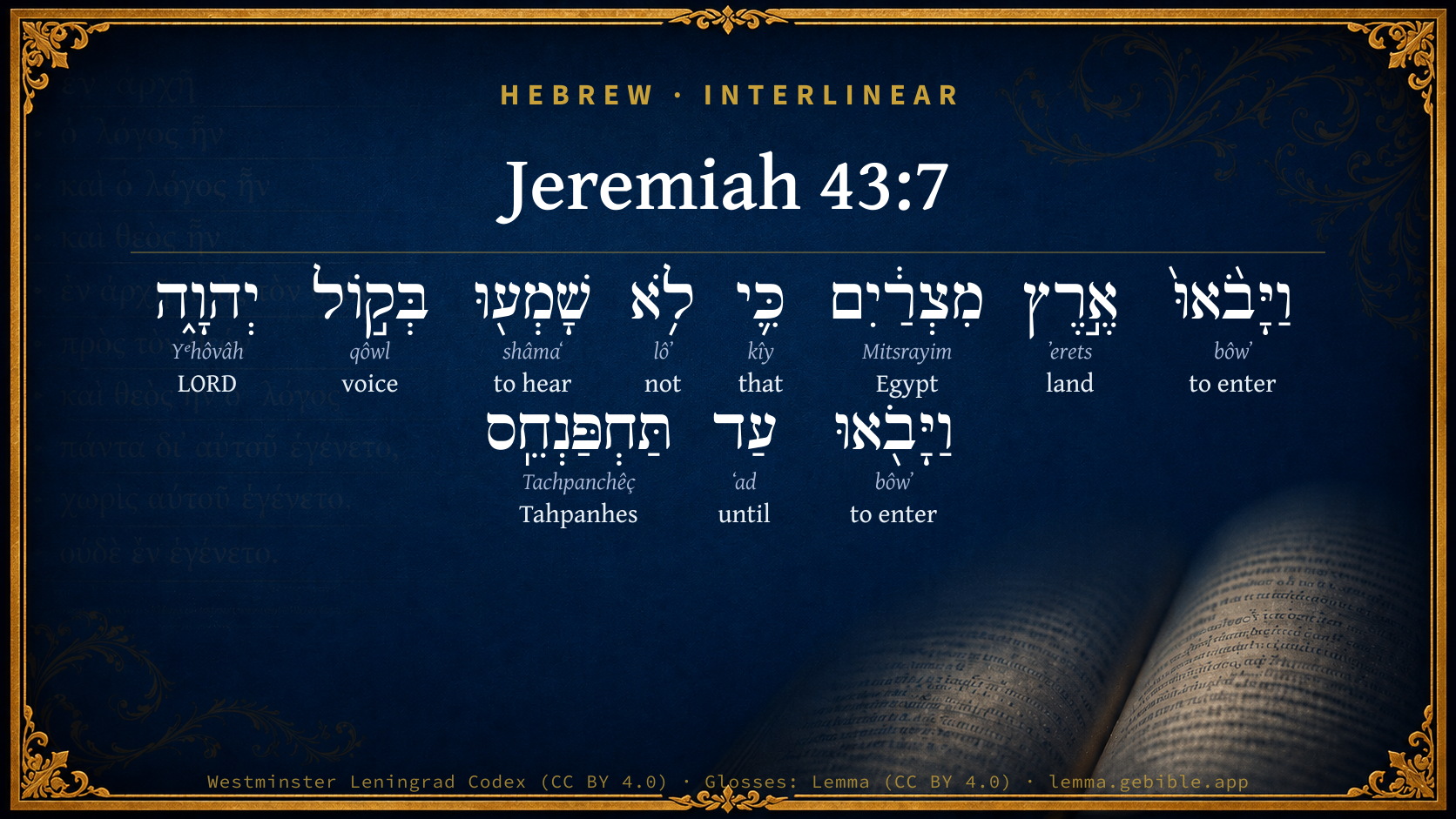
Hebrew (Westminster Leningrad Codex) Jeremiah 43:7 appears in the Hebrew Old Testament. The text above is from the Westminster Leningrad Codex. Each word links to its Strong’s number, a concise gloss, and parsing drawn from the Open Scriptures Hebrew Bible morphology. Click any word for its full Brown-Driver-Briggs (BDB) entry.
Download image
Cite this verse

Jeremiah 43:7 (World English Bible). Public Domain. Lemma interlinear Bible study tool, https://lemma.gebible.app/v/jeremiah/43/7.

Show BibTeX & RIS
BibTeX
RIS
English Translation
and they came into the land of Egypt; for they didn't obey the voice of Yahweh: and they came to Tahpanhes.
World English Bible · Public Domain
Download a study sheet

One document with this verse’s original text, its word-by-word gloss line, the meaning frame, cross-references with their text, attributed commentary, and full source and license credits — printable, and it pastes into notes with its structure intact.

This verse Autodidact and up

Study sheet (.html) Plain text (.txt)

A passage Seminary Student

Up to 50 verses in one chapter. A passage sheet keeps up to 6 commentary sources and 12 cross-references per verse, in the order this page ranks them, and says so on the sheet whenever that leaves anything out. Ask for a single verse and you get the Autodidact verse sheet above.

Everything on this page stays free to read, with no account — the sheet is a download of what is already on screen, not access to it.

Want to remove ads? Support Godless Engineer
Compare translations 3

The same verse in 3 English versions, stacked beneath the original-language interlinear above. Click any original word for its lexicon entry.

Each is an independent rendering of the whole verse — the interlinear is not word-aligned to these translations.

Highlighted words mark where these versions differ — a whole-verse word diff, not a word-by-word alignment.

  • World English Bible Public Domain
    and they came into the land of Egypt; for they didn't obey the voice of Yahweh: and they came to Tahpanhes.
  • King James Version Public Domain
    So they came into the land of Egypt: for they obeyed not the voice of the LORD: thus came they even to Tahpanhes.
  • unfoldingWord Literal Text CC BY-SA 4.0
    They went to the land of Egypt, to Tahpanhes, because they did not listen to Yahweh’s voice.

unfoldingWord Literal Text — © unfoldingWord, licensed CC BY-SA 4.0. Word-aligned USFM3 via Door43 (git.door43.org/unfoldingWord/en_ult).

Versions to compare (up to 4)

3 of 4 selected

Show all 18 translations

Every available English version of this verse, each an independent rendering of the whole verse.

  • World English Bible Public Domain
    and they came into the land of Egypt; for they didn't obey the voice of Yahweh: and they came to Tahpanhes.
  • Berean Standard Bible Public Domain
    So they entered the land of Egypt because they did not obey the voice of the LORD, and they went as far as Tahpanhes.
  • Majority Standard Bible Public Domain
    So they entered the land of Egypt because they did not obey the voice of the LORD, and they went as far as Tahpanhes.
  • King James Version Public Domain
    So they came into the land of Egypt: for they obeyed not the voice of the LORD: thus came they even to Tahpanhes.
  • American Standard Version (1901) Public Domain
    and they came into the land of Egypt; for they obeyed not the voice of Jehovah: and they came unto Tahpanhes.
  • Revised Version (1885) Public Domain
    and they came into the land of Egypt; for they obeyed not the voice of the LORD: and they came even to Tahpanhes.
  • Geneva Bible (1599) Public Domain
    So they came into the lande of Egypt: for they obeied not the voice of the Lord: thus came they to Tahpanhes.
  • Douay-Rheims (1899) Public Domain
    And they went Into the land of Egypt, for they obeyed not the voice of the Lord: and they came as far as Taphnis.
  • Young's Literal Translation Public Domain
    and they enter the land of Egypt, for they have not hearkened to the voice of Jehovah, and they enter unto Tahpanhes.
  • Literal Standard Version CC BY-SA 4.0
    and they enter the land of Egypt, for they have not listened to the voice of YHWH, and they come as far as Tahpanhes.
  • Unlocked Literal Bible CC BY-SA 4.0
    They went to the land of Egypt, to Tahpanhes, because they did not listen to Yahweh's voice.
  • unfoldingWord Literal Text CC BY-SA 4.0
    They went to the land of Egypt, to Tahpanhes, because they did not listen to Yahweh’s voice.
  • Darby Bible Public Domain
    and they came into the land of Egypt: for they hearkened not unto the voice of Jehovah. And they came as far as Tahpanhes.
  • World Messianic Bible Public Domain
    They came into the land of Egypt, for they didn’t obey the LORD’s voice; and they came to Tahpanhes.
  • Webster's Bible Public Domain
    So they came into the land of Egypt: for they obeyed not the voice of the LORD: thus they came even to Tahpanhes.
  • Free Bible Version CC BY-SA 4.0
    They went to Egypt because they refused to obey the Lord's command. They went all the way to Tahpanhes.
  • Bible in Basic English Public Domain
    And they came into the land of Egypt; for they did not give ear to the voice of the Lord: and they came to Tahpanhes.
  • JPS Tanakh (1917) Public Domain
    and they came into the land of Egypt; for they hearkened not to the voice of the LORD; and they came even to Tahpanhes.

Literal Standard Version (2020), Covenant Press — licensed CC BY-SA 4.0. Text via the HelloAO Bible API (eBible.org). Unlocked Literal Bible (unfoldingWord) — licensed CC BY-SA 4.0. Text via the HelloAO Bible API (eBible.org). unfoldingWord Literal Text — © unfoldingWord, licensed CC BY-SA 4.0. Word-aligned USFM3 via Door43 (git.door43.org/unfoldingWord/en_ult). Free Bible Version, Dr. Jonathan Gallagher — licensed CC BY-SA 4.0. Text via the HelloAO Bible API (eBible.org).

Word by word

More ways to search: Search by grammar → Find every occurrence → Compare this word →

Practice this passage: Drill this verse → Learn its vocabulary →

About this verse

These counts appear in no published source. They are computed here, from the morphology-tagged text and Lemma’s own curated glosses. What Lemma adds →

11
words
10
distinct lemmas
Prophets
section

Notable vocabulary

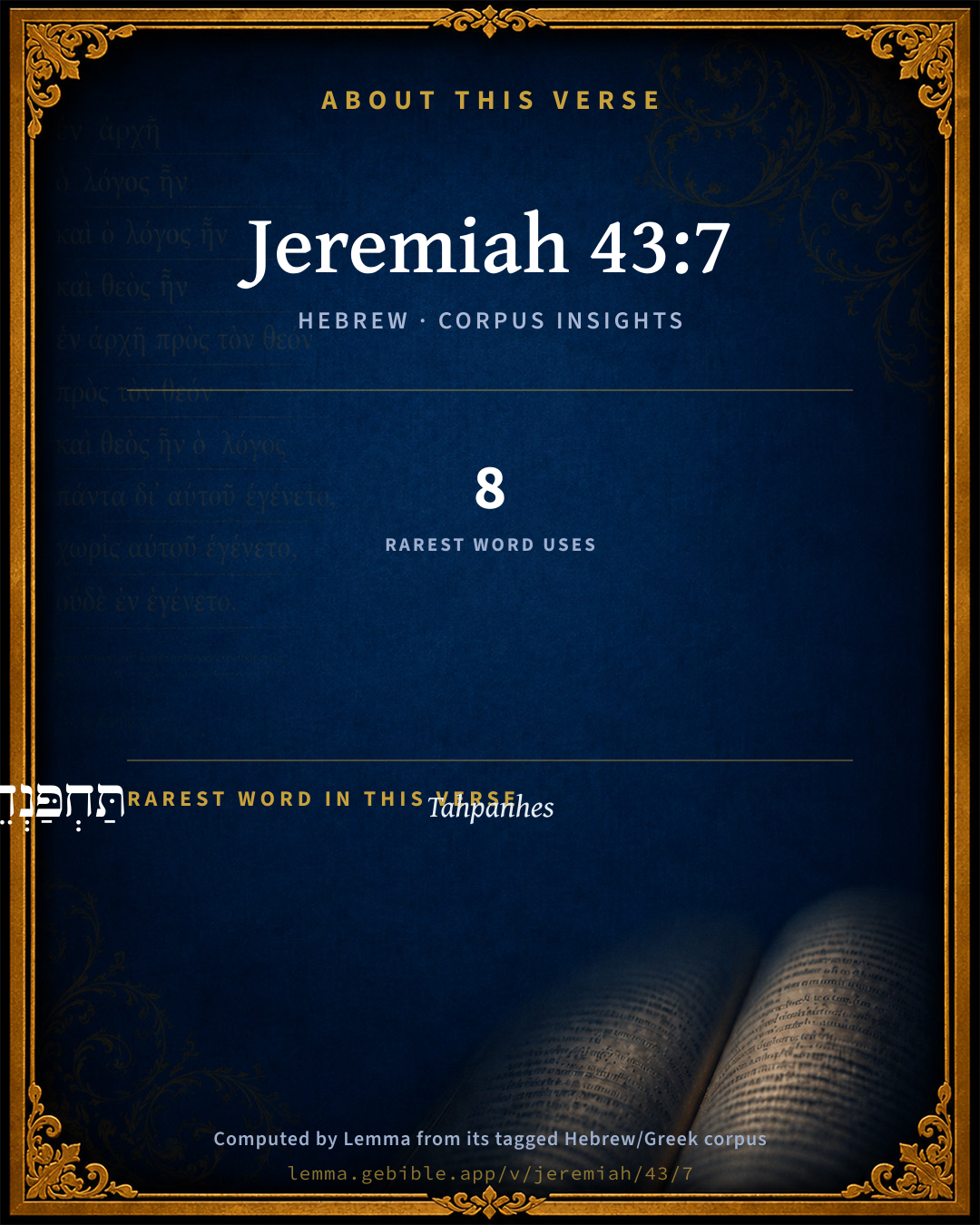
The rarest word here is תַּחְפַּנְחֵֽס Tahpanhes H8471 — appearing just 8 times in the whole Hebrew Bible.

Shared distinctive vocabulary

תַּחְפַּנְחֵֽס Tahpanhes H8471 occurs in 7 verses of the Hebrew Bible. Also found in:

Grammatical profile

  • 3 verbs
  • 5 nouns
  • 1 preposition
  • 1 conjunction
  • 1 particle

Verb forms

  • וַיָּבֹ֨אוּ֙ Qal · Sequential Imperfect
  • שָׁמְע֖וּ Qal · Perfect
  • וַיָּבֹ֖אוּ Qal · Sequential Imperfect

Repetition

A word recurs within this verse — often emphatic in Hebrew:

  • וַיָּבֹ֨אוּ֙ to enter H935 ×2

Cross-references

6

Topical passages linked to Jeremiah 43:7 in the Treasury of Scripture Knowledge — connected by theme and wording, ordered by reader-vote popularity; previews shown in the World English Bible.

  • Jeremiah 2:16 The children also of Memphis and Tahpanhes have broken the crown of your head.
  • Jeremiah 44:1 The word that came to Jeremiah concerning all the Jews who lived in the land of Egypt, who lived at Migdol, and at Tahpanhes, and at Memphis, and in the country of Pathros, saying,
  • Isaiah 30:4 For their princes are at Zoan, and their ambassadors are come to Hanes.
  • Jeremiah 46:14 Declare you in Egypt, and publish in Migdol, and publish in Memphis and in Tahpanhes: say you, Stand forth, and prepare you; for the sword has devoured round about you.
  • 2 Chronicles 25:16 It happened, as he talked with him, that [the king] said to him, Have we made you of the king's counsel? Stop! Why should you be struck down? Then the prophet stopped, and said, I know that God has determined to destroy you, because you have done this, and have not listened to my counsel.
  • Ezekiel 30:18 At Tehaphnehes also the day shall withdraw itself, when I shall break there the yokes of Egypt, and the pride of her power shall cease in her: as for her, a cloud shall cover her, and her daughters shall go into captivity.

Cross-references courtesy of OpenBible.info (CC BY 4.0).

Hebrew and Greek witnesses Masoretic Hebrew ↔ Greek Septuagint

The same verse in the two great witnesses to the Old Testament, shown verse-for-verse.

These are two independent witnesses, not word-aligned to each other, and the Septuagint is shown in lemma (dictionary) form.

Hebrew Jeremiah 43:7 Masoretic · Westminster Leningrad Codex

וַיָּבֹ֨אוּ֙ אֶ֣רֶץ מִצְרַ֔יִם כִּ֛י לֹ֥א שָׁמְע֖וּ בְּק֣וֹל יְהוָ֑ה וַיָּבֹ֖אוּ עַד תַּחְפַּנְחֵֽס

and they came into the land of Egypt; for they didn't obey the voice of Yahweh: and they came to Tahpanhes.

World English Bible · Public Domain

Greek LXX Structure differs

In the Septuagint, Jeremiah is about an eighth shorter than the Hebrew and arranges its material differently — the Oracles Against the Nations (Hebrew chapters 46–51) appear in the middle of the Greek book, after 25:13. Because the chapter and verse boundaries do not line up, a verse-for-verse comparison with the Hebrew is not shown.

A verse-for-verse comparison isn’t shown here because the chapters and verses don’t line up. Switch to the LXX edition with the MT / LXX toggle above to read the Greek directly.

On this verse, John Gill's Exposition discusses the Septuagint’s reading. Read the note in Commentary ↓

Hebrew: Westminster Leningrad Codex (CC BY 4.0). Greek: Septuagint (public domain); English from a public-domain English Septuagint. How the Septuagint differs from the Hebrew →

Targum (Aramaic paraphrase)

1

The Targum is the ancient Jewish Aramaic paraphrase of the Hebrew Scriptures — an interpretive translation, not the Hebrew text itself. Onkelos (literal) and Pseudo-Jonathan (expansive) render the Torah, and Jonathan the Prophets. Coverage is partial: where no permissively-licensed English translation exists for a verse, only the Aramaic is shown. This is verse-level text, not a word-by-word alignment to the Hebrew.

  1. Targum Jonathan Prophets (Joshua–Malachi)
    וַאֲתוֹ לְאַרְעָא דְמִצְרַיִם אֲרֵי לָא קַבִּילוּ לְמֵימְרָא דַייָ וַאֲתוֹ עַד תַּחְפַּנְחֵס:

    (no public-domain English translation for this verse)

    Targum Jonathan — Aramaic: “Mikraot Gedolot” (public domain). English: “Sefaria Community Translation” (CC0 1.0 (public-domain dedication)); “London "Chaldee Paraphrase," 1871” (public domain). Text via Sefaria.

Commentary

Notes on Jeremiah 43:7 from classic Christian and Jewish commentators (each source and its license shown beneath its notes). The classic Christian expositions comment on the surrounding passage and are grouped to its opening verse, so a note may address several verses; the Jewish commentaries on the Tanakh (Rashi and others) are per-verse, so they appear only where the commentator wrote on this verse.

Lemma curates 59 commentaries, every one of them public domain or Creative Commons licensed, each selected and text-cleaned for this edition rather than reprinted as found. About our sources →

Trapp's Complete Commentary

John Trapp

Jer 43:7 So they came into the land of Egypt: for they obeyed not the voice of the LORD: thus came they [even] to Tahpanhes.

Ver. 7. Thus came they even to Tahpanhes.] A chief city of Egypt, called also Hanes. {Isa 30:4} Jerome calleth it Tunis, and Herodotus, Daphnis Pelusiae.

John Trapp, A Commentary or Exposition upon All the Books of the Old and New Testament (1647–1656) — public domain. Text from a community e-Sword module.

Tyndale Open Study Notes

Tyndale Open Resources

43:7 The city of Tahpanhes (2:16; Ezek 30:18), now known as Tell Dafneh, guarded the road entering Egypt at its northeast corner.

Tyndale Open Study Notes — © Tyndale Open Resources, licensed CC BY-SA 4.0. Text via the HelloAO Bible API.

Geneva Bible (1599)

Geneva Bible translators

A city in Egypt near to Nilus.

Geneva Bible (1599) marginal notes — public domain. Text via Bolls.life.

Jamieson, Fausset & Brown

Robert Jamieson, A. R. Fausset & David Brown

Tahpanhes--(See on Jer 2:16); Daphne on the Tanitic branch of the Nile, near Pelusium. They naturally came to it first, being on the frontier of Egypt, towards Palestine.

Jamieson, Fausset & Brown — Commentary Critical and Explanatory on the Whole Bible (1871) — public domain (CC PDM 1.0). Text via the HelloAO Bible API.

Adam Clarke's Commentary

Verse 7. Came they even to Tahpanhes] This city was called Daphne by the Greeks, and was situated at the extremity of Lower Egypt, near to Heliopolis. It was called Daphne Pelusiaca. They halted at this place, most probably for the purpose of obtaining the king's permission to penetrate farther into Egypt. It was at this place that, according to St. Jerome, tradition says the faithful Jeremiah was stoned to death by these rebellious wretches; for whose welfare he had watched, prayed, gone through many indignities, and suffered every kind of hardship. And now he sealed the truth of his Divine mission with his blood.

Adam Clarke's Commentary on the Bible (1810–1826) — public domain. Text from a community e-Sword/MySword module.

John Calvin's Commentaries

At last he adds, all the souls which had been left by Nebuzaradan with Gedaliah, with Jeremiah, and with Baruch This had not been expressed elsewhere, that is, that Jeremiah and Baruch were joined with Gedaliah as rulers over the remnant of the people. But it was not the design of Jeremiah to relate everything that then took place. Now then, when an occasion occurred, he says that he and also Baruch were made governors in connection with Gedaliah. He then adds, that they all came into Egypt, or that they entered into Egypt,. For the word first used, ויבאו, vaibau, may be rendered, “and they entered into Egypt;” and then he adds, ויבאו עד-תחפנחס, vaibau od-tachephnuches, “and they entered (or penetrated) as far as Tachephnuches.” It was formerly one of the chief cities of Egypt; but its name has perished together with is wealth; for in heathen writers hardly the name of this city is found. They indeed mention the city Taphnim, but speak not of Taphnees. It is then probable, as changes take place in a country, that this city became by degrees forsaken, so as to become obscure and mean, and that other cities were built which exceeded it in wealth. He then says that they came to Taphnees It now follows, —

John Calvin's Commentaries (1540-1563) — public domain. Text from the Calvin Translation Society English edition (1840s-50s) via the Christian Classics Ethereal Library (ccel.org). Calvin's coverage is partial (roughly two-thirds of the Bible); uncommented books and verses are honest gaps, never fabricated. The 19th-century editor's footnotes and remarks are omitted so the notes are faithfully Calvin's own voice.

Ellicott's Commentary for English Readers

(7) Thus came they even to Tahpanhes.—The town was obviously on the north-eastern frontier of Egypt. In Jdt_1:9 it appears between the river of Egypt (the Rhinocolura, which divided Egypt from Palestine) and Ramesse (the Raamses of Exo_1:11, or Rameses of Num_33:3; Num_33:5) and all the land of Gesen, or Goshen. In Eze_30:16-18 it is named, in conjunction with No (= Thebes) and Noph (= Memphis), among the chief cities of Egypt. In Greek historians it appears as Daphnce and as near Pelusium (Herod. ii. 30), and in the Itinerary of Antoninus is placed, under the name of Dafno, at a distance of sixteen Roman miles from the latter city. Its name may be connected with that of the Egyptian Quoen Tahpenes, mentioned in 1Ki_11:19. Here apparently the emigrants determined to settle and found a new home for themselves.

A Bible Commentary for English Readers, edited by Charles John Ellicott (1878–1897) — public domain. Text from a community e-Sword module.

John Gill's Exposition

So they came into the land of Egypt,.... They set out from the habitation of Chimham, where they were, Jer 41:17; and proceeded on their journey, till they entered the land of Egypt:

for they obeyed not the voice of the Lord; to continue in Judea, and not to go into Egypt; and though the prophet of the Lord, who was with them, might, as they went along, advise them to go back, they regarded him not, but still went on:

thus came they even to Tahpanhes; the same with Hanes, Isa 30:4; and might be so called, as here, from a queen of Egypt of this name, Kg1 11:19. The Septuagint version, and others after that, call it Taphnas. It is thought to be the Daphnae Pelusiae of Herodotus (f) It was a seat of the king of Egypt, as appeals from Jer 43:9; and no less a place would these proud men stop at, or take up with, but where the king's palace was. Tyrius (g) calls it Tapium, and says it was in his time a very small town.

(f) Enterpe, sive l. 2. c. 30, 107. (g) Apud Adrichem. Theatrum Terrae Sanctae, p. 125.

John Gill's Exposition of the Whole Bible (1746–1763) — public domain (CC PDM 1.0). Text via the HelloAO Bible API.

Albert Barnes' Notes on the Bible

Tahpanhes - See the Jer 2:16 note.

Albert Barnes' Notes on the Bible (1834–1885) — public domain. Text from a community e-Sword/MySword module.

Matthew Poole's English Annotations

Egypt at this time, though it was humbled by the king of Babylon, by an inroad he had made into it, of which we read, 2Ki 24:7, yet it was a distinct kingdom, and being near to Canaan, the Jews often fled thither for sanctuary, and borrowed assistance against their enemies from them. Of this city we read little but in holy writ. 1Ki 11:19, we read of a queen of Egypt called

Taphenes, in honour to whom probably this city was builded, after whose name this city was called, of which the Scripture saith nothing, but in this prophet, Jer 2:16, in this chapter, and Jer 44:1; 46:14; it appears by Jer 43:9 that it was at this time the place where the king of Egypt made his residence, or at least had a palace. Thither these captains and the Jews came, forcing Jeremiah and Baruch along with them.

Matthew Poole's English Annotations on the Holy Bible (1683–1685) — public domain. Text from a community e-Sword/MySword module.

Whedon's Commentary on the Bible

Daniel D. Whedon

7. Tahpanhes — See Jer_2:16. This was a frontier town on the Pelusian branch of the Nile. It is the Daphne of Herodotus. It is repeatedly mentioned by Jeremiah and Ezekiel, and seems to have been a place of considerable importance, as in the passage above referred to “Noph and Tahpanhes” are made to represent Egypt, and in Jer_43:9 we learn that Pharaoh had a palace there.

Daniel D. Whedon (gen. ed.), Commentary on the Old and New Testaments (1874–1909) — public domain. Text from a community e-Sword module.

The Pulpit Commentary

Tahpanhea. An Egyptian frontier city, (see Eze_30:18 and note on Jer_2:16) where the fugitives had to wait till the views of the Egyptian government respecting them were made known. The supposed site of the Pelusiac Daphnae has not yet been explored; a single inscribed fragment would reveal the Egyptian name, and probably ratify the identity of Daphnae with the Tahpanhes of the prophets (R.S. Poole, "The Cities of Egypt," p. 177).

The Pulpit Commentary (1880–1919), ed. H.D.M. Spence-Jones & Joseph S. Exell — public domain. Text from a community e-Sword module.

John Wesley's Explanatory Notes

Tahpanhes - It was at this time the place where the king of Egypt made his residence.

John Wesley, Explanatory Notes Upon the Whole Bible (1754–1765) — public domain. Text via the GEBible commentary corpus.

Scofield Reference Notes

C. I. Scofield

Tahpanhes

See, Jer 2:16; Jer 44:1. Called "Hanes," Isa 30:4.

The Scofield Reference Bible (1917 edition), notes by C. I. Scofield — public domain. Text from a community e-Sword module.

Lesson kit

Teaching starters — assembled from the data on this page, not authored interpretation. Every prompt links to the verse data it draws on. Edit before teaching.

Jeremiah, in the Prophets, opens this verse with 11 words (10 distinct Hebrew lemmas). Its most distinctive word is Tachpanchêç (“Tahpanhes”). A historical commentator’s framing appears above. Read the whole chapter for the surrounding context.

Discussion questions

  1. What does “Tahpanhes” (Tachpanchêç) contribute to the verse as a whole?
  2. How does Jeremiah 2:16, which shares the word «Tahpanhes», read alongside this verse?
  3. What does the repetition of “to enter” (2× in this one verse) do in this verse?
  4. These translations render this verse differently. What is at stake in choosing one wording over another?
  5. «וַיָּבֹ֨אוּ֙» is a Qal Sequential Imperfect verb. How does that grammatical form shape the action described?
  6. Compare how Trapp's Complete Commentary and Tyndale Open Study Notes read this verse. Where do they agree or differ?

Things to notice

Reading settings

Reading text

Shown beneath each verse's original-language words.

Old Testament
Old Testament edition

Read the OT as the Masoretic Hebrew (MT) or the Greek Septuagint (LXX).

English shown for the Greek Septuagint (in the Hebrew ↔ Greek comparison).

Comparing translations? Open the Compare panel on any verse page to stack up to four side by side.