Isaiah 36:9

Hebrew (Westminster Leningrad Codex) Isaiah 36:9 appears in the Hebrew Old Testament. The text above is from the Westminster Leningrad Codex. Each word links to its Strong’s number, a concise gloss, and parsing drawn from the Open Scriptures Hebrew Bible morphology. Click any word for its full Brown-Driver-Briggs (BDB) entry.
Download image
Cite this verse

Isaiah 36:9 (World English Bible). Public Domain. Lemma interlinear Bible study tool, https://lemma.gebible.app/v/isaiah/36/9.

Show BibTeX & RIS
BibTeX
RIS
English Translation
How then can you turn away the face of one captain of the least of my master's servants, and put your trust on Egypt for chariots and for horsemen?
World English Bible · Public Domain
Download a study sheet

One document with this verse’s original text, its word-by-word gloss line, the meaning frame, cross-references with their text, attributed commentary, and full source and license credits — printable, and it pastes into notes with its structure intact.

This verse Autodidact and up

Study sheet (.html) Plain text (.txt)

A passage Seminary Student

Up to 50 verses in one chapter. A passage sheet keeps up to 6 commentary sources and 12 cross-references per verse, in the order this page ranks them, and says so on the sheet whenever that leaves anything out. Ask for a single verse and you get the Autodidact verse sheet above.

Everything on this page stays free to read, with no account — the sheet is a download of what is already on screen, not access to it.

Want to remove ads? Support Godless Engineer
Compare translations 3

The same verse in 3 English versions, stacked beneath the original-language interlinear above. Click any original word for its lexicon entry.

Each is an independent rendering of the whole verse — the interlinear is not word-aligned to these translations.

Highlighted words mark where these versions differ — a whole-verse word diff, not a word-by-word alignment.

  • World English Bible Public Domain
    How then can you turn away the face of one captain of the least of my master's servants, and put your trust on Egypt for chariots and for horsemen?
  • King James Version Public Domain
    How then wilt thou turn away the face of one captain of the least of my master's servants, and put thy trust on Egypt for chariots and for horsemen?
  • unfoldingWord Literal Text CC BY-SA 4.0
    But how would you turn back the face of a captain of one of the least servants of my master? So you trust for yourself in Egypt for chariots and for horsemen.’

unfoldingWord Literal Text — © unfoldingWord, licensed CC BY-SA 4.0. Word-aligned USFM3 via Door43 (git.door43.org/unfoldingWord/en_ult).

Versions to compare (up to 4)

3 of 4 selected

Show all 18 translations

Every available English version of this verse, each an independent rendering of the whole verse.

  • World English Bible Public Domain
    How then can you turn away the face of one captain of the least of my master's servants, and put your trust on Egypt for chariots and for horsemen?
  • Berean Standard Bible Public Domain
    For how can you repel a single officer among the least of my master’s servants when you depend on Egypt for chariots and horsemen?
  • Majority Standard Bible Public Domain
    For how can you repel a single officer among the least of my master’s servants when you depend on Egypt for chariots and horsemen?
  • King James Version Public Domain
    How then wilt thou turn away the face of one captain of the least of my master's servants, and put thy trust on Egypt for chariots and for horsemen?
  • American Standard Version (1901) Public Domain
    How then canst thou turn away the face of one captain of the least of my master's servants, and put thy trust on Egypt for chariots and for horsemen?
  • Revised Version (1885) Public Domain
    How then canst thou turn away the face of one captain of the least of my master’s servants, and put thy trust on Egypt for chariots and for horsemen?
  • Geneva Bible (1599) Public Domain
    For howe canst thou despise any captaine of the least of my lordes seruants? and put thy trust on Egypt for charets and for horsemen?
  • Douay-Rheims (1899) Public Domain
    And how wilt thou stand against the face of the judge of one place, of the least of my master's servants? But if thou trust in Egypt, in chariots and in horsemen:
  • Young's Literal Translation Public Domain
    And how dost thou turn back the face of one captain of the least of the servants of my lord, and dost trust for thee on Egypt, for chariot and for horsemen?
  • Literal Standard Version CC BY-SA 4.0
    And how do you turn back the face of one captain of the least of the servants of my lord, and trust on Egypt for yourself, for chariot and for horsemen?
  • Unlocked Literal Bible CC BY-SA 4.0
    How could you resist even one captain of the least of my master's servants? You have put your trust in Egypt for chariots and horsemen!
  • unfoldingWord Literal Text CC BY-SA 4.0
    But how would you turn back the face of a captain of one of the least servants of my master? So you trust for yourself in Egypt for chariots and for horsemen.’
  • Darby Bible Public Domain
    How then wilt thou turn away the face of one captain of the least of my master's servants? And thou reliest upon Egypt for chariots and for horsemen!
  • World Messianic Bible Public Domain
    How then can you turn away the face of one captain of the least of my master’s servants, and put your trust in Egypt for chariots and for horsemen?
  • Webster's Bible Public Domain
    How then wilt thou turn away the face of one captain of the least of my master's servants, and put thy trust on Egypt for chariots and for horsemen?
  • Free Bible Version CC BY-SA 4.0
    How could you defeat even a single officer in charge of the weakest of my master's men when you're trusting in Egypt for chariots and horsemen?
  • Bible in Basic English Public Domain
    How then may you put to shame the least of my master's servants? and you have put your hope in Egypt for war-carriages and horsemen:
  • JPS Tanakh (1917) Public Domain
    How then canst thou turn away the face of one captain, even of the least of my master's servants? yet thou puttest thy trust on Egypt for chariots and for horsemen!

Literal Standard Version (2020), Covenant Press — licensed CC BY-SA 4.0. Text via the HelloAO Bible API (eBible.org). Unlocked Literal Bible (unfoldingWord) — licensed CC BY-SA 4.0. Text via the HelloAO Bible API (eBible.org). unfoldingWord Literal Text — © unfoldingWord, licensed CC BY-SA 4.0. Word-aligned USFM3 via Door43 (git.door43.org/unfoldingWord/en_ult). Free Bible Version, Dr. Jonathan Gallagher — licensed CC BY-SA 4.0. Text via the HelloAO Bible API (eBible.org).

Word by word

More ways to search: Search by grammar → Find every occurrence → Compare this word →

Practice this passage: Drill this verse → Learn its vocabulary →

פַחַ֥ת
pechâh
H6346
“governor of”
Noun, Common, Masculine, Singular, Construct
Part of Speech
Noun
Type
Common
Gender
Masculine
Number
Singular
State
Construct
Full BDB Definition

Origin: of foreign origin

TWOT: 1757

governor
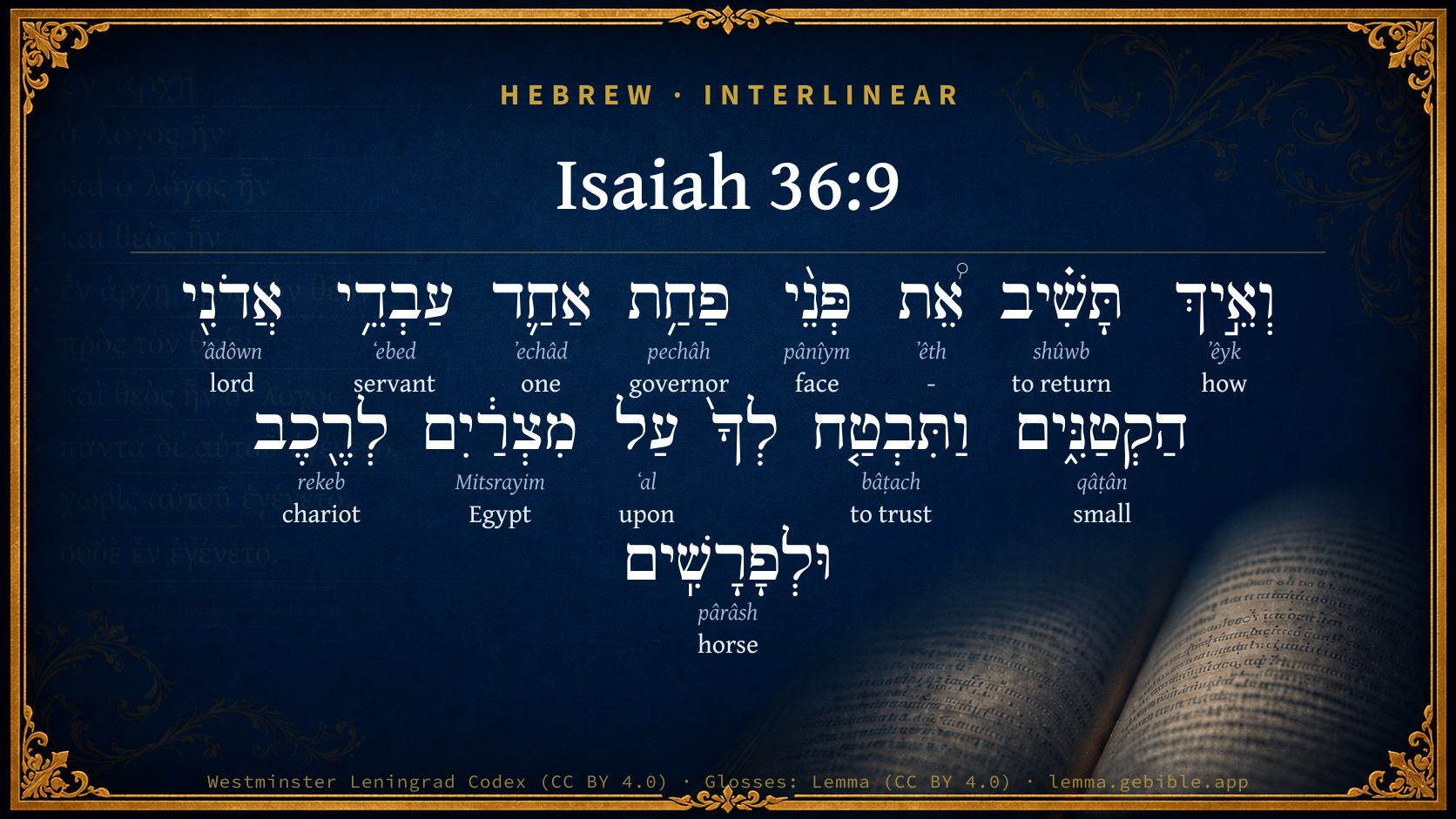
  1. וְאֵ֣יךְ ʼêyk H349 “and · how” Conjunction + Particle, Interrogative
  2. תָּשִׁ֗יב shûwb H7725 “to return” Verb, Hiphil, Imperfect, 2nd Person, Masculine, Singular
  3. אֵ֠ת ʼêth H853 “-” Particle, Direct Object
  4. פְּנֵ֨י pânîym H6440 “face(s) of” Noun, Common, Both, Plural, Construct
  5. אַחַ֛ד ʼechâd H259 “one” Adjective, Cardinal number, Masculine, Singular, Absolute
  6. עַבְדֵ֥י ʻebed H5650 “servants of” Noun, Common, Masculine, Plural, Construct
  7. אֲדֹנִ֖י ʼâdôwn H113 “lord · my” Noun, Common, Masculine, Singular, Construct + Suffix, Personal, 1st Person, Common, Singular
  8. הַקְטַנִּ֑ים qâṭân H6996 “the · small” Particle, Definite Article + Adjective, Adjective, Masculine, Plural, Absolute
  9. וַתִּבְטַ֤ח bâṭach H982 “and · to trust” Conjunction + Verb, Qal, Sequential Imperfect, 2nd Person, Masculine, Singular
  10. עַל ʻal H5921 “upon” Preposition
  11. מִצְרַ֔יִם Mitsrayim H4714 “Egypt” Noun, Proper
  12. לְרֶ֖כֶב rekeb H7393 “to/for · chariot” Preposition + Noun, Common, Masculine, Singular, Absolute
  13. וּלְפָרָשִֽׁים pârâsh H6571 “and · to/for · horses” Conjunction + Preposition + Noun, Common, Masculine, Plural, Absolute

About this verse

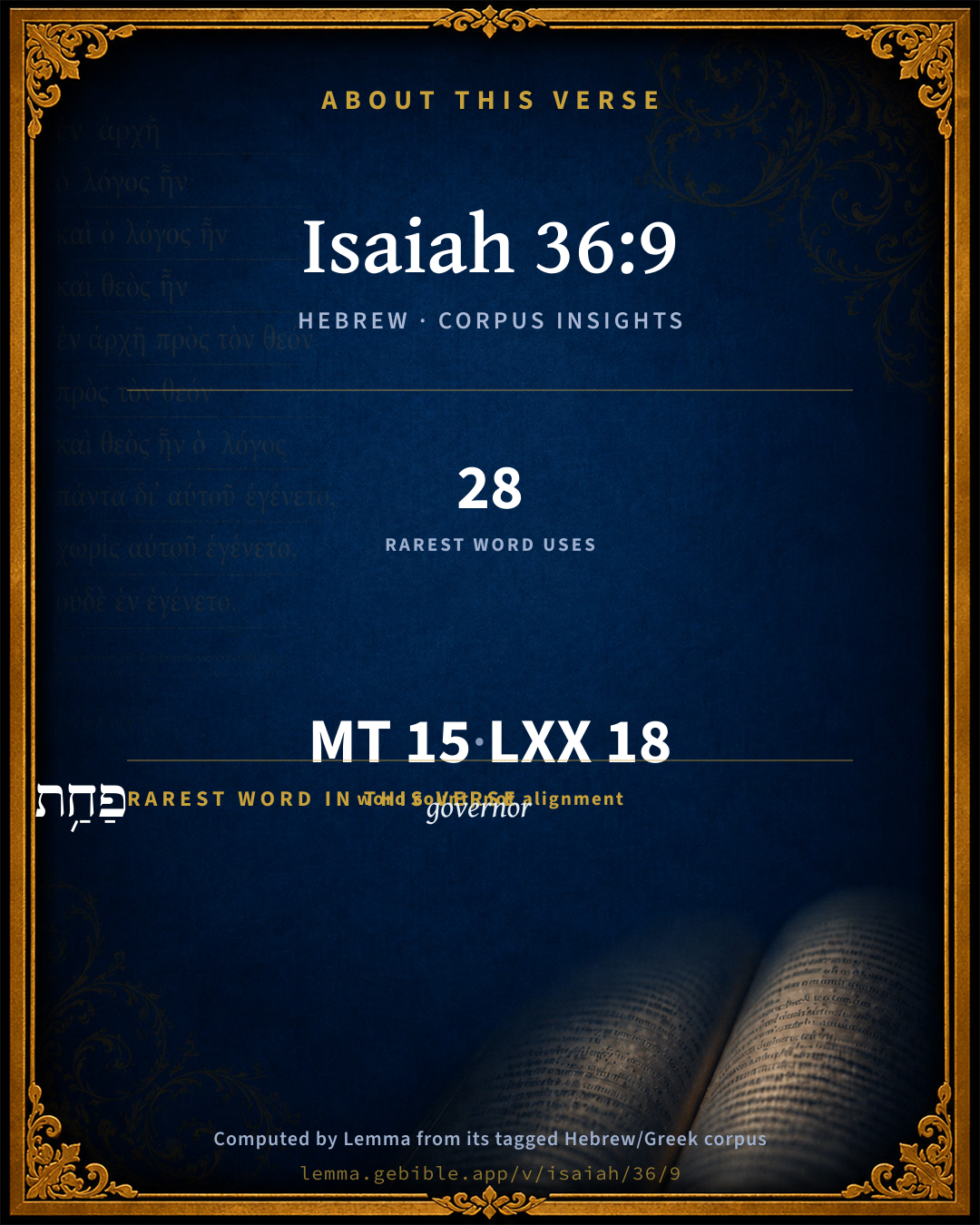
These counts appear in no published source. They are computed here, from the morphology-tagged text and Lemma’s own curated glosses. What Lemma adds →

15
words
14
distinct lemmas
Prophets
section

Shared distinctive vocabulary

פַחַ֥ת governor H6346 occurs in 27 verses of the Hebrew Bible. Also found in:

Grammatical profile

  • 2 verbs
  • 7 nouns
  • 2 adjectives
  • 2 prepositions
  • 2 particles

Verb forms

  • תָּשִׁ֗יב Hiphil · Imperfect
  • וַתִּבְטַ֤ח Qal · Sequential Imperfect

Hebrew & Septuagint length

In English translation the verse runs 29 words from the Hebrew and 25 from the Septuagint (LXX English) — closely comparable.

A rough comparison of the two English renderings, which tokenize alike — not a word-level alignment.

Word counts can differ between the Hebrew and the Greek without any difference in meaning — e.g. the Hebrew direct-object marker אֵת has no separate Greek word, and Greek often adds the article ὁ.

In the original languages it is 15 Hebrew tokens and 18 Greek tokens — but the two are counted differently (Hebrew bundles its prefixes and suffixes into one token; the Greek is in lemma form), so that isn’t a like-for-like length.

Cross-references

11

Topical passages linked to Isaiah 36:9 in the Treasury of Scripture Knowledge — connected by theme and wording, ordered by reader-vote popularity; previews shown in the World English Bible.

  • Isaiah 10:8 For he says, Aren't my princes all of them kings?
  • Deuteronomy 17:16 Only he shall not multiply horses to himself, nor cause the people to return to Egypt, to the end that he may multiply horses; because Yahweh has said to you, You shall henceforth return no more that way.
  • 2 Kings 18:24 How then can you turn away the face of one captain of the least of my master's servants, and put your trust on Egypt for chariots and for horsemen?
  • Proverbs 21:31 The horse is prepared for the day of battle; But victory is with Yahweh.
  • Isaiah 20:5 They shall be dismayed and confounded, because of Ethiopia their expectation, and of Egypt their glory.
  • Isaiah 30:2–5 that set out to go down into Egypt, and have not asked at my mouth; to strengthen themselves in the strength of Pharaoh, and to take refuge in the shadow of Egypt!
  • Isaiah 30:7 For Egypt helps in vain, and to no purpose: therefore have I called her Rahab who sits still.
  • Isaiah 30:16–17 but you said, No, for we will flee on horses; therefore shall you flee: and, We will ride on the swift; therefore shall those who pursue you be swift.
  • Isaiah 31:3 Now the Egyptians are men, and not God; and their horses flesh, and not spirit: and when Yahweh shall stretch out his hand, both he who helps shall stumble, and he who is helped shall fall, and they all shall be consumed together.
  • Isaiah 36:6 Behold, you trust on the staff of this bruised reed, even on Egypt, whereon if a man lean, it will go into his hand, and pierce it: so is Pharaoh king of Egypt to all who trust on him.
  • Jeremiah 2:36 Why go you about so much to change your way? you shall be ashamed of Egypt also, as you were ashamed of Assyria.

Cross-references courtesy of OpenBible.info (CC BY 4.0).

Hebrew and Greek witnesses Masoretic Hebrew ↔ Greek Septuagint

The same verse in the two great witnesses to the Old Testament, shown verse-for-verse.

These are two independent witnesses, not word-aligned to each other, and the Septuagint is shown in lemma (dictionary) form.

Hebrew Isaiah 36:9 Masoretic · Westminster Leningrad Codex

וְאֵ֣יךְ תָּשִׁ֗יב אֵ֠ת פְּנֵ֨י פַחַ֥ת אַחַ֛ד עַבְדֵ֥י אֲדֹנִ֖י הַקְטַנִּ֑ים וַתִּבְטַ֤ח לְךָ֙ עַל מִצְרַ֔יִם לְרֶ֖כֶב וּלְפָרָשִֽׁים

How then can you turn away the face of one captain of the least of my master's servants, and put your trust on Egypt for chariots and for horsemen?

World English Bible · Public Domain

Greek LXX Isaiah 36:9 Septuagint · lemma form

καί πῶς δύναμαι ἀποστρέφω εἰς πρόσωπον τοπαρχής εἷς οἰκέτης εἰμί ὁ πείθω ἐπί αἰγύπτιος εἰς ἵππος καί ἀναβάτης

And how can you⌃ then turn to the face of the satraps? They that trust on the Egyptians for horse and rider, are our servants.

LXX2012 (modern English Septuagint) · Public Domain

Hebrew: Westminster Leningrad Codex (CC BY 4.0). Greek: Septuagint (public domain); English from LXX2012 (modern English Septuagint) (Public Domain). How the Septuagint differs from the Hebrew →

Targum (Aramaic paraphrase)

1

The Targum is the ancient Jewish Aramaic paraphrase of the Hebrew Scriptures — an interpretive translation, not the Hebrew text itself. Onkelos (literal) and Pseudo-Jonathan (expansive) render the Torah, and Jonathan the Prophets. Coverage is partial: where no permissively-licensed English translation exists for a verse, only the Aramaic is shown. This is verse-level text, not a word-by-word alignment to the Hebrew.

  1. Targum Jonathan Prophets (Joshua–Malachi)
    וְאֵיכְדֵין אַתְּ מְדַמִי לַאֲתָבָא יַת אַפֵּי חַד מִשִׁלְטוֹנֵי עַבְדֵי רִיבּוֹנִי זְעֵרַיָא וְאִיתְרַחֵצְתָּא לָךְ עַל מִצְרָיִם לִרְתִיכִין וּלְפָרָשִׁין:

    And how dost thou expect to turn back the face of one of the least princes, servants of my master? yet, thou trustest in Egypt for chariots and horsemen.

    Targum Jonathan — Aramaic: “Mikraot Gedolot” (public domain). English: “Sefaria Community Translation” (CC0 1.0 (public-domain dedication)); “London "Chaldee Paraphrase," 1871” (public domain). Text via Sefaria.

Commentary

Notes on Isaiah 36:9 from classic Christian and Jewish commentators (each source and its license shown beneath its notes). The classic Christian expositions comment on the surrounding passage and are grouped to its opening verse, so a note may address several verses; the Jewish commentaries on the Tanakh (Rashi and others) are per-verse, so they appear only where the commentator wrote on this verse.

Lemma curates 59 commentaries, every one of them public domain or Creative Commons licensed, each selected and text-cleaned for this edition rather than reprinted as found. About our sources →

Geneva Bible (1599)

Geneva Bible translators

He reproacheth to Hezekiah his small power, which is not able to resist one of Sennacherib’s least captains.

Or, turn back.

Geneva Bible (1599) marginal notes — public domain. Text via Bolls.life.

Jamieson, Fausset & Brown

Robert Jamieson, A. R. Fausset & David Brown

captain--a governor under a satrap; even he commands more horsemen than this.

Jamieson, Fausset & Brown — Commentary Critical and Explanatory on the Whole Bible (1871) — public domain (CC PDM 1.0). Text via the HelloAO Bible API.

The Cambridge Bible for Schools and Colleges

gen. ed. J. J. S. Perowne

9. Hezekiah’s power is not equal to that of the lowest official in the Assyrian Empire; yet he dares to defy the great king! The word rendered captain means the governor of a province.

The Cambridge Bible for Schools and Colleges (gen. ed. J. J. S. Perowne; Cambridge University Press, 1878–1918) — public domain. Text from a community e-Sword module.

John Gill's Exposition

How then wilt thou turn away the face of one captain of the least of my master's servants,.... Be able to resist him; or be a match for him; or cause him to flee; the least captain or general in the army having, as Kimchi says, two thousand men under him; and therefore, if Hezekiah could not produce two thousand men, to sit upon so many horses offered, he could not be a match for, or hope to conquer, or cause to flee, the least officer in the army, who had the fewest men under him, and much less conquer, or cause to flee, the whole Assyrian army. Some think Rabshakeh means himself, but that does not seem likely, that Sennacherib should send an inferior officer, or a person of a low character, and in a low station, or that such an one should be the principal speaker; nor does it suit with the imperious and haughty disposition of Rabshakeh to speak in such a manner of himself:

and put thy trust on Egypt for chariots, and for horsemen? for to what purpose was it to seek and send to Egypt for chariots and horses, since he had not a sufficient number of men to put upon them, but must be obliged to have men, as well as horses and chariots; and which, as before observed, it was a vain thing to trust to, and was quite needless, when he might have enough from his master, the Assyrian king, would he agree with him.

John Gill's Exposition of the Whole Bible (1746–1763) — public domain (CC PDM 1.0). Text via the HelloAO Bible API.

Albert Barnes' Notes on the Bible

How then wilt thou turn away the face - The most unimportant captain in the army of Assyria commands more horsemen than this, and how can you expect to oppose even him, much more how can you be able to resist all the mighty army of the Assyrians?

One captain of the least - The word ‘captain’ here (פחת pachat, construct state from פחה pechâh) denotes a prefect or governor of a province less than a satrap, an officer who was under the satrap, and subject to him. It is applied to an officer in the Assyrian empire 2Ki 18:24; in the Chaldean empire Jer 51:23; the Persian Est 8:9; Est 9:3; and to the prefects of Judea in the time of Solomon 1Ki 10:15. The word is of foreign origin.

Albert Barnes' Notes on the Bible (1834–1885) — public domain. Text from a community e-Sword/MySword module.

Whedon's Commentary on the Bible

Daniel D. Whedon

9. How… turn away… one captain — How will you, even then, figure in a hand to hand fight with the least one of my satraps or small governors? Which do you think would first take flight?

And put thy trust on Egypt — Can Egypt come to you with any more glorious rescue with her cavalry?

Daniel D. Whedon (gen. ed.), Commentary on the Old and New Testaments (1874–1909) — public domain. Text from a community e-Sword module.

The Pulpit Commentary

How then wilt thou turn away the face, etc.? i.e. "How wilt thou be able to defeat, and cause to retreat, a single Assyrian captain at the head of his squadron?" And put thy trust on Egypt for chariots and for horsemen; rather, but thou trustest in Egypt for chariots and for horsemen. Consciousness of the weakness, with which Rabshakeh had just reproached them, had led to their application to Egypt for a chariot and a cavalry force. Egypt was well able to furnish both, and had sent a large force of both to the help of Ekron a short time previously ("Eponym Canon," p. 133, 11. 48-56). That force had, however, suffered defeat at the hands of Sennacherib.

The Pulpit Commentary (1880–1919), ed. H.D.M. Spence-Jones & Joseph S. Exell — public domain. Text from a community e-Sword module.

J. A. Alexander on Isaiah

Joseph Addison Alexander

“And how wilt thou turn away the face of one governor (or satrap) of the least of my master’s servants? So thou hast reposed thyself on Egypt, with respect to chariots and horses.” As a man is said to turn his face towards an object of attack, so the latter may be said to turn back (or away) the face of his assailant when he repels him. The last clause is an inference from the first, as the first is from the foregoing verse. If Hezekiah could not command two thousand horsemen, he was unprepared to resist even a detachment of the Assyrian force; and if thus helpless, he must be trusting, not in his own resources, but in foreign aid.

Joseph Addison Alexander, The Prophecies of Isaiah (1846–1847; New York: Scribner, 1870–1878) — public domain. Text from a community e-Sword module.

unfoldingWord translationNotes

Door43 World Missions Community

General Information:

This continues the king of Assyria's message to Hezekiah by speaking the message to Hezekiah's men. (See: Isaiah 36:4-5)

How could you resist even one captain ... servants?

The chief commander continues to ridicule Hezekiah and his army. When he says "you," referring to Hezekiah, he is actually referring to Hezekiah's army. This question may be written as a statement. AT: "Your army could not even defeat one captain ... servants." (See: Rhetorical Question and Metonymy)

Now then, have I traveled up here without Yahweh to fight against this land and destroy it?

The chief commander uses another question to ridicule Hezekiah and the people of Judah. This question may be written as a statement. AT: "I came here with Yahweh's command to destroy Jerusalem." (See: Rhetorical Question)

without Yahweh

Here "Yahweh" refers to Yahweh's orders. AT: "without Yahweh's command" (See: Metonymy)

against this land and destroy it ... Attack this land and destroy it

This means to fight against the people and cause destruction in the place where they live. The land referred to here is Jerusalem. AT: "against this people and destroy their land ... Attack these people and destroy their land" (See: Metonymy)

translationWords

servant

trust

Egypt

chariot

Yahweh

unfoldingWord translationNotes — © Distant Shores Media and the Door43 World Missions Community, licensed CC BY-SA 4.0. Source: git.door43.org/Door43/en_tn.

Rashi

Rabbi Shlomo Yitzchaki (Rashi)

And how can you repulse even a captain, who is one of my master’s smallest servants, for the smallest of the heads of his troops is in charge of two thousand men.

one of...servants (אַחַד) one of the servants of. Comp. (Gen. 21:15) “One of (אַחַד) the bushes.” Also (II Sam. 6:20) “One of (אַחַד) the idlers.”

Rashi on the Tanakh — English translations: “The Judaica Press complete Tanach with Rashi, translated by A. J. Rosenberg” (CC BY 4.0); “Pentateuch with Rashi's commentary by M. Rosenbaum and A.M. Silbermann, 1929-1934” (public domain); “The Metsudah Tanach series, Lakewood, N.J” (CC BY 4.0); and “The Book of Joshua, Metsudah Publications, 1997” (CC BY 4.0). Text via Sefaria.

Lesson kit

Teaching starters — assembled from the data on this page, not authored interpretation. Every prompt links to the verse data it draws on. Edit before teaching.

Isaiah, in the Prophets, opens this verse with 15 words (14 distinct Hebrew lemmas). Its most distinctive word is pechâh (“governor”). A historical commentator’s framing appears above. Read the whole chapter for the surrounding context.

Discussion questions

  1. How does “governor” (pechâh) shape what this verse is saying?
  2. How does 1 Kings 10:15, which shares the word «governor», read alongside this verse?
  3. These translations render this verse differently; the difference is in the English rendering, not the original. What questions does that raise?
  4. «תָּשִׁ֗יב» is a Hiphil Imperfect verb. How does that grammatical form shape the action described?
  5. Compare how Geneva Bible (1599) and Jamieson, Fausset & Brown read this verse. Where do they agree or differ?

Things to notice

Reading settings

Reading text

Shown beneath each verse's original-language words.

Old Testament
Old Testament edition

Read the OT as the Masoretic Hebrew (MT) or the Greek Septuagint (LXX).

English shown for the Greek Septuagint (in the Hebrew ↔ Greek comparison).

Comparing translations? Open the Compare panel on any verse page to stack up to four side by side.