
Jeremiah 46:2

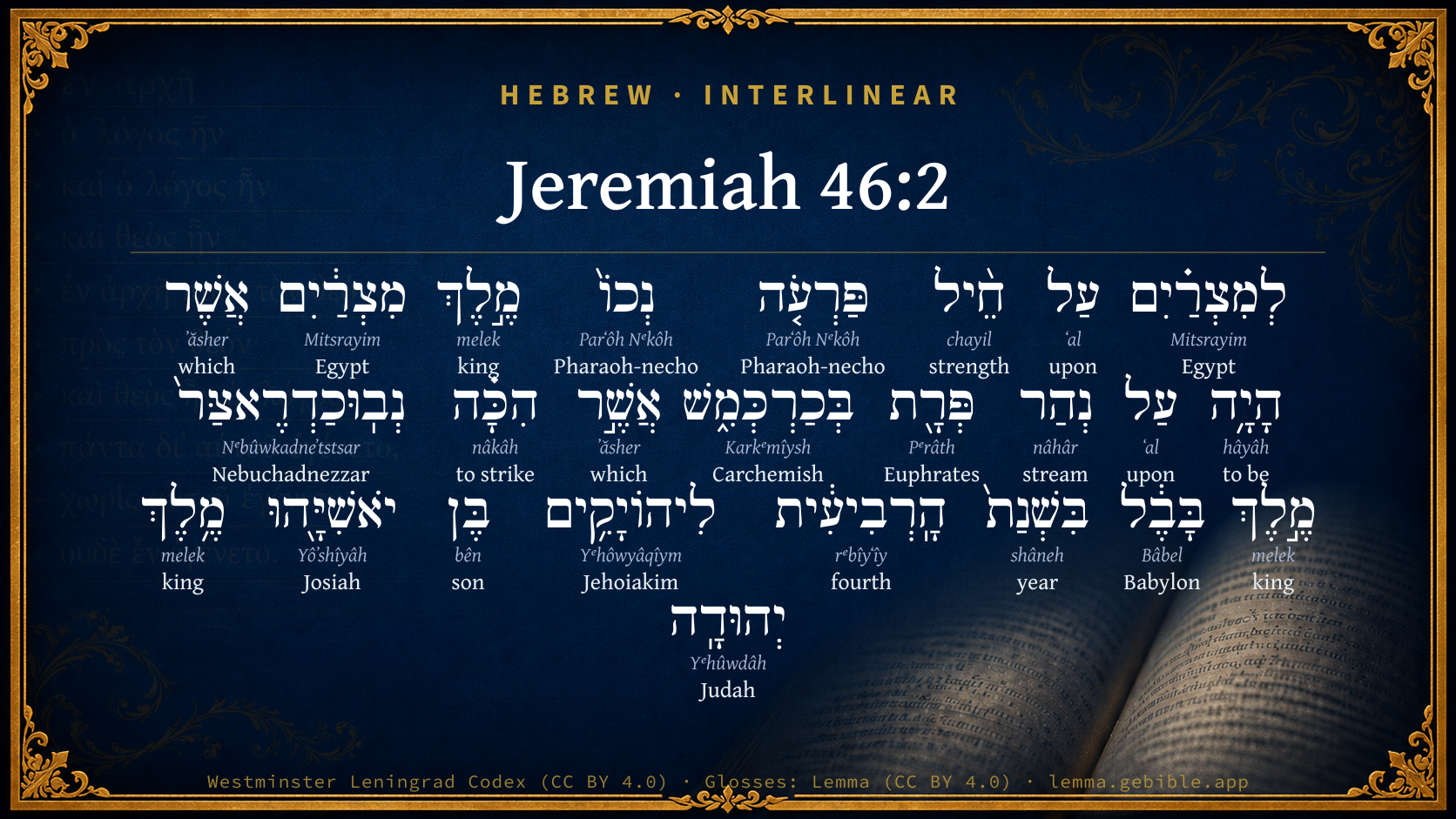
Hebrew (Westminster Leningrad Codex) Jeremiah 46:2 appears in the Hebrew Old Testament. The text above is from the Westminster Leningrad Codex. Each word links to its Strong’s number, a concise gloss, and parsing drawn from the Open Scriptures Hebrew Bible morphology. Click any word for its full Brown-Driver-Briggs (BDB) entry.
Download image
Cite this verse

Jeremiah 46:2 (World English Bible). Public Domain. Lemma interlinear Bible study tool, https://lemma.gebible.app/v/jeremiah/46/2.

Show BibTeX & RIS
BibTeX
RIS
English Translation
Of Egypt: concerning the army of Pharaoh Necoh king of Egypt, which was by the river Euphrates in Carchemish, which Nebuchadrezzar king of Babylon struck in the fourth year of Jehoiakim the son of Josiah, king of Judah.
World English Bible · Public Domain
Download a study sheet

One document with this verse’s original text, its word-by-word gloss line, the meaning frame, cross-references with their text, attributed commentary, and full source and license credits — printable, and it pastes into notes with its structure intact.

This verse Autodidact and up

Study sheet (.html) Plain text (.txt)

A passage Seminary Student

Up to 50 verses in one chapter. A passage sheet keeps up to 6 commentary sources and 12 cross-references per verse, in the order this page ranks them, and says so on the sheet whenever that leaves anything out. Ask for a single verse and you get the Autodidact verse sheet above.

Everything on this page stays free to read, with no account — the sheet is a download of what is already on screen, not access to it.

Want to remove ads? Support Godless Engineer
Compare translations 3

The same verse in 3 English versions, stacked beneath the original-language interlinear above. Click any original word for its lexicon entry.

Each is an independent rendering of the whole verse — the interlinear is not word-aligned to these translations.

Highlighted words mark where these versions differ — a whole-verse word diff, not a word-by-word alignment.

  • World English Bible Public Domain
    Of Egypt: concerning the army of Pharaoh Necoh king of Egypt, which was by the river Euphrates in Carchemish, which Nebuchadrezzar king of Babylon struck in the fourth year of Jehoiakim the son of Josiah, king of Judah.
  • King James Version Public Domain
    Against Egypt, against the army of Pharaohnecho king of Egypt, which was by the river Euphrates in Carchemish, which Nebuchadrezzar king of Babylon smote in the fourth year of Jehoiakim the son of Josiah king of Judah.
  • unfoldingWord Literal Text CC BY-SA 4.0
    For Egypt: “This is about the army of Pharaoh Necho, king of Egypt that was at Carchemish by the Euphrates river. This was the army that Nebuchadnezzar king of Babylon defeated in the fourth year of Jehoiakim son of Josiah, king of Judah:

unfoldingWord Literal Text — © unfoldingWord, licensed CC BY-SA 4.0. Word-aligned USFM3 via Door43 (git.door43.org/unfoldingWord/en_ult).

Versions to compare (up to 4)

3 of 4 selected

Show all 18 translations

Every available English version of this verse, each an independent rendering of the whole verse.

  • World English Bible Public Domain
    Of Egypt: concerning the army of Pharaoh Necoh king of Egypt, which was by the river Euphrates in Carchemish, which Nebuchadrezzar king of Babylon struck in the fourth year of Jehoiakim the son of Josiah, king of Judah.
  • Berean Standard Bible Public Domain
    concerning Egypt and the army of Pharaoh Neco king of Egypt, which was defeated at Carchemish on the Euphrates River by Nebuchadnezzar king of Babylon in the fourth year of Jehoiakim the son of Josiah king of Judah:
  • Majority Standard Bible Public Domain
    concerning Egypt and the army of Pharaoh Neco king of Egypt, which was defeated at Carchemish on the Euphrates River by Nebuchadnezzar king of Babylon in the fourth year of Jehoiakim the son of Josiah king of Judah:
  • King James Version Public Domain
    Against Egypt, against the army of Pharaohnecho king of Egypt, which was by the river Euphrates in Carchemish, which Nebuchadrezzar king of Babylon smote in the fourth year of Jehoiakim the son of Josiah king of Judah.
  • American Standard Version (1901) Public Domain
    Of Egypt: concerning the army of Pharaoh-neco king of Egypt, which was by the river Euphrates in Carchemish, which Nebuchadrezzar king of Babylon smote in the fourth year of Jehoiakim the son of Josiah, king of Judah.
  • Revised Version (1885) Public Domain
    Of Egypt: concerning the army of Pharaoh-neco, king of Egypt, which was by the river Euphrates in Carchemish, which Nebuchadrezzar king of Babylon smote in the fourth year of Jehoiakim the son of Josiah, king of Judah.
  • Geneva Bible (1599) Public Domain
    As against Egypt, against ye armie of Pharaoh Necho King of Egypt, which was by the riuer Perath in Carchemish, which Nebuchad-nezzar King of Babel smote in the fourth yere of Iehoiakim the sonne of Iosiah King of Iudah.
  • Douay-Rheims (1899) Public Domain
    Against Egypt, against the army of Pharao Nechao king of Egypt, which was by the river Euphrates in Charcamis, whom Nabuchodonosor the king of Babylon defeated, in the fourth year of Joakim the son of Josias king of Juda.
  • Young's Literal Translation Public Domain
    For Egypt, concerning the force of Pharaoh-Necho king of Egypt, that hath been by the river Phrat, in Carchemish, that Nebuchadrezzar king of Babylon hath smitten, in the fourth year of Jehoiakim son of Josiah king of Judah:
  • Literal Standard Version CC BY-SA 4.0
    for Egypt, concerning the force of Pharaoh-Necho king of Egypt, that has been by the Euphrates River, in Carchemish, that Nebuchadnezzar king of Babylon has struck, in the fourth year of Jehoiakim son of Josiah king of Judah:
  • Unlocked Literal Bible CC BY-SA 4.0
    For Egypt: “This is about the army of Pharaoh Necho, king of Egypt that was at Carchemish by the Euphrates river. This was the army that Nebuchadnezzar king of Babylon defeated in the fourth year of Jehoiakim son of Josiah, king of Judah:
  • unfoldingWord Literal Text CC BY-SA 4.0
    For Egypt: “This is about the army of Pharaoh Necho, king of Egypt that was at Carchemish by the Euphrates river. This was the army that Nebuchadnezzar king of Babylon defeated in the fourth year of Jehoiakim son of Josiah, king of Judah:
  • Darby Bible Public Domain
    Of Egypt: concerning the army of Pharaoh-Necho king of Egypt, which was by the river Euphrates at Carchemish, which Nebuchadrezzar king of Babylon smote in the fourth year of Jehoiakim the son of Josiah, the king of Judah.
  • World Messianic Bible Public Domain
    Of Egypt: concerning the army of Pharaoh Necoh king of Egypt, which was by the river Euphrates in Carchemish, which Nebuchadnezzar king of Babylon struck in the fourth year of Jehoiakim the son of Josiah, king of Judah.
  • Webster's Bible Public Domain
    Against Egypt, against the army of Pharaoh-necho king of Egypt, who was by the river Euphrates in Carshemish, whom Nebuchadrezzar king of Babylon smote in the fourth year of Jehoiakim the son of Josiah king of Judah.
  • Free Bible Version CC BY-SA 4.0
    This concerns Pharaoh Neco king of Egypt and the Egyptian army which was defeated at Carchemish on the Euphrates River by Nebuchadnezzar king of Babylon.
  • Bible in Basic English Public Domain
    Of Egypt: about the army of Pharaoh-neco, king of Egypt, which was by the river Euphrates in Carchemish, which Nebuchadrezzar, king of Babylon, overcame in the fourth year of Jehoiakim, the son of Josiah, king of Judah.
  • JPS Tanakh (1917) Public Domain
    Of Egypt: concerning the army of Pharaoh-neco king of Egypt, which was by the river Euphrates in Carchemish, which Nebuchadrezzar king of Babylon smote in the fourth year of Jehoiakim the son of Josiah, king of Judah.

Literal Standard Version (2020), Covenant Press — licensed CC BY-SA 4.0. Text via the HelloAO Bible API (eBible.org). Unlocked Literal Bible (unfoldingWord) — licensed CC BY-SA 4.0. Text via the HelloAO Bible API (eBible.org). unfoldingWord Literal Text — © unfoldingWord, licensed CC BY-SA 4.0. Word-aligned USFM3 via Door43 (git.door43.org/unfoldingWord/en_ult). Free Bible Version, Dr. Jonathan Gallagher — licensed CC BY-SA 4.0. Text via the HelloAO Bible API (eBible.org).

Word by word

More ways to search: Search by grammar → Find every occurrence → Compare this word →

Practice this passage: Drill this verse → Learn its vocabulary →

בְּכַרְכְּמִ֑שׁ
Karkᵉmîysh
H3751
“in/at · Carchemish”
Preposition + Noun, Proper
Part of Speech
Preposition + Noun
Type
Proper
Full BDB Definition

Origin: of foreign derivation

TWOT: None

Carchemish = "fortress of Chemosh" - a Hittite capital northeast of Israel on the Euphrates river captured by Pharaoh Necho and then from him by Nebuchadnezzar
  1. לְמִצְרַ֗יִם Mitsrayim H4714 “to/for · Egypt” Preposition + Noun, Proper
  2. עַל ʻal H5921 “upon” Preposition
  3. חֵ֨יל chayil H2428 “strength of” Noun, Common, Masculine, Singular, Construct
  4. פַּרְעֹ֤ה Parʻôh Nᵉkôh H6549 “Pharaoh-necho” Noun, Proper
  5. נְכוֹ֙ Parʻôh Nᵉkôh H6549 “Pharaoh-necho” Noun, Proper
  6. מֶ֣לֶךְ melek H4428 “king of” Noun, Common, Masculine, Singular, Construct
  7. מִצְרַ֔יִם Mitsrayim H4714 “Egypt” Noun, Proper
  8. אֲשֶׁר ʼăsher H834 “which” Particle, Relative
  9. הָיָ֥ה hâyâh H1961 “to be” Verb, Qal, Perfect, 3rd Person, Masculine, Singular
  10. עַל ʻal H5921 “upon” Preposition
  11. נְהַר nâhâr H5104 “stream of” Noun, Common, Masculine, Singular, Construct
  12. פְּרָ֖ת Pᵉrâth H6578 “Euphrates” Noun, Proper
  13. אֲשֶׁ֣ר ʼăsher H834 “which” Particle, Relative
  14. הִכָּ֗ה nâkâh H5221 “to strike” Verb, Hiphil, Perfect, 3rd Person, Masculine, Singular
  15. נְבֽוּכַדְרֶאצַּר֙ Nᵉbûwkadneʼtstsar H5019 “Nebuchadnezzar” Noun, Proper
  16. מֶ֣לֶךְ melek H4428 “king of” Noun, Common, Masculine, Singular, Construct
  17. בָּבֶ֔ל Bâbel H894 “Babylon” Noun, Proper
  18. בִּשְׁנַת֙ shâneh H8141 “in/at · year of” Preposition + Noun, Common, Feminine, Singular, Construct
  19. הָֽרְבִיעִ֔ית rᵉbîyʻîy H7243 “the · fourth” Particle, Definite Article + Adjective, Ordinal number, Feminine, Singular, Absolute
  20. לִיהוֹיָקִ֥ים Yᵉhôwyâqîym H3079 “to/for · Jehoiakim” Preposition + Noun, Proper
  21. בֶּן bên H1121 “son of” Noun, Common, Masculine, Singular, Construct
  22. יֹאשִׁיָּ֖הוּ Yôʼshîyâh H2977 “Josiah” Noun, Proper
  23. מֶ֥לֶךְ melek H4428 “king of” Noun, Common, Masculine, Singular, Construct
  24. יְהוּדָֽה Yᵉhûwdâh H3063 “Judah” Noun, Proper

About this verse

These counts appear in no published source. They are computed here, from the morphology-tagged text and Lemma’s own curated glosses. What Lemma adds →

25
words
19
distinct lemmas
Prophets
section

Notable vocabulary

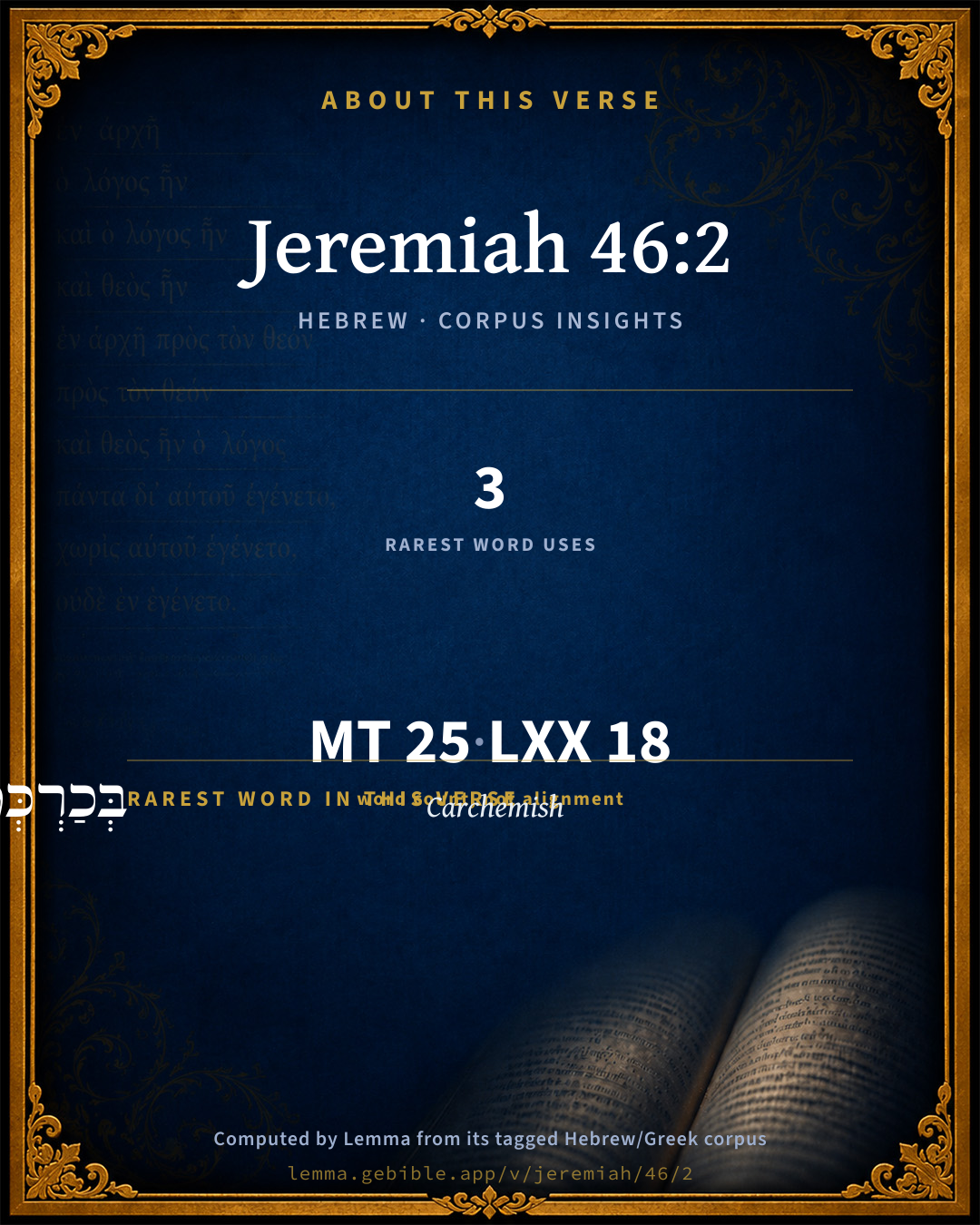
The rarest word here is בְּכַרְכְּמִ֑שׁ Carchemish H3751 — appearing just 3 times in the whole Hebrew Bible.

Shared distinctive vocabulary

בְּכַרְכְּמִ֑שׁ Carchemish H3751 occurs in 3 verses of the Hebrew Bible. Also found in:

Grammatical profile

  • 2 verbs
  • 18 nouns
  • 1 adjective
  • 2 prepositions
  • 2 particles

Verb forms

  • הָיָ֥ה Qal · Perfect
  • הִכָּ֗ה Hiphil · Perfect

Repetition

Words recur within this verse — often emphatic in Hebrew:

  • מֶ֣לֶךְ king H4428 ×3
  • לְמִצְרַ֗יִם Egypt H4714 ×2
  • עַל upon H5921 ×2
  • פַּרְעֹ֤ה Pharaoh-necho H6549 ×2
  • אֲשֶׁר which H834 ×2

Hebrew & Septuagint length

In the original languages it is 25 Hebrew tokens and 18 Greek tokens — but the two are counted differently (Hebrew bundles its prefixes and suffixes into one token; the Greek is in lemma form), so that isn’t a like-for-like length.

Cross-references

10

Topical passages linked to Jeremiah 46:2 in the Treasury of Scripture Knowledge — connected by theme and wording, ordered by reader-vote popularity; previews shown in the World English Bible.

  • 2 Kings 23:29 In his days Pharaoh Necoh king of Egypt went up against the king of Assyria to the river Euphrates: and king Josiah went against him; and [Pharaoh Necoh] killed him at Megiddo, when he had seen him.
  • Isaiah 10:9 Isn't Calno as Carchemish? Isn't Hamath as Arpad? Isn't Samaria as Damascus?
  • Jeremiah 25:1 The word that came to Jeremiah concerning all the people of Judah, in the fourth year of Jehoiakim the son of Josiah, king of Judah (the same was the first year of Nebuchadrezzar king of Babylon),
  • Jeremiah 25:19 Pharaoh king of Egypt, and his servants, and his princes, and all his people;
  • Jeremiah 36:1 It happened in the fourth year of Jehoiakim the son of Josiah, king of Judah, that this word came to Jeremiah from Yahweh, saying,
  • Jeremiah 45:1 The word that Jeremiah the prophet spoke to Baruch the son of Neriah, when he wrote these word in a book at the mouth of Jeremiah, in the fourth year of Jehoiakim the son of Josiah, king of Judah, saying,
  • Jeremiah 46:14 Declare you in Egypt, and publish in Migdol, and publish in Memphis and in Tahpanhes: say you, Stand forth, and prepare you; for the sword has devoured round about you.
  • Ezekiel 29:1–21 In the tenth year, in the tenth [month], in the twelfth [day] of the month, the word of Yahweh came to me, saying,
  • 2 Chronicles 35:20–21 After all this, when Josiah had prepared the temple, Neco king of Egypt went up to fight against Carchemish by the Euphrates: and Josiah went out against him.
  • Jeremiah 25:9 behold, I will send and take all the families of the north, says Yahweh, and [I will send] to Nebuchadrezzar the king of Babylon, my servant, and will bring them against this land, and against the inhabitants of it, and against all these nations round about; and I will utterly destroy them, and make them an astonishment, and a hissing, and perpetual desolations.

Cross-references courtesy of OpenBible.info (CC BY 4.0).

Hebrew and Greek witnesses Masoretic Hebrew ↔ Greek Septuagint

The same verse in the two great witnesses to the Old Testament, shown verse-for-verse.

These are two independent witnesses, not word-aligned to each other, and the Septuagint is shown in lemma (dictionary) form.

Hebrew Jeremiah 46:2 Masoretic · Westminster Leningrad Codex

לְמִצְרַ֗יִם עַל חֵ֨יל פַּרְעֹ֤ה נְכוֹ֙ מֶ֣לֶךְ מִצְרַ֔יִם אֲשֶׁר הָיָ֥ה עַל נְהַר פְּרָ֖ת בְּכַרְכְּמִ֑שׁ אֲשֶׁ֣ר הִכָּ֗ה נְבֽוּכַדְרֶאצַּר֙ מֶ֣לֶךְ בָּבֶ֔ל בִּשְׁנַת֙ הָֽרְבִיעִ֔ית לִיהוֹיָקִ֥ים בֶּן יֹאשִׁיָּ֖הוּ מֶ֥לֶךְ יְהוּדָֽה

Of Egypt: concerning the army of Pharaoh Necoh king of Egypt, which was by the river Euphrates in Carchemish, which Nebuchadrezzar king of Babylon struck in the fourth year of Jehoiakim the son of Josiah, king of Judah.

World English Bible · Public Domain

Greek LXX Structure differs

In the Septuagint, Jeremiah is about an eighth shorter than the Hebrew and arranges its material differently — the Oracles Against the Nations (Hebrew chapters 46–51) appear in the middle of the Greek book, after 25:13. Because the chapter and verse boundaries do not line up, a verse-for-verse comparison with the Hebrew is not shown.

A verse-for-verse comparison isn’t shown here because the chapters and verses don’t line up. Switch to the LXX edition with the MT / LXX toggle above to read the Greek directly.

Hebrew: Westminster Leningrad Codex (CC BY 4.0). Greek: Septuagint (public domain); English from a public-domain English Septuagint. How the Septuagint differs from the Hebrew →

Targum (Aramaic paraphrase)

1

The Targum is the ancient Jewish Aramaic paraphrase of the Hebrew Scriptures — an interpretive translation, not the Hebrew text itself. Onkelos (literal) and Pseudo-Jonathan (expansive) render the Torah, and Jonathan the Prophets. Coverage is partial: where no permissively-licensed English translation exists for a verse, only the Aramaic is shown. This is verse-level text, not a word-by-word alignment to the Hebrew.

  1. Targum Jonathan Prophets (Joshua–Malachi)
    לְמִצְרַיִם עַל מַשִׁרְיַת פַרְעֹה חֲגִירָא מַלְכָּא דְמִצְרַיִם דַהֲוָה עַל נְהַר פְּרָת בְּכַרְכְּמִישׁ דִמְחָא נְבוּכַדְרֶאצַר מַלְכָּא דְבָבֶל בְּשַׁתָּא רְבִיעֵיתָא לִיהוֹיָקִים בַּר יֹאשִׁיָה מְלַךְ שִׁבְטָא דְבֵית יְהוּדָה:

    (no public-domain English translation for this verse)

    Targum Jonathan — Aramaic: “Mikraot Gedolot” (public domain). English: “Sefaria Community Translation” (CC0 1.0 (public-domain dedication)); “London "Chaldee Paraphrase," 1871” (public domain). Text via Sefaria.

Commentary

Notes on Jeremiah 46:2 from classic Christian and Jewish commentators (each source and its license shown beneath its notes). The classic Christian expositions comment on the surrounding passage and are grouped to its opening verse, so a note may address several verses; the Jewish commentaries on the Tanakh (Rashi and others) are per-verse, so they appear only where the commentator wrote on this verse.

Lemma curates 59 commentaries, every one of them public domain or Creative Commons licensed, each selected and text-cleaned for this edition rather than reprinted as found. About our sources →

Trapp's Complete Commentary

John Trapp

Jer 46:2 Against Egypt, against the army of Pharaohnecho king of Egypt, which was by the river Euphrates in Carchemish, which Nebuchadrezzar king of Babylon smote in the fourth year of Jehoiakim the son of Josiah king of Judah.

Ver. 2. Against Egypt.] First, That the Jews might not rely on that broken reed, as they did to their ruin, because they would never be warned.

Against the army of Pharaohnecho.] Who had beaten Nebuchadnezzar Priscus at Carchemish, and gotten all the country from Egypt to Euphrates; but was afterwards himself beaten out again, by Nebuchadnessar II, surnamed Magnus, in the first year of his reign, which was the fourth year of Jehoiakim, who also was glad to become his tributary. {a} Now this overthrow of the Egyptian, who was driven out of all Syria, as far as Pelusium, by the Babylonian, is here foretold.

{a} Joseph., lib. x. cap. 7.

John Trapp, A Commentary or Exposition upon All the Books of the Old and New Testament (1647–1656) — public domain. Text from a community e-Sword module.

Joseph Benson's Commentary

Jer 46:2. Against Egypt, against the army of Pharaoh-necho — Pharaoh- necho was king of Egypt in Josiah’s time, and it was by his army that Josiah was killed at Megiddo, as is related 2Ki 23:29, where see the note. That army was then marching under the conduct of Necho against the Medes and Babylonians, who, having by the capture of Nineveh destroyed the Assyrian empire, had become formidable to the neighbouring states. Josiah opposed it in its march through the country, but was defeated, and received a wound in the battle which proved mortal. Necho continued his march after this victory, defeated the Babylonians, took Carchemish, and securing it with a strong garrison, returned into his own country. Nabopolassar, the king of Babylon, observing that all Syria and Palestine had revolted on account of the reduction of Carchemish by the Egyptians, sent his son Nebuchadnezzar with an army to retake that city, and recover the revolted provinces. Necho marched with a powerful army to oppose him; and it appears it was at the time when the Egyptian army lay along the banks of the Euphrates, waiting to oppose the entrance of Nebuchadnezzar into Syria, that this prophecy was delivered, namely, as is here said, in the fourth year of Jehoiakim. The two armies came to an engagement near the city of Carchemish, and the event of the battle proved very disastrous to the Egyptians, who were routed with prodigious slaughter, as is here foretold by the prophet in a very animated style, and with great poetic energy and liveliness of colouring.

Joseph Benson's Commentary on the Old and New Testaments (1811–1818) — public domain. Text from a community e-Sword module.

Tyndale Open Study Notes

Tyndale Open Resources

46:2-12 Jeremiah used the results of a battle known to Jehoiakim to warn him and the people of Jerusalem that Egypt could not protect them from Babylon. Pharaoh Neco had thought that the time was ripe to become the dominant power in the ancient Near East, so he moved north in 609 BC. After Neco spent several years trying to help fragments of the Assyrian army stop the westward movements of the Babylonian army, he was soundly defeated at Carchemish on the Euphrates River in 605 BC. Soon after that, the Babylonian army surrounded Jerusalem and forced Jehoiakim to become a vassal of Babylon.

Tyndale Open Study Notes — © Tyndale Open Resources, licensed CC BY-SA 4.0. Text via the HelloAO Bible API.

Geneva Bible (1599)

Geneva Bible translators

Read 2 Kings 23:29 and 24:7; 2 Chron. 35:20.

Geneva Bible (1599) marginal notes — public domain. Text via Bolls.life.

Jamieson, Fausset & Brown

Robert Jamieson, A. R. Fausset & David Brown

Inscription of the first prophecy.

Pharaoh-necho--He, when going against Carchemish (Cercusium, near the Euphrates), encountered Josiah, king of Judah (the ally of Assyria), at Megiddo, and slew him there (Kg2 23:29; Ch2 35:20-24); but he was four years subsequently overcome at Carchemish, by Nebuchadnezzar, as is foretold here; and lost all the territory which had been subject to the Pharaohs west of the Euphrates, and between it and the Nile. The prediction would mitigate the Jews' grief for Josiah, and show his death was not to be unavenged (Kg2 24:7). He is famed as having fitted out a fleet of discovery from the Red Sea, which doubled the Cape of Good Hope and returned to Egypt by the Mediterranean.

Jamieson, Fausset & Brown — Commentary Critical and Explanatory on the Whole Bible (1871) — public domain (CC PDM 1.0). Text via the HelloAO Bible API.

Adam Clarke's Commentary

Verse 2. Pharaoh-necho] This was the person who defeated the army of Josiah, in which engagement Josiah received a mortal wound, of which he died, greatly regretted, soon after at Megiddo. After this victory, he defeated the Babylonians, and took Carchemish; and, having fortified it, returned to his own country. Nabopolassar sent his son Nebuchadnezzar with an army against him, defeated him with immense slaughter near the river Euphrates, retook Carchemish, and subdued all the revolted provinces, according to the following prophecies.

Adam Clarke's Commentary on the Bible (1810–1826) — public domain. Text from a community e-Sword/MySword module.

John Calvin's Commentaries

He then says that he had prophesied of the destruction of the Egyptian army which King Nebuchadnezzar overthrew in the fourth year of Jehoiakim Jeremiah had then foretold before this time what was to be. It might have been that before Pharaoh-necho prepared his army, Jeremiah predicted what would take place; but it is probable that this prophecy was announced at the time when Pharaoh-necho went forth against the Chaldeans, for he was fighting then for the Assyrians. As they were not equal to the Chaldeans they made a treaty with the Egyptians. They then had come for a subsidy to drive away the Babylonians, and thus to defend the Assyrians against their forces. But at first the expedition met with success; yet at last what had been predicted by the Prophet was fulfilled.

It is not known whether or not the design was to alleviate the sorrow of the people by this prophecy; and yet I am disposed to receive what the greater part of interpreters have held, that as at that time the people were in the greatest trouble, this prophecy was given in order that the faithful might know that God had not ceased to care for his people. But we must especially attend to the truth of history, for when Pharaoh-necho was induced, as it has been said, by the Assyrians, to lead his army to the Euphrates, the pious king Josiah met him, and he was then a confederate with the Babylonians, because there had been a friendly intercourse between the Chaldeans and the Jews since the reign of Hezekiah. As then Josiah wished to render service to a king who was his friend, he opposed the army of Pharaoh; but he was conquered and slain. Now the expedition of Pharaoh was fortunate and successful for a time, but when he began to boast of victory he was suddenly cast down; for King Nebuchadnezzar not only checked his audacity, but having routed his army, compelled him to return into Egypt, and occupied the whole country from the Euphrates to Palusium. That country had not yet been exposed to those continual changes which afterwards happened, that is, when those robbers who had succeeded Alexander the Great boasted that they were the kings of kings, and when every one strove to draw all things to himself. For hence it happened that now Egyptian kings, and then Asiatic kings, often shook that land as far as they could. This had not yet happened when Jeremiah prophesied, nor had Alexander been yet born, but it yet appears that these regions were even then subject to changes, so that there was nothing fixed or permanent connected with them. We must then bear in mind that the events of wars were dubious, so that, one while, the Egyptians forcibly seized a portion of Asia, and at another time the Assyrians diminished their power, and again the Chaldeans. Pharaoh-necho was then so repulsed that he never dared again to come forth, as sacred history testifies in 2 Kings 24:7.

Let us now come to the Prophecy of Jeremiah. He says that he prophesied against the army of Pharaoh-necho, when it was at Euphrates, that is when he fought there and thought that he would be a conqueror, as he had far and wide desolated a hostile land, and brought under his authority many cities. When therefore he had met with great successes, Jeremiah was then bidden to prophesy against his army, so that the Jews might know that the death of pious Josiah would not go unpunished, because God had purposed to destroy that great army by which Josiah had been killed, and so to break down and lay prostrate the power of Egypt, that King Pharaoh would hereafter remain as shut up in prison as it afterwards happened. The rest to-morrow.

John Calvin's Commentaries (1540-1563) — public domain. Text from the Calvin Translation Society English edition (1840s-50s) via the Christian Classics Ethereal Library (ccel.org). Calvin's coverage is partial (roughly two-thirds of the Bible); uncommented books and verses are honest gaps, never fabricated. The 19th-century editor's footnotes and remarks are omitted so the notes are faithfully Calvin's own voice.

Ellicott's Commentary for English Readers

(2) Against Egypt, against the army of Pharaoh-necho.—The king of Egypt thus named was the last of its great native sovereigns. He was the sixth king of the twenty-sixth dynasty of Manetho, and succeeded his father Psammetichus in B.C. 610, and reigned for sixteen years. Herodotus (ii. 158, 159) relates as his chief achievements that he anticipated the Suez Canal by endeavouring to connect the Nile with the Red Sea, but was stopped by an oracle, and sent a fleet of Phœnician ships to circumnavigate Africa. One hundred and twenty thousand lives were said to have been sacrificed in the former enterprise. On desisting from it, he turned his attention to other plans of conquest, defeated the Syrians at Magdolus, near Pelusium, and took Cadytis, a great city of Syria, which Herodotus describes as not much less than Sardis. By some writers this has been identified with the capture of Jerusalem in 2Ch_36:3, the name Cadytis being looked on as equivalent to Kadusha (=the holy city),and so anticipating the modern Arabic name of El-Khuds. Herodotus, however (iii. 5), describes it as being near the coast, and this has led to its being identified with Gaza, or Kedesh-Naphtali, or a Hittite city—Ketesh—on the Orontes, near which the great commercial and. military road turned off for Damascus and the Euphrates. In any case, it was in the course of this invasion, directed against the Babylonian Empire, then ruled by Nabopolassar, the father of Nebuchadnezzar, that he defeated and slew Josiah at Megiddo (2Ch_35:20-24), deposed Jehoahaz, and appointed Jehoiakim (2Ch_36:4). By some writers, accordingly (R. S. Poole, in Smith’s Dict. Bible, Art. Pharaoh-necho), Megiddo is identified with the Magdolus of Herodotus. His army advanced, and took the city of Carchemish, by some (Hitzig) identified with Circesium, an island formed by the confluence of the Chaboras and the Euphrates; by others (Rawlinson) with a Hittite city, now Jerablus, a corruption of the Greek Hierapolis, much higher up the Euphrates. (See Note on Isa_10:9). After the capture Necho appears to have returned to Egypt. Three years later (B.C. 606) Carchemish was taken by Nebuchadnezzar with the almost total defeat of Necho’s army, he himself having returned to Egypt, and it is this defeat of which Jeremiah now proceeds to speak as in a song of anticipated triumph at the downfall of the Egyptian oppressor.

A Bible Commentary for English Readers, edited by Charles John Ellicott (1878–1897) — public domain. Text from a community e-Sword module.

The Cambridge Bible for Schools and Colleges

gen. ed. J. J. S. Perowne

2. Pharaoh-neco] This monarch (b.c. 610–594) had defeated and slain Josiah at Megiddo (b.c. 608). In three months he had deposed Josiah’s successor, Jehoahaz, and imprisoned him at Riblah, and had set up Jehoiakim. He was extending his conquests in the Asiatic direction when he was overthrown at Carchemish (b.c. 605).

Carchemish] Gargamish in Assyrian inscriptions, was not Circesium at the junction of the rivers Chaboras and Euphrates, but considerably higher up the latter stream and some distance to the north of lat. 36°. Professor Rawlinson (Anc. Mon. II. 475) describes it as the key of Syria on the east and as commanding the ordinary passage of the Euphrates. It was, he adds, the only great city in that quarter. The meaning of the name is unknown.

2–12. Co. declines to accept objections which have been brought by some recent commentators to the substantial genuineness of these vv., and Gi. on the whole agrees, but considers the passage to have been expanded.

The Cambridge Bible for Schools and Colleges (gen. ed. J. J. S. Perowne; Cambridge University Press, 1878–1918) — public domain. Text from a community e-Sword module.

John Gill's Exposition

Against Egypt,.... This is the title of the first prophecy against Egypt; which is the first mentioned, because first accomplished; and because the Jews placed great confidence in and much relied on the Egyptians for help:

against the army of Pharaohnecho king of Egypt; who is by Herodotus (q) called Necos; he was the son and successor of Psammitichus, and was succeeded by his son Psammis; and he by Apries, the same with Pharaohhophra, Jer 44:30; the Targum calls this king Pharaoh the lame:

which was by the river Euphrates in Carchemish; of which place See Gill on Isa 10:9; this being in the land of the king of Assyria, as appears from the same place. Pharaohnecho, in Josiah's time, came up against him, in order to take it from him; but whether he did or no is not certain; see Kg2 23:29; however, he appeared at the same place a second time, against the king of Babylon, into whose hands it was now very probably fallen, with the whole Assyrian monarchy; and here, in this second battle, his army was routed, as follows:

which Nebuchadnezzar king of Babylon smote in the fourth year of Jehoiakim the son of Josiah king of Judah; when he took away from the king of Egypt all that belonged to him between the Nile and Euphrates, so that he came no more out of his land, Kg2 24:7. Kimchi and Abarbinel think there was but one expedition of Pharaohnecho; and that the siege of Carchemish continued to the fourth year of Jehoiakim; when he met with an entire overthrow from the king of Babylon, which God suffered as a judgment on him for killing Josiah. This, according to Bishop Usher, was in the year of the world 3397, and before Christ 607; and, according to the Universal History, in the year of the world 3396, and before Christ 608.

(q) L. 2. sive Euterpe, c. 158.

John Gill's Exposition of the Whole Bible (1746–1763) — public domain (CC PDM 1.0). Text via the HelloAO Bible API.

Albert Barnes' Notes on the Bible

Against ... - i. e., relating to, concerning. So Jer 48:1; Jer 49:1; see the note at Jer 46:13.

Pharaoh-necho - See 2Ki 23:29 note.

In - (at) Carchemish - (The Gargamis of the inscriptions, now Jerabis, on the Euphrates, about 16 miles south of Birejik.)

Albert Barnes' Notes on the Bible (1834–1885) — public domain. Text from a community e-Sword/MySword module.

Haydock's Catholic Bible Commentary

Nechao. He slew Josias, and took all as far as Charcamis, 4 Kings xxiii. Four years after Nabopolasser associated his son, and sent him to conquer these countries, which he effected, 4 Kings xxiv. 7. (Josephus)

George Leo Haydock (1774–1849), Haydock's Catholic Family Bible and Commentary, 1859 edition — public domain. Excludes Psalms (Douay-Rheims chapter numbering differs from Protestant) and Deuterocanonical books (Catholic canon only).

Matthew Poole's English Annotations

Pharah-necho was king of Egypt in Josiah’s time; it was by his army that Josiah was killed at Megiddo, 2Ki 23:29; it was he that made Jehoiakim king of Judah, taking away Jehoahaz, 2Ki 23:34; but though he prevailed at that time, and that was one time when he came out against Carchemish, 2Ch 35:20, yet he was overthrown by Nebuchadnezzar in a battle with him afterwards, as appears from 2Ki 24:7, and Jehoiakim was made tributary to Nebuchadnezzar, as we read, 2Ki 24:1; and the king of Egypt was brought so low by that victory, that he stirred no more out of Egypt, for the king of Babylon had taken from him all from Nilus, the great river of Egypt, to Euphrates; and this, saith this verse, was in the fourth year of Jehoiakim. This prophecy must be before that time.

Carchemish appeareth, from Isa 10:9, to have been a place in Syria where the Egyptian army had been in Josiah’s time, and then went away conquerors, as appears from 2Ch 35:20, &c.

Matthew Poole's English Annotations on the Holy Bible (1683–1685) — public domain. Text from a community e-Sword/MySword module.

Whedon's Commentary on the Bible

Daniel D. Whedon

2. Against Egypt — The particular caption of the passage immediately following. As there are two sections pertaining to Egypt (3-12 and 13-26) this title may relate to both.

Pharaoh-necho — Said by Manetho to have been the sixth king of the twenty-sixth dynasty. His date has been fixed from 611 to 595 B.C.

Carchemish — The site of this important ancient city is not determined beyond question. That it was on the Euphrates is settled by this passage. The common opinion is, that it was at the junction of the Chebar with the Euphrates, and identical with the Greek Circesium. Others, however, locate it higher up the Euphrates, about in latitude thirty-six. Professor Rawlinson favours this. The place is mentioned in the cuneiform inscriptions, and also in the Egyptian hieroglyphical sculptures. Circesium, which is the site commonly identified with “Carchemish,” was built on a narrow wedge-shaped plain in the fork between the two rivers. All that now remains of it is ruins.

Daniel D. Whedon (gen. ed.), Commentary on the Old and New Testaments (1874–1909) — public domain. Text from a community e-Sword module.

The Pulpit Commentary

Against Egypt, against the army; rather, concerning Egypt, concerning the army. Pharaoh-necho. Necho II, a member of the twenty-sixth Egyptian dynasty, son of Psametik I (Psammetichus), who had for a time revived the declining power of Egypt. Herodotus (2:158) credits him with being the first to construct a canal to the Red Sea, which seems an exaggeration (see Sir Gardner Wilkinson"s note ap. Rawlinson), also (4:42) with having caused the circumnavigation of Africa, after which the Phoenician seamen brought back the startling news that they had had the sun upon their right hand. This energetic monarch noticed the decline of Assyria, and, at the battle of Megiddo (Herodotus, 2:159, wrongly says Magdolus or Migdol), reattached Judah to the Egyptian empire. Four years later, at the battle of Carchemish, he himself sustained a crushing defeat at the hands of the Babylonian king Nebuchadnezzar. (2Ch_35:20) Carehemish. This was the great emporium of Mesopotamia, Syria, and Palestine. Its true site was discovered by Mr. George Smith, in his last fatal journey, to be at Jerabis or Jirbas, on the right bank of the Euphrates. It was anciently a city of the Kheta (equivalent to Khittim, "Hittites"), but passed to the Assyrians, under Sargon, under whom it attained the highest commercial prosperity, especially after the overthrow of Tyre by Sennacherib. The "mana," or mina, "of Gargamis" is constantly referred to as a standard weight in the commercial cuneiform inscriptions. In the fourth year, etc. Marcus Niebuhr wishes to put a stop before these words, so as to make them a definition of the date of the prophecy. He thinks the date of the battle of Carchemish was the third and not the fourth year of Jehoiakim. This view, however, is very uncertain (see Keil), and it is exegetically very unnatural to detach the closing words of ver. 2 from those which precede. The obvious inference, moreover, from the prophecy (vers. 2-12) is that it was written at or about the time of the battle; a special date for the prophecy did not require to be given. Should Niebuhr"s chronological combinations, however, turn out to be correct, the mistake would probably not be that of Jeremiah, nor of his scribe, but of his editor, who may easily have fallen into error in the mere minutiae of chronology.

The Pulpit Commentary (1880–1919), ed. H.D.M. Spence-Jones & Joseph S. Exell — public domain. Text from a community e-Sword module.

Lesson kit

Teaching starters — assembled from the data on this page, not authored interpretation. Every prompt links to the verse data it draws on. Edit before teaching.

Jeremiah, in the Prophets, opens this verse with 25 words (19 distinct Hebrew lemmas). Its most distinctive word is Karkᵉmîysh (“Carchemish”). A historical commentator’s framing appears above. Read the whole chapter for the surrounding context.

Discussion questions

  1. The word Karkᵉmîysh carries the sense “Carchemish.” How does it shape the verse?
  2. How does 2 Chronicles 35:20, which shares the word «Carchemish», read alongside this verse?
  3. What does the repetition of “king” (3× in this one verse) do in this verse?
  4. These translations render this verse differently; the difference is in the English rendering, not the original. What questions does that raise?
  5. «הָיָ֥ה» is a Qal Perfect verb. How does that grammatical form shape the action described?
  6. Compare how Trapp's Complete Commentary and Joseph Benson's Commentary read this verse. Where do they agree or differ?

Things to notice

Reading settings

Reading text

Shown beneath each verse's original-language words.

Old Testament
Old Testament edition

Read the OT as the Masoretic Hebrew (MT) or the Greek Septuagint (LXX).

English shown for the Greek Septuagint (in the Hebrew ↔ Greek comparison).

Comparing translations? Open the Compare panel on any verse page to stack up to four side by side.