
Ezekiel 20:9

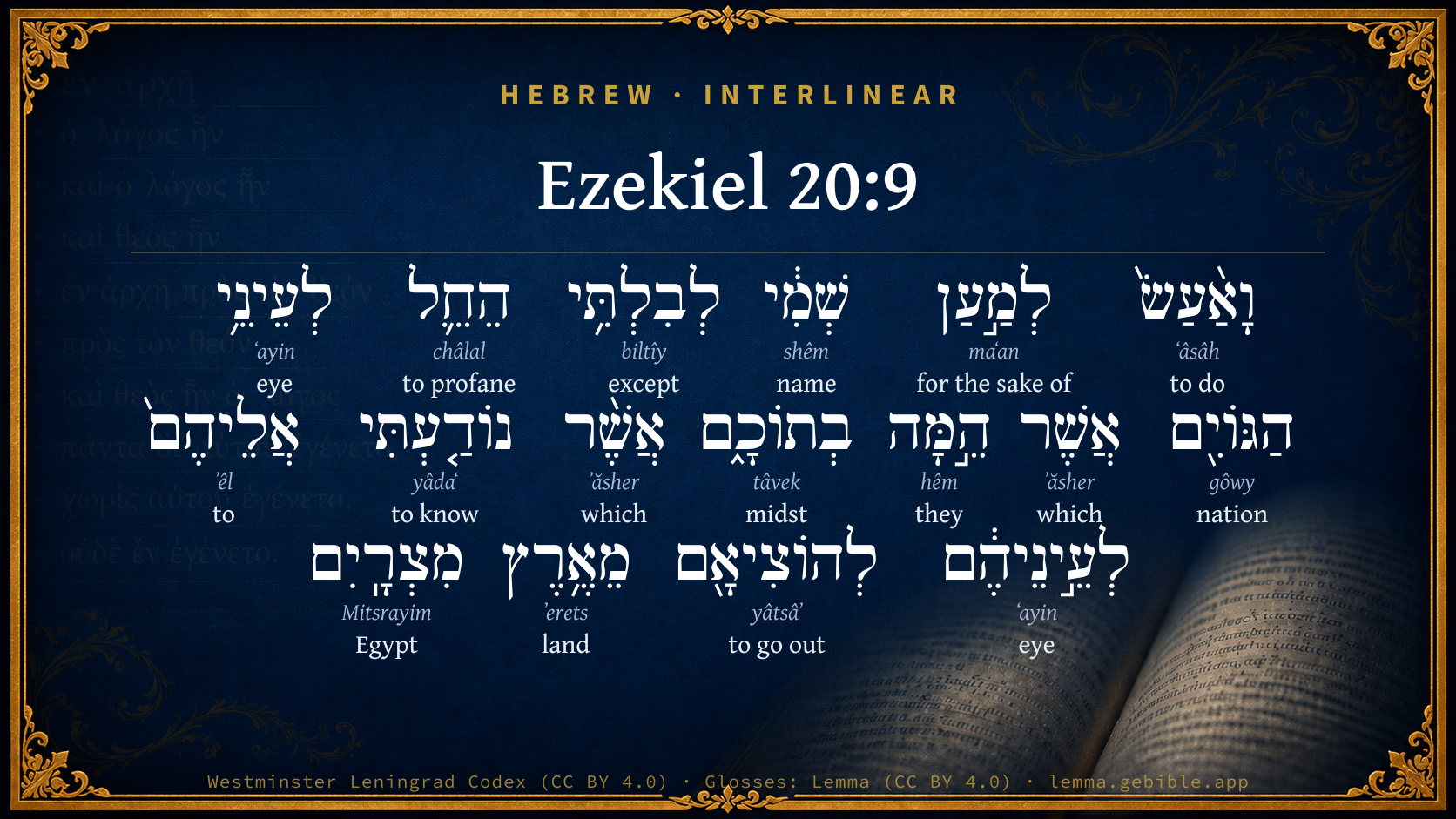
Hebrew (Westminster Leningrad Codex) Ezekiel 20:9 appears in the Hebrew Old Testament. The text above is from the Westminster Leningrad Codex. Each word links to its Strong’s number, a concise gloss, and parsing drawn from the Open Scriptures Hebrew Bible morphology. Click any word for its full Brown-Driver-Briggs (BDB) entry.
Download image
Cite this verse

Ezekiel 20:9 (World English Bible). Public Domain. Lemma interlinear Bible study tool, https://lemma.gebible.app/v/ezekiel/20/9.

Show BibTeX & RIS
BibTeX
RIS
English Translation
But I worked for my name's sake, that it should not be profaned in the sight of the nations, among which they were, in whose sight I made myself known to them, in bringing them forth out of the land of Egypt.
World English Bible · Public Domain
Download a study sheet

One document with this verse’s original text, its word-by-word gloss line, the meaning frame, cross-references with their text, attributed commentary, and full source and license credits — printable, and it pastes into notes with its structure intact.

This verse Autodidact and up

Study sheet (.html) Plain text (.txt)

A passage Seminary Student

Up to 50 verses in one chapter. A passage sheet keeps up to 6 commentary sources and 12 cross-references per verse, in the order this page ranks them, and says so on the sheet whenever that leaves anything out. Ask for a single verse and you get the Autodidact verse sheet above.

Everything on this page stays free to read, with no account — the sheet is a download of what is already on screen, not access to it.

Want to remove ads? Support Godless Engineer
Compare translations 3

The same verse in 3 English versions, stacked beneath the original-language interlinear above. Click any original word for its lexicon entry.

Each is an independent rendering of the whole verse — the interlinear is not word-aligned to these translations.

Highlighted words mark where these versions differ — a whole-verse word diff, not a word-by-word alignment.

  • World English Bible Public Domain
    But I worked for my name's sake, that it should not be profaned in the sight of the nations, among which they were, in whose sight I made myself known to them, in bringing them forth out of the land of Egypt.
  • King James Version Public Domain
    But I wrought for my name's sake, that it should not be polluted before the heathen, among whom they were, in whose sight I made myself known unto them, in bringing them forth out of the land of Egypt.
  • unfoldingWord Literal Text CC BY-SA 4.0
    I acted for my name’s sake so it would not be profaned in the eyes of the nations among whom they were staying. I made myself known to them, in their eyes, by bringing them out of the land of Egypt.

unfoldingWord Literal Text — © unfoldingWord, licensed CC BY-SA 4.0. Word-aligned USFM3 via Door43 (git.door43.org/unfoldingWord/en_ult).

Versions to compare (up to 4)

3 of 4 selected

Show all 18 translations

Every available English version of this verse, each an independent rendering of the whole verse.

  • World English Bible Public Domain
    But I worked for my name's sake, that it should not be profaned in the sight of the nations, among which they were, in whose sight I made myself known to them, in bringing them forth out of the land of Egypt.
  • Berean Standard Bible Public Domain
    But I acted for the sake of My name, that it should not be profaned in the eyes of the nations among whom they were living, in whose sight I had revealed Myself to Israel by bringing them out of the land of Egypt.
  • Majority Standard Bible Public Domain
    But I acted for the sake of My name, that it should not be profaned in the eyes of the nations among whom they were living, in whose sight I had revealed Myself to Israel by bringing them out of the land of Egypt.
  • King James Version Public Domain
    But I wrought for my name's sake, that it should not be polluted before the heathen, among whom they were, in whose sight I made myself known unto them, in bringing them forth out of the land of Egypt.
  • American Standard Version (1901) Public Domain
    But I wrought for my name's sake, that it should not be profaned in the sight of the nations, among which they were, in whose sight I made myself known unto them, in bringing them forth out of the land of Egypt.
  • Revised Version (1885) Public Domain
    But I wrought for my name’s sake, that it should not be profaned in the sight of the nations, among whom they were, in whose sight I made myself known unto them, in bringing them forth out of the land of Egypt.
  • Geneva Bible (1599) Public Domain
    But I had respect to my Name, that it should not be polluted before the heathen, among whome they were, and in whose sight I made my selfe knowen vnto them in bringing them forth of the land of Egypt.
  • Douay-Rheims (1899) Public Domain
    But I did otherwise for my name's sake, that it might not be violated before the nations, in the midst of whom they were, and among whom I made myself known to them, to bring them out of the land of Egypt.
  • Young's Literal Translation Public Domain
    And I do `it' for My name's sake, Not to pollute `it' before the eyes of the nations, In whose midst they `are', Before whose eyes I became known to them, To bring them out from the land of Egypt.
  • Literal Standard Version CC BY-SA 4.0
    And I do [it] for My Name’s sake, || Not to defile [it] before the eyes of the nations, || In whose midst they [are in], || Before whose eyes I became known to them, || To bring them out from the land of Egypt.
  • Unlocked Literal Bible CC BY-SA 4.0
    I acted for my name's sake so it would not be profaned in the eyes of the nations among whom they were staying. I made myself known to them, in their eyes, by bringing them out of the land of Egypt.
  • unfoldingWord Literal Text CC BY-SA 4.0
    I acted for my name’s sake so it would not be profaned in the eyes of the nations among whom they were staying. I made myself known to them, in their eyes, by bringing them out of the land of Egypt.
  • Darby Bible Public Domain
    But I wrought for my name's sake, that it should not be profaned in the sight of the nations among whom they were, in whose sight I had made myself known unto them in bringing them forth out of the land of Egypt.
  • World Messianic Bible Public Domain
    But I worked for my name’s sake, that it should not be profaned in the sight of the nations among which they were, in whose sight I made myself known to them in bringing them out of the land of Egypt.
  • Webster's Bible Public Domain
    But I wrought for my name's sake, that it should not be profaned before the heathen, among whom they were, in whose sight I made myself known to them, in bringing them forth from the land of Egypt.
  • Free Bible Version CC BY-SA 4.0
    But I did act so I would not be misrepresented, so that I wouldn't lose respect in the eyes of the other nations living near them who had seen me reveal myself to Israel by leading them out of Egypt.
  • Bible in Basic English Public Domain
    And I was acting for the honour of my name, so that it might not be made unclean before the eyes of the nations among whom they were, and before whose eyes I gave them knowledge of myself, by taking them out of the land of Egypt.
  • JPS Tanakh (1917) Public Domain
    But I wrought for My name's sake, that it should not be profaned in the sight of the nations, among whom they were, in whose sight I made Myself known unto them, so as to bring them forth out of the land of Egypt.

Literal Standard Version (2020), Covenant Press — licensed CC BY-SA 4.0. Text via the HelloAO Bible API (eBible.org). Unlocked Literal Bible (unfoldingWord) — licensed CC BY-SA 4.0. Text via the HelloAO Bible API (eBible.org). unfoldingWord Literal Text — © unfoldingWord, licensed CC BY-SA 4.0. Word-aligned USFM3 via Door43 (git.door43.org/unfoldingWord/en_ult). Free Bible Version, Dr. Jonathan Gallagher — licensed CC BY-SA 4.0. Text via the HelloAO Bible API (eBible.org).

Word by word

More ways to search: Search by grammar → Find every occurrence → Compare this word →

Practice this passage: Drill this verse → Learn its vocabulary →

לְבִלְתִּ֥י
biltîy
H1115
“to/for · except”
Preposition + Conjunction
Part of Speech
Preposition + Conjunction
Full BDB Definition

Origin: constructive fem. of H1086 (equivalent to H1097 )

TWOT: 246i

not, except (substantive) - not (adverb) - except (after preceding negation) (adverb) - except (after an implied or expressed negation) (conjunction) - so as not, in order not (with preposition) - an account of not, because...not (with preposition) - until not (with preposition)
  1. וָאַ֨עַשׂ֙ ʻâsâh H6213 “and · to do” Conjunction + Verb, Qal, Sequential Imperfect, 1st Person, Common, Singular
  2. לְמַ֣עַן maʻan H4616 “for the sake of” Preposition
  3. שְׁמִ֔י shêm H8034 “name · my” Noun, Common, Masculine, Singular, Construct + Suffix, Personal, 1st Person, Common, Singular
  4. הֵחֵ֛ל châlal H2490 “to profane” Verb, Niphal, Infinitive Construct
  5. לְעֵינֵ֥י ʻayin H5869 “to/for · eyes of” Preposition + Noun, Common, Both, Dual, Construct
  6. הַגּוֹיִ֖ם gôwy H1471 “the · nations” Particle, Definite Article + Noun, Common, Masculine, Plural, Absolute
  7. אֲשֶׁר ʼăsher H834 “which” Particle, Relative
  8. הֵ֣מָּה hêm H1992 “they” Pronoun, Personal, 3rd Person, Masculine, Plural
  9. בְתוֹכָ֑ם tâvek H8432 “in/at · midst · their” Preposition + Noun, Common, Masculine, Singular, Construct + Suffix, Personal, 3rd Person, Masculine, Plural
  10. אֲשֶׁ֨ר ʼăsher H834 “which” Particle, Relative
  11. נוֹדַ֤עְתִּי yâdaʻ H3045 “to know” Verb, Niphal, Perfect, 1st Person, Common, Singular
  12. אֲלֵיהֶם֙ ʼêl H413 “to · them” Preposition + Suffix, Personal, 3rd Person, Masculine, Plural
  13. לְעֵ֣ינֵיהֶ֔ם ʻayin H5869 “to/for · eyes · their” Preposition + Noun, Common, Both, Dual, Construct + Suffix, Personal, 3rd Person, Masculine, Plural
  14. לְהוֹצִיאָ֖ם yâtsâʼ H3318 “to go out · them” Preposition + Verb, Hiphil, Infinitive Construct + Suffix, Personal, 3rd Person, Masculine, Plural
  15. מֵאֶ֥רֶץ ʼerets H776 “from · land of” Preposition + Noun, Common, Both, Singular, Construct
  16. מִצְרָֽיִם Mitsrayim H4714 “Egypt” Noun, Proper

About this verse

These counts appear in no published source. They are computed here, from the morphology-tagged text and Lemma’s own curated glosses. What Lemma adds →

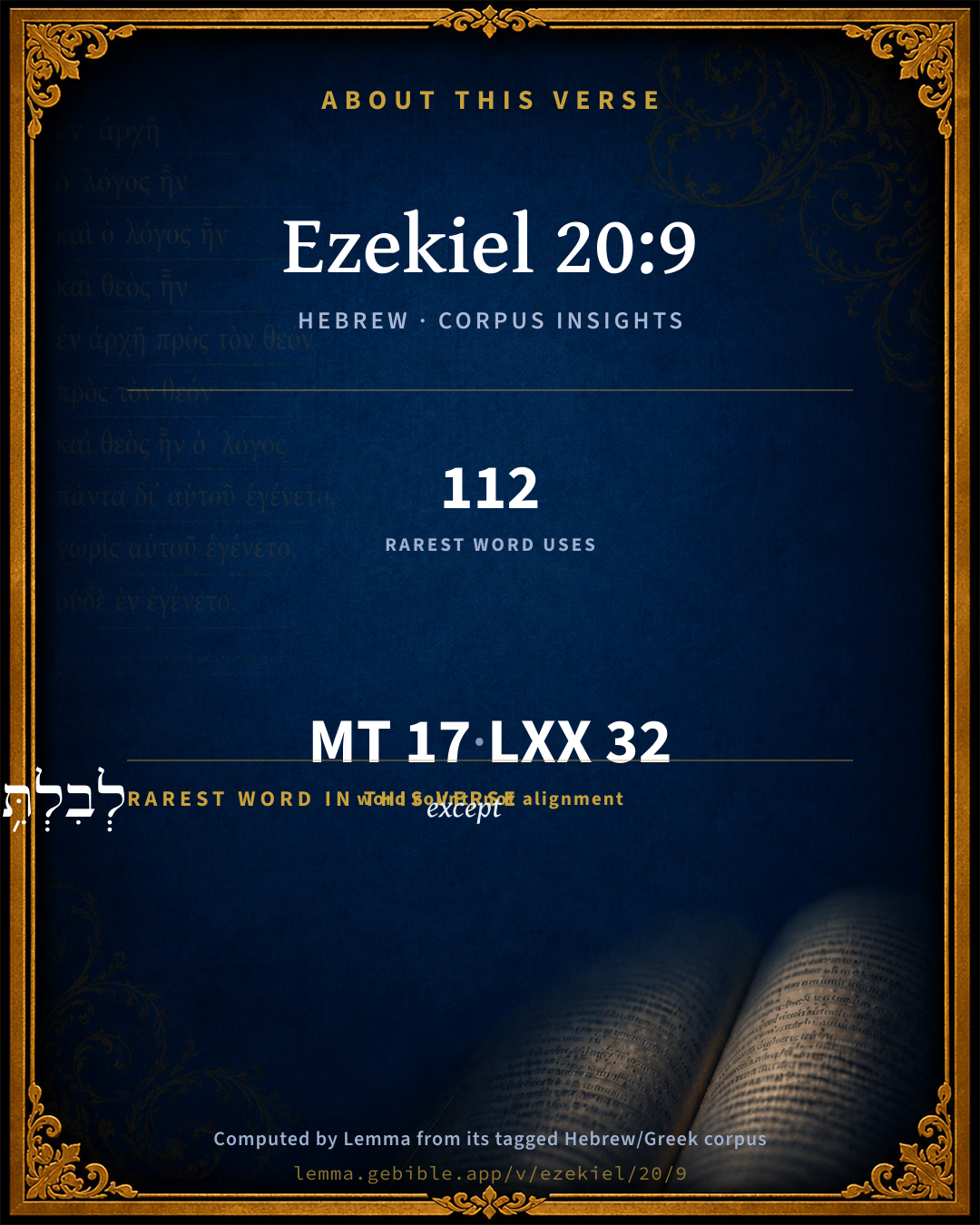
17
words
15
distinct lemmas
Prophets
section

Grammatical profile

  • 4 verbs
  • 7 nouns
  • 1 pronoun
  • 2 prepositions
  • 1 conjunction
  • 2 particles

Verb forms

  • וָאַ֨עַשׂ֙ Qal · Sequential Imperfect
  • הֵחֵ֛ל Niphal · Infinitive Construct
  • נוֹדַ֤עְתִּי Niphal · Perfect
  • לְהוֹצִיאָ֖ם Hiphil · Infinitive Construct

Repetition

Words recur within this verse — often emphatic in Hebrew:

  • לְעֵינֵ֥י eye H5869 ×2
  • אֲשֶׁר which H834 ×2

Hebrew & Septuagint length

In English translation the verse runs 42 words from the Hebrew and 46 from the Septuagint (LXX English) — closely comparable.

A rough comparison of the two English renderings, which tokenize alike — not a word-level alignment.

Word counts can differ between the Hebrew and the Greek without any difference in meaning — e.g. the Hebrew direct-object marker אֵת has no separate Greek word, and Greek often adds the article ὁ.

In the original languages it is 17 Hebrew tokens and 32 Greek tokens — but the two are counted differently (Hebrew bundles its prefixes and suffixes into one token; the Greek is in lemma form), so that isn’t a like-for-like length.

Cross-references

13

Topical passages linked to Ezekiel 20:9 in the Treasury of Scripture Knowledge — connected by theme and wording, ordered by reader-vote popularity; previews shown in the World English Bible.

  • Ezekiel 39:7 My holy name will I make known in the midst of my people Israel; neither will I allow my holy name to be profaned any more: and the nations shall know that I am Yahweh, the Holy One in Israel.
  • Ezekiel 20:22 Nevertheless I withdrew my hand, and worked for my name's sake, that it should not be profaned in the sight of the nations, in whose sight I brought them forth.
  • Exodus 32:12 Why should the Egyptians speak, saying, 'He brought them forth for evil, to kill them in the mountains, and to consume them from the surface of the earth?' Turn from your fierce wrath, and repent of this evil against your people.
  • Ezekiel 20:14 But I worked for my name's sake, that it should not be profaned in the sight of the nations, in whose sight I brought them out.
  • Ezekiel 36:21–22 But I had regard for my holy name, which the house of Israel had profaned among the nations, where they went.
  • Deuteronomy 9:28 lest the land whence you brought us out say, Because Yahweh was not able to bring them into the land which he promised to them, and because he hated them, he has brought them out to kill them in the wilderness.
  • Deuteronomy 32:26–27 I said, I would scatter them afar, I would make the memory of them to cease from among men;
  • Joshua 9:9–10 They said to him, From a very far country your servants are come because of the name of Yahweh your God: for we have heard the fame of him, and all that he did in Egypt,
  • 1 Samuel 4:8 Woe to us! who shall deliver us out of the hand of these mighty gods? these are the gods that struck the Egyptians with all manner of plagues in the wilderness.
  • 1 Samuel 12:22 For Yahweh will not forsake his people for his great name's sake, because it has pleased Yahweh to make you a people to himself.
  • Numbers 14:13–25 Moses said to Yahweh, Then the Egyptians will hear it; for you brought up this people in your might from among them;
  • Joshua 2:10 For we have heard how Yahweh dried up the water of the Red Sea before you, when you came out of Egypt; and what you did to the two kings of the Amorites, who were beyond the Jordan, to Sihon and to Og, whom you utterly destroyed.
  • Joshua 7:9 For the Canaanites and all the inhabitants of the land will hear of it, and will compass us round, and cut off our name from the earth: and what will you do for your great name?

Cross-references courtesy of OpenBible.info (CC BY 4.0).

Hebrew and Greek witnesses Masoretic Hebrew ↔ Greek Septuagint

The same verse in the two great witnesses to the Old Testament, shown verse-for-verse.

These are two independent witnesses, not word-aligned to each other, and the Septuagint is shown in lemma (dictionary) form.

Hebrew Ezekiel 20:9 Masoretic · Westminster Leningrad Codex

וָאַ֨עַשׂ֙ לְמַ֣עַן שְׁמִ֔י לְבִלְתִּ֥י הֵחֵ֛ל לְעֵינֵ֥י הַגּוֹיִ֖ם אֲשֶׁר הֵ֣מָּה בְתוֹכָ֑ם אֲשֶׁ֨ר נוֹדַ֤עְתִּי אֲלֵיהֶם֙ לְעֵ֣ינֵיהֶ֔ם לְהוֹצִיאָ֖ם מֵאֶ֥רֶץ מִצְרָֽיִם

But I worked for my name's sake, that it should not be profaned in the sight of the nations, among which they were, in whose sight I made myself known to them, in bringing them forth out of the land of Egypt.

World English Bible · Public Domain

Greek LXX Ezekiel 20:9 Septuagint · lemma form

καί ποιέω ὅπως ὁ ὄνομα ἐγώ ὁ παράπαν μή βεβηλόω ἐνώπιον ὁ ἔθνος ὅς αὐτός εἰμί ἐν μέσος αὐτός ἐν ὅς γιγνώσκω πρός αὐτός ἐνώπιον αὐτός ὁ ἐκἄγω αὐτός ἐκ γῆ αἴγυπτος

But I wrought so that my name should not be at all profaned in the sight of the Gentiles, in the midst of whom they are, among whom I was made known to them in their sight, to bring them out of the land of Egypt.

LXX2012 (modern English Septuagint) · Public Domain

Hebrew: Westminster Leningrad Codex (CC BY 4.0). Greek: Septuagint (public domain); English from LXX2012 (modern English Septuagint) (Public Domain). How the Septuagint differs from the Hebrew →

Targum (Aramaic paraphrase)

1

The Targum is the ancient Jewish Aramaic paraphrase of the Hebrew Scriptures — an interpretive translation, not the Hebrew text itself. Onkelos (literal) and Pseudo-Jonathan (expansive) render the Torah, and Jonathan the Prophets. Coverage is partial: where no permissively-licensed English translation exists for a verse, only the Aramaic is shown. This is verse-level text, not a word-by-word alignment to the Hebrew.

  1. Targum Jonathan Prophets (Joshua–Malachi)
    וַעֲבָדֵית בְּדִיל שְׁמִי בְּדִיל דְלָא יִתְחַל לְעֵינֵי עַמְמַיָא דִי אִינוּן בֵּינֵיהוֹן דְאִתְגְלֵיתִי לְמִפְרַקְהוֹן לְעֵינֵיהוֹן לְאַפָּקוּתְהוֹן מֵאַרְעָא דְמִצְרָיִם:

    (no public-domain English translation for this verse)

    Targum Jonathan — Aramaic: “Mikraot Gedolot” (public domain). English: “Sefaria Community Translation” (CC0 1.0 (public-domain dedication)); “London "Chaldee Paraphrase," 1871” (public domain). Text via Sefaria.

Commentary

Notes on Ezekiel 20:9 from classic Christian and Jewish commentators (each source and its license shown beneath its notes). The classic Christian expositions comment on the surrounding passage and are grouped to its opening verse, so a note may address several verses; the Jewish commentaries on the Tanakh (Rashi and others) are per-verse, so they appear only where the commentator wrote on this verse.

Lemma curates 59 commentaries, every one of them public domain or Creative Commons licensed, each selected and text-cleaned for this edition rather than reprinted as found. About our sources →

Trapp's Complete Commentary

John Trapp

Eze 20:9 But I wrought for my name’s sake, that it should not be polluted before the heathen, among whom they [were], in whose sight I made myself known unto them, in bringing them forth out of the land of Egypt.

Ver. 9. But I wrought for my name’s sake.] Lest the heathens should say to my dishonour, Me non voluisse aut valuisse eos educere, that I either would not, or could not, bring them out of the house of bondage. Ergo quod nomen suum in nobis servandis asserat, sperandum est. It is also well to be hoped that God will deal favourably with the reformed churches, though ill deserving, for the dishonour that else would redound to himself. Fiat, fiat.

John Trapp, A Commentary or Exposition upon All the Books of the Old and New Testament (1647–1656) — public domain. Text from a community e-Sword module.

The Biblical Illustrator

Joseph S. Exell

Eze_20:9

I wrought for My names sake.

The glory of God, His principle of action

It is an admitted axiom of all enlightened legislation, that with man as a moral agent human lawmakers have nothing to do; that they must overlook many considerations of natural infirmity and educational bias, to which due weight will nevertheless be given in the merciful estimate of Heaven, confining their attention solely to what will most uphold the majesty of the law, and thus secure the greatest good of the greatest number. Now with some difference in form, this is the very thing which takes place with the great rule of the Divine procedure. What the honour of the law is to earthly govermnents, the honour of His own great name is to Almighty God. Every decree that goes forth from the court of heaven is referred to this one rule.

I. Some reasons for this rule of the Divine procedure. The steps of the reasoning, whereby a moral necessity (as it were) is imposed upon God, to consult first the glory of His own name, as distinguished from anything He should see in His creatures, appear to us to be both simple and conclusive. For what is a part of God must have more glory than that which comes from God, seeing that the glory of the one is original and the glory of the other is derived. Another reason to be offered for this rule of the Divine procedure is, that God designs to show to us, that in all the deliverances He has hitherto wrought, or any which He may be expected hereafter to work, He could be influenced by no considerations foreign to Himself: to show that He would put forth or withdraw His arm, according as He did or did not apprehend dishonour would be charged upon the rectitude of His government, or His name be polluted in the sight of the heathen, from whom He brought them forth. We have yet another reason to urge why the glory of His own name should be chosen by God as the governing principle of His administration, in preference to seeking for that governing principle in anything that man does, or in anything that man is: that by so choosing He gives to men themselves the only security they can have, that the administration of heaven shall be free from all inconstancy, from all fluctuation, and from all change. It would not, however, we think, be sufficient that we should merely justify the principle laid down in our text, that in all which God hath done He hath wrought for His names sake; the solemnity and frequency with which we see it repeated seem to require from us a distinct recognition, that it is designed to exert some direct influence on our faith and practice. And this influence we take to be, that in all our judgments of His ways, and in all our petitions for His help, we should have a uniform regard to that end, which He avows to be the ruling principle of the heavenly administration, namely, the glory of His own name. It is good to give back something of glory, for what hath been so largely bestowed of grace; and on all occasions of perplexity and of doubt which may arise, it will ever afford us comfort in the retrospect, to have known that we acted neither from ourselves, nor for ourselves, but that we wrought for His names sake. There is, however, another reason why we think God so frequently insists on the glory of His own name, as being the ruling principle of His government; and that is, because He would teach us that what is to Him the rule of action should be to us both a measure and a plea of prayer.

II. A few observations in evidence of this.

1. God had an eye to His glory in the works of creation. It is obvious, that had the necessities of man been the only motive to the Divine beneficence, Deity might have provided for man a less noble theatre for the exercise of his powers, and a less gorgeous home for the place of his rest. His design in creation is to lead us from the seen to the unseen; from the measured to the infinite; from the top of heights, which sense would apprehend and scale, to the loftier pinnacle of His own eternal power and Godhead.

2. God has never lest sight of this great end in the various departments of His providence. It may be true--it must be true--that seeing as we do only a part of our Makers ways, the mere fragments of the stupendous plan, the detached pieces of providence, we shall be prone to ask, Wherein is Gods name exalted here? But ye must wait to see these pieces of providence put together; ye must wait to see all the wheels and springs of the great Timepiece adjusted and fitted in; and then shall ye find that the most inscrutable act of the Divine administration formed one of the letters of His own great Name.

3. It was with a view to the glory of His own great name that the Creator of all the ends of the earth devised, effectuated, and wrought out the plan of mans redemption. (D. Moore, M. A.)

The Divine motive of action

The conception that Jehovah acts only for His own names sake, to sanctify His great name, is capable of being set in a repellent light. It seems to make the Divine Being egoistic, and His own sense of Himself the source of all His operations. The way too in which He brings the nations to know that He is Jehovah, through judgments mainly, invests the idea with additional harshness. The conception is not found in the earlier prophets, but is familiar in the age of Ezekiel. Perhaps two things, if considered, would help to explain the prophets idea. One is his lofty conception of Jehovah, God alone and over all, and his profound reverence before Him. The child of man cannot conceive the motive of Jehovahs operations to be found anywhere but in himself. But that name for whose sake he works is a great name (Eze_36:23) and a holy name (Eze_39:25), it is that of Him who is God. The prophet thinks of Jehovah as one of his predecessors did. For Jehovah your God is the God of gods, and Lord of lords, the great God, the mighty and the terrible, which regardeth not persons, nor taketh reward (Deu_10:17). And the second thing is this: the conception arose out of the conflicts of the times. There were antagonisms within Israel, and more powerful antagonisms without, between Israel and the nations. The conflicts on the stage of history were but the visible forms taken by a conflict of principles, of religions of Jehovah God with the idolatries of which the nations of the earth were the embodiments. The prophet could not help drawing up this antagonism into his conception of God; and not unnaturally he inflicted his own feeling upon the mind of God, and conceived Him thinking of Himself as he thought of Him. If it was but half a truth, it was perhaps the half needed for the age. When the fulness of time was come, the centre of Divine motive was shifted. God so loved the world, etc. Coming from the bosom of the Father, and knowing Him, the Sons mind was altogether absorbed in the positive truth the stream of which was so broad and deep that all antagonisms were buried beneath it. (A. B. Davidson, D. D.)

The Biblical Illustrator, edited by Joseph S. Exell (c. 1880s–1900s) — public domain. Text from a community e-Sword module.

Geneva Bible (1599)

Geneva Bible translators

God had ever this respect to his glory, that he would not have his Name evil spoken of among the Gentiles for the punishment that his people deserved, in confidence whereof the godly ever prayed, as Exod. 32:12; Num. 14:13.

Geneva Bible (1599) marginal notes — public domain. Text via Bolls.life.

Adam Clarke's Commentary

Verse 9. But I wrought for my name's sake] I bare with them and did not punish them, lest the heathen, who had known my promises made to them, might suppose that I had either broken them through some caprice, or was not able to fulfil them.

Adam Clarke's Commentary on the Bible (1810–1826) — public domain. Text from a community e-Sword/MySword module.

John Calvin's Commentaries

Here God signifies that he was restrained for one reason only from entirely blotting out so ungrateful and wicked a nation, namely, since he saw his own sacred name would be exposed to the Gentiles as a laughing-stock. He teaches, therefore, that he spared them, and suspended his rigor for the time, rather through being induced by regard to his own glory than by pity to them. Hence, by the word I did it, we ought to understand what will be more clearly explained. The sense is, that he abstained from the final act of vengeance for his name’s sake, that it should not be profaned among the Gentiles. Although God here pronounces that he had respect rather to himself than to them, yet there is no doubt that he spared them, because he saw that they could not be otherwise preserved than by his pardoning them even in such hardness and obstinacy; and certainly God’s glory and the salvation of the Church are things almost inseparably united. When I speak of the salvation of the Church, I do not comprehend all those who profess to be its members, but I mean only the elect. Since, therefore, God had adopted that nation, he must preserve the remnant in safety, otherwise his truth would have failed, and thus his name would have been much more severely profaned. Hence we may gather, whenever God pardons us, though he regards himself, and wishes in this way to exercise his clemency, yet his pity towards us is another reason for his pardoning us: but when he says that he has withdrawn his hand from vengeance through regard for His own glory, he in this way prostrates still more the pride of this nation, since, whenever he had pity on them, they thought it a concession to their own worthiness and merits. The Prophet therefore shows here that they were snatched from destruction, while they were remaining in the land of Egypt, for no other reason than this, that God was unwilling to expose his name to the contempt of the nations. He says, therefore, in the eyes of the Gentiles, among whom they were, regarding not the Egyptians only, but others.

Yet the question arises, in what sense, he adds by and by, that he was known to them? for as yet he had given no specimen of his power among the Gentiles. He had borne witness by two miracles that Moses should be the agent in their redemption, (Exodus 4:2, and following:) afterwards Moses approached Pharaoh himself: there God put forth the signs of his power, which deservedly frightened all the Egyptians; but his fame had not yet reached other nations. But this knowledge ought not to be simply restricted to past time; for God only means that he had already begun to show, by certain and remarkable proofs, that Moses was chosen, by whose hand he wished to redeem his own people. Since, therefore, God had. already come forward with those remarkable signs, he says, that he was known to those nations, not that his fame had reached them, but because he had gone there himself, so that the event could not be in obscurity, and all must know that miracles had been performed by the hand of Moses, by which it was evident that he wished to claim the Israelites as his own. Now, therefore, we understand in what sense Ezekiel says that God was known. Some explain this relatively thus: I was known to them, meaning the Israelites, in their eyes, meaning the Gentiles: but this sense seems to me forced; for in my opinion this one word “their,” in the Prophet’s language, is superfluous. He simply means that God was manifested in the eyes of all the nations in leading them forth. This clause shows the kind of knowledge intended, since God showed his power in liberating the people by remarkable miracles. It follows —

John Calvin's Commentaries (1540-1563) — public domain. Text from the Calvin Translation Society English edition (1840s-50s) via the Christian Classics Ethereal Library (ccel.org). Calvin's coverage is partial (roughly two-thirds of the Bible); uncommented books and verses are honest gaps, never fabricated. The 19th-century editor's footnotes and remarks are omitted so the notes are faithfully Calvin's own voice.

Ellicott's Commentary for English Readers

(9) For my name’s sake.—This is the express ground of Moses’ pleading for the people in the passage just referred to, and again in Exo_32:12; Deu_9:28; and it is repeatedly given, as in Deu_32:27-28, as the ground on which the Lord spared His rebellious people. Had they been treated according to their deserts, and destroyed for their sins, the heathen would have said that God was unable to deliver them.

A Bible Commentary for English Readers, edited by Charles John Ellicott (1878–1897) — public domain. Text from a community e-Sword module.

The Cambridge Bible for Schools and Colleges

gen. ed. J. J. S. Perowne

9. for my name’s sake] This idea, very common in this prophet, also in Isaiah 40-66, does not appear in the earlier prophets, except Isa_37:35. Cf. however, Deu_9:28-29; Jer_14:7; Jer_14:21; Isa_43:25; Isa_48:9; Isa_48:11. Jehovah’s name expresses that which he is, or has revealed himself to be, and the phrase does not differ from “for my own sake,” cf. ch. Eze_36:22; Eze_36:32.

should not be polluted] Rather: profaned. The words explain, “for my name’s sake,” viz. lest it should be profaned among the nations. Deu_9:28-29 suggests one way in which the name of Jehovah might be profaned among the nations. To “profane” is the opposite of to “sanctify.” The one is to cherish any thoughts of Jehovah or to attribute any deed to him inconsistent with his being the one true God, or derogatory to him who is so. To “sanctify” him is to recognise him in thought and in act, particularly in worship, to be the one true God; to assign to him attributes and operations befitting his nature, and to live in such a way as those who are the people of Jehovah ought to live, for the manner of the people is reflected on the character of their God (Amo_2:7). This is the way, at least, in which Ezek., with the conception of Jehovah which in his age he had reached, uses the terms “profane” and “sanctify.”

The Cambridge Bible for Schools and Colleges (gen. ed. J. J. S. Perowne; Cambridge University Press, 1878–1918) — public domain. Text from a community e-Sword module.

John Gill's Exposition

But I wrought for my name's sake,.... In a way of grace and mercy; did well by thorn, did what he promised to do; not for any merits of theirs, but for his own honour, and the glory of his name:

that it should not be polluted before the Heathen, among whom they were; be spoken evil of, which is a polluting it; saying, either that he was not true to his word, in not doing what he promised; or else that it was not in his power to perform; either of which would reflect dishonour on his name, and so defile it:

in whose sight I made myself known unto them; by the wonders he wrought; and who, by one means or another, became acquainted with the promises of God to Israel, that he would bring them out of Egypt, and settle them in the land of Canaan: wherefore for the honour of his name he exerted his power,

in bringing them forth out of the land of Egypt; as he did, as follows:

John Gill's Exposition of the Whole Bible (1746–1763) — public domain (CC PDM 1.0). Text via the HelloAO Bible API.

Matthew Poole's English Annotations

I wrought, according to my promise, ny infinite mercy, and the hopes of those few that heard and obeyed.

For my name’s sake; for my glory: had you been used as you deserved, you had died slaves in Egypt, and there had been your graves; but the glory of God’s mercy and faithfulness is the motive of him sparing them.

Polluted; reproached, blasphemed, and lessened among the heathen.

The heathen, among whom they were; the Egyptians, amongst whom Israel had sojourned two hundred and fifteen years, in which time many of the children of Israel, no doubt, had discoursed of their hopes of going out of Egypt to the land promised to Abraham for them, and were apt to boast of their God, and that country; and, to render the thing credible in the eyes of the Egyptians, would speak of the mercy, power, faithfulness, and wisdom of the Lord to effect this, the glory of which would have been eclipsed, and the heathen blasphemed, if God had not brought them out; when it was thus God wrought for his name’s sake.

Matthew Poole's English Annotations on the Holy Bible (1683–1685) — public domain. Text from a community e-Sword/MySword module.

Whedon's Commentary on the Bible

Daniel D. Whedon

9. I wrought for my name’s sake — The destruction of the Jewish state came from the same motive as its origination — Jehovah’s regard to his own name. His “name” stands for all he had been revealed to be: “merciful and gracious, forgiving iniquity, yet; by no means clearing the guilty” (Exo_34:5-7). Not to punish sin would pollute (literally, profane) and stain the reputation of Jehovah for justice and holiness among the nations. Besides this, the people of Israel were so identified with Jehovah in the thought of the nations that no doubt the evil acts and unholy rites of the Jerusalem worship were thought of as having Jehovah’s sanction.

Daniel D. Whedon (gen. ed.), Commentary on the Old and New Testaments (1874–1909) — public domain. Text from a community e-Sword module.

John Wesley's Explanatory Notes

For my name's sake - For the glory of my mercy and faithfulness. Polluted - Reproached and blasphemed.

John Wesley, Explanatory Notes Upon the Whole Bible (1754–1765) — public domain. Text via the GEBible commentary corpus.

Rashi

Rabbi Shlomo Yitzchaki (Rashi)

that it should not be desecrated That My Name should not be desecrated; since I became known to them and I promised to take them out, and the Egyptians recognized that they are My people, if I were to destroy them their enemies would say, “Because He has not the ability to take them out.”

Rashi on the Tanakh — English translations: “The Judaica Press complete Tanach with Rashi, translated by A. J. Rosenberg” (CC BY 4.0); “Pentateuch with Rashi's commentary by M. Rosenbaum and A.M. Silbermann, 1929-1934” (public domain); “The Metsudah Tanach series, Lakewood, N.J” (CC BY 4.0); and “The Book of Joshua, Metsudah Publications, 1997” (CC BY 4.0). Text via Sefaria.

Lesson kit

Teaching starters — assembled from the data on this page, not authored interpretation. Every prompt links to the verse data it draws on. Edit before teaching.

Ezekiel, in the Prophets, opens this verse with 17 words (15 distinct Hebrew lemmas). Its most distinctive word is biltîy (“except”). A historical commentator’s framing appears above. Read the whole chapter for the surrounding context.

Discussion questions

  1. How does “except” (biltîy) shape what this verse is saying?
  2. Ezekiel 39:7 shares this passage’s theme. How do the two illuminate each other?
  3. “eye” occurs 2× in this one verse. What is the effect of the repetition?
  4. These translations render this verse differently. What is at stake in choosing one wording over another?
  5. The verb «וָאַ֨עַשׂ֙» is Qal Sequential Imperfect. How does its form color the action?
  6. Reading how Trapp's Complete Commentary and The Biblical Illustrator read this verse, where do the two commentators agree and where do they part?

Things to notice

Reading settings

Reading text

Shown beneath each verse's original-language words.

Old Testament
Old Testament edition

Read the OT as the Masoretic Hebrew (MT) or the Greek Septuagint (LXX).

English shown for the Greek Septuagint (in the Hebrew ↔ Greek comparison).

Comparing translations? Open the Compare panel on any verse page to stack up to four side by side.