Isaiah 19:25

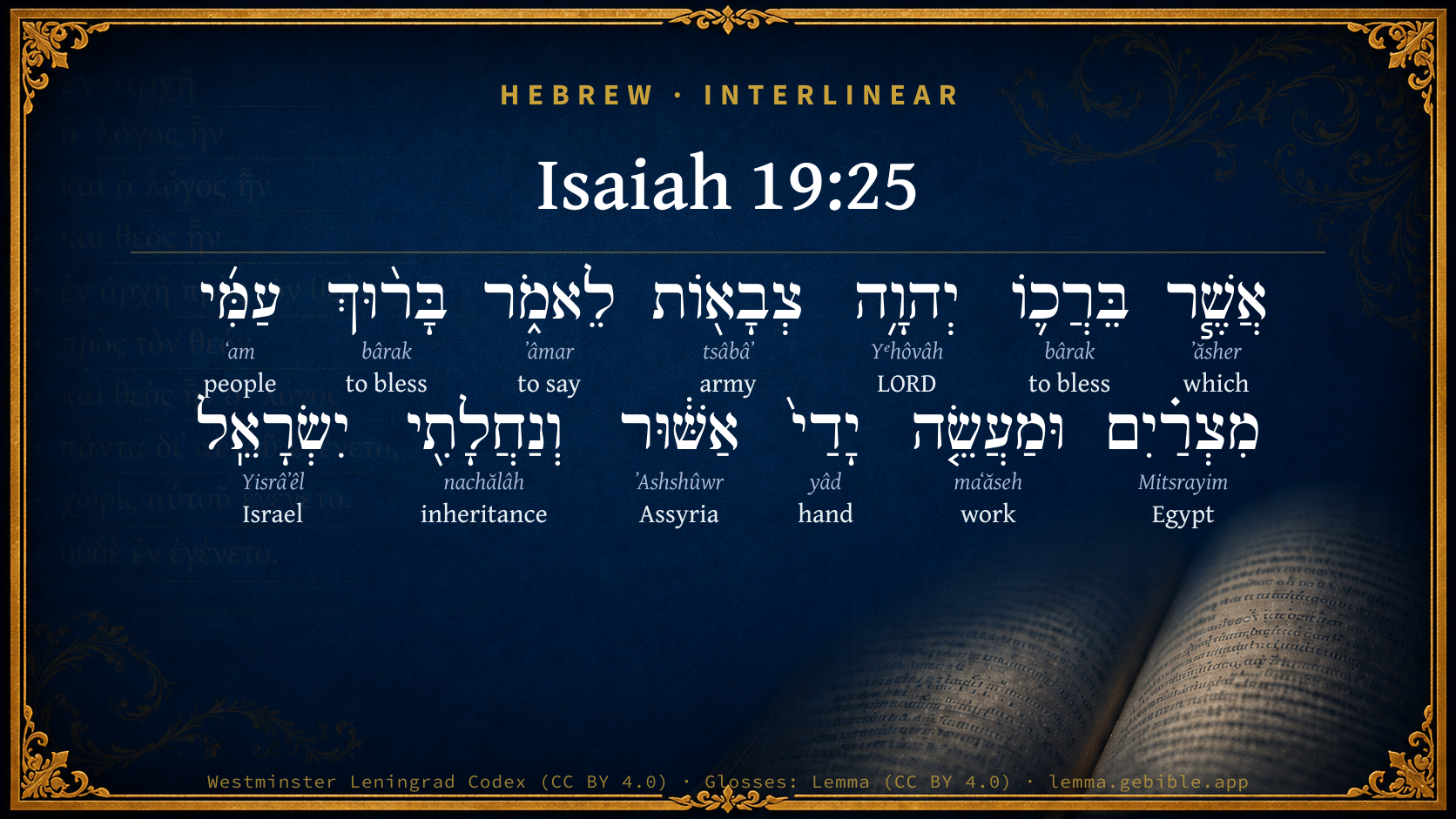
Hebrew (Westminster Leningrad Codex) Isaiah 19:25 appears in the Hebrew Old Testament. The text above is from the Westminster Leningrad Codex. Each word links to its Strong’s number, a concise gloss, and parsing drawn from the Open Scriptures Hebrew Bible morphology. Click any word for its full Brown-Driver-Briggs (BDB) entry.
Download image
Cite this verse

Isaiah 19:25 (World English Bible). Public Domain. Lemma interlinear Bible study tool, https://lemma.gebible.app/v/isaiah/19/25.

Show BibTeX & RIS
BibTeX
RIS
English Translation
because Yahweh of Hosts has blessed them, saying, Blessed be Egypt my people, and Assyria the work of my hands, and Israel my inheritance.
World English Bible · Public Domain
Download a study sheet

One document with this verse’s original text, its word-by-word gloss line, the meaning frame, cross-references with their text, attributed commentary, and full source and license credits — printable, and it pastes into notes with its structure intact.

This verse Autodidact and up

Study sheet (.html) Plain text (.txt)

A passage Seminary Student

Up to 50 verses in one chapter. A passage sheet keeps up to 6 commentary sources and 12 cross-references per verse, in the order this page ranks them, and says so on the sheet whenever that leaves anything out. Ask for a single verse and you get the Autodidact verse sheet above.

Everything on this page stays free to read, with no account — the sheet is a download of what is already on screen, not access to it.

Want to remove ads? Support Godless Engineer
Compare translations 3

The same verse in 3 English versions, stacked beneath the original-language interlinear above. Click any original word for its lexicon entry.

Each is an independent rendering of the whole verse — the interlinear is not word-aligned to these translations.

Highlighted words mark where these versions differ — a whole-verse word diff, not a word-by-word alignment.

  • World English Bible Public Domain
    because Yahweh of Hosts has blessed them, saying, Blessed be Egypt my people, and Assyria the work of my hands, and Israel my inheritance.
  • King James Version Public Domain
    Whom the LORD of hosts shall bless, saying, Blessed be Egypt my people, and Assyria the work of my hands, and Israel mine inheritance.
  • unfoldingWord Literal Text CC BY-SA 4.0
    that Yahweh of Armies has blessed it, saying, “Blessed my people Egypt and the work of my hands Assyria and my inheritance Israel.”

unfoldingWord Literal Text — © unfoldingWord, licensed CC BY-SA 4.0. Word-aligned USFM3 via Door43 (git.door43.org/unfoldingWord/en_ult).

Versions to compare (up to 4)

3 of 4 selected

Show all 18 translations

Every available English version of this verse, each an independent rendering of the whole verse.

  • World English Bible Public Domain
    because Yahweh of Hosts has blessed them, saying, Blessed be Egypt my people, and Assyria the work of my hands, and Israel my inheritance.
  • Berean Standard Bible Public Domain
    The LORD of Hosts will bless them, saying, “Blessed be Egypt My people, Assyria My handiwork, and Israel My inheritance.”
  • Majority Standard Bible Public Domain
    The LORD of Hosts will bless them, saying, “Blessed be Egypt My people, Assyria My handiwork, and Israel My inheritance.”
  • King James Version Public Domain
    Whom the LORD of hosts shall bless, saying, Blessed be Egypt my people, and Assyria the work of my hands, and Israel mine inheritance.
  • American Standard Version (1901) Public Domain
    for that Jehovah of hosts hath blessed them, saying, Blessed be Egypt my people, and Assyria the work of my hands, and Israel mine inheritance.
  • Revised Version (1885) Public Domain
    for that the LORD of hosts hath blessed them, saying, Blessed be Egypt my people, and Assyria the work of my hands, and Israel mine inheritance.
  • Geneva Bible (1599) Public Domain
    For the Lord of hostes shall blesse it, saying, Blessed be my people Egypt and Asshur, the worke of mine hands, and Israel mine inheritance.
  • Douay-Rheims (1899) Public Domain
    Which the Lord of hosts hath blessed, saying: Blessed be my people of Egypt, and the work of my hands to the Assyrian: but Israel is my inheritance.
  • Young's Literal Translation Public Domain
    In that Jehovah of Hosts did bless it, saying, `Blessed `is' My people -- Egypt, And the work of My hands -- Asshur, And Mine inheritance -- Israel!'
  • Literal Standard Version CC BY-SA 4.0
    In that YHWH of Hosts blessed it, saying, “Blessed [is] My people—Egypt, || And the work of My hands—Asshur, || And My inheritance—Israel!”
  • Unlocked Literal Bible CC BY-SA 4.0
    Yahweh of hosts will bless them and say, “Blessed be Egypt, my people; Assyria, the work of my hands; and Israel, my inheritance.”
  • unfoldingWord Literal Text CC BY-SA 4.0
    that Yahweh of Armies has blessed it, saying, “Blessed my people Egypt and the work of my hands Assyria and my inheritance Israel.”
  • Darby Bible Public Domain
    whom Jehovah of hosts will bless, saying, Blessed be Egypt my people, and Assyria the work of my hands, and Israel mine inheritance!
  • World Messianic Bible Public Domain
    because the LORD of Hosts has blessed them, saying, “Blessed be Egypt my people, Assyria the work of my hands, and Israel my inheritance.”
  • Webster's Bible Public Domain
    Whom the LORD of hosts will bless, saying, Blessed be Egypt my people, and Assyria the work of my hands, and Israel my inheritance.
  • Free Bible Version CC BY-SA 4.0
    The Lord Almighty will bless them, saying, “Blessed be Egypt, my people, Assyria, the creation of my hands, and Israel, my special possession.”
  • Bible in Basic English Public Domain
    Because of the blessing of the Lord of armies which he has given them, saying, A blessing on Egypt my people, and on Assyria the work of my hands, and on Israel my heritage.
  • JPS Tanakh (1917) Public Domain
    for that the LORD of hosts hath blessed him, saying: 'Blessed be Egypt My people and Assyria the work of My hands, and Israel Mine inheritance.'

Literal Standard Version (2020), Covenant Press — licensed CC BY-SA 4.0. Text via the HelloAO Bible API (eBible.org). Unlocked Literal Bible (unfoldingWord) — licensed CC BY-SA 4.0. Text via the HelloAO Bible API (eBible.org). unfoldingWord Literal Text — © unfoldingWord, licensed CC BY-SA 4.0. Word-aligned USFM3 via Door43 (git.door43.org/unfoldingWord/en_ult). Free Bible Version, Dr. Jonathan Gallagher — licensed CC BY-SA 4.0. Text via the HelloAO Bible API (eBible.org).

Word by word

More ways to search: Search by grammar → Find every occurrence → Compare this word →

Practice this passage: Drill this verse → Learn its vocabulary →

אַשּׁ֔וּר
ʼAshshûwr
H804
“Assyria”
Noun, Proper
Part of Speech
Noun
Type
Proper
Full BDB Definition

Origin: apparently from H833 (in the sense of successful)

TWOT: 176

Asshur or Assyria = "a step" - the second son of Shem, eponymous ancestor of the Assyrians (noun proper masculine) - the people of Assyria (noun proper masculine) - the nation, Assyria (noun proper locative) - the land, Assyria or Asshur (noun proper locative)
  1. אֲשֶׁ֧ר ʼăsher H834 “which” Particle, Relative
  2. בֵּרֲכ֛וֹ bârak H1288 “to bless · him” Verb, Piel, Perfect, 3rd Person, Masculine, Singular + Suffix, Personal, 3rd Person, Masculine, Singular
  3. יְהוָ֥ה Yᵉhôvâh H3068 “LORD” Noun, Proper
  4. צְבָא֖וֹת tsâbâʼ H6635 “armies” Noun, Common, Both, Plural, Absolute
  5. לֵאמֹ֑ר ʼâmar H559 “to say” Preposition + Verb, Qal, Infinitive Construct
  6. בָּר֨וּךְ bârak H1288 “blessed” Verb, Qal, Participle Passive, Masculine, Singular, Absolute
  7. עַמִּ֜י ʻam H5971 “people · my” Noun, Common, Masculine, Singular, Construct + Suffix, Personal, 1st Person, Common, Singular
  8. מִצְרַ֗יִם Mitsrayim H4714 “Egypt” Noun, Proper
  9. וּמַעֲשֵׂ֤ה maʻăseh H4639 “and · work of” Conjunction + Noun, Common, Masculine, Singular, Construct
  10. יָדַי֙ yâd H3027 “hands · my” Noun, Common, Both, Dual, Construct + Suffix, Personal, 1st Person, Common, Singular
  11. וְנַחֲלָתִ֖י nachălâh H5159 “and · inheritance · my” Conjunction + Noun, Common, Feminine, Singular, Construct + Suffix, Personal, 1st Person, Common, Singular
  12. יִשְׂרָאֵֽל Yisrâʼêl H3478 “Israel” Noun, Proper

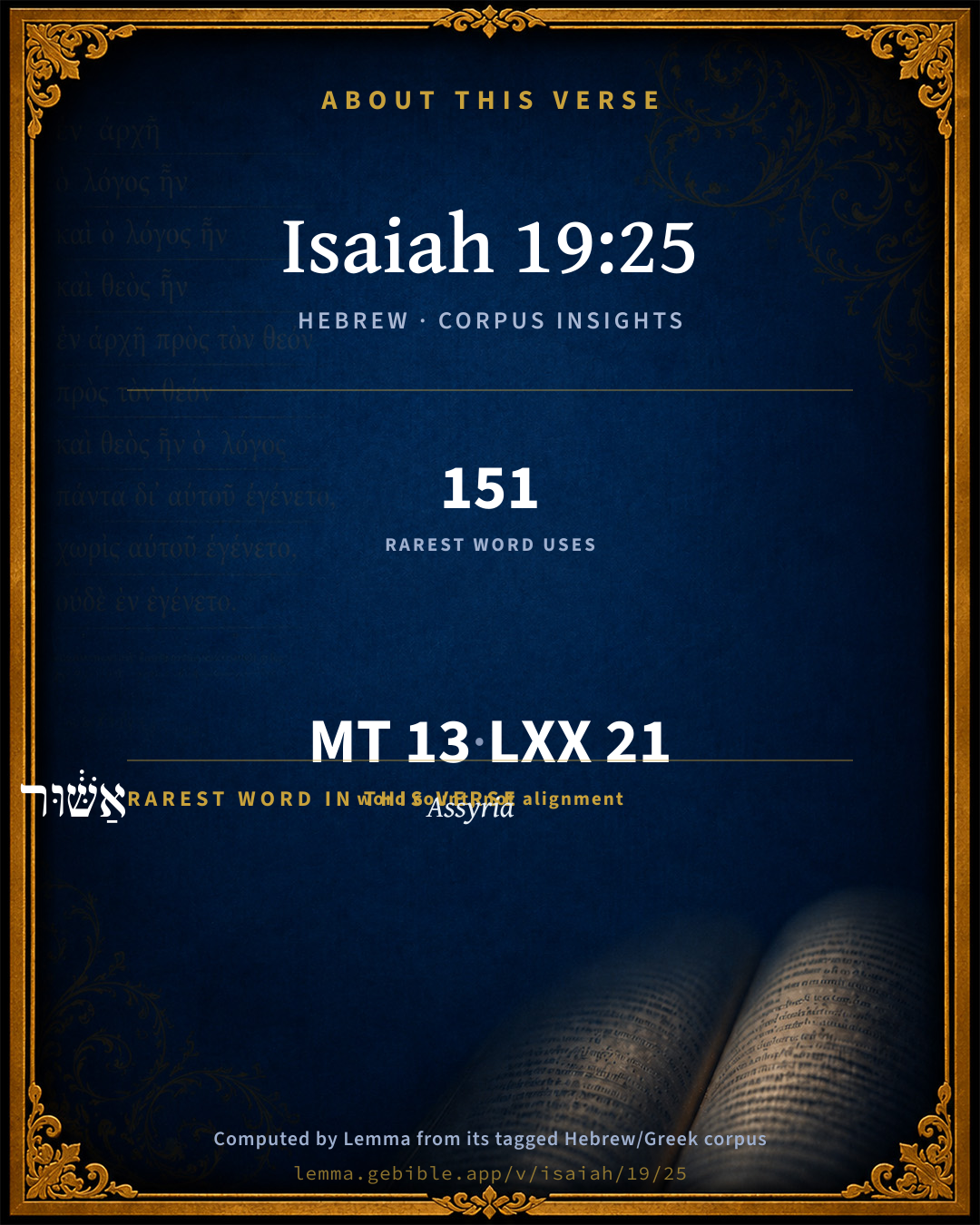
About this verse

These counts appear in no published source. They are computed here, from the morphology-tagged text and Lemma’s own curated glosses. What Lemma adds →

13
words
12
distinct lemmas
Prophets
section

Grammatical profile

  • 3 verbs
  • 9 nouns
  • 1 particle

Verb forms

  • בֵּרֲכ֛וֹ Piel · Perfect
  • לֵאמֹ֑ר Qal · Infinitive Construct
  • בָּר֨וּךְ Qal · Participle Passive

Repetition

A word recurs within this verse — often emphatic in Hebrew:

  • בֵּרֲכ֛וֹ to bless H1288 ×2

Hebrew & Septuagint length

In English translation the verse runs 24 words from the Hebrew and 19 from the Septuagint (LXX English) — closely comparable.

A rough comparison of the two English renderings, which tokenize alike — not a word-level alignment.

Word counts can differ between the Hebrew and the Greek without any difference in meaning — e.g. the Hebrew direct-object marker אֵת has no separate Greek word, and Greek often adds the article ὁ.

In the original languages it is 13 Hebrew tokens and 21 Greek tokens — but the two are counted differently (Hebrew bundles its prefixes and suffixes into one token; the Greek is in lemma form), so that isn’t a like-for-like length.

Cross-references

23

Topical passages linked to Isaiah 19:25 in the Treasury of Scripture Knowledge — connected by theme and wording, ordered by reader-vote popularity; previews shown in the World English Bible.

  • Isaiah 29:23 But when he sees his children, the work of my hands, in the midst of him, they shall sanctify my name; yes, they shall sanctify the Holy One of Jacob, and shall stand in awe of the God of Israel.
  • Hosea 2:23 I will sow her to me in the earth; And I will have mercy on her who had not obtained mercy; And I will tell those who were not my people, 'You are my people;' And they will say, 'My God!'"
  • Romans 9:24–25 us, whom he also called, not from the Jews only, but also from the Gentiles?
  • Deuteronomy 32:9 For Yahweh's portion is his people; Jacob is the lot of his inheritance.
  • Psalms 115:15 Blessed are you by Yahweh, Who made heaven and earth.
  • Psalms 138:8 Yahweh will fulfill that which concerns me; Your loving kindness, Yahweh, endures forever. Don't forsake the works of your own hands.
  • Numbers 6:24 'Yahweh bless you, and keep you.
  • Numbers 6:27 "So they shall put my name on the children of Israel; and I will bless them."
  • Isaiah 60:21 Your people also shall be all righteous; they shall inherit the land forever, the branch of my planting, the work of my hands, that I may be glorified.
  • Isaiah 61:9 Their seed shall be known among the nations, and their offspring among the peoples; all who see them shall acknowledge them, that they are the seed which Yahweh has blessed.
  • Psalms 67:6–7 The earth has yielded its increase. God, even our own God, will bless us.
  • Psalms 100:3 Know that Yahweh, he is God. It is he who has made us, and we are his. We are his people, and the sheep of his pasture.
  • Isaiah 45:11 Thus says Yahweh, the Holy One of Israel, and his Maker: Ask me of the things that are to come; concerning my sons, and concerning the work of my hands, command you me.
  • Isaiah 64:8 But now, Yahweh, you are our Father; we are the clay, and you our potter; and we all are the work of your hand.
  • Isaiah 65:23 They shall not labor in vain, nor bring forth for calamity; for they are the seed of the blessed of Yahweh, and their offspring with them.
  • Galatians 6:15 For in Christ Jesus neither is circumcision anything, nor uncircumcision, but a new creation.
  • Ephesians 1:3 Blessed be the God and Father of our Lord Jesus Christ, who has blessed us with every spiritual blessing in the heavenly places in Christ;
  • Philippians 1:6 being confident of this very thing, that he who began a good work in you will complete it until the day of Jesus Christ.
  • Numbers 24:1 When Balaam saw that it pleased Yahweh to bless Israel, he didn't go, as at the other times, to meet with enchantments, but he set his face toward the wilderness.
  • Romans 3:29 Or is God the God of Jews only? Isn't he the God of Gentiles also? Yes, of Gentiles also,
  • Ephesians 2:10 For we are his workmanship, created in Christ Jesus for good works, which God prepared before that we would walk in them.
  • 1 Peter 2:10 who in time past were no people, but now are God's people, who had not obtained mercy, but now have obtained mercy.
  • Colossians 3:10–11 and have put on the new man, that is being renewed in knowledge after the image of his Creator,

Cross-references courtesy of OpenBible.info (CC BY 4.0).

Hebrew and Greek witnesses Masoretic Hebrew ↔ Greek Septuagint

The same verse in the two great witnesses to the Old Testament, shown verse-for-verse.

These are two independent witnesses, not word-aligned to each other, and the Septuagint is shown in lemma (dictionary) form.

Hebrew Isaiah 19:25 Masoretic · Westminster Leningrad Codex

אֲשֶׁ֧ר בֵּרֲכ֛וֹ יְהוָ֥ה צְבָא֖וֹת לֵאמֹ֑ר בָּר֨וּךְ עַמִּ֜י מִצְרַ֗יִם וּמַעֲשֵׂ֤ה יָדַי֙ אַשּׁ֔וּר וְנַחֲלָתִ֖י יִשְׂרָאֵֽל

because Yahweh of Hosts has blessed them, saying, Blessed be Egypt my people, and Assyria the work of my hands, and Israel my inheritance.

World English Bible · Public Domain

Greek LXX Isaiah 19:25 Septuagint · lemma form

ὅς εὐλογέω κύριος σαβαωθ λέγω εὐλογέω ὁ λαός ἐγώ ὁ ἐν αἴγυπτος καί ὁ ἐν ἀσσύριος καί ὁ κληρονομία ἐγώ ἰσραήλ

saying, Blessed be my people that is in Egypt, and that is among the Assyrians, and Israel my inheritance.

LXX2012 (modern English Septuagint) · Public Domain

On this verse, The Cambridge Bible for Schools and Colleges discusses the Septuagint’s reading. Read the note in Commentary ↓

Hebrew: Westminster Leningrad Codex (CC BY 4.0). Greek: Septuagint (public domain); English from LXX2012 (modern English Septuagint) (Public Domain). How the Septuagint differs from the Hebrew →

Targum (Aramaic paraphrase)

1

The Targum is the ancient Jewish Aramaic paraphrase of the Hebrew Scriptures — an interpretive translation, not the Hebrew text itself. Onkelos (literal) and Pseudo-Jonathan (expansive) render the Torah, and Jonathan the Prophets. Coverage is partial: where no permissively-licensed English translation exists for a verse, only the Aramaic is shown. This is verse-level text, not a word-by-word alignment to the Hebrew.

  1. Targum Jonathan Prophets (Joshua–Malachi)
    דְבָרְכֵהּ יְיָ צְבָאוֹת לְמֵימָר בְּרִיךְ עַמִי דְאַפְקֵית מִמִצְרַיִם דְעַל דְחָבוּ קֳדָמַי אַגְלֵיתִי יַתְהוֹן לְאַתּוּר וּכְדוּ דְתָבוּ מַתְקְרָן עַמִי וְאַחְסַנְתִּי יִשְׂרָאֵל:

    Whom the Lord of hosts hath blessed, saying, Blessed be my people, whom I have brought out of Egypt; and because they sinned before me, I carried them captive into Assyria, but when they repent, they are called my people, and Israel mine inheritance.

    Targum Jonathan — Aramaic: “Mikraot Gedolot” (public domain). English: “Sefaria Community Translation” (CC0 1.0 (public-domain dedication)); “London "Chaldee Paraphrase," 1871” (public domain). Text via Sefaria.

Commentary

Notes on Isaiah 19:25 from classic Christian and Jewish commentators (each source and its license shown beneath its notes). The classic Christian expositions comment on the surrounding passage and are grouped to its opening verse, so a note may address several verses; the Jewish commentaries on the Tanakh (Rashi and others) are per-verse, so they appear only where the commentator wrote on this verse.

Lemma curates 59 commentaries, every one of them public domain or Creative Commons licensed, each selected and text-cleaned for this edition rather than reprinted as found. About our sources →

Trapp's Complete Commentary

John Trapp

Isa 19:25 Whom the LORD of hosts shall bless, saying, Blessed [be] Egypt my people, and Assyria the work of my hands, and Israel mine inheritance.

Ver. 25. Whom the Lord af hosts shall bless.] Or, For the Lord of hosts shall bless, and then he shall be blessed, {a} as Isaac said of Jacob. {Gen 27:33}

Blessed be Egypt, my people.] A new title to Egypt, and no less honourable. Vide quantum profecerit Egyptus flagellis, saith Oecolampadius, here, i.e., see how Egypt hath got by her sufferings. See Isa 19:22. She who was not a people, but a rabble of rebels conspiring against heaven, is now owned and taken into covenant.

And Assyria, the work of my hands.] "For we are his workmanship created in Christ Jesus unto good works." {Eph 2:10}

And Israel mine inheritance.] This is, upon the matter, one and the same with the former; every regenerate person, whether Jew or Gentile, is all these three in conjunction. Oh the μυρωμακαριοτης, the heaped up happiness of all such! "Let Israel rejoice in him that made him; let the children of Zion be joyful in their king." {Psa 149:2} "For the Lord her God in the midst of her is mighty; he will save, he will rejoice over her with joy; he will rest in his love, he will joy over her with singing." {Zep 3:17}

{a} Jun.

John Trapp, A Commentary or Exposition upon All the Books of the Old and New Testament (1647–1656) — public domain. Text from a community e-Sword module.

Tyndale Open Study Notes

Tyndale Open Resources

19:25 Two designations usually reserved for Israel, my people and the land I have made (see 29:22; 32:18), are applied here to foreign nations. The Lord promised to regard those from the nations who turn to him as his special possession (63:17).

Tyndale Open Study Notes — © Tyndale Open Resources, licensed CC BY-SA 4.0. Text via the HelloAO Bible API.

Jamieson, Fausset & Brown

Robert Jamieson, A. R. Fausset & David Brown

Whom--rather, "Which," namely, "the land," or "earth," that is, the people of it [MAURER].

my people--the peculiar designation of Israel, the elect people, here applied to Egypt to express its entire admission to religious privileges (Rom 9:24-26; Pe1 2:9-10).

work of my hands--spiritually (Hos 2:23; Eph 2:10).

In the reign of Sargon (722-715 B.C.), the successor of Shalmaneser, an Assyrian invasion of Egypt took place. Its success is here foretold, and hence a party among the Jews is warned of the folly of their "expectation" of aid from Egypt or Ethiopia. At a later period (Isa 18:1-7), when Tirhakah of Ethiopia was their ally, the Ethiopians are treated as friends, to whom God announces the overthrow of the common Assyrian foe, Sennacherib. Egypt and Ethiopia in this chapter (Isa 20:3-4) are represented as allied together, the result no doubt of fear of the common foe; previously they had been at strife, and the Ethiopian king had, just before Sethos usurpation, withdrawn from occupation of part of Lower Egypt. Hence, "Egypt" is mentioned alone in Isa. 19:1-25, which refers to a somewhat earlier stage of the same event: a delicate mark of truth. Sargon seems to have been the king who finished the capture of Samaria which Shalmaneser began; the alliance of Hoshea with So or Sabacho II of Ethiopia, and his refusal to pay the usual tribute, provoked Shalmaneser to the invasion. On clay cylindrical seals found in Sennacherib's palace at Koyunjik, the name of Sabacho is deciphered; the two seals are thought, from the inscriptions, to have been attached to the treaty of peace between Egypt and Assyria, which resulted from the invasion of Egypt by Sargon, described in this chapter; Kg2 18:10 curiously confirms the view derived from Assyrian inscriptions, that though Shalmaneser began, Sargon finished the conquest of Samaria; "they took it" (compare Kg2 17:4-6). In Sargon's palace at Khorsabad, inscriptions state that 27,280 Israelites were led captive by the founder of the palace. While Shalmaneser was engaged in the siege of Samaria, Sargon probably usurped the supreme power and destroyed him; the siege began in 723 B.C., and ended in 721 B.C., the first year of Sargon's reign. Hence arises the paucity of inscriptions of the two predecessors of Sargon, Tiglath-pileser and Shalmaneser; the usurper destroyed them, just as Tiglath-pileser destroyed those of Pul (Sardanapalus), the last of the old line of Ninus; the names of his father and grandfather, which have been deciphered in the palace of his son Sennacherib, do not appear in the list of Assyrian kings, which confirms the view that he was a satrap who usurped the throne. He was so able a general that Hezekiah made no attempt to shake off the tribute until the reign of Sennacherib; hence Judah was not invaded now as the lands of the Philistines and Egypt were. After conquering Israel he sent his general, Tartan, to attack the Philistine cities, "Ashdod," &c., preliminary to his invasion of Egypt and Ethiopia; for the line of march to Egypt lay along the southwest coast of Palestine. The inscriptions confirm the prophecy; they tell us he received tribute from a Pharaoh of "Egypt"; besides destroying in part the Ethiopian "No-ammon," or Thebes (Nah 3:8); also that he warred with the kings of "Ashdod," Gaza, &c., in harmony with Isaiah here; a memorial tablet of him is found in Cyprus also, showing that he extended his arms to that island. His reign was six or seven years in duration, 722-715 B.C. [G. V. SMITH].

Next: Isaiah Chapter 20

Jamieson, Fausset & Brown — Commentary Critical and Explanatory on the Whole Bible (1871) — public domain (CC PDM 1.0). Text via the HelloAO Bible API.

Adam Clarke's Commentary

Verse 25. Blessed be Egypt - Assyria - and Israel] All these countries shall be converted to the Lord. Concerning Egypt, it was said, Isa 18:7, that it should bring gifts to the Lord at Jerusalem. Here it is predicted, Isa 19:19, that there shall be an altar to the Lord in Egypt itself; and that they, with the Assyrians shall become the people of God with the Israelites. This remains partly to be fulfilled. These countries shall be all, and perhaps at no very distant time from this, converted to the faith of our Lord Jesus Christ.

Adam Clarke's Commentary on the Bible (1810–1826) — public domain. Text from a community e-Sword/MySword module.

Ellicott's Commentary for English Readers

(25) Whom the Lord of hosts shall bless . . .—In this tripartite holy alliance Israel is to retain the spiritual supremacy. Egypt, once alien, becomes the people of the Lord. (Comp. Hos_1:9-10.) Assyria is recognised as the instrument which He has made to do His work (comp. Isa_10:15; Isa_37:26); but Israel has the proud pre-eminence of being His “inheritance.”

A Bible Commentary for English Readers, edited by Charles John Ellicott (1878–1897) — public domain. Text from a community e-Sword module.

The Cambridge Bible for Schools and Colleges

gen. ed. J. J. S. Perowne

25. whom the Lord of hosts shall bless] R.V. for that the Lord of hosts hath blessed him (Israel). A better sense than either is given by the LXX. “(the earth;) which Jehovah … hath blessed.” But the masculine suffix is opposed to this.

my people and the work of my hands are titles elsewhere confined to Israel, but here accorded to Egypt and Assyria, the still dearer epithet mine inheritance being reserved for Israel,—as it were the ancestral estate of the one true God.

The Cambridge Bible for Schools and Colleges (gen. ed. J. J. S. Perowne; Cambridge University Press, 1878–1918) — public domain. Text from a community e-Sword module.

John Gill's Exposition

Whom the Lord of hosts shall bless,.... Not only Israel, but Egypt and Assyria, even all his chosen ones, whether among Jews or Gentiles:

saying, blessed be Egypt my people; as they must needs be blessed who are the Lord's covenant people; for he being their covenant God, his blessing is upon them, even life for evermore; they are blessed with all the blessings of the covenant, even all the spiritual blessings which are in Christ; they are secure of his love, and may depend upon his power and protection; they are happy here, and will be so hereafter:

and Assyria the work of my hands; not as creatures only, but new creatures, having the good work of grace wrought in their hearts, of which God is the author; and therefore are called his workmanship, Eph 2:10 and who must be blessed, because, by this work of grace upon them, they appear to be the chosen of God, and precious, to be his children, and dear unto him, whom he will not forsake, and who are formed for himself, and for heaven, and happiness:

and Israel mine inheritance; chosen by him to be so, and given to Christ as such; and who must be happy, because, as they are the Lord's inheritance, portion, and peculiar treasure, so he has provided an inheritance for them, incorruptible, undefiled, which fades not away, reserved in the heavens. The Targum interprets all this of Israel, thus,

"blessed be my people, whom I brought out of Egypt; and because they sinned before me, I carried them captive into Assyria; and when they are turned, they are called my people, and mine inheritance, Israel.''

Next: Isaiah Chapter 20

John Gill's Exposition of the Whole Bible (1746–1763) — public domain (CC PDM 1.0). Text via the HelloAO Bible API.

Albert Barnes' Notes on the Bible

whom the Lord of hosts shall bless - That is, which united country he shall acknowledge as truly worshipping him, and on which he shall bestow his favors as his favored people.

Assyria the work of my hands - This is synonymous with the expression ‘my people.’ It means that the arrangements by which the true religion would be established among them, were the work of God. Conversion to God is everywhere in the Scriptures spoken of as his work, or creation; see Eph 2:10 : ‘For we are his workmanship; created in Christ Jesus unto good works’ (compare 2Co 5:17; Psa 100:3).

Israel mine inheritance - The land and people which is especially my own - a name not unfrequently given to Israel. For a learned examination of the various hypotheses in regard to the fulfillment of this prophecy, see Vitringa. He himself applies it to the times succeeding Alexander the Great. Alexander he regards as the ‘saviour’ mentioned in Isa 19:20; and the establishment of the true religion referred to by the prophet as that which would take place under the Ptolemies. Vitringa has proved - what indeed is known to all who have the slightest knowledge of history that there were large numbers of Jews under the Ptolemies in Egypt, and that multitudes became proselytes to the Jewish faith.

Albert Barnes' Notes on the Bible (1834–1885) — public domain. Text from a community e-Sword/MySword module.

Matthew Poole's English Annotations

Whom the Lord of hosts shall bless; whom, i.e. which people, to wit, Israel, Egypt, and Assyria, expressed both in the foregoing verse, and in the following clause of this verse; of whom he speaks as of one people, in the singular number, because they are all united into one body and church. Or, For or because (as this particle is taken, 1Sa 15:15, and elsewhere) the Lord of hosts shall bless him or them. So this is added as a reason why he said Israel should be a blessing to them all. My people: this title, and those which follow, that were peculiar to the people of Israel, shall now be given to these and all other nations of the world.

Matthew Poole's English Annotations on the Holy Bible (1683–1685) — public domain. Text from a community e-Sword/MySword module.

The Pulpit Commentary

Whom the Lord of hosts bless; rather, forasmuch as the Lord of hosts hath blessed him. "Him" must be understood collectively, of the threefold Israel, spread through the three countries, which all partake of the blessing. The three countries are able to be a blessing to the world at large, because God"s blessing rests upon them. Egypt my people. Egypt"s great work in Jewish times, by which she became a blessing to the world, was her translation of the Hebrew Scriptures into Greek, commanded by Egyptian kings, and executed at Alexandria, the Egyptian capital. Neo-Platonism certainly owed much to this source. Stoicism probably something. Assyria the work of my hands. Assyria did no such work as Egypt. Neither the Targum of Onkelos nor the Babylonian Talmud can be compared for a moment with the Septuagint. Still the Mesopotamian Jews were a blessing to their neighbors. They kept alive in the East the notion of one true and spiritual God; they elevated the tone of men"s thoughts; they were a perpetual protest against idolatry, with all its horrors. They, no doubt, prepared the way for that acceptance of Christianity by large masses of the population in Syria, Mesopotamia, Babylonia, and even in Persia, of which we have evidence in the ecclesiastical history of the first seven centuries. Israel mine inheritance. (comp. Isa_47:6 Isa_63:17)

Lights in which God regards us.

The words intimate that there are various aspects in which the Divine Father looks at his human children, and they may suggest reciprocal views on our part.

I LIGHTS IN WHICH GOD REGARDS US.

1. As those to whom he is nearly related. Egypt in her hour of obedience has become "my people," i.e. closely connected with God, and having, therefore, serious claims upon him. God does regard his own as those who are most closely, most intimately, most tenderly related to him, standing in such close relation that they may confidently reckon on the continuance of his kindness, on the protection and interposition of his strong arm.

2. As those who are the product of his Divine energy. "Assyria the work of my hands." We who are trusting and rejoicing in him and walking in his truth are frequently to remind ourselves that we are not the product of our own wisdom and effort, but are "his workmanship created in Christ Jesus". (Eph_2:10; and see 1Co_3:9 2Co_5:5) God has expended on us Divine thought, Divine love, Divine sorrow, Divine patience, Divine discipline.

1. As those in whom he finds a Divine delight. "Israel mine inheritance." In Israel, when that people was faithful to his rule, God found his portion, his inheritance. In us, when we are attentive to his voice, responsive to his love, obedient to his commands, submissive to his will, he finds a Divine satisfaction. (Joh_15:11)

2. As those on whom he can confer blessedness. "Whom the Lord shall bless;" "Whom God blesses, they are blessed indeed." Theirs is not mere physical excitement, or temporary gratification, or dubious delight, but true, abiding, elevating joy.

II RECIPROCAL VIEWS WE SHOULD TAKE OF HIM. We should consider God:

1. As One to whom we are most intimately related more closely, indeed, than to any human kindred.

2. As One to whom we owe everything we are, as well as everything we have.

3. As that One in whom, in whose friendship, service, presence, we find (and hope to find) our true and lasting heritage. C.

All nations belonging unto God.

This is a singular and even surprising expression. These nations were idolatrous, and they came under severe Divine judgments, and yet God claims them as his, and even declares his favor towards them, using the same terms concerning Egypt and Assyria as concerning his own people Israel, and saying, "Blessed is my people Egypt, and the work of my hands Assyria, and mine inheritance Israel." "Speaker"s Commentary" says, "The widespread influence of the Jews over Syria, and the adjacent countries under the Syro-Macedonian kings, as well as over Egypt under the Ptolemies, may represent an initial stage in the fulfillment of the prophecy. A second stage commenced with that great day, which sent devout men back from Jerusalem into Egypt and Libya on one side, into Parthta, Media, Elam, and Mesopotamia, on the other, (Act_2:9, Act_2:10) to tell how "God, having raised up his Son Jesus" (the Prince and the Savior), had sent him to bless "the Jews first, and in them all nations.

I AS INDIVIDUALS, COMPOSING NATIONS, ALL MEN ARE GOD"S CREATION. So he has natural rights in them all. "It is he that hath made us, and not we ourselves;" then "Come, let us worship and bow down: let us kneel before the Lord our Maker.

II AS LOCATED IN PARTICULAR POSITIONS, NATIONS HAVE THE BOUNDS OF THEIR HABITATIONS APPOINTED BY GOD. See St. Paul"s argument in Act_17:26.

III AS ENDOWED WITH NATIONAL CHARACTERISTICS, ALL NATIONS ARE CALLED TO THE SERVICE OF GOD. For nations have special gifts, as truly as individuals; and wherever there are gifts there must be responsibility. The genius of every nation is its special ability to witness for and work for God. It has been well said that Israel, Greece, and Rome were three countries of God"s election; Israel called to witness for religion, Greece for art, and Rome for law. But a similar statement might be made concerning every nation.

IV AS UNDER MORAL TRIAL, ALL NATIONS ARE WITHIN THE SUPERVISION OF GOD. The true way to regard national history and experiences is this: In them, God"s dealings with individuals find open and public illustration; and so individuals may learn moral lessons that have personal application to themselves.

V AS NEEDING A REDEEMER, ALL NATIONS SHARE IN THE ONE PROVISION MADE BY GOD. God loves the world. All have sinned. There is only one Name, but by it all men everywhere may be saved. R.T.

The Pulpit Commentary (1880–1919), ed. H.D.M. Spence-Jones & Joseph S. Exell — public domain. Text from a community e-Sword module.

John Wesley's Explanatory Notes

Whom - That is, which people, Israel, Egypt, and Assyria; of whom he speaks as of one people, because they are all united into one church. My people - This title, and those which follow, that were peculiar to the people of Israel, shall now be given to these and all other nations.

John Wesley, Explanatory Notes Upon the Whole Bible (1754–1765) — public domain. Text via the GEBible commentary corpus.

J. A. Alexander on Isaiah

Joseph Addison Alexander

“Which Jehovah of Hosts has blessed (or with which Jehovah of Hosts has blessed it) saying, Blessed be my people Egypt, and the work of my hands Assyria, and my heritage (or peculiar people) Israel.” The perfect union of the three great powers in the service of God and the enjoyment of his favor is now expressed by a solemn benediction on the three, in which language commonly applied to Israel exclusively is extended to Egypt and Assyria. The force of the expressions would be much enhanced by the habitual associations of a Jewish reader. It arises very much from the surprise excited by the unexpected termination of the clauses. Instead of ‘Blessed be my people Israel,’ the formula is ‘Blessed be my people Egypt’. That ‘the work of my hands’ does not merely mean my creature, or a creature perfectly at my disposal, but my creature in a special and a spiritual sense, the same in which God is said to be the maker or founder of Israel (Deu 32:6; Isa 43:6-7) is evident from this consideration, that the clause would otherwise say nothing peculiar or distinctive of Assyria, as those before and after it do of Egypt and Israel. In order to express once more and in the most emphatic manner the admission of Egypt and Assyria to the privileges of the chosen people, he selects three titles commonly bestowed upon the latter exclusively, to wit, God’s people, the work of his hands, and his inheritance, and these three he distributes to the three united powers without discrimination or invidious distinction. As to the application of the prophecy there are three distinct opinions. One is, that the Prophet here anticipates a state of peace and international communion between Egypt, Israel, and Assyria in his own times, which may or may not have been actually realized. Another is, that he predicts what actually did take place under the reign of Alexander and the two great powers that succeeded him, viz. the Graeco-Syrian and Egyptian monarchies, by which the true religion was protected and diffused and the way prepared for the preaching of the gospel. A third is, that Egypt and Assyria are here named as the two great heathen powers known to the Jews, whose country lay between them and was often the scene if not the subject of their contests, so that for ages they were commonly in league with the one against the other.

To describe these two great belligerent powers as at peace with Israel and one another, was not only to foretell a most surprising revolution in the state of the world, but to intimate at least a future change in the relation of the Jews and the Gentiles. When he goes still further and describes these representatives of heathenism as received into the covenant and sharing with the church of God its most distinctive titles, we have one of the clearest and most striking predictions of the calling of the Gentiles that the word of God contains. One advantage of this exposition is that, while it thus extends and elevates the scope of the prediction, it retains unaltered whatever there may be of more specific prophecy or of coincidence with history. If Alexander is referred to, and the spread of Judaism under him and his successors, and the general pacification of the world and progress of refinement, these are so many masterly strokes added to the great prophetic picture; but they cannot be extracted from it and made to constitute a picture by themselves.

Joseph Addison Alexander, The Prophecies of Isaiah (1846–1847; New York: Scribner, 1870–1878) — public domain. Text from a community e-Sword module.

Rashi

Rabbi Shlomo Yitzchaki (Rashi)

Which...blessed them [lit. him,] i.e., Israel.

Blessed is My people Israel, whom I chose for Myself as a people when they were in Egypt.

and the work of My hands I showed them with the mighty deeds I performed wondrously against Assyria, and through those miracles they will repent and be as though I just made them anew, and they will be My heritage, Israel. Jonathan paraphrased this in a similar manner.

Rashi on the Tanakh — English translations: “The Judaica Press complete Tanach with Rashi, translated by A. J. Rosenberg” (CC BY 4.0); “Pentateuch with Rashi's commentary by M. Rosenbaum and A.M. Silbermann, 1929-1934” (public domain); “The Metsudah Tanach series, Lakewood, N.J” (CC BY 4.0); and “The Book of Joshua, Metsudah Publications, 1997” (CC BY 4.0). Text via Sefaria.

Ibn Ezra

Rabbi Abraham ibn Ezra

Whom the Lord of hosts hath blessed. For the Lord has blessed Israel, therefore he will be a blessing, etc; or He has blessed each of the three.

My people. Because they will erect an altar to the Lord publicly, He calls them my people.

And the work of my hands (and not my people), for there will be only a few of them that will know the work of the Lord.

And mine inheritance. Israel remains His inheritance for ever, for Assyria and Egypt are this only temporarily in comparison with Israel. The Chaldæan translation renders this passage thus: Blessed be my people that is in Egypt.

Ibn Ezra on the Tanakh — English translations: “Sefaria Community Translation” (CC0 1.0 (public-domain dedication)); “Yalkut, Sifsei Chachomim Chumash, Metsudah Publications, 2009” (CC BY 4.0); and “Commentary of Ibn Ezra on Isaiah - trans. by M. Friedlander, 1873” (public domain). Text via Sefaria.

Lesson kit

Teaching starters — assembled from the data on this page, not authored interpretation. Every prompt links to the verse data it draws on. Edit before teaching.

Isaiah, in the Prophets, opens this verse with 13 words (12 distinct Hebrew lemmas). Its most distinctive word is ʼAshshûwr (“Assyria”). A historical commentator’s framing appears above. Read the whole chapter for the surrounding context.

Discussion questions

  1. The word ʼAshshûwr carries the sense “Assyria.” How does it shape the verse?
  2. Isaiah 29:23 shares this passage’s theme. How do the two illuminate each other?
  3. “to bless” occurs 2× in this one verse. What is the effect of the repetition?
  4. The translations on this page render this verse differently — a whole-verse word diff, not a word-by-word alignment. What might account for the different wordings?
  5. The verb «בֵּרֲכ֛וֹ» is Piel Perfect. How does its form color the action?
  6. Reading how Trapp's Complete Commentary and Tyndale Open Study Notes read this verse, where do the two commentators agree and where do they part?

Things to notice

Reading settings

Reading text

Shown beneath each verse's original-language words.

Old Testament
Old Testament edition

Read the OT as the Masoretic Hebrew (MT) or the Greek Septuagint (LXX).

English shown for the Greek Septuagint (in the Hebrew ↔ Greek comparison).

Comparing translations? Open the Compare panel on any verse page to stack up to four side by side.