
Ezekiel 30:13

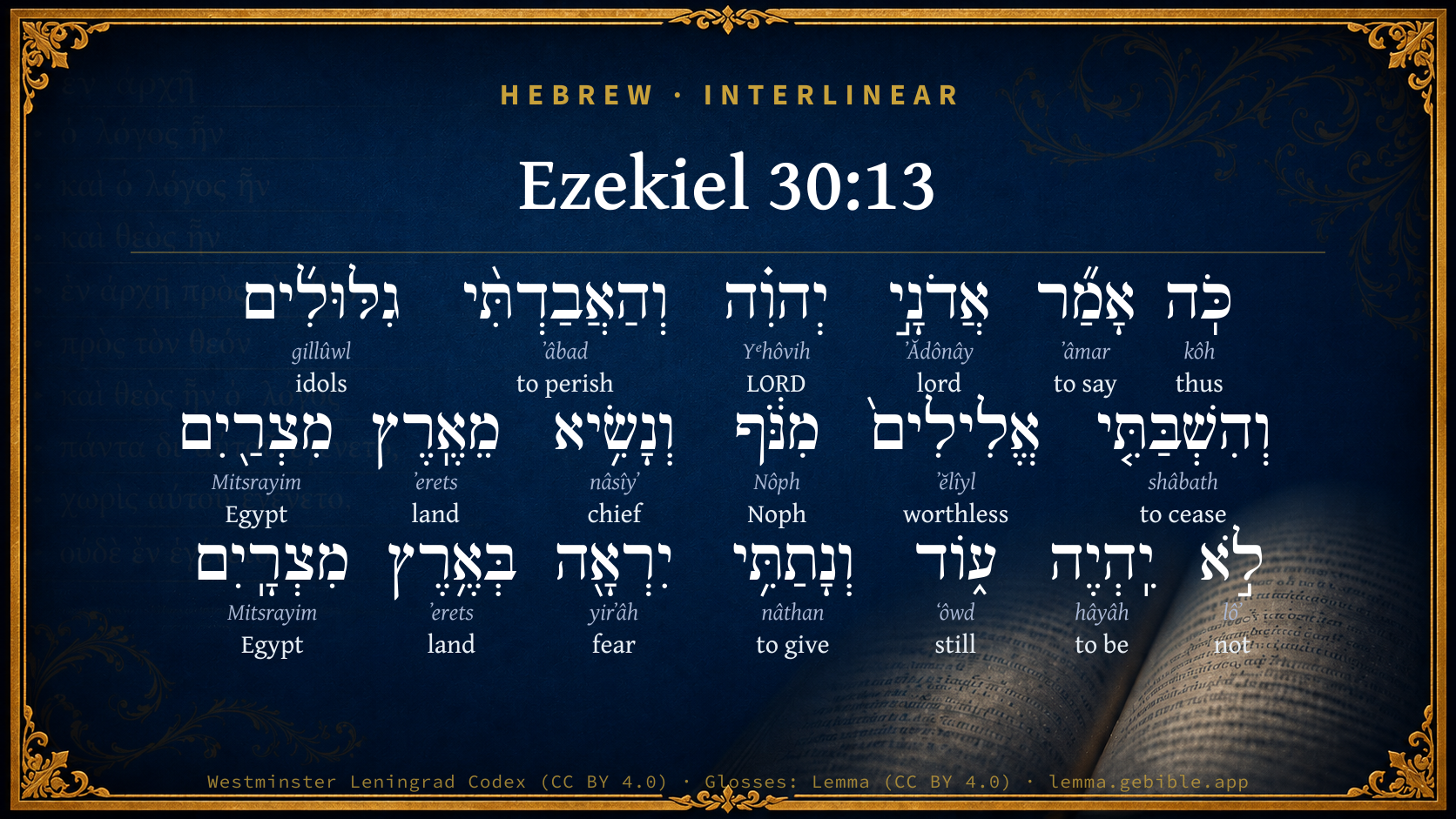
Hebrew (Westminster Leningrad Codex) Ezekiel 30:13 appears in the Hebrew Old Testament. The text above is from the Westminster Leningrad Codex. Each word links to its Strong’s number, a concise gloss, and parsing drawn from the Open Scriptures Hebrew Bible morphology. Click any word for its full Brown-Driver-Briggs (BDB) entry.
Download image
Cite this verse

Ezekiel 30:13 (World English Bible). Public Domain. Lemma interlinear Bible study tool, https://lemma.gebible.app/v/ezekiel/30/13.

Show BibTeX & RIS
BibTeX
RIS
English Translation
Thus says the Lord Yahweh: I will also destroy the idols, and I will cause the images to cease from Memphis; and there shall be no more a prince from the land of Egypt: and I will put a fear in the land of Egypt.
World English Bible · Public Domain
Download a study sheet

One document with this verse’s original text, its word-by-word gloss line, the meaning frame, cross-references with their text, attributed commentary, and full source and license credits — printable, and it pastes into notes with its structure intact.

This verse Autodidact and up

Study sheet (.html) Plain text (.txt)

A passage Seminary Student

Up to 50 verses in one chapter. A passage sheet keeps up to 6 commentary sources and 12 cross-references per verse, in the order this page ranks them, and says so on the sheet whenever that leaves anything out. Ask for a single verse and you get the Autodidact verse sheet above.

Everything on this page stays free to read, with no account — the sheet is a download of what is already on screen, not access to it.

Want to remove ads? Support Godless Engineer
Compare translations 3

The same verse in 3 English versions, stacked beneath the original-language interlinear above. Click any original word for its lexicon entry.

Each is an independent rendering of the whole verse — the interlinear is not word-aligned to these translations.

Highlighted words mark where these versions differ — a whole-verse word diff, not a word-by-word alignment.

  • World English Bible Public Domain
    Thus says the Lord Yahweh: I will also destroy the idols, and I will cause the images to cease from Memphis; and there shall be no more a prince from the land of Egypt: and I will put a fear in the land of Egypt.
  • King James Version Public Domain
    Thus saith the Lord GOD; I will also destroy the idols, and I will cause their images to cease out of Noph; and there shall be no more a prince of the land of Egypt: and I will put a fear in the land of Egypt.
  • unfoldingWord Literal Text CC BY-SA 4.0
    The Lord Yahweh says this: I will destroy idols, and I will bring an end to the worthless idols of Memphis. There will no longer be a prince in the land of Egypt, and I will put terror on the land of Egypt.

unfoldingWord Literal Text — © unfoldingWord, licensed CC BY-SA 4.0. Word-aligned USFM3 via Door43 (git.door43.org/unfoldingWord/en_ult).

Versions to compare (up to 4)

3 of 4 selected

Show all 18 translations

Every available English version of this verse, each an independent rendering of the whole verse.

  • World English Bible Public Domain
    Thus says the Lord Yahweh: I will also destroy the idols, and I will cause the images to cease from Memphis; and there shall be no more a prince from the land of Egypt: and I will put a fear in the land of Egypt.
  • Berean Standard Bible Public Domain
    This is what the Lord GOD says: I will destroy the idols and put an end to the images in Memphis. There will no longer be a prince in Egypt, and I will instill fear in that land.
  • Majority Standard Bible Public Domain
    This is what the Lord GOD says: I will destroy the idols and put an end to the images in Memphis. There will no longer be a prince in Egypt, and I will instill fear in that land.
  • King James Version Public Domain
    Thus saith the Lord GOD; I will also destroy the idols, and I will cause their images to cease out of Noph; and there shall be no more a prince of the land of Egypt: and I will put a fear in the land of Egypt.
  • American Standard Version (1901) Public Domain
    Thus saith the Lord Jehovah: I will also destroy the idols, and I will cause the images to cease from Memphis; and there shall be no more a prince from the land of Egypt: and I will put a fear in the land of Egypt.
  • Revised Version (1885) Public Domain
    Thus saith the Lord GOD: I will also destroy the idols, and I will cause the images to cease from Noph; and there shall be no more a prince out of the land of Egypt: and I will put a fear in the land of Egypt.
  • Geneva Bible (1599) Public Domain
    Thus saith the Lord God, I will also destroy the idoles, and I will cause their idoles to cease out of Noph, and there shall be no more a prince of the land of Egypt, and I will send a feare in the land of Egypt.
  • Douay-Rheims (1899) Public Domain
    Thus saith the Lord God: I will also destroy the idols, and I will make an end of the idols of Memphis: and there shall be no more a prince of the land of Egypt: and I will cause a terror in the land of Egypt.
  • Young's Literal Translation Public Domain
    Thus said the Lord Jehovah: And -- I have destroyed idols, And caused vain things to cease from Noph, And a prince of the land of Egypt there is no more, And I give fear in the land of Egypt.
  • Literal Standard Version CC BY-SA 4.0
    Thus said Lord YHWH: And I have destroyed idols, || And caused vain things to cease from Noph, || And there is no longer a prince of the land of Egypt, || And I give fear in the land of Egypt.
  • Unlocked Literal Bible CC BY-SA 4.0
    The Lord Yahweh says this: I will destroy idols, and I will bring an end to the worthless idols of Memphis. There will no longer be a prince in the land of Egypt, and I will put terror on the land of Egypt.
  • unfoldingWord Literal Text CC BY-SA 4.0
    The Lord Yahweh says this: I will destroy idols, and I will bring an end to the worthless idols of Memphis. There will no longer be a prince in the land of Egypt, and I will put terror on the land of Egypt.
  • Darby Bible Public Domain
    Thus saith the Lord Jehovah: I will also destroy the idols, and I will cause the images to cease out of Noph; and there shall be no more a prince out of the land of Egypt; and I will put fear in the land of Egypt.
  • World Messianic Bible Public Domain
    “‘The Lord GOD says: “I will also destroy the idols, and I will cause the images to cease from Memphis. There will be no more a prince from the land of Egypt. I will put a fear in the land of Egypt.
  • Webster's Bible Public Domain
    Thus saith the Lord GOD; I will also destroy the idols, and I will cause their images to cease out of Noph; and there shall be no more a prince of the land of Egypt: and I will put a fear in the land of Egypt.
  • Free Bible Version CC BY-SA 4.0
    This is what the Lord God says: I'm going to destroy the idols and get rid of the images in Memphis. There won't be a prince in Egypt any longer, and I will make everyone in the country terrified.
  • Bible in Basic English Public Domain
    This is what the Lord has said: In addition to this, I will give up the images to destruction and put an end to the false gods in Noph; never again will there be a ruler in the land of Egypt: and I will put a fear in the land of Egypt.
  • JPS Tanakh (1917) Public Domain
    Thus saith the Lord GOD: I will also destroy the idols, and I will cause the things of nought to cease from Noph; and there shall be no more a prince out of the land of Egypt; and I will put a fear in the land of Egypt.

Literal Standard Version (2020), Covenant Press — licensed CC BY-SA 4.0. Text via the HelloAO Bible API (eBible.org). Unlocked Literal Bible (unfoldingWord) — licensed CC BY-SA 4.0. Text via the HelloAO Bible API (eBible.org). unfoldingWord Literal Text — © unfoldingWord, licensed CC BY-SA 4.0. Word-aligned USFM3 via Door43 (git.door43.org/unfoldingWord/en_ult). Free Bible Version, Dr. Jonathan Gallagher — licensed CC BY-SA 4.0. Text via the HelloAO Bible API (eBible.org).

Word by word

More ways to search: Search by grammar → Find every occurrence → Compare this word →

Practice this passage: Drill this verse → Learn its vocabulary →

מִנֹּ֔ף
Nôph
H5297
“from · Noph”
Preposition + Noun, Proper
Part of Speech
Preposition + Noun
Type
Proper
Full BDB Definition

Origin: a variation of H4644

TWOT: None

Noph = "presentability" - another name for 'Memphis' the capital city of Egypt
  1. כֹּֽה kôh H3541 “thus” Adverb
  2. אָמַ֞ר ʼâmar H559 “to say” Verb, Qal, Perfect, 3rd Person, Masculine, Singular
  3. אֲדֹנָ֣י ʼĂdônây H136 “Lord · my” Noun, Common, Masculine, Plural, Construct + Suffix, Personal, 1st Person, Common, Singular
  4. יְהוִ֗ה Yᵉhôvih H3069 “LORD” Noun, Proper
  5. וְהַאֲבַדְתִּ֨י ʼâbad H6 “and · to perish” Conjunction + Verb, Hiphil, Sequential Perfect, 1st Person, Common, Singular
  6. גִלּוּלִ֜ים gillûwl H1544 “idols” Noun, Common, Masculine, Plural, Absolute
  7. וְהִשְׁבַּתִּ֤י shâbath H7673 “and · to cease” Conjunction + Verb, Hiphil, Sequential Perfect, 1st Person, Common, Singular
  8. אֱלִילִים֙ ʼĕlîyl H457 “idols” Noun, Common, Masculine, Plural, Absolute
  9. וְנָשִׂ֥יא nâsîyʼ H5387 “and · chief” Conjunction + Noun, Common, Masculine, Singular, Absolute
  10. מֵאֶֽרֶץ ʼerets H776 “from · land of” Preposition + Noun, Common, Both, Singular, Construct
  11. מִצְרַ֖יִם Mitsrayim H4714 “Egypt” Noun, Proper
  12. לֹ֣א lôʼ H3808 “not” Particle, Negative
  13. יִֽהְיֶה hâyâh H1961 “to be” Verb, Qal, Imperfect, 3rd Person, Masculine, Singular
  14. ע֑וֹד ʻôwd H5750 “still” Adverb
  15. וְנָתַתִּ֥י nâthan H5414 “and · to give” Conjunction + Verb, Qal, Sequential Perfect, 1st Person, Common, Singular
  16. יִרְאָ֖ה yirʼâh H3374 “fear” Noun, Common, Feminine, Singular, Absolute
  17. בְּאֶ֥רֶץ ʼerets H776 “in/at · land of” Preposition + Noun, Common, Both, Singular, Construct
  18. מִצְרָֽיִם Mitsrayim H4714 “Egypt” Noun, Proper

About this verse

These counts appear in no published source. They are computed here, from the morphology-tagged text and Lemma’s own curated glosses. What Lemma adds →

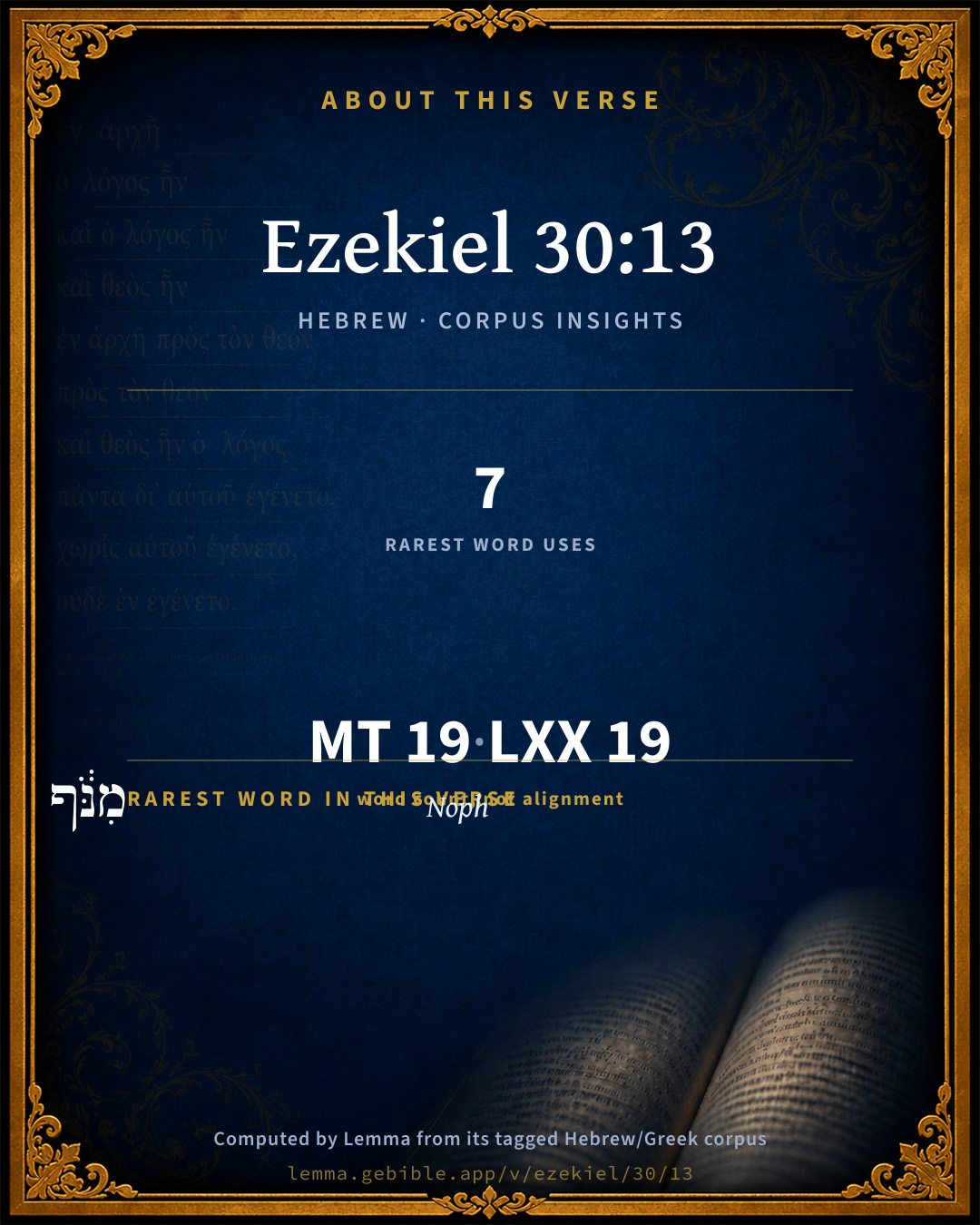
19
words
17
distinct lemmas
Prophets
section

Notable vocabulary

The rarest word here is מִנֹּ֔ף Noph H5297 — appearing just 7 times in the whole Hebrew Bible.

Shared distinctive vocabulary

מִנֹּ֔ף Noph H5297 occurs in 7 verses of the Hebrew Bible. Also found in:

Grammatical profile

  • 5 verbs
  • 11 nouns
  • 2 adverbs
  • 1 particle

Verb forms

  • אָמַ֞ר Qal · Perfect
  • וְהַאֲבַדְתִּ֨י Hiphil · Sequential Perfect
  • וְהִשְׁבַּתִּ֤י Hiphil · Sequential Perfect
  • יִֽהְיֶה Qal · Imperfect
  • וְנָתַתִּ֥י Qal · Sequential Perfect

Repetition

Words recur within this verse — often emphatic in Hebrew:

  • מֵאֶֽרֶץ land H776 ×2
  • מִצְרַ֖יִם Egypt H4714 ×2

Hebrew & Septuagint length

In English translation the verse runs 45 words from the Hebrew and 31 from the Septuagint (LXX English) — the Septuagint runs noticeably shorter here. See the side-by-side →

A rough comparison of the two English renderings, which tokenize alike — not a word-level alignment.

Word counts can differ between the Hebrew and the Greek without any difference in meaning — e.g. the Hebrew direct-object marker אֵת has no separate Greek word, and Greek often adds the article ὁ.

In the original languages it is 19 Hebrew tokens and 19 Greek tokens — but the two are counted differently (Hebrew bundles its prefixes and suffixes into one token; the Greek is in lemma form), so that isn’t a like-for-like length.

Cross-references

12

Topical passages linked to Ezekiel 30:13 in the Treasury of Scripture Knowledge — connected by theme and wording, ordered by reader-vote popularity; previews shown in the World English Bible.

  • Zechariah 10:11 He will pass through the sea of affliction, And will strike the waves in the sea, And all the depths of the Nile will dry up; And the pride of Assyria will be brought down, And the scepter of Egypt will depart.
  • Jeremiah 2:16 The children also of Memphis and Tahpanhes have broken the crown of your head.
  • Jeremiah 46:14 Declare you in Egypt, and publish in Migdol, and publish in Memphis and in Tahpanhes: say you, Stand forth, and prepare you; for the sword has devoured round about you.
  • Exodus 12:12 For I will go through the land of Egypt in that night, and will strike all the firstborn in the land of Egypt, both man and animal. Against all the gods of Egypt I will execute judgments: I am Yahweh.
  • Isaiah 19:1–16 The burden of Egypt. Behold, Yahweh rides on a swift cloud, and comes to Egypt: and the idols of Egypt shall tremble at his presence; and the heart of Egypt shall melt in the midst of it.
  • Jeremiah 43:12–44:1 I will kindle a fire in the houses of the gods of Egypt; and he shall burn them, and carry them away captive: and he shall array himself with the land of Egypt, as a shepherd puts on his garment; and he shall go forth from there in peace.
  • Jeremiah 46:5 Why have I seen it? they are dismayed and are turned backward; and their mighty ones are beaten down, and have fled apace, and don't look back: terror is on every side, says Yahweh.
  • Jeremiah 46:25 Yahweh of Hosts, the God of Israel, says: Behold, I will punish Amon of No, and Pharaoh, and Egypt, with her gods, and her kings; even Pharaoh, and those who trust in him:
  • Ezekiel 29:14–15 and I will bring back the captivity of Egypt, and will cause them to return into the land of Pathros, into the land of their birth; and they shall be there a base kingdom.
  • Hosea 9:6 For, behold, they have gone away from destruction. Egypt will gather them up. Memphis will bury them. Nettles will possess their pleasant things of silver. Thorns will be in their tents.
  • Zephaniah 2:11 Yahweh will be awesome to them, for he will famish all the gods of the land. Men will worship him, everyone from his place, even all the shores of the nations.
  • Zechariah 13:2 It will come to pass in that day, says Yahweh of Hosts, that I will cut off the names of the idols out of the land, and they will no more be remembered; and also I will cause the prophets and the spirit of impurity to pass out of the land.

Cross-references courtesy of OpenBible.info (CC BY 4.0).

Hebrew and Greek witnesses Masoretic Hebrew ↔ Greek Septuagint

The same verse in the two great witnesses to the Old Testament, shown verse-for-verse.

Here the Septuagint runs noticeably shorter than the Hebrew — LXX2012 (modern English Septuagint) 31 words vs World English Bible 45. A rough length comparison of the two English translations, not a word-level alignment — read both below.

These are two independent witnesses, not word-aligned to each other, and the Septuagint is shown in lemma (dictionary) form.

Hebrew Ezekiel 30:13 Masoretic · Westminster Leningrad Codex

כֹּֽה אָמַ֞ר אֲדֹנָ֣י יְהוִ֗ה וְהַאֲבַדְתִּ֨י גִלּוּלִ֜ים וְהִשְׁבַּתִּ֤י אֱלִילִים֙ מִנֹּ֔ף וְנָשִׂ֥יא מֵאֶֽרֶץ מִצְרַ֖יִם לֹ֣א יִֽהְיֶה ע֑וֹד וְנָתַתִּ֥י יִרְאָ֖ה בְּאֶ֥רֶץ מִצְרָֽיִם

Thus says the Lord Yahweh: I will also destroy the idols, and I will cause the images to cease from Memphis; and there shall be no more a prince from the land of Egypt: and I will put a fear in the land of Egypt.

World English Bible · Public Domain

Greek LXX Ezekiel 30:13 Septuagint · lemma form

ὅτι ὅδε λέγω κύριος κύριος καί ἀποὀλλύω μεγιστάν ἀπό μέμφις καί ἄρχων ἐκ γῆ αἴγυπτος καί οὐ εἰμί ἔτι

For thus says the Lord God; I will also destroy the nobles from Memphis, and the princes of Memphis out of the land of Egypt; and they shall be no more.

LXX2012 (modern English Septuagint) · Public Domain

On this verse, Keil & Delitzsch discusses the Septuagint’s reading. Read the note in Commentary ↓

Hebrew: Westminster Leningrad Codex (CC BY 4.0). Greek: Septuagint (public domain); English from LXX2012 (modern English Septuagint) (Public Domain). How the Septuagint differs from the Hebrew →

Targum (Aramaic paraphrase)

1

The Targum is the ancient Jewish Aramaic paraphrase of the Hebrew Scriptures — an interpretive translation, not the Hebrew text itself. Onkelos (literal) and Pseudo-Jonathan (expansive) render the Torah, and Jonathan the Prophets. Coverage is partial: where no permissively-licensed English translation exists for a verse, only the Aramaic is shown. This is verse-level text, not a word-by-word alignment to the Hebrew.

  1. Targum Jonathan Prophets (Joshua–Malachi)
    כִּדְנַן אֲמַר יְיָ אֱלֹהִים וְאַבֵיד דְפָלְחִין לְטַעֲוָתָא וֶאֱשֵׁיצֵי דְפָלְחִין לְצַלְמָנַיָא מִמָפֵס וּמַלְכָּא מֵאַרְעָא דְמִצְרַיִם דַחֲלָא בְּמִצְרַיִם:

    (no public-domain English translation for this verse)

    Targum Jonathan — Aramaic: “Mikraot Gedolot” (public domain). English: “Sefaria Community Translation” (CC0 1.0 (public-domain dedication)); “London "Chaldee Paraphrase," 1871” (public domain). Text via Sefaria.

Commentary

Notes on Ezekiel 30:13 from classic Christian and Jewish commentators (each source and its license shown beneath its notes). The classic Christian expositions comment on the surrounding passage and are grouped to its opening verse, so a note may address several verses; the Jewish commentaries on the Tanakh (Rashi and others) are per-verse, so they appear only where the commentator wrote on this verse.

Lemma curates 59 commentaries, every one of them public domain or Creative Commons licensed, each selected and text-cleaned for this edition rather than reprinted as found. About our sources →

Trapp's Complete Commentary

John Trapp

Eze 30:13 Thus saith the Lord GOD; I will also destroy the idols, and I will cause [their] images to cease out of Noph; and there shall be no more a prince of the land of Egypt: and I will put a fear in the land of Egypt.

Ver. 13. I will also destroy their idols.] He did so by Cambyses. See on Eze 30:6. He doth so still by the Turks. When they invade Popish countries, they break down their mawmets.

Out of Noph.] Called also Moph, {Hos 9:6} afterwards Memphis (the metropolis of idolatry; Nazianzen calleth it ανοια, the mad city, because ειδωλομανης, madly set upon idols, Apis especially), afterwards Babylon, and now Alcair; famous for its incredible greatness, fair situation, pillars and pyramids. It was the seat royal of the sultans, till taken by the Turks from Camson Gaurus and the Mamelukes about the year 1515.

And there shall be no more a prince.] For forty years at least.

John Trapp, A Commentary or Exposition upon All the Books of the Old and New Testament (1647–1656) — public domain. Text from a community e-Sword module.

Joseph Benson's Commentary

Eze 30:13. I will also destroy the idols — Idolatry being one of the principal things for which God visits the infidel nations, he would take particular vengeance upon the idols, thereby showing how much he is superior to them in power. Cambysis, the successor of Cyrus, destroyed the idols of Egypt. I will cause their images to cease out of Noph — Noph, or Memphis, was one of the principal cities of Egypt, a seat of their kings, where their sepulchres stood, one of which is still remaining. It is often mentioned in Scripture. In Hosea it is called Moph, and by many at this day Menoph. This place was famous for the worship of Apis and Osiris, whereupon the prophet, in a particular manner, denounces destruction to the idolatry of that place. And there shall be no more a prince of the land of Egypt — This undoubtedly refers to the future government of Egypt by foreigners, or to the general destruction of the Egyptian princes by Nebuchadnezzar and Amasis. All men know, says Josephus against Appion, 50. 2. sec. 11, Οτι Περσων και μετ’ εκεινους, ηγουμενων της Ασιας Μακεδονων, Αιγυπτοι μεν εδουλευον, ανδραποδων ουδεν διαφεροντες, “That the Egyptians were subject to the Persians, differing nothing from slaves, and after them to the Macedonians, who ruled over Asia.” See the note on Eze 29:15. And I will put a fear in Egypt —

I will make the Egyptians faint-hearted, and not able to defend themselves.

Joseph Benson's Commentary on the Old and New Testaments (1811–1818) — public domain. Text from a community e-Sword module.

Keil & Delitzsch

C. F. Keil & F. Delitzsch

Further Description of the Judgment

Eze 30:13. Thus saith the Lord Jehovah, I will exterminate the idols and cut off the deities from Noph, and there shall be no more a prince from the land of Egypt; and I put terror upon the land of Egypt. Eze 30:14. And I lay Pathros waste, and bring fire into Zoan, and execute judgments upon No; Eze 30:15. And I pour out my fury upon Sin, the stronghold of Egypt, and cut off the multitude of No; Eze 30:16. And I put fire in Egypt; Sin will writhe in pain, and No will be broken open, and Noph - enemies by day. Eze 30:17. The men of On and Bubastus will fall by the sword, and they themselves will go into captivity. Eze 30:18. At Tachpanches the day will be darkened when I shatter the yokes of Egypt there, and an end will be put to its proud haughtiness; cloud will cover it, and its daughters till go into captivity. Eze 30:19. And thus I execute judgments upon Egypt, that they may know that I am Jehovah. - Egypt will lose its idols and its princes (cf. Jer 46:25). גּלּוּלים and אלילים are synonymous, signifying not the images, but the deities; the former being the ordinary epithet applied to false deities by Ezekiel (see the comm. on Eze 6:4), the latter traceable to the reading of Isa 19:1. נף, contracted from מנף, Manoph or Menoph = מף in Hos 9:6, is Memphis, the ancient capital of Lower Egypt, with the celebrated temple of Ptah, one of the principal seats of Egyptian idolatry (see the comm. on Hos 9:6 and Isa 19:13). In Eze 30:13 מארץ מצר' belongs to נשׂיא, there shall be no more a prince from the land of Egypt, i.e., a native prince. נתן יראה, to put fear upon (cf. Eze 26:17). From Lower Egypt Ezekiel passes in Eze 30:14 to Upper Egypt (Pathros, see the comm. on Eze 29:14), which is also to be laid waste, and then names several more of the principal cities of Lower Egypt along with the chief city of Upper Egypt. צען, Egypt. Zane, Copt. Jane, is the Τανίς, Tanis, of the Greeks and Romans, on the Tanitic arm of the Nile, an ancient city of Lower Egypt; see the comm. on Num 13:22 and Isa 19:11. נא = נא אמון in Nah 3:8, probably "abode of Amon," Egypt. P-amen, i.e., house of Amon, the sacred name of Thebes, the celebrated royal city of Upper Egypt, the Διὸς πόλις ἡ μεγάλη of the Greeks (see the comm. on Nah 3:8). סין (literally, mire; compare the Aram. סין) is Πηλούσιον, Pelusium, which derives its name from πηλός (ὠνόμασται ἀπὸ τοῦ πηλοῦ πηλός, Strab. xvii. p. 802), because there were swamps all round. It was situated on the eastern arm of the Nile, to which it gave its name, at a distance of twenty stadia from the sea. The Egyptian name Pehromi also signifies dirty, or muddy. From this the Arabs have made Elfarama; and in the vicinity of the few ruins of the ancient Pelusium there is still a castle called Arab. t, Tineh (compare the Chaldee טינא, clay, in Dan 2:41). Ezekiel calls it the "fortress or bulwark of Egypt," because, as Strabo (l.c.) observes, "Egypt is difficult of access here from places in the East;" for which reason Hirtius (de bell. Al. c. 27) calls it "the key of Egypt," and Suidas (s.v.) "the key both of the entrance and exit of Egypt." On the history of this city, see Leyrer in Herzog's Encyclopaedia. In המון נא many of the commentators find a play upon the name of the god אמון (Jer 46:25), the chief deity of Thebes, which is possible, but not very probable, as we should not expect to find a god mentioned again here after Eze 30:13; and הכרתּי would be inappropriate. - In Eze 30:16 Sin (= Pelusium) is mentioned again as the border fortress, No (= Memphis) as the capital of Upper Egypt, as all falling within the range of the judgment. The expression נף צרי יומם has caused some difficulty and given occasion to various conjectures, none of which, however, commend themselves as either simple or natural explanations.

(Note: Ewald proposes to alter צרי into צדי (after the Aramaean), "rust," and renders it: "Memphis will be eternal rust." But to this Hitzig has very properly objected that in Eze 24:6, Eze 24:11, rust is called חלאה; and that even in Psa 6:3 יומם does not mean perpetual or eternal. Hvernick proposes to explain צרים, from the Aramaean zer', to rend or tear in pieces, "Memphis shall become perpetual rents." To this also it may be objected, that צרים in Hebrew has the standing meaning of oppressors; and that יומם, interdiu, is not equivalent to perpetual; and still further, that the preposition ל could not be omitted before צרי.)

As Hitzig has correctly observed, צרי יומם is the same as שׁדד בּצּהרים in Jer 15:8, and is the opposite of שׁדדי לילה in Oba 1:5. The enemy who comes by day, not in the night, is the enemy who does not shun open attack. The connection with נף is to be explained by the same rule as Jer 24:2, "the one basket - very good figs." Memphis will have enemies in broad daylight, i.e., will be filled with them. און = און, אן, in Gen 41:45, Gen 41:50 (Egyptian An, or Anu), is the popular name of Heliopolis in Lower Egypt (see the comm. on Gen 41:45); and the form און (a vain thing, or idol) is probably selected intentionally in the sense of an idol-city (see the comm. on Hos 4:15), because On-Heliopolis (בּית־שׁמשׁ in Jer 43:13) was from time immemorial one of the principal seats of the Egyptian worship of the sun, and possessed a celebrated temple of the sun, with a numerous and learned priesthood (see the comm. on Gen 41:45, ed. 2). פּי־בסת, i.e., βουβαστός (lxx), or βουβαστίν (Herod. ii. 59), Egyptian Pi-Pasht, i.e., the place of Pasht, so called from the cat-headed Bubastis or Pasht, the Egyptian Diana, which was worshipped there in a splendid temple. It was situated on the royal canal leading to Suez, which was begun by Necho and finished under Ptolemy II, not far from its junction with the Pelusiac arm of the Nile. It was the chief seat of the Nomos Bubastites, was destroyed by the Persians, who demolished its walls (Diod. Sic. xvi. 51), and has entirely disappeared, with the exception of some heaps of ruins which still bear the name of Tel Bastah, about seven hours' journey from the Nile (compare Ges. Thes. pp. 1101ff., and Leyrer in Herzog's Encyclopaedia, s.v.). The Nomos of Bubastis, according to Herod. ii. 166, was assigned to the warrior-caste of Calasirians. The בּחוּרים, the young military men, will fall by the sword; and הנּה, not αἱ γυναῖκες (lxx and others), but the cities themselves, i.e., their civil population as distinguished from the military garrison, shall go into exile. This explanation of הנּה is commended by בּנותיה in Eze 30:18. תּחפנחס or תּחפּנחס (Jer 43:7., Eze 44:1; Eze 46:14), and תּחפנס in Jer 2:16 (Chetib), is Τάφναι, Τάφνη (lxx), or Δάφναι (Herod. ii. 30. 107), a frontier city of Egypt in the vicinity of Pelusium, after the time of Psammetichus a fortification with a strong garrison, where a palace of Pharaoh was also to be found, according to Jer 43:9. After the destruction of Jerusalem, a portion of the Jews took refuge there, and to them Jeremiah predicted the punishment of God on the conquest of Egypt by Nebuchadnezzar (Jer 43:7., Eze 44:1.). In the case of השך the reading varies; the printed Masora at Gen 39:3 giving חשׂך as the reading to be found in all the codices examined by the author of the Masora; whereas many of the codices and printed editions have חשׁך, and this is adopted in all the ancient versions. This is evidently the correct reading, as חשׂך does not furnish an appropriate meaning, and the parallel passages, Eze 32:8; Isa 13:10; Joe 3:4; Amo 8:9, all favour חשׁך. The darkening of the day is the phenomenal prognostic of the dawning of the great day of judgment upon the nations (cf. Joe 2:10; Joe 3:4, Joe 3:15; Isa 13:10, etc.). This day is to dawn upon Egypt at Tachpanches, the border fortress of the land towards Syria and Palestine, when the Lord will break the yokes of Egypt. These words point back to Lev 26:13, where the deliverance of Israel from the bondage of Egypt is called the breaking in pieces of its yokes (see also Eze 34:27). That which took place then is to be repeated here. The yokes which Egypt put upon the nations are to be broken; and all the proud might of that kingdom is to be brought to an end (גּאון עזּהּ, as in Eze 30:6). In Eze 30:18, היא, which stands at the head in an absolute form, points back to בּתּחפנחס. The city (Daphne) will be covered with cloud, i.e., will be overthrown by the judgment; and her daughters, i.e., the smaller cities and hamlets dependent upon her (cf. Eze 16:46 and Eze 26:6), will go into captivity in the persons of their inhabitants. It follows from this that Daphne was the chief city of a Nomos in Lower Egypt; and this is confirmed by the circumstance that there was a royal palace there. If we compare the threat in this verse, that in Tachpanches an end is to be put to the proud might of Pharaoh, with the threatening words of Jer 43:9., to the effect that Nebuchadnezzar would set up his throne at Tachpanches and smite Egypt, it is evident that the situation of Daphne must at that time have been such that the war between Egypt and Babylonia would necessarily be decided in or near this city. These prophetic utterances cannot be explained, as Kliefoth supposes, from the fact that many Jews had settled in Daphne; nor do the contents of this verse furnish any proof that Ezekiel did not utter this prophecy of his till after the Jews had settled there (Jer 43:1-13 and 44). Eze 30:19 serves to round off the prophecy.

Keil & Delitzsch — Biblical Commentary on the Old Testament (1861–1891) — public domain (CC PDM 1.0). Text via the HelloAO Bible API. (Old Testament only.)

Tyndale Open Study Notes

Tyndale Open Resources

30:13-14 From Memphis, the most important city in the north, to Thebes, the most important city in the south, all of the cities of Egypt would be destroyed.

Tyndale Open Study Notes — © Tyndale Open Resources, licensed CC BY-SA 4.0. Text via the HelloAO Bible API.

Geneva Bible (1599)

Geneva Bible translators

Or, Memphis, or Cairo.

Geneva Bible (1599) marginal notes — public domain. Text via Bolls.life.

Jamieson, Fausset & Brown

Robert Jamieson, A. R. Fausset & David Brown

Noph--Memphis, the capital of Middle Egypt, and the stronghold of "idols." Though no record exists of Nebuchadnezzar's "destroying" these, we know from HERODOTUS and others, that Cambyses took Pelusium, the key of Egypt, by placing before his army dogs, cats, &c., all held sacred in Egypt, so that no Egyptian would use any weapon against them. He slew Apis, the sacred ox, and burnt other idols of Egypt.

no more a prince--referring to the anarchy that prevailed in the civil wars between Apries and Amasis at the time of Nebuchadnezzar's invasion. There shall no more be a prince of the land of Egypt, ruling the whole country; or, no independent prince.

Jamieson, Fausset & Brown — Commentary Critical and Explanatory on the Whole Bible (1871) — public domain (CC PDM 1.0). Text via the HelloAO Bible API.

Adam Clarke's Commentary

Verse 13. Their images to cease out of Noph] Afterwards Memphis, and now Cairo or Kahira. This was the seat of Egyptian idolatry; the place where Apis was particularly worshipped.

No more a prince of the land of Egypt] Not one, from that time to the present day. See Clarke on Eze 29:14.

Adam Clarke's Commentary on the Bible (1810–1826) — public domain. Text from a community e-Sword/MySword module.

Ellicott's Commentary for English Readers

(13) Noph.—A contraction of Menoph, Memphis, the capital of Lower Egypt, situated in the region of the Pyramids, the seat of several dynasties, one of the chief centres of Egyptian idolatry, and celebrated for its Temple of Ptah.

There shall be no more a prince is to be understood, in accordance with the rest of the prophecy, not absolutely, but relatively: there shall be no more a native prince possessing the power of former kings.

A Bible Commentary for English Readers, edited by Charles John Ellicott (1878–1897) — public domain. Text from a community e-Sword module.

The Cambridge Bible for Schools and Colleges

gen. ed. J. J. S. Perowne

13. destroy the idols] On “idols” ch. Eze_6:5. The clause fails in LXX.

their images to cease] Lit., their not-gods, a favourite term of Isaiah’s, e.g. Eze_19:1; Eze_19:3, though found only here in Ezek. For “not-gods” (elîlim) LXX. renders “magnates” (elim), which no doubt gives a good parallelism to the next clause; cf. Isa_34:12.

put a fear] Cf. Isa_19:16, Egypt “shall fear because of the shaking of the hand of the Lord of hosts, which he shaketh over it.” Noph (in Hos_9:6 Moph) is Memphis, the most important city of lower Egypt, lying on the left bank of the Nile, somewhat south of the modern Cairo. Isa_19:13; Jer_2:16; Jer_44:1; Jer_46:14.

The Cambridge Bible for Schools and Colleges (gen. ed. J. J. S. Perowne; Cambridge University Press, 1878–1918) — public domain. Text from a community e-Sword module.

John Gill's Exposition

Thus saith the Lord God, I will also destroy the idols,.... With which Egypt abounded, making an idol of all sorts of creatures, rational and irrational, animate and inanimate, and in which they trusted; wherefore these being destroyed, they had nothing to put their confidence in:

I will cause their images to cease out of Noph; called Moph, Hos 9:6 and which we there rightly render Memphis, as many versions do here, and was very famous for idolatry: here stood the temple of Serapis, and the temple of other idols; here Isis and Osiris were worshipped; and it was in Jerom's time, as he says, the metropolis of the Egyptian superstition. It was built by Menes (s), the Mizraim of the Scriptures, the first king of Egypt; though Diodorus Siculus (t) makes Uchoreus to be the founder of it. Some interpreters take this city to be the same with what is now called Alkair, or Grand Cairo; or, however, that this is built upon the same spot, or near the same place that was, in which I have followed them on Isa 19:13 whereas Cairo stands right over against old Memphis, the Nile being between them, on the east side of it, and Memphis on the west; as is clear from Herodotus (u), and from the charts of Dr. Shaw, and Mr. Norden; and who observe, that some take the place of it to have been where a village now stands, Dr. Shaw calls Geza, and Mr. Norden Gize:

and there shall be no more a prince of the land of Egypt; that is, a native of that country; or that should rule over the whole of it, and in that grandeur the kings of Egypt had before; or, however, not dwell in Memphis, which was the seat of the kings of Egypt, but now should be so no more: when Egypt was conquered by Nebuchadnezzar, it was under the Babylonians; and then under the Persians; and then under the Greeks; and afterwards under the Romans; since under the Saracens and Mamalucks; and now in the hands of the Turks; so that it never recovered its former glory; and indeed, after Nectanebus was driven out of it by Ochus, king of Persia, it never after had a king:

and I will put a fear in all the land of Egypt; a panic in all the inhabitants of it; as soon as they shall hear of the king of Babylon entering into it, their courage, bravery, and fortitude, shall at once leave them, and they shall be dispirited, and have no heart to defend themselves, and oppose the enemy.

(s) Herodot, Euterpe, sive l. 2. c. 99. (t) Bibliothec. l. 1. p. 46. (u) Euterpe, sive l. 2. c. 99.

John Gill's Exposition of the Whole Bible (1746–1763) — public domain (CC PDM 1.0). Text via the HelloAO Bible API.

Albert Barnes' Notes on the Bible

Noph - Memphis Isa 19:13.

Albert Barnes' Notes on the Bible (1834–1885) — public domain. Text from a community e-Sword/MySword module.

Haydock's Catholic Bible Commentary

Memphis, the capital of Lower Egypt, (Calmet) where the idol or bull (Haydock) Apis was fed. (Calmet) --- Here Amasis overcame Apries. (Herodotus ii. 168.) --- The Chaldeans made war on the gods as well as on the people. --- Prince Amasis was tributary to Babylon. Some of this probably regards the times of Cambyses and Ochus. (Usher, the year of the world 3478 and 3653.) (Calmet) See chap. xxix. 14. (Haydock)

George Leo Haydock (1774–1849), Haydock's Catholic Family Bible and Commentary, 1859 edition — public domain. Excludes Psalms (Douay-Rheims chapter numbering differs from Protestant) and Deuterocanonical books (Catholic canon only).

Matthew Poole's English Annotations

I will also destroy; God did it by the Babylonians; those proud and impious nations did triumph over the gods of the conquered, and out of contempt of them burnt them or broke them, as is well known; so Sennacherib threatened, 2Ch 32:19; Isa 37:19,24, against the true God, as he did to idol gods.

The idols; dunghill gods, as the words, fitter to be trod under foot than to be decked and respected.

Their images; these nothings, as the word imports; whoever destroyed the image destroyed the god, for it was nothing but an image.

Noph; Memphis, now Grand Cairo, the chief city of the country, the seat of their kings first, of their priests by consequence, and of all their several gods too; but the Chaldeans destroyed the nest and birds too.

A prince; either an Egyptian horn, or independent, or over all Egypt, or that shall have the power, wealth, or honour like a former brave Egyptian king. A fear of consternation and cowardice, that should disable them for counsel and action in their most urgent affairs.

Matthew Poole's English Annotations on the Holy Bible (1683–1685) — public domain. Text from a community e-Sword/MySword module.

Whedon's Commentary on the Bible

Daniel D. Whedon

13. Images — Hebrews, no-gods. By the omission of one syllable the LXX. reads, “great ones.”

Noph — LXX., Memphis, as Hos_9:6; “Moph” (Assyrian, Mi-im-pi). Memphis, the splendid capital of the ancient empire, is to-day no more than a dust heap connected with the most magnificent cemetery on earth.

Daniel D. Whedon (gen. ed.), Commentary on the Old and New Testaments (1874–1909) — public domain. Text from a community e-Sword module.

The Pulpit Commentary

Noph, or, as in Hos_9:6, Moph, is a form of the Egyptian M"noph, the reek Memphis (so in the LXX), the capital of Lower Egypt, the chief center of the worship of Phthah, whom the Greeks identified with Hephaestos. Hence the special mention of the idols and images.

Destroying idols.

Egypt was a land of innumerable idols. In the general desolation that was approaching, not only would these idols prove themselves useless protectors, they themselves would share the fate of their patrons. The idols are destroyed in the ruin of the idolaters.

I THERE IS NO DEFENSE IN IDOLS. This is a lesson for the heathen. But not only pagans who worship images of wood and stone need to learn it; men who despise the superstitions of heathendom have their own superstitions and practice their own idolatry, and the lesson is also for such people.

1. Every substitute for God is an idol. What a man loves supremely and trusts in absolutely is his god. One man thus idolizes his money, believing that he has only to draw a check to frighten away the most dreadful calamity. Another makes an idol of his own ability, his skill, energy, or cleverness, proudly supposing that he is equal to any emergency. A third worships a theory, and imagines, say, that the general course of evolution will assuredly bring all right. A fourth idolizes his own religious experience, and, instead of trusting God, puts his faith in his own saintliness.

2. No idol will preserve its worshipper. Money, ability, theory, saintliness, all fail in the hour of trial, as surely as the sacred hawks and eats of Egypt proved useless in face of the march of the Chaldean army.

II GOD WILL DESTROY IDOLS. The idols of Egypt were to be destroyed in the general havoc of the invasion. The Philistine god Dagon fell down and was broken before the ark of the Lord. (1Sa_5:4) The false hope will be laid low. It may be done speedily; if so, we may thank God for a merciful deliverance. It may be long delayed, and not even seen during the present life. Dives lives clad in purple and fine linen, and faring sumptuously till the end of his days. The rich fool is not disillusioned till the very night of his death. But in the next world, if not in this, men must see things in their true light. A happier destruction of idols comes through the revelation of their vanity in the light of God"s truth. This is the Christian method of iconoclasm. The missionary will do little good if he simply rails at the folly and sin of idol-worship. But if he makes men know of the existence of the one spiritual God, the idols will disappear without his taking any trouble to hew them down. Idols vanish from the soul when the vision of Christ is received.

III THE DESTRUCTION OF HIS IDOLS IS FOR THE SALVATION OF THE IDOLATER. There is redemption in the Divine iconoclasm. Idols delude men, hold them in bondage to superstition, degrade their souls, and blot out the view of the true heavens. God, seeing a rich man worshipping gold, snatches the fatal idol away and plunges the man into poverty that there he may learn to search for the true treasure of the kingdom of heaven. Earthly loss is often thus sent to clear away obstructions that hide us from seeing what are our souls" true possessions. But the mere destruction of idols is not itself a salvation. It is remarkable that Christian and European education is rapidly destroying the native idolatry of India; but it is questionable how far this is a gain if nothing is substituted but a hard and scornful agnosticism. When the idols are cast out of our lives, we need that the Christ shall come in and bring his new life.

Idols destroyed.

It is well known, from the records of ancient history, and from the explorations and studies of Egyptologists of our own century, that the land of the Pharaohs was the seat of idolatry of the most deeply rooted, widespread, and at the same time most debasing and contemptible kind. It was not possible that the prophet of the Lord, in rebuking Egypt, should confine himself to the region of polities; he could not but deal with the religion and the religious practices which prevailed in the land of immemorial superstition. His words upon this matter are few, but they are clear, direct, and powerful. "Thus saith the Lord God, I will also destroy the idols, and I will cause their images to cease from Noph.

I THE VANITY AND INABILITY OF IDOLS TO HELP THOSE WHO TRUST IN THEM.

II THE HELPLESSNESS OF THEIR DEVOTEES TO RETAIN FOR IDOLS THE ALLEGIANCE OF THEIR WORSHIPPERS.

III THE CERTAINTY THAT PROVIDENTIAL OCCURRENCES WILL SHAKE THE CONFIDENCE OF IDOLATERS IN THEIR IDOLS, AND WILL BRING IDOLATRY TO NAUGHT.

IV THE DIVINE PROVISION THAT, AS IDOLS ARE CONFOUNDED, THE TRUE AND ONLY GOD WILL BE EXALTED.

APPLICATION.

1. The principles underlying this prophecy are a great encouragement to all those who labor for the propagation of the gospel among the heathen; their labors shall, sooner or later, meet with a full success and recompense.

2. There is here an implicit counsel as to the replacing of idolatry by true religion. It is one thing to destroy, another thing to construct. In our Indian dominions at the present time, education is shaking the faith of the native population in their idols and idol-worship. But in very many instances, education has done nothing to supply the place made vacant by the exorcism of superstition. Hence the importance of philosophical and historical instruction in connection with Christian missions; so that provision may be made for the deep-seated needs of the spirit of man, so that a reasonable faith in the Supreme may be encouraged, and so that the evidences of supernatural Christianity may be presented in a convincing and satisfying form. It should be the aim of the Church, in her missionary capacity, to replace idolatry, not by an irrational atheism or a degrading secularism, but by intelligent and scriptural Christianity. T.

The Pulpit Commentary (1880–1919), ed. H.D.M. Spence-Jones & Joseph S. Exell — public domain. Text from a community e-Sword module.

John Wesley's Explanatory Notes

Noph - Memphis, now Grand Cairo, the chief city of the country. A prince - Either an Egyptian born, or independent, and over all Egypt. A fear - Consternation and cowardice.

John Wesley, Explanatory Notes Upon the Whole Bible (1754–1765) — public domain. Text via the GEBible commentary corpus.

unfoldingWord translationNotes

Door43 World Missions Community

The Lord Yahweh says this

The word "this" refers to what follows. See how you translated this in Ezekiel 5:5.

I will bring an end to the worthless idols

"I will destroy the worthless idols"

Memphis

Memphis was a very important city in Egypt. It was near modern-day Cairo. (See: How to Translate Names)

a prince in the land of Egypt

"an important ruler in the land of Egypt"

I will put terror on the land of Egypt

Here "put terror on the land" represents causing the people of the land to be very afraid. AT: "I will make the people of Egypt very afraid" (See: Metaphor)

Pathros

This was a region in southern Egypt.

set fire in Zoan

"I will burn Zoan with fire"

Zoan

Zoan was another important city in Egypt.

I will execute acts of judgment on Thebes

The phrase "acts of judgment" refers to punishment. AT: "I will punish Thebes" (See: Abstract Nouns)

Thebes

This was the capital city of southern Egypt.

translationWords

Lord Yahweh

false god

prince

terror

desolate

fire

judge

unfoldingWord translationNotes — © Distant Shores Media and the Door43 World Missions Community, licensed CC BY-SA 4.0. Source: git.door43.org/Door43/en_tn.

Lesson kit

Teaching starters — assembled from the data on this page, not authored interpretation. Every prompt links to the verse data it draws on. Edit before teaching.

Ezekiel, in the Prophets, opens this verse with 19 words (17 distinct Hebrew lemmas). Its most distinctive word is Nôph (“Noph”). The Greek Septuagint runs shorter here. A historical commentator’s framing appears above. Read the whole chapter for the surrounding context.

Discussion questions

  1. The word Nôph carries the sense “Noph.” How does it shape the verse?
  2. Isaiah 19:13 shares the word «Noph» with this verse. How do the two illuminate each other?
  3. “land” occurs 2× in this one verse. What is the effect of the repetition?
  4. Compared with the Hebrew, the Septuagint runs shorter here. What questions does that raise?
  5. These translations render this verse differently. What is at stake in choosing one wording over another?
  6. The verb «אָמַ֞ר» is Qal Perfect. How does its form color the action?
  7. Reading how Trapp's Complete Commentary and Joseph Benson's Commentary read this verse, where do the two commentators agree and where do they part?

Things to notice

Reading settings

Reading text

Shown beneath each verse's original-language words.

Old Testament
Old Testament edition

Read the OT as the Masoretic Hebrew (MT) or the Greek Septuagint (LXX).

English shown for the Greek Septuagint (in the Hebrew ↔ Greek comparison).

Comparing translations? Open the Compare panel on any verse page to stack up to four side by side.