
Jeremiah 43:12

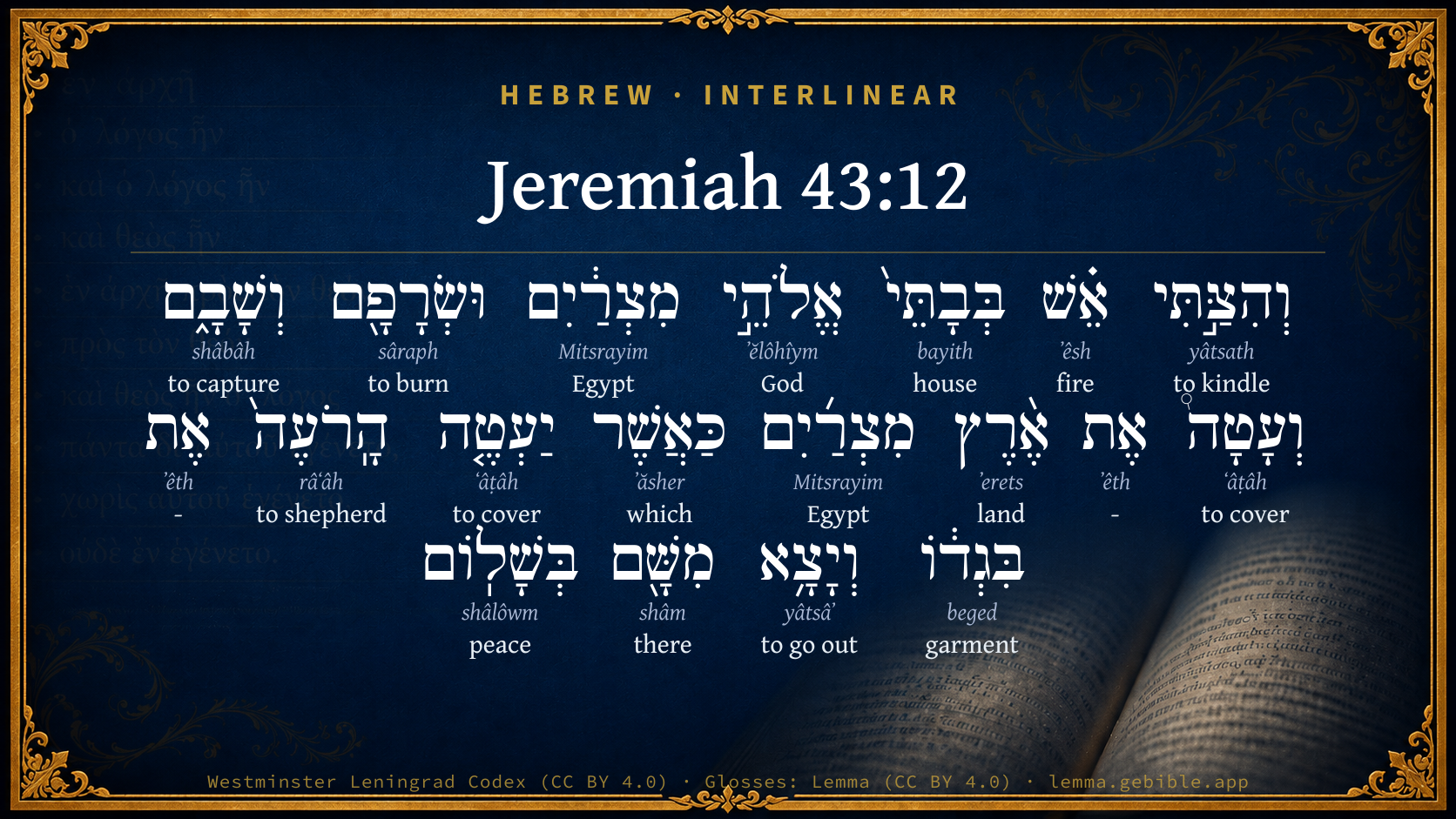
Hebrew (Westminster Leningrad Codex) Jeremiah 43:12 appears in the Hebrew Old Testament. The text above is from the Westminster Leningrad Codex. Each word links to its Strong’s number, a concise gloss, and parsing drawn from the Open Scriptures Hebrew Bible morphology. Click any word for its full Brown-Driver-Briggs (BDB) entry.
Download image
Cite this verse

Jeremiah 43:12 (World English Bible). Public Domain. Lemma interlinear Bible study tool, https://lemma.gebible.app/v/jeremiah/43/12.

Show BibTeX & RIS
BibTeX
RIS
English Translation
I will kindle a fire in the houses of the gods of Egypt; and he shall burn them, and carry them away captive: and he shall array himself with the land of Egypt, as a shepherd puts on his garment; and he shall go forth from there in peace.
World English Bible · Public Domain
Download a study sheet

One document with this verse’s original text, its word-by-word gloss line, the meaning frame, cross-references with their text, attributed commentary, and full source and license credits — printable, and it pastes into notes with its structure intact.

This verse Autodidact and up

Study sheet (.html) Plain text (.txt)

A passage Seminary Student

Up to 50 verses in one chapter. A passage sheet keeps up to 6 commentary sources and 12 cross-references per verse, in the order this page ranks them, and says so on the sheet whenever that leaves anything out. Ask for a single verse and you get the Autodidact verse sheet above.

Everything on this page stays free to read, with no account — the sheet is a download of what is already on screen, not access to it.

Want to remove ads? Support Godless Engineer
Compare translations 3

The same verse in 3 English versions, stacked beneath the original-language interlinear above. Click any original word for its lexicon entry.

Each is an independent rendering of the whole verse — the interlinear is not word-aligned to these translations.

Highlighted words mark where these versions differ — a whole-verse word diff, not a word-by-word alignment.

  • World English Bible Public Domain
    I will kindle a fire in the houses of the gods of Egypt; and he shall burn them, and carry them away captive: and he shall array himself with the land of Egypt, as a shepherd puts on his garment; and he shall go forth from there in peace.
  • King James Version Public Domain
    And I will kindle a fire in the houses of the gods of Egypt; and he shall burn them, and carry them away captives: and he shall array himself with the land of Egypt, as a shepherd putteth on his garment; and he shall go forth from thence in peace.
  • unfoldingWord Literal Text CC BY-SA 4.0
    Then I will light a fire in the temples of Egypt’s gods. Nebuchadnezzar will burn them or capture them. He will clean out the land of Egypt just as shepherds clean vermin off their clothes. He will go out from that place in victory.

unfoldingWord Literal Text — © unfoldingWord, licensed CC BY-SA 4.0. Word-aligned USFM3 via Door43 (git.door43.org/unfoldingWord/en_ult).

Versions to compare (up to 4)

3 of 4 selected

Show all 18 translations

Every available English version of this verse, each an independent rendering of the whole verse.

  • World English Bible Public Domain
    I will kindle a fire in the houses of the gods of Egypt; and he shall burn them, and carry them away captive: and he shall array himself with the land of Egypt, as a shepherd puts on his garment; and he shall go forth from there in peace.
  • Berean Standard Bible Public Domain
    I will kindle a fire in the temples of the gods of Egypt, and Nebuchadnezzar will burn those temples and take their gods as captives. So he will wrap himself with the land of Egypt as a shepherd wraps himself in his garment, and he will depart from there unscathed.
  • Majority Standard Bible Public Domain
    I will kindle a fire in the temples of the gods of Egypt, and Nebuchadnezzar will burn those temples and take their gods as captives. So he will wrap himself with the land of Egypt as a shepherd wraps himself in his garment, and he will depart from there unscathed.
  • King James Version Public Domain
    And I will kindle a fire in the houses of the gods of Egypt; and he shall burn them, and carry them away captives: and he shall array himself with the land of Egypt, as a shepherd putteth on his garment; and he shall go forth from thence in peace.
  • American Standard Version (1901) Public Domain
    And I will kindle a fire in the houses of the gods of Egypt; and he shall burn them, and carry them away captive: and he shall array himself with the land of Egypt, as a shepherd putteth on his garment; and he shall go forth from thence in peace.
  • Revised Version (1885) Public Domain
    And I will kindle a fire in the houses of the gods of Egypt; and he shall burn them, and carry them away captives: and he shall array himself with the land of Egypt, as a shepherd putteth on his garment; and he shall go forth from thence in peace.
  • Geneva Bible (1599) Public Domain
    And I wil kindle a fire in the houses of the gods of Egypt, and he shall burne them and carie them away captiues, and he shall aray himself with the land of Egypt, as a shepheard putteth on his garment, and shall depart from thence in peace.
  • Douay-Rheims (1899) Public Domain
    And he shall kindle a fire in the temples of the gods of Egypt, and he shall burn them, and he shall carry them away captives: and he shall array himself with the land of Egypt, as a shepherd putteth on his garment: and he shall go forth from thence in peace.
  • Young's Literal Translation Public Domain
    And I have kindled a fire in the houses of the gods of Egypt, and it hath burned them, and he hath taken them captive, and covered himself with the land of Egypt, as cover himself doth the shepherd with his garment, and he hath gone forth thence in peace;
  • Literal Standard Version CC BY-SA 4.0
    And I have kindled a fire in the houses of the gods of Egypt, and it has burned them, and he has taken them captive, and covered himself with the land of Egypt, as the shepherd covers himself with his garment, and he has gone forth there in peace;
  • Unlocked Literal Bible CC BY-SA 4.0
    Then I will light a fire in the temples of Egypt's gods. Nebuchadnezzar will burn them or capture them. He will clean out the land of Egypt just as shepherds clean vermin off their clothes. He will go out from that place in victory.
  • unfoldingWord Literal Text CC BY-SA 4.0
    Then I will light a fire in the temples of Egypt’s gods. Nebuchadnezzar will burn them or capture them. He will clean out the land of Egypt just as shepherds clean vermin off their clothes. He will go out from that place in victory.
  • Darby Bible Public Domain
    And I will kindle a fire in the houses of the gods of Egypt, and he shall burn them, and carry them away captive; and he shall array himself with the land of Egypt, as a shepherd putteth on his garment; and he shall go forth from thence in peace.
  • World Messianic Bible Public Domain
    I will kindle a fire in the houses of the gods of Egypt. He will burn them, and carry them away captive. He will array himself with the land of Egypt, as a shepherd puts on his garment; and he will go out from there in peace.
  • Webster's Bible Public Domain
    And I will kindle a fire in the houses of the gods of Egypt; and he shall burn them, and carry them away captives: and he shall array himself with the land of Egypt, as a shepherd putteth on his garment; and he shall go forth from thence in peace.
  • Free Bible Version CC BY-SA 4.0
    I will set fire to the temples of the gods of Egypt. Nebuchadnezzar will burn them and loot their idols. He will pick the land of Egypt clean like a shepherd picks his cloak clean of fleas, and he will leave unharmed.
  • Bible in Basic English Public Domain
    And he will put a fire in the houses of the gods of Egypt; and they will be burned by him: and he will make Egypt clean as a keeper of sheep makes clean his clothing; and he will go out from there in peace.
  • JPS Tanakh (1917) Public Domain
    And I will kindle a fire in the houses of the gods of Egypt; and he shall burn them, and carry them away captives; and he shall fold up the land of Egypt, as a shepherd foldeth up his garment; and he shall go forth from thence in peace.

Literal Standard Version (2020), Covenant Press — licensed CC BY-SA 4.0. Text via the HelloAO Bible API (eBible.org). Unlocked Literal Bible (unfoldingWord) — licensed CC BY-SA 4.0. Text via the HelloAO Bible API (eBible.org). unfoldingWord Literal Text — © unfoldingWord, licensed CC BY-SA 4.0. Word-aligned USFM3 via Door43 (git.door43.org/unfoldingWord/en_ult). Free Bible Version, Dr. Jonathan Gallagher — licensed CC BY-SA 4.0. Text via the HelloAO Bible API (eBible.org).

Word by word

More ways to search: Search by grammar → Find every occurrence → Compare this word →

Practice this passage: Drill this verse → Learn its vocabulary →

וְעָטָה֩
ʻâṭâh
H5844
“and · to cover”
Conjunction + Verb, Qal, Sequential Perfect, 3rd Person, Masculine, Singular
Part of Speech
Conjunction + Verb
Stem
Qal
Form
Sequential Perfect
Person
3rd Person
Gender
Masculine
Number
Singular
Full BDB Definition

Origin: a primitive root

TWOT: 1601 , 1602

to cover, enwrap, wrap oneself, envelop oneself - (Qal) - to wrap, envelop oneself - to cover (the beard in mourning) - mourner, one who covers (participle) - (Hiphil) to cover, enwrap, envelop - to grasp - (Qal) to grasp
  1. וְהִצַּ֣תִּי yâtsath H3341 “and · to kindle” Conjunction + Verb, Hiphil, Sequential Perfect, 1st Person, Common, Singular
  2. אֵ֗שׁ ʼêsh H784 “fire” Noun, Common, Both, Singular, Absolute
  3. בְּבָתֵּי֙ bayith H1004 “in/at · houses of” Preposition + Noun, Common, Masculine, Plural, Construct
  4. אֱלֹהֵ֣י ʼĕlôhîym H430 “God(s) of” Noun, Common, Masculine, Plural, Construct
  5. מִצְרַ֔יִם Mitsrayim H4714 “Egypt” Noun, Proper
  6. וּשְׂרָפָ֖ם sâraph H8313 “and · to burn · them” Conjunction + Verb, Qal, Sequential Perfect, 3rd Person, Masculine, Singular + Suffix, Personal, 3rd Person, Masculine, Plural
  7. וְשָׁבָ֑ם shâbâh H7617 “and · to capture · them” Conjunction + Verb, Qal, Sequential Perfect, 3rd Person, Masculine, Singular + Suffix, Personal, 3rd Person, Masculine, Plural
  8. אֶת ʼêth H853 “-” Particle, Direct Object
  9. אֶ֨רֶץ ʼerets H776 “land of” Noun, Common, Both, Singular, Construct
  10. מִצְרַ֜יִם Mitsrayim H4714 “Egypt” Noun, Proper
  11. כַּאֲשֶׁר ʼăsher H834 “like/as · which” Preposition + Particle, Relative
  12. יַעְטֶ֤ה ʻâṭâh H5844 “to cover” Verb, Qal, Imperfect, 3rd Person, Masculine, Singular
  13. הָֽרֹעֶה֙ râʻâh H7462 “the · shepherding” Particle, Definite Article + Verb, Qal, Participle Active, Masculine, Singular, Absolute
  14. אֶת ʼêth H853 “-” Particle, Direct Object
  15. בִּגְד֔וֹ beged H899 “garment · his” Noun, Common, Masculine, Singular, Construct + Suffix, Personal, 3rd Person, Masculine, Singular
  16. וְיָצָ֥א yâtsâʼ H3318 “and · to go out” Conjunction + Verb, Qal, Sequential Perfect, 3rd Person, Masculine, Singular
  17. מִשָּׁ֖ם shâm H8033 “from · there” Preposition + Adverb
  18. בְּשָׁלֽוֹם shâlôwm H7965 “in/at · peace” Preposition + Noun, Common, Masculine, Singular, Absolute

About this verse

These counts appear in no published source. They are computed here, from the morphology-tagged text and Lemma’s own curated glosses. What Lemma adds →

19
words
16
distinct lemmas
Prophets
section

Notable vocabulary

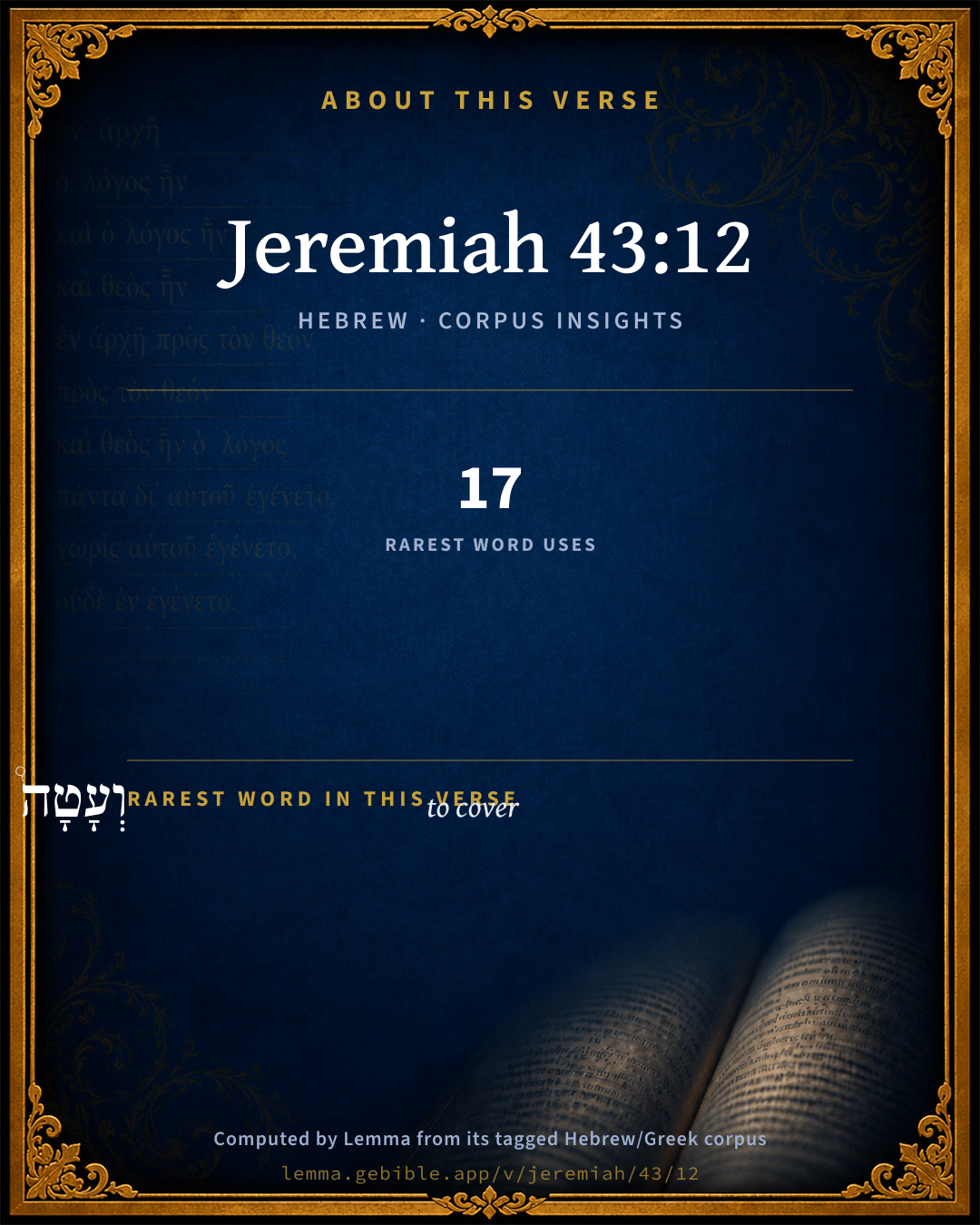
The rarest word here is וְעָטָה֩ to cover H5844 — appearing just 17 times in the whole Hebrew Bible.

Shared distinctive vocabulary

וְעָטָה֩ to cover H5844 occurs in 15 verses of the Hebrew Bible. Also found in:

Grammatical profile

  • 7 verbs
  • 8 nouns
  • 1 adverb
  • 3 particles

Verb forms

  • וְהִצַּ֣תִּי Hiphil · Sequential Perfect
  • וּשְׂרָפָ֖ם Qal · Sequential Perfect
  • וְשָׁבָ֑ם Qal · Sequential Perfect
  • וְעָטָה֩ Qal · Sequential Perfect
  • יַעְטֶ֤ה Qal · Imperfect
  • הָֽרֹעֶה֙ Qal · Participle Active
  • וְיָצָ֥א Qal · Sequential Perfect

Repetition

Words recur within this verse — often emphatic in Hebrew:

  • מִצְרַ֔יִם Egypt H4714 ×2
  • וְעָטָה֩ to cover H5844 ×2

Cross-references

27

Topical passages linked to Jeremiah 43:12 in the Treasury of Scripture Knowledge — connected by theme and wording, ordered by reader-vote popularity; previews shown in the World English Bible.

  • Ezekiel 30:13 Thus says the Lord Yahweh: I will also destroy the idols, and I will cause the images to cease from Memphis; and there shall be no more a prince from the land of Egypt: and I will put a fear in the land of Egypt.
  • Psalms 109:18–19 He clothed himself also with cursing as with his garment. It came into his inward parts like water, Like oil into his bones.
  • Isaiah 19:1 The burden of Egypt. Behold, Yahweh rides on a swift cloud, and comes to Egypt: and the idols of Egypt shall tremble at his presence; and the heart of Egypt shall melt in the midst of it.
  • Isaiah 49:18 Lift up your eyes round about, and see: all these gather themselves together, and come to you. As I live, says Yahweh, you shall surely clothe you with them all as with an ornament, and gird yourself with them, like a bride.
  • Jeremiah 46:25 Yahweh of Hosts, the God of Israel, says: Behold, I will punish Amon of No, and Pharaoh, and Egypt, with her gods, and her kings; even Pharaoh, and those who trust in him:
  • Jeremiah 48:7 For, because you have trusted in your works and in your treasures, you also shall be taken: and Chemosh shall go forth into captivity, his priests and his princes together.
  • Exodus 12:12 For I will go through the land of Egypt in that night, and will strike all the firstborn in the land of Egypt, both man and animal. Against all the gods of Egypt I will execute judgments: I am Yahweh.
  • 2 Samuel 5:21 They left their images there; and David and his men took them away.
  • Esther 6:9 and let the clothing and the horse be delivered to the hand of one of the king's most noble princes, that they may array the man therewith whom the king delights to honor, and cause him to ride on horseback through the street of the city, and proclaim before him, Thus shall it be done to the man whom the king delights to honor.
  • Job 40:10 "Now deck yourself with excellency and dignity. Array yourself with honor and majesty.
  • Psalms 104:2 He covers himself with light as with a garment. He stretches out the heavens like a curtain.
  • Psalms 132:16 Her priests I will also clothe with salvation. Her saints will shout aloud for joy.
  • Psalms 132:18 I will clothe his enemies with shame, But on himself, his crown will be resplendant."
  • Isaiah 21:9 and, behold, here comes a troop of men, horsemen in pairs. He answered, Fallen, fallen is Babylon; and all the engraved images of her gods are broken to the ground.
  • Isaiah 46:1 Bel bows down, Nebo stoops; their idols are on the animals, and on the cattle: the things that you carried about are made a load, a burden to the weary [animal].
  • Isaiah 52:1 Awake, awake, put on your strength, Zion; put on your beautiful garments, Jerusalem, the holy city: for henceforth there shall no more come into you the uncircumcised and the unclean.
  • Isaiah 59:17 He put on righteousness as a breastplate, and a helmet of salvation on his head; and he put on garments of vengeance for clothing, and was clad with zeal as a mantle.
  • Isaiah 61:5 Strangers shall stand and feed your flocks, and foreigners shall be your plowmen and your vine-dressers.
  • Isaiah 61:10 I will greatly rejoice in Yahweh, my soul shall be joyful in my God; for he has clothed me with the garments of salvation, he has covered me with the robe of righteousness, as a bridegroom decks himself with a garland, and as a bride adorns herself with her jewels.
  • Jeremiah 50:2 Declare you among the nations and publish, and set up a standard; publish, and don't conceal: say, Babylon is taken, Bel is disappointed, Merodach is dismayed; her images are disappointed, her idols are dismayed.
  • Jeremiah 51:44 I will execute judgment on Bel in Babylon, and I will bring forth out of his mouth that which he has swallowed up; and the nations shall not flow any more to him: yes, the wall of Babylon shall fall.
  • Zephaniah 2:11 Yahweh will be awesome to them, for he will famish all the gods of the land. Men will worship him, everyone from his place, even all the shores of the nations.
  • Romans 13:12 The night is far gone, and the day is near. Let's therefore throw off the works of darkness, and let's put on the armor of light.
  • Ephesians 4:24 and put on the new man, who in the likeness of God has been created in righteousness and holiness of truth.
  • Ephesians 6:11 Put on the whole armor of God, that you may be able to stand against the wiles of the devil.
  • Colossians 3:12 Put on therefore, as God's chosen ones, holy and beloved, a heart of compassion, kindness, lowliness, humility, and perseverance;
  • Colossians 3:14 Above all these things, walk in love, which is the bond of perfection.

Cross-references courtesy of OpenBible.info (CC BY 4.0).

Hebrew and Greek witnesses Masoretic Hebrew ↔ Greek Septuagint

The same verse in the two great witnesses to the Old Testament, shown verse-for-verse.

These are two independent witnesses, not word-aligned to each other, and the Septuagint is shown in lemma (dictionary) form.

Hebrew Jeremiah 43:12 Masoretic · Westminster Leningrad Codex

וְהִצַּ֣תִּי אֵ֗שׁ בְּבָתֵּי֙ אֱלֹהֵ֣י מִצְרַ֔יִם וּשְׂרָפָ֖ם וְשָׁבָ֑ם וְעָטָה֩ אֶת אֶ֨רֶץ מִצְרַ֜יִם כַּאֲשֶׁר יַעְטֶ֤ה הָֽרֹעֶה֙ אֶת בִּגְד֔וֹ וְיָצָ֥א מִשָּׁ֖ם בְּשָׁלֽוֹם

I will kindle a fire in the houses of the gods of Egypt; and he shall burn them, and carry them away captive: and he shall array himself with the land of Egypt, as a shepherd puts on his garment; and he shall go forth from there in peace.

World English Bible · Public Domain

Greek LXX Structure differs

In the Septuagint, Jeremiah is about an eighth shorter than the Hebrew and arranges its material differently — the Oracles Against the Nations (Hebrew chapters 46–51) appear in the middle of the Greek book, after 25:13. Because the chapter and verse boundaries do not line up, a verse-for-verse comparison with the Hebrew is not shown.

A verse-for-verse comparison isn’t shown here because the chapters and verses don’t line up. Switch to the LXX edition with the MT / LXX toggle above to read the Greek directly.

On this verse, Joseph Benson's Commentary discusses the Septuagint’s reading. Read the note in Commentary ↓

Hebrew: Westminster Leningrad Codex (CC BY 4.0). Greek: Septuagint (public domain); English from a public-domain English Septuagint. How the Septuagint differs from the Hebrew →

Targum (Aramaic paraphrase)

1

The Targum is the ancient Jewish Aramaic paraphrase of the Hebrew Scriptures — an interpretive translation, not the Hebrew text itself. Onkelos (literal) and Pseudo-Jonathan (expansive) render the Torah, and Jonathan the Prophets. Coverage is partial: where no permissively-licensed English translation exists for a verse, only the Aramaic is shown. This is verse-level text, not a word-by-word alignment to the Hebrew.

  1. Targum Jonathan Prophets (Joshua–Malachi)
    וְאַדְלֵיק אֶשְׁתָּא בְּבָתֵּי טַעֲוַת מִצְרָאֵי וְיוֹקְדִינוּן וְיִשְׁבִּינוּן וִירוֹקֵין יַת אַרְעָא דְמִצְרַיִם כְּמָא דְמִתְעַטֵיף רָעֲיָא יַת לְבוּשֵׁיהּ וְיִפּוֹק מִתַּמָן בִּשְׁלָם:

    (no public-domain English translation for this verse)

    Targum Jonathan — Aramaic: “Mikraot Gedolot” (public domain). English: “Sefaria Community Translation” (CC0 1.0 (public-domain dedication)); “London "Chaldee Paraphrase," 1871” (public domain). Text via Sefaria.

Commentary

Notes on Jeremiah 43:12 from classic Christian and Jewish commentators (each source and its license shown beneath its notes). The classic Christian expositions comment on the surrounding passage and are grouped to its opening verse, so a note may address several verses; the Jewish commentaries on the Tanakh (Rashi and others) are per-verse, so they appear only where the commentator wrote on this verse.

Lemma curates 59 commentaries, every one of them public domain or Creative Commons licensed, each selected and text-cleaned for this edition rather than reprinted as found. About our sources →

Trapp's Complete Commentary

John Trapp

Jer 43:12 And I will kindle a fire in the houses of the gods of Egypt; and he shall burn them, and carry them away captives: and he shall array himself with the land of Egypt, as a shepherd putteth on his garment; and he shall go forth from thence in peace.

Ver. 12. And I will kindle a fire in the houses of the gods of Egypt.] Goodly gods they were, that could not keep their temples from burning! Diana, said one jestingly, was so busy at the birth of great Alexander that she could not for some while be at Ephesus, where her stately temple was at the same time set on fire by Herostratus.

And he shall array himself with the land of Egypt, as a shepherd putteth on his garment,] i.e., Easily and speedily shall he carry away the spoil of that rich country, there being none there to hinder him, either in taking them or carrying them away:

“ Pastor enim secure portat tectumque, laremque. ”

John Trapp, A Commentary or Exposition upon All the Books of the Old and New Testament (1647–1656) — public domain. Text from a community e-Sword module.

Joseph Benson's Commentary

Jer 43:12-13. And I will kindle a fire in the houses of the gods of Egypt — I will cause the temples of the gods of Egypt to be set on fire, and their images to be consumed, or carried away, as being neither able to save their worshippers nor themselves. God here speaks of himself as the prime mover, or principal agent in this business, no doubt with a design to inculcate this necessary and important lesson, that in the punishing of idolatrous or ungodly nations both the plan is his, and the power of carrying it into execution, whatever instruments he may choose to employ as the subordinate ministers of his providence. And he shall array himself with the land of Egypt — That is, he shall clothe, or enrich himself and his army with the spoils and plunder of the country: or he shall add Egypt to his dominions, and possess himself of the riches of it, with as much ease as the shepherd puts on his garment. So calamities, when they surround men on every side, are compared to a garment, Psa 109:19. “The expression shows,” says Rollin, “the prodigious ease with which all the power and riches of a kingdom are carried away, when God appoints the revolution.” And he shall go forth from thence in peace — None daring or attempting to resist him, or give him any molestation. He shall also break the images of Beth-shemesh — Or, the house of the sun, as the word signifies. The LXX. render the clause, και συντριψει στυλους Ηλιουπολεως, He shall break in pieces the pillars of Heliopolis, that is, the city of the sun, where, as we learn from Herodotus, lib. 2. c. 59, the Egyptians celebrated a grand festival annually, in honour of the sun, that had a temple there. But בית שׁמשׁ, the house of the sun, seems rather to mean the temple itself, in which the images of their deity were erected.

Joseph Benson's Commentary on the Old and New Testaments (1811–1818) — public domain. Text from a community e-Sword module.

Tyndale Open Study Notes

Tyndale Open Resources

43:12-13 In the ancient Near East, temples and idols were regarded as power centers, so successful invaders usually destroyed them.

Tyndale Open Study Notes — © Tyndale Open Resources, licensed CC BY-SA 4.0. Text via the HelloAO Bible API.

Geneva Bible (1599)

Geneva Bible translators

Meaning, most easily and suddenly shall he carry the Egyptians away.

Geneva Bible (1599) marginal notes — public domain. Text via Bolls.life.

Jamieson, Fausset & Brown

Robert Jamieson, A. R. Fausset & David Brown

houses of . . . gods--He shall not spare even the temple, such will be His fury. A reproof to the Jews that they betook themselves to Egypt, a land whose own safety depended on helpless idols.

burn . . . carry . . . captives--burn the Egyptian idols of wood, carry to Babylon those of gold and other metals.

array himself with the land, &c.-- Isa 49:18 has the same metaphor.

as a shepherd, &c.--He shall become master of Egypt as speedily and easily as a shepherd, about to pass on with his flock to another place, puts on his garment.

Jamieson, Fausset & Brown — Commentary Critical and Explanatory on the Whole Bible (1871) — public domain (CC PDM 1.0). Text via the HelloAO Bible API.

Adam Clarke's Commentary

Verse 12. He shall burn them, and carry them away captives] Some of these gods, such as were of wood, he will burn; those of metal he will carry away. Some of them were of gold. See below.

Shall array himself with the land of Egypt] Shall take all its wealth, and all its grandeur; shall take all its spoils.

As a shepherd putteth on his garment] With as much ease, and with as little opposition; and with as full a confidence that it is now his own.

He shall go forth from thence in peace.] He shall suffer no interruption, nor endure any disaster in his return from his Egyptian expedition. See the proof of all this in Clarke's notes at the end of "Jer 44:30".

Adam Clarke's Commentary on the Bible (1810–1826) — public domain. Text from a community e-Sword/MySword module.

John Calvin's Commentaries

He goes on with the same subject; and he ascribes to God the kindling of the fire, that the Jews might know that the war would be conducted by a divine power, and that Nebuchadnezzar would not come except through God’s providence. For though, as it has been said, he had his own reasons, yet God, by his wonderful power, led him, as it were, by the hand, to punish the Egyptians. They, indeed, deserved such a destruction, because they had by their fiat-teries deceived the miserable Jews, and had corrupted them. Besides, their allurements had been very ruinous, for through them the aid of God had been despised, and all the prophecies rejected. As then they had been the authors of all kinds of evils to the Jews, we hence infer that they deserved a dreadful vengeance; and this had been in due time made known to the Jews, but they did not believe it. Then the Prophet fully confirms what had been declared in his former prophecies.

I will kindle a fire, says God, in the temples of the gods of Egypt And he mentions temples, that the Jews might understand that no part of the land would be safe or secure from destruction: for it often happens that when the cruelty of enemies rages greatly, the temples are spared; for religion commands respect, and honor has been given also to idols, so that their temples have often remained untouched, when enemies have wholly overthrown all other things. But it is probable, that the Chaldeans had so great a presumption and pride, that they wished to destroy all the temples, that there might be no religion anywhere except among themselves. And some also among the Persians had this barbarity, as Xerxes, who, when he entered into Greece, and some parts of Asia, burnt and destroyed all the temples, and said also in derision, that all the gods in Greece were taken captive, and were shut up in the temples, and that he accomplished everything through his own valor. There is, indeed, no doubt but that Xerxes thus arrogantly triumphed over the gods of the Greeks; and such was probably the insolence displayed by the Chaldeans. However this may have been, yet God shews, that no place in Egypt would be held sacred: for the Chaldeans would even burn their temples. But at the same time he meant to cast a reproach on the obstinacy of the Jews, because they went down to Egypt, whose safety depended on idols. God then shews that they were more than blind, and wholly beside themselves, as though they were brute animals, when they hoped for a quiet port in Egypt, which was under the protection of false gods. God then says, that he would kindle a fire by which the temples of the gods of Egypt would be burned.

And he adds, and it or he will burn them This may be applied to the fire; but he, no doubt, speaks of the King Nebuchadnezzar, for it immediately follows, and shall carry them captives, and shall roll up the land of Egypt, as a shepherd his garment The verb properly means to cover, but it means also sometimes to gather up. It may be rendered here to roll up, as we say in French, trousser et entortiller. He intimates, that Nebuchadnezzar would, according to his own will, so rule in Egypt, that he would heap together all the wealth of the whole land: and as a shepherd, when he leads his flock to another place, collects his utensils, and rolls up his garments, or folds himself in them; so Nebuchadnezzar, says the Prophet, would gather together, or roll up the whole land of Egypt He mentions land, as signifying the wealth which Nebuchadnezzar accumulated. At length he adds, and thence shall he depart in peace He shews that the conquest would be complete, for the Egyptians would not dare to mutter, nor dare to follow their enemy on his departure; for he would be as though he were in a peaceable place, and in his own kingdom.

John Calvin's Commentaries (1540-1563) — public domain. Text from the Calvin Translation Society English edition (1840s-50s) via the Christian Classics Ethereal Library (ccel.org). Calvin's coverage is partial (roughly two-thirds of the Bible); uncommented books and verses are honest gaps, never fabricated. The 19th-century editor's footnotes and remarks are omitted so the notes are faithfully Calvin's own voice.

Ellicott's Commentary for English Readers

(12) I will kindle a fire.—The change of person is full of significance. Jehovah Himself kindles the fire which is to destroy the temples of the gods of Egypt, and the Chaldæan king is but His instrument.

As a shepherd putteth on his garment.—The words may point simply to the easiness of the conquest. To take possession of the whole country will be as quick and light a matter as when the shepherd takes up his garment at night and wraps it round him. Possibly (as Hitzig suggests) there may be a reference to the fact that when the shepherd so wraps himself he turns the fleecy coat which he wears inside out (the “pellibus inversis” of Juvenal, Sat. xiv. 136). So, the prophet may suggest, shall the conqueror turn the whole land upside down. (Comp. 2Ki_21:13).

A Bible Commentary for English Readers, edited by Charles John Ellicott (1878–1897) — public domain. Text from a community e-Sword module.

The Cambridge Bible for Schools and Colleges

gen. ed. J. J. S. Perowne

12. I will kindle] LXX (better) he will kindle.

array himself … garment] The Heb. verb means to roll up, or to wrap round, as a garment, but interpretations of the figure here used differ: viz. (a) Nebuchadnezzar shall have no more difficulty in carrying off the spoil of Egypt than the shepherd has in rolling up his possessions in his garment and carrying them off (so Erbt); (b) the king of Babylon will take possession of the land itself, as easily as the shepherd wraps himself in his garment (so apparently R.V.), a figure, however, which is too violent to be probable. The LXX reading (so Co.), however unacceptable to modern taste, has a good deal to be said for its likelihood as expressive of the prophet’s attitude towards Babylon and Egypt respectively; i.e. for Nebuchadnezzar the utter devastation of the land of Egypt will be as easy a matter as it is for the shepherd to cleanse his garment by removing one by one the vermin which infest it.

The Cambridge Bible for Schools and Colleges (gen. ed. J. J. S. Perowne; Cambridge University Press, 1878–1918) — public domain. Text from a community e-Sword module.

John Gill's Exposition

And I will kindle a fire in the houses of the gods of Egypt,.... Not only men should not be spared, but their gods also, and their temples should be burnt, as was usually done when cities were taken and destroyed: this is ascribed to God, to his wrath and vengeance; idolatry being a sin highly displeasing to him; though the Chaldeans were the instruments of it, yet it being done by the order, direction, and providence of God, it is rightly attributed to him:

and he shall burn them, and carry them away captives; that is, Nebuchadnezzar shall do this; he shall burn their temples, and carry away their idols of gold and silver; so Kimchi, who adds, or the sense is, he shall carry captive their worshippers; but rather the meaning is, he shall burn their idols, such as are made of wood, or any base matter, not worth saving; and he shall carry away with him their idols, such as are made of gold and silver, or any precious matter:

and he shall array himself with the land of Egypt, as a shepherd putteth on his garment. The Targum is,

"he shall spoil the land of Egypt.''

The meaning is, that he shall load and cover himself and his army with the spoil of the land of Egypt, as a shepherd covers himself with his garment; and he shall do it as easily as a shepherd puts on his coat; and as completely he shall roll up all the spoil, wealth, and riches of the land, and carry it off, even as a shepherd rolls up the covering of his tent; and, as Kimchi's father observes, as well as puts on his garment, and leaves nothing behind him, when he removes from place to place; and as he is unmindful of his clothes, or what he wears in the heat of the day; but at night, when he returns home from keeping his sheep, puts on his clothes, the best he has; so should the king of Babylon and his army return richly laden with the spoil of Egypt, when he should leave it. Or the sense rather is, he shall cover the land of Egypt with his forces, as a shepherd is covered and wrapped up in his garment against the inclemency of the weather; or else, as Bochart (k) suggests, the destruction of Egypt may be compared to an old worn out garment, or such a mean and sordid garment as shepherds wear:

and he shall go forth from thence in peace: there shall be none to molest and disturb him, to stop him and take away the spoil from him, or hinder his return to his own country; whither he should go in safety, and with great booty.

(k) Hierozoic. par. 1. l. 2. c. 44. col. 456.

John Gill's Exposition of the Whole Bible (1746–1763) — public domain (CC PDM 1.0). Text via the HelloAO Bible API.

Albert Barnes' Notes on the Bible

I will kindle - Or, “he shall kindle.”

He shall burn them ... - i. e., he shall burn the temples, and carry away the gods.

And he shall array - literally, “And he shall wrap himself in the land of Egypt as the shepherd wrappeth himself in his cloak, and shall (go forth thence in peace;” i. e., With as great ease as a shepherd throws his cloak round him when going forth to watch his flock by night in the field, so easily shall the king of Babylon take possession of all the glory of Egypt, throw it round him, and depart without anyone resisting his progress.

Albert Barnes' Notes on the Bible (1834–1885) — public domain. Text from a community e-Sword/MySword module.

Haydock's Catholic Bible Commentary

Temples. Hebrew also, "the palaces of the princes," as temples occur below. --- Captives. The idols share the fate of their votaries, chap. xlviii. 7. --- Array; or Hebrew, "cover with soldiers the land." Septuagint, "he shall cleanse (Calmet) or destroy." (Bochart)

George Leo Haydock (1774–1849), Haydock's Catholic Family Bible and Commentary, 1859 edition — public domain. Excludes Psalms (Douay-Rheims chapter numbering differs from Protestant) and Deuterocanonical books (Catholic canon only).

Matthew Poole's English Annotations

God by his prophet declares a particular hatred to the idols of Egypt, that he would burn up their temples, i.e. by the hands of Nebuchadnezzar.

And carry them away captives; he shall carry away both the idols and the inhabitants of Egypt captives.

He shall array himself with the land of Egypt; that is, with the spoils and plunder of the land of Egypt the king of Babylon shall clothe his army.

As a shepherd putteth on his garment: our unacquaintedness with the fashions of shepherds causeth divers guesses at the sense of this phrase; that which the best interpreters fix in as the best is, that as a shepherd that while he hath been attending his flocks goes in any rags and is careless of his clothes, but when he goes home at night he puts on his coat; so the Babylonish soldiers, when they have finished their work in the conquest of Egypt, shall go home clothed in the better habits of the Egyptians.

And he shall go forth from thence in peace; and the armies shall go home in peace, as conquerors not foiled in their undertaking.

Matthew Poole's English Annotations on the Holy Bible (1683–1685) — public domain. Text from a community e-Sword/MySword module.

Whedon's Commentary on the Bible

Daniel D. Whedon

12. I will kindle… he shall burn — Because of the difference in person here, many critics have conjectured a change of one letter in the text, so that the true reading would be he shall kindle. This is unwarranted. Such conjectural emendations of the text should be rarely ventured upon or accepted. The great majority of the corrections of the Masorites themselves are now seen to be mistakes and not corrections. God kindles the fire; Nebuchadrezzar applies it to its purpose of destruction. Both God and Nebuchadrezzar were concerned in this work. Men have their purposes, which are often low, selfish, and wicked; God has his purpose, always wise and just.

And he shall array — “As easily as any shepherd in the open field wraps himself in his cloak, so will he take the whole of Egypt in his hand and be able to throw it round him like a light garment.” — Ewald.

Daniel D. Whedon (gen. ed.), Commentary on the Old and New Testaments (1874–1909) — public domain. Text from a community e-Sword module.

The Pulpit Commentary

Burn them; viz. the temples. Egypt was full of gorgeous and imposing temples, which could not, however, always be burned, nor were the conquerors of Egypt anxious to display hostility to Egyptian religion. Carry them away captives; viz. the idol gods. (comp. Jer_48:7, "Chemosh shall no forth into captivity:" and Isa_46:2, "Their soul or, "personality hath gone into captivity The prophet speaks from the point of view of a believer in the idol gods. He shall array himself with the land of Egypt, etc. (For "array himself with" and "putteth on,read wrap himself in and wrappeth himself in. ) Ewald well explains this figure. "As easily as the shepherd in the open field wraps himself in the cool night in his mantle, will he be able to grasp Egypt with his hand and fling it round him like an easily managed garment, in order then to leave the land as an absolute conqueror, clothed in this attire of booty, in peace, without an enemy."

The Pulpit Commentary (1880–1919), ed. H.D.M. Spence-Jones & Joseph S. Exell — public domain. Text from a community e-Sword module.

John Wesley's Explanatory Notes

Carry them - He shall carry away both the idols, and the inhabitants of Egypt captive. With the land - With the spoils of the land of Egypt, he shall clothe his army.

John Wesley, Explanatory Notes Upon the Whole Bible (1754–1765) — public domain. Text via the GEBible commentary corpus.

Keil & Delitzsch

C. F. Keil & F. Delitzsch

He shall burn the temples of the gods of Egypt, and carry away the idols. The first person הצּתּי, for which lxx, Syriac, and Vulgate have the third, must not be meddled with; it corresponds to שׂמתּי in Jer 43:10. What Nebuchadnezzar does as Jahveh's servant (עבדּי, Jer 43:10) is done by God. The suffixes in שׂרפם and שׁבּם are assigned in such a way that the one is to be referred to the temples, the other to the idols; see on Jer 48:7. - ועטה has been variously interpreted. עטה with the accus. מעיל or שׂלמה means the envelope one's self with a garment, put on a garment, wrap the cloak round; cf. Sa1 28:14; Psa 109:19; Isa 59:17, etc. This is the meaning of the verb here, as is shown by the clause expressing the comparison. The point of likeness is the easiness of the action. Ewald has very well explained the meaning of the whole: "As easily as any shepherd in the open field wraps himself in his cloak, so will he take the whole of Egypt in his hand, and be able to throw it round him like a light garment, that he may then, thus dressed as it were with booty, leave the land in peace, without a foe, - a complete victor." Other explanations of the word are far-fetched, and lexically untenable.

Keil & Delitzsch — Biblical Commentary on the Old Testament (1861–1891) — public domain (CC PDM 1.0). Text via the HelloAO Bible API. (Old Testament only.)

Rashi

Rabbi Shlomo Yitzchaki (Rashi)

and he shall wrap up the land of Egypt He shall wrap up all its plunder and leave, as a shepherd wraps up and rolls his garment and casts it over his shoulder when he leads his flock before him.

Rashi on the Tanakh — English translations: “The Judaica Press complete Tanach with Rashi, translated by A. J. Rosenberg” (CC BY 4.0); “Pentateuch with Rashi's commentary by M. Rosenbaum and A.M. Silbermann, 1929-1934” (public domain); “The Metsudah Tanach series, Lakewood, N.J” (CC BY 4.0); and “The Book of Joshua, Metsudah Publications, 1997” (CC BY 4.0). Text via Sefaria.

Lesson kit

Teaching starters — assembled from the data on this page, not authored interpretation. Every prompt links to the verse data it draws on. Edit before teaching.

Jeremiah, in the Prophets, opens this verse with 19 words (16 distinct Hebrew lemmas). Its most distinctive word is ʻâṭâh (“to cover”). A historical commentator’s framing appears above. Read the whole chapter for the surrounding context.

Discussion questions

  1. What does “to cover” (ʻâṭâh) contribute to the verse as a whole?
  2. How does Leviticus 13:45, which shares the word «to cover», read alongside this verse?
  3. What does the repetition of “Egypt” (2× in this one verse) do in this verse?
  4. These translations render this verse differently; the difference is in the English rendering, not the original. What questions does that raise?
  5. «וְהִצַּ֣תִּי» is a Hiphil Sequential Perfect verb. How does that grammatical form shape the action described?
  6. Compare how Trapp's Complete Commentary and Joseph Benson's Commentary read this verse. Where do they agree or differ?

Things to notice

Reading settings

Reading text

Shown beneath each verse's original-language words.

Old Testament
Old Testament edition

Read the OT as the Masoretic Hebrew (MT) or the Greek Septuagint (LXX).

English shown for the Greek Septuagint (in the Hebrew ↔ Greek comparison).

Comparing translations? Open the Compare panel on any verse page to stack up to four side by side.