
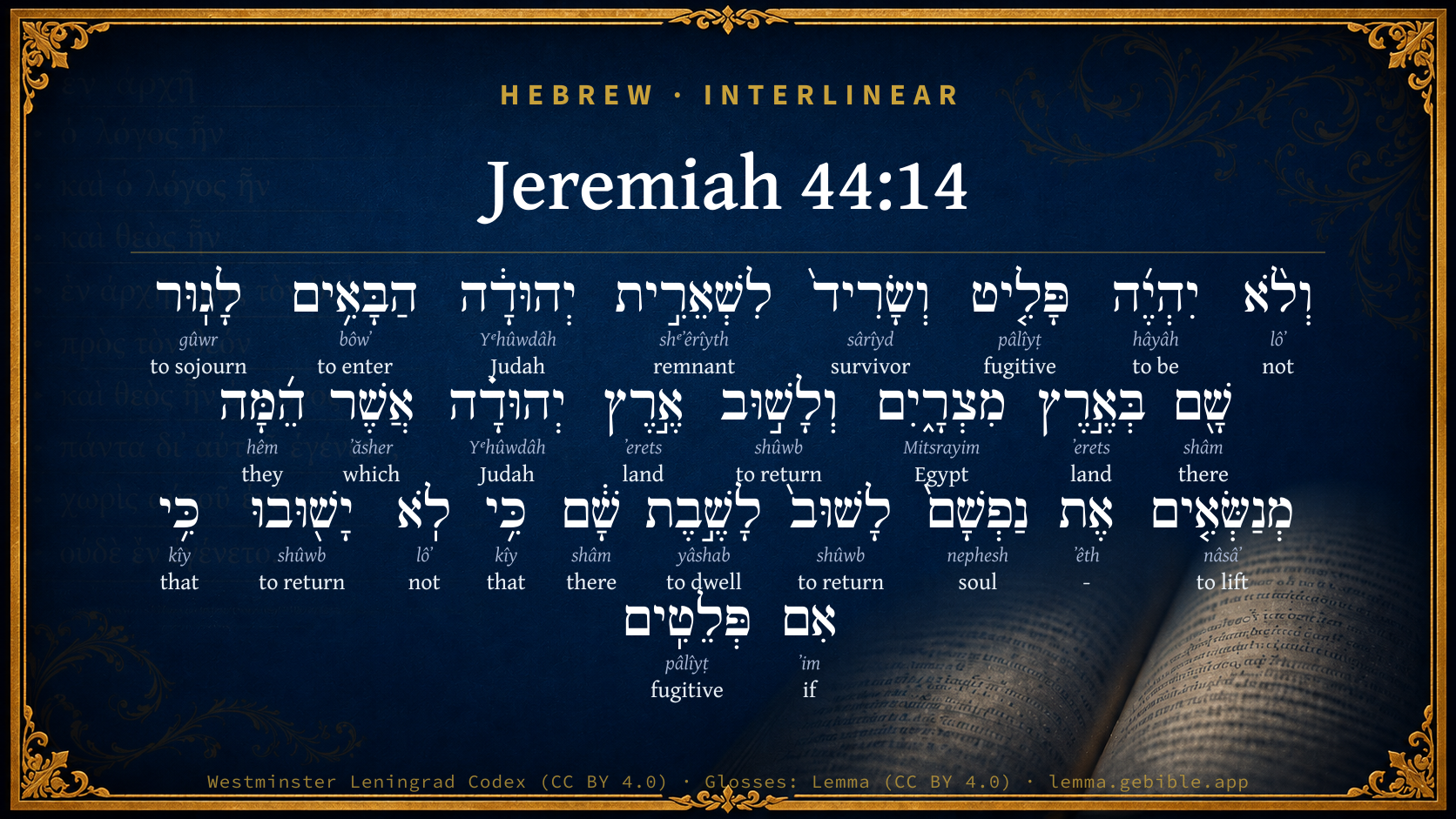
Jeremiah 44:14

Hebrew (Westminster Leningrad Codex) Jeremiah 44:14 appears in the Hebrew Old Testament. The text above is from the Westminster Leningrad Codex. Each word links to its Strong’s number, a concise gloss, and parsing drawn from the Open Scriptures Hebrew Bible morphology. Click any word for its full Brown-Driver-Briggs (BDB) entry.
Download image
Cite this verse

Jeremiah 44:14 (World English Bible). Public Domain. Lemma interlinear Bible study tool, https://lemma.gebible.app/v/jeremiah/44/14.

Show BibTeX & RIS
BibTeX
RIS
English Translation
so that none of the remnant of Judah, who have gone into the land of Egypt to sojourn there, shall escape or be left, to return into the land of Judah, to which they have a desire to return to dwell there: for none shall return save such as shall escape.
World English Bible · Public Domain
Download a study sheet

One document with this verse’s original text, its word-by-word gloss line, the meaning frame, cross-references with their text, attributed commentary, and full source and license credits — printable, and it pastes into notes with its structure intact.

This verse Autodidact and up

Study sheet (.html) Plain text (.txt)

A passage Seminary Student

Up to 50 verses in one chapter. A passage sheet keeps up to 6 commentary sources and 12 cross-references per verse, in the order this page ranks them, and says so on the sheet whenever that leaves anything out. Ask for a single verse and you get the Autodidact verse sheet above.

Everything on this page stays free to read, with no account — the sheet is a download of what is already on screen, not access to it.

Want to remove ads? Support Godless Engineer
Compare translations 3

The same verse in 3 English versions, stacked beneath the original-language interlinear above. Click any original word for its lexicon entry.

Each is an independent rendering of the whole verse — the interlinear is not word-aligned to these translations.

Highlighted words mark where these versions differ — a whole-verse word diff, not a word-by-word alignment.

  • World English Bible Public Domain
    so that none of the remnant of Judah, who have gone into the land of Egypt to sojourn there, shall escape or be left, to return into the land of Judah, to which they have a desire to return to dwell there: for none shall return save such as shall escape.
  • King James Version Public Domain
    So that none of the remnant of Judah, which are gone into the land of Egypt to sojourn there, shall escape or remain, that they should return into the land of Judah, to the which they have a desire to return to dwell there: for none shall return but such as shall escape.
  • unfoldingWord Literal Text CC BY-SA 4.0
    so that none of the remnant of Judah who have gone to live in the land of Egypt will escape or survive or return to the land of Judah, to which they desire to return and live; and none of them will return except a few who escaped from there.’”

unfoldingWord Literal Text — © unfoldingWord, licensed CC BY-SA 4.0. Word-aligned USFM3 via Door43 (git.door43.org/unfoldingWord/en_ult).

Versions to compare (up to 4)

3 of 4 selected

Show all 18 translations

Every available English version of this verse, each an independent rendering of the whole verse.

  • World English Bible Public Domain
    so that none of the remnant of Judah, who have gone into the land of Egypt to sojourn there, shall escape or be left, to return into the land of Judah, to which they have a desire to return to dwell there: for none shall return save such as shall escape.
  • Berean Standard Bible Public Domain
    so that none of the remnant of Judah who have gone to reside in Egypt will escape or survive to return to the land of Judah, where they long to return and live; for none will return except a few fugitives.”
  • Majority Standard Bible Public Domain
    so that none of the remnant of Judah who have gone to reside in Egypt will escape or survive to return to the land of Judah, where they long to return and live; for none will return except a few fugitives.”
  • King James Version Public Domain
    So that none of the remnant of Judah, which are gone into the land of Egypt to sojourn there, shall escape or remain, that they should return into the land of Judah, to the which they have a desire to return to dwell there: for none shall return but such as shall escape.
  • American Standard Version (1901) Public Domain
    so that none of the remnant of Judah, that are gone into the land of Egypt to sojourn there, shall escape or be left, to return into the land of Judah, to which they have a desire to return to dwell there: for none shall return save such as shall escape.
  • Revised Version (1885) Public Domain
    so that none of the remnant of Judah, which are gone into the land of Egypt to sojourn there, shall escape or remain, that they should return into the land of Judah, to the which they have a desire to return to dwell there: for none shall return save such as shall escape.
  • Geneva Bible (1599) Public Domain
    So that none of the remnant of Iudah, which are gone into the lande of Egypt to dwell there, shall escape or remaine, that they shoulde returne into the land of Iudah to the which they haue a desire to returne to dwell there: for none shall returne, but such as shall escape.
  • Douay-Rheims (1899) Public Domain
    And there shall be none that shall escape, and remain of the remnant of the Jews that are gone to sojourn in the land of Egypt: and that shall return into the land of Juda, to which they have a desire to return to dwell there: there shall none return but they that shall flee.
  • Young's Literal Translation Public Domain
    and there is not an escaped and remaining one of the remnant of Judah, who are entering into the land of Egypt to sojourn there, even to turn back to the land of Judah, whither they are lifting up their soul to return to dwell, for they do not turn back, except those escaping.'
  • Literal Standard Version CC BY-SA 4.0
    and there is not an escaped and remaining one of the remnant of Judah, who are entering into the land of Egypt to sojourn there, even to turn back to the land of Judah, to where they are lifting up their soul to return to dwell, for they do not turn back, except those escaping.”
  • Unlocked Literal Bible CC BY-SA 4.0
    so that none of the remnant of Judah who have gone to live in the land of Egypt will escape or survive or return to the land of Judah, to which they desire to return and live; and none of them will return except a few who escaped from there.'”
  • unfoldingWord Literal Text CC BY-SA 4.0
    so that none of the remnant of Judah who have gone to live in the land of Egypt will escape or survive or return to the land of Judah, to which they desire to return and live; and none of them will return except a few who escaped from there.’”
  • Darby Bible Public Domain
    and none of the remnant of Judah, that have come into the land of Egypt to sojourn there, shall escape or remain, so as to return into the land of Judah, whither they have a desire to return to dwell there; for none shall return but such as shall escape.
  • World Messianic Bible Public Domain
    so that none of the remnant of Judah, who have gone into the land of Egypt to live there, will escape or be left to return into the land of Judah, to which they have a desire to return to dwell there; for no one will return except those who will escape.’”
  • Webster's Bible Public Domain
    So that none of the remnant of Judah, who have gone into the land of Egypt, to sojourn there, shall escape or remain, that they should return into the land of Judah, to which they have a desire to return to dwell there: for none shall return but such as shall escape.
  • Free Bible Version CC BY-SA 4.0
    Nobody who is left from Judah who has gone to live in Egypt will escape or survive to return to the country of Judah. You long to go back and live there, but nobody will return except a few stragglers.
  • Bible in Basic English Public Domain
    So that not one of the rest of Judah, who have gone into the land of Egypt and are living there, will get away or keep his life, to come back to the land of Judah where they are hoping to come back and be living again: for not one will come back, but only those who are able to get away.
  • JPS Tanakh (1917) Public Domain
    so that none of the remnant of Judah, that are gone into the land of Egypt to sojourn there, shall escape or remain, that they should return into the land of Judah, to which they have a desire to return to dwell there; for none shall return save such as shall escape.'

Literal Standard Version (2020), Covenant Press — licensed CC BY-SA 4.0. Text via the HelloAO Bible API (eBible.org). Unlocked Literal Bible (unfoldingWord) — licensed CC BY-SA 4.0. Text via the HelloAO Bible API (eBible.org). unfoldingWord Literal Text — © unfoldingWord, licensed CC BY-SA 4.0. Word-aligned USFM3 via Door43 (git.door43.org/unfoldingWord/en_ult). Free Bible Version, Dr. Jonathan Gallagher — licensed CC BY-SA 4.0. Text via the HelloAO Bible API (eBible.org).

Word by word

More ways to search: Search by grammar → Find every occurrence → Compare this word →

Practice this passage: Drill this verse → Learn its vocabulary →

פָּלִ֤יט
pâlîyṭ
H6412
“fugitive”
Noun, Common, Masculine, Singular, Absolute
Part of Speech
Noun
Type
Common
Gender
Masculine
Number
Singular
State
Absolute
Full BDB Definition

Origin: from H6403

TWOT: 1774b , 1774c

refugee, fugitive, escaped one
  1. וְלֹ֨א lôʼ H3808 “and · not” Conjunction + Particle, Negative
  2. יִהְיֶ֜ה hâyâh H1961 “to be” Verb, Qal, Imperfect, 3rd Person, Masculine, Singular
  3. וְשָׂרִיד֙ sârîyd H8300 “and · survivor” Conjunction + Noun, Common, Masculine, Singular, Absolute
  4. לִשְׁאֵרִ֣ית shᵉʼêrîyth H7611 “to/for · remnant of” Preposition + Noun, Common, Feminine, Singular, Construct
  5. יְהוּדָ֔ה Yᵉhûwdâh H3063 “Judah” Noun, Proper
  6. הַבָּאִ֥ים bôwʼ H935 “the · entering” Particle, Definite Article + Verb, Qal, Participle Active, Masculine, Plural, Absolute
  7. לָגֽוּר gûwr H1481 “to sojourn” Preposition + Verb, Qal, Infinitive Construct
  8. שָׁ֖ם shâm H8033 “there” Adverb
  9. בְּאֶ֣רֶץ ʼerets H776 “in/at · land of” Preposition + Noun, Common, Both, Singular, Construct
  10. מִצְרָ֑יִם Mitsrayim H4714 “Egypt” Noun, Proper
  11. וְלָשׁ֣וּב shûwb H7725 “and · to return” Conjunction + Preposition + Verb, Qal, Infinitive Construct
  12. אֶ֣רֶץ ʼerets H776 “land of” Noun, Common, Both, Singular, Construct
  13. יְהוּדָ֗ה Yᵉhûwdâh H3063 “Judah” Noun, Proper
  14. אֲשֶׁר ʼăsher H834 “which” Particle, Relative
  15. הֵ֜מָּה hêm H1992 “they” Pronoun, Personal, 3rd Person, Masculine, Plural
  16. מְנַשְּׂאִ֤ים nâsâʼ H5375 “lifting” Verb, Piel, Participle Active, Masculine, Plural, Absolute
  17. אֶת ʼêth H853 “-” Particle, Direct Object
  18. נַפְשָׁם֙ nephesh H5315 “soul · their” Noun, Common, Both, Singular, Construct + Suffix, Personal, 3rd Person, Masculine, Plural
  19. לָשׁוּב֙ shûwb H7725 “to return” Preposition + Verb, Qal, Infinitive Construct
  20. לָשֶׁ֣בֶת yâshab H3427 “to dwell” Preposition + Verb, Qal, Infinitive Construct
  21. שָׁ֔ם shâm H8033 “there” Adverb
  22. כִּ֥י kîy H3588 “that” Conjunction
  23. לֹֽא lôʼ H3808 “not” Particle, Negative
  24. יָשׁ֖וּבוּ shûwb H7725 “to return” Verb, Qal, Imperfect, 3rd Person, Masculine, Plural
  25. כִּ֥י kîy H3588 “that” Conjunction
  26. אִם ʼim H518 “if” Conjunction
  27. פְּלֵטִֽים pâlîyṭ H6412 “fugitives” Noun, Common, Masculine, Plural, Absolute

About this verse

These counts appear in no published source. They are computed here, from the morphology-tagged text and Lemma’s own curated glosses. What Lemma adds →

28
words
20
distinct lemmas
Prophets
section

Notable vocabulary

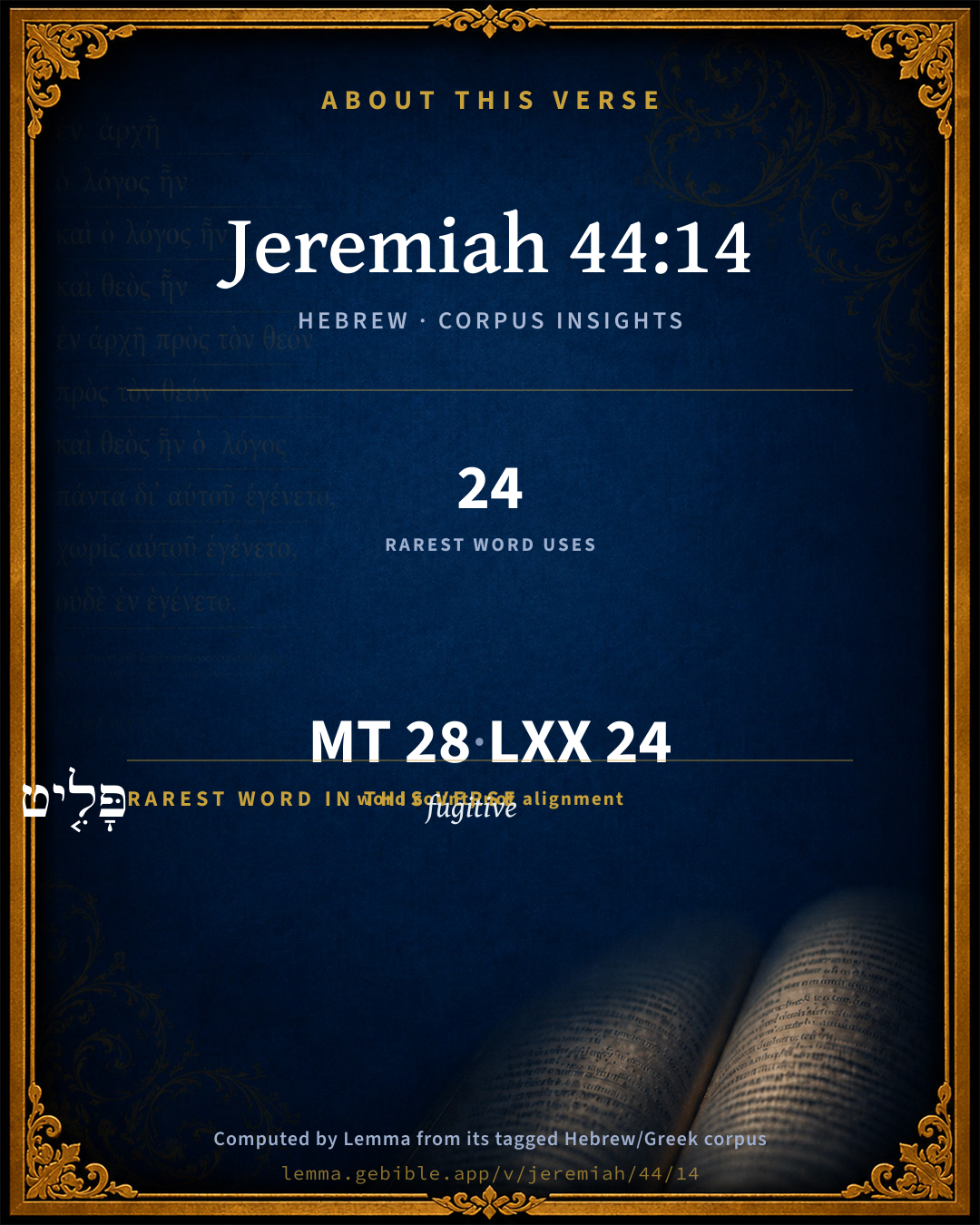
The rarest word here is פָּלִ֤יט fugitive H6412 — appearing just 24 times in the whole Hebrew Bible.

Shared distinctive vocabulary

פָּלִ֤יט fugitive H6412 occurs in 23 verses of the Hebrew Bible. Also found in:

Grammatical profile

  • 8 verbs
  • 10 nouns
  • 1 pronoun
  • 3 conjunctions
  • 2 adverbs
  • 4 particles

Verb forms

  • יִהְיֶ֜ה Qal · Imperfect
  • הַבָּאִ֥ים Qal · Participle Active
  • לָגֽוּר Qal · Infinitive Construct
  • וְלָשׁ֣וּב Qal · Infinitive Construct
  • מְנַשְּׂאִ֤ים Piel · Participle Active
  • לָשׁוּב֙ Qal · Infinitive Construct
  • לָשֶׁ֣בֶת Qal · Infinitive Construct
  • יָשׁ֖וּבוּ Qal · Imperfect

Repetition

Words recur within this verse — often emphatic in Hebrew:

  • וְלָשׁ֣וּב to return H7725 ×3
  • פָּלִ֤יט fugitive H6412 ×2
  • יְהוּדָ֔ה Judah H3063 ×2
  • שָׁ֖ם there H8033 ×2
  • בְּאֶ֣רֶץ land H776 ×2
  • וְלֹ֨א not H3808 ×2
  • כִּ֥י that H3588 ×2

Hebrew & Septuagint length

In the original languages it is 28 Hebrew tokens and 24 Greek tokens — but the two are counted differently (Hebrew bundles its prefixes and suffixes into one token; the Greek is in lemma form), so that isn’t a like-for-like length.

Cross-references

12

Topical passages linked to Jeremiah 44:14 in the Treasury of Scripture Knowledge — connected by theme and wording, ordered by reader-vote popularity; previews shown in the World English Bible.

  • Jeremiah 22:26–27 I will cast you out, and your mother who bore you, into another country, where you were not born; and there shall you die.
  • Romans 9:27 Isaiah cries concerning Israel, "If the number of the children of Israel are as the sand of the sea, It is the remnant who will be saved;
  • Isaiah 4:2 In that day, Yahweh's branch will be beautiful and glorious, and the fruit of the land will be the beauty and glory of the survivors of Israel.
  • Isaiah 10:20 It shall come to pass in that day, that the remnant of Israel, and those who are escaped of the house of Jacob, shall no more again lean on him who struck them, but shall lean on Yahweh, the Holy One of Israel, in truth.
  • Jeremiah 42:17 So shall it be with all the men who set their faces to go into Egypt to sojourn there: they shall die by the sword, by the famine, and by the pestilence; and none of them shall remain or escape from the evil that I will bring on them.
  • Jeremiah 44:27–28 Behold, I watch over them for evil, and not for good; and all the men of Judah who are in the land of Egypt shall be consumed by the sword and by the famine, until there be an end of them.
  • Isaiah 30:1–3 Woe to the rebellious children, says Yahweh, who take counsel, but not of me; and who make a league, but not of my Spirit, that they may add sin to sin,
  • Jeremiah 42:22 Now therefore know certainly that you shall die by the sword, by the famine, and by the pestilence, in the place where you desire to go to sojourn there.
  • Matthew 23:33 You serpents, you offspring of vipers, how will you escape the judgment of Gehenna?
  • Romans 2:3 Do you think this, O man who judges those who practice such things, and do the same, that you will escape the judgment of God?
  • Romans 11:5–6 Even so then at this present time also there is a remnant according to the election of grace.
  • Hebrews 2:3 how will we escape if we neglect so great a salvation-- which at the first having been spoken through the Lord, was confirmed to us by those who heard;

Cross-references courtesy of OpenBible.info (CC BY 4.0).

Hebrew and Greek witnesses Masoretic Hebrew ↔ Greek Septuagint

The same verse in the two great witnesses to the Old Testament, shown verse-for-verse.

These are two independent witnesses, not word-aligned to each other, and the Septuagint is shown in lemma (dictionary) form.

Hebrew Jeremiah 44:14 Masoretic · Westminster Leningrad Codex

וְלֹ֨א יִהְיֶ֜ה פָּלִ֤יט וְשָׂרִיד֙ לִשְׁאֵרִ֣ית יְהוּדָ֔ה הַבָּאִ֥ים לָגֽוּר שָׁ֖ם בְּאֶ֣רֶץ מִצְרָ֑יִם וְלָשׁ֣וּב אֶ֣רֶץ יְהוּדָ֗ה אֲשֶׁר הֵ֜מָּה מְנַשְּׂאִ֤ים אֶת נַפְשָׁם֙ לָשׁוּב֙ לָשֶׁ֣בֶת שָׁ֔ם כִּ֥י לֹֽא יָשׁ֖וּבוּ כִּ֥י אִם פְּלֵטִֽים

so that none of the remnant of Judah, who have gone into the land of Egypt to sojourn there, shall escape or be left, to return into the land of Judah, to which they have a desire to return to dwell there: for none shall return save such as shall escape.

World English Bible · Public Domain

Greek LXX Structure differs

In the Septuagint, Jeremiah is about an eighth shorter than the Hebrew and arranges its material differently — the Oracles Against the Nations (Hebrew chapters 46–51) appear in the middle of the Greek book, after 25:13. Because the chapter and verse boundaries do not line up, a verse-for-verse comparison with the Hebrew is not shown.

A verse-for-verse comparison isn’t shown here because the chapters and verses don’t line up. Switch to the LXX edition with the MT / LXX toggle above to read the Greek directly.

Hebrew: Westminster Leningrad Codex (CC BY 4.0). Greek: Septuagint (public domain); English from a public-domain English Septuagint. How the Septuagint differs from the Hebrew →

Targum (Aramaic paraphrase)

1

The Targum is the ancient Jewish Aramaic paraphrase of the Hebrew Scriptures — an interpretive translation, not the Hebrew text itself. Onkelos (literal) and Pseudo-Jonathan (expansive) render the Torah, and Jonathan the Prophets. Coverage is partial: where no permissively-licensed English translation exists for a verse, only the Aramaic is shown. This is verse-level text, not a word-by-word alignment to the Hebrew.

  1. Targum Jonathan Prophets (Joshua–Malachi)
    וְלָא יְהֵי שְׁאָר וּמְשֵׁיזֵיב לִשְׁאָרָא דְבֵית יְהוּדָה דְאָתָן לְאִתּוֹתָבָא תַמָן בְּאַרְעָא דְמִצְרַיִם וּלְמִתַּב בְּאַרְעָא דְבֵית יְהוּדָה דְאִינוּן מַטְעָן יַת נַפְשְׁהוֹן לְמֵיתָב לְמִתַּב תַּמָן אֲרֵי לָא יְתוּבוּן אֱלָהֵין מְשֵׁיזְבִין:

    (no public-domain English translation for this verse)

    Targum Jonathan — Aramaic: “Mikraot Gedolot” (public domain). English: “Sefaria Community Translation” (CC0 1.0 (public-domain dedication)); “London "Chaldee Paraphrase," 1871” (public domain). Text via Sefaria.

Commentary

Notes on Jeremiah 44:14 from classic Christian and Jewish commentators (each source and its license shown beneath its notes). The classic Christian expositions comment on the surrounding passage and are grouped to its opening verse, so a note may address several verses; the Jewish commentaries on the Tanakh (Rashi and others) are per-verse, so they appear only where the commentator wrote on this verse.

Lemma curates 59 commentaries, every one of them public domain or Creative Commons licensed, each selected and text-cleaned for this edition rather than reprinted as found. About our sources →

Trapp's Complete Commentary

John Trapp

Jer 44:14 So that none of the remnant of Judah, which are gone into the land of Egypt to sojourn there, shall escape or remain, that they should return into the land of Judah, to the which they have a desire to return to dwell there: for none shall return but such as shall escape.

Ver. 14. For none shall return, but such as shall escape,] sc., From these fighters against God, Johanan and his complices. The Talmudists tell us - but who told them? - that Nebuchadnezzar, at his conquest of Egypt, sent back into Judea Jeremiah and Baruch, &c.

John Trapp, A Commentary or Exposition upon All the Books of the Old and New Testament (1647–1656) — public domain. Text from a community e-Sword module.

Matthew Poole's English Annotations

There is a great variety in the reading of the words, Jer 44:14; some reading besides such as have a desire to return; others, although they have a desire to return; others, for they have a desire to return. The words seem to hint that these Jews went into the land of Egypt, not with a design to live there always, but to stay for a while till the heat of the Chaldeans in inquiring after the blood of Gedaliah should be over, then thinking to return into their own country; which one would think were true, considering it not only as their native soil, but also a place where was now room enough, and they might live in much greater plenty than they could in Egypt. The only difficulty is in the last words, compared with what in the same verse went before; it is said in the beginning of the verse that none of them should escape, and in the close,

none shall return but such as shall escape. But reason will guide us to interpret the first none in a restrained sense, i.e. none of those who have been the authors of this counsel and rebellion against God, and who went into Egypt willingly; for none can think that God involved Jeremiah and Baruch who were in Egypt (at least the first of them) in the same punishment with which he punished the rebellious Jews. Or none of those who in Egypt have burnt incense to idols, and defiled themselves with the idolatry of Egypt; but there shall some escape, such as have been forced into Egypt against their wills; and such as, being so forced, when they came here did not fall in with the idolatry of the Egyptians, (for we may gather from the next verse that all of them did not,) these men shall again return into the land of Judah. This to me seemeth the fairest and most probable sense of the words.

Matthew Poole's English Annotations on the Holy Bible (1683–1685) — public domain. Text from a community e-Sword/MySword module.

Geneva Bible (1599)

Geneva Bible translators

Meaning, but a few.

Hebrew, lift up their souls.

Geneva Bible (1599) marginal notes — public domain. Text via Bolls.life.

Jamieson, Fausset & Brown

Robert Jamieson, A. R. Fausset & David Brown

none . . . shall escape . . . that they should return, &c.--The Jews had gone to Egypt with the idea that a return to Judea, which they thought hopeless to their brethren in Babylon, would be an easy matter to themselves in Egypt: the exact reverse should happen in the case of each respectively. The Jews whom God sent to Babylon were there weaned from idolatry, and were restored; those who went to Egypt by their perverse will were hardened in idolatry, and perished there.

have a desire--literally, "lift up (their) soul," that is, their hopes (compare Jer 22:27, Margin; Deu 24:15, Margin).

none shall return but such as shall escape--namely, the "small number" (Jer 44:28) who were brought by force into Egypt, as Jeremiah and Baruch, and those who, in accordance with Jeremiah's advice, should flee from Egypt before the arrival of the Chaldeans (see on Jer 42:17). CALVIN less probably refers the words to the return of the exiles in Babylon, which the Jews in Egypt regarded as hopeless.

Jamieson, Fausset & Brown — Commentary Critical and Explanatory on the Whole Bible (1871) — public domain (CC PDM 1.0). Text via the HelloAO Bible API.

John Calvin's Commentaries

The Prophet seems to be inconsistent with himself; for at the beginning of the verse he says that there would be no residue, but at the end he adds an exception, that there would be few alive, who would flee, and, by some miracle, escape from death. Some take this view, that none of the ungodly despisers would remain, but that some would yet be preserved alive, even those who had been drawn there against their own will, such as Jeremiah, Baruch, and such as were like them. But this explanation may seem forced at the first view; and yet if the Prophet is speaking of the Jews who had fled into Egypt, it is necessary so to take it; otherwise there would be a manifest inconsistency and contradiction. But we may also refer what he says at the end of the verse to the exiles in Babylon; for they who had concealed themselves in Egypt thought that it was all over with all others, because they had been led away into a distant country. As, then, a return to their country was closed up against them, they thought that they themselves would become the sole heirs of the land; for as Egypt was not far from the land of Judah, a return was easy, and also free, because they had made a treaty with the Egyptians; and further, they had gone to them as friends to partake of their hospitality. They, then, who dwelt in Egypt thought that the land of Judah would be their own.

But God says that none would return into that land except those who should escape, even those to whom permission to return would be given at the end of their captivity and exile. I take then the word פלטים, pelethim, at the end of the verse, as referring to the remnant which God would at length gather, when liberty to return was granted to the Jews by the edict of Cyrus, at the end of the seventy years, which the Prophet had before mentioned. And this seems to me a simpler meaning, that. is, that none would remain of that remnant which had gone down to Egypt, who came, as it is expressed, to sojourn in the land of Egypt and to return to the land of Judah, for this was their purpose.

He then adds, To which they lift up their souls to return there The Prophet here exposes the confidence by which the Jews still deceived themselves; for the lifting up of which he speaks, means to aspire or to hope, and denotes pride and presumption. So by saying that they lifted up their souls, he reproves them, because they were still inflated with a foolish hope, and persuaded themselves that a return would soon be open for them, as the land was without any possessors. As, then, they were cherishing themselves with such delusions, they were to know that they were never to return there, They shall not return, he says. And then follows an exception, Except those who escape, even those of whom the Jews in Egypt despaired, who thought that they did well, and had taken a prudent counsel, because they had for a time a quiet hiding-place in Egypt. It now follows, —

John Calvin's Commentaries (1540-1563) — public domain. Text from the Calvin Translation Society English edition (1840s-50s) via the Christian Classics Ethereal Library (ccel.org). Calvin's coverage is partial (roughly two-thirds of the Bible); uncommented books and verses are honest gaps, never fabricated. The 19th-century editor's footnotes and remarks are omitted so the notes are faithfully Calvin's own voice.

Ellicott's Commentary for English Readers

(14) To the which they have a desire to return.—Literally, unto which they lift up their souls to return. The words are significant as showing that the exiles still cherished the hope of getting back to the land of their fathers.

None shall return but such as shall escape.—The words seem at first a truism, but they imply that the escape would be difficult. The formula seems to have been not uncommon (Eze_7:16). In Jer_44:28 we have the fact more definitely stated: there should be, as in previous chastisements, a remnant, and a remnant only (Isa_1:9; Isa_6:13). By some critics the limiting clause has been looked on as an interpolation, inserted to bring the verse into agreement with Jer_44:28.

A Bible Commentary for English Readers, edited by Charles John Ellicott (1878–1897) — public domain. Text from a community e-Sword module.

The Cambridge Bible for Schools and Colleges

gen. ed. J. J. S. Perowne

14. have a desire] For lit. Heb. See on Jer_22:27.

for none … escape] perhaps added afterwards as a correction to the earlier part of the v. on account of the actual return of certain fugitives. So Co.

The Cambridge Bible for Schools and Colleges (gen. ed. J. J. S. Perowne; Cambridge University Press, 1878–1918) — public domain. Text from a community e-Sword module.

John Gill's Exposition

So that none of the remnant of Judah,.... Which were left in the land of Judea after the captivity:

which are gone into the land of Egypt to sojourn there, shall escape or remain; escape either the sword, or the famine, or the pestilence, or remain in the land of Egypt, or in the land of the living; so general should be the destruction:

that they should return into the land of Judah, to the which they have a desire to return there; or, "have lift up their souls (b) to return there": most earnestly desire it, and have raised hopes and expectations of it; for it seems that those Jews that went into Egypt did not go with a design to settle there for ever; but to return to their own land, when there should be better times, and more safety and security there; particularly when they thought the affair of the death of Gedaliah would be no further inquired into:

for none shall return but such as shall escape; out of the hands of Johanan, and the rest of the captains; and should get out of the land of Egypt before the Chaldeans came into it. Some understand this of those that should escape out of Babylon; that none should return to Judea but those of that captivity, who should be released by the proclamation of Cyrus. Jarchi interprets it of Jeremiah and Baruch, whom Nebuchadnezzar removed to Babylon, when Egypt fell into his hands, in the twenty seventh year of his reign, as is related in the Jewish chronicles (c).

(b) "elevant, vel elevantes animam, suam", Pagninus, Vatablus, Calvin; "attolunt animam suam", Schmidt. (c) Seder Olam Rabba, c. 26. p. 77.

John Gill's Exposition of the Whole Bible (1746–1763) — public domain (CC PDM 1.0). Text via the HelloAO Bible API.

Albert Barnes' Notes on the Bible

Literally, “And there shall not be to the remnant of Judah, which are going to sojourn there in the land of Egypt, one that escapes or remains etc.” The word rendered “escapes” means one who slips away, saves himself by a stealthy flight Gen 14:13; the word “remains,” one who survives when all the rest perish Job 18:19. Of all those now going down to Egypt none shall return to Judaea except a few miserable fugitives, who shall steal away as men who flee in battle 2Sa 19:3. For really years Jewish settlers had gone to Egypt in great numbers, and these old settlers would be treated in the same way as the Egyptians, but these fugitives, with no knowledge of the Egyptian language or ways, would have no friends in the country to aid them, and would also be recognized by the Chaldaeans as inveterate enemies, and mercilessly slain.

Albert Barnes' Notes on the Bible (1834–1885) — public domain. Text from a community e-Sword/MySword module.

Haydock's Catholic Bible Commentary

Desire and expectation, chap. xxii. 27. They meant to return as soon as the Chaldeans had left the country: but their hose were vain. The enemy would fall upon Egypt, after he had taken Tyre and the neighbouring provinces; and those who had not abandoned that country in time, would perish, ver. 12, 26. (Calmet)

George Leo Haydock (1774–1849), Haydock's Catholic Family Bible and Commentary, 1859 edition — public domain. Excludes Psalms (Douay-Rheims chapter numbering differs from Protestant) and Deuterocanonical books (Catholic canon only).

Whedon's Commentary on the Bible

Daniel D. Whedon

14. But such as shall escape — This qualifies and explains the broad statement in previous verses. There would be exceptions to this universal cutting off, but they would be individual fugitives.

Daniel D. Whedon (gen. ed.), Commentary on the Old and New Testaments (1874–1909) — public domain. Text from a community e-Sword module.

The Pulpit Commentary

They have a desire; literally, they lift up their soul. (comp. Jer_22:27)

The Pulpit Commentary (1880–1919), ed. H.D.M. Spence-Jones & Joseph S. Exell — public domain. Text from a community e-Sword module.

John Wesley's Explanatory Notes

For none - Only such shall escape, as have been forced into Egypt against their wills; and as did not fall in with the idolatry of the Egyptians.

John Wesley, Explanatory Notes Upon the Whole Bible (1754–1765) — public domain. Text via the GEBible commentary corpus.

Rashi

Rabbi Shlomo Yitzchaki (Rashi)

only fugitives Jeremiah and Baruch returned from there, for Nebuchadnezzar exiled them when the land of Egypt was delivered into his hand in the twenty-seventh year of his reign (Ezek. 29:17). So we learned in Seder Olam (ch. 26).

Rashi on the Tanakh — English translations: “The Judaica Press complete Tanach with Rashi, translated by A. J. Rosenberg” (CC BY 4.0); “Pentateuch with Rashi's commentary by M. Rosenbaum and A.M. Silbermann, 1929-1934” (public domain); “The Metsudah Tanach series, Lakewood, N.J” (CC BY 4.0); and “The Book of Joshua, Metsudah Publications, 1997” (CC BY 4.0). Text via Sefaria.

Lesson kit

Teaching starters — assembled from the data on this page, not authored interpretation. Every prompt links to the verse data it draws on. Edit before teaching.

Jeremiah, in the Prophets, opens this verse with 28 words (20 distinct Hebrew lemmas). Its most distinctive word is pâlîyṭ (“fugitive”). A historical commentator’s framing appears above. Read the whole chapter for the surrounding context.

Discussion questions

  1. What does “fugitive” (pâlîyṭ) contribute to the verse as a whole?
  2. Genesis 14:13 shares the word «fugitive» with this verse. How do the two illuminate each other?
  3. “to return” occurs 3× in this one verse. What is the effect of the repetition?
  4. These translations render this verse differently; the difference is in the English rendering, not the original. What questions does that raise?
  5. The verb «יִהְיֶ֜ה» is Qal Imperfect. How does its form color the action?
  6. Reading how Trapp's Complete Commentary and Matthew Poole's English Annotations read this verse, where do the two commentators agree and where do they part?

Things to notice

Reading settings

Reading text

Shown beneath each verse's original-language words.

Old Testament
Old Testament edition

Read the OT as the Masoretic Hebrew (MT) or the Greek Septuagint (LXX).

English shown for the Greek Septuagint (in the Hebrew ↔ Greek comparison).

Comparing translations? Open the Compare panel on any verse page to stack up to four side by side.