Isaiah 19:24

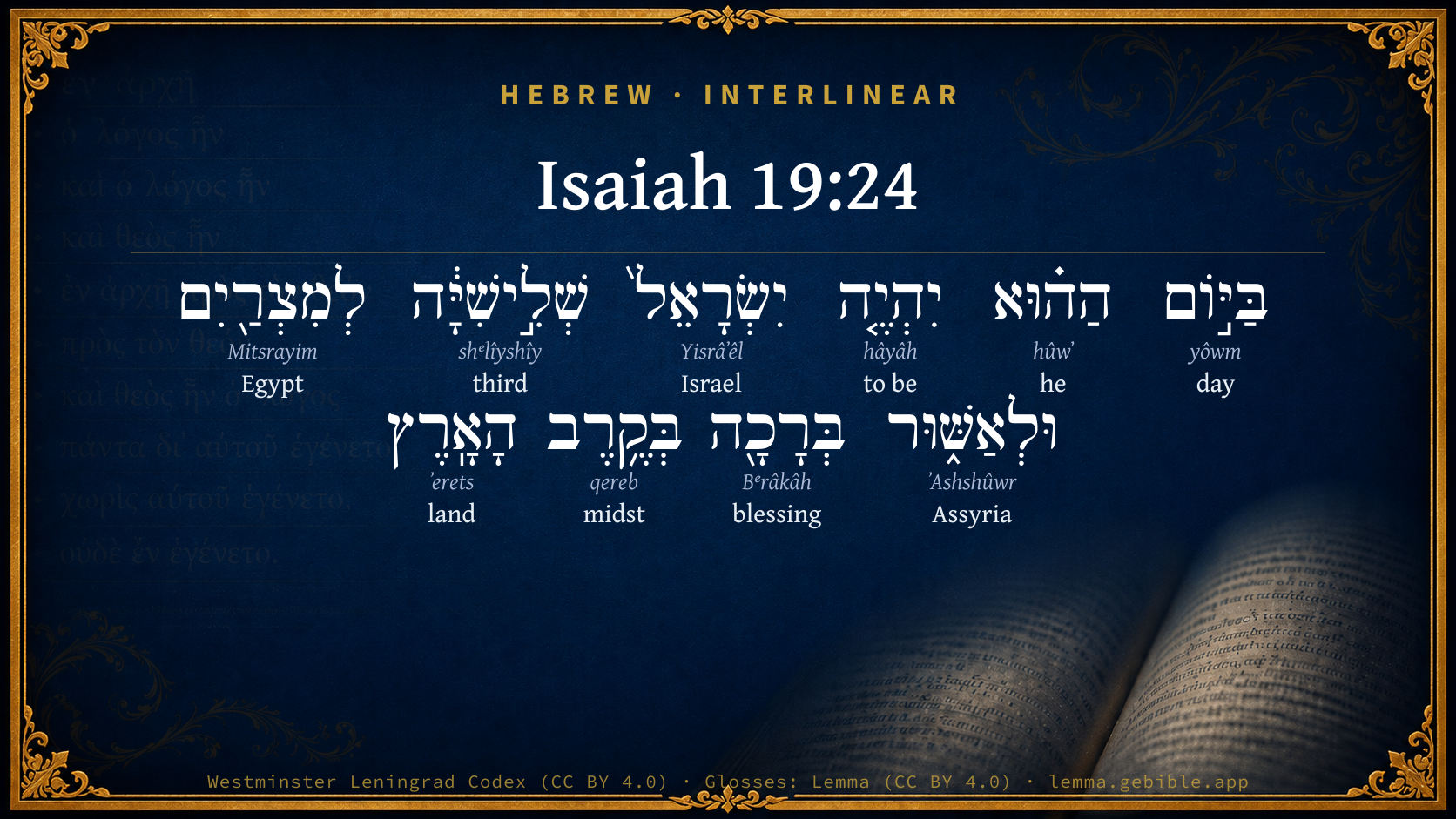
Hebrew (Westminster Leningrad Codex) Isaiah 19:24 appears in the Hebrew Old Testament. The text above is from the Westminster Leningrad Codex. Each word links to its Strong’s number, a concise gloss, and parsing drawn from the Open Scriptures Hebrew Bible morphology. Click any word for its full Brown-Driver-Briggs (BDB) entry.
Download image
Cite this verse

Isaiah 19:24 (World English Bible). Public Domain. Lemma interlinear Bible study tool, https://lemma.gebible.app/v/isaiah/19/24.

Show BibTeX & RIS
BibTeX
RIS
English Translation
In that day shall Israel be the third with Egypt and with Assyria, a blessing in the midst of the earth;
World English Bible · Public Domain
Download a study sheet

One document with this verse’s original text, its word-by-word gloss line, the meaning frame, cross-references with their text, attributed commentary, and full source and license credits — printable, and it pastes into notes with its structure intact.

This verse Autodidact and up

Study sheet (.html) Plain text (.txt)

A passage Seminary Student

Up to 50 verses in one chapter. A passage sheet keeps up to 6 commentary sources and 12 cross-references per verse, in the order this page ranks them, and says so on the sheet whenever that leaves anything out. Ask for a single verse and you get the Autodidact verse sheet above.

Everything on this page stays free to read, with no account — the sheet is a download of what is already on screen, not access to it.

Want to remove ads? Support Godless Engineer
Compare translations 3

The same verse in 3 English versions, stacked beneath the original-language interlinear above. Click any original word for its lexicon entry.

Each is an independent rendering of the whole verse — the interlinear is not word-aligned to these translations.

Highlighted words mark where these versions differ — a whole-verse word diff, not a word-by-word alignment.

  • World English Bible Public Domain
    In that day shall Israel be the third with Egypt and with Assyria, a blessing in the midst of the earth;
  • King James Version Public Domain
    In that day shall Israel be the third with Egypt and with Assyria, even a blessing in the midst of the land:
  • unfoldingWord Literal Text CC BY-SA 4.0
    In that day Israel will be a third with Egypt and with Assyria, a blessing in the midst of the earth

unfoldingWord Literal Text — © unfoldingWord, licensed CC BY-SA 4.0. Word-aligned USFM3 via Door43 (git.door43.org/unfoldingWord/en_ult).

Versions to compare (up to 4)

3 of 4 selected

Show all 18 translations

Every available English version of this verse, each an independent rendering of the whole verse.

  • World English Bible Public Domain
    In that day shall Israel be the third with Egypt and with Assyria, a blessing in the midst of the earth;
  • Berean Standard Bible Public Domain
    In that day Israel will join a three-party alliance with Egypt and Assyria—a blessing upon the earth.
  • Majority Standard Bible Public Domain
    In that day Israel will join a three-party alliance with Egypt and Assyria—a blessing upon the earth.
  • King James Version Public Domain
    In that day shall Israel be the third with Egypt and with Assyria, even a blessing in the midst of the land:
  • American Standard Version (1901) Public Domain
    In that day shall Israel be the third with Egypt and with Assyria, a blessing in the midst of the earth;
  • Revised Version (1885) Public Domain
    In that day shall Israel be the third with Egypt and with Assyria, a blessing in the midst of the earth:
  • Geneva Bible (1599) Public Domain
    In that day shall Israel be the third with Egypt and Asshur, euen a blessing in the middes of the land.
  • Douay-Rheims (1899) Public Domain
    In that day shall Israel be the third to the Egyptian and the Assyrian: a blessing in the midst of the land,
  • Young's Literal Translation Public Domain
    In that day is Israel third, After Egypt, and after Asshur, A blessing in the heart of the earth.
  • Literal Standard Version CC BY-SA 4.0
    In that day Israel is third, || With Egypt, and with Asshur, || A blessing in the heart of the earth.
  • Unlocked Literal Bible CC BY-SA 4.0
    In that day, Israel will be the third with Egypt and Assyria, a blessing in the midst of the earth;
  • unfoldingWord Literal Text CC BY-SA 4.0
    In that day Israel will be a third with Egypt and with Assyria, a blessing in the midst of the earth
  • Darby Bible Public Domain
    In that day shall Israel be the third with Egypt and with Assyria, a blessing in the midst of the earth;
  • World Messianic Bible Public Domain
    In that day, Israel will be the third with Egypt and with Assyria, a blessing within the earth;
  • Webster's Bible Public Domain
    In that day shall Israel be the third with Egypt and with Assyria, even a blessing in the midst of the land:
  • Free Bible Version CC BY-SA 4.0
    At that time Israel will be the third part of this alliance, joining with Egypt and Assyria, a blessing to the whole of the earth.
  • Bible in Basic English Public Domain
    In that day Israel will be the third together with Egypt and Assyria, a blessing in the earth:
  • JPS Tanakh (1917) Public Domain
    In that day shall Israel be the third with Egypt and with Assyria, a blessing in the midst of the earth;

Literal Standard Version (2020), Covenant Press — licensed CC BY-SA 4.0. Text via the HelloAO Bible API (eBible.org). Unlocked Literal Bible (unfoldingWord) — licensed CC BY-SA 4.0. Text via the HelloAO Bible API (eBible.org). unfoldingWord Literal Text — © unfoldingWord, licensed CC BY-SA 4.0. Word-aligned USFM3 via Door43 (git.door43.org/unfoldingWord/en_ult). Free Bible Version, Dr. Jonathan Gallagher — licensed CC BY-SA 4.0. Text via the HelloAO Bible API (eBible.org).

Word by word

More ways to search: Search by grammar → Find every occurrence → Compare this word →

Practice this passage: Drill this verse → Learn its vocabulary →

בְּרָכָ֖ה
Bᵉrâkâh
H1293
“blessing”
Noun, Common, Feminine, Singular, Absolute
Part of Speech
Noun
Type
Common
Gender
Feminine
Number
Singular
State
Absolute
Full BDB Definition

Origin: from H1288

TWOT: None

blessing - (source of) blessing - blessing, prosperity - blessing, praise of God - a gift, present - treaty of peace
  1. בַּיּ֣וֹם yôwm H3117 “in/at the · day” Preposition, Determined + Noun, Common, Masculine, Singular, Absolute
  2. הַה֗וּא hûwʼ H1931 “the · he” Particle, Definite Article + Pronoun, Personal, 3rd Person, Masculine, Singular
  3. יִהְיֶ֤ה hâyâh H1961 “to be” Verb, Qal, Imperfect, 3rd Person, Masculine, Singular
  4. יִשְׂרָאֵל֙ Yisrâʼêl H3478 “Israel” Noun, Proper
  5. שְׁלִ֣ישִׁיָּ֔ה shᵉlîyshîy H7992 “third” Adjective, Ordinal number, Feminine, Singular, Absolute
  6. לְמִצְרַ֖יִם Mitsrayim H4714 “to/for · Egypt” Preposition + Noun, Proper
  7. וּלְאַשּׁ֑וּר ʼAshshûwr H804 “and · to/for · Assyria” Conjunction + Preposition + Noun, Proper
  8. בְּקֶ֥רֶב qereb H7130 “in/at · midst of” Preposition + Noun, Common, Masculine, Singular, Construct
  9. הָאָֽרֶץ ʼerets H776 “the · land” Particle, Definite Article + Noun, Common, Both, Singular, Absolute

About this verse

These counts appear in no published source. They are computed here, from the morphology-tagged text and Lemma’s own curated glosses. What Lemma adds →

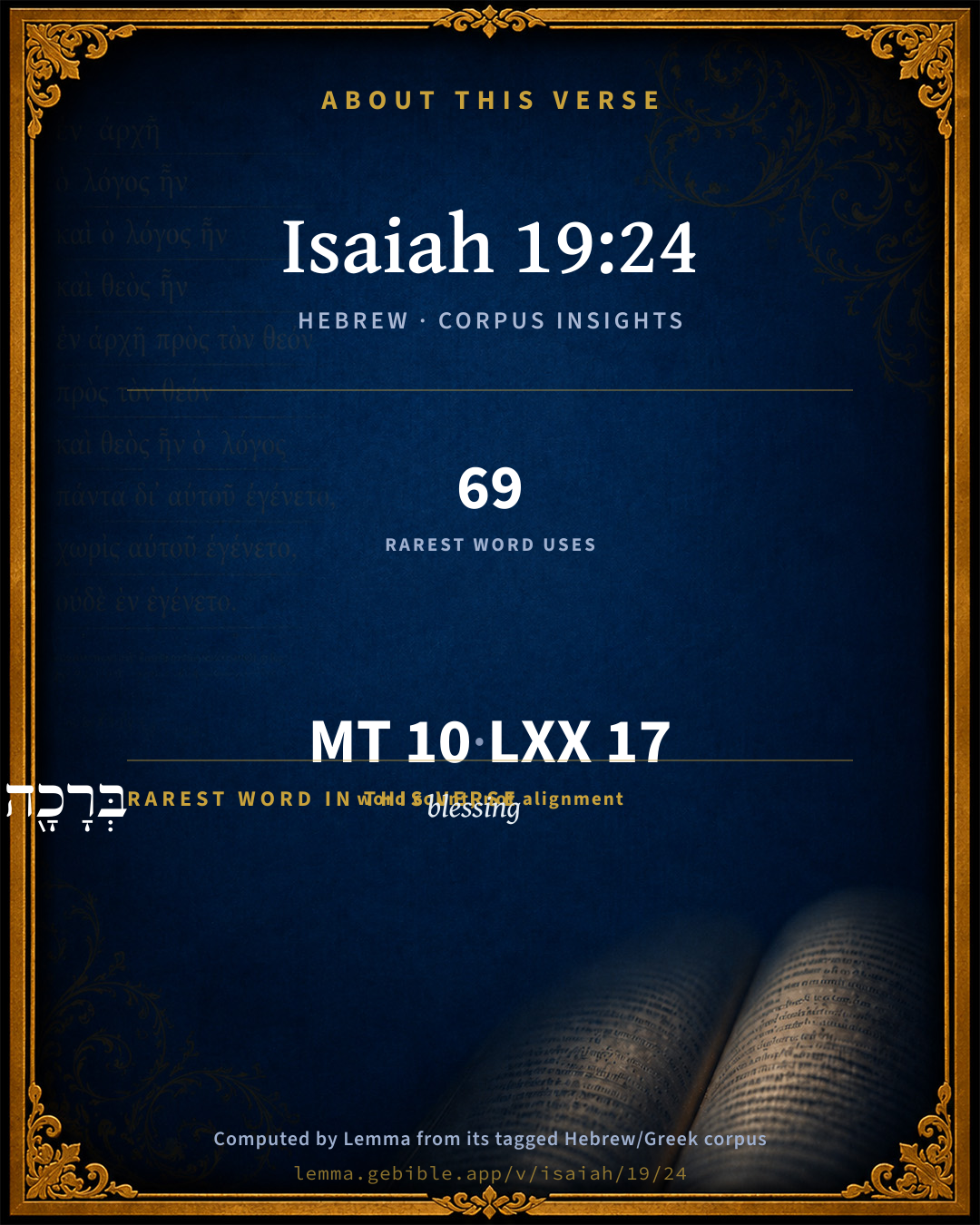
10
words
10
distinct lemmas
Prophets
section

Grammatical profile

  • 1 verb
  • 7 nouns
  • 1 adjective
  • 1 pronoun

Verb forms

  • יִהְיֶ֤ה Qal · Imperfect

Hebrew & Septuagint length

In English translation the verse runs 21 words from the Hebrew and 24 from the Septuagint (LXX English) — closely comparable.

A rough comparison of the two English renderings, which tokenize alike — not a word-level alignment.

Word counts can differ between the Hebrew and the Greek without any difference in meaning — e.g. the Hebrew direct-object marker אֵת has no separate Greek word, and Greek often adds the article ὁ.

In the original languages it is 10 Hebrew tokens and 17 Greek tokens — but the two are counted differently (Hebrew bundles its prefixes and suffixes into one token; the Greek is in lemma form), so that isn’t a like-for-like length.

Cross-references

19

Topical passages linked to Isaiah 19:24 in the Treasury of Scripture Knowledge — connected by theme and wording, ordered by reader-vote popularity; previews shown in the World English Bible.

  • Isaiah 65:8 Thus says Yahweh, As the new wine is found in the cluster, and one says, Don't destroy it, for a blessing is in it: so will I do for my servants' sake, that I may not destroy them all.
  • Genesis 12:2 I will make of you a great nation. I will bless you, and make your name great. You will be a blessing.
  • Deuteronomy 32:43 Rejoice, you nations, [with] his people: For he will avenge the blood of his servants, Will render vengeance to his adversaries, Will make expiation for his land, for his people.
  • Psalms 117:1–2 Praise Yahweh, all you nations! Extol him, all you peoples!
  • Isaiah 6:13 If there are yet a tenth in it, It also shall in turn be eaten up: As a terebinth, and as an oak, whose stock remains, when they are felled; So the holy seed is its stock."
  • Isaiah 49:6 yes, he says, It is too light a thing that you should be my servant to raise up the tribes of Jacob, and to restore the preserved of Israel: I will also give you for a light to the Gentiles, that you may be my salvation to the end of the earth.
  • Isaiah 49:22 Thus says the Lord Yahweh, Behold, I will lift up my hand to the nations, and set up my ensign to the peoples; and they shall bring your sons in their bosom, and your daughters shall be carried on their shoulders.
  • Isaiah 65:22 They shall not build, and another inhabit; they shall not plant, and another eat: for as the days of a tree shall be the days of my people, and my chosen shall long enjoy the work of their hands.
  • Isaiah 66:12 For thus says Yahweh, Behold, I will extend peace to her like a river, and the glory of the nations like an overflowing stream: and you shall suck [of it]; you shall be borne on the side, and shall be dandled on the knees.
  • Isaiah 66:19–21 I will set a sign among them, and I will send such as escape of them to the nations, to Tarshish, Pul, and Lud, who draw the bow, to Tubal and Javan, to the isles afar off, who have not heard my fame, neither have seen my glory; and they shall declare my glory among the nations.
  • Ezekiel 34:26 I will make them and the places round about my hill a blessing; and I will cause the shower to come down in its season; there shall be showers of blessing.
  • Zechariah 2:10–11 Sing and rejoice, daughter of Zion; for, behold, I come, and I will dwell in the midst of you,' says Yahweh.
  • Zechariah 8:13 It shall come to pass that, as you were a curse among the nations, house of Judah and house of Israel, so will I save you, and you shall be a blessing. Don't be afraid. Let your hands be strong."
  • Zechariah 8:20–23 Thus says Yahweh of Hosts: "Many peoples, and the inhabitants of many cities will yet come;
  • Luke 2:32 A light for revelation to the Gentiles, And the glory of your people Israel."
  • Romans 10:11–13 For the Scripture says, "Whoever believes in him will not be disappointed."
  • Romans 15:9–12 and that the Gentiles might glorify God for his mercy. As it is written, "Therefore will I give praise to you among the Gentiles, And sing to your name."
  • Romans 15:27 Yes, it has been their good pleasure, and they are their debtors. For if the Gentiles have been made partakers of their spiritual things, they owe it to them also to serve them in fleshly things.
  • Galatians 3:14 that the blessing of Abraham might come on the Gentiles through Christ Jesus; that we might receive the promise of the Spirit through faith.

Cross-references courtesy of OpenBible.info (CC BY 4.0).

Hebrew and Greek witnesses Masoretic Hebrew ↔ Greek Septuagint

The same verse in the two great witnesses to the Old Testament, shown verse-for-verse.

These are two independent witnesses, not word-aligned to each other, and the Septuagint is shown in lemma (dictionary) form.

Hebrew Isaiah 19:24 Masoretic · Westminster Leningrad Codex

בַּיּ֣וֹם הַה֗וּא יִהְיֶ֤ה יִשְׂרָאֵל֙ שְׁלִ֣ישִׁיָּ֔ה לְמִצְרַ֖יִם וּלְאַשּׁ֑וּר בְּרָכָ֖ה בְּקֶ֥רֶב הָאָֽרֶץ

In that day shall Israel be the third with Egypt and with Assyria, a blessing in the midst of the earth;

World English Bible · Public Domain

Greek LXX Isaiah 19:24 Septuagint · lemma form

ὁ ἡμέρα ἐκεῖνος εἰμί ἰσραήλ τρίτος ἐν ὁ ἀσσύριος καί ἐν ὁ αἰγύπτιος εὐλογέω ἐν ὁ γῆ

In that day shall Israel be third with the Egyptians and the Assyrians, blessed in the land which the Lord of hosts has blessed,

LXX2012 (modern English Septuagint) · Public Domain

Hebrew: Westminster Leningrad Codex (CC BY 4.0). Greek: Septuagint (public domain); English from LXX2012 (modern English Septuagint) (Public Domain). How the Septuagint differs from the Hebrew →

Targum (Aramaic paraphrase)

1

The Targum is the ancient Jewish Aramaic paraphrase of the Hebrew Scriptures — an interpretive translation, not the Hebrew text itself. Onkelos (literal) and Pseudo-Jonathan (expansive) render the Torah, and Jonathan the Prophets. Coverage is partial: where no permissively-licensed English translation exists for a verse, only the Aramaic is shown. This is verse-level text, not a word-by-word alignment to the Hebrew.

  1. Targum Jonathan Prophets (Joshua–Malachi)
    בְּעִדָנָא הַהִיא יְהֵי יִשְׂרָאֵל תְּלִיתָאָה לְמִצְרָאֵי וּלְאַתּוּרָאֵי בִּרְכָא בְּגוֹ דְאַרְעָא:

    And at that time Israel shall be a third party to the Egyptians and to the Assyrians, a blessing in the midst of the land.

    Targum Jonathan — Aramaic: “Mikraot Gedolot” (public domain). English: “Sefaria Community Translation” (CC0 1.0 (public-domain dedication)); “London "Chaldee Paraphrase," 1871” (public domain). Text via Sefaria.

Commentary

Notes on Isaiah 19:24 from classic Christian and Jewish commentators (each source and its license shown beneath its notes). The classic Christian expositions comment on the surrounding passage and are grouped to its opening verse, so a note may address several verses; the Jewish commentaries on the Tanakh (Rashi and others) are per-verse, so they appear only where the commentator wrote on this verse.

Lemma curates 59 commentaries, every one of them public domain or Creative Commons licensed, each selected and text-cleaned for this edition rather than reprinted as found. About our sources →

Trapp's Complete Commentary

John Trapp

Isa 19:24 In that day shall Israel be the third with Egypt and with Assyria, [even] a blessing in the midst of the land:

Ver. 24. In that day shall Israel be the third with Egypt.] The posterity of Shem, Ham, and Japheth, shall concur in the communion of saints; the pale and partition wall being taken away.

Even a blessiing in the midst of the earth.] The saints are so. Absque stationibus non staret mundus. If it were not for them, the world would soon shatter and fall in pieces.

John Trapp, A Commentary or Exposition upon All the Books of the Old and New Testament (1647–1656) — public domain. Text from a community e-Sword module.

Keil & Delitzsch

C. F. Keil & F. Delitzsch

Thus is the way prepared for the highest point of all, which the prophet foretells in Isa 19:24, Isa 19:25 : "In that day will Israel be the third part to Egypt and Asshur, a blessing in the midst of the earth, since Jehovah of hosts blesseth them thus: Blessed be thou, my people Egypt; and thou Asshur, the work of my hands; and thou Israel, mine inheritance." Israel is added to the covenant between Egypt and Asshur, so that it becomes a tripartite covenant in which Israel forms the "third part" (sheilshiyyâh, tertia pars, like ‛ası̄ryyâh, decima pars, in Isa 6:13). Israel has now reached the great end of its calling - to be a blessing in "the midst of the earth" (b'kereb hâ'âretz, in the whole circuit of the earth), all nations being here represented by Egypt and Assyria. Hitherto it had been only to the disadvantage of Israel to be situated between Egypt and Assyria. The history of the Ephraimitish kingdom, as well as that of Judah, clearly proves this. If Israel relied upon Egypt, it deceived itself, and was deceived; and if it relied on Assyria, it only became the slave of Assyria, and had Egypt for a foe. Thus Israel was in a most painful vise between the two great powers of the earth, the western and the eastern powers. But how will all this be altered now! Egypt and Assyria become one in Jehovah, and Israel the third in the covenant. Israel is lo longer the only nation of God, the creation of God, the heir of God; but all this applies to Egypt and Assyria now, as well as to Israel. To give full expression to this, Israel's three titles of honour are mixed together, and each of the three nations receives one of the choice names - nachali, "my inheritance," being reserved for Israel, as pointing back to its earliest history. This essential equalization of the heathen nations and Israel is no degradation to the latter. For although from this time forward there is to be no essential difference between the nations in their relation to God, it is still the God of Israel who obtains this universal recognition, and the nation of Israel that has become, according to the promise, the medium of blessing to the world.

Thus has the second half of the prophecy ascended step by step from salvation to salvation, as the first descended step by step from judgment to judgment. The culminating point in Isa 19:25 answers to the lowest point in Isa 19:15. Every step in the ascending half is indicated by the expression "in that day." Six times do we find this sign-post to the future within the limits of Isa 19:16-25. This expression is almost as characteristic of Isaiah as the corresponding expression, "Behold, the days come" (hinneh yâm bâ'im), is of Jeremiah (compare, for example, Isa 7:18-25). And it is more particularly in the promising or Messianic portions of the prophecy that it is so favourite an introduction (Isa 11:10-11; Isa 12:1; compare Zech). Nevertheless, the genuineness of Isa 19:16-25 has recently been called in question, more especially by Hitzig. Sometimes this passage has not been found fanatical enough to have emanated from Isaiah, i.e., too free from hatred towards the heathen; whereas, on the other hand, Knobel adduces evidence that the prophet was no fanatic at all. Sometimes it is too fanatical; in reply to which we observe, that there never was a prophet of God in the world who did not appear to a "sound human understanding" to be beside himself, since, even assuming that this human understanding be sound, it is only within the four sides of its own peculiar province that it is so. Again, in Isa 19:18, Isa 19:19, a prophecy has been discovered which is too special to be Isaiah's, in opposition to which Knobel proves that it is not so special as is supposed. But it is quite special enough; and this can never astonish any one who can discern in the prophecy a revelation of the future communicated by God, whereas in itself it neither proves nor disproves the authorship of Isaiah. So far as the other arguments adduced against the genuineness are concerned, they have been answered exhaustively by Caspari, in a paper which he contributed on the subject to the Lutherische Zeitschrift, 1841, 3. Hvernick, in his Introduction, has not been able to do anything better than appropriate the arguments adduced by Caspari. And we will not repeat for a third time what has been said twice already. The two halves of the prophecy are like the two wings of a bird. And it is only through its second half that the prophecy becomes the significant centre of the Ethiopic and Egyptian trilogy. For chapter 19 predicts the saving effect that will be produced upon Egypt by the destruction of Assyria. And Isa 19:23. announces what will become of Assyria. Assyria will also pass through judgment to salvation. This eschatological conclusion to chapter 19, in which Egypt and Assyria are raised above themselves into representatives of the two halves of the heathen world, is the golden clasp which connects chapters 19 and Isa 20:1-6. We now turn to this third portion of the trilogy, which bears the same relation to chapter 19 as Isa 16:13-14 to Isaiah 15-16:12.

Keil & Delitzsch — Biblical Commentary on the Old Testament (1861–1891) — public domain (CC PDM 1.0). Text via the HelloAO Bible API. (Old Testament only.)

Tyndale Open Study Notes

Tyndale Open Resources

19:24 Israel will be . . . a blessing in fulfillment of God’s promise to Abraham (Gen 12:3).

Tyndale Open Study Notes — © Tyndale Open Resources, licensed CC BY-SA 4.0. Text via the HelloAO Bible API.

Jamieson, Fausset & Brown

Robert Jamieson, A. R. Fausset & David Brown

third--The three shall be joined as one nation.

blessing--the source of blessings to other nations, and the object of their benedictions.

in the midst of the land--rather, "earth" (Mic 5:7). Judah is designed to be the grand center of the whole earth (Jer 3:17).

Jamieson, Fausset & Brown — Commentary Critical and Explanatory on the Whole Bible (1871) — public domain (CC PDM 1.0). Text via the HelloAO Bible API.

The Cambridge Bible for Schools and Colleges

gen. ed. J. J. S. Perowne

24. shall Israel be the third]—member of the Messianic League. For land read earth as R.V.

The Cambridge Bible for Schools and Colleges (gen. ed. J. J. S. Perowne; Cambridge University Press, 1878–1918) — public domain. Text from a community e-Sword module.

John Gill's Exposition

In that day shall Israel be the third with Egypt and with Assyria,.... There shall be a triple alliance between them; Jew and Gentile shall be made one, the middle wall of partition being broken down; yea, Israel, or the Jews, shall be the third, or the Mediator between them both, or the means of uniting the Gentiles together, since the Gospel of peace was to go out from them, as it did. Perhaps there may be an allusion to the situation of the land of Israel between Egypt and Assyria:

even a blessing in the midst of the land; or of the earth, the whole world, being the means of conveying the blessings of grace to the several nations of the world; the Messiah, in whom all nations are blessed, descending from them, and the Gospel being sent out from them unto all nations, which publishes the blessings of grace by Christ, and is the means both of the knowledge, application, and possession of them.

John Gill's Exposition of the Whole Bible (1746–1763) — public domain (CC PDM 1.0). Text via the HelloAO Bible API.

Albert Barnes' Notes on the Bible

In that day shall Israel be the third - That is, the three shall be united as one people. Instead of being rival, hostile, and contending kingdoms, they shall be united and friendly; and instead of having different and jarring religions, they shall all worship the same God. The prophecy rather refers to the spread of the true religion, and the worship of the true God, than to a political or civil alliance.

Even a blessing - It shall be a source of blessing, because from Judea the true religion would extend into the other lands.

In the midst of the land - That is, “the united land” - composed of the three nations now joined in alliance. Judea was situated in the “midst” of this united land, or occupied a central position between the two. It was also true that it occupied a central position in regard to the whole earth, and that from it, as a radiating point, the true religion was disseminated throughout all nations.

Albert Barnes' Notes on the Bible (1834–1885) — public domain. Text from a community e-Sword/MySword module.

Haydock's Catholic Bible Commentary

Land. The apostles, who were true Israelites, (Haydock) procured the blessing of faith for these nations, (Calmet) to serve God with concord. (Haydock)

George Leo Haydock (1774–1849), Haydock's Catholic Family Bible and Commentary, 1859 edition — public domain. Excludes Psalms (Douay-Rheims chapter numbering differs from Protestant) and Deuterocanonical books (Catholic canon only).

Matthew Poole's English Annotations

The third; the third party, to wit, in that sacred league, whereby all of them oblige themselves to God.

With Egypt and with Assyria: these people are named because they were the most obstinate and malicious enemies to God’s church, and therefore in a special manner accursed by God; but they are here put synecdochically for all the Gentiles.

Even a blessing: this is peculiar to Israel, who is not only a third party, as the others are, but is the most eminent and blessed of the three, as being the fountain, or rather the conduit-pipe, by which the blessing is conveyed to the other two, because Christ was to be born of them, and the gospel church and ordinances were first established among them, and from them derived to the Gentiles.

In the midst of the land; or, of the earth; which may be added, to imply that God’s blessing should be conveyed from and by Israel, not only to the Egyptians and the Assyrians, but to all the nations of the earth, in the midst of which the land of Israel might well be said to lie. Or, of that land of which I am here speaking; or, the singular number being put for the plural, of those lands, Egypt and Assyria, between which Israel lay.

Matthew Poole's English Annotations on the Holy Bible (1683–1685) — public domain. Text from a community e-Sword/MySword module.

Whedon's Commentary on the Bible

Daniel D. Whedon

24, 25. In that day — Here, doubtless, the Messianic “day.” The language here is but the prefiguration of great moral changes.

Shall Israel — The Israel through whom, according to God’s covenant with Abraham, “all nations shall be blessed.”

The third with Egypt and with Assyria — The three nations shall be at peace, and Israel shall be the instrument of spiritual revolutions in their midst. While Israel was untrue to Jehovah he was crushed between the great hostile world-powers; but repenting and returning, he is to become the means of bringing both Egypt and Assyria to the feet of Jehovah to become his people.

Much of implied reference is no doubt made here to the far and wide dispersion of the Jews, diffusing influences preparatory to the incoming gospel age; of which influences the first noted instalment was brought to view at the day of Pentecost.

Daniel D. Whedon (gen. ed.), Commentary on the Old and New Testaments (1874–1909) — public domain. Text from a community e-Sword module.

The Pulpit Commentary

In that day shall Israel be the third; rather, a third. Not third in rank, for ver. 25 shows that she would retain a pre-eminence, but the common intermediary, brining the other two together. A blessing in the midst of the land; rather, in the midst of the earth. Judaean monotheism, upheld by God"s people in Palestine, Egypt, and Mesopotamia, would be a blessing, not only to those three countries, but to the world at large. So, and still more, would Christianity.

The God-fearing man a blessing wherever he is found.

Israel is the type of the God-fearing man, and it is prophesied of Israel, as a nation, that when it is linked in friendly alliance with Egypt and Assyria, its testimony for the true God, and its example of noble living in the fear of God, would make it a blessing in the lands. The prophecy was fulfilled in the time of the Hasmonean princes. Compare the promise made to Abraham, as a man of God and man of faith, that "in him, and in his seed, all nations of the earth should be blessed". (Gen_22:18) Scripture intimates that the Jews have been the great conservators of the two foundation-truths, of

(1) God"s unity and

(2) God"s spirituality,

for the whole world, and that they are yet to be the great agents in the conversion of the world to God, as revealed in Jesus Christ; and perhaps no race is so widely scattered over the earth, or so efficiently represented in all lands, as the Jews. They may be a "blessing" indeed, when the veil is taken away, and they see in Jesus of Nazareth the world"s Messiah and Savior. We, however, for the purpose of this homily, think of the Jew in the world as representing the godly man set in various circumstances, and exercising a gracious influence in his circle, whatever it may be. He is a source of blessing, a means of blessing, and an object of blessing.

I HE IS A SOURCE OF BLESSING. This term brings up for consideration his unconscious influence the blessing which flows from the good man, by virtue of what he is, rather than of what he does. A beautiful picture, a work of perfect art, a gracious and gentle-mannered person, exert power for good apart from conscious intention. And so the pure are the "salt of the earth.

II HE IS A MEANS OF BLESSING. This term brings to view his conscious influence. For the good man lies under trust, and wants to be faithful. And the good man, by virtue of his goodness, is full of concern for the well-being of others; so his life must be an active charity. Like his Master, he is "ever going about, doing good," inventing ways in which he can become a blessing.

III HE IS AN OBJECT TO BE BLESSED. By God, whoso work he is doing, whose Name he is honoring, and whose service he is commending. God never forgets our work of faith and labor of love, but ensures that all who are a blessing are blessed. R.T.

The Pulpit Commentary (1880–1919), ed. H.D.M. Spence-Jones & Joseph S. Exell — public domain. Text from a community e-Sword module.

John Wesley's Explanatory Notes

The third - The third party, in that sacred league, whereby all of them oblige themselves to serve God. Egypt - These are named, because they were the most obstinate enemies to God's church, but they are here put for all the Gentiles. A blessing - This is peculiar to Israel, who is not only a third party, but is the most eminent of the three, as being the fountain, by which the blessing is conveyed to the other two; because Christ was to be born of them, and the gospel-church and ordinances were first established among them, and from them derived to the Gentiles. The land - Or, of those lands, Egypt and Assyria, between which Israel lay.

John Wesley, Explanatory Notes Upon the Whole Bible (1754–1765) — public domain. Text via the GEBible commentary corpus.

J. A. Alexander on Isaiah

Joseph Addison Alexander

“In that day shall Israel be a third with respect to Egypt and Assyria, a blessing in the midst of the earth.” The meaning obviously is that Israel should be one of three or a party to a triple union. The idea meant to be conveyed, is not merely that of equality in magnitude or power, but also that of intimate conjunction, as in the preceding verse. Blessing is here used in a comprehensive sense, as denoting at the same time a source of blessing, a means of blessing, and an object to be blessed.

Joseph Addison Alexander, The Prophecies of Isaiah (1846–1847; New York: Scribner, 1870–1878) — public domain. Text from a community e-Sword module.

unfoldingWord translationNotes

Door43 World Missions Community

Israel will be the third with Egypt and Assyria

The names of the three nations represent the people of those nations. AT: "the Israelites will be the third with the Egyptians and Assyrians" (See: Metonymy)

be the third with

Possible meanings are 1) "join together with" or 2) "be the third blessing with" or 3) "be equal to." (See: Ordinal Numbers)

Blessed be Egypt, my people; Assyria, the work of my hands; and Israel, my inheritance

The names of the three nations refer to the people of those nations. This can be stated in active form. AT: "I have blessed you, people of Egypt, because you are my people; and I have blessed you, people of Assyria, because I created you; and I have blessed you, people of Israel, because I securely possess you" (See: Metonymy and Active or Passive)

the work of my hands

Here "hands" refers to God's power and action. (See: Metonymy)

translationWords

Israel

Egypt

Assyria

bless

Yahweh of hosts

people group

hand

inherit

unfoldingWord translationNotes — © Distant Shores Media and the Door43 World Missions Community, licensed CC BY-SA 4.0. Source: git.door43.org/Door43/en_tn.

Rashi

Rabbi Shlomo Yitzchaki (Rashi)

Israel shall be a third to Egypt and to Assyria for a blessing, since there was no prominent nation in the world at that time like Egypt and like Assyria, and the Jews were humble in the days of Ahaz and in the days of Hoshea the son of Elah. And the prophet states that, through the miracle that will be performed for Hezekiah, Israel’s name will be greatly magnified, and they will be as prominent as one of these kingdoms in regards to blessing and greatness.

Rashi on the Tanakh — English translations: “The Judaica Press complete Tanach with Rashi, translated by A. J. Rosenberg” (CC BY 4.0); “Pentateuch with Rashi's commentary by M. Rosenbaum and A.M. Silbermann, 1929-1934” (public domain); “The Metsudah Tanach series, Lakewood, N.J” (CC BY 4.0); and “The Book of Joshua, Metsudah Publications, 1997” (CC BY 4.0). Text via Sefaria.

Ibn Ezra

Rabbi Abraham ibn Ezra

שלשיה The third. Most of the commentators compare it with ושלשים and chiefs (Ex. 14:7); but they must presume the existence of the second degree before they speak of the third. More naturally it is derived from שלשה three, and explained by the third; for there will be in Assyria people that will know the Lord, and many more so in Egypt; and Israel will be a blessing in the midst of the land, for through him Egypt and part of Assyria will know the Lord.

Ibn Ezra on the Tanakh — English translations: “Sefaria Community Translation” (CC0 1.0 (public-domain dedication)); “Yalkut, Sifsei Chachomim Chumash, Metsudah Publications, 2009” (CC BY 4.0); and “Commentary of Ibn Ezra on Isaiah - trans. by M. Friedlander, 1873” (public domain). Text via Sefaria.

Lesson kit

Teaching starters — assembled from the data on this page, not authored interpretation. Every prompt links to the verse data it draws on. Edit before teaching.

Isaiah, in the Prophets, opens this verse with 10 words (10 distinct Hebrew lemmas). Its most distinctive word is Bᵉrâkâh (“blessing”). A historical commentator’s framing appears above. Read the whole chapter for the surrounding context.

Discussion questions

  1. What does “blessing” (Bᵉrâkâh) contribute to the verse as a whole?
  2. How does Isaiah 65:8, which shares this passage’s theme, read alongside this verse?
  3. These translations render this verse differently; the difference is in the English rendering, not the original. What questions does that raise?
  4. «יִהְיֶ֤ה» is a Qal Imperfect verb. How does that grammatical form shape the action described?
  5. Compare how Trapp's Complete Commentary and Keil & Delitzsch read this verse. Where do they agree or differ?

Things to notice

Reading settings

Reading text

Shown beneath each verse's original-language words.

Old Testament
Old Testament edition

Read the OT as the Masoretic Hebrew (MT) or the Greek Septuagint (LXX).

English shown for the Greek Septuagint (in the Hebrew ↔ Greek comparison).

Comparing translations? Open the Compare panel on any verse page to stack up to four side by side.