
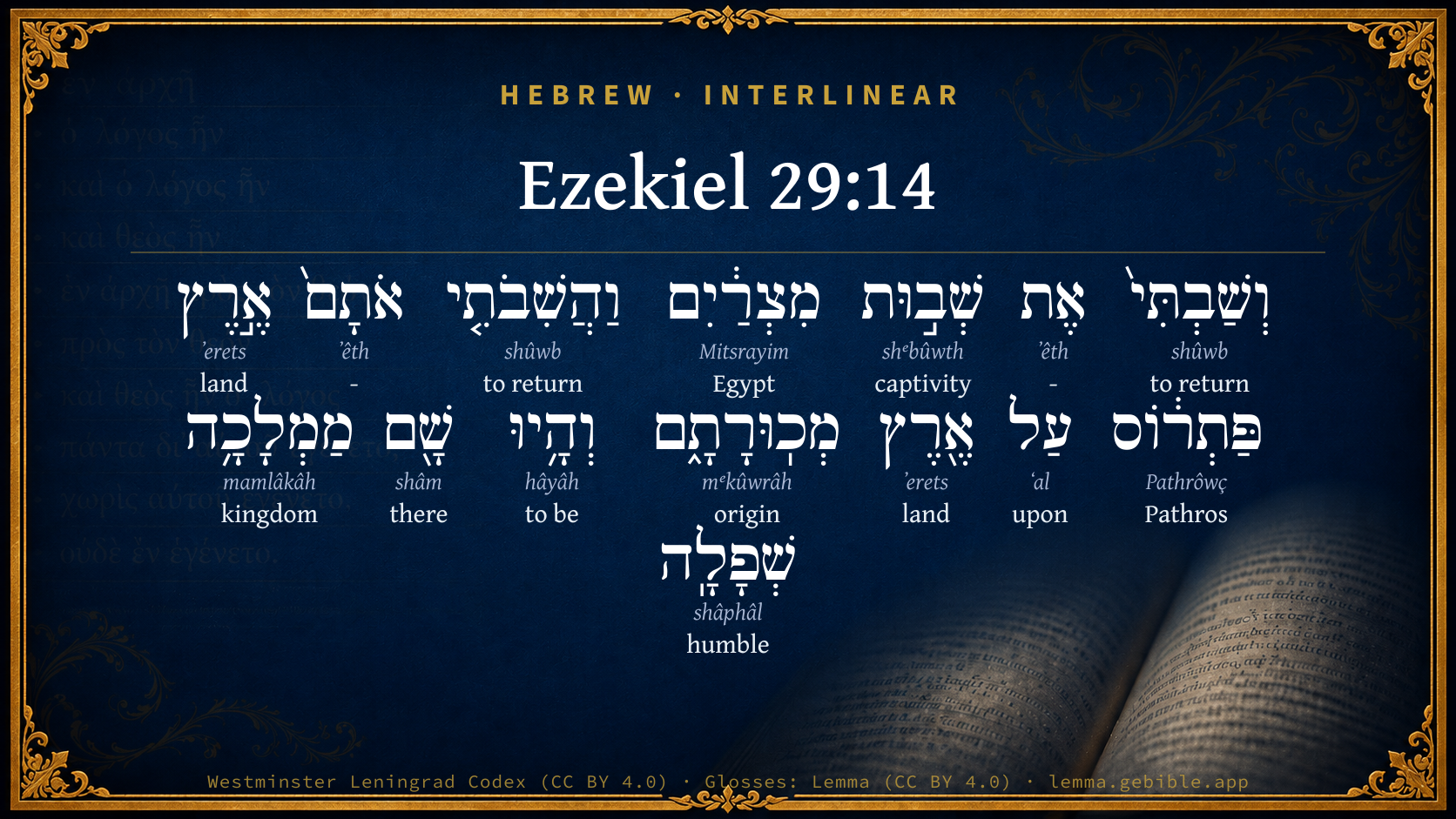
Ezekiel 29:14

Hebrew (Westminster Leningrad Codex) Ezekiel 29:14 appears in the Hebrew Old Testament. The text above is from the Westminster Leningrad Codex. Each word links to its Strong’s number, a concise gloss, and parsing drawn from the Open Scriptures Hebrew Bible morphology. Click any word for its full Brown-Driver-Briggs (BDB) entry.
Download image
Cite this verse

Ezekiel 29:14 (World English Bible). Public Domain. Lemma interlinear Bible study tool, https://lemma.gebible.app/v/ezekiel/29/14.

Show BibTeX & RIS
BibTeX
RIS
English Translation
and I will bring back the captivity of Egypt, and will cause them to return into the land of Pathros, into the land of their birth; and they shall be there a base kingdom.
World English Bible · Public Domain
Download a study sheet

One document with this verse’s original text, its word-by-word gloss line, the meaning frame, cross-references with their text, attributed commentary, and full source and license credits — printable, and it pastes into notes with its structure intact.

This verse Autodidact and up

Study sheet (.html) Plain text (.txt)

A passage Seminary Student

Up to 50 verses in one chapter. A passage sheet keeps up to 6 commentary sources and 12 cross-references per verse, in the order this page ranks them, and says so on the sheet whenever that leaves anything out. Ask for a single verse and you get the Autodidact verse sheet above.

Everything on this page stays free to read, with no account — the sheet is a download of what is already on screen, not access to it.

Want to remove ads? Support Godless Engineer
Compare translations 3

The same verse in 3 English versions, stacked beneath the original-language interlinear above. Click any original word for its lexicon entry.

Each is an independent rendering of the whole verse — the interlinear is not word-aligned to these translations.

Highlighted words mark where these versions differ — a whole-verse word diff, not a word-by-word alignment.

  • World English Bible Public Domain
    and I will bring back the captivity of Egypt, and will cause them to return into the land of Pathros, into the land of their birth; and they shall be there a base kingdom.
  • King James Version Public Domain
    And I will bring again the captivity of Egypt, and will cause them to return into the land of Pathros, into the land of their habitation; and they shall be there a base kingdom.
  • unfoldingWord Literal Text CC BY-SA 4.0
    I will restore the fortunes of Egypt and bring them back to the region of Pathros, to the land of their origin. Then they will be a lowly kingdom there.

unfoldingWord Literal Text — © unfoldingWord, licensed CC BY-SA 4.0. Word-aligned USFM3 via Door43 (git.door43.org/unfoldingWord/en_ult).

Versions to compare (up to 4)

3 of 4 selected

Show all 18 translations

Every available English version of this verse, each an independent rendering of the whole verse.

  • World English Bible Public Domain
    and I will bring back the captivity of Egypt, and will cause them to return into the land of Pathros, into the land of their birth; and they shall be there a base kingdom.
  • Berean Standard Bible Public Domain
    I will restore Egypt from captivity and bring them back to the land of Pathros, the land of their origin. There they will be a lowly kingdom.
  • Majority Standard Bible Public Domain
    I will restore Egypt from captivity and bring them back to the land of Pathros, the land of their origin. There they will be a lowly kingdom.
  • King James Version Public Domain
    And I will bring again the captivity of Egypt, and will cause them to return into the land of Pathros, into the land of their habitation; and they shall be there a base kingdom.
  • American Standard Version (1901) Public Domain
    and I will bring back the captivity of Egypt, and will cause them to return into the land of Pathros, into the land of their birth; and they shall be there a base kingdom.
  • Revised Version (1885) Public Domain
    and I will bring again the captivity of Egypt, and will cause them to return into the land of Pathros, into the land of their birth; and they shall be there a base kingdom.
  • Geneva Bible (1599) Public Domain
    And I wil bring againe the captiuitie of Egypt, and will cause them to returne into the land of Pathros, into the lande of their habitation, and they shalbe there a small kingdome.
  • Douay-Rheims (1899) Public Domain
    And I will bring hack the captivity of Egypt, and will place them in the land of Phatures, in the land of their nativity, and they shall be there a low kingdom:
  • Young's Literal Translation Public Domain
    And I have turned back `to' the captivity of Egypt, And I have brought them back `To' the land of Pathros, to the land of their birth, And they have been there a low kingdom.
  • Literal Standard Version CC BY-SA 4.0
    And I have turned back [to] the captivity of Egypt, || And I have brought them back || [To] the land of Pathros, to the land of their birth, || And they have been a low kingdom there.
  • Unlocked Literal Bible CC BY-SA 4.0
    I will restore the fortunes of Egypt and bring them back to the region of Pathros, to the land of their origin. Then they will be a lowly kingdom there.
  • unfoldingWord Literal Text CC BY-SA 4.0
    I will restore the fortunes of Egypt and bring them back to the region of Pathros, to the land of their origin. Then they will be a lowly kingdom there.
  • Darby Bible Public Domain
    and I will turn again the captivity of Egypt, and will cause them to return to the land of Pathros, into the land of their birth, and they shall there be a base kingdom.
  • World Messianic Bible Public Domain
    I will reverse the captivity of Egypt, and will cause them to return into the land of Pathros, into the land of their birth. There they will be a lowly kingdom.
  • Webster's Bible Public Domain
    And I will bring again the captivity of Egypt, and will cause them to return into the land of Pathros, into the land of their habitation; and they shall be there a base kingdom.
  • Free Bible Version CC BY-SA 4.0
    I will bring Egypt out of captivity and take them back to the land of Pathros, where they originally came from. Their kingdom will be insignificant.
  • Bible in Basic English Public Domain
    I will let the fate of Egypt be changed, and will make them come back into the land of Pathros, into the land from which they came; and there they will be an unimportant kingdom.
  • JPS Tanakh (1917) Public Domain
    and I will turn the captivity of Egypt, and will cause them to return into the land of Pathros, into the land of their origin; and they shall be there a lowly kingdom.

Literal Standard Version (2020), Covenant Press — licensed CC BY-SA 4.0. Text via the HelloAO Bible API (eBible.org). Unlocked Literal Bible (unfoldingWord) — licensed CC BY-SA 4.0. Text via the HelloAO Bible API (eBible.org). unfoldingWord Literal Text — © unfoldingWord, licensed CC BY-SA 4.0. Word-aligned USFM3 via Door43 (git.door43.org/unfoldingWord/en_ult). Free Bible Version, Dr. Jonathan Gallagher — licensed CC BY-SA 4.0. Text via the HelloAO Bible API (eBible.org).

Word by word

More ways to search: Search by grammar → Find every occurrence → Compare this word →

Practice this passage: Drill this verse → Learn its vocabulary →

מְכֽוּרָתָ֑ם
mᵉkûwrâh
H4351
“origin · their”
Noun, Common, Feminine, Singular, Construct + Suffix, Personal, 3rd Person, Masculine, Plural
Part of Speech
Noun
Type
Common
Gender
Feminine
Number
Singular
State
Construct
Full BDB Definition

Origin: from the same as H3564 in the sense of dipping

TWOT: 1033c

origin
  1. וְשַׁבְתִּי֙ shûwb H7725 “and · to return” Conjunction + Verb, Qal, Perfect, 1st Person, Common, Singular
  2. אֶת ʼêth H853 “-” Particle, Direct Object
  3. שְׁב֣וּת shᵉbûwth H7622 “captivity of” Noun, Common, Feminine, Singular, Construct
  4. מִצְרַ֔יִם Mitsrayim H4714 “Egypt” Noun, Proper
  5. וַהֲשִׁבֹתִ֤י shûwb H7725 “and · to return” Conjunction + Verb, Hiphil, Sequential Perfect, 1st Person, Common, Singular
  6. אֹתָם֙ ʼêth H853 “- · them” Particle, Direct Object + Suffix, Personal, 3rd Person, Masculine, Plural
  7. אֶ֣רֶץ ʼerets H776 “land of” Noun, Common, Both, Singular, Construct
  8. פַּתְר֔וֹס Pathrôwç H6624 “Pathros” Noun, Proper
  9. עַל ʻal H5921 “upon” Preposition
  10. אֶ֖רֶץ ʼerets H776 “land of” Noun, Common, Both, Singular, Construct
  11. וְהָ֥יוּ hâyâh H1961 “and · to be” Conjunction + Verb, Qal, Sequential Perfect, 3rd Person, Common, Plural
  12. שָׁ֖ם shâm H8033 “there” Adverb
  13. מַמְלָכָ֥ה mamlâkâh H4467 “kingdom” Noun, Common, Feminine, Singular, Absolute
  14. שְׁפָלָֽה shâphâl H8217 “humble” Adjective, Adjective, Feminine, Singular, Absolute

About this verse

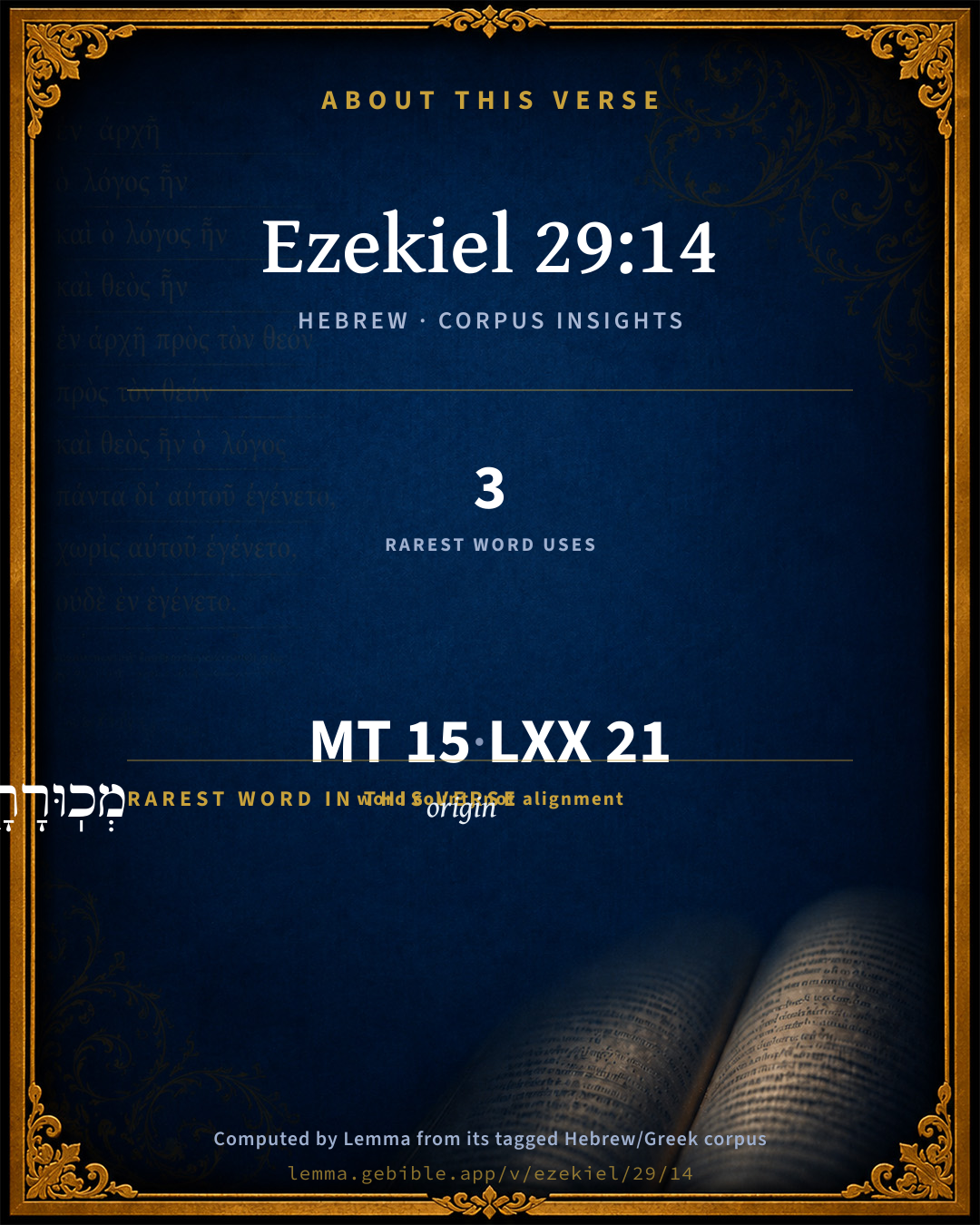
These counts appear in no published source. They are computed here, from the morphology-tagged text and Lemma’s own curated glosses. What Lemma adds →

15
words
12
distinct lemmas
Prophets
section

Notable vocabulary

The rarest word here is מְכֽוּרָתָ֑ם origin H4351 — appearing just 3 times in the whole Hebrew Bible.

Shared distinctive vocabulary

מְכֽוּרָתָ֑ם origin H4351 occurs in 3 verses of the Hebrew Bible. Also found in:

Grammatical profile

  • 3 verbs
  • 7 nouns
  • 1 adjective
  • 1 preposition
  • 1 adverb
  • 2 particles

Verb forms

  • וְשַׁבְתִּי֙ Qal · Perfect
  • וַהֲשִׁבֹתִ֤י Hiphil · Sequential Perfect
  • וְהָ֥יוּ Qal · Sequential Perfect

Repetition

Words recur within this verse — often emphatic in Hebrew:

  • וְשַׁבְתִּי֙ to return H7725 ×2
  • אֶ֣רֶץ land H776 ×2

Hebrew & Septuagint length

In English translation the verse runs 34 words from the Hebrew and 27 from the Septuagint (LXX English) — closely comparable.

A rough comparison of the two English renderings, which tokenize alike — not a word-level alignment.

Word counts can differ between the Hebrew and the Greek without any difference in meaning — e.g. the Hebrew direct-object marker אֵת has no separate Greek word, and Greek often adds the article ὁ.

In the original languages it is 15 Hebrew tokens and 21 Greek tokens — but the two are counted differently (Hebrew bundles its prefixes and suffixes into one token; the Greek is in lemma form), so that isn’t a like-for-like length.

Cross-references

5

Topical passages linked to Ezekiel 29:14 in the Treasury of Scripture Knowledge — connected by theme and wording, ordered by reader-vote popularity; previews shown in the World English Bible.

  • Ezekiel 30:14 I will make Pathros desolate, and will set a fire in Zoan, and will execute judgments on No.
  • Isaiah 11:11 It shall happen in that day, that the Lord will set his hand again the second time to recover the remnant of his people, who shall remain, from Assyria, and from Egypt, and from Pathros, and from Cush, and from Elam, and from Shinar, and from Hamath, and from the islands of the sea.
  • Jeremiah 44:1 The word that came to Jeremiah concerning all the Jews who lived in the land of Egypt, who lived at Migdol, and at Tahpanhes, and at Memphis, and in the country of Pathros, saying,
  • Genesis 10:14 Pathrusim, Casluhim (which the Philistines descended from), and Caphtorim.
  • 1 Chronicles 1:12 and Pathrusim, and Casluhim (from whence came the Philistines), and Caphtorim.

Cross-references courtesy of OpenBible.info (CC BY 4.0).

Hebrew and Greek witnesses Masoretic Hebrew ↔ Greek Septuagint

The same verse in the two great witnesses to the Old Testament, shown verse-for-verse.

These are two independent witnesses, not word-aligned to each other, and the Septuagint is shown in lemma (dictionary) form.

Hebrew Ezekiel 29:14 Masoretic · Westminster Leningrad Codex

וְשַׁבְתִּי֙ אֶת שְׁב֣וּת מִצְרַ֔יִם וַהֲשִׁבֹתִ֤י אֹתָם֙ אֶ֣רֶץ פַּתְר֔וֹס עַל אֶ֖רֶץ מְכֽוּרָתָ֑ם וְהָ֥יוּ שָׁ֖ם מַמְלָכָ֥ה שְׁפָלָֽה

and I will bring back the captivity of Egypt, and will cause them to return into the land of Pathros, into the land of their birth; and they shall be there a base kingdom.

World English Bible · Public Domain

Greek LXX Ezekiel 29:14 Septuagint · lemma form

καί ἀποστρέφω ὁ αἰχμαλωσία ὁ αἰγύπτιος καί καταοἰκίζω αὐτός ἐν γῆ παθουρης ἐν ὁ γῆ ὅθεν λαμβάνω καί εἰμί ἀρχή ταπεινός

and I will turn the captivity of the Egyptians, and will cause them to dwell in the land of Phathore, in the land whence they were taken;

LXX2012 (modern English Septuagint) · Public Domain

On this verse, The Pulpit Commentary discusses the Septuagint’s reading. Read the note in Commentary ↓

Hebrew: Westminster Leningrad Codex (CC BY 4.0). Greek: Septuagint (public domain); English from LXX2012 (modern English Septuagint) (Public Domain). How the Septuagint differs from the Hebrew →

Targum (Aramaic paraphrase)

1

The Targum is the ancient Jewish Aramaic paraphrase of the Hebrew Scriptures — an interpretive translation, not the Hebrew text itself. Onkelos (literal) and Pseudo-Jonathan (expansive) render the Torah, and Jonathan the Prophets. Coverage is partial: where no permissively-licensed English translation exists for a verse, only the Aramaic is shown. This is verse-level text, not a word-by-word alignment to the Hebrew.

  1. Targum Jonathan Prophets (Joshua–Malachi)
    וְאֶתֵּיב יַת גָלוּת מִצְרַיִם וְאָתֵיב יַתְהוֹן לְאַרְעָא פַּתְרוֹס עַל אַרְעָא תּוֹתְבוּתְהוֹן וִיהוֹן תַּמָן מָלְכוּ חֲלָשָׁא:

    (no public-domain English translation for this verse)

    Targum Jonathan — Aramaic: “Mikraot Gedolot” (public domain). English: “Sefaria Community Translation” (CC0 1.0 (public-domain dedication)); “London "Chaldee Paraphrase," 1871” (public domain). Text via Sefaria.

Commentary

Notes on Ezekiel 29:14 from classic Christian and Jewish commentators (each source and its license shown beneath its notes). The classic Christian expositions comment on the surrounding passage and are grouped to its opening verse, so a note may address several verses; the Jewish commentaries on the Tanakh (Rashi and others) are per-verse, so they appear only where the commentator wrote on this verse.

Lemma curates 59 commentaries, every one of them public domain or Creative Commons licensed, each selected and text-cleaned for this edition rather than reprinted as found. About our sources →

Trapp's Complete Commentary

John Trapp

Eze 29:14 And I will bring again the captivity of Egypt, and will cause them to return [into] the land of Pathros, into the land of their habitation; and they shall be there a base kingdom.

Ver. 14. Into the land of Pathros.] A part of the lower Egypt; a corner of the country, say some, but big enough to hold the remnant that returned.

And they shall be there a base kingdom.] Reditum et regnum illis promittit, sed humile. A kingdom God promiseth them, but base and abject, because subject and tributary to the Persian, so that the Israelites shall no more lean upon it. God often removeth occasions of sin from his people, taketh away their stumblingblocks, that they may not fall under his heavy displeasure.

John Trapp, A Commentary or Exposition upon All the Books of the Old and New Testament (1647–1656) — public domain. Text from a community e-Sword module.

The Biblical Illustrator

Joseph S. Exell

Eze_29:14

I Will bring again the Captivity of Egypt.

Gods dealings with heathen nations

1. The goodness and mercy of God extend to heathens. He hath a care of them in their captivity, and after they have suffered His appointed time He will show kindness to them.

2. The afflictions of nations and persons may be long, yet not without end; they may suffer seven and seven years, yea, twenty, thirty, forty years together, which is a long time, and then see an end of their sufferings.

3. God sometimes deals more favourably with heathens than with His own people. At the end of forty years will I gather the Egyptians, but it was the end of seventy years before He gathered the Jews out of Babylon: His own people were thirty years, or near upon, longer under the Babylonish yoke than the Egyptians. There was just cause for this; Gods people had sinned worse than the heathens, and so provoked Him above them.

4. Nothing is too hard for God, or can hinder the fulfilling of His will. The Egyptians were scattered among the nations, here a family and there a family, and that forty years together; so mingled with the people of other countries that they had well nigh forgotten Egypt, and had so drunk in the manners and customs of the places where they lived that they were neutralised thereunto; they were so rooted among the nations that it seemed impossible to pluck them up, and plant them in their own countries; yet notwithstanding these things, saith God, I will gather the Egyptians from the people whither they were scattered. The Jews had lain longer n Babylon, and were like dry bones in the grave, without hope (Eze_37:11); but God made good His word; He brought them out with a strong hand, breaking in pieces gates of brass, and cutting in sunder bars of iron.

5. It is the same hand, the same God, that drives men out of their countries and comforts, into deep and long afflictions abroad, and brings them back out of the same, to enjoy their countries and comforts. (W. Greenhill, M. A.)

The Biblical Illustrator, edited by Joseph S. Exell (c. 1880s–1900s) — public domain. Text from a community e-Sword module.

Joseph Benson's Commentary

Eze 29:14-15. And I will bring again the captivity of Egypt — This captivity of the Egyptians, though not taken notice of by Herodotus, is mentioned by Berosus, in one of the fragments of his history, quoted by Josephus, Antiq., 50. 10. chap. 11, and published with notes by Scaliger, at the end of his books, De Emendatione Temporum, whose remark upon the place is very observable, namely, “The calamities that befell the Egyptians are passed over by Herodotus, because the Egyptian priests would not inform him of any thing that tended to the disgrace of their nation.” And I will cause them to return into the land of Pathros — That part of Egypt which is called Thebais, as Bochart proves by several arguments. And they shall be there a base kingdom, the basest of kingdoms — “By base kingdom is meant, that it should be tributary and subject to strangers, for the much greatest part of the time. This is the purport and meaning of the prophecy; and the truth will appear by a short deduction of the history of Egypt from that time to this. It was first of all tributary to the Babylonians under Amasis; upon the ruin of the Babylonish empire, it was subject to the Persians; upon the failure of the Persian empire, it came into the hands of the Macedonians; after the Macedonians, it fell under the dominion of the Romans; after the division of the Roman empire, it was subdued by the Saracens, in the reign of Omar, their third emperor; about the year of Christ 1250, it was in the possession of the Mamelukes, a word which signifies a slave bought with money, but is appropriated to those Turkish or Circassian slaves, whom the sultans of Egypt bought young, and taught military exercises. These slaves usurped the royal authority, and by that means Egypt became their prey. But, A.D. 1517, Selim, the ninth emperor of the Turks, conquered the Mamelukes, and annexed Egypt to the Ottoman empire, of which it continues to be a province to this day. By this deduction it appears, that the truth of Ezekiel’s prediction is fully attested by the whole series of the history of Egypt, from that time to the present. And who could pretend to say, upon human conjecture, that so great a kingdom, so rich and fertile a country, should ever afterward become tributary and subject to strangers? It is now a great deal above two thousand years since this prophecy was first delivered; and what likelihood or appearance was there, that the Egyptians should, for so many ages, bow under a foreign yoke, and never, in all that time, be able to recover their liberties, and have a prince of their own to reign over them? But as is the prophecy, so is the event.” — Bishop Newton.

Joseph Benson's Commentary on the Old and New Testaments (1811–1818) — public domain. Text from a community e-Sword module.

Tyndale Open Study Notes

Tyndale Open Resources

29:14-16 Judah would ultimately be fully restored, but Egypt would remain an unimportant . . . kingdom. Israel would never again be tempted to call on Egypt for help instead of calling on the Lord. Egypt’s restored but reduced position would make it a constant reminder of Israel’s past folly in trusting it.

Tyndale Open Study Notes — © Tyndale Open Resources, licensed CC BY-SA 4.0. Text via the HelloAO Bible API.

Geneva Bible (1599)

Geneva Bible translators

Meaning, that they should not have full dominion, but be under the Persians, Greeks and Romans, and the cause is that the Israelites should no more put their trust in them, but learn to depend on God.

Geneva Bible (1599) marginal notes — public domain. Text via Bolls.life.

Jamieson, Fausset & Brown

Robert Jamieson, A. R. Fausset & David Brown

Pathros--the Thehaiti, or Upper Egypt, which had been especially harassed by Nebuchadnezzar (Nah 3:8, Nah 3:10). The oldest part of Egypt as to civilization and art. The Thebaid was anciently called "Egypt" [ARISTOTLE]. Therefore it is called the "land of the Egyptians' birth" (Margin, for "habitation").

base kingdom--Under Amasis it was made dependent on Babylon; humbled still more under Cambyses; and though somewhat raised under the Ptolemies, never has it regained its ancient pre-eminence.

Jamieson, Fausset & Brown — Commentary Critical and Explanatory on the Whole Bible (1871) — public domain (CC PDM 1.0). Text via the HelloAO Bible API.

Adam Clarke's Commentary

Verse 14. Into the land of Pathros] Supposed to mean the Delta, a country included between the branches of the Nile, called Δ delta, from its being in the form of the Greek letter of that name. It may mean the Pathrusim, in Upper Egypt, near to the Thebaid. This is most likely.

Shall be there a base kingdom.] That is, it shall continue to be tributary. It is upwards of two thousand years since this prophecy was delivered, and it has been uninterruptedly fulfilling to the present hour.

1. Egypt became tributary to the Babylonians, under Amasis.

2. After the ruin of the Babyionish empire, it became subject to the Persians.

3. After the Persians, it came into the hands of the Macedonians.

4. After the Macedonians it fell into the hands of the Romans.

5. After the division of the Roman empire it was subdued by the Saracens.

6. About A.D. 1250, it came into the hands of the Mameluke slaves.

7. Selim, the ninth emperor of the Turks, conquered the Mamelukes, A.D. 1517, and annexed Egypt to the Ottoman empire, of which it still continues to be a province, governed by a pacha and twenty-four beys, who are always advanced from servitude to the administration of public affairs. So true is it that Egypt, once so glorious, is the basest of kingdoms. See Newton on the prophecies.

Adam Clarke's Commentary on the Bible (1810–1826) — public domain. Text from a community e-Sword/MySword module.

Ellicott's Commentary for English Readers

(14) The land of Pathros.—Comp. Isa_11:11. Pathros is Upper Egypt, the Thebaid. In the following clause this is described as “the land of their birth” (Marg.). According to ancient testimony and the opinion of many moderns, this was the original seat of Egyptian power. It may, however, be put only as the part for the whole—Pathros for Egypt.

Shall be there a base kingdom.—Egypt should be restored, but not to its former power. Historically this has been eminently true. For a little while Egypt struggled against its oppressors, but its power was already broken, and from the time of its conquest by Cambyses it has never been for any length of time independent. There are few stronger contrasts in any inhabited country than between the ancient glory, dignity, power, and wealth of Egypt, and its later insignificance.

A Bible Commentary for English Readers, edited by Charles John Ellicott (1878–1897) — public domain. Text from a community e-Sword module.

The Cambridge Bible for Schools and Colleges

gen. ed. J. J. S. Perowne

14. land of Pathros] i.e. Upper Egypt or the Thebaid, ch. Eze_30:14, Isa_11:11; Jer_44:15. The name is said to mean “south land.”

their habitation] their origin, or birth, cf. Eze_16:3. For the phrase “bring again the captivity” i.e. probably turn the fortunes, cf. Eze_16:53.

a base kingdom] i.e. a low or humble state, ch. Eze_17:6; Eze_17:14.

The Cambridge Bible for Schools and Colleges (gen. ed. J. J. S. Perowne; Cambridge University Press, 1878–1918) — public domain. Text from a community e-Sword module.

John Gill's Exposition

And I will bring again the captivity of Egypt,.... For what is done by men, under the direction and influence of divine Providence, is said to be done by the Lord, as this was, though by the means of Cyrus:

and will cause them to return into the land of Pathros; which was a part of the land of Egypt; perhaps so called from Pathrusim, the son of Mizraim, from whom Egypt had its name, Gen 10:14. Bochart takes it to be Thebais, a principal country in Egypt:

into the land of their habitation; or nativity, where they were born, and where they before dwelt:

and they shall be there a base kingdom; as it is at this day more especially, to which it has been gradually reduced, having passed into various hands, and come under the power and dominion of different states: whatever might be the case and circumstances of it under Cyrus, Cambyses his son entered into it, made sad devastation in it, and an entire conquest of it; and though it revolted under Darius Hystaspes, it was subdued again, and brought into a worse state than before by Xerxes: it revolted again in the reign of Darius Nothus, and was at last by Ochus totally subdued; and from that time the Egyptians never had a king of their own nation to reign over them. Along with the Persian empire it came into the hands of Alexander without any opposition; and, after his death, fell to the share of Ptolemy, one of his captains; and, though some of the first kings of that name were of considerable note and power, yet Egypt made a poor figure under the reigns of several of them. When the Roman empire obtained, it became a province of that, and continued so for six or seven hundred years; and then it fell into the hands of the Saracens, when it sunk into ignorance and superstition, the Mahometan religion being established in it, with whom it continued until about the year of Christ 1250; when the Mamalucks, or Turkish and Carcassian slaves, rose up against their sovereigns, the sultans of Egypt, and usurped the government, in whose hands it was until the year 1517; when Selim the ninth, emperor of the Turks, conquered the Mamalucks, and put an end to their government, and annexed it to the Ottoman empire; of which it is a province to this day (x), being governed by a Turkish basha, with twenty four begs or princes under him, who are raised, from being servants, to the administration of public affairs; and so it is become a base kingdom indeed, if to be called one (y).

(x) Written about 1730. Editor. (y) See all this at large, with the proofs of it, in Dr. Newton's Dissertations on Prophecies, from p. 382. to 394.

John Gill's Exposition of the Whole Bible (1746–1763) — public domain (CC PDM 1.0). Text via the HelloAO Bible API.

Albert Barnes' Notes on the Bible

Pathros - The Thebaid or Upper Egypt, the original seat of the kingdom.

The land of their habitation - Rather, as margin, i. e., the home of the restored exiles.

Albert Barnes' Notes on the Bible (1834–1885) — public domain. Text from a community e-Sword/MySword module.

Haydock's Catholic Bible Commentary

Low. The Jews were not more tempted to apply to them for aid. (Calmet) --- Amasis strove to shake off the yoke: but Cambyses came and slew many. Psammenites killed himself; (Herodotus iii. 9.) or was taken to Susa, and the country laid waste. (Ctesias) --- Egypt has almost ever since been subject to foreign princes, (Haydock) Persians, Greeks, Romans, Saracens, Mamelukes, and Turks. The trade of Egypt, by caravans, was in a manner destroyed for forty years by Nabuchodonosor, whose victories Megesthenes and Berosus attest 300 years before Christ. (Watson)

George Leo Haydock (1774–1849), Haydock's Catholic Family Bible and Commentary, 1859 edition — public domain. Excludes Psalms (Douay-Rheims chapter numbering differs from Protestant) and Deuterocanonical books (Catholic canon only).

Matthew Poole's English Annotations

The captivity; which Nebuchadnezzar led away into Babylon.

The land of Pathros; one province or country of Egypt; it was a southern part of Egypt. in which was the famous city Thebae or Thebais, known for its hundred gates.

The land of their habitation; the ancient habitation of the fathers of the most of those that did return, forty years having eaten up almost all that had lived there before.

A base kingdom; a low, tributary, dependent kingdom, subject to the Persian kingdom as Areasis was to Cyrus; and though it did at length grow great, yet was it always dependent on Greeks or Romans.

Matthew Poole's English Annotations on the Holy Bible (1683–1685) — public domain. Text from a community e-Sword/MySword module.

Whedon's Commentary on the Bible

Daniel D. Whedon

14. I will bring again the captivity — That is, after the necessary and complete period of chastisement symbolically represented by forty years has passed, the captives shall be brought back again to their own land. It is a curious thing that a cylinder of Cyrus, now in the British Museum, declares that he permitted his captives of “all lands” to return from Babylon to their own homes.

Pathros — The Pharaohs from earliest times wore a double crown, as rulers of “two lands.” Pathros (Assyrian, Paturissu), the “land of the south” (Isa_11:11), was Upper Egypt.

Habitation — R.V., “birth.”

Daniel D. Whedon (gen. ed.), Commentary on the Old and New Testaments (1874–1909) — public domain. Text from a community e-Sword module.

The Pulpit Commentary

Into the land of Pathros. (For the land of their habitation, read, with the Revised Version, the land of their birth.) (For Pathres, see Gen_10:13, Gen_10:14; 1Ch_1:12; Isa_11:1; Jer_44:1) Its position is somewhat doubtful, but the balance of evidence is in favor of placing it in the Thebaid of Upper Egypt, which Herodotus (2. 4, 15) describes as the original seat of the Egyptian monarchy. Its name may be connected with the Pathyrite name in which Thebes was situated (Pliny, "Hist. Nat.," 5:9). The LXX gives the form Pathures, and is followed by the Vulgate, with a slight change, Phathures.

Vers. 14-16. The meager restoration of Egypt.

I GOD HAS MERCY ON THE HEATHEN. Egypt is to be conquered by Nebuchadnezzar; but in course of time the Chaldean yoke shall be broken off its neck and Egypt shall be restored to national existence. There is here a promise somewhat similar to that which the prophets repeatedly gave in God"s name to the Jews. Now, this promise is offered to a heathen people. God is not only the Judge of the heathen; he is also their Savior. He does not deal only in one way with any people. He cannot confine his relations with any to one side of his nature. He must be ever himself, his true and whole self. But the judicial, and that only in condemning to punishment, by no means includes the whole nature of God. God is essentially love. Therefore whenever God is dealing with any of his creatures, since he is always true to his nature and approaches them in the totality of his character, he must come in love, though at first this love may be hidden behind the clouds of wrath and judgment. In the gospel God shows his mercy to the heathen. Christ came because of God"s love for the whole world. It is now the desire of Christ that his gospel should be preached to every creature.

II THERE ARE IRREPARABLE LOSSES WHICH ARE BROUGHT ABOUT BY SIN. The proud pre-eminence of the empire of the Pharaohs was never recovered. The restored Pharaohs were feeble shadows of their awful predecessors. Cambyses the Persian king asked and received the daughter of one of them, not as a wife, but in the lower rank of a concubine. To the present day Egypt has been a weak and dependent nation. Ezekiel predicts that it shall be the "basest of the kingdoms.

1. The temporal consequences of sin are unavoidable. Repentance does not bring back the spendthrift"s squandered fortune. A shattered constitution cannot be restored to sound health.

2. Without a return to God the worst consequences of sin must continue. There is a striking difference between the predictions of the glorious restoration of Israel and this prophecy of the meager and uninviting restoration of Egypt. The conditions of the two peoples were very different. Israel humbled herself and returned in faith and devotion to God. Egypt remained a heathen nation, and as far as we know underwent no moral reformation. God was still merciful to her, but she could not reap the full blessings of restoration. We must believe that the heathen will be judged according to their light, and certainly not be punished for being heathen when they have no opportunity of knowing the truth. But the fact remains that while they lie sunken in moral corruption they cannot be also enjoying the heavenly blessedness of the pure in heart.

III IT IS WELL THAT FALSE GROUNDS OF CONFIDENCE SHOULD BE EXPOSED. In the past the Jews continually hankered after the Egyptian alliance. They will do so no longer. "Egypt shall be no more the confidence of the house of Israel

1. When the nature of false hopes is exposed we are driven to the truth for our refuge. No longer going down to Egypt for help, restored Israel will know that God is the Lord, and learn to trust him better. God wins us by disillusioning us.

2. The ruin of false hopes is a perpetual warning. Egypt is not to be swept to permanent destruction like Tyre, on whose rocks the fishermen are to hang their nets. She is to continue in existence, but no longer as a ruling nation. Thus Israel will have the spectacle of her neighbor"s humiliation perpetually bringing her own iniquity to remembrance. Ruins are a melancholy sight; but they are an instructive one. It is well to study the sadder lessens of history.

The Pulpit Commentary (1880–1919), ed. H.D.M. Spence-Jones & Joseph S. Exell — public domain. Text from a community e-Sword module.

John Wesley's Explanatory Notes

Pathros - The southern part of Egypt, in which was the famous city Thebae, known for its hundred gates. Their habitation - The ancient habitation of their fathers. A base - A low, tributary, dependent kingdom.

John Wesley, Explanatory Notes Upon the Whole Bible (1754–1765) — public domain. Text via the GEBible commentary corpus.

Rashi

Rabbi Shlomo Yitzchaki (Rashi)

their habitation [Heb. מְכוּרָתָם] [like] מְגוּרָתָם, their habitation. Another interpretation: like תוֹלדוֹתָם, their birth, and this is how Menachem (p. 110) associated it.

Rashi on the Tanakh — English translations: “The Judaica Press complete Tanach with Rashi, translated by A. J. Rosenberg” (CC BY 4.0); “Pentateuch with Rashi's commentary by M. Rosenbaum and A.M. Silbermann, 1929-1934” (public domain); “The Metsudah Tanach series, Lakewood, N.J” (CC BY 4.0); and “The Book of Joshua, Metsudah Publications, 1997” (CC BY 4.0). Text via Sefaria.

Lesson kit

Teaching starters — assembled from the data on this page, not authored interpretation. Every prompt links to the verse data it draws on. Edit before teaching.

Ezekiel, in the Prophets, opens this verse with 15 words (12 distinct Hebrew lemmas). Its most distinctive word is mᵉkûwrâh (“origin”). A historical commentator’s framing appears above. Read the whole chapter for the surrounding context.

Discussion questions

  1. How does “origin” (mᵉkûwrâh) shape what this verse is saying?
  2. How does Ezekiel 16:3, which shares the word «origin», read alongside this verse?
  3. What does the repetition of “to return” (2× in this one verse) do in this verse?
  4. These translations render this verse differently. What is at stake in choosing one wording over another?
  5. «וְשַׁבְתִּי֙» is a Qal Perfect verb. How does that grammatical form shape the action described?
  6. Compare how Trapp's Complete Commentary and The Biblical Illustrator read this verse. Where do they agree or differ?

Things to notice

Reading settings

Reading text

Shown beneath each verse's original-language words.

Old Testament
Old Testament edition

Read the OT as the Masoretic Hebrew (MT) or the Greek Septuagint (LXX).

English shown for the Greek Septuagint (in the Hebrew ↔ Greek comparison).

Comparing translations? Open the Compare panel on any verse page to stack up to four side by side.