
Isaiah 19:21

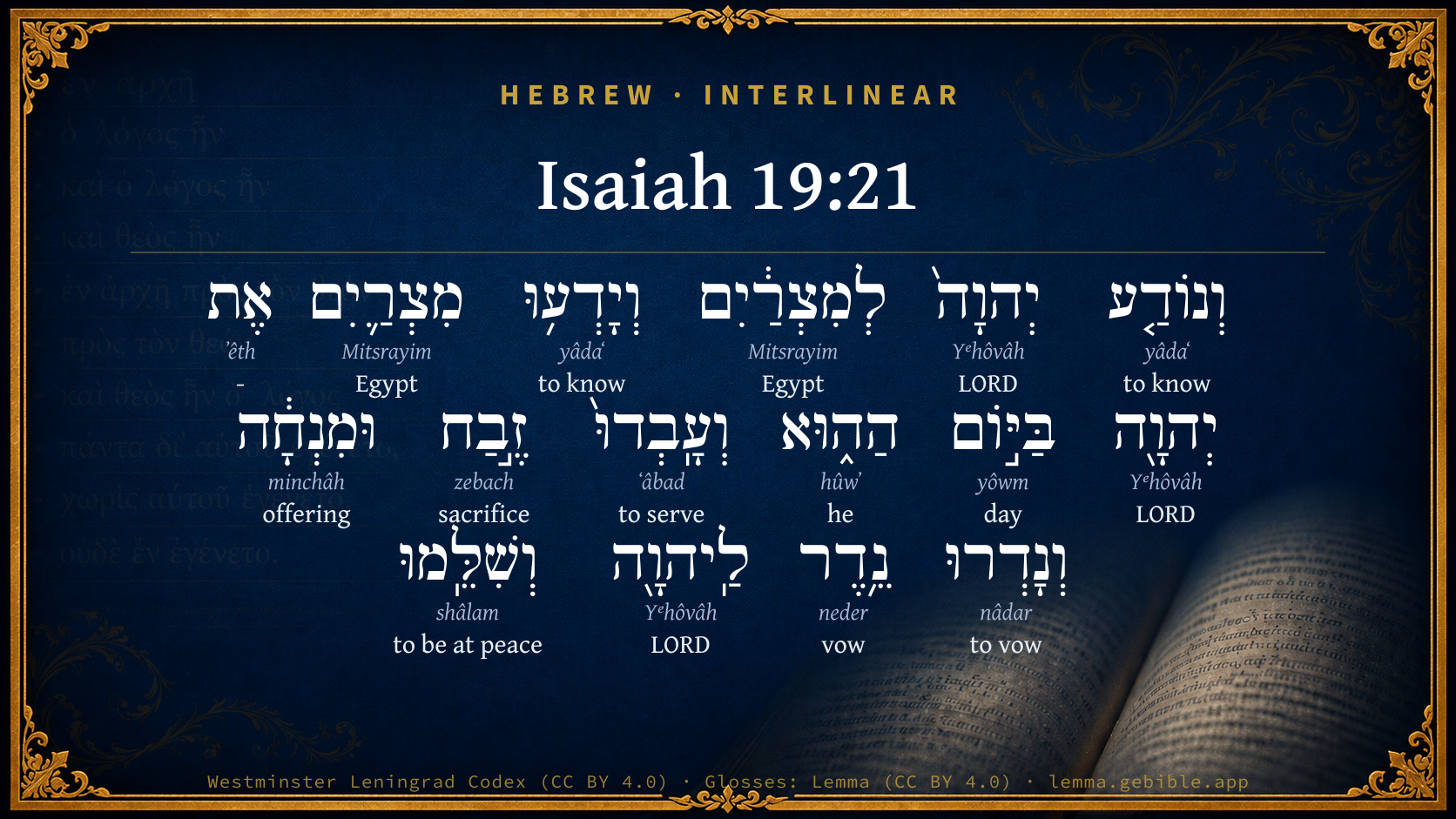
Hebrew (Westminster Leningrad Codex) Isaiah 19:21 appears in the Hebrew Old Testament. The text above is from the Westminster Leningrad Codex. Each word links to its Strong’s number, a concise gloss, and parsing drawn from the Open Scriptures Hebrew Bible morphology. Click any word for its full Brown-Driver-Briggs (BDB) entry.
Download image
Cite this verse

Isaiah 19:21 (World English Bible). Public Domain. Lemma interlinear Bible study tool, https://lemma.gebible.app/v/isaiah/19/21.

Show BibTeX & RIS
BibTeX
RIS
English Translation
Yahweh shall be known to Egypt, and the Egyptians shall know Yahweh in that day; yes, they shall worship with sacrifice and offering, and shall vow a vow to Yahweh, and shall perform it.
World English Bible · Public Domain
Download a study sheet

One document with this verse’s original text, its word-by-word gloss line, the meaning frame, cross-references with their text, attributed commentary, and full source and license credits — printable, and it pastes into notes with its structure intact.

This verse Autodidact and up

Study sheet (.html) Plain text (.txt)

A passage Seminary Student

Up to 50 verses in one chapter. A passage sheet keeps up to 6 commentary sources and 12 cross-references per verse, in the order this page ranks them, and says so on the sheet whenever that leaves anything out. Ask for a single verse and you get the Autodidact verse sheet above.

Everything on this page stays free to read, with no account — the sheet is a download of what is already on screen, not access to it.

Want to remove ads? Support Godless Engineer
Compare translations 3

The same verse in 3 English versions, stacked beneath the original-language interlinear above. Click any original word for its lexicon entry.

Each is an independent rendering of the whole verse — the interlinear is not word-aligned to these translations.

Highlighted words mark where these versions differ — a whole-verse word diff, not a word-by-word alignment.

  • World English Bible Public Domain
    Yahweh shall be known to Egypt, and the Egyptians shall know Yahweh in that day; yes, they shall worship with sacrifice and offering, and shall vow a vow to Yahweh, and shall perform it.
  • King James Version Public Domain
    And the LORD shall be known to Egypt, and the Egyptians shall know the LORD in that day, and shall do sacrifice and oblation; yea, they shall vow a vow unto the LORD, and perform it.
  • unfoldingWord Literal Text CC BY-SA 4.0
    And Yahweh will be known to Egypt, and Egypt will know Yahweh in that day. And they will serve sacrifice and offering, and they will vow a vow to Yahweh, and they will pay.

unfoldingWord Literal Text — © unfoldingWord, licensed CC BY-SA 4.0. Word-aligned USFM3 via Door43 (git.door43.org/unfoldingWord/en_ult).

Versions to compare (up to 4)

3 of 4 selected

Show all 18 translations

Every available English version of this verse, each an independent rendering of the whole verse.

  • World English Bible Public Domain
    Yahweh shall be known to Egypt, and the Egyptians shall know Yahweh in that day; yes, they shall worship with sacrifice and offering, and shall vow a vow to Yahweh, and shall perform it.
  • Berean Standard Bible Public Domain
    The LORD will make Himself known to Egypt, and on that day Egypt will acknowledge the LORD. They will worship with sacrifices and offerings; they will make vows to the LORD and fulfill them.
  • Majority Standard Bible Public Domain
    The LORD will make Himself known to Egypt, and on that day Egypt will acknowledge the LORD. They will worship with sacrifices and offerings; they will make vows to the LORD and fulfill them.
  • King James Version Public Domain
    And the LORD shall be known to Egypt, and the Egyptians shall know the LORD in that day, and shall do sacrifice and oblation; yea, they shall vow a vow unto the LORD, and perform it.
  • American Standard Version (1901) Public Domain
    And Jehovah shall be known to Egypt, and the Egyptians shall know Jehovah in that day; yea, they shall worship with sacrifice and oblation, and shall vow a vow unto Jehovah, and shall perform it.
  • Revised Version (1885) Public Domain
    And the LORD shall be known to Egypt, and the Egyptians shall know the LORD in that day; yea, they shall worship with sacrifice and oblation, and shall vow a vow unto the LORD, and shall perform it.
  • Geneva Bible (1599) Public Domain
    And the Lord shall be knowen of the Egyptians, and the Egyptians shall knowe the Lord in that day, and doe sacrifice and oblation, and shall vowe vowes vnto the Lord, and performe them.
  • Douay-Rheims (1899) Public Domain
    And the Lord shall be known by Egypt, and the Egyptians shall know the Lord in that day, and shall worship him with sacrifices and offerings: and they shall make vows to the Lord, and per- form them.
  • Young's Literal Translation Public Domain
    And known hath been Jehovah to Egypt, And the Egyptians have known Jehovah in that day, And done sacrifice and present, And vowed a vow to Jehovah, and completed `it'.
  • Literal Standard Version CC BY-SA 4.0
    And YHWH has been known to Egypt, || And the Egyptians have known YHWH in that day, || And done sacrifice and present, || And vowed a vow to YHWH, and completed [it].
  • Unlocked Literal Bible CC BY-SA 4.0
    Yahweh will become known to Egypt, and the Egyptians will acknowledge Yahweh on that day. They will worship with sacrifices and offerings, and will make vows to Yahweh and fulfill them.
  • unfoldingWord Literal Text CC BY-SA 4.0
    And Yahweh will be known to Egypt, and Egypt will know Yahweh in that day. And they will serve sacrifice and offering, and they will vow a vow to Yahweh, and they will pay.
  • Darby Bible Public Domain
    And Jehovah shall be known to the Egyptians, and the Egyptians shall know Jehovah in that day, and shall serve with sacrifice and oblation; and they shall vow a vow unto Jehovah, and perform it.
  • World Messianic Bible Public Domain
    The LORD will be known to Egypt, and the Egyptians will know the LORD in that day. Yes, they will worship with sacrifice and offering, and will vow a vow to the LORD, and will perform it.
  • Webster's Bible Public Domain
    And the LORD shall be known to Egypt, and the Egyptians shall know the LORD in that day, and shall do sacrifice and oblation; yes, they shall vow a vow to the LORD, and perform it.
  • Free Bible Version CC BY-SA 4.0
    The Lord will make himself known to Egypt, and at that time Egypt will come to know the Lord. They will worship him with sacrifices and offerings; they will make promises to the Lord and keep them.
  • Bible in Basic English Public Domain
    And the Lord will give the knowledge of himself to Egypt, and the Egyptians will give honour to the Lord in that day; they will give him worship with offerings and meal offerings, and will take an oath to the Lord and give effect to it.
  • JPS Tanakh (1917) Public Domain
    And the LORD shall make Himself known to Egypt, and the Egyptians shall know the LORD in that day; yea, they shall worship with sacrifice and offering, and shall vow a vow unto the LORD, and shall perform it.

Literal Standard Version (2020), Covenant Press — licensed CC BY-SA 4.0. Text via the HelloAO Bible API (eBible.org). Unlocked Literal Bible (unfoldingWord) — licensed CC BY-SA 4.0. Text via the HelloAO Bible API (eBible.org). unfoldingWord Literal Text — © unfoldingWord, licensed CC BY-SA 4.0. Word-aligned USFM3 via Door43 (git.door43.org/unfoldingWord/en_ult). Free Bible Version, Dr. Jonathan Gallagher — licensed CC BY-SA 4.0. Text via the HelloAO Bible API (eBible.org).

Word by word

More ways to search: Search by grammar → Find every occurrence → Compare this word →

Practice this passage: Drill this verse → Learn its vocabulary →

וְנָדְרוּ
nâdar
H5087
“and · to vow”
Conjunction + Verb, Qal, Sequential Perfect, 3rd Person, Common, Plural
Part of Speech
Conjunction + Verb
Stem
Qal
Form
Sequential Perfect
Person
3rd Person
Gender
Common
Number
Plural
Full BDB Definition

Origin: a primitive root

TWOT: 1308

to vow, make a vow - (Qal) to vow a vow
  1. וְנוֹדַ֤ע yâdaʻ H3045 “and · to know” Conjunction + Verb, Niphal, Sequential Perfect, 3rd Person, Masculine, Singular
  2. יְהוָה֙ Yᵉhôvâh H3068 “LORD” Noun, Proper
  3. לְמִצְרַ֔יִם Mitsrayim H4714 “to/for · Egypt” Preposition + Noun, Proper
  4. וְיָדְע֥וּ yâdaʻ H3045 “and · to know” Conjunction + Verb, Qal, Sequential Perfect, 3rd Person, Common, Plural
  5. מִצְרַ֛יִם Mitsrayim H4714 “Egypt” Noun, Proper
  6. אֶת ʼêth H853 “-” Particle, Direct Object
  7. יְהוָ֖ה Yᵉhôvâh H3068 “LORD” Noun, Proper
  8. בַּיּ֣וֹם yôwm H3117 “in/at the · day” Preposition, Determined + Noun, Common, Masculine, Singular, Absolute
  9. הַה֑וּא hûwʼ H1931 “the · he” Particle, Definite Article + Pronoun, Personal, 3rd Person, Masculine, Singular
  10. וְעָֽבְדוּ֙ ʻâbad H5647 “and · to serve” Conjunction + Verb, Qal, Sequential Perfect, 3rd Person, Common, Plural
  11. זֶ֣בַח zebach H2077 “sacrifice” Noun, Common, Masculine, Singular, Absolute
  12. וּמִנְחָ֔ה minchâh H4503 “and · offering” Conjunction + Noun, Common, Feminine, Singular, Absolute
  13. נֵ֥דֶר neder H5088 “vow” Noun, Common, Masculine, Singular, Absolute
  14. לַֽיהוָ֖ה Yᵉhôvâh H3068 “to/for · LORD” Preposition + Noun, Proper
  15. וְשִׁלֵּֽמוּ shâlam H7999 “and · to be at peace” Conjunction + Verb, Piel, Sequential Perfect, 3rd Person, Common, Plural

About this verse

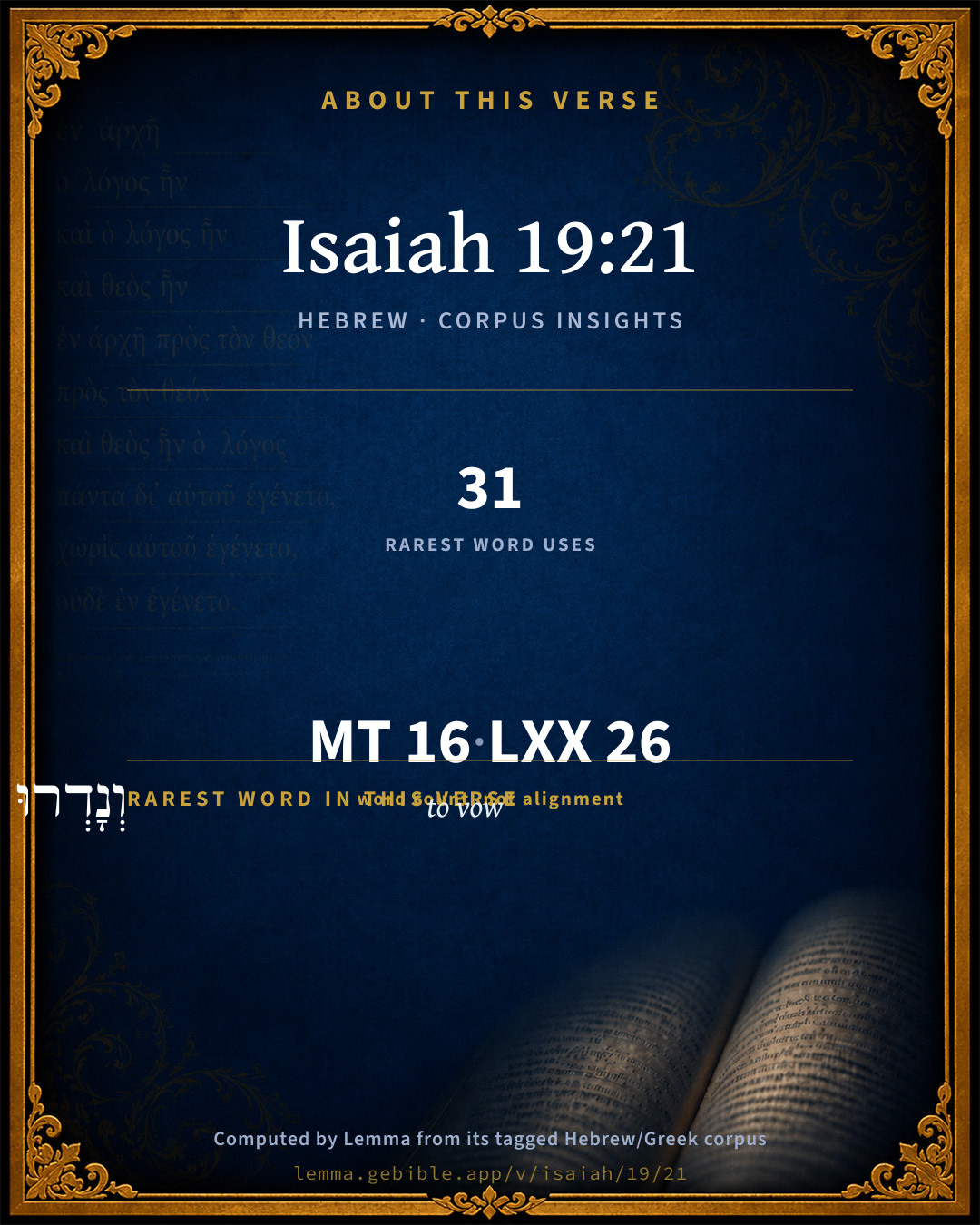
These counts appear in no published source. They are computed here, from the morphology-tagged text and Lemma’s own curated glosses. What Lemma adds →

16
words
12
distinct lemmas
Prophets
section

Shared distinctive vocabulary

וְנָדְרוּ to vow H5087 occurs in 28 verses of the Hebrew Bible. Also found in:

Grammatical profile

  • 5 verbs
  • 9 nouns
  • 1 pronoun
  • 1 particle

Verb forms

  • וְנוֹדַ֤ע Niphal · Sequential Perfect
  • וְיָדְע֥וּ Qal · Sequential Perfect
  • וְעָֽבְדוּ֙ Qal · Sequential Perfect
  • וְנָדְרוּ Qal · Sequential Perfect
  • וְשִׁלֵּֽמוּ Piel · Sequential Perfect

Repetition

Words recur within this verse — often emphatic in Hebrew:

  • יְהוָה֙ LORD H3068 ×3
  • וְנוֹדַ֤ע to know H3045 ×2
  • לְמִצְרַ֔יִם Egypt H4714 ×2

Hebrew & Septuagint length

In English translation the verse runs 34 words from the Hebrew and 34 from the Septuagint (LXX English) — the same length.

A rough comparison of the two English renderings, which tokenize alike — not a word-level alignment.

Word counts can differ between the Hebrew and the Greek without any difference in meaning — e.g. the Hebrew direct-object marker אֵת has no separate Greek word, and Greek often adds the article ὁ.

In the original languages it is 16 Hebrew tokens and 26 Greek tokens — but the two are counted differently (Hebrew bundles its prefixes and suffixes into one token; the Greek is in lemma form), so that isn’t a like-for-like length.

Cross-references

21

Topical passages linked to Isaiah 19:21 in the Treasury of Scripture Knowledge — connected by theme and wording, ordered by reader-vote popularity; previews shown in the World English Bible.

  • Isaiah 11:9 They shall not hurt nor destroy in all my holy mountain; for the earth shall be full of the knowledge of Yahweh, as the waters cover the sea.
  • Malachi 1:11 For from the rising of the sun even to the going down of the same, my name is great among the nations, and in every place incense will be offered to my name, and a pure offering: for my name is great among the nations," says Yahweh of Hosts.
  • 1 Samuel 17:46 This day will Yahweh deliver you into my hand; and I will strike you, and take your head from off you; and I will give the dead bodies of the host of the Philistines this day to the birds of the sky, and to the wild animals of the earth; that all the earth may know that there is a God in Israel,
  • 1 Kings 8:43 hear in heaven, your dwelling-place, and do according to all that the foreigner calls to you for; that all the peoples of the earth may know your name, to fear you, as does your people Israel, and that they may know that this house which I have built is called by my name.
  • Psalms 67:2 That your way may be known on earth, And your salvation among all nations,
  • Psalms 98:2–3 Yahweh has made known his salvation. He has openly shown his righteousness in the sight of the nations.
  • Ecclesiastes 5:4 When you vow a vow to God, don't defer to pay it; for he has no pleasure in fools. Pay that which you vow.
  • Isaiah 37:20 Now therefore, Yahweh our God, save us from his hand, that all the kingdoms of the earth may know that you are Yahweh, even you only.
  • Isaiah 44:5 One shall say, I am Yahweh's; and another shall call [himself] by the name of Jacob; and another shall subscribe with his hand to Yahweh, and surname [himself] by the name of Israel.
  • Isaiah 55:5 Behold, you shall call a nation that you don't know; and a nation that didn't know you shall run to you, because of Yahweh your God, and for the Holy One of Israel; for he has glorified you.
  • Isaiah 56:7 even them will I bring to my holy mountain, and make them joyful in my house of prayer: their burnt offerings and their sacrifices shall be accepted on my altar; for my house shall be called a house of prayer for all peoples.
  • Jonah 1:16 Then the men feared Yahweh exceedingly; and they offered a sacrifice to Yahweh, and made vows.
  • Habakkuk 2:14 For the earth will be filled with the knowledge of the glory of Yahweh, as the waters cover the sea.
  • Zephaniah 3:10 From beyond the rivers of Cush, my worshipers, even the daughter of my dispersed people, will bring my offering.
  • Zechariah 14:16–18 It will happen that everyone who is left of all the nations that came against Jerusalem will go up from year to year to worship the King, Yahweh of Hosts, and to keep the feast of tents.
  • John 4:21–24 Jesus said to her, "Woman, believe me, the hour comes, when neither in this mountain, nor in Jerusalem, will you worship the Father.
  • John 17:3 This is eternal life, that they should know you, the only true God, and him whom you sent, Jesus Christ.
  • Romans 15:27–28 Yes, it has been their good pleasure, and they are their debtors. For if the Gentiles have been made partakers of their spiritual things, they owe it to them also to serve them in fleshly things.
  • 1 Peter 2:5 You also, as living stones, are built up as a spiritual house, to be a holy priesthood, to offer up spiritual sacrifices, acceptable to God through Jesus Christ.
  • 1 Peter 2:9 But you are a chosen race, a royal priesthood, a holy nation, a people for God's own possession, that you may show forth the excellencies of him who called you out of darkness into his marvelous light:
  • Galatians 4:8–9 However at that time, not knowing God, you were in bondage to those who by nature are not gods.

Cross-references courtesy of OpenBible.info (CC BY 4.0).

Hebrew and Greek witnesses Masoretic Hebrew ↔ Greek Septuagint

The same verse in the two great witnesses to the Old Testament, shown verse-for-verse.

These are two independent witnesses, not word-aligned to each other, and the Septuagint is shown in lemma (dictionary) form.

Hebrew Isaiah 19:21 Masoretic · Westminster Leningrad Codex

וְנוֹדַ֤ע יְהוָה֙ לְמִצְרַ֔יִם וְיָדְע֥וּ מִצְרַ֛יִם אֶת יְהוָ֖ה בַּיּ֣וֹם הַה֑וּא וְעָֽבְדוּ֙ זֶ֣בַח וּמִנְחָ֔ה וְנָדְרוּ נֵ֥דֶר לַֽיהוָ֖ה וְשִׁלֵּֽמוּ

Yahweh shall be known to Egypt, and the Egyptians shall know Yahweh in that day; yes, they shall worship with sacrifice and offering, and shall vow a vow to Yahweh, and shall perform it.

World English Bible · Public Domain

Greek LXX Isaiah 19:21 Septuagint · lemma form

καί γνωστός εἰμί κύριος ὁ αἰγύπτιος καί γιγνώσκω ὁ αἰγύπτιος ὁ κύριος ἐν ὁ ἡμέρα ἐκεῖνος καί ποιέω θυσία καί εὔχομαι εὐχή ὁ κύριος καί ἀποδίδωμι

And the Lord shall be known to the Egyptians, and the Egyptians shall know the Lord in that day; and they shall offer sacrifices, and shall vow vows to the Lord, and pay them.

LXX2012 (modern English Septuagint) · Public Domain

Hebrew: Westminster Leningrad Codex (CC BY 4.0). Greek: Septuagint (public domain); English from LXX2012 (modern English Septuagint) (Public Domain). How the Septuagint differs from the Hebrew →

Targum (Aramaic paraphrase)

1

The Targum is the ancient Jewish Aramaic paraphrase of the Hebrew Scriptures — an interpretive translation, not the Hebrew text itself. Onkelos (literal) and Pseudo-Jonathan (expansive) render the Torah, and Jonathan the Prophets. Coverage is partial: where no permissively-licensed English translation exists for a verse, only the Aramaic is shown. This is verse-level text, not a word-by-word alignment to the Hebrew.

  1. Targum Jonathan Prophets (Joshua–Malachi)
    וְתִתְגְלֵי גְבוּרְתָּא דַייָ לְאוֹטָבָא לְמִצְרָאֵי וְיֵדְעוּן מִצְרָאֵי לְמִדְחַל מִן קֳדָם יְיָ בְּעִדָנָא הַהִיא וְיִפְלְחוּן בְּנִכְסַת קוּדְשִׁין וּבְקוּרְבָּנִין וִינַדְרוּן נִדְרִין קֳדָם יְיָ וִישַׁלְמוּן:

    And the power of the Lord shall be revealed to do good to the Egyptians, and the Egyptians shall know the fear of the Lord at that time, and they shall worship with holy sacrifices and offerings; yea, they shall vow vows before the Lord, and shall perform them.

    Targum Jonathan — Aramaic: “Mikraot Gedolot” (public domain). English: “Sefaria Community Translation” (CC0 1.0 (public-domain dedication)); “London "Chaldee Paraphrase," 1871” (public domain). Text via Sefaria.

Commentary

Notes on Isaiah 19:21 from classic Christian and Jewish commentators (each source and its license shown beneath its notes). The classic Christian expositions comment on the surrounding passage and are grouped to its opening verse, so a note may address several verses; the Jewish commentaries on the Tanakh (Rashi and others) are per-verse, so they appear only where the commentator wrote on this verse.

Lemma curates 59 commentaries, every one of them public domain or Creative Commons licensed, each selected and text-cleaned for this edition rather than reprinted as found. About our sources →

Trapp's Complete Commentary

John Trapp

Isa 19:21 And the LORD shall be known to Egypt, and the Egyptians shall know the LORD in that day, and shall do sacrifice and oblation; yea, they shall vow a vow unto the LORD, and perform [it].

Ver. 21. And the Lord shall be known to Egypt.] They shall both know the Lord Christ, and be known of him. {as Gal 4:9} See Rom 10:20.

And shall do sacrifce and oblation.] Perform "reasonable service," {Rom 12:1} such as whereof they can render a reason. Not a Samaritan service, {Joh 4:22} or Athenian {Act 17:23} - "Whom therefore ye ignorantly worship," &c. God will have no such blind sacrifices. {Mal 1:8}

Yea, they shall vow a vow, &c.] That in baptism especially.

John Trapp, A Commentary or Exposition upon All the Books of the Old and New Testament (1647–1656) — public domain. Text from a community e-Sword module.

Keil & Delitzsch

C. F. Keil & F. Delitzsch

When Egypt became the prey of Islam in the year 640, there was already to be seen, at all events in the form of a magnificent prelude, the fulfilment of what the prophet foretells in Isa 19:21, Isa 19:22 : "And Jehovah makes Himself known to the Egyptians, and the Egyptians know Jehovah in that day; and they serve with slain-offerings and meat-offerings, and vow vows to Jehovah, and pay them. And Jehovah smites Egypt, smiting and healing; and if they return to Jehovah, He suffers Himself to be entreated, and heals them." From that small commencement of five cities, and a solitary altar, and one solitary obelisk, it has now come to this: Jehovah extends the knowledge of Himself to the whole of Egypt ענודע, reflective se cognoscendum dare, or neuter innotescere), and throughout all Egypt there arises the knowledge of God, which soon shows itself in acts of worship. This worship is represented by the prophet, just as we should expect according to the Old Testament view, as consisting in the offering of bleeding and bloodless, or legal and free-will offerings: ועבדוּ, viz., את־יהוה, so that עבד is construed with a double accusative, as in Exo 10:26, cf., Gen 30:29; or it may possibly be used directly in the sense of sacrificing, as in the Phoenician, and like עשׂה in the Thorah; and even if we took it in this sense, it would yield no evidence against Isaiah's authorship (compare Isa 28:21; Isa 32:17). Egypt, though converted, is still sinful; but Jehovah smites it, "smiting and healing" (nâgoph verâpho', compare Kg1 20:37), so that in the act of smiting the intention of healing prevails; and healing follows the smiting, since the chastisement of Jehovah leads it to repentance. Thus Egypt is now under the same plan of salvation as Israel (e.g., Lev 26:44; Deu 32:36).

Keil & Delitzsch — Biblical Commentary on the Old Testament (1861–1891) — public domain (CC PDM 1.0). Text via the HelloAO Bible API. (Old Testament only.)

Geneva Bible (1599)

Geneva Bible translators

By these ceremonies he comprehendeth the spiritual service under Christ.

Geneva Bible (1599) marginal notes — public domain. Text via Bolls.life.

Jamieson, Fausset & Brown

Robert Jamieson, A. R. Fausset & David Brown

oblation--unbloody.

Jamieson, Fausset & Brown — Commentary Critical and Explanatory on the Whole Bible (1871) — public domain (CC PDM 1.0). Text via the HelloAO Bible API.

Ellicott's Commentary for English Readers

(21) The Egyptians shall know the Lord . . .—Here also we note what we may venture to call the catholicity of Isaiah’s mind. The highest of all blessings, the knowledge of God as He is (Joh_17:3), was not to be the exclusive inheritance of Israel, but was to be shared even by the nation whom she had reason to regard as her hereditary enemy.

Sacrifice and oblation.—The two words describe respectively the slain victims and the meat, or rather, meal, offerings of the Law. Did the prophet, we ask, think of such sacrifices as literally offered in Egypt, or did he look beyond the symbol to the thing symbolised? The builders of the temple at Leontopolis took the former view. Those who have entered into the mind and spirit of Isaiah will be inclined, perhaps, to take the latter. A literal fulfilment has been found in the fact that Ptolemy Euergetes (B.C. 244) came to Jerusalem to offer sacrifices in the Temple.

A Bible Commentary for English Readers, edited by Charles John Ellicott (1878–1897) — public domain. Text from a community e-Sword module.

The Cambridge Bible for Schools and Colleges

gen. ed. J. J. S. Perowne

21. shall be known] Rather: shall make himself known, as R.V. marg.

sacrifice and oblation] animal and vegetable offerings, see on Isa_1:11; Isa_1:13.

The Cambridge Bible for Schools and Colleges (gen. ed. J. J. S. Perowne; Cambridge University Press, 1878–1918) — public domain. Text from a community e-Sword module.

John Gill's Exposition

And the Lord shall be known to Egypt,.... The means of knowing him would be granted them; which were partly through the Bible being translated into the Greek language, at the request of Ptolemy king of Egypt, which was then understood in that country, and this was a considerable time before the coming of Christ; and chiefly through the Gospel being brought hither by the Evangelist Mark, and others, whereby many of them were brought to a spiritual, experimental, and evangelical knowledge of Christ:

and the Egyptians shall know the Lord; own and acknowledge him, profess faith in him, hope of happiness by him, love of him, and subjection to him, his Gospel and ordinances:

and shall do sacrifice and oblation; not such sacrifice and oblation as were enjoined by the ceremonial law, since those would be now abrogated; but the spiritual sacrifices of prayer, praise, and good works, and of the presentation of themselves, as a holy, living, and acceptable sacrifice to God, their reasonable service: under these ceremonial rites is signified the whole spiritual worship of the New Testament:

yea, they shall vow a vow unto the Lord, and perform it; lay themselves under obligation to serve the Lord, and act according to it; see Ecc 5:4 and this is to be understood not of legal vows, as that of the Nazarite, or any other, but of the spiritual one of praise and thanksgiving; see Psa 50:14.

John Gill's Exposition of the Whole Bible (1746–1763) — public domain (CC PDM 1.0). Text via the HelloAO Bible API.

Albert Barnes' Notes on the Bible

And the Lord shall be known to Egypt - Shall be worshipped and honored by the Jews who shall dwell there, and by those who shall be proselyted to their religion.

And the Egyptians shall know the Lord - That many of the Egyptians would be converted to the Jewish religion there can be no doubt. This was the result in all countries where the Jews had a residence (compare the notes at Act 2:9-11).

And shall do sacrifice - Shall offer sacrifices to Yahweh. They would naturally go to Jerusalem as often as practicable, and unite with the Jews there, in the customary rites of their religion.

And oblations - The word מנחה minichāh ‘oblation,’ denotes any offering that is not a “bloody” sacrifice - a thank-offering; an offering of incense, flour, grain, etc. (see the notes at Isa 1:13) The sense is, that they should be true worshippers of God.

They shall vow a vow ... - They shall be sincere and true worshippers of God. The large numbers of the Jews that dwelt there; the fact that many of them doubtless were sincere; the circumstances recorded Act 2:9-11, that Jews were in Jerusalem on the day of Pentecost; and the fact that the true religion was carried to Egypt, and the Christian religion established there, all show how fully this prediction was fulfilled.

Albert Barnes' Notes on the Bible (1834–1885) — public domain. Text from a community e-Sword/MySword module.

Haydock's Catholic Bible Commentary

Egypt. The kings often caused sacrifices to be offered for them; but they were not acceptable, as long as they continued idolaters. The country was converted to Christianity, (Calmet) and the Anchorets performed their vows and penitential exercises, to the admiration of all. (Haydock)

George Leo Haydock (1774–1849), Haydock's Catholic Family Bible and Commentary, 1859 edition — public domain. Excludes Psalms (Douay-Rheims chapter numbering differs from Protestant) and Deuterocanonical books (Catholic canon only).

Matthew Poole's English Annotations

Shall know the Lord; shall acknowledge, and love, and serve him; for words of knowledge in Scripture commonly include affection and practice, as hath been often observed.

Shall do sacrifice and oblation; shall worship God spiritually; which yet is signified by typical phrases, as it is Mal 1:11, and in many other places.

And perform it; they shall not only profess and promise piety, but shall seriously and diligently practise it.

Matthew Poole's English Annotations on the Holy Bible (1683–1685) — public domain. Text from a community e-Sword/MySword module.

Whedon's Commentary on the Bible

Daniel D. Whedon

21. Egypt shall know — The above idea continues and is expanded, as usual with the prophet when he sees the grand results of the prevalence of the true worship of Jehovah. From the small beginning with five cities, one “altar,” and one “pillar,” the whole of Egypt comes to know Jehovah, and this knowledge soon shows itself in acts of worship.

Daniel D. Whedon (gen. ed.), Commentary on the Old and New Testaments (1874–1909) — public domain. Text from a community e-Sword module.

The Pulpit Commentary

The Lord shall be known; rather, shall make himself known, Eze_20:5, Eze_20:9; by answering prayer, by spiritual influences, and the like. The Egyptians shall know the Lord. (comp. Jer_31:34, "They shall all know me from the least of them unto the greatest And shall do sacrifice and oblation; rather, shall serve with sacrifice and oblation. The bulk of the Jews settled in Egypt, together with their Egyptian proselytes, went up year by year to worship Jehovah at Jerusalem, and make offerings to him there. (see Zec_14:16-19) Christian Egypt worshipped God with sacrifice and oblation in the same sense as the rest of the Church. (Mal_1:11)

The Pulpit Commentary (1880–1919), ed. H.D.M. Spence-Jones & Joseph S. Exell — public domain. Text from a community e-Sword module.

John Wesley's Explanatory Notes

Shall sacrifice - Shall worship God spiritually; which yet is signified by typical phrases.

John Wesley, Explanatory Notes Upon the Whole Bible (1754–1765) — public domain. Text via the GEBible commentary corpus.

J. A. Alexander on Isaiah

Joseph Addison Alexander

“And Jehovah shall be known to Egypt, and Egypt (or the Egyptians) shall know Jehovah in that day, and shall serve (with) sacrifice and offering, and shall vow a vow to Jehovah and perform it.” This is not the prediction of a new event, but a repetition in another form of the preceding promise. What is first described as the knowledge of the true God, is afterwards represented as His service, the expressions being borrowed from the ancient ritual. If the last clause be literally understood, we must either regard it as an unfounded expectation of the Prophet which was never fulfilled, or suppose that it relates to an express violation of the law of Moses, or assume that the ancient rites and forms are hereafter to be re-established. On the other hand, the figurative explanation is in perfect agreement with the usage of both testaments and with the tenor of the prophecy itself. Bloody and unbloody sacrifice is here combined with vows in order to express the totality of ritual services as a figure for those of a more spiritual nature. The express mention of the Egyptians themselves as worshipping Jehovah shows that they are also meant in the preceding verse.

Joseph Addison Alexander, The Prophecies of Isaiah (1846–1847; New York: Scribner, 1870–1878) — public domain. Text from a community e-Sword module.

unfoldingWord translationNotes

Door43 World Missions Community

Yahweh will become known to Egypt

Here "Egypt" refers to the people of Egypt. This can be stated in active form. AT: "Yahweh will make the people of Egypt know him" (See: Metonymy and Active or Passive)

will acknowledge Yahweh

"will accept the truth about Yahweh" or "will agree to the truth about Yahweh"

They will worship

The object of their worship can be made explicit. AT: "They will worship Yahweh" (See: Assumed Knowledge and Implicit Information)

will make vows to Yahweh and fulfill them

"will make promises to Yahweh and keep them" or "they will make promises to Yahweh and they will do what they have promised to do"

Yahweh will afflict Egypt

Here, "Egypt" refers to the people of Egypt. AT: "Yahweh will afflict the people of Egypt" (See: Metonymy)

afflict

"strike" or "punish"

afflicting and healing

The word "them" is understood in this phrase. AT: "afflicting them and healing them" (See: Ellipsis)

afflicting and healing

How this phrase relates to the phrase before it can be made clear with the words "after" and "also." AT: "and after he afflicts them, he will also heal them"

translationWords

Yahweh

worship

sacrifice

vow

fulfill

pray

cure

unfoldingWord translationNotes — © Distant Shores Media and the Door43 World Missions Community, licensed CC BY-SA 4.0. Source: git.door43.org/Door43/en_tn.

Rashi

Rabbi Shlomo Yitzchaki (Rashi)

And the Lord shall be known to the Egyptians The strength of His might shall be recognized by them.

Rashi on the Tanakh — English translations: “The Judaica Press complete Tanach with Rashi, translated by A. J. Rosenberg” (CC BY 4.0); “Pentateuch with Rashi's commentary by M. Rosenbaum and A.M. Silbermann, 1929-1934” (public domain); “The Metsudah Tanach series, Lakewood, N.J” (CC BY 4.0); and “The Book of Joshua, Metsudah Publications, 1997” (CC BY 4.0). Text via Sefaria.

Ibn Ezra

Rabbi Abraham ibn Ezra

ועבדו בזבח ═ ועבדו זבח And they shall worship with sacrifice.

Ibn Ezra on the Tanakh — English translations: “Sefaria Community Translation” (CC0 1.0 (public-domain dedication)); “Yalkut, Sifsei Chachomim Chumash, Metsudah Publications, 2009” (CC BY 4.0); and “Commentary of Ibn Ezra on Isaiah - trans. by M. Friedlander, 1873” (public domain). Text via Sefaria.

Lesson kit

Teaching starters — assembled from the data on this page, not authored interpretation. Every prompt links to the verse data it draws on. Edit before teaching.

Isaiah, in the Prophets, opens this verse with 16 words (12 distinct Hebrew lemmas). Its most distinctive word is nâdar (“to vow”). A historical commentator’s framing appears above. Read the whole chapter for the surrounding context.

Discussion questions

  1. What does “to vow” (nâdar) contribute to the verse as a whole?
  2. Genesis 28:20 shares the word «to vow» with this verse. How do the two illuminate each other?
  3. “LORD” occurs 3× in this one verse. What is the effect of the repetition?
  4. These translations render this verse differently. What is at stake in choosing one wording over another?
  5. The verb «וְנוֹדַ֤ע» is Niphal Sequential Perfect. How does its form color the action?
  6. Reading how Trapp's Complete Commentary and Keil & Delitzsch read this verse, where do the two commentators agree and where do they part?

Things to notice

Reading settings

Reading text

Shown beneath each verse's original-language words.

Old Testament
Old Testament edition

Read the OT as the Masoretic Hebrew (MT) or the Greek Septuagint (LXX).

English shown for the Greek Septuagint (in the Hebrew ↔ Greek comparison).

Comparing translations? Open the Compare panel on any verse page to stack up to four side by side.