
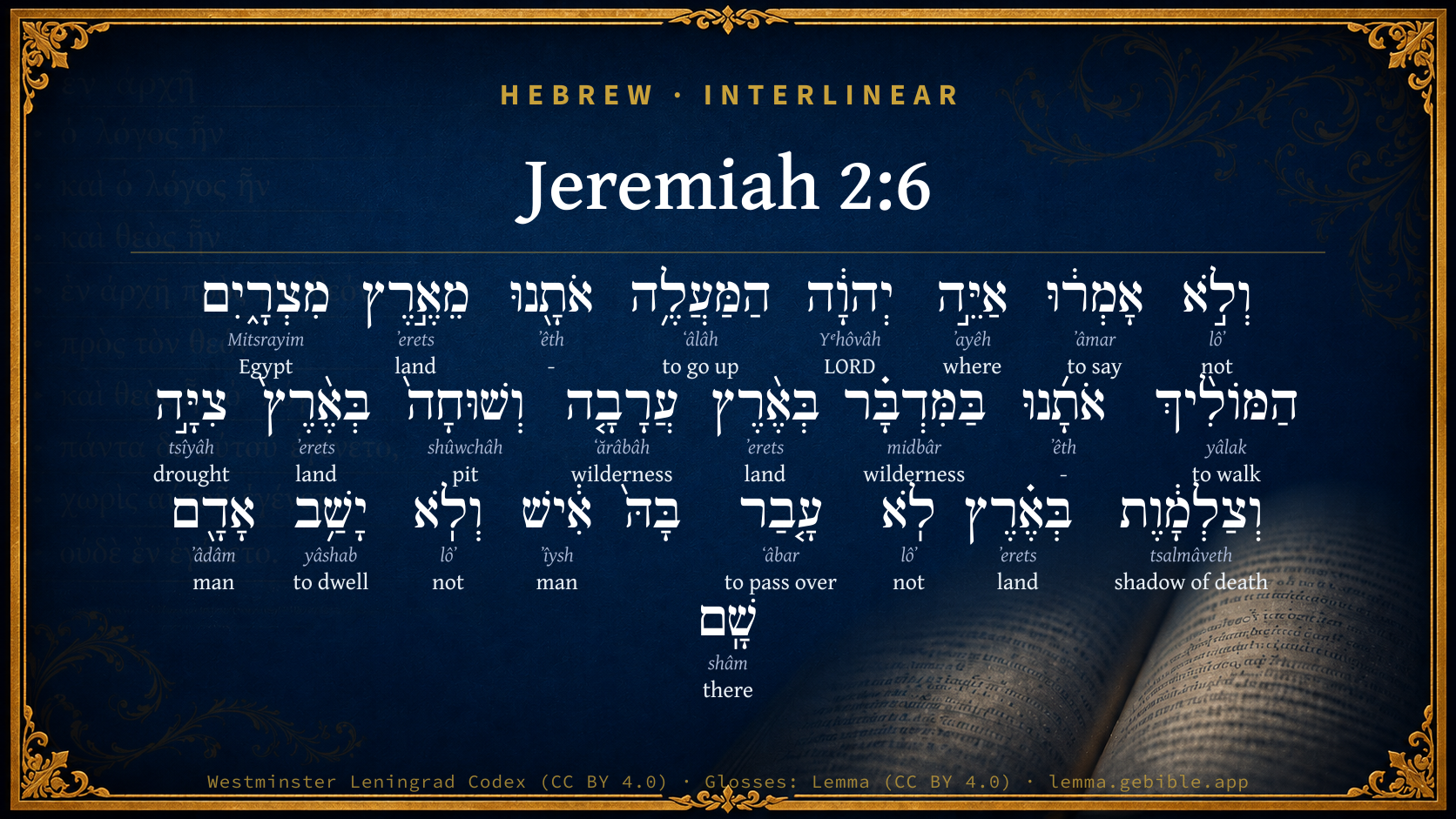
Jeremiah 2:6

Hebrew (Westminster Leningrad Codex) Jeremiah 2:6 appears in the Hebrew Old Testament. The text above is from the Westminster Leningrad Codex. Each word links to its Strong’s number, a concise gloss, and parsing drawn from the Open Scriptures Hebrew Bible morphology. Click any word for its full Brown-Driver-Briggs (BDB) entry.
Download image
Cite this verse

Jeremiah 2:6 (World English Bible). Public Domain. Lemma interlinear Bible study tool, https://lemma.gebible.app/v/jeremiah/2/6.

Show BibTeX & RIS
BibTeX
RIS
English Translation
Neither said they, Where is Yahweh who brought us up out of the land of Egypt, who led us through the wilderness, through a land of deserts and of pits, through a land of drought and of the shadow of death, through a land that none passed through, and where no man lived?
World English Bible · Public Domain
Download a study sheet

One document with this verse’s original text, its word-by-word gloss line, the meaning frame, cross-references with their text, attributed commentary, and full source and license credits — printable, and it pastes into notes with its structure intact.

This verse Autodidact and up

Study sheet (.html) Plain text (.txt)

A passage Seminary Student

Up to 50 verses in one chapter. A passage sheet keeps up to 6 commentary sources and 12 cross-references per verse, in the order this page ranks them, and says so on the sheet whenever that leaves anything out. Ask for a single verse and you get the Autodidact verse sheet above.

Everything on this page stays free to read, with no account — the sheet is a download of what is already on screen, not access to it.

Want to remove ads? Support Godless Engineer
Compare translations 3

The same verse in 3 English versions, stacked beneath the original-language interlinear above. Click any original word for its lexicon entry.

Each is an independent rendering of the whole verse — the interlinear is not word-aligned to these translations.

Highlighted words mark where these versions differ — a whole-verse word diff, not a word-by-word alignment.

  • World English Bible Public Domain
    Neither said they, Where is Yahweh who brought us up out of the land of Egypt, who led us through the wilderness, through a land of deserts and of pits, through a land of drought and of the shadow of death, through a land that none passed through, and where no man lived?
  • King James Version Public Domain
    Neither said they, Where is the LORD that brought us up out of the land of Egypt, that led us through the wilderness, through a land of deserts and of pits, through a land of drought, and of the shadow of death, through a land that no man passed through, and where no man dwelt?
  • unfoldingWord Literal Text CC BY-SA 4.0
    And they did not say, ‘Where Yahweh, who brought us up from the land of Egypt? The one who led us in the wilderness, in a land of a desert and a pit, in a land of dryness and thick darkness, in a land—no human passes through it and no man lives there?’

unfoldingWord Literal Text — © unfoldingWord, licensed CC BY-SA 4.0. Word-aligned USFM3 via Door43 (git.door43.org/unfoldingWord/en_ult).

Versions to compare (up to 4)

3 of 4 selected

Show all 18 translations

Every available English version of this verse, each an independent rendering of the whole verse.

  • World English Bible Public Domain
    Neither said they, Where is Yahweh who brought us up out of the land of Egypt, who led us through the wilderness, through a land of deserts and of pits, through a land of drought and of the shadow of death, through a land that none passed through, and where no man lived?
  • Berean Standard Bible Public Domain
    They did not ask, ‘Where is the LORD who brought us up from the land of Egypt, who led us through the wilderness, through a land of deserts and pits, a land of drought and darkness, a land where no one travels and no one lives?’
  • Majority Standard Bible Public Domain
    They did not ask, ‘Where is the LORD who brought us up from the land of Egypt, who led us through the wilderness, through a land of deserts and pits, a land of drought and darkness, a land where no one travels and no one lives?’
  • King James Version Public Domain
    Neither said they, Where is the LORD that brought us up out of the land of Egypt, that led us through the wilderness, through a land of deserts and of pits, through a land of drought, and of the shadow of death, through a land that no man passed through, and where no man dwelt?
  • American Standard Version (1901) Public Domain
    Neither said they, Where is Jehovah that brought us up out of the land of Egypt, that led us through the wilderness, through a land of deserts and of pits, through a land of drought and of the shadow of death, through a land that none passed through, and where no man dwelt?
  • Revised Version (1885) Public Domain
    Neither said they, Where is the LORD that brought us up out of the land of Egypt; that led us through the wilderness, through a land of deserts and of pits, through a land of drought and of the shadow of death, through a land that none passed through, and where no man dwelt?
  • Geneva Bible (1599) Public Domain
    For they saide not, Where is the Lord that brought vs vp out of the lande of Egypt? that led vs through the wildernesse, through a desert, and waste land, through a drie land, and by the shadow of death, by a land that no man passed through, and where no man dwelt?
  • Douay-Rheims (1899) Public Domain
    And they have not said: Where is the Lord, that made us come up out of the land of Egypt? that led us through the desert, through a land uninhabited and unpassable, through a land of drought, and the image of death, through a land wherein no man walked, nor any man dwelt?
  • Young's Literal Translation Public Domain
    And have not said, Where `is' Jehovah, Who bringeth us up out of the land of Egypt, Who leadeth us in a wilderness, In a land of deserts and pits, In a dry land, and of death-shade, In a land -- none hath passed through it, Nor dwelt hath man there?'
  • Literal Standard Version CC BY-SA 4.0
    And have not said, Where [is] YHWH, || Who brings us up out of the land of Egypt, || Who leads us in a wilderness, || In a land of deserts and pits, || In a dry land, and of death-shade, || In a land that none has passed through, || Nor has man dwelt there?
  • Unlocked Literal Bible CC BY-SA 4.0
    They did not say, 'Where is Yahweh, who brought us up from the land of Egypt? Where is Yahweh, who led us to the wilderness, into the land of the Arabah and pits, in a land of drought and deep darkness, a land through which no one passes and where no one lives?'
  • unfoldingWord Literal Text CC BY-SA 4.0
    And they did not say, ‘Where Yahweh, who brought us up from the land of Egypt? The one who led us in the wilderness, in a land of a desert and a pit, in a land of dryness and thick darkness, in a land—no human passes through it and no man lives there?’
  • Darby Bible Public Domain
    And they said not, Where is Jehovah, that brought us up out of the land of Egypt, that led us in the wilderness, in a land of deserts and of pits, in a land of drought and of the shadow of death, in a land that no one passeth through, and where no man dwelleth?
  • World Messianic Bible Public Domain
    They didn’t say, ‘Where is the LORD who brought us up out of the land of Egypt, who led us through the wilderness, through a land of deserts and of pits, through a land of drought and of the shadow of death, through a land that no one passed through, and where no man lived?’
  • Webster's Bible Public Domain
    Neither said they, Where is the LORD that brought us out of the land of Egypt, that led us through the wilderness, through a land of deserts and of pits, through a land of drouth, and of the shades of death, through a land that no man passed through, and where no man dwelt?
  • Free Bible Version CC BY-SA 4.0
    They didn't ask themselves, “Where is the Lord who led us from Egypt, who led us through the wasteland, through a land of deserts and ravines, a land of drought and darkness, a land that no one travels through and where no one lives?”
  • Bible in Basic English Public Domain
    And they never said, Where is the Lord, who took us up out of the land of Egypt; who was our guide through the waste of sand, through an unplanted land full of deep holes, through a dry land of deep shade, which no one went through and where no man was living?
  • JPS Tanakh (1917) Public Domain
    Neither said they: 'Where is the LORD that brought us up out of the land of Egypt; that led us through the wilderness, through a land of deserts and of pits, through a land of drought and of the shadow of death, through a land that no man passed through, and where no man dwelt?'

Literal Standard Version (2020), Covenant Press — licensed CC BY-SA 4.0. Text via the HelloAO Bible API (eBible.org). Unlocked Literal Bible (unfoldingWord) — licensed CC BY-SA 4.0. Text via the HelloAO Bible API (eBible.org). unfoldingWord Literal Text — © unfoldingWord, licensed CC BY-SA 4.0. Word-aligned USFM3 via Door43 (git.door43.org/unfoldingWord/en_ult). Free Bible Version, Dr. Jonathan Gallagher — licensed CC BY-SA 4.0. Text via the HelloAO Bible API (eBible.org).

Word by word

More ways to search: Search by grammar → Find every occurrence → Compare this word →

Practice this passage: Drill this verse → Learn its vocabulary →

וְשׁוּחָה֙
shûwchâh
H7745
“and · pit”
Conjunction + Noun, Common, Feminine, Singular, Absolute
Part of Speech
Conjunction + Noun
Type
Common
Gender
Feminine
Number
Singular
State
Absolute
Full BDB Definition

Origin: from H7743

TWOT: 2343 . 1a

pit
  1. וְלֹ֣א lôʼ H3808 “and · not” Conjunction + Particle, Negative
  2. אָמְר֔וּ ʼâmar H559 “to say” Verb, Qal, Perfect, 3rd Person, Common, Plural
  3. אַיֵּ֣ה ʼayêh H346 “where” Particle, Interrogative
  4. יְהוָ֔ה Yᵉhôvâh H3068 “LORD” Noun, Proper
  5. הַמַּעֲלֶ֥ה ʻâlâh H5927 “the · going up” Particle, Definite Article + Verb, Hiphil, Participle Active, Masculine, Singular, Absolute
  6. אֹתָ֖נוּ ʼêth H853 “- · us” Particle, Direct Object + Suffix, Personal, 1st Person, Common, Plural
  7. מֵאֶ֣רֶץ ʼerets H776 “from · land of” Preposition + Noun, Common, Both, Singular, Construct
  8. מִצְרָ֑יִם Mitsrayim H4714 “Egypt” Noun, Proper
  9. הַמּוֹלִ֨יךְ yâlak H3212 “the · walking” Particle, Definite Article + Verb, Hiphil, Participle Active, Masculine, Singular, Absolute
  10. אֹתָ֜נוּ ʼêth H853 “- · us” Particle, Direct Object + Suffix, Personal, 1st Person, Common, Plural
  11. בַּמִּדְבָּ֗ר midbâr H4057 “in/at the · wilderness” Preposition, Determined + Noun, Common, Masculine, Singular, Absolute
  12. בְּאֶ֨רֶץ ʼerets H776 “in/at · land of” Preposition + Noun, Common, Both, Singular, Construct
  13. עֲרָבָ֤ה ʻărâbâh H6160 “wilderness” Noun, Common, Feminine, Singular, Absolute
  14. בְּאֶ֨רֶץ֙ ʼerets H776 “in/at · land of” Preposition + Noun, Common, Both, Singular, Construct
  15. צִיָּ֣ה tsîyâh H6723 “drought” Noun, Common, Feminine, Singular, Absolute
  16. וְצַלְמָ֔וֶת tsalmâveth H6757 “and · shadow of death” Conjunction + Noun, Common, Masculine, Singular, Absolute
  17. בְּאֶ֗רֶץ ʼerets H776 “in/at · land” Preposition + Noun, Common, Both, Singular, Absolute
  18. לֹֽא lôʼ H3808 “not” Particle, Negative
  19. עָ֤בַר ʻâbar H5674 “to pass over” Verb, Qal, Perfect, 3rd Person, Masculine, Singular
  20. אִ֔ישׁ ʼîysh H376 “man” Noun, Common, Masculine, Singular, Absolute
  21. וְלֹֽא lôʼ H3808 “and · not” Conjunction + Particle, Negative
  22. יָשַׁ֥ב yâshab H3427 “to dwell” Verb, Qal, Perfect, 3rd Person, Masculine, Singular
  23. אָדָ֖ם ʼâdâm H120 “man” Noun, Common, Masculine, Singular, Absolute
  24. שָֽׁם shâm H8033 “there” Adverb

About this verse

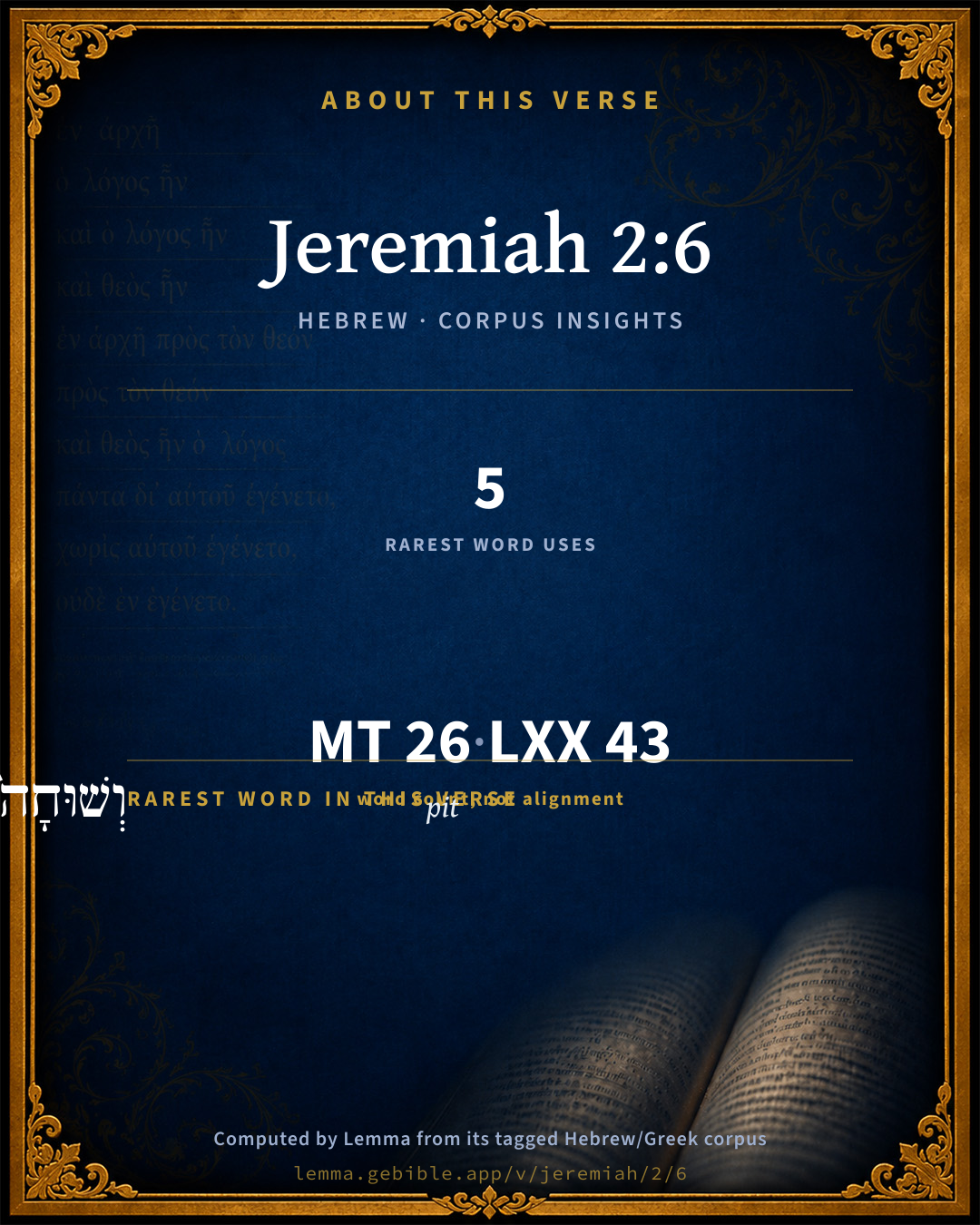
These counts appear in no published source. They are computed here, from the morphology-tagged text and Lemma’s own curated glosses. What Lemma adds →

26
words
19
distinct lemmas
Prophets
section

Notable vocabulary

The rarest word here is וְשׁוּחָה֙ pit H7745 — appearing just 5 times in the whole Hebrew Bible.

Shared distinctive vocabulary

וְשׁוּחָה֙ pit H7745 occurs in 5 verses of the Hebrew Bible. Also found in:

Grammatical profile

  • 5 verbs
  • 13 nouns
  • 1 preposition
  • 1 adverb
  • 6 particles

Verb forms

  • אָמְר֔וּ Qal · Perfect
  • הַמַּעֲלֶ֥ה Hiphil · Participle Active
  • הַמּוֹלִ֨יךְ Hiphil · Participle Active
  • עָ֤בַר Qal · Perfect
  • יָשַׁ֥ב Qal · Perfect

Repetition

Words recur within this verse — often emphatic in Hebrew:

  • מֵאֶ֣רֶץ land H776 ×4
  • וְלֹ֣א not H3808 ×3

Hebrew & Septuagint length

In the original languages it is 26 Hebrew tokens and 43 Greek tokens — but the two are counted differently (Hebrew bundles its prefixes and suffixes into one token; the Greek is in lemma form), so that isn’t a like-for-like length.

Cross-references

19

Topical passages linked to Jeremiah 2:6 in the Treasury of Scripture Knowledge — connected by theme and wording, ordered by reader-vote popularity; previews shown in the World English Bible.

  • Deuteronomy 32:10 He found him in a desert land, In the waste howling wilderness; He compassed him about, he cared for him, He kept him as the apple of his eye.
  • Deuteronomy 8:14–16 then your heart be lifted up, and you forget Yahweh your God, who brought you forth out of the land of Egypt, out of the house of bondage;
  • Isaiah 63:11–13 Then he remembered the days of old, Moses [and] his people, [saying], Where is he who brought them up out of the sea with the shepherds of his flock? where is he who put his holy Spirit in the midst of them?
  • Hosea 13:4 "Yet I am Yahweh your God from the land of Egypt; And you will know no god but me, And besides me there is no savior.
  • Exodus 14:1–15 Yahweh spoke to Moses, saying,
  • Judges 6:13 Gideon said to him, Oh, my lord, if Yahweh is with us, why then has all this happened to us? and where are all his wondrous works which our fathers told us of, saying, Did not Yahweh bring us up from Egypt? but now Yahweh has cast us off, and delivered us into the hand of Midian.
  • 2 Kings 2:14 He took the mantle of Elijah that fell from him, and struck the waters, and said, Where is Yahweh, the God of Elijah? and when he also had struck the waters, they were divided here and there; and Elisha went over.
  • Job 3:5 Let darkness and the shadow of death claim it for their own. Let a cloud dwell on it. Let all that makes black the day terrify it.
  • Job 10:21–22 Before I go where I shall not return from, To the land of darkness and of the shadow of death;
  • Job 35:10 But none says, 'Where is God my Maker, Who gives songs in the night,
  • Psalms 23:4 Even though I walk through the valley of the shadow of death, I will fear no evil, for you are with me. Your rod and your staff, they comfort me.
  • Psalms 77:5 I have considered the days of old, The years of ancient times.
  • Isaiah 63:9 In all their affliction he was afflicted, and the angel of his presence saved them: in his love and in his pity he redeemed them; and he bore them, and carried them all the days of old.
  • Isaiah 64:7 There is none who calls on your name, who stirs up himself to take hold of you; for you have hid your face from us, and have consumed us by means of our iniquities.
  • Jeremiah 2:2 Go, and cry in the ears of Jerusalem, saying, Thus says Yahweh, I remember for you the kindness of your youth, the love of your weddings; how you went after me in the wilderness, in a land that was not sown.
  • Jeremiah 2:8 The priests didn't say, Where is Yahweh? and those who handle the law didn't know me: the rulers also transgressed against me, and the prophets prophesied by Baal, and walked after things that do not profit.
  • Jeremiah 5:2 Though they say, As Yahweh lives; surely they swear falsely.
  • Hosea 12:13 By a prophet Yahweh brought Israel up out of Egypt, And by a prophet he was preserved.
  • Matthew 4:16 The people who sat in darkness saw a great light, To those who sat in the region and shadow of death, To them light has dawned."

Cross-references courtesy of OpenBible.info (CC BY 4.0).

Hebrew and Greek witnesses Masoretic Hebrew ↔ Greek Septuagint

The same verse in the two great witnesses to the Old Testament, shown verse-for-verse.

These are two independent witnesses, not word-aligned to each other, and the Septuagint is shown in lemma (dictionary) form.

Hebrew Jeremiah 2:6 Masoretic · Westminster Leningrad Codex

וְלֹ֣א אָמְר֔וּ אַיֵּ֣ה יְהוָ֔ה הַמַּעֲלֶ֥ה אֹתָ֖נוּ מֵאֶ֣רֶץ מִצְרָ֑יִם הַמּוֹלִ֨יךְ אֹתָ֜נוּ בַּמִּדְבָּ֗ר בְּאֶ֨רֶץ עֲרָבָ֤ה וְשׁוּחָה֙ בְּאֶ֨רֶץ֙ צִיָּ֣ה וְצַלְמָ֔וֶת בְּאֶ֗רֶץ לֹֽא עָ֤בַר בָּהּ֙ אִ֔ישׁ וְלֹֽא יָשַׁ֥ב אָדָ֖ם שָֽׁם

Neither said they, Where is Yahweh who brought us up out of the land of Egypt, who led us through the wilderness, through a land of deserts and of pits, through a land of drought and of the shadow of death, through a land that none passed through, and where no man lived?

World English Bible · Public Domain

Greek LXX Structure differs

In the Septuagint, Jeremiah is about an eighth shorter than the Hebrew and arranges its material differently — the Oracles Against the Nations (Hebrew chapters 46–51) appear in the middle of the Greek book, after 25:13. Because the chapter and verse boundaries do not line up, a verse-for-verse comparison with the Hebrew is not shown.

A verse-for-verse comparison isn’t shown here because the chapters and verses don’t line up. Switch to the LXX edition with the MT / LXX toggle above to read the Greek directly.

On this verse, Matthew Poole's English Annotations discusses the Septuagint’s reading. Read the note in Commentary ↓

Hebrew: Westminster Leningrad Codex (CC BY 4.0). Greek: Septuagint (public domain); English from a public-domain English Septuagint. How the Septuagint differs from the Hebrew →

Targum (Aramaic paraphrase)

1

The Targum is the ancient Jewish Aramaic paraphrase of the Hebrew Scriptures — an interpretive translation, not the Hebrew text itself. Onkelos (literal) and Pseudo-Jonathan (expansive) render the Torah, and Jonathan the Prophets. Coverage is partial: where no permissively-licensed English translation exists for a verse, only the Aramaic is shown. This is verse-level text, not a word-by-word alignment to the Hebrew.

  1. Targum Jonathan Prophets (Joshua–Malachi)
    וְלָא אֲמָרוּ נִדְחַל מִן קֳדָם יְיָ דְאַסִיק יָתָנָא מֵאַרְעָא דְמִצְרַיִם דְדַבֵּר יָתָנָא בְמַדְבְּרָא בַּאֲרַע מֵישַׁר וְחָרוֹב בַּאֲרַע צַדְיָא וְטוּלֵימוֹתָא בַּאֲרַע דְלָא עָדָא בָּהּ אֱנַשׁ וְלָא אִתּוֹתַב אֱנָשָׁא תַּמָן:

    (no public-domain English translation for this verse)

    Targum Jonathan — Aramaic: “Mikraot Gedolot” (public domain). English: “Sefaria Community Translation” (CC0 1.0 (public-domain dedication)); “London "Chaldee Paraphrase," 1871” (public domain). Text via Sefaria.

Commentary

Notes on Jeremiah 2:6 from classic Christian and Jewish commentators (each source and its license shown beneath its notes). The classic Christian expositions comment on the surrounding passage and are grouped to its opening verse, so a note may address several verses; the Jewish commentaries on the Tanakh (Rashi and others) are per-verse, so they appear only where the commentator wrote on this verse.

Lemma curates 59 commentaries, every one of them public domain or Creative Commons licensed, each selected and text-cleaned for this edition rather than reprinted as found. About our sources →

Trapp's Complete Commentary

John Trapp

Jer 2:6 Neither said they, Where [is] the LORD that brought us up out of the land of Egypt, that led us through the wilderness, through a land of deserts and of pits, through a land of drought, and of the shadow of death, through a land that no man passed through, and where no man dwelt?

Ver. 6. Neither said they.] In their minds, or with their mouths. That signal deliverance was obliterated, and even lost upon them. Plerique omnes sumus ingrati. {a}

Through a land of deserts and of pits.] Per terrain campestrem et sepulchralem, where we talked of making our graves; neither was it any otherwise likely, but that God gave us pluviam escatilem et petram aquatilem, {b} all manner of necessaries.

{a} Cicero.

{b} Tertul.

John Trapp, A Commentary or Exposition upon All the Books of the Old and New Testament (1647–1656) — public domain. Text from a community e-Sword module.

Tyndale Open Study Notes

Tyndale Open Resources

2:6 By not seeking the Lord, Israel’s ancestors showed that they had lost interest in their history. To them, the God of Israel was a delusion. They were only interested in the sensual excitement of the moment.

Tyndale Open Study Notes — © Tyndale Open Resources, licensed CC BY-SA 4.0. Text via the HelloAO Bible API.

Geneva Bible (1599)

Geneva Bible translators

Where for lack of all things necessary for life, ye could look for nothing every hour but present death.

Geneva Bible (1599) marginal notes — public domain. Text via Bolls.life.

Jamieson, Fausset & Brown

Robert Jamieson, A. R. Fausset & David Brown

Neither said they, Where, &c.--The very words which God uses (Isa 63:9, Isa 63:11, Isa 63:13), when, as it were, reminding Himself of His former acts of love to Israel as a ground for interposing in their behalf again. When they would not say, Where is Jehovah, &c., God Himself at last said it for them (compare see on Jer 2:2).

deserts . . . pits--The desert between Mount Sinai and Palestine abounds in chasms and pits, in which beasts of burden often sink down to the knees. "Shadow of death" refers to the darkness of the caverns amidst the rocky precipices (Deu 8:15; Deu 32:10).

Jamieson, Fausset & Brown — Commentary Critical and Explanatory on the Whole Bible (1871) — public domain (CC PDM 1.0). Text via the HelloAO Bible API.

Adam Clarke's Commentary

Verse 6. Through the wilderness] Egypt was the house of their bondage: the desert through which they passed after they came out of Egypt, was a place where the means of life were not to be found; where no one family could subsist, much less a company of 600,000 men. God mentions these things to show that it was by the bounty of an especial providence that they were fed and preserved alive. Previously to this, it was a land through which no man passed, and in which no man dwelt. And why? because it did not produce the means of life; it was the shadow of death in its appearance, and the grave to those who committed themselves to it.

Adam Clarke's Commentary on the Bible (1810–1826) — public domain. Text from a community e-Sword/MySword module.

John Calvin's Commentaries

The Prophet goes on with the same subject; for God adduces here no small crime against his people, as they had buried his favom’s in oblivion. Indeed, a redemption so wonderful was worthy of being celebrated in all ages, not only by one nation, but by all the nations of the earth. As then the Jews had thus buried the memory of a favor so remarkable and valuable, their base impiety appeared evident. Had they not experienced the power and kindness of God, or had they only witnessed them in an ordinary way, their guilt might have been extenuated; but as God had from heaven made an unusual display of his power, and as his majesty had been manifested before the eyes of the people, how great was their sottishness in afterwards forgetting their God, who had openly and with such proofs made himself known to them!

We now then understand what the Prophet means by saying, they have not said: for God here sharply reproves the stupidity of the Jews, — that they did not consider that they were under perpetual obligations to him for his great kindness in delivering them in a manner so wonderful from the land of Egypt. By saying that they did not say, Where is Jehovah, he intimates that he was present with them and nigh them, but that they were blind, and that hence they were without an excuse for their ignorance, as he was not to be sought as one at a distance, or by means tedious and difficult. If then this only had come to their mind, “Did not God once redeem us?” they could not have departed after their vanities. How then was it that their error, or rather their madness, was so great that they followed idols? Even because they did not choose to make any effort, or to apply their minds to seek or to inquire after God.

Here then the Prophet meets the objection of the hypocrites, who might have said, that they had been deceived, and had relapsed through ignorance; for they have ever some evasions ready at hand, when they are called to an account for their sins. But lest the Jews should make any pretense of this kind, the Prophet here shews that they had not been through a mistake deceived, but that they had followed after falsehood through a wicked disposition, for they had willfully despised God and refused to inquire respecting him, though he was sufficiently nigh them.

This passage deserves to be especially noticed; for there is nothing more common than for the ungodly, when they are proved guilty, to have recourse to this subterfuge, — that they acted with good intention, when they gave themselves up to their own superstitions. The Prophet then takes off this mask, and shews that where God is once known, his name and his glory cannot be obliterated, except through the depravity of men, as they knowingly and willfully depart from him. Hence all apostates are by this one clause condemned, that they may no more dare to make evasions, as though they have been through more simplicity deceived: for when the matter is examined, their malignity and ingratitude are discovered, because they deign not to inquire, Where is Jehovah?

And he afterwards adds what explains this sentence. I have said that other nations are not here condemned, but the Jews, who had known by clear experience that God was their father. As then God had, by many testimonies, made himself known to them, they had no pretext for their ignorance. Hence the Prophet says, that they did not consider where God was who brought them from the land of Egypt, and made them to pass through the desert He could not have stated this indiscriminately of all nations; but, as it has been said, the words are addressed particularly to the Jews, who had clearly witnessed the power of God; so that they could not have sinned except willfully, even by extinguishing, through their own malignity, the light presented to them, which shone before their eyes. And here, also, the Prophet amplifies their guilt by various circumstances: for he says, not simply that they had been brought out of Egypt, but intimates that God had been their constant guide for forty years; for this time is suggested by the word “desert.” The history was well known; hence a brief allusion was sufficient. He, at the same time, by mentioning the desert, greatly extols the glory of God.

But the first thing to be observed is, that the Jews were inexcusable, who had not considered that their fathers had been wonderfully and in an unusual manner preserved by God’s hand for forty years; for they had no bread to eat, nor water to drink. God drew water for them from a rock, and satisfied them with heavenly bread; and their garments did not wear out during the whole time. We then see that all those circumstances enhanced their guilt. Then follows what I have referred to: the Prophet calls the desert a dry or a waste land, a dreary land, a horrible land, a land of deadly gloom, as though he had said, that the people had been preserved in the midst of death, yea in the midst of many deaths: for man was not wont to pass through that land, nor did any one dwell in it “Whence then,” he says, “did salvation arise to you? from what condition? even from death itself: for what else was the desert but a horrible place, where you were surrounded, not only by one kind of death, but by a hundred? Since then God brought you out of Egypt by his incredible power, and fed you in a supernatural manner for forty years, what excuse can there be for so great a madness in now alienating yourselves from him?” Now this passage teaches us, that the more favors God confers on us, the more heinous the guilt if we forsake him, and less excusable will be our wickedness and ingratitude, especially when he has manifested his kindness to us for a long time and in various ways.

John Calvin's Commentaries (1540-1563) — public domain. Text from the Calvin Translation Society English edition (1840s-50s) via the Christian Classics Ethereal Library (ccel.org). Calvin's coverage is partial (roughly two-thirds of the Bible); uncommented books and verses are honest gaps, never fabricated. The 19th-century editor's footnotes and remarks are omitted so the notes are faithfully Calvin's own voice.

Ellicott's Commentary for English Readers

(6) Neither said they.—In somewhat of the same tone as in Deu_8:15; Deu_32:10, the horrors of the wilderness are painted in vivid colours, to heighten the contrast with the land into which they had been brought. The picture was true of part, but not of the whole, of the region of the wanderings. But the people had forgotten this. There was no seeking for the Lord who had then been so gracious. The question, Where is He? never crossed their thoughts.

A Bible Commentary for English Readers, edited by Charles John Ellicott (1878–1897) — public domain. Text from a community e-Sword module.

The Cambridge Bible for Schools and Colleges

gen. ed. J. J. S. Perowne

6. The prophet brings their thanklessness into bolder relief by depicting in the strongest colours the care lavished upon them of old. Utter forgetfulness is their return for the deliverance from Egyptian bondage, the preservation from the various dangers of the wilderness, and the bestowal of Canaan.

pits] one of the difficulties and dangers of travellers consisted in the rifts or clefts which had to be crossed or avoided by a circuitous route.

shadow of death] mg. (better) deep darkness. The difference depends on the vowels which we attach to the consonants of the Hebrew word. For its application, as here, to circumstances of peril, cp. Psa_23:4; Psa_44:19. The pathless desert is as bewildering as would be profound darkness.

The Cambridge Bible for Schools and Colleges (gen. ed. J. J. S. Perowne; Cambridge University Press, 1878–1918) — public domain. Text from a community e-Sword module.

John Gill's Exposition

And I brought you into a plentiful country,.... "Into the land of Carmel", as in the Hebrew text; that is,

"into the land of Israel, which was planted as Carmel,''

as the Targum paraphrases it; with wheat, barley, vines, fig trees, pomegranates, and olives; a land flowing with milk and honey, Deu 8:8, so Ben Melech:

to eat the fruit thereof and the goodness thereof; of vineyards and oliveyards, which they had not planted, and for which they had never laboured, Jos 24:13,

but when ye entered ye defiled my land; which the Lord had chosen above all lands, where he would have a temple built for his worship, and where he would cause his Shechinah or glorious Majesty to dwell; but this they defiled by their sins and transgressions, and particularly by their idolatry, as follows:

that made mine heritage an abomination; by devoting it to the worship of idols, as the Targum paraphrases it.

John Gill's Exposition of the Whole Bible (1746–1763) — public domain (CC PDM 1.0). Text via the HelloAO Bible API.

Albert Barnes' Notes on the Bible

Modern researches have shown that this description applies only to limited portions of the route of the Israelites through the Sinaitic peninsula.

Albert Barnes' Notes on the Bible (1834–1885) — public domain. Text from a community e-Sword/MySword module.

Matthew Poole's English Annotations

Neither said, i.e. with themselves, thought not.

Brought us up: the expression may have some respect to the situation of the place, as lying lower than Canaan; but the design is to reprove their sloth and stupidity, charging herein their apostacy, not upon their ignorance, but wilfulness; their deliverance from Egypt, and therefore is it here mentioned, being such a deliverance as never greater was wrought for any people, wherein there was so much of his power and love seen; they never regarded the operations of his hands, never concerned themselves about what God had done for them, Jer 2:8, which should have engaged them to a more close cleaving to him.

Through a land of deserts; desolate places, Jer 1:13; and then what follows is to amplify the greatness of their dangers in the wilderness, and therein the greatness of their deliverance. And of pits; either those natural dangerous pits that were there; or put for the grave, where passengers are so often buried quick in the heaps of sand suddenly blown up by the wind; or threatening in every respect nothing but death, which may be implied in that expression of the

shadow of death in this verse, which may allude to several kinds or fears of death in passing through a wilderness. See in the Synopsis.

A land of drought, where they had no water but by miracle; the LXX. render it a land without water. The shadow of death: see on the word pits: the LXX. render it a land without fruit, bringing forth nothing that might have a tendency to the support of life, therefore nothing but death could be expected; and besides, it yielding so many venomous creatures, as scorpions, and serpents, &c., as also the many enemies that they went in continual danger of; all which could not but look formidable, and as the

shadow of death. That no man passed through, and where no man dwelt; as having in it no accommodation for travel, much less for habitation. In these respects may it well be called a waste howling wilderness, Deu 32:10.

Matthew Poole's English Annotations on the Holy Bible (1683–1685) — public domain. Text from a community e-Sword/MySword module.

Whedon's Commentary on the Bible

Daniel D. Whedon

6. Neither said they — God is not in all their thoughts — there is total forgetfulness of him. That led us… through a land of deserts, etc. — This description of the desert of the Exodus is graphic and truthful, and may be taken as a fitting illustration of the verisimilitude of Scripture. It is described as a wilderness, that is, a region comparatively uninhabited; a land of deserts, a region of waste country;… of pits,… of drought,… of the shadow of death, without inhabitant and without traveller! (See Robinson, Stanley, and especially PALMER’S Desert of the Exodus.)

Daniel D. Whedon (gen. ed.), Commentary on the Old and New Testaments (1874–1909) — public domain. Text from a community e-Sword module.

The Pulpit Commentary

Neither said they, etc.; as their children"s children were forced by stress of trouble to say. (Isa_63:11; see note) A land of desserts and of pits. The first phrase applied to the region through which the Israelites passed ("a wilderness") was vague, and might mean merely pasture-land. The remainder of the description, however, shows that "wilderness" is here meant, as often, (e.g. Isa_35:1 Isa_35:2) in the sense of "desert." Though recent travelers have shown that the Sinaitie peninsula is not by any means universally a "desert," and that in ancient times it was still less so, it is not unnatural that an agricultural people should regard it as a most inhospitable region, and should even idealize its terrors. (comp. Deu_8:15) "Pits," i.e. rents and fissures in the soil, in which the unwary traveler might lose his life. (Jer_18:20, Jer_18:22)

The Pulpit Commentary (1880–1919), ed. H.D.M. Spence-Jones & Joseph S. Exell — public domain. Text from a community e-Sword module.

John Wesley's Explanatory Notes

Neither - They never concerned themselves about what God had done for them, which should have engaged them to cleave to him. Of drought - Where they had no water but by miracle. Death - Bringing forth nothing that might support life, therefore nothing but death could be expected; and besides, yielding so many venomous creatures, as many enemies that they went in continual danger of. No man dwelt - As having in it no accommodation for travelers, much less for habitation.

John Wesley, Explanatory Notes Upon the Whole Bible (1754–1765) — public domain. Text via the GEBible commentary corpus.

Rashi

Rabbi Shlomo Yitzchaki (Rashi)

And they did not say, Where is the Lord that we should follow other gods?

plains Heb. ערבה (planure in O.F.), related to pianoro in Old Italian, meaning ‘a plateau.’

and pits Heb. ושוחה (enfosses in O.F.), pitted.

waste Heb. ציה (degat in French).

and darkness Heb. וצלמות. An expression of darkness.

Rashi on the Tanakh — English translations: “The Judaica Press complete Tanach with Rashi, translated by A. J. Rosenberg” (CC BY 4.0); “Pentateuch with Rashi's commentary by M. Rosenbaum and A.M. Silbermann, 1929-1934” (public domain); “The Metsudah Tanach series, Lakewood, N.J” (CC BY 4.0); and “The Book of Joshua, Metsudah Publications, 1997” (CC BY 4.0). Text via Sefaria.

Lesson kit

Teaching starters — assembled from the data on this page, not authored interpretation. Every prompt links to the verse data it draws on. Edit before teaching.

Jeremiah, in the Prophets, opens this verse with 26 words (19 distinct Hebrew lemmas). Its most distinctive word is shûwchâh (“pit”). A historical commentator’s framing appears above. Read the whole chapter for the surrounding context.

Discussion questions

  1. The word shûwchâh carries the sense “pit.” How does it shape the verse?
  2. How does Proverbs 22:14, which shares the word «pit», read alongside this verse?
  3. What does the repetition of “land” (4× in this one verse) do in this verse?
  4. These translations render this verse differently; the difference is in the English rendering, not the original. What questions does that raise?
  5. «אָמְר֔וּ» is a Qal Perfect verb. How does that grammatical form shape the action described?
  6. Compare how Trapp's Complete Commentary and Tyndale Open Study Notes read this verse. Where do they agree or differ?

Things to notice

Reading settings

Reading text

Shown beneath each verse's original-language words.

Old Testament
Old Testament edition

Read the OT as the Masoretic Hebrew (MT) or the Greek Septuagint (LXX).

English shown for the Greek Septuagint (in the Hebrew ↔ Greek comparison).

Comparing translations? Open the Compare panel on any verse page to stack up to four side by side.